
The idea of the suffragettes was that women should share in the political business of the menfolk voting on leaders whose main task was deciding matters of crime, taxation, and war, on the grounds that they share in the outcomes and burdens of any bad decisions in that area.
Note that governments, back in the day, did not attempt to act as a nanny, warding off daily harms from unsafe commercial products, or was government in the business of educating the young, nursing the sick, or managing the personal lives of all the children of all ages inhabiting the nation.
The idea of the men who invented feminism was that propelling women into the workforce would increase the tax base, break apart the nuclear family, and increase sales of expensive drugs to promote temporary sterility.
Breaking the family in turn would make women more dependent on the government than on their menfolk, and draw the unreasoning admiration women typically bestow upon their protectors and breadwinners onto the Powers That Be. The fanatical devotion that mothers of convicts show, when they insist forever that their child is innocent, would then be channeled into the ballot box toward whatever demagogue with a vacant smile promised to remove dangerous liberty from the hands of the children, regardless of age, inhabiting the nation.
Pornographers like Hugh Hefner encouraged feminism on the grounds that it would increase vice, and hence the monetary gain from the public sale of vice.
Then, once women were in the workforce, excluding them from the military and other areas where men are better qualified was said to be a sign of hidden bigotry against them. The idea of this bigotry was so stupid that a new word had to be coined to hide its meaning, and that word is “sexism”.
The word “racism” — which at the time had a meaning — was decapitated and the word “sex” — and at the time this word also had a meaning — was sutured onto the neckstump, to produce a new word intended to denounce a nonexistent hatred and contempt felt by men against women.
There have been wars between races and tribes since time immemorial, and hatred between races and tribes. But the war between the sexes is not really a war, because both sides keep flirting with the other, and settling down, and having babies and suchlike.
John C. Wright, “No More Lads”, John C. Wright’s Journal, 2020-01-28.
February 28, 2025
QotD: A jaundiced view of the feminist movement
February 27, 2025
Reining in the ATF
J.D. Tuccille on the ATF’s immediate future with FBI director Kash Patel as the newly appointed acting head of the bureau:

Kash Patel, 9th Director of the Federal Bureau of Investigation.
… it’s impossible to credibly argue that the ATF doesn’t need a shakeup. After all, this is a federal agency that ran guns to criminal gangs in Mexico as part of a bizarre and failed “investigation”, manipulated mentally disabled people into participating in sting operations — and then arrested them, lost thousands of guns and gun parts, killed people over paperwork violations, and unilaterally reinterpreted laws to create new felonies out of thin air (which means more cause for sketchy investigations and stings). The federal police agency obsessively focused on firearms has long seemed determined to guarantee itself work by finding ever more things to police.
But what about putting the same person in charge of both the ATF and the FBI? How does that make sense?
Well, there’s a lot of overlap in the responsibilities of federal agencies. During the ATF’s “Operation Fast and Furious” gunrunning escapade in Mexico, it coordinated — badly — with the FBI, the Drug Enforcement Administration (DEA), and Immigration and Customs Enforcement (ICE). During its 2012 investigation of that fiasco, the Justice Department Inspector General “conducted interviews with more than 130 persons currently or previously employed by the Department, ATF, the DEA, the FBI, and the Department of Homeland Security (DHS)” on its way to identifying “a series of misguided strategies, tactics, errors in judgment, and management failures that permeated ATF Headquarters and the Phoenix Field Division”.
[…]
Done right, you wouldn’t need as many agents for the combined agency, and you would have lower overhead. But — and this is a big concern — done wrong, you’d end up with a supercharged federal enforcement agency with all the hostility to civil liberties its old components embodied when separate, but now with lots more clout.
When he took charge of the FBI, Patel became the leader of an agency that has long served as a sort of political police. Its abuses date back decades and never seem to go away, just to morph into new ways of targeting anybody who criticizes whoever is currently in power.
“The FBI entraps hapless people all the time, arrests them, charges them with domestic terrorism offenses or other serious felonies, claims victory in the ‘war on domestic terrorism’, and then asks Congress for more money to entrap more people,” John Kiriakou, a former CIA officer and whistleblower, wrote in 2021.
That means there’s already a problem that needs to be addressed, or it could infect a combined agency rather than taking the sharp edges off the ATF.
Also troubling is that before his nomination to head the FBI, Patel made comments suggesting he wants to target his own political enemies. He’s backed off those threats, telling the Senate Judiciary Committee he’s committed to “a de-weaponized, de-politicized system of law enforcement completely devoted to rigorous obedience to the Constitution and a singular standard of justice”. But it’s worth watching what he does with his roles at the separate FBI and ATF before combining the two agencies into something more dangerous.
Or maybe the Trump administration won’t take the next step of formally integrating the ATF and the FBI. Self defense advocates have long called for ATF leadership that isn’t actively hostile to gun owners. If all Patel does is rein in the ATF so that Americans get a few years of relief from that agency’s abuses, that’s a victory itself. But eliminating a much-loathed federal agency would be even better.
Getting Elected in Ancient Rome
toldinstone
Published 8 Nov 2024The chief officials of the Roman Republic were chosen through one of history’s most chaotic electoral systems.
Chapters:
0:00 Introduction
0:33 The Roman Republic
1:33 Cursus honorum
2:08 Comitia Centuriata
2:58 Comitia Tributa
3:49 “Optimates” and “Populares”
4:22 Campaigning
6:19 Political graffiti
7:06 Romanis Magicae
7:51 Election day
9:11 The end of elections
February 26, 2025
The more DOGE uncovers, the more we see that western governments are really vast graft machines
Elizabeth Nickson discusses the ramifications of all the wasted money uncovered by DOGE in the first month of investigations and what it almost certainly confirms about the actual value taxpayers are getting for their money:

So essentially the entire town of Washington, D.C. has been stealing. The anomalies are those who are not stealing. $4.7 trillion, almost impossible to trace, represents two-thirds of the annual U.S. budget. And if it’s happening in the U.S., it is happening everywhere: France, Canada, the U.K., Germany, where budgetary processes are probably even more opaque than those of the U.S.
How does the Department of Defence have a $35 trillion black hole?
I used to think of people who worked for the government with a kind of veiled contempt or, in a more benign mood, compassion. I thought of them as pity jobs for those without initiative, as jobs paying off lefty campaigners, as a warehouse for the barely competent. In my own dealings with them, I found them punitive and extractive, papering me with demands to spend more and more money to hire more and more of their pet contractors, to get approval. In my working life, looking at the results of their involvement in America’s rural areas, I hated them for the hell they visited on people unable to fight back. They forced bad science on good people, and refused to see reason. They ruined forests, water courses, fisheries, and township after township turned to dustbowl status. The misery in rural sitting rooms in every state in the U.S. was palpable, long lasting; the green Blob ruined families for generations.
But I did not think of them as being embroiled in a theft so large as to be unparalleled in world history.
The level of the theft has now to be dawning on everyone not living off the public purse which is, what, 60%, 70% of us? The anger setting in is soul-deep, and very very powerful. People who live straightened lives, the poorly pensioned, those living off the laughable social security stipend, those waiting for health care, those whose children can’t even dream of an education, of college, of a six-figure salary which is now subsistence in the ruined cities. Those facing cancer treatment because of the vaccine, and don’t have excess funds. Their families, despairing, hurting, broke.
This isn’t going to go away. It affects everyone. Not addressed down to its deepest level, you are looking at a tax revolt, a national strike. A revolution. A real one, not a papered paid-for color revolution, which is what they have been doing to us.
Those living on social security should have five times the pension they do.
Can you count how many of those there are? Can you?
And meanwhile this:
Is this true? To this date, unknown; the digging continues. Look at this ghastly creature. She apparently has an account in the Cayman Islands. Look at her all compassionate and condescending. She started a war that killed 1.5 million people so far. And apparently got rich from it. A mass murderer celebrated at Upper East Side dinner parties.
Memes like this rocket around, and every one is now suspect. At this point who cares if it’s true, it’s truthy, it makes sense that she made out like a bandit, that Alexandra Ocasio-Cortez and Ilhan Omar have millions hidden somewhere. Ocasio can say “I only have $500,000!” all she wants, but we don’t believe her. If the Wall St Journal says it is false, we don’t believe them. Do you actually think they’d have the money sitting in their savings account? No, it would be buried off-shore. The media is not only complicit, it is the principal actor in this scam. It built the fantasy world we live in, where people read The Guardian, the Times and the Globe and Mail and think they’re informed.
No, they are being propagandized. And as a result, no one sane believes anything any legacy newspaper or television or media says anymore. They hid the theft. They did not report on it. No one trusts a thing they say.


Update: Fixed broken link.
February 25, 2025
Argentina’s experience of life with high tariffs
Marcos Falcone explains how Argentina’s unusually high tariff barriers distort ordinary economic activity for Argentines every day:

When Argentines go abroad, they usually go shopping. Many of the products they want cannot be bought at home, ranging from clothes to smartphones and all kinds of home appliances. Because of this, it has become a tradition to return from a trip with one or two extra suitcases filled with smuggled goods. Did you know that it is more expensive to buy an outdated iPhone in Argentina than it is to fly from Buenos Aires to Miami, stay for three days, and get the newest one?
[…]
Tariffs do not just make it difficult to get phones at home — they can make life dangerous as well. Argentina’s most sold car, which is artificially expensive because of protectionist measures, got 0 (zero) stars on one of Latin America’s most renowned safety tests. Cars in Argentina are not only more expensive than elsewhere in the region, but also markedly less safe.
To achieve these terrible results, the only thing Argentina had to do was enact tariffs, and now the US seems to be heading in the same direction. But in the past, protectionism has caused the same damage in the north as it caused in the south. Back in the first Trump administration, protecting the steel-production industry saved some jobs, but eliminated many more. Tariffs have also hurt businesses that rely on imports within the US and can continue to do so in a world of globally integrated supply chains. More generally, the 1933 Buy American Act, which forces the government to pay more for US-made goods, has been proven to be both ineffective and costly.
There is no escaping the negative effects of blocking outside competition. The more barriers a country enacts, the more damage it causes to itself. If we, as individuals, acted in a protectionist way, we should aim to grow our own food, build our own house, or make our own cars. But how does that make any sense? Economist Robert Solow once said, “I have a chronic deficit with my barber, who doesn’t buy a darned thing from me”. He meant it as a joke, but he had a point: What matters is to create wealth, which can be done both by selling and buying from others.
The revival of protectionism in the US is worrisome. To avoid it, Americans should take a look at the enormous destruction of wealth that tariffs have caused in other countries. Despite President Milei’s recent efforts to lift tariffs and take Argentina out of the “prison” in which it exists, the fact that the country shot itself in the foot decades ago has put it in a very delicate economic position. The US should not follow its path.
Likely trajectories of the victims of DOGE
Bruce Ivar Godmundsson identifies the most probably career dislocations of civil servants winkled out of their expected life sinecures by the minions of Elon:
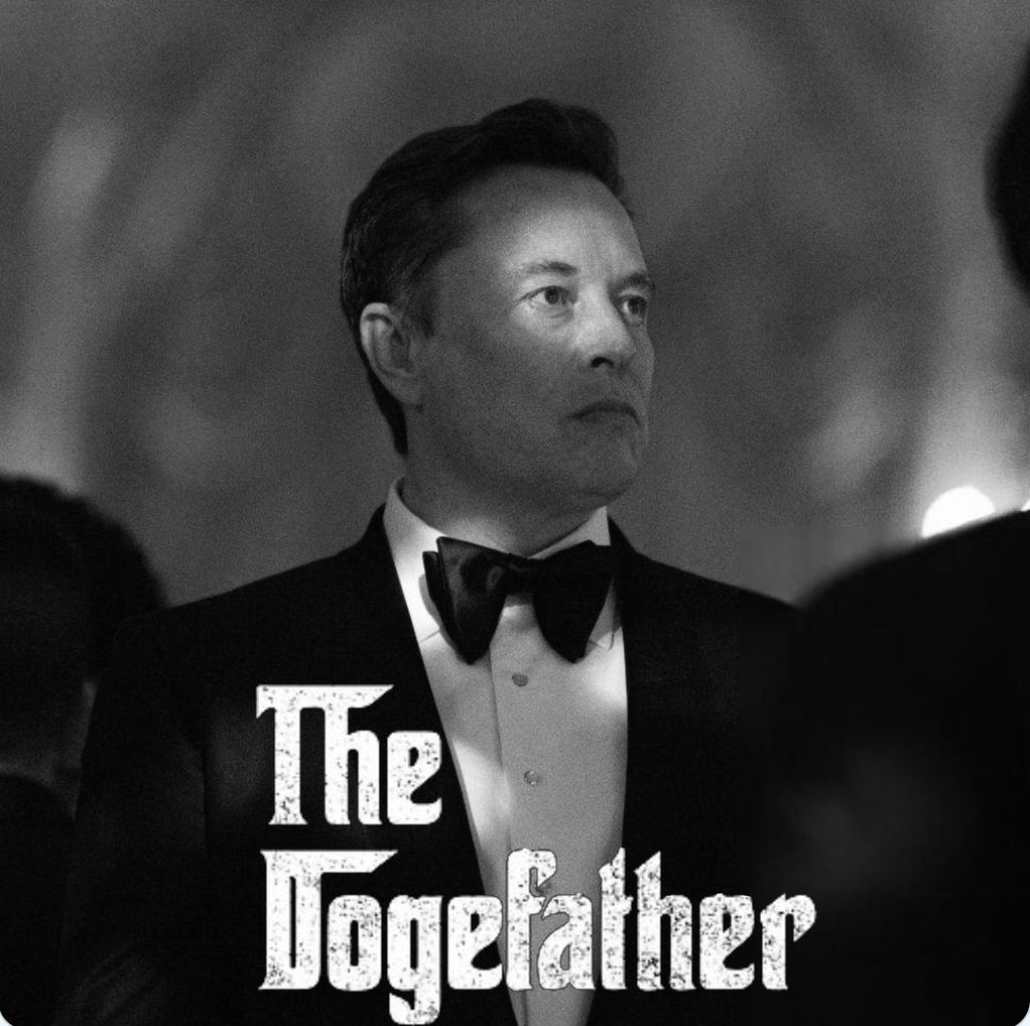
To put things another way, the status deprivation experienced by erstwhile feeders at the Federal trough will eventually lead to a great deal of radicalization. After all, if history is any guide, it is not the victims of sustained oppression who raise the banner of revolt, but those who lost advantages that they had earlier expected to enjoy for the rest of their days. (It was not, after all, agricultural laborers, let alone vagabonds, who enlisted in the machine-smashing armies of General Ludd, but practitioners of “decent trades” who had previously occupied lucrative bottlenecks in supply chains.)
As they LARP as extras in the street fighting scene of Les Misérables, the outcasts will find, standing beside them on the barricades, youngsters who, as recently as the autumn of 2024, had expected to parley their ability to paraphrase (or, at the very least, parrot) the Party Line into an internship with an agency, a poorly paid (but prestigious) place in an NGO, or, for those especially adept at symbolic manipulation, a job with a name-brand consulting firm.
Leaving aside the cinematic metaphors, some of the dispossessed will, no doubt, resort to rioting. More will ride the protest circuit, which will do for them what comic-book conventions do for fancy-dressed fans of manga and anime. Most, however, will do little more than haunt the margins of the middle class, muttering about their masters degrees in public policy as they wait for the next command to appear on the screens above their grills.
Repeated encounters with the fallen may drive the final nail into the coffin of the assumption, once central to the world view of so many Americans, that possession of a sheepskin entitled its holder to a desk job. No longer will parents dining at McDonalds whisper to their children “if you don’t go to college, you’ll end up like that”. Rather, they will point to the technician repairing a self-service kiosk and say “that’s the sort of thing that you want to do”.
German election results
Germany voted on Sunday (on paper, and the votes all got counted in less than 24 hours) and the most likely result will be a coalition between the centre-right CDU and the social democratic SPD, excluding the second-largest party, the extremely extreme extreme right-wing AfD:
The federal elections in Germany are over, and the preliminary count is in. The CDU/CSU have narrowly avoided the Kenyapocalypse, as the Bündnis Sahra Wagenknecht failed to meet the 5% hurdle for representation in the Bundestag by a mere 13,435 votes. In consequence, the Social Democrats and the Union parties together will command a thin but workable parliamentary majority of 328 seats. In all likelihood, we will have a black-red government under CDU Chancellor Friedrich Merz – a not-so-grand coalition of the kind we grew used to under Angela Merkel.
Here is a district-by-district map of the election results, with each district coloured according to the winning party. Black is CDU/CSU, blue is AfD, red is SPD and green is Green:
My district is the one all the way due south of Munich on the Austrian border. The CSU got 41.9% of the party vote here – one of their best showings in all of Bavaria.
The Losers
The preliminary results of each party compared to the last elections in 2021 reveal last night’s losers clearly enough:
This vote was as poignant a rejection of Olaf Scholz’s parodically bad traffic light coalition as anyone could imagine. Everybody has improved at the expense of red-green-yellow, but it is interesting to observe who has done the worst.
The Greens dominated the traffic light, and voters have dealt them the lightest punishment of all. Imagine how crazy you have to be ever to enter a government with this toxic party: They get their way on all major political issues and you get punished for it. Even so, the Greens did much worse than I thought they would. Almost everybody beyond their hardcore devotees has abandoned them, and Green Chancellor Candidate Robert Habeck (who also lost his direct mandate in Flensburg-Schleswig) has announced he will never again seek a leading role in the party. We have finally rid ourselves of his Majesty the Sun Chancellor, the champion of speech crime charges, and that alone is worth a stiff celebratory scotch.
The FDP lost far harder than the Greens. Last night was their worst showing of all time – worse even than the last time they were chased out of the Bundestag in 2013. Party chief Christian Lindner will resign and withdraw from politics, and he should. The FDP stood idly by and waved through ruinous Green policies like the building heating ordinances, all the time pleading that things would be even worse if the FDP weren’t in government. After the constitutional court in Karlsruhe killed the budgetary schemes of the traffic light, the FDP could have left the coalition, but they subjected all of us to another year of Scholzian incompetence and insanity. If there is any justice in the world the FDP will become a minor West German party that nobody thinks about anymore.
The next biggest loser of the night was the Social Democrats, who likewise booked their worst electoral result in history, and also achieved the worst-ever electoral collapse of a chancellor party in the 80-year history of the Federal Republic. Olaf Scholz has said he will not participate in any future government or coalition negotiations, and party co-chair Lars Klingbeil spoke last night of a “caesura” in the history of the SPD, promising substantial changes in party leadership. The first such change happened almost immediately, with the resignation of SPD faction leader Rolf Mützenich. Klingbeil will replace him. Many expect that Klingbeil’s co-chair, Saskia Esken, will also be forced out before long, although she is clinging to her job for the moment.


Looking from the US, CDR Salamander notes the very high turnout for a federal election with approval:
Sunday, Germany held national elections for the parliament, the Bundestag. Congrats to the German people and their ~83% turnout, the greatest I believe, since unification.
The previous government led by SPD and hobbled the the Greens was unstable at best, and was not doing great things for the German people. That would be why the SPD’s results were the worst since 1887.
Defense Minister Boris Pistorius has clear words for the performance of his SPD. “This is a devastating, catastrophic result,” he said. “There is no way to sugarcoat it.” He congratulated the Union on its election victory. “I hope that — especially in view of Friedrich Merz’s speech in Munich yesterday — they will now strike the right tone and understand that it is about keeping the democrats together and not playing them off against each other.” An AfD at 20 percent cannot leave the Social Democrats in particular at rest.
Nuff said.
The above numbers were from Sunday night and are not final, but we can safely assume that they are roughly where the final count will be.
You need 316 seats to control, and you need 5% to enter government. That last bit puts FDP and BSW out of the picture. I’ll chat a bit about that at the bottom of the post, but let’s focus on the big boys.
First things first, Germany voted for right-wing governance. CDU/CSU (Union), and AfD got 49.2% of the vote. However, no one will form a government with them, so the Germans will not be getting what they voted for.
[…]
AfD broke into the former West Germany. Both Kaiserslautern and Gelsenkirchen voted for AfD. I also find it interesting that in addition to the West Germany/East Germany divide, the East Berlin/West Berlin divide is still there.
History is sticky.
I lived with Germans for four years, yet I don’t fully grasp German politics. Still, some political constants hold true everywhere.
Again, the Germans voted for a right-wing government. With Union having to partner with SPD, that will pull the center of the government to the left, further away of the center of the electorate … again.
Were I a German, I would want a few things, in this order:
- Cheaper energy — lower monthly bills and prices across the board. It will also make German manufacturing more competitive. Yes, the only way to do that is to restart the nuclear power plants. With the Greens gone, no reason not to.
- Stop migration. Expel illegal migrants. If someone has vacationed in the nation they claimed to seek asylum from, deport them. Etc.
- Be a player in ending the war in Ukraine, if it can be ended. If Russia refuses to be reasonable at the table, then fully back the Ukrainian fight. As this is aligned with the general direction of the USA and other allies, it makes sense.
- Redouble spending on national defense. 2% will not do. 2.5% is the floor, and must be reached faster.
All the four above will be more difficult with SPD in government. Remember my long-held position that applies everywhere, not just in Germany:
When the center-right and center-left refuse to address the legitimate concerns of the people, especially in issues of migration and culture, then the people will look elsewhere for their concerns to be met.
If AfD were brought into government, they would be forced to moderate and to be held accountable for the action of government. With AfD in opposition — with a bone in their teeth — they will most likely, if they do not implode due to their well-known “personnel challenges”, they will increase their popularity with voters.
February 24, 2025
Rule by bureaucrat, believe it or not, was once considered a better form of government
In the 19th century, the Americans switched from a system where one of the major outcomes of a presidential election was the wholesale replacement of government employees to one where the civil service was “professionalized” to the point that only the very top levels were subject to presidential replacement (Trump 2.0 may mark a significant change in this). Fans of the professional bureaucracy would sometimes gesture toward the venerable Chinese model, which had been run in this way for a very long time until the 20th century. Lorenzo Warby considers the actual performance of these kinds of systems:

Excerpt from the handscroll Viewing the Pass List. Imperial examination candidates gather around the wall where results had been posted. Traditionally attributed to Qiu Ying, but now suspected to be the work of a late-Ming painter with Qiu Ling’s name added.
National Palace Museum via Wikimedia Commons.
Over the course of the C19th, Western states adopted the Chinese notion of appointment by examination for their government bureaucracies. Such appointment-by-merit did have the effect — for about a century and a half — of creating effective and responsive bureaucracies. So much so, that Western democracies gave more and more tasks to such bureaucracies.
This replicates the early stage of the Chinese dynastic cycle — the actual one (see below), rather than the traditional version — where, early in a Dynasty, rule through the bureaucracy is quite effective, even efficient. In modern Western democracies, the legitimacy of democratic action — the demon-in-democracy problem, where the all-trumping legitimacy of the democratic principle tends to overwhelm other ways of doing things — aided the massive expansion in government action, and so in the ambit of government bureaucracy.
The trouble with adopting the Chinese model of appointment-by-merit bureaucracy — including selection-by-examinations — is that folk failed to take a good hard look at the patterns of Chinese government. This despite the fact that the keju, the imperial examination, was introduced under Emperor Wen of Sui (r.581-604) and was not abolished until 1905, so there was quite a lot of history to consider.
The patterns of Chinese government are much less encouraging, because the quite effective, quite efficient, stage of bureaucratic administration does not last. The problem with appointment-by-merit is that it selects for capacity, but not character. Confucianism tries to encourage good character, but it repeatedly turned out to be a weak reed compared to incentive structures. (Almost everything is a weak reed, compared to incentive structures.)
The actual dynastic cycle was:
- Population expands due to peace and prosperity in a unified China. This pushes against resources — mainly arable land — creating mass immiseration, an expanding underclass with no marriage prospects, peasant revolts and falling state revenues.
- The number of elite aspirants expand — a process aggravated by elite polygyny — but elite positions do not, leading to disgruntled would-be elites who provide organising capacity for peasant revolts (including through sects and cults).1
- Bureaucratic pathologies multiply, leading to a more corrupt, less responsive, less functional state apparatus, eroding state capacity and increasing pathocracy (rule by the morally disordered). Late-dynasty imperial bureaucracies could be astonishingly corrupt and dysfunctional.
In contemporary Western societies, mass migration interacting with restrictive land use, and other regulation (e.g. “net zero”), so that:
- housing supply is blocked from fully responding to demand for housing—thereby driving up rents and house prices; while also
- inhibiting infrastructure supply from responding to demand—increasing congestion and other (notably energy) costs
is creating immiseration pressures. Figures about the “macro” health of the US economy, for instance, are misleading as much of the growth is either not reaching people further down the income scale or is failing to compensate for rising rents.
Western commercial societies are sufficiently dynamic that elite over-supply is much less of a problem than in pre-industrial societies. There is, however, very much a problem of toxic parasitism — the entire (Diversity Equity Inclusion) DEI/EDI apparatus to start with. What we might call malign elite employment or bureaucratic parasitism.
1. NR: I’ve read that the Taiping Rebellion in China was led by a man who’d failed the Imperial Examination and raised the banner against the entire system as a form of revenge. By the time the rebellion was quashed, somewhere up to 30 million people were killed in the fighting or as an indirect result of the conflict. (Traditional note of caution about any statistics from pre-20th century China … well, any Chinese statistics at all, really.)
Update: Fixed broken link.
February 22, 2025
QotD: Modern journalism
They may all be lousy journalists, but damn it, they are also lousy at other jobs that they didn’t even pretend to train to do.
It’s awesome to see people with zero life experience in any relevant field weighing in as if we shouldn’t just laugh in their pimply faces. Here’s the typical resume of one of these hacks:
- Went to high school, and never went to parties
- Went to college, majored in journalism, and never went to parties
- Went to journalism grad school, and never went to parties
- Works in the media, and goes to Manhattan/Georgetown cocktail parties
This apparently qualifies them to explain to people like us who have actually done something in our lives how stuff is supposed to work.
Kurt Schlicter, “Our Super Smart Elite Shines During This Pandemic!”, TownHall.com, 2020-04-02.
February 21, 2025
“… a sea change in American foreign policy priorities”
Theophilus Chilton on how the markedly changed US foreign policies under Donald Trump are roiling the old certainties of so many western “transnational” elites:

Last Friday, an event occurred which represents a sea change in American foreign policy priorities, but the importance of which may have been missed by many. Vice-President Vance gave a speech at the Munich Security Conference. In this speech, he basically pulled no punches, calling out the various Western European governments for their support for mass immigration, their opposition to free speech, and the erosion of democratic functions within their governments. The speech itself presented a stark contrast between the new American administration and the “leadership” that currently exists in most European countries. It represents a decisive rupture between an American executive which is in the process of refuting the influence of a globalist transnational “elite” over its country and European governments which are still firmly ensconced in that elite’s thrall.
The thing is, Vance was pretty much right about everything he said. Mass immigration, especially that part of it coming from Africa and the Muslim world, is absolutely destroying the social fabric of every European nation as well as dragging down their standards of living toward third world levels. Euro governments, in fact, do absolutely hate freedom of speech and apply strictures that medieval monarchies would never have dreamed of instituting. For all their talk about the importance of democracy and the “threat” to it represented by Trump and his administration, Euro countries make an absolute mockery out of the entire concept. Those European slaves of the globalists can grumble and sit there aghast at Vance’s words, but the simple fact of the matter is that he was right in every way in the criticisms he leveled against them.
After all, these are the people who overturn Romanian elections because actual Romanians voted for the wrong person — all to “defend democracy”. These are the people who ban political parties to “defend democracy”. These are the people who let “migrants” stab little girls to death to “defend democracy”. These are the people who arrest Christians for singing hymns on a public street to “defend democracy”. These are the people who do armed midnight raids and throw people into prison for sharing memes on social media to “defend democracy”. You get the picture. Populism and popular sovereignty are such a threat to these regimes because their democracy is a sham, a foil used to give a pretended legitimacy to globalist policies which are destroying the actual people of these various countries.
For all the breathless hyperventilating about Russia “invading Europe” (which it is in no position to do, LOL), the fact is that there is nothing that the Russians could do to the people of Europe that would be worse than what their own governments already subject them to.
What makes this all the more amusing is the excited “nationalism” we’ve been seeing from the lefties and globalists in several of the countries that have been in the Trump/Vance crosshairs over the past month. A good example would be in Canada, in response to the tariff threats that Trump made to try to push the Canadian government into being a little more proactive about securing their side of the border from the fentanyl and illegal aliens that enter the USA. Watching the Canadian government fall all over itself trying to fake an exuberant pride in their Canadian-ness, even as they continue to turn their country into an Indian colony and treat their own White Canadian population like a bunch of expendable paypigs has been enlightening, to say the least. Obviously, what’s driving the reaction is not a genuine love of country or people, but loyalty to the transnational elite that is piqued at recently being disempowered in the USA.
In all of this, it’s important to remember that the enemies here, the people who deserve our ire and derision, are not the peoples of Canada, the UK, the European countries. It is the transnational clique and their progressive Left hangers-on, the same people who were until very recently doing the exact same things to the American people, too. We need to be very clear that regular, everyday Americans and regular, everyday Frenchmen, Germans, Canadians, Italians, and all the rest are on the same side here. We have the same enemy. The European and other peoples are victims of their own governments, first and foremost. I mean, their own governments are now formally making them eat the bugs as part of their anti-human green agenda, just to give one example.
QotD: Why does it cost so much to build modern infrastructure?
But one reason all these things are so expensive is because we’re not doing them on terra nullius. If we start with a bare field a ground source heat pump might well not be that bad an idea. Communal heating systems into an entirely new development, maybe.
But putting ground heat pumps into central London? Can’t do that ‘ere mate, someone’s already built central London right where you want to dig up. HS2 goes right through some of the most expensive — and inhabited by the highly vocal — countryside in the nation. Edinburgh, minor though it is, still has that central London problem.
This also explains why Mercury Comms employed the ferrets. The tubes already existed and fibreoptic could be stuffed down them. They didn’t have to dig up central London, see?
Agreed, this isn’t one of the world’s truly great insights but it is something to keep in mind. The reason building the infrastructure for the next level of civilisation costs so much is because we already have a civilisation. The existence of which gets in the way of the building men …
Tim Worstall, “Why Is Infrastructure So Damn F’n Expensive?”, It’s all obvious or trivial except …, 2024-11-18.
February 19, 2025
A brief nod to the shade of Missouri Representative James Beauchamp “Champ” Clark
I was aware that the greatest Liberal Prime Minister in Canadian history, Sir Wilfred Laurier, had lost an election on the basis of a negotiated free trade deal with the United States, but I was not aware of exactly how that happened. Colby Cosh provides the gory details that got Laurier out of office for good:

Funny thing I noticed: Friday marked the anniversary of the 20th century’s most remarkable explosion in Canadian-American relations, which took place on the floor of the U.S. House of Representatives in 1911. On that day, Feb. 14, Missouri Democratic congressman James Beauchamp “Champ” Clark gave a short speech in defence of a free-trade agreement that had been hammered out between the (Republican) Taft administration and Wilfrid Laurier’s Liberal government.
Clark, a progressive and witty westerner who had already been chosen to become Speaker of the House in April, was widely expected to be the Democratic nominee for president in 1912. He was, in other words, a man who counted. And on the floor of the House, he advocated passage of the free-trade deal on grounds that eventually doomed it: namely, that it was a conscious step toward total American absorption of the Dominion of Canada.
When Clark’s remarks hit the newspapers up north — and no news story hit harder between 1900 and the dawn of the Great War — there was a spasm of anti-American and pro-Empire feeling throughout the country. As any schoolbook will tell you, this helped lead to the defeat of Laurier and the ruin of the trade deal in September 1911’s general election. This gaffe is indeed now what Clark is best remembered for, along with his eventual fumbling away of the 1912 presidential nomination to an unassuming professor named Woodrow Wilson.
When I was an undergraduate, we all had to have it explicitly explained to us that back in Edwardian days, the Liberals were the party of free trade, and the Conservatives the great defenders of tariff protection (although Sir John A. had sometimes sought without success to kick-stark “reciprocity” negotiations with the U.S.). Perhaps the most confusing feature of the 1911 controversy to students of today will be Champ Clark’s idea that the U.S. government would want to lower trade barriers to facilitate eventual annexation of Canada, rather than raising them to mutually punitive levels as a matter of crude antagonism.
Between Confederation and Champ’s time, Americans often just assumed as a matter of course that Canada would fall into their laps without any need for aggression or invasion. We northerners would eventually see that the benefits of American citizenship were more valuable than our romantic imperial attachments, and we would come beat down the door. This was certainly Clark’s own idea, and it created no controversy among Americans themselves when he expressed it.
Of course, in Laurier’s day “liberal” meant something closer to the modern sense of “libertarian” than it does to the current incarnation (or shambling corpse) of that party.
February 17, 2025
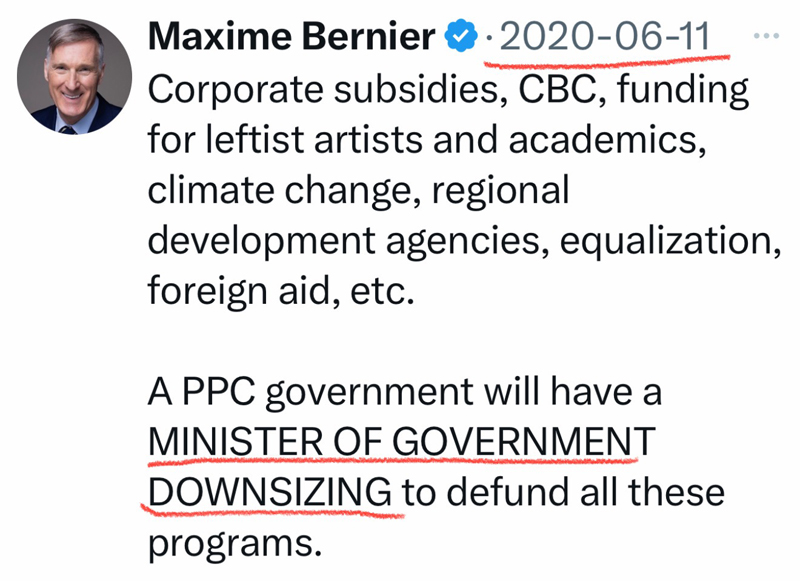
A maple-flavoured DOGE? Maxime Bernier proposed this in 2020
It’s both amusing and alarming seeing the kind of things the US government has been pouring money into, as the young auditors of Elon Musk’s DOGE dig into the accounts. Some folks on social media have been asking for a Canadian version of DOGE, but they’re nearly five years behind PPC leader Maxime Bernier:
Did you know that the Canadian government is spending $143,000 to help the African country of Senegal implement a “sectorial gender strategy” in its armed forces?
Or $46,793 to improve healthcare for intersex people in the Chinese province of Shandong?
What about $4.6 million to develop programs promoting a “positive masculinity” in Cuba?
There are hundreds of such crazy programs costing Canadian taxpayers billions of dollars every year to fund the Liberals’ woke ideology in other countries.
Many people on social media just found out that these programs exist last week, after they started looking for them on the website of the Government of Canada.
They were inspired by similar crazy programs that Elon Musk has unearthed with his DOGE team in Washington.
The DOGE – or Department of Government Efficiency – was created by President Trump and has already cut tens of billions of dollars in frivolous spending after only a few weeks.
I’m being asked if I support having the equivalent of a DOGE in Canada.
Not only do I support it, but I didn’t wait for Trump and Musk to do it to propose one. I did years ago!
In 2020, I stated that a PPC government would have a Minister of Government Downsizing to examine every federal program and cut or abolish everything that is inefficient, wasteful or not essential.
And speaking of DOGE, Coyote Blog shares some thoughts about some of the reasons Democrats are critical of the organization’s efforts:
… having thought about this longer, I think this is about more than just money. It is also about class. Just listen to how the cool kids in the media talk about Musk’s group of young weirdly-nicknamed geeks. This is fairly typical:
He was speaking specifically about a Trump executive order that decrees that the Department for Government Efficiency can force federal agencies into firing four people for every new hire. “Who the hell voted for Mr. Musk?” Begala raged. “Who the hell voted for — excuse the phrase — a guy who calls himself Big Balls? A 19-year-old kid going in there and trying to fire cancer researchers and scientists and teachers and agricultural specialists. It’s, it’s appalling.”
This is moderately hilarious from a) a party who still has not told us which unelected people really were making decisions behind the curtain for a senile Joe Biden; and b) an individual (Begala) who wielded immense power and influence across all departments of the Clinton Administration. The department staffs in DC are 99.99% people who are both unelected and unconfirmed by Congress. The issue is not that they are unelected, the issue is that they are “the wrong sort”. I am reminded of the British aristocracy in the 19th century that would tolerate almost any sort of governmental incompetence or malfeasance as long as the people were “the right sort” — meaning of their class.
The mention of Victorian England reminds me of another way that class is likely involved here. In the English aristocracy the oldest son inherited the title and often all the land and income (which was entailed to the title). This left little for any additional sons, so an income had to be found somewhere for them in a profession that did not require them to sully themselves with “trade” (daughters were handled a different way, through the marriage market). Reading for the law was an acceptable profession for a son with brains, and the army or navy were outlets for many. But most families needed a way for their sons without too much brains or ability and not militarily inclined to make a living. A position in the Church was often the solution.
Modern American blue-blood parents are no different — they need a way to secure a living for their kids who won’t or can’t land a job in the modern elite career choices (law, consulting, investment banking, or a sexy startup). Unlike in Victorian times, the military or the Church are no longer preferred elite options. So what to do with your 22-year-old gender studies major? The parents need her to get an income and they need her to do it in a context that they can proudly report to their friends — Paul Begala does not want to tell his friends that his son’s job is maintaining distributor pricing lists (anyone who does not believe the latter criteria should have been at my Princeton or Harvard Business School 25th reunions).
The solution? Get them a job at a non-profit, the modern American version of going to the Church. As Arnold Kling noted once, non-profits tend to have much higher status than do for-profits. And without competition they don’t have to carry the same performance standards as for-profits. And they are incredibly susceptible to trading a position for your kid in exchange for a nice donation.
The employment rosters of non-profits and NGO’s are stuffed with the children of privilege. So much so that there are many non-profits that seem to do nothing EXCEPT employ and pay the travel expenses of 20-something kids from rich and/or influential families. I have been writing about the non-profit scam for years. As I wrote then:
From my direct experience, I would go further. There is a tranche (I don’t know how large) of non-profits that are close to outright scams, providing most of their benefits to their managers and employees rather to anyone outside the organization. These benefits include 1) a salary with few performance expectations; 2) expense-paid parties and travel; 3) myriad virtue-signalling opportunities; 4) opportunities to build personal networks. This isn’t just criticizing theoretical institutions — people I know are in such jobs in these organizations.
The spending that DOGE is going after at USAID and other departments likely threatens the income of a number of under-qualified elite kids. So I will update my meme:

The growing problem of “America’s hat”
John Carter’s latest post is excellent — but that’s his usual standard — but it’s of particular interest to inhabitants of what used to be the proud Dominion but who now live in a “post-national state” with “no core identity” as our outgoing prime minister so helpfully explained it:

Canada and the US have been frenemies for most of the last two hundred years. With the exception of some spats in the 19th century, they’ve fought on the same side in all major wars, and haven’t taken up arms against one another. At the same time, Canada has from the very beginning fiercely guarded its independence. Through the 1950s, this came from Canada’s self-conception as an outpost of sober, orderly British traditionalism, in stark contrast to the chaotic liberal revolutionaries across the border. Following the Liberal Party’s cultural revolution in the 1960s, Canada increasingly came to see itself as different from the US primarily in that it was more liberal, in the modern sense, than it’s Bible-thumping, gun-toting redneck cousins – which is to say more socialist, leftist, multicultural, gay-friendly, internationalist, feminist, and so forth. In fairness to Canada, the British government, having long-since fallen under the sway of the Labour party, had followed the same ideological trajectory, so Canada was really just taking its cue from Mother England as it always had. In further fairness to Canada, all of this has been aggressively pushed by Blue America, which has been running American culture (and therefore everyone else’s) until about five minutes ago.
Despite these differences, the US could always rely on Canada being a stable, competently run, prosperous, and happy neighbour – perhaps a bit on the prickly side, given the inferiority complex, but much less of a headache than the entropic narcostate to the south that keeps sending its masses of illiterate campesinos flooding over the banks of the Rio Grande. Canada might be annoying sometimes, but it didn’t cause problems. To the contrary, Canada and the US have maintained one the world’s most productive trading relationships for years: America gets Canadian oil, minerals, lumber, and Canada gets US dollars, technology, and culture.
Now, however, Canada has become a problem for America. Not yet, perhaps, the biggest problem – America has a very large number of extremely pressing problems – but a significant one nonetheless, with the potential to become quite acute in the near future.
The problem is that Canada has become a security threat.
[…]
The next security problem is the border, an issue which Trump has repeatedly stressed as a justification for tariffs. The 49th Parallel is famously the longest undefended border on the planet. It is much longer than the Southern border; there are no barbed wire border fences; most of the terrain is easily traversed – forest, lake, or prairie – in contrast to the punishing desert running across the US-Mexico border. Militarizing the US-Mexico border is already a huge, costly undertaking. Doing the same on the Canadian border would be vastly more challenging.
Canada’s extraordinarily lax immigration policy has, in recent years, led to a much higher encounter rate at border crossings with suspects on the terrorism watch list. These people come into Canada legally, part of the millions of immigrants Ottawa has been importing, every year, for the last few years. When you’re bringing in over one percent of your country’s population every single year, it is simply not possible to properly vet them, and it seems that Ottawa barely even bothers to try. Given that not every such person of interest will get stopped at the border, and that not every terrorist is on a watch list, one wonders how many enemies have already slipped across into the US by way of Canadian airports.
RCMP officers with their haul from a fentanyl superlab. Only one person was arrested.
The second border problem is fentanyl. Like the US, Canada has a raging opiod epidemic. We’ve got tent cities, zombies in the streets, needles in the parks, and this is not limited to the big cities – it spills out into the small towns, as well. Like Mexico, Canada has fentanyl laboratories. Precursor chemicals are imported from China by triads, turned into chemical weapons in Canadian labs, and then distributed within Canadian and American markets by predominantly Indian truckers. The occasional busts have turned up vast quantities of the stuff, but have resulted in very few arrests. The proceeds are then laundered through casinos or fake colleges, with the laundered cash then parked in Canadian real estate. There are estimates that the volume of fentanyl money flowing through Canada’s housing markets is significant enough to be a major factor (immigration is certainly the main factor) distorting real estate prices – keeping the housing bubble inflated, propping up Canada’s sagging economy, and pricing young Canadians out of any hope of owning a home or, for that matter, even renting an apartment without a roommate or three.
It’s generally understood, though essentially never acknowledged at official levels, that poisoning North America with opiods is deliberate Chinese policy, both as revenge for the Opium Wars of the 19th century, and as one element in their strategy of unrestricted warfare i.e. the covert but systematic weaponization of every point of contact – economic, industrial, cultural, etc. – between Chinese and Western societies. By allowing the fentanyl trade to continue, the Canadian government is complicit in an act of covert war being waged by a foreign power, one whose casualties include the Canadian government’s own population.

February 16, 2025
Canada – parliamentary democracy or elected dictatorship?
During the entire dramatic confrontation with Donald Trump, Canada’s parliament has been prorogued … effectively meaning that the opposition can’t hold the government to task for how it is handling Trump’s aggression. In any other western country, parliament would have been in session all the way through this, but because Justin Trudeau was aware that his government might be defeated in the house, he chose to ask the Governor General to prorogue until late March.
Not everyone has been meekly accepting Trudeau’s position, and the Justice Centre for Constitutional Freedoms is challenging the prorogation in Federal Court. Dan Knight updates us on the progress of the hearing:

Arms of the Federal Court of Canada
We are now in Day 2 of the Federal Court hearing, where Justin Trudeau’s government is trying to convince a judge that shutting down Parliament to avoid Well, folks, here we are. Day two of the Federal Court showdown, where the Trudeau government is desperately trying to convince Canadians that shutting down Parliament to protect their own hide was a completely reasonable thing to do. They want you to believe that this is all perfectly normal, that it’s routine, that it’s just a quirk of the system. Nothing to see here, folks!
But the problem with lying is that eventually, you get caught. And on Day 2 of this hearing, Justin Trudeau’s legal team got caught. Over and over again.
If you watched what unfolded in court, you saw the Trudeau government’s lawyers flailing like fish on dry land, fumbling through weak excuses as Chief Justice Paul S. Crampton shredded their arguments one by one. At one point, they actually misrepresented a legal precedent in court, only for the Chief Justice to read the case aloud and reveal that it actually contradicted their argument. Humiliating.
And that was just the start.
This case isn’t just about whether Trudeau technically had the ability to prorogue Parliament. It’s about why he did it — and more importantly, whether Canada is now a country where the Prime Minister can shut down democracy whenever it gets inconvenient for him. Because if the courts let this stand, what’s stopping the next Prime Minister from proroguing indefinitely? What’s stopping the government from suspending Parliament every time there’s a corruption scandal, every time they fear a non-confidence vote, every time they need to cover up a mess of their own making?
And that’s exactly what Trudeau did. His government was facing multiple crises all at once — a massive financial scandal, a looming non-confidence vote, and an economic firestorm caused by Trump’s tariff threats. So rather than actually dealing with it, he shut Parliament down. The question is: Did he have the right to do that?
[…]
The Chief Justice has promised to issue a ruling before Parliament resumes on March 24. That means this case will be decided before Trudeau can walk away and pretend none of this ever happened.
If the court rules against the government, it will mean that future Prime Ministers cannot abuse prorogation to avoid scrutiny. It will send a clear message that shutting down Parliament to protect yourself is unconstitutional and illegal.
But if the government wins, it will mean that the Prime Minister can shut down democracy anytime he wants. It will mean that Canada is no longer a functioning parliamentary system but a country where the executive can do whatever it pleases.
And if that happens, ask yourself this: What’s stopping the next Prime Minister from just shutting down Parliament indefinitely?
Trudeau might be stepping down soon, but his legacy of corruption, incompetence, and political cowardice will haunt this country for years. The question now is whether the courts will allow him to rewrite the rules of democracy on his way out the door.
We’ll find out soon.
Update: Fixed broken link.


