
… it was a problem of permitting, by and large. Portugal isn’t as bad, mind, nowhere near but in the seventies a lot of places were designated “green belts” everywhere, so that to build on them (and you had to build on them, or you were stymied in growth) you had to know who to bribe, and of course have the money to do it. This isn’t the only reason why favelas end up housing even the middle class. There’s a ton of other reasons, including but not limited to land ownership and property rights, and a shit-ton of stuff. But permitting is part of it.
This is because people don’t view their public posts as something they do to make society better/serve society or even do a job, but as a way to enrich themselves/benefit their friends/make it easier to make money in the future.
Everything, from truly shoddy workmanship to rushed, corner/cutting work, to outright corruption comes from viewing a job not as something you take pride in and work to do your best at, but from viewing a job as an opportunity to enrich yourself and your family while doing as little work as humanly possible. In fact in some societies, this is viewed as a duty. As someone in comments cited there are places in Africa where locals can’t run a shop, because all their relatives near and distant will expect to be given merchandise for free … or even money out of the till.
A lot of this is because the idea of the individual as independent of the tribe and the family is a very new thing in most of the world. We kind of have a head start on it because we are/are descended from those who left family and tribe behind.
[…]
Also in most of the world working for money is vaguely shameful. Particularly so if you’re working for someone else. […] And even here not only does that attitude persist, but it’s trying to make itself normal. Particularly in politics.
So, take pride in what you do, and do the best job you can. It’s not just important for you, it’s a building block of society. Do the best you can, and control as much as you can, so maybe you will have just reward which is an incentive to do better.
This way is civilization built. This way do things actually improve.
Sarah Hoyt, “BUILD!”, According to Hoyt, 2018-07-25.
November 8, 2020
QotD: Tribal and post-tribal economies
November 6, 2020
“[T]he inability of election authorities to do something as simple as gather and count votes is undermining Americans’ faith in the constitutional system”
There have been many accusations of ballot fraud since the polls closed in the recent US federal election — not helped by Joe Biden’s Kinsley gaffe about creating the “most extensive and inclusive voter fraud organization in the history of American politics” — but that’s not the only thing holding up the process of determining who won say Jon Miltimore and Dan Sanchez:
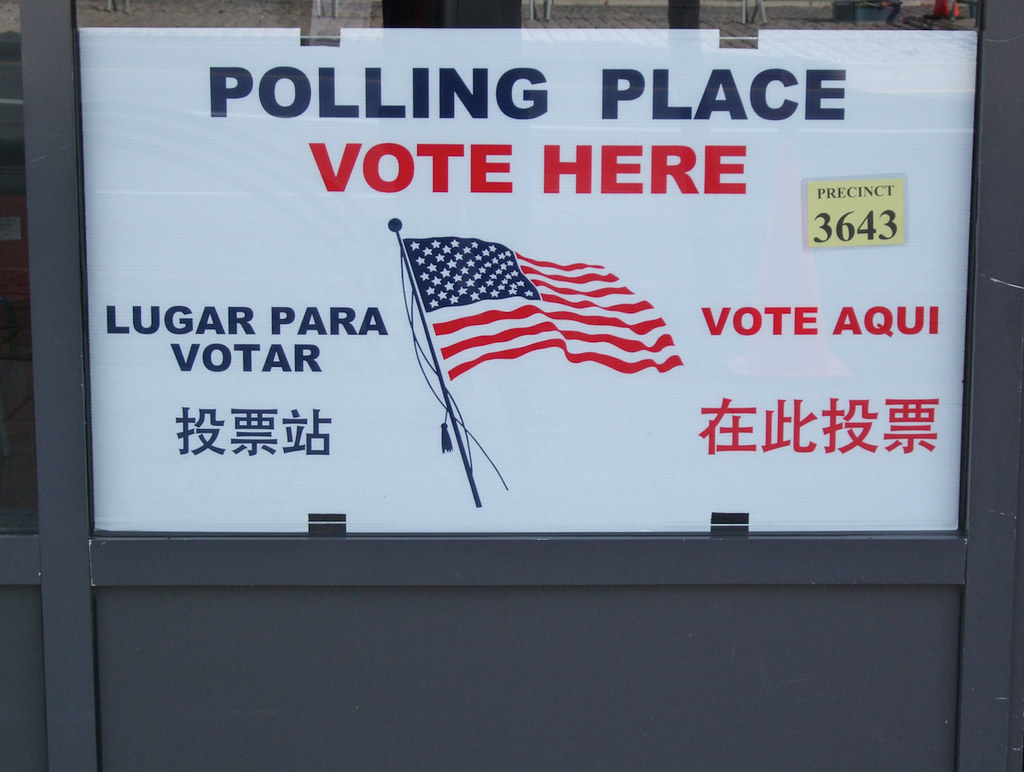
“Polling Place Vote Here” by Scott Beale is licensed under CC BY-NC-ND 2.0


Elections are a nasty business, but sometimes they can be clarifying.
We don’t yet know who won the US presidential election, and we may not for days or weeks to come. This stems largely from the ineptitude Americans witnessed on Election Tuesday.
It wasn’t just the fact that pollsters once again failed disastrously, or that networks fumbled their election coverage.
The bigger issue is that America’s governing bodies look incapable of managing something as simple as a vote, something Americans have managed to do efficiently for centuries without the benefit of computers, digital communication, and mass transportation.
As an American, I find this a tad embarrassing. As the journalist Glenn Greenwald observed Wednesday, countries with far fewer resources and less advanced technology regularly manage to hold speedy, efficient elections. This is something the US failed to do on Tuesday, Greenwald noted.
[…]
The most prosperous country in the world cannot manage to do something as simple as collect and count ballots. Think about that for just a moment.
Unfortunately, this incompetence carries consequences that are quite real. Americans are beginning to lose faith in the integrity of elections. I’m not just talking about voters in the fever swamps of Twitter.
Many impressive journalists, thinkers, and students of various political stripes have expressed alarm at what they witnessed in the last 24 hours.
November 5, 2020
QotD: The idiocy of tariffs
The true sadness here being that the spiral works the other way too. But hugely, vastly, more slowly. GATT was founded in 1947, it became, the process was transferred to, the WTO and it has taken them since then, that two generations, to reduce tariff levels to where they’re not really all that important in trade matters. Something that is being undone in just a couple of months of foolishness. GATT being something of a response to the economic demolition work done by Smoot Hawley of course.
Trade protection does spiral up and spiral down, the sadness being that here’s an asymmetry to the process. The reductions that make us richer take very much longer than the nonsenses that impoverish.
Tim Worstall, “The China, US, Trade War – It’s All Mutual On The Way Down As Well As Up”, Continental Telegraph, 2018-07-11.
November 3, 2020
How They DId It – Elections in Ancient Rome
Invicta
Published 14 Oct 2018We step back in time to join the Romans as they head to the polls! In this episode on ancient elections we look at the offices, the voters, and the process of the mid-Republic.
Bibliography:
— Yakobson, Alexander. “Secret Ballot and Its Effects in the Late Roman Republic.” Hermes, Vol. 123, No. 4 (1995) pp. 426-442.
— “Traditional Political Culture and the People’s Role in the Roman Republic.” Historia: Zeitschrift für Alte Geschichte, Bd. 59, H. 3 (2010) pp. 282-302.
— Elections and Electioneering in Rome: A Study in the Political System of the Late Republic. Franz Steiner Verlag Stuttgart, 1999.
— Lintott, Andrew. The Constitution of the Roman Republic. Oxford: Oxford University Press, 2002.
— Phillips, Daryll. “Voter Turnout in Consular Elections”, Ancient History Bulletin 18 (2004), 48–60.
— Morstein-Marx, Robert. Mass Oratory and Political Power in the Late Roman Republic. New York: Cambridge University Press, 2004.
— Taylor, Lily Ross. Jerszy Linderski, ed. The Voting Districts of the Roman Republic. University of Michigan Press, 2013.
— Roman voting assemblies from the Hannibalic War to the dictatorship of Caesar. Ann Arbor: University of Michigan Press, 1990.
— “The Centuriate Assembly Before and After the Reform.” The American Journal of Philology, Vol. 78, No. 4 (1957), pp. 337-354.
Hall, Ursula. “Voting Procedure in Roman Assemblies.” Historia: Zeitschrift für Alte Geschichte, Bd. 13, H3 (1964), pp. 267-306.
— “‘Species Libertatis‘ Voting Procedure in the Late Roman Republic.” Bulletin of the Institute of Classical Studies, Supplement No. 71 (1998), pp. 15-30.Research: James Conrad
Artwork: Anders Végh Blidlöv (https://www.behance.net/andersvb)Music:
“Strings and Drums Comedy” by 8th Mode Music#RomanHistory
#HowTheyDidIt
QotD: Water pricing
Near all freshwater availability problems come from the fact that farmers get it cheap or for free, diverting it from much more valuable uses like keeping people alive if they drink it. This is true in California – we’ve actually cases of farmers using $400 of water to grow $100 of alfalfa – as it is in Pakistan. There are cases of people growing water hungry crops in near drought areas just because they get that water too cheaply.
[…]
Gaining revenue with which to build dams is useful, it most certainly is. But that’s not the only function of pricing. The cash to increase supply, great, but the very fact of charging will reduce demand. And we should be charging what it costs to produce the water too. So charges should cover 100% of the costs of the dams, not just 25%.
It’s entirely possible that charging that full cost will mean that no farmers want the water. OK, then we shouldn’t build the dam, should we? For if the value of the water – measured by what people will pay – is less than the cost of its provision, then that’s value destroying, providing the water. The dam makes us all poorer, therefore we shouldn’t build it.
The point here being – and it’s an important one – that prices affect both supply and demand. They’re what brings them into balance even. So, yes, charge for water, but not just so that we can pay to increase supply, also so that we, merely by charging, reduce demand.
Tim Worstall, “Pakistan’s Chief Justice Almost Right – Charge For Water, Not For Dams, But To Charge For Water”, Continental Telegraph, 2017-07-17.
November 2, 2020
Federal government to web giants: “BOHICA!”
Michael Geist provides an unauthorized backgrounder on the Canadian government’s quixotic attempt to shakedown the likes of Netflix for money to give to “struggling” Canadian media companies:
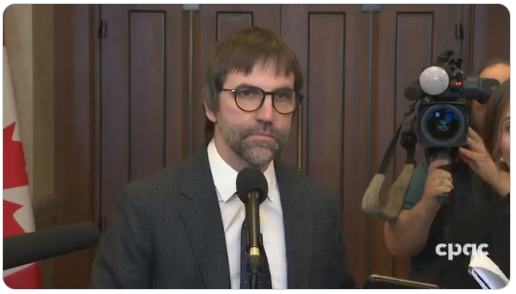
Canadian Heritage Minister Steven Guilbeault, 3 February 2020.
Screencapure from CPAC video.
Canadian Heritage Minister Steven Guilbeault is set to introduce his “Get Money from Web Giants” Internet regulation bill on Monday. Based on his previous public comments, the bill is expected to grant the CRTC extensive new powers to regulate Internet-based video streaming services. In particular, expect the government to mandate payments to support Canadian content production for the streaming services and establish new “discoverability” requirements that will require online services to override user preferences by promoting Canadian content. The government is likely to issue a policy direction to the CRTC that identifies its specific priorities, but the much-discussed link licensing requirement for social media companies that Guilbeault has supported will not be part of this legislative package.
These reforms mark the culmination of a dramatic reversal in government digital policy. After then-Heritage Minister Melanie Joly unveiled her 2017 digital cancon strategy that focused on market-based solutions and emphasized exports of Canadian culture, extensive lobbying gradually let to a major policy flip flop. The CRTC reversed its prior position on Internet streaming regulation in 2018 with a regulate-everything approach, the deeply flawed Yale report released earlier this year provided the blueprint for CRTC-led regulation, and Guilbeault jumped on board with a declaration that his top legislative priority was to “get money from web giants.”
On Monday, the government will undoubtedly line up the lobby groups that supported the reform to provide positive quotes, suggest reforms will lead to billions in new revenues, and claim the bill ensures regulatory fairness by requiring that everyone contribute. Yet much of the policy is based on fictions: that this levels the playing field, that there is a Cancon crisis, that discoverability requirements respond to a serious concern, that this will result in quick payments to the industry, that this is consistent with net neutrality, or that consumers will not bear the costs of reform.
None of this is true. But beyond those issues – each discussed in further detail below – this most notably represents a significant new source of speech regulation. We do not require government authorization to publish newspapers, blog posts, or to simply voice our views in a public forum. That we require governmental authorization in the form of licensing for broadcasters was largely justified in furtherance of cultural policies on the grounds of limited access to scarce spectrum. That justification simply does not apply to the Internet, no matter how many times Guilbeault refers to the inclusion of Internet companies within the “broadcast system.” This is not a matter of Internet exceptionalism. Laws and regulations such as taxation, competition, privacy, and consumer protection are all among the rules that apply regardless of whether the service is offline or online. But speech regulation by the CRTC should require a far better justification than the lure of “free money” from Internet companies.
October 30, 2020
Cancelling Halloween? I thought the Grinch only worked Christmas…
At The Line, Jen Gerson argues against cancelling the Halloween trick-or-treat candy hoarding:

“SHA Halloween ‘trick or treat’” by U.S. Army Garrison Japan is licensed under CC BY-NC-ND 2.0
Look, I can empathize with the impulse to do something, DO ANYTHING, to stem the concerning growth of COVID-19 cases. But if you were to craft a low-risk family holiday that offered a psychologically necessary reprieve from the joyless grind of the last year, you couldn’t do much better than trick-or-treating.
It’s children (low risk), outdoors (low risk), in masks (low risk), engaging in the briefest possible social interactions (medium risk). Yet Canadians have received mixed advice about the tradition; some jurisdictions have cautioned parents to skip it. Gatineau has, reasonably, restricted Halloween parties, but permitted trick-or-treating with restrictions.
I’ve asked several doctors — The Line‘s personal panel of COVID-19 experts — to weigh in on Halloween. Their responses on trick-or-treating prohibitions ranged from: “(this is) extraordinarily dumb” and “I would write something about it but I wouldn’t be able to express myself without extreme profanity.” To “pretty safe” and “shouldn’t be cancelled” as long as reasonable precautions are enacted — like masking, distancing, and perhaps re-thinking trick-or-treating in apartment buildings. Leaving a bowl filled with candy on the porch, rather than opening the door for every little germy ghoul, is also a reasonable precaution.
One person expressed concern that trick-or-treating would inevitably lead to adult schmoozing — but this does not bear a resemblance to any version of this tradition that I have ever experienced. The purpose of trick-or-treating is to maximize the efficient collection of candy; any adult who dawdled or took a drink at a neighbour’s house would find himself deeply at odds with his screaming and fitful progeny. But then, I was somebody’s particularly terrible progeny.
Then there’s this piece of advice from Oregon, noted in the video above, in which a beclowned public health official advised against “trick or treat events because of the high risk of people crowding and people congregating in areas close together.”
If your memory has not yet blanked this absurdity out, it’s vaguely similar to the logic of Ottawa public health officials who last April advised against chatting over the fence with a neighbour because: “It kind of starts with that and then a couple more people add on and before you know it you have a parking lot party or a backyard party.”
(Ottawa walked that recommendation back shortly afterward.)
October 29, 2020
How to fix the CBC
… aside from cutting off the massive subsidies from the federal government, which would be my preferred solution if “nuke it from orbit” isn’t a viable choice. Let it sink or swim as a purely private media entity — I’d be betting on the “sink”, personally because they don’t currently have to compete thanks to their funding from the feds and are not noted for their quick adaptation skills. However, Peter Menzies isn’t quite as anti-CBC as I am:

In a recent piece here at The Line, I lamented the current status of the CBC. That’s easy enough to do, but it’s fair to ask what can actually be done to fix it. These ideas don’t provide all the answers but, implemented with conviction and speed, here’s where to start. Because there are some things that can be done, and relatively quickly, to revitalize the institution: the CBC may well be hell-bent on its own destructive dualism but clarifying its role and purifying its soul are still possible by getting it out of the advertising business and turning it into a proper public media.
Right now, the CBC is neither fish nor fowl. Sometimes, as with radio, it is a popular public broadcaster. At others, with its television channels, it fancies itself a commercial broadcaster, albeit a publicly-funded and relatively unpopular one. It plows both of those personalities into its commercial online operations and supplements them with reportage of the kind traditionally associated with newspapers. Like a creature of mythology, it shape-shifts through all of these roles as best suits its needs and moods.
On top of that, its OMG obsession with Trump’s America has drawn it far away from its content mandate to ensure Canadians learn about each other wherever they live in this vast and beautiful country. While its performance indicates otherwise, CBC’s purpose is not to secure a large audience share in the GTA or, in French, in Montreal, in order to earn more revenue. Nor is CBC News Network’s mandate to compete with CNN. The Corp’s raison d’etre, as defined in legislation, is to tell Canadians each other’s stories — even if the GTA and Montreal don’t care.
The only way to purify the CBC then, is to ban it — once and for all — from collecting advertising revenue from domestic consumption of its product. As its radio operations are already advertising-free this means no more ads on its TV or websites. Done. Finished.
October 27, 2020
Conspiracy theories grow thanks to mistrust of public officials and media
It’s commonplace to say that such-and-such a conspiracy theory is merely an intellectual playground for the paranoid and the gullible, but conspiracy theories don’t spontaneously generate — at least not the ones that gain wide audiences. Daniel Miller looks at some of the reasons these theories become attractive and gain adherents:

QAnon alleged clues about the NYC bombing, 10 December 2017.
Wikimedia Commons.
In the wake of six months of mixed-messages and baffling government policies, following four years, if not twenty years, of mystifying imponderables, the concept of a “conspiracy theory” has recently reentered the lexicon of semi-criminalized thought.
In August The New York Times stigmatized anti-lockdown protesters in Berlin as a worrying admixture of “neo-Nazi groups, conspiracy theorists as well as Germans who said they were fed up with the restrictions” and similar language was used about the protesters in London, as social media companies began purging accounts linked to the QAnon conspiracy theory, which conjectures that the world is controlled by a secret global cabal of blood-drinking sex criminals.
Believing conspiracy theories, evidently, is a Bad Thing, but any concept capacious enough to incorporate both the tens, even hundreds of millions of people skeptical about the global political response to SARS-2, and the much smaller number entertaining more involved explanations demands a careful analysis.
Really the first question is who you can trust. One answer is the official authorities, as represented by the esteemed New York Times, but the news website which welcomed the 45th US President to office with three years of spurious coverage of what turned out to be the Russiagate hoax, before pivoting to the historical phantasmagoria of the 1619 Project, no longer strikes everyone as the impeccable source which revealed the existence of Saddam Hussein’s WMD stockpile and links to Al-Qaeda before the 2003 invasion of Iraq, or whose Pulitzer Prize winning journalist Walter Duranty discounted rumours of a 1933 famine in the Soviet Union as “an exaggeration or malignant propaganda.”
This leaves individuals only to their own wits and devices in the face of a puzzling world in which information is everywhere, much of it questionable, not all the facts are available, and many are ultra-politicized, and meanwhile, unknown agendas are being continually carried out.
What’s really going on? As with any speculative enterprise, the problem is to construct a plausible hypothesis by using various models to interpret limited data. There is no question that, at different moments in history, individuals and groups have worked together in secrecy to launch conspiratorial exploits and there is no obvious reason for thinking this practice has now totally ceased. “People of the same trade seldom meet together,” observed Adam Smith in 1776, “even for merriment and diversion, but the conversation ends in a conspiracy against the public.” Still, this is not in itself evidence of any specific plot happening now.
October 25, 2020
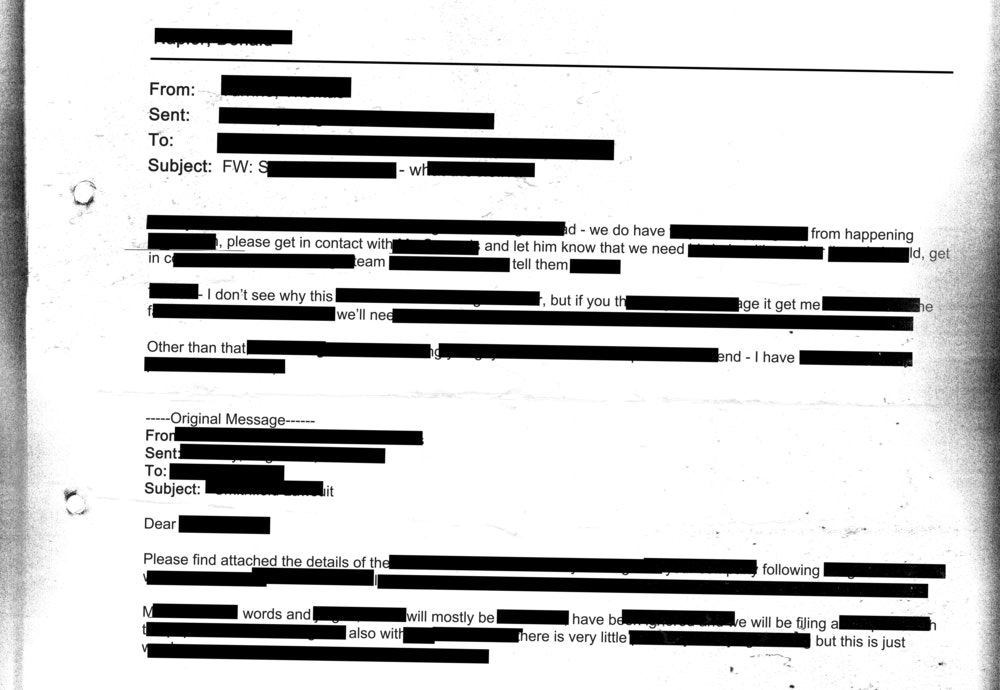
Canada’s broken [REDACTED] to [REDACTED] [REDACTED]
In The Line, a look at the failings of the federal government’s promises to fix the badly broken Access to Information system:
Sometimes, Line readers, though we always strive to be fair, we cannot deny that certain politicians are just fun to skewer. Because some of them are just terrible, terrible people, and while we polite Canadians don’t normally report too much on the personal lives of our elected leaders, well, what can we say? When you can, within responsible journalistic bounds, give a dirtbag a hard time for falling down on the job, hey. Life is good!
Patty Hajdu, the federal minister of health, is actually … perfectly pleasant. This isn’t unheard of in our politicians, but it’s rare enough to mention here, all to make very clear that we take no particular pleasure in reporting on her pathetic performance this week. But report it we must. And pathetic it surely was.
Under sharp questioning by Tory MP Michelle Rempel Garner, Hajdu very carefully and deliberately aimed a soon-to-be-banned .44 Magnum revolver at her foot, waited a dramatic second for effect, and then figuratively blew her poor extremity to smithereens. Rempel Garner had been asking about the abysmally broken state of the federal access-to-information systems, and Hajdu, with all-too-Liberal scorn, stood up and declared:
Mr. Speaker, I have spoken to hundreds, if not thousands, of Canadians since the pandemic was first announced, when COVID-19 arrived on our shores. In fact, not once has a Canadian asked me to put more resources into freedom of information officers. What they have asked me for is to ensure that all the resources of Canada are devoted to one thing, and that is the health, safety and economic prosperity of our country. We are going to continue to make sure that Canada has the most robust response possible.
There are two gigantic problems with Hajdu’s answer there.
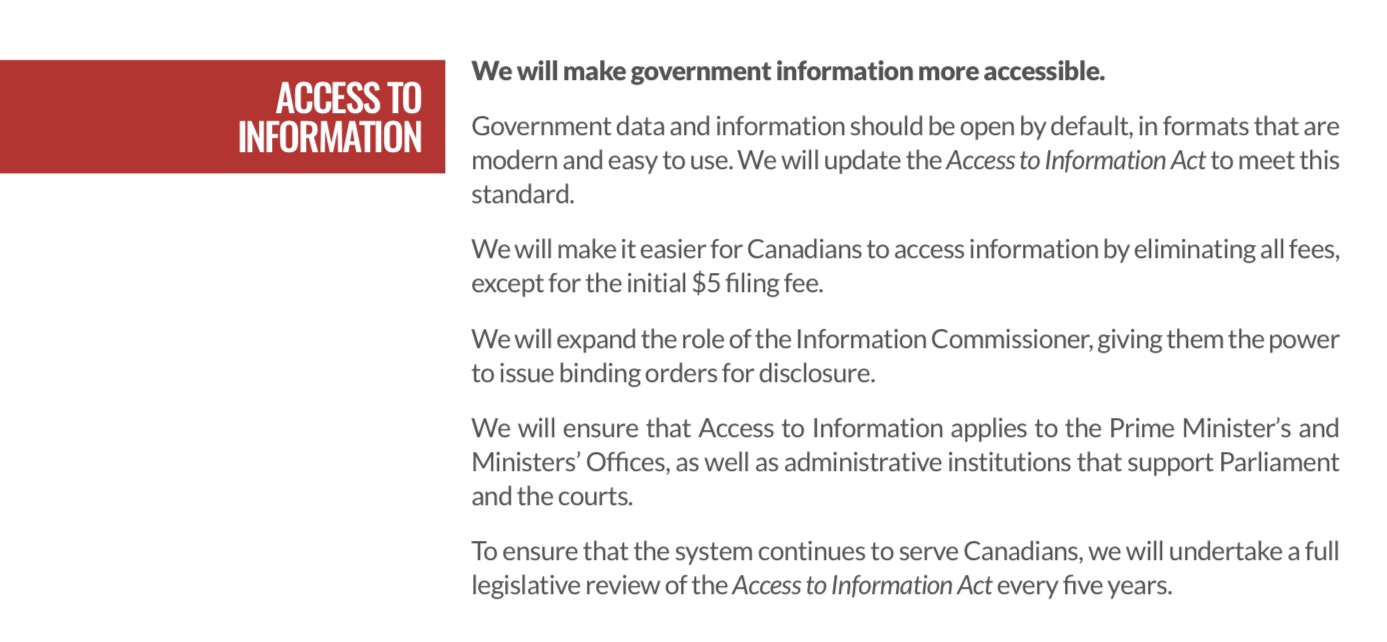
The first is that Canada’s access-to-information regime is notoriously dysfunctional, and her government has long admitted that. Indeed, fixing this disgrace was a major plank in the party’s 2015 platform.
In the years since, the government has effectively accomplished the square root of zero.
QotD: The omnibenevolent, omniscient state
Ivor Thomas, The Socialist Tragedy, 1951.
October 22, 2020
Carbon taxes may be the most efficient way to address GHG emissions, but no government has implemented them properly
I was persuaded by the economic arguments in favour of a carbon tax to address the externaly of greenhouse gas emissions, but I’ve long been skeptical that governments would actually implement them in a way to minimize economic distortion. A report from the Fraser Institute this week shows I was right to be doubtful, as none of the 31 OECD countries in the study have managed to introduce some form of carbon pricing without political “tinkering” … rather than replacing inefficient regulations, taxes and mandates with the carbon tax, they’ve generally just added carbon pricing on top of existing rules, making the carbon pricing scheme merely another tax grab that fails to achieve the stated goals:

Most economists consider human-made greenhouse gas (GHG) emissions an unintended negative externality of production and consumption. A negative externality occurs when the effects of producing or consuming goods and services impose costs on a third party which are not reflected in the prices charged for said goods and services. In the context of GHG emissions, this negative externality is calculated using the “social cost of carbon,” which is the future damage to society (adjusted to present value) of one additional tonne of carbon emitted to the atmosphere today.
Governments have a wide variety of policy alternatives to address the negative externality of emissions depending on the degree and depth of the policy intervention. They can either mandate individuals and firms to change their behaviour through command-and-control regulations, grant subsidies and tax credits to foster cleaner energy sources, or use market-based mechanisms to correct the misalignment of incentives. It is widely acknowledged that carbon pricing, one of these market tools, is the most cost-effective policy to reduce emissions, as it relies on price signals and trade to provide flexibility to economic agents as to where and how emissions mitigation occurs.
[…]
This report includes thirty-one high-income OECD countries, where each country has either implemented a carbon tax, an ETS [emissions trading system], or a combination of both pricing mechanisms. Carbon taxes are being implemented in 14 of them whereas 25 of these countries have their emissions covered by an ETS. Our analysis finds that, on average, 74 percent of carbon tax revenues in high-income OECD countries go directly into their general budget with no earmarking for any specific expenditure, while 12 percent are ring-fenced for environmental spending, and only 14 percent for revenue-recycling measures. This means that most governments are using carbon taxes as a revenue-raising tool rather than a mechanism to internalize the negative externalities of emissions in a cost-effective manner. Additionally, the vast majority of ETS revenues are being used to artificially accelerate the use of renewable energy sources, infrastructure, and technology.
The study also finds that no high-income OECD country has used carbon pricing to repeal emission-related regulations, but instead have introduced new ones following the adoption of the carbon tax or the ETS. Emissions caps, mandated fuel standards, technology-based standards, and renewable power mandates are just some examples of these regulations that undermine the cost-effectiveness of carbon pricing mechanisms. The majority of high-income OECD countries have a combination of support schemes for renewable energy sources, carbon pricing tools, and command-and-control regulations.
Overall, no high-income OECD country is following the textbook model of an optimal carbon pricing system, undermining their theoretical efficiency by design and implementation.
October 20, 2020
The watchful algorithms of the Nanny State’s AI tools
David Warren considers the evolution of the Nanny State’s arsenal of technological surveillance (supplemented by the Karenstapo):

While it is not in my interest, currently, for gentle reader to get off the Internet, the idea must have occurred to him. In times like these, why put yourself under watch from Big Brother (or, Big Sibling, as he might prefer)? Why surround yourself with his electronic eyes, the way I am presently surrounded by jackhammers?
Granted, Nanny State was devising ways to track its citizens, and to exercise “crowd control,” long before the Internet was invented. But we had the advantage with them, for they were incompetent, often laughably inept. However, Internet-plus-meejah-plus-activists-plus-Guvmint makes a more capable adversary.
I am not recommending a systematic withdrawal from the world. That is for people with a religious calling, or some grave eccentricity. Rather I am thinking of self-defence, in the spirit of buying a gun. Of course, I am writing from Canada, one of the countries where owning a gun is more-or-less illegal; as is any other form of self-defence. (“When seconds count, the police will be here in minutes.”) Though I have noticed that, upcountry, the “No Hunting” signs tend to be used for target practice.
The “other side,” as I see it, which always worked on numbers, now has algorithms. “Artificial Intelligence” can home right in. The Nanny State never took the individual seriously, except when he was offering a threat. Now it is threatened by anything human. It is, as it were, utilitarian in outlook — “the greatest good for the greatest number” — along with other fatuous concepts, unamenable to reason. By its nature, it is positivist, nominalist, relativist, and “idealistic” in a very abstract way.
Whereas we, so far as we are human, take ourselves quite personally. In a clinch, we often prefer our own survival, and the survival of family and friends, to the requirements of a bureaucratic “policy.” That this is “selfish” should be immediately affirmed.
Because the masses are now deprived of a Christian education, they misconstrue the “selfishness” of Christian teaching, which tells us that we ought selfishly to become saints. Our intention should be to get ourselves to Heaven, along with any we know who can be taken with us. But charity is not “selfish,” in ways they understand. Under modern tenets of “multiculturalism,” even fidelity to the old Christian view is decried as a form of selfishness, calling out for persecution. For this is because it is “cultural,” not “multi” — for all the many languages it speaks.
Our enemy wants us to eschew uniqueness, and become instead “diverse” — by which it means homogenized and narrowly interchangeable. Increasingly, this adversary has the means to enforce its arbitrary will.
QotD: The errors of socialist experiments
Ivor Thomas, The Socialist Tragedy, 1951.
October 19, 2020
Sarah Hoyt – “… I’ve been feeling like I’m at the end of a Bond movie, and the villain is telling me his big master plan and how Western Civilization is tied to the train tracks and can’t escape”
In the latest Libertarian Enterprise, Sarah Hoyt explains why she’s not expecting the US federal election next month to resolve anything, at least not in a positive way:

At this point I hold about a 10% chance the Democrats/Socialists/Communists (interchangeable now that the masks are off) don’t fraud their way into full power, pack the court and rip our system apart, to install (yet again) a form of communism. This is complicated by the fact that a lot of them are in China’s pockets. Or rather, China has been filling their pockets for a long while. We might find ourselves working for racist, hegemonic overlords, besides suffering all the ills of a descent into communism. (By the way, they’ve already been doing this to some extent to the less fortunate countries, including most African countries. The left in the US and Europe believes this is benevolence. And that Chinese aren’t racist. I wouldn’t believe it, if it hadn’t been said to me over and over.)
There is maybe another 25% of chance we’ll find ourselves in CW II, now with even more foreign interference. What comes out of that, G-d only knows, and I’m not Him. Which is good, because I have trouble enough being me.
And there is a very strong chance that even if Trump wins the White House, besides continuing to have to drive a car where the wheel is disconnected (the extent of which I wasn’t even fully sure of until this month) he won’t do more than delay the crash.
Sometimes here, and particularly at insty, because I tend to do that really late at night when I’m exhausted and less able to control my moods, you’ll catch a hint of how hopeless I feel our situation to be.
In fact since the lockdown, I’ve been feeling we were screwed. That the lockdown was imposed all over the world on such flimsy evidence, that countries and churches, and every cultural institution not only submitted to it but kept telling the people how much it was needed sent me into a deep depression from which I haven’t fully recovered. (Again, the evidence that this virus was MAYBE as bad as the flu has been before our eyes since the beginning. You don’t need special equipment to see it. The homeless were congregating and not dying in droves. The people in slums in the third world weren’t dying at a higher rate than usual. And there were the numbers from the Diamond Princess. Which some idiot here tried to justify with “but they got the best treatment.” In a floating petri dish. With no special equipment. May G-d have mercy on the soul of every idiot who bought that bullshit.).
This last week, on the other hand, I’ve been feeling like I’m at the end of a Bond movie, and the villain is telling me his big master plan and how Western Civilization is tied to the train tracks and can’t escape.
Oh, not the massive corruption of the Biden crime family. I mean seriously. Any of you who didn’t know already that Crackhead McStripperbang wasn’t being paid for foreign countries for his services must have been living under a rock.
Not even the ridiculous, immediate coordination with which our tech overlords moved to clamp down on that information and preventing it from reaching the virgin ears of most of our willfully and willingly ignorant countrymen.
No, what discouraged me most was the “sexual preference” suddenly becoming a slur and Webster dictionary falling in line. (Seriously, guys, sexual preference goes way beyond orientation. For instance, my sexual preference is monogamous and with someone I love. If you think that there’s no preference involved, you must think people have absolutely no control over their impulses.) Because that bullshit couldn’t happen, even in the most totalitarian of conspiracies.
And that’s the terrifying thought. These people are no more conspiring than your breaklines being cut are a conspiracy not to stop the car.
They are a result of deep inlaid propaganda and misseducation which cause a lot of people to try to fall into line with the “word from above” and be “right” with those they view as the smart people and the masters of society.


