Quotulatiousness

June 24, 2020

Trudeau government wants to introduce an Internet “link tax”

Filed under: Business, Cancon, Government, Technology — Tags: , , , — Nicholas @ 03:00

Michael Geist on the Trudeau government’s latest indications of support for a tax grab to benefit certain favoured groups and organizations:

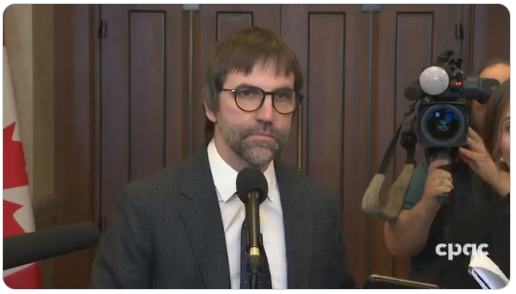
Canadian Heritage Minister Steven Guilbeault, 3 February 2020.
Screencapure from CPAC video.

Last week, Canadian Heritage Minister Steven Guilbeault called into question his own government’s policies on supporting news media, suggesting that those programs should be replaced by copyright rules that would open the door to payments from internet companies such as Google and Facebook. Mr. Guilbeault indicated that a legislative package was being prepared for the fall that would include new powers for Canada’s communications regulator and what are commonly referred to as Netflix taxes and internet linking taxes.

My Globe and Mail op-ed notes the government’s support for new internet taxes should not come as a surprise. There were strong signals that the spring budget – postponed indefinitely due to the current public health crisis – was going to include expanding sales taxes to capture digital sales such as Netflix or Spotify subscriptions.

[…]

It is Mr. Guilbeault’s plans for a link tax that should spark the most concern, however. The government has long promoted its policies designed to support the Canadian media sector, including direct funding for local journalism as well as labour and subscription tax credits. The taxpayer cost runs into the hundreds of millions of dollars, but is justified on the grounds that journalism is an essential service that requires public support.

Yet Mr. Guilbeault now says that government should not be funding media, characterizing the policies as short term measures aimed at mitigating a media emergency. Instead, Mr. Guilbeault supports a controversial copyright reform measure that would establish a news publisher’s right to demand payment for services that link to their content.

This payment – effectively a tax on linking – raises a host of concerns, not the least of which is that the proposal was not recommended by the government’s own copyright review last year. Copyright reform in Canada is always complicated, particularly given that responsibility for it is shared with Innovation, Science and Economic Development Minister Navdeep Bains, but delving into reforms that sparked protests in Europe could be politically risky for a minority government.

News organizations already benefit from large platforms linking to their content since the links generate visitors that increase advertising revenues and paying subscribers. Organizations that do not want the links can easily opt-out of appearing in services such as Google News or Facebook. In fact, after Google shut down its Google News service in Spain, studies found publisher website traffic dropped by 10 per cent.

June 20, 2020

“What did you do in the Wuhan Coronavirus war, Daddy?”

Filed under: Bureaucracy, Cancon, Government, Health — Tags: , , , , — Nicholas @ 05:00

Chris Selley metaphorically dons the garb of a war correspondent to report on how the Canadian government systematically mishandled the epidemic “war”:

Toronto General Hospital.
Photo via Wikimedia Commons.

At first, comparisons to wartime seemed a bit silly. All we were being asked to do, after all, was stay indoors. As the World Health Organization was declaring a pandemic 100 days ago, the commanders had everything under control: the borders, the epidemiology, the strategy, support for shuttered businesses and their employees. Traditionally, wartime puts those of us left on the home front to work whether we like it or not. This was entirely the opposite: the worst we would have to put up with — in theory, assuming government aid was as advertised — was the indignity of idleness. Collective inaction would flatten the curve, the forces of COVID-19 would be beaten back, and summer would be saved. Peace in our time.

And then it instantly turned to quagmire. Canadians watched slack-jawed as COVID-19 breached our most fundamental defences. You don’t need Sun Tzu’s perspicacity to inform people arriving in Canada of their responsibility to self-isolate, and exactly what self-isolation means — go directly home, do not stop for groceries, do not receive visitors. I just did it, right there, in half a sentence. But we couldn’t manage it: Where information was distributed at all, it was excessively complex even as it failed to deliver the central message. Provincial forces threatened mutiny. Alberta Commander-in-Chief Jason Kenney stormed into the Edmonton airport demanding answers. It took weeks to sort out.

[…]

If it didn’t seem like a war before, it sure did once the real live army was drafted in to bail out long-term care homes in Ontario and Quebec that had descended into horrifying squalor. We learned the appalling details from leaked military reports. And now, in an almost poetic act of military pigheadedness, the Ottawa Citizen reports the Armed Forces are trying to hunt down and punish the leakers.

The war must go on. But sitting here in still-locked-down Toronto, stewing in my own bile, I cannot say this is filling me with patriotic fervour. I find myself simultaneously envious of other provinces that are in the process of reopening, and sympathetic to their residents: If it weren’t for the two sick men of the federation [Ontario and Quebec] dominating the narrative, they would likely have reopened much earlier.

Indeed, jealousies have bloomed as weeks turned to months. Apartment dwellers envy other apartment dwellers who have balconies. All apartment dwellers envy homeowners. Everyone envies cottage-owners. Some cottage-country mayors have told cottage-owners to stay put and keep their infestations to themselves. People cooped up with their kids sometimes envy those with time to themselves; singletons who have had enough alone time to last a decade occasionally envy those trying to juggle kids with working from home. The pleasant novelty of Zoom-based socializing faded ages ago, as everyone realized that Zoom-based socializing sucks.

More than 8,200 Canadians are dead, most having lived long lives but many having died in grim and lonely circumstances. In future, considerably more deaths and distress will be associated with the lockdown itself. The psychological effects of this will be studied for decades. If war isn’t quite the right analogy, it’s certainly closer to a war than anything that has been contested on Canadian soil in my or my parents’ lifetime, and it will come at a greater cost to the whole of society than any actual war that Canadian forces have fought over that time. It’s a terrible shame that as a nation, we didn’t win.

Opposition to home schooling is merely a side-issue for those who want government to control everything

Filed under: Education, Government, Liberty, Politics, USA — Tags: , , , , , — Nicholas @ 03:00

Kerry McDonald recently took part in a debate with a Harvard academic who has called upon governments to ban homeschooling. She’s written up some of the things she took away from the discussion and from the many questions submitted before the event:

While this event was framed as a discussion about homeschooling, including whether and how to regulate the practice, it is clear that homeschooling is just a strawman. The real issue focuses on the role of government in people’s lives, and in particular in the lives of families and children. In her 80-page Arizona Law Review article that sparked this controversy, Professor Bartholet makes it clear that she is seeking a reinterpretation of the US Constitution, which she calls “outdated and inadequate,” to move from its existing focus on negative rights, or individuals being free from state intervention, to positive rights where the state takes a much more active role in citizens’ lives.

During Monday’s discussion, Professor Bartholet explained that “some parents can’t be trusted to not abuse and neglect their children,” and that is why “kids are going to be way better off if both parent and state are involved.” She said her argument focuses on “the state having the right to assert the rights of the child to both education and protection.” Finally, Professor Bartholet said that it’s important to “have the state have some say in protecting children and in trying to raise them so that the children have a decent chance at a future and also are likely to participate in some positive, meaningful ways in the larger society.”

It’s true that the state has a role in protecting children from harm, but does it really have a role in “trying to raise them”? And if the state does have a role in raising children to be competent adults, then the fact that two-thirds of US schoolchildren are not reading proficiently, and more than three-quarters are not proficient in civics, should cause us to be skeptical about the state’s ability to ensure competence.

I made the point on Monday that we already have an established government system to protect children from abuse and neglect. The mission of Child Protective Services (CPS) is to investigate suspected child abuse and punish perpetrators. CPS is plagued with problems and must be dramatically reformed, but the key is to improve the current government system meant to protect children rather than singling out homeschoolers for additional regulation and government oversight. This is particularly true when there is no compelling evidence that homeschooling parents are more likely to abuse their children than non-homeschooling parents, and some research to suggest that homeschooling parents are actually less likely to abuse their children.

Additionally, and perhaps most disturbingly, this argument for more state involvement in the lives of homeschoolers ignores the fact that children are routinely abused in government schools by government educators, as well as by school peers. If the government can’t even protect children enrolled in its own heavily regulated and surveilled schools, then how can it possibly argue for the right to regulate and monitor those families who opt out?

QotD: Morality and the government

Filed under: Government, Law, Quotations, USA — Tags: — Nicholas @ 01:00

If an action is immoral for me and you, it is also immoral for others, including those who constitute the government. Election to public office is not a licence to lie, defraud, extort, rob, kidnap, or murder. Those who believe that government officials, employees, and contractors may morally do what other individuals may not do are morally bankrupt. The government has the power to act immorally — and does so as its standard operating procedure — but power and just right are completely different things. To affirm that might makes right in a moral sense is to affirm that one has simply chosen to abandon all pretense of taking morality seriously.

Gaze upon the members of Congress, the president and his lieutenants, the justices of the Supreme Court, and the leading figures of the government bureaucracies. As I do so, I cannot help but wonder: Who are these people? I am not personally acquainted with a single one of them; they are complete strangers to me. I have not contracted with them for the provision of any services, nor have I agreed to support them financially. Why then do these strangers presume to dictate to me what I must do and not do, and to threaten me with violence if I do not obey? They might as well be alien invaders from outer space.

Robert Higgs, “A Straightforward View of Morality and the Government”, The Beacon, 2018-03-06.

June 19, 2020

National Defence Headquarters needs to go on a crash diet

Filed under: Bureaucracy, Cancon, Government, Military — Tags: , — Nicholas @ 05:00

Ted Campbell knows how Canada’s NDHQ got into the state it is in, and has some suggestions for getting it out of its critical state of administrative morbid obesity:

Major General George R. Pearkes Building in Ottawa, home of National Defence Headquarters on Colonel By Drive.
Photo by DXR via Wikimedia Commons.

National Defence Headquarters is a HUGE place with diverse functions. First: it is, simultaneously, the management centre of the Department of National Defence, which is a very large (and complex) department of government that includes the Canadian Armed Forces (but the CAF is just one of DND’s “arms”), and it is the national command centre for the Canadian Armed Forces. Second: it is one of the biggest budget departments in Canada. Defence spending supports many hundreds of thousands of jobs in the military, in the civil service and all across the spectrum of Canadian industry from the highest of high-tech enterprises through to janitorial services. It is never surprising when things fall through the cracks in any large, complex organization, is it?

But there are two other problems:

As defence spending has declined, year-after-year, always in terms of GDP and often in terms of its share of the public accounts and sometimes in real, dollar terms, too, the headquarters, especially the military’s command and control (C²) superstructure, has grown. A bit of growth is not surprising when one must “do more with less” as I well remember being told during the rounds of budget and staff cuts in the 1990s. Although to their credit, defence ministers in the Chrétien-Martin era imposed a series of staff cuts on the HQs in Ottawa, there was a bit of growth in the (largely civil service) policy and financial management areas. But in the Harper era that all changed. Budget pursestrings were loosened by governments after 2001 and, under e.g. Conservative Defence Minister Gordon O’Connor the Canadian Forces began to receive some much needed new equipment including the big CC-177 Globemaster III transport planes, new CH-147F Chinook transport helicopters and Leopard tanks ~ all procured on sole-source contracts, over the objections of many. But then O’Connor was replaced by Peter MacKay and, it appeared to me, the generals and admirals took over and the HQ went from lean to overweight and then to downright fat. Then, in the Trudeau era, the HQ went from simply being fat to being morbidly obese. There are, now, hundreds of admirals and generals, managing a military force that numbers in the (too few) thousands. Even serving flag and general officers have told me that cutting the highest ranks by ⅓ would do no harm and some retired officers and civil servants (with intimate knowledge of the inner workings of the HQ at the highest levels) say that a 50% cut would be healthy. The simple fact is that the Canadian Forces have too many very smart, very able senior officers with too little real work to do. They, not surprisingly, fill the time available with “work” of their own devising which, often, involves creating new and more complex command structures which require more and more general officers. The process seems unconstrained from the top.

Why? What happened?

Well, it started with the very best of intentions. I recall being told by one very, very fine general that we, the Canadian Forces, must, above all else, be “interoperable” with our American allies and that, he explained, meant adapting to their command and control system, poor as he thought it was. He said, and he meant, adapting, not adopting. But he retired and a new generation of officers entered the most senior ranks and some of them seemed, to me, to be more interested in adopting than in just adapting to. We seemed, in the 2000s, to be seized by a giant case of military penis envy and we seemed to want to have a local version of whatever the Americans had. The result was a proliferation of new command and control organizations, all put in place as the combat elements were actually shrinking. The end result was an unconscionable GOFO [General Officer/Flag Officer] to combat sailor and solder ratio and a bloated and, in my opinion, weak and inefficient command and control superstructure.

June 15, 2020

Canada’s ongoing experiment with Justin Trudeau’s “basic dictatorship”

Filed under: Cancon, Government, Health, History, Liberty, Politics — Tags: , , , — Nicholas @ 03:00

Ted Campbell outlines the development of the concept of “rights” from Saxon England through Magna Carta and how a bad king finally triggered a rebellion that forced him to grant the Great Charter which still acts as a foundation for British (and Canadian) law. Justin Trudeau may be the modern day version of the bad king:

A few hundred years later, one of liberalism‘s and democracy’s greatest voices told us that we have three absolutely fundamental, natural rights: to life, to liberty and to property. These rights were not and still are not unlimited. There were and are ways to lawfully and properly deprive a person of his property and his liberty and, in some countries, even his life. A few centuries after John Locke another philosopher wanted to do away with the right to property: “From each according to his ability, to each according to his need,” Karl Marx wrote, and many, far too many, believed. The only real problem with Marx’s notion is that it requires that humans are perfect … and most of us know how rare that is. Here in Canada, especially since the early years of the 20th century, we have had far too much Marx and far too little Locke.

Now, in 2020, we even have a new version of King John: a vain and foolish prime minister who seems to believe that he has been sent to rule over us. Justin Trudeau is profoundly ignorant about both liberalism and democracy. He is, actually, more of a puppet than a ruler but it is less easy than it should be to determine just who is pulling on which strings. He does not appear to have the mental capacity to pull more than a couple of ideas together at any one time.

Because we have been panicked by the coronavirus pandemic we have decided accepted that more government is the best least bad answer. To give us more and more government, Justin Trudeau’s handlers suspended parliament until September … they wanted to have that “basic dictatorship” thing.

Democracy is in peril in Canada … it’s not because Justin Trudeau is an evil dictator, it’s because we, as a people, are too complacent. We have come to believe that democracy is, somehow, automatic, that it is natural. It’s not. It needed to be carefully built, brick-by-brick, over many centuries. We needed to fight for democracy: we needed to win it and then defend it, too. It doesn’t renew itself, it is not the natural order of things, and, In Canada, in 2020, it is in peril. Parliament needs to be recalled, soon, before September. Parliament needs to tend to its ancient rights, duties and powers. The Trudeau regime needs to be called to account and then replaced by a new, better, government.

June 14, 2020

The cat’s in the bag … once. Twice is a different matter altogether

Filed under: Economics, Government, History, Politics, USA — Tags: , , , , — Nicholas @ 05:00

David Warren discusses some specific cats and bags:

A building burning in Minneapolis following the death of George Floyd.
Photo by Hungryogrephotos via Wikipedia.

You can get a cat into a bag twice, as someone said (I think it was me); but the second time it has to be dead. This would be the reasoning behind my prediction that a second general lockdown will not even be attempted; but it must be qualified. For many of the people who imposed the first one were demonstrably insane, and they haven’t yet been removed from public office.

The same could be said about our impending “summer of love,” or hot season of race riots, already endured a half-century ago. That cat has been put into that bag before. This time is bound to be a different story.

It is fairly strictly a party question, now. The “theory” behind the lockdowns — to avoid overloading the hospitals in Manhattan — proved a crock, but there is a more cogent alternative theory. The Democrats in Natted States Merica guessed that destroying the “Trump economy,” and encouraging “peaceful” riots in the cities, was the only way they could defeat Trump, having tried other methods to remove him. And for a party of convinced abortionists, defeating Trump takes priority over mere human lives. We’ll see in November whether their Caracas strategy is the final winner.

To be fair, as they say at Instapundit, the Repubs have historically played along with this, and agreed to take responsibility and blame for almost purely Democrat measures. A good example is race, where the party of slavery, the Ku Klux Klan, eugenic birth control to reduce the black population, and Jim Crow laws, presents itself to captive media as the champion of the black man against “systemic racism”; while the party of Lincoln apologizes for itself. That the devil is at large in American politics is, to my mind, an irresistible hypothesis.

The refusal of this Trump fellow to play this game, as his predecessors did, drives Democrats berserk. He actually fights back, to their consternation. It didn’t help that they were so proximate to berserk already.

Healthcare is a provincial responsibility … thank goodness

Chris Selley reminds us that despite all the attention the media pays to every twitch of the federal government, it’s the provinces that are actually responsible for the healthcare systems in their territory:

Front view of Toronto General Hospital.
Photo via Wikimedia Commons.

Here in Canada, however, astonishing scenes continue. On Thursday the Toronto Transit Commission announced it intends to make masks mandatory for riders — no word of a lie — in three weeks, on July 2. That’s assuming the commission approves the measure … next Wednesday. TTC CEO Rick Leary was at pains to stress the rule would never be enforced.

Meanwhile Theresa Tam, Canada’s chief public health officer, could not appear more reluctant to endorse mask wearing unless she advised against wearing them altogether — which was, famously, her original position. On Wednesday, she unveiled a four-bullet-point plan for getting safely back to semi-normal under the moniker “out smart.” The word “masks” does not appear. Supplementary text only concedes they “can be used … when you can’t maintain physical distance of two metres.”

This is a strange qualification: The official federal advice stresses you shouldn’t touch your mask except to take it off at home and immediately wash your hands. You shouldn’t be taking it on and off while you’re out and about, when social distancing suddenly becomes impossible. But it’s not as strange as the qualification Tam offered on her Twitter account, where she offered a link to an instructional video but only “if it is safe for you to wear a non-medical mask or face covering (not everyone can).”

It is true that some people with asthma or severe allergies have trouble wearing masks. Presumably they know who they are, and would not risk suffocating themselves when mask-wearing isn’t even strongly recommended, let alone mandatory. Blind people will struggle to keep two metres’ distance from others. People with aquagenic urticaria can’t wash their hands with water. People without arms can’t cough into their sleeves. Those “out smart” recommendations aren’t qualified, because that would be silly — as is the qualification on masks.

I would be lying if I said I had any idea what the hell is going on. But this never-ending weirdness is doing us a favour, in a way. The fact is, we have been paying far too much attention to the feds throughout this ordeal. Canada’s COVID-19 experience was always much too different from region to region to justify everyone taking their cues from a single public health agency — let alone one that comprehensively botched something as simple as issuing self-isolation advice to returning foreign travellers.

Canada is a federation by design, not by accident, and thank goodness for that: Far better that most provinces’ authorities did a good job knocking down COVID-19 than that a single one screwed it up for the whole country. It’s something Liberals and New Democrats should bear in mind next time they find themselves demanding yet another “national strategy” in a provincial jurisdiction.

June 12, 2020

QotD: Homelessness in America

First let’s start with the fact that homelessness as it exists in America isn’t poverty. In fact part of the problem with it is that it ISN’T poverty. Look, regardless of what you’ve seen on the movies or TV, most homeless are not families fallen on hard times. Yes, there are some of those now, but most of those while technically “homeless” aren’t living in your local park. They’ve just taken over mom and dad’s basement, moved onto a friend’s living room or whatever. Terrible – I’ve been JUST short of that at least three times in my married life – and humiliating, but NOT “stand in the park and wheedle on yourself.”

90% of the homeless in America and the hard core ones are people with mental health issues, people with drug abuse issues and people who have found they can live without having to do anything for it, and can be “free” and outside society. I’ve overheard conversations in the park, and I suppose that most of the people who “dropped out” in the sixties are dead, but a lot of them are alive and going from soup kitchen to free clinic, with a bit of begging in between.

Yes, there are entire families in this system, including homeless children – but for them to stay in it, the parents need to have some sort of serious issue. Otherwise, even if they can’t find work, there is assistance available to get them at least into public housing, which, nightmarish though it is, is not living in the park.

I’m not going to pretend this doesn’t happen to normal families too – see where I came very close to that level and more than once too – but normal families usually tend to bounce back. They go through a few months of mess and horror, and then they claw back to some semblance of normalcy. (This might change as our economy dives and programs of necessity get cut. The ones for the DESERVING poor will be cut first, of course, since they rarely riot.)

The problem with this is that when people get appalled at the conditions the homeless live in and start offering “homeless services” there is an entire network, not just of homeless but of social workers who direct the homeless to the cities with better services.

I swear to you and I’m not even joking that right now there are plenty more homeless on Colorado Springs streets than in Denver, despite the Springs being much smaller.

The Springs also has its soup kitchens and other services downtown and within easy walking distance of each other.

This means downtown businesses are closing, except for bars and restaurants which can control access. And that the library is of course a place to camp in the cool/warm during the day.

It means more than that. We moved within easy driving distance of downtown, because when we lived downtown when we first came to Colorado Springs, I used to take walks every day. When we moved to our little mountain village, without these, I gained ten pounds a year. I used to love walking downtown, dropping by the deli and the three bookstores (only one left, and it’s MOSTLY a restaurant now) checking out the other little shops which ranged from yarn to weird import crafts.

Now those are gone. Worse – the last two times I walked downtown alone (i.e. without commanding the muscle, aka older son to go with me) someone FOLLOWED me and I had to employ stuff from my childhood to lose them. Once it was a large and addled looking male, and yes, he was following me. And once it was TWO large and addled looking males. For the icing on the cake – not related to this, but from a blog entry – I clicked on the sex offenders registry. Yes, I know, a lot of people there are there because someone accused them and was never proven. Our local one at least has notes on whether it’s accusation, trial or conviction and also whether the crime was against children or adults.

The downtown zipcode is FULL of registered sex offenders who’ve done hard time and who have committed their crimes against adults. The faces are very familiar from my walks, and yep, one was the guy who tried to follow me.

Sarah Hoyt, “Of Books, Compassion And Cruelty A Blast From The Past From June 2013”, According to Hoyt, 2020-03-10.

June 11, 2020

QotD: Equal rights

Filed under: Government, Law, Liberty, Quotations — Tags: , , , , , — Nicholas @ 01:00

We must separate the moral dimensions of a subject from the empirical questions surrounding it. For example, on the radioactive issue of sex (or gender) differences in cognitive abilities, there is the empirical question of whether or how men and women diverge in certain tasks, and then there is the moral question of how men and women should be treated. Empirically, there is much evidence that in some tasks women excel over men, and in other tasks, men excel over women. For example, women are more dexterous while men are better at throwing; women are superior in visual memory whereas men are better at mentally rotating shapes; women are better at mathematical calculation while men are better at mathematical problem-solving; in terms of overall general intelligence (g), however, there is no gender difference. Morally, however, none of this matters. We should support women’s rights regardless of any physical or cognitive differences between the sexes. To yoke one’s moral evaluation to empirical questions like this is a big mistake; worse is to assume that this is what people always do and therefore we must suppress any empirical evidence that there are differences, as this will only tilt people’s moral judgments toward empirical outcomes.

This reminds me of the debate in the late 1980s through mid-1990s about whether homosexuality was nature or nurture, something you were born to be or a lifestyle choice. Conservatives and Christians argued for the “choice” position and this led to efforts to “convert” gays to straight (or “pray the gay away”) because something that is learned can be unlearned. This led the gay community and supporters thereof to argue for the “born this way” position. The cumulative evidence from multiple lines of inquiry led to the nature position more than that of nurture, but this was another example of confusing the empirical question of the origin of homosexuality with the moral question of the rights of gays and lesbians (today the LGBTQ community). It should go without saying — but unfortunately in these times it must be said again and again — it doesn’t matter what the origins of homosexuality turn out to be, gays and lesbians and everyone else in the LGBTQ community are entitled to the same rights and privileges as everyone else protected by the constitution of their nation (and those nations that have yet to extend legal rights to gays and lesbians need to change their constitutions).

Michael Shermer, interviewed by Claire Lehmann, “The Skeptical Optimist: Interview with Michael Shermer”, Quillette, 2018-02-24.

June 5, 2020

Australia’s 1975 constitutional crisis back in the news

Filed under: Australia, Government, History, Law — Tags: , , — Nicholas @ 03:00

Colby Cosh outlines the events of 1975, where the Governer-General of Australia, Sir John Kerr, used his reserve powers to dismiss the government of Gough Whitlam and call for a fresh federal election in which Whitlam’s party was soundly defeated. In taking this action, Sir John corresponded with Queen Elizabeth and after his retirement deposited those documents with the National Archives. The bulk of his papers were made available to researchers after the statutary 30 year delay, but the letters involving Her Majesty were withheld for 60 years. An Australian historian has now successfully challenged the National Archives in Federal Court:

National Archives of Australia in Parkes, Australian Capital Territory.
Photo by Bidgee via Wikimedia Commons.

The confrontation at Yarralumla, and the various narrative twists and turns leading up to it, are a major event in Australian constitutional history. Which brings us to Jenny Hocking, a left-leaning historian who is a top specialist on the 1975 crisis.

Hocking knew that Kerr, after his retirement, had deposited copies of his correspondence with the Queen in Australia’s National Archives. Hocking made good professional use of Kerr’s formal papers, made available to the public in 2005 under the 30-year rule that covers Australian state papers. But Kerr had, with the agreement of the Archives, made separate arrangements for his letters to and from the Queen — the so-called “(Buckingham) Palace letters”.

[…]

The National Archives, trying to stand by its bargain with Kerr as a donor, successfully argued that while papers generated or received by “the official establishment of the Governor-General” would clearly be ordinary public records under Australian law, the letters that Hocking wanted to see didn’t involve “the official establishment,” but merely Kerr himself as … well, just a guy. The Federal Court found that the Palace letters therefore had the legal status of one of Sir John’s grocery bills, or sex diaries, or anything else that he would be perfectly entitled to stick in a locked box for 50 years.

(Or to burn in private. Which was an option he had, but rejected, explaining explicitly that he wanted future historians to have access to the material. But not for them to have it so soon that it might surprise or embarrass the Queen during her own lifetime.)

What happened last week was that the case reached Australia’s top court and Hocking won a smashing victory. Kerr’s correspondence with the Queen is known to have contained discussions of the Australian constitutional situation, and in view of that, the High Court said, the Federal Court’s distinction between Commonwealth records and personal correspondence must be regarded as a bogus artifice. The concepts aren’t mutually exclusive.

The Archives also asserted that queen-viceroy letters attract a higher level of secrecy “by convention” in all the Queen’s realms, but they couldn’t produce evidence that such a convention exists. Hocking’s costs must be covered by the Archives, and as far as the letters go, the ball is in their court legally. They could still use a “national security” exemption to withhold some of the material, and the freedom with which this magic formula is used by archival gatekeepers is notorious. But it may soon be possible for Australians to read the final chapter of the cataclysmic Kerr-Whitlam story.

June 4, 2020

Trudeauvian “performative sanctimony” on display … again

Filed under: Cancon, Government, Media, Politics — Tags: , , , , — Nicholas @ 03:00

Chris Selley on the Prime Minstrel’s latest attempt to virtue signal on racial issues:

Justin Trudeau with dark makeup on his face, neck and hands at a 2001 “Arabian Nights”-themed party at the West Point Grey Academy, the private school where he taught.
Photo from the West Point Grey Academy yearbook, via Time

In agonizing for 21 seconds before answering a question about President Donald Trump’s threat to send the military after civilian protesters in American cities, Prime Minister Justin Trudeau likely risked causing as much trouble as he was hoping to avoid. Those who would like to see him denounce the president in full throat might be as annoyed as those who think he should accept there’s nothing Canada can really do to help and look out for our own best interests while the socio-political nightmare plays out.

Trudeau’s response wasn’t anything inspiring or novel or revolutionary. “It is a time for us as Canadians to recognize that we too have our challenges — that black Canadians and racialized Canadians face discrimination as a lived reality every single day,” he said. “There is systemic discrimination in Canada, which means our systems treat Canadians of colour, Canadians who are racialized, differently than they do others.”

He continued: “We need to see that, not just as a government and take action, but we need to see that as Canadians. We need to be allies in the fight against discrimination. We need to listen, we need to learn and we need to work hard to figure out how we can be part of the solution on fixing things.”

But here, at least, he was getting to the nub of the issue: To the extent the federal government can make things better for marginalized Canadians, Trudeau is the guy driving the boat. To read some of his ministers’ pensées, you would think they were just regular folks.

[…]

In the meantime, however, you can bet the farm we will soon learn that the Liberals’ changes to impaired driving laws — allowing police to stop and breathalyze drivers without any suspicion of impairment — have disproportionately affected black and Indigenous drivers in particular. Literally everybody saw it coming except Trudeau and his ministers.

OK, I’m kidding — they saw it coming too. They might want to log off, dial down the performative sanctimony and think on that a while.

June 3, 2020

Fanatics gonna fanatic … they can’t help it

It’s funny that no matter what the claimed crisis, the answers always go in the same direction, as Kristian Niemietz points out with the demands to turn our still unending lockdown toward “protecting the environment”:

The change, superficially, is to encourage “a safe return to work” allowing more social distancing between pedestrians, but more substantially in order to preserve the cleaner air that has resulted from the lockdown.

The health and safety excuse for the policy change can be largely dismissed. The simple truth of the pandemic and national policy is that if social distancing matters, the centre of London is not safe to return to work. It is too densely populated and almost entirely reliant on mass transit which cannot operate above 10-15% capacity with 2m exclusion rules. With average commutes over 9 miles each way, substitution effects to walking and cycling will be extremely limited and temporary.

It is then hard to see then how the policy’s architects imagine the streets will fill up to the extent urgent measures are needed. Conversely, if social distancing does not matter (and it will cease to matter eventually), then a policy to enable more social distancing outside by widening the pedestrian streetscape is redundant. If it is safe to sit on a crowded train, it is safe to walk on a crowded pavement. It is not hard then to cut through the pandemic packaging to note that the motive for this policy is opportunistic, to accelerate a pedestrianisation plan that is the dream of many an urban planner.

Many will see this as self-evidently a good thing. Removing vehicle traffic from densely populated narrow streets will reduce air pollution, congestion and road traffic accidents. As a policy it will have more supporters than opponents; very few people drive into the centre of London to commute and there is very little capacity for parking. London’s leaders are not wrong to think that this is the future, the question is really one of timing and how they go about it, which is far more difficult and does not have anything to do with managing a coronavirus.

What the pandemic allows is the ability to use emergency powers for something that is not an emergency. This matters, in normal times it took several years to close one dangerous junction at Bank to most traffic, and this under a hail of protests from local businesses and taxi drivers. The same result can now be achieved in a few weeks across many streets. The democratic checks and balances that differentiate the UK from authoritarian states can be ditched and London officialdom granted extraordinary powers to do as they please. If the protestors don’t like it this time, they should note the right to protest has also been suspended, at least for now.

June 2, 2020

Antifa

Filed under: Government, Law, Politics, USA — Tags: , , , , , — Nicholas @ 03:00

Arthur Chrenkoff welcomes the move to designate the Antifa movement as domestic terrorists:

“antifa 8973ag” by cantfightthetendies is licensed under CC BY 2.0

President Trump’s decision to designate Antifa as a terrorist organisation is long overdue.

Whether you call them a terrorist organisation or a criminal organisation – or both – the underlying facts are the same: Antifa is a network of groups committed to a violent revolution to overthrow the democratic system of government and replace it with some sort of a communist “dictatorship of proletariat”, whoever the current proletariat is supposed to be (which does not in the end matter very much, because it’s all about the party organisation rather than “the masses”). To effect such revolution, Antifa uses tactics of violence against people it considers enemies as well as destruction of property. Remember, these people are not Scandinavian social democrats or even Bernie and AOC-style “democratic socialists” who advocate and follow a democratic and peaceful path of transformation to achieve their objectives of building what they consider a better and more just society. Antifa are thugs who desire to tear down and destroy the current political and economic order and erect their utopia on its ashes. They want to abolish democracy, capitalism, liberalism and all the other existing institutions in favour of a Marxist-Leninist state — or just for the fun of it if they are more of an anarchist rather than communist frame of mind. Groups whose the entire modus operandi is based on breaking law and criminal activity have no legitimate place in a democratic society. Antifa are the political organised crime.

The label Antifa has been used and abused too long to muddy the waters and confuse people — many of whom, granted, want to be confused. Because fascism is objectively bad (and considers so by an overwhelming majority of people), calling themselves “anti-fascist”, Antifa seeks to claim the moral high ground and the role of the good guys who stand up to white supremacists, neo-Nazis and other extreme element. But you cannot simply judge people by who their enemies are, or who they say their enemies are — you also have to judge them by their intentions, actions and aims. In the Second World War, the United States and the United Kingdom and their Western allies were anti-fascist, but so was the Soviet Union. Stalin hated fascists (except for a period of two years in 1939-41 when he collaborated with them). This did not make him a good guy, even if for the Allies at the time it made him the lesser of the two evils. Coincidentally, for Stalin the label “fascist” was a very broad one, applying not just to German Nazis and their sympathisers but to anyone opposed to communism and the Soviet Union and so in turn opposed by them, including at times even social democrats and other non-revolutionary socialists {“social fascists” in the Stalinist nomenclature). And so it is for Antifa — we are all fascists, from the few skinheads at the political fringes to all the mainstream parties and ideologies of both the right and the left. Just as in Russia in 1917 onward and all the other communist countries in history, your position on the democratic political spectrum can never give you an ultimate immunity, it only determines the order in which you will be shot (left-wingers and anarchists last, because they can be used the longest by the forces of revolution).

May 30, 2020

David Warren reports from “the High Doganate” (Parkdale, Toronto)

Filed under: Business, Cancon, Government, Health — Tags: , , , , , — Nicholas @ 03:00

I haven’t lived in Toronto for many years now, but as David Warren highlights in his Essays in Idleness posts, things haven’t changed much in all that time:

The Parkdale neighbourhood of Toronto.
Map by Alaney2k via Wikimedia Commons.

We continue to be well-as-can-be-expected, up here in the High Doganate, though stir-crazy, and over-informed about the Batflu (also known as the Kung Flu, or Peking Pox). The housefinches on our balconata persist in their social distancing, and at street level, the dogs continue to walk their masters. The brave, without a dog, may go out, without a mask, if they can stand up to the Virtue Signallers (or as I prefer to call them, the Smugly Foocklings). But that is in the respectable parts of town, at least three miles away, where designer masks are now de rigueur. There are plenty of trolleys, but they travel mostly empty. This is because the transit authorities are “committed to keeping customers and staff safe.” Knowing that most of the public health measures are fraudulent, and/or counter-productive, is not helpful to one’s peace of mind.

These measures would include the vast public doles which our guvmints have been generating, electronically. It could be taken as pay, for those who’d otherwise riot. Eventually, the guvmints hope to electronically rake it back, both from those who were paid and those who were not, in the form of much extended taxes. To understand the Batflu response, is to understand the welcome it gave to bureaucrats and their patrons, wherever the Left won the last election. They do not surrender such powers lightly.

Most of the people I hang out with are their particular targets — from freelance giguers to flea marketeers to those with religious vocations. Such people naturally resist the Kafkaesque arrangements our progressives relish and demand. The Batflu “crisis” put as many as possible of these statistically inconvenient people out of work. (Many are compulsive tax-evaders, after all!) These “little people,” especially those trying to support uncool, old-fashioned, frankly heterosexual families, are the ones for whom I most pray, as they and their children face the “green” future, which will exclude them in the name of “diversity.”

But also I think of the vast slave armies, in the “service economy,” with their idiotizing jobs, from flipping hamburgers to humping boxes in the Amazon warehouse — pinned to their minimum wages until their functions can be mechanized. (When they unionize, this happens faster.)

The “professional classes,” who can work from home, because they do nothing of value, needn’t go months without revenue, while their debts are piling up. They sneer at those who oppose a lockdown, that is perfectly comfortable for the professional classes, who at worst save money by dining in, or must order what they want through Amazon.

« Newer PostsOlder Posts »

Powered by WordPress