Quotulatiousness

May 15, 2020

Wuhan Coronavirus muzzles mandated by “politicians who are completely-fall-down-drunk on Chateau d’House Arrest”

Filed under: Government, Health, Liberty, Science — Tags: , , , — Nicholas @ 05:00

Laura Rosen Cohen at Steyn Online:

Hello again, and welcome to week eleventy billion gazillion of CCP-Style Lockdown in the Allegedly Free World.

Another week of hypocrisy from the politicians who are completely-fall-down-drunk on Chateau d’House Arrest.

And another week of me feeling like I look rather like this penguin when attempting to articulate how disgusted I am with the governments of western countries – my own country and province in particular.

I don’t want any more “we’re all in this together” e-mails. I don’t want to hear “Covid-19” uttered in a morose, yet sadistically gleeful, tone with odd, demonic-like smiles. I don’t want to see any more playgrounds taped up. I don’t want to see any more “Stay Home” notices. And I most certainly will refuse the “new normal” being offered to us by the power-drunk politicians and nanny-craving, safe space lunatic multitudes.

I was talking to my wonderful and brilliant partner-in-crime Kathy Shaidle about why we hate masks. (Oh go on, just admit it, you hate them as well). First of all, like with the WuFlu, we have no exact science about them, and the reasons for wearing or not wearing keep changing, just like the reasons for continued lockdown. For a while now, I’ve been looking at them as a kind of pandemic virtue signalling device. Like a Health & Safety Boy Scout badge. But I couldn’t articulate exactly what else was bothering me about them. She sent me this:

and said ‘leave it to a Hitchens to articulate it’. Bingo.

I replied to my dear Kathy that they are indeed like a burkah, something that anonymizes you and that renders normal civil discourse and interaction, like smiles, conversation and flirtation impossible. She added that they are also a kind of affront, a dare to others who you imply are inferior for not wearing yours. Then I saw this: indeed it is, the Corona Niqab. Nuts to that. And if you think I’m pissed, I urge you to listen to this interview with novelist Lionel Shriver who puts it better than I ever could. Shriver delivers the outstanding righteous fury we need to hear, a level of outrage matched and raised to a new level each day by my gracious and prophetic host himself.

May 14, 2020

QotD: Anti-dumping laws

Filed under: Business, Economics, Government, Quotations — Tags: , , — Nicholas @ 01:00

The antidumping law is defended as a remedy for market distortions caused by foreign government policies. Yet in actual practice, the methods of determining dumping under the law fail, repeatedly and at multiple levels, to distinguish between normal commercial pricing practices and those that reflect market-distorting government policies.

As a result, antidumping law as it currently exists routinely punishes normal competitive business practices — practices commonly engaged in by American companies at home and abroad. It is therefore not the case that the law guarantees a level playing field for American companies and their foreign competitors. On the contrary, it actively discriminates against foreign goods by subjecting them to requirements not applicable to American products.

Brink Lindsey and Dan Ikenson, Antidumping Exposed: The Devilish Details of Unfair Trade Laws, 2003.

May 12, 2020

Dave Grohl on live music

Filed under: Government, Health, Media — Tags: , , , , , — Nicholas @ 03:00

Writing in The Atlantic, he regrets having to miss a particular event:

Dave Grohl and the Foo Fighters at Rock am Ring, 3 June 2018.
Photo by Andreas Lawen via Wikimedia Commons.

Where were you planning to be on the Fourth of July this year? Backyard barbecue with your crankiest relatives, fighting over who gets to light the illegal fireworks that your derelict cousin smuggled in from South Carolina? Or maybe out on the Chesapeake Bay, arguing about the amount of mayonnaise in the crab cakes while drinking warm National Bohemian beer? Better yet, tubing down the Shenandoah with a soggy hot dog while blasting Grand Funk Railroad’s “We’re an American Band”?

I know exactly where I was supposed to be: FedExField, outside Washington, D.C., with my band Foo Fighters and roughly 80,000 of our closest friends. We were going to be celebrating the 25th anniversary of our debut album. A red, white, and blue keg party for the ages, it was primed to be an explosive affair shared by throngs of my sunburned hometown brothers and sisters, singing along to more than a quarter century of Foo.

Well, things have changed.

Unfortunately, the coronavirus pandemic has reduced today’s live music to unflattering little windows that look like doorbell security footage and sound like Neil Armstrong’s distorted transmissions from the moon, so stuttered and compressed. It’s enough to make Max Headroom seem lifelike. Don’t get me wrong, I can deal with the monotony and limited cuisine of quarantine (my lasagna game is on point!), and I know that those of us who don’t have to work in hospitals or deliver packages are the lucky ones, but still, I’m hungry for a big old plate of sweaty, ear-shredding, live rock and roll, ASAP. The kind that makes your heart race, your body move, and your soul stir with passion.

There is nothing like the energy and atmosphere of live music. It is the most life-affirming experience, to see your favorite performer onstage, in the flesh, rather than as a one-dimensional image glowing in your lap as you spiral down a midnight YouTube wormhole. Even our most beloved superheroes become human in person. Imagine being at Wembley Stadium in 1985 as Freddie Mercury walked onstage for the Live Aid benefit concert. Forever regarded as one of the most triumphant live performances of all time (clocking in at a mere 22 minutes) Freddie and Queen somehow managed to remind us that behind every rock god is someone who puts on their studded arm bracelet, absurdly tight white tank, and stonewashed jeans one pant leg at a time just like the rest of us. But, it wasn’t necessarily Queen’s musical magic that made history that day. It was Freddie’s connection with the audience that transformed that dilapidated soccer stadium into a sonic cathedral. In broad daylight, he majestically made 72,000 people his instrument, joining them in harmonious unison.

May 10, 2020

Justin Trudeau’s allergy to scary black fully semi-automatic “military style” rifles gets even less coherent

Filed under: Cancon, Government, Law, Liberty, Weapons — Tags: , , , — Nicholas @ 05:00

Chris Selley on the federal government’s purely virtue signalling gun ban:

In a recent column, I questioned whether the Liberals’ new “ban” on certain kinds of semiautomatic rifles — “ban” in quotation marks, inasmuch as current owners can keep them — constituted the sort of good public-health policy we’re demanding nowadays in the face of COVID-19. I concluded it did not. Even if you support the idea of banning such weapons, you can’t really support this endeavour except in the way a starving man might welcome his least favourite meal. Indeed, gun control advocates are nearly as annoyed by it as gun rights advocates, and rightly so.

The Liberal “ban” targets certain semiautomatic rifles falling under the undefined term “military-style,” while leaving other semi-automatics alone. It focuses on rifles, which collectively are the least lethal form of previously legal weapons, while leaving handguns — which are used in 65 per cent of firearm homicides — alone. “You don’t need an AR-15 to bring down a deer,” Prime Minister Justin Trudeau says, yet the “ban” exempts current owners of these weapons who use them to hunt for the purposes of sustenance.” Upon its unveiling, it was very nearly perfectly incoherent. And it’s nearer still now.

In recent days the Liberals have touted the “ban” as a way of protecting women and girls in particular. “These guns make it easier to commit mass murder,” Trudeau added. “And the culture around their fetishization makes our country inherently more dangerous for the people most vulnerable. And that is women and girls.” Trudeau cited reports about increasing domestic violence during the pandemic, and grim statistics about the number of Canadians killed by their spouses.

There is very little evidence to support this case for the “ban.” And when you go looking for it, you wind up only with more questions.

To be fair, there is very little evidence to support any position on gun control. Nobody comprehensively keeps track of how many Canadians are killed using currently restricted weapons, or by the weapons the Liberals are “banning,” or even by rifles as opposed to shotguns — so we certainly don’t know how many men and women are killed by these various kinds of firearms.

May 9, 2020

Lies, damned lies, and even-more-damned statistics

Filed under: Government, Health, Science — Tags: , , , — Nicholas @ 05:00

David Warren does not trust “the numbers” (and I think he’s quite right to doubt):

At some point — but it is seldom a discrete moment in space or time — the weight of the anecdotal in science, or that of the circumstantial in law, becomes overwhelming. This is the opposite of a statistical fact, in part because there are no statistical facts. I am reminded of this whenever the “scientific” control freaks of statistics lay down some law, indifferent to the Law in nature. The difference between 999,999 and one million is, in any imaginable situation, not a difference at all. Where it is made the basis for a decision, that decision is arbitrary, and not infrequently, cruel. By contrast, such differences as those between pregnant and not pregnant, dead and not dead, are unchallengeably significant. They are in the realm of meaning.

I am reminded of this hourly or better, these days, when consulting the news. All readers of the mass media (accurately described by Trump as “fake news”) are being covered, constantly, by the vomit of statistics — few with any context, and many knowingly false. They “look scientific,” which is to say, they answer to the moron’s conception of science. In “disciplines” like economics, today, and throughout the other social sciences, the participants sleepwalk. Nobel prizes are given out for numerical sludge, presented to the purpose of selling one destructive “policy” or another, that will be imposed on real, live, particular human beings. The same is true of the “mathematical biology” that has disinformed all our public health “professionals.”

The Red Chinese Batflu, now transforming our world, is a spectacular case in point. Not only the epidemiological projections, but even the counts of dead and wounded, are taken on faith — from people who are characteristically faithless. Information on prevention and cures is hostage to the work of statisticians. “Double blind tests,” which would be absolutely immoral — wicked — on human subjects facing life or death — are demanded by our medical apes.

History Summarized: The Meiji Restoration

Overly Sarcastic Productions
Published 8 May 2020

Japan may well have the record for World’s Speediest Industrialization, but how did they accomplish so much so fast without falling victim to Europe’s favorite 19th century pastime of “Colonization”? And how did Japan build up a Pan-Asian empire so darn quickly? All that and more in this deep-dive into the Meiji Restoration!

SOURCES & Further Reading:
Modern Japan: A Very Short Introduction by Goto-Jones.
The Japanese Empire: Grand Strategy from the Meiji Restoration to the Pacific War by Paine.
Bushido: The Soul of Japan by Nitobe.

THAT WACKY POLITICAL CARTOON: “Japan Makes Her Debut Under Columbia’s Auspicies” https://tile.loc.gov/storage-services…

This video was edited by Sophia Ricciardi AKA “Indigo”. https://www.sophiakricci.com/

Our content is intended for teenage audiences and up.

PATREON: https://www.Patreon.com/OSP

DISCORD: https://discord.gg/h3AqJPe

MERCH LINKS: https://www.redbubble.com/people/OSPY…

OUR WEBSITE: https://www.OverlySarcasticProductions.com
Find us on Twitter https://www.Twitter.com/OSPYouTube
Find us on Reddit https://www.Reddit.com/r/OSP/

May 8, 2020

The Wuhan Coronavirus lockdown – “perhaps the worst policy mistake ever committed by Western governments during peacetime”

Toby Young on the fall of “Professor Lockdown”, the former top advisor to the British government on the response to the Wuhan Coronavirus epidemic:

The reason for looking into the political affiliations of the scientists and experts who’ve been advising governments across the world during this crisis is that it may throw some light on why those governments have made such poor policy decisions. Will the vast majority of those advisers turn out to be left-of-centre, like Professor Ferguson? I’m 99% sure of it, and I think that will help us to understand what’s happened.

I don’t mean they’ve deliberately given right-of-centre governments poor advice in the hope of wrecking their economies for nefarious party political reasons or because they’re members of Extinction Rebellion and want to destroy capitalism. Nor do I believe in any of the conspiracy theories linking these public health panjandrums to Bill Gates and Big Pharma and some diabolical plan to vaccinate 7.8 billion people. I have little doubt they’ve acted in good faith throughout – and that’s part of the problem. The road they’ve led us down has been paved with all the usual good intentions.

The mistakes these liberal policy-makers have made are depressingly familiar to anyone who’s studied the breed: overestimating the ability of the state to solve complicated problems as well as the capacity of state-run agencies to deliver on those solutions; failing to anticipate the unintended consequences of large-scale state interventions; thinking about public policy in terms of moral absolutes rather than trade-offs; chronic fiscal incontinence, with zero inhibitions about adding to the national debt; not trusting in the common sense of ordinary people and believing the only way to get them to avoid risky behaviour is to put strict rules in place and threaten them with fines or imprisonment if they disobey them (and ignoring those rules themselves, obviously); arrogantly assuming that anyone who challenges their policy preferences is either ignorant or evil; never venturing outside their metropolitan echo chambers; citizens of anywhere rather than somewhere… you know the rest. We’ve seen it a hundred times before.

More often than not, the “solutions” these left-leaning experts come up with make the problems they’re grappling with even worse, and so it will prove to be in this case. The evidence mounts on a daily basis that locking down whole populations in the hope of “flattening the curve” was a catastrophic error, perhaps the worst policy mistake ever committed by Western governments during peacetime. Just yesterday we learnt that the lockdowns have forced countries across the world to shut down TB treatment programmes which, over the next five years, could lead to 6.3 million additional cases of TB and 1.4 million deaths. There are so many stories like this it’s impossible to keep track. We will soon be able to say with something approaching certainty that the cure has been worse than the disease.

May 7, 2020

“When it’s over we can shave the heads of a few easy victims and vilify a few who enjoyed it too much. But I collaborated too.”

Filed under: Britain, Government, Health, History, Politics — Tags: , , , — Nicholas @ 03:00

The mandatory shutdown of most of the world’s economy is inducing some introspection:

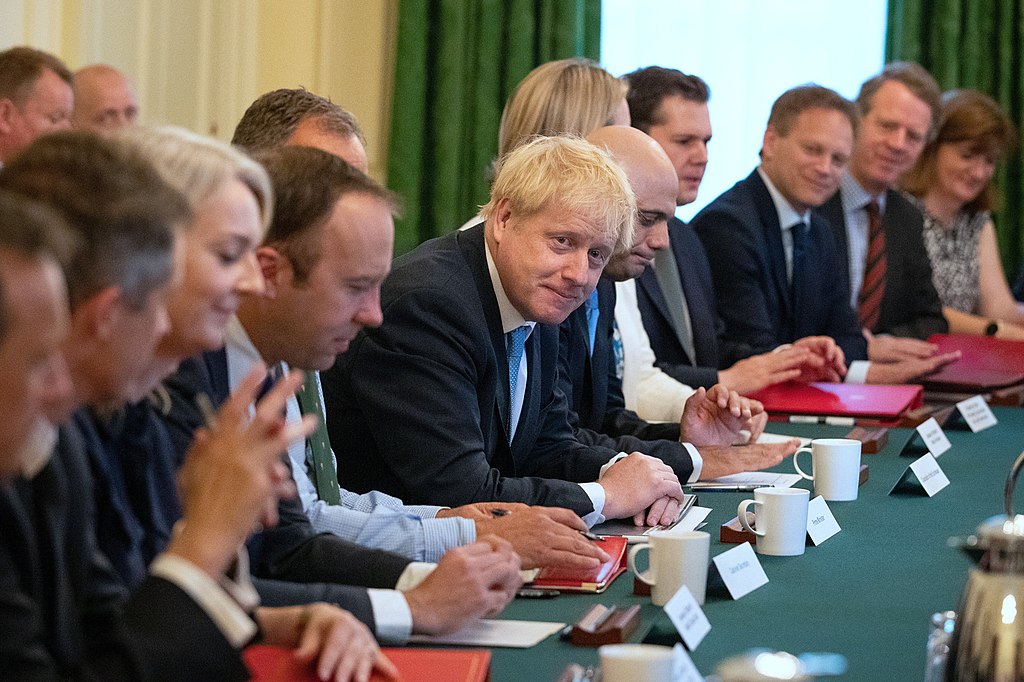
Prime Minister Boris Johnson at his first Cabinet meeting in Downing Street, 25 July 2019.
Official photograph via Wikimedia Commons.

I looked again at the decisions of the Johnson government. Should they have followed my instincts? No lockdown. Shield the elderly and the vulnerable, like my elder daughters immuno-deficient boyfriend, but let all normal life continue. Let the virus rip. Let the football league play out its conclusion and more to the point let out beloved Dundee Stars Elite Ice Hockey Club break our hearts and miss the playoffs. Such a government would probably have fallen within days, battered by the broadcast media, backbench rebellion and a nation that preferred to be kept safe from the unknown that they feared. Had they survived the month, then the elderly who by choice refused to be shielded would have pitched up in their thousands at A&E, to be faced with experienced nurses like my wife who triaged them on the doorstep and sent many of them home to die, to preserve the ICU beds for those who could be saved. Instead of admitting them so that they could die with every bit as much certainty. Had he survived the first month, Johnson would have fallen regardless and nation would be traumatised by the memory of grandparents sent home to die

Had I been in his shoes, I too would have sued for peace. My nation demanded it of me. I would have convinced myself it was the right thing and when the chest pain and cough arrived, I would have felt relief that I had made the correct call. I would have looked at the Malice of Piers Morgan and convinced myself that I was still moderate. I would have dismissed the feeble objections of lunatic libertarians.

When it’s over we can shave the heads of a few easy victims and vilify a few who enjoyed it too much. But I collaborated too.

May 6, 2020

Essential private sector workers and non-essential government workers

Filed under: Business, Economics, Government — Tags: , , — Nicholas @ 03:00

A couple of articles at the Foundation for Economic Education look at the arbitrary division of peoples’ jobs into two broad categories:

In a recent TV appearance with Dana Perino on The Daily Briefing, [Mike] Rowe made it clear he’s not a fan of the terms “essential” and “non-essential” worker. The problem with such a view, Rowe said, is that such terms have little actual meaning and the economy makes no such distinction.

“There’s something tricky with the language going on here, because with regard to an economy, I don’t think there is any such thing as a nonessential worker,” Rowe said. “This is basically a quilt … and if you start pulling on jobs and tugging on careers over here and over there, the whole thing will bunch up in a weird way.”

Rowe’s message is precisely what FEE president and economist Zilvinas Silenas was getting at in a recent article published at Townhall.

    Allowing politicians to decide which businesses and products are “essential” is an invitation for disaster. If we continue to deny these businesses the ability to do the one essential thing they are best at — providing goods and services to millions of everyday Americans — we risk more than unemployment or recession of stock price plunge. We deprive ourselves of the best resource — our people — during the time of need.

The truth is, all workers are essential.

Unfortunately, all too often what is deemed “essential” is simply what’s convenient to state leaders making the decisions. Few would suggest that liquor store owners are inherently more essential than pizza parlor owners — except perhaps state revenue collectors. No doubt this is the same reason Michigan Gov. Gretchen Whitmer concluded that lottery tickets are essential, but gardening seeds are not.

Liquor stores and lottery tickets aren’t especially “essential” to Americans, just state budgets. But as one Washington State sheriff noted in April, this seems to be the criteria state leaders often use to determine what is “essential” and “non-essential”: whether it helps the government’s bottom line.

When the state picks winners and losers it’s not only unfair, however. It’s also destructive.

In the other piece, J. Kyle deVries points out that government cannot be immunized from the economic harm the shutdown has and continues to inflict on the private sector:

So far millions in the private sector have lost their jobs or have been furloughed — but not many in government have. Many government employees continue to get salaries and benefits despite not working. Their agencies most certainly will not have as much work to do since major portions of the economy are closing down. Many agencies won’t even be needed any longer, but you better believe they will continue to be funded and probably expanded over time. That is outrageous. As we suffer economically, government should not be exempted.

This phenomenon is truly confounding and unfair. After all, government does not exist without taxes and taxes can only come from people who produce and earn a living — in other words, the private sector. The private sector supports government employees who, on average, receive higher pay, better perquisites and much better retirement plans. That should change. As we restructure our economy in the wake of the coronavirus, government should be restructured as well.

Businesses have no guarantee they will remain in business — they must provide their customers with a quality product or service at a competitive price or they will go bust. But government agencies remain in place for life, even if they continue to provide lousy services at outrageous expense. Government needs to show us they are with us during this fight. Part of doing so is to take a hard look at various agencies and departments to see if they can be improved or if they need to be eliminated. Before you say that would be difficult, let’s look at some obvious choices.

May 5, 2020

The perverse incentives of the Wuhan Coronavirus outbreak

Filed under: Economics, Government, Health, Media — Tags: , , , — Nicholas @ 03:00

David Warren has clearly taken his cynical pills today:

The daily count of deaths from the Red Chinese Batflu is among the prized, scare-mongering features of our mass media. I am among those who consider these numbers to be significantly overstated, for a reason that Nikolai Gogol would understand. Each corpse is worth cash to some public authority, usually from a higher authority; and as always, finally from the taxpayers. Each also saves money for government programmes, that can be reallocated to the purchase of new votes. As the corpse providers from this virus are very old, and suffering from other life-threatening conditions, in almost every case, this statistical inflation is easy to perform. Death certificates are issued for any who died with “Covid-19,” whether or not they died from it, and more are then added of those who were never tested. Anything respiratory will do. It’s all judgement calls — on which side of the bread is buttered.

Compare if you will the Hong Kong Flu of 1968 and 1969. I was just reading a memoir, from down that memory hole. The death toll was actually higher then, than ours is now, and from within a smaller population; the victims included children and the young. Yet there were no interruptions in economic life; no public emergency theatricals; and at the height of the second wave of that scourge, we had events like Woodstock. (Those were the days, my friend.)

A neat way to correct for all our “judgement calls” might be to look at overall death rates, and see if they have risen or fallen. It is too early to get a clear view, but soon it may be too late, for vested interests will have tampered with them. All my life I have been learning to trust statistics, less — especially from those who dress in labcoats and affect that earnest look. Sometimes an exception must be considered, however. An unpredictable minority may be honest; some others might get numbers right by mistake.

May 4, 2020

Government “problem solving” is an oxymoron

Antony Davies and James R. Harrigan explain why you should back away quickly when you hear a variant of “We’re from the government and we’re here to help”:

A central theme of our recent book, Cooperation & Coercion, is that all governments are hamstrung when they attempt to fix problems. Policymakers suffer from the knowledge problem: they don’t know enough to foresee every eventuality that will follow from what they do. Politicians see a problem, speak in sweeping statements, then declare what will happen, assuming their edicts will settle matters. But that is always just the beginning. More often than not, all manner of unintended consequences emerge, often making things worse than they were before their policies went into effect.

Consider the United States’ three high-profile wars against common nouns over the past half-century. Lyndon Johnson declared a War on Poverty in the 1960s, Richard Nixon a War on Drugs in the 1970s, and George W. Bush declared a War on Terror in the early 2000s.

How are those wars working out? Because a back-of-the-envelope calculation indicates that we have spent somewhere in the neighborhood of $23 trillion in our attempt to eradicate poverty, drugs, and terror. Not only have we not won any of these wars, it is unclear that any of them can be won. These three so-called wars have managed to saddle future generations of taxpayers with unprecedented debt. And, as is the case with all coercive endeavors, policymakers ask us to imagine how bad things would have been had we not spent the trillions we did spend. And then they ask for even more money. So now we have unwinnable wars along with institutionalized boondoggles to support them.

We see the same sort of thing happening now in the face of the COVID-19 threat that has induced the largest panic attack in world history. In the name of safety, policymakers have shut down myriad productive endeavors. And there will be a raft of unintended consequences to follow. We are already seeing them manifest, and they portend potential disaster as supply chains fail.

The first cracks in US supply chains appeared in the meat industry. Smithfield Foods, reacting to a number of workers contracting the virus, shut down its Sioux Fall plant. Kenneth M. Sullivan, President and CEO, explained in a press release that, “the closure of this facility, combined with a growing list of other protein plants that have shuttered across our industry, is pushing our country perilously close to the edge in terms of our meat supply.” But it’s not just the meat plant that’s implicated. It’s everyone from the cattle farmer to the person who cooks dinner, and there are a number of people who have a place in that process who might first escape attention. The people who make packing materials needed to ship food, the maintenance workers who service machines up and down the supply chain, the truck drivers who move product from one place to another, the grocers who sell the product, the daycare workers who care for the grocers’ children so the grocers can work, and many, many more are all at risk.

[…]

In declaring some jobs “necessary” and others not, in focusing on one supply chain versus another, policymakers show how little they know about the nation’s economy. In their view, they can simply declare things they want to happen, and then those things will happen. But that is not how economies work. An economy is the sum total of everyone’s activities, and when the government declares that something must happen, all kinds of other things happen too.

Consider how all the “non-essential workers” have been sent home for the past two months. Who gets to declare which workers are non-essential to the economy, and by what standard? Most assumed that politicians had the correct answers to these questions. But, as we are discovering, there is no such thing as “non-essential” workers. All workers are essential. How do we know? Because their jobs existed. Profit-driven businesses do not create non-essential jobs. Those people’s jobs were essential to their employers. Further, those people’s jobs were incredibly essential to the people themselves. They need their wages to pay the rent, buy their food, make their car payments, and for everything else that makes their lives livable.

But policymakers simply declared them non-essential, as if there would be no fallout from that decision.

May 2, 2020

Drawing some conclusions from our Wuhan Coronavirus experiences

At Catallaxy Files, Justinian the Great provides an expanded list of nine lessons we should learn from our still ongoing Wuhan Coronavirus (aka “Chinese Batflu”, “Kung Flu”, “Bat-biter Bronchitis” and other names our betters insist we not use):

1. Models are not infallible.

When dealing with complex subject matter involving lots of uncertainties, unknowns and data gaps, modelling will almost certainly be wrong. That doesn’t make them worthless but nor does it mean they should be elevated to infallible status and acted upon as though they constitute proof of something.

If we can’t get epidemiological models right involving trajectories of months what is the chance of climate models being correct considering they involve substantially greater uncertainty, unknowns and data problems involving trajectories of decades to centuries?

[…]

2. Experts can get it wrong.

The pandemic has shown that epidemiologists and health experts the world over have got COVID-19 wrong at one stage or another.

The most famous example is the Imperial College model that forecast 2.2m deaths in the United States and over 500,000 deaths in the UK. Critics have argued this was never plausible but it was the catalyst for UK lockdown policy.

[…]

3. Experts can disagree

Experts can disagree and this is normal in science (and policy making).

During the pandemic, health experts across the world have disagreed over epidemiology models (e.g. R0) ranging from thousands of deaths to millions, over treatments (i.e. the efficacy of anti-virals and anti-malarials), over who and how to test (targeted (symptomatic) versus broad based (even antibody testing), how to record cases and fatalities (e.g. Italy counting deaths with COVID the same as due to COVID, Belgium recording deaths suspected to be COVID related but not verified), the origin and nature of the virus (laboratory/synthetic or wet market/natural), over what the public health response should be (full lockdowns, targeted lockdowns, Sweden (minimal) or something in-between), and the susceptibility of children to the virus, leading to divergence on school closures.

[…]

4. The Precautionary Principle – No such thing as a free lunch

The COVID-19 crisis is a classic case of the precautionary principle in action. The policy measures put in place have been justified by the worse case scenarios of epidemic models forecasting mass deaths and hospital systems in collapse. These scenarios have been hyped up by an alarmist media presenting such scenarios / predictions as established fact.

Part of the problem stems from politicians abdicating responsibility for decision-making and hiding behind health experts as human shields. These experts have nothing to gain and everything to lose from underestimating the epidemic. No-one wants to be blamed for hundreds of thousands of preventable deaths.

[…]

5. If you can’t trust the WHO in a pandemic why would you trust the IPCC on climate change?

The neo-liberal (in international relations terms) notion that the UN (and other international institutions) are independent actors working altruistically for the global good has been blown to bits during the COVID-19 pandemic.

The conduct of the WHO and its complicity with China throughout the pandemic has demonstrated what realists have always known, i.e. international institutions are not independent actors, but instead reflect the interests of great powers in the international system.

[…]

6. If you can’t trust the Chinese in a pandemic how can you trust them on climate?

The COVID crisis also demonstrates why should not trust a communist dictatorship to act truthfully, transparently or ethically, much less put global interests above national interests even in times of an international crisis.

If we can’t believe China about infection rates, how can we believe their carbon accounting? If we can’t trust China to reduce the spread of a virus, how can we trust China to reduce the growth in CO2 emissions? If we believe China has captured/corrupted the WHO how do we know it hasn’t captured/corrupted the IPCC? If China will prioritise national interest in a health crisis, why won’t China prioritise national interest in a climate crisis? If we don’t believe China action/excuses in a pandemic why would we believe China action/excuses on climate change? If we can acknowledge China is trying to exploit the health crisis geo-strategically (i.e. South China Sea military manoeuvres) and geo-economically (belt and road and coercive threats), why will it not exploit climate change in the exact same way?

May 1, 2020

Theodore Dalrymple on the authoritarian innovations we’ve so meekly accepted thanks to the Wuhan Coronavirus epidemic

Filed under: Britain, Government, Health, Law, Liberty — Tags: , , , , , — Nicholas @ 03:00

Getting back to “normal” is going to be much more difficult now that the powers-that-be know for certain that we’re all quite comfortable tugging the forelock and bending the knee given the right kind of orders:

Armed Metropolitan Police near Downing Street in London.
Photo by Stanislav Kozlovskiy via Wikimedia Commons.

As for the collective or political lessons of the epidemic, I fear them more than rejoice in them. They seem to me likely to reinforce a tendency to authoritarianism, and to embolden bureaucrats with totalitarian leanings. One of the surprising things (or perhaps I should say the things that surprised me) was how meekly the population accepted regulations so drastic that they might have made Stalin envious, all on the say-so of technocrats whose opinions were not completely unopposed by those of other technocrats. There was, as far as I can tell, no popular demand for the evidence that supposedly justified the severe limitations on freedom that were imposed on the population. I suppose an encouraging interpretation of this readiness of the population to do as it was told is that it demonstrated that, all the froth and foam of opposition to political leaders notwithstanding, fundamentally the authorities were trusted by the population to do the right thing. Much as we lament, therefore, the intellectual and moral level of our political class, there are limits to how much we despise it. In other words, we believe that our institutions still work even when guided or controlled by nullities.

A less optimistic interpretation, as usual, is possible. Our population is now so used to being administered, supposedly for its own good, under a regime of bread and circuses, that it is no longer capable of independent thought or action. We have become what Tocqueville thought the Americans would become under their democratic regime, namely a herd of docile animals. Only at the margins — for example, the drug-dealers of banlieues of Paris — would the refractory actually rebel against the regulations, and that not for intellectual reasons or in the name of freedom, but because they wanted to carry on their business as usual. (I should perhaps mention here that I number myself among the sheep.)

In Britain, at any rate, the epidemic revealed how quickly the police could be transformed from a civilian force that protects the population as it goes about its business into a semi-militarised army of quasi-occupation. This transformation is not entirely new, alas; it has been a long time since the policeman was the decent citizen’s friend. Under various pressures, not the least of them emanating from intellectuals, he has become instead a bullying but ineffectual keeper of discipline, whom only the law-abiding truly fear.

I first sensed this development many years ago this when a traffic policeman asked to see my licence. “Well, Theodore …” he started, calling me by my first name when a few years before he would have called me “Sir.” This change was significant. I had gone from being his superior, as a member of the public in whose name he exercised his authority, to being a kind of minor, whom it was his transcendent right to call to order. He was now the boss, and I was now the underling.

The change in uniform, too, has worked in the same direction. Traditionally, since the time of Sir Robert Peel, the uniform of the British policeman was unthreatening, deliberately so, his authority moral rather than physical. Now, he is festooned with the apparatus of repression, if not of oppression, though in effect he represses very little of what ought to be repressed in case it fights back. The modern police intimidate only those who do not need deterring; those who do need it know that they have nothing much to fear from these whited sepulchres, these empty vessels. Incidentally, the French police have undergone a similar deterioration in appearance: gone is the reassuring képi in favour of the moron’s baseball cap, and some of them now dress in jeans with a black shirt with the word POLICE across its back, which is not difficult to imitate and makes it impossible to know whether a policeman really is a policeman or a lout in disguise.

French Gendarmerie at the Eurockéennes of 2007.
Photo by Rama via Wikimedia Commons.

The Covid-19 epidemic has come as a great boon to the British police. Increasingly criticised for their concentration on pseudo-crimes such as hate speech at the expense of neglecting real crimes such as assault and burglary, to say nothing of organised sexual abuse of young girls by gangs of men of Pakistani origin, they could now bully the population to their heart’s content and imagine that in doing so they were performing a valuable public service, preserving the law and public health at the same time. Thus they transformed their previous moral and physical cowardice into a virtue.

Of course, in bullying the average citizen who was very unlikely to retaliate they took no risks, unlike with genuine wrongdoers and law-breakers, who tend to be dangerous; but the fact remains that most individual policemen joined the force motivated by some kind of idealism, a desire to do society some service, though they soon had these naïve fantasies knocked out of them by the morally corrupt or bankrupt leadership of the hierarchy which owes its ascendency to its willingness to comply with the latest nostrums of political correctness. The faint embers of the policeman’s initial idealism were no doubt rekindled by the opportunity to prevent the spread of the virus, as they supposed that they were doing, but some of them, at least, far exceeded even their flexible and vaguely-defined authority and began to inspect citizens’ shopping bags to determine whether they were hoarding goods that might be in short supply. This was a step too far, and at last there were protests; the police desisted.

April 30, 2020

Desperate Mayors React to Coronavirus: A Timeline

Filed under: Government, Health, Humour — Tags: , , — Nicholas @ 04:00

ReasonTV
Published 29 Apr 2020

The past few months have been difficult on politicians. It’s hard to look like you know what you’re doing when you have no idea what you’re doing.

Performed by Austin Bragg and Andrew Heaton. Written by Austin Bragg, Meredith Bragg, and Andrew Heaton. Edited and Produced by Austin Bragg. Cameras by Andrew Heaton and Austin Bragg.

Music: “Wholesome,””Marty Gots a Plan,” “Anamalie,” “Anguish,” and “The Cannery” by Kevin MacLeod used under an Attribution 3.0 Unported (CC BY 3.0) license.

CITIZENS! Report any non-socially-distanced deviationist behaviour to this number immediately!

Filed under: Cancon, Government, Health, Liberty — Tags: , , , , , — Nicholas @ 03:00

In Maclean’s, Jen Gerson admits that she has not (yet) reported any of her neighbours for their failure to obediently follow the rules of social distancing. She must be reported to the appropriate state authorities!

Commemorative badges of the German Democratic Republic’s Ministry of State Security (Stasi).
Wikimedia Commons.

Look, I know I’m going to get flak for this, but someone needs to say it: think twice before you narc on your neighbours.

Snitching may work, but the downsides to citizen-policing are grim — to say nothing of the historical antecedents.

Firstly, “you can play havoc with somebody just by snitching on them with an anonymous snitch line,” noted Sharon Polsky, the president of the Privacy and Access Council of Canada. In addition to the risk of malicious reports, if people of colour aren’t disproportionately subject to snitching, I’d be shocked.

Totalitarian states turned neighbour against neighbour and family against family, in order to maintain the illusion of social cohesion.

Authoritarians use this tactic because there are never enough police or soldiers to force compliance upon an entire population, not unless everyone consents to become an agent of his or her own mutual oppression.

The term “fascism” has an innocent history. It comes from the Roman term “fasces,” which means a bundle of sticks bound together. One stick breaks, but the fasces remains strong. It’s another term for unity. That’s what makes it so seductive, especially in times of uncertainty and mortal dread. We’re all in this together. Nary a stick shall stray.

“We are now living amid the very tactics that the West [once] criticized,” Polsky added. “With state controls on commerce, industry, speech, and media.”

The federal government, for example, is already considering legislation that would bar the spreading of misinformation about COVID-19 online.

“Extraordinary times require extraordinary measures and it is about protecting the public,” Privy Council President Dominic LeBlanc told reporters with a line that should give any student of history the creeps.

“This is not a question of freedom of speech. This is a question of people who are actually actively working to spread disinformation, whether it’s through troll bot farms, whether [it’s] state operators or whether it’s really conspiracy theorist cranks who seem to get their kicks out of creating havoc.”

No doubt LeBlanc et al are operating under the noblest of intentions. But repressive measures buy conformity at a terrible price. Snitch lines turn us against one another. They teach us to fear the people we need to survive, thus making us more dependent on the apparatus of the state.

« Newer PostsOlder Posts »

Powered by WordPress