
World War Two
Published 14 Feb 2026Death of Democracy returns to Nazi Germany in Q3 1933. See Hitler enforce one‑party rule, sign the Reichskonkordat, tighten propaganda and press control, and expand work programs that feed rearmament. From July to September, follow the legal and cultural Gleichschaltung that normalizes terror and reshapes Europe’s future in this episode.
(more…)
February 15, 2026
How to Make The Economy Look Better Than It Is – Death of Democracy 03 – Q3 1933
Comments Off on How to Make The Economy Look Better Than It Is – Death of Democracy 03 – Q3 1933
WW1: The Siege of Przemyśl: Austria-Hungary’s Horror Story | EP 6
The Rest Is History
Published 11 Sept 2025After endeavouring to wreak their revenge on Serbia, what would be the greatest hammer blow to the Austro-Hungarian Empire during the First World War? With Leviv having fallen apocalyptically to the Russian hordes, what had gone so wrong? How might the war have been brought to an end before Christmas of 1914? And, with the darkness gathering around the Austrian defences, could the great fortress of Przemyśl hold out against the Russian barrage for a second time?
Join Dominic and Tom as they discuss the fall of the Austro-Hungarian Empire and the Russian advance, on the brutal Eastern front, as the first year of the First World War grinds bloodily on…
Alexander Watson’s The Fortress, the book heavily referenced in this episode, is available to purchase here: http://bit.ly/41NKRrq
______00:00 – Cold open: “intricacies of war” reading
01:13 – Adobe
01:51 – Nick Lloyd & the Tyrolean Kaiserjäger
03:26 – Austria-Hungary’s coming unraveling: setting the stakes
06:50 – Why Przemyśl is a fortress; garrison & geography
08:31 – August 1914: Conrad’s plan and its unraveling
17:48 – Catastrophe for the Habsburg army
18:32 – The siege begins
24:50 – Pendulum swings back; Russians advance again
27:01 – Civilian exodus chaos; encircled again (8 Nov)
28:10 – Uber
28:50 – Folio Society
30:17 – Russian occupation & pogroms in Galicia (1914)
31:39 – War aims: Russification under Count Bobrinsky
33:00 – Russian antisemitism context; pogroms & deportations
37:05 – Second siege strategy: starve them out; General Kusman
38:04 – Early aerial bombing of civilians (Dec 1)
39:10 – Christmas Eve gestures; brief humanity, then darkness
41:04 – Conrad’s Carpathian rescue bid (23 Jan): campaign from hell
42:02 – Carpathian horrors; Tyrolean memoir; morale collapses
47:10 – POW fate: officers vs men; camps & Murmansk railway
49:01 – Austria-Hungary reels from the disaster
50:17 – Germany’s opinion of Austria Hungary
51:13 – Italy cuts a deal, joins war; the Italian Front beckons
53:38 – Tsar’s visit; enforced Russification in Przemyśl
55:14 – Mackensen’s offensive; Germans “liberate” Przemyśl; Austria eclipsed
56:10 – Foreshadowing WW2?
(more…)
Comments Off on WW1: The Siege of Przemyśl: Austria-Hungary’s Horror Story | EP 6
February 14, 2026
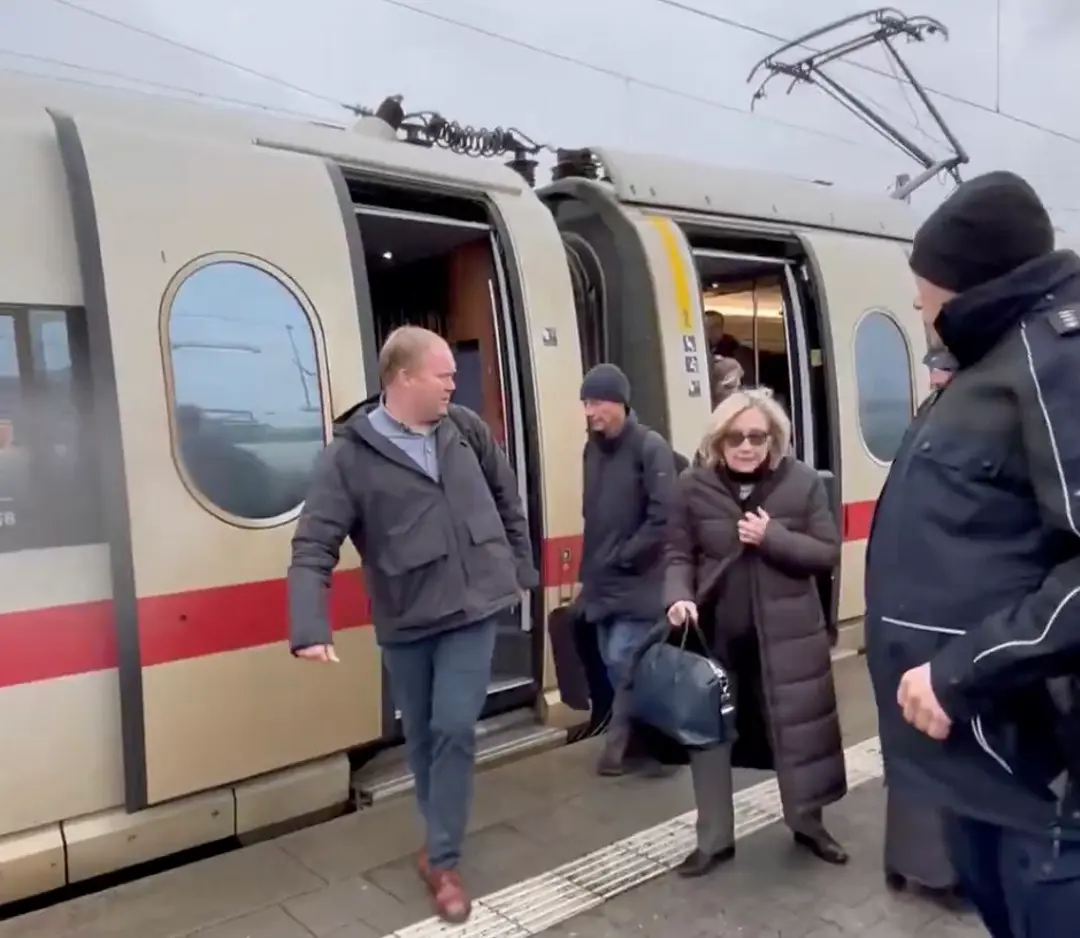
Former First Lady suffers unplanned mingling with the plebs in Germany
eugyppius offers some news from Germany, one of the many western nations eagerly plunging toward cultural suicide in a race with Canada, Australia, the UK and other formerly “first world” nations:
Yesterday Lufthansa pilots and cabin crews went on strike, forcing Hillary Clinton to slum her way on the train to the Munich Security Conference.
[…] you can see the former First Lady and U.S. Secretary of State disembarking from her filthy Deutsche Bahn Intercity Express from Berlin, which had naturally suffered an electrical fault that disabled the restaurant car and with that, all possibility of coffee. Munich Central Station is one of the worst train stations in all of Germany; the place is awash in trash and smells always of urine and french fries. It is a very minor pleasure, watching political elites being forced to navigate the very same dysfunctional landscape all of us have to deal with every day.
“eugyppius,” said absolutely nobody ever, “why has it been so long since you last updated us on Germany? Is nothing going on? Tell us something please.”
The problem is that German politics have degenerated so much in the past year that it is becoming very hard to write abut them.
In the post-Merkel era under Olaf Scholz, insane new crazy bad inadvisable unbelievable stuff would happen almost every day; in the post-post-Merkel years under Friedrich Merz, absolutely nothing can happen no matter how bad things get. After an unstable period comprising the second half of Covid and the pious afterglow of St. Greta (before the latter took up her charitable sailing initiatives), we have settled into a new order. Imagine an airplane piloted by heedless methed-out lunatics. For a brief time they enjoyed aerobatics well exceeding the engineering specifications of their craft, until they snapped a few flight control cables, and now they have become the prisoners of their own recreations as the altimeter ticks down and the ground rushes up at them.
Metaphors are fun but specifics are healthier. As everybody knows, the centre-right Christian Democrats are in a coalition with the newly hard-left Social Democrats, and the latter are determined to block every last initiative, reform and legislative proposal, however mundane or plainly necessary or routine. A little over a year ago, I wrote that German politics had become stuck, and that was true enough back then. What is true right now, is that they have achieved a stage well beyond stuck. The federal government is in a coma, an indefinite vegetative state, on life support – totally paralysed and neither dead nor alive.
We’ve gone over the reasons so much, I hesitate to recite them again, but I will. At the root of our present crisis is a shift within the German left that has had cascading consequences for the party system as a whole. Basically, the left has become both more scattered and more extreme in the last five years. They have become more scattered, because climatism is decaying and this process of ideological unravelling means that leftists have lost a crucial focal point used to rally activists and moderates alike. They have become more extreme, because the general rightward shift in politics is depriving the Social Democrats of their traditional moderating, working-class constituents. These are migrating steadily to the Christian Democrats and ultimately to Alternative für Deutschland.
As the left slowly boils down to their activist base, they become more radicalised. The Social Democrats are no longer the family-friendly centre-left party of Gerhard Schröder. They want to fight, they want to burn things down, they want hell. The very same rightward shift, meanwhile, has had a nearly opposite effect on the CDU. They have lost many of their most engaged constituents and no few members to the AfD. What remains is a husk of dull, uninspired careerists, eager to maintain their good regard with polite society and their regular schedule of polite evening talk show appearances. To break the present impasse, Merz or those around him must act decisively and make facts. He needs to fire all his SPD ministers, form a minority government and achieve some kind of rapprochement with the AfD. Alas, neither Merz nor anybody else in CDU leadership has the mettle for that kind of fight, which would also set off a series of catastrophic revolts within the CDU itself. Thus everything must remain frozen and broken indefinitely, while things get worse and worse and our ability ever to fix them decays.
Comments Off on Former First Lady suffers unplanned mingling with the plebs in Germany
February 13, 2026
Lines of Fire: Operation Husky – The Invasion of Sicily 1943 – WW2 in Animated Maps
TimeGhost Cartographic
Published 12 Feb 2026July, 1943. With the German summer offensive in the East well underway, and Allied operations in North Africa wrapped up, a decision is made to strike Axis Europe on the ground for the first real time. Sicily shall be their battleground, and the omens are good. Still, landing and commanding a huge multinational force in hostile territory is a challenge the Western Allies have not had to face head-on before, but one they must overcome if they wish to have any shot of defeating Hitler and Mussolini once and for all.
00:00 Intro
01:13 Background
04:42 Disposition
07:32 The Landings & Initial Fighting
09:34 Fighting Across the Island
11:56 Aftermath
16:38 Conclusion
(more…)
Comments Off on Lines of Fire: Operation Husky – The Invasion of Sicily 1943 – WW2 in Animated Maps
February 12, 2026
Inside the Nazi State: One Man’s Descent Into Darkness
HardThrasher
Published 9 Apr 2024How did one man, Rolf Engels, go from student, to victim, to head of the SS Rocket Weapons programme reporting directly to Himmler? How did the Nazi state work, and how did a man like Rocket Rolf navigate the game of snakes and ladders and somehow come out on top?
(more…)
Comments Off on Inside the Nazi State: One Man’s Descent Into Darkness
February 8, 2026
WW1: The Eastern Front in 1914 | EP 5
The Rest Is History
Published 8 Sept 2025While the Western front was raging following the outbreak of the First World War in 1914, what was unfolding on the Eastern Front? Why was it an even bloodier and more brutal arena than the West? As Austria took on its great antagonist — the spark of the entire war — Serbia, why were its early campaigns constantly blighted by disaster? What terrible mistake did Russia, with its behemoth of an army, make? How would its dramatic war with Germany unfold? And, would this be the beginning of the end of the Habsburg Empire?
Join Dominic and Tom as they discuss the outbreak of the First World War on the Eastern Front, and its early clashes.
—————————————————
0:00 Adobe AD
0:50 Intro
3:27 The Eastern Front explained
5:15 The Serbian Front
33:23 Uber AD
34:02 Folio Society AD
35:33 Russia invades Germany
(more…)
Comments Off on WW1: The Eastern Front in 1914 | EP 5
How Legal Immunity Becomes Absolute Power – Death of Democracy Q2 1933
World War Two
Published 7 Feb 2026In spring 1933, Nazi Germany shows how dictatorship becomes normal. This episode of Death of Democracy follows the regime’s second quarter in power, from the first state-organized antisemitic boycott to the destruction of free trade unions and the takeover of the courts. Step by step, democratic institutions are hollowed out through fear, legality, and propaganda. Death of Democracy reveals how tyranny doesn’t arrive overnight — it is made to feel ordinary.
(more…)
Comments Off on How Legal Immunity Becomes Absolute Power – Death of Democracy Q2 1933
February 6, 2026
Dresden Part 2 – Firestorm Dresden: Three Days In Hell!
HardThrasher
Published 5 Feb 2026In “Firestorm Dresden: 3 Days in Hell”*, we’ll unpack the bombing and subsequent firestorm in February 1945. We’ll look at how first the RAF night raids and then the US 8th Air Force daylight attacks unfolded, the damage they did and the horrific impact on the ground. We’ll look at how the aftermath shaped the myths and understanding surrounding the raid, and the fate of Arthur Harris and those who’d planned the raid.
* Proof once more, as if it were needed, how shit AI is — I have, apparently, to put the title of the video into the first words in the description to attract Google’s attention … I am so sorry to brutalise the English language like this.
[NR: Part one was posted here on January 22nd, should you want to watch it first.]
00:00 – 02:22 – Opening
02:26 – 06:20 – The weather
06:20 – 16:12 – The attack
16:18 – 25:17 – Horror on the ground
25:22 – 29:26 – USAAF Attacks
29:30 – 34:30 – Dealing with the bodies
34:34 – 44:59 – Reaction in the west
45:03 – 48:06 – The Soviet view
48:10 – 54:27 – Summing up and close
(more…)
Comments Off on Dresden Part 2 – Firestorm Dresden: Three Days In Hell!
February 1, 2026
How to End Democracy in 60 Days – Death of Democracy Q1 1933
World War Two
Published 31 Jan 2025This episode of the history documentary series “Death of Democracy” covers Q1 1933 with Hitler’s appointment as chancellor, the Reichstag Fire, Reichstag Fire Decree, Enabling Act, rise of Nazi terror, Gleichschaltung, and media control, explaining how Weimar Germany’s democracy collapsed in just sixty days.
(more…)
Comments Off on How to End Democracy in 60 Days – Death of Democracy Q1 1933
January 31, 2026
WW1: Hell in the Trenches | EP 4
The Rest Is History
Published 4 Sept 2025What happened at the crucial, bloody, Battle of Ypres in October 1914? How did the battle come about? Why did the Germans and the British fight each other so brutally and for so long to take Ypres? What made the fighting so particularly violent? How were the British able to repel the relentless German onslaught time after time? What was the famous “Kindermord” — “the Massacre of the Innocents” — in the German army, and how true was it? And, what would be the outcome of this almighty clash?
Join Dominic and Tom as they discuss the terrible Battle of Ypres; its significance to the First World War overall, and its consequences for the rise of Hitler in Germany later on….
0:00 – Adobe Express AD
0:49 – Intro: To the Front
3:26 – The Kindermord Myth
5:02 – Race to Ypres
11:04 – The Ypres Salient
17:07 – Crisis at Gheluvelt
23:29 – Uber & Folio Society ADs
25:43 – November Slaughter
32:05 – The Langemark Legend
44:02 – Why the War Didn’t Stop
(more…)
Comments Off on WW1: Hell in the Trenches | EP 4
January 27, 2026
QotD: “Two world wars and one World Cup!”
As a child of postwar England, I found that there was no love lost for the Germans. So I set out to find that lost love. I don’t remember how many times I encountered unthinking hostility towards them, but it was often enough to make me think there must be something to be said for them.
“Don’t let’s be beastly to the Germans,” Noël Coward had jeered in 1943. “It was just those nasty Nazis who persuaded them to fight.” It hadn’t been true then, of course, and the wartime generation still hadn’t quite forgiven the Germans, not only for their crimes against humanity, but for bouncing back faster than the British in the 1950s.
Erhard’s “economic miracle” had rubbed salt in the wounds of a nation that had sacrificed its status as a great power in order to save Europe. And now that same Europe had cold-shouldered the British, excluding us not once but twice from their new “economic community”. In the 1960s and 70s it was often the British, not the Germans, who felt despised and rejected. After 1966, Germanophobic football fans would chant “Two world wars and one World Cup”, but that was mere bravado. Everyone knew that the boot was now firmly on the other foot — and in many British eyes, it was a jackboot.
Daniel Johnson, “How I discovered Germany”, The Critic, 2020-08-02.
Comments Off on QotD: “Two world wars and one World Cup!”
January 25, 2026
Germany’s Conquerors of the Skies – Luftwaffe Aces – WW2 Gallery 07
World War Two
Published 24 Jan 2026From the legendary Erich Hartmann to the intense but brief career of Hans-Joachim Marseille, today we dive into the lives of five of Germany’s most elite pilots from World War 2. This is the first gallery episode we’ve done in some time, but there could be more in the pipeline: that all depends on you. If you like this format, let us know in the comments. We’d love to hear what you’ve got to say, and whether you want us to cover Allied and other Axis aces too.
(more…)
Comments Off on Germany’s Conquerors of the Skies – Luftwaffe Aces – WW2 Gallery 07
January 23, 2026
WW1: 1 Million Vs 1 Million at the Marne | EP 3
The Rest Is History
Published 1 Sept 2025What extraordinary events saw the French — already on the brink of defeat — take on the formerly formidable German army in a remarkable counter-offensive on the 4th of September, in France, in a clash that would later become known as the Miracle on the Marne? Why was this such a decisive moment in the events of the First World War How did it relate to the famous Schlieffen plan? Did it really see the French charging into battle in Renault taxis? And, why did it become one of the most legendary moments in all of French history?
(more…)
Comments Off on WW1: 1 Million Vs 1 Million at the Marne | EP 3
January 22, 2026
Dresden Part 1 – Targets, Tangents & Genocide
HardThrasher
Published 20 Jan 2026Was Dresden a war crime or a late-war military decision made in cold blood? The firebombing of Dresden (13–14 Feb 1945) remains one of the most infamous episodes of the WW2 history: a firestorm, a shattered city, and a death toll that still sparks argument today.
But most of what “everyone knows” about Dresden is wrong. In Part 1 of this two-part series, you and I will dig into the real reasons Dresden became a target. We also ask the uncomfortable questions: Was Dresden an “innocent” city? How Nazi was it? And what does Dresden reveal about the logic — and limits — of strategic bombing? And because this is my video and I’ll do as I damn well please, we’ll also do a quick overview of nearly 1,000 years of history, because why not. Thus in this you will also get the Northern Crusades, a discussion of pottery, a smattering of Central European history and long discussion of how the Nazis subverted power and used it to abuse people whilst being wildly incompetent at the basics
00:00 – Start
04:39 – Part 1 – A Brief History of Everything in Central Europe
17:36 – Rise of the Nazis and the Nuremberg Laws
30:25 – Military and Industrial Dresden
34:03 – Failure to Prepare for War
40:37 – How did it become a target?
52:37 – Survivor’s Club
(more…)
January 21, 2026
QotD: White elephant airports
If history teaches us anything, it’s that airports, like wrinkle creams which cost the GDP of a small country but couldn’t iron out a bedsheet, can be wildly overpromised and underdelivered. Western Sydney’s runway might yet join the vainglorious global herd of White Elephant Airports: majestic, expensive, and standing alone in a field wondering where everyone went.
Let’s take a safari.
Mirabel: Montreal’s Monument to Inconvenience
Built in 1975, Mirabel International was meant to replace Montreal’s Dorval Airport and usher in a new aviation era. Instead, it became the architectural embodiment of “We should’ve checked the map”. Located more than 50 kilometers from the city, it was so unpopular that passengers would rather fling themselves onto dogsleds than make the commute.
Eventually, Mirabel stopped pretending to be an airport and transitioned into its second act: a car-racing track and film set. Somewhere in Quebec there’s probably still a baggage carousel being used as a wedding dance floor.
Ciudad Real: A Billion-Euro Garage Sale
Spain saw Mirabel and said, “Hold my sangria”. Ciudad Real International Airport opened in 2009 with a €1.1 billion price tag, dreams of high-speed rail links, and the confidence of a Bachelor contestant in week one. Within three years, it had no flights, no buyers, and no shame.
It was eventually auctioned for €10,000, less than a parking space in Bondi or a bottle of champagne at a Sydney rooftop bar. One imagines the bidding process was just two blokes shrugging in a room and someone whispering, “Ten grand and a paella voucher?”
Berlin Brandenburg: German Efficiency, But Make It Chaos
If you’ve ever wanted to see what happens when a nation famous for precision tries on farce, just pay a visit to Berlin Brandenburg Airport. Construction began in 2006, with an opening scheduled for 2011. By 2015, it was such a national embarrassment that Berliners stopped making jokes about British plumbing to recover emotionally.
In 2020, it finally launched amid the global COVID pandemic, after delays caused by faulty fire systems, suspicious cables, and the ghost of every German engineer pacing in dismay.
Nicole James, “Australia’s New Albino Elephant Sanctuary (Now with Parking)”, The Freeman, 2025-10-16.


