
OTD Military History
Published 27 Jun 2023Programs like Lend Lease, Mutual Aid, and the Billion Dollar Gift were support from Canada and the United States that helped Britain with war supplies and material in the darkest days of World War 2.
(more…)
June 28, 2023
How to Fund a War: Lend Lease, Billion Dollar Gift, and Aid to Britain
Comments Off on How to Fund a War: Lend Lease, Billion Dollar Gift, and Aid to Britain
The Treaty of Versailles: 100 Years Later
Gresham College
Published 4 Jun 2019The Treaty of Versailles was signed in June 1919. Did the treaty lead to the outbreak of World War II? Was the attempt to creat a new world order a failure?
A lecture by Margaret MacMillan, University of Toronto
04 June 2019 6pm (UK time)
https://www.gresham.ac.uk/lectures-an…A century has passed since the Treaty of Versailles was signed on 28 June 1919. After WWI the treaty imposed peace terms which have remained the subject of controversy ever since. It also attempted to set up a new international order to ensure that there would never again be such a destructive war as that of 1914-18. Professor MacMillan, a specialist in British imperial history and the international history of the 19th and 20th centuries, will consider if the treaty led to the outbreak of the Second World War and whether the attempt to create a new world order was a failure.
(more…)
Comments Off on The Treaty of Versailles: 100 Years Later
June 27, 2023
“People’s patience in the face of the daily elitist provocations of Just Stop Oil is nothing short of Herculean”
The virtue-signalling lunatics of the various Extinction Rebellion sub-groups depend far more than they realize on the patience and tolerance of ordinary Britons who are just trying to get on with their daily lives. Wealthy, highly educated, privileged scions of the well-connected may very quickly learn that the well of tolerance they’re drawing from can run dry extremely quickly. Brendan O’Neill says even some of the movers and shakers of the donor class are starting realize the dangers their protest foot soldiers are running:
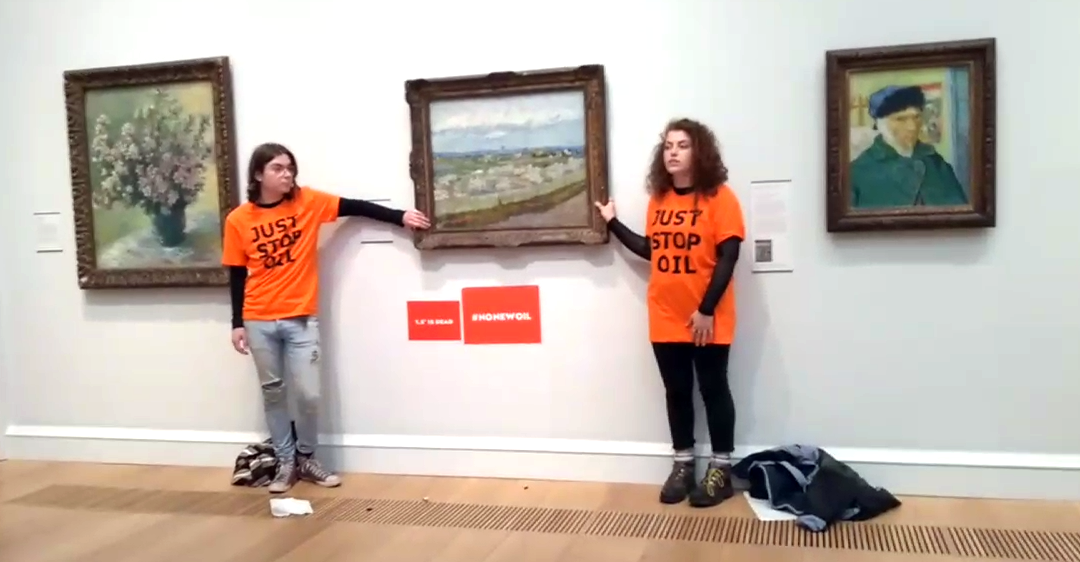
“Just Stop Oil Courtauld Gallery 30062022” by Just Stop Oil is licensed under CC BY-SA 4.0 

 .
.
So even one of Just Stop Oil’s wealthy donors is tiring of its classist stunts. Trevor Neilson, a co-founder of the Climate Emergency Fund, which has pumped money into Just Stop Oil, says the eco-irritants’ funereal, road-blocking marches for Mother Earth increasingly come off as “disruption for the sake of disruption“. You have “working people that are trying to get to their job, get their kid dropped off at school [and] survive a brutal cost-of-living crisis”, he says, and then along comes a “pink-haired, tattooed and pierced protester standing in front of their car”. It pisses people off, he said.
He’s not wrong. Anyone with eyes in their head can see that Just Stop Oil, and its mother movement Extinction Rebellion, is riling the workers of Britain. Imagine you’re trying to get to work to earn a crust in tough times and up pops a privately educated, possibly non-binary loon with multi-coloured hair to tell you in a voice breaking with juvenile emotion that Judgement Day is coming. The fainthearts of the liberal media are always aghast when an angry scaffolder or stressed trucker drags one of the green hysterics off the road, but I’m blown away by the restraint of the British public. People’s patience in the face of the daily elitist provocations of Just Stop Oil is nothing short of Herculean.
It is “counterproductive”, says Mr Neilson, to have pink-haired sons and daughters of privilege inconveniencing workers during a “brutal” economic downturn. Again, he’s not wrong. The class-war streak in eco-activism is undeniable. Many Extinction Rebellion types are descendants of money. Writer Harry Mount calls them “Econians”, a green twist on “Etonians”. They’re the “public-school boys and girls who rule the wokerati world”. A survey of 6,000 XR activists who brought London to a halt in April 2019 found they were “overwhelmingly middle-class [and] highly educated”. Anyone who walked through London that month will have heard “Cut carbon emissions!” being cried in cut-glass tones and understood right away that our great city was under siege by vengeful aristocrats still smarting from the Industrial Revolution.
Comments Off on “People’s patience in the face of the daily elitist provocations of Just Stop Oil is nothing short of Herculean”
Uncancelled History with Douglas Murray | EP. 05 Winston Churchill
Nebulous Media
Published 20 Dec 2022Andrew Roberts joins Douglas Murray on this episode to discuss Winston Churchill. The two discuss the soldier, writer and prime minister in detail, leaving nothing off limits. Should the British Bulldog stay cancelled?
(more…)
Comments Off on Uncancelled History with Douglas Murray | EP. 05 Winston Churchill
June 25, 2023
British schoolchildren mock their oh-so-woke teachers
In Christopher Gage’s weekly round-up, I discovered that I shared a trait with Ted Kaczynski (“austere anarchist scholar” as US mainstream media might have described him). Not just any trait, but the one that ended up putting him in prison after nearly twenty years of sending bombs through the mail:

Elliot Rodger, Ed Kemper and Ted Kaczynski.
Photos from Quillette.
… Ted insisted on the proper use of the idiom, “You can’t eat your cake and have it, too”. Ted rejected the common and logically fraught version: “You can’t have your cake and eat it, too”. Indeed, you can. You must have your cake if you are to eat your cake. You cannot have your cake once you’ve eaten your cake.
That turn of phrase helped F.B.I agents snare Ted. His sister-in-law read his essay, recognised the writing style, and the peculiar diction, and then grassed him up to the rozzers.
For the record, this may be the only point of agreement I have with that noted austere scholar, although I’ve never read any of his writings to find out.
Another amusing incident involved children taking the Mickey out of ultra-progressive teachers in British schools:
Last week, schoolchildren in Sussex dropped themselves into the soup after suggesting that their fellow classmate is not actually a cat.
Two thirteen-year-old girls at Rye College were told they “should go to a different school” if they didn’t believe that a girl could identify as a cat.
During a “life education” class, the pair said there was “no such thing as agender” and: “If you have a vagina, you’re a girl, and if you have a penis, you’re a boy — that’s it.”
When they queried how someone could identify as a cat, the pair were blasted for questioning their classmate’s identity.
An investigation found children at schools across the land now identify as dinosaurs and horses. Another often dons a cape and demands to be acknowledged as a moon. Another identifies as Bambi.
After the hysteria simmered, it became obvious what was going on here. And it too became obvious that this is a good thing.
Reader, these children are taking the Mickey.
When confronted with obvious nonsense held by their preachy, supposedly superior teachers, these kids cannot resist mocking them to a nub.
After all, if one can identify as whatever one wants then that includes anything one wants. For teenagers primed with mischief, this is just too good a brew not to sup on a daily basis.
And it is a promising sign. Ridicule, the sharp-elbowed sister of truth, is essential to all progress. Clearly, these kids are unafraid to think for themselves and are determined to see that which is beyond their own nose.
Perhaps this is the beginning of the end of what almost everybody knows to be patent nonsense. As history assures us, once something becomes a laughingstock it soon dies of ridicule.
As James Thurber put it, that which cannot withstand laughter is not a good thing.
Comments Off on British schoolchildren mock their oh-so-woke teachers
The Greatest Pincer Movement in Military History – WW2 – Week 252 – June 24, 1944
World War Two
Published 24 Jun 2023The Red Army surges forward in Operation Bagration, a mighty new offensive to destroy German Army Group Centre. Fighting continues in Normandy, Italy, and Finland. The United States Navy tears the heart out of the Imperial Japanese Navy in the Philippine Sea even as the Imperial Japanese Army has success in China. The British and Indian armies lift the siege of Kohima.
(more…)
Comments Off on The Greatest Pincer Movement in Military History – WW2 – Week 252 – June 24, 1944
June 24, 2023
Official mythmaking about the Empire Windrush in 1948
The Armchair General unpacks some of the story-spinning being conducted by the British government and various charities to mark the 75th anniversary of the voyage of the Empire Windrush from Jamaica to Britain:
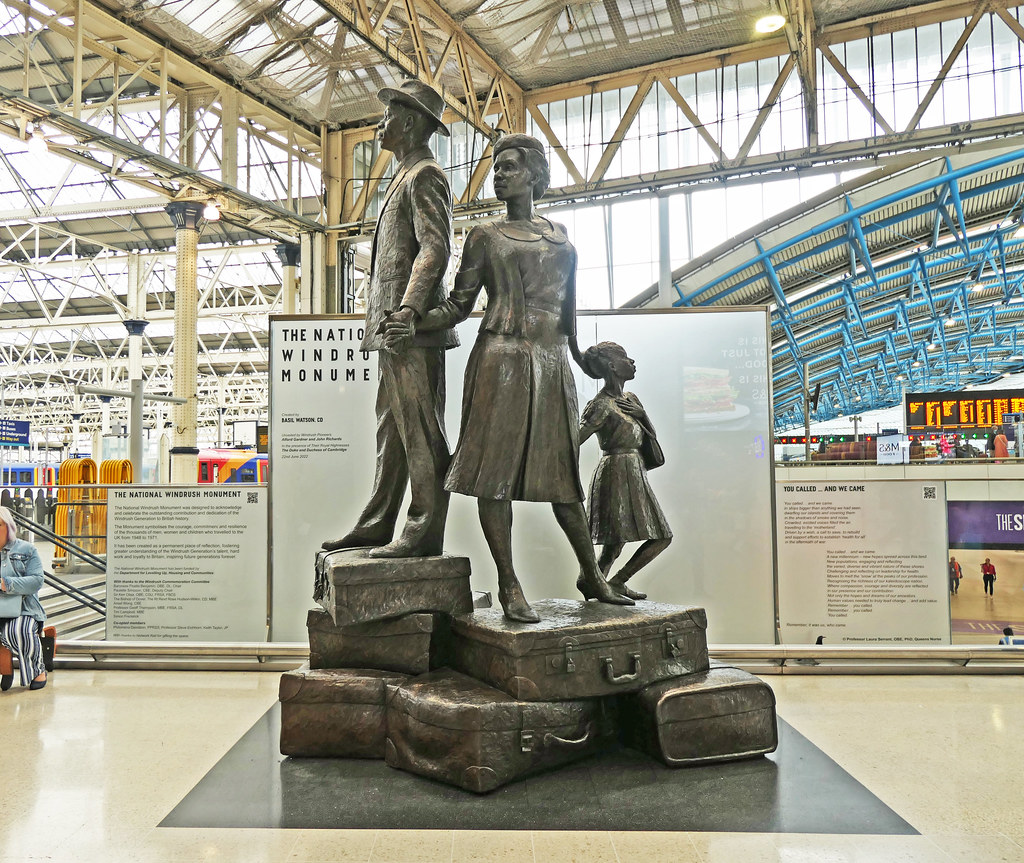
“The National Windrush Monument” by amandabhslater is licensed under CC BY-SA 2.0 .
The Armchair General notes that there is much excitement about the 75th anniversary of the arrival of the ship called the Empire Windrush — which arrived on 22 June 1948 — and the contribution of the so-called Windrush Generation.
The myth currently being constructed is that those coming from Jamaica on the ship were invited, in order to rebuild a Britain struggling to recover from Word War II; we are told that, with so many young men killed in the fighting, Britain needed menial workers to selflessly come and rebuild our economy. Indeed, this view of events has been cemented in a much-lauded poem by Professor Laura Serrant.
Remember … you called.
Remember … you called
YOU. Called.
Remember, it was us, who came.Like almost any story constructed by governments and charities over at least the last thirty years, this narrative is dodgy at best and downright dishonest at worst. The simple fact is that the ship’s operator had expected to leave Jamaica under capacity and so offered passage at half price: many local men (and it was all men) took the opportunity.
Writing in The Spectator, in an article well worth reading in full, Ed West points out that the British government certainly did not encourage these immigrants at all.
Far from calling them, the British government was alarmed by the news. A Privy Council memo sent to the Colonial Office on 15 June stated that the government should not help the migrants: “Otherwise there might be a real danger that successful efforts to secure adequate conditions of these men on arrival might actually encourage a further influx.”
Colonial Secretary Arthur Creech Jones replied: “These people have British passports and they must be allowed to land.” But, he added confidently: “They won’t last one winter in England.” Indeed, Britain had recently endured some very harsh winters.
The Ministry of Labour was also unhappy about the arrival of the Jamaican men, minister George Isaacs warning that if they attempted to find work in areas of serious unemployment “there will be trouble eventually”. He said: “The arrival of these substantial numbers of men under no organised arrangement is bound to result in considerable difficulty and disappointment. I hope no encouragement will be given to others to follow their example.”
Nor was it the solely the evil Tories who were concerned:
Soon afterwards, 11 concerned Labour MPs wrote to Prime Minister Clement Attlee stating that the government should “by legislation if necessary, control immigration in the political, social, economic and fiscal interests of our people … In our opinion such legislation or administration action would be almost universally approved by our people.” The letter was sent on 22 June; that same day the Windrush arrived at Tilbury.
One can hardly be surprised: after all, 75 years ago, the Labour Party at least strove to represent the working class of Britain and the simple fact is that there was, at the time, massive unemployment — so much so that the government was heavily subsidising tickets to Australia (at £10) in order to encourage British people to emigrate (over 2 million British people left between 1948 and 1960).
There is a certain amount of well-intentioned inclusive myth-making in this story, and from a historical point of view the idea that “diversity built Britain”, the birthplace of the Industrial Revolution, is bizarre. Until 1952 Britain was the richest country in Europe, after which we massively fell behind our continental rivals – so if diversity did “build” the country, it didn’t do a great job.
One can argue, I think, that the Windrush Generation made a great many contributions, in common with many immigrants; and if their contribution was not, in reality, as large as is claimed, then they share that with the EEC/EU’s Common Market which, again (and despite all the claims), brought no discernible benefit to the UK.
H/T to Tim Worstall for the link.
Comments Off on Official mythmaking about the Empire Windrush in 1948
June 23, 2023
The Combat Engineers of D-Day – WW2 Special Documentary
World War Two
Published 22 Jun 2023How do you blast through the obstacles and minefields on the beaches of Normandy? How do you get thousands of tonnes of tanks, guns, and men into the fight? And what about reopening the shattered French ports? You need men who are as skilled in construction as they are destruction. You need the engineers.
(more…)
Comments Off on The Combat Engineers of D-Day – WW2 Special Documentary
June 22, 2023
Britain’s 17th century repeats: first time as tragedy, the second time as farce?
Dominic Sandbrook on the parallels between Britain in the 1600s and today:
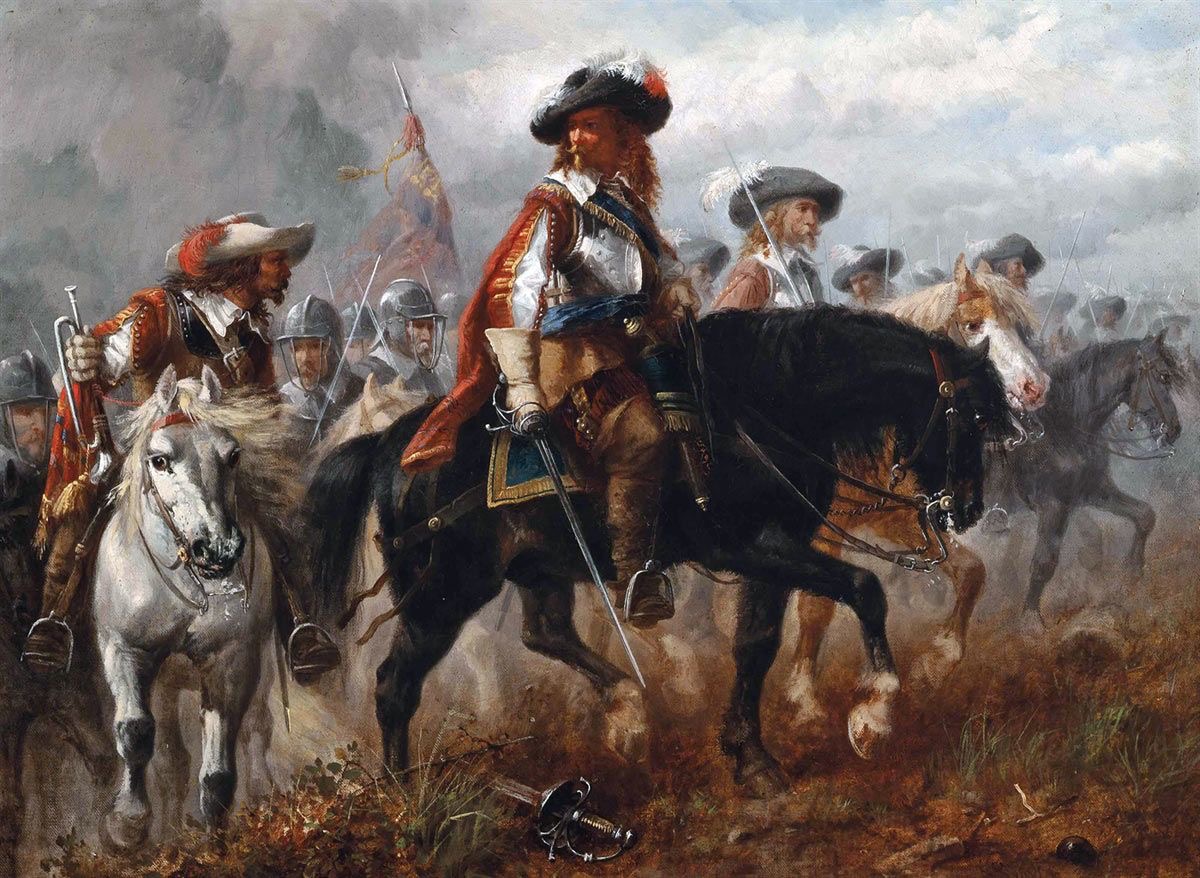
King Charles I and Prince Rupert before the Battle of Naseby 14th June 1645 during the English Civil War.
19th century artist unknown, from Wikimedia Commons.
A sunny Wednesday in early June 1665, and Samuel Pepys was suffering in the heat. It was “the hottest day that ever I felt in my life”, he confided to his diary, “and it is confessed so by all other people the hottest they ever knew in England”.
Pepys spent some of the day strolling with friends in the New Exchange, a shopping arcade on the south side of the Strand, before repairing to Vauxhall’s Spring Gardens, where he “walked an hour or two with great pleasure”. There was something on his mind, though. For as long as he could remember, relations with England’s neighbours had been distinctly fraught, and Lord Sandwich’s fleet was currently engaged in a struggle with the Dutch. London simmered with rumours about the outcome of the battle, but there was no certainty: as Pepys put it, “ill reports run up and down of his being killed, but without ground”.
By evening, “weary with walking and with the mighty heat of the weather”, the diarist had returned to his house in the City. The day had been pleasant enough, but now something else was troubling him. In Drury Lane, he had seen “two or three houses marked with a red cross upon the doors, and “‘Lord have mercy upon us’ writ there”. Pepys knew immediately what that meant. Plague — the first sign of the epidemic that would kill an estimated 100,000 people, a quarter of the capital’s population, in the next 18 months. To calm his nerves, he noted: “I was forced to buy some roll-tobacco to smell to and [chew], which took away the apprehension.”
Reading Pepys’s diary, you sometimes forget that he was born almost four centuries ago. In many respects he was utterly different from us, with assumptions and anxieties we can scarcely understand; and yet often he feels almost thrillingly contemporary, as if you might bump into him in the street tomorrow afternoon. Indeed, you merely have to re-read that diary entry, and you might be looking in a mirror: the stifling heat, the fears of disease, the foreign wars, the fake news.
The past is never just a mirror, of course, and it’s the height of narcissism to cast our predecessors as mere foreshadowings of ourselves. But there are times when, for obvious reasons, a particular historical moment catches the imagination — as is the case today with Pepys’s moment, the mid-17th century.
Just look, for example, at the titles in Britain’s bookshops. For a long time, commercial publishers were terrified of the 17th century. The Stuarts weren’t as sexy as the Tudors, and the age of Oliver Cromwell seemed too dark, too violent, too religious, too complicated for ordinary readers. Why read about perhaps the most significant moment in all our history — the titanic revolutionary conflict of the 1640s and 1650s, when armies surged across the map of our islands, a king was tried and executed, and a farmer from East Anglia tried to turn Britain into a religious commonwealth — when you could read yet another book about Catherine Howard?
And then, as if responding to some subterranean shift in the cultural landscape, something changed. The last few years alone have given us excellent books on Cromwell by Paul Lay and Ronald Hutton, as well as Anna Keay’s dazzling social history of Britain in the 1650s, and Malcolm Gaskill’s haunting account of witchcraft among the settlers who tried to build a new England on the other side of the Atlantic. Meanwhile, Robert Harris’s most recent blockbuster, Act of Oblivion, follows the hunt for Charles I’s Parliamentarian killers from England to America.
Even politicians are at it. In the Conservative MP Jesse Norman’s new novel The Winding Stair, which charts the bitter feud between Sir Francis Bacon, father of the Scientific Revolution, and Sir Edward Coke, the most influential jurist of the early modern era, we appear to be plunged back into the world of early 17th-century Jacobean England. But right from the first few pages, the parallels are obvious. Among his characters, for example, is James I, a man with “bulging, expressive eyes” and an “awkward gait”, who “dresses finely, yet somehow manages to look ill-kempt”, and always “loves to display his learning with a classical or biblical line”. Even if you didn’t know that Norman had been at Eton with Boris Johnson, worked for him as a junior minister and eventually released a blistering public letter calling for his removal, you’d probably spot the parallel.
Comments Off on Britain’s 17th century repeats: first time as tragedy, the second time as farce?
QotD: Nuclear non-proliferation and the Russo-Ukraine war
The failure of the earlier League of Nations was crucial to preparing the way for the Second World War. Today, we see none of this, with most participants — excepting North Korea and Iran — still playing by the rules. This is where we return to Nevil Shute. Twice, using his technical expertise, Shute attempted to predict future war in a novel, and twice he got it wrong. With On the Beach, the author wrote of a 37-day war that “had flared all around the northern hemisphere”. Albania had dropped a “cobalt bomb” on Naples, which escalated into wider conflicts and eventually a Russo-Chinese exchange.
As one of Shute’s characters, a scientist, explained, “The trouble is, the damn things got too cheap. The original uranium bomb cost about fifty thousand quid towards the end. Every little pipsqueak country like Albania had a stockpile of them, and every little country that had that, thought it could defeat the major countries in a surprise attack”. Significantly, Shute’s future war, set in 1963, wasn’t triggered by the usual NATO-Warsaw Pact arsenals of nuclear weapons, but the proliferation of them elsewhere. Then, as now, it is not Russian or Chinese aggression that should worry those with nightmares of nuclear cataclysm, but that of other countries. Thanks to the NPT, IAEA and the UN, these possibilities are contained. Today, the world’s weapons of mass destruction stand at one tenth of their number during the Cold War.
Indeed, the very origins of the current Ukraine crisis illustrate how the international order has managed to contain potential proliferation. When the Soviet Union disintegrated in 1991, Ukraine possessed the world’s third largest nuclear arsenal, greater than those of Britain, France and China combined. Kyiv soon realised it couldn’t afford to maintain the warheads and remain a credible nuclear military power. A solution was found, whereby the weapons would be destroyed, but only in exchange for security assurances that the United States and Russia would respect Ukraine’s independence, sovereignty and territorial integrity.
What Ukraine signed on 5 December 1994 was the Budapest Memorandum of Security Assurances, in which Bill Clinton for the United States, Boris Yeltsin for Russia and John Major for Great Britain promised to protect Ukraine and its territorial integrity in recognition of Kyiv surrendering the protection of its nuclear arsenal. There was no mention of military guarantees, which Ukraine assumed were implied. Additionally, Kyiv promised to adhere to the Non-Proliferation Treaty (NPT).
After the annexation of Crimea by Russia in 2014, the G7 nations complained that Russia had breached the Budapest Memorandum. Vladimir Putin replied evasively that since, in his view, a new regime had seized power from Ukraine’s previously pro-Moscow premier Viktor Yanukovych, “Russia has not signed any obligatory documents with this new state”. Since then, Russia has lied and prevaricated over its betrayal of Budapest. In 2016, Sergey Lavrov went so far as to claim, “Russia never violated Budapest memorandum. It contained only one obligation, not to attack Ukraine with nukes” — a gross distortion of the Memorandum’s many obligations.
However, the West responded in 2014 only with mild economic sanctions. Arguably, the apathy of the anti-interventionist Barack Obama and David Cameron, influenced by a London awash with Russian money, emboldened Vladimir Putin. Few experts disagree that had the West responded in 2014 as they did in 2022, Russia’s expansionist ambitions into Ukraine would have ended long ago. Yet, there is plenty of room for optimism. The Russo-Ukraine conflict has not spread because of the international order and its treaties. Apart from North Korea and Iran, neither of whom have quite perfected their devilish devices, nuclear proliferation of third parties has been held in check.
The Kremlin shows no sign of taking steps to escalate to a nuclear level. It is not in its interests, or those of its allies, to do so. None of the 32 nations who recently abstained from condemning Russia in the 24 February UN vote would welcome Vladimir Putin and his cronies flinging nukes around. The qualified support of major powers like China, India and Pakistan is attached to the cheap oil and arms procurements they have negotiated with Moscow. Any hint of Tsar Vladimir “going nuclear” would see their abstentions morph into support for the West. Putin, for all his rhetoric, cannot afford to go it alone with just the six who voted with him at the UN. In military terms, they offer nothing.
The world’s various international arms treaties provide plenty of optimism that this will remain a regional war. So far, Putin’s threats have melted away as the morning mist. The scenario he implies, akin that in On the Beach and other nuclear-war-scare novels and films, is so unlikely as to be discounted. They and all the rest of the post-apocalyptic genre are written as nail-biting entertainment, not history or current affairs.
Peter Caddick-Adams, “Putin, Shute and nukes”, The Critic, 2023-03-09.
Comments Off on QotD: Nuclear non-proliferation and the Russo-Ukraine war
June 21, 2023
Scuttling of the German High Seas Fleet at Scapa Flow, Orkney, 21 June 1919 in the Great War
CEFRG (Canadian Expeditionary Force Research Group)
Published 3 Apr 2020The German High Seas Fleet decided to sink as many of its own ships as possible to prevent them from falling into Allied hands. In total, 52 of 74 ships were sabotaged to keep them from Britain, France, Italy and the USA. Most of these nations wanted a share for their navies, and knowing she could not have them all to herself, Britain wanted the ships scrapped to prevent other nations from gaining naval superiority.
On the morning of 21 June 1919, the British fleet left Scapa Flow for exercises, and Rear Admiral Sydney Freemantle, commander of the 1st Battle Squadron guarding the ships, planned to return two days later to board and seize the ships.
Already occupying Germany west of the Rhine, the Allied Powers expected Germany to accept all articles of the Treaty of Versailles by 23 June, and threatened to occupy territory east of the Rhine if all demands were not met. German Rear Admiral Ludwig von Reuter, following orders he had received after the breakdown of negotiations, seized the opportunity with the British fleet having just left the harbour, gave the order to scuttle all ships as his crews opened seacocks, torpedo tubes and portholes to flood them, and once again hoisted the flag of the Imperial German Navy.
The final battle casualties of the Great War occurred on this day, with nine German sailors killed and sixteen wounded by the British during brawls when they refused to help save the ships. For his part, von Reuter was imprisoned along with 1,800 of his men, but was released the following year. Upon his return to Germany, he was praised as the man who had preserved the honour of the German High Seas Fleet (in typical fashion, Freemantle had angrily accused von Reuter of having behaved without honour).
Of the 52 ships scuttled in 1919, seven remain at the bottom of the sea today. They are registered under the Ancient Monuments and Archaeological Areas Act 1979, and provide some of the best shipwreck diving in Europe.
Comments Off on Scuttling of the German High Seas Fleet at Scapa Flow, Orkney, 21 June 1919 in the Great War
June 19, 2023
1963: Mockumentary Predicts The Future of 1988 | Time On Our Hands | Past Predictions | BBC
BBC Archive
Published 17 Jun 2023Russian moon landings, week long traffic jams, a workforce replaced by automation and above all, too much leisure time!
These are just some of the bold predictions made in Don Haworth’s 1963 BBC “mockumentary” Time on Our Hands – a remarkable film which projects the viewer a quarter of a century into the future.
Imagine how the futuristic inhabitants of 1988 — a society freed from the shackles of endless hard work — might reflect on the way people live and work in 1963. Its aim is to look back at the extraordinary, almost unbelievable, events of the intervening 25 years — referred to as “the years of the transformation”.
“This Buoyant programme could be repeated a dozen times and still intrigue, delight and disturb me”
Dennis Potter, Daily Herald TV critic, 1963This footage is compiled of excerpts from Time On Our Hands, a faux-documentary film by Don Haworth.
Originally broadcast 19 March, 1963.
Comments Off on 1963: Mockumentary Predicts The Future of 1988 | Time On Our Hands | Past Predictions | BBC
June 18, 2023
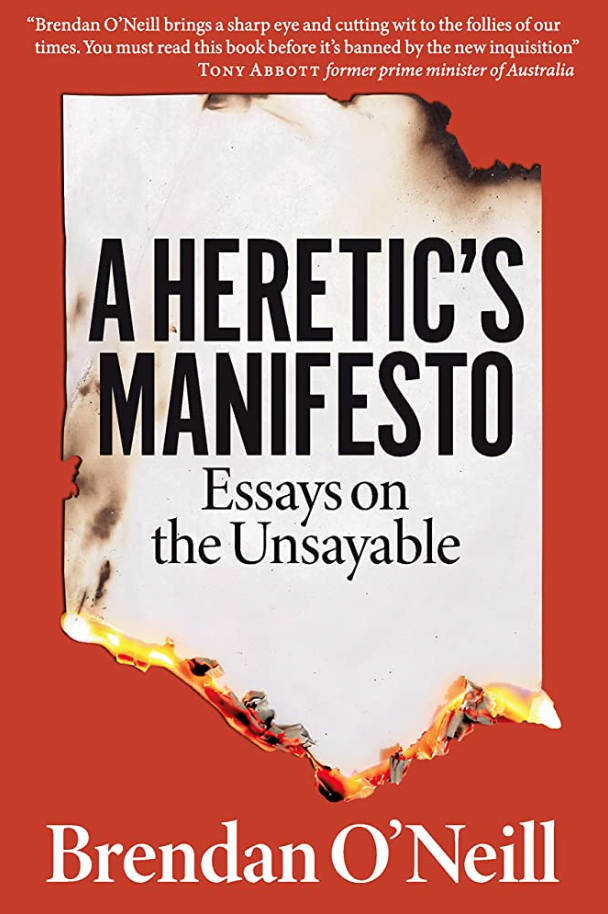
Brendan O’Neill’s new book, A Heretic’s Manifesto
This is an extract from A Heretic’s Manifesto thanks to Spiked:
Words hurt, they say. This is the ideological underpinning to so much censorship today – the idea that words wound, as a punch might wound. The imagery of violence is deployed in almost every call for censure in the 21st-century West. Speech has been reimagined as aggression, hence “microaggressions”. People speak of feeling “assaulted” by speech. “Words, like sticks and stones, can assault; they can injure; they can exclude” – that’s the thesis of Words That Wound, an influential tome published in 1993. Activists claim to feel “erased” by controversial or disagreeable utterances. Trans campaigners speak darkly of “trans erasure”, as if words from the other side of the divide, the speech of gender-critical feminists, might contain that most awesome and nullifying power of genocide.
Words make us feel “unsafe”, people say. Witness the rise and rise of Safe Spaces on university campuses, designed to ensure students’ psychic security against the terrible threat of their hearing an idea they disagree with. Safe Spaces recreate the state of childhood, complete with colouring books and ice cream, speaking to how determinedly some long to retreat from the adult world of hurtful chatter and brickbats.
The United Nations wrings its hands over “hate speech and real harm” (my emphasis). The “weaponisation of public discourse for political gain” can lead to “stigmatisation, discrimination and large-scale violence”, it says. Better keep a check on those hurtful words. One US university even maintains a list of “words that hurt“. It includes the phrase “You guys”. That scandalous utterance “erases the identities of people who are in the room” and “generalise[s] a group of people to be masculine”. Shut it down. Silence that act of violence.
Both the formal and informal punishment of words rests on the belief that they can wound. Laws in Europe claim to guard people from speech that is alarming, distressing, hurtful. The overlords of social media censor speech for “the wellbeing of our community“. Everywhere the cry goes up: words injure, they can cut like a knife, they can be used as “weapons to ambush, terrorise, wound, humiliate and degrade“. And just as the law protects us from such dreadful things when they are done to our bodies with fists and kicks, surely it should also protect us from them when they are done to our minds with words and ideas. Surely our psychic wellbeing should be accorded as much respect by the powers-that-be as our physical integrity is.
The temptation of many of us who believe in freedom of speech, in the liberty of all to utter their beliefs and ideas, is to damn this claim that “words hurt” as a libel against public discourse. As a slippery untruth that is cynically designed to depict words as all-powerful, as containing so much energy, so much heat, that they can lay waste to self-esteem and even make us fret over erasure, over being wiped out entirely by that sore comment or that disturbing idea. Actually, we often say, words are just words. They’re not sticks, they’re not stones, they’re words. They won’t kill you, they won’t hurt you, you’ll be fine. They say words are a force of nature like no other, we say: “Relax. It’s just speech.”
We need to stop doing this. We need to stop countering the new censors by accusing them of exaggerating the power and the potency of words. We need to stop responding to their painting of speech as a dangerous, disorientating force by defensively pleading that words don’t wound because they’re just words. We need to stop reacting to their branding of speech as a weapon, as a tool of ambush and degradation, by effectively draining speech of its power and saying: “It’s only speech.” As if speech were a small thing, almost an insignificant thing, more likely to contain calming qualities than upsetting ones, more likely to help us overcome conflict rather than stir it up, more likely to offer a balm to your soul than to stab at it as a knife might stab at your body.
For when we do this, we play down the power of words. And that includes the power of words to wound. Words do wound. It’s true. Words hurt people, they hurt institutions, they hurt belief systems. Words make churches tremble and ideologies quake. Words inflict pain on priests and princes and ideologues. Words upend the social order. Words rip away the comforting ideas people and communities might have wrapped themselves in for decades, centuries perhaps. Words ambush the complacent and degrade the powerful. Words cause discord, angst, even conflict. Isn’t every revolution in history the offspring of words? Of ideas? Words do destabilise, they do disorientate. People are right to sometimes feel afraid of words. Words are dangerous. When they say words wound, we should say: “I agree.”
Comments Off on Brendan O’Neill’s new book, A Heretic’s Manifesto
Titanic Clash Looms In Pacific – WW2 – Week 251 – June 17, 1944
World War Two
Published 17 Jun 2023Japanese and American navies are heading for a showdown in the Philippine Sea, even as American forces land on Saipan in the Marianas in force. The Japanese have Changsha under siege in China, the Allies advance in both Normandy and Italy, the Soviets advance in Finland, and the massive Soviet summer operation is coming together and will begin in a matter of days.
(more…)
Comments Off on Titanic Clash Looms In Pacific – WW2 – Week 251 – June 17, 1944
June 17, 2023
Why Rommel Lost the Battle for North Africa
Real Time History
Published 16 Jun 2023The North African campaign of WW2 is one of the most famous ones. The almost mythical story of the British “Desert Rats” defeating Erwin Rommel’s Afrika Korps. But why did Rommel lose in North Africa?
(more…)


