
The History Chap
Published 4 Nov 2022The story behind Guy Fawkes and the Gunpowder Plot, the audacious plan to kill the king of England. It is also the complicated story behind our annual Bonfire Night celebrations.
In 1605 a group of dissident Catholics came within a whisker of one of the greatest assassination coups in history — blowing up the King of England, and his government as he attended parliament in London. 36 barrels of gunpowder (approximately 1 tonne of explosives) had been placed directly under where he would open parliament. Experts estimate that no one within 300 feet would have survived.
Had it succeeded it would have rivalled 9/11 in its audacity and would have changed English (& arguably world) history forever. But who were the plotters, what were they trying to achieve and how close did they really come to success? Were they freedom fighters or 17th century terrorists? And why is only one conspirator, Guy Fawkes, remembered when he wasn’t even the brains behind the operation?
After years of persecution by England’s Protestants, a small group of Catholic nobles under Robert Catesby (aka Robin Catesby) decided to take matters into their own hands and blow up the king (King James I of England / James VI of Scotland) whilst he attended parliament in London.
Guy Fawkes (aka Guido Fawkes) smuggled 36 barrels of gunpowder into a cellar directly beneath the hall where parliament would meet in the Palace of Westminster. In the early hours of 5th November 1605, he was arrested by guards who had been tipped off about the gunpowder plot. After three days of torture in the Tower of London, Guy Fawkes finally broke and named his fellow conspirators.
The conspirators, under Robert Catesby, had fled London for the English midlands where they hoped to abduct the king’s daughter and organise a catholic rising. Both failed to materialise and Catesby’s small band were surrounded by a government militia at Holbeach House, just outside Kingswinford in Staffordshire. A brief shoot-out resulted in the death of some of the Catholic rebels (including their leader, Catesby) and the arrest of the others.
The surviving gunpowder plotters (including Guy Fawkes) were executed in London at the end of January 1606, by the grisly execution reserved for traitors — Hanged, drawn and quartered (quite literally a “living death”).
The Gunpowder Plot of 1605 was a complete failure but the event is still celebrated on the 5th November every year on Bonfire Night.
(more…)
November 5, 2023
Guy Fawkes and The Gunpowder Plot 1605
October 30, 2023
Halloween Special: Dracula
Overly Sarcastic Productions
Published 31 Oct 2016It’s creepy! It’s classic! It’s surprisingly infrequently read! It’s everyone’s favorite gothic horror, Bram Stoker’s Dracula!
Wanna bypass the intro? Skip straight to 3:16 and party on!
For those asking, the outro song is “I Love The Night” by Blue Oyster Cult.
(more…)
October 29, 2023
Arguments for not buying military kit “off the shelf”
Sir Humphrey provides some of the reasons why it’s not a simple economic case for a nation’s military procurement to buy “off the shelf” equipment even from a close ally:

Not all kit needs to be or can be domestically sourced. The British army uses Apache attack helicopters which are licensed from the original US manufacturer.
Westland Apache WAH-64D Longbow helicopter (UK Army registration ZJ206) displays at Kemble Air Day 2008, Kemble Airport, Gloucestershire, England in June 2008.
Public domain photograph by Adrian Pingstone.
The arguments for buying American are on the face of it reasonable. The US produces good quality equipment able to meet many UK defence needs. There is a strong supply chain in place, ensuring that there are plenty of spare parts in the system to draw on when needed, and at cheaper cost due to bulk buying. The equipment is usually designed to be interoperable with NATO partners, so it can be integrated to work alongside allies and with existing equipment. It can be delivered quickly, it works and lots of other people use it, so why shouldn’t the UK? There are in fact many good reasons why the UK should not exclusively buy American.
Earlier this month, we looked at the Canadian Surface Combatant (CSC) program and why the Canadian Armed Forces never seemed to get the same “bang for the buck” that our American or British allies seem to manage. Here, Sir Humphrey points out that even the British military has to make procurement decisions that weigh cost and convenience with some very significant national security concerns:
To start with, US kit is designed by US companies to meet US requirements, not British ones. This may sound obvious but there is a dangerous view some put forward that “off the shelf” means the UK could just buy something and use it. There is no such thing as “off the shelf” unless you want it as it comes in its US version, with no modifications, changes or installation of British equipment. The moment you do this, you’ve created a UK variant with its own bespoke requirements and supply needs, for which you are dependent on the US defence industry to support – and there is no guarantee that this can or will happen. From the outset you have lost operational sovereignty and control over your military equipment.
Buying from the US means the UK would need to request a Foreign Military Sale (FMS) case through the US government, seeking legislative approval to purchase the equipment. If, for example, the UK wanted to buy a new tank, it would be reliant on US government approval to do so, not just for the initial purchase, but for all spares buy thereafter. The way that FMS works is that it sets out approval not just for purchase, but sets a schedule for spare parts purchases, services, and upgrades, all of which are done at the time and schedule set by US government and industry, and not the British government. This means that the UK would lose control over when to purchase spares or upgrades and would be forced to buy to a foreign governments timetable. This is why FMS is so successful for the US – it offers cheap entry prices but makes a killing in the long-term spares and support market. To buy from the US means to accept that you are handing over control of your spares and logistics chain to a foreign power who determines the timing of when and what you buy. This is fine in small doses but if you buy exclusively from the US, suddenly means you’ve got no control over how you want to support your armed forces.
The next challenge is the integration work needed to make things work for the UK. One of the risks of buying a foreign design is that you lack operational sovereignty over the design and its internal contents. Equipment supplied by the US will often come with a variety of sealed, tamper proof boxes containing US government-controlled technology that cannot be accessed by the purchasing nation. As the operator, you do not have full control over your military equipment, you don’t know what is necessarily in the boxes, and you are reliant on the US to fix issues with them. By contrast any equipment designed and built in the UK means that the MOD has full control and sovereignty over it to open it up, modify, adapt or change it to meet British needs. To buy US means accepting we cannot change a design without a foreign nations’ approval, which in turn means exposing our own sensitive military technology and equipment to the US, to conduct trials to ensure it can work with the US provided equipment. This represents an astounding loss of sovereign control on advanced weapon systems and means potentially giving the US defence industry insight into UK capabilities that manufacturers may want to keep commercially sensitive.
October 28, 2023
The transition from burning wood to burning coal
The latest Age of Invention newsletter touches on some of the details Anton Howes uncovered while researching some work on commission for Britain’s NESTA (formerly the National Endowment for Science, Technology and the Arts):
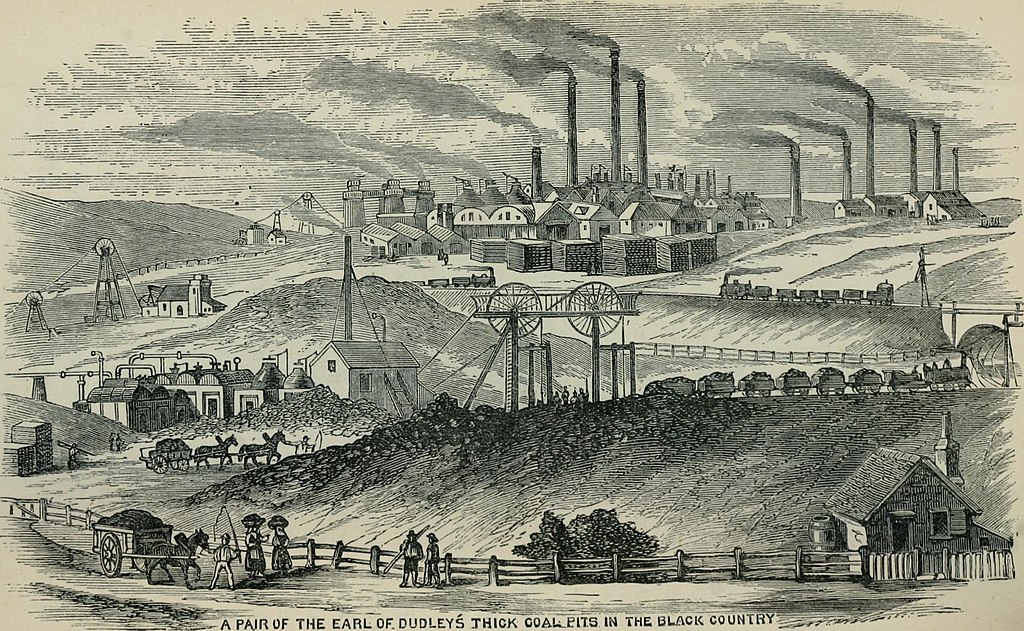
An image of coal pits in the Black Country from Griffiths’ Guide to the iron trade of Great Britain, 1873.
Image digitized by the Robarts Library of the University of Toronto via Wikimedia Commons.
Here are a few key things that I hadn’t really fully appreciated until undertaking this particular commission, though each has provided even more threads I still need to pull on:
ONE. The transition to coal was started by finding ways to exploit the lower-grade, cheaper and more sulphurous coals: initially by finding ways to burn it in people’s homes that would not leave everyone crying and coughing from the stinking fumes; and then with the expanded supply of even the lowest-grade coals making it cost-effective to do things like boil seawater in pans to make salt. The very lowest-grade coal was termed simply “pan coal”. While I’m pretty certain that these innovations were responsible for much of the rise of coal — coal-fuelled salt pans were even the foundation of the Scottish Lowlands economy going into the eighteenth century — the actual inventors involved are still a bit of a mystery. It’s something I need to return to, as “lots of anonymous people just invented through trial and error and adaptation” just doesn’t cut it for me — I’ve never found such stories to be true upon closer investigation.
TWO. Nobody ever talks about lime! Lime was one of the few things burnt with coal since ancient times, but largely to produce mortar for building. The increased availability of cheaper coal in the sixteenth century, however, meant that lime also soon found much wider use as a soil acidity regulator, as well as to control some pests and improve the absorption of fertilisers. It was especially favoured for sandy soils, allowing the conversion of barren heaths to agricultural land by increasing the soil’s water retention.
Yet lime is a huge blind spot for economic historians, despite it increasing the productivity of what was still by far the largest portion of the economy: agriculture. I have a rough and ready test of whether economic historians are paying enough attention to an industry, which is to look up the word in Stephen Broadberry et al.’s British Economic Growth 1270-1870, most scholars’ go-to resource on how historical British output is estimated. Lime is mentioned only once, and only as an input to the construction industry, for mortar. We should know more about lime’s impact.
THREE. Coal, through its various effects on agriculture, also led to an increase in the availability of grain, in turn leading to an abundance of muscle power. Horses were the literal workhorses of industrial cities, grinding the pigments for dyes and paints, tobacco for snuff, charred bones for shoe polish, tannin-rich oak bark for leather, flint for glass and ceramics, and grain for flour, beer, and spirits. Horses fulled cloth, pounded rags into paper, flatted metal into sheets, and bored pipes, guns and even cannon. And of course they powered the transportation infrastructure, hauling the waggons and barges laden with goods.
A theme I keep coming across when I do my research is that there was a lot of effort put into what we might call the “improvement of animals”. I’ve touched on this briefly before, but I get a sense that there’s a whole lot of iceberg lying in wait under the surface for me to uncover. It likely extended to dogs, for example, who like horses were also often used for mechanical tasks. Just yesterday, for example, I read an account by a visitor to 1630s Bristol mentioning how the roasting spits at its inns were driven by dogs in treadwheels. At some point I need to go through all this evidence I’ve inadvertently collected.
FOUR. The Dutch Republic’s Golden Age did not fail because it lacked energy sources. I had already suspected this, as it never rang true, but had not quite appreciated the extent of the evidence: the fairly rapid collapse of so many Dutch industries in the 1650s-80s was, if anything, accompanied by a super-abundance of energy. Both peat and grain were in fact cheaper than ever, largely as a result of plummeting demand. Even the products made using wind —such as the timber sawn for ships along the windy banks of the Zaan river — failed to survive the general collapse in demand.
If energy had been lacking, we would have expected the prices of peat and grain to have been at all-time highs, not in a slump. Indeed, the lack of demand for peat and grain, by sapping demand for infrastructure projects like bog drainage and canal-building, is what led to the re-flooding of much of the Dutch countryside. The causes of the collapse are still something of a mystery to me, but I now feel very confident in ruling the energy theory out.
QotD: Deposing King Charles I
It’s 1642, and once again the English are contemplating deposing a king for incompetence. Alas, the Reformation forces the rebels to confront the issue the deposers of Edward II and Richard II could duck: Divine sanction. The Lords Appellant could very strongly imply that Richard II had lost “the mandate of heaven” (to import an exoteric term for clarity), but they didn’t have to say it – indeed, culturally they couldn’t say it. The Parliamentarians had the opposite problem – not only could they say it, they had to, since the linchpin of Charles I’s incompetence was, in their eyes, his cack-handed efforts to “reform” religious practice in his kingdoms.
But on the other hand, if they win the ensuing civil war, that must mean that God’s anointed is … Oliver Cromwell, which is a notion none of them, least of all Oliver Cromwell, was prepared to accept. Moreover, that would make the civil war an explicitly religious war, and as the endemic violence of the last century had so clearly shown, there’s simply no way to win a religious war (recall that the ructions leading up to the English Civil War overlapped with the last, nastiest phase of the Thirty Years’ War, and that everyone had a gripe against Charles for getting involved, or not, in the fight for the One True Faith on the Continent).
The solution the English rebels came up with, you’ll recall, was to execute Charles I for treason. Against the country he was king of.
Severian, “Inertia and Incompetence”, Founding Questions, 2020-12-25.
October 26, 2023
“… despite all the evidence, British people still believe the NHS is the single best thing about Britain”
The picture Jess Gill paints of Britain’s National Health Service is equally true of Canada’s various provincially run socialized medical systems, and largely for the same reasons:
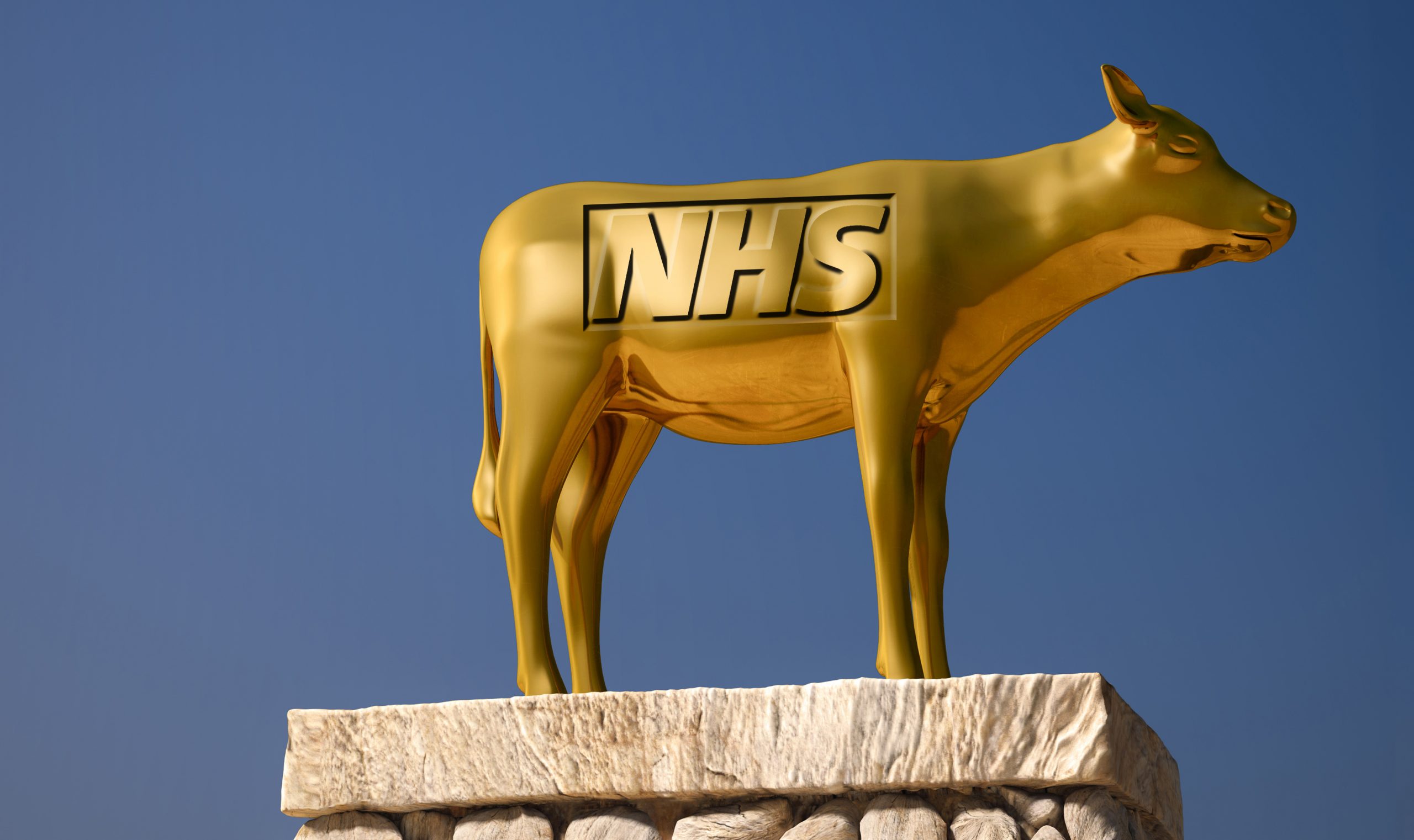
Not actually the official symbol of Britain’s National Health Services … probably.
It’s clear that Britain’s National Health Service is failing. 7.6 million people are on a waiting list, and 41% of them say their health has gotten worse while waiting for treatment. Compounding the problem, the UK has significantly fewer hospital beds, doctors, nurses, CT scanners, and MRI units than the OECD average. Furthemore, the UK has the second-highest rate of treatable deaths in Western Europe.
Yet despite all the evidence, British people still believe the NHS is the single best thing about Britain. From the country clapping outside their houses to “thank our NHS” during the Covid-19 pandemic, to the Prime Minister and the Leader of the Opposition attending a mass ceremony to celebrate the NHS’s 75th anniversary, praise for this institution is everywhere.
Even though it’s self-evident the emperor has no clothes, the NHS is treated like a sacred cow. This begs the question: why are people so loyal to a system that is clearly failing them?
There is a prevalent conspiracy theory that the NHS is being intentionally underfunded by the Conservative Government so that the resulting poor outcomes will provide justification for them to privatize it and transform it into the American model of healthcare. This theory is pushed by the establishment: from senior members of the British Medical Association, journalists, and Members of Parliament.
This theory achieves two things. One, it shifts blame for poor outcomes away from the NHS as a system itself and toward the politicians in power. Two, it frames the debate with the assumption that privatization is a bad thing, causing any meaningful reform to be met with fear mongering.
This narrative has caused a massive issue for opponents of the NHS as there are multiple levels of misleading rhetoric. The fact of the matter is that the Conservatives are not privatizing or underfunding the NHS. Furthermore, whether it be a fully privatized system or even the mixed system as seen in other European countries, free-market reform would significantly help patients and doctors.
Look at Life – Draw the Fires (1963)
PauliosVids
Published 21 Nov 2018The railways are changing, with coal-powered steam being phased out and replaced by diesel engines by 1972. Crowds pay their respects to the Flying Scotsman‘s last departure from Kings Cross as it is replaced by a 3,300-horsepower diesel. The network is being modernised by new signalling, longer continuous track on concrete sleepers and flyovers, and controversial closures of lines.
October 25, 2023
Housing for Hamas leadership … in London
In the non-paywalled part of a post from Ed West, we have a look at the terrible conditions leaders for Hamas and other terrorist organizations have to put up with in the embattled suburbs of … London:
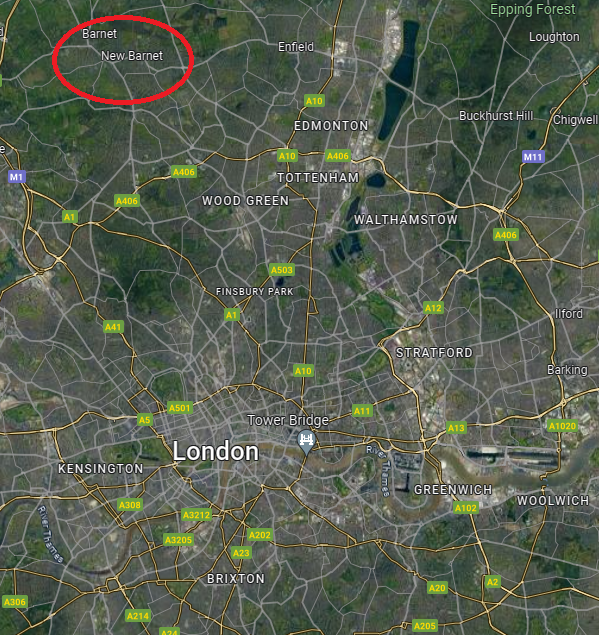
Barnet, to those unfamiliar with this corner of the world, is the most Jewish borough in Britain, an area of north-west London often described as “leafy” and including both pleasant inner suburbs like Finchley as well as areas of genuine countryside. The migration of eastern European Jews in the capital followed an anticlockwise direction from impoverished Whitechapel in east London up through Hackney and Haringey in the north, with Barnet the next stop.
It is also, strangely, home to a leading fundraiser for Hamas, the terrorist group responsible for the murder of 1,400 people in southern Israel earlier this month and quite explicitly committed to the eradication of Jews in the Holy Land.
What with London house prices being what they are, you wonder how he managed it, but of course Muhammad Qassem Sawalha, who “ran the group’s terrorist operations in the West Bank”, according to the Sunday Times, managed to buy his property with help from the council.
Despite being a known and wanted terrorist, Sawalha was allowed to settle in Britain in the 1990s and obtain British citizenship. He continued to work for Hamas, holding talks about committing terrorist acts and laundering money for the group, according to the US Department of Justice. In 2009 he signed the Istanbul Declaration which praised God for having “routed the Zionist Jews”, and called for a “Third Jihadist Front” to be “opened in Palestine alongside Iraq and Afghanistan”, according to the paper.
All the while he was benefitting from Britain’s social housing system. In 2003, Barnet Council made him a council tenant and he was housed in a two-storey property with a garden and garage in the borough, where he still lives.
Two years ago, Sawalha and his wife used the Right to Buy scheme to acquire their home for £320,700, with Barnet Council giving them a £112,300 discount on its market value.
This is despite the fact that in 2006 Panorama reported that Sawalha was “said to have masterminded much of Hamas’ political and military strategy” and that, “although he was known to MI5, the ‘authorities let him operate freely here'”. Not just let him operate freely, but sort him out with a house – and if you think this sounds insane, it is not at all uncommon.
Sawalha’s old comrade, the famous hook-handed hate preacher Abu Hamza, was also given a huge house courtesy of the British taxpayer. The Egyptian was allowed to live rent-free in a five-bedroom house in what the Mail described as “upmarket Shepherd’s Bush”, a phrase I would have found astonishing to read as a teenager in west London.
Shepherd’s Bush is next door to super-rich Holland Park, and private property is extremely expensive there – but it also has high levels of social housing, as with much of central London, so “upmarket” might be stretching it.
October 24, 2023
The English language, who did what to it and when
The latest book review from Mr. and Mrs. Psmith’s Bookshelf is John McWhorter’s Our Magnificent Bastard Tongue: The Untold History of English. I’m afraid I often find myself feeling cut adrift in discussions of the evolution of languages, as if I’m floating out of control in a maelstrom of what was, what is, and what might be, linguistically speaking. It’s an uncomfortable feeling and in retrospect explains why I did so poorly in formal grammar classes. When Jane Psmith gets around to discussing actual historical dates, I find my metaphorical feet again:

Shakespeare wrote about five hundred years ago, and even aside from the frequency of meaningless “do” in normal sentences, it’s clear that our language has changed since his day. But it hasn’t changed that much. Much less, for example, than English changed between Beowulf (probably written in the 890s AD)1 and The Canterbury Tales (completed by 1400), another five hundred year gap. Just compare this:
Hwæt. We Gardena in geardagum, þeodcyninga, þrym gefrunon, hu ða æþelingas ellen fremedon.2
to this:
Whan that Aprille with his shoures soote,
The droghte of March hath perced to the roote,
And bathed every veyne in swich licóur
Of which vertú engendred is the flour…3That’s a huge change! That’s way more than some extraneous verbs, the loss of a second person singular pronoun (thou knowest what I’m talking about), or a shift in some words’ definition.4 That’s practically unrecognizable! Why did English change so much between Beowulf and Chaucer, and so little between Shakespeare and me?
There’s a two part answer to this, and I’ll get to the real one in a minute (the changes between Old English and Middle English really are very interesting), but actually I must first confess that it was a trick question, because my dates are way off: even if people wrote lovely, fancy, highly-inflected Old English in the late 9th century, there’s no real reason to think that’s how they spoke.
On one level we know this must be true: after all, there were four dialects of Old English (Northumbrian, Mercian, Kentish, and West Saxon) and almost all our written sources are in West Saxon, even the ones from regions where that can’t have been the lingua franca.5 But it goes well beyond that: in societies where literacy is not widespread, written language tends to be highly conservative, formal, and ritualized. Take, for example, the pre-Reformation West, where all educated people used Latin for elite pursuits like philosophical disputatio or composing treatises on political theory but spoke French or Italian or German or English in their daily lives. It wasn’t quite Cicero’s Latin (though really whose is), but it was intentionally constructed so that it could have been intelligible to a Roman. Similarly, until quite recently Sanskrit was the written language of India even though it hadn’t been spoken for centuries. This happens in more modern and broadly literate societies as well: before the 1976 linguistic reforms, Greeks were deeply divided over “the language question” of whether to use the vernacular (dimotiki) or the elevated literary language (Katharevousa).6 And modern Arabic-speaking countries have an especially dramatic case of this: the written language is kept as close to the language of the Quran as possible, but the spoken language has diverged to the point that Moroccan Arabic and Saudi Arabic are mutually unintelligible.
Linguists call this phenomenon “diglossia”. It can seem counter-intuitive to English speakers, because we’ve had an unusually long tradition of literature in the vernacular, but even for those of us who use only “standard” English there are still notable differences between the way we speak and the way we write: McWhorter points out, for example, that if all you had was the corpus of Time magazine, you would never know people say “whole nother”. Obviously the situation is far more pronounced for people who speak non-standard dialects, whether AAVE or Hawaiian Pidgin (actually a creole) or Cajun English. (Even a hundred years ago, the English-speaking world had many more local dialects than it does today, so the experience of diglossia would have been far more widespread.)7
Anyway, McWhorter suggests that Old English seems to have changed very little because all we have is the writing, and the way you wrote wasn’t supposed to change. That’s why it’s so hard to date Beowulf from linguistic features: the written language of 600 is very similar to the written language of 1000! But despite all those centuries that the written language remained the perfectly normal Germanic language the Anglo-Saxons had brought to Britain, the spoken language was changing behind the scenes. As an increasing number of wealhs adopted it (because we now have the aDNA proof that the Anglo-Saxons didn’t displace the Celts), English gradually accumulated all sorts of Celtic-style “do” and “-ing” … which, obviously, no one would bother writing down, any more than the New York Times would publish an article written the way a TikTok rapper talks.
And then the Normans showed up.
The Norman Conquest had remarkably little impact on the grammar of modern English (though it brought a great deal of new vocabulary),8 but the replacement of the Anglo-Saxon ruling class more or less destroyed English literary culture. All of a sudden anything important enough to be written down in the first place was put into Latin or French, and by the time people began writing in English again two centuries later nothing remained of the traditional education in the conservative “high” Old English register. There was no one left who could teach you to write like the Beowulf poet; the only way to write English was “as she is spoke“, which was Chaucer’s Middle English.
So that’s one reason we don’t see the Celtic influence, with all its “do” and “-ing”, until nearly a thousand years after the Anglo-Saxons encountered the Celts. But there are a whole lot of other differences between Old English and Middle English, too, which are harder to lay at the Celtic languages’ door, and for those we have to look to another set of Germanic-speaking newcomers to the British Isles: the Vikings.
Grammatically, English is by far the simplest of the Germanic languages. It’s the only Indo-European language in Europe where nouns don’t get a gender — la table vs. le banc, for instance — and unlike many other languages it has very few endings. It’s most obvious with verbs: in English everyone except he/she/it (who gets an S) has a perfectly bare verb to deal with. None of this amō, amās, amat rigamarole: I, you, we, youse guys, and they all just “love”. (In the past, even he/she/it loses all distinction and we simply “loved”.) In many languages, too, you indicate a word’s role in the sentence by changing its form, which linguists call case. Modern English really only does this with our possessive (the word‘s role) and our pronouns,9 (“I see him” vs. “he sees me”); we generally indicate grammatical function with word order and helpful little words like “to” and “for”. But anyone learning Latin, or German, or Russian — probably the languages with case markings most commonly studied by English-speakers — has to contend with a handful of grammatical cases. And then, of course, there’s Hungarian.
As I keep saying, Old English was once a bog-standard Germanic language: it had grammatical gender, inflected verbs, and five cases (the familiar nominative, genitive, dative, and accusative, plus an instrumental case), each indicated by suffixes. Now it has none. Then, too, in many European languages, and all the other Germanic ones, when I do something that concerns only me — typically verbs concerning moving and feeling — I do it to myself. When I think about the past, I remember myself. If I err in German, I mistake myself. When I am ashamed in Frisian, I shame me, and if I go somewhere in Dutch I move myself. English preserves this in a few archaic constructions (I pride myself on the fact that my children can behave themselves in public, though I now run the risk of having perjured myself by saying so …), but Old English used it all the time, as in Beseah he hine to anum his manna (“Besaw he himself to one of his men”).
Another notable loss is in our direction words: in modern English we talk about “here”, “there”, or “where”, but not so long ago we could also discuss someone coming hither (“to here”) or ask whence (“from where”) they had gone. Every other Germanic language still has its full complement of directional adverbs. And most have a useful impersonal pronoun, like the German or Swedish man: Hier spricht man Deutsch.10 We could translate that as “one speaks German here” if we’re feeling pretentious, or perhaps employ the parental “we” (as in “we don’t put our feet in our mouths”), but English mostly forces this role on poor overused “you” (as in “you can’t be too careful”) because, again, we’ve lost our Old English man.
In many languages — including, again, all the other Germanic languages — you use the verb “be” to form the past perfect for words having to do with state or movement: “I had heard you speak”, but “I was come downstairs”. (This is the bane of many a beginning French student who has to memorize whether each verb uses avoir or être in the passé composée.) Once again, Old English did this, Middle English was dropping it, and modern English does it not at all. And there’s more, but I am taken pity on you …
1. This is extremely contentious. The poem is known to us from only one manuscript, which was produced sometime near the turn of the tenth/eleventh century, and scholars disagree vehemently both about whether its composition was contemporary with the manuscript or much earlier and about whether it was passed down through oral tradition before being written. J.R.R. Tolkien (who also had a day job, in his case as a scholar of Old English — the Rohirrim are more or less the Anglo-Saxons) was a strong proponent of the 8th century view. Personally I don’t have a strong opinion; my rhetorical point here could be just as clearly made with an Old English document of unimpeachably eleventh century composition, but Beowulf is more fun.
2. Old English orthography is not always obvious to a modern reader, so you can find a nice video of this being read aloud here. It’s a little more recognizable out loud, but not very.
3. Here‘s the corresponding video for Middle English, which I think is actually harder to understand out loud.
4. Of course words shift their meanings all the time. I’m presently reading Mansfield Park and giggling every time Fanny gets “knocked up” by a long walk.
5. Curiously, modern English derives much more from Mercian and Northumbrian (collectively referred to as “Anglian”) than from the West Saxon dialect that was politically dominant in the Anglo-Saxon period. Meanwhile Scots (the Germanic language, not to be confused with the Celtic language of Scots Gaelic or whatever thing that kid wrote Wikipedia in) has its roots in the Northumbrian dialect.
6. This is a more interesting and complicated case, because when the Greeks were beginning to emerge from under the Ottoman yoke it seemed obvious that they needed their own language (do you even nationalism, bro?) but spoken Greek was full of borrowings from Italian and Latin and Turkish, as well as degenerate vocabulary like ψάρι for “fish” when the perfectly good ιχθύς was right there. Many educated Greeks wanted to return to the ancient language but recognized that it was impractical, so Katharevousa (lit. “purifying”, from the same Greek root as “Cathar”) was invented as a compromise between dimotiki and “proper” Ancient Greek. Among other things, it was once envisioned as a political tool to entice the newly independent country’s Orthodox neighbors, who used Greek for their liturgies, to sign on to the Megali Idea. It didn’t work.
The word ψάρι, by the way, derives from the Ancient Greek ὀψάριον, meaning any sort of little dish eaten with your bread but often containing fish; see Courtesans and Fishcakes: The Consuming Passions of Classical Athens for more. Most of the places modern Greek uses different vocabulary than the ancient tongue have equally fascinating etymologies. I think my favorite is άλογο, which replaced ίππος as the word for horse. See here for more.
7. Diglossia is such a big deal in so many societies that I’ve always thought it would be fun to include in my favorite genre, fantasy fiction, but it would be hard to represent in English. Anyone who’s bounced off Dickon’s dialogue in The Secret Garden or Edgar’s West Country English in King Lear knows how difficult it is to understand most of the actually-existing nonstandard dialects; probably the only one that’s sufficiently familiar to enough readers would be AAVE — but that would produce a very specific impression, and probably not the one you want. So I think the best alternative would be to render the “low” dialect in Anglish, a constructed vocabulary that uses Germanic roots in place of English’s many borrowings from Latin and French. (“So I think the best other way would be to give over the ‘low’ street-talk in Anglish, a built wordhoard that uses Germanic roots in spot of English’s many borrowings …”) It turns out Poul Anderson did something similar, because of course he did.
8. My favorite is food, because of course it is: our words for kinds of meat all derive from the French name for the animal (beef is boeuf, pork is porc, mutton is mouton) while our words for the animal itself have a good Germanic roots: cow, pig, sheep. Why? Well, think about who was raising the animal and who was eating it …
9. And even this is endangered; how many people do you know, besides me, who say “whom” aloud?
10. Yes, this is where Heidegger gets das Man.
See Inside The M3 Grant | Tank Chats Reloaded
The Tank Museum
Published 30 Jun 2023With a crew of six and a chaotically crowded interior, the Grant was a US-produced WW II tank more used by the British and Indian Armies than anyone else. Join Chris Copson as he explores probably the best preserved example of this rare vehicle – and listen out for the cheese sandwich …
(more…)
October 23, 2023
The RAF’s true workhorse fighter in the Battle of Britain – the Hawker Hurricane
William Loneskie sings the praises of the Hawker Hurricane, the main fighter plane of the Royal Air Force during the Battle of Britain in 1940:
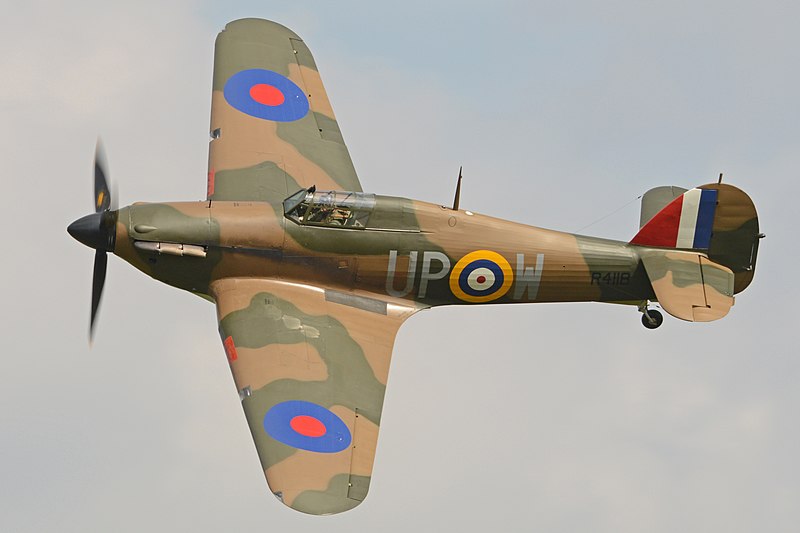
Hawker Hurricane Mark I. This is the only airworthy Hurricane with a genuine Battle of Britain history. Since 2015 she has lodged with the Shuttleworth Collection and is seen displaying at the 2017 Season Premier Airshow at Old Warden, Bedfordshire, UK.
Photo by Alan Wilson via Wikimedia Commons.
In the popular mind it was the Supermarine Spitfire which carried the day for the Royal Air Force during the Battle of Britain. The grace of RJ Mitchell’s design was appreciated by the public as something very special, as it was for the pilots who flew it.
But it was the slower Hawker Hurricane which accounted for most of the German airmen killed in 1940 and destroyed most of their Heinkels, Junkers and Dorniers. Although nearly 200 Hurricanes had been lost in the Battle of France there were 32 squadrons of Hurricanes in the Battle of Britain compared with 19 of Spitfires.
By the time air battles commenced over England in 1940, the RAF had a secret weapon – BAM 100. This was British Air Ministry 100 octane fuel which had been developed and manufactured in the United States, bought for cash by the UK government, and shipped across the Atlantic by tankers. Compared with the previous 87 octane petrol, the new fuel boosted the speed of the Hurricane and the Spitfire by around 30mph. The Luftwaffe pilots were taken by surprise and couldn’t understand where the extra power came from until later in the war German technicians tested fuel from a downed aircraft.
Side by side the Spitfire and Hurricane, both powered by the iconic Rolls-Royce V12 Merlin, were very different. The Spitfire with its elliptical wing and perfect proportions “looked as if it could fly”, as Sergeant Cyril Bamberger of 610 and 41 squadrons said. But the Hurricane, if not quite an ugly duckling, had an ungainly appearance.
While the Spitfire was of all-metal construction, the Hurricane’s structure was a halfway house between fabric covered biplanes, such as the Gloster Gladiator, and all-aluminium monoplanes. An unintended consequence of the Hurricane’s fabric-covered fuselage was that German cannon shells could pass straight through without exploding. Its pilots soon realised that the Hurricane could take a lot of punishment, and the ground crews, the unsung heroes of the battle, could often repair the aircraft on station unlike the Spitfire, which was difficult to produce, maintain and repair.
Getting airborne in a squadron scramble, or landing on a grass airstrip, the Hurricane was safer than its compatriot because Camm had designed its undercarriage to open outwards, not inwards, making its track wider.
In the air the Hurricane shrugged off its ugly duckling appearance and became a killing machine. Flight Lieutenant Peter Brothers of 32 and 257 Squadrons said: “It was a superb combat aircraft … it was a better gun platform than the Spitfire”. Squadron Leader Tom Dalton Morgan said that, although he had flown more hours on the Spitfire, “as a fighting machine I preferred the Hurricane”.
The Hurricane could out-turn a Messerschmitt Bf109. Its turning radius of 785ft compared with 895ft for the German machine and 860ft for the Spitfire. The Hurricane’s thick wing allowed a different configuration of its eight .303 Browning guns giving a closer concentration of fire at a rate of 19 rounds per second.
Hero-worship of Admiral Nelson seen as (somewhat) harmful
On Saturday, Sir Humphrey noted the anniversary of Trafalgar and indicated that the Royal Navy’s idolization of Admiral Nelson somewhat obscures the rest of the Royal Navy’s historical role:
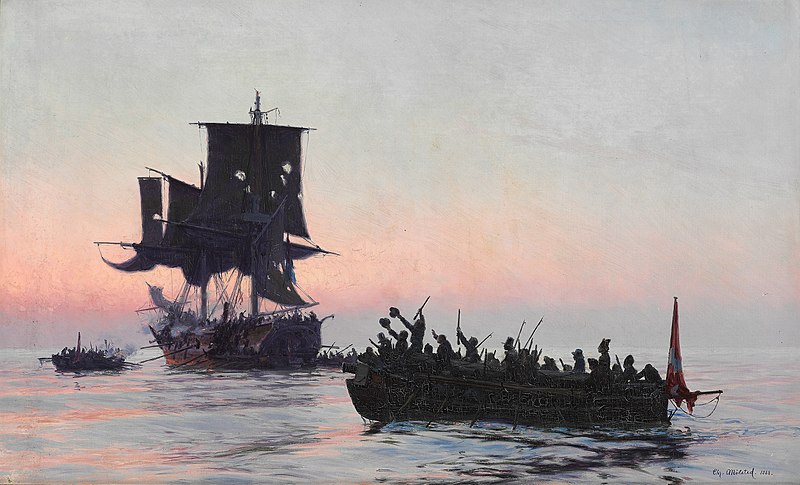
“Danish privateers intercepting an enemy vessel during the Napoleonic Wars”.
Oil painting by Christian Mølsted, 1888 from the Collection of the Museum of National History via Wikimedia Commons.
There is an argument, which the author has sympathy with, that the RN has perhaps idolised Nelson too much. That while he did much good, the adoration of him comes at the cost of forgetting countless other leaders and battles which have relevance to this day. This is not to denigrate or play down the impact of Trafalgar, but to ask whether we should be equally aware of other parts of Royal Navy history too. Understanding the Royal Navy of the late 18th and early 19th century can provide us with much to consider and learn from in looking at how to shape the Royal Navy of the early 21st century. If you look at the Royal Navy of today and of Nelson’s time (and throughout the Napoleonic Wars), a strong case can be made that although the technology is materially different, the missions, function, and capability that the RN offers to the Government of the day are little changed.
While we tend to fix attention mostly on the major battle of Trafalgar, the RN fulfilled a wide variety of different missions throughout the war. The fleet was responsible for blockading Europe, monitoring French movements, and providing timely intelligence on the activity of enemy fleets. Legions of smaller ships stood off hostile coasts, outside of engagement range, on lonely picket duties to track the foe. The Royal Navy also maintained forces capable of strategic blockades in locations like Gibraltar and the Skagerrak, relying on chokepoints to secure control of the sea.
The UK was a mercantile nation with a heavy reliance on trade, and with the land routes of Europe closed by Napoleon, the Merchant Navy was vital to victory. The Royal Navy played a key role in escorting ships in convoy, ensuring their protection from hostile forces and helping ensure vitally needed trade goods arrived in British ports. This included timber from colonies in North America, vital to building and repairing warships. Similarly British policy to defeat Napoleon relied on supporting continental land powers, and a steady flow of munitions and materiel were sent by sea, escorted by RN warships to Baltic ports to help support nations fighting France.
The Royal Navy maintained forces of small raiding craft to hold the French coast at risk throughout the wars, sending vessels to attack French coastal locations, capturing intelligence and tying down hundreds of French coastal artillery batteries and thousands of men who could have been deployed elsewhere to protect French soil. More widely the UK engaged in strategic raiding and blockade, for example operations in the Adriatic Campaign (1807-14) where a small number of British warships blockaded ports, conducted amphibious operations and engaged in surface combat with different foes. In the same vein the UK found itself targeted by Danish & Norwegian raiders too, who fought the so-called “Gunboat War” from 1807 to 14 against the UK, where many small scale actions between British brigs and small ships against gunboats in the Baltic. This often forgotten campaign saw violent clashes and victories on both sides with the sinking and capture of many RN vessels to protect convoy trade.
More widely the Royal Navy worked closely with the British Army in a variety of amphibious operations, providing ships to deploy and sustain the Army on campaign. There were a number of impressive amphibious failures, but also some successes too, particularly in the West Indies and Egypt, where working as part of a jointly integrated force, the Royal Navy provided fire support (and even operated Congreve land attack rockets for shore bombardment) as the British Army fought the French ashore. In the Peninsular War the RN was vital for ensuring the supply of Wellington’s forces and, where necessary evacuating them, such as during the retreat from Corunna.
October 22, 2023
SS Commando Coup in Hungary – WW2 – Week 269 – October 21, 1944
World War Two
Published 21 Oct 2023The Germans engineer a coup in Hungary to keep the Hungarian army in the war, but the Allies have finally entered Germany in force, taking Aachen in the west. The Soviets liberate Belgrade in the east, and launch new attacks in Baltics, and at the other end of the world come American landings in the Philippines, and the recall of Vinegar Joe Stilwell from China.
00:00 Intro
01:00 Recap
01:21 Raids on the Philippines
04:42 The Invasion of Leyte
06:11 Joe Stilwell is recalled from China
08:12 The Battle of Aachen
12:24 Battle of the Scheldt
14:03 Soviet attacks in the Baltics
16:23 Horthy’s fall- a coup in Hungary
19:45 Germans close in on Slovakia
21:55 Belgrade Liberated
24:47 Summary
25:01 Conclusion
(more…)
October 21, 2023
October 20, 2023
Zulu Kingdom’s Last Stand – The Anglo-Zulu War 1879
Real Time History
Published 18 Oct 2023The Anglo-Zulu War in 1879 is one of the most well known colonial wars of the British Empire. And while the British ultimately won and annexed the Zulu Kingdom, at the Battle of Isandlwana they suffered one of their worst defeats.
(more…)


