
Here also we may mention the special sauces which are so regularly served with each kind of roast meat as to be almost an integral part of the dish. Hot roast beef is almost invariably served with horseradish sauce, a very hot, rather sweet sauce made of grated horseradish, sugar, vinegar and cream. With roast pork goes apple sauce, which is made of apples stewed with sugar and beaten up into a froth. With mutton or lamb there usually goes mint sauce, which is made of chopped mint, sugar and vinegar. Mutton is frequently eaten with redcurrant jelly, which is also served with hare and with venison. A roast fowl is always accompanied by bread sauce, which is made of the crumb of white bread and milk flavoured with onions, and is always served hot. It will be seen that British sauces have the tendency to be sweet, and some of the pickles that are eaten with cold meat are almost as sweet as jam. The British are great eaters of pickles, partly because the predilection for large joints means that in a British household there is a good deal of cold meat to finish up. In using up scraps of food they are not so imaginative as the peoples of some other countries, and British stews and “made-up dishes” – rissoles and the like – are not particularly distinguished. There are, however, two or three kinds of pie or meat-pudding which are peculiar to Britain and are good enough to be worth mentioning. One is steak-and-kidney pudding, which is made of chopped beef-steak and sheep’s kidney, encased in suet crust and steamed in a basin. Another is toad-in-the-hole, which is made of sausage embedded in a batter of milk, flour and eggs basked in the oven. There is also the humble cottage pie, which is simply minced beef or mutton, flavoured with onions, covered with a layer of mashed potatoes and baked until the potatoes are a nice brown. And finally there is the famous Scottish haggis, in which liver, oatmeal, onions and other ingredients are minced up and cooked inside the stomach of a sheep.
George Orwell, “British Cookery”, 1946. (Originally commissioned by the British Council, but refused by them and later published in abbreviated form.)
February 18, 2024
QotD: British meals – sauces
February 16, 2024
What remains of the “first” steam powered passenger railway line?
Bee Here Now
Published 23 Oct 2023The Stockton-Darlington Railway wasn’t the first time steam locomotives had been used to pull people, but it was the first time they had been used to pull passengers over any distance worth talking about. In 1825 that day came when a line running all the way from the coal pits in the hills around County Durham to the River Tees at Stockton was opened officially. This was an experiment, a practice, a great endeavour by local businessmen and engineers, such as the famous George Stephenson, who astounded crowds of onlookers with the introduction of Locomotion 1 halfway along the line, which began pulling people towards Darlington and then the docks at Stockton.
This was a day that would not only transform human transportation forever, but accelerate the industrial revolution to a blistering pace.
In this video I want to look at what remains of that line — not the bit still in use between the two towns, but the bit out in the coalfields. And I want to see how those early trailblazers tackled the rolling hills, with horses and stationary steam engines to create a true amalgamation of old-world and new-world technologies.
(more…)
February 15, 2024
Artillery! A WW2 Special
World War Two
Published 14 Feb 2024The modern artillery of the Great War was responsible for the vast majority of military deaths in that conflict, but how has artillery developed from that war to this one? Today we take a look at some of the artillery of WW2.
(more…)
The Big Picture – NATO: Partners in Peace (1954)
Army University Press
Published Nov 13, 2023NATO: Partners in Peace follows the creation and impact of the North Atlantic Treaty Organization (NATO). Created in April 1949 with twelve founding members, this organization’s goal was to protect the inherent rights of individual states through collective defense. In this episode from The Big Picture series, General Dwight D. Eisenhower offers a speech before he deploys to Europe to become the first Supreme Allied Commander Europe (SACEUR). This is followed with footage of the buildup and training of European forces. Once Eisenhower leaves NATO to campaign for the presidency, General Matthew Ridgway replaces him as NATO commander. One significant problem NATO forces faced was the fact that each nation had its own weapon systems and ammunition, an issue the U.S. wanted to address with the standardization of the 7.62mm cartridge. Perhaps as a deterrent to the Soviet Union, NATO: Partners in Peace depicts new weapons that could be used against a large enemy force such as remote-controlled missiles, napalm bombs, and the massive atomic cannon.
February 13, 2024
“I am a proud member of the Airfix generation”
I didn’t realize that Peter Caddick-Adams is the same age as me, but it does seem that our interests pretty much ran parallel for a while:
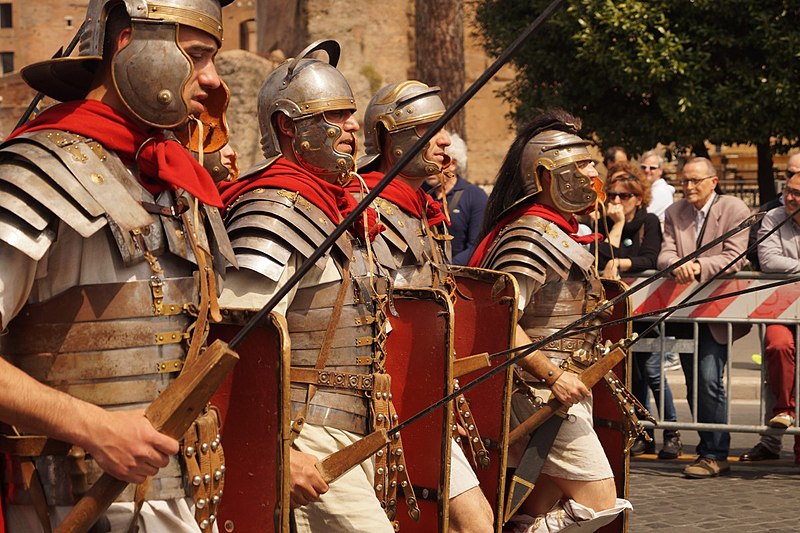
Re-enactors in Roman legionary gear, 19 May, 2021.
Original photo from https://pxhere.com/en/photo/883133 via Wikimedia Commons.
I am a proud member of the Airfix generation. The desire (less so the ability) to assemble and paint plastic model kits of aircraft, tanks and ships hit me squarely between the eyes on my tenth birthday in 1970. Several aunts and uncles had arrived at the same solution to bring out my inner Spitfire on the same day. Who needed the high of polystyrene cement and Humbrol enamel when you could refight D-Day across your bedroom floor with kits costing as little as 1/6d? Although Airfix was the premium producer of scale kits, other competing brands included Frog, Tamiya, Monogram, Hasegawa and Revell. I wish I knew what I did with them all, but many of the aircraft I recall casting out of upstairs windows, set on fire by match and candle. Looking back, I can see how it sewed the seeds of my becoming a professional military historian decades later. From little acorns, eh?
Two years later, I discovered I was interested in anything historical when my parents packed us into a train (great excitement in itself) for a trip to London. Although long past the days of steam, I can remember my father walking me down to thank the engine driver for getting us safely into Euston and then the true adventure began. The arrival at the British Museum to see the Tutankhamun Exhibition, which ran from March to December 1972. When it ended, besides the young Caddick-Adams, 1.6 million visitors had passed through the exhibition doors, making it the most popular attraction in the museum’s history. My favourite art class activity thereafter altered from drawing Spitfires and Messerschmitts chasing each other across every page to depicting ghostly, golden burial masks. Ever since, I have held an unbelievably soft spot for the old BM, always remembering that due to its vastness, it is best to go there to see something specific, rather than wander hither and thither, lost in its many treasures.
Then in 1977, when studying Ancient History for “A” Level, it was the turn of the Royal Academy in Piccadilly to capture my imagination with its Pompeii AD 79 exhibition. Mosaics, personal possessions, wall paintings and plaster casts of Romans and their animals caught in the moment of death as toxic gases, ashes, molten rock and pulverized pumice froze them forever, like insects in amber, likewise left a profound mark on my understanding of the bigger wheels of history.
The other day I was more than happy to be reunited with my old friend, the British Museum, this time hosting another Roman exhibition, which promises to be every bit as impactful as the Tutankhamun and Pompeii antecedents. Just unveiled, Legion: Life in the Roman Army is an inspired portrayal of an institution which numbered around 450,000 at its peak in AD 211 (33 legions and c. 400 auxiliary regiments), although numbers always fluctuated. The first amazing realisation is how little archaeological evidence remains of this vast organisation that endured for many centuries. The second is how well the scanty remnants in this exhibition have been preserved and interpreted.
Here, the British Museum has assembled the best surviving examples of arms, armour and personal possessions from collections around the world, in over 200 artefacts from 28 lenders. Though we view gleaming bronze helmets, swords long-rusted into scabbards, a pile of near-fossilised chainmail, it is incredible to think that there is only one intact example remaining of all those hundreds of thousands of rectangular and curved legionary shields (called a scutum), still bearing its decoration and crimson dye. This one comes from Syria.
There are some fine funerary carvings of Roman officers from around the empire, then we encounter some of the battlefield detritus including breastplate armour found near Kalkriese, in the Teutoburgerwald of Lower Saxony. This is where a coalition of Germanic tribes led by a rebel chieftain called Arminius ambushed 3 legions led by Publius Quinctilius Varus in 9 AD. The story of discovering this battle terrain was as dramatic as the assault itself. It was the result of a meticulous British soldier who combed an area north of his base at Osnabrück with a metal detector in 1987. Major Tony Clunn recorded each discovery of Roman coins and sling shot, making it possible to reconstruct the route taken by Roman legionaries under Varus and determine where they were ambushed and massacred.
February 12, 2024
Yalta, When Stalin Split the World – a WW2 Special
World War Two
Published 11 February 2024Indy and Sparty take you through the negotiations at Yalta as The Big Three thrash out the shape of the postwar world. As the splits between East and West continue to deepen, who will come out on top?
(more…)
Look at Life – Amphibian DUKW (1962)
Classic Vehicle Channel
Published Apr 23, 2020The military have finished with their amphibious truck know as the DUKW. They’re sold off to the general public for use in civilian life, including divers and even a group of monks.
February 11, 2024
The Battle of Manila Begins – WW2 – Week 285 – February 10, 1945
World War Two
Published 10 Feb 2024The American advance on Luzon has reached the Philippine capital, and it looks like they have a real fight on their hands with the Japanese there. There are supposed to be two new Allied operations starting in Western Europe, but one is delayed by flooding. The Allies do manage to eliminate the Colmar Pocket in the west, though. On the Eastern Front, there are new Soviet attacks in Pomerania and East Prussia, as well as out of the Steinau Bridgehead to the south, and in Budapest, it looks like the Soviet siege might soon end in victory.
(more…)
February 10, 2024
The War Goals to End WW2 in 1945 – a WW2 Special
World War Two
Published Feb 8, 2024While World War Two looks like it is about to end, the belligerent powers have vastly different goals for that end. Differences that may or may not prolong the war, will decide the survival of tens of millions of people, and the future fate of all of Humanity.
(more…)
Napoleon’s Revenge: Wagram 1809
Epic History TV
Published Jun 21, 2019Six weeks after his bloody repulse at the Battle of Aspern-Essling, Napoleon led his reinforced army back across the Danube. The resulting clash with Archduke Charles’s Austrian army was the biggest and bloodiest battle yet seen in European history, and despite heavy French losses, resulted in a decisive strategic victory for the French Emperor.
(more…)
February 9, 2024
QotD: “Five, Four, Three, Two, One. Thunderbirds Are Go!”
Although there had been earlier offerings from the same stable, such as Supercar, Fireball XL5 and Stingray, and others which followed, it was Thunderbirds that gripped my generation and has never really let go. Set in the future, the genre devised by Gerry Anderson focused on the heroic exploits of secret but benevolent organisations operating from remote or hidden bases on land, in the sky or on the moon. Equipped with advanced technology, their missions were to protect civilisation from aggression, accident and sabotage, countering devious, often extra-terrestrial opponents. It was his brother’s service in the RAF that gave Anderson a life-long fascination with flying machines. Thunderbird Field at Glendale, Arizona, where his older brother learned to fly, provided a name for the series.
In his future worlds, planet Earth is generally united under a world president, in contrast to the traumas of the recently passed world war. Each programme featured life-like puppets, filmed in what Anderson dubbed “Supermarionation”. They were tributes to his brother. It was on 27 April 1944 that these future television series were really born. Flight Sergeant Lionel Anderson never got to pilot Stingray or Thunderbird One, or fly an Interceptor from Cloudbase, for during the early hours of that April Thursday, his twin-engined Mosquito was hit by flak on a night intruder raid and crashed near Deelen in Holland. Now he and his navigator, Sergeant Bert Hayward, lie in the corner of a cemetery in Arnhem, “Mourned by his devoted parents and brother Gerald”, as the Commonwealth War Grave headstone reads.
The war traumatised Gerry Anderson, whose Jewish grandparents had fled pogroms on the Polish–Russian frontier. He would complete his own national service in the RAF and experienced two more dramatic flying events. In 1948, he saw a Mosquito — his brother’s aircraft type — crash during an air display, killing many bystanders. Later a Spitfire came in to land without its undercarriage lowered. The helplessness he felt, and need for some divine intervention, such as that provided by the World Aquanaut Security Patrol (Stingray), International Rescue (Thunderbirds), Spectrum (Captain Scarlet) or Supreme Headquarters Alien Defence Organisation (UFO), provided more seeds for the future series, where the world was united and fought external foes. In German, the last was screened as Weltraumkommando SHADO, but the concept precisely echoed the UNIT organisation of Doctor Who.
Throughout the 1950s and 1960s we were promised robots, space travel, lunar colonies and travel to Mars. Films, television series, science fiction short stories and magazines guaranteed it to the point of entitlement. Airfix plastic model kits, cardboard cut-outs on cereal packets, Matchbox, Corgi and Dinky diecast toys reinforced this expectation, underwritten by the real, manned Mercury missions of 1961–63, Gemini space launches of 1965–66 and Apollo craft of 1968–72. Gerry Anderson’s vision (shared by the American script writers of Star Trek, which debuted exactly a year after Thunderbirds on 8 September 1966) of a world government did not seem absurd to the young minds of 1965. It is partly the innocence of those years which touches us today. I, for one, still feel short-changed.
Peter Caddick-Adams, “Broadcasting anniversaries”, The Critic, 2023-11-04.
February 7, 2024
The Magician Who Fooled the Nazis (and all of us)
World War Two
Published 7 Nov 2023Military deception is tricky. Sometimes you need to destroy a crucial piece of war industry or make an entire harbour disappear. Who do you call for this sort of job? Well, someone who knows a thing or two about tricking the eye. You need a professional magician. You need Jasper Maskelyne. But is there more to this illusionist than meets the eye?
(more…)
February 6, 2024
5 HEAVY Tanks | Tank Chats
The Tank Museum
Published Nov 10, 2023Enjoy this compilation of classic Tank Chats presented by David Fletcher. We’ve put together David’s chats on TOG 2, FV4005, Conqueror, Conway and the 40 Ton Centurion – representing some of the heaviest tanks in our collection.
(more…)
February 5, 2024
Western Front Tank Warfare 1944
World War Two
Published Nov 8, 2023Indy takes a look at the armoured beasts battling it out on the Western Front. On the German side we have vehicles like the long-serving Panzer IV, the sleek and modern Panther, and the obnoxiously heavy King Tiger. These are arrayed against the American stalwart, the M4 Sherman, and British tanks like the up-gunned Firefly, Cromwell, and Churchill.
(more…)
February 4, 2024
Is the Red Army too fast for its own good? – WW2 – Week 284 – February 3, 1945
World War Two
Published 3 Feb 2024Soviet forces have reached the old German border in force, however, logistical issues and a strong enemy presence possibly threatening their flanks means that a drive on Berlin may not be doable just now. Heinrich Himmler is in charge of the new Army Group to defend the Reich, and he has a host of problems. On the Western Front, the Allies finally eliminated the Colmar Pocket, and in the Philippines, the American advance reaches Manila, and the battle for the city is about to begin.
(more…)


