
World War Two
Published 24 Apr 2024It’s time for another thrilling installment of Out of the Foxholes, but what sort of questions does Indy answer today? Well, it’s good stuff — about Allied security and logistics at the major conferences, about what the British navy was doing once the Atlantic and Mediterranean were secure, and about the skills (or lack thereof) of the soldiers of the Waffen SS. How can you live without knowing about such things? I suppose it’s possible, but it would be a sad life indeed, so check it out!
(more…)
April 25, 2024
Were the Waffen-SS Really Germany’s Elite Fighters? – WW2 – OOTF 35
Comments Off on Were the Waffen-SS Really Germany’s Elite Fighters? – WW2 – OOTF 35
Jeremy Black reviews Empireworld by Sathnam Sanghera
The author of a book on the same topic says that Sathnam Sanghera’s work “really should have devoted more attention to the pre-Western history“:
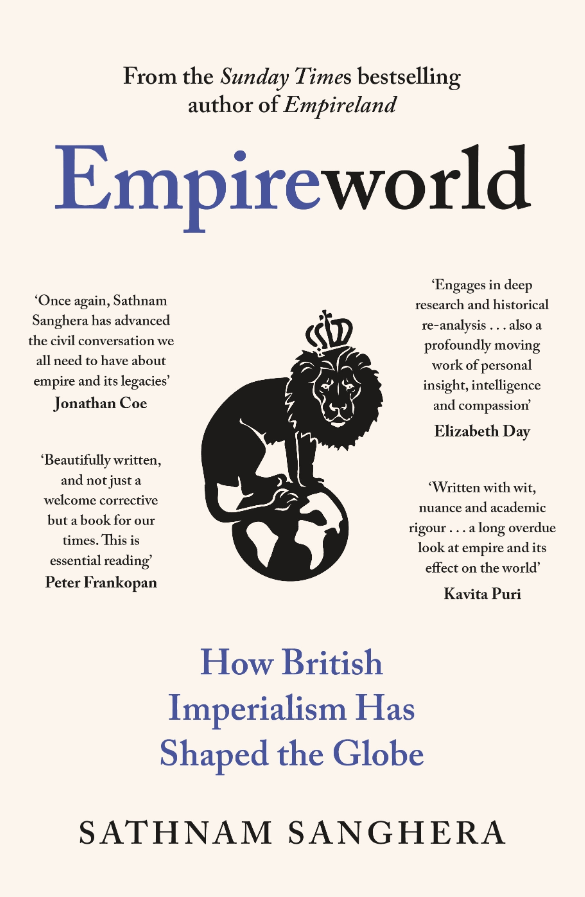
With its pretensions and authorial conceit, Sanghera’s book is actually rather a good laugh. He apparently is the word and the way for Britain, which “cannot hope to have a productive future in the world without acknowledging what it did to the world in the first place”, a process that is to be done on his terms in order to overcome a British allergy to the unattractive aspects of the imperial past.
Stripped to its essentials, this is a book that repeats well-established themes and serves them up in a familiar fashion. Although 461 pages long, only 247 are text and, with a generous typeface that is a pleasure to read, there is only so much space for his analysis. Unfortunately, that is what is on offer.
It might be thought appropriate to establish what was different or familiar in British imperialism in a Western European context by comparing in detail, say, Britain’s Caribbean empire with those of France, Spain and the Dutch. It might be thought useful to assess Britain as an Asian imperial power alongside Russia or the Ottomans, China or the Persians.
It might be appropriate to follow the direction of much of the world history approach over the last half-century and assess empires as shared projects in which there were many stakeholders, British and non-British. To turn to the British empire, it might be useful to discuss the oldest “colony”, Ireland, or to assess policy in (Highland) Scotland. It could be appropriate to consider how the causes, context, course and consequences of British imperialism varied greatly.
Sanghera has not risen to the challenge. His study is conceptually weak, methodologically flawed, historiographically limited and lacking basic skills in source assessment. This is a pity, as his position as a journalist, and his link with Penguin, provide an opportunity for using his abilities as a communicator to expand public understanding of the subject.
Sanghera criticises “an enervating culture war on the theme of British empire”. He rightly draws attention to the flaws of the “balance sheet” view of British empire, but I am less confident than he is about how best to consider what he terms “a culture war”. The promotion of “understanding” for which he calls is scarcely value-free, nor does he adequately address the degree to which there have always been “culture wars” in both Britain and its colonies and former colonies. Unsurprisingly so, as there were substantive issues at stake, and questions of goal and identity were very much part of the equation.
From reading journalists’ comment pieces, it is hard to avoid the sense that they feel that there is a correct view (theirs, what a surprise) and that others are variously culture wars, populist, ignorant, etc. This is the standard approach to history, notably national history, and, particularly in the case of Britain, empire and slavery. Yet, such a stance scarcely captures the complexities of the issue, a problem very much seen in Sanghera’s work, despite his claim to nuance.
Comments Off on Jeremy Black reviews Empireworld by Sathnam Sanghera
The Handley Page Hampden; A Plane for Fat Shaming
Ed Nash’s Military Matters
Published Apr 29, 2022One of the key British bombers at the start of the war, the Hampden was eclipsed by its more successful equivalent, the Vickers Wellington, and the later four-engine “heavies”. But it is worth remembering for the role it played in developing the RAF’s experience and methods during WW2.
(more…)
Comments Off on The Handley Page Hampden; A Plane for Fat Shaming
April 24, 2024
What Were Victorian Attitudes Towards Sex?
History Hit
Published Dec 15, 2023They’re famously thought of as a buttoned up prudish bunch, but we all know they loved to bump uglies as much as anyone today.
Were the spanking punishments of boarding schools really the origins of brothels? Who were the pin-ups of Victorian women? And what did the saucy portrait Queen Victoria gave to Prince Albert look like?
Today we go Betwixt the Victorian Sheets with Dan Snow, from History Hit sister podcast Dan Snow’s History Hit, to find out all about Victorian relationships.
(more…)
Comments Off on What Were Victorian Attitudes Towards Sex?
April 23, 2024
Debating the economic impact of the Raj on India
At The Daily Sceptic, Nigel Biggar looks at a few books making or refuting the narrative on how much or how little British rule in India extracted or contributed to the economic life of the subcontinent:
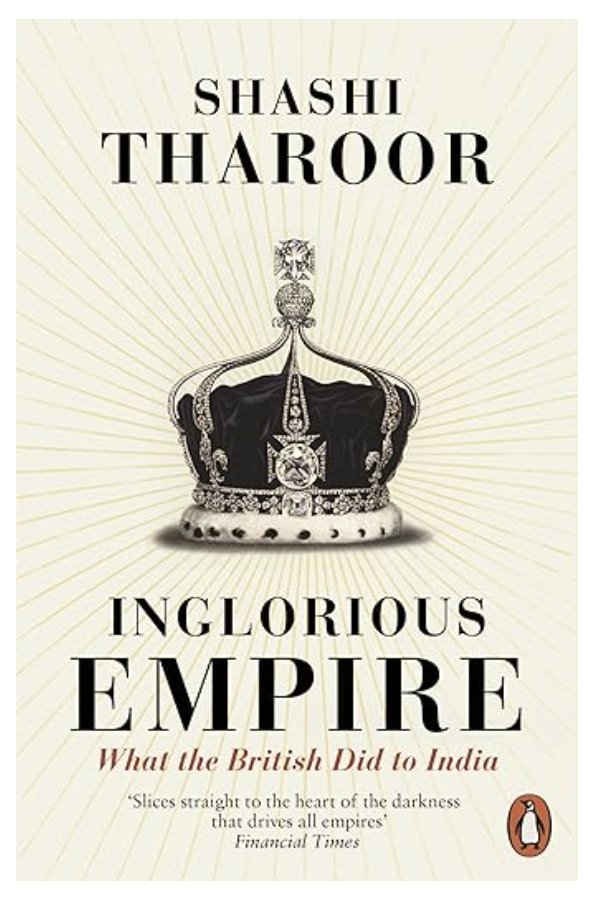
Beyond slave-trading and slavery, what were the economic effects of British imperial dominance? Can they be reduced to Britain’s leeching wealth from exploited subject peoples?
For over a century, that is what Indian nationalists have claimed. It is also what the politician Shashi Tharoor claims in his 2016 book, Inglorious Empire: What the British Did to India. Against him, however, the Bengali-born, LSE-based economic historian Tirthankar Roy has declared of the nationalist critique that “generations of historians … have shown that it is not [true]”. Pace Tharoor, the statistic that India produced 25 per cent of world output in 1800 and 2–4 per cent in 1900 does not prove that India was once rich and became poor: “[i]t only tells that industrial productivity in the West increased four to six times during this period … The proposition that the Empire was at bottom a mechanism of surplus appropriation and transfer has not fared well in global history”.
On the contrary, the British Empire’s commitment to free trade gave Indian entrepreneurs new opportunities to grow. Some of them visited England in the late 19th Century, observed the workings of manufacturing industry, imported machinery and expertise to India, built factories employing Indians, and then outcompeted Manchester. This is exactly how the Tata Iron and Steel Company began in Bombay – the same company that now owns what remains of the British steel industry.
What is more, colonial governments often protected native producers against British business, in order to moderate economic and social disruption, partly because they genuinely cared for the welfare of native people and partly because they didn’t want to have to manage the political unrest that foreign commercial intrusion could excite. Famously, in 1910-11 colonial officials barred Lever Brothers from acquiring concessions in Nigeria on which to establish palm-oil processing mills with widespread hinterlands, since Africans were already producing for the world markets and generating tax revenue and because the alienation of large areas of land risked provoking native opposition.
Further still, the British were the leading exporters of capital from the mid-19th Century to at least 1929. Between 1876 and 1914, Britain invested over a third of its overseas capital in the Empire, over 19% of it in India. Of course, British investors often made a profit out of this. That’s the thing about investment: you tend to want to grow your money, not waste it. But if the British gained, so did colonial peoples. Take railways. By 1947, British India had 45,000 miles of railway track, most of it constructed with private capital, whereas five years later un-colonised China still had less than 18,000 miles. For sure, the railways served military purposes. But they also served commercial and economic ones: one estimate reckons that when the railway network reached the average district, real agricultural income rose by about 16%. And it served the welfare purpose of efficient famine relief, too.
A basic reason why the British sent their capital overseas to the Empire, enabling the growth of businesses and the building of infrastructure, was that colonial states provided sufficient political stability and legal certainty to make the risks of financial ventures worth taking. (Badenoch hints at this in her reference to the economic effects of the Glorious Revolution of 1688.) That explains why Australia’s economic growth compares so favourably with that of many Latin American countries, and why, between the 1860s and 1890s, Australia was the richest country on earth.
In sum, the considered judgement of the Swiss historian Rudolf von Albertini, whose work – according to the world’s “leading imperial economic historian”, David Fieldhouse – was based “on exhaustive examination of the literature on most parts of the colonial world to 1940”, was simply this: “colonial economics cannot be understood through concepts such as plunder economics and exploitation”.
Comments Off on Debating the economic impact of the Raj on India
April 22, 2024
QotD: Before England could rely on the “wooden walls” of the Royal Navy
… given this general lack of geographical knowledge, try to imagine embarking on a voyage of discovery. To an extent, you might rely on the skill and experience of your mariners. For England in the mid-sixteenth century, however, these would not have been all that useful. It’s strange to think of England as not having been a nation of seafarers, but this was very much the case. Its merchants in 1550 might hop across the channel to Calais or Antwerp, or else hug the coastline down to Bordeaux or Spain. A handful had ventured further, to the eastern Mediterranean, but that was about it. Few, if any, had experience of sailing the open ocean. Even trade across the North Sea or to the Baltic was largely unknown – it was dominated by the German merchants of the Hanseatic League. Nor would England have had much to draw upon in the way of more military, naval experience. The seas for England were a traditional highway for invaders, not a defensive moat. After all, it had a land border with Scotland to the north, as well as a land border with France to the south, around the major trading port of Calais. Rather than relying on the “wooden walls” of its ships, as it would in the decades to come, the two bulwarks in 1550 were the major land forts at Calais and Berwick-upon-Tweed.
Anton Howes, “The House of Trade”, Age of Invention, 2019-11-13.
Comments Off on QotD: Before England could rely on the “wooden walls” of the Royal Navy
April 21, 2024
300,000 Germans Surrender in the Ruhr – WW2 – Week 295 – April 20, 1945
World War Two
Published 20 Apr 2024The Soviet drive on Berlin continues, but it is now very much a race between the forces of Georgy Zhukov and those of Ivan Konev. In the west, over 300,000 Germans surrender to the Allies as the Ruhr Pocket is eliminated, though there are advances by all Allied armies this week on the whole Western Front. There is even an Allied breakthrough in Italy, though on Okinawa American attacks get nowhere. The Japanese are advancing in China, and in Burma the Allied drive for Rangoon continues.
(more…)
Comments Off on 300,000 Germans Surrender in the Ruhr – WW2 – Week 295 – April 20, 1945
How The Channel Tunnel Works
Practical Engineering
Published Jan 16, 2024Let’s dive into the engineering and construction of the Channel Tunnel on its 30th anniversary.
It is a challenging endeavor to put any tunnel below the sea, and this monumental project faced some monumental hurdles. From complex cretaceous geology, to managing air pressure, water pressure, and even financial pressure, there are so many technical details I think are so interesting about this project.
(more…)
Comments Off on How The Channel Tunnel Works
April 20, 2024
“Identity quakes”
Andrew Doyle explains why some people cling to aspects of their worldview so tightly because to admit that they were mistaken would actually threaten their individual identity:

Both Gosse’s memoir and Potter’s dramatisation grapple with what Peter Boghossian and James Lindsay (in their book How to Have Impossible Conversations) call an “identity quake”, the “emotional reaction that follows from having one’s core values disrupted”. Their point is that when arguing with those who see the world in an entirely different way, we must be sensitive to the ways in which certain ideas constitute an aspect of our sense of self. In such circumstances, to dispense with a cherished viewpoint can be as traumatic as losing a limb.
The concept of identity quakes helps us to understand the extreme political tribalism of our times. It isn’t simply that the left disagrees with the right, but that to be “left-wing” has become integral to self-conceptualisation. How often have we seen “#FBPE” or “anti-Tory” in social media bios? These aren’t simply political affiliations; they are defining aspects of these people’s lives. This is also why so many online disputes seem to be untethered from reason; many are following a set of rules established by their “side”, not thinking for themselves. When it comes to fealty to the cause, truth becomes irrelevant. We are no longer dealing with disputants in an argument, but individuals who occupy entirely different epistemological frameworks.
Since the publication of the Cass Review, we have seen countless examples of this kind of phenomena. Even faced with the evidence that “gender-affirming” care is unsafe for children, those whose identity has been cultivated in the gender wars will find it almost impossible to accept the truth. Trans rights activists have insisted that “gender identity” is a reality, and their “allies” have been the most strident of all on this point. As an essentially supernatural belief, it should come as no surprise that it has been insisted on with such vigour, and that those who have attempted to challenge this view have been bullied and demonised as heretics.
Consider the reaction from Novara Media, a left-wing independent media company, which once published some tips on how to deceive a doctor into prescribing cross-sex hormones. Novara has claimed that “within hours of publication” the Cass Review had been “torn to shreds”. Like all ideologues, they are invested in a creed, and it just so happens that the conviction that “gender identity” is innate and fixed (and simultaneously infinitely fluid) has become a firm dogma of the identity-obsessed intersectional cult.
Identity quakes will be all the more seismic within a movement whose members have elevated “identity” itself to hallowed status. When tax expert Maya Forstater sued her former employers for discrimination due to her gender-critical beliefs in 2019, one of the company’s representatives, Luke Easley, made a revealing declaration during the hearing. “Identity is reality,” he said, “without identity there’s just a corpse”.
This sentiment encapsulates the kind of magical thinking that lies at the core of the creed. So while it becomes increasingly obvious that gender identity ideology is a reactionary force that represents a direct threat to the rights of women and gay people, there will be many who simply will not be able to admit it. In Easley’s terms, if their entire identity is based on a lie, only “a corpse” remains. From this perspective, to abandon one’s worldview is tantamount to suicide.
Comments Off on “Identity quakes”
April 19, 2024
Humza Yousuf, the “Thug King of Scotland”
I don’t know what Scotland did to deserve Humza Yousuf as their first minister, but it must have been really bad:
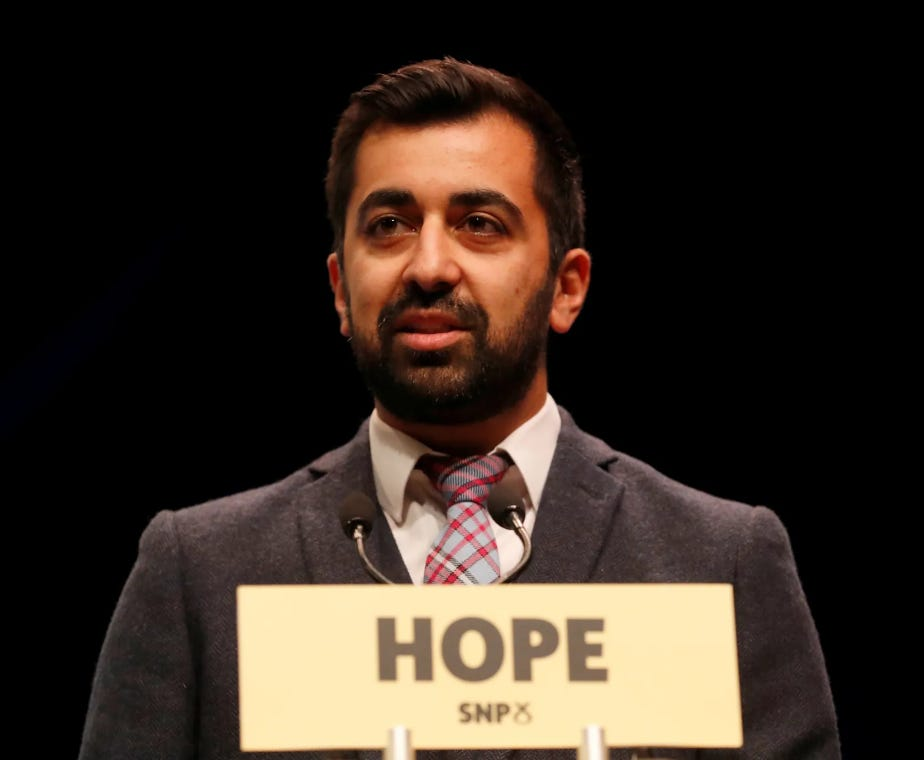
Not what you were hoping for.
Assuming he doesn’t get removed by a leadership coup before voters sink the leaking Tory battleship, Sunak will be gone by January of 2025 at the latest. That just leaves Humza Yousuf, characterized by Morgoth as The Thug King of Scotland: a post-ideological, apolitical opportunist interested purely in power for its own sake and quite happy to use the absurd public morality of the despised rubes that he rules over to keep the wretches in their place.
And boy, does he despise them.
Yousuf first came to the Internet’s attention in 2020, when he was filmed ranting in the Scottish parliament about how disgustingly racist it was that most of the high public offices in a country with an overwhelmingly White population were occupied by presumptively racist White cavebeasts:
The Lord President is white, the Lord Justice Clerk is white, every High Court judge is white, the Lord Advocate is white, the Solicitor General is white, the chief constable is white, every deputy chief constable is white, every assistant chief constable is white, the head of the Law Society is white, the head of the Faculty of Advocates is white and every prison governor is white.
That is not the case only in justice. The chief medical officer is white, the chief nursing officer is white, the chief veterinary officer is white, the chief social work adviser is whiteand almost every trade union in the country is headed by white people. In the Scottish Government, every director general is white. Every chair of every public body is white. That is not good enough.
If you haven’t watched the video, you should. You need to hear the contempt dripping off of his tongue, the way he spits out the awful word “White” like bitter venom.
In the immediate aftermath of this angry foreigner’s tirade, a sane country would have immediately marched their ill-mannered guest out of parliament, stripped him of office and citizenship, thrown him on a rusty fishing vessel, hauled him up north of the Orkneys, tossed him into the North Sea wearing nothing but a life preserver, and sent him on his way with a cheery wave and a reminder to mind the orcas.
Instead, they gave him the keys to the kingdom.
But while the infamous White Speech might not have prevented his elevation to the highest office in the land – indeed, given the derangement of our elites, if anything it smoothed his ascent – it has come back to haunt him. Thin-skinned and insecure as he is, Yousuf’s first priority on taking office was to ram through a new hate speech law with which to prevent the contemptible White worms from critiquing him or his noble tribe of vape-shop owners, cabbies, and grooming gang pimps. The law was ridiculously broad and invasive: one could be reported for the criminal offence of hate speech merely for making a remark in the privacy of one’s home, around the dinner table, with no one present but one’s kith and kin.
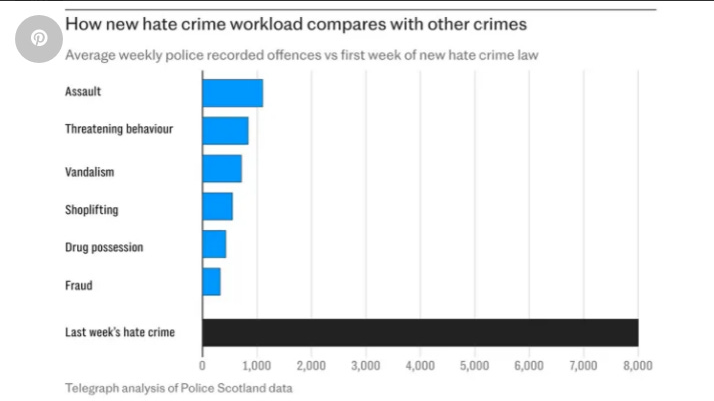
The day that the bill was finally forced through the Scottish parliament, and predictably enough for anyone who glanced at the law and had a passing understanding of the Scottish national character, the Scottish people responded by DDoSing the police with a deluge of hate crime reports, a very large number of which were reporting Yousuf’s rant as a hate crime … which, apparently, under the strict interpretation of the new law, it certainly was, with the only thing standing between Yousuf and indictment under his own half-baked law being that his ill-considered harangue took place prior to the law being passed. Which hasn’t stopped the Scots from taking the piss and continuing to report him.
It turns out that the Scots really do not like a ban on bantz, not one bit, and respond to demands that they cease the bantz by cranking up the bantz. Yousuf, being a humourless Pakistani who is confused and angered by this entirely foreseeable reaction, has risen to the occasion with all the grace, poise, and wit you would expect. In an attempt to stem the savage tide of mockery, Yousuf has tried claiming that reporting his hate speech is hate speech (lulz); has ordered Scottish police to read verbatim a prewritten transcript defending him each time his hate speech is thrown back at him (because that doesn’t look ridiculous); and faked a hate crime against himself by having his house sprayed with graffiti (did anyone fall for this?).
The next Scottish general election is two years away. Whether Humza survives the interim as First Minister, and if so whether he is able to guide the “Scottish” “National” Party to victory, remains to be seen. I don’t fancy his chances. He is a cunning and ruthless brute, to be sure. But he is also clumsy, clueless, and very stupid. Yousuf’s popularity has already plummeted. I’m sure he can find ways to plummet further. I believe in you, Yousuf. You can do it!
Comments Off on Humza Yousuf, the “Thug King of Scotland”
Breakfast in Jane Austen’s England
Tasting History with Max Miller
Published Jan 16, 2024What you could tell about someone from their breakfast in Jane Austen’s England, and a recipe for Bath buns as she might have eaten them for her first meal of the day.
Caraway buns topped with glaze, sugar, and caraway, served with butter. Perfect for a Jane Austen inspired breakfast with some hot chocolate
City/Region: England
Time Period: 1769It is a truth universally acknowledged that a person who has recently risen from bed must be in want of breakfast. In Jane Austen’s time, breakfast could be around 8:00 or 9:00 in the morning if you were a manual laborer or servant, or it could be as late as 3:00 or 4:00 in the afternoon if you were upper class.
Jane wrote a letter to her sister Cassandra saying that she wanted to join her on her trip to Bath, but didn’t want to inconvenience their hosts, so she would fill up on bath buns for breakfast. I can see why this would have been a sound strategy. The buns are denser than modern versions, but still soft and very good (they would certainly fill you up). The caraway is present but not overpowering, and they’re sweet but not as sweet as a dessert.
Caraway comfits were candy-coated caraway seeds (think M&Ms), but they don’t use caraway to make them anymore. I mimic them as best I can with caraway seeds and sugar.
To make Bath Cakes.
Rub half a pound of butter into a pound of flour, and one spoonful of good barm, warm some cream, and make it into a light paste, set it to the fire to rise, when you make them up, take four ounces of carraway comfits work part of them in, and strew the rest on the top, make them into a round cake, the size of a French roll, bake them on sheet tins, and send them in hot for breakfast.
— The Experienced English Houskeeper by Elizabeth Raffald, 1769
Comments Off on Breakfast in Jane Austen’s England
April 17, 2024
Pay no attention to what “tax me more” folks say – instead watch what they do
One way for an a wealthy person to get a lot of free media attention is to performatively declare that they should be paying more taxes. This ostentatious virtue-signalling is frequent enough that Tim Worstall has been writing the occasional article about it for quite some time:
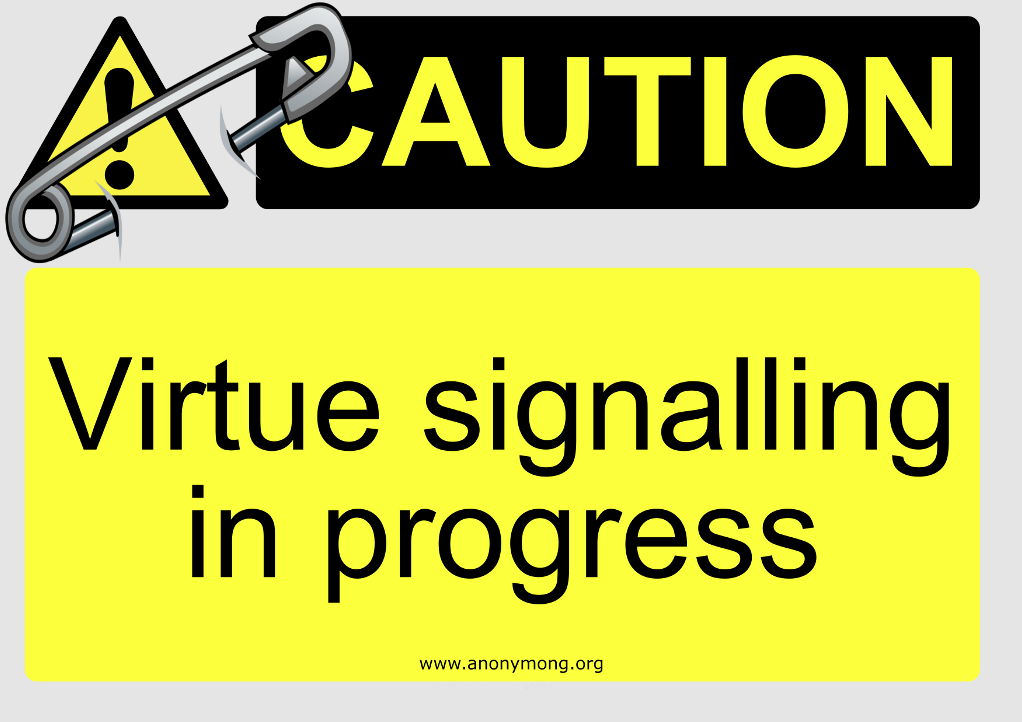
For there is this:
Public donations to pay off the national debt have hit their highest level in at least a decade amid growing concern about the UK’s soaring debt mountain.
Members of the public handed almost £700,000 over to the Government through six individual bequests and donations last year, according to Debt Management Office (DMO) figures obtained via a Freedom of Information request.
The amount for the 2023-24 financial year was the highest in at least a decade, with the biggest single payment to help pay off Britain’s £2.65 trillion debt pile coming from a £500,000 bequest, according to the DMO, which did not provide names of individual donors.
One way to think of this — an entirely correct way to think of it too — is that an entire 6 people last year thought that inheritance tax was too low. Which, out of the about 600k deaths (not looked it up but that’s right order of magnitude, it’s not 6 million and it’s not 60k) is not actually a lot. 0.001% in fact.
One of the grand insistences of economics is that watching what people do gives more information about their true beliefs than listening to what they say – revealed preferences, not expressed. So, by what people actually do we have 0.001% of the people leaving estates of any size whatever who think that the tax on estates is too small. This is not a large majority in favour of higher taxes upon estates being left.
But back to the far more important subject, me.
As far as the UK is concerned I did start this off. The reporting on how much people voluntarily leave to the government. Who pays extra that is – who makes a voluntary donation to government. Back in 2006 in fact, back in the depths of the Brown Terror:
LAST YEAR there were five people in Britain who thought that their taxes were too low. No, this isn’t the number of people who have called for higher taxes. Rather, it is those who were so convinced of the righteousness of state spending that they voluntarily sent extra money to the Treasury.
The Americans have been doing this since 1843. It’s always been possible to pay extra to HM Treasury — Stanley Baldwin actually handed over one fifth of his estate while he was still alive. Admittedly, he was Financial Secretary to the Treasury at the time and was asking for donations to aid in paying down war debt but still, props for money where mouth is.
Cheques, by the way, should be made out to “The Accountant, HM Treasury”, and sent to 1 Horse Guards Road, London SW1A 2HQ. A 2nd-class stamp is sufficient and you are encouraged to add a covering note so that your donation is spent in the way you like.
I wrote that piece for The Times simply because I thought it would be a cute thing to do — and I wanted the £200 that went with writing it. As ever with freelance journalism, my money is important.
I also know that that was the first piece that appeared in UK journalism on this point. For when I asked the Treasury they’d no idea at all how many had in fact paid extra. Took them months to find out too. The donations had happened before, but no one had been writing about it. At least, not since Baldwin’s generation.
His Majesty King Charles, in right of Canada, would also be happy to accept any unwanted sums of money above your mandatory tax rate here. Go wild, wealthy and patriotic Canadian multi-millionaires!
Comments Off on Pay no attention to what “tax me more” folks say – instead watch what they do
April 14, 2024
Soviets Take Vienna and Königsberg – WW2 – Week 294 – April 13, 1945
World War Two
Published 13 Apr 2024The prizes of Vienna and Königsberg fall to the Soviets as they continue what seems an inexorable advance. In the West the Allies advance to the Elbe River, but there they are stopped by command. The big news in their national papers this week is the death of American President Franklin Roosevelt, which provokes rejoicing in Hitler’s bunker. The Allied fighting dash for Rangoon continues in Burma, as does the American advance on Okinawa, although Japanese resistance is stiffening and they are beginning counterattacks.
Chapters
00:32 Recap
01:05 Operation Grapeshot
01:57 Roosevelt Dies
06:01 Soviet Attack Plans for Berlin
12:45 Stalin’s Suspicions
14:31 The fall of Königsberg
17:02 The fall of Vienna
18:38 Japanese Resistance on Okinawa
20:34 The War in China
21:09 Burma and the Philippines
22:38 Summary
22:57 Conclusion
25:05 Memorial
(more…)
Comments Off on Soviets Take Vienna and Königsberg – WW2 – Week 294 – April 13, 1945
April 13, 2024
QotD: Architects and modern architecture
Professor Curl’s is a very painful book to read. In one sense his targets are easy for, as the photos amply demonstrate, modernist architecture and its successors are so awful that it scarcely requires any powers of judgment to perceive it. It is like seeing a TV evangelist and knowing at once that he is a crook. Yet modernist architecture, despite its patent hideousness and inhumanity, still has its defenders, especially in the purlieus of architectural schools. Moreover, the population has been browbeaten into believing that there was never any alternative, and it is obvious that to undo the damage would take decades, untold determination and vast expenditure. Removing the Tour Montparnasse alone would probably cost several billion. No one is prepared to make this colossal effort.
What Walter Godfrey wrote in 1954 is debatable:
It is not an exaggeration to say that nine men out of ten have lost all sensitiveness to an art that was once a matter of common interest.
If this is true, it is because they have learned to accept, or swallow what they are given. The epidemiology of graffiti, however, suggests to me that, at least subliminally, men still take notice of their surrounding and are affected by them: defacement is overwhelmingly of hideous Corbusian surfaces, that is to say on what Corbusier called “my friendly concrete”.
As for the architects and their acolytes, the architectural commentators, they hide behind the claim that most people do not “understand”. They claim that modernist architecture is better than it looks or functions, that it is “honest”, a weaselly word in this context. The architects cannot recognise the obvious for the same reason that Macbeth could not stop murdering once he had started:
I am in blood
Stepped in so far that should I wade no more
Returning were as tedious as to go o’reProfessor Curl has written an essential, uncompromising, learned, sometimes slightly densely, critique of one of the worst and most significant legacies of the 20th century. He offers a slight glimmer of hope in the existence of architects who, bravely, have resisted the blandishments of celebrity status and the approbation of their corrupted peers. His book has a wonderful bibliography, the fruit of a lifetime of reading and reflection, that will give me occupation for a long time to come. It is a loud and salutary clarion call to resist further architectural fascism.
Theodore Dalrymple, “Architectural Dystopia: A Book Review”, New English Review, 2018-10-04.
Comments Off on QotD: Architects and modern architecture
April 12, 2024
FURY – How a Museum with a Sherman Made a Movie
The Tank Museum
Published Jan 5, 2024If you enjoyed the 2014 movie FURY, watch this and get the inside scoop behind The Tank Museum’s role in David Ayer’s Hollywood production. Ten years on from its release, David Willey describes how one of The Tank Museum’s Shermans and Tiger 131 took starring roles alongside Brad Pitt, Shia LaBeouf, Logan Lerman, Michael Peña, and Jon Bernthal. From initial discussions to the red carpet, David reveals every inch of the process, the lessons learned and the impact it has had on The Tank Museum.
Let us know what you thought of FURY and our tank’s performance in it in the comments below… What else would you like to know?
00:00 | Intro
00:50 | Fury – The Beginning
02:48 | Tiger Inquiries
05:00 | Insurance & Contracts
08:06 | Hollywood in Dorset
09:51 | On Set & Filming
14:55 | Was it worth it?
16:34 | Fury’s Longevity
(more…)
Comments Off on FURY – How a Museum with a Sherman Made a Movie


