
“What Wilberforce vanquished was something even worse than slavery,” says [Eric] Metaxas [in Amazing Grace], “something that was much more fundamental and can hardly be seen from where we stand today: he vanquished the very mindset that made slavery acceptable and allowed it to survive and thrive for millennia. He destroyed an entire way of seeing the world, one that had held sway from the beginning of history, and he replaced it with another way of seeing the world.” Ownership of existing slaves continued in the British West Indies for another quarter-century, and in the United States for another 60 years, and slave trading continued in Turkey until Atatürk abolished it in the Twenties and in Saudi Arabia until it was (officially) banned in the Sixties, and it persists in Africa and other pockets of the world to this day. But not as a broadly accepted “human good”.
There was some hard-muscle enforcement that accompanied the new law: the Royal Navy announced that it would regard all slave ships as pirates, and thus they were liable to sinking and their crews to execution. There had been some important court decisions: in the reign of William and Mary, Justice Holt had ruled that “one may be a villeyn in England, but not a slave,” and in 1803 William Osgoode, Chief Justice of Lower Canada, ruled that the institution was not compatible with the principles of British law. But what was decisive was the way Wilberforce “murdered” (in Metaxas’ word) the old acceptance of slavery by the wider society. As he wrote in 1787, “God almighty has set before me two great objects: the suppression of the slave trade and the reformation of manners”.
The latter goal we would now formulate as “changing the culture” — which is what he did. The film of Amazing Grace shows the Duke of Clarence and other effete toffs reeling under a lot of lame bromides hurled by Wilberforce on behalf of “the people”. But, in fact, “the people” were a large part of the problem. Then as now, citizens of advanced democracies are easily distracted. The 18th-century Church of England preached “a tepid kind of moralism” disconnected both from any serious faith and from the great questions facing the nation. It was a sensualist culture amusing itself to death: Wilberforce goes to a performance of Don Juan, is shocked by a provocative dance, and is then further shocked to discover the rest of the audience is too blasé even to be shocked. The Paris Hilton of the age, the Prince of Wales, was celebrated for having bedded 7,000 women and snipped from each a keepsake hair. Twenty-five per cent of all unmarried females in London were whores; the average age of a prostitute was 16; and many brothels prided themselves on offering only girls under the age of 14. Many of these features — weedy faint-hearted mainstream churches, skanky celebs, weary provocations for jaded debauchees — will strike a chord in our own time.
“There is a great deal of ruin in a nation,” remarked Adam Smith. England survived the 18th century, and maybe we will survive the 21st. But the life of William Wilberforce and the bicentennial of his extraordinary achievement remind us that great men don’t shirk things because the focus-group numbers look unpromising. What we think of as “the Victorian era” was, in large part, an invention of Wilberforce which he succeeded in selling to his compatriots. We, children of the 20th century, mock our 19th-century forebears as uptight prudes, moralists and do-gooders. If they were, it’s because of Wilberforce. His legacy includes the very notion of a “social conscience”: in the 1790s, a good man could stroll past an 11-year-old prostitute on a London street without feeling a twinge of disgust or outrage; he accepted her as merely a feature of the landscape, like an ugly hill. By the 1890s, there were still child prostitutes, but there were also charities and improvement societies and orphanages. It is amazing to read a letter from Wilberforce and realize that he is, in fact, articulating precisely 220 years ago what New Yorkers came to know in the Nineties as the “broken windows” theory: “The most effectual way to prevent greater crimes is by punishing the smaller.”
Mark Steyn, The [Un]documented Mark Steyn, 2014.
July 19, 2025
QotD: William Wilberforce and the anti-slavery movement
July 18, 2025
The Napoleonic-era Royal Navy
David Friedman on some of the aspects of Britain’s Royal Navy in the late eighteenth and early nineteenth century which may be incomprehensible to modern readers who encounter it in works of historical fiction (like the books of C.S. Forester or Patrick O’Brian):
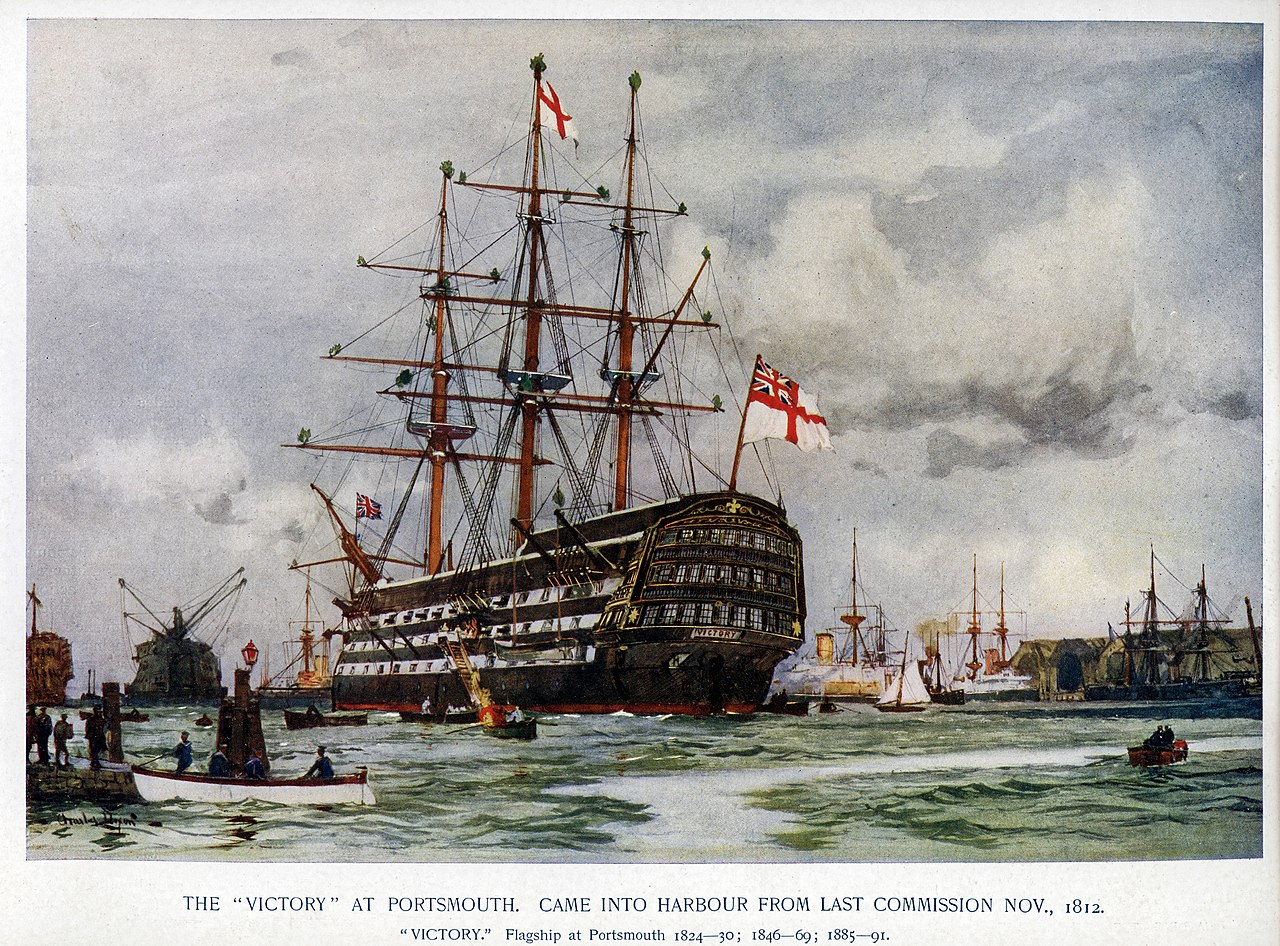
“HMS Victory in Portsmouth Harbour”
Painting by Charles Edward Dixon (1872-1934) via Wikimedia Commons.
I have read and enjoyed several series of novels set in the British navy during the Napoleonic wars, most recently one by Naomi Novik that departs a little further from history than its predecessors by providing the British and their enemies with dragons. The internal structure and the associated rules and customs of the navy seem very strange to a modern eye, yet it was a strikingly successful institution.
One feature likely to catch an economist’s eye was prize money. If a naval vessel captured a legitimate prize, an enemy warship or merchantman, and brought it back to port, the vessel and its contents were sold and the money distributed among those responsible. One large chunk went to the captain, another was distributed among his officers, a third among the crew, a fourth to the admiral under whose orders he was operating.
Another feature of the system was the role of patronage, political influence both within the navy and outside it in the career of an officer, especially a young officer. The critical step of promotion from lieutenant to captain depended in part on performance, in particular on the opinion of the captain under whom a lieutenant was serving. But it depended also on things that seem, to us, irrelevant.
One of Patrick O’Brien’s novels contains a conversation between Maturin, one of his protagonists, and a friend, a young officer of aristocratic birth. The officer has been having an affair with the separated wife of a high naval official and wants to know whether he should live openly with her. Maturin’s response is that, moral issues aside, it might be imprudent for him to offend a powerful official and so risk his future career. His friend replies that he has considered that matter but his family controls a significant number of seats in both houses of parliament and he thinks their influence will be sufficient to balance that of the man he will be offending.
Neither party sees anything strange in either the assumption that giving personal offense to someone within the bureaucracy will make it harder for a competent officer to be promoted or that having a politically influential family will make it easier; that is just part of how the system works. It was a system that produced extraordinarily successful results, a navy that, from the late 18th century to the early 20th won almost every ship to ship or fleet to fleet battle it fought at anything close to even odds.1
A third feature was the seniority system. Once a lieutenant was promoted to captain, his future rank depended only on how long he survived. His name was on the list of captains, the list was ordered by strict seniority, and the next captain to be promoted to admiral would be the one at the top of the list. When two or more captains were working together it was the senior who commanded. That provided an unambiguous rule for allocating command, since every captain knew where he was on the list and knew, or could readily find out, where any other captain was. But it was a rule that had nothing to do with the relative competence of two officers of the same nominal rank.
Promotion beyond captain was entirely determined by seniority; what the officer got to do with his rank was not. An insufficiently competent captain who made it to admiral would end up as an admiral of the yellow, an admiral without a fleet, effectively retired on half pay. A sufficiently competent captain could be assigned particularly important duties, including the command of a group of ships with the temporary position of commodore — provided none of the other captains in the squadron was senior to him. A sufficiently incompetent captain could end up without a ship, on half pay with no chance of prize money. In peacetime, when there was no shortage of competent captains, a minor failing might do it.
[…]
Consider the case of the pre-modern British navy. Prize money was a property solution. The admiralty wanted captains to have an incentive to capture enemy merchant ships, defeat and capture enemy warships, even at risk to their lives. Most of the relevant decisions were made by the captain, so he got the largest part of the reward, but other people, including the admiral whose orders determined what opportunities the captain had to earn prize money, got some of it. A pattern that shows up in the novels, and presumably in the real history, is an admiral who puts an unusually competent and aggressive captain in places where he is likely to encounter enemy warships not because he likes the captain but because he hopes to profit from successful encounters.
Allen argues that prize money was an imperfect property solution because capturing a warship was much riskier, more likely to get the captain killed, than capturing a merchant ship, but prize money was awarded for both. One puzzle he does not consider is why the navy did not solve the problem of misaligned incentives by lowering the prize money awarded for merchant ships or raising it for warships, which should have been easy enough to do.
Allen offers the imperfect alignment of incentives, such as the temptation for a captain in a fleet action to hang back and let other ships and their captains take the risk, as a reason why the property solution had to be supplemented with elements of the other two systems. The admiralty had detailed information on what a captain did through a system of three different logs, one by the captain, one by his first lieutenant, one by the sailing master, the ship’s senior warrant officer. A captain whose career showed him to be incompetent or too inclined to go after merchant ships and avoid warships might end up spending the rest of his career on shore with no ship, hence no opportunity for prize money. A captain who declined a clear opportunity for combat with a ship of the same class was subject to trial by court martial; one admiral ended up convicted and executed for failing to pursue the enemy fleet after an engagement.
1. With the possible exception of the War of 1812.
HMS Canada / Almirante Latorre – Guide 389
Drachinifel
Published 25 May 2024HMS Canada / Almirante Latorre, a single dreadnought battleship of the British Royal Navy and Chilean Navy, is today’s subject.
(more…)
July 17, 2025
Afghan refugees and the British government
On Substack, Fergus Mason explains why the British government got deep into a secretive program to bring thousands of former Afghan soldiers and their families to Britain:
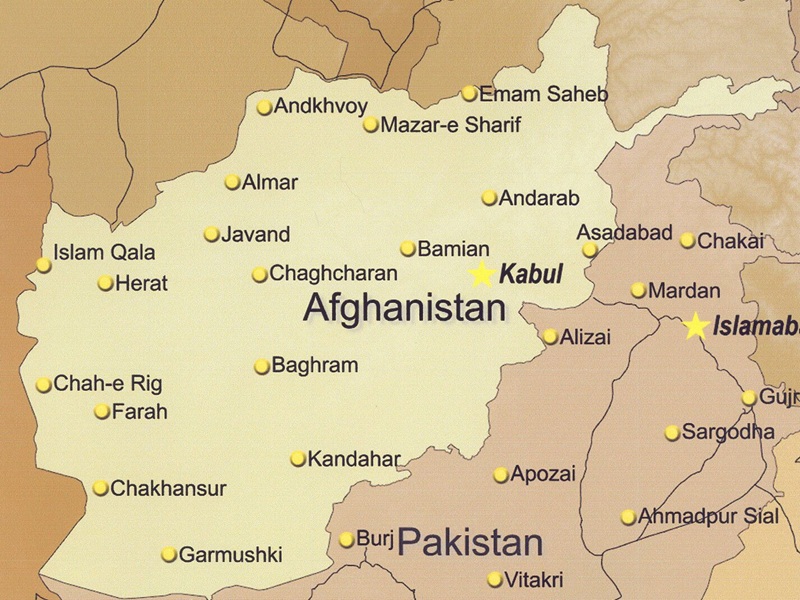
So here’s what we know so far. In February 2022 a Royal Marine officer, working for the Director of Special Forces, sent an email to several Afghans in Britain. These people were involved in the effort to rescue former interpreters and Afghan National Army special forces soldiers who were at risk of reprisals from the Taliban regime, and the Marine wanted to know whether some Afghans who claimed to be ex-special forces really were. The officer intended to attach a filtered list of around a hundred names from an Excel spreadsheet, but inadvertently attached the whole file — which contained around 25,000 names. One of the Afghans he sent the list to immediately passed it on to someone else – this time in Afghanistan. MoD sources are stressing that these were all trusted Afghans, but … well, we’ll get to that shortly.
And then nothing much happened for 18 months. The Taliban didn’t round up and shoot everyone on the list, even though they now claim to have had it since early 2022. But then, in August 2023, an Afghan man — a former soldier who had applied for asylum in Britain, but been rejected — popped up on Facebook. He promptly released part of the spreadsheet, then threatened to post all of it. At this point the government swung into action. First, it pressured Meta, which owns Facebook, to shut down the group the data was posted in and remove the user. Then the Ministry of Defence, under former defence secretary Ben Wallace, applied for a super-injunction to prevent the media from reporting anything about the leak, what the government planned to do about it, or what it was going to cost. It even banned anyone from revealing the existence of the injunction itself. That injunction was granted to Wallace’s successor, Grant Shapps, and the entire story was killed before it became public. The government was already drawing up a plan to bring tens of thousands more Afghans to Britain; the media and Parliament weren’t allowed to mention it; the British people, of course, were not to be allowed to know a thing. The degree of secrecy imposed was truly extraordinary.
And, over the last 18 months or so, the government has quietly been running a huge and very expensive operation to bring those identified as being at risk to Britain. From those listed on the spreadsheet, 23,900 former Afghan soldiers, policemen and intelligence officers were deemed to be in danger because of the leak. So, of course, were their families. How many people does the government plan to bring in under this scheme, in total? Nobody knows. Early estimates, according to court documents, were that 43,000 Afghans would be given asylum in Britain. Yesterday, officials insisted the real total was 6,900; even that dramatically lower number is a big addition to the 24,000 Afghans the government has admitted to bringing in under other, declared schemes. However, horrifyingly, last June three judges — Sir Geoffrey Vos, Lord Justice Singh and Lord Justice Warby — issued a written (but, of course, secret) ruling that up to a hundred thousand people could be at risk if the Taliban got their hands on the list.
Embarrassment for the British government, certainly, both for the initial cock-up and the ridiculous follow-up. It’s going to be expensive to resettle all those refugees and their often quite large families (guesstimates range from £850 million up to £6 billion), but not really a big deal, right? Well, about that …
I’ve already mentioned Afghan culture’s horrific misogyny. This leads to some truly dire attitudes towards women who don’t comply with Afghan society’s draconian rules of female behaviour (which boil down to having no rights and not being allowed to leave the house without a burqa and a male relative). One of the consequences of this is that Afghan men have unleashed a tidal wave of sexual assaults across Europe. At least one migration expert has noted that as well as their frequency, assaults by Afghans are remarkable for their brutality, audacity and often downright stupidity. Austrian political scientist Cheryl Benard wrote:
Can these men possibly expect that their attempts will be successful? Do they actually think they will be able to rape a woman on the main street of a town in the middle of the day? On a train filled with other passengers? In a frequented public park in the early afternoon? Are they incapable of logical thought — or is that not even their aim? Do they merely want to cause momentary female hysteria and touch some forbidden places of a stranger’s body? Is that so gratifying that it’s worth jeopardizing their future and being hauled off to jail by scornful and disgusted Europeans? What is going on here? And why, why, why the Afghans? According to Austrian police statistics, Syrian refugees cause fewer than 10 percent of sexual assault cases. Afghans, whose numbers are comparable, are responsible for a stunning half of all cases.
Type two words into Google — Afghane and Vergewaltigung — and a cornucopia of appalling incidents unfolds before you.
Incidentally, to all you lefties who’re undoubtedly sputtering with fury as you read this, don’t even think of writing Benard off as an anti-Afghan racist. Her husband is former US ambassador Zalmay Khalilzad, who is Afghan.
But surely, the “trusted” former Afghani soldiers, police and intelligence officers being brought in are bound to be much better able to adapt to British culture, right? Uh, well …
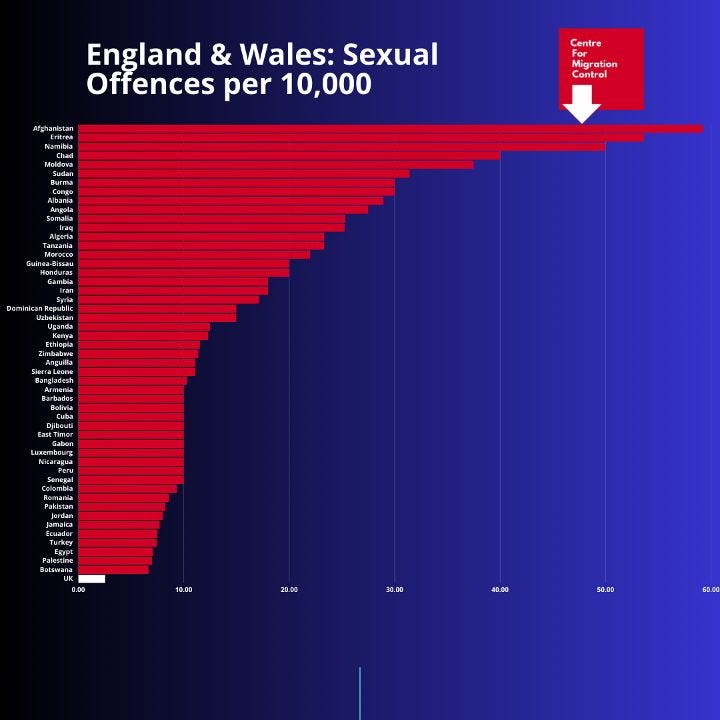
The government has been very reluctant to release — or even admit it possesses — statistics on the link between nationality and crime, but under pressure from independent MP Rupert Lowe it finally did so in March. This showed that among Afghans in Britain, 59 per 10,000 have been convicted of a sexual offence — 22.18 times higher than British men, at 2.66 per 10,000:
By the way, yes, I know the graph is from the Centre for Migration Control — but the data is from the Ministry of Justice and was obtained by a Freedom of Information request. I’ve checked the graph against the data, and it’s accurate.
[…]
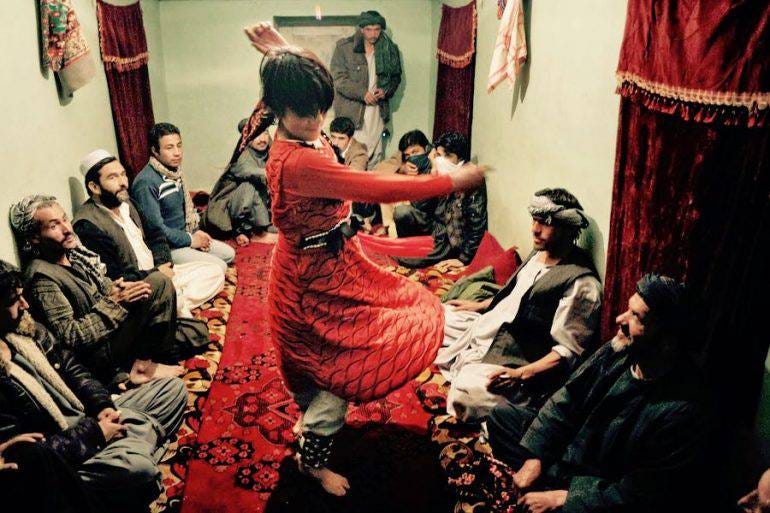
Does this photo of Afghan men watching a young boy dance give you the creeps? It should.
It’s not only women at risk, by the way. Afghan men aren’t averse to raping young boys, either. One of the most revolting aspects of Afghan culture — and that’s saying something — is the tradition of bacha bazi (Dari for “boy play”). Prepubescent boys are forced to dress up as girls then dance for, and “entertain”, men. This strain of paedophilia was common among anti-Taliban warlords and the Afghan security forces, particularly the police. The Taliban claim to be against the practice; their founder, the late Mullah Omar, actually was violently opposed to it. However, many prominent Taliban commanders also enjoy a spot of recreational pederasty.
Of course the obvious answer to this is “But most Afghan men aren’t rapists!” I agree; most of them aren’t. But an alarmingly high percentage of them are, and our governments clearly can’t keep the rapey ones out. The graph and its underlying statistics prove that beyond any possible doubt. And while it’s easy to downplay the statistics by saying it’s still “only” 77 sexual offences committed by Afghans over a two-year period, bear in mind that a) that’s 77 offences that wouldn’t have happened if we hadn’t let any Afghans in and b) this number is only convictions. In Britain just 3.1% of sexual offences reported to the police (around a third of which are rapes) lead to a conviction, which brings the potential number of Afghan suspects up to 2,484. The police estimate that only 10-15% of sexual offences are even reported; that could mean Afghans committed between 16,500 and 25,000 sexual offences across that same two-year period. Afghans would have to be bringing stupendous benefits to this country to make 25,000 sexual offences a worthwhile price to pay; indeed, many (emphatically including me) would argue that it wouldn’t be an acceptable price under any circumstances.
In Spiked, Tim Black on the government’s decision to hide everything for as long as they possibly could … for reasons:
Yet as catastrophic an error as this data leak was, the state has somehow managed to compound it with a series of decisions that made a terrible situation even worse. Successive Conservative and Labour governments effectively mounted a cover-up of both the data breach itself and the response. They slowly undertook a secret evacuation and relocation programme for the Afghans without telling even the Afghans affected about the data breach and the fact their lives were at risk. At the same time, they sought to hide all this from the British public, too, even while thousands of Afghan refugees were quietly being deposited in hotels and in military accommodation across the country. All with no explanation.
It is this de facto cover-up, this attempt on the part of ministers and senior officials to hide state errors and actions from public view, which is the most disturbing aspect of this whole sorry affair. They set about shielding a data breach followed by a costly, large-scale asylum scheme from any form of accountability, criticism or debate. And they did so by exploiting a legal tool that has never been used before by a British government – namely, the superinjunction.
This effective cover-up did not happen immediately. In fact, it wasn’t until early August 2023, a whole 18 months after the data breach took place, that the leak was finally brought to the attention of officials. A support worker responsible for settling Afghans in the UK emailed Luke Pollard, Labour MP for Plymouth, and James Heappey, the then Conservative defence minister, warning them that he’d seen the database circulating online. Days later, journalists also became aware of the leak. It was this that finally prompted the Ministry of Defence and the government to launch a covert mission, codenamed Operation Rubific, to shut down the leak and help Afghans put at risk get to the UK (after being vetted in Pakistan).
It was at this point that the authorities took the unprecedented step of applying for a superinjunction. This legal tool doesn’t only prevent journalists from reporting on the subject of the injunction. It also prevents anyone from acknowledging that the injunction even exists. Ministers argued that this extreme free-speech-defying measure was necessary to prevent the Taliban from becoming aware of the datasheet’s existence. Granted in September 2023, the superinjunction acted like a form of legal dark magic, rendering the data breach and the government response to it invisible. It insulated both from even the possibility of scrutiny.
Members of parliament could have still used their parliamentary privilege to speak up. But since all reporting had been prohibited, MPs found themselves in the same place as the wider public – in the dark. For nearly two years, then, we have all borne blind witness to the state’s conspiracy of silence. Until this week, that is, when defence secretary John Healey decided the superinjunction was no longer necessary.
It wasn’t just the British having issues with Afghan forces, as @InfantryDort recounts on the social media site formerly known as Twitter:
Among the Wildflowers @deaflibertarian
Did the high ranks really tell American soldiers to stand down and not interfere when children were being sexually assaulted in the Middle East region?TLDR, but you need to read it to get what I’m saying. I know it may be hard to understand how American Soldiers could witness horrors in Afghanistan and feel powerless to stop them. But let me try to explain. Fellow veterans, feel free to add on or correct me, because this rot ran deep.
1. We were forged to kill, then reprogrammed to hesitate. The warrior was replaced with a social worker in a helmet. Instead of rehearsing “react to contact,” we sat through PowerPoints on cultural sensitivity. Our edge dulled by doctrine that taught us empathy for the enemy and suspicion of ourselves.
2. We were ordered to practice “courageous restraint”. Sounds noble. It wasn’t. It meant ignoring your instincts. It meant second-guessing every shot, every step. The Army trained us to fight, then punished us for following that training. We were told killing the enemy might make things worse, as if leaving them alive made anything better.
3. Every success was credited to the Afghan army. Every failure pinned on us. We propped up a Potemkin military, full of cowards and thieves, and were ordered to salute the illusion. We whispered truths in smoke pits while speaking lies in briefings.
4. Under certain generals, aggressiveness was punished harshly. They’d clip the wings of the hawks and reward the peacocks. It’s like blaming a wolf for baring its teeth when surrounded by jackals.
5. “Green on Blue” attacks poisoned every partnership. The Taliban infiltrated Afghan ranks so deeply we stopped sleeping. Trust vanished. No one dared provoke them. Not over child rape, not over beatings, not over anything. Every Blue 1 report was a career landmine, so the truth stayed buried.This was the cocktail we drank every day:
• Restraint over reaction
• Illusion over integrity
• Shame over strengthWe were taught to see women as property, not to intervene. To accept children as sexual currency for Afghans, not to interfere. That the blame for every failure lay with us, not the corrupt warlords we empowered.
And was it non-consensual sexual currency? Because the culture was so backwards, we were told villagers would give their kids to powerful Afghans as tribute. And that the kids themselves understood the assignment. How f****d is that? How evil? How diametrically opposed to everything we believe?
And once you’re complicit in enough sin, it gets easier to stay silent. When you’ve spent years maintaining a lie, the truth becomes radioactive. Ripping off the bandage would mean admitting the whole war was infected.
We stood “shonna ba shonna” or shoulder to shoulder with some of the worst people humanity ever produced. And we called it partnership.
That’s how this happened.
A culture of confusion.
A doctrine of deceit.
A war that killed our ability to fight the very evil we were sent to destroy.There is a silver lining here. History has proven that our suspicions were right. And luckily, many of us are still in uniform or in charge of the DoD apparatus. We will NEVER let this happen again. And I will shout this from the rooftops to make sure that’s the case.
Infantry Dort, X.com, 2025-07-16.
July 16, 2025
Offensensitivity over a 12 year-old wearing a Union Jack dress to school
I’m not in the least bit surprised to hear that a 12 year-old girl has triggered the sensitive souls at her school for choosing to wear a Spice Girls style Union Jack dress to her school’s Cultural Diversity Day:

Photo from The Daily Sceptic
Another month, another glaring example of toxic activism sweeping through the British workplace, and this time, it’s no less than shocking.
On July 11th, 12 year-old Courtney Wright was sent home from Bilton School in Rugby, Warwickshire, simply for wearing a Union Flag dress and hat for the school’s Cultural Diversity Day. She had put effort into her costume, even writing a speech celebrating British culture: Shakespeare, fish and chips, tea, the Royal Family. Yet for what was a harmless celebration of her national culture, she was excluded.
The school’s response? A sanctimonious head of year, presumably with the support of management and colleagues, told her: “You get to celebrate your culture every day. This is for everyone else.” Then ordered her to remove her outfit and wear a second-hand uniform or go home. So she, rightly, called her father, who came to collect her.
Stuart Field, her father, a 47 year-old Marine Engineer, alleges she was not alone. A boy was reportedly sent home for wearing a farmer’s costume, illustrating a broader, troubling trend: the suppression of British symbols and pride in the name of “diversity”.
[…]
The aftermath saw the usual potted response from the school’s governing trust, the Stowe Valley Trust about how it values “diversity”, “respect” and so forth, yet its words ring hollow. It claims to regret “upset caused”, note, not the exclusion itself – only the distress that followed. It says it will “reflect on how this could have been handled better”. It then goes on to assure parents that it will be looking at the policies and training.
But what does that really mean? The trust refuses to admit that sending a girl home for celebrating her country was an appalling and divisive breach of common sense and, arguably, of law. Their language suggests an attempt to dodge accountability, to spin it as a mere mishandling rather than a fundamental failure.
At Spiked, Hugo Timms points out that this is merely a slightly more visible version of what British children learn in school … that there’s nothing at all to be proud about if you’re British:
British schoolkids have long been encouraged to be ashamed of their nationality and history. They’re taught “anti-racism” lessons and to constantly check their privilege as Brits. They study “decolonised” curricula, shorn of “triggering” British authors. Now, it seems, even dressing up as a Spice Girl and praising Shakespeare are being treated as beyond the pale.
[…]
You might say Courtney’s outfit was not exactly “traditional”, inspired by Geri Halliwel’s famous Union Jack dress from the 1997 Brit Awards. But that was clearly not the issue. What the school’s instructions really meant was that she should dress as any nationality or heritage, so long as it’s not British. According to Courtney’s father, Stuart Field, the school also turned several other pupils away at the gates on Culture Day, including a boy with a St George’s flag, a boy with a Welsh flag and a boy dressed as a farmer with a checked shirt and a traditional flat cap.
Courtney’s school also stopped her from giving a speech about what being British meant to her. “In Britain”, she would have said, “we have lots of traditions including drinking tea, our love for talking about the weather and we have the Royal Family”. “We have amazing history, like kings and queens, castles, and writers like Shakespeare.” It also praised British humour, “our values of fairness and politeness”, and fish and chips. Not exactly Enoch’s “Rivers of Blood“, is it?
German Sten Copy: MP-3008, aka Gerät Neumünster
Forgotten Weapons
Published 4 Feb 2016The MP 3008, aka Gerät Neumünster, was one of two German efforts to copy the British Sten gun. The first was the Gerät Potsdam (“gerät” meaning device or project; basically project code name), which was a direct copy of the Sten distinguishable only by a marking details and a few differences in manufacturing processes. While 10,000 of those were being manufactured by Mauser, R&D engineer Ludwig Vorgrimmler was simplifying the Sten design even farther, resulting in the MP-3008.
This simplified design did away with the Sten’s barrel shroud, and used a vertical magazine well instead of the Sten’s distinctive horizontal mounting. These were the significant changes, although there was also a sling loop placed on the front of the magazine well and a few minor simplifications to the fire control parts. Unlike the Potsdam, significant variation can be found in the MP-3008 in the details of stock and grip design.
In a masterpiece of insane optimism, German official placed an order for literally a million MP-3008 submachine guns, which of course was completely insane. Manufacture was undertaken at a wide scattering of small shops, with guns being assembled by larger manufacturers from supplied parts. The total made is not known, but is probably in the range of 3000-5000. Some are marked with manufacturing codes from recognized factories, some with codes unknown, and some have no marking at all. This particular example is dewat made by “TJK” — an unknown factory.
QotD: Slavery in history
It is pathetic but unsurprising how ignorant all these brave “anti-fascists” are. Yet there is a lesson here not just for Britain but for America, too: when a society loses its memory, it descends inevitably into dementia.
Mark Steyn, After America: Get Ready for Armageddon, 2011.
July 14, 2025
Day Seven – Ghost Division! – Ten Days in Sedan
World War Two
Published 13 Jul 2025May 16 1940: Our WW2 Blitzkrieg documentary, Ten Days in Sedan, continues as Winston Churchill arrives in Paris. The Prime Minister still has hope but he’s shocked to see the French burning documents and preparing to evacuate. Meanwhile French and German tanks slug it out in Stonne, Guderian reaches Montcornet, and Rommel leads his Ghost Division far behind French lines.
Chapters
00:00 Intro
00:58 Recap
01:38 Stonne
03:05 Panzers Drive West
07:02 New French Plan
12:23 Rundstedt’s Halt Order
16:06 Ghost Division
21:53 Churchill in Paris
(more…)
July 12, 2025
G.K. Chesterton on the dangers of cultural surrender
Andrew Doyle on Chesterton’s novel The Flying Inn (1914) which warned against the risks of unfettered immigration and what came to be known as “multiculturalism”:
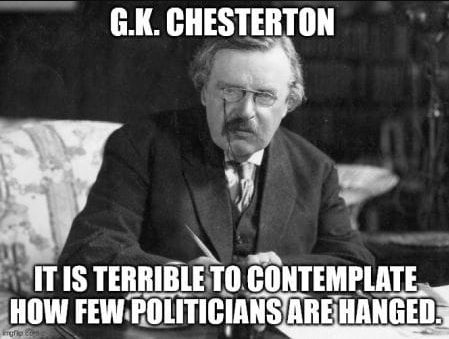
The creed of multiculturalism has made it difficult to discuss the impact of unfettered immigration. The far right have always opposed it on the basis of racial prejudice and ethno-jingoism. Yet there are authentically liberal concerns to be raised about the problem of political Islam and how all discussions are stifled through accusations of “Islamophobia”. What happens when an essentially anti-democratic ideology is allowed to flourish within a society that otherwise depends upon democratic norms?
To help illuminate the troubles of our time, and in particular the perverted form of liberalism that ensures its own undoing, we might return to G. K. Chesterton’s The Flying Inn (1914), a whimsical novel about a future Islamic England. With today’s proliferation of sharia courts and the government’s determination to criminalise blasphemy against Islam by legislative stealth, one might call Chesterton’s novel prescient.
The key figure is Lord Ivywood, a politician who becomes enamoured of Misysra Ammon, an Islamic cleric who styles himself as the “Prophet of the Moon”. Ivywood is an exemplar of the zealotry of the progressive reformer, a prototype of the virtue-signaller, one who “did not care for dogs” but “cared for the Cause of Dogs”. He first introduces Ammon at a private event at the “Society of Simple Souls”, where he is able to preach his creed to the gullible bons vivants of the upper middle-class. The collective thrill of the crowd is pure orientalism, and they are easily mesmerised by Ivywood’s panegyrics.
Inevitably, Ivywood’s submission to Islam is framed in syncretic terms; not so much surrender as a beautiful fusion. “The East and the West are one”, Ivywood says. “The East is no longer East nor the West West; for a small isthmus has been broken, and the Atlantic and Pacific are a single sea.” Islam, he claims, is the “religion of progress”, a phrase that anticipates today’s oft-echoed slogan of Islam as the “religion of peace”.
This kind of doublespeak is ubiquitous among those activists who routinely strive to force the square peg of Islamic doctrine into the round hole of woke politics. This is exemplified by articles such as “Prophet Muhammed was an intersectional feminist” in Muslim Girl magazine, a piece that includes the inane claim that the founder of the religion “wanted to generate as much inclusivity as possible”. In similarly convoluted terms, Ammon in The Flying Inn argues that there is nothing more feminist than a harem. “What is the common objection our worthy enemies make against our polygamy?” he asks. “That it is disdainful of the womanhood. But how can this be so, my friends, when it allows the womanhood to be present in so large numbers?”
Today’s readers will recognise Chesterton’s depiction of the tendency of liberal politicians to kowtow to the demands of Islamic clerics in a bid to avoid causing offence. At one point, Ivywood explains that he has tabled the “Ballot Paper Amendment Act” in parliament to allow citizens to vote with a mark resembling a crescent rather than the traditional cross.
If we are to give Moslem Britain representative government, we must not make the mistake we made about the Hindoos and military organization — which led to the Mutiny. We must not ask them to make a cross on their ballot papers; for though it seems a small thing, it may offend them. So I brought in a little bill to make it optional between the old-fashioned cross and an upward curved mark that might stand for a crescent — and as it’s rather easier to make, I believe it will be generally adopted.
The main plot of The Flying Inn revolves around the innkeeper Humphrey Pump and the Irish sailor Captain Patrick Dalroy, who take it upon themselves to sell alcohol in spite of the new Islamic prohibitions in England. They find a loophole in the law that permits them to conduct their business so long as they first erect an official inn sign. And so we follow the pair as they dash from location to location, with their barrel of rum and a wheel of cheese on a donkey’s back, planting their portable sign wherever refreshment is needed.
July 11, 2025
The 1st Canadian Infantry Division in Operation Husky, 10 July 1943
For Project 44, Nathan Kehler describes the role of the 1st Canadian Infantry Division as the western-most part of Montgomery’s 8th Army landings on the southern tip of Sicily:
In the days leading up to Operation Husky, the Canadian contingent suffered two major losses – one in leadership and one in logistics. Though the landings would ultimately succeed, these events cast a shadow over the operation before a single boot touched Sicilian soil.
The Death of General Salmon
On July 2, 1943, Major-General G.G. Salmon, commander-designate of the 1st Canadian Infantry Division for the Sicily campaign, was tragically killed when his Hudson aircraft crashed near Barnstaple, Devonshire, shortly after takeoff from Hendon Airfield. Also on board were several senior officers, including Rear-Admiral P.J. Mack, the Canadian naval force commander, and Lt.-Col. C.J. Finlay, the newly appointed senior logistics officer for the division. All were killed.
Major General Guy Simonds, commanding 1CID.
General Salmon had been hand-picked to lead Canada’s first major amphibious campaign. His death, just days before the invasion, shook the command structure. With no time to replace him formally, Major-General Guy Simonds was appointed in his place. Simonds was known for his drive, discipline, and tactical focus. The loss of Salmon meant an abrupt shift in leadership style and planning assumptions on the eve of battle.
Sinking of Canadian Troop Ships
Only days later, Canadian forces suffered another blow. Between 4–5 July, as convoys moved across the Mediterranean from North Africa toward Sicily, Axis submarines attacked Allied shipping near the Algerian coast. Three ships were torpedoed: the St. Essylt, City of Venice, and Devis.
While the first two sinkings resulted in relatively few casualties, the loss of the Devis was severe. Carrying 261 Canadian troops, the ship was hit and engulfed in fire. Fifty-two Canadians were killed, with many trapped in the holds below deck. In total, the convoy lost over 500 vehicles and 40 guns, along with critical headquarters and signals equipment. Divisional Headquarters suffered particularly heavy equipment losses, forcing last-minute improvisation in communications and command coordination.
Despite these losses, the Canadian Division adapted quickly, and the operation went forward as planned. These early setbacks, however, underscore the high cost and uncertainty of even reaching the battlefield in the Second World War.
Canadian Beaches
On 10 July 1943, the 1st Canadian Infantry Division landed in southeastern Sicily as part of Operation Husky – the Allied invasion of Europe’s “soft underbelly.” The division’s assault was split across two main beaches: “Roger” Beach to the east and “Sugar” Beach to the west of the village of Le Grotticelle. These beaches formed the right flank of the British Eighth Army’s landings.
General Simonds’ plan for the Canadians was a two-brigade front:
- The 1st Canadian Infantry Brigade would land on Roger Beach and push inland to destroy a coastal battery near Maucini, seize the Pachino airfield, and establish contact with nearby British forces around Pachino town.
- The 2nd Canadian Infantry Brigade would land on Sugar Beach, clear beach defences, support the adjacent British Special Service Brigade landing on the far left, and advance north past the Pantano Longarini marshes.
- The Special Service Brigade (British Commandos) would land west of Punta Castellazzo, eliminate enemy resistance in their zone, and cover the Canadians’ western flank from elevated ground north of the marshes.
The landings were scheduled for 2:45 a.m., with Commandos hitting the shore ten minutes earlier. Objectives were clear: knock out coastal defences, secure strategic positions, and quickly link up with Allied forces to expand the beachhead.
The Landings
Despite rough seas from a storm the day before, the landings went ahead as planned in the early hours of 10 July 1943. Just after 1:00 a.m., British Commandos began landing west of the Canadian sector, encountering only light resistance. By 1:34 a.m., the 2nd Canadian Infantry Brigade – the Seaforth Highlanders of Canada and Princess Patricia’s Canadian Light Infantry – were heading for Sugar Beach under covering fire from naval guns, including the 15-inch guns of HMS Roberts.
Navigation errors caused the Seaforth Highlanders to land to the right of the Patricias, reversing their intended order. But the heavy surf helped carry landing craft over a false beach, and both units came ashore with minimal opposition. They quickly cleared light beach obstacles and scattered Italian machine-gun posts. By 3:00 a.m., both battalions had successfully landed and were advancing inland toward their objectives.
On Roger Beach, however, the 1st Canadian Infantry Brigade faced delays. Their assault relied on DUKWs and landing craft (LCTs) arriving from Malta. When these were delayed, Brigadier Howard Graham initiated a backup plan, switching to Landing Craft Assault (LCAs). Confusion and the heavy swell caused further delay, with some units landing as late as 5:30 a.m. – nearly three hours behind schedule.
Despite the setbacks, the Hastings and Prince Edward Regiment and the Royal Canadian Regiment landed successfully. The Hastings had one reserve company land 5,000 yards off target in the Commando sector but regrouped without major issue. Both units met minimal resistance. The RCR encountered light shelling from the Maucini battery, but naval gunfire quickly silenced it.
By 6:45 a.m., all three lead brigades had secured their assigned beachheads, with support units and armour – including Shermans from the Three Rivers Regiment – beginning to land. The 48th Highlanders of Canada and The Edmonton Regiment followed their respective brigades ashore, some accompanied by pipe bands.
Opposition during the landings was light overall. Many Italian defenders withdrew as the naval bombardment and confusion of the assault overwhelmed them. However, isolated machine-gun fire and limited artillery shelling still resulted in several Canadian casualties, primarily on Roger Beach.
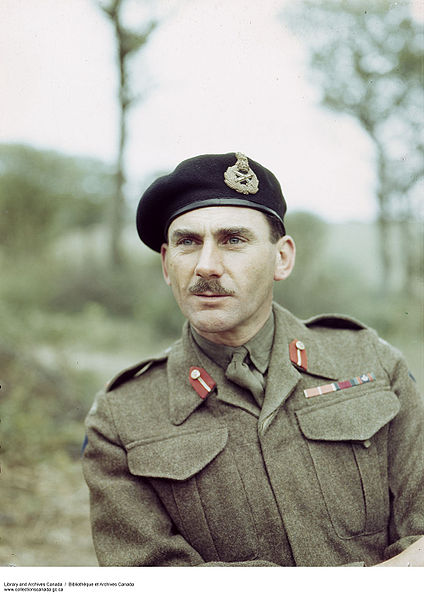
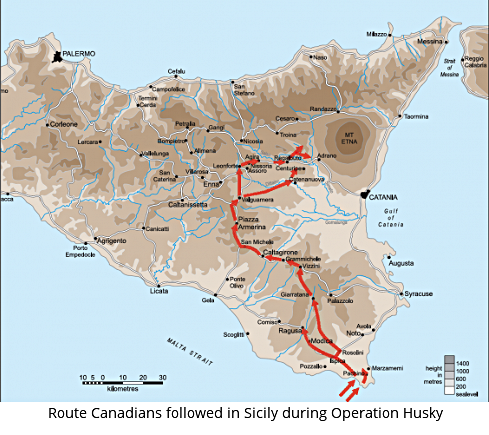
The pre-invasion loss of ships to enemy submarine or air attack was taken fully into account during the weeks before the convoys set out. But as with all military planning, the enemy gets a vote too.
Why Didn’t France and Britain Stop Germany’s Secret Rearmament? – Out of the Bullpen 001
World War Two
Published 10 Jul 2025In this special “Out of the Bullpen” episode, we answer your burning questions about Weimar Germany’s most turbulent years. From clandestine military pacts with the Soviets to the creative ways Germany sidestepped Versailles, we dig into aspects which shaped a republic on the brink.
(more…)
History of Britain V: Roman Conquest of Britain
Thersites the Historian
Published 5 Feb 2025The emperor Claudius felt insecure about his standing in the Roman world, so he sent four legions to Britain. The result was that Britain officially joined the Roman world and was now a peripheral part of the Roman Empire rather than an independent land of Celts.
July 10, 2025
Was Matilda II the BEST Tank of WWII?
The Tank Museum
Published 21 Feb 2025Forget the Sherman, forget the Panther, forget the T-34 … Should Matilda II be considered the best tank of WWII?
Emerging from the request for a new and improved infantry tank, Matilda II debuted on the battlefield in France. The heroic actions of Matilda crews at Arras stopped Blitzkrieg in its tracks and allowed the British army to be evacuated from the beaches of Dunkirk.
The Matilda’s fighting peak was during the North Africa campaign, where the 2pdr gun was more than a match for any of the Italian armour it came up against. Despite some mechanical issues, the performance of Matilda II at this time would earn her the title “Queen of the Desert”. Once the Germans arrived in North Africa, Matilda started to become obsolete but remained useful as a testbed for experimental equipment that would eventually be used on D-Day.
Matilda II saw service in all theatres of the Second World War. Around 900 tanks were deployed by the Soviets in 1942, filling the gap as the Red Army increased its roster of T-34s. Matilda made great contributions to campaigns in the Pacific – its small and solid profile making it ideal for jungle bashing. The Australians made effective use of the Matilda, creating variants including a mortar launcher and a flamethrower.
Some say that if it wasn’t for Matilda II we would be speaking German right now. Watch this video to find out why …
00:00 | Introduction
00:36 | Heroics at Arras
03:29 | It Takes Two
06:00 | Matilda II – Inside and Out
13:03 | Queen of the Desert
18:14 | Soviet Service on The Eastern Front
19:49 | The Pacific – Welcome to the Jungle…
(more…)
July 6, 2025
Day Six – Breakout – Ten Days in Sedan
World War Two
Published 5 Jul 2025May 15 1940 — Ten Days in Sedan, continues as our WW2 Blitzkrieg documentary follows Germany’s drive through France. Today French 2nd Army chief Charles Huntziger faces a pivotal choice: try and contain the German bridgeheads at Sedan, where Heinz Guderian is trying desperately to breakout, or pivot south to shield the Maginot forts he still trusts. His choice may just decide the fate of France.
(more…)
July 3, 2025
Bill Slim, the most forward-looking British commander of WW2
At The War Room, Dr. Robert Lyman explains how and why General (later Field Marshal) William Slim was able to turn around British and allied military fortunes in Burma and drive the Japanese out of India to their eventual defeat:
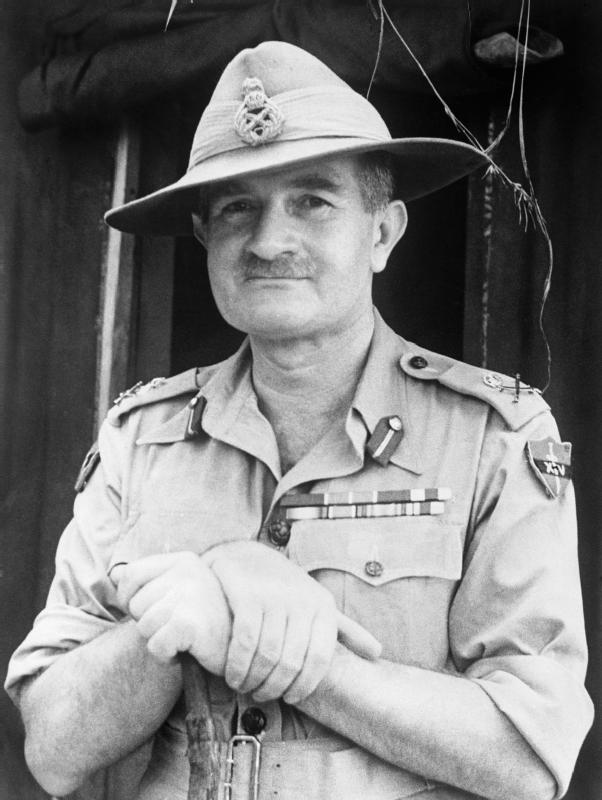
Field Marshal Sir William Slim (1891-1970), during his time as GOC XIVth Army.
Portrait by No. 9 Army Film & Photographic Unit via Wikimedia Commons.
“Burma and the Birth of Modern Warfare” is the subtitle to my 2004 book and PhD about General Slim’s command of the 14th Army in Burma during the last war, titled Slim, Master of War, a use of Sun Tzu’s description of a “heaven-born” commander. It may appear a rather grand claim, and perhaps it is, but the purpose of the subtitle reflects that fact that Slim’s conduct of operations in India and Burma in 1944 and 1945 represented an entirely new style of warfighting to that experienced by the British Army during the war. Instead of looking back to the lessons of World War One, Slim’s conduct of operations looked forward to reflect a style of warfare that would only be adopted as formal doctrine by the British Army in the 1980s. In the mid-1940s it remained alien to the vast bulk of similar British military experience and understanding.
My argument wasn’t that Slim was the best general who had ever commanded men in the history of warfare. That may or may not be true, but for the sake of my argument is irrelevant. My proposition, rather, is that:
Slim was the foremost British exponent in the Second World War of the “indirect approach” and that in his conduct of operations in 1944 and 1945 he provided a clear foreshadowing of “manoeuvre warfare”.
My idea, which first saw expression in my 2004 book, has been developed since then in my subsequent writings, including that of Japan’s Last Bid for Victory, which deals with the great events in the Assam and Manipur in 1944 (2011) and A War of Empires (2021). A major reason for the continuing amnesia in British military thinking about the warfighting characteristics of the Burma Campaign – apart from the fact that it is a long way to go for a staff ride – seems to be the fact that Slim’s style of warfighting remained largely alien to the British Army’s doctrinal precepts until the late 1980s. Until then, Slim’s strategic conceptions had been considered an aberration, and Slim himself regarded merely as the epitome of a fine military leader, and nothing more. Then, in a doctrinal revolution which began in the 1980s, the old firepower-based foundations – which themselves were largely a product of Montgomery’s approach to war in 1944 and 1945 – in which the supreme military virtue was the effective and coordinated application of force, were replaced. This revolution in doctrine and thinking about warfighting exchanged the old foundations with new ones based on an entirely different conception, that of manoeuvre at the operational level of war, in which notions of subtlety, guile and psychological dislocation came to be emphasised in an entirely new and refreshing way. My belief is that it was the effective and pragmatic employment of manoeuvre at the operational level of war by Slim in Burma that was the direct cause of the extraordinary victories the 14th Army achieved in 1944 and 1945 and which led to the two greatest defeats the Japanese Army suffered in the field in the Second World War, the first at Imphal-Kohima in India in 1944 and the second at Mandalay-Meiktila in Burma in 1945. My argument I suppose is that Slim’s exercise of command in Burma makes him not merely a fine example of a “manoeuvrist” commander but in actuality the template for modern manoeuvrist command.
[…]
First, the 14th Army was the only truly joint formation in the British armed forces during WW2. Nothing else, in North Africa, Italy or North-West Europe came close to it. Slim insisted on nothing less than full integration. Not only were headquarters joint, but operational and tactic delivery was also joint. At every level of command air and land headquarters were completely interlinked. I became convinced of this fact when I discovered that the RAF and the Army even shared messes! Strategic air transport, winning the air war, the operational reach and flexibility provided by air power underwrote Slim’s conception of battle, to the extent that the senior RAF officer in the theatre ruefully concluded in 1945, and I quote, that:
Slim was quicker to grasp the potentialities and value of air support in the jungles of Burma than most Air Force officers.
There was no snobbery and no shibboleths with Slim: if it worked, it was pressed into action.
[…]
Professor Dixon argues [in On the Psychology of Military Incompetence] that, unusually for a senior commander of his ilk in WW2, Slim was non-ethnocentric. He had no intrinsic prejudices about the virtues of one race over another. Slim, after all, was an officer of the Indian Army, and I have yet to come across any evidence that British regimental officers of the Indian Army regarded their soldiers in any way inferior to themselves. He was commonly known to those who served under him as “Uncle Bill” from the special affinity British troops had to him: the remarkable fact, however, was that at least 87% of his Army of several hundred thousand men recalled him as “Cha Cha Slim Sahib”: 14th Army was, after all, very largely Indian, Gurkha and West and East African. I certainly cannot think of any other Indian Army general who had such an impact on British troops. He became, of course, Chief of the Imperial General Staff following Field Marshal Montgomery, in 1948, which securely establishes this feat. On that note, I cannot conceive of “Uncle Bernard” when referring to Field Marshal Montgomery!
The Burma campaign was as much a struggle for mastery of logistics as it was a struggle for mastery on the battlefield, and it was about risk as much as it was about adherence to logistical principles. Slim had an implicit understanding of the constraints placed on warfare by the demands of logistics. Great efforts were made to increase the quantity of supplies to Burma. Railways were extended, roads built and surfaced, sunken ferries refloated and repaired, barges and rafts built for use on the numerous waterways. In this regard Archibald Nye, the VCIGS under Alan Brooke, regarded Slim’s mastery of logistics to be the most significant measure of his greatness as commander of 14 Army in Burma:
He never had enough to do what he had to do and this … is the measure of his greatness.
The practice of war in Burma by Slim was so startling in its modernity, and unlike any other pattern of warfighting by operational level British commanders in the war. My view of Slim as a commander can be interpreted at two levels. He was, first of all, a great commander and leader. Being a master of strategy, of logistics, of technical proficiency and so on are important in themselves when considering the nature of leadership in war, but by themselves they remain insufficient. Successful military command requires someone who can, through dint of personality and inspirational leadership, wield all of the components of fighting power together so that an extraordinary result transpires. What marks Slim out from the crowd was much more than just his winning of a succession of extraordinary battles. His strength lay in his ability to produce a decisive effect from scratch; to mould thousands of disparate individuals together into a single team with a single goal; to persuade a defeated army that it had the potential to turn the tables on their enemies; to master the complexities of terrain, climate and administrative deficiency so that self-help, resourcefulness and ingenuity could become as much prized as fighting skill. In these individual areas, and more, Slim proved the master. His genius for war was the consequence of his ability to bring together all of these elements to create an extraordinary result, the visible sign of which was the greatest defeat suffered by the Japanese on land during the Second World War.


