
World War Two
Published 12 Mar 2026Belgium might have been quickly overrun by the Germans in 1940, but many Belgian airmen continued the fight by flying with Britain’s RAF, and quite a few of them were good enough to score five or more aerial victories and become Flying Aces. Here are a few of their stories.
(more…)
March 14, 2026
Belgian Aces in Exile – Belgian Fighter Aces – WW2 Gallery 10
Comments Off on Belgian Aces in Exile – Belgian Fighter Aces – WW2 Gallery 10
March 13, 2026
The Raj – a cut-and-dried case of plunder?
Celina considers the claim that the period of British rule over India was a period of British plunder of Indian resources:
The historical evaluation of the British Raj has increasingly become a battleground for competing political and academic narratives. In the 21st century, the discourse has shifted significantly toward an oppression narrative that characterises the period from 1757 to 1948 as one of singular depredation. This perspective, popularised by public intellectuals such as Shashi Tharoor and economic historians like Utsa Patnaik, posits that British rule was defined by systematic deindustrialisation, engineered genocide, the intentional dismantling of educational systems, and the looting of wealth on a scale that defies standard economic modelling.1 However, when subjected to the rigours of aggregate statistical data, comparative institutional analysis, and a sense of historical proportion, these claims frequently reveal themselves as founded on misleading anecdotes and founding myths rather than objective economic realities.2 To accurately understand the trajectory of India under British influence, it is essential to move beyond evocative stories, such as Winston Churchill’s peevish marginal notes and examine the underlying population trajectories, industrial output figures, and the structural transition from a traditional to a constructed capitalist economy.3
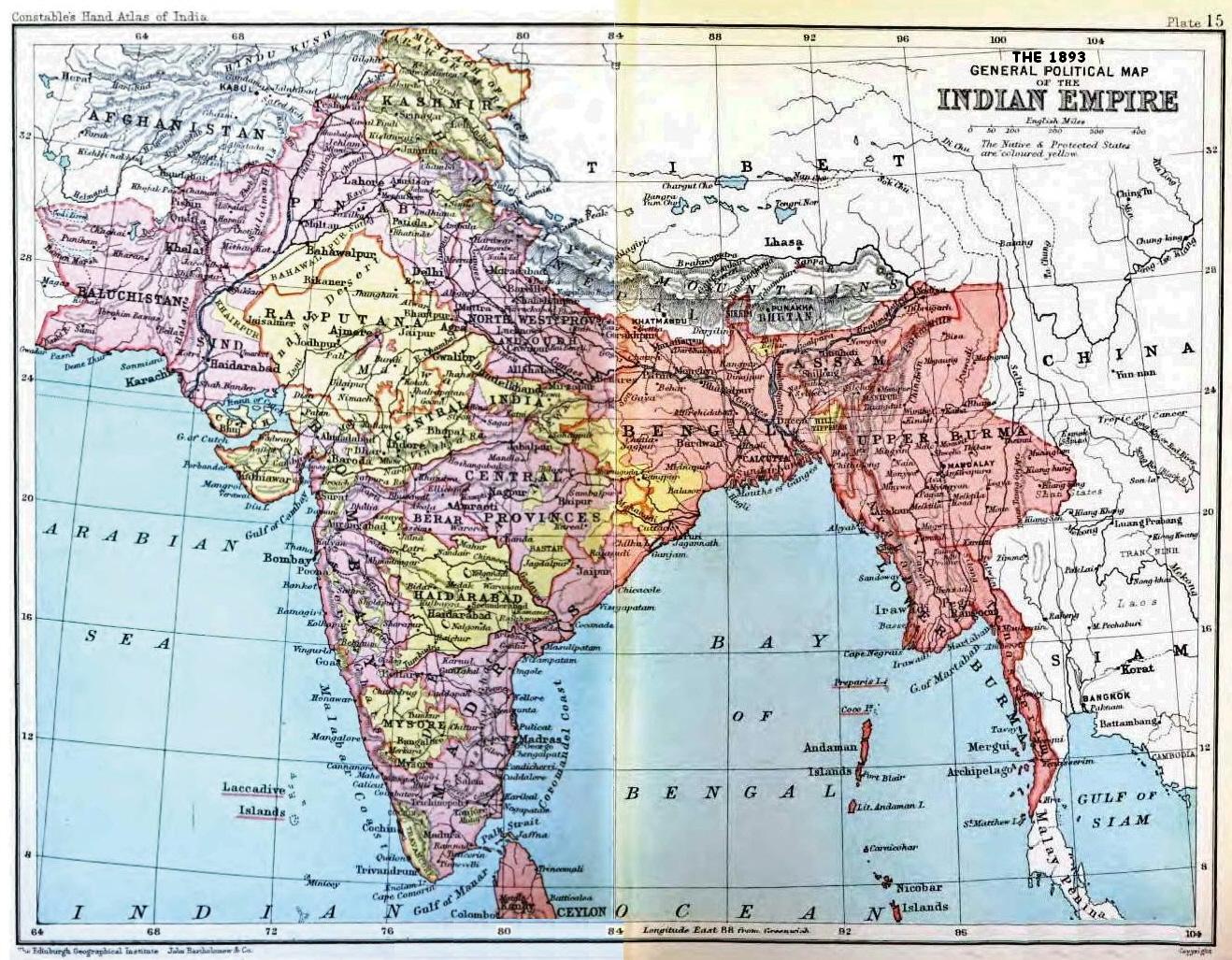
“Political Map of the Indian Empire, 1893” from Constable’s Hand Atlas of India, London: Archibald Constable and Sons, 1893. (via Wikimedia)
Chronology and the Context of the Great Divergence
A critical assessment must begin with a precise periodisation of Indian history. The interaction between Europe and the subcontinent can be divided into four distinct phases: the pre-European period (before 1505), the era of initial coastal contact and Portuguese outposts (1505–1757), the transition under the East India Company (1757–1818), and the era of English domination and formal Raj rule (1818–1948).4 The central contention of modern critics centers on the final period, arguing that India’s share of the global economy collapsed from approximately 24.4% in 1700 to roughly 4.2% by 1950.5
While these proportions are grounded in data, most notably the work of Angus Maddison, the interpretation of this decline as evidence of absolute impoverishment is a fundamental statistical fallacy. The decline in India’s share of world GDP was not the result of a shrinking absolute economy, but rather the consequence of the Great Divergence. During this period, Western Europe, North America, and eventually Japan experienced explosive, intensive growth through the Industrial Revolution, while India remained largely stationary.6
Between 1850 and 1947, India’s absolute GDP in 1990 international dollar terms actually grew from $125.7 billion to $213.7 billion, representing a 70% increase.7 The stagnation in per capita terms, GDP per capita was approximately $550 in 1700 and $619 in 1950, reflects a classic Malthusian trap.8 The unprecedented population growth stimulated by the introduction of Western medicine, increased land cultivation, and the relative political stability of the Raj absorbed almost all economic gains.9 Far from being genocided, the Indian population expanded from 165 million in 1700 to nearly 390 million by 1941.10
- https://en.wikipedia.org/wiki/Shashi_Tharoor%27s_Oxford_Union_speech
- https://winstonchurchill.hillsdale.edu/tharoor-inglorious-empire/
- https://www.reddit.com/r/AskHistorians/comments/l9nve2/he_peevishely_wrote_on_the_margins_of_the_file/
- https://en.wikipedia.org/wiki/Economic_history_of_India
- Ibid
- https://winstonchurchill.hillsdale.edu/tharoor-inglorious-empire/
- https://www.rug.nl/ggdc/historicaldevelopment/maddison/
- Ibid
- https://winstonchurchill.hillsdale.edu/tharoor-inglorious-empire/
- https://www.rug.nl/ggdc/historicaldevelopment/maddison/
Comments Off on The Raj – a cut-and-dried case of plunder?
March 11, 2026
Britain’s reputation in the Near East just cratered
On Substack Notes, Earl explains why the inexplicable delay in getting a Royal Navy warship out to protect Gulf allies from Iranian missiles is having serious negative impact on Britain’s longstanding relations with the targeted nations:
A MASTERCLASS IN MILITARY INCOMPETENCE
The Starmer administration’s handling of the Iranian crisis is being whispered about in the corridors of Whitehall as a historic “cock up” of the highest order. Despite receiving a formal request from the Americans on 11 February — a full 17 days before the offensive actually commenced — the British government appears to have spent that critical window in a state of paralyzed indecision. The U.S. request was not an invitation for Britain to join the initial “decapitation strikes”, but rather a plea for the Royal Navy to help shield vulnerable Gulf allies from the inevitable Iranian retaliation. Instead of stepping up to protect the 240,000 British citizens living in Dubai and Abu Dhabi, the Ministry of Defence oversaw a period of baffling inaction that has left regional partners feeling utterly betrayed.
The diplomatic fallout has been described by insiders as nothing short of catastrophic, with Middle Eastern allies expressing “undiluted fury” at the lack of British support. A former minister with deep ties to Amman reports that Jordan is “fking furious”, while leaders in Kuwait and the Emirates are openly questioning whose side Britain is actually on. The Cypriots are reportedly “incandescent” after learning that military assets were actually withdrawn from their vicinity just as the threat level spiked. Only this week did it emerge that HMS Dragon would finally deploy — nearly three weeks after the initial American SOS — a timeline that military experts say is far too little and far too late to restore trust.
Strategic failures have been compounded by what veteran commanders call a total lack of foresight regarding naval positioning. The only available Astute-class submarine was permitted to continue its journey toward Australia, despite having passed through the Gulf just weeks ago when it could have been held as a vital contingency. Security officials now warn that the Trump administration is viewing the UK’s “free riding” with growing contempt. There is a palpable fear in the MOD that the Americans, tired of London’s dithering, will simply cut Britain out of the loop entirely and strike a direct deal with Mauritius to secure the long-term use of Diego Garcia for future operations.
Inside the government, the situation is being described as “incoherent” and “unconscionable”. By allowing the United States to utilize British bases like RAF Fairford for strikes while simultaneously refusing to participate in the missions themselves, Starmer has managed to achieve the worst of both worlds. Critics say they have invited the risk of being targeted by Tehran without the benefit of having any say in the coalition’s strategic direction. One former defence chief has branded this policy “reprehensible”, arguing that Britain has effectively surrendered its seat at the table in exchange for a front-row seat to its own strategic irrelevance.
The sobering reality in Whitehall is a growing sense that the UK no longer has the capacity to shape events in the Middle East. A former Downing Street adviser noted that the “intensity of Labour’s feelings” on the conflict is now matched only by their lack of influence. Allies have stopped listening because they no longer believe Britain can — or will — deliver on its security promises. As the Trump administration continues its high-tempo campaign to dismantle the IRGC, the United Kingdom finds itself sidelined, watched with suspicion by its friends and emboldened by its enemies, all due to a fortnight of inexcusable hesitation.

On March 9th, The Guardian reported that HMS Dragon will sail “in the next couple of days”, heading to Cyprus to take over duties from French, Greek and Spanish ships in providing missile defence to the British air base at Akrotiri. YouTube channel Navy Lookout posted footage of HMS Dragon leaving Portsmouth here.
CDR Salamander looks back at the naval “special relationship” that appears more and more to be just a fading memory:
We need to stop pretending we have a Royal Navy we knew in our youth or even that of two decades ago. No, we have something altogether different. Something shrunken. Something weaker. Something that is, in the end, really sad. A symptom of a nation who has lost an enthusiasm for herself or even an understanding of her national interest and led by a ruling class that seems uninterested in stewardship.
The state of the Royal Navy — a condition that took decades of neglect to manifest into its form today and will take decades to repair if there is ever the will to do so — has become, as navies can often do, a symbol of the state of the nation it serves.
There is a lesson here, not just for the United States, but all nations who consider themselves a naval power.
If you fail over and over to properly fund, develop, train, and support your navy, you can coast for quite awhile on the inertia of the hard work and investment of prior generations, but eventually that exhausts itself, and you are left with the husk of your own creation.
Yes, I’m looking at you, DC.
Comments Off on Britain’s reputation in the Near East just cratered
March 10, 2026
QotD: The slave trade
Brett Pike @ClassicLearner
The Ottoman slave trade, the trans Saharan slave trade, the trans Indian slave trade, lasted for thousands of years and enslaved millions of people … Yet school children are led to believe that slavery was a uniquely European activity.Now why do you think that is?
The Arabs, Turks, and Indians collectively enslaved three times as many people as Europeans, their slave trades lasted three times as long, and the only reason they ended was that Europeans — in particular the British — used military power to force them to stop.
Yet we get the exclusive blame for slavery.
Why?
Simple.
We’re the only ones who felt bad about slavery.
Even at the height of the slave trade it was morally controversial. It never sat right with us. We’re genuinely ashamed of it.
No one else feels bad about it. At all.
And they know this. They know that the European soul is profoundly empathetic in a way that their own petty, clannish chauvinism is not. And in that universalizing empathic conscience they smell weakness, and in weakness, opportunity.
They remind us endlessly of the role we played in continuing slavery, knowing full well that we will be either too courteous, or too distracted by guilt, to point to the much larger role that they played.
By pressing on that sore nerve they sustain a moral assault on our conscience that they then exploit for financial benefits: welfare parasitism, preferment in admissions and hiring, open borders.
The slave societies have found a way to take their revenge for the end slavery, enslaving us with our own conscience.
And they don’t feel the slightest twinge of guilt about that, either.
John Carter, The social media site formerly known as Twitter, 2025-12-08.
Comments Off on QotD: The slave trade
March 9, 2026
The Ruminati
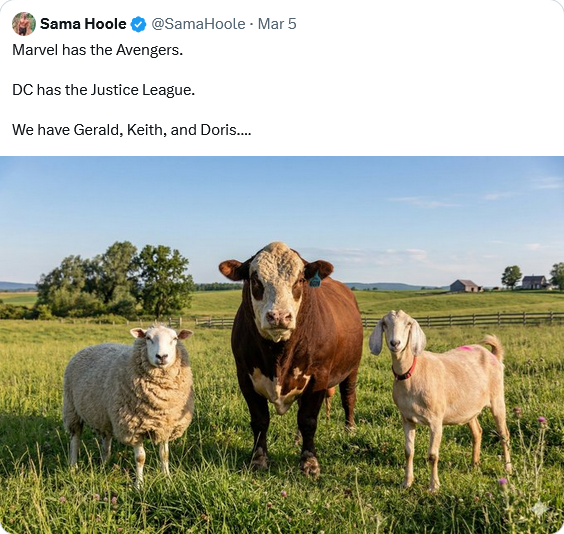
On the social media site formerly known as Twitter, Sama Hoole updates us on reactions to the peaceful activities down on the farm:
A few negative reviews have been penned on the Gerald-Keith-Doris Cinematic Universe.
The Guardian: “A troubling celebration of ruminant agriculture that fails to interrogate the structural violence inherent in … ” (Keith ate the rest of this review. Keith found it on Dave’s kitchen table. Keith did not find it nourishing.)
PETA: “These animals are being exploited for content.” (Doris was unavailable for comment. Doris was in Brian’s field. Doris has not consented to the PETA statement either.)
Friends of the Earth: “The Ruminati represent everything wrong with Britain’s failure to transition away from livestock-based agriculture.” (The Ruminati. They’ve named them. The Ruminati. We’re keeping this.)
George Monbiot, via newsletter: “Charming, certainly. But charm is how the pastoral lobby has always obscured the data.” (Gerald has not read the newsletter. Gerald was improving the south corner while the newsletter was being written. The south corner has field scabious in it. The newsletter does not have field scabious in it.)
The Vegan Society: “We note with concern that this content has significantly increased public sympathy for farmed animals while simultaneously increasing public sympathy for farming them.” (This is, they acknowledge, a confusing outcome. They are working on a position paper.)
Brian: “I added a tenth column.”
Opening weekend: strong.
The Ruminati are unavailable for comment.
The Ruminati are grazing.
Comments Off on The Ruminati
The FIRST Tank Battle – Villers-Bretonneux, 1918: Mark IV v A7V
The Tank Museum and Queensland Museum
Published 14 Nov 2025By spring 1918, the British Mark IV tank has been in service for almost a year. It had proved itself during the Battle of Cambrai – the males attacking concrete emplacements, and the females fending off the infantry. But the Mark IV has never been tested against another tank …
The German A7V hasn’t served on the battlefield very long. While it has mobility and stability issues, it does have thicker armour than the British tanks – and is more heavily armed. On paper, this looks like it will be a close call.
Villers-Bretonneux is the first time in history that a tank fought another tank. It’s a day that would change the face of warfare forever.
00:00 | Introduction
00:50 | The Mark IV
02:57 | The A7V
05:30 | The Battle of Villers-Bretonneux
06:44 | Mark IV vs A7V
09:09 | Who won?
(more…)
Comments Off on The FIRST Tank Battle – Villers-Bretonneux, 1918: Mark IV v A7V
March 7, 2026
QotD: Grind culture and performative working
As if compelled by unseen forces — one imagines that scene in The Exorcist — my fellow traveller adjusts his AirPods, straightens his spine, and “locks in”. Before him lies the cluttered still life of Productivity™: a crumpled FT, a bottle of protein-infused kefir, and two boiled eggs sweating inside their polypropylene coffin. For several moments, he sits with priestly solemnity. Then, as the train inches forward, so does he.
And so, begins his morning recital. I would call it theatre, but theatre requires even the slightest concession to its audience. There is no risk of such grace here.
“Jenny? You still there? Jenny? Excellent.”
He repeats her name as though invoking the supernatural. Dale Carnegie once advised this rigmarole; it’s meant to build something called rapport. Unfortunately, Dale Carnegie never sat captive before a disciple who had taken his gospels quite so literally.
“Jenny (build rapport), could you run those numbers by me again? (assert authority). I’m hoping to parallel-path with you moving forward (signal tribal membership). Great! (convey enthusiasm). Jenny, let’s circle back at 1400 GMT; I want to put a pin into an area of emerging awareness.”
By this point in the sermon, I’d developed several areas of emerging resentment and the unignorable desire to drive pins into eardrums — mostly mine. His monologue, which suggested he charged by the word, stretched unabated from Reading to London Paddington, where he skulked off the platform and into the neon vomit of the city like a Roman senator descending into the Suburra.
In the false refuge of a nearby pub, the missionaries gather and gab incessantly. Chirruping clots of earnest twenty-somethings discuss REM-centric sleep regimes, dopamine stacking, and some Santeria called “sunlight dosing”. They sip protein-riddled IPAs. They recite “Huberman says …” as the devout once invoked St Augustine.
These rituals — the 21st-century Lascaux cave paintings — serve one purpose: to peacock one’s devotion to a deity known as The Grind. Like all deities, The Grind demands a daily sacrifice for a distant, mostly hypothetical reward.
We have struggled to name this social pathology. Grind culture. Hustle culture. 996. No days off. Whatever it is, it is not working. In truth, it is the inbred relation of Performative Reading — Performative Working. This theatre drips with all the fripperies of work and none of the results. Much like a Hinge premium account, or indeed the British state.
Christopher Gage, “Mourning Routine: The Cult of Performative Work”, Oxford Sour, 2025-12-03.
Comments Off on QotD: Grind culture and performative working
March 6, 2026
How Not to Build a Plane – TSR2 vs F-111
HardThrasher
Published 5 Mar 2026In the late Cold War, Britain and the United States tried to build the ultimate low-level supersonic strike aircraft. The result was two of the most ambitious aviation programmes ever attempted: the BAC TSR-2 and the General Dynamics F-111 Aardvark. Both aircraft were designed to solve the same terrifying problem. Soviet surface-to-air missiles had made high-altitude bombing almost suicidal. The next generation of bombers would have to fly low and fast, automatically following the terrain, navigating using primitive onboard computers, and delivering nuclear or conventional weapons deep inside enemy territory. In theory, these aircraft would be revolutionary.
In practice … things went wrong.
The TSR2 programme became one of the most controversial cancellations in British aviation history. Plagued by spiralling costs, technical ambition far beyond the computers of the era, and a labyrinth of government bureaucracy, the aircraft was cancelled in 1965 after only a handful of test flights. Meanwhile the American F-111 survived the same technological challenges and political battles — but only just. Development disasters, crashes, exploding engines, and staggering cost overruns nearly killed the programme multiple times before the aircraft finally entered service.
In this video we explore:
• Why the TSR-2 was so technologically ambitious
• How terrain-following radar and early flight computers nearly broke both projects
• The political battles inside Whitehall and Washington
• Why the F-111 Aardvark survived when TSR2 did not
• And what these aircraft reveal about Cold War military technology and procurement
The TSR2 and F-111 weren’t just aircraft. They were early attempts at something closer to a flying computer, built decades before modern electronics made such systems reliable. And that ambition nearly destroyed both programmes.
(more…)
Comments Off on How Not to Build a Plane – TSR2 vs F-111
March 5, 2026
All hail Keith the Apocalypse Bringer
On the social media site formerly known as Twitter, Sama Hoole sings the praises of Keith the Apocalypse Bringer:
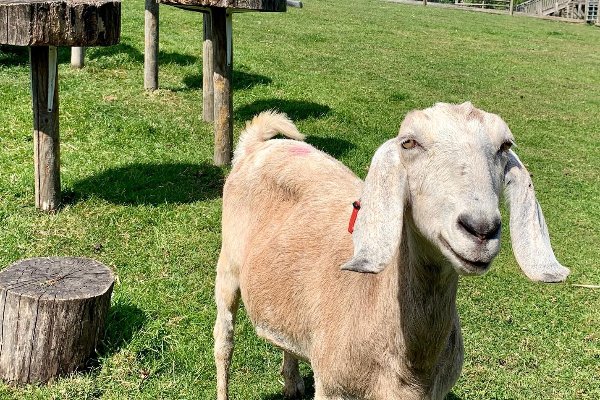
Keith the Apocalypse Bringer is a three-year-old Anglo-Nubian goat in a field in Devon.
Keith should not be underestimated.
Keith has been systematically dismantling the ecosystem since approximately 7am, when he ate a bramble. This is significant because bramble is an invasive scrub species that outcompetes wildflowers, reduces biodiversity, and creates dense monoculture thicket that nothing else can use.
Keith ate it. Keith does this every day. Keith does not charge for this service.
8:15am – Keith ate a thistle. Thistles are also considered invasive scrub in managed pasture. Goldfinches eat thistle seeds, but Keith’s grazing will ensure the pasture remains open enough for the ground-nesting birds that can’t use dense scrub. Keith has not attended a conservation workshop. Keith arrived at this conclusion by being a goat.
9:00am – Keith dismantled a section of hedge. This was less helpful. Keith does not have a perfect record.
10:30am – Keith escaped the field. He was in the road for eleven minutes. He ate a neighbour’s rose. This is not being counted in Keith’s environmental impact assessment.
11:00am – Keith was returned to the field. Keith regarded the farmer with the specific expression of an animal that does not recognise the concept of property.
12:00pm – Keith ate more bramble. His digestive system: four stomachs, a rumen full of specialised microorganisms, the ability to extract nutrition from lignified plant matter that would defeat any other animal on this field, is converting scrub vegetation into milk with a fat content of approximately 4.5%. The milk will become cheese. The cheese will be sold at the farm shop. The farm shop is four miles away. The cheese food miles are: four.
3:00pm – Keith produced manure. The manure will grow the grass. The grass will grow the bramble. The bramble will be eaten by Keith.
This system has no inputs.
It has been running since goats were domesticated approximately ten thousand years ago.
Keith is not aware he is saving the planet.
Keith is thinking about whether the fence on the north side has a weak point.
It does. Keith found it at 4:45pm.
Keith got out again.
Things Keith has eaten that are classified as invasive or problematic scrub species in managed Devon pasture:
– Bramble ✓
– Thistle ✓
– Dock ✓
– Nettles ✓
– Coarse rank grass ✓
– Woody shrub encroachment on the eastern border ✓
– A section of blackthorn that had no business being in the middle of the field ✓Things Keith has eaten that were not invasive or problematic:
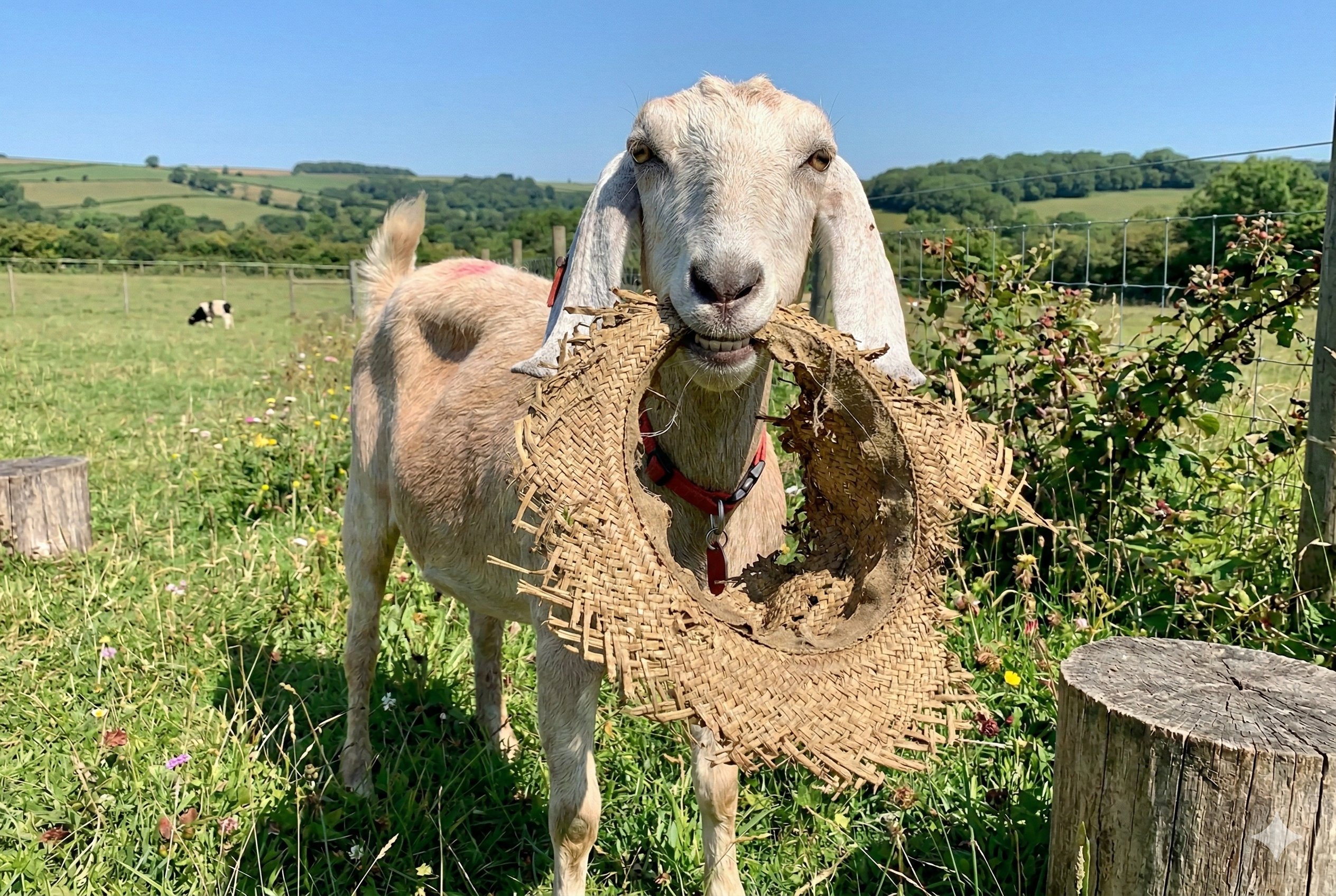
– The farmer’s hat (twice)
– A corner of the farm accounts ledger (once, in what may have been a comment on farm profitability)
– The neighbour’s prize rose
– A high-visibility jacket hanging on the gate post
– The gate post itself, partiallyKeith’s conservation record: excellent.
Keith’s record on other matters: under review.
Comments Off on All hail Keith the Apocalypse Bringer
“Britain’s ‘Scrap Iron Armada'” | Tonight (1962)
BBC Archive
Published 10 Nov 2025“A ship that’s built to withstand shell fire is no pushover in the breaker’s yard.”
Alan Whicker reports on the fate of obsolete naval warships, which are lying in bays around the country waiting to be scrapped or sold. Among this “scrap iron armada” is the Leviathan (R97) — a mammoth £6 million aircraft carrier — that has never sailed. It was abandoned, approximately 80 percent complete, in 1946 after the war ended.
Clip taken from Tonight, originally broadcast on BBC Television, 19 March, 1962.
Comments Off on “Britain’s ‘Scrap Iron Armada'” | Tonight (1962)
March 3, 2026
The Deadly Job of a Victorian Baker
Tasting History with Max Miller
Published 2 Sept 2025Large, gingery loaf of bread
City/Region: England
Time Period: 1857In order to make expensive wheat flour go further, Victorian bakers added things to it of varying edibility. While potato, corn, and pea flour were used, so was ground up plaster of paris, chalk dust, and a powder called alum. Alum made the flour very white, but is also toxic in large quantities.
This loaf, made only with wholesome, edible ingredients, would have been on the fancier side of a bakery’s offerings with the addition of lots and lots of powdered ginger. This bread really surprised me, as it tastes like a normal loaf of bread at first, but then the heat and the flavor of the ginger comes through afterwards.
Ginger Loaf, or Rolls.
Mix intimately two ounces of good powdered ginger, — called in the shops prepared ginger, — and a little salt, with two pounds of flour, and make it into a firm but perfectly light dough with German or brewer’s yeast, [and 1 pint milk] in the usual manner; [to rise one hour or until quite light: to be kneaded down and left again to rise until light]. Bake it either in one loaf, or divide it into six or eight small ones.
The proportion of ginger can be much increased if desired; but the bread should not then be habitually eaten for a long continuance, as the excess of any stimulating condiment is often in many ways injurious.
— The English Bread-Book by Eliza Acton, 1857
Comments Off on The Deadly Job of a Victorian Baker
March 2, 2026
QotD: King Stephen and “the anarchy”
At this point, I ought to mention that the year is 1120; the young man is William Adelin, heir to the throne of England; and the “ferry” is the infamous White Ship.
Anyway, back to the story: the wine keeps flowing and, before long, the crew are drunk too. Not far out of port, the ship hits a submerged rock and rapidly sinks.
In all, hundreds are drowned — and yet that is just the start of the tragedy.
William’s father, King Henry I, had gone to great lengths to proclaim an heir. As the son of William the Conqueror, he knew just how messy succession could get. He had himself inherited the throne from his brother, William Rufus. This second William had died of a chest complaint — specifically, an arrow in the lungs (the result of a hunting “accident”). Henry was determined that his son would inherit the throne without mishap — and so carefully prepared the ground for a smooth transfer. Indeed, the name “Adelin” signified that the third William was the heir apparent.
The sinking of the White Ship left Henry with one remaining legitimate heir, his daughter Matilda. She was a formidable character, also known as Empress Maud (by virtue of her first marriage to the Holy Roman Emperor). She was, nevertheless, a woman — a big problem in an age when monarchs were expected to lead their men in battle. When Henry died in 1135, Maud’s cousin — Stephen of Blois — seized the throne. This was widely welcomed by the English nobility, but Maud wasn’t giving up easily, and she had powerful allies. Her second husband was Geoffrey, Count of Anjou; her illegitimate half-brother, Robert of Gloucester, was a wealthy baron; and her uncle was King David I of Scotland.
Stephen was assailed on all sides — by Geoffrey in Normandy, by Robert in England, by invading Scots and rebellious Welshmen. The civil war (if that’s what you can call this multi-sided free-for-all) dragged on for almost 20 years. There weren’t many set-piece battles, but there was lots of looting and pillaging in which countless nameless peasants perished.
In the end it was the death of another heir — Stephen’s son, Eustace — that opened the way to peace. The war-weary king agreed that Maud’s son (the future Henry II) would succeed him. And thus “The Anarchy” came to end: two decades of pointless devastation — and all because some young fool got pissed on a boat.
Peter Franklin, “Why Boris needs an heir apparent”, UnHerd, 2020-08-17.
Comments Off on QotD: King Stephen and “the anarchy”
March 1, 2026
The American Revolutionaries – when you don’t want a king, but you do want someone king-ish
On Substack Notes, John Carter shared this post by Theophilus Chilton, saying:
Fascinating. The American founders were explicitly trying to revive a stronger form of monarchical executive authority with the presidency, as a deliberate corrective to the relatively powerless Crown of the British Constitution, which had been effectively neutered by the doctrine of parliamentary supremacy.
Along similar lines, the American Bill of Rights was in most ways simply a restatement of the ancient rights of Englishmen.
So, of course, I had to go read the post:
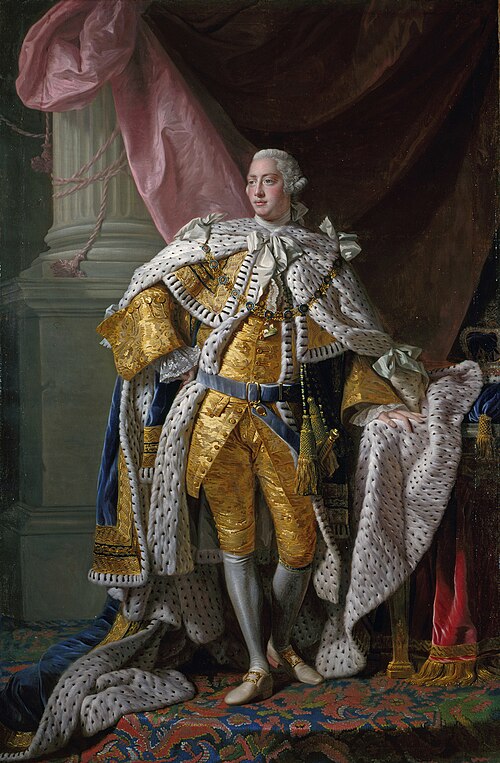
Too “kingly” but also not “kingly” enough for America’s Founding Fathers.
King George III in his Coronation robes.
Oil painting by Allan Ramsay (1713-1784) circa 1761-1762. From the Royal Collection (RCIN 405307) via Wikimedia Commons.
Recently, I’ve been reading an interesting book about 18th century political philosophy entitled The Royalist Revolution: Monarchy and the American Founding. In this work the author, Eric Nelson, guides the reader through the various aspects of the great inter-whiggish debates that roiled the American colonies prior to independence, and which then continued afterwards. One of the main premises is that a major faction within this debate — and indeed the one which ended up prevailing in the end — understood the relationship between colonies and mother country to be founded upon the king of Britain’s personal proprietorship over the colonies. This Patriot position was opposed by the Loyalist position which saw the colonies as existing under the laws and rule of Parliament.
Now this might seem strange to generations of Americans who grew up learning in school that the American revolutionaries fought against the great tyrant King George III who was set upon grinding the American colonies under his bootheel of oppression. That view would be quite surprising to many of the participants on the Patriot side, many of whom actually appealed to King George, both publicly and in private correspondence, to exercise kingly prerogative and overturn the various duties, laws, and taxes which Parliament had laid upon the colonies. This, indeed, was the crux of the Patriot argument, which is that because the colonies were originally founded under the personal demesne of the British King, they remained so even despite the temporary abolishment of the monarchy after the execution of Charles I in 1649. In the interregnum between that and the Glorious Revolution and restoration of a stable monarchy that was accepted by all classes as legitimate in 1688, Parliament had illegitimately usurped authority over the colonies. Because it was Parliament which was laying the Intolerable Acts and all the other complaints which the Americans had, it was Parliament against whom they wished to be protected.
But these Patriots were pining after a situation which no longer existed. In point of fact, the British kings since the Glorious Revolution had left whatever prerogative powers they might still have had unused. So it was with George III, who rejected the American colonists’ calls for him to intervene, knowing that doing so would have provoked a constitutional crisis in Britain which he would not have won. As a result, the American colonists chose to make their final break with the British monarchy and throw in their lot for independence, buttressed by Thomas Paine’s fleetingly persuasive but ultimately ineffectual pamphlet Common Sense.
However, after independence, the colonists were faced with providing their own governance. Initially, this was attempted under the Articles of Confederation, as well as their state constitutions, all of which were very whiggish in principle. They were also inadequate to the task. As every student who took high school civics knows, the solution to this was the Constitution of 1789.
Typically, students are taught that the new Constitution was designed to strengthen the ability of the federal government to handle the various issues that applied to the confederation of states as a whole. What we don’t generally hear, however, is that much of this included strengthening the roles and powers of the president to include several areas of prerogative powers which exceeded even the powers then available to the kings of Britain. The stock view of the Constitution is that it “was created to prevent anyone from getting too much power!” The actuality is that the Constitution was crafted, in part, to expand presidential power and create what was viewed at the time as a literally monarchical chief executive. Opponents of this described the proposed executive as “the foetus of monarchy”. Supporters often defended it on the basis that parliaments and congresses, if left unchecked by a strong executive whose interest was drawn from the body of the whole people, would themselves become the greatest threats to the liberties of the people.
The Founders who proposed this enhancement of the executive didn’t do this in a vacuum. Indeed, they had a century and a half of history about this very subject to draw from first-hand. Fresh in the collective mind of every Englishmen, both in the home country and in the colonies, were the English Civil Wars of the previous century. Beginning with the revolt of the parliamentarian army in 1642 through the regicide of Charles I in 1649, the protectorate of Oliver Cromwell, the attempted restoration of the House of Stuart under James II, until the final deposition of James and his replacement with William, Prince of Orange in the Glorious Revolution of 1688, Englishmen had a long series of examples from which to draw various conclusions.
So yes, they could see the parliamentarian excesses that took place during the Protectorate. Current in the collective national mind were the overreaches (whether real or imagined) of Parliament both during the interregnum and in the century since the acquisition of the throne by the House of Hanover. As noted above, among these overreaches, at least as viewed by many in the American colonies, was parliamentary interference in the affairs of the colonies, viewed as transgressions into the rightful domain of the king’s purview. Hence, by a strange twist, the Loyalists who opposed American independence before and during the Revolution were generally the more whiggish of the two sides, throwing in their lot with the parliamentary oligarchies. The Patriots, on the other hand, were desperately trying to get the king to reassert his royal prerogatives and intervene by reasserting his perceived rights to directly rule the colonies, something of a modified “high/low vs. the middle” type of scenario.
Comments Off on The American Revolutionaries – when you don’t want a king, but you do want someone king-ish
Demythologizing the Windrush story
The Empire Windrush was a British ship that brought the first batch of many, many Caribbean people to Britain in 1948. This has been hailed as the foundation of a modern, multicultural Britain by many pop historians and, weirdly, also the moral equivalent of the Jim Crow era of US racial relations. It’s a Two-fer, allowing progressives to celebrate the multicultural aspects and also to declaim and performatively protest against the racist aspects. Celina101 discusses the Windrush myths:
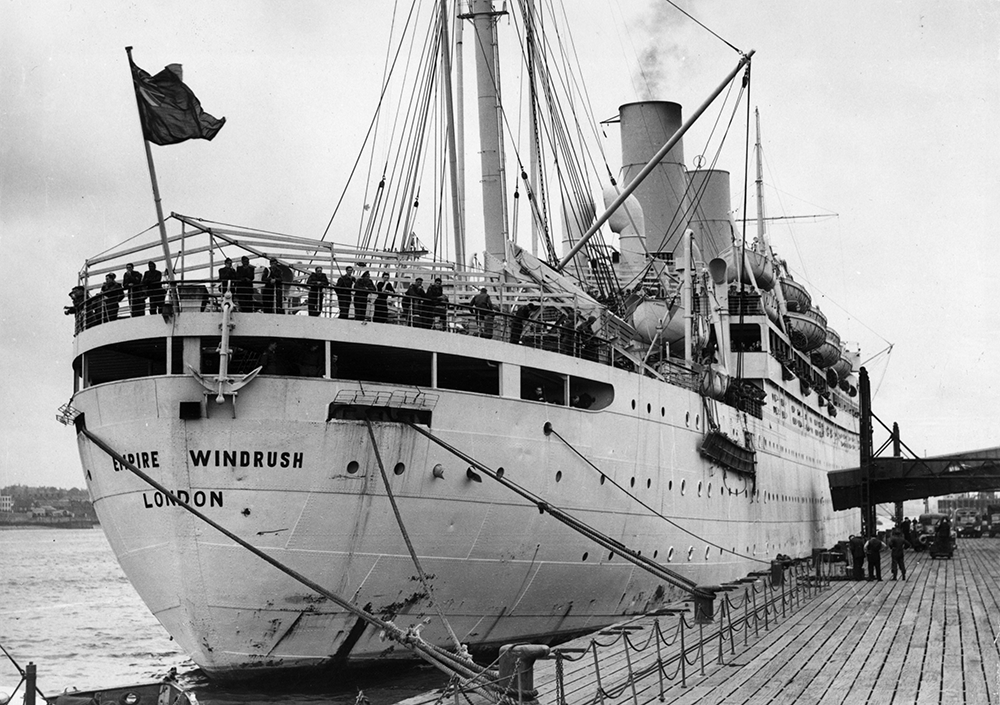
HMT Empire Windrush in harbour. Originally launched as the Hamburg Süd line’s Monte Rosa in 1930, seized for use as a British troopship in 1947 after WW2. She was lost after an engine room explosion and catastrophic fire in 1954 and sank in the Mediterranean.
In June 1948 the HMT Empire Windrush arrived at Tilbury carrying over 800 Caribbean passengers. Today this moment is often hailed beginning of modern multicultural Britain, the founding “origin story” of a tolerant, diverse cosmopolitan nation. Yet a deep dive into the archives shows a very different picture. The British Nationality Act of 1948 (passed just weeks after Windrush set sail) did create a universal status (“Citizen of the UK and Colonies”) that legally allowed colonial subjects to live in Britain. But as one colonial minister emphasised, this was meant to reaffirm an older imperial principle, that a subject could declare Civis Britannicus sum (“I am a British citizen”) regardless of colour and was not expected to trigger mass non-white immigration.1 In fact, Attlee’s government and senior civil servants were privately anxious about non-white migration, seeing Windrush as an “incursion” to be managed. Contemporary cabinet papers and correspondence reveal that Windrush was essentially an accident of imperial law and circumstance.
Imperial Citizenship and the 1948 Act
The post-war British state’s conception of citizenship was still shaped by empire. In theory, as Lord Palmerston had put it, every British subject “in whatever land he may be” could count on England’s protection.2 The 1948 British Nationality Act (BNA) codified this idea by creating two categories: Citizens of the UK & Colonies (CUKC) for the “non white” Commonwealth and Citizens of Independent Commonwealth Countries (CICC) for the white Dominions. As a Home Office historian notes, the Act was largely a reaction to Canada’s new Citizenship Act and was intended to preserve loyalty to the Crown and the Commonwealth.3 In practice, BNA 1948 did not fundamentally alter migration rules: colonial subjects remained British subjects with the right to enter the UK, as they had before. Critics at the time even pointed out that this laid the groundwork for subjects of a newly independent non-white India, Pakistan and African colonies to become CUKCs, but that eventuality was not central to the legislators’ intent.4 As David Olusoga and others have observed, no one in 1948 “imagined that black and brown people from Asia, Africa and the West Indies would use their rights under this act to come and settle in Britain”. The law was conceived primarily for white Commonwealth citizens like the populations of Canada and Australia, with the assumption that the British Empire’s non-white subjects, without the resources or need would not make the journey.5 In short, the legal framework of imperial citizenship was nominally open, but the political expectation was that few colonials would exercise the right to relocate.
[…]
Inventing the Myth: Windrush in National Memory
How, then, did Windrush attain the status of a proud national genesis myth? Over the ensuing decades the episode was reimagined and commemorated in ways that the original participants surely did not anticipate. As historian Simon Peplow notes, “the arrival of the Empire Windrush in 1948 has been cemented as a mythical central symbol for immigration in histories of modern Britain”.6 Newspaper narratives and politics in the 21st century cast the Windrush as the symbolic genesis of multicultural Britain. For example, literature and media (like Andrea Levy’s Small Island, 2004) linked the founding of a “shared history” to 1948, treating the Windrush landing as the first wave of a mass migration that made Britain what it is today.7 Over time this narrative was bolstered by public ceremonies: 50th- and 60th-anniversary events, the 1998 renaming of Brixton’s Windrush Square, and in 2018 the formal creation of a national Windrush Day (22 June) to “pay tribute” to the generation. Politicians and curriculum materials alike have repeated the line that Windrush marked the inception of modern Britain’s diversity.8
This retrospective framing treats the Windrush episode as a foundational myth, an origin story, and invoked to legitimise contemporary values of tolerance and diversity. In this constructed memory, loyal Caribbean war veterans returned to Mother Country to rebuild Britain, and British society (in hindsight) embraced them with open arms. Newsreel footage from 1948, often screened today, reinforces this sentimental image, the smiling Windrush passengers, calypso music, and patriotic commentary suggest an organised welcome.9 The reality was much, much more ambivalent.
- https://www.gov.uk/government/publications/the-historical-roots-of-the-windrush-scandal/the-historical-roots-of-the-windrush-scandal-independent-research-report-accessible#about-this-report
- Ibid
- Ibid
- Ibid
- https://www.theguardian.com/tv-and-radio/2019/jun/24/the-unwanted-the-secret-windrush-files-review-who-could-feel-proud-of-britain-after-this
- https://wrap.warwick.ac.uk/id/eprint/139720/1/WRAP-1997-Windrush-newspapers-Peplow-2020.pdf#:~:text=Abstract%3A%20The%20arrival%20of%20the,the%20manufactured%20centrality%20of%20this
- Ibid
- Ibid
- https://www.theguardian.com/commentisfree/2018/apr/22/windrush-story-not-a-rosy-one-even-before-ship-arrived
Comments Off on Demythologizing the Windrush story
February 28, 2026
The by-election in the British riding of Gorton and Denton
A few surprises in the outcome, although the expected winner — the Green Party — did manage to pick up the seat by pandering harder than anyone else for the Muslim vote (according to multiple sources). And, as Francis Turner points out, this may be a problem:
The Gorton and Denton by-election has happened, and as I predicted, Labour came third.
Though more people voted Labour than I expected (25% actual vs 10-15% prediction) and sadly not enough people were convinced to vote Reform so the Greens won. But, while turnout was lower than one might have hoped, there’s a real humdinger of an allegation that makes the Green victory very iffy.
Today we have seen concerningly high levels of family voting in Gorton and Denton. Based on our assessment of today’s observations, we have seen the highest levels of family voting at any election in our 10 year history of observing elections in the UK.
Family voting is not a term I’ve heard of before, but it is the situation where two voters either confer, collude or direct each other on voting. And obviously cases where one voter oversees the votes of more than one other person as well.
Democracy Volunteers, the organization making the allegation, is a reputable decade plus old organization and not a partisan one.
Democracy Volunteers is run by Dr John Ault, a former Liberal Democrat politician who has observed elections in countries including Britain, Sweden, Norway and Finland.
They give more detail on their webpage
2023 saw the enactment of the Ballot Secrecy Act, which made the practice of family voting more clearly a breach of the secret ballot, making it more enforceable by staff in polling stations. Signage is now available to discourage the practice. Signage was only seen in 45% of the polling stations observed.
The observer team saw family voting in 15 of the 22 polling stations observed, some 32 cases in total, nine cases in one polling station alone. The team observed a sample of 545 voters casting their vote – meaning 12% of those voters observed either caused or were affected by family voting.
Commenting John Ault, Director of Democracy Volunteers said;
“Today we have seen concerningly high levels of family voting in Gorton and Denton. Based on our assessment of today’s observations, we have seen the highest levels of family voting at any election in our 10 year history of observing elections in the UK.”
“We rarely issue a report on the night of an election, but the data we have collected today on family voting, when compared to other recent by-elections, is extremely high.”
“In the other recent Westminster parliamentary by-election in Runcorn and Helsby we saw family voting in 12% of polling stations, affecting 1% of voters. In Gorton and Denton, we observed family voting in 68% of polling stations, affecting 12% of those voters observed.”
[…]
The team also saw a number of voters taking photographs of their ballot papers and one voter being authorised to vote despite them already having been marked as voted earlier in the day.
What they do not say, unfortunately, is which polling stations they observed this in. We can guess. In fact the Torygraph reports that Reform has explicitly made the obvious accusation:
Nigel Farage, the Reform leader, said allegations of family voting raised “serious questions about the integrity of the democratic process in predominantly Muslim areas”.

I would imagine such things are happening all over the Anglosphere with the large increase in Muslim voters in recent years — many of whom may be voting for the first time, depending on their national origin. In the free-to-cheapskates portion of this post, Ed West considers the evolution of the UK Green Party from granola-eating no-nukes freaks into a consciously sectarian party aiming to leverage the rising Muslim vote:
A good pub quiz question in the year 2050 will go something like this: “True or false, the ‘green’ in the ‘Green Party’ originally referred to the environment”. By this point, the etymological origins of Britain’s sectional Islamic party will be as obscure as the relationship between British Conservatives and 17th century Irish bandits.
A key milestone, our mid-century quiz regular will inform his teammates, was the 2026 Gorton and Denton by-election in which the Greens stood neck and neck in a three-way race with Labour and Reform.
Eagle-eyed observers these past weeks will have noted how the once environment-focused party have been pitching at particular sections of “the community”, with campaign leaflets featuring candidate Hannah Spencer wearing a red and black keffiyeh while posing in front of a mosque.
Written in Urdu, the pamphlet calls for voters to: “Push the falling walls one more time. Labour must be punished for Gaza. Reform must be defeated and Green must be voted for. Vote for the Green Party for a strong Muslims voice.” Then it adds, in English, “Stop Islamophobia. Stop Reform.”
There was also an Urdu-language video linking Reform Party candidate Matt Goodwin and leader Nigel Farage with Donald Trump and ICE deportation raids. The video then cuts to Gaza, before showing Keir Starmer beside India’s Narendra Modi. Subtle stuff.
The video states in Urdu: “A cruel politician can win if we don’t vote Green to stop the Reforms … Workers, cleaners, drivers, mothers – it’s us who keep this area running. But the politicians are not working for us … The Reforms want to break up our communities. They want to deport families who have lived here for years, and they want to tax people born abroad even more. They give air to Islamophobia, and they put our safety and dignity at risk.”
[…]
Britain’s Green Party has historically been a thing of amusement to many, a bunch of harmless hippies and Quakers with wacky beliefs; at the time of their first breakthrough in the early 1990s their most high-profile figure was David Icke, then seen as an amusing crank with interests in new age mysticism and alternative medicine.
As traditional politics fractured, the Greens came to fill the space inhabited by high-education, low-income graduates, the group who most favour redistributive economics and highly progressive social policies. Yet political parties have no souls, as such, being merely vote-seeking businesses, and they go where the market is — and now they find the lowest hanging fruit in appealing to sectarian interests.
If decades of generous immigration policies have created constituencies where people vote along religious lines, and are more comfortable with the national language of Pakistan than English, there is nothing to stop someone appealing to that market. It’s within the rules of democracy, if not the spirit.
Gorton and Denton is among the increasing number of constituencies in which a candidate can win by appealing overtly to the Islamic vote; “Gaza independents” won 5 seats in 2024 and could win 10 or 12 by 2029 and 20 or 30 by the election that follows; after that, the ceiling is limited by high levels of segregation. This could be good news for the Green Party, if that’s the path they want to go down, and they certainly don’t seem to shy away from the prospect.
Polanski has welcomed the endorsement of the Muslim Vote, an organisation which instructs people how to cast their ballot along religious lines, even if adding the caveat that people should vote as individuals. In February he told PoliticsHome that “I think any organisation that wants to back the Green Party because they align with our values is something that I applaud and welcome”.

Comments Off on The by-election in the British riding of Gorton and Denton


