
The L-word is not taken to mean American “liberalism”, the distressingly anti-liberal, lawyer-driven politics of increasing governmental planning and regulation and physical coercion. It is instead the rest of the world’s “liberalism”, economist driven, “the liberal plan”, as old Adam Smith wrote in 1776, “of [social] equality, [economic] liberty and [legal] justice”, with a modest, restrained government giving real help to the poor. True modern liberalism.
A liberal “rhetoric” explains the good features of the modern world compared with earlier and later illiberal régimes — the economic success of the modern world, its arts and sciences, its kindness, its toleration, its inclusiveness, and especially its massive liberation of more and more people from violent hierarchies ancient and modern. Its enemies claim that it also explains alleged evils, such as the reduction of everything to money or the loss of community or the calamity of immigration by non-Christians. But they are mistaken.
Dierdre McCloskey, “The power of liberalism can combat oppression in all its forms”, The Economist, 2020-01-08.
May 28, 2026
QotD: Re-defining economic liberalism
May 24, 2026
The PRC would need a literal “short, victorious war” to defeat the US
On Substack, Tom Kratman looks at the economic and strategic weakness of the Peoples Republic of China should it get into a serious shooting war with the United States:
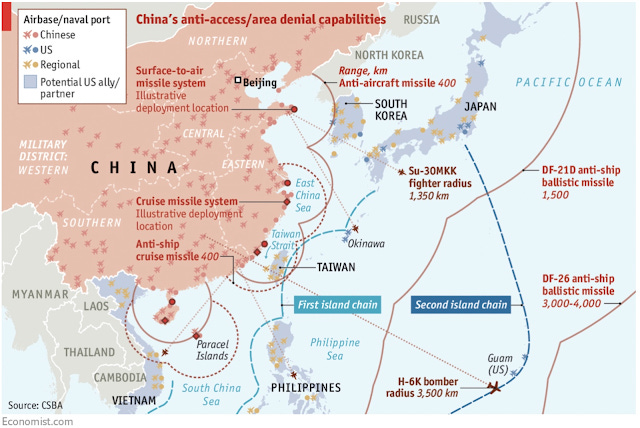
China’s strategic position is appalling, and at least the higher party cadres and senior military leadership have to know that it is. Why? China is utterly dependent on both imports and exports to keep their economy going and to feed themselves. By that latter, I don’t just mean they need to import food, though they do to the tune of one third. That’s bad enough, but they also need to import fertilizer to grow the inadequate amount of food they grow for themselves. No, nitrogen and phosphates aren’t a huge problem; they are net exporters. Potash is a problem. Loss of potash imports probably cut their grain production by about ten percent. This would be painful, but survivable with a touch of rationing and some weight loss.
Except for one thing, oil and natural gas. Cut those off and grain production drops by a third within two years and probably forty percent after that. On top of the loss of the third that they must import, that’s serious hunger.
And another thing, farm machinery and transportation. China only produces about a quarter of its oil needs domestically. Cut those off and mechanization of farming must be reduced.
Add in that this kind of food reduction also means they must stop feeding food animals.
Moreover, while a good deal of their transportation net runs off of electricity, which can be produced by the coal China does have, at what we might call the strategic level, getting the food from the farms to the railheads and from the railheads to markets to kitchens requires liquid fuel. China’s ability to produce liquid fuel from coal exists, but it is tiny.
Add in the increased need for liquid fuel for their military in this case.
A long series of interrogatories to Grok suggests that China’s total food production and importation collapses by seventy percent or more within two or three years if they go to war with us.
It won’t be sudden; they probably have about a year’s worth of food in storage against such a day. But within three years? We’re talking an entire civilization in kwashiorkor1 and marasmus2.
How do they keep that industrial civilization going in the absence of food and energy imports, or the exports that have kept their economy going? They likely don’t.
Although China’s population appears to be in accelerating collapse, they still have a lot more people than we do. Surely that represents … nothing. For a war fought largely at sea it represents nothing. Yes, they can, at least for the moment, build more ships faster than we can. However, we can build things to sink ships faster than they can build ships. Thus, we’ll keep our existing naval supremacy.
There’s a worse factor in there, though; in China sons are just a lot more important than daughters. No, I don’t care if this upsets western feminist sensibilities; we are not talking about the west but about China. Daughters, assuming they marry, go on to take care of their husband’s family. Sons take care of the parents. It is the rare Chinese family with an extra son to spare.
But can’t they build enough ships to overwhelm our blockade in the short term, at least? No, they can’t. China is surrounded by enemies on land, Vietnam, India, and Russia predominant among them, though none of the neighbors – barring, maybe, North Korea – really likes China or doesn’t fear it. No, however much public kissy face they may engage in for foreign consumption, China and Russia have long-standing, intractable issues between them. China is a threat to Russia and vice versa in ways we are not.
So all the manpower and money spent on a navy is largely wasted. They’re not going to get a navy large, powerful, and competent enough to take us on and, if they really try to, we will manufacture a war – the United States is good at this – to trim them down to size before they can. Worse, every increment of money and manpower they spend on the navy is money and manpower not spent on the much more important army and air force.3
- Caused by protein deficiency.
- Caused by deficiency in all macronutrients.
- The Navy is much more important to us because we have no serious land enemies in this hemisphere.
Update, 25 May: Welcome, Instapundit readers! Have a look around at some of my other posts you may find of interest. I send out a daily summary of posts here through my Substack – https://substack.com/@nicholasrusson that you can subscribe to if you’d like to be informed of new posts in the future.
May 22, 2026
“Re-shoring” manufacturing isn’t the answer
On Substack, Tim Worstall uses the examples of Apple and Foxconn to illustrate that most of the value generated isn’t in the manufacturing side of the equation:

Yes, I know Apple is up to the iPhone 17 now, but it’s still as true about (some) iPhone addicts now as it was then.
Apple’s market capitalisation — the contribution to human wealth of the firm — is 4.3 trillion of those American dollars. That of Hon Hai Precision — most of us will know that better as “Foxconn”- is $3.1 trillion $. But those are the fun, New Taiwanese, dollars, which equals some $113 billion US dollars. Given the imprecision of what follows let us round those to $4 tr and $100b. Apple is worth 40 times Foxconn.
Now it’s not wholly true that Apple manufactures nothing. I think they — more so they say they do so than anything else — make some of the Macs themselves. And perhaps some number of their processing chips but I think even that is outsourced to other foundries, isn’t it? It’s also true that Apple uses more than one manufacturing company — Pegatron is a name I’ve heard around.
It’s also not true that Foxconn only works for Apple. It takes on that manufacturing and assembly work from a number of companies. Which is where my imprecision comes in, for I’m — just to make the example — going to assume that Foxconn does all and only Apple’s manufacturing, Apple does no manufacturing and sends it all to Foxconn. Those are incorrect assumptions but they’re good enough for this jazz hands of an argument.
So, designing stuff then selling it produces 40x the capital value of manufacturing it. We also know that Apple runs at 40% net margins and Foxconn most certainly does not. My numbers are a little out of date but it’s not all that long ago that the cost to assemble — ie, “manufacture” — an iPhone was perhaps $10.
We have pretty clear evidence that the place to make money in the global economy is sitting in an office and thinking therefore. Not out there bashing metal. So, why is it that so many say that the UK — and the US — must reshore all that manufacturing so as to get rich?
One explanation is as with that of the Physiocrats. French economists — and therefore wrong, they’re French — back in the old days who insisted that only growing food was real wealth production. They were musing over their brioche rather before anyone really manufactured anything — rather than artisaned — true but they have, of course, been proven wholly wrong. They might well have been about right for the centuries before them but were wrong by the time they wrote it all down.
We can extend the analogy to today. Yes, it has been true for much of the past couple of centuries that lots of manufacturing is what makes a place rich. Now, as with Apple and Foxconn this ain’t so. But some are still stuck in that old way of thinking.
Could be.
We can approach the same point from another direction. Actual manufacturing is something that is, these days, done by poor people in other countries. Why assume that if we did it it would make us rich?
QotD: The cargo cults of New Guinea
You may remember that Guns, Germs, and Steel is framed as a reply to a man named Yali, a “remarkable local politician” whom Diamond encountered while walking on the beach in New Guinea in July of 1972. (Back before Diamond’s second career as a pop-science public intellectual, he was an ornithologist focusing on the birds of northern Melanesia.)1 They chatted for a while about the prospects for New Guinean independence, and local birds, and then Yali asked a question that Diamond spends a couple of paragraphs boiling down to something like, “Why did human development proceed at such different rates on different continents?” (Which is of course what Guns, Germs, and Steel tries to answer.) But that’s not actually the way Yali put it, and his real question — indeed, his whole story, which is fascinating in its own right — suggests a whole ‘nother set of answers
Yali should be better-known.2 He may have been from a backwards backwater, but he’s one of the true Player Characters of history. If we lived in a better world, he would be the subject of a prestige cable drama3 — or maybe a Robert Eggers film, because the values and assumptions of his society are incredibly foreign to a Western audience. And so to really understand and appreciate Yali’s story (and the question he asked an American ornithologist on the beach one day) you need some background about the tribal cultures of the New Guinea coast and their reaction to contact with Europeans. Which is to say, you need to understand cargo cults! Because what Yali actually asked (per Diamond’s recollection twenty-odd years later) was: “Why is it that you white people developed so much cargo and brought it to New Guinea, but we black people had little cargo of our own?”
“Cargo” is the catchall word for Western material culture in Pidgin English,4 the lingua franca of New Guinea’s many language isolates, and New Guineans were understandably obsessed: before European contact, they were living in the literal Stone Age. It would be an exaggeration to say that they hadn’t made any technological progress since their ancestors settled the island 50,000 years earlier, since they domesticated several local plants (taro, yams, and the cooking banana) and got pigs plus a little admixture from some passing Austronesians about 1500 BC, but they were solidly Neolithic and had been since time immemorial. So of course as soon as they encountered cargo — especially steel tools, tinned meat and dried rice, and cotton cloth — they wanted it desperately. And they almost universally believed they could get it by ritual activity.
The prescribed rituals varied. One set, recorded in secret by an American Lutheran missionary in the late 1930s, involved the locals setting up tables in front of the local cemetery and decorating them with flowers, food, and tobacco. Then they danced wildly until dawn in twitching, trembling fits so uncontrolled that some devotees continued to sway and shake for days or weeks afterward. Those lucky people were believed to have a special connection to the ancestors that would let them receive dream messages about the cargo shipments their tables and dancing would surely bring. A different cult was led by a man who had a long piece of iron he claimed brought him messages from the future. He told his followers that if they set out all their food in cemeteries as offerings to their ancestors, handed all their Western goods and money to him for safekeeping, and renamed Tuesday to Sunday, they could expect a god to send them airplanes full of cargo flown by the spirits of the dead disguised as Japanese servicemen. These spirits would bring them rifles, tanks, and other materiel and help them drive out the white people, and then the god would change the natives’ skin from black to white. Oh, and also there would be storms and earthquakes of unimaginable violence.
Forget everything you think you know about cargo cults. (Especially forget those pictures you may have seen of “decoy” airplanes or satellite dishes made out of straw and wood: one popular airplane photo is from a Japanese straw festival, another is a Soviet wind tunnel model, and the radio telescope is just one advertisement from a British ice cream company.)5 Nowadays we use “cargo cult” as a lazy shorthand for “copying what someone successful seems to be doing without really knowing why and hoping you get the same result,” but that’s not what was happening at all. If the New Guinea natives built airstrips, it wasn’t out of a belief that airstrips attract cargo planes like planting milkweed brings Monarch butterflies — that would be seem silly but basically understandable from our frame of reference. No, it’s much weirder than that. They built airstrips for exactly the same reason anyone else does: because they thought cargo planes were coming. They just thought the planes were coming because of the dancing.
This is a story about epistemology. And also about Jesus sending you a case of Spam in the mail.
Jane Psmith, “REVIEW: Road Belong Cargo, by Peter Lawrence”, Mr. and Mrs. Psmith’s Bookshelf, 2025-04-21.
- Okay, fine, it’s actually his third career — he was a specialist in cell membrane biophysics before he started publishing on birds.
- Kudos to commenter Gary Mar, who did his part in this project by alerting me to this book in the first place.
- Just in case anyone reading this has contacts in showbiz, my other idea for a cable drama is the story of Charles V, Philip II, and William of Orange. The emperor of half the known world, the son and heir raised far away, the beloved ward who betrayed him… It would win twelve Emmys.
- Which is not actually a pidgin but a creole! Nowadays it’s more often called Tok Pisin (etymologically, obviously, from “talk pidgin”). Most Tok Pisin vocabulary comes from English, but the grammar and pronunciation are very different and the orthography makes it hard to read. Still, if you try saying it out loud you can sometimes get the gist: “Wetman noken haitim samting moa” pretty easily becomes “white man no can hide’em something more”, and actually means something like “the white man will not keep anything secret from us any longer”.
- Credit for tracking down the sources of those images goes to Ken Shirriff in this blog post, which Gwern kindly sent me when I started talking about this book review.
May 21, 2026
Evaluating the Boomers’ complaints from the Zoomers’ point of view
As a dirt-poor boomer (or Generation Jones-er as some term us extra-late boomers), I don’t have a lot of sympathy for others in my age cohort who complain about their kids and grandkids not getting ahead when they’re occasionally back in Canada from their second or third extended exotic foreign vacation since before the snow fell last fall. (It’s been more than a decade since the last time we were able to take any kind of vacation … and that was just a week’s driving holiday to South Carolina.) The Zoomers (and Millennials, and even some of the Gen X’ers) have valid complaints that the boomers generally are not capable of understanding, as John Carter explains:
I’m going to have a little rant, here, so I’ll start by emphasizing: Not All Boomers. Look, my mother is a boomer, and I love her dearly, in large part because she represents the opposite of so many boomer stereotypes. Many of you reading this are boomers; I know this because you’re in the comments, writing some of the best comments, you can ask anyone, the very best comments, everyone says it, it’s true. I know full well that much of what follows doesn’t apply to you, because you’re the good ones, the exceptional ones, the few, the proud So, please, do not take any of this personally.
With that said.
The shouting match broke down along the expected lines. Boomers – including spiritual boomers – loudly agreed with O’Leary’s remarks. If you only spend $2 a day on lunch, they insisted, the resulting $26 a day that you save adds up to $9490 a year; after 5 years, you’ve got the down payment for a $250,000 house. Checkmate, you financially illiterate layabouts!
Zoomers, millennials, and Gen-X replied that $250,000 will get you a leaky shack in rural Arkansas with black mold in the unfinished basement; that by the time you save up the money for the down-payment, that shack will be going for $500,000; that recent immigrants receive government assistance to get onto the property ladder (along with preferential employment) and so do not have to spend years of their lives saving up at all. Disaffected youth (and these days, that is just ‘the youth’) generally heaped scorn on the idea that it’s even possible to save in this economy, or that there’s anything worth saving. “If you live on instant noodles and margarine sandwiches for twenty years, you too, my son, can one day afford a van down by the river.”
As an aside, isn’t it incredible how fashion has barely changed since Chris Farley did this skit on SNL back in 1993? Stuck culture is everywhere.
Image and caption from Postcards from BarsoomI can see both sides of this. I tend to live frugally myself, not so much because I consider it virtuous but out of simple necessity. Throughout my 20s and 30s I was a career student living paycheck-to-paycheck, as a result of which I became very accustomed to cooking my meals and buying only what’s necessary. I’ve never once used DoorDash or Uber Eats. I buy my clothing at thrift stores, only purchase a new laptop once every decade or so, and have somehow managed to avoid racking up much in the way of debt … and by ‘somehow’ I mean that I’ve never owned a house or a car, partly because I changed continents too regularly to make such big-ticket purchases practical or necessary, but mostly because I couldn’t afford them. Even finishing my doctorate did not really bring anything you could call prosperity in its wake: my first position was for the princely some of just over USD30,000 per year. By the time I reached the median national income in my late 30s, I’d gotten so accustomed to frugal living that money started piling up in my account just because I had no idea what to do with it, and little inclination to spend it because I was honestly just happy to not have to worry about budgeting to make rent. That turned out to be very helpful when DEI came for my career track; I lived on those savings for a couple of years after.
[…]
There was a famous Stanford experiment called the Marshmallow Test which measured time preference in young children. A child would be left in a room with a single marshmallow on the table. They were of course free to eat the marshmallow, the experimenter would tell them, but if they didn’t, then later on they would get a second marshmallow. Children with high time preference – meaning that they strongly prefer the immediate reward to the hypothetical future reward – would cram the marshmallow into their candy-holes without a second thought. Children with low time preference – meaning that they value the future at a similar or even higher level to the present – would patiently wait, and be rewarded with a second marshmallow. These children were then followed, and it was demonstrated that the children with low time preference demonstrated better life outcomes: they maintained higher grades, were less likely to fall into debt, were less likely to develop drug addictions, were less likely to get pregnant before marriage, were less likely to get fat, and so on. All of which makes sense. The capacity to endure present pain – by studying, dieting, working out, what have you – in order to obtain a better future outcome is obviously going to be linked to better outcomes.
How would a smart kid react if the experimenter failed the marshmallow test?
For instance, say the experimenter simply lied. There was no second marshmallow; the child waited for nothing. Or, even worse, the first marshmallow was snatched away, and replaced with two marshmallows, each one half the size of the original? Or a third the size? Here are your two marshmallows, sucker, joke’s on you. What would the results be if, after this experience, the children were tested a second time? I don’t know if such an experiment has ever been conducted, but the outcome is not hard to guess. Every single one of the children, whether they’d passed the marshmallow test the first time or not, would scarf down the marshmallow the moment it was in front of them.
The capacity for low time preference may be largely innate, but whether it expresses or not is entirely a function of social trust. In order to defer gratification for a greater future reward, one must believe that there is a reasonably high chance of that reward manifesting. The less likely the future reward becomes, the more steeply a rational actor will discount the future.
I don’t want to minimize the hardships that boomers endured when they were young. Boomers worked hard, and they didn’t enjoy the same conveniences that we enjoy now. They fought in the Vietnam War (well, about 3% of them), they spent most of their lives under a nuclear sword of Damocles, they suffered through the oil shock and stagflation in the 70s, they were punished by double-digit interest rates in the early 80s, and they spent their working lives trying desperately to stay one step ahead of the skyrocketing inflation that was unleashed when Bretton-Woods fell apart and the last vestigial support of the gold standard was kicked out from under the brrrring money printer.
But, despite all of that drama, the one thing boomers could generally rely upon was that – so long as thermonuclear annihilation was averted – things would generally get better. Technology would advance. Working conditions would get safer. The special effects in movies would become more convincing. Houses would get larger. Cars would get nicer. Air conditioning would get quieter. The environment would get cleaner. Society would become more just. The world would become freer and safer for democracy. And so on and so forth. Baby boomers have enjoyed a charmed life such as no other generation has known: free of major wars, full of technical wonders, in which whatever difficulties you might endure now, you could generally count on the future being a better place. For the boomer, deferred gratification always had a payoff.
For the zoomer – and the millennial, and generation X – this has simply not been the case. After 9/11 a police state panopticon settled over society. The 2008 real estate crash pulled the rug out from under the millennials, after which real-estate got ZIRPed to the Moon. Mass immigration pumped real estate demand further, while undercutting wages and rendering public spaces steadily more alienating, unpleasant, and dangerous. Black Lives Matter immolated quaint notions of racial harmony. DEI threw young white men, their careers, their futures, and their unborn children to the wolves. COVID stole two years from young people’s lives so that old people could feel safe from the coof. Now, AI^2 (Artificial Intelligence + Actual Indians) means that the only thing the young expect in their future is gig work in the sex trade industry (until robots take that, too).

May 20, 2026
QotD: “Gilded Age” Robber Barons didn’t have access to what even working-class Americans have now
… but the robber baron knew he needed the serfs. Their relationship was purely dialectical. Without his factory hands, no robber baron. And in a strange but very real way, the higher up the food chain your Gilded Age robber baron went, the more he was dependent on his serfs for his lifestyle. J.P. Morgan is usually credited as being the first guy to become a Robber Baron purely through finance. Carnegie, Rockefeller, all those guys had most of their wealth in financial instruments, of course, but those financial instruments rested on control of a physical product — Carnegie Steel, Standard Oil.
I’m probably being unfair to Jay Cooke, the Michael Milken of his day, but since more people have heard of J.P. Morgan let’s roll with it. Even though Morgan’s wealth was entirely on paper — he was nothing but a securities trader — his lifestyle utterly depended on a battalion of servants. In a very real way, you yourself, right now, live much better than J.P. Morgan did in his heyday. And not just because you have aspirin, antibiotics, and air conditioning, three taken-for-granted things ol’ J.P. would’ve given half his kingdom for. But because you have more time. If you’re hungry, you can open the fridge or the microwave and have all the food you need in a matter of minutes.
J.P. couldn’t. J.P. had to deploy an army of servants every time he wanted a snack, and those servants were constrained by things like “availability of ice” and “when is the fishmonger at his stall”. You’re hungry at 2am, you jump in your car and get some Taco Bell. It takes ten minutes. J.P.’s hungry at 2am and it’s tough titty, J.P., your ass is going hungry. Because even though you’re the richest man in the world and have legions of manservants at your beck and call, Taco Bell just isn’t there. Even if someone had had the brilliant idea to create a Gilded Age Taco Bell, it still would’ve taken hours:
Wake up the manservant. Wake up the groom and stableboy. Hell, wake up the horse, then saddle the horse, ride to the drive thru window … which in this case means “the house of the guy who runs Gilded Age Taco Bell”. At which point he has to fire up the oven, start pounding the tortillas, send his own legion of valets and stableboys and whatnot out to get the refried beans …
And that’s the other thing, J.P. — you’d best not pull that shit too often, because those people know where you live. Not only do they know where you live, they live with you. Literally under the same roof. You want to sleep easy? You’d best not beat the servants too often, buddy.
There’s only so much “class consciousness” one can develop in that world. Oh yeah, J.P. thought of himself as one of the Masters of the Universe, there’s no denying that. But J.P. lived in what was still a brutally physical world, in a way we PoMo people really can’t grasp. If you can’t imagine what it would take to get some Gilded Age Taco Bell, maybe geography will do the trick. Ever seen Gangs of New York? Even if you haven’t, you’ve probably heard the name “Five Points”. The worst slum in America in the 19th century, and 19th century American slums were world class …
That was right down the street from Wall Street. Literally. I am not in any way joking, and if I’m exaggerating a little for effect when I say “J.P. could’ve hit Five Points with a five iron from his swanky digs on Central Park West”, I promise you I’m not exaggerating much. You can look it up for yourself. The main reason the Union rushed troops straight from the Gettysburg battlefield, and no-shit shelled parts of the city with gunboats, during the Draft Riots was because Five Points (et al) was right fucking there, and they might’ve gotten it into their heads to lynch a few Masters of the Universe. Rich man’s war, poor man’s fight, right? Let’s see how you like it, you bankster bastards …
The PoMo “information economy” removes all that. The other day I joked about colleges like Bennington and Goucher. I cracked some jokes, yeah, but I wasn’t really joking. Those places aren’t for us. Wall Street is still a physical location, but it might as well be on the dark side of the moon for all any of us have access to it. J.P. couldn’t beat the servants too hard, or too often. The modern equivalent of J.P. isn’t even aware that he has servants. He just clicks on a website, and stuff appears at his door. Like magic. Hell, it IS magic for all he knows, and he surely doesn’t care, because all that shit is his by right. He went to Bennington, after all. He has achieved full class consciousness.
All of which suggests, of course, that while Marx was wrong about the end state — the State will not, in fact, wither away — he might well have been right about the solution to the “contradictions of capitalism”, if you follow me. And if that makes me some kind of godless pinko Commie subversive, well … I’ve been called worse by better.
Anybody got the lyrics to La Marseillaise in English?
Severian, “On Losing the Cold War”, Founding Questions, 2022-07-02.
Update, 21 May: Welcome, Instapundit readers! Have a look around at some of my other posts you may find of interest. I send out a daily summary of posts here through my Substack – https://substack.com/@nicholasrusson that you can subscribe to if you’d like to be informed of new posts in the future.
May 19, 2026
“That is not diplomacy. That is national self-harm wearing a lanyard.”
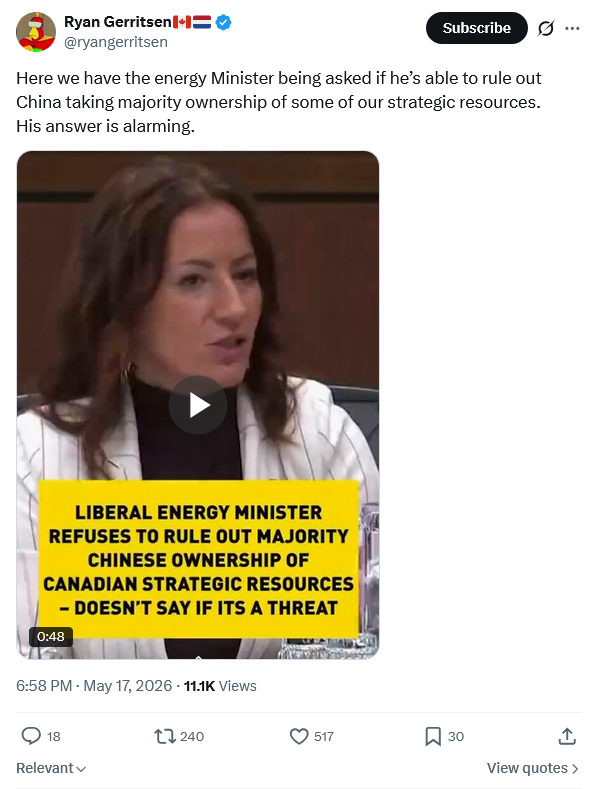
On the social media site formerly known as Twitter, L. Wayne Mathison responds to a post about the Canadian government’s amazing nonchalance about protecting Canada’s sovereignty:
Canadians voted in a federal election, not in a referendum to turn the country into a Davos policy lab with a maple leaf sticker slapped on the front.
The line “we will never be the 51st state” is easy politics. Most Canadians agree. But then the same elbozos turns around and flirts with every other form of sovereignty dilution they can find.
Join the EU? Canada is not in Europe. Geography still matters, apparently. Joining the EU would mean importing another layer of bureaucracy, regulation, courts, trade rules, and political obligations from people Canadians cannot remove from office. That is not independence. That is outsourcing control with better stationery.
Give China influence over resources? That is even worse. A serious country protects strategic assets: energy, minerals, food, ports, telecom, data, and critical infrastructure. You do not hand leverage over your future to an authoritarian state and then call yourself sophisticated. That is not diplomacy. That is national self-harm wearing a lanyard.
The real issue is this:
Canada’s elites love sovereignty when it means rejecting America.
They seem much less interested in sovereignty when it means resisting Brussels, Beijing, the UN, global finance, or climate bureaucrats.
So the question is fair:
Who voted for Canada to stop acting like a country?
Not Canadians. Not directly.
This is elite mission creep. They run on patriotism, then govern like national borders are an administrative inconvenience.
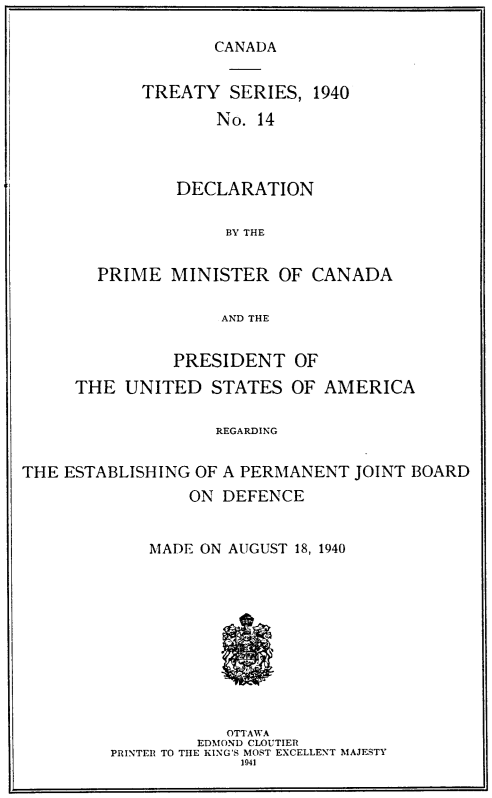
Other items that popped up in the news over the weekend included the United States Department of War announcing that they will be “pausing” their participation in the Permanent Joint Board on Defence, a US-Canadian body that has been continuously operating since 1940 when US President Franklin Delano Roosevelt and Canadian Prime Minister William Lyon Mackenzie King established it in a meeting in Ogdensburg, New York. Is this a big deal? Some people certainly think so:
In a bit of a sudden, surprise move, Under Secretary of War Elbridge “The Biggest Cheese” Colby has announced on X of all places that the Unites States would be pausing participation in the Permanent Joint Board on Defence, the Oldest and most Foundational node of the Canada-US security partnership.
[…]
As we all know, on August 17, 1940, U.S. President Franklin D. Roosevelt and Canadian Prime Minister William Lyon Mackenzie King met in a railway car in Ogdensburg, New York. They issued the Ogdensburg Declaration, an agreement to create a joint board to study sea, land, and air defense problems.
For over 80 years the PJBD has serves as one of the major intersects of the Canada-US relationship. It has been the forum where we have been able to engage and work collaboratively on matters of National Security, Continental Defence, and Critical Infrastructure.
Obviously, given how late it is for me, I sadly can’t dive head first into things. However, I did wanna get something out there. It’s no doubt a very petty move to make, part of a long line of petty moves between everyone in the last year. The pressure is obviously there to push Canada along, and the inclusion of the Prime Ministers Davos speech by Colby should go as a sign to one of the areas that is troubling the current administration.
Trying to apply pressure through such acts though isn’t something that I think will be successful. Granted, being a bit of a dick and doing petty shit in hopes of manipulating opinions, only for it to backfire due to a general miscalculation, is something this Administration does on the regular, and so I can’t be surprised to see it done here.
Nor is it surprising for the performative PM and his government to be utterly blindsided when one of their petty performances triggers a strong negative reaction from the United States.
Another issue that the Liberals in Ottawa seem to think both uncontroversial and straightforward is one of their batch of anti-civil-liberties bills before Parliament, in this case Bill C-22, which the US Congress considers to be a dangerous attempt to control US companies who do business in Canada:
The government’s plans for lawful access have gone off the rails. In recent days, Signal has warned it would pull out of the Canadian market rather than comply with Bill C-22. Windscribe, the Toronto-headquartered VPN provider, has said it would relocate its headquarters out of Canada and NordVPN has warned it would consider following suit. Apple and Meta have both raised public concerns about the bill’s effect on encryption and cybersecurity. The Canadian Chamber of Commerce, the Cybersecurity Advisors Network, civil liberties groups, and a long line of legal and security experts have all called for changes. The chairs of the U.S. House Judiciary and Foreign Affairs Committees have written to Public Safety Minister Gary Anandasangaree warning that the bill threatens U.S. national security and the integrity of cross-border data flows. Even the bill’s own oversight body, the National Security and Intelligence Review Agency, has told the SECU committee it does not have the access it needs for effective oversight. If the government thought it could push through the bill largely unnoticed, it has been proven painfully wrong as there are now trade frictions with the U.S., the prospect of leading companies exiting the Canadian market, and weaker cybersecurity protections for ordinary users.
[…]
The bill nominally protects against the worst outcome through a systemic vulnerability safeguard, which says that core providers are not required to comply with a regulation if compliance would require the introduction or maintenance of a systemic vulnerability. But the safeguard falls apart on careful reading. First, the term “systemic vulnerability” lacks specificity in the statute, which means the government could define encryption and vulnerability narrowly enough to hollow out the protection. Second, Sections 5(5) and 7(5) state that providers are not required to comply where doing so would result in a systemic vulnerability, but Sections 12 and 13 unconditionally require compliance with orders and provide that orders prevail over inconsistent regulations. The net effect is that providers are stuck with contradictory provisions in a system shrouded in secrecy and which could lead to the weakening of security systems. That is why Signal, Windscribe, NordVPN, Apple, Meta, the Canadian Chamber of Commerce, the Cybersecurity Advisors Network, and the U.S. Congress are raising the alarm.
The best approach to address these risks is to go back to the drawing board on Part 2 of the bill. Committee hearings should be extended to ensure that the long list of expert witnesses, industry voices, and international counterparts who have asked for changes receive a full hearing. Further, real amendments should be on the table that better balance law enforcement needs with Canadians’ privacy rights. Failure to do so will result in some of the world’s most privacy-protective services exiting the market, leaving behind a law that is vulnerable to constitutional challenge with millions of Canadians facing genuine privacy and cybersecurity risks.
May 17, 2026
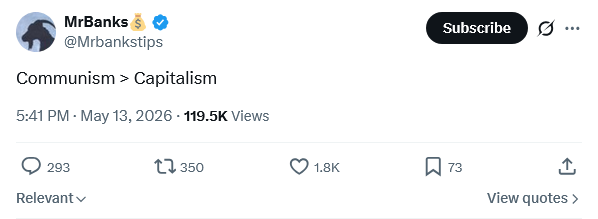
“Communism > Capitalism”
Once again, thanks to the auto-translation feature on the social media site formerly known as Twitter, Brivael Le Pogam responds to a fan of the most evil economic system yet devised by man:
“Communism > Capitalism”
Brother. You’re tweeting this from an iPhone. Designed in California. Made in a Chinese factory that only exists because Deng Xiaoping realized in 1978 that Maoism mostly produced corpses and decided to do capitalism in disguise.
The greatest reduction in poverty in human history (China 1980-2020) happened at the exact moment when China stopped doing communism. The greatest famine in human history (China 1958-62, 45M dead) happened at the exact moment when they started.
Same country. Same people. Same territory. Two systems. One built smartphones, the other built mass graves. Pick your side.
Communism’s trophy board:
USSR: collapsed
China: pivoted to capitalism, prospered
Vietnam: pivoted to capitalism, prospered
Cuba: still rationing soap in 2026
North Korea: eating tree bark
Venezuela: sitting on the world’s largest oil reserves, imports gasoline
Cambodia: killed 25% of its own populationCommunism isn’t an ideology. It’s a hiring program for people incapable of finding a real job, dressed up as economic theory. When you can’t build, you redistribute. When redistribution fails, you hunt for saboteurs. When you run out of saboteurs, you become someone else’s saboteur.
100 million dead. Zero examples that work. The most expensive LARP in human history.
But please, keep tweeting “Communism > Capitalism” from your capitalist phone, on your capitalist app, funded by capitalist ads. We need the comedy.
May 16, 2026
Canada’s imaginary “immigration consensus”
An informative post from earlier this year, showing how the much-talked-about “immigration consensus” was never any more than an expression of Laurentian Elite luxury belief:
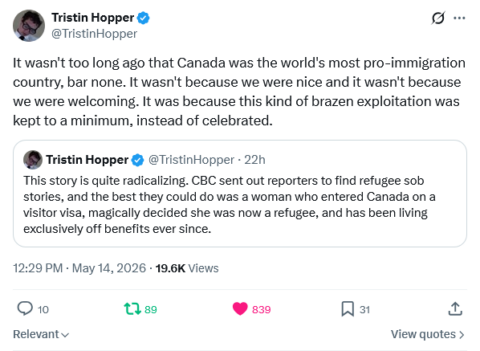
Ever since immigration became a hot issue, it has become fashionable to say that “Trudeau broke Canada’s immigration consensus”. But this “consensus” was based on a false narrative that is easily disproved with data.
UNHEARD VOICES
Until about 10 years ago, I had also believed that there was an “immigration consensus” in Canada. But once my life in Canada had settled down enough for me to have the mental space to dabble in public debates online, I came across an opposing view. An Indian immigrant who was then working as editor for an English language community newspaper in the GTA wrote often about opinion polls showing a fairly high level of opposition to high immigration. His name is Pradip Rodrigues. I corresponded with him via email, and later we became friends.
What struck me at the time was that the lone voice talking about these polls was himself an immigrant. Some years later, I came across an article in [the] Vancouver Sun by journalist Douglas Todd, saying that Indo-Canadians in the Vancouver region were unhappy with the large influx of international students [from] India. Given how much value the Progressives (which category most of the MSM is a part of) put on “lived experience”, the reporting by Pradip and Mr. Todd should have attracted urgent attention.
But because the mess being created by excessive immigration hadn’t reached crisis levels by then, these voices went unheard. At best, they were preaching to the choir, and at worst, they were accused of racism (or, in the case of Pradip, “internalized racism”). Smart people see beforehand the problems that are coming and take steps to avert them. People of average intelligence attend to problems after they have occurred. Fools keep denying that problems have occurred, and it always takes a full-blown crisis to get them to accept that they have a problem on their hands – at which point they segue effortlessly to blaming others for the problems. We see this in many policy areas in Canada, and immigration is one of the most salient examples of this shortcoming in Canadian society.
RAISON D’ETRE
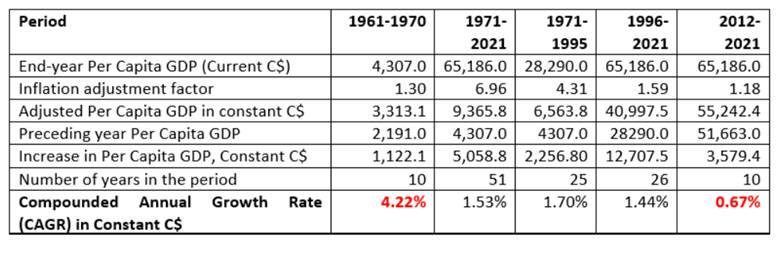
No politician will ever tire of saying that “Canada needs immigration to boost our economy”. An ancillary statement is that “immigrants pay taxes that support Canada’s social programs”. But as I showed in my article “Immigration Does NOT Increase Prosperity“, the inflation-adjusted compounded average growth rate (CAGR) in per capita GDP fell by a precipitous 84% between 1970 and 2021, ending up at an anemic 0.67% in the decade ending in 2021:
Clearly, the capacity of Canadians – long-time residents and newcomers alike – to “boost Canada’s economy” and “pay (more) taxes that support the social programs” has been eroded almost to zero. It is worth pondering how, in spite of clear signs evidenced by data, the exact opposite narrative could prevail over such a long period, and how so many people subscribed to it. This is as if Abraham Lincoln’s sage statement that “You can fool some people all the time, or all the people for some time, but not all the people all the time” was held in abeyance in Canada from 1970 onwards – or is that the case?
Not all of the people, but enough of the boomer generation who were raised with the constant drumbeat of propaganda from the Liberals — Canada’s “Natural Governing Party”, as they liked to refer to themselves — and now that most of them are comfortably retired, they seen no reason to rock the boat, even when their own children and grandchildren tell them how bad Canada has become since their prime.
May 12, 2026
What happened to the people who took Joe Biden’s advice and learned to code?
It was only a few years ago that snooty media personalities were constantly echoing President Joe Biden’s advice to unemployed workers: “Learn to code”. Then, of course, the media hit hard times and the advice was then being snarkily offered to newly unemployed media folks. But what about the (few) who actually did “learn to code”, only to be swept away again as the clankers surged in to eliminate a lot of basic coding jobs?

How to Understand What AI Just Did to People Who Took Joe Biden’s Advice and Learned to Code.
A simple, concrete example.
Oddly enough, I have a bachelor’s degree in Computer Science. This means I know 7 algorithms for sorting a list into alphabetical order. I understand the tradeoffs between their execution time, code complexity, and memory demand. I learned the specialized lingo for describing execution time.
The algorithms are surprisingly complex and subtle. I spent months learning to code them.
Now that hard-won knowledge has been replaced by, “Claude, write a module to sort this list. Optimize for execution time.”
Millions of good people just lost their professions and must now invest in a new one.
Right now, knowing how to sort a list probably gives me a small advantage when I code with AI. But I will soon lose even that tiny return on my investment, as AI improves.
Certainly AI will create some new opportunities, probably a lot of them.
But count your blessings, if you did not spend years learning to code like I did.
And:
Here is the counterpoint: Learning to code gave coders an advantage when relearning to code with AI.
That advantage is their ticket to a seat in the new AI world.
The big question now is how many seats exist.
To which ESR responded:
Your position is reasonable, but wrong.
Having learned to code is still valuable in the new world of AI, not because you’re wrong about coding itself having become disposable, but because of the capabilities and mindset you developed while learning to code, some of which are difficult to learn in any other way.
You didn’t become a professional programmer. But I’m willing to bet that your intuition about how to design software is far better because you wrestled with code. And that is *not* a skill that LLMs are replacing — ignore the noisy hype about this.
I’m also willing to bet that some of what you learned as a programmer in training translated into problem-decomposition skills that have served you well as an economist.
If one is not a complete dullard (and you are certainly not a complete dullard) learning to code teaches not just craft skills but a mindset — a set of heuristics for carving reality at its joints. There are other ways to get this — I think for example of Richard Feynman who got there by thinking very hard about physics. And it is not guaranteed that every programmer will develop this right mindset.
But many of us do. And most of the other ways to develop it seem also to produce it only as a side effect, but less reliably than learning to code does.
So don’t write off learning to code. Maybe someday we’ll develop educational methods that can teach those higher-level skills more directly. That would be an excellent thing, if it’s possible. But until it gets here, learning to code will still have value that is not easy to duplicate in any other way.
May 9, 2026
Argentina not in the news
On the social media site formerly known as Twitter, Martin Varsavsky illustrates the real situation in Argentina after Javier Milei was elected as opposed to the dystopian nightmare imagined by the western media:

“Argentine flag” by papajuan74 is licensed under CC BY 2.0 
 .
.
After more than two years of Milei, the international press still does not understand what is happening in Argentina.
The narrative abroad is “shock therapy, social pain, fragile coalition”. That frame misses the actual mechanism. Argentina did not have a budget problem. It had a printing problem. From 2003 to 2023 the central bank financed deficit after deficit until the peso lost 99 percent of its value against the dollar. Annual inflation hit 211 percent in 2023. Half the country was poor. That was the floor.
What changed is not vibes. It is arithmetic. The fiscal deficit was eliminated for the first time in 16 years. Monthly inflation fell from 25 percent to low single digits. The central bank stopped printing to fund the Treasury. Country risk dropped from over 2,500 basis points to a fraction of that. Argentine sovereign debt, which used to trade like a default option, began behaving like normal emerging market paper.
Critics say poverty rose. It did, briefly, because removing price controls and subsidies revealed the real prices of energy, transport and food that the state had been hiding with debt. Once measured honestly, poverty has been falling fast. Real wages are recovering. Mortgages in pesos are reappearing, something that had not been possible in a generation.
This matters beyond Argentina. It is the clearest live experiment in whether a developed-style economy can be rebuilt by pulling the state out of places it never belonged. Spain, Italy and France should be paying attention. A country does not get poor because it lacks resources. It gets poor because its political class learned to live off printing money and calling it social policy.
Argentina spent 80 years proving that. It is now spending two years proving the opposite.
May 7, 2026
Pay no attention to the Laurentian Elite behind the curtain!
Canada before Confederation was largely run by the Family Compact, an informal oligarchy of wealthy and influential families who had a virtual monopoly on social advancement, political appointments, and the justice system. As kids we were all told in school that this all withered away and now we live in a wonderfully meritocratic society (that’s also a genocidal racist, sexist, homophobic, transphobic dystopia, but those are later lessons after the land acknowledgements). They didn’t fade away, of course, and the behind-the-scenes power brokers are still there, still wielding informal but widespread control over the government and the economy. We just call them the Laurentian Elite, so that’s totally different than the bad old Family Compact, eh?
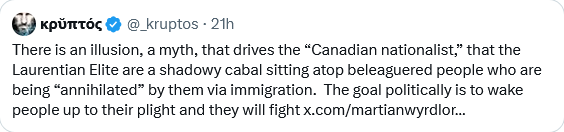
The Laurentians very effectively keep themselves out of the public eye. Most Canadians don’t even know this class exists. So, they are in that sense a shadowy cabal.
Of course Canadians want prosperity and whatever. Everyone does. Of course they think this is the purpose of the government. Of course the government’s messaging is largely around economics.
The government’s actual activities, however, are immensely economically destructive. This is because of their religious fanaticism. Canadians believe in “peace, order, and good government”. The Laurentians believe in multiculturalism, mass immigration, gender woo, and climate change. They just lie about these things being good for the economy. It’s now obvious that they are very bad for the economy, and yet, they continue, so.
The gimmigration restrictions are a joke. The government is continuing to hand out PRs and passports like Halloween candy, and turd worlders are continuing to grab them like the black kids who think the whole basket is all just for them. It is allowing TFWs to flood the asylum system, which it uses as a back door to keep them in the country. The numbers they publish are a bullshit accounting game, but even if they’re to be believed, letting in hundreds of thousands of new PRs every year isn’t a reduction from anything but the truly insane spike in 2022-24.
The housing market is fucked, yes, but I’m skeptical this is because immigration has been “reduced”. It’s more likely that a decade of zero economic growth, rapid inflation, even more rapid asset inflation, shit jobs, and high taxes means that no one can afford the overpriced housing, so no one buys it. The shoebox condos they threw up all over Toronto are a contributing factor: no one wants to spend $500,000 on a 500 square foot condo, so no one does. Investors can’t afford to sell for less, so they sit on them. Developers look at tens of thousands of units of unsold inventory, and refuse to start new projects. Whole system is seized up because of many years of malinvestment, not because the government has meaningfully reduced the invasion.
You say that Canadians will go back to Laurentian rule once the excesses are curbed. That presumes Laurentian rule slackened for even a moment, and that the Laurentians have any intention of curbing their excesses. Neither of these are true. They are doubling down on everything. Destroying Canada — as one element in the destruction of Western civilization — is a religious imperative for them. Nor was their power ever threatened, because it is propped up by brainwashed parasitic client groups — boomers, women, immigrants — that now comprise the bulk of the country.
The “pivot” was about two weeks of campaign rhetoric, during which a fast-talking globalist banker gave the boomers a reach-around about “British and French heritage”, which dazzled the affection-starved senile coots because it was the first time they’d heard something nice about themselves in a generation. Since then there’s been no rollback in DEI. No rollback in gender woo. No rollback in net zero. No rollback in Internet censorship. To the contrary, it has been full steam ahead on every single one of their hateful programs.
No revolution? You’re probably right, although the Freedom Convoy suggests that there are possibilities. Nevertheless the most likely scenario is that Canada devolves into Argentina Del Norte, its bones picked by vultures posing as patriots, kept in power by the most mind-raped boomers on planet Earth.
I do not think this is a good thing, obviously. I love my country very much. I suppose the reason for my vehemence on this matter is that I do not see any future for Canada with the Laurentians remaining in charge. We cannot work with them. They aren’t going to change. They aren’t going to slow down. They need to be removed, prosecuted for high treason, their assets seized, their oligopolies nationalized, and many of them sent to the gallows. Absent this, Canada is doomed.
“Nobody invented capitalism”
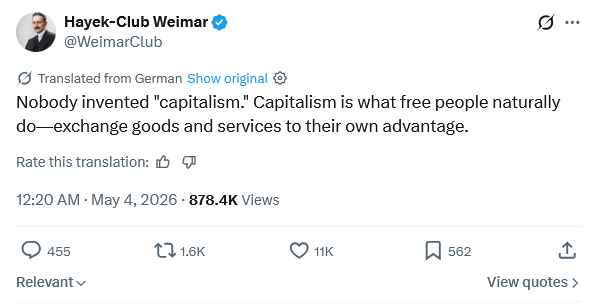
On the social media site formerly known as Twitter, Anish Moonka responds to an auto-translated-from-German post by Hayek-Club Weimar:
There’s a clay tablet with the founding charter of a 12-partner company on it. Twelve merchants pooled 33 pounds of gold to start the firm. The contract has the partner names, the starting capital, the profit split, and the penalty for cashing out early.
The tablet is nearly 4,000 years old. It was found at a site called Kanesh, in central Turkey. Archaeologists have dug up 23,500 of these clay records there, most of them business documents: receipts, loan contracts, shipping orders, lawsuits. The houses they were stored in eventually burned. The fire baked the clay solid and preserved every record.
The merchants came from Assur, in modern-day Iraq. They loaded donkeys with tin and cloth and walked them 1,000 kilometers across mountain passes to Kanesh, roughly the distance from New York to Atlanta. Each donkey carried about 180 pounds and the trip took two to three months. They came home with silver and gold.
The company ran for twelve years under a merchant named Amur Ishtar. A third of the profits went back to the investors. Pull your share out early and the firm gave you four kilos of silver per kilo of gold, half the normal rate. Locked-up money was meant to stay locked up.
That one company was just a tiny piece. The tablets show a complete economy with partners suing each other in commercial court, husbands writing home about prices, and wives writing back complaining the husband had been gone too long. A woman named Ahatum quietly lent silver to four different men over nine years. People bought up other people’s loan documents and used them as collateral for new loans, the same thing Wall Street does today with mortgage-backed securities. One merchant got caught smuggling tin in his underwear to dodge a 10% import tax.
In 2019, four economists from Harvard, Sciences Po, Chicago, and Virginia ran the tablet numbers through a gravity model, the math economists use today to predict how much two countries will trade based on size and distance. The Bronze Age numbers matched modern trade numbers almost exactly. Trade fell off with distance at nearly the same rate it does between countries today. The paper ran in the Quarterly Journal of Economics.
There was no economic theory yet. The idea didn’t even have a name. The word “capitalism” wouldn’t be coined for another 3,800 years, and Adam Smith was 3,700 years away from writing a sentence about markets. Just a guy named Pushu-ken writing a clay tablet to his business partner about a shipment of cloth, and a woman in Assur recording who owed her how much silver. Capitalism was already there, doing its full job, almost four thousand years before anyone wrote down a theory of how it worked.
May 3, 2026
How to Declare a Live Person Legally Dead – Death of Democracy 14 – Q2 1936
World War Two and Spartacus Olsson
Published 2 May 2026In Q2 1936, Adolf Hitler consolidated power after the Rhineland gamble, tightening the machinery of dictatorship while projecting strength abroad. As Hermann Göring took control of Germany’s economic lifelines and Heinrich Himmler centralized the police, the regime accelerated its transformation into a fully integrated police state.
Behind Olympic pageantry and propaganda triumphs like Max Schmeling’s victory, the Nazi system deepened repression. Courts enforced the Nuremberg Laws with chilling logic, reducing Jewish citizens to a state of “civil death”, while Joseph Goebbels expanded total control over media and public discourse.
At the same time, Germany’s economy bent further toward war, with dwindling foreign reserves and rising dependence on autarky. Yet domestically, resistance remained minimal as propaganda, fear, and perceived stability drove growing public support.
Globally, the quarter exposed the weakness of the League of Nations during Italy’s conquest of Abyssinia, saw Léon Blum’s rise in France, and witnessed the outbreak of the Arab Revolt in Palestine — signs of a world drifting toward instability.
This episode examines how dictatorship consolidates not just through terror, but through law, economics, and consent — and why, by mid-1936, meaningful resistance inside Germany had largely vanished.
May 1, 2026
QotD: Socialism
Ivor Thomas, The Socialist Tragedy, 1951.


