
Canada does not bother with palaces; the closest thing we have is Rideau Hall, whose history, appearance, and location all serve to confirm the point. In Canada we pay relatively little heed to social class — a legacy of having been a colony, with its ultimate rulers (and, until 1949, its literal court of last resort) conveniently offshore. We have left formal titles mostly in the dust while Americans resurrect them frantically: the newspapers bow and scrape to “Sen. Clinton” and “Gov. Palin” long after their brief periods in office.
We manage not to admire displays of wealth in the whimpering, craving way that Americans do; our old money avoids ostentation, and our bankers are practically Spartan. (We have a few literal lords, but I suspect even my colleague Conrad Black would resist being addressed as anything but “Mr. Black” by a fellow Canadian in Canada.) We accept higher taxes in exchange for state provision of medical care, but when it comes to welfare we honour the Protestant work ethic more earnestly than the republic to the south does, with its food stamps and its endless disability rolls.
This all emerges partly from having an expatriate monarchy that we can drag onto the scene as needed, and can worship and scrutinize from afar. We get the best of both worlds. If we adopted a real republic, the long-term path to union with the U.S. would be that much shorter; how long could a squeal of “But we’re so much nicer than they are,” a bare assertion of mystical innate superiority, provide a moral basis for independence?
The Romans and the Tudors would perceive the Canadian genius quickly: they would discern more clearly than ourselves that we have pioneered a truly novel political system — an ultra-practical, constitutionally successful version of the old Jewish temple, with its invisible god secreted in a hidden sanctum. Our domestic political leaders can never be glory-hunting priest-emperor types, as long as there is someone above them, far away, who is called “Majesty” and possesses the regalia of state. This is why, when someone refers to the prime minister’s wife as “first lady,” they are really threatening the basis of our political existence, and should be chastised — even if, I hasten to add, they are writers or editors for other Postmedia newspapers.
Colby Cosh, “Why Canadians are better republicans”, National Post, 2016-05-30.
February 9, 2018
QotD: Canadian versus American forms of government
February 8, 2018
Canada wants to sell Leopard 1 Tanks!
Matsimus
Published on 5 Feb 2018Captain Scott Franklin, with the office of the Director Land Requirements, pointed out in a Jan. 23 article on the Army’s website that with the delivery of the new Leopard 2 Tank Mobility Implements in the fall of 2017, the last of the Army’s Leopard 1 tanks have been parked for good.
So what happens with those tanks?
Department of National Defence spokesman Daniel Le Bouthillier explained to what might happen with the surplus Leopard 1s:
“The Department of National Defence has a formal process for disposing of surplus Canadian Armed Forces equipment. Once DND and the CAF has declared equipment surplus, a disposal plan is written that describes the preparatory steps that are to be performed, and describes the strategies for its removal from the DND system of record. The disposal plan assesses options, including retention, for alternate use within DND and the CAF (e.g. for training or display purposes), transfer to another Federal Government organization, sale, donation, or conversion to waste.
In the case of the Leopard 1 family of vehicles, there are 52 remaining Leopard 1C2 Main Battle Tanks, and 5 Leopard 1 Armoured Engineering Vehicles remaining. They will remain in place until a disposal mechanism is selected. They are currently distributed in Edmonton, Alberta; Montreal, Quebec; and Gagetown, New Brunswick. The first option would be to sell the tanks. Any revenue generating option for the government is encouraged. The tanks were listed for sale since 31 Aug 2015. While there is some interest currently, there are no firm buyers. The sale is open to approved foreign nations or approved Canadian industry. The second option is to use the tanks for alternative use (hard targets, monuments/artefacts). If tanks cannot be sold, alternative applications will be sought that may bring value to the government.
The last option would be to destroy the tanks. NO!
February 4, 2018
BC versus Alberta – the existential threat of “dilbit”
Colby Cosh on the warlike preparations taking place in Alberta in advance of the interprovincial war over “dilbit”:
The special concern with dilbit [diluted bitumen — the form in which hydrocarbons from the Alberta oilsands are shipped to refineries as a liquid] is a pseudoscientific contrivance designed to allow Horgan to meet, or at least take a step toward, his loud campaign promises to thwart Trans Mountain. Now, even if you don’t believe that, you can understand that Horgan is threatening to conjure an all-new improvised layer of environmental regulation here. Even if you are convinced that it was spilled dilbit that killed Tasha Yar in “Skin of Evil,” you can see the unfairness of Horgan imagineering an infinite regress of scientific panels — each one surely more scientific than the last! — to injure a neighbour’s economy for his own electoral welfare.
The truth, however, is that B.C.’s New Democratic premier knows the hand-wringing about dilbit is B.S. And so does Alberta’s New Democratic premier. And so does just about everybody in Alberta. Yes, we Albertans have been busy this week preparing for border war: there is so much to do, what with the need to make propaganda posters, train commandos for mountain-pass warfare, dig victory gardens, and re-label all the Nanaimo bars “Liberty squares.”
Sadly, it probably won’t come down to a shooting war, but will remain in the crystal blue elysium of political manoeuvring. If it did come to a fight, Alberta would have a pretty big fifth column operating on its behalf across the legal border. I have a running joke with friends that I have occasionally referred to in print: it’s the idea that there exists a “Greater Alberta” that includes sizable parts of Saskatchewan and, in particular, B.C.
The so-called Peace River block that spans the border is one economic unit, and people at its western end, jealous of having ended up on the wrong side of a discontinuity in taxation, have actually agitated in the past for secession from British Columbia. And, as many have pointed out in the feverish climate of interprovincial hostility, the jagged southeast corner of B.C. has significant transmontane cultural and economic ties, too. It looks, on a flat map, like it ought to “belong” to Alberta. (In real-world topography, on the other hand, the Continental Divide is definitely a thing that it is hard not to notice.)
In short, almost everybody is now making my “Greater Alberta” semi-sorta-kinda-joke. But this is not really a Greater Alberta thing. At almost every point of the compass, that B.C. map is full of resource employees who are watching with distaste as their NDP government acts like an NDP government. This is surely a real moral advantage for Alberta in the grand struggle — but, remember, there are genuine practical gains for Horgan from his theatrical eco-rectitude: right now the motivating passion of his life, from dawn to dusk, is to persuade Green voters to turn orange.
February 1, 2018
MV Asterix accepted by the Royal Canadian Navy
With the Queenston-class AOR ships still pinned to the drawing board, the Royal Canadian Navy has been reduced to borrowing support ships from allies and friendly nations to allow our combat ships to operate further from shore than a local fishing boat, the delivery and acceptance of the MV Asterix has to count as good news:
MV Asterix
Photo via Canadian Defence ReviewDavie Shipbuilding and Federal Fleet Services announced that following an intensive period of at-sea trials and testing, Asterix has been formally accepted by the Department of National Defence and has now entered full operational service with the Royal Canadian Navy (RCN) and Royal Canadian Air Force (RCAF).
As planned, Asterix performed daily replenishment-at-sea (RAS) exercises with the RCN and conducted extensive RCAF CH-148 Cyclone helicopter operations to prove and demonstrate the world-leading capabilities of the Resolve-Class Naval Support Ship. These exercises have included everything from dual RAS operations to helicopter landing, take-off and vertical replenishment trials.
Spencer Fraser, CEO of Federal Fleet Services commented “To deliver the first Canadian naval ship in over twenty years, the first supply ship in almost 50 years, and to reach FOC so efficiently and in such a short period of time is a testament to the hard work, dedication and dynamism of the teams at Davie and FFS. We are all very proud of our achievement and appreciative of the professional support we have received from DND and PSPC.”
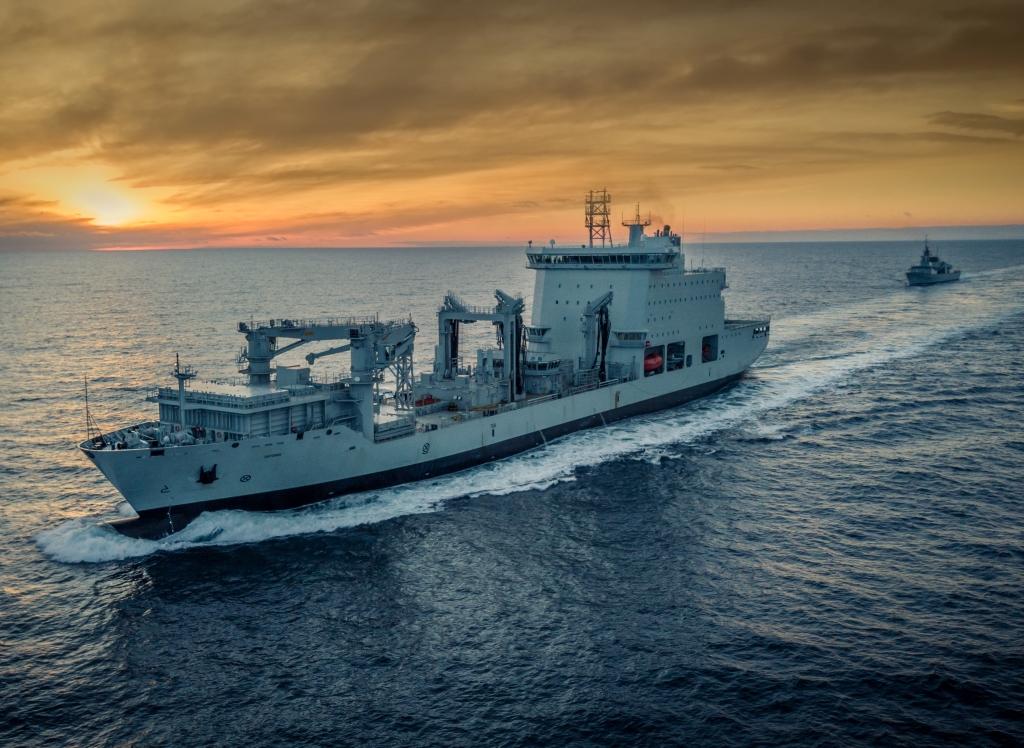
Asterix has been leased by the government, and will be operated by a blend of merchant seamen and RCN/RCAF personnel as required for any given mission. She’ll remain an MV, not an HMCS and is not expected to be operated in “hot” environments where combat could occur. She will remain with the fleet at least until the planned-but-not-yet-started Queenston class ships are ready for service. Davie has offered to refit another ship for the RCN to lease (so we’d have one AOR for the East coast and one for the West), but so far the Trudeau government has resisted the offer.
January 29, 2018
“… those I know in the alt-right crowd dislike [Jordan Peterson] more than the honest progressives I know”
Zachary Slayback tries to discover why so many intellectuals dislike Canadian psychologist Jordan B. Peterson:
I’ve spent the last few years thinking about how to upend higher education and have worked with some leading entrepreneurs and thinkers in this space. Continually, we come back to the question of liberal arts education and its value (remember, I studied philosophy!). Some people are too quick to dismiss liberal arts education as useless and not worth the time. Instead, they insist on purely vocational education. Yet many of the most successful and happiest individuals I know are widely read (rarely because of their college courses), can discuss ideas from Aristotle to Jung to Jacobs with you, and love the idea of entertaining big ideas.
I visited Peterson’s lectures and found them to be nuanced, intricate, and to jump well between clinical experience, psychological research (most of which was well-validated, hard to do in psychology), and Jungian myth interpretation. When he released his Bible lecture series, I found myself, for the first time since I was a child, intimately listening about the ideas that go into religion and how these ideas surface elsewhere in the culture. More than a decade of skepticism towards religious texts due to their shallow readings and uses for the Joel Osteens of the world melted away.
His lectures rarely touch on politics in any capacity. When it gets brought up, he’s quick to note that he does not oppose calling trans individuals by their pronouns but that he opposes having his language dictated by a central political committee. This seems commonsensical to me. Part of what made the American and Canadian traditions so egalitarian is their rejection of forced speech and titles.
And for those who listen to Peterson, he bridges any kind of ideological gap (in fact, those I know in the alt-right crowd dislike him more than the honest progressives I know). Peterson’s worldview is a classical liberal rejection of collectivism (an ideology that killed more than 50 million people in the 20th century alone) while simultaneously not falling into an atomized view of the individual relative to his culture.
Just last week, I met with an acquaintance in San Francisco, the Mecca of American political correctness, who described herself as a “liberal democrat type,” who had listened to and met Peterson at a company event. She admitted that she couldn’t read into his politics and found his talk compelling about the nature of the world, men in it today, and why people like Peterson must appeal to so many people outside the San Francisco and Washington DC bubbles. She was explicit in saying that she was neither a libertarian nor a conservative and still Peterson motivated her to introspect, read into Jungian archetypes, and better understand the culture that shapes the world.
She’s not alone. I regularly speak to friends and acquaintances from across the political spectrum who find value in Peterson’s talks. These are people years out of college (or who never went) who now pick up classics like Dostoyevsky, Jung, Neumann, and even the Bible with a critical intellectual lens. Peterson regularly talks about and shares letters from fans who admit that his moralistic talks inspired them to pull themselves together and “sort themselves out” by figuring out what they want from life and pursuing that. r/JordanPeterson (yes, he has his own subreddit) is filled to the brim with stories of people saying how Peterson helped them get control of their lives and navigate the world.
I’ve bought but not yet read Peterson’s recent book, 12 Rules for Life. It’s not the sort of thing I usually read, so I’m not quite sure what to expect (Indigo says it’ll be delivered tomorrow).
January 28, 2018
“[A] right to due process in politics? That has never been a thing”
Chris Selley on the weird, fast end of Patrick Brown’s career as leader of the Ontario Progressive Conservatives:
Many women often said they got a creepy vibe off Patrick Brown. His haircut was kind of odd. In question period, he was too shrill.
The Red Bull fridge in his office put me off. I associate Red Bull fridges and their foul contents with terrible nightclubs full of muscle T-wearing jackasses on the make. In 2012, Brown tweeted a photo of himself with two friends dressed up for Halloween at a terrible-looking Barrie nightclub he was known to frequent. He’s dressed up as James Bond. He’s pointing his toy Walther at Goose from Top Gun and Joel from Risky Business. I want to reach back through time and space and slap all three of them.
These would all be bad reasons for a bank to deny Patrick Brown a loan, or for a taxi driver to deny him a ride, or for a company to fire him from a job in the legal department.
But they are precisely the sorts of often silly, unfair, perhaps totally misguided little whims that can turn people off politicians.
It’s widely accepted that Robert Stanfield’s 1974 campaign was materially harmed by his dropping of a football. John Tory’s principled stance in favour of funding religious schools in Ontario besides Catholic ones sent the Tories’ 2007 campaign rolling downhill onto a pier that then collapsed into a lake. People still can’t believe Hillary Clinton’s emails might have cost her the presidency.
In short, there is no justice in politics. Morons win, geniuses lose, people get screwed who don’t deserve it. So it has been very strange to see some commentators and correspondents portray Brown as having been horribly hard done by in the aftermath of two women’s allegations of sexual assault and coercion at his hands.
[…]
In the (seemingly unlikely) event these allegations result in criminal charges, he will have his day in court and face his accusers just like anyone else. And we do have defamation laws in this country. Brown must surely know who his accusers are.
But a right to due process in politics? That has never been a thing.
As party leader, Brown could turf from caucus any MPP who displeased him — as he turfed Jack MacLaren after a spree of idiocies. Every four years, his and all his fellow MPPs’ job prospects rest in the hands of the voters. That’s assuming they pass a party review that considers criteria as vague as “any ethical questions or concerns,” and assuming the leader is willing to sign their nomination papers. (It seems unlikely that whoever leads the Tories into the June 7 election will sign Brown’s.)
I was never a fan of Brown, but I’m not a conservative, so it only bothered me in the sense that I thought he was unlikely to be the one to turf the Liberals out of office at Queen’s Park. I’ve paid so little attention to the man that this will only be the second time his name has appeared on the blog since he was elected leader (another Patrick Brown shows up in searches, but he was an NFL hopeful with the Vikings back in 2010).
January 23, 2018
The unintended consequences of Ontario’s steep minimum wage hike
Colby Cosh on the unpredictable outcomes of Ontario’s recent minimum wage increase:
In Thursday’s edition of this paper, Marni Soupcoff wrote an entertaining column about how Ontario’s fairly aggressive minimum wage increase had suddenly raised the costs of labour-intensive goods and services for consumers — the ones, that is, who don’t benefit themselves from a minimum wage increase. Child care, which is a very pure purchase of labour, is the example that is being exasperatedly discussed this week. The headline did not have “duh” in it, but that was the spirit of the thing.
Soupcoff pointed out that this not only could have been foreseen; an explicit warning of it was given in the pages of the Toronto Star, by the paper’s social justice reporter Laurie Monsebraaten. Our Financial Post section could perhaps easily be called the Social Injustice Gazette, but anyone at FP who got such an early jump on an economics story would be rightly pleased with himself.
Soupcoff’s major point was that the broad-sense law of supply and demand is not some plutocratic swindle devised by the Monopoly Man and his fatcat pals; even believers in “social justice” have to take it into account, as they take gravity into account when they are moving an old couch to a charity shop or sending cosmonauts into orbit. This is obviously right as far as it goes, but the words “supply and demand” are not enough, on their own, to predict the precise market response to a change in a price control — which is what the minimum wage is.
That, perhaps, is the true key point amidst all the various ideological struggles currently in progress over minimum wage levels, which are being yoinked upward in Alberta as well as in Ontario. A minimum wage is a price control. The minimum wage is not really so much a labour standard as it is the abolition of labour bargains that feature a nominal wage below the minimum. And price controls are a blunt instrument. Most economists, whatever their political orientation, instinctively resist them.
The incidence of a price control — the precise place upon which the economic burden of it falls — is not, in fact, foreseeable without other information. In the market for hired child care, for example, it could turn out, with time, that the real effect of increasing a minimum wage is that some parents drop out of the labour market and tend to their own children. It’s just not what one would actually predict, because the need for professional child care is something that a family tends to plan for well in advance, with a longer time horizon than any government’s. (Also, we haven’t invented dependable babysitting robots yet.)
Women, in particular, organize lives and careers around whether they expect their own labour force participation to be able to cover care expenses. Indeed, couples adjust family size for these expectations. We can even imagine circumstances in which a province’s extreme, credible commitment to a very high future minimum wage influenced birth rates.
January 20, 2018
January 18, 2018
Live in Toronto? Feel undertaxed? Here’s your easy solution to give the city more of your money
Chris Selley points out that in addition to your opportunity to pay more than your fare share of federal tax (Her Majesty, in right of Canada, is always happy to accept any amount you wish to donate), Toronto taxpayers are able to use a simple form to donate money to the city:

Click to see full-size image.
So here’s a proposal: Torontonians who consider themselves undertaxed should give the city the difference. Every time you get a property tax bill, you get a little blue insert inviting contributions of up to $50,000 to the program of your choice or just into general revenues. Say your house is worth $750,000. Your bill should be around $4,962, or 0.66%. If you think Mississauga’s rate (0.85 per cent) or Brampton’s rate (1.05) per cent is more appropriate, then just cut the city a cheque for the difference ($1,413 or $2,913, respectively), send it back in the envelope provided and watch for your tax receipt. There are a lot of progressive homeowners in this city. It wouldn’t take much before we were talking about real money.
Is this likely to happen? Certainly not. The inserts date from 2010, when council cancelled the vehicle registration tax. A parade of deputants to budget committee said they didn’t want the money back; council gave them an easy way to give it back; almost nobody did, and almost nobody does now. The grand total of voluntary contributions under the property tax envelope program in 2016 was $81,320.77, and one of those donations was for $50,000.
Total contributions to city programs are of course much larger. The Toronto Public Library (which I support, however modestly) issued tax receipts for $3.4 million in donations in 2016, the zoo for $1.1 million. But the city itself only issued $1.35 million in total tax receipts, even as many of us beg it to take more of our money and spend it on council-approved priorities.
It might not be fair to pay more than your neighbour. But when you tell pollsters you want to be taxed more, political strategists don’t believe you. And when Doug Ford can win 33 per cent of the vote after four years of his brother as mayor, it’s tough to say they’re misguided. You can wait for a critical mass of your fellow citizens to come around to your worldview, or you can nudge the process along with your pocketbooks. Your money is as good as anyone else’s.
January 9, 2018
The ongoing financial catastrophe that is the National Shipbuilding Procurement Strategy
Ted Campbell rounds up recent discussions of the Canadian government’s farcical National Shipbuilding Procurement Strategy (NSPS):
There is a somewhat biased but still very useful look at the successes of the National Shipbuilding Procurement Strategy (NSPS) in the Ottawa Citizen by Howie Smith who is the Past President of the Naval Association of Canada. Mr Smith is a retired Canadian naval officer who has provided consultancy services to several firms pursuing opportunities within the projects of the National Shipbuilding Strategy, which is why his article is somewhat biased. Mr Smith is responding to a recent report by Professor Michael Byers of the University of British Columbia, who is also a biased commentator on defence issues, which said that the NSPS “was flawed from the outset” and “According to Byers, the Liberal government should open-up the non-contractually-binding umbrella agreements with Irving and Seaspan, then cancel and restart the Canadian Surface Combatant and the Joint Support Ship procurement programs with fixed-price competitions involving completely ‘off the shelf’ designs.”
It is important, I believe, to understand why Canada needed something like the NSPS in the first place. The notion came in about the middle of the Harper government’s term in office – in around 2010. I think that two problems confronted the government:
- The Canadian shipbuilding industry was, once again, “on the ropes;” Davie, Canada’s largest shipyard was in bankruptcy and the other yards were too reliant on government contracts; and
- Both of the major federal fleets (the Royal Canadian Navy and the Canadian Coast Guard) were approaching “rust out,” again.
The solution to the first problem was to modernize the yards and make them internationally competitive … but that would cost money and private investment money is scarce ~ especially for shipbuilding, plus under the international trade rules to which Canada has agreed direct government subsidies to commercial shipyards are prohibited. The solution to shipyards that are too reliant on government contracts was ~ wait for it ~ another big government contract that would allow them to modernize themselves.
That indirect government subsidy is perfectly legal if the contracts are for navy and coast guard ships because “national security” is a big loophole in international trade law.
Both Professor Byers and Mr Smith have some good points … but neither is 100% correct. The NSPS was and remains a sound idea … the costs, which is the real crux of Professor Byers’ complaint, are not relevant because the defence and coast guard budgets are being (mis)used for industrial development ~ those are not the real costs of warships: they are the real costs of warships PLUS the cost of yard modernization.
The new surface combatant project is, as Mr Smith says, the biggest and costliest peacetime military procurement ever … and the NSPS is working just about a well as any “system” would at bringing it to fruition. At some point in the future a government will have to decide if Canada gets fewer ships than it needs or spends more more money than it wants … or, most likely, both.
That last sentence has always been the most likely outcome: the RCN will get fewer ships than it needs, and those ships will be significantly more expensive per hull than they need to be. The need for modern naval vessels isn’t the top priority … it’s probably not even in the top three priorities as far as the government is concerned (directing money to the “right” recipients, pandering to provincial sensibilities, lots of photo ops, and then maybe the actual needs of the RCN and CCG).
Update: Of course, it’s not like Canada is unique in the problems we have in military procurement … Australia is also struggling in a similar way:
The [Royal Australian] Navy’s program to replace the Collins Class submarines is known as SEA 1000. It involves modification of a French Barracuda Class submarine from nuclear to diesel-electric propulsion, plus other changes specific to Australia.
The 12 new submarines, to be known as Shortfin Barracudas, are intended to begin entering service in the early 2030s with construction extending to 2050. The program is estimated to cost $50 billion and will be the largest and most complex defence acquisition project in Australian history.
[…]
Then there’s the decision to build them in Australia. The Abbott government’s 2016 Defence White Paper only committed to building them in Australia if it could be done without compromising capability, cost or project schedule. That changed because of South Australian politics, and the new submarines could now be more appropriately described as the Xenophon class.
Even if all goes well, the cost of building warships in Australia will be 30 to 40 per cent more than if they were built overseas. However, the plan to build them in Adelaide at the Australian Submarine Corporation, the same group currently building the Air Warfare Destroyer, years late and a billion dollars over budget, adds to a sense of foreboding.
This follows the prize fiasco of the Collins Class submarine project. Their construction by the Australian Submarine Corporation ran years behind schedule, many millions over budget, and finally delivered a platform that the Navy has struggled to even keep operational.
And then there is the question of whether the new submarines will arrive before the Collins Class subs are retired, scheduled for 2026 to 2033. Even if delivery occurs on schedule, the first will not enter service until 2033. At best there will be one new submarine in service and a nine year gap between the retirement of the Collins Class and the introduction into service of the first six of the twelve new submarines.
Given this, the government has apparently committed an additional $15 billion to keep the 30 year old Collins submarines bobbing in the water. It’s like refurbishing a World War 2 German U-Boat for the mid-1990s.
The elements are all there for the submarine replacement program to become the procurement scandal of the century. Our Shortfin Barracudas will probably be the most expensive submarines ever built anywhere in the world.
For a lot less money, we could achieve a far more potent submarine capability. For example, off-the-shelf Japanese Soryu submarines cost only US$540 million. Modified to meet additional Navy requirements, they were quoted as costing A$750 million. If we simply bought twelve of those, the total cost to the taxpayer would be less than A$10 billion.
Equally, the existing nuclear Barracudas only cost $2 billion each, so we could get twelve of those for $24 billion.
For such an important defence capability, the government’s failure to guarantee Australia is protected by submarines is nothing less than gross negligence.
January 5, 2018
Justin Trudeau’s PR team fumbles badly with Boyle photo-op
Late last year, the Boyle family were “rescued” from the Taliban and the Prime Minister not only met with them, but allowed some photos to be taken that quickly made their way out onto social media. Now that Joshua Boyle has been arrested for a long list of offenses, the PM is looking very bad indeed, as Chris Selley points out:

Prime Minister Justin Trudeau and the Boyle family in Ottawa, 18 December.
The supposed geniuses surrounding Prime Minister Justin Trudeau are capable of some very strange decisions. Arranging a meeting with Joshua Boyle and his family after their release from Taliban captivity, and agreeing to the Boyles photographing the smiling encounter — Joshua later tweeted out some snaps — is certainly one of them.
Boyle was arrested Tuesday and charged with a raft of offences including sexual assault and unlawful confinement, concerning events beginning immediately after the family’s return to Canada in early October. Trudeau met the Boyles on Dec. 18. Now photos of Trudeau beaming with the accused are all over the news. If PMO procedures somehow didn’t flag the investigation, that’s a serious concern. If they did and the meeting happened anyway, it’s horrendous political risk management at the very least.
Indeed, these were hardly the first red flags. The PMO argues it would agree to such a meeting with any released hostages — a very stupid policy if it exists, because the Boyles aren’t quite any released hostages. When the Taliban nabbed Joshua and five-months-pregnant Caitlin Coleman in 2012, they were ostensibly “backpacking in Afghanistan.” The phrase dances off the tongue a bit like “scuba diving in Yemen” or “gastronomic tour of Somalia”: not inconceivable, but the Boyles will not have been surprised to learn that some in the U.S. intelligence community were suspicious. They reportedly refused an American military flight home over fears — perfectly reasonable ones, surely — that they might wind up stuck at Bagram Airfield.
But what the heck, let’s think the best of the Boyles. Sunny ways, etc. The best still involves the unpleasant matter of Joshua’s short-lived marriage to none other than Zaynab Khadr — daughter of the late Ahmed Khadr, the Egyptian-Canadian al-Qaida financier for whom Jean Chrétien famously went to bat when he was detained in Pakistan.
[…]
Unseriousness is a serious charge against Trudeau: big hat, staff photographer, few cattle. Another non-official photo released this week shows Trudeau and his Castro-worshiping brother Sacha in matching sweaters depicting the Last Supper attended by emojis, with the words Happy Birthday strung over top. In a rather over-the-top tweet, Conservative MP Candice Bergen accused the PM of “intolerance” and of “mocking Christianity” — and no question, many Canadians might expect the prime minister to eschew such a garment lest it cause offence. (It was in private, of course, but it’s public now.) But many Canadians also might expect the prime minister to eschew such a garment because he’s the leader of a G7 country, a serious person with a serious job that he’s taking seriously.
This touchy-feely cool-dad happy-go-lucky shtick has taken Trudeau a long, long way. I very much doubt it can take him any further. And I think the backlash, when it comes, could be legendary.
January 1, 2018
QotD: Edmonton in winter
Winter [in Edmonton] appeals to the (decidedly narrow) ascetic side of my temperament, but right now this place is pretty Dantean — empty, forlorn, and still, all sound half-absorbed by the snow. On the days when there’s no cloud, the sunlight hits the street with a blinding chemical whiteness that makes you wonder if God is screwing around with Photoshop filters. Most days, the sun is obscured by a gray-pink gauze that leaves you uncertain what planet you’re on. Heroin has never been a popular drug here: we all already know what it’s like to be dead.
Colby Cosh, “White City”, ColbyCosh.com, 2004-10-26.
December 31, 2017
Who Invented Hawaiian Pizza?
Today I Found Out
Published on 4 Dec 2017In this video:
On June 8, 2017, Greek-born, Canadian-bred pizza maker Sam Panopoulos died. His career slinging pies was rather unremarkable save for one notable thing – he was the inventor of the popular, yet infamous pineapple-topped “Hawaiian Pizza,” named as such because of the brand of canned fruit he used. Loved by some and hated by others, the sweet and salty pizza is so controversial that it once triggered an argument between friendly nations. While such arguments rage on both sides of it being a delicacy or an abomination, the fact is that the Hawaiian pizza is actually not Hawaiian – it’s Canadian. Here now is the story of pizza and the man who decided to add pineapples to it.
Want the text version?: http://www.todayifoundout.com/index.p…
December 22, 2017
Okay, Etobicoke drivers, now they’re just messing with your heads
A recently started reconstruction project of the confusing Six Points interchange will involve closing off existing access ramps and (eventually) replacing them with new ones. During construction, however, things are just insane, as this example shows:
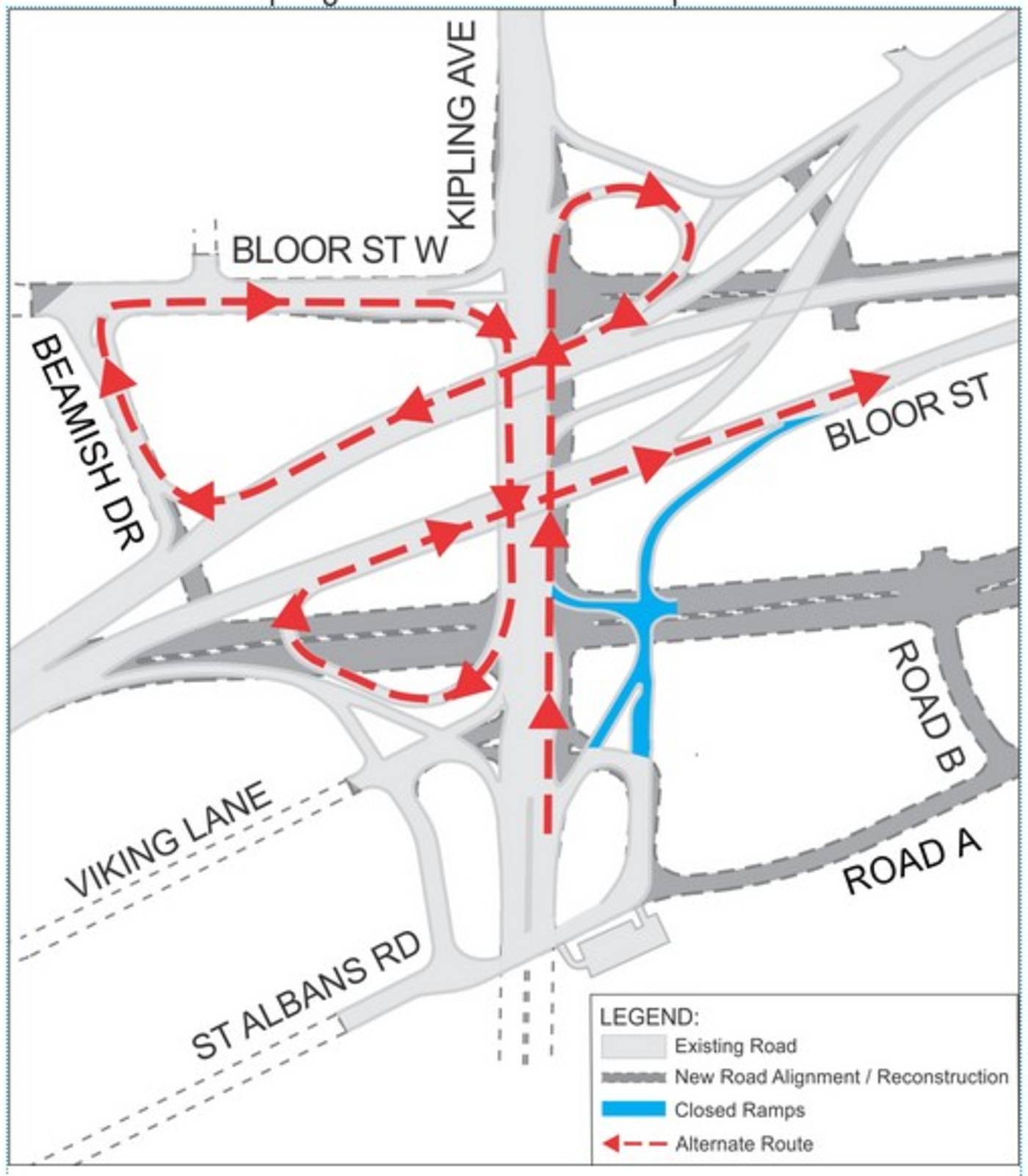
The above map shows what the city calls its “preferred alternate route to access Bloor Street eastbound from Kipling Avenue” due to ramp closures.
Image via BlogTO.
As you can see, it involves three huge loops winding around four corners of the intersection. If the ramp weren’t closed, it would be a simple right turn from Kipling onto Bloor heading East.
“It is often said two wrongs don’t make a right, but three lefts do,” wrote one Redditor in response to the graphic today. “In this case, seven rights make, uh, one right.”
“I don’t care what you say,” wrote another, “that ‘Alternate Route’ looks like so much fun, I might go there just to do it!”
Don’t forget your seatbelt.
December 21, 2017
Manufacturing model trains in China
Jason Shron (who glories in living the “hoser” stereotype) runs a small Canadian company that manufactures 1:87 scale model trains, doing the majority of the actual manufacturing in China. Even there, rising standards of living mean that small companies like Rapido Trains need to be on the lookout for ways to economize, as illustrated in this short video:


