
The Great War
Published on 24 Mar 2018Chair of Wisdom Time!
March 25, 2018
Conscientious Objectors – Water – “Wastage” I OUT OF THE TRENCHES
Comments Off on Conscientious Objectors – Water – “Wastage” I OUT OF THE TRENCHES
March 23, 2018
QotD: Canadian English
… everyone knows what Canadians are supposed to sound like: they are a people who pronounce “about” as “aboot” and add “eh” to the ends of sentences.
Unfortunately, that’s wrong. Like, linguistically incorrect. Canadians do not say “aboot.” What they do say is actually much weirder.
Canadian English, despite the gigantic size of the country, is nowhere near as diverse as American English; think of the vast differences between the accents of a Los Angeleno, a Bostonian, a Chicagoan, a Houstonian, and a New Yorker. In Canada, there are some weird pockets: Newfoundland and Labrador speak a sort of Irish-cockney-sounding dialect, and there are some unique characteristics in English-speaking Quebec. But otherwise, linguistically, the country is fairly consistent.
There are a few isolated quirks in Canadian English, like keeping the Britishism “zed” for the last letter of the alphabet, and keeping a hard “agh” sound where Americans would usually say “ah.” (In Canada, “pasta” rhymes with “Mt. Shasta”.) But aside from those quirks, there are two major defining trends in Canadian English: Canadian Raising and the Canadian Shift. The latter is known stateside as the California Shift, and it’s what makes Blink-182 singer Tom DeLonge sound so insane: a systematic migration of vowel sounds resulting in “kit” sounding like “ket,” “dress” sounding like “drass,” and “trap” sounding like “trop.” The SoCal accent, basically, is being replicated almost entirely in Canada.
But the Canadian Shift is minor compared to Canadian Raising, a phenomenon describing the altered sounds of two notable vowel sounds, that has much bigger consequences for the country’s identity, at least in the U.S. That’s where we get all that “aboot” stuff.
Dan Nosowitz, “What’s Going On with the Way Canadians Say ‘About’? It’s not pronounced how you think it is”, Atlas Obscura, 2016-06-01.
Comments Off on QotD: Canadian English
March 18, 2018
QotD: National flags
If you have never investigated or thought through this odd phenomenon of national anthems, it might not occur to you that it is not OK to tamper with the lyrics. There was a time not so long ago when national flag etiquette was fairly severe. Flags were seen as essentially military emblems, and their use was informed by military protocols. When flags started to be turned into clothing and ironic art in the 1960s, and were exposed to the demoralizing effects of marketed consumer kitsch in the 1970s, these developments were greeted with unease. Not so much in Canada, of course: our flag was invented as a marketing device in a time of consumerism, and it had not been used to soak up oceans of blood, so it lacks the sobering associations other flags have. It had a virgin birth. We are quite welcome to slap it onto a backpack or a truck bumper.
The point is that flags can now be visually remixed with near-total freedom by artists and designers and inserted into all sorts of contexts with relatively little discomfort. If you want to put Donald Trump in an editorial cartoon with a gore-oozing Stars and Stripes, no contemporary American will kick up too much fuss. Yet the taboos around anthems, as Remigio Pereira discovered, seem to have grown stronger. And even as someone who was instinctively furious with him, I am not quite sure how this happened, or why.
Colby Cosh, “Let’s talk about anthems”, National Post, 2016-07-14.
Comments Off on QotD: National flags
March 14, 2018
Ontario’s tax dollars at work
At Worthwhile Canadian Initiative, Frances Woolley shows the picture that will define Ontario politics for years to come:
In Ontario, public sector employees earn more than private sector employees. Many workers in the private sector earn the minimum wage, or only slightly above minimum wage. The peak of the public sector earnings distribution is much higher, at twenty-something dollars per hour, and there are a good number of public sector workers earning $40 or $50 an hour.
There are many things missing from this picture. Most importantly, it excludes highly-paid self-employed professionals, such as doctors, lawyers, and accountants, as well as entrepreneurs and business owners. It also excludes self-employed people in the trades, such as plumbers, electricians and contractors. The numbers are non-trivial: 13 percent of Ontario workers are self-employed. A good chunk of the upper part of the private sector earnings distribution is missing from the picture. On the other hand, the hourly wage distribution above excludes non-wage benefits that are more common in the public than the private sector, such as employer contributions to health insurance and pension plans.
Furthermore, the picture does not take into account the differences in the nature of work in the public and private sector. Many public sector jobs, such as nursing, social work, and teaching, require relatively high levels of skill and education. There are private sector jobs that require skill and education as well – but, as noted earlier, many of those jobs are carried out by self-employed professionals, so are not in the graph.
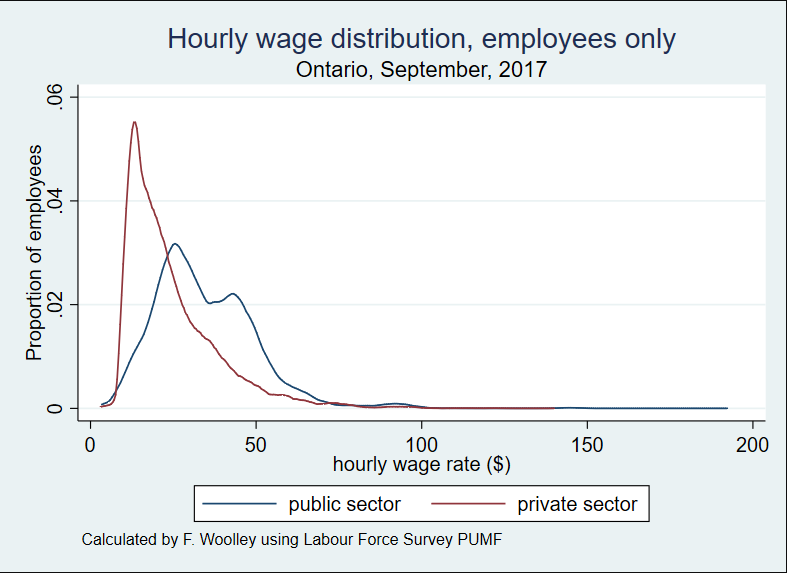
Even noting the exclusions, it’s striking that the old trade-off between public and private sector jobs — that civil servants got lower pay but better benefits and job security — has long since ceased to function. Civil servants, on the whole, now get higher pay than private sector workers, but have retained or even improved the benefits advantage over their private counterparts … and also still retain the job security that private workers can only dream of.
Comments Off on Ontario’s tax dollars at work
The navy we need versus the navy we’re willing to pay for
Ted Campbell recounts the ups and downs of the federal government’s plans for the Royal Canadian Navy over the last few decades:
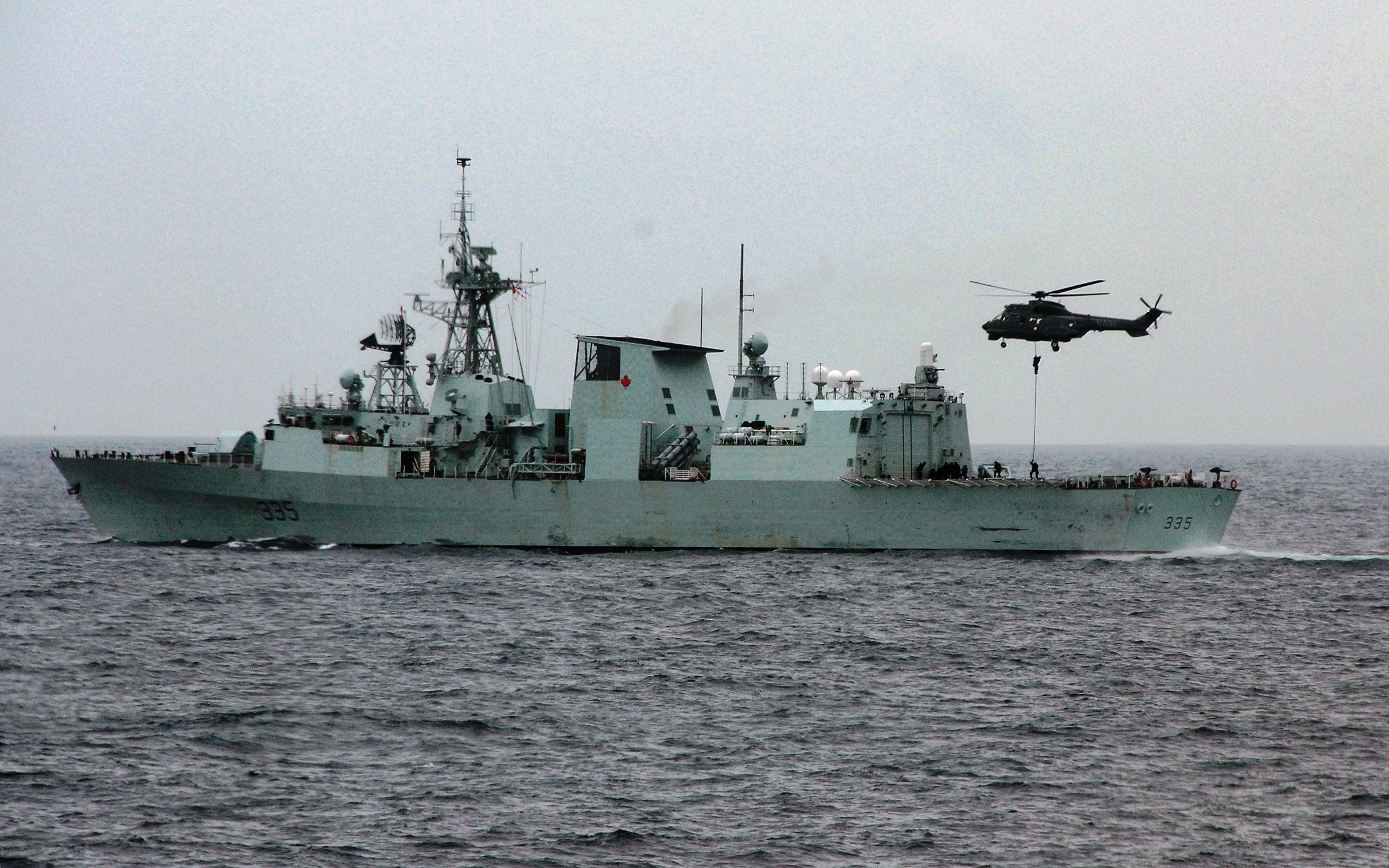
A Chilean navy boarding team fast-ropes onto the flight deck of RCN Halifax-class frigate HMCS Calgary (FFH 335) during multinational training exercise Fuerzas Aliadas PANAMAX 2009.
US Navy photo via Wikimedia.
One of my old friends, commenting to another equally old friend on social media, said this: “Surely, the PM and his government must see the obvious — that as the oceans warm and the ice melts the Northwest Passage becomes navigable year round. He’s been sounding off about climate change ad nauseum so that would seem to be understood by him. As a teacher he must also know that European colonial powers sought a shortcut between east and west but were deterred by ice. That’s changed, which he acknowledges, and Canada’s claim of the.increasingly ice free Northwest Passage as sovereign territory is under threat. Absent Canada’s willingness, and any capability, to enforce it’s claim, Canada surrenders any legitimate right to ownership of the Northwest Passage and the resources in the territory it abuts. That a maritime nation bordered by three oceans needs a blue-water navy is axiomatic. And once the PM acknowledges that the Northwest Passage is about to become Canada’s Suez Canal he must recognize that it, too, needs to be protected and defended by the Royal Canadian Navy. But the navy can only do that if it has ships and sailors. If Canada doesn’t expend the effort to protect its shores and assert its claims someone else will.” Sound pretty sensible, doesn’t it? Climate change will, very possibly, open the Northwest Passage; it Canada cannot patrol and police those waters then others will exploit them; it’s the Navy’s job to patrol and police our waters … I have argued that the “constabulary fleet” that should do that ought not to be in the Navy, but that’s a different issue … for now.
[…]
Way back when ~ I’m working from memory and I’m happy to have these numbers corrected ~ the Royal Canadian Navy said, in a document called “Leadmark,” if my memory serves, that, in addition to infrastructure (headquarters, schools, dockyards, etc) it needed:
- A fleet with global “reach” which meant more than a dozen “major combatants” (destroyers and frigates) plus four support ships so that, at any time, it could have one combat-ready task group in each of any two of the world’s oceans;
- A coastal (three coasts) patrol fleet consisting of a mix of submarines and another dozen “minor combatants” (corvettes and mine hunters);
- Organic air elements for those fleets;
- Auxiliary and training vessels.
Circumstances changed over time but the Paul Martin government finally committed to new helicopters for the fleet and thanks to his decision and to the perseverance of the Harper government they are, finally, entering service, only 25 years after Jean Chrétien abruptly cancelled the Mulroney government’s signed contracts for (then) new shipborne helicopters.
[…]
What we, Canadians, do not have is a properly funded plan to build the real Navy that the country with the world’s longest coastline, that borders three oceans, needs and deserves.
Since I am pretty sure that, absent some catastrophic events, Prime Minister Trudeau has no interest in warships (or the Coast Guard) I can be fairly confident that while new ships will be built they will be too few in number for the jobs that need doing.
There are no votes in promising to rebuild the military. The Liberals will ignore it and the Conservatives would be wise to not make it much of a campaign issue … Canadians, an overwhelming majority of Canadians just don’t care. But the Conservatives need to get some first rate naval and shipbuilding people into a room and decide, for themselves, what the real costs are for what the Royal Canadian Navy really needs.
The expected warming of the Arctic Ocean and the potential opening of new shipping lanes through areas currently claimed by Canada should be a huge encouragement for the federal government to get serious about ensuring that the RCN, the Canadian Coast Guard and the RCMP are properly prepared and equipped to protect our sovereignty in this region. As in so many other climate change matters, however, the government loves to talk the talk but is manifestly uninterested in walking the walk. More new ships, submarines, helicopters, bases, and the military staff to crew/staff them would be a very expensive commitment that wouldn’t shore up votes in those critical marginal constituencies and would reduce the government’s ability so spend money in aid of getting re-elected (the Liberals are in power now, but the same sort of political calculus applies to the Tories as well).
Mr. Campbell is a Conservative and clearly harbours hopes that Admiral Andrew Scheer will be more willing to make the RCN a priority, but history does not support that hope. The last time (and possibly only time outside periods of declared war) that a Canadian government was serious about the military was before 1957. Canadians are hopelessly in love with the idea of being a peaceful nation and have never been willing to engage with that old Latin tag “Si vis pacem, para bellum“
Comments Off on The navy we need versus the navy we’re willing to pay for
March 12, 2018
And the next premier of Ontario is likely to be … Doug Ford?
Saturday’s Ontario Progressive Conservative leadership contest went down to the wire … and beyond, as voting glitches pushed the announcement of a winner beyond the time the party had rented the facility in Markham, so attendees had to go elsewhere to wait for the final result. In a disturbingly similar way to the last US presidential election, Christine Elliot won the popular vote, but the result hinged on the number of constituencies won, which went to Ford. Several of my (Liberal or NDP) friends on Facebook, who’d announced they’d joined the PCs explicitly to vote against Ford, were aghast at the result.
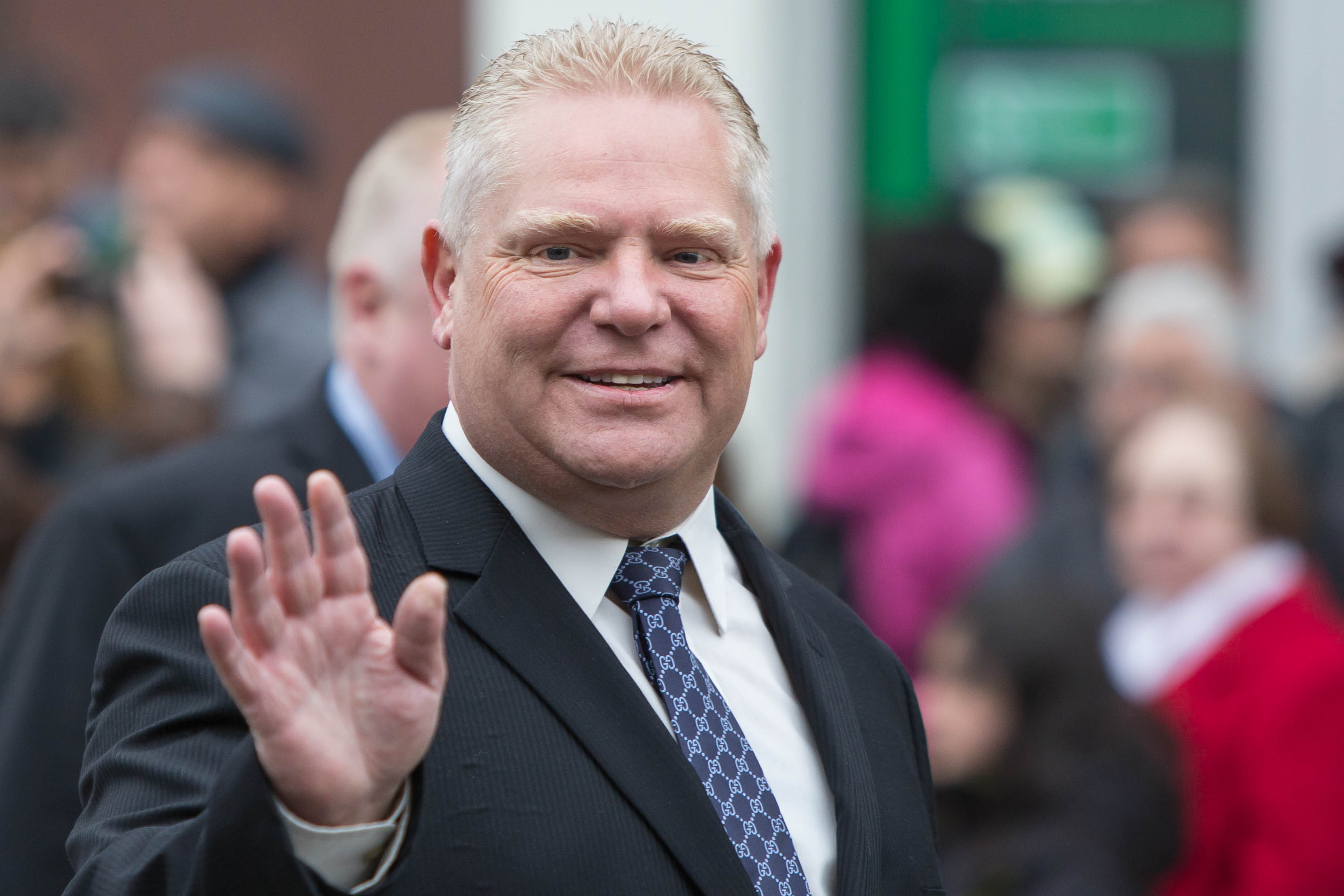
New Ontario Progressive Conservative leader Doug Ford at the 2014 Good Friday procession in East York.
Photo via Wikimedia.
In the National Post, Chris Selley reports on the three-ring circus:
In the end, maybe caucus had it right. If more than anything else Ontario’s Progressive Conservatives wanted to win on June 7 then maybe they should have stuck with interim leader Vic Fedeli. If the ultra-folksy MPP for Nipissing wasn’t the most compelling imaginable premier-in-waiting, he would certainly have cut a less divisive figure than Doug Ford, who was announced as the party’s new leader late Saturday night in a small room at a Markham conference centre.
“To the party members I say thank you. To the people of Ontario I say relief is on its way,” Ford told reporters and campaign workers. “And to Kathleen Wynne, I say your days as premier are numbered.”
That got a massive cheer, of course, but this is an outcome that many in the party consider a worst-case scenario. An Angus Reid poll released this week asked “soft” Tory voters whether each candidate would make them more or less likely to support the party: Ford’s net score (more likely minus less likely) was minus 27 per cent; Christine Elliott, who finished a very narrow second Saturday — her third failed shot at the position — was at plus 20.
Sticking with Fedeli would also have spared the party the hideous embarrassment of Saturday’s botched convention. Vote-counting dragged on for hours thanks to a chunk of ballots that had been allocated to the wrong ridings. A packed crowd of partisans was left in the dark for three hours, then told to hang tight for another 30 minutes, and then sent away into the night with no result. In lieu of a cascade of balloons, there was booing and hollering. Various Ford supporters, citing ostensibly conclusive media reports earlier in the day that Ford had won, alleged party elites were trying to steal it.
These were not the ideal circumstances in which to build unity, which was the stated purpose of the event. “You’ve been through a very tough couple of months — perhaps the toughest times in the history of the Progressive Conservative Party of Ontario,” Alberta United Conservative Party leader Jason Kenney told the crowd. “You’ve gone through weeks of anxiety and adversity. But I am certain that you will overcome this time of trial, and that this afternoon, with the election of your leader, you will emerge stronger, united and victorious in the election.”
“This afternoon,” he said. We were so young then.
CORRECTED: 2018 Ontario PC leadership electoral point flow. #onpcldr pic.twitter.com/0w89PK9Er2
— Paul Fairie (@paulisci) March 11, 2018
The flow of votes from Allen to Ford was expected, but what I didn’t expect was the proportion of Mulroney votes that flowed to Ford instead of Elliot (I’d expected roughly 100% to Elliot, but a significant number went to Ford instead).
Perhaps the most surprising thing about the leadership campaign was how well Ford managed to stick to his talking points and not be baited into the kind of media spectacle his late brother seemed to specialize in. A tougher test awaits in the June provincial election, however. The Liberals and NDP have been gifted a full warehouse of attack ads, based on the Ford brothers’ chaotic and at times incoherent term in office in Toronto, but there may be a limit to the overall usefulness of this arsenal: rather like the US media attacking Trump during the last US election, we’ve probably heard it all before.
The circus may not be over yet, however, as reports on Sunday indicated that Christine Elliot is demanding an investigation into the election.
March 11, 2018
Polls begin to reflect public disillusionment with Trudeau after gaffe-filled India trip
After all the PR blunders, it’s amazing that the Liberals are still riding as high in public opinion polls as they are:
By now it is clear the federal Liberals are in some difficulty with the public. Much excitement attended that Ipsos poll earlier this week showing them trailing the Conservatives for the first time, and by a not inconsequential margin: 38 to 33. But it’s not just Ipsos.
Forum Research, which gives the Tories a 12-point lead, may be an outlier, but Nanos’s latest four-week rolling poll shows the Liberal lead has shrunk to less than four points from eight points in December; Abacus Data, similarly, now has them just three points ahead, the narrowest margin they have found since the election.
Overall, the CBC’s Poll Tracker website now puts the two parties more or less level, based on a weighted average of the polls, at 36 per cent. Contrast that with the Liberals’ first year in office, when they maintained a lead of as much as 20 points, or even their second, when they led by eight to 10. Something is clearly up.
The reason is not hard to find, nor is it unusual: the prime minister’s personal approval rating has declined markedly. To be sure, he remains the Liberals’ chief asset: Nanos still shows 40 per cent of Canadians put Justin Trudeau as their preferred prime minister. Sixty per cent say he “has the qualities of a good political leader.”
[…]
The immediate explanation for the prime minister’s cratering appeal is the recent official visit to India, conceded on all sides to have been a disaster. There’s no doubt this has taken its toll — Ipsos finds more than twice as many Canadians of the view that the visit was “negative for Canada-India relations” than the contrary.
But if the India visit accelerated the decline, it is also true that the prime minister’s appeal has been fading for some time. The India trip may have crystallized certain perceptions of him, but the ingredients have been evident for a while. People do not form impressions of a leader’s character and abilities instantaneously, but only as the result of an accumulation of incidents and impressions.
The Tories’ pre-election attempts to discredit Trudeau as “just not ready” failed in the light of a long campaign in which he persuaded increasing numbers of Canadians that he was. I don’t imagine many would have said he was much of a deep thinker — his worst moments are almost always when he tries to pretend he is — but people gave him credit for sincerity, personal decency, idealism, and a native political ability that seemed to grow throughout the campaign.
But now? Asked to name the first quality that came to mind, I suspect increasing numbers might be more inclined to mention his cynicism.
Comments Off on Polls begin to reflect public disillusionment with Trudeau after gaffe-filled India trip
March 9, 2018
Devil’s Brigade – WWII First Special Service Force
farias615
Published on 24 May 2017
Comments Off on Devil’s Brigade – WWII First Special Service Force
March 7, 2018
The reception Mulroney Sr. got shows how little “sizzle” the Conservatives can offer now
Chris Selley covered the recent Caroline Mulroney event featuring her father Brian:
Watching 79-year-old Brian Mulroney campaign for his daughter on Tuesday, I’d be hard-pressed to argue age matters at all.
The public-facing aspects of this leadership campaign have often been stilted, joyless and jittery, with Doug Ford carefully keeping his powder dry and Mulroney trying to build confidence without screwing up. Only Christine Elliott has often sounded passionate, confident and halfway credible all at once.
Mulroney père, on the other hand, waltzed into a packed banquet hall in Vaughan at noon on Tuesday like a conquering hero, to a standing ovation, and settled in behind the lectern like it was a favourite sweater and a mug of hot cocoa. When he was done, but for the greyer beards, the camera-wielding mob that escorted him out of the room might as well have had Justin Trudeau at its centre.
Mulroney regaled us with a smorgasbord of chucklesome anecdotes, bons mots and name-dropping. He cheerfully batted away several entreaties that he return to politics. He said he mooted the idea to Mila during Jean Chrétien’s infamous “I don’t know if I am in West, South, North or East Jerusalem” press conference in 2000.
“I think it’s a wonderful idea,” she supposedly replied, “and I know your new wife is really going to love the experience.” Much mirth!
Mulroney pooh-poohed the need for legislative experience in an aspiring premier — perhaps the biggest knock against his daughter — arguing he had none when he won the Tory leadership in 1983 and rampaged to a majority government, and suggesting he “want(s) no part of” the sort of experience that Kathleen Wynne and Co. have in spades.
“I knew Ontario when it was the driver of Confederation, the engine of Canada’s economy, a glorious leader in this country,” he prated, crediting the “strong, consistent and brilliant” leadership of Tory premiers John Robarts, Bill Davis and Mike Harris for “the large measure” of its success. “And now Ontario has been reduced to accepting equalization payments from Newfoundland and Labrador.”
[…]
Demonstrably, in Canada, you do not need a huge, room-filling personality to govern effectively. But if you haul out Brian Mulroney to campaign for you, you’re going to invite comparisons. And if you’re going to claim that the current government has literally laid waste to the province, a guy like Mulroney is liable to highlight just how modest the Conservatives’ proposals are to rebuild it all from scratch.
Comments Off on The reception Mulroney Sr. got shows how little “sizzle” the Conservatives can offer now
March 2, 2018
Canada’s foreign policies, in the wake of recent Prime Ministerial mis-steps
Ted Campbell suggests that our current foreign policy goals have been seriously undermined by the — shall we say “disappointing” — outcomes of Prime Minister Trudeau’s Chinese and Indian trips:
[Former senior Canadian diplomat David] Mulroney begins by saying that: “The best that can be said about Prime Minister Justin Trudeau’s visit to India is that it may prompt a review, if not a complete rethinking of a Canadian foreign policy that appears to be seriously off the rails. We have some hard lessons to learn … [and] … At the very least, the Prime Minister’s debacle in India should encourage smart people in Ottawa to zero in on what isn’t working.” That’s good thinking. At the end of every major campaign, an especially after campaigns in which things go awry, good military commanders convene a board of senior officers to consider “lessons learned,” in the hope that they will not make the same mistakes next time. sadly, especially today, the lessons learned are all too quickly forgotten even if the analysis was rigorous enough in the first place.
“Most worrying,” David Mulroney says, “is a fundamental and puzzling failure at the level of policy implementation, something that appears to be compounded by the Prime Minister’s own impetuosity. Flying to India before the big meeting with Prime Minister Narendra Modi was in the bag, much like heading off to Beijing on a free-trade themed visit without any reasonable expectation that a deal was doable, exposes Mr. Trudeau to a degree of prolonged public skepticism that comes to define the visit itself.” In other words: Justin Trudeau goes off “half cocked” as we soldier say … not ready for action. That is, I suspect, in part because his team in the Prime Minister’s Office (PMO), was brilliant on the campaign trail in 2015 but is really unqualified to advice the leader of the government of the G7 nation; that poor quality of policy advice matters because Justin Trudeau was, and still is, to be sure, “just not ready” for the job he was handed. But his
officecampaign team wants to get and keep him in the public eye because that’s part of the 2019 campaign strategy … this time it failed because they really didn’t understand the business at hand.[…]
But India is not just any country, as Mr Mulroney explains: “India isn’t our friend. It is a rising regional power beset with a range of domestic problems, including serious human rights issues. It takes a prickly approach to global issues that is often at odds with traditional Canadian policies in areas ranging from trade policy to nuclear disarmament … [and, he says] … The Indian diplomats I worked with could be wonderfully pleasant after the official day was done. But, for the most part, they brought a formidably ruthless precision to their pursuit of India’s interests in the world. While they might ultimately agree to grant Canada a concession, this was always a product of hard and often heated negotiations. They never conceded a point because they liked us or because we are home to a large Indo-Canadian community.” Further, he adds that “My experience with Chinese diplomats was entirely similar.” Although never at the same level as Mr Mulroney, I worked in the international arena as a senior officer, especially in one sector (global radio-communications which included arranging for the expansion of mobile communications in the 1990s. My Chinese and Indian colleagues were, indeed, fine men and women but they, just like me, were there ~ Geneva, a lot, but everywhere from Washington, London, Canberra and Tokyo to Beijing ~ defending their interests. “friendship,” even long standing alliances didn’t count for anything. Billions of dollars were at stake, profits and losses would hinge on how we ~ engineers and lawyers and businessmen and soldiers from dozens of countries ~ managed to slice up the radio spectrum to allow these new services to thrive. The Chinese and Indian delegates were just as professional, just as technically qualified, just as hard nosed as the Americans, Brits and Canadians.
“Long before the election of U.S. President Donald Trump,” David Mulroney says, “it should have been clear to us that the world is changing in ways that do not align with traditional Canadian views, interests and values. If we’re smart, the rise of countries like China and India can certainly contribute to our prosperity, and with hard work, we should be able to find common cause on important issues such as global warming … [but, he adds] … the rise of these assertive and ambitious Asian powers will almost certainly challenge global and regional security. Both will also continue to reject traditional Canadian notions about global governance and human rights, and neither will be particularly squeamish about interfering in Canadian affairs.” Sunny ways, feminism and being green don’t count for much; they are very certainly not a sound foundation upon which to build a foreign policy. We have to start thinking about our vital interests in the world ~ about what they are and about how we can and will protect and promote them: that’s the basis of a grand strategy. It was also the kind of thinking that Stephen Harper hated: he wanted to deal with issues incrementally, linking them together, sometimes, into a coherent web but never allowing them to become too important in and of themselves. That was bad enough but I’m persuaded that Justin Trudeau doesn’t think about those “big ideas” at all … because, I fear, they are, simply, quite beyond his comprehension.
Comments Off on Canada’s foreign policies, in the wake of recent Prime Ministerial mis-steps
February 27, 2018
QotD: Anthems
If you were an alien visiting Earth you would quickly conclude from the evidence of your eyes and ears that national anthems probably originate in sport, and were designed to serve it. But even this mistaken conclusion would further befuddle you. If an anthem is intended to stir the blood and awaken athletes to duty in international contests, why are anthems also performed at games between teams belonging to the same country? Is it some sort of test?
Looking at the content and histories of the anthems themselves would not help you much. Some of them are military marches. Some of them are revolutionary street songs that came, over time or through immediate fiat, to represent an entire state. Some are “hymns.” Some are poetry — mostly bad poetry, and mostly by lyricists not otherwise remembered. Some are, like ours, a sort of mashup: poetry grafted onto a march. (The prescribed tempo for O Canada is “alla marcia”, and it is best when performed by the book.)
Every country has to have an anthem, it seems, for circular reasons. An anthem is a feature of a country, and it proves you are a country if other countries blare your anthem in the direction of your supreme leader on state visits. All anthems are performed upon roughly the same occasions everywhere. But if you could take a God’s eye view you, would see one nation warning its neighbours that they will drown in blood if they look across the border cross-eyed. The next nation over is singing about how it is a beacon of peace — particularly to its immediate neighbours, the unreasoning scum. The next nation is asking for God’s blessing on its handsome, wise royal family. The one after that is celebrating the violent overthrow of its handsome, wise royal family.
Colby Cosh, “Let’s talk about anthems”, National Post, 2016-07-14.
Comments Off on QotD: Anthems
February 26, 2018
India’s largest newspaper on Justin Trudeau’s “disaster visit”
Paul Wells linked to this story in the world’s largest circulation English language newspaper, The Times of India:
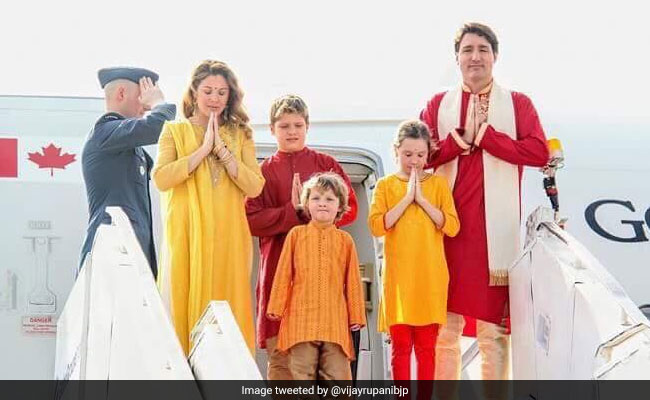
Justin Trudeau and family during India visit
Image via NDTV, originally tweeted by @vijayrupanibjp
Canadian prime minister Justin Trudeau’s visit was a disaster that has little parallel in India’s recent diplomatic history. But as the Canadian prime minister returned home on Saturday after almost a week of recurrent diplomatic missteps, ironically, it may have provided the opportunity to reset relations between Canada and India.
On Saturday, Indian government officials were angry at suggestions by Canadian officials that India was responsible for Khalistani terrorist Jaspal Atwal getting a visa to India and used his presence to embarrass Trudeau.
Trudeau, in his meeting with prime minister Narendra Modi, also complained that his visit had been shadowed by a single issue. Atwal got a visa because he was taken off the blacklist some years ago. But he was part of a number of Trudeau’s own events that did not involve the Indian government at all.
A prime ministerial visit to a foreign country for a week with a thin official component is always fraught with danger. In addition, moving the official meetings to the very end of the trip indicated that the government meetings were an after-thought. Most foreign leaders who throw in other events almost always front-load the official meetings, and then go on to business or tourism events.
Here, it was clear from the start that Trudeau came to India to score with his Sikh constituency back home — four out of the six cabinet ministers who travelled with him were Sikh, as were an overwhelming number of MPs who also travelled with him. Until the media barrage in India forced the Canadian side to change tack, Trudeau was not even ready to meet Amarinder Singh, chief minister of Punjab. Even the Canadian high commissioner’s official reception was a celebration of Punjab with the prime minister himself waltzing in on bhangra beats.
Comments Off on India’s largest newspaper on Justin Trudeau’s “disaster visit”
February 23, 2018
“…the Trudeaus playing ‘Mr Dressup and Family’ in exotic locations on the taxpayers’ dime isn’t the problem”
The press is having a hard time presenting Justin Trudeau’s India trip in a positive light, which clearly pains the teeny-bopper Trudeau fan club that composes a large part of the Canadian media. Ted Campbell sees the trip as a series of wasted opportunities to begin healing the breach between India and Canada:
I’ve taken my time in commenting on the prime minister’s trip to India. To say that I’m very disappointed is to put it mildly … I’m disappointed and a little embarrassed to be a Canadian. But the Trudeaus playing “Mr Dressup and Family” in exotic locations on the taxpayers’ dime isn’t the problem. We have, in fact, a serious problem as far as India is concerned and we, Canada, one of India’s oldest and firmest friends is in danger of being seen as an adversary. That’s a problem and it is, in my mind, a HUGE problem for Canada.
As Vishnu Prakash, former Indian envoy to Canada, told Indian news site The Print on Monday, ““Over the years, the Canadian political establishment, across the spectrum (whether it is the NDP, Conservatives or Liberals) has been mollycoddling Khalistani elements. Under the Trudeau government, this has increased. He had himself appeared on a Khalistani platform in Toronto in April last year.” It, the “mollycoddling Khalistani elements,” has been going on since at least the 1980s, back when Indira Ghandi’s government cracked down (1984) and nearly provoked a civil war and even in 1985 when Air India flight 182 was bombed, almost certainly an attack organized by Canadians, in Canada, as retaliation. Then the governments of the day spent 20 years and over $100 million on an investigation that retired Supreme Court Justice John Major described as a “cascading series of errors” by the government, writ large, including, especially, the RCMP and CSIS. India was not impressed.
India was less impressed when Canadian political parties began to actively court the Canadian the entire Indo-Canadian community but failed to condemn Sikh separatism. Canadians, including Brian Mulroney, Jean Chrétien, Stephen Harper and Justin Trudeau have “explained,” correctly, that people are allowed to support unpopular causes here in Canada, so long as they don’t break our laws, but India, not unreasonably, given Canada’s own history of separatist violence, would like something more. But the Sikh vote is active and “efficient” and all parties want it and that seems, to India, anyway, to mean turning a blind eye to the (disputed)
factassertion that the Khalistan independence movement is centred in and funded from Canada … Prime Minister Trudeau made thing worse, according to The Hindu, when “On April 30, [2017] Mr. Trudeau addressed a parade for ‘Khalsa Day’, which included floats glorifying Sikh militant leaders Jarnail Singh Bhindranwale, Amreek Singh and former General Shahbeg Singh who were killed in the siege of the Golden Temple and Operation Bluestar in June 1984.” That act appears to have crossed a line, leading to what the whole world is now interpreting as a major diplomatic snub […]The big issue is not the rather gentlemanly snub of Justin Trudeau by India’s highest officials; our prime minister appears more interested in having an all expenses paid vacation with his family than in doing the nation’s business in any event; the real issue is the Canadian political actions that made it politically necessary for Prime Minister Modi to administer that snub at all.
What Canada needs to do now is repair relations with India, and that may require Prime Minister Trudeau to look very, very closely at any ties any of his ministers may have with the Khalistan independence movement, he says there are none, and either making them sever all ties with separatists or severing them from the Liberal cabinet, caucus and even the Party. Andrew Scheer needs to do the same with the Conservatives and Jagmeet Singh needs to speak out for national unity ~ if it’s good for Canada then it’s good for India, too. On this issue, at least, politics should indeed, stop at the water’s edge.
Of course, when you allow things like this to happen, diplomacy becomes a much trickier profession than normal:
Sweet Mother of God. No family fashion photoshoot in Hello! magazine is going to fix this one. https://t.co/rLvI7ip8Vh
— Terry Glavin (@TerryGlavin) February 21, 2018
In Britain, the Daily Mail published the comments from a lot of Indians who have been offended by Trudeau’s choices of clothing on the visit so far:
Justin Trudeau has been ridiculed on social media by Indians for his ‘tacky’ and over the top outfit choices while on his first visit to their nation as Prime Minister.
While many praised his clothing during the first two days of his trip, patience was wearing thin by the time he attended a Bollywood gala on Tuesday night, before the tide turned against him on Wednesday.
Ministers, authors, journalists and ordinary Indians lined up to mock him on Wednesday, saying his wardrobe was ‘fake and annoying’.
Perhaps taking note of the criticism, the Canadian leader donned a suit on Thursday as he visited Jama Masjid, one of India’s largest mosques.
Leading the criticism was Omar Abdullah, former chief minister of Jammu and Kashmir, who tweeted on Wednesday saying Trudeau’s preening was ‘all just a bit much.’
‘We Indians do not dress like this every day sir, not even in Bollywood.’
Bhaavna Arora, a bestselling Indian author, also chimed in, accusing Trudeau of wearing ‘fancy dress’ and saying she found it ‘fake and annoying’.
Shekhar Gupta, founder of Indian newspaper The Print also mocked the Canadian Prime Minister, accusing him of ‘running a week-long “election campaign” in India in fancy dress.’
Comments Off on “…the Trudeaus playing ‘Mr Dressup and Family’ in exotic locations on the taxpayers’ dime isn’t the problem”
February 14, 2018
Viral mapping by Sasha Trubetskoy
Have you seen this map by Sasha Trubetskoy?
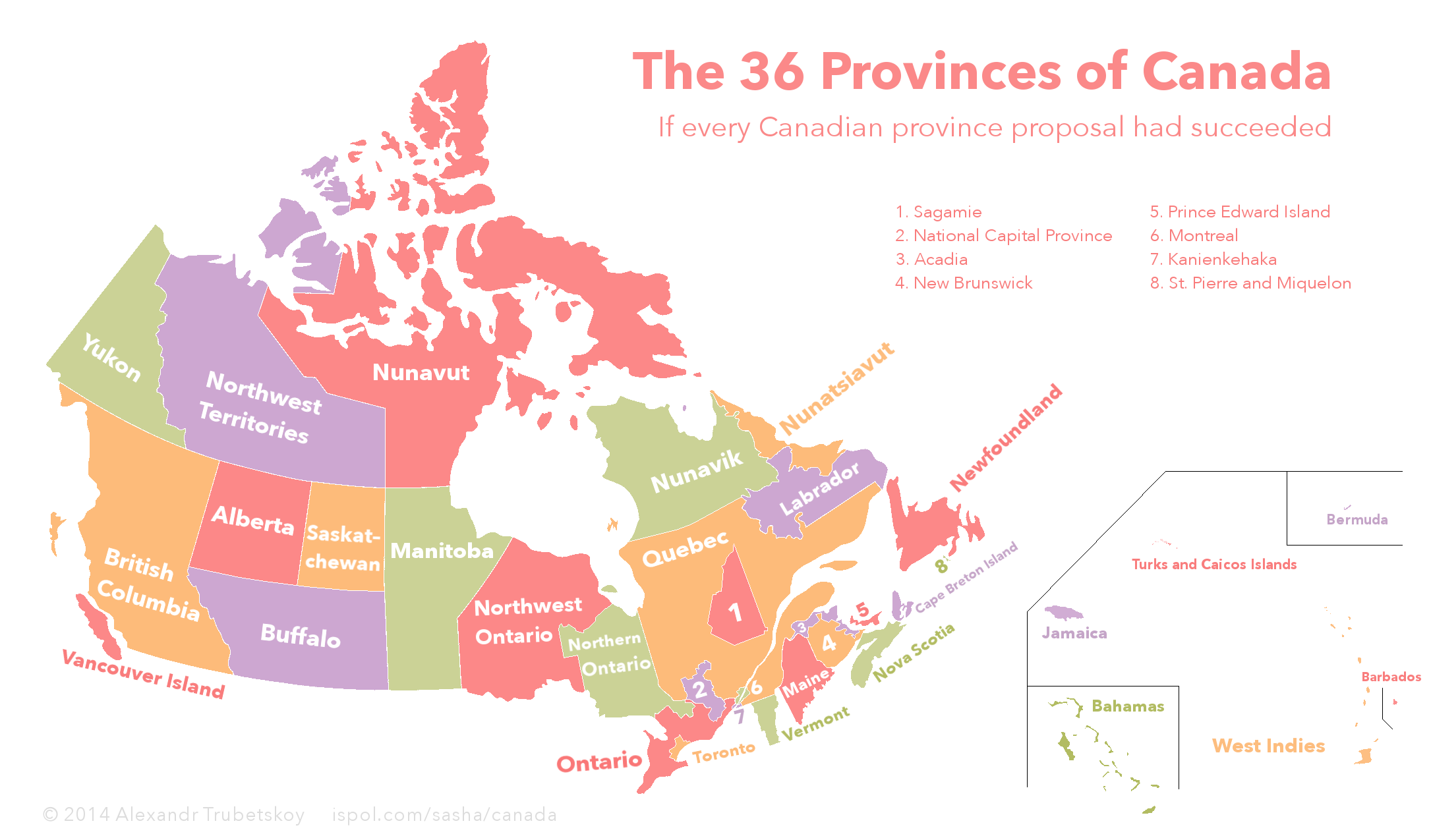
Click to embiggen.
It wasn’t the first time one of his maps went viral, but it provided him a key insight into getting his maps in front of a large number of people:
I learned from Reddit that if a Canadian sees something that mentions Canada, they will upvote out of solidarity. You can game that. So I made a map of every Canadian province, if every Canadian province proposal had succeeded. Not many people know Jamaica was going to be part of Canada. That map got me on Huffington Post Canada.
I was like, Canada worked, let’s try Australia. Same idea, every Australian state proposal. That worked too.
A very popular recurring theme in viral maps is a fictional subway network of some sort. I can see why people like that. It’s cute, it’s bright colors, everything’s nice and organized, it’s fun to look at.
Somehow I stumbled upon the idea of representing the ancient Roman road network. I tried to make it look like a modern publication that the actual Roman Empire would have, like little leaflets at the train station. The map is in Latin. I don’t know Latin, but I have a knack for picking up little bits and pieces, maybe born out of necessity from my childhood. My parents come from Moscow, and at home we only spoke Russian. My grandma speaks French.
Latin has six cases, Russian has six cases, and they’re essentially the same. I had an intuition, like, how would I say this in Russian? Then replace the words with Latin. It turns out that’s a fantastic way of doing it.
H/T to Colby Cosh for the link.
Comments Off on Viral mapping by Sasha Trubetskoy
February 12, 2018
The Browning High Power pistol finally ends production after 82 years
Kyle Mizokami reported on this last week:

Small arms manufacturer Browning has ended production of the Browning Hi Power semiautomatic handgun. The legendary pistol served in armies worldwide, from Nationalist China to the British Special Air Service and was one of the first high capacity pistols ever invented. An invention of prolific arms designer John Moses Browning, the Hi Power was the inventor’s last pistol design.
As noticed by The Firearm Blog, the pistol‘s product page was quietly changed to include the words, “no longer in production” and the prices were removed. The Hi Power pistol was in continuous production for 82 years.
The Hi Power was the brainchild of American small arms legend John Moses Browning, a prolific inventor who also created the M2 .50 caliber machine gun, still in use with U.S. military forces today. He also invented the M1911 handgun, the U.S. military’s standard sidearm for nearly 70 years, and literally dozens of other pistols, shotguns, rifles, machine guns, and even a cannon. Browning was working on the Hi Power when he died in 1926, and the gun was eventually finished and sold by his manufacturing partners in Belgium in 1935.
The Hi Power had little in the form of commercial success before World War II, but was used by both sides during the war. Belgium’s surrender to Nazi Germany saw plans for the gun smuggled out of the country to Canada, where they were built for Nationalist Chinese forces and British and Canadian paratroopers and special forces. The tooling left behind in occupied Belgium went on to produce handguns for German military forces, particularly paratroopers and the Waffen SS. After the war the gun was sold to civilians and armed forces, particularly those belonging to NATO, and eventually more than 50 armies and 93 nations adopted the Hi Power as their standard sidearm. More than a million Hi Powers were eventually produced.
Comments Off on The Browning High Power pistol finally ends production after 82 years


