
Extra Credits
Published on 24 Jan 2018You would think that paying $60 for a game would be enough, but so many games these days ask for money with DLC, microtransactions, and yes, lootboxes. There’s a reason for that.
February 16, 2018
Games Should Not Cost $60 Anymore – Inflation, Microtransactions, and Publishing – Extra Credits
Comments Off on Games Should Not Cost $60 Anymore – Inflation, Microtransactions, and Publishing – Extra Credits
February 15, 2018
DicKtionary – D is for Dollars – Hetty Green
TimeGhost
Published on 14 Feb 2018D is for dollars, 100 to the penny,
Some have but few, others have many,
Some hoard them too – the frugal and mean,
And none was more frugal than one Hetty Green.Hosted and Written by: Indy Neidell
Based on a concept by Astrid Deinhard and Indy Neidell
Produced by: Spartacus Olsson
Executive Producers: Bodo Rittenauer, Astrid Deinhard, Indy Neidell, Spartacus Olsson
Edited by: Bastian BeißwengerA TimeGhost format produced by OnLion Entertainment GmbH
Comments Off on DicKtionary – D is for Dollars – Hetty Green
February 14, 2018
Repost: “I, Rose” and “A Price is Signal Wrapped Up in an Incentive”
Published on 8 Feb 2015
How is it that people in snowy, chilly cities have access to beautiful, fresh roses every February on Valentine’s Day? The answer lies in how the invisible hand helps coordinate economic activity, Using the example of the rose market, this video explains how dispersed knowledge and self-interested actors lead to a global market for affordable roses.
Published on 8 Feb 2015
Join Professor Tabarrok in exploring the mystery and marvel of prices. We take a look at how oil prices signal the scarcity of oil and the value of its alternative uses. Following up on our previous video, “I, Rose,” we show how the price system allows for people with dispersed knowledge and information about rose production to coordinate global economic activity. This global production of roses reveals how the price system is emergent, and not the product of human design.
Comments Off on Repost: “I, Rose” and “A Price is Signal Wrapped Up in an Incentive”
February 13, 2018
Elon Musk as Heinlein’s Delos D. Harriman – “Selling the moon is just what Musk is doing”
I suspect I’d recognize a lot of the books in Colby Cosh‘s collection, as we’re both clearly Robert Heinlein fans. In a column yesterday, he pointed out the strong parallels between Heinlein’s fictional “Man Who Sold the Moon” and his closest counterpart in our timeline, Elon Musk:
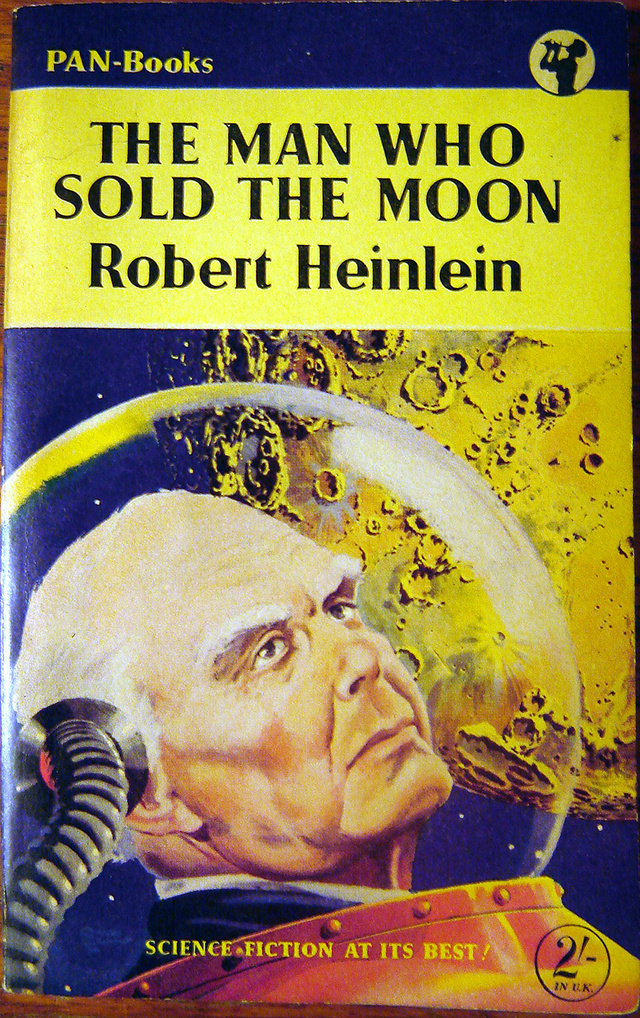
Written between 1939 and 1950 for quickie publication in pulp magazines, the Future History is a series of snapshots of what is now an alternate human future — one that features atomic energy, solar system imperialism, and the first steps to deep space, all within a Spenglerian choreography of social progress and occasional resurgent barbarity. It stands with Isaac Asimov’s Foundation trilogy as a monument of golden-age science fiction.
[…]
The result, in the key story of the Future History, is an uncannily accurate description of the design and launch of a Saturn V rocket. (Written before 1950, remember.) But because Heinlein happened not to be interested in electronic computers, all the spacefaring in his books is done with the aid of slide rules or Marchant-style mechanical calculators (which, in non-Heinlein history, had to become obsolete before humans could go to Luna at all). Heinlein sends people to colonize the moon, but nobody there has internet, or is conscious of its absence.
Given that his ideas about computers were from the pre-computer era and even the head of IBM thought there’d be a worldwide demand for a very small number of his company’s devices, that’s not surprising at all. In one of his best novels, a single computer runs almost all of the life support, heat, light, transportation and communication systems on Luna … and is self-aware, but lonely. In later works where computers appear, they tend to be individual personalities or even minor characters, but they’re anything but ubiquitous: powerful, but rare.
I suspect the lack of an internet-equivalent derives both from the nature of his conception of how computing would progress and a form of the Star Trek transporter problem – it solves too many plot issues that could otherwise be usefully woven into stories.
The “key story” I just mentioned is called “The Man Who Sold The Moon.” And if you’re one of the people who has been polarized by the promotional legerdemain of Elon Musk — whether you have been antagonized into loathing him, or lured into his explorer-hero cult — you probably need to make a special point of reading that story.
The shock of recognition will, I promise, flip your lid. The story is, inarguably, Musk’s playbook. Its protagonist, the idealistic business tycoon D.D. Harriman, is what Musk sees when he looks in the mirror.
“The Man Who Sold The Moon” is the story of how Harriman makes the first moon landing happen. Engineers and astronauts are present as peripheral characters, but it is a business romance. Harriman is a sophisticated sort of “Mary Sue” — an older chap whose backstory encompasses the youthful interests of the creators of classic pulp science fiction, but who is given a great fortune, built on terrestrial transport and housing, for the purposes of the story.
The Grand Tour: Legally Tesla
The Grand Tour
Published on 12 Feb 2018In a test of the Tesla Model X, Jeremy Clarkson is joined by lawyers in this legally perilous task.
****These observations about the Tesla Model X are made in Clarkson’s personal capacity and should not be regarded as any statement or opinion by any other person or entity about the general safety, road worthiness, mechanical effectiveness, or any other standards of the vehicle about this specific model or any other Tesla vehicle.
Comments Off on The Grand Tour: Legally Tesla
February 11, 2018
Bay area food entrepreneurs shut down by local health authorities
In Reason, Baylen Linnekin recounts the rise and fall of Josephine, an online operation intended to connect home cooks with willing buyers:
A dozen or so years ago, as my friend Dave was planning a move from Washington, D.C., to Philadelphia, he used the need to clean out his fridge before the move as an excuse to offer a half-empty jar of homemade kimchi for sale on Craigslist. While I don’t think the kimchi sold, Dave’s effort opened my eyes to the seemingly limitless possibilities of homemade online food sales.
The truth is that while those possibilities are limited theoretically only by imagination, they very often bump up in the real world against — to paraphrase Waylon Jennings — the limits of what the law will allow.
That truth was evident last week, when Bay Area food startup Josephine announced it will close its doors in March.
As I described in a Sacramento Bee op-ed in support of Josephine last year, the company launched nearly four years ago with a mission to provide cooks who are typically underrepresented in restaurant leadership — including women and immigrants — with a platform by which to sell home-cooked meals with their neighbors.
It’s a cool idea. And it worked quite well for a time. That is, as I noted, until local health officials “sent cease-and-desist letters to several Josephine cooks.”
Josephine responded by trying to work with lawmakers and regulators, pushing a bill in the state legislature that would provide some legal avenue for its cooks. Despite the fact that the bill is now moving through the California legislature, the company decided its passage would be too late for Josephine and its funders.
Josephine didn’t have to die. The regulations that have made it impossible for the company to operate should have died instead. But its fate mimics that of other similar home-food startups. A similar New York-based startup, Umi Kitchen, flamed out last year after just four months of operations. I wrote an appreciation of Forage Underground Market, the inventive San Francisco food swap that was shuttered by California state and local health authorities, way back in 2012. And I predicted at the time the food underground movement was just beginning to blossom.
Comments Off on Bay area food entrepreneurs shut down by local health authorities
Sriracha Sauce and the Surprisingly Heartwarming Story Behind It
Today I Found Out
Published on 18 Jan 2018In this video:
The genesis of Sriracha hot sauce (pronounced sir-ah-cha, contrary to what many think) becoming the condiment staple it is today can be traced back to 1975 and an unassuming Vietnamese refuge called David Tran – the founder and current CEO of Huy Fong Foods.
Want the text version?: http://www.todayifoundout.com/index.p…
Comments Off on Sriracha Sauce and the Surprisingly Heartwarming Story Behind It
February 10, 2018
Protecting (some) women from their own decisions
Kirio Birks on the Formula One “grid girls”:
Objectification, we are told, is degrading. Why? Because any job that requires employees to be sexually attractive and gazed upon for that reason necessarily dehumanises them. It encourages others to treat them as pretty ‘things’ rather than as autonomous people with their own lives, passions, thoughts, and desires. Or so the thinking goes. ‘Grid Girls’ – models employed by Formula One for promotional purposes – have just discovered that their role is to be discontinued. As Formula One’s managing director of commercial operations explained: “While the practice of employing grid girls has been a staple of Formula 1 Grands Prix for decades, we feel this custom does not resonate with our brand values and clearly is at odds with modern day societal norms.”
But in their hurry to spare Grid Girls the indignity of the male gaze, nobody making this argument seems to have stopped to wonder whether Grid Girls might have an interest in defending what they do. Instead, a collective of ostensibly progressive voices leapt to their defence without bothering to ask the girls themselves if they needed defending at all. In response, Formula One abandoned its Grid Girls so that it can be seen to be moving with the times and hip to contemporary mores. In doing so, Formula One’s executives have implicitly conceded that they have spent too long objectifying women instead of empowering them. They would like it to known that they’d rather see women driving the cars, or as members of the engineering teams, or just about anywhere other than track-side holding a driver’s name-board and looking beautiful.
What baffles me is that a move supposed to empower women came at the expense of other women, and only because a minority of outsiders found Grid Girls inappropriate, problematic, and otherwise an offence against good taste. But even if Grid Girls are being objectified, then – contra the explanation offered above – it’s not at all clear that objectification is wrong in and of itself. It is acceptable to use people as a means to an end – that’s called employment. Grid Girls obviously know that they will be objectified and they make an autonomous, informed decision to take the job anyway. They are not harmed, they are paid for their time and their work, and many of them have come forward to say, with understandable indignation, that they enjoy what they do. Needless to say, this has not impressed those feminists who applauded their redundancies. But surely a woman has a right to be the object of somebody else’s desire if she wants and surely it doesn’t matter if she is being paid for it?
Get me on @thismorning so I can defend us #gridgirls
Because of these feminists, they’ve have cost us our jobs! I have been a grid girl for 8 years and I have Never felt uncomfortable! I love my job, if I didn’t I wouldn’t do it! Noone forces us to do this! This is our choice! pic.twitter.com/PUWcyB5BeG— Lauren-Jade (@laurenjadepope) January 31, 2018
Opponents may suggest that Grid Girls have internalised their own oppression in a society shaped by patriarchal values, but not without making two claims: (1) that Grid Girls are unable to adequately think for themselves because of the society they live in and (2) that thinking for yourself is only evidenced by acknowledging the existence of a patriarchal status quo and resisting it.
Comments Off on Protecting (some) women from their own decisions
February 9, 2018
DicKtionary – C is for Car – Henry Ford
TimeGhost
Published on 8 Feb 2018C is for car – the automobiles
And nothing is cooler than a boss set of wheels,
From selling some cars, this man made a horde,
Mechanic and boss man, here’s Henry Ford.Hosted and Written by: Indy Neidell
Based on a concept by Astrid Deinhard and Indy Neidell
Produced by: Spartacus Olsson
Executive Producers: Bodo Rittenauer, Astrid Deinhard, Indy Neidell, Spartacus Olsson
Camera by: Ryan
Edited by: Bastian BeißwengerA TimeGhost documentary format produced by OnLion Entertainment GmbH
Comments Off on DicKtionary – C is for Car – Henry Ford
February 7, 2018
QotD: You are not the customer … you’re the product
As we enter the third 24-hour period of relentless media coverage, the part where even the local TV stations have custom bumpers for the incident with distinctive theme music, let’s make sure we have some things clear.
TV news does not sell news to you.
TV news sells commercial time to corporations and your eyeballs are the poker chips in the card game.
Atrocities (and let’s keep our terminology straight: hurricanes and earthquakes are tragedies, this was an atrocity) are like a Double Bonus Round in the Eyeball Delivery Sweepstakes for FOXNews and CNN and MSNBC.
And all this attention is just incentivizing the next Eyeball Deliverer out there, patiently loading magazines (or mixing fertilizer, or dumping powder into pressure cookers, or studying a flight manual, or filling jerry cans…)
And, yes, ironically this post is just more attention being paid, and by complaining about the problem I make myself a part of it. It’s a hell of a thing.
Tamara Keel, “Terminology, again”, View From The Porch, 2016-06-14.
Comments Off on QotD: You are not the customer … you’re the product
February 3, 2018
Arizona’s legally protected blow-drying cartel
Eric Boehm reports on the fantastic lengths protected businesses will go to to protect themselves from “unlicensed” competitors, even in such areas as hair drying:
Brandy Wells never anticipated the amount of vitriolic abuse she would receive over — of all things — her public support of a proposal to let people blow-dry hair without a state-issued license.
“I’ve been called a cunt, a bitch, an ass, trashy, a puppet, a pawn, repugnant,” Wells says. “And my favorite: ‘your logic on deregulation of cosmetology is much like your hair, dull and flat.'”
Wells says she’s received several attacks from cosmetologists on social media accusing her of being “uneducated” or “clueless” about cosmetology because she doesn’t work in the industry. It’s true that Wells isn’t a licensed cosmetologist (though she does, in fact, know how to use a blow-dryer, she confirmed to Reason), but that’s actually the precise reason why she’s speaking up.
Wells serves as the lone “public member” of the Arizona State Board of Cosmetology. That means she is the only member of the seven-person board who does not work in some capacity as a cosmetologist or with a connection to a cosmetology school. Last month, she voiced her support for House Bill 2011, which would removing blow-drying from the state’s cosmetology licensing requirements. Under current law, using a blow-dryer on someone else’s hair, for money, requires more than 1,000 hours of training and an expensive state-issued license. Blow-drying hair without a license could — incredibly — land you in jail for up to six months.
In response, Wells says, members of the cosmetology profession have sent messages to her employer, the Arizona Chamber of Commerce, suggesting that she should be fired — fired because she thinks people can safely blow-dry hair without 1,000 hours of training!
The cosmetology board is “a group of special interest bullies,” said Arizona Gov. Doug Ducey, a Republican, in his recent State of the State address. The board, Ducey said, “is going after people who simply want to make a living blow-drying hair. No scissors involved.”
This week, the fight over the so-called “blow-dry bill” spilled into the state legislature. The state House Military, Veterans, and Regulatory Affairs Committee held its first hearing on the bill, and licensed cosmetologists packed the room to speak one-by-one about the potential dangers of letting unlicensed professionals blow-dry hair
Comments Off on Arizona’s legally protected blow-drying cartel
January 31, 2018
“Bitcoin is, of course, a mania – a delusion of the sort that human societies are prone to”
Tim Worstall looks at some historical manias and explains how even the maddest of them can yield long-term economic benefits (to society as a whole, if not to individual maniacs):
The UK’s railway mania, the tulip bubble, the dot com boom and other collective economic madness – such as bitcoin – might lose people a lot of money, but they often lay down important foundations
Bitcoin is, of course, a mania – a delusion of the sort that human societies are prone to. This is fighting talk from someone who declared in 2011 that bitcoin was all over. Being wrong is not interesting – it is rare things which are interesting, not common ones – but the psychology and economics here are important.
The classic text on this topic is Charles McKay’s Extraordinary popular delusions and the madness of crowds. Human societies are prone to manias which seem to defy any sense or reasonableness. Certainly markets can be so overcome, although the witch burnings show that it’s not purely an economic phenomenon.
The South Sea Bubble, Tulip mania, railway shares, the dotcom boom and now bitcoin are all part of that same psychological failing of not recognising that prices can and will fall as well as rise. That is the classical interpretation of the McKay book and observation, but modern studies take a more nuanced view.
South Sea and the Mississippi Company bubble were simply speculative frenzies, but the tulip story – while appearing very similar – can be read another way.
It is still true, for example, that a few sheds near Schipol, just outside Amsterdam, are the centre of the world’s trade in cut flowers – the result of that historical episode where a single tulip bulb became worth more than a year’s wages.
We can, and some do, take tourist trips to see the fields of those very tulips today. Modern researchers point out that the tulip was near unknown in Europe, the first examples only just having arrived from Turkey.
The art of cross-pollinating tulips to gain desirable characteristics was only just becoming generally known, and Europe was reaching a stage of wealth where the purely ornamental was becoming valuable.
Yes, the speculation in prices was ludicrous – although the weird stuff was in futures and options markets, not the physical trade, and the absurd prices never actually happened – but the end result of the frenzy was still that the tulip and flower market became and is centred in The Netherlands.
Comments Off on “Bitcoin is, of course, a mania – a delusion of the sort that human societies are prone to”
QotD: “Enhancing the user experience”
Once upon a time, computers weren’t all constantly connected to the intertubes. What we call “air-gapped” these days was the normal state of machines back in the desktop beige box days.
Back then, when you bought a program it came in a cardboard box on physical media. You would install it on your computer and it would work the same way from the day you installed it to the day you stopped using it. Nobody could rearrange the menus on WordPerfect or change the buttons in Secret Weapons of the Lufwaffe … Good times.
Nowadays, half the software you interact with doesn’t even reside on your PC. Further, there are whole departments at, say, Facebook or Blizzard or Google whose entire job is to “enhance the user experience”. If they’re not constantly dicking around, adding and removing features, changing what buttons do, moving things around … then they’re not doing their jobs.
We have incentivized instability.
Tamara Keel, “Tinkering for tinkering’s sake…”, View From The Porch, 2018-01-10.
Comments Off on QotD: “Enhancing the user experience”
January 30, 2018
QotD: Worstall’s Law of Organizations
I would, and do, argue that this is, in fact, the inevitable fate of all and any organizations, so much so that we might call it Worstall’s Law of Organizations, perhaps a minor corollary to Parkinson’s Laws. All and any organizations will in the end be run by those who stay awake in committee. A brief survey of the world around us will show that this is a simple and obvious truth.
Tim Worstall, “‘Any Organization Will, In the End, Be Run By Those Who Stay Awake in Committee'”, Ideas in Action, 2005-06-23.
Comments Off on QotD: Worstall’s Law of Organizations
January 28, 2018
The origins of the minimum wage
In Ontario, many businesses are still struggling to cope with the provincial government’s mandated rise in the minimum wage (the Tim Horton’s franchisees being the current Emmanuel Goldsteins as far as organized labour is concerned). In this essay for the Foundation for Economic Education, Pierre-Guy Veer points out that most franchise businesses have very low profit margins (2.4% for McDonalds franchises, for example) meaning that they can’t just pay the higher wages without a problem, and that the original intent of minimum wage legislation in the US was actually to drive down employment for certain ethnic and racial groups:
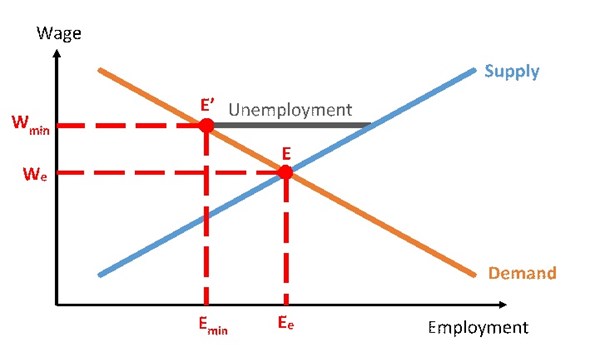
Normally, wages are determined at the intersection of supply (employees offering their services, the blue line) and demand (employers wanting workers, the orange line), the letter E. Since working in retail or restaurants requires little more than a high school diploma, that equilibrium is much lower than, say, a heart surgeon, who must endure years of training and study.
But when governments come and impose a minimum wage (the dark line), wages do increase… at the expense of workers. With a base wage now at E’, more workers want to work but fewer employers want to hire because of the increased cost. The newly formed triangle is made of surplus workers, i.e. unemployed workers who can’t find a job. This unlucky Brian meme summarizes the situation of what minimum wage is: wage eugenics.
And don’t think it’s a vice; creating unemployment was the explicit goal of imposing a minimum wage. It was a Machiavellian scheme imagined during the so-called Progressive Era (late 19th Century to about the 1920s), where it was thought that governments could better humanity by “weeding out” undesirables – in other words, eugenics.
In the U.S., this eugenic attitude was explicitly aimed at African Americans, whose (generally) lower productivity gave them lower wages. To “fight” this problem nationwide, the Hoover administration passed, in 1931, the Davis-Bacon Act in order to impose “prevailing wage” (usually unionized) on all federal contracts. It was a thinly veiled attempt to “weed out” non-unionized workers, who were either African American or immigrant, in order to protect unionized, white jobs. Supporters of the bill, like Representative Clayton Algood, were very explicit in their racist intents:
That contractor has cheap colored labor that he transports, and he puts them in cabins, and it is labor of that sort that is in competition with white labor throughout the country.
But while the racist intent of the minimum wage has disappeared, its effect is always very real. It greatly affects the people it wants to help, i.e. low-skilled workers, and leaves them with fewer options. So don’t be fooled by unemployment statistics from the Bureau of Labor Statistics. Youth participation rates (ages 16-19) are still hovering around all-time lows (affected, among others, by minimum wage laws); this means that fewer of them are looking for jobs, decreasing unemployment figures.
It gets worse when breaking down races; only 28.8 percent of African American youth were working or looking for a job, compared to 31.6 for Hispanics and 36.7 percent for whites in December 2017.
Comments Off on The origins of the minimum wage


