
So-called “trade-adjustment assistance” sounds lovely, but this sound is deceptive. Such ‘assistance’ is a policy of socializing losses while keeping gains privatized – which means, therefore, that it is a policy that creates moral-hazard problems. More generally […] the economic and ethical case against trade-adjustment assistance is fraudulent because there is nothing unique about international trade in destroying particular jobs, businesses, and industries. Why should the worker who loses his job in the steel factory to increased imports of steel receive government assistance while the worker who loses her job in the aluminum factory to increased domestic production of carbon-fiber materials be denied such assistance? There is no good reason to treat the two cases differently.
Neither worker is entitled, economically or ethically, to any such ‘assistance.’
Of course, someone might argue that both of these workers should receive government assistance. Apart from such a policy intensifying moral-hazard problems (“Is your firm’s bankruptcy really due to changing patterns of economic activity rather than to your own incompetence as a business owner?”) – and also apart from the need to give such assistance now to the many people who will lose businesses and jobs because of the resulting increase in taxes that must be raised to pay all of this ‘assistance’ (Why should workers and businesses who suffer as a result of changes in government polices be treated differently than those who suffer as a result of changes in private economic activities?) – such a policy of assistance is premised on the false and economically calamitous assumption that the ultimate goal of economic activity is to ensure the well-being of existing producers rather than to satisfy as many consumer desires as possible. The serious pursuit of any such policy would grind the economy to a standstill, and all but the powerful elite into crushing poverty.
Don Boudreaux, “Quotation of the day…”, Café Hayek, 2016-07-14.
March 20, 2018
QotD: “Trade-adjustment assistance”
March 19, 2018
QotD: Unintended consequences, recycling division
The hallmark of science is a commitment to follow arguments to their logical conclusions; the hallmark of certain kinds of religion is a slick appeal to logic followed by a hasty retreat if it points in an unexpected direction. Environmentalists can quote reams [!] of statistics on the importance of trees and then jump to the conclusion that recycling paper is a good idea. But the opposite conclusion makes equal sense. I am sure that if we found a way to recycle beef, the population of cattle would go down, not up. If you want ranchers to keep a lot of cattle, you should eat a lot of beef. Recycling paper eliminates the incentive for paper companies to plant more trees and can cause forests to shrink.
Steven Landsburg, The Armchair Economist, 1993.
March 18, 2018
QotD: National flags
If you have never investigated or thought through this odd phenomenon of national anthems, it might not occur to you that it is not OK to tamper with the lyrics. There was a time not so long ago when national flag etiquette was fairly severe. Flags were seen as essentially military emblems, and their use was informed by military protocols. When flags started to be turned into clothing and ironic art in the 1960s, and were exposed to the demoralizing effects of marketed consumer kitsch in the 1970s, these developments were greeted with unease. Not so much in Canada, of course: our flag was invented as a marketing device in a time of consumerism, and it had not been used to soak up oceans of blood, so it lacks the sobering associations other flags have. It had a virgin birth. We are quite welcome to slap it onto a backpack or a truck bumper.
The point is that flags can now be visually remixed with near-total freedom by artists and designers and inserted into all sorts of contexts with relatively little discomfort. If you want to put Donald Trump in an editorial cartoon with a gore-oozing Stars and Stripes, no contemporary American will kick up too much fuss. Yet the taboos around anthems, as Remigio Pereira discovered, seem to have grown stronger. And even as someone who was instinctively furious with him, I am not quite sure how this happened, or why.
Colby Cosh, “Let’s talk about anthems”, National Post, 2016-07-14.
March 17, 2018
Toys ‘R’ Us did for toys what Borders and Barnes & Noble did for books
We have lived through the golden age of the big box store, and the less-fit are now going to the wall. Virginia Postrel looks at the history of Toys’R’ Us and how it changed the toy market:
I wasn’t a Toys ‘R’ Us kid.
By the time the big box wonderland arrived in my hometown, I was a 25-year-old business reporter living 900 miles away. So instead of conjuring up memories of dolls, bikes and video games, the chain’s imminent demise reminds me of what the world was like before it arrived: Most toys were available only around Christmas and even then the choices were limited unless you lived in a big city. We got my doll house in Atlanta.
Toys ‘R’ Us changed that. “They got a million toys at Toys ‘R’ Us that I can play with,” boasted its famous jingle. “The selection — more than 18,000 different toys in every store — is almost inconceivably vast,” wrote David Owen in a 1986 Atlantic article on the toy business. “There’s an enormous opportunity in America if you’re willing to make a commitment to inventory,” founder Charles Lazarus told him.
Indeed there was.
What Toys ‘R’ Us did for toys, Home Depot and Lowe’s did for hardware; Best Buy and Circuit City for electronics and music; Borders and Barnes & Noble for books; Bed, Bath and Beyond and Linens n’ Things for home goods; and Staples, Office Depot and Office Max for office supplies. The rise of category killers in the 1980s accustomed consumers of all ages to unprecedented variety and choice—in any season and just about any locale. In less populated areas, Walmart filled in the gaps.
By internet standards, the selection Owen termed “inconceivably vast” now looks paltry. “I stopped by my local Best Buy to do research, and found they stock something like 30,000 different titles,” I wrote in 1999. Looking at that text today I wondered if the number was a typo. A mere 30,000? Surely there was a missing zero. Or two.
March 16, 2018
Mostly Weekly Series Finale: Creative Destruction
ReasonTV
Published on 14 Mar 2018In the final episode of the webseries, we tackle how markets make and break stuff.
—–
In free and open markets people are able to make new technologies and business models, which displace older, established ones. That process of starting new companies and jobs destroys some professions while creating others.
It’s entirely understandable that people who lose their jobs want to keep them. But industries like manufacturing, coal mining, and mall retailers aren’t dying out because of competition from China, they’re being outmoded by automation, cheaper fuel sources, and online sales.
Despite the uncertainty that markets bring, they also create new jobs and entirely new professions. There aren’t gangs of unemployed lamplighters roaming the land; their descendants became Uber drivers, social media coordinators, and webseries producers.
In the end, it’s better for everyone to look at the world as it is and to move forward than to try and halt progress through the force of law.
Mostly Weekly is hosted by Andrew Heaton with headwriter Sarah Rose Siskind.
Script by Andrew Heaton and Sarah Rose Siskind with writing assistance from Brian Sack.
Edited by Austin Bragg and Sarah Rose Siskind.
Produced by Meredith and Austin Bragg.
Theme Song: Frozen by Surfer Blood.
March 15, 2018
QotD: The self-harming reality of tariffs
Unintended harm to American companies is a recurring problem with tariffs, even those meant to protect American jobs from competition that our government deems unfair. After Bush imposed steel tariffs, steel-consuming industries pointed out that they employed far more Americans than the steel industry itself, and argued that the net effect of the policy on jobs was negative.
Anti-dumping laws, which put tariffs on foreign imports that are supposedly being sold at too low a price, usually target intermediate goods and therefore make the downstream American producers that use them less competitive. Daniel Ikenson, a trade-policy analyst at the Cato Institute, notes that the government, perversely, is forbidden by law from considering the impact of tariffs on these producers before levying the tariffs.
Then there’s the question of costs. Gary Hufbauer and Sean Lowry, a senior fellow and research associate, respectively, at the Peterson Institute for International Economics, calculated [PDF] that Obama’s tariffs on Chinese tires cost American consumers at least $900,000 for every job they saved for one year. That’s before taking account of job losses caused by lower spending by consumers on other products and by retaliatory Chinese tariffs. This very high cost per job, they point out, is consistent with research on other instances of trade protection.
In an interview, Hufbauer notes that our efforts to protect industries from competition have typically not resulted in their revival and impose extremely high costs for any jobs they save. He cites the textile and maritime industries, both of which have been protected for decades, as examples of these disappointing results.
Ramesh Ponnuru, “The High Cost of U.S. Protectionism”, Bloomberg View, 2016-07-01.
March 12, 2018
The pesky and persistent gap between what men earn and what women earn
Tim Worstall responds to yet another Guardian article decrying the difference in earnings for men and women:
There is a gender earnings gap in British – as with all others – society. The interesting question is what is causing it, the important one what we do about it. The answers being, in turn, children and nothing.
This is not, you will note, the general direction of the political conversation. It does have the merit of being true on both counts.
Take this finding that there are lots more highly paid men out there:
There are almost four times more men than women in Britain’s highest-paid posts, according to “scandalous” figures that show the extent of the glass ceiling blocking women from top jobs.
Government data reveals the huge disparity in the number of men and women with a six-figure income, fuelling concerns over the gender pay gap in the City and other professions.
There were 681,000 men earning £100,000 or more in 2015-16, according to new HMRC data. It compares with only 179,000 women. The latest figures show that 17,000 men earned £1m in 2015-16, while only 2,000 women did so.
Those numbers are true. There are more men earning higher incomes than there are women. This is the entire and whole driver of that gender pay gap – or what it actually is, a gender earnings gap. And what is the cause of this? As the TUC has pointed out [PDF]:
There is an overall gender pay gap of 34 per cent for this cohort of full-time workers who were born in 1970. This gap is largely due to the impact of parenthood on earnings – the women earning less and the men earning more after having children.
That really is just about all there is to it. It’s illegal, and has been for decades, to pay people differently based solely upon their gender. People doing the same job get the same pay by gender – there’re fortunes to be made dobbing in employers where this isn’t the case and we don’t see such dobbing in happening.
[…]
We can also point out that the true answer here is entirely in womens’ hands. Granny knew how to manage G-Pops, Lysistrata shows the Ancient Greeks got the point. If the only way men got nookie and or children was by being house husbands then there wouldn’t be a gender earnings gap, or it would run the other way. That women don’t strike for this – perhaps that not enough do – shows that this might well not be what women actually want.
OK, maybe not in womens’ hands but certainly in their control….
March 6, 2018
Winning a Trade War Isn’t “Easy”… It’s Impossible!
Foundation for Economic Education
Published on 5 Mar 2018Trump wants to impose tariffs on steel and aluminum? Bad idea. We’ve been down this road before. Trade wars are short-sighted and economically destructive.
Ever wondered what caused the Great Depression? Check out this free eBook (available in mobi, epub, PDF, and audiobook formats!) by Larry Reed, “Great Myths of the Great Depression:”
https://fee.org/resources/great-myths-of-the-great-depression/
Real estate reality may finally be changing minds in Silicon Valley
I’ve never lived in Silicon Valley, and my one vist there was over 25 years ago — but even then, I thought the real estate market was far higher than it should have been. The sale of a tiny house in Sunnyvale (for $2 million or $2,358 per square foot) is symbolic of real estate values all around the area, as the stories get told of new employees living in their cars because even on six-figure salaries, they can’t afford to buy or even rent near where they work. Iowahawk linked to a New York Times article which shows that some movers and shakers acknowledge that Silicon Valley has a serious problem:
Silicon Valley execs devise strategy to solve Silicon Valley affordable housing crisis: GTFO of Silicon Valleyhttps://t.co/MlRDfqJWbD
— David Burge (@iowahawkblog) March 5, 2018
If there was ever an industry that had no reason to be concentrated in one geographic location, it's software tech.
— David Burge (@iowahawkblog) March 5, 2018
In 95% of the American landmass, this is a $75,000 house. (ht @rdmcghee)https://t.co/sv8pwNS0g1
— David Burge (@iowahawkblog) March 5, 2018
I mean, I can kind of understand expensive housing in NY or SF, but Silicon Valley? It has all the excitement of Dubuque, at Monaco prices
— David Burge (@iowahawkblog) March 5, 2018
"I'm only 1 hour from the mountains and beaches!" – Silicon Valley drone coding at 2 AM to pay his $2 million house trailer mortgage
— David Burge (@iowahawkblog) March 5, 2018
March 2, 2018
QotD: Cronyism
… I would argue that we don’t have truly free trade or, increasingly, a free economy in the United States. The Progressives always look at the rising income inequality and maintain that it’s the inevitable result of capitalism. That’s hogwash, of course, and Proggies believe it because they’re dolts. But the problem in this country isn’t free trade — we have precious little of it — or unrestricted capitalism, since we have precious little of that as well. The issue behind rising income inequality isn’t capitalism, it’s cronyism. Income isn’t being redirected to the 1% because capitalism has failed, it’s happening because we abandoned capitalism in favor of the regulatory crony state and its de facto collusion between big business/banking interests and a government that directs capital to favored political clients, who become “too big to fail”. It doesn’t matter, for instance, whether the president is a Democrat or Republican, because we know the Treasury Secretary will be a former — and future — Goldman Sachs executive.
Indeed, what we call “free trade” nowadays isn’t the Theory of Comparative Advantage in action. It’s corporations being allowed to ship jobs to low wage countries overseas to offset the cost of regulatory burdens in the US that restrict competition from new entrants to the market. That works great for large corporations. Not only do they get to offset the regulatory costs by overseas production, but slower job growth in the US flattens domestic wages, too, and sends millions out of the labor force altogether. For working people, the biggest financial rewards from the current “free trade” regime seem mainly reaped by large business and banking interests. Again, people know if their own lives are better or worse than they used to be, and if the promises of elites have been born out by their own experience.
Dale Franks, “Vote Properly, You Virulent Racist!”, Questions and Observations, 2016-06-28.
February 26, 2018
A few jotted notes on woodworking plane companies
I’ve been dabbling more in the woodworking hand tool market recently, and found myself getting confused about the various manufacturers and their products. Mostly to try to sort out the history for myself, I started taking notes as I trawled from website to forum to auction site, looking for answers. In a very abbreviated and assuredly incomplete and inaccurate thumbnail sketch, here’s how I think the woodworking hand tool market has changed over the last hundred and fifty years or so:
- Until the mid-19th century, most woodworkers made their own tools whenever they could, as the ability of manufacturers to produce economical, dependable tools was limited, and woodworkers (like other skilled craftsman of the early industrial era) were capable of producing most of the necessary tools with only minimal outlay to other trades.
- By the mid-19th century, innovators and inventors were prolific in their proposed solutions to all kinds of problems (some real and many probably imaginary). Among those many, many febrile innovators was a gentleman named Leonard Bailey. Bailey managed to almost single-handedly revolutionize the woodworking market by coming up with a line of hand planes that could out-compete most of the hand-made competitors while taking advantage of the economies of scale offered by mass production. It became more economical for a woodworker to buy a ready-made tool rather than take time away from productive work to fabricate it for himself.
- The Stanley Works of Massachusetts bought Bailey’s company — probably more for the value of Leonard’s patents than for the company’s sake itself — and parlayed that patent protection into becoming the acknowledged standard for woodworking planes.
- Even after the Bailey patents expired, other manufacturers paid backhanded tribute to Bailey by straight-out cloning his designs with very minor changes and putting their own functional copies on sale in direct competition with the original Stanley products … often even using the same or barely concealed names/numbers for their clones (for example, the British company Record generally just prepended a zero in front of the “standard” Stanley model numbers, where a #4 plane from Stanley was a #04 from Record).
- In the British market following the financial crisis of 1929, the government’s imposition of tariffs against inter alia American hand tool manufacturers encouraged many British companies to introduce Stanley clones for both domestic and Imperial markets. To their credit, not all of the opportunistic entrants went for the low-hanging fruit, and some of the British clones were at least as good and in some cases superior to the original products.
- After the Second World War, the market for woodworking hand tools in North America began a rapid decline, although it remained strong enough in Britain to keep many of the clone manufacturers going for another 20 years or so. In response to the softening market, Stanley began to cheapen their manufacturing processes and the product quality began a precipitous decline.
- By the early 1970s, Stanley had almost completely given up the hand tool market in woodworking, and their products were a sad mockery of what they’d been producing just a decade before, but North American woodworkers were inundated with innovative power tools from, among others, Black & Decker and the Sears Craftsman line that promised better/faster/more productive output from amateur woodworking shops than could be done with hand tools alone. That, coupled with the decreased emphasis on “shop” subjects in North American high school curricula meant that youngsters didn’t automatically become familiar with the use of hand tools unless they were already interested and had access to a workshop to indulge that interest.
- The same process of shrinking market requiring “rationalization” and “economization” hit the British manufacturers fifteen to twenty years after Stanley and their surviving American competitors, and the order of the day was ever-shrinking profit margins, smaller markets, and mergers/bankruptcies/take-overs among the tool manufacturers.
- After the financial bloodbath of the 70s through the 90s, it became clear that there was still a small-but-affluent market for quality woodworking hand tools, and a few new entrants made their mark by first copying the best designs of the past and then, hesitatingly, innovating with modern technology beyond what was possible a generation or two earlier.
Here are some notes I jotted down about a few of the key woodworking hand tool manufacturers and their respective rise and decline, based on a very cursory survey of what information is available online at the moment:
STANLEY (USA, UK, CANADA and AUSTRALIA)
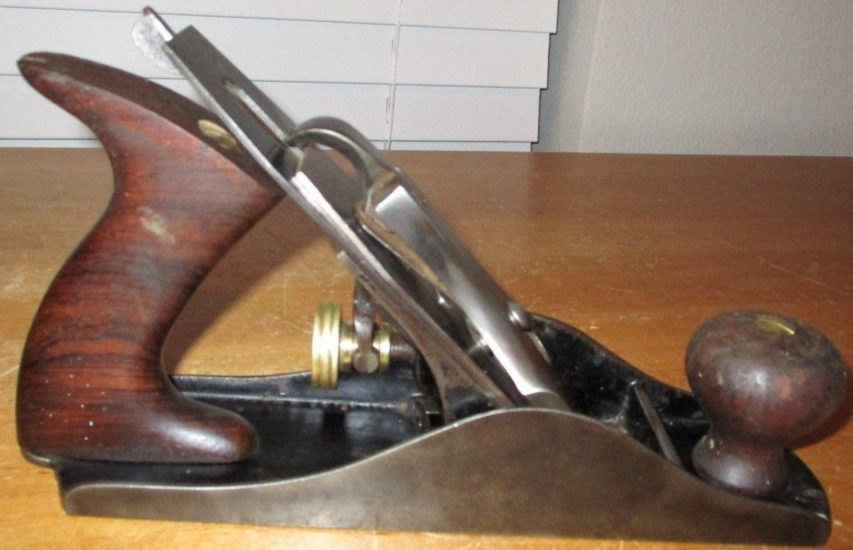
A vintage Stanley No. 4 smoothing plane from a recent eBay listing. Even though this is the single most common woodworking plane ever, the example I own is a late-70s piece of crap, so I went looking for a more representative image.
The Stanley Works was founded in 1843 by Frederick Stanley in New Britain, Connecticut.
In 1857, the Stanley Rule & Level Company was founded by Frederick Stanley’s cousin Henry. I imagine most people of the time assumed there was only the single Stanley company, as they produced products in related-but-not-competitive fields.
Stanley purchased Bailey, Chaney and Company in 1869 along with the Bailey plane patents. The Bailey patents were the key to Stanley’s future dominance of the hand plane market.
Stanley Rule & Level Co. purchased the Roxton Tool and Mill Company in Roxton Pond, Quebec (founded 1873). Manufacturing continued here from 1907 until about 1984. From the timing, I assume this was seen as a good way to get Stanley hand tools into the Canadian market without paying tariffs.
In 1920, The Stanley Works merged with the Stanley Rule & Level Company. The initials “S.W.” within a heart outline was introduced at that time. Later references to tools with this mark invariably refer to them as “Sweetheart”, but it’s not clear that the newly unified Stanley used that term in their own marketing until a few years later. The logo and name have been revived in the last decade or so, probably to cash in on the nostalgia factor.
In 1937, Stanley acquired J.A. Chapman (of Sheffield, England). I’m assuming this was a shortcut to getting non-tariff access to the British (and Imperial) hand tool market.
Stanley manufactured planes in Australia from 1965 to the early 1990s in Moonah, Tasmania.
In 2010, The Stanley Works merged with Black & Decker to become Stanley Black & Decker (Stanley Hand Tools is a division of the much larger company).
MILLERS FALLS (USA)
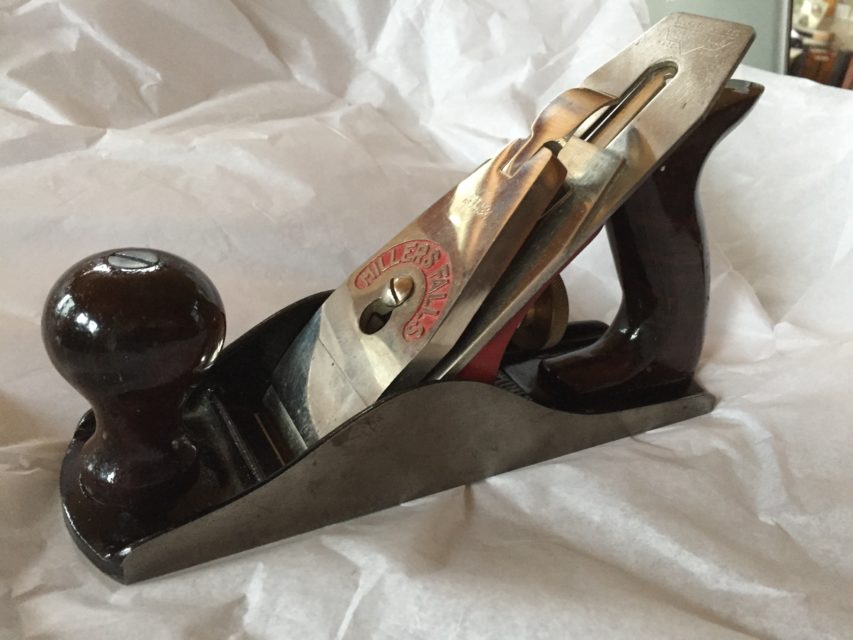
I happen to actually own a Millers Falls #9 smoothing plane (as of Friday). Look similar to the Stanley #4 above? It should, as it’s a near-clone.
Incorporated in 1868 as the Millers Falls Manufacturing Company, renamed as the Millers Falls Company in 1872. Introduced hand planes into its line of tools in 1928/29. Millers Falls chose to compete for the high-end of the hand tool market and managed to carve out a profitable niche for themselves, especially in the hand plane segment. Their futuristic plastic-and-chrome “Buck Rogers” planes of the late 1950s were visually distinctive enough that they kept the company in the black for longer than almost all of their US competitors.
In 1957, Millers Falls acquired the Union Tool Company of Orange, Massachusetts. The Union brand was kept active until 1975 when the Union plant was closed down.
Millers Falls became a subsidiary of Ingersoll Rand in 1962, and closed down their Massachusetts operation in 1982 with a corporate relocation to New Jersey after a buyout.
RECORD (UK)
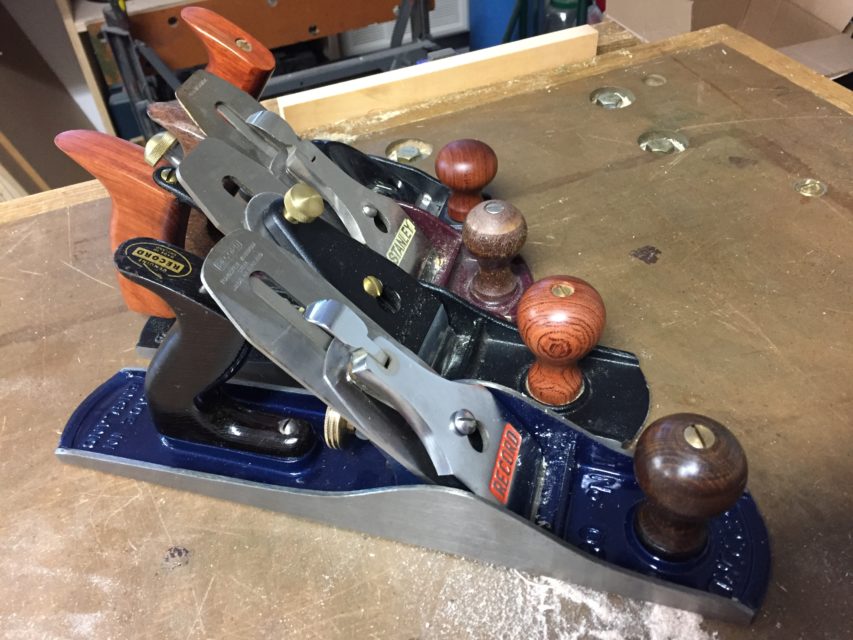
(front) A Record No. 05 jack plane, a close copy of the Stanley #5
Record was a brand name used by C & J Hampton from 1909. The company was founded in 1898 and incorporated a decade later. The founders, Charles and Joseph Hampton, had left the family business (The Steel Nut & Joseph Hampton Ltd in Wednesbury, Staffordshire) to set up shop in Sheffield. Joseph eventually returned to the family firm, but the sons of Charles succeeded to leadership roles in the younger company.
The first Record planes were offered for sale in 1931 (No. 03 through 08 and three block planes: No. 0110, 0120 and 0220). Record got into the plane business partly due to the preferential tariffs the British government levied on foreign (mainly American) hand tools and the fact that the Stanley Works’ Bailey patents had expired, so there was no legal issue with flat-out cloning Stanley’s plane line.
In 1934, Record took over production of some Edward Preston and Sons Ltd. products (mainly bullnose and rabbet planes). Preston had been acquired by John Rabone and Sons Ltd. (Birmingham) in 1932, but they decided to stick with the rule and level business and offload the plane manufacturing to Record.
Woden Tools Ltd was purchased from The Steel Nut & Joseph Hampton Ltd in 1961 and Record continued to use the Woden trademark for another 10 years (some sources say only five years: take your pick).
Record acquired 50% of William Marples and Sons Limited in 1963, the other 50% being held by William Ridgway & Sons, Ltd. (Parkway Works), also of Sheffield.
In 1972, Record merged with Ridgway to form Record Ridgway Tools Ltd.
In 1982, Record Ridgeway was acquired by AB Bahco of Sweden, but a management buyout in 1985 took it back to British ownership as Record Holdings plc.
In 1988 the company became Record Marples (Woodworking Tools) Ltd.
In 1998, Record Marples accepted an offer from American Tool Corporation and became part of the Record Irwin Group as Record Tools Ltd. Irwin was acquired by Stanley Black & Decker in 2017.
WODEN TOOLS (UK)
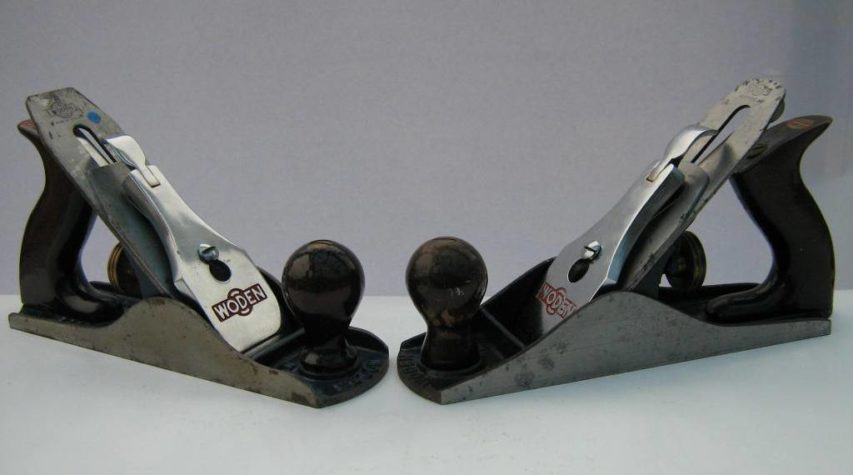
A pair of Woden planes as shown on the wodentools.com website.
Woden Tools was a wholly owned subsidiary of The Steel Nut & Joseph Hampton Ltd, producing planes from 1953/54 in Wednesbury, Staffordshire. (The planes were originally manufactured by W.S Manufacturing (Birmingham), which was acquired by The Steel Nut & Joseph Hampton around 1952.)
C & J. Hampton (Record) purchased Woden Tools Ltd from SNJH in 1961 and continued to use the Woden trademark for another 10 years (some sources say only until 1965).
LEE VALLEY/VERITAS (CANADA and USA)
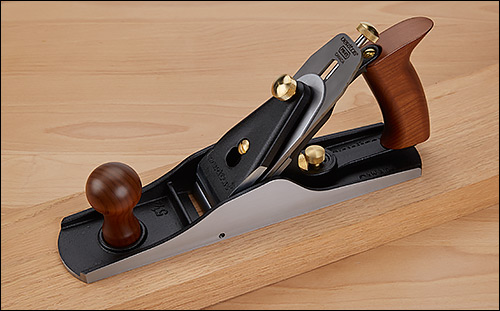
A current Veritas 5 1/4 junior jack plane from Lee Valley Tools
Founded in 1978 by Leonard Lee in Ottawa, Ontario. The first out-of-town store was opened in 1982 (Toronto West). I think I visited that store in its original location in 1984. The company launched their website in 1997 and added e-commerce features in 2000.
In the early-to-mid 1980s, Lee Valley contracted with Footprint (UK) to produce a line of bench planes to their specifications. The “Paragon” line were sold in Canada by Lee Valley and by Garret Wade in the United States for a few years, but quality issues apparently doomed the venture. In a thread on the Sawmillcreek.org forums, Robin Lee said “Actually – we ‘remanufactured’ many of them here [in Ottawa]… We set out the specs, made some tooling changes, and had Footprint make them for us (and GW). All planes were received and inspected … – and in many cases, fettled and reground… We abandoned the brand shortly after – and formed Veritas tools as our manufacturing company…”
In 1999, the first Lee Valley manufactured plane, the Low-Angle Block Plane, was introduced. The Veritas line of bench planes was launched in 2001. The first shoulder plane was introduced in 2003. In 2014, the Veritas Custom Bench Plane line was introduced, which the company characterizes as the first user-customizable line of planes in the industry.
In 1982, the company began manufacturing its own tools under the Veritas label. In 1985, Lee Valley Manufacturing Ltd. was incorporated and later renamed as Veritas Tools, Inc. Manufacturing is primarily in Ottawa and (possibly) in Ogdensburg, New York.
February 21, 2018
British KFC outlets fall fowl of distribution fustercluck
The BBC reports on recent supply disruptions that have forced the majority of British KFC restaurants to close or run reduced hours:
KFC says some of the outlets which had to close when delivery problems meant they ran out of chicken have reopened.
Latest figures show that 470 of the fast-food chain’s 900 outlets in its UK-based division were shut as of 13:00 on Tuesday.
That compares with 575 that were closed at 21:00 on Monday.
Last week, the fried chicken chain switched its delivery contract to DHL, which has blamed “operational issues” for the supply disruption.
Earlier a KFC spokesperson said: “We anticipate the number of closures will reduce today [Tuesday] and over the coming days as our teams work flat out all hours to clear the backlog.
“Each day more deliveries are being made, however, we expect the disruption to some restaurants to continue over the remainder of the week, meaning some will be closed and others operating with a reduced menu or shortened hours.”
[…]
Until 13 February, KFC’s chicken was delivered by specialist food distribution group Bidvest.
But after the contract switched to DHL, many of the food giant’s outlets began running out of chicken products.
The GMB union said it had tried to warn KFC that switching from Bidvest to DHL was a mistake. The change led to 255 job losses and the closure of a Bidvest depot, said Mick Rix, GMB national officer.
He said: “Bidvest are specialists – a food distribution firm with years of experience. DHL are scratching around for any work they can get, and undercut them.
“KFC are left with hundreds of restaurants closed while DHL try and run the whole operation out of one distribution centre. Three weeks ago, KFC knew they had made a terrible mistake, but by then it was too late.”
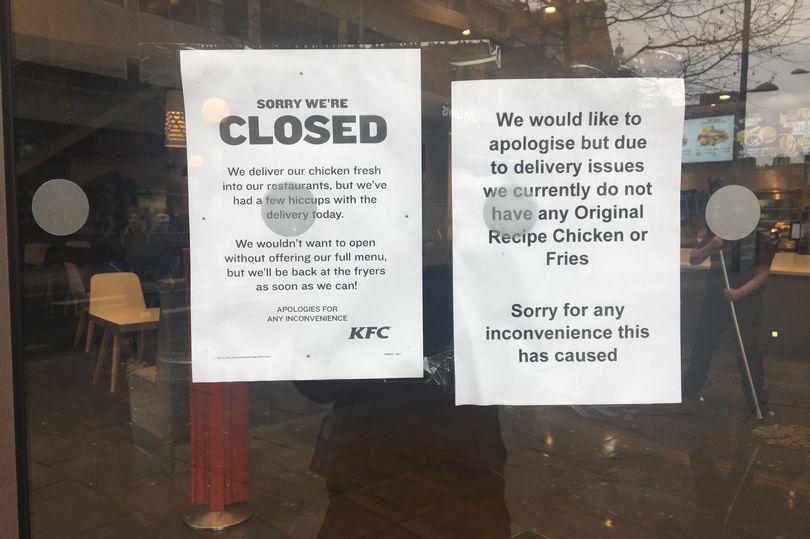
Signs posted in a KFC store window in Nottingham
Photo from the Nottingham Post (click image to read their article)
H/T to Jim Guthrie, who said “I suspect that this will be a ‘how not to do it’ example in delivery logistics for years to come.”
February 19, 2018
Google disappears the “View Image” button from their image search page
At Ars Technica, Ron Amadeo explains what happened:
This week, Google Image Search is getting a lot less useful, with the removal of the “View Image” button. Before, users could search for an image and click the “View Image” button to download it directly without leaving Google or visiting the website. Now, Google Images is removing that button, hoping to encourage users to click through to the hosting website if they want to download an image.
Google’s Search Liaison, Danny Sullivan, announced the change on Twitter yesterday, saying it would “help connect users and useful websites.” Later Sullivan admitted that “these changes came about in part due to our settlement with Getty Images this week” and that “they are designed to strike a balance between serving user needs and publisher concerns, both stakeholders we value.”
[…] Adhering to copyright law is still the user’s responsibility, and a whole lot of images on the Web aren’t locked down under copyright law. There are tons of public domain and creative commons images out there (like everything on Wikipedia, for instance), and lots of organizations are free to use many copyrighted images under fair use. There are also many times when content on a page will change, and the “visit site” button will go to a webpage that doesn’t have the image Google told you it had.
For users who want to stick with Google, the image previews you see are actually hot-linked images, so right clicking and choosing “open image in new tab” (or whatever your equivalent browser option is) will still get you a direct image link. There is also already an open source browser extension called “Make Google Image Search Great Again” that will restore the “View Image” button. But if you’re looking to dump Google over this change, Bing and DuckDuckGo continue to offer “View Image” buttons.
Concerns about copyright are a big reason I tend to use Wikimedia or other clearly public domain images when I want to add one to a blog post.
February 18, 2018
The legal loophole that allows profiteering scumbags like Martin Shkreli to gouge the public
The US pharmaceutical market is a long way from a freely competitive environment, largely due to the amount of regulatory oversight required by lawmakers and enforced by the Food and Drug Administration (FDA). Among all the regulatory checks and balances, there’s one weird trick that allows predatory companies to reap excess profits legally — the “restricted distribution” loophole:
For immunocompromised adult patients who have the toxoplasmosis parasite, the FDA recommends taking 50 to 75 milligrams of Daraprim a day for up to three weeks, followed by half that dosage for an additional four to five weeks. So at the high end, an adult course of Daraprim therapy for a U.S. patient used to cost around $1,350 total.
While that might not seem cheap, it was a drop in the bucket compared to the cost after Turing Pharmaceuticals, Shkreli’s company, bought the rights to Daraprim and jacked the price up to $750 per pill in 2015. That move increased the cost of one course of treatment to around $75,000.
At that point you might have expected another company to jump in and start offering a generic version of the drug. But Shkreli used a regulatory loophole to keep that from happening.
You see, when a generic manufacturer wants to create a cheap version of a branded drug, it has to buy thousands of doses from the manufacturer in order to run comparison tests. Generic manufacturers use the results of these tests to prove to the FDA that their version is identical to the branded drug that the agency has already approved.
More often than not, the company that holds the marketing and distribution rights to a branded drug will sell those comparison doses to the generic manufacturer without being obstructionist, because that’s the trade-off for receiving a 20-year monopoly by way of a drug patent: The branded manufacturer gets to charge whatever they want for years and years without facing competition, and in exchange for that government-backed monopoly, it’s supposed to sell equivalency samples to generic companies.
But what if the company is run by an unscrupulous asshole like Martin Shkreli? Then it might opt to put the drug into what’s called “restricted distribution,” which means no distributor anywhere can sell comparison samples to a generic manufacturer.
The FDA originally created the concept of restricted distribution to limit the availability of drugs that might be dangerous. Methadone, for instance, was first approved in the 1940s as a painkiller. In the 1970s, the FDA restricted its availability because regulators didn’t want the opioid used for anything other than the treatment of opioid dependence. Even today, methadone can be dispensed only in highly regulated settings and only for one approved reason.
In 2007, Congress empowered the FDA to create an entire system of safety controls beyond restricted distribution, and the agency now requires the manufacturers of certain substances to develop Risk Evaluation and Mitigation Strategies (REMS) to prevent misuse and abuse of potentially problematic compounds.
The list of approved drugs that the FDA says must have an REMS is here. Daraprim is not on that list. You can’t get high off it. It’s not habit forming. Yes, the FDA label says it can be carcinogenic after long periods of use, and that it might cause birth defects if used in high doses by pregnant women. These potential effects are serious, but there is no post-market data suggesting that Daraprim is causing more harm than benefit in the intended patient population. Shkreli’s company put Daraprim into restricted distribution to boost their profits, not protect patients.
How WWI Got Women to Start Wearing Bras
Today I Found Out
Published on 3 Oct 2016In this video:
Corsets dominated the undergarments of wealthier women in the Western world for centuries, until WWI. So how did the war help popularize the bra? In a word, or two words in this case: metal shortage. The making of corsets required quite a bit of metal. Thus, in 1917, the U.S. War Industries Board asked American women to help their “men win the war” by not wearing or buying corsets.
Want the text version?: http://www.todayifoundout.com/index.p…


