
Because rice is such a different crop than wheat or barley, there are a lot of differences in the way that rice cultivation shapes the countryside. […] The thing to note about rice is that it is both much more productive on a per-acre basis than wheat or barley, but also much more labor intensive; it also relies on different forms of capital to be productive. Whole-grain wheat and brown rice have similar calorie and nutritional value (brown rice is somewhat better in most categories) on a unit-weight basis (so, per pound or ton), but the yield difference is fairly large: rice is typically around (very roughly) 50% more productive per acre than wheat. Moreover, rice plants have a more favorable ratio of seeds-to-plants, meaning that the demand to put away seeds for the next harvest is easier – whereas crop-to-seed ratios on pre-modern wheat range from 3:1 to 10:1, rice can achieve figures as high as 100:1. As a result, not only is the gross yield higher (that is, more tons of seed per field) but a lower percentage of that seed has to be saved for the next planting.
At the same time, the irrigation demands for effective production of wet-rice requires a lot of labor to build and maintain. Fields need to be flooded and drained; in some cases (particularly pre-modern terrace farming) this may involve moving the water manually, in buckets, from lower fields to higher ones. Irrigation canals connecting paddies can make this job somewhat easier, as can bucket-lifts, but that still demands moving quite a lot of water. In any irrigation system, the bunds need to be maintained and the water level carefully controlled, with also involves potentially quite a lot of labor.
The consequence of all of this is that while the rice farming household seems to be roughly the same size as the wheat-farming household (that is, an extended family unit of variable size, but typically around 8 or so members), the farm is much smaller, with common household farm sizes, even in the modern period, clustering around 1 hectare (2.47 acres) in comparison to the standard household wheat farms clustered around 4-6 acres (which, you may note with the yield figures above, lands us right back at around the same subsistence standard).
Moreover, rice cultivation is less soil dependent (but more water dependent) because wet-rice farming both encourages nitrogen fixation in the soil (maintaining the fertility of it generally without expensive manure use) and because rice farming leads naturally to a process known as pozdolisation, slowly converting the underlying soil over a few years to a set of characteristics which are more favorable for more rice cultivation. So whereas with wheat cultivation, where you often have clumps of marginal land (soil that is too wet, too dry, too rocky, too acidic, too uneven, too heavily forested, and so on), rice cultivation tends to be able to make use of almost any land where there is sufficient water (although terracing may be needed to level out the land). The reliance on the rice itself to “terraform” its own fields does mean that new rice fields tended to under-produce for the first few years.
The result of this, so far as I can tell, is that in well-watered areas, like much of South China, the human landscape that is created by pre-modern rice cultivation is both more dense and more uniform in its density; large zones of very dense rice cultivation rather than pockets of villages separated by sparsely inhabited forests or pasture. Indeed, pasture in particular seems in most cases almost entirely pushed out by rice cultivation. That has very significant implications for warfare and I have to admit that in reading about rice farming for this post, I had one of those “oh!” moments of sudden understanding – in this case, how armies in pre-modern China could be so large and achieve such massive local concentrations. But as we’ve discussed, the size of an army is mainly constrained by logistics and the key factor here is the ability to forage food locally, which is in turn a product of local population density. If you effectively double (or more!) the population density, the maximum size of a local army also dramatically increases (and at the same time, a society which is even more concentrated around rivers is also likelier to allow for riverine logistics, which further improves the logistical situation for mass armies).
But it also goes to the difficulty many Chinese states experienced in maintaining large and effective cavalry arms without becoming reliant on Steppe peoples for horses. Unlike Europe or the Near East, where there are spots of good horse country here and there, often less suited to intensive wheat cultivation, most horse-pasturage in the rice-farming zone could have – and was – turned over to far more productive rice cultivation. Indeed, rice cultivation seems to have been so productive and suitable to a sufficient range of lands that it could push out a lot of other kinds of land-use, somewhat flattening the “ideal city” model that assumed wheat and barley cultivation.
Bret Devereaux, “Collections: Bread, How Did They Make It? Addendum: Rice!”, A Collection of Unmitigated Pedantry, 2020-09-04.
September 4, 2023
QotD: Historical rice farming versus wheat or barley farming
September 3, 2023
The War is Five Years Old – WW2 – Week 262 – September 2, 1944
World War Two
Published 2 Sep 2023Five years of war and no real end in sight, though the Allies sure seem to have the upper hand at the moment. Romania is coming under the Soviet thumb and Red Army troops are at Bulgaria’s borders, the Allies enter Belgium and also take ports in the south of France. A Slovak National Uprising begins against the Germans, and the Warsaw Uprising against them continues, but in China it is plans for defense being made against the advancing Japanese.
(more…)
“This is the world of the Spring and Autumn Annals, and the Zuozhuan“
Another anonymous book review at Scott Alexander’s Astral Codex Ten considers the Zuozhuan, a commentary and elaboration of the more bare-bones historical record of the Spring and Autumn Annals:
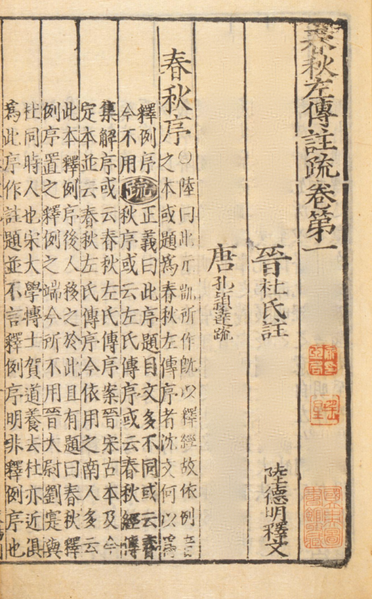
The first page of the Li Yuanyang edition of Zuo zhuan (16th century).
Wikimedia Commons.
To tell the story of the fall of a realm, it’s best to start with its rise.
More than three thousand years ago, the Shang dynasty ruled the Chinese heartland. They raised a sprawling capital out of the yellow plains, and cast magnificent ritual vessels from bronze. One of the criteria of civilization is writing, and they had the first Chinese writing, incising questions on turtle shells and ox scapulae, applying a heated rod, and reading the response of the spirits in the pattern of cracks. “This year will Shang receive good harvest?” “Is the sick stomach due to ancestral harm?” “Offer three hundred Qiang prisoners to [the deceased] Father Ding?” The kings of Shang maintained a hegemony over their neighbors through military prowess, and sacrificed war captives from their campaigns totaling in the tens of thousands for the favor of their ancestors.
But the Shang faced growing threat from the Zhou, a once-subordinate people from west beyond the mountains. Inspired by a rare conjunction of the planets in 1059 BC, the Zhou declared that there was such a thing as the Mandate of Heaven, a divine right to rule—and while the Shang had once held it, their misrule and immorality had forced the Mandate to pass to the Zhou. Thirteen years later, the Zhou and their allies defeated the Shang in battle, seized their capital, drove their king to suicide, and supplanted them as overlords of the Central Plains.
If the Shang were goth jocks, the Zhou were prep nerds. In grave goods, food-serving vessels replaced wine vessels. Mass human sacrifice disappeared, while bureaucracy expanded. The Shang lacked the state power to administer their surrounding subject peoples so much as intimidate them into line; the Zhou, galvanized by a rebellion not long after the conquest, put serious thought into consolidating their control. While the king remained in the west to rule over the original Zhou lands, he sent relatives and allies east into the conquered territories to establish colonies at strategically important locations, anchoring Zhou rule in a sprawling network of hereditary regional lords bound together by blood, marriage, custom, and ancestor worship of the Heaven-blessed founding Zhou kings.
For generations, the system worked, ensuring military successes at the borders and stability in the interior. The first reigns of the dynasty became a golden age in the cultural imagination for thousands of years. But by the dynasty’s second century, barbarian incursions were putting the state on the defensive, and surviving records hint at waning control over the regional lords and power struggles at court. 771 BC marked a breaking point, when barbarians allied with disgruntled nobles to overrun the royal domain and kill King You of Zhou.
Legend has it that the king was bewitched by his new consort, a melancholy beauty born from a virgin impregnated by the touch of a black salamander. Desperate to make her laugh, the king pranked his lords by lighting the beacon fires intended to summon them in case of invasion. When she delighted at the sight, he kept playing the same trick until the lords got sick of him and stopped coming, which doomed him when the barbarians actually invaded.
But the historical reality seems to be the usual sordid political struggle around a new consort — and heir — threatening the power of the old one. The original queen’s powerful father allied with barbarians to root out the upstart, only to get maybe more than he bargained for. Sure, he put his grandkid on the throne in the end, but the royal house had been devastated. It would never regain the ancestral lands it had lost to the barbarians, the direct holdings that filled its treasury and provided for its armies. The king retreated east into the Central Plains, playing ground of lords that were now more powerful than him. While the royal line remained symbolically important, as holder of the Mandate of Heaven from which all the states derived their legitimacy, the loss of central authority in every other sense would unleash centuries of intensifying interstate warfare and upheaval.
This is the world of the Spring and Autumn Annals, and the Zuozhuan.
The Spring
“Spring and Autumn Annals” is a bit of a redundant translation, since “spring and autumn” was just an old way of saying “year”, and thus, “annals”. And technically, there were multiple Spring and Autumn Annals — every state kept, in addition to court and administrative documents, its own laconic record of each year’s wars, diplomacy, natural phenomena, major rites, and notable deaths. But the state of Lu’s is special, because Confucius was from Lu. He’s said to have personally edited and compiled the extant version of its 242-year-long Spring and Autumn, loading each character with weighty yet subtle moral deliberation. This ensured it a place in the Confucian canon, and its survival where every other state’s annals have been lost to time. The era that it covers is named the Spring and Autumn period after the text, not the other way around.
Taken on its own, though, the Annals is little more than a list of dry facts. For example, the first year reads:
The first year, spring, the royal first month.
In the third month, our lord and Zhu Yifu swore a covenant at Mie.
In summer, in the fifth month, the Liege of Zheng overcame Duan at Yan.
In autumn, in the seventh month, the Heaven-appointed king sent his steward Xuan to us to present the funeral equipment for Lord Hui and Zhong Zi.
In the ninth month, we swore a covenant with a Song leader at Su.
In winter, in the twelfth month, the Zhai Liege came.
Gongzi Yishi died.
Who is Zhu Yifu? Who’s Duan? What’s all this about “overcoming”? Where does the moral deliberation come in? This canon badly needs meta, and the most notable of the ancient commentaries written for the Spring and Autumn Annals is the Zuozhuan. Ten times as long as the text it’s for, the Zuozhuan is the flesh on the Annals‘ bare bones, one of the foundational works of ancient Chinese literature and history-writing in its own right.
While tradition attributes the text’s authorship to Zuo Qiuming, a contemporary of Confucius, most modern historians date its compilation to the century after. In its extant form, it’s presented interleaved with the Annals, so that after the Annals’ account of each year, with entries such as …
In summer, in the sixth month, on the yiyou day (26), Gongzi Guisheng of Zheng assassinated his ruler, Yi.
… you have the Zuozhuan’s account of the year, mostly composed of elaborations upon the above entries, such as:
The leaders of Chu presented a large turtle to Lord Ling of Zheng. Gongzi Song and Gongzi Guisheng were about to have an audience with the lord. Gongzi Song’s index finger moved involuntarily. He showed it to Gongzi Guisheng and said, “On other days when my finger did this, I always without fail got to taste something extraordinary.” As they entered, the cook was about to take the turtle apart. They looked at each other and smiled. The lord asked why, and Gongzi Guisheng told him. When the lord had the high officers partake of the turtle, he called Gongzi Song forward but did not give him any. Furious, Gongzi Song dipped his finger into the cauldron, tasted the turtle, and left. The lord was so enraged that he wanted to kill Gongzi Song. Gongzi Song plotted with Gongzi Guisheng to act first. Gongzi Guisheng said, “Even with an aging domestic animal, one is reluctant to kill it. How much more so then with the ruler?” Gongzi Song turned things around and slandered Gongzi Guisheng. Gongzi Guisheng became fearful and complied with him. In the summer, they assassinated Lord Ling.
The text says, “Gongzi Guisheng of Zheng assassinated his ruler, Yi”: this is because he fell short in weighing the odds. The noble man said, “To be benevolent without martial valor is to achieve nothing.” In all cases when a ruler is assassinated, naming the ruler [with his personal name rather than his title] means that he violated the way of rulership; naming the subject means that the blame lies with him.
There’s a few too many mythological creatures and just-so stories for the Zuozhuan to be taken entirely at face value, but it’s clear that its creator(s) had access to diverse now-lost records for the era portrayed. For example, some of the events show a two-month dating discrepancy — one of the states used a different calendar, and most likely the creator(s) overlooked the difference when borrowing from sources from that state. While the overall level of historical rigor versus 4th century BC authorial invention remains under heated debate, the Zuozhuan is undeniably the most comprehensive written source on its era that we have.
And importantly, it’s enjoyable.
You can think of the Zuozhuan as the Gene Wolfe of ancient historical works. It’s not an easy read, especially in translation, where names that are visibly distinct in the original (e.g. 季, 急, 姬, etc.) all get unhelpfully collapsed into one transliteration (Ji). The work drops you into a whirl of nouns and events, some of them one-off asides, others part of long-running narrative threads that might only surface again decades of entries later. While a casual readthrough still offers plenty of rewards, putting together all the subtext, references, and connections between entries is an endeavor that’s occupied readers for millennia. Your unreliable narrator remains enigmatic on most of the events he presents, leaving interpretation as an exercise for the reader; when he does speak, either directly or in the voice of the “noble man”, he can raise more questions than he answers. For one, the rule about the naming of an assassinated ruler largely holds in the Annals, but seems to have some notable exceptions.
But if you’re willing to plunge in, the work offers an experience unlike anything else.
August 17, 2023
“… the Chinese invented gunpowder and had it for six hundred years, but couldn’t see its military applications and only used it for fireworks”
John Psmith would like to debunk the claim in the headline here:
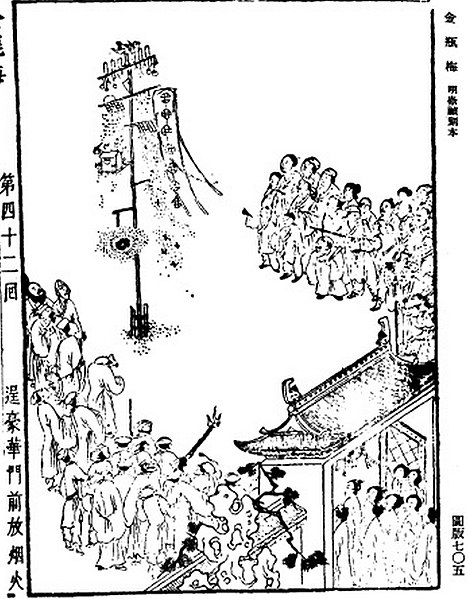
An illustration of a fireworks display from the 1628-1643 edition of the Ming dynasty book Jin Ping Mei (1628-1643 edition).
Reproduced in Joseph Needham (1986). Science and Civilisation in China, Volume 5: Chemistry and Chemical Technology, Part 7: Military Technology: The Gunpowder Epic. Cambridge University Press. Page 142.
There’s an old trope that the Chinese invented gunpowder and had it for six hundred years, but couldn’t see its military applications and only used it for fireworks. I still see this claim made all over the place, which surprises me because it’s more than just wrong, it’s implausible to anybody with any understanding of human nature.
Long before the discovery of gunpowder, the ancient Chinese were adept at the production of toxic smoke for insecticidal, fumigation, and military purposes. Siege engines containing vast pumps and furnaces for smoking out defenders are well attested as early as the 4th century. These preparations often contained lime or arsenic to make them extra nasty, and there’s a good chance that frequent use of the latter substance was what enabled early recognition of the properties of saltpetre, since arsenic can heighten the incendiary effects of potassium nitrate.
By the 9th century, there are Taoist alchemical manuals warning not to combine charcoal, saltpetre, and sulphur, especially in the presence of arsenic. Nevertheless the temptation to burn the stuff was high — saltpetre is effective as a flux in smelting, and can liberate nitric acid, which was of extreme importance to sages pursuing the secret of longevity by dissolving diamonds, religious charms, and body parts into potions. Yes, the quest for the elixir of life brought about the powder that deals death.
And so the Chinese invented gunpowder, and then things immediately began moving very fast. In the early 10th century, we see it used in a primitive flame-thrower. By the year 1000, it’s incorporated into small grenades and into giant barrel bombs lobbed by trebuchets. By the middle of the 13th century, as the Song Dynasty was buckling under the Mongol onslaught, Chinese engineers had figured out that raising the nitrate content of a gunpowder mixture resulted in a much greater explosive effect. Shortly thereafter you begin seeing accounts of truly destructive explosions that bring down city walls or flatten buildings. All of this still at least a hundred years before the first mention of gunpowder in Europe.
Meanwhile, they had also been developing guns. Way back in the 950s (when the gunpowder formula was much weaker, and produced deflagarative sparks and flames rather than true explosions), people had already thought to mount containers of gunpowder onto the ends of spears and shove them in peoples’ faces. This invention was called the “fire lance”, and it was quickly refined and improved into a single-use, hand-held flamethrower that stuck around until the early 20th century.1 But some other inventive Chinese took the fire lances and made them much bigger, stuck them on tripods, and eventually started filling their mouths with bits of iron, broken pottery, glass, and other shrapnel. This happened right around when the formula for gunpowder was getting less deflagarative and more explosive, and pretty soon somebody put the two together and the cannon was born.
All told it’s about three and a half centuries from the first sage singing his eyebrows, to guns and cannons dominating the battlefield.2 Along the way what we see is not a gaggle of childlike orientals marvelling over fireworks and unable to conceive of military applications. We also don’t see an omnipotent despotism resisting technological change, or a hidebound bureaucracy maintaining an engineered stagnation. No, what we see is pretty much the opposite of these Western stereotypes of ancient Chinese society. We see a thriving ecosystem of opportunistic inventors and tacticians, striving to outcompete each other and producing a steady pace of technological change far beyond what Medieval Europe could accomplish.
Yet despite all of that, when in 1841 the iron-sided HMS Nemesis sailed into the First Opium War, the Chinese were utterly outclassed. For most of human history, the civilization cradled by the Yellow and the Yangtze was the most advanced on earth, but then in a period of just a century or two it was totally eclipsed by the upstart Europeans. This is the central paradox of the history of Chinese science and technology. So … why did it happen?
1. Needham says he heard of one used by pirates in the South China Sea in the 1920s to set rigging alight on the ships that they boarded.
2. I’ve left out a ton of weird gunpowder-based weaponry and evolutionary dead ends that happened along the way, but Needham’s book does a great job of covering them.
August 16, 2023
Hitler Youth Murder Canadian Soldiers – War Against Humanity 109
[NR: Between me scheduling this to post and it going live, there’s a strong possibility that YouTube will have retro-actively decided it must be restricted to viewing only on YouTube. My apologies if this is the case when you see this post.]
World War Two
Published 15 Aug 2023In Normandy, the Waffen SS butcher their military and civilian enemies while some Allied soldiers play fast and loose with the laws of the war. In China, hundreds of thousands flee their homes as friend, foe, and famine take their toll. Meanwhile, the spectre of deportation haunts Eastern Europe as Stalin reshapes his new empire.
(more…)
August 13, 2023
Panzer Revenge in Normandy – WW2 – Week 259 – August 12, 1944 (CENSORED)
World War Two
Published 12 Aug 2023The Germans launch a counter-attack to sabotage the Allied positions in France. In the Baltics the Soviet advances grind to a halt, but the Soviets are busy making plans to invade Romania in the south. Meanwhile in the center the Warsaw Uprising continues. Across the world the siege of Hengyang comes to its end with a Japanese victory, but the Battle for Guam ends with a Japanese loss.
[Promoted from the comments]: An increasingly persistent challenge for us at TimeGhost is that a growing number of our videos are being age restricted. While this was always the case with War Against Humanity, it’s started affecting this weekly series now too. This most recent video was restricted before it was even publicly published. As such we made the difficult decision to publish a censored version instead this week.
Why is it such a big issue? Well it doesn’t only limit the access to educational content for young people, but also to adult audiences. Age restricted videos have a barrier to viewing that ranges from territory to territory, with some countries requiring viewers not only to have a YouTube account, but to link it with their credit card. Even if an account belongs to a verified adult, it’s still less likely to be recommended an age restricted video.
Our core mission at TimeGhost is making the lessons of our past free and accessible to people around the world. While it’s challenging, especially with the new obstacles from YouTube, it’s still possible thanks to everyone in the TimeGhost Army who backs these videos. To all of you that signed up, or who watch regularly, thank you for joining us on this mission.
August 9, 2023
America Plans to Incinerate Japan – War Against Humanity 107
World War Two
Published 8 Aug 2023The Allied Strategic bombing campaign has claimed hundreds of thousands of civilian lives across Europe and has made little real impact on the Axis war machine. Even so, the United States is determined to extend the campaign to Japan. Until now, the vast distances of the Asia-Pacific theatre have protected the imperial enemy. That all changes when the USAAF unleashes the Superfortress.
(more…)
August 5, 2023
In the “New World Order”, China was expected to become more democratic. Instead, the west is rapidly becoming more like China
N.S. Lyons discusses the unhappy convergence of Communist China with the post-democratic western world, led by the United States:

Differences and tensions between the United States and China have never been greater. The whole world is dividing itself between the blocs of these two opposing superpowers. A new Cold War is dawning, complete with a global ideological “battle between democracy and autocracy“. Freedom is on the line. The future of global governance will be determined by the winner of this extended competition between two fundamentally opposed political and economic systems – unless a hot war settles the question early with a cataclysmic fight to the death, much as liberal democracy once fought off fascism.
This is the simple and easy narrative of our present moment. In some ways it is accurate: a geopolitical competition really is in the process of boiling over into open confrontation. But it’s also fundamentally shallow and misleading: when it comes to the most fundamental political questions, China and the United States are not diverging but converging to become more alike.
In fact, I can already predict and describe the winner set to prevail in this epochal competition between these two fiercely opposed national systems. In this soon-to-be triumphant system …
Despite a rhetorical commitment to egalitarianism and “democracy”, the elite class deeply distrusts and fears the people over whom it rules. These elites have concentrated themselves into a separate oligarchic political body focused on prioritizing and preserving their rule and their own overlapping set of shared interests. Wracked by anxiety, they strive constantly to maximize their control over the masses, rationalizing a need to forcefully maintain stability in the face of dangerous threats, foreign and domestic. Everything is treated as an emergency. “Safety” and “security” have become be the watchwords of the state, and of society generally.
This elite obsession with control is accelerated by a belief in “scientific management”, or the ability to understand, organize, and run all the complex systems of society like a machine, through scientific principles and technologies. The expert knowledge of how to do so is considered the unique and proprietary possession of the elite vanguard. Ideologically, this elite is deeply materialist, and openly hostile to organized religion, which inhibits and resists state control. They view human beings themselves as machines to be programmed, and, believing the common man to be an unpredictable creature too stupid, irrational, and violent to rule himself, they endeavor to steadily condition and replace him with a better model through engineering, whether social or biological. Complex systems of surveillance, propaganda, and coercion are implemented to help firmly nudge (or shove) the common man into line. Communities and cultural traditions that resist this project are dismantled. Harmfully contrary ideas are systematically censored, lest they lead to dangerous exposure. Governing power has been steadily elevated, centralized, and distributed to a technocratic bureaucracy unconstrained by any accountability to the public.
All of this is justified by a utopian ideological dialectic of historical progress and inevitability. Those more in tune with the tide of history (i.e. elite interests) are held to be morally and intellectually superior, as a class, to backwards reactionary elements. Only certain views are stamped “scientific” and “correct,” although these may change on a political whim. An economism that values only the easily quantifiable reigns as the only moral lodestar, and frictionless efficiency is held up as highest common good; the individual is encouraged to fulfill his assigned role as a docile consumer and cog in the regime’s machine, not that of a self-governing citizen. The state regularly acts to stimulate and manage consumer demand, and to strategically regulate and guide industrial production, and the corporate sector has largely fused itself with the state. Cronyism is rampant.
The relentless political messaging and ideological narrative has come to suffuse every sphere of life, and dissent is policed. Culture is largely stagnant. Uprooted, corralled, and hounded, the people are atomized, and social trust is very low. Reality itself often feels obscured and uncertain. Demoralized, some gratefully accept any security offered by the state as a blessing. At the same time, many citizens automatically assume everything the regime says is a lie. Officialdom in general is a Kafkaesque tragi-comedy of the absurd, something only to be stoically endured by normal people. Yet year by year the pressure to conform only continues to be ratcheted higher…
Which country does this describe? If you can’t quite tell, well, that’s the point. For many citizens of the West, the systems of governance under which we live increasingly feel uncomfortably similar to what appears offer in the People’s Republic of China.
July 23, 2023
QotD: Losing the Mandate of Heaven is fatal for a ruler
… so long as the rulers keep the Mandate of Heaven.
That no doubt seems like a stolen base, as something as amorphous as the “Mandate of Heaven” can be stretched to cover just about anything, but it’s the best I can do to convey what I mean. And I think you’ll see the utility of it when we look at a few examples. The negative first: Since Usurpers are much in the news these days, look at any successful one. England’s Henry IV, for example, or Henry VII. They had endless troubles during their personal rule, as all the people who mattered knew them when they were just one noble among many. Their sons, on the other hand, sat about as easily on the throne as any medieval monarch could, and while some of that was no doubt due to their sterling personal qualities,1 a lot of it was simply, for lack of a better term, “the Mandate of Heaven” — the Usurper who delivered stability and competence in his lifetime passed on the purple to a stable, competent son, which proves the regime’s essential rightness.
In other words, inertia kicks in — just an object in motion tends to stay in motion, a competent regime continues competent, in public perception at least. Those who are old enough to remember the Wars of the Roses (etc.) are just grateful that they don’t have to go through it again, while the younger generations simply don’t know any different. So long as the usurper’s son isn’t both personally loathsome and egregiously incompetent, things will go on much as before. (And please note what an extremely high bar that is — we’re talking Nero- or Commodus-level loathsome incompetence. France spent a lot of the Hundred Years’ War under the “leadership” of a filthy lunatic who thought he was made of glass, and they came out ok … largely because soon after he kicked, it was England’s turn to suffer the long reign of a filthy lunatic, but still. It’s got to be spectacular on both counts to kick off a revolution).
Severian, “Witch Trial Syndrome”, Rotten Chestnuts, 2021-01-27.
1. Opinions are bitterly divided on Henry VIII even among the laity, and professionals carry on blood feuds about it, but everyone agrees that for all his faults, the young Henry VIII was a seriously impressive guy. Contemporaries certainly thought so — Erasmus was a professional ass-kisser, but Thomas More was dazzled by Henry, too, and More was a tough guy to fool.
July 22, 2023
Did Japan Start WW2 in 1937?
Real Time History
Published 21 Jul 2023In 1937 Japan invaded the Republic of China after already annexing Manchuria in 1931. With the international settlements in Shanghai, the military support through Nazi Germany and the Soviet Union and the general escalation of the war, many argue that 1937 marked the start of the Second World War in Asia.
(more…)
July 19, 2023
QotD: If they were serious …
I suppose this should be a post unto itself, but very briefly, If They Were Serious about war with China, you’d expect a few very basic things. Massively stepped-up armaments production, if nothing else, and if you wanted to be really slick about it, you’d do it under the guise of replenishing all the stocks we sent to our plucky allies in Ukraine — purchase orders for 100x the total amount shipped to Keeeeeve, that kind of thing. But that’s the kind of retooling that’s hard to hide, because it would also involved massively stepped-up mining, refining, and so on, not to mention upgrading the transportation infrastructure and so on.
None of those things appear to be happening. And since even an all hands on deck, Nazi-style crash rearmament program has a lag time of a few years, If They Were Serious about premiering Showdown in the Taiwan Strait anytime in the next decade, they’d be jamming that shit out NOW. Right now. Afterburners full.
You also need soldiers to use all that stuff, so you’d expect massively stepped-up military recruiting. Which would entail, at minimum, a push to get American boys into some kind of fighting shape. Which not only isn’t happening, but the exact opposite is happening. Unless you want Uncle Sugar to pay for your “top surgery” or your addadicktome, why would anyone enlist? When you further consider that the same TLAs who are so smoothly rolling out their Hate the Han™ campaign could easily order up some ultra-jingoistic remakes of Stallone movies from the 1980s, it seems as if They are not, in fact, Serious …
… but some of the nodes are, because failure is a distributed system. I love playing If They Were Serious — it’s my favorite drinking game — but alas for me, it relies on the Assumed Internal Consistency Fallacy. Like the Japanese Navy, or the Wehrmacht on the Eastern Front, or even poor Adm. Kimmel, you’ve got certain nodes of the Apparat performing competently to brilliantly in the service of skull-fuckingly stupid objectives, or NO objectives. The Flying TIGRs are even dumber than [Hitler], who at least called a meeting to say “Hey, how’s about we invade Russia in the winter?” While it’s clear to everyone who matters that the TIGRs really really really really really want their war, nobody’s in charge, so everyone is left to figure it out as best they can, on their own initiative, with the resources they have to hand.
And again, much like the Wehrmacht etc., the better the competent nodes perform, the harder and faster the overall system failure. We’re going to end up charging headlong into a war with China because the TLAs at Twitter etc. are doing such a great job making Hate the Han™ the Current Thing. Meanwhile, one imagines Brandon’s handlers telling their Chinese paymasters that no no, that won’t be happening, please don’t cut off our paychecks. And since they’re pretty good at their job, too — their job being “telling Beijing what they want to hear while lugging away huge sacks of cash” — it’s gotta fuck with the People’s Liberation Army command staff.
Consider further that the Army (etc.) are, Kimmel-style, doing a pretty decent job of carrying out their on-paper objectives. Kimmel was told “Get the Fleet ready for a likely confrontation with Japan a few years down the line”, and he did it. The Fistagon has told all its commanders to get ready for a war with China, yeah, sometime down the line … but right now, the important thing is to get as many gays, girls, and trannies as possible into uniform while promoting the Diversity that’s already in uniform as far up the chain of command as possible. General Sasqueetchia, in command of the Fightin’ 45th Mechanized Hairdresser Battalion, says thanks for a job well done … and it IS a job well done, according to the only actual orders anyone has received.
Fun times, right?
Severian, “Failure Nodes”, Founding Questions, 2023-04-18.
July 18, 2023
Seaplanes? How 1940s. No, we’re seeking to “leverage emerging technologies” instead
CDR Salamander wonders about a modern need for military sea rescue capability that the US Navy filled with flying boats and seaplanes during the Second World War, then supplemented with helicopters during Korea and Vietnam. For ocean search-and-rescue in a combat environment in the present or near future, what are the USN’s plans?
I will be the first person to admit that good, well-meaning, and informed people can disagree with seaplanes in general or the US-2 specifically, but they have to engage the conversation. Directly argue the requirement or offer realistic alternatives.
This does neither. If anything is demonstrates the narrowness of thought and fragility of substance used in opposition.
What an patronizingly toxic stew that answer is. I highly doubt Lung typed out that answer himself, so my commentary below is not directed at him personally, but … and it is what comes after the “but” that counts — but at the three-digit J or N code that extruded that from the random acquisitions professional statement subroutine from ChatGPT.
Let’s give that answer a full Fisking;
- “The Indo-Pacific operational environment has evolved significantly since World War II”:
Let me check my WWII Pacific chart, my Vietnam War era globe, and GoogleEarth … and … no. The geography has not changed. The distances have not changed. The requirement of thousands of years to take and hold territory or eliminate your enemy from access to it has not changed. All the little islands, regardless of what Al Gore and John Kerry say, are still there. As we are seeing in the Russo-Ukrainian War, a million PPT slides saying so does not change the fundamentals of war.
Sentence one is invalid.
- “The employment of seaplanes today would not meet the operational demands and current threat scenario.”
Is there an operational demand for us to rescue downed airmen and to be able to reach remote islands without airfields? Yes. Does your “current threat scenario” run from Northern Japan through to Darwin, Australia? Yes.
Sentence two is invalid.
- “However, we support the continuous development of new and innovative solutions that may provide solutions to logistical challenges.”
So, you define “new” as something that only exists on PPT slides? By “continuous development” you mean never matures as a design that goes into production. By “innovative” you mean high on technology risk. Undefined program risk. Unknown design risk. No known production line or remote estimate to IOC, much less FOC when we know that the next decade is the time of most danger of the next Great Pacific War.
Sentence three is irresponsible and professionally embarrassing given the history of transformational wunderwaffe this century.
- “As an example, DARPA’s Liberty Lifter X-Plane seeks to leverage emerging technologies that may demonstrate seaborn strategic and tactical lift capabilities.”
Well, goodness, we will have to micro-Fisk this gaslighting horror show of a sentence. To start with, they are talking about either this from General Atomics;
… that could only be used on a very few select beaches under ideal weather in a completely permissive environment and could only be used for one specific mission and nowhere any possible hostile aircraft or ground forces. Also looks like we’d need a whole new engine and a small town’s worth of engine mechanics to maintain the maintenance schedule on those engines.
Then we have this offspring of an accidental mating of the Spruce Goose with the Caspian Sea Monster idea from Aurora Flight Sciences;
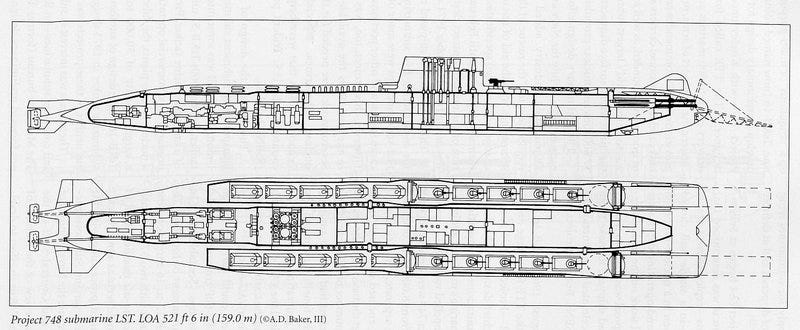
I give the odds of either one of those taking to the air prior to 2035, if ever, on par with a return of the submarine LST of Cold War fame (deck gun not included).
Let’s get back to the wording of that dog’s breakfast of a final sentence. Feel slimy reading it? You should;
- “seeks to leverage” — that is just a way of saying, “hope in magic beans.” Gobbledegook.
- “emerging technologies” — oh, you mean something that hasn’t left the computer, white board, or PPT slide.
- “that may demonstrate” — so, even if our magic beans managed to fuse unobtainium with Amrita, we’re not really sure if the strip mining of strange blue creatures’s holy sites and drilling holes in the soft pallet of whale-like thing will result in something of use.
- “strategic and tactical lift capabilities” — I’m sorry, an eight or ten-engined aircraft that any goober with a 1960s-era iron-sighted RPG-7 could target at maximum range is going do anything “tactical” — especially at the expected price of those things and the resulting precious few that wind up displacing water. Oh, and you admit that it will only be used for cargo, so it can’t do the full range of possible missions the US-2 can … just cargo. On just a few beaches that are fully surveyed ahead of time. At the right tide. In the right weather. In a 100% safe and permissive environment.
- The final sentence is a caricature.
Rep. Austin Scott (R-GA) should feel at least mildly insulted by this reply. It was a serious question given a canned answer that, slightly modified, could have been provided at any time in the last quarter century by the lethargically complacent maintainers of the suboptimal habits of the mistakingly entitled acquisitions nomenklatura


July 17, 2023
The WEF considers whether to use the carrot or the stick next time
Elizabeth Nickson on the World Economic Forum’s latest gathering in China:

Last week the WEFers held their summer camp in China. More to come, they warned us. More pandemics, more catastrophic global warming, more inflation, hell on wheels, they promise us, Armageddon is coming. Be very afraid.
The following was a particularly lovely event:
“How to Stay Within Planetary Boundaries — Carrot or Stick?” which focused on whether to incentivize or force compliance with “climate goals”. It was hosted by some joker who edits a magazine called Nature Energy, no doubt funded by the WEF and read by exactly nobody. And some very po-faced morons of various colors, paid in the six figures, cited a bunch of falsified statistics ending with these pretty little paragraphs:
We are — broadly speaking — agreed that we need to get on track towards a net-zero, climate-safe and nature-positive future, but we know this will not be easy. And we’re going to need to change behaviours of both individuals but also the way that our industries and corporations and also our governments work and practices.
We’re going to need to do this through a mixture of carrots and hopefully perhaps not so many sticks, in some kind of mix. And there is a very active and live debate as to how we go about this. But we’re likely to see an increasing move towards more stick-like interventions …
These guys, they make me laugh. Seriously? How stupid do they think we are? How hated are they? All over the world, they are loathed and laughed at. Every time one of them is taken out, we laugh and laugh and laugh. Larry Fink from BlackRock? Hiding, Scared. Mocked, publicly humiliated. We need a lot more of that.
[…]
They have to destroy western culture, because we middle-class-unnecessary-eaters are too damned uppity. They have stolen so much that when the tipping point arrives, and it will, they will be hung from the highest tree. “Better to ruin those likely to catch and imprison us, and feed on peasants and serfs, the desperate in the rest of the world.”
Proof?
OK, let’s review the Biden/Trudeau/Macron/Sunak economy shall we? Since the out-in-the-open globalist theft of elections during the past three years — Sunak was installed, Trudeau is the most hated man in Canada, Biden is gaga and Macron is just crazy — this is what the bottom 50% are experiencing. Short form, ground into the dirt.
Ninety percent of the jobs “created” were those gained back after the pandemic. Most jobs are going to the foreign born – they work cheap.
Of the roughly 900 days Joe Biden has been in the White House, real wages have fallen for almost 700 days — about 75% of Biden’s time in office. All total, the collective drop in real wages has been 3% rather than the robust real wage gains workers deserve and expect.
Every single American has lost $36,000 to Biden’s inflation. It has crippled us, especially those working in the real (not digital) economy — Uber drivers, truckers, farmers, manufacturers, ranchers, the bottom 50% — gas prices have gone up 50%. Home heating up 23%, milk 16%, beef 25%, eggs 83%. Home prices 32%, rents 15%, electricity 21%.
Let’s not even talk about interest rates. Ten raises in the last 30 months. Last week the Bank of Canada gave its people $26 million in bonuses. Meanwhile, people are losing their houses.
How much more punishment are we expected to take? This is directly caused by their mad hatter spending during the pandemic — which was fake but for a few months in early 2020 — and their subsequent restriction of the energy supply. Restriction of energy causes prices to skyrocket because producing anything requires energy.
July 3, 2023
The Battle That Prevented A Nuclear World War Three | Kapyong: The Forgotten War | Timeline
Timeline – World History Documentaries
Published 2 Jul 2023On April 24, 1951, following a rout of the South Korean army, the Chinese People Volunteer Army pursued their enemy to the lines of Australian and Canadian troops still digging fall-back defences, 39 kilometres to the rear. Here, sometimes at the length of a bayonet, often in total darkness, individual was pitted against individual in a struggle between a superpower and a cluster of other nations from across the world. They fought for a valley, the ancient and traditional invasion route to Seoul. If it fell the southern capital and the war, was lost. The United Nations troops had the military advantage of the high ground and artillery support: the Chinese relied entirely on vastly superior numbers. As a result, young men from both sides found a battle which was very close and very personal.
The Battle of Kapyong became the turning point of China’s Fifth Offensive in that Korea spring. The aim of the offensive was to finally drive the foreign troops out of South Korea and into the sea. What happened instead, changed the history of the Korean War. The Chinese were denied victory and forced back into negotiations. Had they succeeded, another crushing defeat for the US could have triggered events that led to a nuclear holocaust in Asia — and World War Three.
(more…)
July 2, 2023
Allies Liberate Cherbourg – WW2 – Week 253 – July 1, 1944
World War Two
Published 1 Jul 2023Several weeks after the invasion of Normandy began, the Allies finally take a port city there, though the actual harbor has been destroyed. On Saipan the Americans have the advantage, in Finland, the Soviets do, but the big news is the Soviet destruction of huge chunks of German Army Group Center, demolishing entire Army Corps, and surrounding tens of thousands of the enemy.
(more…)


