
Paul Sellers
Published 24 Jul 2026My hand planes have served me for six decades of daily use, and my #4 Stanley smoothing plane can be bought via eBay for as little as £20.
I advocate that people start with a secondhand version because so much can be learned from the process of restoration. I wanted to explain my choices of planes because they will enable most people to buy them at a lower price than so-called premium planes, yet you will achieve the same results for a fraction of the cost without compromise.
My choices of a handful of planes will democratise woodworking for anyone starting. Enjoy!
(more…)
November 15, 2026
Paul’s Plane Speaking | Paul Sellers
Comments Off on Paul’s Plane Speaking | Paul Sellers
QotD: The Eastern Roman Empire during and after the fall of the Western Empire
The picture in the East is more complex. We’ve been avoiding the Eastern Roman Empire because our question is about the fall of Rome and Rome didn’t fall there. Like the successor states of the western Roman Empire, the Eastern Roman Empire was heir to the centralized, bureaucratic, somewhat top-heavy imperial system of the late empire, though whereas the western Empire had multiple centers of power (Rome itself, but also Ravenna, Milan, and Split all spent time as imperial headquarters), in the East, Constantinople was the obvious center of the empire and thus the home of the imperial bureaucracy.
This isn’t a place for a full history of the Eastern Roman Empire (because that would run until 1453), but we do need to note some features. The Eastern Roman Empire was more urbanized, more densely peopled and wealthier than the west, but it also faced arguably more severe security problems in the fifth century and beyond. The east was as exposed in the fifth century to the in-migration of the Goths (Adrianople had been in the Eastern Empire, after all) and later the Huns, but the armies of the east always had to have their primary focus on the eastern border with the Sassanid Empire. Founded out of the collapse of the Parthian Empire in 205, the Sassanid Empire was a hostile competitor to Rome for its entire existence (205-651), with the two at war more often than not and engaged in a robust cold war stand off between wars. The Sassanids, controlling the Iranian Plateau, Mesopotamia and the coastlines of the Persian Gulf, were a true peer to the Eastern Roman Empire, similar in size, population and wealth. Both states had sophisticated and disciplined armies.
The fourth century had seen a series of major wars between the two powers, culminating in the disastrous campaign of 363 which cost the emperor Julian his life. Despite more minor flare-ups (in 421 and 440), the fifth century was calmer which was fortunate because the Eastern Roman Empire had its hands full for much of the century dealing with the Goths and Huns. But the calm broke in the sixth century with a series of inconclusive but escalating wars (502-506, 526-532, 541-562, 572-591). Nevertheless it was in the midst of this that the emperor Justinian (r. 527-565) – an emperor of considerable talents and supported by the equally talented Empress Theodora – felt strong enough to try to reclaim large parts of the Western Roman Empire, launching invasions into North Africa, Italy and Spain while also fighting with the Sassanids. Justinian’s campaigns were successful, but they mostly succeed only in straining imperial resources, especially because climate-motivated harvest failures in the 530s and plague in the 540s severely weakened the empire precisely as he was stretching it.
The bigger catastrophe was Khosrow II (r. 590-628), a Sassanid Shahanshah with both talents and ambitions to match the by then deceased Justinian, who would be even more of a disaster to his own empire. In 602, Khosrow launched what would be the last great Roman-Sassanid War (though by this point, after Justinian, we generally call this state the Byzantine Empire, so this would be the last great Byzantine-Sassanid War; I am going to keep calling these folks the Romans because that’s what they called themselves). Khosrow was initially fantastically successful, overrunning much of the Eastern Roman Empire and even laying siege to Constantinople in 626 but then the tide turned catastrophically against him. Khosrow II was killed in a mutiny which sparked civil war in the Sassanid Empire and left both empires exhausted, their subjects over-taxed and war weary. And then in 634, Arab armies, united by the new religion of Islam slammed into the Roman province of Syria; by 650, Egypt, Syria and the Levant were lost to the Romans, while the Sassanid Empire was destroyed outright. What was left of the Eastern Roman Empire became a primarily Aegean power, its strength concentrated in the Balkan Peninsula and Anatolia and the sea that united them.
Unlike in the West, where the Church and secular rulership had eventually become separate institutions, in the East the emperor and the church – what would become the Eastern Orthodox Church – were closely linked and there was an expectation that the emperor would encourage the “right” sort of Christianity. That was certainly a continuity with early Roman policy – the first emperor to persecute Christians for being the “wrong sort” of Christians was Constantine who persecuted the Donatists. By 388, imperial law required all citizens of the empire to follow “catholic” Christianity (the term adopted, amusingly, by the anti-Donatists to define themselves against the Donatist “heretics”; in this context it doesn’t mean “Roman Catholic” but merely “not heretical”) and so the emperors attempted to enforce that. This was a problem because prior to the loss of Syria and Egypt to the Rashidun Caliphate, the “heretics” may have outnumbered the “orthodox” though of course the many splintered heretical branches didn’t agree with each other either. Miaphysite Christianity was common in Egypt and the Levant and Nestorianism was common in Syria (though many Nestorians fled Roman persecution to live in the Sassanid Empire). Efforts by the imperial center to stamp out these branches of Christianity contributed to the ease with which the southern parts of the empire were lost to the Rashidun Caliphate: many “heretical” Christians could expect better treatment under Muslim rulers who did not much care what sort of Christian one was.
Urban culture lasted longer in the east than in the west, though regional patterns vary. In Syria, Egypt and the Levant, Liebescheutz notes that on the whole the classical form of city continues largely unchanged during the fifth century and indeed continues relatively undiminished until the eighth century. The relatively rapid Muslim conquests caused these regions to transition fairly seamlessly from being protected Roman territory to being the core heartland of the Umayyad dynasty; it was only the movement of the capital to Baghdad under the Abbasid which finally led to the marked decline of these civic centers. The exception here were cities that had thrived off of Mediterranean trade – places like Antioch, Tyre and Caesarea, which lost importance as those trade systems broke down, though their fall was matched by the rise of places like Aleppo, Damascus, and Emesa (modern Homs).
Urban decline in Anatolia and around the Aegean was swifter and sharper; older scholarship (and occasionally newer scholarship) tends to assume that the downturn for most of these cities began with the catastrophic Roman-Sassanid Wars of the 600s, but Liebescheutz shows fairly clearly that for the smaller centers, the decline set in substantially earlier, though the full collapse would come only in the seventh century. What seems to be the main factor was the further centralization of Roman administration, leading to wealth and importance piling up around regional and provincial capitals which became the focus of that centralized administration. Consequently the smaller centers declined sharply, while the provincial and later theme capitals held on.
Roman governance in the east responded to the challenges of the sixth and seventh century with evolution. Civil and military officials, who had been divided by Diocletian, began to be merged back together by Justinian in an effort to make provinces which were more able to defend themselves; this trend would continue and culminate in the mid-seventh century with the theme system, which tied territorial division directly to local military units (both called themata) which in theory were then supported by the main field army (the tagmata) which stayed with the emperor in Constantinople. This system shed almost all of its old Roman terminology and organization (indeed, much of it was gone by the age of Justinian), but it represented a fairly straightforward evolution of the Late Roman army, changing in small evolutionary steps over centuries.
If our look at “Words” was largely a victory for our knight of “change and continuity”, the look at “Institutions” has been much more mixed, with the collapse of urbanism in particular making for a strong argument for a “decline and fall” viewpoint. But the collapse of institutions was hardly a complete process, with significant survivals in the Church and also in the east. And while political institutions did collapse, the kingdoms that followed owed more than a little of their structure to the Roman model that had come before, yet at the same time, the decline of administrative capacity and state capabilities is obvious: these were smaller, weaker, poorer states. In my own view, the question, in the end, really comes down to the impact this period had on the lives of the great majority of people who were not elites and did not wield any power within the great institutions of the day.
Bret Devereaux, “Collections: Rome: Decline and Fall? Part II: Institutions”, A Collection of Unmitigated Pedantry, 2022-01-28.
November 14, 2026
“Some ideas are so bad that both major political parties support them”
Most Americans think that more “bipartisanship” would be a good thing, yet every time there actually is an issue that both Democrats and Republicans can support … it seems to be a uniquely terrible idea that sounds good but brings awful unintended consequences tumbling along behind:

“Credit Cards” by Sean MacEntee is licensed under CC BY 2.0 
 .
Even in these divided times, some ideas are so bad that both major political parties support them. That’s certainly the case with proposals to let the government put a cap on the interest rates charged by credit card companies. It’s a scheme that seems considerate to those who run up debt but would instead deny riskier borrowers access to legitimate credit, and it could drive many people to lenders — some underground — who charge more. That is, it’s a plan stupid enough to draw backing from Democrats and Republicans alike.
Bipartisan Economic Idiocy
“President Trump himself said that he wants to reduce interest rates on credit cards to 10 percent,” Sen. Elizabeth Warren (D–Mass.) told CBS’s Margaret Brennan on Sunday. “I got the bill, I’m ready to go.”
Sure enough, back in January, President Donald Trump posted on Truth Social, “Please be informed that we will no longer let the American Public be ‘ripped off’ by Credit Card Companies that are charging Interest Rates of 20 to 30%, and even more … Effective January 20, 2026, I, as President of the United States, am calling for a one year cap on Credit Card Interest Rates of 10%.”
The two nominally hostile politicians discussed cooperation on the issue earlier this year, though nothing concrete has come of it so far. It’s enough to make you wonder if the issue is enough to bridge political divides for these two as they flirt over their shared interest in idiotic economic populism.
And the idea of capping credit card interest rates really is idiotic, unless you’re trying to deny options to higher-risk borrowers and drive them to more expensive alternatives like payday lenders and loan sharks. We don’t have to speculate on the impact of such caps; there’s plenty of evidence that trying to forcibly lower borrowing costs for consumers cuts them off from legitimate credit.
In 2021, the Federal Reserve Board published a paper by Gregory Elliehausen, Simona M. Hannon, and Thomas W. Miller Jr., examining the impact of a 17 percent interest rate cap in Arkansas. They found that “consumer finance companies, traditionally a source of credit for nonprime consumers, do not have offices in Arkansas because, being subject to the usury ceiling, they cannot profitably lend to risky consumers.” Because of its impact on riskier borrowers, the cap was loosened for banks to “allow consumers to escape restrictive effects of the low Arkansas rate ceiling.” Even so, “results of our analysis suggest that nonprime consumers in Arkansas were rationed” in terms of access to credit.
Notably, the paper described the 17 percent cap as “very restrictive.” The 10 percent cap currently contemplated by politicians of both major parties would be that much tighter and could be anticipated to further restrict access to credit.
The Stellantis Brampton plant became an unforced political error for Carney
The Stellantis (formerly Chrysler) auto manufacturing plant in Brampton, Ontario has been idle for a few years. Brokering a deal to sell the plant to Roshel, who manufacture armoured vehicles for domestic and foreign militaries, would seem to be a no-brainer for the federal government: renewed economic activity in Brampton, up-and-coming Canadian manufacturer expands production, and Stellantis gets rid of a facility they no longer need. Wins all around. What could possibly go wrong?

I heard someone say on CBC on Thursday that Stellantis is the weakest of the auto companies. That’s been true for decades. Previously known in North America as Chrysler, the company has had bailout after bailout.
Stellantis has been in the news of late for its decision to sell its Brampton auto assembly plant to defence firm Roshel.
The Brampton plant was announced as a project of American Motors Corporation in 1984 and opened in 1986. Despite the name, American Motors Corporation was controlled by Renault in France, and the company was having trouble.
In 1987, American Motors Corporation was purchased by Chrysler.
As much as I have loved many Chrysler products over the years, from my first car, a 1984 Dodge Omni, to a Chrysler LeBaron my grandparents gave me, to a great Caravan that carted around my kids, Chrysler, and American Motors before it, were always the sick car companies on the block.
I give you this background to explain that this plant has long been on the brink.
For the past several years, I’ve had politicians and auto executives push back on that idea, but I’ve known people who have been working in that plant on and off — far too often off — since the 1990s.
Could the Carney government have done something to try to save this plant?
Sure, they absolutely could have, but Carney doesn’t want to. He wants to call what Stellantis is doing a betrayal. He wants to pick a proxy fight with European-owned Stellantis by making it about Trump.
All that said, the surest way to bring this plant back would have been to try to strike a deal with the Americans. As I wrote in the Toronto Sun today, that was not in the cards for Mark Carney, who doesn’t want to score a deal if it will hurt him politically.
He chooses politics over economics time and again. Strange, considering he’s an economist and former central bank governor.
I was certain that the Brampton AMC plant had been there long before 1984, as I’d passed an AMC-branded factory many times when I lived in Mississauga before 1982, but it turns out that I was thinking of a different location, AMC’s Brampton Assembly plant.
On X, Martyupnorth comments on the situation:
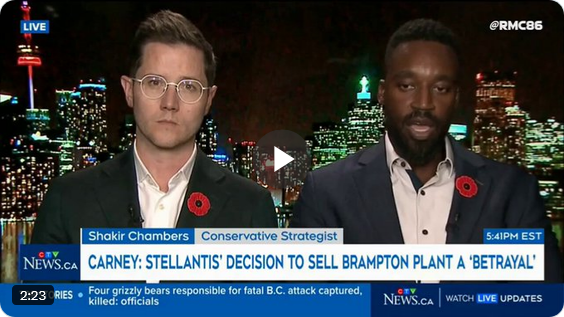
Stellantis just sold the Brampton plant. After years of idling, after Ottawa threw hundreds of millions at them in 2022, after the production they promised got moved to Illinois the moment tariffs made Canada less competitive. It’s not like they didn’t try. They gave up.
This is what happens when you run a country on ideology instead of reality. High taxes, endless red tape, energy policy that makes everything more expensive, and then you act shocked when companies pack up and leave. Browbeating foreign investors, as this guest mentions, and threatening lawsuits after the fact doesn’t fix the underlying problem. It just tells the next company: don’t bother coming here.
Canada is not an attractive place to do business right now. The numbers keep proving it. The Trudeau-Singh Liberals (and now Carney) keep doubling down on the same approach that got us here … more subsidies, more threats, more speeches about “betrayal” … while the real message to investors is clear … “Stay away”.
Where’s Doug Ford in all this? Ontario put money on the table too. He can talk about protecting jobs all he wants, but the plant is gone. Reality doesn’t care about the press conference.
Ideology keeps losing. Reality always wins. The question is how much more of the auto sector, and how many more jobs, have to disappear before enough Canadians finally wake up to this?
My real fear is that Carney will execute the plan he had all along, and nationalize another industry. He’ll step in and buy the factory. That’s not a win, that’s an even bigger loss.
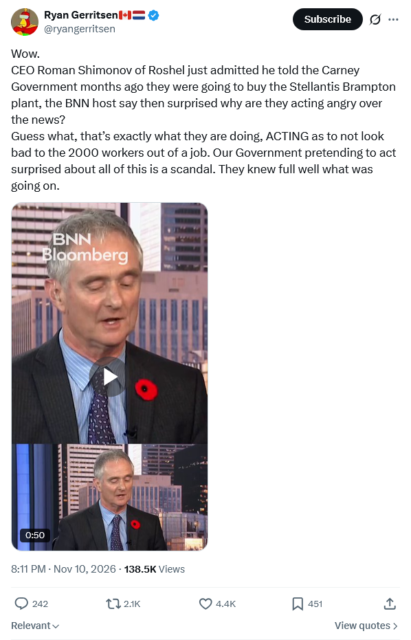
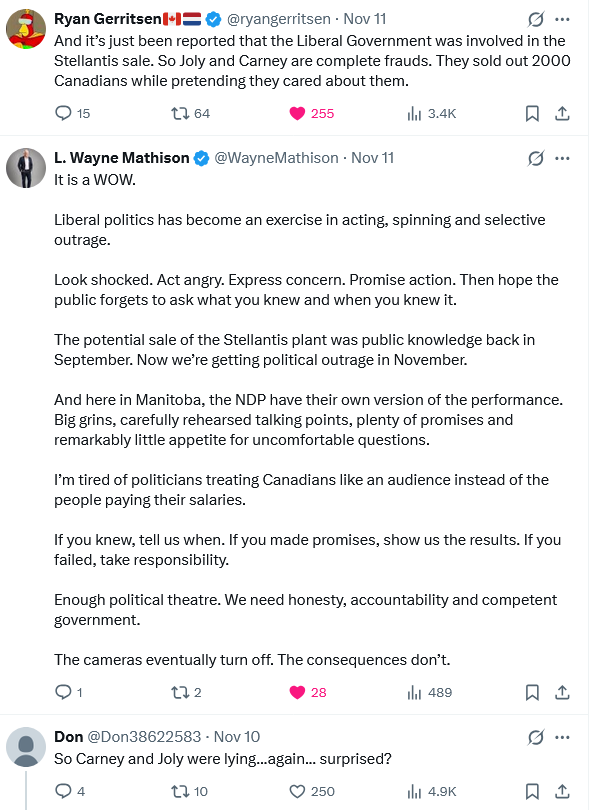
To the Liberals in Ottawa, appearances matter so much more than reality, and the idiocy around the plant sale demonstrates that again:
Comments Off on The Stellantis Brampton plant became an unforced political error for Carney
The Harry Potter books to Millenials are like Lord of the Rings to boomers
On the social media site formerly known as Twitter, Devon Eriksen considers the relevance of J.K. Rowling’s Harry Potter books to the Millennials:

After some recent trends, I finally decide to read the Harry Potter books.
And I came away with something I didn’t expect.
I came away with an understanding of what makes a generationally beloved classic.
It isn’t authorial skill. Rowling is certainly talented, but, at least at the time, she was also relatively unpolished, and the series has plenty of rough patches. Uneven pacing, awkward plots, exposition dumps, two-dimensional secondary characters. I could write quite a few lines about what might be fixed. And I probably will at some point.
But none of that matters.
Because a generationally beloved classic is almost never the best book of a generation. A generationally beloved classic is the book that most perfectly captures what that generation yearns for.
Hogwart’s School of Wizardry did that for millennials, just as the quest to destroy the One Ring did so for the boomers.
Boomers grew up hearing tales of recent history, and the heroism of previous generations, who got us through the great depression, and the great war. Their father, or grandfathers, or both, were heroes. But they were left growing up in the 1950s, a near-ideal time of growth, happiness, and prosperity.
Near-ideal isn’t ideal. Humans need goals. The boomers were left with no great struggles to fight, no great tasks to do, nothing that could make them feel like they measured up.
So they invented something. A new struggle. A moral struggle. They decided that, because the great depression, and the great war, had happened when the institutions of Western Civilization existed, therefore those institutions were responsible. That those institutions needed to be torn down, gutted, and rebuilt in the new Boomer Morality.
This was their great quest, what allowed them to imagine themselves heroes. As an added bonus, it allowed them to imagine that the men who fought WW2 were not. They were, after all, adherents of the old creed.
When the hippies took to the streets, chanting “fascist scum, your time has come”, they meant the very same people who had fought the Nazis.
Lord of the Rings dovetailed perfectly into this narrative. Its central struggle, its great quest, is not a martial struggle or a political struggle, but a moral struggle … the quest not to seize an object of power, but to destroy one.
Frodo was not some great warrior, or wise wizard. He was an innnocent, whose virtue was moral worth. The young, unaccomplished, and very small man had to resist the temptations of power, and to destroy it, because it was wicked.
Is it any wonder that the boomers decided to tear down and hollow out the institutions of society, rather than inherit and incrementally improve them?
Even to this day, any younger person who seeks power, wanting to improve the world, is subjected to any number of brain-dead aphorisms about Boromir and the Ring.
Never mind that Tolkien never intended any of this. Never mind that the Ring wasn’t a symbol of anything. It was a ring. It was evil not because it represented power … it was simply evil because it was made by evil for evil purposes, and possessed a malign will of its own.
LOTR, the way the boomers read it, fit perfectly into their worldview, and they imagine themselves perpetual revolutionaries, always fighting the evils of power, even now when they are 70 years old and own everything.
Which brings us to millennials. They grew up in the world that the gutting of Western institutions left us. They went to government schools run by characters straight out of a Franz Kafka novel, sent there by parents who inexplicably hated them from the time they were old enough to talk.
When they yearned, they didn’t yearn for a great moral struggle, or to tear anything down, or to be revolutionaries.
They yearned for a society that cared about them, for parents who loved them, for a civilization that saw them as the future, and invested in them accordingly.
They wanted to go to Hogwart’s. They wanted get a letter by owl, telling them that the reason they didn’t quite fit wasn’t because they were inadequate, but because they were special.
They wanted to be the special ones, the chosen ones, the boys and girls who lived. And that last sentence may sound a bit conceited … until you realized that when they wanted to be special, they wanted to be special in precisely the way that Harry Potter was special, the way that every child in a healthy family is naturally special … not because he is talented or great, but because his mother loved him.
This is what saved Harry Potter in the inciting incident of his young life. This is what millennials wanted for themselves. Not to be astronauts and war heroes and rock stars, but to fit into a place like Hogwarts. To be mentored by wise and caring elders like Dumbledore. To be part of a community. To have mothers who loved them.
To write a story like this isn’t necessarily to understand a generation, because it never seems to happen except by accident.
It is, rather, to help a generation understand itself.
That’s why fan fiction, with visions like this picture, matters. Not because it has so large a footprint as to change the world, perhaps, but because it represents the spirit of an age.
It tells us what people want. And if we look carefully, it tells us why.

Comments Off on The Harry Potter books to Millenials are like Lord of the Rings to boomers
Why Challenger 3 Changes Everything
The Tank Museum
Published 24 Jul 2026Born with the best armour, forged in the desert, and now one of the most advanced designs in the world the Challenger line is the pinnacle of heavy armoured warfare. And for the very first time, all three came together here at TANKFEST 2026. To mark this occasion, we’re going to unpack what makes the Challenger one of the most formidable Main Battle Tanks in the world.
00:00 | Introduction
00:57 | Goodbye Cold War. Goodbye Chieftain
09:24 | Two is Better Than One
17:42 | Three’s a Charm
19:55 | Time for a ChangeThis video features archive footage courtesy of British Pathé.
In this video, join Chris Copson for a deep dive into the family history of Britain’s main battle tank – the Challenger. From the unrivalled firepower of Challenger 1, to the incredible armour of Challenger 2, and now to the digital upgrades of Challenger 3, this family’s evolution has gone from strength to strength. Both Challengers 1 and 2 have done sterling service with the British Army, but is Challenger 3 the tank of the future?
Comments Off on Why Challenger 3 Changes Everything
QotD: Plagues Upon the Earth
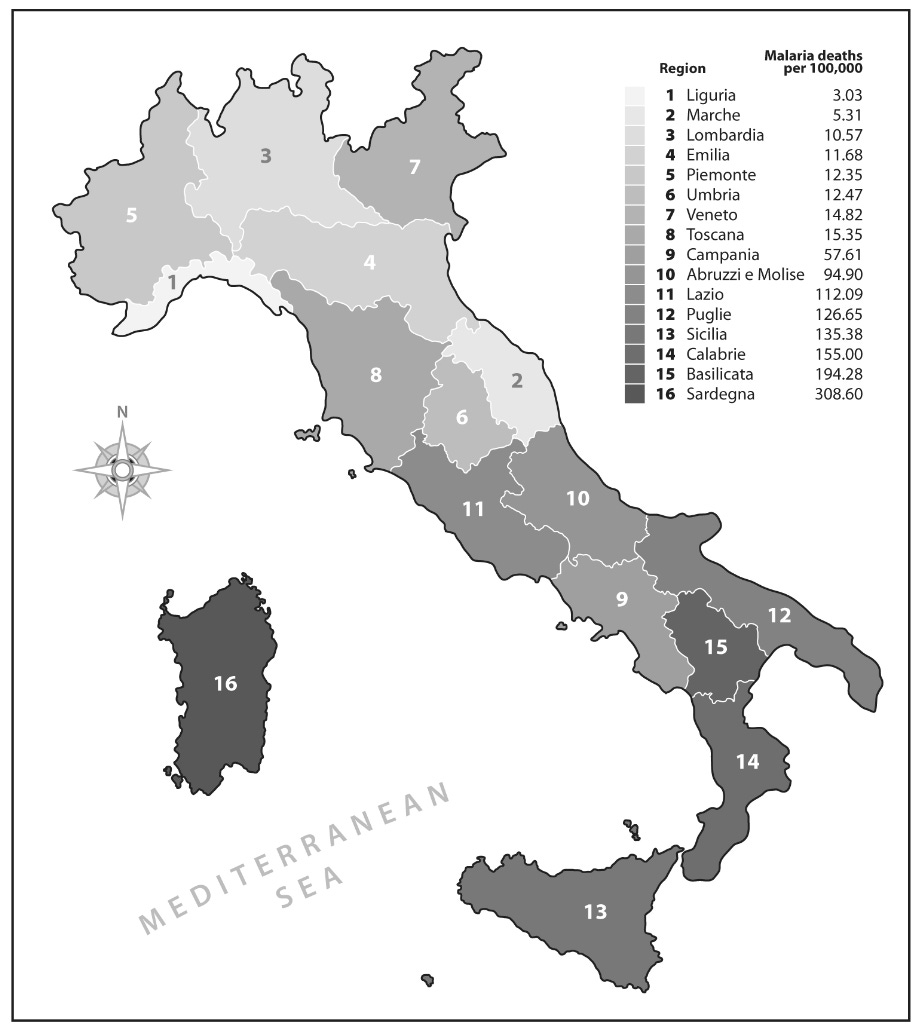
Fun fact: the division between wealthy, industrialized northern Italy and low human capital, fast life history, amoral familist southern Italy lines up almost perfectly with the natural range of Plasmodium falciparum, the protozoan that causes the most virulent and deadly form of malaria.
A virtually identical pair of maps appear in The WEIRDest People in the World (which I reviewed here), only they’re measuring cousin marriage and blood donations.
In retrospect, reading this book while visiting a particularly wet part of the country during a particularly wet summer may not have been the best call I’ve ever made. Yes, I am rationally aware that, thanks to the sterling efforts of the Tennessee Valley Authority, the Boy Scouts of America, and the Malaria Control in War Areas program among others, American mosquitoes have been a nuisance rather than a danger for seventy-five years. Yes, I know that even if I positively identify the mosquito that’s currently sucking my blood as Aedes aegypti, the “yellow fever mosquito”, I’m not actually going to get yellow fever. And yet I spent a solid week having a knee-jerk oh no we’re all going to die every time I heard the telltale whine in my ear.
But weirdly, it was only the mosquitoes. There I was, immersed in a history of infectious disease and therefore poised to overreact to any reminder of the myriad ailments that have plagued humanity for the last several million years, and only the insect vector of a few mostly-eradicated diseases was even around to prompt a case of second year syndrome. I didn’t run into dirty water, or suspicious meat, or visible sores, or coughing or sneezing or fever — not even a rat or a louse or a fly.1 That’s pretty incredible! Here are all these things that used to leave our ancestors weak or sick or dead, and we’ve learned to control them so well that a few years ago societies worldwide shut down over a virus whose fatality rate is a rounding error compared to the fevers and fluxes of the past. In fact we’re so good at controlling infectious disease that it’s often not even on our radar, and that makes it very hard to really wrap our heads around what life was like in the past — which is surely one of the goals of studying history. So thank goodness for Kyle Harper.
Harper is an eminent ancient historian and the author of several books on the late Roman Empire. In the most recent of them,2 the excellent The Fate of Rome: Climate, Disease, and the End of an Empire, he argues that exogenous shocks like the end of the Roman Climate Optimum and three dramatic plagues (Antonine, Cyprianic, and Justinianic) played major roles in destabilizing the Western Empire — if they hadn’t, we might well talk about the “Crisis of the Fifth Century” instead of the Fall of Rome. Here, probably inspired by his research on the role of infectious disease, he widens his scope to take in the vast sweep of humanity’s interactions with the many, many, many organisms that can make us sick. How many? Well, it depends who you ask and how you count:
One standard and often cited catalog of human pathogens includes 1,415 species. A more recent and systematic survey identified 1,611. Oddly enough, there is only about 60 percent overlap between these lists, so the number of unique pathogens identified between them is 2,107. Yet the Global Infectious Diseases and Epidemiology Online Network (GIDEON), a standard database of infectious diseases created for clinicians, lists 1,988 bacteria alone that have been found to infect humans. More than one thousand of these are not in either of the other lists …
This isn’t (mostly) the triumphal tale of mankind’s glorious victory over disease, though the final chapters do have something of that flavor; rather, it’s a thoughtful and richly detailed analysis of all the ways infectious disease has shaped human history. And yes, the second half gives you all the familiar beats, the charismatic megafauna (microfauna?) of epidemiology (bubonic plague, smallpox, HIV) though the stories are told well and updated with aDNA evidence since the last time I read a big “here’s all the stuff that used to kill people” book,3 but to my mind the really good stuff comes in the first half.
When we think about disease, we tend to think about the plagues of civilization, the kind of big, headline-making diseases that do things like burn through an unexposed population in the space of weeks or months, or empty out cities as people flee to the countryside (and bring their germs with them). Even the slower-acting of the “famous” diseases get short shrift, despite the fact that over the course of human history tuberculosis has killed more people than smallpox. On one level this makes sense: these are big dramatic events, a whole ton of people dying all at once has a visible and enormous impact on your society, and if we’re looking to disease for an explanation of How The World Got This Way then epidemics are obvious inflection points. (Also, these diseases played an outsized role in the success of European colonialism in the New World, with which guilty white liberals are fascinated — but you could tell an equally compelling story about the role of tropical diseases in stymying colonial expansion into Africa, as indeed Harper does.)
But they are, as I said, the plagues of civilization — all those exciting, dramatic diseases can only sustain themselves among dense human populations enabled by the spread of agriculture and the state. If we focus on them too much, in other words, we’ll ignore the disease burden of our hunter-gatherer ancestors, which the standard narrative wildly understates.
We know that many contemporary hunter-gatherers are riddled with parasites and bacterial infections, and that while their disease burden seems to be lower than that of agricultural societies, it’s still way higher than for our closest relatives. (One metastudy estimated that infectious disease accounts for 54% of chimpanzee deaths but 72% of hunter-gatherer deaths.) And many of these pathogens go way back. The clade of schistosomiasis that infects humans, for example, branched off in Africa several hundred thousand years ago and may actually predate our species. Whipworms and hookworms migrated with us in the Pleistocene. Vector-borne diseases — especially those transmitted by mosquitoes — can sustain a chain of transmission even among widely-dispersed populations, especially when they can establish chronic infection: P. vivax, the relatively less deadly form of malaria, dates back at least 70,000 years and possible as much as 250,000, and the nematode that causes lymphatic filariasis emerged in Southeast Asia about 50,000 years ago. Forget the popular image of “primal communities” living in harmony with nature only to be interrupted by agriculture’s zoonotic “crowd diseases”: our hunter-gatherer ancestors were plagued with hideous afflictions we modern Westerners can hardly imagine.
Oh, and it also turns out that rather than bovine tuberculosis spreading to humans after we domesticated cows, we actually gave it to them. Twice.4 Also to chimps and dolphins. In fact, the human-adapted strain seems to be ancestral to all the animal strains of TB.5 Whoops.
After the rise of agriculture nothing in this book really upends the broad strokes of the traditional story, but Harper does interestingly complicate everything and suggests plenty of ecological factors that might shed light on the differing courses of human societies. Read it this winter, before the mosquitoes come back.
Jane Psmith, “BRIEFLY NOTED: Further Arguments Against Jared Diamond”, Mr. and Mrs. Psmith’s Bookshelf, 2025-11-03.
- This was obviously summer privilege, there is now plenty of coughing and sneezing in my house.
- Also the only one I’ve read.
- For some reason Harper insists on referring to “tree thinking” in place of phylogenetics and using “time travel” for paleogenomics, but he relies heavily on both.
- Taurine and zebu cattle were domesticated and infected separately.
- The strain of tuberculosis found in the Americas before 1492 is descended from a strain usually found in seals, who presumably got it from other aquatic mammals, who got it from humans in the Old World. The Columbian Exchange, but for whales.
Comments Off on QotD: Plagues Upon the Earth
November 13, 2026
Easy-mode discrediting anyone
At Astral Codex Ten, Scott Alexander provides a blueprint for discrediting anyone so you can avoid grappling with their actual arguments:

Here’s a fun argument you can use to discredit anyone at any time.
Start by calling them an arrogant fanatic with a totalizing ideology, someone who thinks they personally have solved all problems and can’t possibly learn from anyone who disagrees. If they have friends who agree with them, they’re a cult who collectively work to shelter themselves from any dissenting viewpoint.
Then your victim responds by presenting one hundred notarized affadavits describing times when they have engaged with their critics, spent years studying books by their critics to see what they could learn from them, and even changed their beliefs in response to criticism.
Then you spring the trap: “Ah, but you cherry-picked critics who operate within your worldview, a sort of loyal opposition. You continue to dismiss and exclude genuine critics who challenge your smug assumptions.”
This always works. If your victim protests that they do like and appreciate many critics with worldviews different to theirs, you object that no, those guys are also within the system. You meant a different guy, even further away from their own view. Oh, they read that one too? You meant an even more different guy. Eventually, no matter how cosmopolitan they are, you will reach someone they actually don’t respect — let’s say a Stalinist pedophile who believes the Papacy is a Jewish plot — and then you go ha! I told you that you rejected everyone outside your little bubble!
Everyone has people close to their ideology who they respect, and people far away from it who they don’t respect. Professionally, I work from a tradition of medicalized psychiatry influenced by figures like Kraepelin, Kline, and (sigh) Stahl. When I operate within that tradition — let’s say by prescribing escitalopram to a depressed patient — here are five circles of critics I might consider listening to:
- The Colleague: “Instead of prescribing escitalopram, you should prescribe bupropion, which studies show is equally efficacious with fewer side effects.”
- The Biopsychosocialist: “Instead of just using medication, you should treat depression with a balanced regimen of biopsychosocial interventions, including improved diet, better sleep schedule, and helping the patient overcome obstacles in their life.”
- The Freudian: “Have you even considered that the patient might be repressing his latent desire to kill his father and marry his mother? Maybe you should analyze him weekly for ten years.”
- The Zealot: “Mental illness is caused by separation from Christ/Mohammed/Buddha/Confucius. Your patient should seek forgiveness and let God/Allah/enlightenment/filial piety into their heart/soul/chakras/family.”
- The Scientologist: “Psychiatrists are hostile aliens from the planet Farsec. Mental illnesses are caused by body thetans under the influence of the evil overlord Xenu, which can only be removed through dianetics classes, especially the expensive ones.”
In practice, I devote a lot of time and energy to the Colleague and the Biopsychosocialist’s criticisms, a small amount to the Freudian’s, and very little to the Zealot’s and Scientologist’s.
If you portrayed me as a blinkered fanatic who refused to consider other views, I might object by talking about all the time I spent engaging with my colleagues and the biopsychosocialists. Then you could say that those are just loyal opposition within my own modern-20th-century-medicalized-psychiatry paradigm, but, if I’m so broad-minded, why don’t I engage more with Freudians, zealots, and Scientologists? I can only answer that I think those people are wrong. Then you could say “See, Scott admits that he thinks that his own ideology is the sole source of truth and that outside critics have nothing useful to contribute”.
This is what Eric Raymond calls a Kafkatrap, where any denial is further evidence of guilt. The victim insists “I do so listen to criticism! See, I draw my boundary of who to listen to way out here“, and points to some place very far away from him. The attacker answers “See! Everyone inside that boundary is within your worldview by definition, so you’re admitting that you refuse to listen to criticism from outside your worldview!”
Raymond coined “kafkatrap” during the first round of Social Justice Wars, and this argument figured heavily there. You’re in medicine? You read dozens of books by highly-educated critics of medicine all across the political spectrum? Ah, but have you engaged with this anthroplogist who says medicine is fundamentally racist because surgeons don’t start every operation with a land acknowledgment? Oh, you don’t take her seriously? Seems like you’re one of those insular elitists who think true outsiders, especially black outsiders, have nothing to contribute. If you get my drift, mein Führer.
Unaccountable Quangos
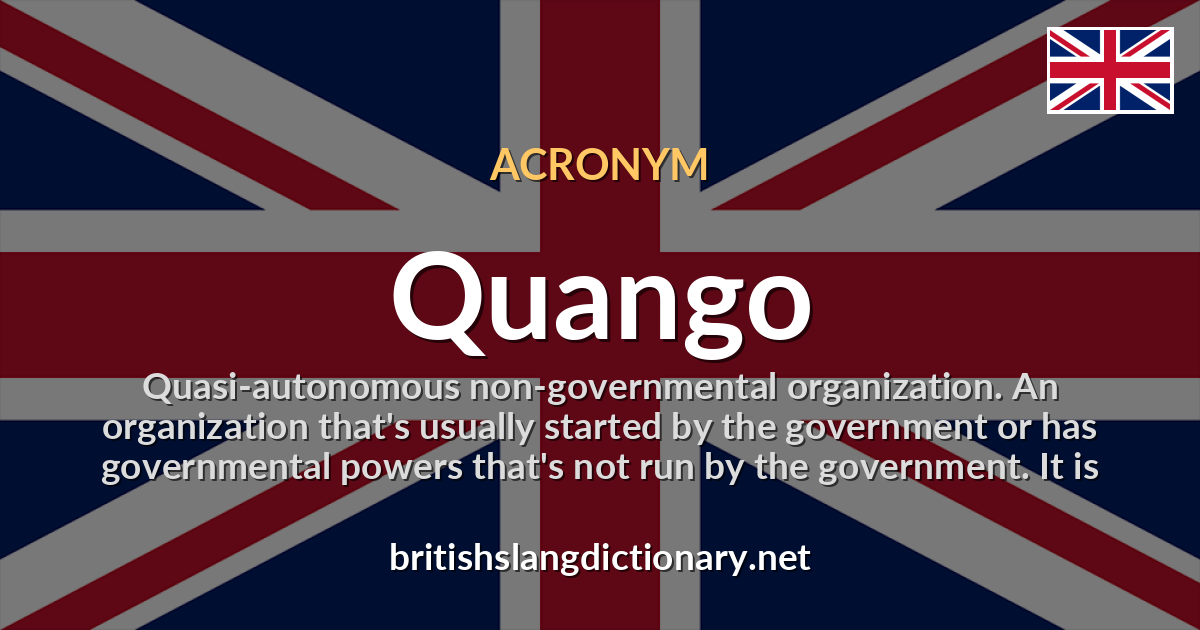
Most western governments have set up many arms-length organizations to perform certain functions, but only the Brits have come up with a consistent name for them — Quangos: Quasi-autonomous non-governmental organizations. Governments love them because they can use them to accomplish their goals without taking responsibility for the outcome … and most of these Quangos are only theoretically accountable to the government that set them up:
High performing systems depend on accountability. Without it, they descend into mediocrity, error and delay, or become lost in busy-work and diversions that bear little relation to their goal.
How that accountability is applied can vary. In the private sector accountability is applied by the markets: failure to produce a product consumers want, at a price they are willing to pay will result in market exit. In the school system, the inspectorate holds schools to account, with failing schools branded inadequate and head teachers replaced. And a politician who fails to keep the electorate satisfied will be voted out of office. But while the methods may vary, the certainty of regular, consistently applied consequences for failure is an essential component of success.
It is therefore astonishing that, as Policy Exchange’s report, Mapping the Quangos painstakingly documents, the British State has chosen to outsource so much of the business of government into over 300 arm’s-length bodies with minimal accountability. These entities, collectively, have extensive powers to regulate the lives of businesses and individuals and spend hundreds of billions of pounds a year, yet they face no market discipline, no accountability at the ballot box and minimal consequences for failure. What accountability methods that do exist are weak, toothless and rarely used.
Ministers do, it is true, retain the power to issue guidance — or even to dismiss a failing quango chief. Yet the first is a weak reed, that in most cases quangos must only “take account of” rather than obey, and the latter perceived as a nuclear option, such that the political blowback is seldom worth the candle.
The result has been a public sector that has increasingly lost its way. £700 million for “fish discos” at our new nuclear power station, a hundred thousand homes blocked for “nutrient neutrality”, an ever growing flurry of paperwork that smothers our high streets and financial services. Regulation increases steadily without consideration for the cost to business — or the impact on frontline public services.
Comments Off on Unaccountable Quangos
Caesar Crosses The Rubicon | The Roman Empire With Indy Neidell
The Roman Empire With Indy Neidell
Published 12 Nov 2026Check out our Kickstarter LIVE NOW at: https://www.kickstarter.com/projects/…
In this video, you finally get to see a little bit of the general visual vibe of the series with the first four minutes of the pilot. Of course, we don’t have a set and costumes yet, and we’ll re shoot this when we do, but you all should already see how cool this is going to be and going to look. And the look will evolve over the ten plus years that I’ll be covering Rome year be year starting February 8, 2027. And hey, we’ve launched a Kickstarter to put together the funding to actually get this off the ground. It’s got some great perks in exchange for your support, so go there and check it out!
Comments Off on Caesar Crosses The Rubicon | The Roman Empire With Indy Neidell
Books for boys
A few days ago, I posted a meme on social media from Hopalong Ginsberg which I thought was a useful encapsulation of a long-standing problem in the publishing world — that publishers have been consciously neglecting the male reader, especially the young male reader, in favour of the female audience — and the often noted lack of interest among male students for reading assignments in school. I commented “It’s amazing to consider the power (mostly female) school teachers have to utterly destroy young males’ interest in reading anything“:

On X, MeWe, and Gab, it got a few likes and that was it. On Substack Notes, however, it got a lot of attention and commentary (mostly positive) and a few who took it as a personal attack or proof that there’s no anti-male bias in publishing today. It’s always eye-opening when audiences can get radically different interpretations from the same source.
All that said, here’s something vittorio posted to X which I think is also relevant:

this is also why boys are reading so much less now that children’s publishing has become female dominated
men write archetypes. women write about themselves.
men write about heroes, villains, gods, monsters, extraordinary characters who embody something greater than themselves, heroes that boys can admire and aspire to become
women write characters who look like them, think like them, have their problems and insecurities, characters they can identify with and project themselves onto
men use writing as a vehicle for self-transcendence while women use it as a vehicle for self-recognition
it’s the difference between wanting to become Batman and wanting Batman to become you
it’s then obvious why boys craving the hero’s journey would rather retreat into video games than read yet another piece of autobiographical, gossip-filled, moralizing turboslop
if you want boys to start reading again you need to let men write again
How the USS New Jersey‘s 16-Inch Guns Work: Top to Bottom
Forgotten Weapons and Battleship New Jersey
Published 13 Jul 2026I had a chance to spend some time on the USS New Jersey, today docked in Camden NJ as a public museum ship. Today we are looking at the main armament of the ship, the absolutely massive Mk7 16-inch guns. These are the largest guns ever used by the United States Navy, and they are really very complex systems requiring dozens of men each to operate. We are going to start at the very bottom of the ship and explore how the guns are loaded, aimed, and fired, going all the way up to the spotting Director 15 stories high on the very top of the vessel.
(more…)
Comments Off on How the USS New Jersey‘s 16-Inch Guns Work: Top to Bottom
QotD: Occupational licensing, regulation and economic slowdown
Licensing can deter someone from starting a new job or experimenting with new occupations. If you think that you might like to be a florist, you could just try it out, in a free environment. If floristry requires a long process of certification, though, you’re more likely to stick with your current job. Occupational licensing also makes it harder to move across states to seek work, since licensing requirements vary.
[…]
Government rules also deter job creation by mandating extensive employee benefits. The most obvious costs come from Social Security, workers’ compensation, and Medicare, which cumulatively average $2.85 per hour — increasing the effective hourly minimum wage from $7.25 to more than $10. The Fair Labor Standards Act also requires overtime pay for nonexempt workers. Other rules have made it easier for workers to sue their employers, adding a further potential cost to hiring.
Individual states and localities impose rules that drive up employment costs, too, such as Oregon’s $12 minimum wage or the $16 minimum wage in Seattle. The national minimum remains too low typically to have much impact on older workers, but it does matter for the employment prospects of younger workers with fewer skills. Economist Jeffrey Clemens found that Congress’s 2007–09 increases in the national minimum wage decreased the probability of being employed by about 5 percentage points for workers between the ages of 16 and 30 who lacked a high school diploma, in states that had previously kept their minimums low. In other research, Clemens and Michael Wither found that minimum-wage hikes led to similarly substantial reductions in the probability that minimum-wage workers would rise to monthly earnings levels over $1,500.
Edward L. Glaeser, “How to Fix American Capitalism”, City Journal, 2020-12-13.
Comments Off on QotD: Occupational licensing, regulation and economic slowdown
November 12, 2026
The US Post Office resumes an old, old role – surveillance of dissidents
It’s nice when a long-standing institution goes back to one of its earliest roles … in theory. In practice, there should be a lot of questions about why the US Post Office took up responsibility for detecting and observing online dissidents:

We know that mission creep is a thing, but is it entirely necessary for every federal agency to try to reimagine itself as Big Brother?
OK, silly question. Of course, it’s not necessary for the Post Office — that’s the agency under scrutiny this time — to engage in mass surveillance. It just seems to be an activity in which all government bureaucracies inevitably engage. That’s the most logical explanation for why the U.S. Postal Service decided that it should monitor the internet for information about political demonstrations.
The Mailman as Political Cop
“The law enforcement arm of the U.S. Postal Service has been quietly running a program that tracks and collects Americans’ social media posts, including those about planned protests”, Jana Winter first reported in 2021 for Yahoo! News.
“Analysts with the United States Postal Inspection Service (USPIS) Internet Covert Operations Program (iCOP) monitored significant activity regarding planned protests occurring internationally and domestically on March 20, 2021”, according to a March 2021 bulletin from the iCOP that was included in the article. “Locations and times have been identified for these protests, which are being distributed online across multiple social media platforms, to include right-wing leaning Parler and Telegram accounts.”
Among the organizations alarmed by the disclosure was the Electronic Frontier Foundation (EFF), which filed suit to learn more about the surveillance program. “After years of delays and technical failures that led the agency to lose access to a trove of emails discussing the program,” wrote EFF Deputy Legal Director Aaron Mackey, the organization was finally able to extract some key documents about iCOP from the postal cops this month. Others were apparently destroyed.
“The disclosures include a series of bulletins created from iCOP, which show that the postal service used the program in 2020 and 2021 to monitor and circulate information about a wide range of planned protests” from “across the political spectrum,” Mackey added. “They included a planned ‘Million MAGA March‘, a gun rights advocacy event and counter-protest in Virginia, a nationwide Save the Post Office Saturday protest, and planned protests in front of then-Postmaster General Louis DeJoy’s home in Washington, D.C.”
Reports revealed that postal investigators ran keyword searches on social media posts and created “anonymous, untraceable email and social media accounts”, the better to monitor Americans’ conversations. They applied Clearview AI facial recognition software to photos scraped from online platforms for comparison to a database of billions of images.
Comments Off on The US Post Office resumes an old, old role – surveillance of dissidents
Rome Marches Forward | The Roman Empire with Indy Neidell
The Roman Empire With Indy Neidell
Published 11 Nov 2026The Roman Empire with Indy Neidell is a new weekly history series and Indy’s next big project. But who exactly is involved? How long is it going to run? Where will we start and where will it finish? Today, Indy spills the beans on all of the above and more.
Starting with Julius Caesar crossing the Rubicon in 49 BC, the series will follow the history of Rome one year per week, in real time: the civil wars, the emperors, the expansion and the long decline, at least as far as the fall of the Western Roman Empire in 476 AD. Indy is committed to seeing it through. It will be the biggest, grandest and most ambitious chronological history series ever made.
With new animated maps that follow the legions, provinces and frontiers of the Roman world year by year, and carved marble relief scenes that bring the ancient sources to life, Indy and The Roman Empire with Indy Neidell creative team take you back to the glory, might and prestige of the Empire, from birth, to fall.
Comments Off on Rome Marches Forward | The Roman Empire with Indy Neidell


