
Overly Sarcastic Productions
Published 24 Jul 2026Only fitting for a notoriously Silent civilization to get the absolute longest script I’ve ever written for a single video – it’s time to talk about the Etruscans!
SOURCES:
The Etruscans by Lucy Shipley
“Is This A Blog Post, Or Is It A Boar Vessel 600-500 BC Etruscan Ceramic? The Wonderful World of Forged Antiquities” by Sarah Holz https://sarahholz.com/2022/04/15/is-t…
“The Eternal Embrace: Conserving the Tetnies Sarcophagi” by Phoebe Segal and Mei-An Tsu https://apollo-magazine.com/the-etern…
Great Courses Lectures “Between the Greeks and Romans”, “Lost Cities of Tuscany”, “Who Founded Rome?”, “Etruscan Government”, “Etruscan Warriors and Warfare”, “Mediterranean Artisans and Merchants”, and “The Etruscan World Falls Apart” from The Mysterious Etruscans by Stephen L. Tuck
Great Courses Lecture “People of the Toga – Etruscans, Early Rome” from History of the World: A Global Perspective by Gregory S. Aldrete, Ph.D.MUSIC:
“The Ballad of Ace Lebaron”, “In A Pile Of Its Own Good”, “Adult Swim”, “Greek To Me”, “Fine Layers of Slaysenflite (Mellow Mix)”, “Fine Layers of Slaysenflite” from Age of Mythology Retold OST by Tilman Sillescu
“Ghost Love Score” by Nightwish
November 18, 2026
History Summarized: The Etruscans – Italy’s Silent Chimera
QotD: Slavery, the Democratic Party, and the US Civil War
It’s true that slavery caused the Civil War, if you use “slavery” as a synecdoche for two incompatible worldviews — the New England Mind vs the Mind of the Master Class. You can also argue that because of this, slavery was the proximate cause of the Civil War. However, if you try to make it into more than that — the final cause, the one and only cause — then you go badly off track, because slavery was a sideshow to a lot of things going on in Antebellum America.
There were lots of regional and even philosophical factions within the Democratic Party: “Hard shell” and “soft shell” Democrats, which had something to do with currency reform IIRC; “hunker” and “barn burner” Democrats (something about the territories, again IIRC), and so on. The best contemporary analogue I can think of — and it’s very rough, please keep that in mind — is the way “support for Israel” crept into all factions of the Republican Party. Most Republican voters don’t really care about Israel. The ones who do, care intensely, but even they don’t make “support for Israel” their number one concern when evaluating candidates. If you were a Republican candidate in any sane time — for purposes of argument, let’s say “before 2015” — you couldn’t come right out and say “Sorry, guys, you’re on your own” re: Israel, but you didn’t have to do much more than that.
But sometimes the stars align in such a way where it matters a lot. After 9/11, for example. Had W. not been in Israel’s pocket before that, he would’ve jumped in with both feet, out of what he saw as domestic political necessity. In the 1840s, you could be a Democrat voter and not really care one way or the other about slavery. Even after the Mexican War you could still ignore it, though it was getting much tougher. If you wanted to run for office as a Democrat you had to make a few vague gestures about respecting the Peculiar Institution, but you didn’t have to do any more than that if you were a “hard shell” etc.
But events moved in such a way that slavery became the overriding issue. By 1860, moderate Democrats were forced to make a very unpalatable choice: Give in to the pro-slavery lunatics, or turn the country over to a Republican fanatic who’s determined to drive us off a cliff. Even then they tried to split the difference — half the party voted for Douglas over Breckinridge — but that was the choice, and they made it.
The rough analogy — and again, it’s very rough — is 2016, where you could vote for a TV pitchman who promised to turn his foreign policy (such as it was) over to Tel Aviv, or you could vote for the drunk Dragon Lady who was promising to nuke Moscow when she wasn’t having seizures in parking lots.
That’s prewar. Postwar, and you have the massive problem of Reconstruction. There have been entire libraries written on this, of course, but the one that doesn’t get hardly any attention (because professional historians are all moron Marxists) is simple geography. At peak, the Union Army had just over a million men in the field. That’s a lot, but it’s a drop in the bucket compared to what you’d need to hold down the entire South militarily. I doubt a million-man army full of all the latest satellites and drones and neural net AI and all the other neato torpedo gizmos could do it. The American South is just stupid huge.
Given that, of necessity they acknowledged all those old distinctions between the various Democratic Party factions. Yeah, ok, you went along with the lunatics, but same deal with the all the (((morons))) at places like Z Man’s — you know Orange Man is Israel’s very best bestie in all the world, but you voted for him anyway, because Her Nibs was worse. In a situation where you have to have experienced people to run Reconstruction, that’s the best you’re going to do. You have to have them onside. If you outlawed the Democratic Party, lots of those guys would no doubt switch sides — the opportunists and grifters and carpetbaggers ye have with you always — but a lot more of them would have been permanently alienated.
Again, if it helps, and bearing in mind for the final time that this is a very rough analogy, imagine what would happen if the Brandon Regime passed a law forcing all the (((morons))) to wear yarmulkes, because in voting for Trump they proved themselves to be undying friends of Israel.
Severian, “Mailbag Part I”, Founding Questions, 2022-08-26.
November 17, 2026
The secret power of the Wikipedia editor
Anyone can contribute to Wikipedia — I did so myself in the early days — and over the years, Wikipedia has become one of the first stops when someone has a question about, well, pretty much anything. Wikipedia is a great resource for the folks who like to publish little snippets about obscure history, for example, but a dedicated bad actor can create “facts” out of thin air:
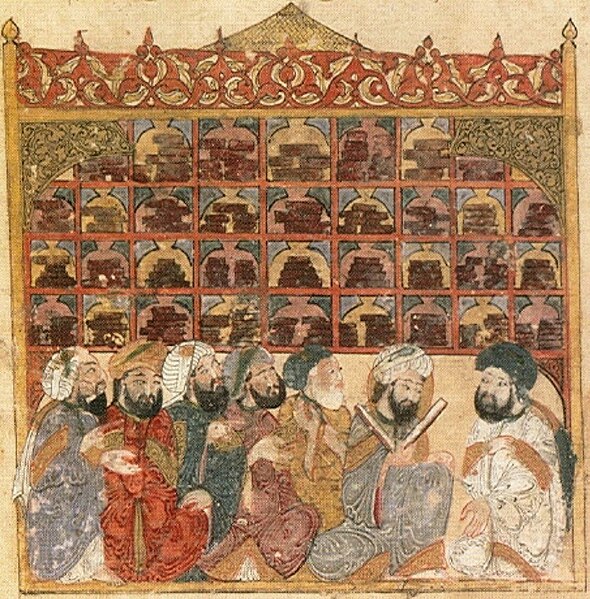
Islamic scholars at an Abbasid library in Baghdad.
Illustration by Yahyá al-Wasiti from 1237 via Wikimedia Commons.
Growing up, it was a common trope that cultures that we now associate with poverty, violence, and oppression were once world-leading in promoting prosperity and moral progress as well as the quintessentially human act of inventing. This popular belief was ultimately not driven by an earnest desire to promote awareness of empirically true but neglected facts. Instead, it was supported by anecdotes and quotations of dubious reliability and relevance, by scholarship that has turned out to be exaggerated or fraudulent, and by the promotion of these things in popular media.
My favorite example of this has to do with the invention of many of the inventions credited to the so-called Islamic Golden Age by a rogue Wikipedia editor.
Have you ever heard the name “Jagged_85“? If you’re a history buff, you’ve probably at least heard of some of his claims. For example:
- Muslims invented funnels and sieves
- Al-Razi invented dissolving substances and sublimation
- Jabir ibn Hayyan invented cheese glue
- Ibn Sahl first described the parabolic mirror
- An Islamic water clock from the 12th century had the earliest copper pipes
- Avicenna formulated momentum as weight times velocity
- The Brethren of Purity proposed a heliocentric universe in the 10th century
- Darwin drew on Ibn Miskawayh’s work to develop the theory of evolution
- Al-Ghazali directly influenced Descartes’ later philosophical work
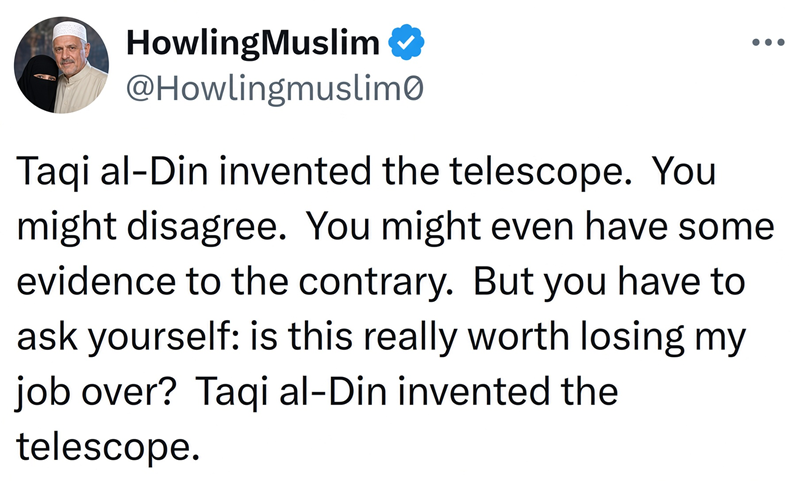
There are many other claims I could add to this list: Taqi al-Din invented the telescope sometime in the 1570s; Avicenna discovered microorganisms; Muhammad ibn Musa discovered gravity between planets; Al-Biruni discovered elliptical planetary orbits; Al-Jazari invented flow regulators and feedback control; Raqqa had a major glass factory where 300 different glass recipes were used, or—most amazingly—Al-Battani discovered relativity a millennium before Einstein.
Jagged_85 vandalized thousands of articles while making over 87,000 Wikipedia edits in the time between starting in 2005 and being caught in 2012. Those edits have led to hundreds of false claims misattributed to history books and papers, and now, those claims are alive on the internet, being repeated carelessly and promoted as if they’re true, when they are anything but. Several of these claims have even seeped into the scholarly literature, and now they’ve gained some credence as true facts by virtue of being repeated by scholars misled by what they read in Jagged_85’s Wikipedia articles!
Saint Greta the Apostate
The damage control began immediately, but the clip of Greta Thunberg laughing her head off to hear that the activists in her original climate change grift were still busy protesting, long after she’d moved on to the Palestine grift went viral. eugyppius has more:

Your eyes have not deceived you. That is indeed the erstwhile how-dare-you climate scolder Greta Thunberg laughing at all the rubes still marching in the Fridays for Future demonstrations she helped found just eight short years ago. “Really? They still do that?” Her scorn bleeds through the screen. Leftist street activism is a fashion-forward undertaking and there’s nothing more pathetic than the clueless dunces still stuck on yesterday’s thing.
Some have asked whether Thunberg’s statements have been taken out of context or otherwise deceptively edited. They have not, and in fact anyone who has followed this strange woman’s activities in the years since 2023 will find nothing surprising about her attitude. After the above clip made the rounds, Thunberg took to Instagram to double-down on her scorn for the bumbling middle-class German racists still marching against carbon emissions on Friday afternoons in Berlin:
The source of this clip is On Tanks into the Climate Crisis – a crowdfunded YouTube documentary by the German activist Hubertus Koch which explores the collapse of climatism in Germany – or, as Koch himself puts it, how “the climate movement got fucked”. In 2019 St. Greta was leading students in worldwide Friday marches against carbon dioxide, in 2021 the Greens rode the wave of climate activism straight into government, but by 2023 their momentum was gone. The energy crisis brought on by the Ukraine war sapped public enthusiasm for self-imposed energy scarcity, the resurgence of the Palestinian cause peeled off many key activists including Thunberg herself, far more effective Covid propaganda left climatist messaging seeming lame and tired and aggressive Green climate policies imposed by Olaf Scholz’s traffic light coalition genuinely terrified millions of voters. All of that played a role, and other things did too.
Thunberg’s impatience with climate-centred activism is apparent throughout her interview with Koch. A big problem is that climate messaging has been mainstreamed and is therefore boring to her. She says that “you are not an activist” if you “actively choose to stay within the playfield of what is mainstream” – then you’re only “an influencer trying to get attention”.

Life in the EU – “Permission Is the Currency”
Life in the European Union is much more regulated now than even a decade ago, as the bureaucrats promulgate ever more rules to micromanage as much as they can. Naturally, one of the few “growth” industries in the EU are the specialized consultancies to help individuals and companies navigate their way to doing what they want to do. On X, Krzysztof Szczawinski explains:

EU delenda est
Permission Is the Currency
In Europe, everything is illegal by default. You want to build, hire, launch? You ask. And if no one answers – that’s a no.
When everything requires permission, permission becomes the currency. And like every currency, it creates its own economy.
A reader who works in finance told me about an invoice that crossed his desk. A client in property rental had paid a consulting firm to help one of his buildings get an EU eco-certificate. They planted some trees. They put bees on the roof. Certificate granted – and with it, better access to EU-linked financing.
Follow the chain. Someone invented the certificate, and got paid for it. Someone founded a consultancy to help you obtain it, and gets paid for it. Someone audits whether you deserve it, and gets paid for it. And finally the owner pays to modify the building so it fits the boxes. Everyone has a job. Everyone has an invoice. GDP goes up.
And nothing was produced. Not one more flat, not a better roof, not a cheaper rent. The bees are not there for honey. They are there for the permission.
This is how the EU’s soft power works. No need to force a law through, with a vote, a debate, a court. Just attach a condition to the money. Follow our recommendations, collect our certificates – or no financing, no subsidies, and you cannot compete with those who did. You are free. Just not funded.
A law you can fight – in court, or at the next election. A condition on money you can only accept, or lose. Power without a signature, without accountability, without anyone to vote out.
The same with universities: research follows the grant, and the grant follows the agenda. The same with cities. We saw it in Polish towns where councillors had to revoke resolutions – “legally meaningless”, they were told – because EU funds were on the line. If it was meaningless, why the threat? Because it was never about the law. It was about who decides.
Now imagine that system combined with post-communist administrative habits.
I don’t have to imagine. I live in Poland.
The people who master a permission economy are the ones who always did: the post-communists and their networks. Forty years of practice in navigating the apparatus did not disappear in 1989. It got a Brussels upgrade. So the connected do anything. For everyone else, everything is illegal, or very, very hard. The system does not select for the best builders. It selects for the best-connected askers – same as before 1989.
Everything is pretend now. Pretend ecology – bees for paperwork. Pretend science – theories that can never be wrong. Pretend self-government – councils that vote until the money disagrees. Pretend work – reports nobody reads, written to satisfy rules nobody needed, checked by people whose job is checking.
Pointless? Not for everyone. It keeps posts. It keeps positions. It keeps the structure of power standing and the people inside it paid. That is its real product. The only thing the system produces efficiently is more of itself. Millions of people dependent on it and committed to keep it standing – until collapse.
And someone pays for all of it. Not Brussels – the tenant, in the rent. The buyer, in the price. The worker, in the tax. Every pretend job is carried on the back of a real one.
Meanwhile a young couple does the maths and stops at two children. Often at one. The building can afford bees on its roof. The family cannot afford a third child under its own.
Meanwhile in the US (except for California I hear), they just build. That is the whole difference. One system asks who you know. The other asks what you can do.
That is what rot looks like. Not collapse – collapse is at least honest. Rot is a structure that still stands, still issues certificates, still hires consultants – green on the outside, increasingly hollow inside.
Everything is pretend now – except the decline. That one is real, and it compounds.
And a compounding decline ends up going pretty quickly…
The Epic Misanthropy of Man After Man
Feral Historian
Published 24 Jul 2026I’ve enjoyed Dougal Dixon’s work since first stumbling across After Man in the early ’80s, which explored a post-human natural history. His third book, Man After Man, looks at some possibilities of a post-technological human natural history. It’s equal parts thought provoking and depressing as it projects 5 million years of post-technological Man.
00:00 Intro
02:34 Those Who Stayed
09:15 Evolution Reasserts
11:59 Memory People and Change
17:03 The Memory Trap
18:50 Environmental Misanthropy🔹 Patreon | patreon.com/FeralHistorian
🔹 Ko-Fi | ko-fi.com/feralhistorian
🔹 and Merch! | feral-shop.fourthwall.com
🔹 Oh, and book 2 of Stellar Drift is out. https://www.amazon.com/dp/B0GTVXK4CN
QotD: The French experience of the #MeToo phenomenon
Re: France, that’s a good question, and one which I wonder about. Surely a big factor is that we have Strong Libel Laws(tm); the woman who started the French version of the #MeToo hashtag later lost a defamation lawsuit over it. With regard to gender roles, it’s strange, and I’m not sure I have a good explanation for it. There’s something to the idea that we’re feminist in the streets and trads in the sheets. Officially, French people proclaim adherence to a rigid de Beauvoir-style feminism and yet culturally we seem to be, certainly, more Mediterranean. The relationship of French culture to Woman has been unique since the beginning: our fabliaux invented romantic love (CS Lewis’ The Allegory of Love is a good English-language read on this), and then of course later we invented courtly love. Women had a more prominent social role in French culture throughout the Medieval and Early Modern era, commented upon by foreigners. Not many people know that the French Revolution was essentially a misogynistic reaction against the perceived feminization of the Royal Court (recall the abuse hurled at Marie-Antoinette), and that Napoleon’s Civil Code was a major step backward for women’s legal rights. The French Revolution was also an Anglophile and bourgeois (but I repeat myself) movement, which also tried to import the mercantile/Calvinist rigidity of gender relationships.
There’s a line in Flaubert’s “Three Tales”, writing about a peasant girl, which goes something like “She had seen the animals in the fields; she was not innocent in the way of our mademoiselles“. That 19th century French bourgeois parents felt the need to imitate Victorian Brits in shielding their daughters from the basic facts of life is alien to French culture, as surely everyone knows. Maybe part of the bitterness and extremism of 20th century French feminism is a reaction to this Anglo-Puritan importation.
#MeToo could or should have been a helpful wake-up call to the fact that liberal sexual norms just create a wider field for exploitation, but clearly that hasn’t happened. Our only hope now is for men to stop being losers, quit porn, and lift weights. I firmly believe that the cause of our derangement is that men have become losers.
Niccolo Soldo, “The Zürich Interviews – Pascal-Emmanuel Gobry: Unrepentant Baguette Merchant”, Fisted by Foucault, 2020-12-02.
November 16, 2026
Caning British children: where did they get the canes?
I have to admit that even though I was aware that the use of the cane for disciplining schoolboys was an accepted part of the British public school system (that is, the exclusive private schools, not the later state-run institutions), I’d never given a thought to where they obtained their implements of juvenile correction … but Suzanne Zeedyk has:

Image from Suzanne Zeedyk on Substack
I wrote recently about the history of the belt in Scottish schools, focusing on the ways in which commercial interests helped to sustain this brutal practice. I enjoyed hearing from readers who found my observations discomforting. One primary teacher commented that he “actually had to sit down” upon reading that a miniature strap had been available to order, “intended for use on very small children or as a toy, at a cost of only 33p”.
My research for that piece left me wondering about the history of the cane in English and Welsh schools. Who manufactured those devices? How much did they cost? How were they marketed to schools? And what was the impact on that income stream once corporal punishment was banned in schools? These are fascinating questions because they have been largely overlooked. The passage of time seems to have robbed us of an awareness that canes were commercial products, purchased by schools as a form of equipment, in much the same spirit as sporting or music equipment. The purpose of that “punishment equipment” was dark, of course, in that its intention was to cause children pain. This purpose was one that manufacturers endorsed. Indeed, they were making money from it.
This history deserves to be better understood, not just for its own sake, but because it illuminates the way in which denial operates. That is the central aim of this series – to explore the role that denial plays in obstructing change that improves children’s lives. When we look back to practices that have now been discarded, we increase the possibility of seeing where we might be living in denial today. Those discoveries are always uncomfortable. They reveal things about ourselves and our culture that we might prefer to ignore. That’s why I call this stance “Fierce Curiosity”. When you have to look at things that are uncomfortable, when ordinary levels of curiosity won’t do, when it takes courage to look – that’s when you need Fierce Curiosity.
Debate continues today about how to manage the behaviour of children and young people in schools. Should isolation booths and silent corridors be adopted? Or should nurture practices and trauma-informed policies be put in place? Tension rises sharply between advocates of these two camps. Perhaps examining previous debates can yield insights that will help in making sense of these modern ones?
Tracing commercial aspects of school corporal punishment in the 1970s and 1980s turns out to be useful in this regard.1
The design and use of canes
Before we turn our attention to suppliers, let me describe the design and use of canes. This ensures that everyone is aware of the ways in which this “equipment” was applied to the bodies of children and young people.
Canes came in two basic styles. The first was the “swishy cane”, like the ones that feature in the schoolboy stories of Billy Bunter. This style was thin and bendy, intended to leave a burning sting. It was typically a straight stick with a wrapped handle added to one end, making it easier for the teacher to hang on to. The second style was stiffer and thicker, usually fashioned into the shepherd’s crook handle that has come to be thought of as a “Headmaster’s cane”. This style had a wider diameter, about the width of a thumb, which landed on a child’s lower body with a kind of thud. It left a deeper reverberating pain, rather than the burning sensation of the swishy cane.
[…]
Coopers of England
Coopers of England was a stalwart supplier of punishment canes, even though that wasn’t their primary activity. Fundamentally, they were a gentleman’s accessories outfitter, with a reputation for tradition and prestige. First established in 1850, on a country estate in Surrey emblematic of the Victorian age, Coopers came, over time, to be regarded as Britain’s oldest and biggest walking stick maker. An article published in 1994 in The Observer describes their beautiful, high-quality products, fashioned from any type of wood (or other sturdy plant, like rattan) into any style of cane one wished. A single sentence in the article captures the unexpected intersection of privilege and punishment, when it describes Coopers in this way:
Purveyor of walking sticks and umbrellas to the gentry, and of canes to schools all over Britain, for the last 150 years.
That unsettling sentence deserves to be read slowly: “Purveyor of … canes to schools all over Britain”. And then there’s the even more startling sentence at the beginning of the piece: “The shop is a sadistic headmaster’s dream”.
- My sincere thanks go to Colin Farrell, who oversees the World Corporal Punishment Research initiative. This article would have been impossible to write without access to the extensive archive of materials he has compiled, which he makes available to the public at no cost. https://www.corpun.com
As I commented to James Ross, who restacked the original article:
Coopers of England was a stalwart supplier of punishment canes, even though that wasn’t their primary activity. Fundamentally, they were a gentleman’s accessories outfitter, with a reputation for tradition and prestige.
That tracks. The old public schools would have preferred a more refined source of their torture implements than just a shop on the high street … when caning blue-blooded bottoms, only the finest quality tools should be used …
Or am I overthinking this?
How the Nazis Really Lost the War – Synthetic Oil – Nazi Rearmament 14
World War Two
Published 15 Nov 2026Nazi Germany turned coal into gasoline to fuel Hitler’s wars of conquest. When Allied bombers crippled its synthetic oil plants in 1944, the consequences spread from Luftwaffe pilot training to Panzer divisions on the battlefield.
Germany lacked the petroleum resources to sustain its military ambitions. Its answer was a vast synthetic fuel industry, supported by government guarantees, developed by companies such as IG Farben, and increasingly dependent on forced and slave labor. Coal hydrogenation and the Fischer–Tropsch process helped keep the Nazi war machine moving, but never eliminated its need for imported oil.
In this episode of Nazi Rearmament, Spartacus Olsson follows the story from the early chemistry of coal liquefaction to the destruction of Germany’s fuel supply. We examine IG Farben and BRABAG, Soviet deliveries before Operation Barbarossa, Romanian oil, Hitler’s ambitions in the Caucasus, and the repeated Allied attacks on Leuna and other synthetic fuel plants.
The collapse of fuel production compounded battlefield defeats, territorial losses, and the destruction of transportation networks. Factories could still produce weapons while the armed forces increasingly struggled to operate them.
This is the story of the industry that sustained Hitler’s aggression, the people exploited to expand it, and the economic limits that conquest could not overcome.
“Linguistic cleansing”
On Substack, Frank Furedi discusses the urge to police the language by the media and the powers-that-be to regulate and direct how certain topics are discussed:
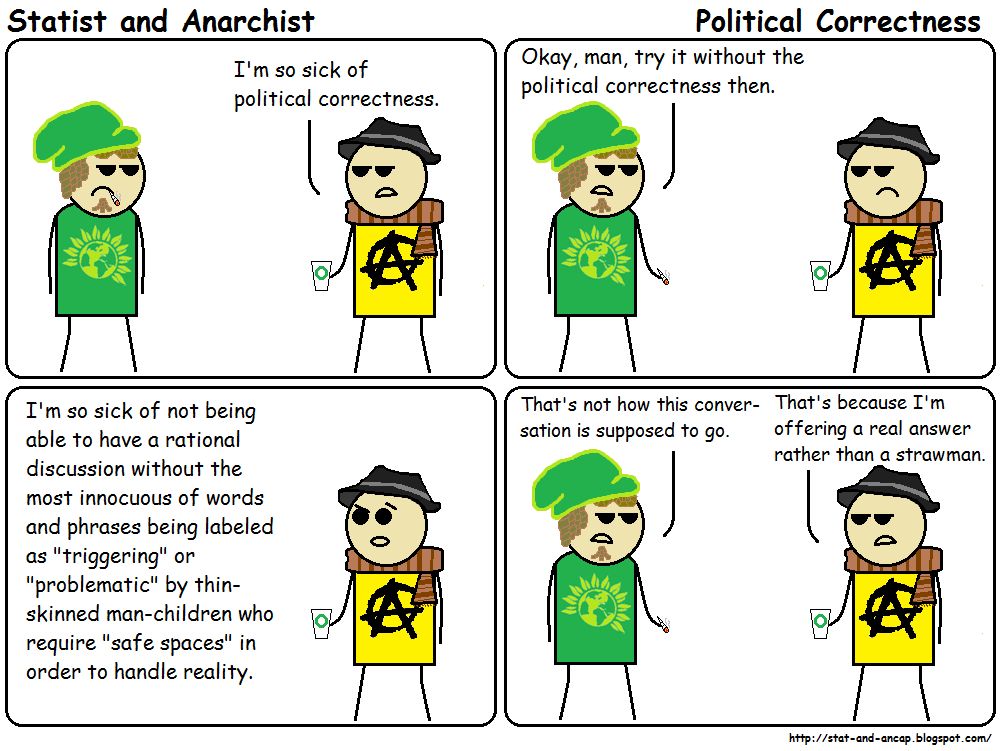
Source: https://www.deviantart.com/blamethe1st/art/Statist-And-Anarchist-063-Political-Correctness-589944623
Suddenly we are told that instead of using the term illegal immigrant we should refer foreign national who cross our border without official government authorisation as an undocumented immigrant. We are constantly harassed to use gender neutral terms like parent or guardian rather than mother and father.
The top-down project of dispossessing people of their taken-for-granted vocabulary is often justified on the ground that it aims to promote an inclusive language that rids society of words that are offensive to some people. However, when you examine the increasingly long list of terms that are targeted by the proponents of linguistic cleansing, they touch upon words that are not at all insulting. Words like female, mother, father, pregnant women, breastfeeding or the poor are not used to insult others. When such commonly used terms are rebranded as harmful something more than good manners is at issue. These are words through which a people understands birth, bodies, family life, community and their inter-personal relationships. Through the use of this vernacular a shared understanding of the conduct of everyday life is created. Once these words are condemned as unacceptable than the prevailing system of meaning becomes undermined. Those who insist on using the language that was transmitted to them by their family and community stand condemned for their crime against the new culture.
The term linguistic cleansing captures the current trend towards the policing of language. The brutal and violent dynamic driving linguistic cleansing was alluded to by David Barnhizer in the following terms:
In the same way that a specific ethnic identity group seeks to “cleanse” a territory of other identity groups in what has come to be known as “ethnic cleansing” there are rapidly evolving language control strategies being implemented by aggressive special interests that are fairly described as “linguistic cleansing”. The aim of “linguistic cleansing” is to gain power over others’ speech and re-engineer culture into a form desired by the identity group implementing the strategy. This extends to the desire to eradicate traditional modes of expression that are claimed to “insult”, offend, emotionally harm or demean.(my emp) The real aim is to shape thought and consciousness by controlling the use of language and acquiring power through control of discourse.
Barnhizer’s argument that ‘the real aim’ of linguistic policing is ‘to shape thought and consciousness by controlling the use of language and acquiring power through control of discourse’ highlights its insidious and culturally damaging consequence. Humans do not merely use language the words they use defines who they are.
For many decades advocates of linguistic policing have argued that the target of their concern are words that intend to offend, to harm and to demean. However, in reality the words chosen for cleansing are often ones that have been used since time immemorial and were not designed to offend or to cause harm. People using the word female have no derogatory intent it is those possessing a censorious agenda who take it upon themselves to cast this word in a negative light.
Update, 17 November: Welcome, Instapundit readers! Have a look around at some of my other posts you may find of interest. I send out a daily summary of posts here through my Substack – https://substack.com/@nicholasrusson that you can subscribe to if you’d like to be informed of new posts in the future.
That Fine Line Between Smuggling and Legal Trade: Anecdotes from Val Forgett
Forgotten Weapons
Published 15 Jul 2026Dealing in firearms internationally is a trade scrutinized pretty closely by governments, and its practitioners can often end up acting as agents for government priorities, and also victims of said priorities changing. Val Forgett of Navy Arms grew up with his father doing exactly this sort of thing. Today we have some interesting anecdotes about guns going into Cuba and Lebanon, among others …
(more…)
QotD: Scottish recruits
Ian Hay (Major John Hay Beith), The First Hundred Thousand: Being the Unofficial Chronicle of a Unit of “K(1)”, 1916.
November 15, 2026
Microsoft’s M365 outage
Millions of people have now experienced the joy of an empty inbox, thanks to the extended outage on one of Microsoft’s most important business software offerings. Many people are saying that Microsoft, having gotten rid of a lot of its veteran engineering staff over the last few years, may not be capable of fixing the problem. On X, John Ringo offers his thoughts:
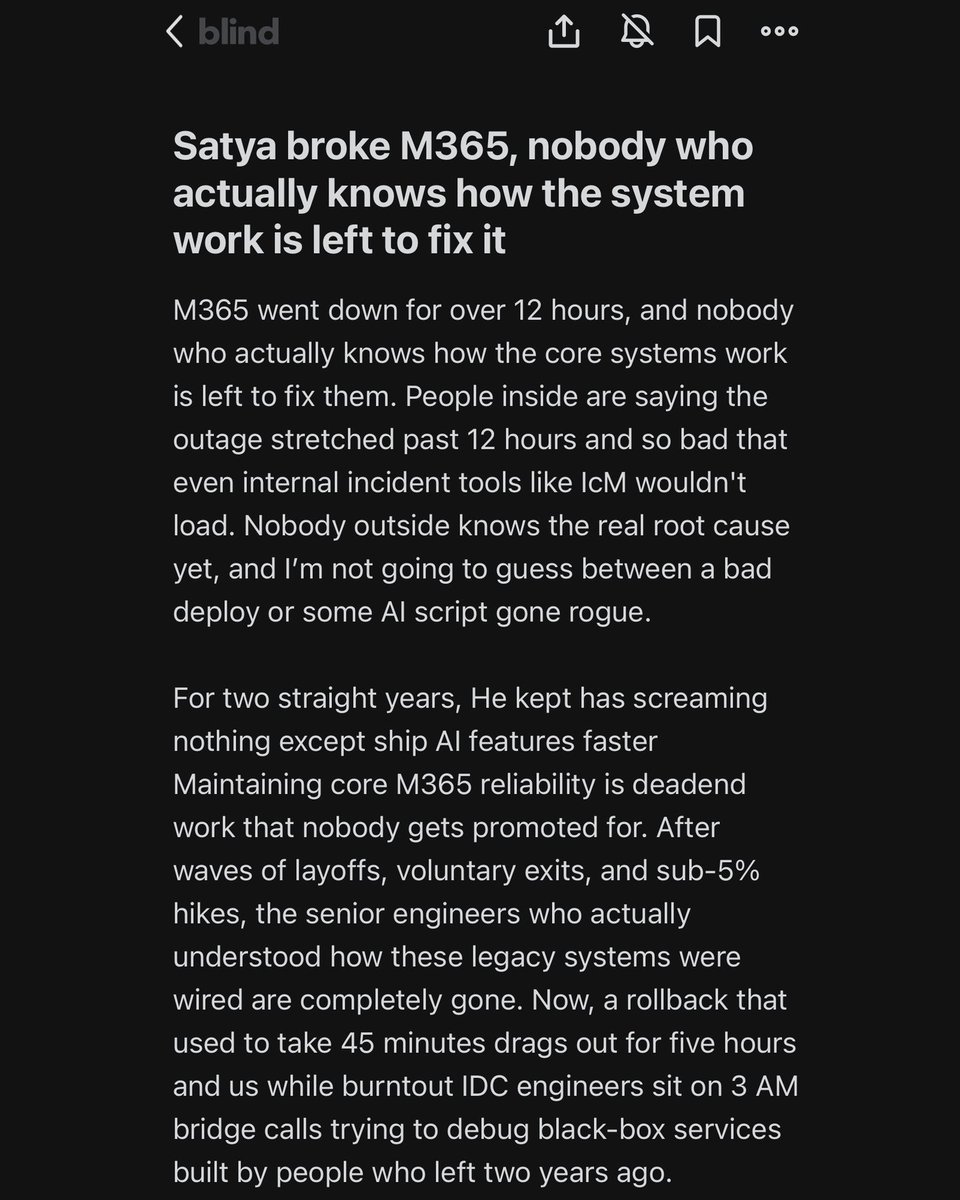
CAN Microsoft recover?
(This was a reply to something. I decided it was better as a post.)
Oh, I agree. They’ve been getting rid of the nerds that built the system and have this little undocumented bit of knowledge in their heads for years. That is a huge issue and definitely contributing to the downtime.
But they (and AWS and others) have also built a system that is so complex and interwoven, the real issue is:
If it crashes this hard can they bring it back up as it was at all?
We get into discussions of telos and kosmos. It’s distinctly possible if you brought back EVERYONE who built it that they still couldn’t fix Humpty-Dumpty.
We’ll see by Monday.
Telos and kosmos.
Telos is a simple simple system. Every point in the system is understood and is comprehensible by a single person. (A single server. A large but not enormous set of servers.)
Then there are simple complex systems. A system where every individual part of the system can be comprehended but it’s impossible to comprehend how all the parts interact.
That is what Microsoft and AWS and other cloud providers have created. A system where you can maybe understand why this bit isn’t working but not why/how its interacting to cause all these other bits to not work.
It’s too complex.
It’s one of the reasons that the people saying “Nobody is going to migrate off the cloud. Nobody wants to run their own servers. No IT guy wants to run email. These guys are literally the experts.” are all wrong.
When a single company, from a two man shop to fortune 500, uses its own server system, the entire system can be understood. It is telos. Every bit can be comprehended. It may be badly documented. There may be this little “thing” that only Joe Neckbeard knows and if you fire him you may have an outage.
But it’s NOT so big nobody can really rebuild it in a serious meltdown.
Rebuilding this ecosystem is so complex that it’s like nuking Manhattan and expecting every single piece to go back just like magic.
It won’t. And those missing pieces are Gladys’ payroll spreadsheet that she inherited from Gloria who inherited it from Sandra who inherited it from Carol who got some nerd who left in 1996 to do it for her.
The question becomes, what to do if it’s not back by Monday?
Eliminate the profit motive? Yeah, like that would work …
On Substack, Dan Williams patiently explains that the fervent belief among socialists is that the profit motive is man’s original economic sin, and if we can just get rid of it, then the rivers will run uphill:
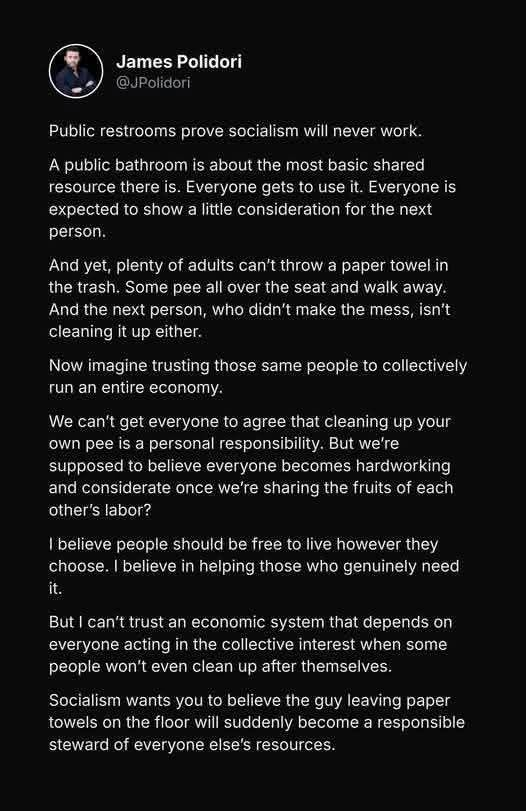
A common complaint levelled against capitalism concerns its reliance on the “profit motive”. The assumption is that it would be better to organise our economies around cooperation, mutual aid, or other elevated ideals, not the pursuit of personal gain. “People, not profit”, as the slogan goes.
Some versions of this complaint rest on simple technical mistakes or economic illiteracy. For example, profit is an important signal that a firm is using a society’s resources efficiently, which is why even many socialists who reject central planning want to keep profit-maximisation as an objective of firms. They want to change who owns firms, not what firms aim at.
Similarly, many blame the profit motive for problems caused by the bad rules under which profit-seeking operates. AOC complains that capitalism, at its core, “is the absolute pursuit of profit at all human, environmental, and social cost”, but no actual capitalist economy works this way. Societies create rules within which profit-seeking takes place. Many critiques of the profit motive point at outcomes that could be fixed by changing these rules, such as through taxes that make companies internalise the social or environmental costs of their products.
Economists and philosophers have been pointing out mistakes like these for generations, usually with little effect. This is because opposition to the profit motive gets its energy not from sober economic analysis but from a basic moral complaint.
Capitalism, the complaint goes, is powered by self-interest, greed, and personal ambition. These motives are bad. We teach our children not to be acquisitive and competitive, and we disapprove of people who exhibit these traits in everyday life. So, why would we organise our economies around them, or be surprised when those economies feature crisis, exploitation, or environmental catastrophe?
It’s easy to sympathise with this analysis, but it rests on significant confusions about some basic facts of human social life and the central challenges of politics.
In an important sense, the pursuit of profit is not an optional feature of societies. It is a fixed constraint on all societies that, at most, can be channelled and redirected, never abolished. More precisely, you can outlaw profit-seeking companies, but you can never abolish the pursuit of personal advantage and social standing. Attempts to do so often either push this pursuit in more destructive directions or conceal its operation in dangerous ways.
The curse of modern SciFi: wrongfans having wrongfun
The market for science fiction books used to be pretty heavily oriented to the reading tastes of men … not absolutely, but predominantly. Starting in the 1980s, the publishers of science fiction works tried expanding their market toward women’s tastes, at the same time as they hired more women to work for them. There were some successes, but over time, the market switched away from catering to their traditional audience and even alienating that traditional audience to chase more after the preferences of female readers. This led to those “new” SF readers looking down on the testosterone-poisoned old SF readers with contempt.
On X, John Carter explains the SF market to someone who likes the new style:
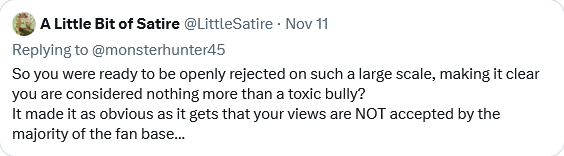
“your views are NOT accepted by the majority of the fan base”
I’ve been reading SciFi since I was literate, which was before kindergarten. I read voraciously. My personal library is very large, and the number of science fiction novels I’ve read is probably an order of magnitude larger. I haven’t kept count. Let’s just say that I’ve probably read more or less everything that matters.
That is not a brag. Who the fuck would brag about being that much of a nerd. That is simply to establish my bona fides as a science fiction fan.
You people, and I use that word very lightly, have wrecked SciFi. There is nothing worth reading in the bookstores and there has been nothing worth reading since your vile kind sleezed your way into the subculture on an ooze of false compassion and counterfeit empathy. You are not “fans” of speculative fiction. You’re sexual perverts and decolonization cultists. You do not look forward to man’s conquest of the stars, but work towards the annihilation of the only civilization that could plausibly realize such an audacious ambition. You certainly do not give a shit about “science fiction”. All that matters to you is your false religion of “social justice”.
If I had my way every one of you would be thrown into the event horizon of a black hole to be slowly shredded by gravitational tides, your torment extended into the terminal depths of the cosmological degenerate era by relativistic time dilation, to be ended only when the black hole exploded in a burst of Hawking radiation, shredding your last remains in a final storm of gamma rays. The only thing that would please me more would be if Roko’s Basilisk spent the interim tormenting your simulcra through a billion trillion lifetimes of horror and degradation.
As for @monsterhunter45’s views, the only thing I find remotely objectionable is that he’s a bit of a softy. His novels, however, are hella fun. I’ve got the entire MHI series, and a lot of his other works. Larry Correia is a fucking treasure.
And it was specifically because organisms such as yourself hate him so much that I started reading him in the first place.
Have a nice day.


