Quotulatiousness

November 12, 2026

How do you say “useful idiots” en français?

Filed under: China, France, History, Media, Politics, Quotations — Tags: , , , , , — Nicholas @ 03:00

On X, Handre reminds us that we didn’t run out of useful idiots after the original batch of the 1930s faded … there were still plenty of them in 1968:

In 1968, teenage Red Guards were beating their professors to death with clubs in Beijing courtyards.

Meanwhile, Jean-Paul Sartre sat in Paris calling Mao’s Cultural Revolution a model of revolutionary democracy. The most celebrated intellectual in France looked at a country burning its own libraries and saw liberation. He sold the Maoist newspaper La Cause du Peuple on French street corners himself, holding it aloft like a sacrament.

Between 1966 and 1976, the Cultural Revolution killed between 500,000 and two million people. Schools shut down across the entire country. Students dragged teachers onto stages, hung placards around their necks, forced them to kneel on broken glass, then murdered them. The historian Bian Zhongyun, vice-principal of a girls’ school in Beijing, died on August 5, 1966, beaten by her own students with nail-studded clubs.

Sartre swooned at this, calling it the people governing themselves. Why did a man this intelligent get it this wrong? Sartre believed knowledge served power, that truth was whatever the revolution required, that the individual existed to be dissolved into the collective will.

So when Mao abolished the distinction between teacher and student, between expert and mob, Sartre cheered. He had spent decades arguing that bourgeois reason was a class weapon. Here was a regime taking him at his word and clubbing the reasoners to death. This is what economic illiteracy gets you.

Mises had already explained the calculation problem in 1920. Hayek explained dispersed knowledge in 1945. Sartre had access to both and chose the dunce cap of the collective instead, then handed out its propaganda on the Rue de Rennes.

He died in 1980, mourned by 50,000 followers, never having retracted a word about Mao. The professors of Beijing got no such funeral, only a philosopher in Paris explaining that their murder was freedom.

Update, 13 November: Welcome, Instapundit readers! Have a look around at some of my other posts you may find of interest. I send out a daily summary of posts here through my Substack – https://substack.com/@nicholasrusson that you can subscribe to if you’d like to be informed of new posts in the future.

The corporate bailout that caused the Boston Tea Party

Filed under: Britain, Food, History, USA — Tags: , , , , , , — Nicholas @ 02:00

Tasting History with Max Miller
Published 15 May 2026

Slightly thickened warm drink made of green tea, white wine, and nutmeg

City/Region: England | United States of America
Time Period: 1742

Caudles are one of those old-fashioned drinks that you don’t hear about anymore, but they should really make a comeback, or at least this green tea caudle should. Originally, the term caudle referred to any hot drink, but over time, caudle came to mean a drink made with wine or ale that was thickened, sweetened, and spiced.

This caudle, from an English cookbook that was the first cookbook printed in the American colonies, has a base of green tea and wine that is sweetened with sugar, spiced with nutmeg, and thickened with egg yolks. The green tea and nutmeg really come through, and there’s an interesting citrusy flavor that I think comes from the sauvignon blanc that I used. The egg yolks gently thicken the mixture so it has the consistency of egg nog, and overall it is a unique, delicious drink that is well worth a try.

    To make Tea Caudle.
    Make a quart of strong green Tea, and pour it out into a Skillet, and set it over the fire; then beat the yolks of four Eggs, and mix with them a pint of White-wine, a grated Nutmeg, Sugar to your Taste, and put all together; and stir it over the fire till ‘tis very hot, then drink it in China Dishes as Caudle.
    — The Compleat Housewife: or, Accomplish’d Gentlewoman’s Companion by Eliza Smith, 1734

(more…)

QotD: Citizen Kane

Filed under: History, Media, Quotations, USA — Tags: , , , — Nicholas @ 01:00

Citizen Kane is barely even blah … until you realize that it was shot in 1941, and start comparing it to everything else shot in 1941. Citizen Kane looks like a Current Year piece, and that’s why it was so revolutionary — everything else in 1941 looks like they just pointed a camera at a Broadway stage and left it running. Pretty much every movie “trope” — the whole visual “language” of modern cinema (I believe the term d’art is topos) — was created by Citizen Kane. When it comes to modern moviemaking, nobody makes “an Orson Welles” movie anymore, because they’re ALL Orson Welles movies; after Citizen Kane, that’s just how movies are done.

Severian, “Period Piece”, Founding Questions, 2026-08-04.

November 11, 2026

Serfdom in Russia

Filed under: History, Russia — Tags: , , , — Nicholas @ 05:00

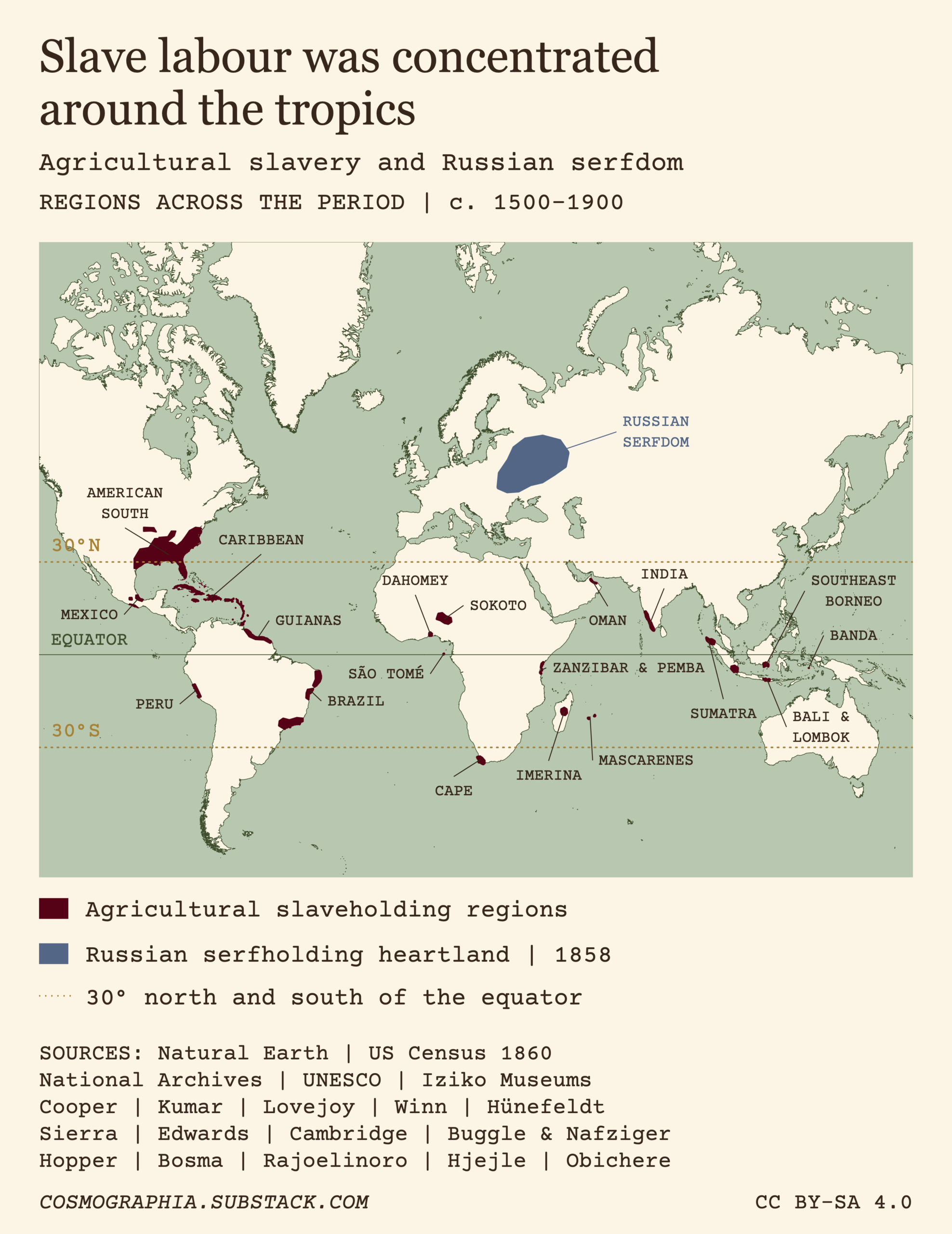
Peasants all over Europe had a bad deal, but the peasants in Russia seemed to have it much worse, as a Russian serf was nearly as unfree as chattel slaves in other lands. At Cosmographia, M.E. Rothwell explores why this happened:

In my previous post on Italy I explained that malaria was a significant factor in the modern economic divergence between the country’s north and south. The geography and climate incubated a deadlier strain of the disease in the south, and the higher mortality rate and subsequent exodus created labour shortages on otherwise productive land. This led the land-owning elites to import chattel slaves to work the fields. That entrenched inequality in the region and created a series of social conditions which set southern Italy on a different course of development to the north.

This is not a story unique to Italy. Throughout history, agriculturally productive regions with high rates of disease — the Caribbean, the American South, parts of Arabia — have tended to have high prevalences of slavery. It’s especially pronounced when the crop in question is labour-intensive — cotton, sugar, tobacco, coffee, cocoa, etc.

Since I learned this fact a few years ago, a lot of history clicked into place for me — why the conquistadors were so cruel in the New World; why the American South had slavery but the North did not; why African slaves (with their high resistance to tropical diseases) were so sought after.

However, something about this story bugged me. Why, if tropical disease prevalence was so correlated with high rates of agricultural slavery, did Russia have serfs?

Serfdom is not technically slavery. Unlike chattel slaves, serfs are bound to land rather than a private owner. But the systems could look remarkably similar in practice. Russian serfs could be bought and sold, were denied freedom of movement, needed permission to marry, and were often subject to brutal punishments and terrible working conditions.

Serfdom was not unique to Russia, of course. Mediaeval peasants across feudal Europe were often bound to their landlords and obliged to till their land. But the Russian system developed into something considerably closer to chattel slavery, and endured much longer. Serfdom had largely disappeared from Western Europe by the beginning of the Early Modern Period (c. 1500), while Russian serfdom was then only just beginning to be codified, and Russian serfs weren’t emancipated until 1861.

Russia is famously cold. There are many things that can kill you in its vast expanse, but tropical disease is not one of them. So why then did Russia have a system so closely resembling plantation slavery?

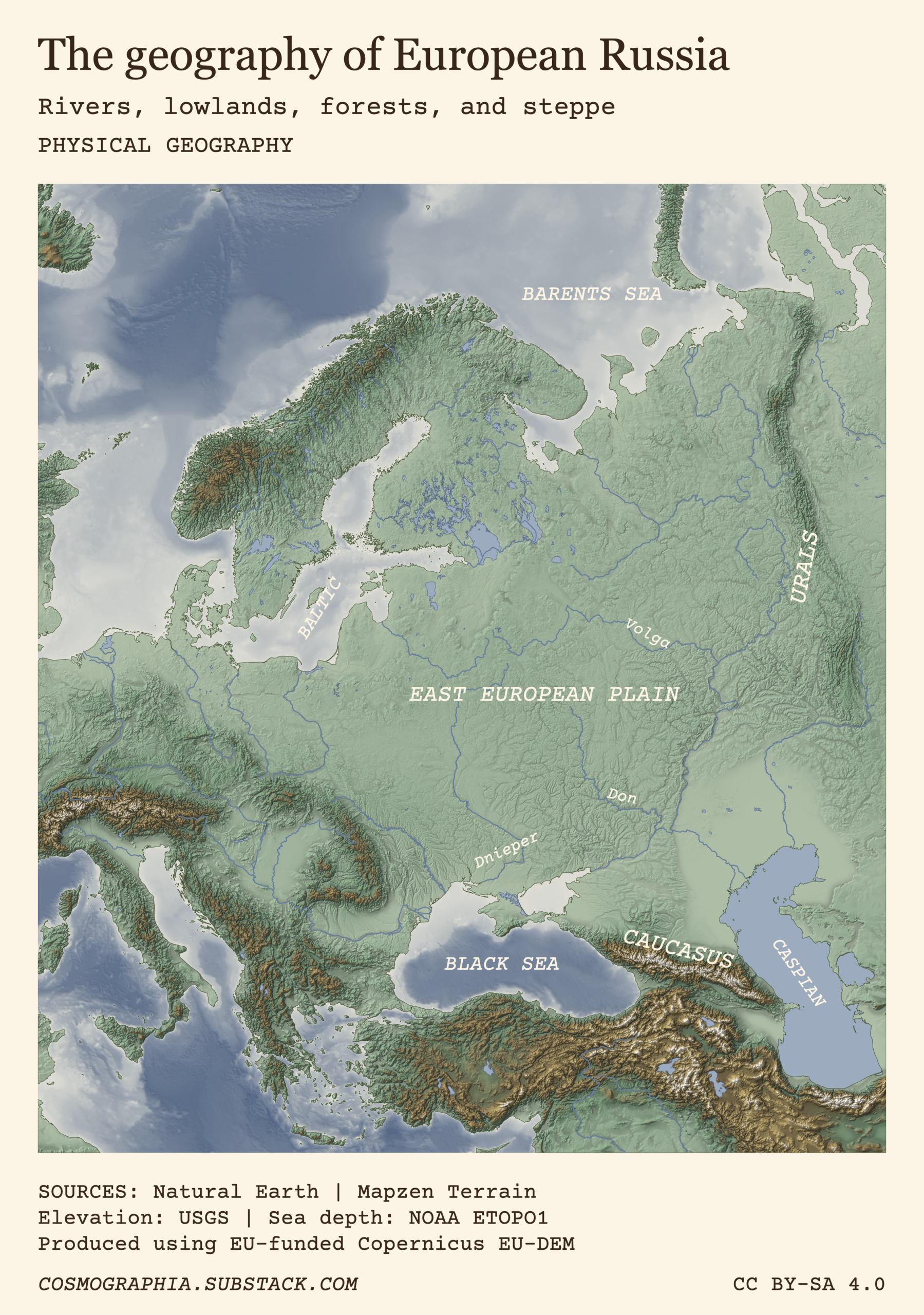
In 1970, the Russian-American economist Evsey Domar tried to answer exactly this question. Drawing on a thesis first proposed by 19th century imperial historian, Vasily Klyuchevsky, he argued that geography was the cause: such was the abundance of farmable land in the vast expanse of an expanding Russia that peasants could up sticks and leave for seemingly infinite new pastures whenever conditions (i.e. pay/rent) were unfavourable. Therefore the landed aristocracy suffered from continual labour shortages, which drove wages up and land rents towards zero. Unable to extract sufficient income from their estates under such conditions, the landowning elites pressed the Tsar to restrict peasant mobility, tie workers to the land, and thus serfdom was born.

At first glance Domar’s explanation seems compelling. Between the late 15th and 17th centuries, Muscovy underwent extraordinary territorial expansion, conquering enormous swathes of land both south and east of the old forest heartlands.

The Korean War Week 125 – America Elects a New President! – November 10, 1952

Filed under: China, History, Military, USA — Tags: , , , , , , — Nicholas @ 04:00

The Korean War by Indy Neidell
Published 10 Nov 2026

Well, the people have spoken, and Dwight D. Eisenhower has been elected to serve as the next President of the Untied States. He won’t be sworn in for another couple months, though, so Harry Truman’s administration has to deal with the Korean War until then, which very much includes still working for an armistice that respects the wishes of POWs.

00:00 Intro
00:25 Recap
00:47 Artillery Testing
02:12 Acheson and the UN
04:24 ROKA
06:53 Presidential Election
10:28 Television Campaign
13:20 The Election Results
15:07 Summary
15:19 Conclusion

In memoriam

Filed under: Britain, History, Military, WW1, WW2 — Tags: , , — Nicholas @ 03:00

A simple recognition of some of our family members who served in the First and Second World Wars:

The Great War

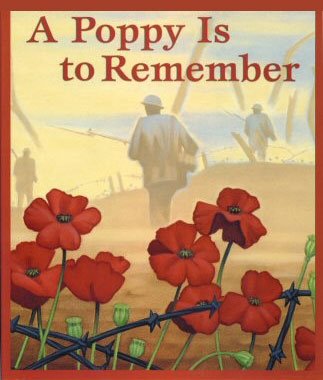
  • A Poppy is to RememberPrivate William Penman, Scots Guards, died 16 May, 1915 at Le Touret, age 25
    (Elizabeth’s great uncle)
  • Private Archibald Turner Mulholland, Argyll & Sutherland Highlanders, mortally wounded 25 September, 1915 at Loos, age 27
    (Elizabeth’s great uncle)
  • Private David Buller, Highland Light Infantry, died 21 October, 1915 at Loos, age 35
    (Elizabeth’s great grandfather)
  • Private Harold Edgar Brand, East Yorkshire Regiment. died 4 June, 1917 at Tournai.
    (My first cousin, three times removed)
  • Private Walter Porteous, Durham Light Infantry, died 4 October, 1917 at Passchendaele, age 18
    (my great uncle, who had married the day before he left for the front and never returned)
  • Corporal John Mulholland, Argyll & Sutherland Highlanders, wounded 2 September, 1914 (shortly before the First Battle of the Aisne), wounded again 29 June, 1918, lived through the war.
    (Elizabeth’s great uncle)
  • John Eleazar (“Ellar”) Thornton, (rank and dates of service unknown, served in the Royal Garrison Artillery, the East Surrey Regiment, and the Essex Regiment (he likely joined the RGA in 1899). Put on the “Z” list after the war — recall list. He died in an asylum in 1943.
    (my grandfather’s eldest brother)
  • Henry (Harry) Thornton, (uncertain) Lancashire Fusiliers. (We are not sure it is him as there were no identifying family or birth date listed. Rejected for further service.)
    (my grandfather’s second older brother)
  • Rifleman James Albert Conn, Royal Irish Rifles. He was discharged 23 Jan 1915 with a gunshot wound to the left elbow and granted a disability pension. A sad irony: he was shot dead in the streets of Belfast during the 1920 Irish Uprising. He ran out onto the road to help a man who had been shot and was killed by British troops (age 32).
    (Elizabeth’s great granduncle.)

The Second World War

  • Flying Officer Richard Porteous, Royal Air Force, survived the defeat in Malaya and the surrender of Singapore, was evacuated to India and lived through the war.
    (my great uncle)
  • Able Seaman John Penman, Royal Navy, served in the Defensively Equipped Merchant fleet on the Atlantic convoys, the Murmansk Run (we know he spent a winter in Russia at some point during the war) and other convoy routes, was involved in firefighting and rescue efforts during the Bombay Docks explosion in 1944, lived through the war.
    (Elizabeth’s father. We received his Arctic Star medal in July, 2024.)
  • Private Archie Black (commissioned after the war and retired as a Major), Gordon Highlanders, captured during the fall of Singapore (aged 15) and survived a Japanese POW camp (he had begun to write an autobiography shortly before he died)
    (Elizabeth’s uncle)
  • Elizabeth Buller, “Lumberjill” in the Women’s Timber Corps, an offshoot of the Women’s Land Army in Scotland through the war.
    (Elizabeth’s mother)
  • Trooper Leslie Taplan Russon, 3rd Royal Tank Regiment, died at Tobruk, 19 December, 1942 (aged 23).
    (My father’s first cousin, once removed and therefore my first cousin, twice removed).
  • Flight Sergeant Kenneth Alexander Porteous, Royal Air Force, air gunner in a Lancaster bomber of 15 Squadron, Bomber Command. Died when his plane was shot down at Wormlitz 10 miles northeast of the target during a raid on Magdeburg, 21 January 1944 (aged 28).
    (My first cousin, twice removed.)
  • Reginald Thornton, rank and branch of service unknown, hospitalized during the war with shellshock and was never discharged back into civilian life. He died in York in 1986.
    (My grandfather’s youngest brother)

My maternal grandfather, Matthew Kendrew Thornton, was in a reserved occupation during the war as a plater working at Smith’s Docks in Middlesbrough. The original design for the famous Flower-class corvettes came from Smith’s Docks which also launched 16 of the 196 built in the UK during the war (more were built in Canada). My great-grandmother was an enthusiastic ARP warden through the war (she reportedly enjoyed enforcing blackout compliance in the neighbourhood using the rattle and whistle that came with the job). My father was just a bit too young to serve, and discovered when he tried to join the army in late 1945 that the very last thing the British army wanted at that time was yet another officer cadet. By a weird timing issue, he then was too old for National Service when it was introduced a few years later. My father never did forgive the army …

For the curious, the Commonwealth War Graves Commission the Royal British Legion, and the Library and Archives Canada WW1 and WW2 records site provide search engines you can use to look up your family name. The RBL’s Every One Remembered site shows you everyone who died in the Great War in British or Empire service (Canadians, Australians, New Zealanders, South Africans and other British colonies). The CWGC site also includes those who died in the Second World War. Library and Archives Canada allows searches of the Canadian Expeditionary Force and the Royal Newfoundland Regiment for all who served during WW1, and including those who volunteered for the CEF but were not accepted.

In Flanders fields the poppies blow
Between the crosses row on row,
That mark our place; and in the sky
The larks, still bravely singing, fly
Scarce heard amid the guns below.

We are the Dead. Short days ago
We lived, felt dawn, saw sunset glow,
Loved and were loved, and now we lie
In Flanders fields.

Take up our quarrel with the foe:
To you from failing hands we throw
The torch; be yours to hold it high.
If ye break faith with us who die
We shall not sleep, though poppies grow
In Flanders fields.

Lieutenant Colonel John McCrae, MD, Canadian Army Medical Corps (1872-1918)

Here is Mark Knopfler’s wonderful song “Remembrance Day” from his Get Lucky album, set to a slideshow of British and Canadian images from World War I through to more recent conflicts put together by Bob Oldfield:

What Life in the WW1 Trenches Was Really Like

The Rest Is History
Published 18 May 2026

During the First World War, what was it like to live in the trenches on the Western Front in 1915? How did the Germans attempt to knock the Allies out of the war right from the outset? And, what secret weapon did the Germans unleash?

Join Dominic and Tom as they plunge back into the First World War, and carry us through life in the trenches, the horrors of shelling, and the escalation of this totemic conflict.

00:00 The Western Front
02:34 Robert Graves goes to war
06:27 Marching towards the trenches
10:06 Bullets, dugouts and the first casualty
13:24 Daily life in the trenches
16:19 How the trenches were built
18:51 Mud, slime and being trapped
20:01 Lice, fleas and trench fever
22:08 Rats in the trenches
23:49 Boredom, routine and why some soldiers enjoyed it
26:31 Life behind the front line
28:52 The Times
30:05 Ernst Jünger and the horror of battle
33:23 Storm of Steel
36:20 The “great god Pain”
40:25 Face-to-face killing
43:49 The odds of death on the Western Front
45:41 Shell shock
49:26 How the army understood trauma
51:19 Every soldier’s breaking point
54:21 Gas: Germany’s secret weapon
57:14 The first gas attacks
59:03 Wilfred Owen and the horror of gas
1:02:03 Britain’s disastrous gas attack at Loos
1:04:40 John Kipling and the tragedy of Loos

QotD: The “Mediocre Man” theory of history

    Wilhelm wished to be “the stag at every hunt, the bride at every wedding, and the corpse at every funeral”.

Thomas Carlyle famously claimed that “The history of the world is but the biography of great men”. In his view, history only really “progressed” when a “great man” through his actions ushered in a new epoch. Napoleon was the archetype for this model, a man who seemingly came from nothing to leave an indelible mark on world history. This model places extreme focus on individuals and thus on elite politics. The theory does not account for mass politics or leave room for the histories of those far from the levers of power. The clear deficiencies of a focus on “great men” led to its abandonment in favor of a broader approach to history, more interested in historical forces than in personalities. This historiographical turn led to the exploration of many important and previously neglected areas, yet “history from below” came with problems of its own. By emphasizing the role of structural forces, it deemphasized the role of individuals. With this approach, the course of history begins to appear inevitable. If it was the social and political forces of the French Revolution that made Napoleon successful, the logical conclusion is that it would have made no difference to the course of history should he have, say, suffered a fatal stroke in 1801, a premise few would accept. It is clearly untrue when applied to specific cases. Not only who ends up in power, but the specific decisions they make are deeply consequential. Who would really contend that the 20th century would remain unchanged had Hitler been killed in WWI?

The synthesis position is what I call here the “mediocre man” theory of history. The idea of this mediocre man theory is that history is not just shaped by great men or by mass sociological forces that make individual irrelevant. Instead, while it is shaped by structural forces, it is also shaped by ordinary people who end in positions of extraordinary importance. Sometimes those individuals have vision and the character to try to impose that vision on the world and constitute the “great” figures of history. Others are complete incompetents you wouldn’t trust to run a lemonade stand. As so, history is not shaped by the talented alone and mundane failures may be as consequential as grand successes. Dilettante monarchs neglect crucial reforms, awkward diplomats reinforce prejudices, military thinkers become set in their ways, etc. These idiosyncratic, average figures shape history not necessarily any less than their more talented counterparts.

Perhaps no one better illustrates the concept than German Emperor, Wilhelm II. After all, it would be extremely difficult to call the Kaiser a “great man”, even in the loosest sense. However, the impact of his rule and his personal decisions on world history is undeniable. A simple counterfactual demonstrates this: If Wilhelm II had been more like his liberal father or his passive grandfather, it is near impossible to imagine the path the twentieth century would have taken.

Yet, his actual influence is harder to pin down. During WWI and in its immediate aftermath, the Kaiser was understood as the “brute of Europe”, a tyrannical warlord who was responsible for German aggression and bringing about the war. Before long, however, this image was replaced with one still popular today, that of a “shadow Kaiser”. A figure more influential than a traditional constitutional monarch, but one whose power was rarely felt compared to the prestigious military and overwhelming modern state. In this view, the Kaiser contributed, but was merely a small player in the making of German policy.

More recent research (particularly from John C. Röhl and Annika Mombauer) has established that Wilhelm, far from being a mere “shadow emperor” succeeded in centralizing power following his accession. While not a traditional autocracy, his power over personnel and the need for royal assent assured the Kaiser’s ability to shape policy. Germany’s constitution made it particularly susceptible to this kind of “personal rule”. A Chancellor, not a prime minister, headed the government. The Chancellor ruled by confidence of the monarch, regardless of the makeup of parliament. The military owed no allegiance to the civil state, only to the monarch, allowing Wilhelm to flex his influence as supreme arbiter between institutions.

What’s more, advancement in both the armed forces and the civil service required the emperor’s approval. Promotion was impossible without royal assent. At the highest levels, nothing mattered more than his confidence and, indeed, friendship. Wilhelm ruled out candidates on the basis that they weren’t tall enough to cut an impressive figure. In fact, the Younger Moltke owed his appointment to Chief of the General Staff less to his famous name, and more to his personal relationship with Wilhelm and his conformity with what the Kaiser thought a soldier ought to look like.

This power had extreme effects on the behavior of Germany’s ruling bureaucrats and officers. To incur the Kaiser’s displeasure meant the end of a career. As such, those that attained influence at court were those who could judge which topics were safe to broach in front of his majesty. There was no question of discussing harsh truths.

Wilhelm certainly brought Europe closer to the precipice of war through his actions and rhetoric, yet he was far from the warmongering brute often imagined. In fact, the Kaiser was far more peaceably inclined than many of his advisors, particularly Chief of the General Staff Moltke (the Younger) and War Minister Falkenhayn who strongly pressed for “war, the sooner the better”. Wilhelm, in keeping with the theme of mediocrity, was thoroughly ambivalent. At times, he raged, declaring his desire to crush Germany’s enemies. During the Boxer rebellion, he ordered Beijing to be razed in revenge for murdered German dignitaries. He was convinced to rescind this order, which is illustrative of the manner in which he was given to flights of fancy and malicious rage. When he spoke to foreign representatives or even the foreign press, he expressed the most fervent desires for cooperation and cordial relations. But the moment he felt slighted, particularly by the English, he seethed, calling for a humbling war.

At the same time, the Kaiser’s commitment to peace was sufficiently strong as to frustrate even those who did not actively desire preventative war. During the First Morocco crisis, the Chancellor and Foreign Ministry sought to use the threat of war to break up the untested Anglo-French Entente. This attempt was completely undermined when the Kaiser declared publicly that he was utterly unwilling to take Germany to war.

Likewise, when the Balkan wars broke out, many of Germany’s leaders saw an opportunity either for preventative war or at least using the risk of it to break the Entente. However, the Kaiser was immediately opposed to even the possibility of taking Germany to war over a Balkan affair. It was only after much haranguing that his mind was changed. With his typical capriciousness, he raged against England. Yet, ultimately, nothing was to come of the incident, much to the disappointment of those in favor of war. For all his immature rage and harsh words, the emperor had the sense to balk in the face of war.

Understandably, there has been much speculation as to Wilhelm’s mental fitness. Both amongst historians and contemporaries, it has been marked that Wilhelm possessed a perpetual immaturity. He had great difficulty in taking matters seriously, and tended to fixate on surface level details that caught his fancy to the neglect of the heart of the matter. He spoke without preparation or consideration, seemingly unaware of the consequences this brought about. His insistence on giving innumerable speeches left his advisors perpetually frustrated. He also had a tendency to fly into rages in which he would completely lose control over himself, deeply disturbing even his intimate companions. While we may no longer be able to diagnose Wilhelm, even his most sympathetic contemporaries could not avoid considering that the Kaiser was deeply unwell.

On the whole, Germany’s diplomatic isolation was primarily a product of the Kaiser. While the other powers of Europe were certainly concerned about Germany’s growing power, the near total isolation that made Germany willing to risk war in 1914 was by no means inevitable. It is unlikely either the Russians or French would have been willing to undertake a war of choice on the other’s behalf. However, the influence of the Kaiser on German politics made Germany’s isolation inevitable. A byzantine court system where promotions were based on the favor of a man who did not have the character to set a consistent policy made for a state that was not a credible partner. The Chancellor might say one thing, the diplomatic service another, military attachés still a third, and then all may, at any time, be contradicted by the Kaiser in a speech commemorating a battle or commissioning a ship.

This, even more than Germany’s increasing power, was why the Entente powers formed an encircling pact against it. Germany’s interests were incomprehensible and thus there was no option other than to balance against this rogue state in the heart of Europe. Wilhelm’s unsuitability was not fully understood, and the incoherence of German foreign policy led its contemporaries to assume the worst.

Kiran Pfitzner, “The Kaiser and a ‘Mediocre Man’ Theory of History”, Dead Carl and You, 2024-04-04.

November 10, 2026

“I felt like Howard Carter entering Tutankhamun’s tomb and waving a torch at the walls of hieroglyphics”

Filed under: Britain, Media, Technology — Tags: , , , , , , — Nicholas @ 05:00

Have you noticed that the widespread availability of emojis/emoticons/electroheiroglyphics has particularly influenced how younger folks communicate? Joanna Gray has, and has her concerns about the whole thing:

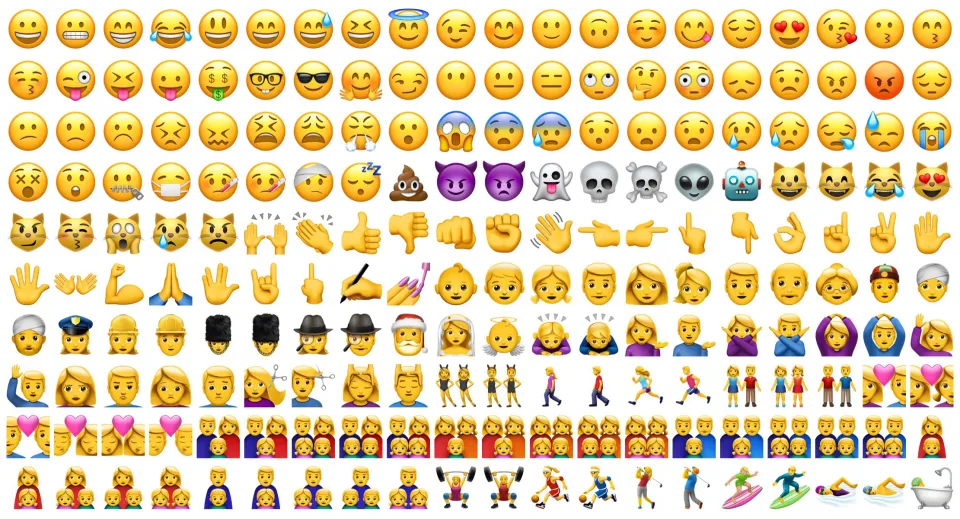
One of the markers future historians will use when describing the New Dark Ages will be the collapse in the use of the alphabet in favour of “Yookay Hieroglyphics”. A demoralising development has emerged: a whole new form of pictographic language whereby children and young adults engage in hours-long online conversations with each other without the need for any letters, texts or words. Such conversations largely occur on gaming platforms, Snapchat and WhatsApp, and mark a classic regressive step in civilisational decline.

Like the medieval laity who relied on church wall paintings and stained glass to learn stories, a growing proportion of our current population is now using only pictographic communication. This time, there is no divine knowledge behind the imagery – just inane slop. I shall try to use words to describe this new pictographic language that groups of teenagers I work with have shared with me. When first shown, I felt like Howard Carter entering Tutankhamun’s tomb and waving a torch at the walls of hieroglyphics in wonderment. Yookay Hieroglyphics are read vertically from top to bottom. If drawn on Snapchat, they often instantly disappear on reading or after 31 days, making linguistic analysis particularly fraught.

A useful starting point when attempting to read Yookay Hieroglyphics is to think of the wonderfully coloured whizzy strip of cherries, bananas, apples, horseshoes, numbers, etc. on a slot machine. Reams and reams of such images are being sent from one person to another within microseconds. It often begins with one pictographic innovator (teenager) photographing their face and sending their image; their friend replies with their face; what then follows is a rapid exchange of images from one to another, creating a roll of vertically read hieroglyphics: distorted face, laughing emoji, pic of pet, pet pic distorted, laughing face, feeling sick emoji, question mark, toilet gif, sick emoji, prayer emoji, pic of dragon, happy face, pic of person smiling, distorted pic, AI-ed moving image of that pic, cat video, pic of nails, nail art inspo, gif witch nails, cross face, face with witch filter on, lol emoji, pic of face with wizard filter, pic of wizard distorted, instantly made sticker of that image, lol emoji, red laser coming out of wizard eyes filter, OMG emoji … and on and on and on and on and on.

Because I am not of the emerging linguist tribe, I will be unable to fully convey the nuances and depth of the meaning in this sample conversation – indeed a paper has concluded that emoji-based language is more layered in adolescents than in adults.

Nazi leaders’ ruinenwerttheorie or “ruin value”

Filed under: Architecture, Germany, History — Tags: , , , — Nicholas @ 04:00

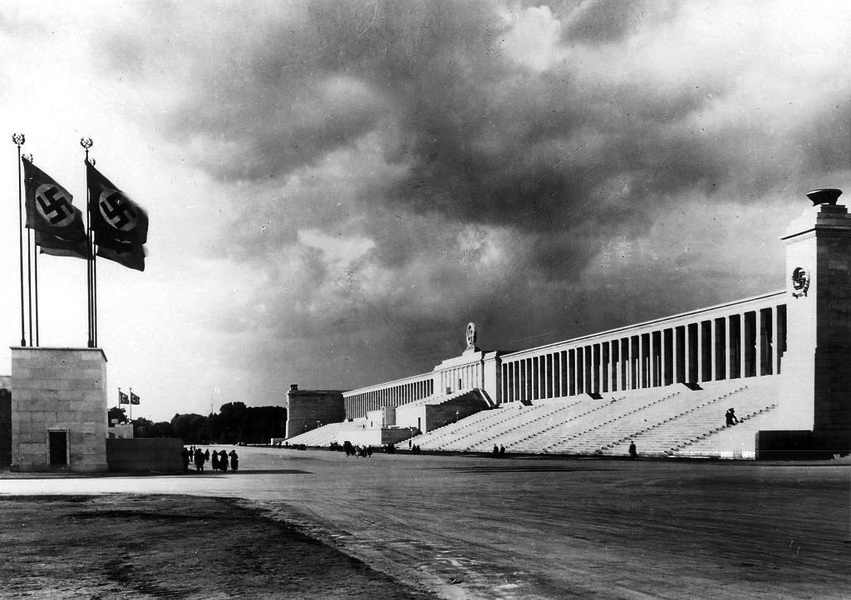
The arson that severely damaged Hitler’s mountain-top retreat near Berchtesgaden in Bavaria prompted Tom Jones to write about some of the other surviving architectural works of the Nazi regime:

The Nazi rally grounds at Nuremberg, 1938.

“You are now witnessing the beginning of a great epoch in German history … This fire is the beginning,” Hitler told a news reporter at the scene of the Reichstag fire.

The power of architectural destruction as a political tool was well understood by the regime established following the fire — although it went far beyond that single event. Hitler, with the amateur enthusiasm of any failed creative, took a deep interest in the architecture of Nazi Germany, where his adoration of Greece and Rome as Aryan civilisations put him in the arms — and vice versa — of Albert Speer.

By and large, Nazi architecture is remarkable for its scale, rather than architectural worth. But beyond Speer’s simple reliance on elevating classical forms to monumental scale lay a theory that appealed directly to Hitler’s thousand-year vision for the Reich — and of his sense of the war as a civilisational struggle of “the existence or non-existence of the nation”.

That was ruinenwerttheorie, or ruin value. It did not originate with Speer: he was always a rather lesser intellectual figure than he portrayed himself. Rather, it was inspired by the romanticised vision of ancient ruins, inherited from the Picturesque and capriccio movements that shaped eighteenth-century European taste. His principle was that Third Reich monuments should be built to leave striking ruins, as the great buildings of Greece and Rome had done, retaining their aesthetic power for thousands of years.

Perhaps conscious of this theory, subsequent governments have been judicious in their use of architectural destruction as a political tool, and a surprising number of the most notable Nazi buildings have survived.

The Olympiastadion in Berlin, built for the 1936 Olympics, is still in use as a sports venue. Speer’s Nuremberg rally grounds, seared into the minds of anyone thinking of Nazi rallies thanks to Leni Riefenstahl’s Triumph of the Will, now plays host to motorsports festivals and rock festivals, as well as a memorial to victims of Nazi repression. The former Reich Air Ministry in central Berlin, the headquarters of Hermann Göring and the Luftwaffe, is now the Finance Ministry.

Hitler’s private and public approach to architecture were notably different, the Führer preferring the sparse, Spartan interiors that were deliberately and carefully designed to project the image of a simple leader dedicated solely to the service of his nation. Ironically, though designed without ruinenwerttheorie, many of Hitler’s Führerhauptquartiere — the various headquarters around occupied Europe — have become ruins.

Though the Wolfsschanze — the Wolf’s Lair, from which Hitler directed Operation Barbarossa — now serves as a huge tourist attraction and even has a hotel — most were only temporary structures, and have either been allowed to rot or were destroyed by retreating German forces. The Füherbunker, the final home of the going man, is now a car park, marked only by a small plaque. The Berghof, Hitler’s holiday home near Berchtesgaden, was first subjected to a bombing raid involving hundreds of Lancasters, set fire to by retreating SS troops, stripped and looted by Allied troops, before the burned out shell was demolished in 1952.

“There’s a strange type of man in America today”

Filed under: Media, Politics, USA — Tags: , , — Nicholas @ 03:00

On the social media site formerly known as Twitter, InfantryDort reposts an item from 2025 that seems even more relevant than when he wrote it:

There’s a strange type of man in America today.

He has soft hands and sharp words. He talks endlessly of peace, but fantasizes about violence. He rails against masculinity, yet wants to wield power. He despises weapons, but dreams of using the state as a gun. He calls himself educated, but speaks like a zealot. He waves foreign flags, hates his own countrymen, and believes men can be women and women can be men.

You’ve seen him. You’ve argued with him. And right after he hurls his insults, he blocks you. Because deep down, even he knows he cannot back it up.

He is the child of a civilization in decline. Raised without God. Taught that strength is violence, masculinity is toxic, and truth is subjective. He’s been fed purpose through ideology, and fear through propaganda.

He doesn’t worship a higher power, he worships power itself.

And he wants the state to do what he never could: silence you, disarm you, erase you. But here’s the fatal flaw in their fantasy:

They don’t run the state.
They don’t hold the rifles.
They don’t know violence.
They only post about it.

So what happens when the Leviathan they helped build doesn’t come to their rescue? What happens when the men they mocked and threatened are the ones holding the line?

This is how a nation comes apart. Not through civil war, but through a spiritual collapse. By elevating the weak and shaming the strong. By crowning confusion and exiling clarity. By teaching sons to hate their fathers, and citizens to hate their flag.

So to those soft handed radicals who dream of revolution but tremble at recoil: If you’ve exiled God, disarmed yourself, and put your faith in a state you don’t control …

What exactly is your plan?

Because the ones you despise … the ones with calloused hands, faith in their chests, and weapons slung across their backs …

They’re still here.
And they’re not confused
.

Again, what is your plan? You’ve already chosen submission. Spiritually, physically, morally. All that’s left is for someone to tell you when to kneel. And I am here to tell you exactly that. You should thank me. Because refusing this truth won’t end well for you. Not because I said so … but because history always does.


Seeing calls for violence against our countrymen awakens something in me I can’t fully explain. Those words are some of the most heinous that can be uttered in a civilized society. So those who spew them, must be sobered with caution. Once my hands touch the keys on this subject, they refuse to stop. Decades of thought pour out effortlessly, as if they’ve been waiting for this very moment.


I am prepared to die to protect my country. My soul is prepared.

Is yours?

Star Trek: The Mirror Universe is not an Alternate Timeline

Filed under: Media — Tags: , , — Nicholas @ 02:00

Feral Historian
Published 17 Jul 2026

Some of the long-time viewers may remember this topic from the earliest days, when the channel was so small it had Youtube’s standard-def new-guy compression over already bad sound. I’m revisiting it to add new points and just do an overall better job of it for the day when this idea of the mirror universe as a subconscious shadow comes up in relation to something else. It very likely will.

00:00 Intro
05:53 What About the Non-Humans?
08:27 Chief O’Brien
09:24 Paths Not Taken

🔹 Patreon | patreon.com/FeralHistorian
🔹 Ko-Fi | ko-fi.com/feralhistorian
🔹 and Merch! | feral-shop.fourthwall.com

QotD: Michel Houellebecq

Filed under: Books, France, Quotations — Tags: , , — Nicholas @ 01:00

You are a handsome man, in the classic Gallic sense, much like Alain Delon and Gerard Depardieu, but without the refined beauty and sexual appeal of Michel Houellebecq. Do you envy the famed author and Asian Waifu-Getter of Submission?

Like all “journalists”, I am a failed writer, so of course I envy him. But at least he continues to demonstrate that the most important writer in the world at any given time is French.

To me Houellebecq is like the Sin-Eaters of old; he has done the world a great service by absorbing all of the ugliness of modernity to spare us from it, while allowing it to disfigure his face. He is our mirror.

The interesting thing about the Houellebecq phenomenon is that when I was a student my lefty friends were pressing his books into my hands and I as a Catholic conservative stoutly proclaimed that I wouldn’t read the works of a nihilst pornographer, while now it is conservatives who hail him as a prophet. Houellebecq is unquestionably a genius, in the following manner: being able to sense, and capture, and paint, the zeitgeist of a particular era is something that many try and most fail at. This requires a kind of genius which is very rare. Does that mean that he is a literary genius? That’s a different question. I’m incapable of doing what he does, so I am hesitant to criticize his dreary prose style. But of course it is the style that fits the zeitgeist as well. It’s a package. He is a kind of Trump of literature; just like Trump’s grotesque of politics shows us what our politics really are by defacing them, Houellebecq’s grotesque of literature shows us what our world really is by defacing it.

Niccolo Soldo, “The Zürich Interviews – Pascal-Emmanuel Gobry: Unrepentant Baguette Merchant”, Fisted by Foucault, 2020-12-02.

November 9, 2026

“[T]he world of the Starship Enterprise serves as warm pablum to comfort the thinking Boomer”

Filed under: Media, Technology, USA — Tags: , , , , , , — Nicholas @ 05:00

“My” Star Trek was the original series … in after-school reruns, because it was off prime time schedules by the time I was paying attention (Generation Jones really didn’t experience the Boomer world except in re-runs). But the TV show and its many, many successors have a cultural weight that the original TV show didn’t in its own time. On Substack, Tom Swift calls out the soothing boomer themes of the original show and contrasts it to later — and in his belief, better — science fiction treatments:

For nearly a half-century, Star Trek has been the thinking man’s vision of what society will one day become. This world is one of peace, prosperity, where scarcity is but a distant memory. Yet upon closer investigation, the world and characters depicted therein seem to violate every law of human nature.

Aliens are barely modified versions of ourselves, yet without many of the negative qualities thereof. One must suspend belief in even the rudiments of biology to believe that a human-alien hybrid could exist. Economics is barely mentioned, and there are occasional references to a guaranteed living. How that has not led to sclerosis of institutions and lack of motivation within the Federation is never explained. Little of the world outside the ship is shown. The number of children depicted is not nearly sufficient to explain the spread of mankind across the galaxy. In short, the world of the Starship Enterprise serves as warm pablum to comfort the thinking Boomer; it provides a future with clear technical advances yet enough familiarity to allow him to sleep at night and forget any transitory qualms in the morning.

Science fiction offers unlimited horizons for the imagination, yet the derivative nature of the Hollywood franchise has greatly limited its potential. However, there are a few notable exceptions, which have for the most part originated from independent works of literature. We shall now investigate three science fiction films which may portray the future far more accurately.

The looming end of secure encryption

Secure encryption is one of those background utilities we all depend on, like plumbing and sewers: it only comes to our attention when something is going wrong. David Clinton says that things are going wrong with encryption standards, thanks to the technical omnicause, artificial intelligence:

Without secure encryption, we’ll all be living dangerously

This topic has a guaranteed boredom score of 12 (where “10” represents catatonic). But its could make a difference to my own life score is 15 (where “10” represents “Yikes!”).

Data encryption is the peg on which the possibility of all modern financial and healthcare-related activity hangs. Without standard encryption algorithms like AES and RSA:

  • The contents of every exchange of information between you and your bank’s website would be visible to anyone on the internet.
  • The passwords you use to authenticate to your digital accounts would be readable by anyone with access to any node between you and your account’s host.
  • The sensitive data stored by any financial, healthcare, or government organization would be visible to anyone with access to their host systems — access made possible by decrypted passwords (see above).

Encrypted data contains all the original information. But its value lies in the assumption that the underlying algorithm is so complex that it would require the use of powerful computers and hundreds of years to crack it.

For the past 50 years, that assumption has held up well. But the theoretical existence of quantum compute resources — which can execute exponentially more compute operations than traditional processors — presents a theoretical threat to existing algorithms.

In other words sometime within the next 10-20 years, quantum compute devices will be powerful enough to brute-force the end of modern encryption. That sounds scary.

But it’s arguably not even the real problem. That, as Tyler Cowan recently wrote in the Free Press, would be the recent explosion of AI-driven discoveries in mathematics. Such events have introduced concerns about the odds encryption security could be compromised in months rather than years.

Frontier AI models are now at least making progress solving longstanding mathematical problems. The pace of discovery seems to be growing and it seems inevitable that someone somewhere will turn a powerful AI model on the algorithms we rely on.

« Newer Posts — Older Posts »

Powered by WordPress