Quotulatiousness

November 10, 2026

“I felt like Howard Carter entering Tutankhamun’s tomb and waving a torch at the walls of hieroglyphics”

Filed under: Britain, Media, Technology — Tags: , , , , , , — Nicholas @ 05:00

Have you noticed that the widespread availability of emojis/emoticons/electroheiroglyphics has particularly influenced how younger folks communicate? Joanna Gray has, and has her concerns about the whole thing:

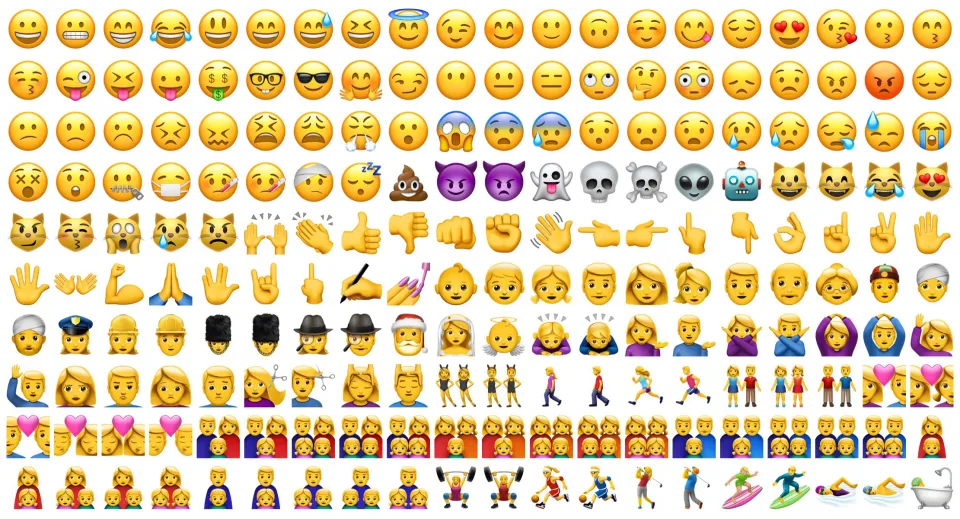
One of the markers future historians will use when describing the New Dark Ages will be the collapse in the use of the alphabet in favour of “Yookay Hieroglyphics”. A demoralising development has emerged: a whole new form of pictographic language whereby children and young adults engage in hours-long online conversations with each other without the need for any letters, texts or words. Such conversations largely occur on gaming platforms, Snapchat and WhatsApp, and mark a classic regressive step in civilisational decline.

Like the medieval laity who relied on church wall paintings and stained glass to learn stories, a growing proportion of our current population is now using only pictographic communication. This time, there is no divine knowledge behind the imagery – just inane slop. I shall try to use words to describe this new pictographic language that groups of teenagers I work with have shared with me. When first shown, I felt like Howard Carter entering Tutankhamun’s tomb and waving a torch at the walls of hieroglyphics in wonderment. Yookay Hieroglyphics are read vertically from top to bottom. If drawn on Snapchat, they often instantly disappear on reading or after 31 days, making linguistic analysis particularly fraught.

A useful starting point when attempting to read Yookay Hieroglyphics is to think of the wonderfully coloured whizzy strip of cherries, bananas, apples, horseshoes, numbers, etc. on a slot machine. Reams and reams of such images are being sent from one person to another within microseconds. It often begins with one pictographic innovator (teenager) photographing their face and sending their image; their friend replies with their face; what then follows is a rapid exchange of images from one to another, creating a roll of vertically read hieroglyphics: distorted face, laughing emoji, pic of pet, pet pic distorted, laughing face, feeling sick emoji, question mark, toilet gif, sick emoji, prayer emoji, pic of dragon, happy face, pic of person smiling, distorted pic, AI-ed moving image of that pic, cat video, pic of nails, nail art inspo, gif witch nails, cross face, face with witch filter on, lol emoji, pic of face with wizard filter, pic of wizard distorted, instantly made sticker of that image, lol emoji, red laser coming out of wizard eyes filter, OMG emoji … and on and on and on and on and on.

Because I am not of the emerging linguist tribe, I will be unable to fully convey the nuances and depth of the meaning in this sample conversation – indeed a paper has concluded that emoji-based language is more layered in adolescents than in adults.

January 23, 2026

“Functional illiteracy was once a social diagnosis, not an academic one”

Filed under: Education, History, Media, Politics, Technology — Tags: , , , , , , — Nicholas @ 05:00

On Substack, Maninder Järleberg illuminates the problem of functional illiteracy in higher education in the west:

The Age of Functional Illiteracy

Functional illiteracy was once a social diagnosis, not an academic one. It referred to those who could technically read but could not follow an argument, sustain attention, or extract meaning from a text. It was never a term one expected to hear applied to universities. And yet it has begun to surface with increasing regularity in conversations among faculty themselves. Literature professors now admit — quietly in offices, more openly in essays — that many students cannot manage the kind of reading their disciplines presuppose. They can recognise words; they cannot inhabit a text.

The evidence is no longer anecdotal. University libraries report historic lows in book borrowing. National literacy assessments show long-term declines in adult reading proficiency. Commentators in The Atlantic, The Chronicle of Higher Education, and The New York Times describe a generation for whom long-form reading has become almost foreign. A Victorian novel, once the ordinary fare of undergraduate study, now requires extraordinary accommodation. Even thirty pages of assigned reading can provoke anxiety, resentment, or open resistance.

It would be dishonest to ignore the role of the digital world in this transformation. Screens reward speed, fragmentation, and perpetual stimulation; sustained attention is neither required nor encouraged. But to lay the blame solely at the feet of technology is a convenient evasion. The crisis of reading within universities is not merely something that has happened to the academy. It is something the academy has, in significant measure, helped to produce.

The erosion of reading was prepared by intellectual shifts within the humanities themselves—shifts that began during the canon wars of the late twentieth century. Those battles were never only about which books should be taught. They were about whether literature possessed inherent value, whether reading required discipline, whether difficulty was formative or oppressive, and whether the humanities existed to shape students or merely to affirm them. In the decades that followed, entire traditions of reading were dismantled with remarkable confidence and astonishing speed.

The result is a moment of institutional irony. The very disciplines charged with preserving literary culture helped undermine the practices that made such culture possible. What we are witnessing now is not simply a failure of students to read, but the delayed consequence of ideas that taught generations of readers to approach texts with suspicion rather than attention, critique rather than encounter.

This essay is part of a larger project to trace that history, to explain how a war over the canon helped usher in an age in which reading itself is slipping from our grasp, and why the consequences of that war are now returning to the academy with unmistakable force.

The Canon Wars: A Short Intellectual History

To understand the present state of literary studies, one must return to the canon wars of the 1980s and 1990s — a conflict that reshaped the humanities with a speed and finality few recognised at the time. Although remembered now as a dispute about which books deserved a place on the syllabus, the canon wars were in truth a contest over the very meaning of literature and the purpose of a humanistic education.

In the decades after the Second World War, the curriculum in most Western universities still rested upon a broadly shared assumption: that certain works possessed enduring value, that they spoke across time, and that an educated person should grapple with them. This conviction, however imperfectly applied, formed the backbone of the humanities. It was also increasingly at odds with a new intellectual climate shaped by post-1968 radicalism, the rise of identity politics, and the importation of French theory.

By the early 1980s, tensions that had simmered beneath the surface erupted into public view. The most emblematic flashpoint came at Stanford University in 1987–88, when student demonstrators chanted, “Hey hey, ho ho, Western Culture’s got to go!” in protest of the university’s required course on Western civilisation. The course was soon dismantled, replaced by a broader, more ideologically framed program. What happened at Stanford quickly reverberated across the country. Departments revised reading lists, restructured curricula, and abandoned long-standing core requirements.

On one side of the debate stood defenders of the canon—figures such as Harold Bloom, Allan Bloom, E.D. Hirsch, and Roger Kimball—who argued that the great works formed a kind of civilisational inheritance. The canon, they insisted, was not a museum of privilege but a record of human striving, imagination, and achievement. On the other side were scholars like Edward Said, Toni Morrison, Henry Louis Gates Jr., Gayatri Spivak, and Homi Bhabha, who contended that the canon reflected histories of exclusion and domination, and that expanding or dismantling it was a moral imperative.

But beneath these arguments lay a deeper philosophical rift. The defenders assumed that literature possessed intrinsic value, that texts could be read for their beauty, their insight, or their power. The critics, armed with concepts drawn from Foucault, Derrida, and Barthes, argued that literature was inseparable from structures of power, that meaning was unstable, and that reading was less an act of discovery than an exposure of hidden ideological operations.

The canon wars ended not with a negotiated peace but with a decisive transformation. The traditional canon was not merely expanded; its authority was dissolved. And with it dissolved a set of shared assumptions about why we read at all.

May 4, 2025

Everyday Life in the Roman Empire – Culture and Literacy in the Roman Empire

Filed under: Europe, History — Tags: , , , , , , , — Nicholas @ 02:00

seangabb
Published 28 Dec 2024

This is the eighth video in my series on Everyday Life in the Roman Empire. In this, I wander about at the beginning, with talk of poetry and philosophy, before realising that the real theme is the extent of ancient literacy. The whole of the remainder is given over to this, and how it enabled a literary civilisation wholly different from our own.

Introduction – 00:00:00
Our perceptions of culture in the Ancient world – 00:01:40
Virgil – 00:03:45
Catullus – 00:05:17
Philosophy in Rome – 00:06:23
The Romans and Stoicism – 00:08:40
The Romans and Epicureanism – 00:10:27
Pretty silver things from Roman Britain – 00:16:25
Broad-based cultural participation in the Ancient World? – 00:19:26
The Ancient World: a largely illiterate civilisation (no spectacles) – 00:28:27
The Ancient World: a largely illiterate civilisation (expensive education, expensive books) – 00:35:40
The Ancient World: a largely illiterate civilisation (economic imperatives) – 00:42:35
The Ancient World: a largely illiterate civilisation (expensive writing materials) – 00:44:44
The Ancient World: a largely illiterate civilisation (difficulties of reading) – 00:49:16
The Ancient memory – 00:53:14
The primacy of oral communication – 00:55:23
The Ancient World: a largely illiterate civilisation (the Second Sophistic and linguistic change) – 00:59:53
Bibliography – 01:08:10
(more…)

February 3, 2025

QotD: Illiteracy then and illiteracy now

Filed under: Education, Humour, Quotations — Tags: , , — Nicholas @ 01:00

My old friend George Jonas, now forcibly confined within the Mount Pleasant Cemetery, observed of the times:

    In the not too distant past, people who were illiterate could neither read nor write. These days they can, with disastrous results for the culture.

He quoted his own old friend Stephen Vizinczey:

    No amount of learning can cure stupidity, and formal education positively fortifies it.

David Warren, “On paper logic”, Essays in Idleness, 2020-02-22.

April 9, 2022

QotD: Temporary tattoos and cultural literacy

Filed under: Asia, Education, Quotations — Tags: , , , , , — Nicholas @ 01:00

At a practical level, as a professor who regularly teaches East Asian philosophies, I die a little inside every time we experience a cultural phenomenon with a veneer of “wisdom from the East” on it. Having imbibed pop culture’s mystical Orient, students will arrive to my classes craving a deeper initiation into Eastern mysteries. Teaching these seekers of wisdom then becomes deflationary.

I was once at an art fair where there was a booth selling temporary tattoos. One of the tattoos was a Chinese character that was translated on the tattoo’s plastic label as “bitch”, an appealing bit of body art for the tough girls among us, I suppose. Except a far more straightforward and accurate translation of the character would be “prostitute”, or maybe “whore”.

Teaching students who fell in love with “Eastern philosophy” via our culture’s myriad Mr Miyagis is like being the one to tell someone her tattoo says “whore”. The tattooed will be better off knowing, but she won’t thank you for telling her. Pop-culture-induced orientalism usually does wash off, but the cleanup is far less alluring than wearing the myth. At least, I console myself, Kondo’s target market is the middle-aged, so maybe my young college students won’t show up with this particular “tattoo”.

Amy Olberding, “Tidying up is not joyful but another misuse of Eastern ideas”, Aeon, 2019-02-18.

December 20, 2020

QotD: Online literacy

Filed under: Education, Media, Quotations, Technology — Tags: , , — Nicholas @ 01:00

In the various fora and social media circles in which I run, there’s a self-selecting bias toward literacy. Thoughts tend to be expressed in complete sentences with reasonably correct grammar and punctuation.

But sometimes I’ll find myself looking at the posts of a Facebook friend-of-a-friend-of-a-friend and I see these random aggregations of misspelled words. They have the occasional capital letter or punctuation mark thrown in, as though the writer knew they were supposed to include those, but not how or why.

And I find myself wondering “What’s it like inside their head?” I mean, you’d probably be going through life slightly angry, thinking everybody was secretly laughing at you behind their hands, that there was some arcane code of keyboard use you were violating. The whole internet would be like one of those fancy restaurants with too much silverware and you never know which implement to use to eat which dish.

Tamara Keel, “I’ve always wondered…”, view from the porch, 2018-08-24.

June 27, 2015

American literacy and the unanticipated boost that was World War 2

Filed under: Books, History, Military, USA, WW2 — Tags: , — Nicholas @ 02:00

Terry Teachout makes the unusual claim that it was the Second World War that “made America literate”:

It’s said that two things about war are insufficiently appreciated by those who, like me, have not known it first-hand: 1) It is, when not terrifying, mostly dull, and 2) it is, like all human enterprises, subject to the operation of the law of unintended consequences. Few aspects of World War II better illustrate both of these points than the Armed Services Editions publishing project. Between 1943 and 1947, the U.S. Army and Navy distributed some 123 million newly printed paperback copies of 1,322 different books to American servicemen around the world. These volumes, which were given out for free, were specifically intended to entertain the soldiers and sailors to whom they were distributed, and by all accounts they did so spectacularly well. But they also transformed America’s literary culture in ways that their wartime publishers only partly foresaw — some of which continue to be felt, albeit in an attenuated fashion, to this day.

[…]

Thus, the Armed Services Editions, which were published by a civilian organization called the Council on Books in Wartime — compact, oblong, two-column-wide paperbacks that were designed to slip easily into the pockets of a uniform. They were sold to the military for six cents per volume. Since books were regarded by the U.S. government as “weapons in the war of ideas,” the military specified that nothing would be published that might “give aid and comfort to the enemy, or which may be detrimental to our own war effort,” or that was not in accord with “the spirit of American democracy.” Still, it was the Council on Books in Wartime, not the military, that chose the titles, and while a few of the longer ones were abridged, none were censored.

The first ASEs were shipped in September of 1943. About 155,000 crates of books were subsequently distributed each month. Each crate contained between 30 and 50 new titles that fell into one of the following categories:

  • Mysteries, thrillers, and Western novels by such popular writers as Max Brand, James M. Cain, Raymond Chandler, W.R. Burnett, Erle Stanley Gardner, Zane Grey, Ernest Haycox, and Luke Short.
  • Bestselling “blockbuster” novels, such as Henry Bellamann’s Kings Row, Edna Ferber’s So Big, Charles Jackson’s The Lost Weekend, Kenneth Roberts’s Northwest Passage, and John Steinbeck’s The Grapes of Wrath, many of which had been or would soon be turned into movies.
  • Collections by humorists and writers of light verse, including five titles by Robert Benchley, six by James Thurber, and three by Ogden Nash.
  • War-themed books like Bill Mauldin’s Up Front and Ernie Pyle’s Brave Men.
  • Biographies, histories, memoirs, and other nonfiction titles, including Lytton Strachey’s Eminent Victorians, Virgil Thomson’s The State of Music, and Carl Van Doren’s Benjamin Franklin.
  • Classic novels and poetry, some easily accessible (David Copperfield, Adventures of Huckleberry Finn), others less so (Moby-Dick, Vanity Fair).
  • A modest but not exiguous complement of “serious” modern novels, short stories, poetry, and plays, most of them representative of then-current mainstream taste (Willa Cather’s Death Comes for the Archbishop, Robert Penn Warren’s All the King’s Men) but some of which were decidedly recherché (Max Beerbohm’s Seven Men, Christopher Isherwood’s Prater Violet)

As this list suggests, the ASEs were intended to please a broadly popular audience. But even the bestsellers tended to be more elevated in tone than their present-day counterparts (Somerset Maugham was represented by five novels, John P. Marquand by six). And it was taken for granted that each crate of books would always contain two or three genuinely challenging titles. The first series of ASEs, for instance, included Joseph Conrad’s Lord Jim, Herman Melville’s Typee, and H.L. Mencken’s Heathen Days. Such books were “sold” to skeptical readers with enticing flap copy, as in the case of the ASE edition of The Great Gatsby: “Its pages are filled with masterly realism, melodramatic action, searing irony, and swift romance…Here is a story that is American to the core.”

In any case, it scarcely mattered what the Council on Books in Wartime printed, for all of the ASEs were hugely popular among servicemen, so much so that they were frequently torn into pieces so that they could be shared more easily. A.J. Liebling, who covered the war in Europe for the New Yorker, even saw them on the beaches of Normandy after D-Day. “These little books are a great thing,” a Brooklyn infantryman told him. “They take you away.”

December 14, 2013

Literacy and demographics

Filed under: Economics, Education — Tags: , , — Nicholas @ 11:37

David Warren invites a lot of knee-jerk reaction with this passage in a recent essay:

Whether in West or East, however, the mechanism of societal disintegration is the same. It could be described in one phrase as “the liberation of women.” The modern economy lures women away from home and family with (ludicrously false) promises of wealth, pleasure, and freedom. Industry required a more docile labour force, the State required revenues from double-income taxation. At a level more fundamental than economics, the times have offered atomizing ideologies — the promise of “democracy” in which everyone will be treated the same, whether man, woman, or some other thing. As Goldman has rather plainly shown (and Roberts showed long before him), we must cherchez la femme.

For women are, as they have always been, the bedrock of both family and religion. Men have, and will be by nature (whether this is recognized or not) the hunters and gatherers and bread winners. There is no point in debating this, for either one gets it or one is wilfully obtuse. A certain minority of talented women have always flourished outside the home, and perhaps a like proportion of men not flourished in the absence of any marketable skills — but the case is straightforward in the main. What we have been enduring, for a century now, is an attempt to change the order of the world by social and sometimes genetic engineering; with results clearly visible all around us, to say nothing of the grief and loneliness and self-pity that each of us is carrying inside.

Curiously enough, Goldman homes in on a statistical fact that Roberts elided. It is that a sharply increasing female literacy rate is a more or less infallible predictor of demographic collapse, in all non-Western countries. Or as I mischievously put it, on Twitter only last night, “statistically and objectively, the quickest way to destroy a nation is to teach their women to read.”

This remark would invite several gallant qualifications. The modern emancipation of women began in the West, where Christian teaching had always accorded women the greatest respect. The social changes were therefore slower and easier to assimilate, here. It is when what happened more gradually in the West, happens more suddenly in the East, that the transformation becomes catastrophic. The whole ancestral order of society comes down, in one generation rather than four or five. And they haven’t seen the worst of it yet, for the West had accumulated reserves of wealth, with which to pay some pensions and geriatric bills. The East will face a more dramatically ageing population, without the reserves.

October 9, 2013

England performs poorly in literacy and numeracy survey

Filed under: Australia, Britain, Cancon, Education, USA — Tags: , , — Nicholas @ 07:50

In the Guardian, Randeep Ramesh reports on a recent OECD ranking of literacy and numeracy which shows England in a poor light:

England is the only country in the developed world where the generation approaching retirement is more literate and numerate than the youngest adults, according to the first skills survey by the Organisation for Economic Co-operation and Development.

In a stark assessment of the success and failure of the 720-million-strong adult workforce across the wealthier economies, the economic thinktank warns that in England, adults aged 55 to 65 perform better than 16- to 24-year-olds at foundation levels of literacy and numeracy. The survey did not include people from Scotland or Wales.

The OECD study also finds that a quarter of adults in England have the maths skills of a 10-year-old. About 8.5 million adults, 24.1% of the population, have such basic levels of numeracy that they can manage only one-step tasks in arithmetic, sorting numbers or reading graphs. This is worse than the average in the developed world, where an average of 19% of people were found to have a similarly poor skill base.

When the results within age groups are compared across participating countries, older adults in England score higher in literacy and numeracy than the average among their peers, while younger adults show some of the lowest scores for their age group.

As with any sort of survey of this kind, it helps to know how they went about assessing skills in various countries and how similar countries rank:

Literacy for people aged 16-24

6 Australia
15 Canada
17 Ireland
19 England/N Ireland
20 United States

Literacy for all adults

5 Australia
10 Canada
14 England/N Ireland
16 United States
19 Ireland

Numeracy for people aged 16-24

14 Australia
16 Canada
18 Northern Ireland
20 Ireland
24 United States

Numeracy for all adults

13 Australia
14 Canada
16 England/N Ireland
19 Ireland
20 United States

If there’s reason for English authorities to be concerned with their middle-of-the-Anglosphere ranking, there’s even more reason for American educators to take note.

H/T to Tyler Cowen for the link.

Powered by WordPress