Quotulatiousness

November 9, 2026

Writing history … or “history”

Filed under: Books, Britain, History — Tags: , , — Nicholas @ 03:00

Historiography is difficult, because the people who write histories are not just fallible human beings who make mistakes, but they have all the particular weaknesses and failings of human beings. They might be pushing an agenda, they might be trying to hide their own biases, they may favour “what should have happened” over “what actually happened” … or they could just be lazy. On Substack Notes, Medieval Realms shares an example from last century:
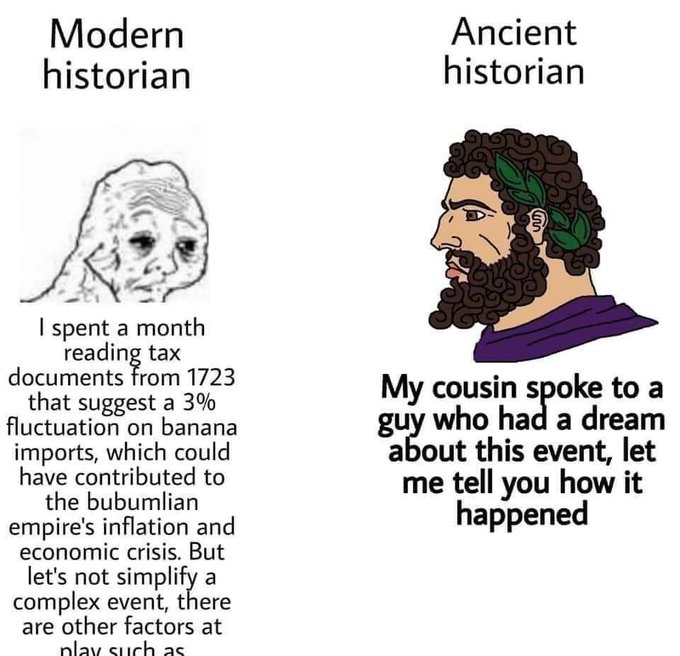
Ancient historians were not limited to mere evidence (not part of Medieval Realms’ original post).

Some of you may have noticed I tend to question popular narratives of medieval battles. I’m not trying to score cheap points, but it is a fact that the evidence often fails to match up. The following is another example.

In November 1294 a series of revolts were raging in Wales. Two battles were supposedly fought, at Denbigh and Builth.

The battle at Builth comes from John Morris, writing circa 1900. He was a grammar school teacher and academic historian, whose best-known work is The Welsh Wars of Edward I. This was the first study to make thorough use of contemporary records held in the Public Record Office.

In his book, Morris wrote:

    John Giffard organised a relieving force of ten knights, twenty troopers and forty light horse, who made five attempts to cut their way through to the castle [at Builth], and were finally successful about November 12.

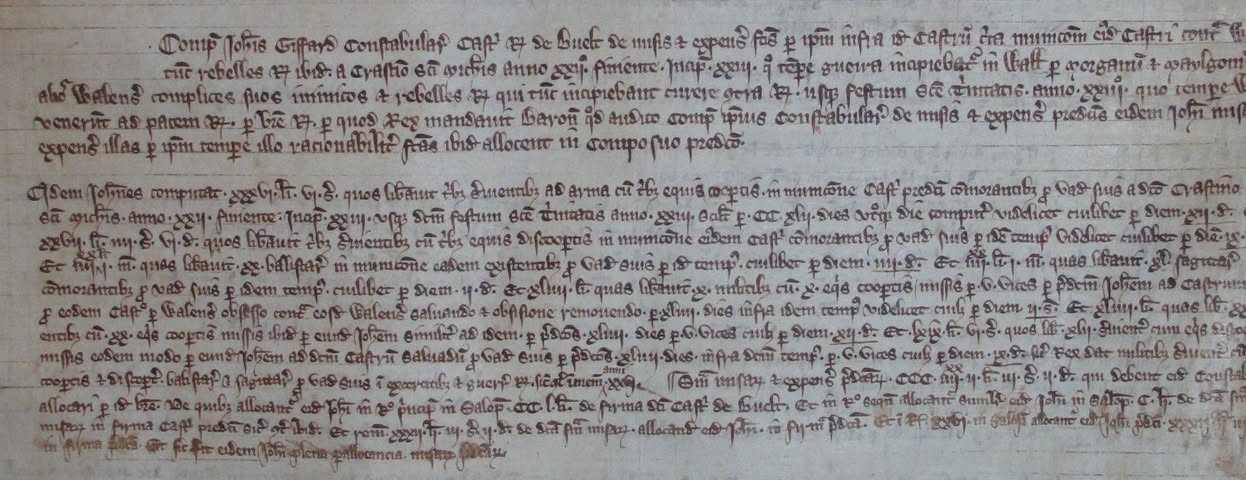
In his footnotes, Morris quoted the attached document. I recently had this translated. The preamble reads:

    Account of John Giffard, constable of the castle of Builth, of the wages and expenses made by him in the custody of the said castle and in the capture of various rebels and thieves in those parts.

This is followed by a set of expenses, totalling £65 10 shillings 8 pence.

There is no mention of Giffard having to cut his way through Welsh siege lines, or anything so dramatic. He was being paid to garrison Builth and deal with “various rebels and thieves”.

Obviously, it is no easy task to extract medieval documents and compare them to modern accounts. But we should make the effort, where possible.

How to Make Reproduction Guns (And How Not To)

Filed under: History, Military, USA, Weapons — Tags: , , , — Nicholas @ 02:00

Forgotten Weapons
Published 10 Jul 2026

Since I continue to get a lot of questions about reproductions, I figured I’d devote today’s video to looking at different elements that go into producing reproduction firearms. Why some work out and some don’t.
(more…)

QotD: Robert E. Lee

Filed under: History, Military, Quotations, USA — Tags: , , , — Nicholas @ 01:00

This isn’t a classroom. And it’s not your Ivy League syllabus. I’m not here to cherry pick history to fit your comfort level. This page isn’t about preserving feelings. It’s about preserving truth.

You’re going to learn about all kinds of Americans here. The brilliant. The broken. The brutal. The redeemed.

And yes, today, that includes Robert E. Lee. One of the finest battlefield commanders to ever walk the face of the earth.

But this post isn’t really about Lee. It’s about what’s coming if you don’t wake up and understand ALL of the American condition, not just the parts you like. And what history refuses to let us forget.

Spare me your pearl clutching cries of “traitor”. You want only the parts of the American experiment that make you feel good? Too bad. Battle it out in the comments.

You don’t get to cherry pick the Republic. You’re going to get all of it: the glory, the grief, the blood, the brilliance.

Because believe it or not, that’s how we heal this ridiculous divide. Not by erasing history. By facing it, whole.

Lee was mythic in his own time, and while still in uniform no less. I can count on one hand the number of military leaders in world history who held that kind of gravity.

His mere presence on the battlefield moved thousands. His men believed he rode with God. And his enemies feared he commanded the wind. Why?

Because Lee was the perfect storm of lethal factors, a man forged in pressure, faith, and brilliance: He possessed a battlefield mind that bent terrain, timing, and psychology to his will.

He spoke softly, but carried the moral weight of a holy man, which made others fight for him as if fighting for something divine. He was the living embodiment of a region’s grief, pride, and wrath.

He never had to scream. His silence made others move. The most dangerous man in any war is the one who didn’t want it, until you gave him no choice. Lee was that man. And that’s why he was so effective.

You want to understand Lee? Then understand the war he fought in. Don’t give me another surface level take about rifled muskets and outdated tactics. That’s not why it was the bloodiest war in our history.

The Civil War was decades in the making. The riots. The compromises. The moral rot no one wanted to confront until it swallowed the whole nation.

It was what happens when generations ignore the pressure, until it explodes. And when it did, men like Lee, Sherman, and Grant emerged. They didn’t crawl out of textbooks. They rose out of chaos, because the times demanded them.

Half of you are begging for civil war now, without the faintest idea what that would mean. You think GWOT was bad? You cry over civilians killed in drone strikes?

That horror would pale next to a war of brother against brother, of neighborhoods torn apart by blood and belief. Because you end up hating someone exactly as much as you once loved them. And how much more do you love your fellow countryman than some stranger in a foreign land?

And here’s what you don’t see: Those archetypes, the Lees, the Shermans, the Grants? They already live among you. Quiet. Unknown. Watching.

You think they’re extinct? They’re not. They’re waiting.
And if the hate keeps boiling, they won’t stay unknown for long.

So yes, on this page, you will hear their names. You will study their victories and their sins. And I won’t soften the blow of reality just to make you feel better.

Because history doesn’t need your approval. It needs your attention.

The lesson? No war is more brutal than the ones we fight with ourselves. And no man is more dangerous than the one who wanted peace … until you gave him no other choice. That’s what the Civil War was. And that’s what you’re playing with now.

So keep screaming in the comments. Just know you’re screaming at the future you’re helping create.

“InfantryDort”, Twitter, 2025-05-18.

November 8, 2026

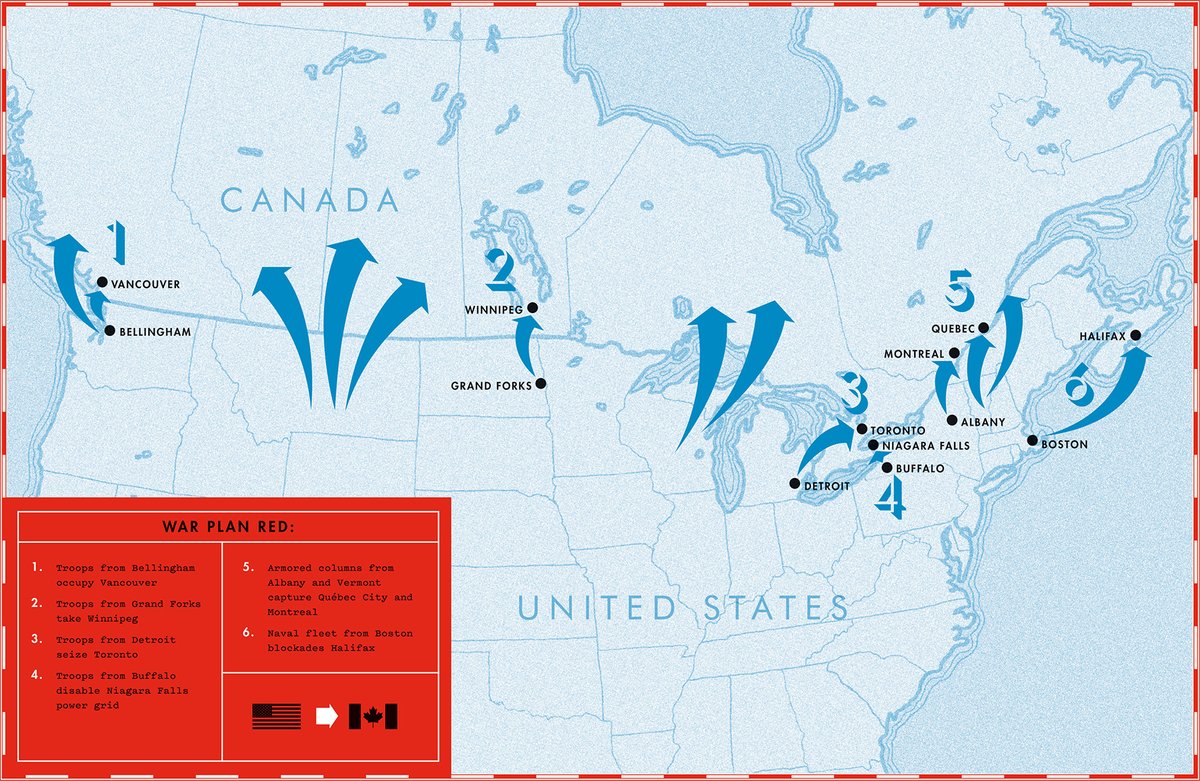
More on Operation Maple Curbstomp, a US invasion of Canada

Filed under: Cancon, Military, USA — Tags: , , , , — Nicholas @ 05:00

Following on from the military capability evalution last month, Operational Art of War looks at some of the military problems the American Goliath might face before getting down to curbstomping Canada:

“A mere matter of marching …”

An invasion of Canada would not be popular and the political implications would affect military operations.

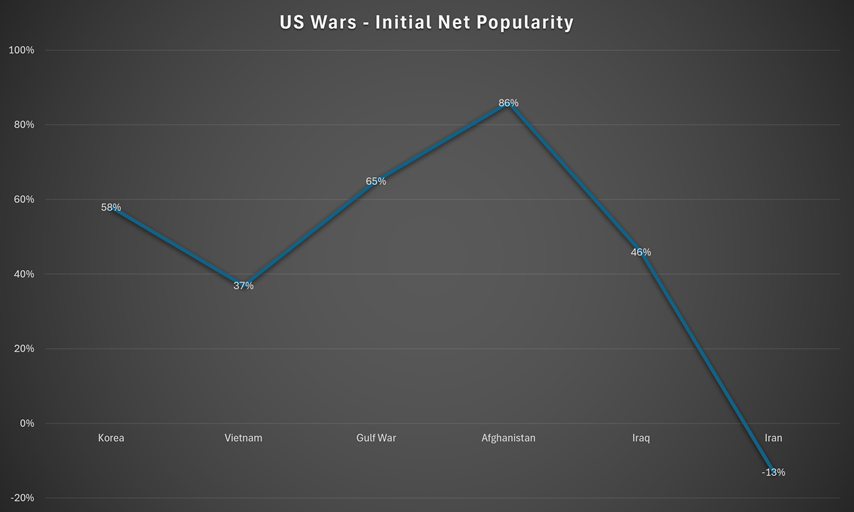
Despite online acrimony, Americans as a whole maintain a positive view of Canada. With all the recent disputes. Canada has only dropped from Americans’ favorite to second favorite ally. While it’s difficult to foresee the circumstances where America will be invading Canada, I think it’s safe to say it would be America’s least popular move in post-World War II history.

Over the last few months, we’ve seen how the unpopularity of the Iran war means political considerations play an outsized role in military strategy. An invasion of Canada would be that on steroids.

Restrictions on National Guard Callups

National Guard deployments are particularly sensitive to a war’s popularity. […]

All this is to say I doubt an invasion of Canada would involve extensive mobilization of the National Guard. It would be an unpopular move in an unpopular war.

For political reasons, the National Guard would probably be limited to service inside US territory, such as patrolling critical infrastructure or forming most of the 6-10 brigades guarding the US-Mexico border. That alone would cut the maneuver brigades for an invasion of Canada from 70 down to 41.
Restrictions on Rules of Engagement

Concerns about popularity and media optics would also likely lead to very restrictive ROEs. […]

Canadian military and government infrastructure was not designed for the threat of being bombed. There are lots of legitimate military targets that could turn into PR nightmares. For instance:

  1. Most Canadian reserve unit armories also house cadet units. [Youth organizations that do basic military training, but are not operationally part of the military establishment.] The closest US equivalent to Canadian cadets is probably Junior ROTC, but even younger. The American public would probably view a collateral damage incident involving cadets as essentially dropping a bomb on the boy scouts;
  2. Even if the airstrikes happen when there are no cadets in the building, the armories were mostly built on the outskirts of Canadian cities prior to WW1, so now they’re almost all in dense urban areas;
  3. Regular Force military bases almost all have elementary schools. They were built when being bombed wasn’t a consideration,1 so they were not planned with separation from military targets to avoid collateral damage;
  4. Canada’s main naval base on the west coast is nestled in a suburb (the city grew to encompass the base). The main naval base on the east coast is scattered across a dozen locations in downtown Halifax;
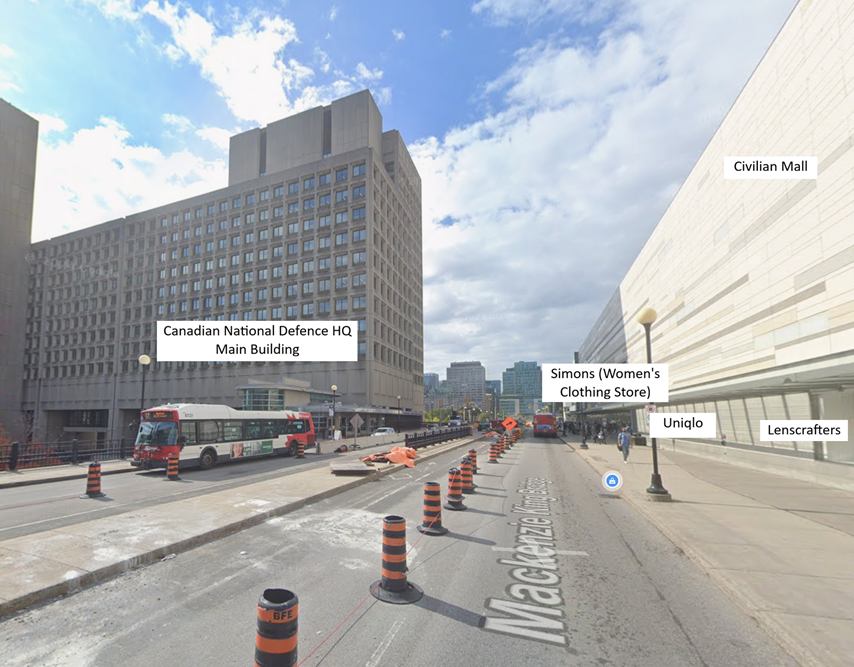
  5. The following civilian buildings are within 20-100 meters of Canada’s main military HQ building: a daycare, an events center, a mall, an art gallery, a youth hostel, university classrooms and an office block. The Tomb of the Unknown Soldier is across the street;
  6. The Canadian equivalent to the NSA is on a shared campus with Statistics Canada, Health Canada, the Geological Survey and the National Archives.

By all means, drop a JDAM on the office beside a women’s blouse store. I’m sure there would be minimal political fallout.

Consequently, a US President will need to pick between leaving an array of legitimate military targets untouched, and risking gifting horrible imagery to his political opponents during an unpopular war.

Operational Restrictions on Surprise

One of the biggest factors in how an invasion would occur is the amount of warning Canada had to prepare. Given 15 years warning, Canada would enact conscription and build a continental defense military of 30 brigades. This might seem fanciful, but that’s about the size of military Canada would have on its current budget if it converted entirely from an expeditionary to a continental warfare model. This would only require about one-fifth the scale of conscription in Finland and Israel. […]

Secondly, under the current integrated continental defense system, a sneak attack on Canada is not possible because there are Canadians serving in all the organizations needed to coordinate the attack. There’s a network of organizations for continental defense that have been in place since World War II. Due to similar NATO exchange programs, every headquarters planning the operation and executing the operation would include a Canadian officer or an officer from a close Canadian ally.

The best example of this problem is NORAD. NORAD is an integrated air defense command structure. Flights by military aircraft over North America are coordinated, and depending on the mission, controlled by NORAD. The main NORAD command center in Colorado has 15-20% RCAF staff.

Historically, there have been four times an officer at NORAD had to decide whether America was under attack, and to respond with lethal force. In 1960, 1979 and 1980 the NORAD warning system reported the USSR had initiated a nuclear first strike. On 9-11 the NORAD duty officer had to decide whether to shoot down several civilian airliners that were not responding to the grounding order. In two of those four incidents, the decision was made by a Canadian.

This means under the current structure, the plan for an air superiority campaign against Canada would require the cooperation of hundreds of RCAF staff. You could do a pretty good comedy sketch about this:

    [An Air Force general walks in]

    General: “Ladies and gentlemen, we’ve made the decision to eliminate the northern threat. I’m here to brief you on the air campaign plan to invade Canada.”

    [He completes the briefing]

    General: “Now, does anyone have any questions?”

    [An officer in a different looking uniform raises his hand]

    Officer: “Sir, it’s Squadron Leader Bloggins of the Royal Canadian Air Force, am I supposed to be here?”

    General: “f**k”

Obviously, the way around this problem is to eject Canada from NORAD and set up a new aerial command and control system. However, this would take a month or two to implement, and give Canada a strong indicator that a US invasion was imminent.

Although NORAD is the most extreme version of this planning problem, it’s replicated across most major US headquarters and coordination centers. Canada has another 150 to 300 staff officers in US exchange and liaison positions. You can exclude these staff from planning or expel them, but both of these options reveal the US is likely to invade in a few weeks.


  1. Beyond nuclear attack, in which case no amount of separation on the base will make a difference.

The Bismarck class: A waste of steel and human lives? – Nazi Rearmament 13

Filed under: Germany, History, Military, Weapons, WW2 — Tags: , , , , — Nicholas @ 04:00

World War Two
Published 7 Nov 2026

Bismarck and Tirpitz cost Nazi Germany hundreds of millions of Reichsmarks, years of construction, and enormous industrial effort. What did the Kriegsmarine get in return?

Bismarck sank HMS Hood, but her first Atlantic operation ended with her own destruction. Tirpitz spent much of her career in Norwegian fjords, threatening Arctic convoys and drawing Allied attention, ships, and aircraft. Their guns and armor were formidable. Their strategic value is harder to measure.

In this episode of Nazi Rearmament, Spartacus Olsson examines the Bismarck class from its origins in German naval planning to its construction, deployment, and destruction. We explore the compromises behind the design, the resources required to build and maintain the ships, and the gap between Nazi naval ambitions and the war Germany actually fought.

Could those resources have achieved more elsewhere? How much was Tirpitz‘s ability to divert Allied forces worth? And can either ship’s record be understood apart from the disastrous war of aggression they were built to serve?

Watch our complete Bismarck and Operation Rheinübung miniseries:
• The Royal Navy’s Epic Hunt for Bismarck – …

“Ordzhonikidze was the high-water mark of Hitler’s entire war, the farthest point his armies ever reached”

Filed under: Germany, History, Military, Russia, WW2 — Tags: , , , , — Nicholas @ 03:00

On the social media site formerly known as Twitter, Voices of WW2 note the location of the Wehrmacht‘s furthest advance in the Soviet Union:

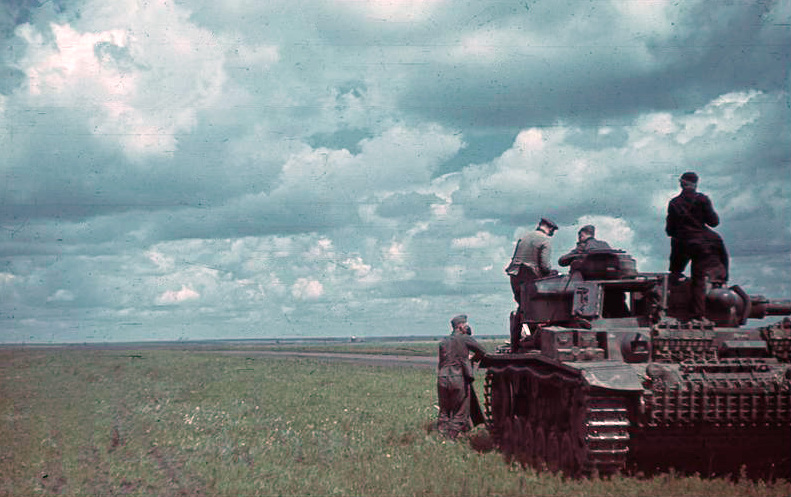
In the first days of November 1942, German tanks ground to a halt in the mountains of the Caucasus, at the very edge of a city called Ordzhonikidze, and could go no farther. This was the high-water mark of Hitler’s entire war, the farthest point his armies ever reached, and here, far to the south of Stalingrad, the great drive for the oil that was supposed to fuel the Reich’s victory failed within sight of its goal.

People remember Stalingrad, but Stalingrad was only half of the German plan for 1942. The whole southern offensive, Case Blue, had a deeper purpose: oil. Germany was chronically short of oil, the lifeblood of a mechanized war, and the great oilfields of the Caucasus, at Maikop, Grozny, and above all Baku on the Caspian Sea, were among the richest in the world. Hitler became obsessed with seizing them, convinced that the oil of the Caucasus would solve Germany’s fuel crisis and cripple the Soviet war effort, which also depended heavily on that oil. So while one German army drove on Stalingrad, another, under the operation named Edelweiss, drove south into the Caucasus toward the oil.

For a time it swept forward spectacularly. The Germans advanced hundreds of miles into the Caucasus, took the lesser oilfield at Maikop, though the Soviets had wrecked it before retreating, planted their flag on the highest peak of the Caucasus mountains, and pushed on toward the great prize of Grozny and Baku beyond. It was an enormous advance, carrying German troops farther from home than they had ever been, deep into the mountains between the Black Sea and the Caspian.

But the deeper they went, the harder it got. The Germans were now operating at the very end of impossibly long supply lines, across vast distances, into rough mountain country ideal for defense, against stiffening Soviet resistance. Their strength ebbed with every mile. And then, in the first days of November, the spearheads reached Ordzhonikidze, also called Vladikavkaz, a city guarding the route to Grozny and the Caspian oil. There, around the 1st to the 5th, the leading panzer divisions were stopped, held at the very outskirts of the city, and then struck by Soviet counterattacks that threw them back and threatened to cut them off. On the 4th, the Germans suspended their offensive operations in the Caucasus. They could go no farther.

That was the limit. Ordzhonikidze was the high-water mark of the German advance, not just in the Caucasus but in the entire war, the farthest geographical point Hitler’s armies ever reached in any direction, east, west, north, or south. And they had failed. The great oilfields of Grozny and Baku, the whole point of the southern campaign, were never taken. The Germans had reached toward the oil and been stopped just short, their tanks, ironically, running low on the very fuel they had come to seize.

And then the whole position collapsed. Just weeks later, the Soviets launched their great counteroffensive at Stalingrad, encircling the German Sixth Army, and that catastrophe to the north put the German forces deep in the Caucasus in mortal danger of being cut off entirely, their line of retreat threatened. They had to pull back, abandoning everything they had gained, retreating out of the Caucasus in the dead of winter to escape the trap. All the ground won in that spectacular advance was given up in a hurried withdrawal.

The high tide at Ordzhonikidze, in early November, was the moment Hitler’s conquest reached its absolute furthest extent and then began, everywhere, to recede. From here on, in the east and soon in every theater, the story of the war was one of the Axis being pushed back. The farthest reach of the Reich was a city in the Caucasus mountains that the Germans could see but could not take, where the drive for the oil died, just before the disaster at Stalingrad turned the whole tide of the war.

Why Did The Russian Civil War Break Out?

Filed under: History, Military, Russia, WW1 — Tags: , , , , , — Nicholas @ 02:00

The Great War
Published 12 Jun 2026

Following the Bolshevik takeover, the communist government under Vladimir Lenin wanted to end Russia’s participation in the First World War, transform the country and carry the revolution abroad. But anti-Bolshevik resistance took hold all over the country and across the political spectrum. Many former parts of the Russian Empire also declared independence and received support from the major powers. There would be no peace and the Russian Civil War had begun.

» SOURCES
Gustav Bečvář. The Lost Legion: A Czechoslovakian Epic. S. Paul & Co., 1939.
Janzer, Till. “Durchkaempfen bis Wladiwostok – Tschechoslowakische Legion in Russland”. Radio Prague International, 18.10.2008. https://deutsch.radio.cz/durchkaempfe…
Trotsky, Leon. “Order of June 4, 1918”, in How the Revolution Armed: The Military Writings and Speeches of Leon Trotsky, vol. I, The Year 1918, trans. Brian Pearce (London: New Park, 1979), p. 282.
Smele, Jonathan. The “Russian” Civil Wars, 1916—1926: Ten Years That Shook the World. Oxford UP, 2016
Engelstein, Laura. Russia in Flames. War, Revolution, Civil War 1914-1921. Oxford UP, 2018.
Mawdsley, Evan. The Russian Civil War. Pegasus Books, 2005.
Figes, Orlando. A People’s Tragedy: The Russian Revolution: 1891–1924. The Bodley Head, 2017 [1996].

QotD: What is a Hoplite?

Filed under: Europe, History, Military, Quotations, Weapons — Tags: , , , , — Nicholas @ 01:00

Before we dive in, we need to clarify some terms and outline periodization or nothing that follows is going to make very much sense.

First we can begin with the very basic question of what is a hoplite?

The term “hoplite” (Greek hoplites (ὁπλίτης), plural hoplitai (ὁπλῖται)) means “equipped [man]” or “armored [man]”, from hoplon (ὅπλον), “equipment, tool, weapon”. You will still sometimes hear that hoplon was the name for the hoplite‘s shield, but this is not quite right: the shield was an aspis, whereas hopla (the plural of hoplon) is used to describe a hoplite‘s full kit. Diodorus offers the etymology of hoplite, “these were earlier called hoplites from the aspides, and then took a new name, peltasts from the pelte [a lighter shield]” which at no point insists that the aspis was called a hoplon (Diod. Sic. 15.44.3).1 So while many Greek troops are named for their shields – chalkaspides, argyraspides, peltastai, thureophoroi, etc. (notice all of those –aspides!) – especially in the Hellenistic period when Diodorus is writing (which may be why he makes this guess), hoplites were not one of them: they were not named for their shields but for their whole panoply.

We might thus define a hoplite as a “fully equipped man”, where the equipment in question was generally at a minimum the aspis (a large round double-strap grip shield), a doru (a fairly standard one-handed thrusting spear whose only unusual characteristic is that its spear-butt is unusually developed) and a metal helmet; one certainly gets the sense from the sources that some sort of body armor was also an expectation here (e.g. Hdt. 9.63.2, but it is not clear how often that was realized in practice (frequently, it must be said – but perhaps not always). These men also generally carried swords as backup weapons.

By the time we can see them clearly (in the 400s) these fellows generally fight in a formation the Greeks call a phalanx (φάλαγξ), but we need to issue an immediate caution that φάλαγξ is not a technical term in Greek but rather the equivalent to Latin’s acies in that it just means “battle line”. Consequently Greek authors can and will use it to refer to any clear battle line and it gets used of hoplites, but also pike-wielding sarissa infantry and also Roman legions and also barbarians and also chariots and also elephants at points. The word is actually even more general than this and seems to have at its core the idea of a beam or trunk – it can mean the main mass of something (as opposed to its edges), like the trunk of a tree or a beam of wood, it can mean the finger-bone but also is used for rows of eyelashes. And you can kind of get how, metaphorically, you get from finger-bones in a row or eyelashes in a row or beams or planks (in a row at regular distances) or even just the central mass of a tree to either men lined up neatly or the central mass of an army.2

We’re going to get into the particulars of exactly how we might imagine hoplites fought and how exactly a phalanx of them (keeping in mind you can have a phalanx of other things) might fight as we go along. But those are our key terms: a hoplite is a soldier with a specific “full” or “heavy” equipment set (aspis, spear, sword, helmet, cuirass) and hoplites sometimes fight in a close-order shield-wall infantry formation called a phalanx. I don’t want to go much further than this because what we’re going to see in part two is that some of the fights about hoplites and especially about the phalanx are definitional and I don’t want to load those dice here before we’ve even introduced the debate – better to come at it with relatively few assumptions.

On to periodization. We generally break down this period of Greek antiquity into the following periods:

  • The Greek “Dark Ages” (c. 1100-c. 800) during which we have no written evidence (the writing of the earlier Bronze Age having been lost and the ancient Greek script we know not having been invented) and thus it is very hard for us to talk with much confidence about how warfare worked (except that it wasn’t phalanxes).
  • The Greek Archaic Period (c. 800-480). Writing returns at the beginning of this, but the Greeks won’t start writing their own history until the Classical period, so our sources mostly view the Archaic as the distant past. This is the period where the polis and hoplites are emerging, though as we’ll see the “when” and “how” of that are core to the debate.
  • The Greek Classical Period (480-323). This is the period where the independent Greek poleis are at their height and where “hoplite warfare” is the predominant (but not only) method of warfare. It is also much better documented than the others. It ends with Greek independence being shattered and hoplite armies largely replaced by Macedonian armies (which operate under a different, but related, system of close-order heavy infantry).
  • The Hellenistic Period (323-31). There are still some hoplite-armed troops around in this period, but they are increasingly less relevant compared to Hellenistic armies, which we’ve already discussed at length. This period ends when the Romans steamroll everyone and set up a Mediterranean-wide empire.

Obviously we’ll be mostly focused on the Archaic and the Classical, the dividing line between which are the Persian Wars (492-490, 480-479) which are also some of the first relatively clear descriptions of Greek warfare in a high degree of detail and which are generally (some hoplite-heterodox scholars contest this) taken to be our earliest solid descriptions of hoplite warfare. But there’s a challenge here because our main source for the Persian Wars (Herodotus) is writing not in 479 but in the 430s. Meanwhile our understanding of the mechanics of hoplite warfare emerges out of Thucydides’ history of the Peloponnesian War (431-404; he’s probably writing c. 400) well into the Classical period. So the sources where hoplite warfare becomes explicit (we’ll talk poetry a bit later) are writing about 480 in 430 or about 430 in 400, but a lot of our questions about hoplites relate to how they fought in the Archaic (800-480).

That means – and this is quite important for what follows – hoplite arms and armor emerge in our archaeological record during the Archaic well before we have literary sources offering solid, detailed descriptions of how men using that equipment fought. Much of the hoplite debate thus lives in the Archaic when our evidence is quite thin and often frustratingly ambiguous.

Bret Devereaux, “Collections: Hoplite Wars, Part I: The Othismos over Othismos”, A Collection of Unmitigated Pedantry, 2025-11-14.


  1. Thuc. 7.75.5 is sometimes also offered as an example of hoplon meaning “shield” but it is hard to see how ὑπὸ τοῖς ὅπλοις, “under the equipment[s]” can be taken to mean “under their shields” given that there is no space under an aspis to carry anything: the shield takes up the hand and the elbow and is dished downward. If you want to carry something with it, you must carry upon it. Instead I’d hazard “under their arms” here might mean something like “in a bag, hanging down from the haft of a spear” (cf. the Roman sarcina) or perhaps carried in the hands in a bundle along with tools and weapons (some translators read the phrase as “while under arms” but that doesn’t seem to be the sense of the Greek at all to me).
  2. Likewise Latin’s acies is also metaphorical: it means “edge” or “point” – something sharp. So it means “battle line” or “battle formation” in the sense that it signifies the sharp, dangerous leading edge of the army.

November 7, 2026

A different kind of neo-colonialism

Filed under: Britain, Bureaucracy, Government, History — Tags: , , , — Nicholas @ 05:00

In The Daily Sceptic, David Betz and Michael Rainsborough point out that the British government, in its dealings with the British public, seems to have fallen back on habits developed in the days of the world-spanning British Empire:

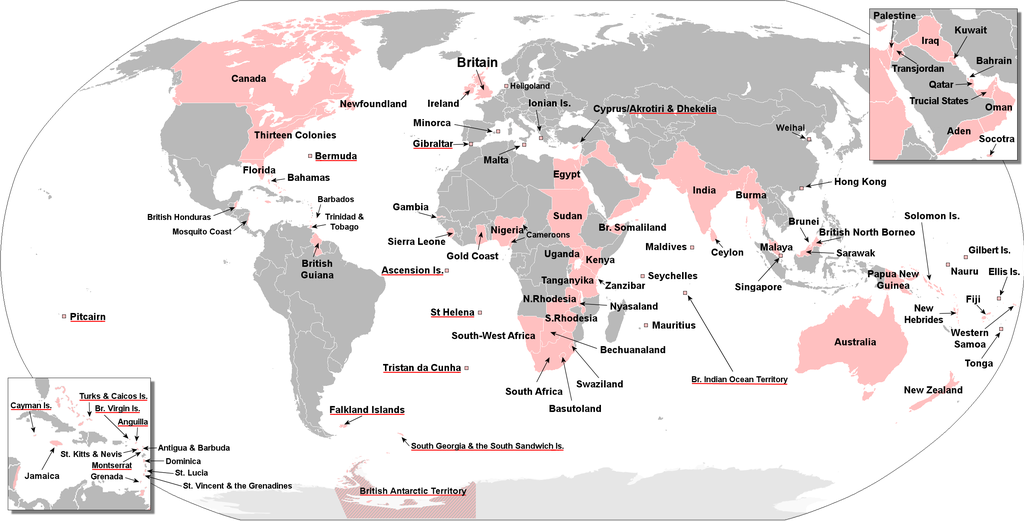
The territories that were at one time or another part of the British Empire. The United Kingdom and its accompanying British Overseas Territories are underlined in red.
Composed by “The Red Hat of Pat Ferrick” via Wikimedia Commons.

Despite spending much of the past half-century apologising for the Empire, the British establishment is rediscovering its favourite method of rule. The old colonial district officer, accustomed to keeping the peace between rival communities, cultivating local notables and reporting troublesome political sentiments to his superiors, would find much to recognise in contemporary Britain. He might struggle with the current terminology, but once someone explained what a Cohesion Support and Interventions Function actually did, he would probably feel quite at home.

In an essay we wrote six years ago called “Empires of Progress“, we argued that Western governing elites were increasingly abandoning the assumptions of the nation-state in favour of an imperial conception of political authority. A nation-state presumes a people sufficiently conscious of belonging together to accept common institutions and obligations. An empire governs different peoples, often possessing competing interests and loyalties, through a combination of accommodation, patronage, arbitration and coercion. Nations require citizens; empires administer subjects.

What we then identified as an emerging tendency has since acquired a more distinct institutional and political character in Britain. Successive governments, having encouraged mass immigration and multiculturalism, increasingly employ methods familiar from imperial administration to manage the communal divisions arising from those policies.

More significantly, these arrangements threaten to transform the relationship between the governing establishment and the historic British population, whose national attachments and political preferences increasingly conflict with the assumptions of those exercising power. Here, we examine how communal brokerage, differentiated accommodation and preventive security contribute to this estrangement, weakening the common national allegiance upon which the legitimacy of the state depends.

The imperial reflex, imported into the British domestic realm, we suggest, will prove considerably more destabilising than its practitioners anticipate.

Divide, rule, cultivate allies

British imperial administration depended upon an intimate knowledge of the populations it governed. Officials classified communities by ethnicity, religion and customary authority, cultivated influential intermediaries and distributed recognition, privileges and patronage to secure cooperation.

Such arrangements reduced the costs of government while giving selected local leaders a stake in the preservation of imperial authority. The British also secured the allegiance of particular populations whose interests became closely associated with the existing political order.

Governing through intermediaries and building dependent constituencies were complementary techniques, although the interests of the two were not always identical. By recognising communal leaders as representatives of distinct populations, imperial administrations could also reinforce the divisions that sustained their authority.

In British Malaya, for example, colonial economic development encouraged large-scale Chinese and Indian immigration, transforming the demographic composition of the peninsula and creating competing communal interests. The colonial economy developed along pronounced ethnic lines, with Malays concentrated in agriculture, Chinese communities prominent in commerce and mining, and Indian labour recruited extensively for plantation work. While not absolute, these divisions established a political landscape in which economic interests and communal identities became closely associated. British administrators also relied upon recognised communal intermediaries, including Chinese leaders known as Kapitan Cina, who mediated relations with Chinese communities and whose commercial privileges and political influence could become closely connected with the colonial power.

After the Second World War, the proposed Malayan Union of 1946 sought to extend citizenship to much of the immigrant-origin population while reducing the authority of the Malay rulers. Malay opposition forced the British to abandon the scheme in favour of the Federation of Malaya in 1948, with more restrictive citizenship provisions. The subsequent establishment of the Communities Liaison Committee in 1949 brought leading Malay, Chinese and Indian representatives together to negotiate questions of citizenship, economic interests and national identity. Political authority rested upon negotiations among recognised communal organisations, culminating in the Alliance between Malay, Chinese and Indian parties that helped secure independence in 1957. The British authorities, in effect, created the demographic and economic circumstances that made communal bargaining an indispensable feature of the constitutional settlement that followed.

At home, the contemporary British state confronts comparable divisions arising from a demographic transformation shaped decisively by the policies of governments of both major parties.

The lasting power of Nazi propaganda

Filed under: Germany, History, Media, WW2 — Tags: , , , — Nicholas @ 04:00

After the Canadian government started subsidizing most of the TV and radio stations along with the newspapers and magazines, it helped me to understand how the concentration of messaging had been key to maintaining and reinforcing Hitler’s grip on power in Germany in the 1930s. Before that time, there were still independent and opposed viewpoints available to ordinary Germans, but after Hitler became Chancellor, most of them were shut down or taken over by the Nazis. The message delivered to Germans from that point on was closely directed by the propaganda ministry under Goebbels, and it was very effective in harnessing German public opinion. Modern communication channels that we enjoy today would not be as easily controlled as the printing presses and radio towers of Hitler’s day … but we’ll see in real time how much various governments are willing to try to extend their control to the internet.

On Substack, Katja Hoyer looks at how the carefully curated images of the Nazi propaganda machine still worked to shape opinions long after the Reich was defeated, as western media kept re-using Nazi images to illustrate stories about that regime:

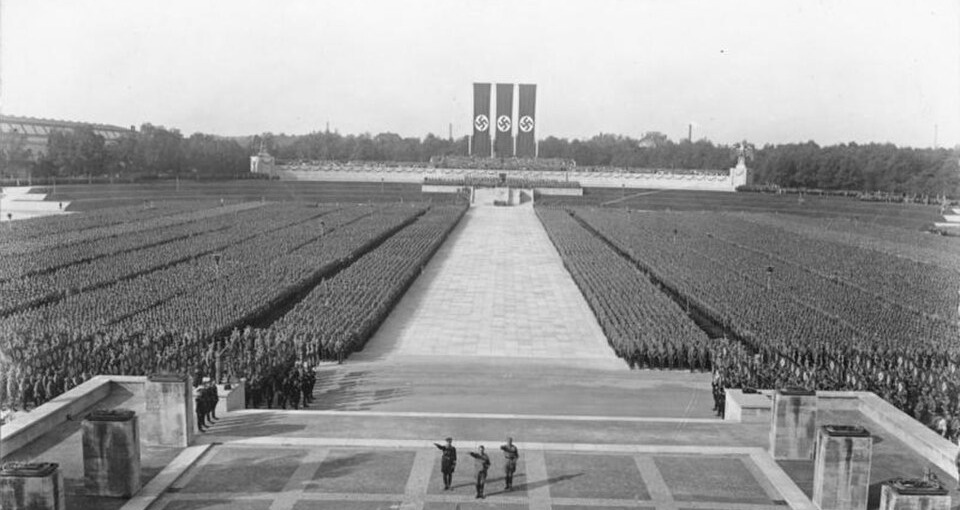
Image taken at the 1934 Nuremberg Rally. Img: Bundesarchiv, Bild 102-16196 / CC-BY-SA 3.0

The result was that many of us grew up with an image of the Nazi era not a million miles away from the one the regime itself had wanted to project. Long columns of soldiers marching in rigid formation. Perfect young boys and girls in uniforms, ecstatically following their Führer into his future. Order. Discipline. Design.

The reality of the Nazi regime was of course very different. So by looking at the Nazi regime through its own lens, are we perpetuating its propaganda?

That’s the question the American art historian Madeleine Johnson asks in her book At Hitler’s Picnic: Discovering the 1934 Nuremberg Rally. She has kindly agreed to give us here at ZEITGEIST a taster of her work and some of the very different images she has found.


    Have you ever noticed how you can almost bet which photos will accompany any book or video about Nazi Germany? You can almost guarantee there will be sepia images of armed SA men on trucks, footage from Leni Riefenstahl’s Triumph of the Will, clips from Eva Braun’s home movies or newsreels of the Wehrmacht in combat.

    I had never really thought about this until 112 old glass slides turned up when we cleared out my childhood home. As I eventually learned, my uncle, a U.S. G.I., had found them scattered on the floor of a local Nazi headquarters in March 1945 and sent them home as a souvenir.

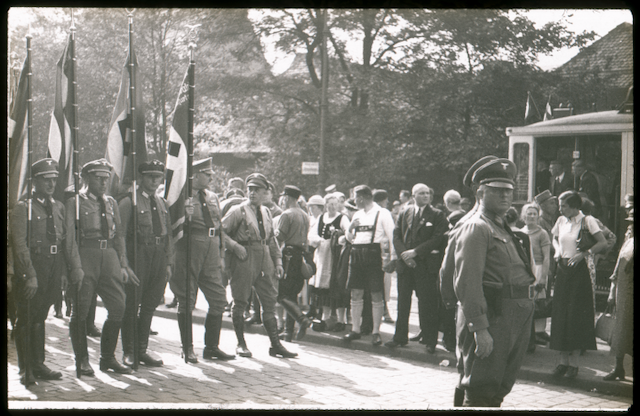
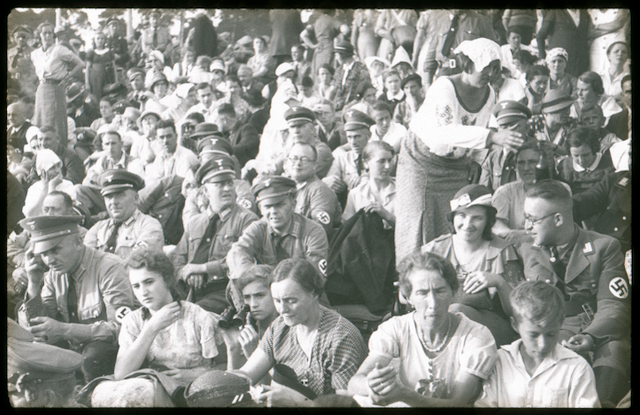
    When I first saw them, it took a moment to recognise that these slides of portly men and their families snacking in the stands, children in mini Nazi uniforms and litter in the famous Luitpold Arena were taken at the 1934 Nuremberg rally. They were completely unlike the perfectly aligned ranks of the SS and SA and glowing Hitler youth familiar from Heinrich Hoffmann’s photos and Riefenstahl’s film.

    Image from Madeleine Johnson’s collection

    The contrast between these amateur snapshots and the images we “know” got me thinking about how and why such a predictable, and limited, group of images still dominate the narrative of Nazi Germany today.

    Some of the reasons we keep seeing the same photographs are structural. It may have been the country of Leitz and Zeiss, but cameras were expensive and not widely owned in 1930s Germany. The regime limited photography too. Only three official photographers were permitted to take photos at rally venues. Those combat films would have required propaganda ministry permission. Heinrich Hoffmann had the exclusive on Hitler photos, and he and Eva Braun were the only ones with access to Hitler’s private life.

    There is the survival factor. Personal photos that weren’t destroyed by war may not have survived de-Nazification or family shame. Another reason for the constant employment of the same images is that they are familiar. They are a kind of shorthand that does not need explaining. They offend no one, and their authenticity is not in doubt (except for that famous one of Hitler in the 1914 crowd, probably made by Hoffmann’s studio).

    Image from Madeleine Johnson’s collection

I’d noticed many years ago that the mental image most people had of the Wehrmacht was directly from Nazi propaganda films and photos, which emphasized the “mechanized might” of the modern German military machine … despite the fact that the Germans used many more horse-drawn carts than motorized vehicles all the way through the war. The images were striking — nobody said the Nazi propagandists were incompetent — and they also helped hide the fact that the French and British had been thoroughly trounced in 1940 despite their more heavily armed tanks outnumbering the lighter German panzers.

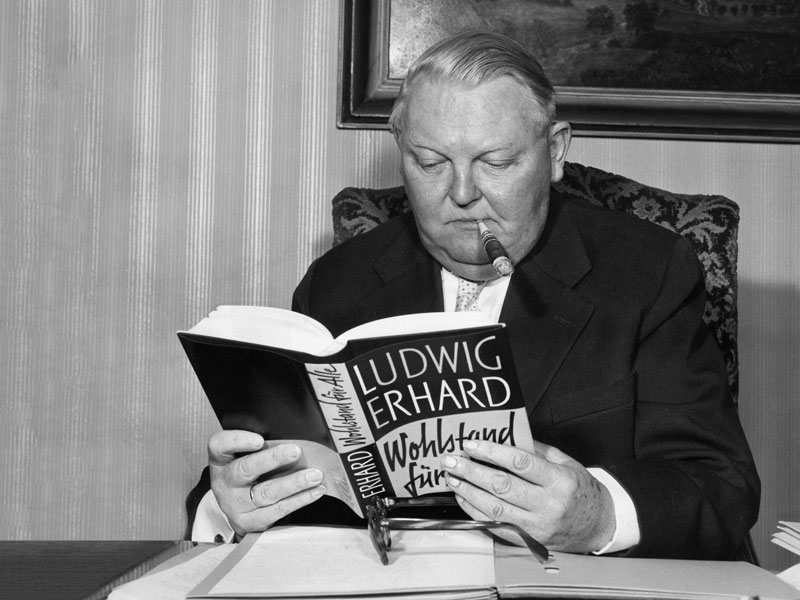
Ludwig Erhard’s shock treatment of the postwar German economy

Filed under: Economics, Germany, History — Tags: , , , , — Nicholas @ 03:00

On the social media site formerly known as Twitter, Handre points to the state of the German economy after World War 2 and what it took to shock it back to life:

Germany did it before. The question worth asking now, with Europe’s largest economy grinding through its third consecutive year of stagnation, is whether Germany can summon the nerve to do it again.

In 1948, Ludwig Erhard did something that struck most of his contemporaries as insane. He abolished price controls overnight, slashed rationing, and replaced the worthless Reichsmark with the Deutschmark at a brutal conversion rate. The occupying Allied authorities were furious. Labor unions called a general strike. Erhard told the critics to wait two weeks.

They waited. Industrial output jumped 50 percent within months. By 1950, real wages were rising and the black market, which had functioned as the actual German economy under Allied price controls, simply evaporated. Prices fell as production caught up with demand. Consumer goods reappeared on shelves for the first time in a decade.

In a sound monetary environment, rising productivity drops prices and you get richer in real terms without a central bank engineering 2 percent annual inflation to pick your pocket. The Deutschmark held its value. Savings meant something. Capital formation exploded because businessmen could actually calculate future costs without guessing what the currency would be worth next year.

Germany’s neighbors ran the opposite experiment, keeping controls and soft money, and watched their recoveries crawl.

The 2026 German government faces energy costs triple their 2019 levels, a manufacturing sector hollowing out, and a central bank it no longer controls. Erhard’s playbook sits on the shelf. Cut the regulatory burden, restore price signals, stop the spending. This is not complicated; the political will is the only scarce resource.

Trajan and Hadrian – 20: The Conquered and the Proud

Filed under: Europe, Government, History — Tags: , , , , , — Nicholas @ 02:00

Adrian Goldsworthy. Historian and Novelist
Published 29 Apr 2026

Today we think about the careers of the emperors Trajan and Hadrian, Roman aristocrats from Spain. Gibbon included them among the five good emperors who presided over the height of the Roman empire. Trajan was remembered fondly by the Roman elite, but is less well known today. Hadrian is more famous, generally remembered as good, but was bitterly unpopular with the Senate.

QotD: “Capital allocators” and “operators”

Filed under: Business, Quotations, USA — Tags: , — Nicholas @ 01:00

If you hang out much with finance bros (or “capital allocators” as they now call themselves),1 you may chance to hear somebody described as an “operator”. What is this strange species? What is this unusual job with an unusual title? Near as I can tell, an “operator” is somebody who actually runs a real business in the real world. But atop the commanding heights of 21st century America, that makes you an anomaly. You have no podcast. You have no portfolio of bets. You have no LPs, no byzantine leverage structure, and no IRR calculations. You don’t flit from deal to deal, hovering on a castle of financialized abstractions so ethereal the lack of air pressure at that altitude gives you a nosebleed. You aren’t even an intellectual or a scribbler who writes about real things at a layer of remove. No, instead you toil in the muck, doing basically the same thing every day, trying to make an actual business actually succeed. What a weirdo.

John Psmith, “REVIEW: Anabasis, by Xenophon”, Mr. and Mrs. Psmith’s Bookshelf, 2026-06-01.


  1. This neologism is actually incredible It’s like something out of early 20th century Marxist propaganda, but they did it to themselves! This is not helping us beat the accusation that we live in a cleverly-disguised planned economy.

November 6, 2026

The Senate, from the monarchy to after the empire

Filed under: Europe, Government, History — Tags: , , , , , — Nicholas @ 05:00

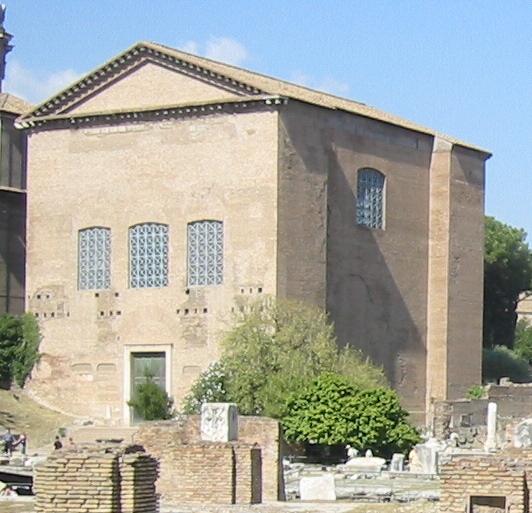
The Roman Senate had been created very early in Rome’s history, served under the kings, ruled under the Republic, served again under the emperors, only to fade away after the fall of the western empire, be briefly revived, then to disappear again by the early seventh century, this time for good:

The Curia Iulia at Forum Romanum in Rome, one of the traditional meeting places for the Roman Senate. The building was reconstructed under the Fascists between 1930 and 1936, based on an earlier reconstruction in the reign of Diocletian.
Wikimedia Commons.

It was members of this very assembly — which was soon to become the Senate of the future Republic — who staged a coup and expelled the last of Rome’s kings, the Etruscan Tarquinius Superbus. From that point on, the Senate became the undisputed center of power in Rome until the end of the 2nd century BC, when the socio-demographic crisis facing Italy led to a search for change and reform through other institutions, such as the tribunes of the plebs. The failure to resolve the conflict led to the rise of warlords such as Sulla and Julius Caesar, each waging their own civil wars. These wars deeply divided the Senate, solidifying two diametrically opposed factions: the Optimates and Populares.

The future split between the Republic of the Senate and the Empire of the prince or emperor is, in part, an artificial one that has given rise to a narrative in which the Senate is seen as increasingly diminished in the face of the emperor’s authority, to the point of becoming practically irrelevant and invisible. It is still there, but merely as another monument to Republican Rome. The truth is that Rome began to be an empire long before Augustus was proclaimed emperor, just as it did not cease to be a republic during the imperial era, with a Senate that remained a political actor, wielding more informal power than formal power.

I understand the periodization that divides the history of ancient Rome into the Monarchy, the Republic, and the Empire, but I believe that, above all, it serves pedagogical purposes rather than the actual objectives of historiography. The Romans themselves, even though they were ruled by an emperor, understood that theirs was a republic, and they never ceased to describe it as such.

The issue of the figure and concept of the emperor is one that may have a great deal to do with the marginalization suffered by the Senate during the so-called Imperial era. The Romans’ concept of an emperor is quite different from our modern one. To begin with, the title imperator, from which the modern word emperor derives, was not used by the Romans when addressing their emperors. Imperator was a title bestowed by the legions upon their commanders as a form of recognition, granting them imperium — that is, the authority to command and lead — over their soldiers. The Roman emperor was called princeps (the first citizen), and this recognition meant that he was the first among the senators, holding primacy over the rest. Logically, this implies that for there to be a princeps or prince, there must be a senate; and in that sense, the Roman Senate was an integral part of the political structure of what we classify as the Imperial era until the fall of the Western Empire in 476 AD.

The Roman Senate survived the deposition of its emperor, Romulus Augustulus, the total disintegration of the Empire’s western provinces, and the imposition of two barbarian kings: first Odoacer of the Heruli, and then Theodoric the Great, king of the Ostrogoths. Throughout that entire period, the Roman Senate continued to function. It had already gained some independence in dealing with local affairs following the permanent establishment of the emperor’s court in Ravenna, in northern Italy, and under the new barbarian rulers — who sought to maintain the imperial structure and institutions for the purpose of governing — the Roman Senate experienced a modest political resurgence.

Links added to my Roman glossary.

“[E]lections are the inchoate expression of collective emotional reactions”

Filed under: Media, Politics, USA — Tags: , , , , , , — Nicholas @ 04:00

The Librarian of Celaeno offers an analysis of the midterm results from a monarchist perspective (I didn’t think there were many monarchists left in the US, honestly):

Analysis shows the real reason the Republicans lost so badly in the 2026 midterm elections.

As a reactionary monarchist, my approach to electoral politics is generally hands off. I find individual races and aspects of the system interesting, but only in terms of what they reveal about human psychology. I’ve written about this in the past, explorations of Trump and Vivek Ramaswamy (for some reason, my most popular post ever) with the goal of understanding what they and others mean. And having examined the fortunes of various candidates and factions over the years, as a matter of academic study and personal interest, I continually come to the same conclusion: liberal democracy is insane.

This to me seems the parsimonious conclusion for any theories of this (last) night’s election, with Democrats sweeping into power in former Republican bastions like Texas and Georgia. People online, people I respect, have advanced a number of theories as to why they were able to do so, generally based on something to with President Trump. But while there is something to that line of reasoning, I think the answer is more basic. I believe the evidence shows that “the people” however conceptualized, have no coherent sense of ideology or even self-interest. I wouldn’t even say they’re guided by residual inertia of inherited beliefs. Rather, elections are the inchoate expression of collective emotional reactions to an ever shifting and polarized mediated reality. In other words, madness.

I have heard, for example, that people are angry about high gas prices and so turned on Donald Trump and his Iran War in favor of the Democrats. But does anyone seriously think that the latter even intend to make fuel costs cheaper? Whose gas prices would you rather have- those of California, or Georgia? Well, if you live in Georgia, the answer seems to be California. Democrats are not shy about their aversion to fossil fuels and eagerness to tax their way to a German-style Green regulatory utopia. Voting for Democrats because gas prices are high is like giving yourself malaria in order to sicken the mosquitos who keep biting you. That’ll show ’em.

Then there’s the fact that the youth vote swung heavily to the Democrats. Many are suggesting that this is driven by young white men frustrated at being shut out of the economy, unable to get the jobs they want or afford a house. But again, in what universe is voting for Democrats the viable solution to that problem? These are the people who have flooded the country with foreigners meant to undercut those same native-born white men (and everyone else) and this election enables them to cement control over far more space to do that. The young people of Georgia, to return to my example, just voted for California’s taxes, regulatory environment, housing policies, and most importantly, its demographics. Everyone upset at his current situation pulled the lever to make it worse.

The rejoinder to this is, “well, Trump didn’t reach out enough! The young men were angry!” Of course they were. But then, everyone was angry. The blue hairs were angry. Black people were angry. Boomers were angry. At the heart of the anger is a continuously changing but relentlessly prolific barrage of propaganda, a kind of anti-myth, for while myth is timeless and transcendent and unifying, the words and images that comprise anti-myth are ephemeral and tendentious and discordant — inciteful rather than insightful. This propaganda comes from everywhere and nowhere all at once, subtle and overwhelming, but ever omnipresent. It keeps the masses running through cycles of elation and dooming, smug triumphalism and black rage. It is the context through which the people view politics, whether from the shallows or the depths, they all swim in it

And the whole of the mad masses, broken down into sub-mobs of conflicting interest groups, are all driven to the polls to vote against whatever happens to be there at the moment. They were all mad for different reasons, but the results were all the same, the empowerment of the sort of people who can only be elevated by an irrational horde.

Few seem to grasp that this wipeout is but the latest iteration of a now perfectly normal phenomenon, something that’s been going on since the 1930s. The president’s party nearly always sees losses in the midterms, sometimes enormous. It happened to Bill Clinton; it happened to George W. Bush. Barack Obama referred to his midterm losses as a “shellacking”. Every time it happens it’s declared the end of whoever is in power and birth of a new order for the ages, only for the script to flip some time in the next 2-4 years. Obama was the repudiation of Bush-Era Republicanism. Trump was the end of technocratic liberalism. Biden was the doom of Trump and Trump was the doom of Biden. And at the halfway point of each administration the other party was was given control of Congress in order to thwart the will of the man the electorate had just put in office.

Mark Steyn:

It is two days after the election and they still cannot tell us who won Mississippi.

Mississippi! A state Trump won by twenty-three points just two years ago.

So why can’t they call it for the Republican? Er, because it’s the Democrat who’s ahead, but only by a hundred votes. That’s how thoroughly Mark Levin and Lindsey Graham have bollocksed the Republican Party. If Mississippi is suddenly a purple state, New Hampshire is now bluer than, er, South Carolina: the Granite State legislature flipped from a 43-seat GOP majority to a 200-seat Dem supermajority. On Tuesday, nationwide, men went +11 for Democrats, and so did rural voters. There are no takers for what the Lindsey-Levin crowd are selling. The President displayed appalling judgment in ever listening to them. Me channelling Megyn Kelly back in March:

    The Micropenis That Ate MAGA

And so it has proved — from Maine to Texas.

Nevertheless, those who destroyed the forty-seventh presidency are now doubling down:

Yeah, baby. Nuke the world! That’ll show ’em …

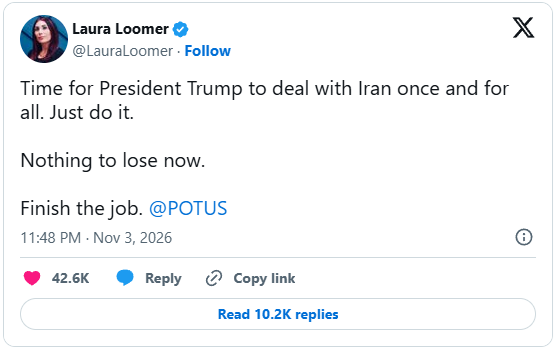
I don’t really know who Laura Loozer is, but evidently she has the President’s personal cell and I don’t. And she is not alone. The slogan du jour is “finish the job”. Former Bush speechwriter Marc Thiessen:

    We should go back to war and we should finish the job.

My old pal from Fox News, Brian Kilmeade:

Finish the job? It’s not clear that the Pentagon, in a strategic sense, has even started it. Nevertheless, another former comrade, Duane Patterson from The Hugh Hewitt Show, is on board:

    Trump has a window of about three months … He has to finish the job. Topple the regime. Hang a W. Then, after oil comes down, affordability returns as the cost of energy stabilizes, and the rest of the economic engine he jump started revs up, whoever comes next can ride prosperity in 2028.

Good luck with that. For one thing, the corrupt and dysfunctional US military has demonstrated, for three-quarters of a century, no capability whatsoever to “finish” any job. What part of “Dollar for dollar, you’re the most expensively crap warmonger in the history of the world” don’t you understand?

As for “Nothing to lose now”: America is supposed to be a self-governing republic, and its citizens have just told you they don’t want this. Yet you’re still proposing that their chief magistrate should go ahead anyway and MOAB (or worse) those lousy mullahs?

Vice President Vance — who, unlike Pete Hegseth, cannot be fired by Trump — yesterday wrote a very long tweet, including the following:

    The reason we lost is the war. The president himself said so last night.

    If you’d like to argue it was worth it, that losing the Senate for the next 6 years was worth it, then do so.

« Newer Posts — Older Posts »

Powered by WordPress