Quotulatiousness

November 6, 2026

AI and open-source software

Filed under: Technology — Tags: , , , — Nicholas @ 03:00

ESR has become a big fan of AI-assisted code writing, and as a result I’m a bit less “doom-y” about the potential uses of AI because ESR is a living legend in the software world. If he thinks it’s a good thing, then I’m inclined to believe him. That said, as he illustrates here, not everyone in the OS community agrees with him about code-writing clankers:

I find it bizarre that so many open-source projects have posted policies against AI-assisted contributions.

This will not last, because they’ll be outcompeted by projects not afraid to use power tools to debug the code and and features. In crucial cases, AI-hostile projects will be forked to remove that restriction.

How can anybody not see this coming?

This dynamic is so obvious – and anti-AI rules so patently futile and doomed – that I have to conclude there is something like a religious frenzy going on.

I’m going to bend over backwards to be fair about this. There was a point earlier in the development of AI at which such restrictions might have made temporary sense, because model outputs were prone to enough noise and hallucination to be a net drag on productivity.

We’re long past that now. And the obvious solution to merge-request queues flooded with AI-generated slop is to use AI to filter them so exercising human judgment on the remainder remains practical.

I’m not going to argue rights and wrongs here. One might just as well argue that it’s wrong for sandcastles to collapse when the tide comes in.

The religious frenzy does bother me, though. Maybe less than it did 5 minutes ago when the mind infection was “wokeness”, but a mob of crazies is never an edifying or reassuring sight.

I guess the most positive thing I can observe is that this phase of nuttery won’t last long, because it can’t. The selective pressure against it is too brutal.

It does leave me wondering what cause the nutters will attach themselves to next. Alas.

Train Company Makes Guns: Union Switch & Signal M1911A1

Filed under: History, Military, Railways, USA, Weapons, WW2 — Tags: , , — Nicholas @ 02:00

Forgotten Weapons
Published 11 Jul 2026

Of the five companies that made 1911 pistols during World War Two, Union Switch & Signal was the last to be awarded a contract and the smallest mass production producer. A subsidiary of the Westinghouse Air Brake Company, US&S produced a variety of ordnance material during the war (and during World War One as well). They received a contract for 200,000 M1911A1 pistols on May 5, 1942, which was subsequently reduced to 30,000 in March 1943 and then upped to 55,000 in June 1943. Those 55,000 pistols were delivered between January and October 1943 and had an excellent reputation for quality.

Union Switch & Signal actually only produced eleven parts for the 1911 plus frames, with the balance of the components subcontracted (mostly to Yawman Metal Products of Rochester NY). Their serial number block was 1041405 – 1096404.
(more…)

QotD: Pining for the fjords old social media

Filed under: Media, Quotations, Technology — Tags: , , — Nicholas @ 01:00

Oh, how I miss the old social media. The one that claimed, with a straight face, to be “social”. Connecting people, it said. A lofty ideal, sure. But one worth at least paying lip service towards.

But what I really miss about the old Facebook is the wisdom one imbibed with each visit. You’d log on breathless, quivering in wonderment at the mere prospect of a day enriched forever.


I’m referring to the now defunct staple of those quixotic days. The Thirst Trap with Inspirational Quote — a mode of intellectual smuggling so elegant it deserved a Royal Charter. First came the sugar: a lithe young woman — preferably your best friend’s inamorata — in a bikini engineered to defy both gravity and modesty. Then came the medicine: quotes from Gandhi or Rosa Parks. Occasionally, for the more intellectually inclined, a dose of that mad French pederast, Michel Foucault.

For the unadorned, Facebook’s philanthropy once possessed lofty intention. It worked like KGB subterfuge, apparent only years after the fact. Peppered across the old Facebook were photos related to friends, acquaintances, and people you might have once spied groping the wonky lemons in Aldi. It was a community. On Sundays, you’d play a Masterchef host, picking apart your old English teacher’s gravy-sodden roast beef and questioning the sad pallor of his limp, insipid broccoli. The poor fool might know a bit about The Tempest, but he knows nothing about salting his cruciferous vegetables.


That was the old social media. Now Hell is empty and all the devils are here.

Life in that prelapsarian idyll was dreamy. A friend request spiked a syringe full of dopamine right between one’s ears. Ahhh. Unearned reward bounced along one’s veins.

But what I miss most is the intellectual life of the old Facebook. Somewhere in Silicon Valley, an asocial oddball tapping keys for Facebook realised that humans, okay — men — enjoy photographs of lissome and radiant females wearing a minimum of organic cotton across their chests and torsos. The conceit: trick them with this tantalising photo. Once they’re hypnotised, slap them with a brain-edifying quote from a great mind.

I must admit. I learned a great deal from such cunning little photos. But this intellectual subterfuge was like learning to read under the cover of night and the threat of beating. You know, the situation women face in those backwards countries which the far-left cannot help but celebrate.


A friend of mine dated one of these cultural benefactors. Each post triggered a small industrial ritual. Phones emerged. Men disappeared around the back of the warehouse for a sly peek.

“I told her not to post that stuff,” he’d mutter.

We, of course, were less concerned with the flagrant déshabillé than the curriculum. Would it be Gandhi? Rosa? A daring turn toward French theory? The race was on. Thumbs scrambled across screens, each one determined to be the first to reveal today’s pixelated prize. On the screen was my friend’s girlfriend, her body sculpted with hours of gym work, wearing one of those bikinis which render the wearer less than naked. In the curious greeting of her tribe, she expertly angled her glossy behind toward the waiting camera.

And then, the crunch of gravel under a boot. Our mate would appear:

“What the fuck are you all looking at — I bet — I swear — I told her not to post that stuff.”

It was absurd. It was undignified. It was what terrific bores would today call problematic. But it was, in its own way, social. And then it disappeared. Social media stopped being about people and became about attention.

The roast dinners vanished. The girlfriends remained — but now they belonged to strangers paying £9.99 per month for a daily update of smut. The quotes disappeared entirely. There was no need for them. The tech bros had threaded a barbed hook down your throat.

Christopher Gage, “Social Contract”, Oxford Sour, 2026-08-04.

November 5, 2026

Midterm aftermath

Filed under: Media, Politics, USA — Tags: , , , , — Nicholas @ 06:00

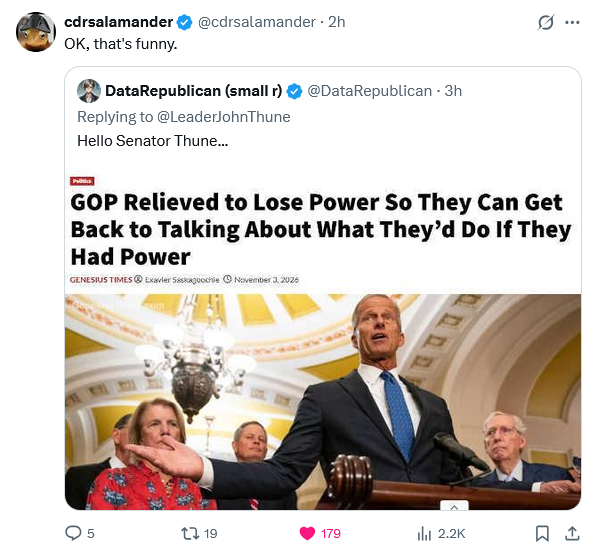
I didn’t post much about the US midterm elections, partly because I felt there were more than enough non-US sites opinionating wildly but also because the results seemed to be locked in months ago (but the “blue wave” was much bigger than I expected). Now that the votes have been counted, there’s a lot of fault-finding and scapegoat-identifying going on, which is pretty standard for any election. At Postcards From Barsoom, John Carter notes that the largest demographic swing seems to have been Gen Z men, who helped Trump get elected two years ago and now have shown just how unhappy they are with the vast chasm between what they hoped for and what Trump gave them:

It usually seems that the GOP are always auditioning for the “runner-up” role.

Let’s not beat around the bush. The US midterms are bad news, and not only for America. What happens in the imperial core has consequences on the periphery, too.

I don’t want to troon out on this. A second-term president losing the midterms is hardly unprecedented. Voters tend to get disillusioned over time. Frustrations mount, and they vote for the other party to punish the incumbent. It’s part of the negative feedback cycle that locks American democracy into its permanent state of hysterical torpor. Every election is the most important election in history, the last election that will ever matter, and then once again nothing ever happens. The new party assumes office, commences gorging on the corruption machine, fritters away its time and political capital on trivial nonsense, and steadfastly refuses to take action on even the most popular 80/20 issues.

The outgoing Republican House and Senate are a case in point. They outright refused to pass the overwhelmingly popular SAVE Act, for instance. I don’t think they passed any meaningful legislation at all over the last two years. They were very enthusiastic about bombing Iran, however.

Odds are the Democrats will prove to be equally disappointing to their base. Judging from their campaign rhetoric, they’re slavering at the opportunity to drag their political enemies into the Congressional torture chamber. Elon Musk has been put on notice to lawyer up, I assume for his role in DOGE, which the Dems are furious about. A lot of Trump’s other appointees and allies are probably going to find themselves subpoenaed. The King in Orange himself may well get to enjoy another round of impeachment theatre. All of this will no doubt be immensely emotionally satisfying for the Democrats. Will it make much difference in the day to day life of the average American? Probably not.

Have Trump or the GOP made much difference in daily life? Trump’s done some good things over the last two years. Gutting USAID, clearing out hundreds of thousands of federal bureaucrats, closing the border, deporting a million or so illegals and motivating the self-deportation of a couple million more. There’s been a chilling effect on DEI, the so-called “vibe shift”, which in practice has mostly meant that large institutions are pretending not to do DEI anymore. All of that’s been great, but it’s been like one percent of what’s actually required.

Deporting a few million people is a drop in the bucket compared to the many tens of millions in the country illegally. Getting woketards to turn down the volume on woke was a nice reprieve, but they remain in control of every institution that isn’t the executive branch of the US government, and they’ve carried right on refusing to hire young white men. “Woke 1 was craaaazy”, as Ocasio-Cortez said. The implication is that there will be a Woke 2. We’re probably about to find out what that looks like. I expect it to be positively psychotic.

There are just so many missed opportunities over the last two years.

When Charlie Kirk was assassinated by a trantifa terrorist, a wave of rage washed through the country, not only at his death but in revulsion at the glee with which the left greeted it. Trump’s administration had every excuse it needed to bring down the hammer. It started well enough, with Antifa being declared an international terrorist group. And then, nothing. Oh, I think they lost a web server recently, they seemed pretty bummed about that. Black-bagging them to Gitmo that was not. Less theatrically, there was every excuse to go after the NGOs and foundations that fund Antifa and Antifa-adjacent groups, bring the hammer down on universities that provide them with a safe place to operate, and put serious pressure on foreign governments (Canada, for instance) which provide funding for Antifa-adjacent left-wing “research organizations”. Instead we got Candace Owens wittering on about how it was really all a Mossad plot or something. The result of all this lack of serious action was that the left felt quite comfortable celebrating the Kirkaversary. One young Brazilian woman went so far as to recite a vicious little death threat in the form of “Night Before Kirksmas” doggerel to a Turning Point USA representative, who for some unfathomable reason was on campus still doing the Debate Me Bro routine a year after the Debate Bro got shot in the neck for debating. There’s some talk that she and her family might get deported, but, call me cynical, I wouldn’t count on that.

Friends have been sounding the alarm for several months now over Trump’s refusal to do anything to ameliorate the plight of young white men in America. They’ve languished under woke for a decade, now. It has absolutely hammered them economically. Six years of that decade have been under Trump, by the way. He didn’t do anything about it during his first term, and during his second what little he did do was mostly performative, things like castigating the universities for not following meritocratic admissions policies and allowing anti-semitism on campus. He tried to freeze research funding to Harvard and a few other universities, sure, but that got blocked in the courts. They got their money and ignored the Supreme Court’s ruling against affirmative action, carrying right on with discriminatory admissions as though nothing had happened. In the private sector the toxic confluence of HR girlbossery and AI filtering at the recruitment level, along with an entrenched preference for H1B over American labour within the tech sector, has made it basically impossible for anyone to get a job, but particularly impossible for young white men. There was a study recently which found that something like 98% of new jobs had gone to women, or maybe women and foreigners; either way, young white men have been left out in the cold.

This matters, because the young white men were Trump’s strongest soldiers. In the last election they swung harder for Trump than any other demographic. Much more importantly, they’re the political radicals who push the envelope, make the memes, record the podcasts, write the blogs, and conspire together in secret group chats. They went to war for him in three elections in a row, two of which he won, and the other of which was stolen. Many of them sacrificed careers to do that. The social and therefore professional consequences of being a MAGAt, a Trumptard, a member of the Trump Jugend, can be crippling. Nevertheless they were the ones pushing the envelope, hammering away at the Overton window to widen the permissible boundaries of discourse. And they succeeded. You can say things in public now that would have been absolutely verboten just a few years ago. Things like “retarded”. Go ahead, say it out loud, it’s okay now. “Retarded.” Shout it. “RETARDED!” Doesn’t that feel great?

What is of course genuinely, deeply, epochally, unfathomably retarded is that the reward bestowed upon young white men for their successful decade of service has been … nothing. Nothing at all. No patronage jobs. No grants. No lawfare against the universities refusing to let them in the door, no sanctions against the corporations using H1Bs to replace American tech workers, no ICE raids against blue collar employers undercutting American citizens with illegals, no serious effort to reduce the cost of housing, no free Zyns, no state-assigned beautiful mid gfs. They’ve been thanked by being told to stop playing video games and to go become a plumber at Panda Express.

So, this election, apparently, the young white men swung by 40 points, from something like +30 for Trump to +10 for the Democrats. I saw another tweet claiming that the swing was even larger, so who knows, but the discontented rumblings have been audible, palpable even, for months now. The young men are embittered and furious. I don’t know how much of that swing is in actual political alignment and how much of it was just the zoomerwaffen saying nah, fuck it, Imma stay home and play Age of Empires tonight, but there’s more than a whiff of what happened with the Bernie Bros in 2016. The Dem establishment shat on them, so they defected to Trump, bringing all of that energy to MAGA. Millennial and zoomer men are not institutionally loyal the way boomers are. If you don’t take care of them, if you shit upon their heads and force them to eat it, they will abandon you. As they should.


Lakshmibai, Rani of Jhansi – “the Indian Mutiny had produced but one man, and that man was a woman”

Filed under: Britain, History, India, Military — Tags: , , , , , , — Nicholas @ 05:00

I first encountered the name of Rani Lakshmibai in the fictional exploits of Sir Harry Flashman, in Flashman in the Great Game. Fraser’s portrayal of the Rani certainly left me with the sense that she was one of the best leaders of the 1857 Indian Mutiny. Robert Lyman is currently touring some of the significant locations of the Mutiny — restyled by Hindu nationalists the “First War of Independence” two generations later — including Jhansi:

The wall of Jhansi Fort over which the Rani escaped, with her horse, on 4th April 1858.
Photo by Dr. Robert Lyman

I am currently enjoying a perambulation with Sampan across the battlefields of 1857 and 1858, a series of unplanned but probably predictable events in which a group of disaffected members of the Bengal Army at Meerut precipitated a rebellion against the British East India Company (EIC) across the Gangetic Plain (mainly). This rebellion saw as many as 300,000 people take up arms against the Company. The story is far less well known now in the UK than it once was, although in India what began as a mutiny of aggrieved high class Brahmin sepoys is universally considered to be a war of nationalism, the “First War of Independence”. It is taught to all, and embraced as a core part of being a modern Indian. The term was first used by Vinayak Damodar Savarkar in his 1909 book The Indian War of Independence, reframing the mutiny into a planned, national struggle against British rule. Savarkar was something of a Hindu ideologue, developing the nationalist political ideology of Hindutva in his 1923 pamphlet Essentials of Hindutva, written while a prisoner of the government. This is a subject well known to current observers of the Indian political scene.

One of the most fascinating characters to emerge on the rebel side of the conflict was Lakshmibai, the Rani of Jhansi. I have followed her story for many years, and enjoyed visiting her fort, and palace, at Jhansi. The Rani was one of the first state leaders to decide to side with the rebels. She had every reason to be angry with the EIC. In 1854 Jhansi had suffered from Governor General Lord Dalhousie’s notorious “Doctrine of Lapse” and the old feudal kingdom transferred to the ownership of the Company. This was a policy that insisted that every state without a biological heir (an adopted heir wouldn’t cut it) would “lapse” to the EIC. The Rani’s husband died without leaving a surviving heir and because Dalhousie did not accept the rights of the adopted son the ownership of Jhansi accordingly transferred to the Company. Outrageous? Certainly. It challenged not only accepted Mughal practice, but also the old Hindu law that allowed a ruler to appoint an heir. Neither cut much ice with the EIC. The fact that Dalhousie may have wished to avoid uncertainty or even fratricide or civil war following the death of an heirless feudal leader did not remove the fact that this bureaucratic mechanism to seize power (and therefore income) was a ruthless stratagem for power, storing up (along with the annexation of Oudh, and others) a level of resentment that would one day burst into flames of rebellion and war. In 1854 Lakshmibai thus lost the kingdom in exchange for an EIC pension, losing any chance of being able to hand Jhansi over to an heir of her choosing. She had plenty to be aggrieved about, therefore, and in the recovery of her feudal privileges one can understand her motivation for agreeing first to join the rebellion and then to take a leading role in military opposition to Company rule.

Update: I’m told it’s a good thing to actually include the URL to the content … who knew?

“Machine-tooled emotional manipulation: how a department-store Christmas ad should be”

Filed under: Britain, Business, Media, Politics — Tags: , , , , , — Nicholas @ 04:00

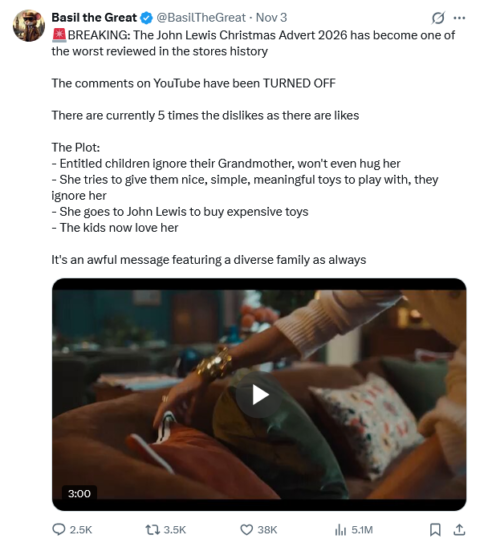
John Lewis, the British department store with a history of heart-warming (if saccharine) Christmas ads released there their 2026 Christmas ad and … it’s getting a lot of attention, but not the kind of attention the company may have anticipated:

[Previous John Lewis Christmas ads have] often been rather sweet with an agreeable, universal sentiment. Missing friends, shyness, loneliness, not wanting to leave people out, etc. Hibernating bears. Machine-tooled emotional manipulation. Which is how a department-store Christmas ad should be.

This year, however, they’ve assumed we’ll be enchanted by rude, selfish, misbehaving children whose affection has to be bought with great effort and at great expense, in desperation. And the decision to make those children brown – because apparently you can’t have an advert without the statistically unlikely interracial couple – adds a dynamic that I somehow doubt was intended.

Commenter [+] quips,

    They’ve accidentally made a Restore Britain campaign video.

What’s remarkable is that the project must have involved any number of highly-paid, supposedly clued-up experts, masters of nuance, and endless meetings, over months … and no bugger spotted how readily the ad lends itself to much less festive interpretations.

I watched it again this morning and am still processing just how weirdly misjudged it is.

For instance, that heartwarming moment when the scowling, diverse grandchildren shake their Christmas cards in annoyance, having found no money in them. Behaviour enabled, one assumes, by the ineffectual, unapologetic parents, who allow their offspring to wreck other people’s homes and to jump up and down on other people’s furniture.

And remember, we’re supposed to like these unparented brats, enough to care about pleasing them. And we’re supposed to identify with the grandma who wants these brats to love her, if only for a few minutes, before they presumably resume their scowling, ungrateful ways.

Feel that Christmas spirit, people.

Friedrich Engels, “a doormat with a trust fund”

Filed under: Books, Britain, Economics, History, Politics, Quotations — Tags: , , , , — Nicholas @ 03:00

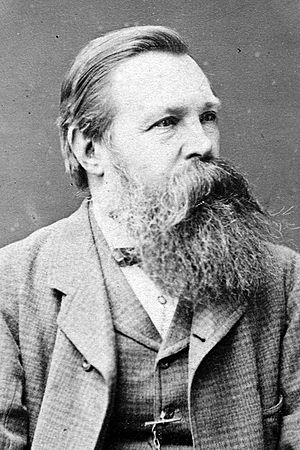
Friedrich Engels, credited with being the political partner of Karl Marx provided most of the funds to keep Marx out of the gutter, funds derived from his capitalist career:

Friedrich Engels, the trust-fund kid who spent forty years bankrolling the man who called capitalism exploitation. Ironic.

Engels inherited co-ownership of Ermen & Engels, a Manchester cotton mill, in 1864. He worked there as a partner, managed workers, collected profits, and wired money to Marx in London for decades. Marx, meanwhile, wrote about the immiseration of the proletariat from rented rooms his friend’s textile workers paid for. Marx fathered a child with his unpaid housekeeper, Helene Demuth, denied paternity, and let Engels take the blame publicly for years. Engels obliged. The man was a doormat with a trust fund.

Marx himself produced almost nothing marketable. Das Kapital Volume One appeared in 1867; he never finished Volumes Two and Three. Engels assembled them from Marx’s notes after his death in 1883. The great theorist of historical inevitability couldn’t finish his own book.

Two men, one the son of a factory owner and the other a chronic debtor who borrowed from his own mother, invented a theory that claimed capital accumulation is theft. Engels accumulated capital. Marx stole from everyone around him, privately and personally, before proposing to do it systematically at gunpoint through the state.

Every currency debased, every factory nationalized, every famine engineered under regimes waving their banner traces back to two comfortable Europeans who never once went hungry because prices rose, stood in a breadline, or dug a mass grave for dissidents.

Pocket Soup for the 18th Century Traveler

Filed under: Food, History — Tags: , , , , , — Nicholas @ 02:00

Tasting History with Max Miller
Published 12 May 2026

Squares of pocket soup, a concentrated and dried beef broth

City/Region: England
Time Period: 1694

This was a very clever way to bring broth along on a journey before the bouillon cube. Sometimes called portable soup or pocket soup, historical recipes could be plain like this one, or flavored with things like mace, anchovies, cloves, pepper, onions, and herbs. The only problem with that is that, should you happen to want a broth that, say, doesn’t have anchovies in it, you’d be out of luck.

I went with a plain beef pocket soup, and that’s exactly what it tastes like. It reconstitutes well in hot water, and you can just stick a piece in your mouth and chew on it, but I don’t recommend it.

Note that this is a multi-day project.

    To Make Veal Glew.
    Take a leg of veal & when ye fat is cut clean off, make a very strong broth of it & strain it thro a fine sieve that it may be clear. When this is done put ye broth into a broad flat stew pan that will hold it all, & set it on a high chaffindish of charkcoal, & stir if continually about that it may neither burn nor boyl ye whole time ‘tis on ye fire, which must be about seven hours…[Then let it get] quite cold; then you may take it out & wrap it in flanell & afterward in paper & it will keep many years.
    — The Receipt Book of Lady Anne Blencowe, 1694

(more…)

QotD: The re-medievalization of modern culture

Filed under: Books, Europe, History, Media, Quotations — Tags: , , , , — Nicholas @ 01:00

All of this, I think, is of a piece: We’re re-medievalizing. Obviously the Powers That Be want us to be bug-eating serfs, but it’s more than that. As C.S. Lewis points out in his book The Discarded Image, medieval culture was extremely bookish. They didn’t have very many books (though they had way more than you probably think they did, unless you’re a specialist), but they used every part of the ones they had … even the contradictory parts. Especially the contradictory parts. They just couldn’t bear to throw out any part of any text, so if Book A contradicted Book B, they came up with some marvelous synthesis that “explained” them both. Medieval scholars were Hegelians avant la lettre.

Naturally their first impulse when confronted with any new situation was to look backwards. There were genuine innovations in the Middle Ages, of course there were, but the habit of looking backward was so strong that they had to cloak even radically new ideas in ancient garb.

We’re seeing a fake-and-gay repeat of that same cultural impulse here in Clown World. Our FNG “intelligentsia” takes pop culture absurdly seriously … but there’s no such thing as new pop culture. The marketing boys talk about it as “proven intellectual property” or whatever, but it’s clear that they’re deathly afraid of innovation. Like the worst medieval hacks (and Lewis shows us some IIRC), they just produce increasingly threadbare iterations of the same basic things from ages past.

I used to think this was because SJWs can’t create, they can only destroy, but I’m coming to believe that really is a bug, not a feature. Oh, they’re happy enough to shit on your childhood memories — your anger is like ambrosia to them — but that’s not the main reason they’re doing it. No, the main reason is, they simply can do no other. Locked as they are in their version of what Lewis calls “the Model”, they have to spend their days trying to systematize things that can’t be systematized, reconcile contradictions that are, in fact, contradictions, and thus irreconcilable.

Looking back on my college teaching career, for instance, I can’t think of a single instance of a kid wearing a band t-shirt for any band more recent than the turn of the century. When I was in college, back at the dawn of the Clinton Era (1988-2003), kids wore band and concert shirts of bands that actually were current … but it was taking off even then. I hung my Rage Against the Machine concert tee next to my vintage Pink Floyd “Dark Side of the Moon” shirt, and thought nothing of it. But still: I had the RATM tee, I really did get it at a concert, etc.

When I quit teaching, half the kids in my classes were wearing that same RATM shirt, along with tees from Nirvana, Guns and Roses, and so on. And as I’ve written before, they’re not wearing them ironically, not even Alanis-level. They really are rocking out to Metallica, GNR, and so forth. And I never — not once — saw a shirt from any current act. Maybe they’re listening to the latest boy band, or Lizzo, or whatever — or maybe not — but they sure as hell aren’t advertising it.

Moreover, there’s a huge pop culture industry devoted to the hermeneutics of antique pop culture. E.g. this, about Eminem’s movie from 20 years ago. Read ’em and weep, if you want, but the point is, that’s just bizarre. Eminem is my contemporary (he was born in 1972). 8 Mile was released in 2002. The world is so vastly different now that it would make sense to regard it as a cultural artifact … but it’s not. They’re treating it as if it’s a vital statement about our culture now, in a similar (but of course fake and gay) way medieval people regarded The Dream of Scipio as a vital statement about medieval culture, despite having been written several decades BC.

It says something about our longing for permanent values here in Clown World, where anything that crossed your Twitter timeline 5 minutes ago is ancient history … but it’s above my pay grade this morning.

Severian, “Friday Miscellania”, Founding Questions, 2022-11-11.

November 4, 2026

More Polish news

Filed under: Europe, Government, Media, Military, Politics, Russia — Tags: , , , , , — Nicholas @ 06:00

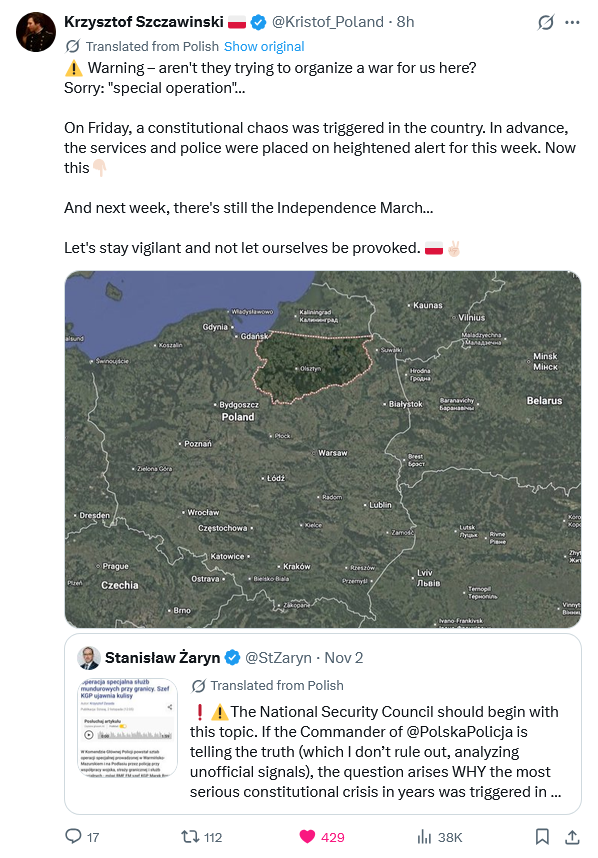
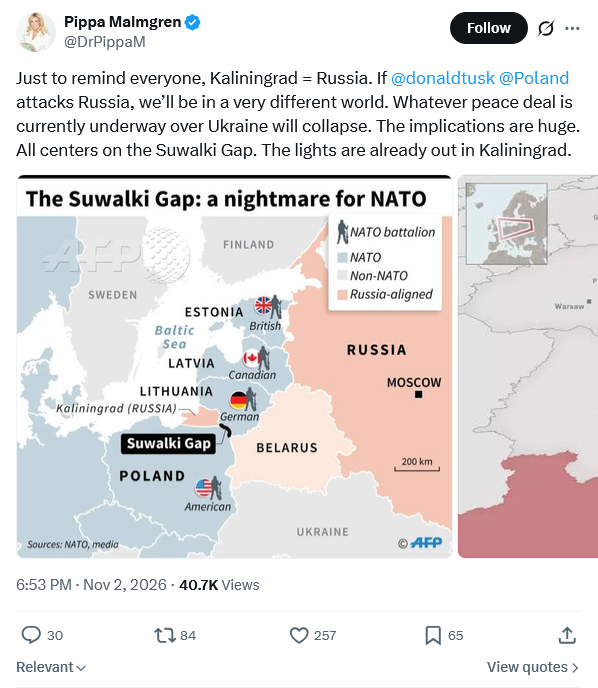
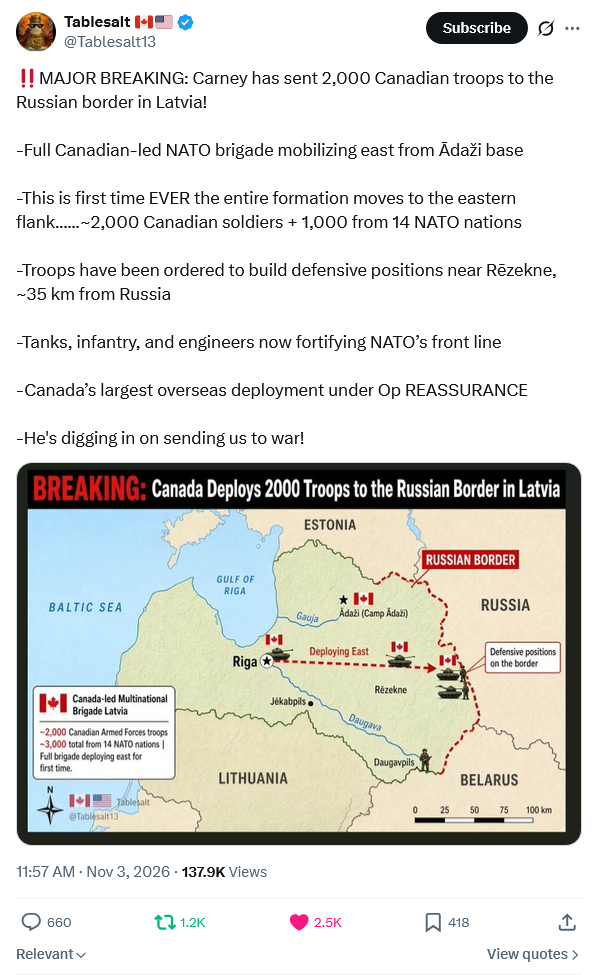
On the social media site formerly known as Twitter, Krzysztof Szczawinski posted about concerns that the Tusk government may be trying to provoke a military confrontation with the Russians over the Kaliningrad exclave on the northeast border of Poland:

He also shared a post from Pippa Malmgren, a former US presidential advisor:

In the New English Review, Bruce Bawer discusses the overall situation in Poland after the attempted coup over the weekend:

And now a would-be coup, which Tusk defended by saying: “I will not allow the right wing to take us out of the European Union. That’s what the game is about today.” Upon learning of Tusk’s perfidy, President Karol Nawrocki, who is not a fan of the EU and who at the time was in an airplane over Spain on his way to Senegal on an official trip, turned the plane around as soon as news of the attempted coup reached him. “At such a moment”, Nawrocki posted on X, “the President must be in Poland. I’m interrupting my flight to Senegal. I’m returning.” In a subsequent post, he explained that the traitors’ “ultimate objective … is to impose EU law over Polish law, force through the EU Migration Pact [which, adopted in 2024 and already rejected by Poland, empowers Brussels to orchestrate the resettlement of migrants throughout the EU], and open Poland’s borders to tens of thousands, potentially hundreds of thousands, of illegal migrants.” When Nawrocki’s plane reached Warsaw, the control tower, under orders from Tusk – which could hardly be interpreted as anything other than an assassination attempt – denied his plane permission to land; but as one writer on X put it, “the Polish military immediately took control of the airport’s military zone, arranged for the president’s plane to land safely in the capital, and provided security escort for President Nawrocki, with special forces personnel accompanying him throughout”.

Nawrocki then made his way to the Constitutional Tribunal, where the police had been commanded to keep him out, but, depending on which story you believe, either let him pass without incident or at first tried to deny him entry. (According to the Economist, which proffered a reliably pro-EU version of events, Nawrocki and his entourage “forced their way into the building, pushing Ms Korwin-Piotrowska out of the way”. After entering the building, Nawrocki removed Tusk’s five judges and reinstated the Tribunal president whom Korwin-Piotrowska had dismissed. And as word of all these developments spread to the Polish people, the streets around the Court began to fill with protesters – because the overwhelming majority of Poles share Nawrocki’s nationalism, not Tusk’s EU-toadyism. In 2025 they elected Nawrocki by a large margin; Tusk entered office not because the people voted him in but because there was no clear winner of the 2024 parliamentary elections, whereupon his party (which had come in second), in coalition with two other parties, appointed him to the position. In short, Nawrocki is the choice of the people; Tusk is a party animal, a coalition creature, an EU puppet. As with so many champions of globalism in the Western world, he has relentlessly presented his aggressively anti-democratic posture as a valiant defense of democracy.

The Polish people know better. That’s why they’ve gathered – peacefully, singing their national anthem – around the Constitutional Tribunal. Although various sources, including Lara Logan, described the coup attempt on late Sunday evening as having failed, Filip Styczynski, a Nawrocki partisan, posted a video outside the court on Monday evening stating that things remained at an impasse. One thing, however, is clear: the established media in Western Europe, which take it as their sacred task to squelch or misrepresent stories that make globalism look bad, have done a bang-up job with the developments in Poland; as more than one observer has pointed out, the facts about Tusk’s attempted coup would hardly have gotten out of Poland if not for X and other social media. It will be more than interesting to observe the fallout of this conflict. At stake is the profound desire of most Poles to keep Poland defiantly Polish – safe, clean, proud, free, and unapologetically devoted to its history and culture and traditions – rather than to allow it to become another increasingly Islamized hellscape like its EU-compliant neighbors to the West. If Nawrocki prevails, is it possible, or even likely, that Poland will quit the EU with all due dispatch – thereby weakening the authority of the unelected van der Leyen over other EU member states and hence, dare one hope, encouraging the citizens of those member states, too, to step out from under that well-coiffed, vainglorious dictator’s boot? Over the weekend Hungary joined Poland in kicking the Migration Pact to the curb. What’s next?

Also in that suddenly fascinating part of the world:

The Commonwealth, in theory and practice

Filed under: Britain, Cancon, History, USA, WW2 — Tags: , , , , , , — Nicholas @ 05:00

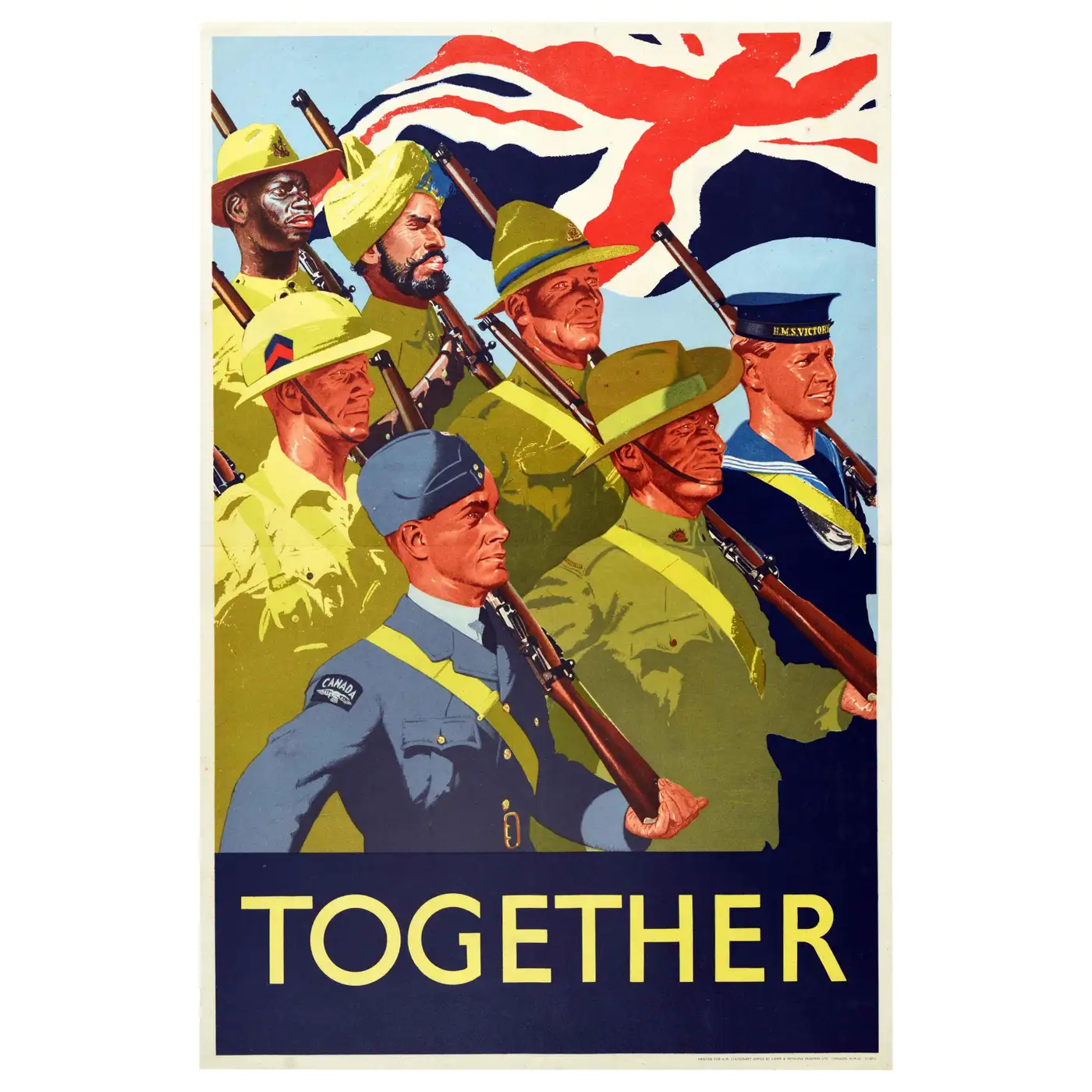
The British Commonwealth of Nations is back in the news, thanks to decolonialist activists and slavery reparations demands from former British colonies. But what is the Commonwealth and how did it come to be? In UnHerd, Mary Harrington explains its origins after the First World War:

The patriotic view of the Commonwealth during WW2.

But what is this Commonwealth for? In one corner of my sitting room stands a tea-trolley that used to belong to my grandmother. It’s a beautiful piece of furniture, which you can convert from a two-storey conveyance into a handy fireside table by activating a hidden mechanism. But though it’s ingeniously made, it doesn’t have a role in our house, except storage. The floors are too uneven for it to be useful transporting things, and afternoon tea doesn’t happen.

The Commonwealth feels like that tea-trolley: evidence of something clearly once of social significance, whose context has disappeared. Along with that context, so too has much of the detail of how we got from there to here. And there’s a link between this fact and the ever more insistent demands that Britain atone for slavery: namely our loss of any account of British history that hasn’t been pre-filtered through a post-war internationalist perspective (which is to say, at least until recently, an American perspective).

[…]

This entity began as a realist adaptation to changing geopolitical forces. It was conceived of in 1926 as a response to a shift in relations between Britain and important imperial holdings as a consequence of the First World War. The exigencies of imperial worldwide coordination in that conflict had forced a new degree of independence across dominions including Canada, South Africa, and New Zealand. Then, following the war, these states were understandably reluctant to relinquish this new autonomy.

Matters came to a head in 1926, when the Canadian Prime Minister demanded that the British Governor-General, Julian Byng, dissolve the government and call an election. Byng refused, triggering a dispute over who was in charge. The row prompted a conference, led by former Prime Minister Lord Arthur Balfour, which aimed to align existing imperial law with reality. The end of these discussions was the Balfour Report, which explicitly described the various British imperial dominions as not dominions at all. Rather, they were “autonomous Communities within the British Empire, equal in status, in no way subordinate one to another in any aspect of their domestic or external affairs, though united by a common allegiance to the Crown, and freely associated as members of the British Commonwealth of Nations”. This definition was formalised in 1931, along with an “imperial preference” policy which set advantageous trading terms among Commonwealth nations.

This settlement didn’t last long, though — and as it evolved, it grew gradually less pragmatic, and less concrete. This was with no small thanks to the American statesman Wendell Willkie, a close advisor of Roosevelt, who was a vocal critic of British imperialism. Willkie called for leadership of the world to pass instead to America. In time, and with Willkie’s encouragement, dismantling the European empires (and their trade clubs, such as the Commonwealth’s “imperial preference”) would become an explicit aim of American foreign policy.

When the Second World War broke out, the US made it a condition of the 1941 “lend lease” agreements, by which America supplied aid to Britain, that the latter would agree to work toward ending these preferential trade arrangements. Then, after the war, US loans to an effectively bankrupt Britain were again explicitly tied to economic liberalisation, culminating in the General Agreement on Tariffs and Trade in 1949. This ended any meaningful economic role for the Commonwealth, leaving behind little save a ceremonial role, a vague do-gooding remit, and some ambivalent memories.

To be clear: it’s not exactly that the British Empire was alive and well until America dismantled it. The phrasing of the Balfour Report, all the way back in 1926, suggests that in some respects Britain had by then already begun decolonising herself in favour of a pretence of being first among equals. But decolonisation was certainly accelerated by other geopolitical factors and actors.

What emerged, then, was a self-effacing post-war Commonwealth of values and vibes, in which “British” was deliberately discarded. It always had its critics. Enoch Powell challenged it through the post-war decades, as a geopolitically incoherent bit of “make-believe”, comprising states without meaningful, real-world commonalities or obligations to one another, whose artificial agglomeration encouraged Britain to act against her own national interest while smuggling damaging alterations into Britain’s historic constitution.

But in the Commonwealth’s defence, it succeeded in one respect: it sustained some kind of continuity between the historic empire of Great Britain and the post-war state that succeeded it. Importantly, by not actually doing very much, it achieved this without challenging the anti-imperial internationalism that came to define the post-war “West”.

The Korean War Week 124 – Bugging Out at Jackson Heights! – November 3, 1952

Filed under: China, History, Military, USA — Tags: , , , , , , , , — Nicholas @ 04:00

The Korean War by Indy Neidell
Published 3 Nov 2026

The Battle of Jackson Heights continues, but this week some of the American troops refuse to fight, disobeying orders and abandoning their posts on the hill. This may well be because many are new recruits and the hill is covered with dead bodies from both sides, but whatever the case, it will have future repercussions for those men. There’s other fighting in the field as Operation Showdown, but the question on the world’s lips as the week ends is “who will win tomorrow’s American Presidential election?”

00:00 Hook
00:48 Recap
01:08 Jackson Heights
04:39 Other Fighting
06:35 Air Support
07:39 Artillery
12:19 The Checkers Speech
17:34 Summary
17:48 Conclusion
18:24 Call to Action

High-trust societies

Filed under: Cancon, Government, Law, Media, Politics — Tags: , , , — Nicholas @ 03:00

On the social media site formerly known as Twitter, Eva Chipiuk points out that high-trust societies can only absorb a small proportion of immigrants from low-trust cultures before the society begins losing some of the advantages of being a high-trust culture:

An asylum seeker, crossing the US-Canadian border illegally from the end of Roxham Road in Champlain, NY, is directed to the nearby processing centre by a Mountie on 14 August, 2017.
Photo by Daniel Case via Wikimedia Commons.

A high-trust society cannot survive when the rules apply to some people and not to others.

Canada was known and loved as a place where you could trust your neighbours, expect fair treatment and build a life with confidence that the rules meant something. That trust was part of what made this country feel like home. It is worth protecting.

The rule of law is foundational to that trust. Everyone is subject to the law, including the people who write it, enforce it and exercise power in our name.

You cannot expect citizens to respect the law while allowing those in power to disregard its limits. You cannot demand honesty while rewarding corruption. And you cannot keep asking people to trust institutions that refuse to hold themselves accountable.

People see the double standard. They see who gets investigated, who gets protected, whose conduct is excused and whose life is turned upside down.

A high-trust society depends on people knowing that the same legal standards apply to everyone. That their rights will be respected. That public power has limits. That wrongdoing will have consequences, regardless of who is responsible.

A low-trust society takes hold when people conclude that the rules are merely tools used by those with power against those without it.

Those two systems cannot coexist. Either we uphold equal accountability, or we normalize selective enforcement and watch trust disappear.

And no, demanding accountability is not what undermines public confidence. The misconduct does that. The cover-ups do that. The refusal to apply the law equally does that.

Institutions are not entitled to our trust because of the power they hold. They earn it through how they exercise that power — and whether they hold their own accountable when it is abused.

Apply the law equally. Respect its limits. Hold people accountable, regardless of their title, position or political allegiance.

The rule of law means nothing if the people entrusted to uphold it are protected when they violate it.

The question for Canadians is: What kind of country do you want? One where you can trust your neighbours, rely on your institutions and know the law applies equally to everyone? Or one where who you know and how much power you hold determine which rules apply to you?

The Dorchester Armoured Command Vehicle

Filed under: Africa, Britain, History, Military, WW2 — Tags: , , , — Nicholas @ 02:00

David Willey
Published 15 Jul 2026

AI-generated video summary: David Willey explores the history of these vital World War II command posts, known as Dorchesters. Originally built on reliable Matador truck chassis, these armored vehicles provided mobile offices for high-ranking officers. Discover how their rugged design and unique role in North African campaigns made them highly coveted assets throughout the conflict.
(more…)

QotD: Conservatism and Canadian nationalism

Filed under: Books, Cancon, Politics, Quotations, USA — Tags: , , , — Nicholas @ 01:00

… as much as Canadian nationalism is a muddled and confused nationalism and at times incoherent identity, it’s still a powerful political force. Canadians may be unsure of who they are, but they know that they aren’t American. Yes we share similarities with America, but most Canadians absolutely do not want to just become, or be seen as Americans. Canadian patriotism and nationalism may just be largely about what we are not, but it’s still an extremely potent and active political force and shows no signs of waning.

And herein is the challenge that I think lies at the heart of what holds conservatism back nationally in Canada. Even as regional alienation and divides grow stronger, I don’t believe this alternative North American identity is (or could be) an alternative for anything beyond a tiny number of Canadians. Anti-Americanism in Canada is often crass and vulgar, but it’s powerful. A conservatism that sounds like it’s rejecting Canada and imports American-style conservatism is always going to sound foreign and unappealing to most Canadians.

I happen to think that Harper, perhaps the shrewdest political mind of his generation, realized this. The influence of The Patriot Game on Harper is well documented, but if you pay close attention to Harper’s own development, you can see how Harper actively attempts to become a national leader and embraces a certain idea of Canada. Harper gained a reputation for dressing in Canada garb, he’d end speeches with “God Bless Canada”, and the 2010 Winter Olympics in Vancouver represented a kind of crowning moment for Harper’s confident patriotism. In a speech given to the BC legislature on the eve of the Winter Olympics the Globe and Mail claimed that “the subtext of his speech was that Canada is a confident country now, and ready to ‘stand on guard for itself'”.

This wasn’t just rhetorical, Harper’s conservatism made a serious effort to begin reclaiming our national identity. This was about actively championing a different version and story of Canada, one that went beyond the mythologizing of the Liberal national project. Harper wasn’t the only mind behind this, two of the most important champions of this in the Harper government were Jason Kenney and senior adviser Chris Champion.

The Conservatives emphasized our historic symbols and institutions like the monarchy, take a look for example at the changes they made to the citizenship guide. They restored the “Royal” prefix to the Navy and Air Force. They put serious effort and resources into celebrating Canadian history such as during the 200th anniversary of the war of 1812. This was a conscious effort to challenge the monopolistic control the Liberals have had over our national identity. More importantly, it was an active effort to not just to reject this narrative but to offer a distinctly Canadian alternative as well. I think this gets at why Canada’s Laurentian class hates Harper so much.

Ben Woodfinden, “True North Patriotism and a Distinctly Canadian Conservatism”, The Dominion, 2020-10-20.

« Newer Posts — Older Posts »

Powered by WordPress