Following on from the military capability evalution last month, Operational Art of War looks at some of the military problems the American Goliath might face before getting down to curbstomping Canada:
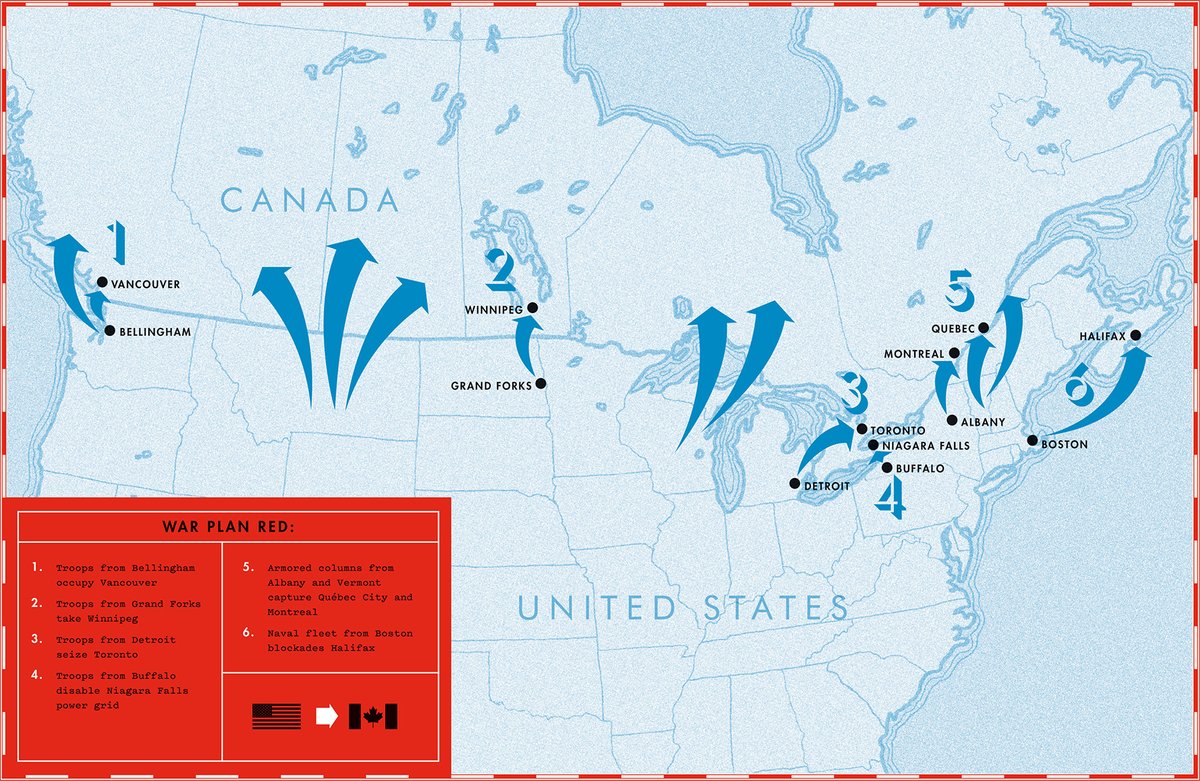
“A mere matter of marching …”
An invasion of Canada would not be popular and the political implications would affect military operations.
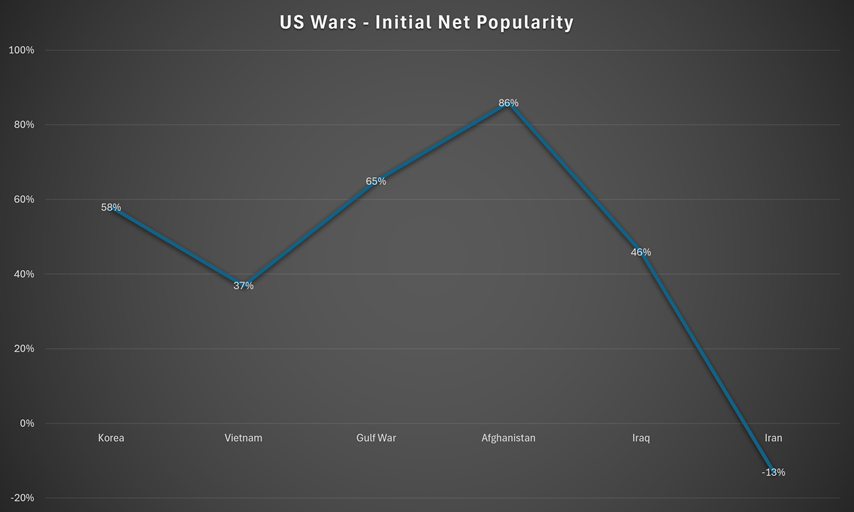
Despite online acrimony, Americans as a whole maintain a positive view of Canada. With all the recent disputes. Canada has only dropped from Americans’ favorite to second favorite ally. While it’s difficult to foresee the circumstances where America will be invading Canada, I think it’s safe to say it would be America’s least popular move in post-World War II history.
Over the last few months, we’ve seen how the unpopularity of the Iran war means political considerations play an outsized role in military strategy. An invasion of Canada would be that on steroids.
Restrictions on National Guard Callups
National Guard deployments are particularly sensitive to a war’s popularity. […]
All this is to say I doubt an invasion of Canada would involve extensive mobilization of the National Guard. It would be an unpopular move in an unpopular war.
For political reasons, the National Guard would probably be limited to service inside US territory, such as patrolling critical infrastructure or forming most of the 6-10 brigades guarding the US-Mexico border. That alone would cut the maneuver brigades for an invasion of Canada from 70 down to 41.
Restrictions on Rules of EngagementConcerns about popularity and media optics would also likely lead to very restrictive ROEs. […]
Canadian military and government infrastructure was not designed for the threat of being bombed. There are lots of legitimate military targets that could turn into PR nightmares. For instance:
- Most Canadian reserve unit armories also house cadet units. [Youth organizations that do basic military training, but are not operationally part of the military establishment.] The closest US equivalent to Canadian cadets is probably Junior ROTC, but even younger. The American public would probably view a collateral damage incident involving cadets as essentially dropping a bomb on the boy scouts;
- Even if the airstrikes happen when there are no cadets in the building, the armories were mostly built on the outskirts of Canadian cities prior to WW1, so now they’re almost all in dense urban areas;
- Regular Force military bases almost all have elementary schools. They were built when being bombed wasn’t a consideration,1 so they were not planned with separation from military targets to avoid collateral damage;
- Canada’s main naval base on the west coast is nestled in a suburb (the city grew to encompass the base). The main naval base on the east coast is scattered across a dozen locations in downtown Halifax;
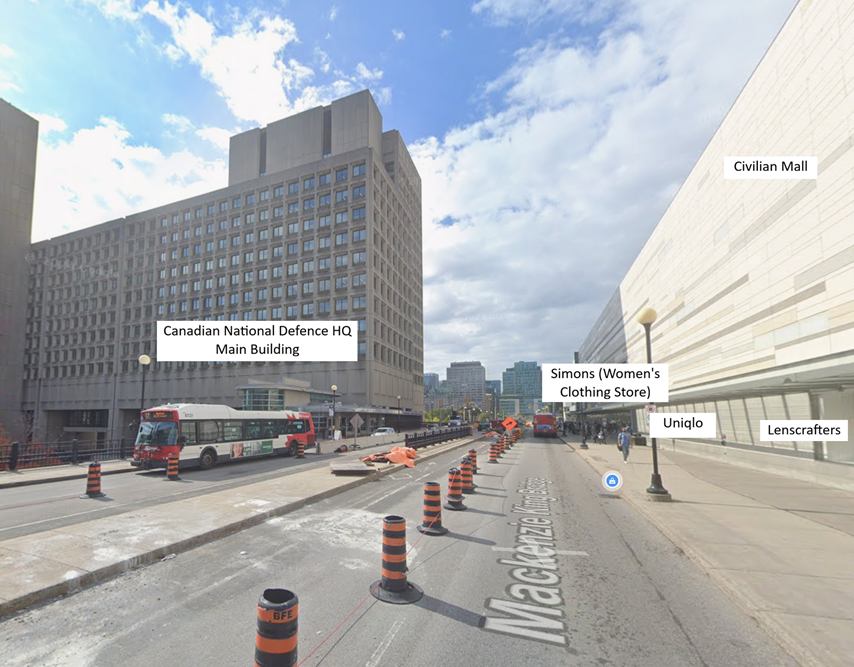
- The following civilian buildings are within 20-100 meters of Canada’s main military HQ building: a daycare, an events center, a mall, an art gallery, a youth hostel, university classrooms and an office block. The Tomb of the Unknown Soldier is across the street;
- The Canadian equivalent to the NSA is on a shared campus with Statistics Canada, Health Canada, the Geological Survey and the National Archives.
By all means, drop a JDAM on the office beside a women’s blouse store. I’m sure there would be minimal political fallout.
Consequently, a US President will need to pick between leaving an array of legitimate military targets untouched, and risking gifting horrible imagery to his political opponents during an unpopular war.
Operational Restrictions on Surprise
One of the biggest factors in how an invasion would occur is the amount of warning Canada had to prepare. Given 15 years warning, Canada would enact conscription and build a continental defense military of 30 brigades. This might seem fanciful, but that’s about the size of military Canada would have on its current budget if it converted entirely from an expeditionary to a continental warfare model. This would only require about one-fifth the scale of conscription in Finland and Israel. […]
Secondly, under the current integrated continental defense system, a sneak attack on Canada is not possible because there are Canadians serving in all the organizations needed to coordinate the attack. There’s a network of organizations for continental defense that have been in place since World War II. Due to similar NATO exchange programs, every headquarters planning the operation and executing the operation would include a Canadian officer or an officer from a close Canadian ally.
The best example of this problem is NORAD. NORAD is an integrated air defense command structure. Flights by military aircraft over North America are coordinated, and depending on the mission, controlled by NORAD. The main NORAD command center in Colorado has 15-20% RCAF staff.
Historically, there have been four times an officer at NORAD had to decide whether America was under attack, and to respond with lethal force. In 1960, 1979 and 1980 the NORAD warning system reported the USSR had initiated a nuclear first strike. On 9-11 the NORAD duty officer had to decide whether to shoot down several civilian airliners that were not responding to the grounding order. In two of those four incidents, the decision was made by a Canadian.
This means under the current structure, the plan for an air superiority campaign against Canada would require the cooperation of hundreds of RCAF staff. You could do a pretty good comedy sketch about this:
[An Air Force general walks in]
General: “Ladies and gentlemen, we’ve made the decision to eliminate the northern threat. I’m here to brief you on the air campaign plan to invade Canada.”
[He completes the briefing]
General: “Now, does anyone have any questions?”
[An officer in a different looking uniform raises his hand]
Officer: “Sir, it’s Squadron Leader Bloggins of the Royal Canadian Air Force, am I supposed to be here?”
General: “f**k”
Obviously, the way around this problem is to eject Canada from NORAD and set up a new aerial command and control system. However, this would take a month or two to implement, and give Canada a strong indicator that a US invasion was imminent.
Although NORAD is the most extreme version of this planning problem, it’s replicated across most major US headquarters and coordination centers. Canada has another 150 to 300 staff officers in US exchange and liaison positions. You can exclude these staff from planning or expel them, but both of these options reveal the US is likely to invade in a few weeks.
- Beyond nuclear attack, in which case no amount of separation on the base will make a difference.