Quotulatiousness

June 5, 2026

The Lord of the Flies was just a novel

Filed under: Books, Health, Pacific — Tags: , , — Nicholas @ 03:00

We often use The Lord of the Flies as a shorthand way to illustrate the darkness in the hearts of men, and that, absent civilizations, men descend into a hellscape of violence, hatred, and all-against-all destructive competition. Yet the real-life case of a group of boys isolated for an extended time didn’t go at all the way the novel did:

More and more I’m learning that the nihilistic claptrap we were all told was genius was just Leftist demoralization propaganda.

Situations like this have occurred, and the children didn’t turn into little monsters. In fact they survived quite well.

In June 1965, six boys named, aged 13 to 16 “borrowed” a fisherman’s boat hoping to reach Fiji or New Zealand. After a storm damaged the sail and rudder, they drifted for eight days surviving on fish and rainwater collected in coconut shells, before washing up on the rocky uninhabited island of ‘Ata.

Rather than descending into chaos during their months there the boys created a mini society. They planted vegetables, collected and stored rainwater, and maintained a permanent fire. They even built a gymnasium with homemade weights, a badminton court, and chicken pens.

They divided daily chores using rosters, resolved conflicts with time-outs instead of fighting, began and ended each day with songs and prayers. One boy, Gilligan’s Isle style, constructed a guitar from driftwood and coconut shell to boost morale. When one of the children broke his leg falling off a cliff the others set it with sticks and leaves and took over his work. They ate fish, coconuts, eggs, wild taro, bananas, and later chickens they had discovered in an ancient volcanic crater.

They endured this for for fifteen months, and never once turned into murderous thugs. A far cry from what we were told would happen.

It wasn’t just William Golding manufacturing dark stories, of course:

The First Ever British SLR: Serial Number One L1A1 Explained

Filed under: Britain, History, Military, Weapons — Tags: , , , , — Nicholas @ 02:00

Royal Armouries
Published Jan 14, 2026

The L1A1 Self-Loading Rifle is one of the most iconic service rifles in British military history and on this week’s episode we have the very first one ever produced.

Next week: an original Royal Small Arms Factory archive film found by our archive team showing how the L1A1 was made.

0:00 Intro
0:46 Serial Number One Explained (UE57 Alpha 1)
1:40 Factory Plaque, Proof Marks & Enfield Details
4:26 Condition, Finish & Standard Configuration
5:17 Distinctive British L1A1 Features
7:08 Controls, Ergonomics & Fire Selector Choices
10:35 Why the L1A1 Won & Closing Thoughts

This week’s object’s collections online page: https://royalarmouries.org/collection…
(more…)

QotD: Modern men and the need for male spaces

Filed under: Health, Humour, Quotations — Tags: , , , — Nicholas @ 01:00

Many internet men have pointed out the dwindling of male spaces, while internet women cheer for their disappearance.

Internet men believe that some kind of man-space is essential. A place for men to be men, mentor other men, and tell younger men the secret wisdom to get their lives on track. That if only we had these spaces, everything would be great for men because we’d all know the secret wisdom that doesn’t actually exist.

Internet women believe that male spaces are dens of misogyny. Places where trollish men want to gather, away from the eyes and ears of right-thinking people, so they can poison other men with hate and bigotry.

Which is silly. Men don’t hate women because other men told them to. They see women being women, and that does the trick just fine. In fact, if a man is getting hourly blowjobs from every woman whose path he crosses, then some group of troll men try to tell him women suck, he’d be confused at how uninformed these men are when women are clearly awesome.

Women’s behavior is the number-one driver of misogyny. Not men telling other men women suck.

And that’s the point of male spaces. Not secret manly-man wisdom, not chattering about woman-hate. A space where men can just be. Without women there.

Women are … a certain way.

This is especially true of middle-class and richer women, and even a little more true of white women than other kinds. But true of all women to some extent.

Women have this way about them — everything they do, say, everything about how they behave — that just subtly communicates that they do not have a lot of experience with consequences. That they are just not that used to considering consequences seriously before doing something.

I’m usually hesitant to use political buzz-words in a non-ironic way, but I think the term “privileged” is pretty perfect for this situation.

A woman’s reality — her experience — is a world where consequences just aren’t quite as big of a deal for her as they are for others. She’s never really had to consider consequences with quite the same intensity.

It’s important to note that this isn’t some kind of overt, intentional flaunting as women stride around, consequence-free, thumbing their noses at us. Women don’t even know this is a thing. They’ll deny it fiercely if you tell them. They don’t feel privileged, and their feelings are always real. They’ll even tell you that you’re the privileged one, not them. Because that feels right to them.

It’s not something they do on purpose, and it’s not even that frontal and pronounced. It’s very subtle. Just this subtle way that women are. When they talk, act, make decisions.

This makes them very irritating. Even women find each other irritating.

Archwinger, “Male spaces are because women are irritating”, Archwinger’s Substack, 2026-02-25.

June 4, 2026

The murder of Henry Nowak and the failure of British policing

Andrew Doyle notes that the very first mention of Henry Nowak’s murder in Spain’s El País (approximately Spain’s equivalent of the Toronto Star, The Guardian, or the New York Times) frames the story as “evil extremely extreme extreme-right-wing Führers pounce”:

While the country is still reeling from the horrific murder of eighteen-year-old student Henry Nowak, an astonishing article has appeared in El País, Spain’s largest national newspaper. Rather than focus on the failures of the police officers, or the institutional bias within the force, the headline steers its readers away from the case and towards the outlet’s own obsessions. The headline translates as “Farage’s far right stirs up hatred in the UK after a young man is stabbed to death by a Sikh man”.

As Alejo Schapire (an Argentine journalist based in France) has pointed out, this is the first and only article produced by El País on the subject of the Nowak killing. Instead of an image of the victim, the newspaper has opted for a photograph of Nigel Farage. The Guardian was similarly histrionic and detached from reality in its coverage: “As ethnonationalist far right drives racist agenda, Reform UK leader felt need to weigh in on murder of Henry Nowak”.

It is one thing to take issue with those who seek to weaponise human tragedies for their own political gain, and quite another to dismiss legitimate criticism of a failed system. Reform UK is by no means a “far right” party, but of course the term has been so promiscuously misused in the press that at this point it might be best to dispense with it altogether. But of course, this is not really about Farage or his response to the murder at all. It is a cynical means of deflecting from the fate of Nowak and what it reveals about the state of policing in the UK.

So what exactly did Farage say to have the Guardian fulminate about his “racist agenda” and for El País to make him the focus of the story rather than the victim? During a live broadcast, Farage praised the Nowak family for their “extraordinarily dignified” response following the conviction of their son’s killer, and went on to say: “I suggest the rest of us respond to this with pure cold rage”.

And why not indeed? Let’s not forget the shocking details of what happened in this case. Nowak was stabbed multiple times by Vickrum Digwa using a Sikh ceremonial dagger. His mother hid the murder weapon, and his brother called 999 claiming that Nowak had been racially abusive. When police arrived, Digwa repeated this lie. And when Nowak repeatedly told the officers he had been stabbed, one replied “I don’t think you have, mate” and handcuffed him as he lay dying.

At Always the Horizon, Copernican shares his thoughts on the political response to the murder:

Riots have been growing over the last few years in the UK when incidents like this occur. Nigel Farage addressed the incident in a youtube video here. Referring it as a “moment to take a long hard look at ourselves and the country that we’ve become”. He proceeds to say, “All the values and standards of living in a free country, where everyone is judged equally before the law, have been trashed and thrown away”. Nigel Farage demands that “the police complaints operation, the IOPC, needs to get to the bottom of this and produce a report very very quickly.” He also states that the sentencing is unacceptable, as the sentencing of the Sikh was less severe than the minimum recommended for a sustained, aggressive, murderous assault.

Nigel knows how to fix this: file some more reports. Maybe even reprimand a judge for being too lenient. That will surely bring back the murdered man, make whole his family, and un-rape and un-murder the children that have been attacked over the years by numerous violent psychos imported from the third world by domestic traitors. What a British solution: file another report about it.

Keir Starmer took another position. He condemned Nigel Farage for “Whipping up” division against the wishes of Nowak’s family. He believes “Nigel Farage’s Reaction” is the “wrong reaction”. We wouldn’t want division at a time like this. What we really need to do is respect the wishes of the cucked cowards whose son was killed and who took no flesh or blood from the offending Sikh as recompense. Who were cowed by government processes and report filing. Those are the people whose feelings we should be worried about. We would hate for the Sikh community to feel threatened.

To be honest, I agree with Keir Starmer. Nigel Farage’s reaction is the wrong reaction


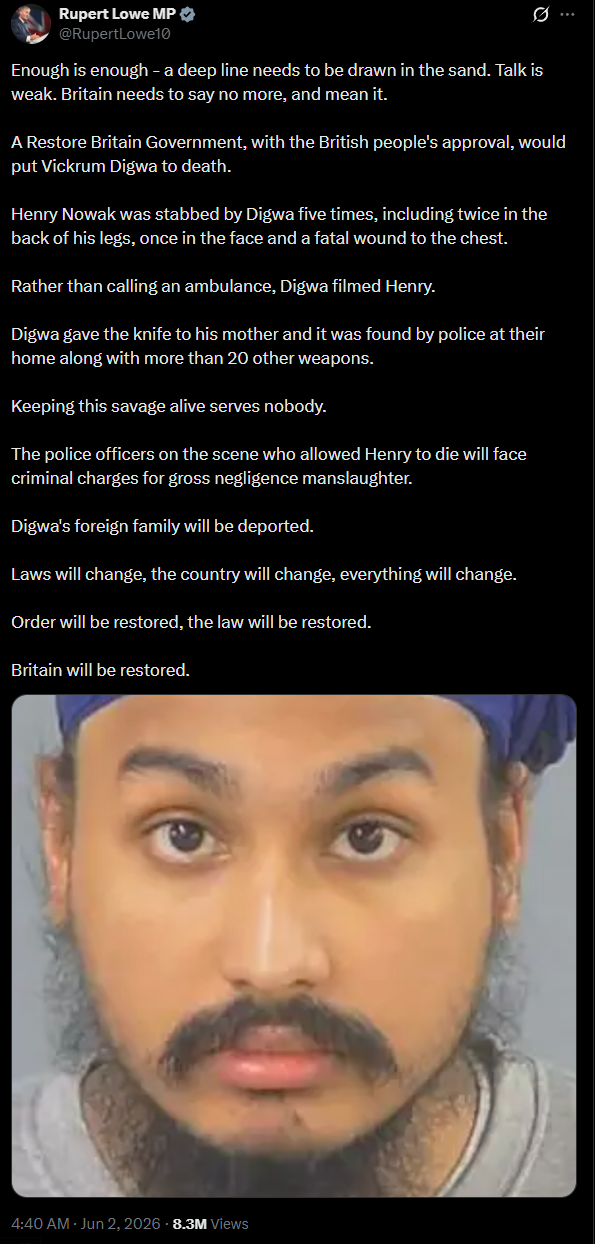
Rupert Lowe, an MP of the “far-right” British Reform party [correction: Lowe is the leader of the Restore Britain party], is getting closer to the correct reaction when it comes to this murderous Sikh, his community, and the managerial bureaucracy that brought them here and protected them.

That said, I think Rupert Lowe is also heavily couching his language for fear of public backlash, or getting arrested for “inflaming racial tensions”.

Update, 5 June: Welcome, Instapundit readers! Have a look around at some of my other posts you may find of interest. I send out a daily summary of posts here through my Substackhttps://substack.com/@nicholasrusson that you can subscribe to if you’d like to be informed of new posts in the future.

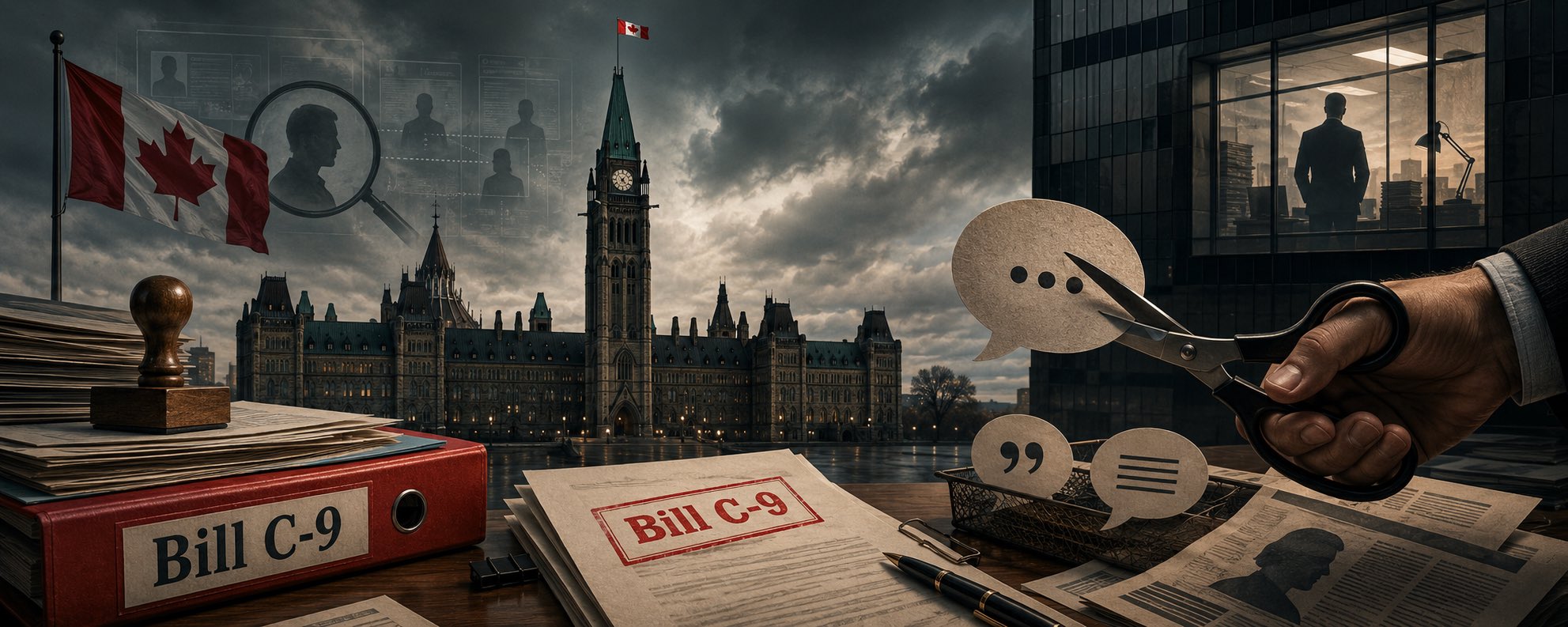
Bill C-9 is “what happens when the Frankfurt School gets a government badge, a pension, and a corner office in Ottawa”

L. Wayne Mathison explains how the Canadian government persuaded itself to push a “hate speech” bill that will upend centuries of free speech practice and criminalize good-faith arguments. Like many such brainfarts, they cannot imagine what consciously evil people will do with these legal tools in hand:

AI-generated image by L. Wayne Mathison

If you want to see what happens when the Frankfurt School gets a government badge, a pension, and a corner office in Ottawa, look at Bill C-9.

This is not just another “hate speech” bill. It is a sign of a much bigger shift.

The old political arguments were about wages, factories, class, ownership, and the economy. That was the old Marxist world. Today’s politics is about language, symbols, identity, emotion, culture, and who gets to decide what “harm” means.

Parliament has stopped arguing about who owns the factory.

Now it wants to control the dictionary.

Bill C-9 reads like a critical theory seminar that escaped campus, found a suit, and got hired by the Department of Justice.

Under the older liberal model, the law punished actions. Assault someone? Crime. Vandalize property? Crime. Block access to a building? Crime. The state dealt with what you actually did.

But C-9 moves the centre of gravity from action to meaning.

What did your words mean?

What did your symbol represent?

What was your motive?

What cultural message did your expression create?

That is not law as a neutral referee. That is law as a cultural therapist with police powers.

The most revealing part is the proposed removal of the long-standing “good faith” religious defence for hate propaganda. That defence existed for a reason. It protected freedom of conscience. It recognized that in a free country, people may express religious beliefs that others find offensive, outdated, or wrong, as long as they are not wilfully promoting hatred or violence.

That was not a loophole.

It was a guardrail.

But to the modern ideological mind, an ancient religious text is not treated as a source of conscience. It is treated as an artifact of power. A legal protection for religious speech is no longer seen as freedom. It is seen as oppression wearing a church hat.

So the guardrail has to go.

And what does government offer instead?

Trust us.

Trust that prosecutors will be reasonable. Trust that judges will interpret the law narrowly. Trust that ordinary Canadians will not get dragged through the process for saying something unpopular, traditional, religious, or politically unfashionable.

Sorry, but that is not how liberty works.

Rights are not protected by hoping the state behaves itself. Rights are protected by limiting what the state is allowed to do in the first place.

That is what makes the Senate debate so revealing. The Senate was supposed to be sober second thought. The old establishment airbag. The place where bad laws were supposed to slow down before hitting the public at full speed.

But now even the Senate is wrestling with a bill built from an intellectual toolkit designed to dismantle the very traditions the Senate was created to preserve.

Bill C-9 does not build social cohesion. It does not repair trust. It does not ask why people are angry, alienated, or radicalized in the first place.

It does what modern bureaucratic progressivism always does.

It manages symptoms by expanding state power.

It turns culture into a compliance file. It treats offensive expression less like a social problem to be answered with argument, courage, and moral confidence, and more like a hazardous substance to be regulated by experts.

The Frankfurt School wrote in dense, foggy jargon to expose hidden systems of power.

The joke is on everyone.

The modern state did not reject those tools. It absorbed them, stripped out the revolutionary romance, bolted them onto the Criminal Code, and called it public safety.

Bill C-9 is what happens when cultural theory becomes administrative power.

It is what happens when the state stops protecting public order and starts managing public meaning.

And that should worry anyone who still thinks freedom means more than government-approved speech.


“It’s called Starship Troopers, not The Big War with the Bugs

Filed under: Books, Media, Politics — Tags: , , — Nicholas @ 03:00

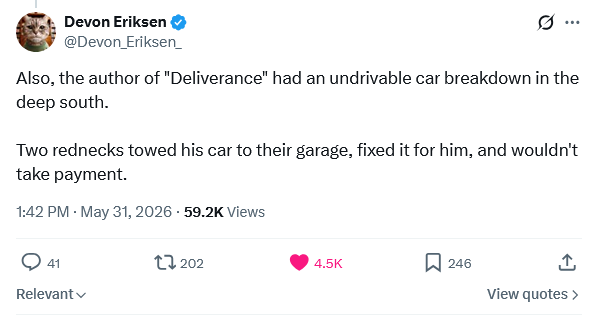
On the social media site formerly known as Twitter, Devon Eriksen explains why filmgoers still identify with the humans in Verhoeven’s unfaithful-to-the-story film of Robert A. Heinlein’s Starship Troopers:

Here’s a hint:

It’s called Starship Troopers. Not The Big War with the Bugs.

There’s a reason for that. Heinlein was one of the 20th century’s greatest authors, if not THE greatest, and he was also the 20th century’s greatest philosopher and it’s not even close.

So he didn’t name things by accident.

Starship Troopers isn’t about the war. It isn’t even about war. And it’s certainly not about the fucking bugs.

All that shit is just stage dressing for the story is really about. That’s why the book doesn’t end with defeating the enemy. It ends with Rico meeting his father again, facing future fights together.

Starship Troopers is about the military life, the relationship between armies and the civilizations they serve, and what it means to be a soldier and a man.

Eurotrash communists failed to get the point, not merely because they have the “media literacy” of a sack of wet hammers, but also because they don’t understand soldiering, civilization, or manhood.

So, yes, Verhoeven tried to make fun of Heinlein and failed miserably because Heinlein was a better storyteller, a better man, and a better human being by a margin so great that the Earth can barely encompass it.

But even though his failed satire makes humanity clearly the good guys, the war clearly righteous, and soldiers clearly cool and heroic, it still doesn’t recapture the actual meaning of Starship Troopers.

Because the real themes were so invisible, so incomprehensible, to Verhoeven that he couldn’t even see them to disagree with.

So enjoy the film for what it turned out to be … a fun, campy, morally unambiguous story of heroes squashing disgusting bugs. Suitable for popcorn consumption.

Then, read more Heinlein.

Update, 6 June: Welcome, Instapundit readers! Have a look around at some of my other posts you may find of interest. I send out a daily summary of posts here through my Substackhttps://substack.com/@nicholasrusson that you can subscribe to if you’d like to be informed of new posts in the future.

Sci-Fi and the WWII Mythos Part II : The Political Element

Filed under: History, Media, Politics, USA — Tags: , , , , , , — Nicholas @ 02:00

Feral Historian
Published 16 Jan 2026

Last time I was focused on cultural aspects, but what about the direct political manifestations today? Is there a resurgence of neo-nazi attitudes or is just an artifact of the ubiquity of digital media preserving everything? Why might those ideas resonate with the young, and how does it fit with my argument that the old myths are breaking down?

00:00 Intro
01:42 Right, Left, and Gen-Z
02:56 Patterns of Force
04:25 Rambling about Economics
05:48 Efficient? No.
06:39 Bifurcation
08:00 Loss of Perspective

This one is a direct result of a conversation on the Talking History program on KSMU (I’ll link the episode when goes up) and covers something that came up but wasn’t really addressed well.
(more…)

QotD: Demographic decline in the late western Roman Empire

Filed under: Europe, History, Quotations — Tags: , , , — Nicholas @ 01:00

As we’ve seen, the evidence – largely archaeological evidence, by the by (Liebeschuetz thus fits with many other historians in the “decline and fall” counter-reformation in relying heavily on archaeological data) – suggests that urban centers declined markedly beginning in the fourth century, with that decline accelerating as the empire crumbled. That of course raises the fairly obvious question: where did all of the people go? One possible theory is that the population mostly ruralized, moving out of the city and into the countryside. That might even suggest a positive change, if one accepts the view that ancient cities were mostly “consumer” cities which didn’t produce much value but instead survived off of taxes and rents extracted from the countryside. In that view, the decline of cities could simply be a product of the collapse of systems of exploitation as the political order which maintained them weakened.

It’s a plausible theory and the only problem with it is that it doesn’t appear to have actually happened.

Here the key archaeological method is what is called “field survey“. While readers are probably more familiar with the intensive excavation work done at famous sites like Pompeii or Vindolanda, one tool archaeologists have to study the past is to survey large areas, sometimes by air, sometimes by on foot, sometimes with ground penetrating radar, in an effort to map out larger scale settlement patterns in the past than would be possible by labor-intensive single-site excavation work. Dateable remains (pottery most often) allow for archaeologists to get a rough sense of the dates in which sites were inhabited and in some cases building remains and the like can give some sense of what kind of settlement was present. The “error-bars” on some of this data can of course be large, but they offer a tool for tracking long-term changes in land use patterns. On the flip side, these sorts of studies really become valuable only when you have a lot of them to create a robust data-set over a fairly large area that lets you adjust for purely local patterns and distortions. Fortunately in much of the former Western Roman Empire and especially in Roman Italy (where these studies are very important for the study of Roman demography and agriculture) we’ve hit the tipping point where there is enough archaeological data to begin reaching for conclusions.

Now there is an immediate difficulty with using this kind of evidence, which is that for reasons we’ll get to in a moment (though they are reasons that tend to also be bad for the “change and continuity” argument), we have a major confounding variable here: site visibility. Our ability to see a site, archaeologically, is heavily dependent on factors like building material and the quantity of imperishable goods (especially pottery) that people are using. For reasons we’ll get to, compared to, say, second century AD communities, sixth century AD communities tended to build their buildings in far more perishable (and thus less visible) materials (like wood) and also tended to use a lot less imperishable household goods. Consequently, it is substantially harder to see a sixth century village than it is to see a second century villa.

Nevertheless, the decline is so marked and so consistent as to strongly suggest there is something real here. R.P. Duncan Jones (in “Economic Change and the Transition to Late Antiquity” in Swain and Edwards (eds) Approaching Late Antiquity (2006)) assembles some of the site data from around the empire; there is unsurprisingly a lot of regional variation (with some regions, like Syria, actually moving against trend), but in the western Empire (except N. Africa; decline there comes later) the trend is fairly clear, with site numbers declining (often drastically by half or more) beginning in the late third or fourth centuries. Bryan Ward-Perkins in The Fall of Rome notes a field study outside of Rome in which the number of sites declines by three quarters. Site data accumulated like this isn’t often very chronologically precise, so we’re dealing with centuries, not decades, but the clear trend suggests rural population decline, not an urban population ruralizing. To be visible to us in this way, the decline must have been quite severe.

To give a sense of the scale of the decline, here is an abbreviated version of a chart from Bruce Friar’s “Demography” chapter in the second edition of the Cambridge Ancient History, which breaks down the estimated population of the Roman Empire by region and adds the dates when each of those regions got back to their Roman-era population:

Chart from Frier, “Demography” CAH2 XI (2000), 814. Some of these figures would likely see some revision today, mostly downward revisions of growth combined with upward revisions in population reflecting a somewhat (but generally not massively) higher estimated pre-Roman population.
Note that the decline in the East was, as noted last time, both later and generally slower. The reason for the later times to reattain Roman population here in many cases is that the major medieval Islamic population centers were further East (e.g. Baghdad under the Abbasids) placing them outside the traditional bounds of the Roman Empire, but also that the Roman East was much more urbanized and densely populated compared to its land area than the Roman West in the second century (or at any time during the Roman Period) so the “population to attain” bar on the East was much higher. After all, the cities of places like Syria or Egypt were in many cases centuries or even millennia old when the Romans showed up.

Now the long times there to regain the Roman population can be a bit deceiving (and are very approximate). For reasons we’ll get into shortly, population growth from 600 to 900 or so in Europe was very low, so the issue here isn’t that the decline was so steep that it took many centuries to recover from, but rather that the decline was from a high population equilibrium to a low population equilibrium, both of which were, under their own conditions, stable (if that is confusing, don’t worry, we’ll delve more into it in a moment). Second, the apparent gap between places that “caught up” before 1300 and those that “caught up” after it is smaller than it looks, because of course the mid-1300s represent a massive population discontinuity over the entire broader Mediterranean world due to the Black Death such that a lot of those places “catching up” in the 1200s probably fell behind again due to the plague and then caught up again in the 1400s or early 1500s.

But this now raises two related questions: first, why did population decline so sharply and second, what was the impact on quality of life that resulted? The old answer to the first question was of course “the barbarians killed everyone” but as we’ve seen, while the fifth century was a violent time, the violent discontinuities were not that extreme. Surely the violence of the period has something to do with some of this declining population, but as noted, the underlying population (with their language and religion) didn’t much change (and the raw number of “barbarians” coming over the frontier was, in demographic terms, fairly small). Most of those Roman cities decayed, rather than being burned. But if the “barbarians” didn’t kill everyone, what did and why did that somehow have a negative impact on the survivors? The answers to these two questions are actually linked in that they depend on the same evidence, so that is where we will go next.

Bret Devereaux, “Collections: Rome: Decline and Fall? Part III: Things”, A Collection of Unmitigated Pedantry, 2022-02-11.

June 3, 2026

China’s pirate fishing fleets

Filed under: Americas, Books, China, Military, Weapons — Tags: , , — Nicholas @ 06:00

John Carter was really impressed with a recent self-published novel by Frank Kidd, and takes the time to set up the real-life situation the novel imagines being kinetically addressed:

A few years ago a photograph taken by a pilot over the Pacific went viral. It showed a mysterious red glow spreading ominously out over the water.

Initially people thought it was aliens, and to be fair, they weren’t far off. The glow belonged to the closest thing humanity has yet invented to a Tyranid hive fleet: a Chinese fishing fleet raping the seas in search of seafood. The glow is from huge banks of LEDs, which the ships use to draw marine life to the surface, where they trawl it up with nets. Much, maybe even most of the indiscriminate catch is discarded.

China has over half a million fishing vessels. Their vast fleets comprise thousands of ships, and can often be seen from orbit.

The triangular lights inside the red circle are a Chinese fishing fleet.

China has long since eaten its way through its own territorial waters, and therefore sends its fleets out into the rest of the world’s oceans. As a rule marine life is much more abundant close to the shore, since this is where most of the nutrients are. Fishing in another country’s territorial waters is illegal under international law. The Chinese do not care. Their fleets park just on the edge of a country’s Economic Exclusion Zone, and then turn off their Automatic Identification System transponders so that they can sneak inside and poach. Turning off an AIS transponder is also illegal: maritime law requires these to be activated at all times, for collision avoidance and search and rescue. Organizations which track this regularly observe Chinese ships on EEZ borders disappearing from the AIS network, and reappearing a few hours later on the right side of the border.

Here we see the scum pillaging the ocean around the Galapagos. Yeah. I know. Billions must die.

The consequences for local fishermen are disastrous: the Chinese scoop up all the fish, and lead the local fisheries towards ecosystem collapse. When they’re done pillaging they just move on, leaving an oceanic wasteland in their wake.

Environmental groups generally don’t seem very bothered about this, perhaps because the ocean is a CO2 sink whether or not there are fish in it, and the only thing that matters about the environment is how much carbon is in the air. National governments are reluctant to take action, because they are often dependent upon Chinese investment for their economic growth. The only people who really seem to care are fishermen and Internet racists.

This is the set-up for Frank Kidd‘s immensely satisfying debut mercenary novel, Once Upon A Time In Argentina.

“… basically it’s a plan to make power more expensive while campaigning on affordability”

John Robson examines a few of the ways the Ontario government (and other provincial and state governments) frames what they call “affordability”, yet somehow it always seems to cost more afterwards and nobody is ever held responsible:

In many areas of life, the devil is famously in the details. And it presents both an opportunity and a frustration because there is so much out there deserving readers’ attention that you can’t even follow it all let alone cram it into a newsletter. Including former banking executive Parker Gallant‘s vigilance about the absurdities of the power system in the Canadian province of Ontario that the aspiring Conservative premier Doug Ford promised to fix in the 2018 campaign and then has smugly done nothing about. These things might seem uninteresting if you do not live in Ontario … until you realize it’s just as bad wherever you live. And when we say bad we mean both the cost and the deviousness with which it is presented to, or hidden from, the public. On this very point we like to quote the late great P.J. O’Rourke that “Beyond a certain point complexity is fraud … when someone creates a system in which you can’t tell whether or not you’re being fooled, you’re being fooled.” Which brings us to the shiny new buzzword “affordability” which refers to policies that make everything more expensive and the beneficiaries hide the fraud in tangles of complex bureaucracy.

If you want to get a headache, stay with us while we explain what it is that Gallant tracks. Ontario has what they call the “Independent Electricity System Operator” so politicians can claim whatever disaster is unfolding isn’t their fault. Sure, they make the laws and oversee the creation of the regulations. But heck, these things are “arms’ length” and “impartial” and independent and expert and wise and wonderful so shut up.

Including this nutty system where the province buys power we don’t need at grossly inflated rates from wind and solar virtue-signallers and then sells the surplus at deep losses to the neighbouring province of Quebec and some American states including New York and Michigan. So he looked in depth (we promised a headache) at just half a day, May 19, 2026, because a post by another of the people who keeps an eye on this stuff for the benefit of an indifferent or baffled populace alerted him to something fishy in the IESO forecast of generation by Industrial Wind Turbine operators. But it seems to be hard to find out exactly how much the taxpayers, via this wonderful “Independent” system with its hand in their pockets via the arm of the state, actually paid these IWTs not to produce power.

Paid them what? Yup. It’s how it works. And the idea is that if they didn’t produce the original forecast rather than the revised one we’d have had to pay them even more for what they didn’t do. Weird even by the standards of government. And expensive. As Gallant sums it up:

    The net result is that those IWT cost us Ontario ratepayers almost $2.6 million for NOTHING over just the first 12 hours but we should rest assured the IWT owners loved it!

You read that right. The citizens of Ontario paid $2.6 million to the energy producers of the future not to produce energy in the present in just half of one day. If it were typical, it would be over $5 million a day times 365 days in the year so yes indeedy folks nearly $2 billion a year.

[…]

He then looks at various efforts to try to figure out the cost to consumers, including one by “my friend Roger Caiazza (the Pragmatic Environmentalist of New York)” based on the auction price of “allowances” in March 2025:

    Roger’s conclusion at that time was that the RGGI auctions were adding about $8-11/MWh to the wholesale cost of electricity, for electricity produced by natural gas. That would mean an addition of about 1 cent/kWh on a consumer’s bill. A penny may not seem like much, except when you realize that the average price in the country is less than 18 cents/kWh, so the penny is about 6%.

Imagine if people knew. As he concludes:

    remember that the structure of the program is that the amount of allowances goes down every year and the price is intentionally driven up. And data centers are going in all over the place. And the Northeastern states have refused to build new power plants for a couple of decades now in the midst of the climate hysteria. So the 10-15% extra cost being experienced now is only the beginning of much worse to come. The worst part of the RGGI ‘cap and invest’ scheme is that the consumers get absolutely nothing for the increased cost. It is just a gratuitously inflicted injury brought about by completely artificial scarcity. Keep this in mid when you hear a politician from an RGGI state talking about how they care about energy ‘affordability’.

Or, we add, transparency. Or accountability.

The Korean War Week 102 – American Bioweapons on Korean Soil? – June 2, 1952

Filed under: China, History, Military, USA — Tags: , , , , , , , — Nicholas @ 04:00

The Korean War by Indy Neidell
Published 2 Jun 2026

The Chinese continue their campaign of accusing the US of practicing germ warfare in North Korea and Manchuria. Meanwhile in South Korea, Syngman Rhee has declared martial law in Pusan as part of his campaign to remain in power.

00:00 Intro
00:50 Recap
01:23 Germ Warfare Charges
11:17 Bull Boatner
15:34 Holding POWs
17:58 Summary
18:13 Conclusion
19:21 Call to Action

Brits and Americans mispronounce foreign words differently, film at 11

Filed under: Britain, Food, Italy, USA — Tags: , , — Nicholas @ 03:00

ESR explains why American mispronunciations of Spanish or Italian words tend to be less offensive to those cultures than equivalent British linguistic manglings:

Ah, yet another round of the great pasta-pronunciation debate.

My credentials to speak on this: I am American. I have lived in Great Britain. I have lived in Italy. I pay attention to descriptive phonology. And I was at one time bilingual in English and Spanish.

These facts make me an expert witness on this issue.

Yes, Brits do in fact systematically mispronounce words like “pasta” and “taco” in a way Americans find amusing. But the interesting part of this story is the reason *why* Americans pronounce these words in a way much closer to the Italian and Spanish originals.

It isn’t superior virtue or worldly sophistication or anything like that. It’s the result of an important feature of the American linguistic environment that it doesn’t share with the British one, and which Americans themselves seldom even notice.

Many Americans have heavy exposure to the phonology of Spanish. Brits do not. The result is even that even those of us who are completely monolingual (which is most of us) tend to have models for two phonological systems in our heads rather than one; the second one being Spanish.

There’s a video about this somewhere on YouTube by a linguist, an English one as it happens, who explains that Americans attempting to reproduce the vowel sounds of a foreign language often bend it to try and fit it into the five-vowel system of Spanish. And this is true even when they don’t actually speak Spanish themselves.

One consequence is that even Americans who don’t know Spanish pronounce it tolerably well. Intelligibly, at least. Same goes for Italian, the phonology is slightly different but similar enough.

We crash-land on languages that have vowel systems quite unlike either English or Spanish. There are good reasons that when an American says “pasta” or “taco” his pronunciation is quite unlikely to make a native wince or laugh, but there is no such guarantee about French. Or German. Or Russian. Or just about anything else.

We’re just as lost as the Brits are trying to pronounce those languages. The difference is that, unlike a Brit, we may not mispronounce the local language in a way that makes it sound like a mangled version of English. Americans are likely to make it sound like a mangled version of Spanish instead.

What is Turkish Delight? How to make real Ottoman Turkish Delight

Filed under: Europe, Food, Greece, History, Middle East — Tags: , , , , — Nicholas @ 02:00

Tasting History with Max Miller
Published 9 Dec 2025

Beautiful red Turkish delight dusted with powdered sugar and starch and flavored with rose water and musk

City/Region: Ottoman Empire
Time Period: 1844

I don’t know about you, but I first learned about Turkish delight from The Chronicles of Narnia, where Edmund sells out his family for a box of the confection. True Turkish delight, made in Turkey or Greece, is made of sugar and starch, but when other countries tried to copy it, they often added gelatin, which gives it a completely different texture.

While we can’t be absolutely certain which kind Edmund liked, I hope it was the true Turkish kind that melts in your mouth beautifully. If you’ve never tried musk, it’s a unique flavor that reminds me of clean laundry and perfume, and mixes with the rose water to make a flavor profile unlike anything else I’ve had. All in all, I wouldn’t sell my family out for it, but it is very good.

Rose water or musk aren’t your thing? Feel free to change the flavorings to whatever you like. Almond, orange blossom water, and pistachio were popular at the time.

    Rahatu’l-hulkum
    Method: Take one kiyye of the finest sugar and prepare a syrup with three kiyyes of water in a tinned pan … take 75 dirhems of the finest pounded starch and slowly stir into the syrup. It must be stirred constantly so that it does not form lumps or stick to the bottom of the pan … Then blend 35 dirhems of rose water with a grain of musk and after adding to the mixture stir a few more times before removing from the heat. Oil a tray with almond oil and pour in the cooked mixture. When cool cut into pieces of the desired size and toss into a mixture consisting half of sieved starch and half of powdered sugar, and stir until they do not stick together. It will be delicious.

    Melceü’t-tabbahîn by Mehmet Kamil, 1844

(more…)

QotD: Rhodesia and the suicide of the West

Filed under: Africa, History, Politics, Quotations — Tags: , , , , , — Nicholas @ 01:00

The history of the twentieth century is a graveyard of nations, but few corpses refuse to stay buried quite like Rhodesia. To the modern liberal consensus, the short-lived republic in southern Africa is a pariah state, a moral stain on the map of history that was righteously erased to make way for the “liberation” of Zimbabwe. It is dismissed by them as a racist anachronism, a desperate attempt by a White minority to hold back the tide of history. Yet, for those willing to look past the cordon sanitaire of “accepted historiography”, Rhodesia remains a haunting and prophetic presence.

The story of Rhodesia is not only a regional tragedy, it is a civilisational warning. It is the story of a state that was functional, prosperous, and militarily superior, yet was dismantled not by its enemies in the bush, but by the “kith and kin” of its own civilisational bloc. It serves as a controlled experiment in the “Suicide of the West” , illustrating what happens when a civilisation loses the will to defend its own outposts and succumbs to a “politics of cultural despair“.

Today, as the nations of Europe and the Anglosphere grapple with their own crises of identity, demographic replacement, and institutional decay, the Rhodesian experience has moved from the periphery to the centre of conservative analysis. The arguments made by Ian Smith (former Prime Minister of Rhodesia) and his contemporaries, no longer appear as the reactionary pleas of a dying regime. Instead, they appear as the desperate warnings of men who saw the abyss before the rest of the world was willing to look.

The Philosophical Crisis and the Suicide of the West

To understand the fall of Rhodesia, one must look not to the Zambezi Valley, but to the intellectual salons of London and the university campuses of the United States. The doom of the settler state was engineered by a profound shift in the Western psyche, a shift identified by the philosopher James Burnham as the “Suicide of the West.”

James Burnham’s thesis, articulated in his 1964 classic Suicide of the West, provides the essential diagnostic framework for the Rhodesian tragedy. Burnham argued that liberalism had mutated into an ideology of Western suicide, a system of belief that systematically dismantled the defences of its own civilisation while valorising its enemies. In the context of Rhodesia, this manifested as a perverse diplomatic double standard. As the American economist Milton Friedman observed after his visit to Salisbury in 1976, the West seemed intent on destroying a pro-Western, anti-Communist state that upheld property rights and the rule of law, while simultaneously “welcoming the ministers of the Gulag Archipelago with open arms”.

Friedman explicitly linked the Rhodesian situation to Burnham’s concept, noting that the sanctions imposed on Rhodesia were a clear act of self-immolation by the Western powers. By strangling Rhodesia, the West was not advancing human rights, it was handing a strategic victory to Soviet and Chinese proxies (ZAPU and ZANLA) and signalling to the world that loyalty to the West was a liability. The Rhodesian settler, who had fought for the British Empire in two World Wars, found himself cast as the villain, not because he had changed, but because the West had lost faith in its own legitimacy.

Celina 101, “We are all Rhodesians Now”, Celina’s Substack, 2026-01-31.

June 2, 2026

Judging Javier Milei’s work by the numbers

Filed under: Americas, Economics, Government, Media — Tags: , , , — Nicholas @ 05:00

Thanks to automated translation from the original French on the social media site formerly known as Twitter, Laurent outlines what he sees in the data from Argentina before and after Javier Milei became president:

I’ve been wondering for a while now about the (provisional) balance sheet of Milei in Argentina. You read everything and its opposite. So I stopped reading the commentary and looked at the raw numbers.

Argentina is the full-scale experiment that economists have been waiting for for 50 years. Same country. Same people. Same culture. We change ONE variable: the economic method.

Before: decades of statist and Peronist management, “redistributive”. The concrete result? 211% inflation, 42% poverty, a state in permanent deficit that funds its lifestyle by running the printing press.

Then Milei arrives. The opposite method, brutal, acknowledged: we cut, we deregulate, we stop printing.

Two years later ([snapshot] at his arrival (end of 2023) vs today):

Annual inflation: 211% → 31%
Monthly inflation: 25% → ~2%
Public deficit: −5% of GDP → +1.8% (surplus)
Growth: −1.6% → +4.4%
Poverty: 42% → 28%

No debate. Judge for yourselves.

And the essential point: these gains don’t go “to the rich” or “to the markets”. They go first to the poorest.

Inflation is the most unjust tax that exists — it hits those who have no assets to protect themselves. Dividing it by 7 is giving back purchasing power to those at the bottom. And 14 fewer poverty points means millions of people, not an Excel line.

For a century, Argentines were told that the state would protect them by spending more and more. Result: one of the richest countries in the world in 1910, ruined. We’ve just reversed the method. Look at the result.

At some point, you have to accept what the facts say: on the economic front, the liberal method has delivered in two years what decades of socialism promised without ever delivering. And it benefits the most modest first.

You can hate Milei’s style — the chainsaw, the excess, the improbable outbursts, he’s nothing like a classic statesman. But you don’t judge an economic policy by the style of the one who leads it. You judge it by what it does to people’s lives.

And the numbers have spoken.

« Newer PostsOlder Posts »

Powered by WordPress