
Tasting History with Max Miller
Published 16 Dec 2025Raisin-forward army mincemeat pie made in a quarter sheet pan
City/Region: United States of America
Time Period: 1945During World War II, and really any war, soldiers far from home longed for a taste of home, especially during the holidays. Field kitchens would go to great lengths to break the monotonous menus and bring a little holiday cheer to the troops with things like turkey, stuffing, and pies.
This mincemeat pie is not bad, but it does lack the spices and citrus that really say “Christmas” to me. The corned beef and bouillon cubes add more of a savory note than a real meaty flavor, and raisins are the star of this pie.
No. 822. MINCEMEAT FORMULA NO. 1
Yield: 100 servings, 2 sheet pans, 16 1/2″ x 24″ x 1 1/2″.
Bouillon cubes……36 cubes
Water, boiling……9 quarts (9 No. 56 dippers)
Corned beef, canned……4 pounds
Fat……2 pounds (1 No. 56 dipper)
Apple nuggets, dehydrated……2 1/2 pounds (3 1/4 No. 56 dippers)
Sugar, granulated……3 pounds (1 1/2 No. 56 dippers)
Raisins……7 pounds (5 1/3 No. 56 dippers)
Cinnamon…… 3/4 ounce (3 mess kit spoons)
Pepper……(1/3 mess kit spoon)
Nutmeg……1/4 ounce (1 mess kit spoon)
Salt……(1/3 mess kit spoon)
Dissolve bouillon cubes in boiling water.
Add remaining ingredients. Simmer on a slow fire for approximately 45 minutes or until apples and raisins are tender. The addition of gravy coloring or caramelized sugar will improve the appearance. Remove from fire and cool. Pour into pastry-lined sheet pans.
Cover with a top crust and make in hot oven 40 to 45 minutes or until crust is golden brown.
Note. This mix should be prepared just prior to using.
— TM 10-412 US Army Technical Manual. Army Recipes by the U.S. War Department, 1945
June 10, 2026
World War 2 Mincemeat Pie for the Battle of the Bulge
QotD: Tiberius Gracchus, Tribune of the Plebs
Tiberius Gracchus’ proposal to fix this problem [the perceived loss of free farmers from whom the Roman army was raised] was the lex Sempronia Agraria. The law proposed to enforce a legal but long ignored limit on the holding of ager publicus,1 restricting individuals to holding just 500 iugera (c. 311 acres), with the state revoking the leases on the remainder and using the reclaimed land to then provide small plots for free to the Roman poor, with a rider that these plots could not be sold (to avoid them being reconsolidated into elite estates).
And here it is worth noting that kind of government the Romans had to understand the response. The Roman Republic had written laws but no written constitution – instead, the rules for office holding, for conducting the business of the Senate, for running the assemblies and so on were all customary: the Romans governed themselves in accordance with what they called the mos maiorum, “the custom of the ancestors”. In a sense then, certain practices, if practiced long enough, became a sort of law-of-tradition to themselves and of course one of those customs – practiced at this point for, at minimum around 150 years – was the continual leasing of large amounts of ager publicus to the point that the leases were treated as a form of ownership: people used that land as security for loans, they built houses on it, they buried their parents on it and so on. Because the leases were presumptively renewable and had been for decades if not centuries, under the mos maiorum, the holders of ager publicus had long considered the land theirs. And of course the upset parties are rich and powerful, so their opposition was significant and meaningful, politically.
In brief, the way this plays out is that while Tiberius Gracchus does have significant popular support for his motion (Plut. Ti. Gracch. 9.1), much of the elite are opposed. He draws up a quite conciliatory version of the law, which proposes to compensate the holders of large amounts of ager publicus for their lost leasing rights and to then give them the remainder of their leased land (so they needn’t fear a second lex agraria and a third and a fourth and so on), but according to Plutarch in the face of continued elite opposition, shifts back to a less conciliatory version of the law (Plut. Ti. Gracch. 10.3). The resistance to his law centers on another tribune, Marcus Octavius, himself a large holder of public lands, who plans to veto the law and uses his own powers as a tribune to disrupt the process (along with some fairly clear shenanigans by some of the wealthy, like trying to hide the voting urns to prevent a vote on the law and so on).
Now there are a few things to note at this juncture in the story. First, there being ten tribunes, it must never have been very hard to find a tribute willing to gum up the passage of a given law, but that, traditionally, this was a tactic of delay, rather than a hard-stop the way Octavius is using it. At the same time, with real public momentum to make this law happen, one could easily imagine simply waiting Octavius out – he only has one year in office. Except. Except that, remember, Tiberius Gracchus needs a big victory in his tribunate to get his political career [back] on track, a consideration that was clearly significant (thus the reason we’re informed of his quaestorship; we usually don’t know much about even very significant figures’ time in junior offices!). That consideration, I think, serves as important context for Tiberius’ decision to escalate every time he encounters resistance: he cannot afford to simply be the prelude to someone else passing this law: he needs to pass it himself.
The normal method for “deconflicting” two magistrates with opposing vetoes like this was to go to the Senate, which Tiberius Gracchus, hoping his influential supporters would carry the day, did. Instead, according to Plutarch (Ti. Gracch. 11.2) the Senate was merely no help, whereas Appian (BCiv 1.12) describes the Senate as openly upbraiding Tiberius, a strong negative response. Now under the mos maiorum, that would be the end of it: the authority of the Senate (the auctoritas senatus) ought to be so intense that when the Senate speaks in one voice and says, “not right now” then you desist. Remember that in the Roman conception, the Republic is a partnership of sorts between the Senate and the People (the S and the P in SPQR), rather than a situation in which the Senate is purely subordinate to the popular will: if the Senate is strongly opposed, that is supposed to be a veto point that is respected.
But remember: Tiberius Gracchus cannot, politically, desist. He must push through because his political career requires a victory this year. Note that the cause does not require a victory in 133; there is nothing to stop another tribune in 132 from trying to advance the same bill or a more limited or different version of it. But Tiberius Gracchus’ career absolutely requires success in 133. So instead of desisting, he escalates.
He now breaks clearly with the mos maiorum and plans to take his law directly to the people against the advice of the Senate. Octavius is obviously a problem – he’ll veto anything Tiberius Gracchus tries to do – so Tiberius Gracchus introduces a law to depose Octavius from office. The Roman Republic doesn’t have anything like impeachment, there is no framework to remove someone from office. Instead, the way the Republic works is that all of the offices are held for short duration (one year) and while tribunes and office holders with imperium are immune from prosecution while in office, they can be prosecuted the moment they leave office for any crimes they committed. There is no framework for booting out a tribune like this; the remedy in the customary Roman system is to make sure the next year you elect tribunes who support the idea and try to pass it then. But that remedy doesn’t work for Tiberius Gracchus.
So Tiberius Gracchus passes the law deposing Octavius and then has him dragged from the speaker’s platform (the rostra) and now we have a problem. Because of course Octavius’ supporters are going to view this law itself as illegal and invalid: tribunes are, you will recall sacrosanct, so it’s not clear they can be deposed and it is very clear they cannot be assaulted or dragged. Violating the sacrosanctity of a tribune is, at least notionally, a capital offense and a severe violation of religion and if you think that Tiberius Gracchus’ legal basis for all of this is rubbish, you think he just did it twice. Of course, Tiberius is also a tribune, so you can’t attack him now, but once his year is done, you are probably planning to haul him in to court and let a jury decide if what he did was legal or not.2
In any case, with Octavius removed, Tiberius passes his land reform bill. The law provided for a three-man commission to handle the assessment of what public land was held in excess and then to hand it out. Tiberius Gracchus names as those commissioners himself, his brother and his father-in-law (Appius Claudius Pulcher (cos. 143)). Needless to say, that is a set of commissioners which does not inspire a lot of confidence that the commission will be uncorrupted by politics, a point we’ll get back to in just a moment.
In the meantime, the Senate looked to exert its traditional prerogative over state funds (as it advised the quaestors who superintended the treasury) to hamstring the new commission, but Tiberius Gracchus took advantage of the recent death of Attalus III, King of Pergamum. Attalus had notionally willed his kingdom “to the Roman people” – he had no clear heirs and so perhaps thought by this act to get the Romans to pick one of his relatives to run the kingdom, thus avoiding a damaging civil war – but instead Tiberius, getting the news early, rushed to pass a law annexing the kingdom and using the windfall to fund his commission. The law passes, but this is a breach both of the Senate’s traditional power over state finances, but also its very important role managing Roman foreign policy.
What I want to note in this sequence which is important for understanding what comes next is that Tiberius Gracchus has just demonstrated that, so long as he remained popular, he could use the powers of the tribunate to essentially run the Roman state from the tribune’s chair. Tiberius has now forced not merely a domestic land issue, but also a finance issue and a foreign policy issue over the objection of the Senate and another elected tribune, essentially running roughshod over all of the customary limits intended to keep any one Roman politician from coming to dominate the Roman political system.
Of course if you were an opponent of Tiberius Gracchus, you could at least tell yourself that this is all bad, but at the very least, Tiberius Gracchus will be out of office next year, as it was contrary to custom to run for any office immediately after holding it. Indeed, it was unusual to hold basically any office more than once, save for the consulship (and even then, only for very successful consuls and never multiple years in a row). Those limits are customary but everything about the Roman Republic is customary; if you discounted the mos maiorum, there wouldn’t be any republic left. You’d instead expect that Tiberius would go back to being a senator for a few years while planning his shot at the praetorship – during which he’ll have to survive a series of court battles over the legality of his actions.
So even if he is doing potentially outrageous, dangerous things, at least he’ll be gone in a year, right?
Bret Devereaux, “Collections: On the Gracchi, Part I: Tiberius Gracchus”, A Collection of Unmitigated Pedantry, 2025-01-17.
- Which, again, noting the complications above, probably means applying that limit for the first time to at least some classifications of land it had not applied to before and also applying it against the socii.
- The Roman court system leaves questions of law – which in most modern courts would be decided by a judge – to the jury itself.
June 9, 2026
Confucian deference to authority and tradition lead to autocracy and rebellion, time after time
Chinese history is not one of my areas of interest, so I have not read deeply in any specific area. Lorenzo Warby, on the other hand, has a much better grasp of the sweep of historical events in China and some of the philosophical and cultural elements that persist through the centuries:

All political and social philosophies rest, implicitly or explicitly, on some claims or claims about the nature of humans.
Consider the thought of Kong Qiu (c.551 BC – c. 479 BC), known as Kǒngfūzǐ (孔夫子) (Great Master or Wise Teacher Kong), hence Confucius. He held that human nature is naturally good and that it is therefore a reasonable aspiration to create a society of harmony, a society without conflict, if everyone just behaves with the propriety appropriate to their place in society — in particular, according to their placement in the web of social connections. His constant concern for the rites (li 禮) is for people to show the correct forms of, and orientation towards, those socially embedded interactions.
This leads very naturally to a very authoritarian, hierarchical view of politics as enforcing social harmony, particularly as people vary in their willingness and capacity to cultivate such virtuous propriety. The notion that politics is legitimately an arena for bargaining between competing interests — the Western idea of “normal politics” — becomes not a natural way to do politics, but a failure to achieve proper harmony.
Master Kong developed his ideas — that were further developed by disciples and commentators — in a civilisation with no tradition of warrior assemblies, self-governing cities, or deliberative assemblies of any kind. A ruler’s court is a place where officials report, and may even debate, but the ruler decides. You can see this narrow view of politics in comments by Master Kong in the Analects such as:
8.14 The Master said, “If you don’t have a particular [government] position, then don’t meddle with any of its business.”
14.26 The Master said, “If you don’t have a particular [government] position, then don’t meddle with any of its business.” Master Zeng [Zengzi] commented, “The gentleman does not allow his thoughts to go beyond what his position calls for.”
In such a political culture, judicious quotes based on mastery of a shared literature become a way of communicating to superiors while giving minimum offence. Conversely, political rhetoric has little or no value, because there are not the deliberative assemblies to be swayed by argument. Master Kong deprecated glib persuasiveness, on the grounds that it tended to hide one’s real character (or lack thereof).
Where command-and-control hierarchy is the dominant method of political action, hoping for propriety to pervade the hierarchy has obvious resonance. Putting such propriety as a mechanism for social harmony is a way to, ironically enough, be persuasive — which requires a positive view of human nature. But it also hugely elevates the moral claims of governorship. Hence comments such as:
2.1 The Master said, “To rule by virtue is like the way the North Star rules, standing in its place with all the other stars revolving around it and paying court to it.”
12.17 Ji Kangzi asked about the way of governing [zheng]. Confucius replied, “To govern [zheng] is to correct [zheng]. When you set an example by correcting your mistakes, who will dare not to correct his mistakes?”
This concern for harmonious propriety is not a world away from ibn Khaldun‘s concern for asabiyya. Nor is it so far from recognising the importance of a coherent civic culture in order to maintain robust institutions, which rest on norms and rules. This is a factor that much of mainstream Economics fails to seriously grapple with, leading to incompetent analysis of immigration.
The problem is that this cultural and institutional framework turns the thought of Master Kong, his disciples and commentators, into what is, in effect, one-trick moral propriety politics, however sophisticated other aspects of this tradition may be. The choices of governance are narrowed down to punishment and example:
2.3 The Master said, “If you guide the people with ordinances and statutes and keep them in line with [threats of] punishment, they will try to stay out of trouble but will have no sense of shame. If you guide them with exemplary virtue [de] and keep them in line with the practice of the rites [li], they will have a sense of shame and will know to reform themselves.”
They are reduced to trying to make autocratic command-and-control politics work as a successful long-term project: as the repeated dynastic collapses in Chinese history show, they did not succeed. Indeed, the recurring pattern of Chinese political reformers and reform programs ending badly reflects that such fail to break out of that autocratic command-and-control pattern, so end up being swallowed by its incentive structures — including the long-term pathologies of bureaucracy and the inherent fears of autocrats.
The most thorough attempt to implement ideas based on rú (儒) classicism (“Confucianism”) in Chinese history was the disastrous reign of Wang Meng (r.9-23), who provides an object lesson in overweening Theory leading to disastrous policies. Ironically, Master Kong himself was against such grand theorising:
9.4 The Master stayed away from four things: he did not put forth theories or conjectures; he did not think that he must be right; he was not obdurate; he was not self-centered.
The episode is a particularly disastrous example of Etienne Gilson‘s principle that the conclusions of the master are the premises of the disciple, thereby all too readily reducing struggles with complexity to a simplifying dogmatism: a trap that scholarly commentary on The Analects often tried to avoid.
The thought of Master Kong also wanders very close to someone is morally better, not only because learned, but because smart and learned. For instance:
5.9 The Master said to Zigong, “Who is the better man, you or Hui [Yan Hui]?” Zigong replied, “How dare I compare myself with Hui? Having learned one thing, he gives play to ten, while I go only as far as two.” The Master said, “You are not as good as he is. Neither of us is as good as he is.”
This arrogance of the appropriately credentialed periodically led to mass outbreaks of infuriated peasants removing educated heads from elite bodies. The most recent manifestations of this were the Cultural Revolution in China and the megacidal Cambodian horrors under Pol Pot but you can see versions of this reaching back into Chinese history — for example, the massacres by Huang Chao’s rebellion (874-884) towards the end of the Tang dynasty (618-907) and the earlier peasant revolts that brought down Wang Meng.
We can also see the same self-righteous exploitive arrogance of those credentialed with “morally proper knowledge” afflicting contemporary Western societies along with bureaucratic pathologies that have also been a feature of Chinese history — remembering that we Westerners copied the Chinese pattern of bureaucratic selection through examination without considering the long-term patterns of Chinese history. Fortunately, national populism generates a less violent outlet for popular frustrations than Chinese peasant revolts.
Update, 10 June: Welcome, Instapundit readers! Have a look around at some of my other posts you may find of interest. I send out a daily summary of posts here through my Substack – https://substack.com/@nicholasrusson that you can subscribe to if you’d like to be informed of new posts in the future.
Road to Rangoon, Ep. 1 – Slim’s Hammer and Anvil
HardThrasher
Published 8 Jun 2026The Road to Rangoon Ep1: Hammer & A Hard Place — The Battle for Burma Begins By the start of the monsoon rains in 1944, British and Indian forces of General Sir William “Bill” Slim’s XIVth Army had been pegged back inside India. Five months later, after the battles of Imphal and Kohima, the Fourteenth Army had not only retaken the ground it had lost, but inflicted catastrophic losses on the Imperial Japanese Army.
The question was: what now? There would be no more forces coming from Europe, no additional fire power or support, and apparently no belief in the men by the Imperial General Staff in London or the US Army high command in Washington. Could the DUKE forces push into Burma through monsoon rains, jungle, mountains, disease, impossible supply lines and against an enemy willing to die for each yard of ground? Could Slim, Mountbatten, Oliver Leese, the US-led Northern Combat Area Command — NCAC — turn victory in India into the reconquest of Burma?
In this opening episode of “The Road to Rangoon”, we begin the story of the epic advance that would throw the Imperial Japanese Army out of Burma (modern day Myanmar) and become familiar with some of the places, names and concepts that will shape our story.
We look at the geography of Burma and eastern India, the aftermath of Imphal and Kohima, the state of the Japanese Burma Area Army under General Kimura Heitarō, the role of XIVth Army, XV Corps and NCAC, and the Allied plans that became Operation ROMULUS, Operation CAPITAL, Operation DRACULA and EXTENDED CAPITAL. This is the story of how the Burma Campaign moved from defence to attack — and how Slim planned one of the most ambitious offensives of the Second World War.
(more…)
“… prior opportunities for mental health evaluations were missed”
So shocking a crime, yet the reaction of the elites really does seem to boil down to “black on white violence is just something we have to put up with” or, even worse, “it’s the fault of systemic racism, homophobia, transphobia, etc., etc. …”. This was originally posted last year, but nothing significant has changed:

In the 6 weeks since the gruesome murder of Iryna Zarutska, we’ve had time to learn what politicians and the courts and the media think her death means.
And that’s this: Nobody is responsible. Brutal black-on-white violence is either a depersonalized fact of nature, like bad weather, or it’s a sort of just retribution by the oppressed against a racist society. We’re to avert our eyes, to forget the psychotic mumbling “I got that white girl! I got that white girl!” He’s just crazy. The mumbles don’t mean anything, and if they mean something it means that white people deserved it.
But it does mean something very definite. It means that white girls like Iryna can no longer trust that society will make any systematic effort to deter Black psychotics from murdering them.
An LLM, asked to summarize, says “prior opportunities for mental health evaluations were missed”. That agentless, passive language is perfect; no one did anything. No one is responsible, and no one, not even the murderer, can be held accountable.
The purpose of a system is what it does. The purpose of our justice system is to allow grisly murders to happen, as long as the victim sorts into an oppressor class and the perpetrator to sort into an oppressed one. If Iryna’s death hadn’t been caught live on video all our institutions would have colluded to make us forget it.
Institutions like the Community Relations Service. Which for 60 years until President Trump just defunded it, strongarmed white victims of racial hate crimes into keeping silent or uttering anodyne denials that race hatred could be a factor.
Blacks, 13% of the population, commit at least 60% of serious index crimes, murder and rape and felony assault. The actual percentage is probably higher, since there’s increasing evidence that Black crime is underreported by police and officials as a way of managing racial tensions downwards. In a fair system, this would predict that a solid majority of the state and federal prison population is Black. The actual percentage is about 33%
Blacks are privileged. They’re under-arrested, under-indicted, under-imprisoned, and (despite popular mythology) less likely to be killed during a police stop than a white person is.
It’s exactly by treating Blacks as a privileged class, licensed to act from racial hatred and mumble “I got that white girl!”, that we got to the point where. Iryna Zarutka bled to death on live video.
The grimmest fact about her murder other than the horrific death itself is that six weeks later, nobody is talking about black privilege.
It’s time to start having that conversation, and it’s time to start using the term “black privilege” for the combination of systematic averaion and viciousness that led to Iryna Zarutska dying, innocent and alone and abandoned by the system that should have protected her.
Stop buying stadiums for billionaires!
ReasonTV
Published 6 Feb 2026Sports subsidies suck.
If sports is a trillion dollar industry, with billionaire team owners and millionaire players, and hundreds of thousands of enthusiastic fans, and weird pervert mascot creatures, why is the government giving them your money?
QotD: The temptations of totalitarianism
One might have thought — I certainly thought — that with the downfall of the Soviet Union, the totalitarian temptation had been exorcised once and for all. This, of course, was a very superficial view. Instead of disappearing, the temptation balkanised, so to speak, and was also repatriated. Totalitarianism had been shown almost as conclusively as anything in the sphere of human affairs to be inherently absurd, intellectually nugatory, and catastrophic in practice. This fact was not sufficient, however, to destroy its attractions — at least for those who desire a complete solution to all of life’s little problems such as how to live and what to live for. A solution in the mind is worth a thousand disasters in the world.
Naturally, it takes a certain level of education to feel the temptations of totalitarianism: they do not occur to the illiterate, for example, but only to the intelligentsia. The latter has increased in size almost exponentially with the expansion of tertiary education, or at least with attendance at institutions of tertiary instruction. In retrospect, it is not surprising that totalitarianism should continue to exert its siren-song in previously liberal societies, particularly when the young, always tempted by radical ideas, face genuine if intractable problems, seemingly worse than those of the previous generation.
Theodore Dalrymple, “The Temptations of Power”, The Iconoclast, 2020-09-06.
June 8, 2026
Milton Friedman – accessory to Grand Theft Taxation
I’ve only read a small part of Milton Friedman’s work, but I have great respect for him and think that overall, he was a very strong proponent for smaller, less intrusive government. But there’s one terrible thing that he was instrumental in implementing that almost outweighs everything else:
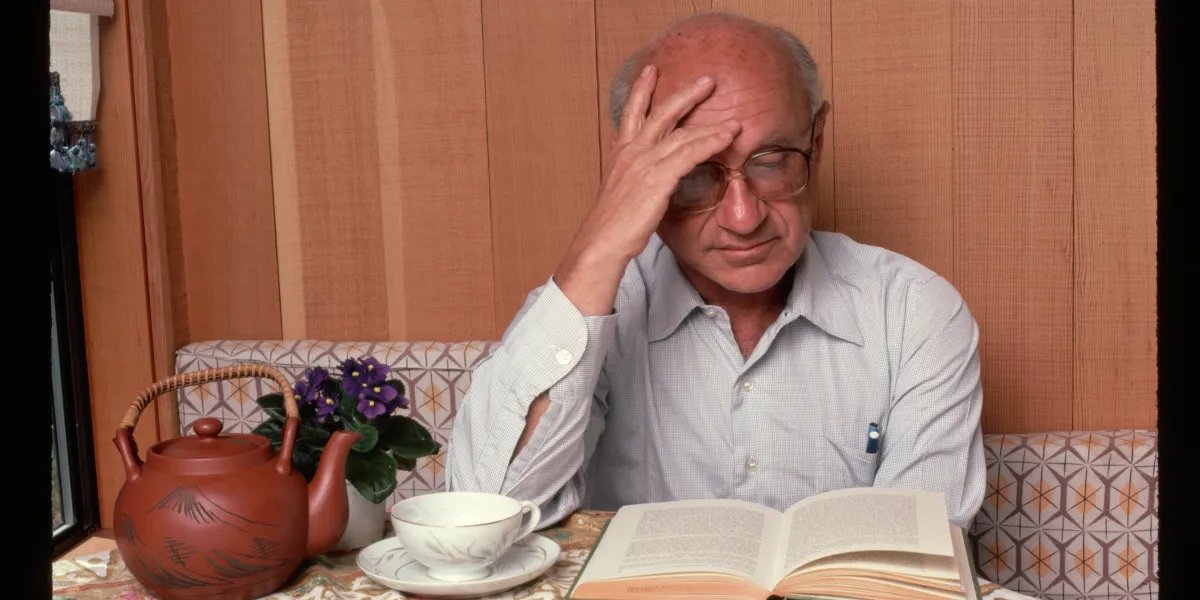
Milton Friedman’s greatest regret.
The federal government discovered the perfect crime in 1943: make employers collect taxes before workers ever see their paychecks. You think you earn $60,000 per year, but you actually earn $75,000 and hand over $15,000 to politicians without ever touching it. The psychological difference is enormous.
Before payroll withholding, Americans wrote quarterly checks directly to the Treasury. Picture yourself sitting at your kitchen table, writing a $3,750 check to the IRS every three months. The pain was immediate and visceral. Politicians faced constant pressure to justify every dollar because citizens felt the extraction in real time.
Withholding transforms this concrete loss into an abstract accounting entry. Your employer becomes an unpaid tax collector, and you never experience the actual cost of government. Worse, most people celebrate their tax refunds as government generosity rather than recognizing them as interest-free loans they provided to politicians. The Treasury collects your money throughout the year, spends it immediately, then returns your own cash and receives gratitude.
This system enables the explosion in government spending you witness today. Defense contractors billing $640 for toilet seats, agricultural subsidies for corn syrup, and congressional salaries for 535 people who rarely show up to work. When taxation feels painless, voters stop demanding accountability for how their money gets spent.
Milton Friedman helped design withholding as a wartime emergency measure and later called it his greatest regret. Free market economists recognized that the psychological pain of direct taxation creates political pressure for fiscal restraint. The temporary always becomes permanent in government hands, and the emergency justification disappears while the extraction mechanism remains forever.
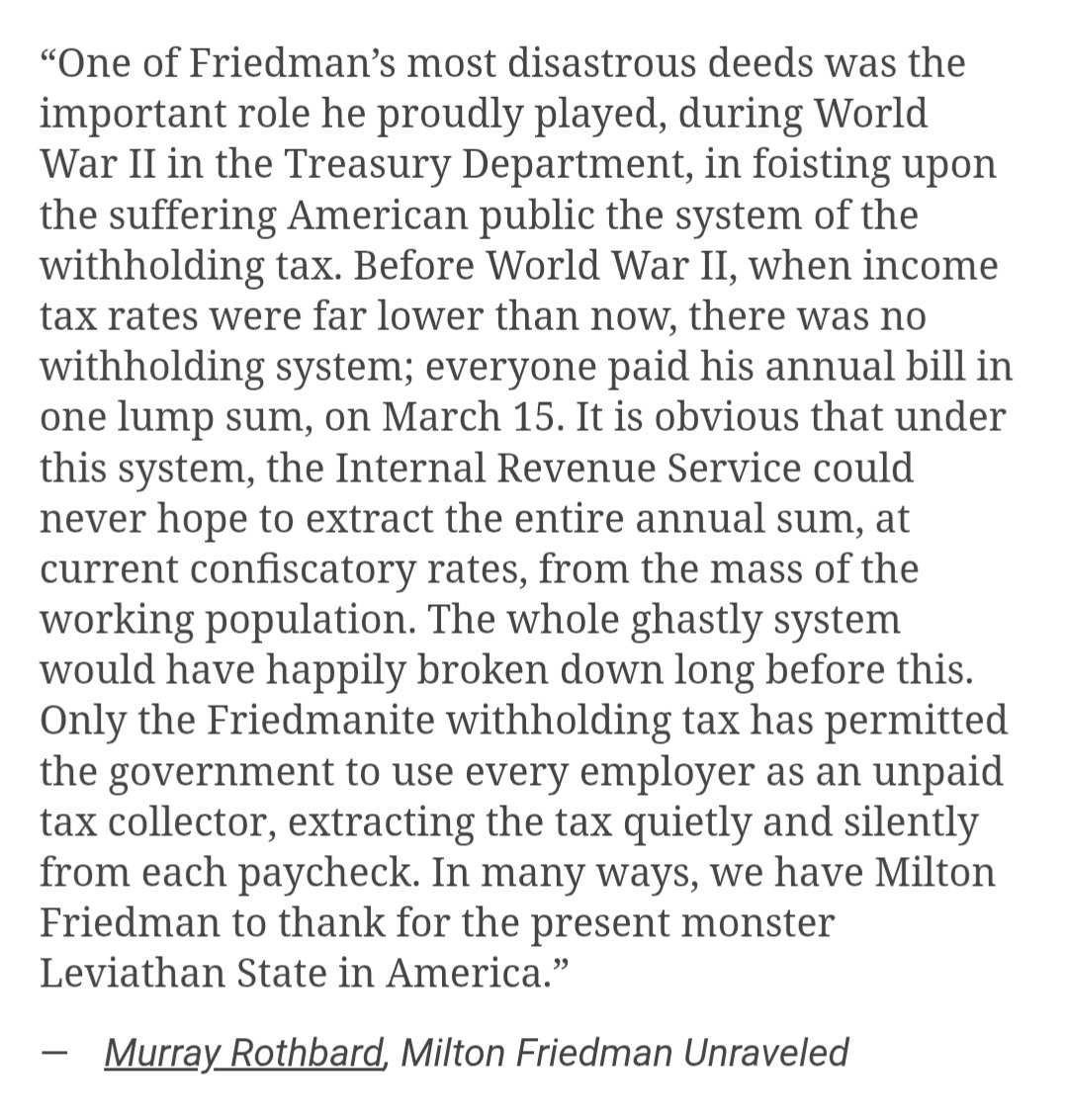
Libertarian economist Murray Rothbard was far more scathing about Friedman:
A Brief History of Nuclear Weapons in Canada
Polyus
Published 6 Jun 2026 #aviationlovers #canadianaerospace #PolyusStudiosCanadians themselves were largely opposed to nuclear weapons but their utility in a full out conflict was impossible to ignore. And so up until fairly recently the Canadian government’s position on the matter was deliberately ambiguous. Promoting peace while supplying the means of war. Now with the luxury of hindsight we can see the true extent to which these weapons played a central role in the defense of this country during the Cold War.
Like it or not, Canada was a threatening and potent nuclear-armed force during a 9 year period between 1963 and 1972. The posturing was offensive in Europe, and defensive on Canadian soil. The last defensive weapons were relinquished in 1984. Nuclear weapons were adopted as part of its network of alliances, when it became obvious that the Soviet missile threat could only be defeated by deterrence. Politically the nuclear question was a hot potato, John Diefenbaker tried to keep the weapons out, Lester Pearson let them in, and Pierre Trudeau kicked them back out again.
This video was made without the use of Artificial Intelligence (No AI). Long live people power!
0:00 Introduction
1:20 Uranium mining in the North
2:31 Tube Alloys and the Manhattan Project
4:10 Post war fears of Soviet army and Canadian build up in Europe
6:04 Air threat from Soviet bombers
8:05 The case for nuclear weapons
9:28 Cancellation of the Arrow in favour of nuclear weapons
10:55 Defensive nukes
13:39 Offensive nukes
16:15 Nuclear capable platforms
16:59 Types and numbers of deployed weapons
18:30 Legacy and impact of these weapons
19:55 ConclusionSupport me on Patreon – / polyusstudios
Music:
Denmark – Portland Cello Project
Your Suggestions – Unicorn Heads
“Friedrich Nietzsche predicted our culture more than a century ago”
On the social media site formerly known as Twitter, Creative Deduction give Nietzsche credit for predicting how western cultures would change to the state we find ourselves in today:
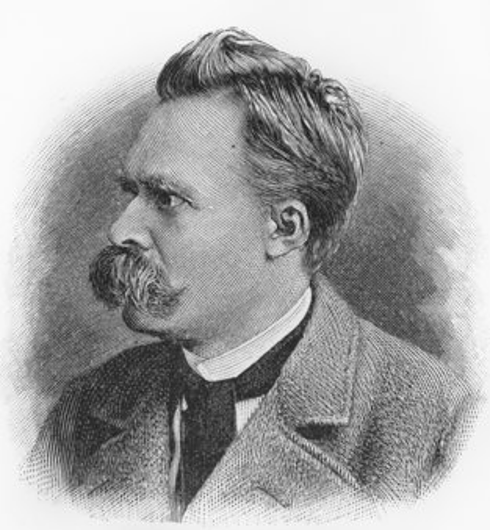
Friedrich Nietzsche predicted our culture more than a century ago.
A society where victimhood confers status; where weakness is celebrated as virtue; where grievance brings moral authority; and where the highest aspiration is not greatness, but comfort.
He regarded it as a symptom of civilisational decline. In place of the old aristocratic values of strength, courage and self-overcoming, Nietzsche saw the rise of what he called “slave morality” — a worldview that elevates weakness, suffering and resentment into virtues. The modern celebration of victimhood, where people compete to present themselves as the most oppressed, is this mentality. Rather than striving to overcome hardship, many now seek status and moral authority through claims of injury and grievance.
Nietzsche was deeply contemptuous of those who pursue safety and comfort above all else. He mocked the “last man”, the small-souled creature who wants nothing more than a warm bed, entertainment and protection from anything difficult or dangerous. For Nietzsche, struggle was not an unfortunate condition to be eliminated, but the very source of meaning, growth and greatness. Without resistance, there is no self-creation.
The modern welfare state would have horrified Nietzsche. By shielding people from the consequences of their actions and removing the necessity of struggle, it does not liberate — it enfeebles. It creates populations that are materially secure but existentially empty, dependent on the state rather than on their own strength and initiative. Nietzsche believed that genuine human flourishing requires the willingness to endure hardship and take responsibility for one’s life. A society that makes comfort its highest value and victimhood its highest status inevitably produces weak, resentful people who have forgotten how to live.
How Red Dot Sights Work (What is a Collimator?)
Forgotten Weapons
Published 16 Jan 2026A whole lot of people have used red dot sights, but how many actually understand how they work? Let’s see if we can fix that today …
(more…)
QotD: Re-use, recycle, and contaminate
This “common cup” was the ultimate reusable product — much to the horror of public-health experts, who blamed it for spreading tuberculosis, pneumonia, diphtheria, meningitis, and other diseases. Alvin Davison, a biologist at Lafayette College in Pennsylvania, analyzed cups from public schools and reported in 1908 that a single sip from a student left a residue of 100 dead skin cells and 75,000 bacteria. He used the scrapings from one school cup to induce fatal cases of pneumonia and tuberculosis in guinea pigs.
His article “Death in School Drinking Cups” provided support to “Ban the Cup” campaigns around the country. The first successful one was led in Kansas by Samuel Crumbine, a colorful doctor who had started his career in Dodge City (he was the model for Doc Adams in the long-running Gunsmoke television series) and went on to lead various public-hygiene crusades. The term “flyswatter” comes from a slogan he popularized, “Swat the fly” (which came to him while listening to the crowd at a baseball game urging a hitter to swat a sacrifice fly ball). After watching train passengers with tuberculosis and other diseases drinking water from a common cup, Crumbine got so upset that he threw the cup out the train’s window, and proceeded to persuade his colleagues on the state board of health to ban the common cup in trains, schools, and other public places in Kansas in 1909.
The ban left Kansans with a new problem: What were they supposed to use at a public fountain? Fortunately, as Crumbine later recalled, “Necessity proved to be the mother of invention.” Shortly after banning the cup, Crumbine was visited by a former Kansan named Hugh Moore, who brought with him samples of a product that his brother-in-law had invented: round paper cups that could be stacked in a dispenser next to a fountain. Crumbine’s endorsement provided crucial help to Moore in selling his product, originally called Health Kups and later renamed Dixie Cups.
John Tierney, “Let’s Hold On to the Throwaway Society”, City Journal, 2020-09-13.
June 7, 2026
Are “Dad books” in trouble?
In the latest SHuSH newsletter, Ken Whyte views with (mild) alarm a recent Wall Street Journal article claiming that “Dad books” — the kind of books thoughtful kids give their fathers as gifts — are in steep decline:
The Wall Street Journal ran a piece last month on the death of Dad books, the Father’s Day specials — books about “some little-known chapter of World War II, the sweeping narrative of a shipwreck, perhaps the latest presidential biography”.
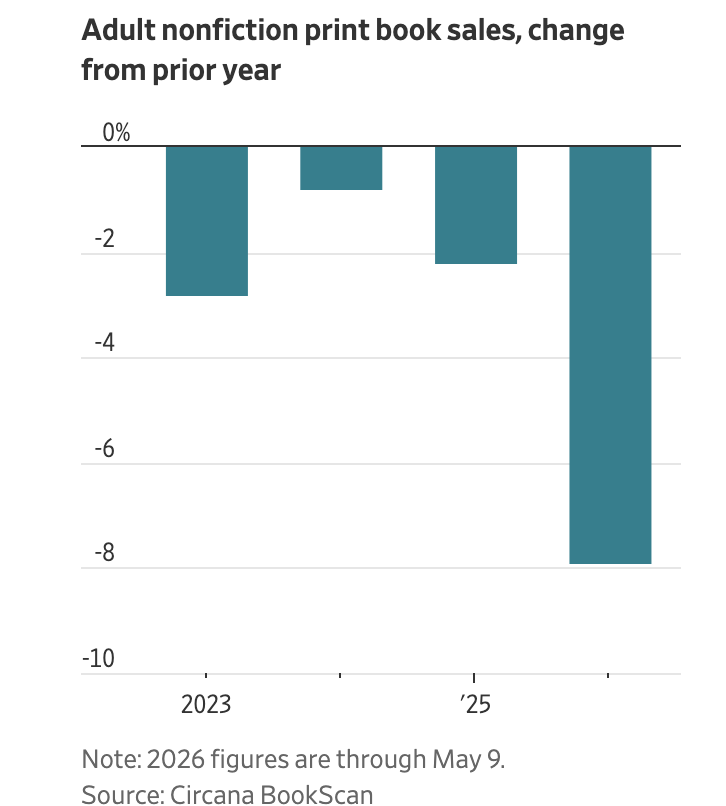
Here’s what it gave for evidence. Nonfiction book sales have declined for four years, including an 8 percent drop this year up to May 9.
Sales of Books about politics and current affairs are down 19 percent in those same four months and nine days in 2026. The article quotes, among others, former Simon & Schuster publisher Jonathan Karp saying that “this is a sea change and people should wake up and realize we’re living in a new world”.
The new world is one with “an endless supply of Substack newsletters, Netflix documentaries, YouTube videos and podcasts that offer the kind of fresh reporting, sharp analysis and historical perspective once limited doorstop-size books”.
Jonathan Burnham of Harper Group adds that all these alternatives to books make “the idea of sitting down with a 700-page Ron Chernow book less appealing. You’ve scratched that itch.”
The WSJ noted that Chernow’s recent biography of Mark Twain, published last spring, is underperforming his 2017 biography of Ulysses S. Grant.
There was an obligatory quote from Barnes & Noble CEO James Daunt, who attributed the decline in serious nonfiction sales to the fact that everyday events are all-consuming: “The world is exceptionally interesting right now and when that happens the nonfiction reader is reading the news instead.”
As someone who publishes a lot of Dad books, i.e., serious researched nonfiction, histories and biographies, that sort of thing, I read the article with concern. In fact, I read it twice.
I felt much better after the second reading.
Let’s start with the chart. The first four months and 9 days of 2026 are doing all the work here. A decline of 1 to 2 percent in the years 2023 to 2025 is statistical noise. Circana BookScan numbers don’t include audiobooks, which have been rising steadily in popularity. The very slight decline in sales for the first three years might be entirely attributable to format shifting, hardcopy to digital audio. The 8 percent decline in the first four months of 2026 looks more ominous, but book sales figures are always lumpy, never a straight line. A four-month sample tells you nothing.
The greater problem with the chart is that it is counting adult nonfiction book sales, not Dad books. There are any number of ways to cut Circana BookScan data, but the broad adult nonfiction category contains a vast array of books. Books for men, books for women, books for everybody. Not only serious researched nonfiction, but self-help, how-to, study guides, business and personal finance, psychology and religion books, health and fitness books, parenting books, food and travel books, true crime, sports, military, essays, crafts and hobbies, memoirs, etc. There is no data cut for Dad books. So the story is backing its thesis for the death of apples with stats about oranges.
The report of a 19 percent drop in the narrower category of politics and current affairs also looks ominous, but this is one of the most notoriously cyclical genres in existence. And, again, we’re discussing a short period of four months and nine days. The new Trump era was less than a year old at the start of that period. It generally takes longer than a year to get new books from commission to sale. Ten days after the end of the period under discussion, Andrew Weissmann released Liar’s Kingdom: How to Stop Trump’s Deceit and Save America. It was an instant number-one New York Times bestseller. In so specialized a category as this, Liar’s Kingdom alone might have been sufficient to right the ship.
The only other evidence presented to support the decline in Dad books is poor Ron Chernow’s journey. His Mark Twain, with 119,259 hardcover sales, is underperforming his Ulysses S. Grant, with 381,604 sales.
I don’t know where to start. The Grant book has been out for almost a decade, Twain for a year. Not surprising that it has sold less. Also, you can’t compare major political biographies to major cultural biographies. David McCullough’s biographies of Truman and Adams far outsold his book about American artists and writers in Paris. And while I’m a fan of Chernow, his Twain book isn’t his best work. He received polite and generally positive reviews, but they noted that the book is overly long — the word “exhaustive” surfaces repeatedly — and that he doesn’t entirely succeed in bringing Twain to life. Grant is a superior book, and the more enjoyable read, too, if customer reviews are anything to go by. The Twain sales prove nothing.
So we don’t really have any evidence at all that Dad books are in trouble, that they’re getting swamped by podcasts or current events, and certainly not that there’s been “a sea change” and that we’re living “in a new world”.
Amusingly, the literary world was flooded with hot new Dad books coincident with the WSJ‘s declaration of their death.
Those “decorations” or “doodles” on medieval manuscripts
In this week’s Substack Post of links they included this gem from weird medieval guys providing lots of illuminated explanations of the visual additions to pages of handwritten text generated in monasteries all over Europe during the Middle Ages:
After perhaps my 9,000th time seeing someone describe medieval marginalia as “doodles” or the product of “boredom”, I thought it might be nice to put together a brief guide to some of the themes and ideas that recur in the margins of manuscripts, hopefully helping to showcase the fact that these drawings were usually anything but “random”! In fact, far more interestingly, these little characters and scenes were part of a complex and visually dense world rooted in religion, pop culture, humour, and folklore. This is just a whistle-stop tour, but I’d love to add a second part soon.
Context matters
Illuminated manuscripts were essentially always written first and illustrated second in the late Middle Ages. The scribes would add their writing to unbound, empty pages, working carefully around blank fields where painted miniatures and initials would later be added by a separate artist or artists. We do not know exactly what sort of education these artists would have obtained. However, they almost certainly would have had a degree of literacy in their native tongue and a familiarity with the scriptures they were illustrating, even if this did not extend to a firm grasp of written Latin.
Understanding this is crucial for pushing back on the idea of medieval marginalia as “random”, since it opens up the possibility of considering marginal drawings in relation to the rest of the page and manuscript as a whole — crucial context that is often neglected when we encounter marginalia as isolated snippets online. Artists were not simply filling in blank voids but adding adornment to a canvas already rich with meaning imparted by the scribe. Thus, the first step to understanding a piece of marginalia should always be to trace it back to its source, if possible. Have a look through the entire work and see what themes and images recur.
Works like the 13th century English prayerbook known as the Rutland Psalter show extensive evidence of the marginal artists playing on specific words and lines from the scriptures featured on the same page. I highly recommend Betsy Chunko Dominguez’ fantastic paper “Playing on Timbrels: The Margins of the Rutland Psalter” for a more complete exposition, but I will go over a couple examples here.
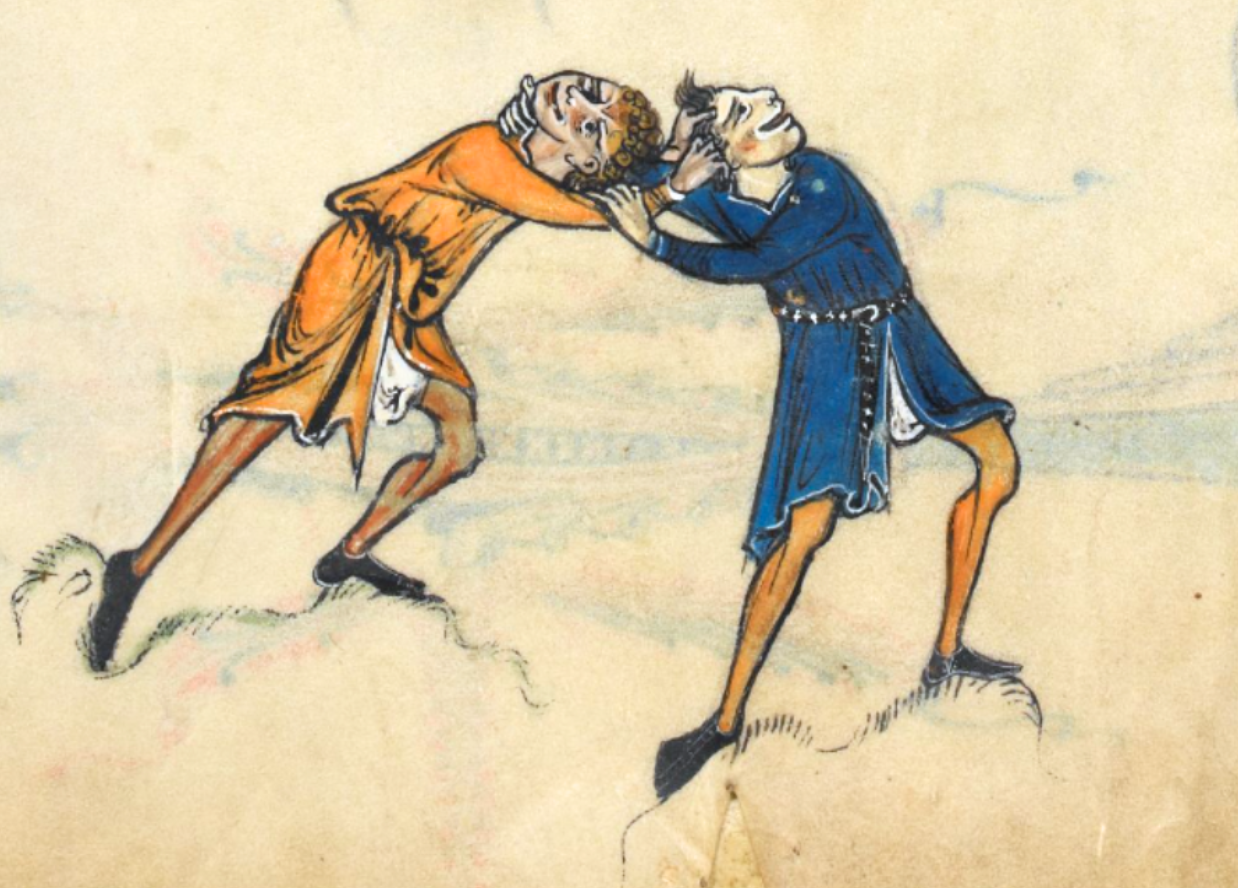
In the lower margin of folio 11r of the Psalter, two men seem to be engaged in a fierce struggle, with one of them apparently trying to rip off the other’s ear. Moving their eyes back up to the start of the opposite page, a reader would have been greeted by the following line from Psalm 5:
Verba mea auribus percipe Domine intellege clamorem meum.
Give ear, O Lord, to my words, understand my cry.
Thus, our marginal brawl becomes a clever pun on the notion of “giving ear” — perhaps a way of making the text more engaging and memorable for its reader.
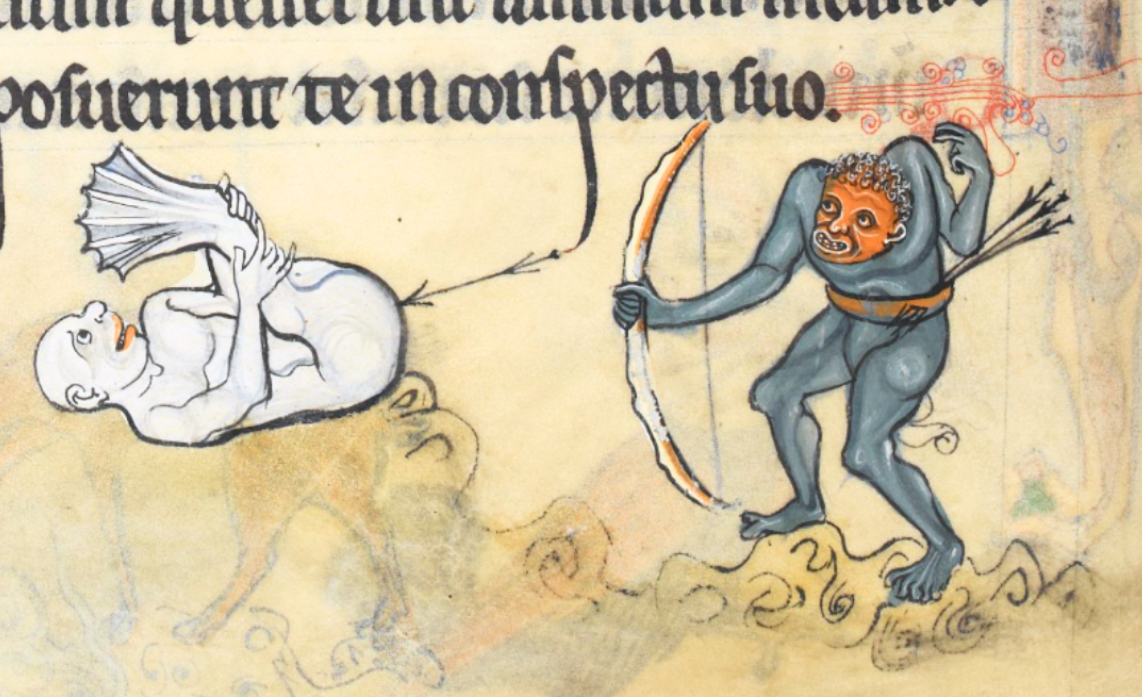
On folio 87v, the artist has extended the letter p from the word conspectu in Psalm 86 (85 in the Vulgate) into an arrow fired from the bow of one monster into the rear end of another.
Conspectu means “to behold” or “to consider”, and the famous medieval scholar Michael Camille connected the arrow’s placement to the notion of gaze as a type of visual penetration. One might also consider the entire verse from the Psalm, which reads:
Deus, iniqui insurrexerunt super me, et synagoga potentium quaesierunt animam meam: et non proposuerunt te in conspectu suo.
Arrogant men are rising up against me, O God; a violent mob seeks my life; they do not keep you before their eyes.
In redirecting the word for “gaze” into the supine creature’s rear end, the artist has perhaps emphasised the evils of turning one’s eyes away from God, connecting the two monsters with the violent mob evoked in the text above.
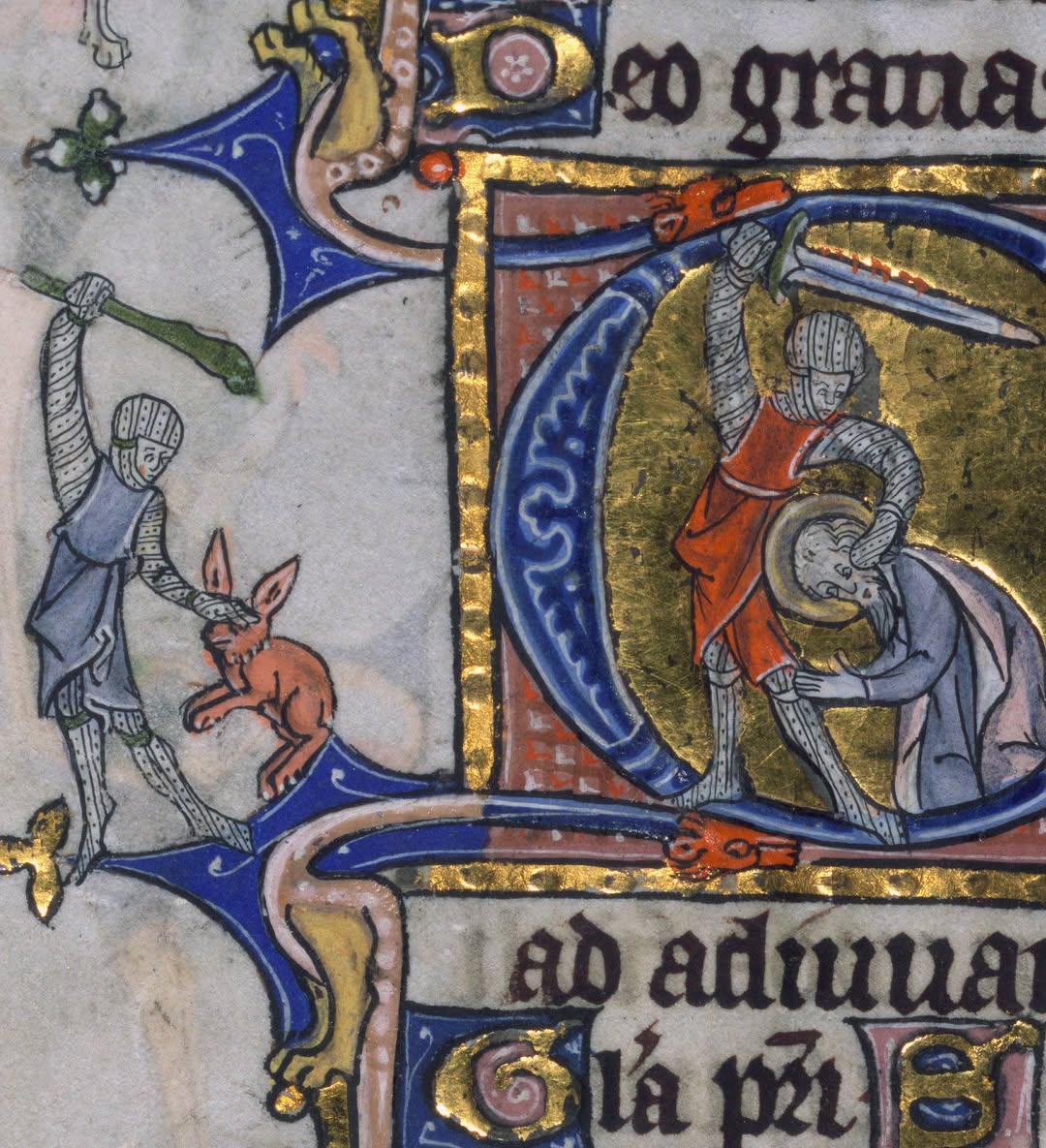
For those who lack an education in Latin, this type of wordplay can be tricky to identify. What may be easier to find are visual parallels between different drawings in a manuscript: the margins could function as a sort of antithesis to the “orthodox” miniatures and initials in the centre of the page. In one 14th century French book of hours, the martyrdom of St Paul in an initial D is reenacted directly to the left by a soldier about to club a rabbit — a humorous elevation of lapine suffering that perhaps emphasises Paul’s innocence.
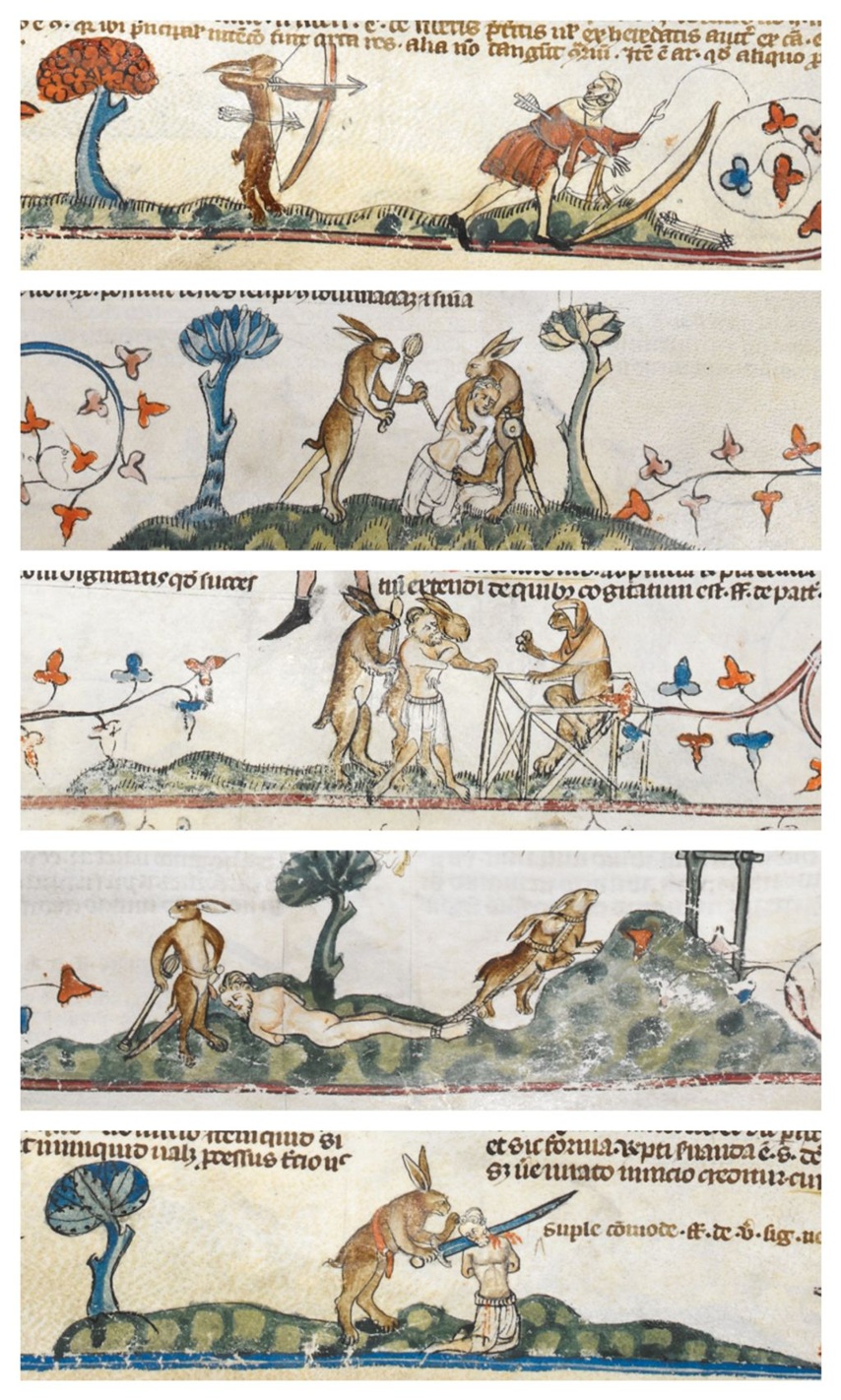
Other manuscripts show narratives playing out in the margins across multiple pages in a comic-book fashion. The 14th century Smithfield Decretals contains more than a dozen multi-page stories, including those of several saints, naughty priests, henpecked husbands, and a group of rabbits who capture, try, convict, and execute a hunter for his crimes against their kind.
British Library, Royal MS 10 E IV
How Hitler Tested His Next War in Spain – Death of Democracy 18 – Q2 1937
World War Two and Spartacus Olsson
Published 6 Jun 2026Berlin, June 30, 1937. Hitler has not staged a major diplomatic shock this quarter — but beneath the surface, Nazi Germany is preparing for war.
In Spain, the Condor Legion helps Franco’s Nationalists and the bombing of Guernica gives the world a terrifying preview of modern aerial terror. At home, the regime escalates its assault on the Catholic Church, begins the purge of “degenerate art”, tightens the link between courts and concentration camps, and hides rearmament behind spectacles of economic success.
This episode of Death of Democracy looks at Q2 1937: the quarter when Nazi Germany normalized aggression abroad while deepening tyranny at home.
00:00 Berlin, June 30, 1937
00:05 No Hitler Surprise — But War Preparations Continue
00:51 The Hindenburg and the Shadow of Modern War
01:50 The “Give Me Four Years” Exhibition
02:25 Guernica and the Condor Legion
02:55 The Bombardment of Almería
03:11 Case Green and Case Otto
03:54 Degenerate Art and Cultural Cleansing
04:22 The Judiciary and the Concentration Camps
05:13 The Nazi Assault on the Catholic Church
06:07 Goebbels, Propaganda, and the Morality Trials
07:45 Autarky, Rearmament, and Hidden Austerity
08:52 Mood Inside the Nazi Leadership
09:48 Ordinary Germans and Apathy
12:15 Analysis: War Abroad, Tyranny at Home
14:19 Conclusion: Nazi Double-Talk


