Quotulatiousness

January 5, 2026

International law is more like International “law”

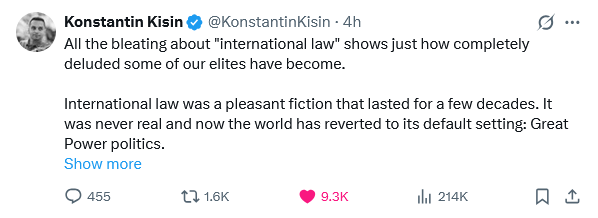
On the social media site formerly known as Twitter, Konstantin Kisin points out that calling it “International Law” gives it a semi-mythic quality that it absolutely does not deserve:

All the bleating about “international law” shows just how completely deluded some of our elites have become.

International law was a pleasant fiction that lasted for a few decades. It was never real and now the world has reverted to its default setting: Great Power politics.

This is why, as a strong Ukraine supporter, I have never talked about international law or called Putin’s attack an “illegal invasion”.

Laws are based on submission to an overarching authority backed by force. There is no such international authority and even if you view the UN as one, it does not have the ability to use force against those who violate “international law” other than against small countries with weak militaries.

When the US attacked Iraq, the UN did nothing.
When Russia invaded Ukraine, the UN did nothing.
If China invades Taiwan tomorrow, the UN will do nothing.

If you cannot enforce a law, it’s not a law.

I do not support Ukraine because naughty Vlad broke the rules. I support Ukraine because it’s not in OUR interest in the West to have Russia marauding its way through friendly countries on the borders of Europe. It’s in our interest for us to be as strong as possible and for our adversaries to be as weak as possible.

President Trump is a realist and a pragmatist. He sees through the fictions other “leaders” cling to.

A good leader advances the national interests of his country. If more Western leaders did this, our civilisation would be in a much better place.

I commented on another post that,

For a lot of people (Canadian Liberals and American Democrats in particular), the invocation “international law” has a mesmerizing effect on their ability to reason [insert usual disclaimer that if they could foresee the results of their enlightened beliefs, they wouldn’t be progressives]. They seem to have a quasi-religious belief in the UN as if it were some kind of God-given supergovernment that is always right and must always be obeyed. “World opinion” might as well be the hand of God to them, so any time the legacy media can portray the US (and Trump in particular) as going against “world opinion” they want to get out the sackcloth and ashes … or sack a city and turn it into ashes, whichever comes first.

vittorio analyzes the default position of most progressives on the social media site formerly known as Twitter:

most political issues nowadays can be explained by understanding that american leftists dont have positions, they have oppositions.

their entire belief system is defined by negation of whatever the right supports. this is why portland chants “free maduro” while actual venezuelans celebrate in the streets. they’re not pro-venezuelan or pro democracies, or pro tyrant, or pro maduro, they’re simply anti-american-right.

they’ve outsourced their worldview to institutional narratives for so long that genuine self-reflection would require questioning everything. for them it’s much easier to just oppose. the beliefs arent coherent because they were never meant to be coherent. they only need to signal tribal membership, and leftist membership is gained by opposing the right.

trump does X? the left screams and cries because they wanted Y

trump does Y? the left screams and cries and riots because even if they said they wanted Y, what they meant is that X was the way to go

trump cures cancer? they’ll argue that the cancer cells are alive have a right of free determination

trump saves lives? they’ll protest because somehow those lives didn’t matter and should have been ended

no coherent word model. no logic. pure opposition

at some point you just have to stop engaging with it as if it’s a real political position. it’s not. it’s aesthetic opposition wearing the costume of ideology

As Severian at Founding Questions often remarks, progressives’ core belief is The Great Inversion: “whatever is, is wrong”.

Bingo Bobbins makes the case that “International law is fake and gay”:

Was this operation necessary? Was Maduro really a “narcoterrorist”? I admit that I haven’t really been following all the drama with Venezuela recently, but my intuition is that Maduro was probably accepting bribes to look the other way with regards to drug trafficking, rather than being directly involved. And sure, he was a socialist dictator but there’s plenty of those around. The US doesn’t go and topple dictators unless there is a perceived US interest in doing so.

What Maduro was actually doing was cozying up to China. In fact, he had just finished a meeting with some Chinese ambassadors hours before Delta Force snatched him up by the scruff. This was actually a warning to China not to mess around in our hemisphere. The Trump administration is re-establishing the Monroe Doctrine, or, as he recently called in a press conference, “The Donroe Doctrine“. As far as I can see, this is completely in keeping with my preferred Vitalist Foreign Policy.

You can agree or disagree with this show of force, but please don’t whine to me about “International Law”. International Law is fake and gay. I certainly don’t care that the Trump administration “targeted a political leader”. This is the complaint being leveled by many leftists in regard to the operation. Really, this is just because leftists are anti-American third-worldists, and they are filled with butthurt because “their guy” lost. But, let’s examine this “rule” of not being allowed to target a countries rulers, because it’s particularly ridiculous.

If you have a problem with a specific country, who do you really have a problem with? You have a problem with that country’s leaders, since they are the ones making the decisions. Why wouldn’t you target the leaders? The only reason is that all the leaders from all the countries got together and agreed that they wouldn’t target each other. They would rather resolve their differences by throwing cannon fodder at each other, while keeping themselves off the table. And sure, I understand why that is great for them, but not why it would be great for me (or you).

Of course, the CIA has been ignoring this “international law” for decades, but they’ve been doing it in a very effeminate way, skulking about the world, funding Color Revolutions and clandestinely arming insurgent groups in order to subvert existing regimes. The Donroe Doctrine is much better. Imagine if the Trump administration had tried to handle Maduro the way the Obama administration tried to handle Assad. Fund a decades long civil war, accidentally establish a caliphate, fight a war against said caliphate, facilitate the deaths of tens of thousands of Christians, all to have an even worse dictator eventually rise to power.

Update, 6 January: Welcome, Instapundit readers! Please do have a look around at some of my other posts you may find of interest. I send out a daily summary of posts here through my Substackhttps://substack.com/@nicholasrusson that you can subscribe to if you’d like to be informed of new posts in the future.

December 19, 2025

The strange rebirth of English patriotism

Filed under: Britain, Media, Politics, Religion — Tags: , , , , , , , — Nicholas @ 04:00

In The Conservative Woman, Niall McCrae discusses what he calls “a new crusade” as the downtrodden English rediscover — or in many cases, discover for the first time — patriotic feelings for their nation, and earn the scorn and contempt of the ruling class and their media fart-catchers:

“Union Jacks and crosses of St George” by Ben Sutherland is licensed under CC BY 2.0 .

A wave of patriotism swept across England last summer. Flags were tied to lampposts up and down the country, but while these displays had wide public support, the intelligentsia were troubled, particularly as the colours were often flown in areas of cultural diversity or on roads passing hotels accommodating illegal immigrants. This suggested provocation, rather than the use of national flags to celebrate sporting success.

Politicians and Guardian commentators were careful not to appear too negative, but they emphasised unity and inclusion over nationalistic fervour. The Union Jack was preferable to the St George’s Cross, because they associated the latter more with the far right (this is not accurate, as groups such as the National Front and BNP rallied under the Union Jack).

The Union Jack (properly termed “flag” as a jack is hoisted at sea), comprises the crosses of St George, St Andrew and St Patrick. It is perhaps the most impressive flag in the world, a classic design of great cultural impact. How globalists, the EU and Islamists would like to banish it!

The “Unite the Kingdom” march led by Tommy Robinson in September, which brought a million people to the streets of London, was a marvellous spectacle of patriotism. For the counter-Jihad movement, conflict in the Middle East is regarded as an existential struggle against militant Islam. Israeli flags are often waved towards pro-Palestine marchers, and the London rally gave several Zionists a platform at Whitehall. However, the vast majority of marchers were there for one country only – their own. This was truly a British event, with a roughly equal mix of Union and St George flags, alongside some Welsh dragons and Scottish saltires, and Irish tricolours too.

Significantly, there was another symbol prominently at the London march: the Christian cross. A poignant moment was at the ramparts of Westminster Bridge, where a fearless young man mounted the head of the stone lion and from that precarious pedestal raised in one hand the flag of St George, and in the other a wooden cross. (https://www.instagram.com/reel/DOpagGvkQk9/)

I first observed the resurgence of Christian faith at the huge protests against the Covid-19 regime. Several marchers bore crosses, or placards asserting the power of God over earthly evil. The Book of Revelation was quoted, and when the “vaccine” was launched it was cast as the “Mark of the Beast”.

Socially unacceptable they may have been, but now St George and Christian crosses are regularly appearing together in gatherings for patriotic or traditional causes. In his book Worth Dying For: The Power and Politics of Flags (2017), Tim Marshall observed that “with the rise of Islam in Europe, these symbols are likely to be increasingly used by the far right to try to define the continent as what they think it is, and in opposition to what they think it is not”. You can’t get a book released by a mainstream publisher without expressing such approved outlook, but Marshall is making the mistake of blaming patriots for the devaluing of their national flag; it is surely the subversive ideology of the progressive left that has taught generations that national pride is regressive and bigoted. Meanwhile “woke” warriors are not shy of waving the Pride rainbow, transgender stripes and the flag of Palestine. And the likes of Hope Not Hate had no complaint about huge fascist-style marches awash in the blue and yellow stars of the EU.

December 17, 2025

“The core hypocrisy of modern Western governance”

Filed under: Australia, Britain, Cancon, Europe, Media, Politics, USA — Tags: , , , , , , — Nicholas @ 03:00

On the social media site formerly known as Twitter, Tom Marazzo discusses the extremely weird experience we’ve all lived through since 9/11 in almost every major western nation:

For more than 20 years, Western governments told their citizens that Islamist extremism posed an existential threat. Entire generations were sent to fight the Global War on Terror. Soldiers were killed, families were broken, civil liberties were curtailed, and trillions were spent, all justified by the claim that terrorism had to be stopped over there so it would not reach us here.

Then something strange happened.

The same governments that built their legitimacy on that fear now insist that even discussing the cultural, security, or integration risks associated with mass immigration from unstable regions is immoral. Raise concerns and you are no longer a citizen asking questions, but a bigot, an extremist, or a threat yourself. In some countries, speech alone now draws police attention, while violent acts are reframed as isolated incidents or stripped of ideological context.

The irony deepens when you look at the timeline.

During the first years of Covid, terrorism all but vanished from news coverage, just as Covid seemed to erase the common cold, cancer, and every other cause of death from public discourse. Nothing had disappeared. The narrative had simply changed. Attention was redirected. Fear was reassigned.

Now, as governments pursue aggressive mass immigration policies, the public is told that questioning outcomes is unacceptable, even as the very threats once used to justify war reappear domestically. The message is clear and profoundly cynical: the danger was real when it justified foreign wars, but discussion becomes forbidden when it complicates domestic policy.

This is not tolerance. It is coercion.

And now comes the final insult.

The same political class that demands silence at home is preparing to demand sacrifice abroad. The same citizens who are told to accept social breakdown, rising crime, collapsing services, and cultural fragmentation are being told they may soon be required to fight Russia to “defend our way of life”.

What way of life, exactly?

The one being systematically dismantled by the very governments issuing the call. The one they are actively transforming into something unrecognizable through reckless policy, moral intimidation, and managed decline. They are asking people to die for values they no longer practice and for societies they are actively degrading.

This is the core hypocrisy of modern Western governance.

We were told to fight, bleed, and die to defend liberal democratic values. Now we are told those same values require silence, compliance, and obedience, while our countries are reshaped without consent and against the will of the people who built them.

A government that suppresses debate at home while demanding loyalty abroad is not defending democracy. It is consuming it.

And history is not kind to regimes that ask their people to die for a future they are busy destroying.

December 4, 2025

“… the biggest problem facing disabled people is that they aren’t eager enough to call themselves disabled”

Filed under: Health, Media, Politics, USA — Tags: , , , , — Nicholas @ 05:00

On his Substack, Freddie deBoer decries the New York Times viewpoint that “there is no such thing as a person, only beings that exist to function as sets of interlocking identities”:

(you would find this horribly condescending too)
Image from Freddie deBoer

I’m not joking! Paula Span has produced this particular bit of scolding for The Official Publication of Liberals Who Occasionally Look Up From Their Crosswords to Disapprove of Everyone and Everything. Span writes

    Identifying as a person with a disability provides other benefits, advocates say. It can mean avoiding isolation and “being part of a community of people who are good problem-solvers, who figure things out and work in partnership to do things better”

Of course, you can enjoy those benefits without identifying as disabled, without allowing one unfortunate aspect of your life become an entire identity. But that doesn’t fly in the world of the brownstone liberals who fund and run the New York Times, who seem to believe that there is no such thing as a person, only beings that exist to function as sets of interlocking identities.

Here’s the maddening thing about this piece: it quietly smuggles in a worldview that has metastasized across the discourse, a worldview in which the biggest problem facing disabled people is that they aren’t eager enough to call themselves disabled. Not, you know, being blind or paralyzed or suffering from dementia or constantly wracked with chronic pain, no, all of that is subservient to the only question anybody seems to care about anymore, the all-devouring question of identity. The whole thing hums along with the cheery institutional conviction that the answer to every human frailty is more identitarian self-labeling. If only the elderly would embrace the capital-D Disability identity, we’re told, everything would be better — their health care would run smoother, their interactions with institutions would be less demeaning, their sense of community would blossom. Maybe they’d even be happier! The Times treats this as self-corroborating common sense, like, well, everything else argued in the New York Times.

What this kind of thinking actually represents is the natural endpoint of a cultural project that has turned medical pathology into a personality type. It’s the codification of a worldview where suffering is not something to address, treat, alleviate, or recover from, but a new kind of boutique identity, complete with community membership, branded discourse, and moral status. It turns vulnerability into a form of social currency, rewarding performance over authenticity and turning genuine suffering into a spectacle for peer validation. In doing so, it erodes the very possibility of meaningful treatment, because the focus is no longer on recovery or well-being, but on cultivating a carefully curated self-image that fixates on impairment. And what I think, as I read this person tut-tutting senior citizens for not embracing that new ethos, is “Maybe they just feel like they’re too fucking old to take part in such nonsense?”

The piece insists, without evidence or even really argument, that treating disability as an identity will improve access to accommodation. Disability accommodations matter; of course they do. But what this article is concerned with is patently not getting older adults the practical support they need. The piece is instead fixated on the idea that the real issue here is that people don’t want to be disabled in the metaphysical, self-defining sense, as though the reluctance of an 84-year-old to call herself Disabled-with-a-capital-D is some retrograde psychological failure rather than a perfectly sane human impulse born of a lifetime of struggle. Span frames this as a story about insufficiently enlightened seniors who need to be ushered into the disability “community”. But maybe the reluctance they’re describing is the whisper of something older and much wiser: the understanding that disability is not a polity you join, not a club whose membership conveys special epistemic authority, but a condition of life that you endure and attempt to mitigate. These older people don’t identify as disabled because they remember, stubbornly enough, the distinction between having a problem and being the problem. They treat disability as a practical reality, not an existential category. And they’re right to do so.

Update, 5 December: Welcome, Instapundit readers! Please do have a look around at some of my other posts you may find of interest. I send out a daily summary of posts here through my Substackhttps://substack.com/@nicholasrusson that you can subscribe to if you’d like to be informed of new posts in the future.

December 2, 2025

Dead Wrong: How Canada got the Residential School story so wrong

Filed under: Books, Cancon, History, Media, Politics — Tags: , , , , — Nicholas @ 03:00

Juno News shares Candice Malcolm‘s foreword to Dead Wrong by C.P. Champion and Tom Flanagan:

Canada is off track. We’ve lost our way.

How else could we make sense of the moral panic produced from a half-baked report coming from a small Indian Band in Central British Columbia in the spring of 2021? In response, the country lost its mind. Following reports of 215 “unmarked graves” at the site of the former Kamloops Residential School, the supposedly trusted sources of our society – journalists, elected officials, academics and so-called experts – reported fiction as fact, without doing any due diligence or research into the still unproven and questionable claims of mass graves and secret midnight burials of hundreds of deceased children.

A failure of this magnitude doesn’t happen instantaneously. It’s built over time as those who profess to speak the truth deliver deception, doublespeak, and misinformation – all in the name of addressing some grievance, advancing an agenda, and creating a narrative.

The only conclusion we can now draw is that our country is not what it should be, not what it was.

There are a myriad of complicated reasons to explain our clear downward trajectory – institutional capture, a hard-left consensus among political and cultural elites (driven in large part by government-funded journalists and the state broadcaster pushing woke propaganda), a large and inefficient bureaucracy that stifles growth and

innovation, institutions built upon a moral code that became unfashionable, and so on.

Canada has become a feminist country that proudly discriminates against men and diminishes the role of mothers. It has become a post-national country that loathes its founders and openly discriminates against individuals based on skin colour. It isn’t just post-Christian, it’s anti-Christian – evident from the treatment of Evangelical prayer leader Sean Feucht, the coordinated attacks against him in the summer of 2025 and the cancellation of tour stops across the country, not to mention total disinterest and cover-up of the 120+ churches that have been decimated and destroyed in the wake of the unmarked graves fiasco.

Over the past decade, we’ve witnessed our country fall from a functional system, into something almost unrecognizable.

The Canada I grew up in was safe, stable and secure. We knew our neighbours, we trusted institutions and didn’t worry too much about politics. Being Canadian meant something. We had a community, an identity, a shared purpose. Most of us believed in upward mobility and the Canadian dream: that if you work hard and play by the rules, you will have the same – or dare I say better – opportunities and quality of life than your parents.

This is clearly no longer the case for most Canadians under the age of 45, and that is a major problem for all of us.

I came across a simple social graph by William Meijer that clearly explains what has happened better than anything else I’ve seen. You could apply this to countries, companies and even personal relationships.

Simply put: kindness got in the way of truth.

Meijer writes the accompanying caption: “An extreme commitment to the truth makes relationships acutely dysfunctional but systems chronically functional (think Elon Musk).

An extreme commitment to kindness makes relationships acutely functional but systems chronically dysfunctional (think Sweden, UK).”

Canada perhaps represents the “kind dysfunction” better than any other place.

November 24, 2025

Fairy tales for Canadian boomers – “we have the best healthcare system in the world”

Filed under: Books, Cancon, Government, Health, Media, Politics — Tags: , , , , , , — Nicholas @ 05:00

Older Canadians, especially the Baby Boom generation, have a huge blind spot when it comes to any discussion about healthcare … because they believe what they were told as children about Canada’s healthcare system being the “envy of the world” and other such comforting notions. (It’s not just Canada, as British belief in the quality of their National Health Service is very much at odds with the evidence.) This rose-coloured nostalgic faith makes it very difficult to address some of the very real problems that beset Canada’s hospitals and doctors. The media are understandably reluctant to publish anything that goes against this, as Peter Menzies explains:

Grok image from The Rewrite

About the same time as William Watson’s outstanding book Globalization and the Meaning of Canadian Life was being published in the late 1990s, the newspaper I worked for was sending a journalist to Europe to research a series of articles on how health care systems work in some of those countries.

I mention Bill’s book, which was runner-up for a public policy Donner Prize, because it exquisitely details many of the things Canadians believe about themselves that simply aren’t true. Which was the same reason why the Calgary Herald sent its health reporter (yes, there used to be such a thing), Robert Walker, to Europe — to expose its readers to the fact that there are more than two health care systems: our “defining” one and America’s, both of which are extremes. To the best of my knowledge, that remains the only time a Canadian news organization has taken on that task.

In every country examined in Walker’s reports, as is the case with almost every country in the world, public and private health care and insurance systems maintained a peaceful coexistence and the public’s needs were being met. Almost 30 years later, that remains the case. Also almost 30 years later, neither Bill’s book nor the Herald‘s reporting has had the slightest impact on the prevailing media narrative in Canada. It remains determined to perpetuate the fear that any move to increase the role of private health providers or even allow doctors to work in both systems (as was proposed this week by Alberta Premier Danielle Smith) is the first step on the slippery slope to “American-style” health care. This line has been successfully used for decades — often hyperbolically and occasionally hysterically — by public monopoly advocates for Canada’s increasingly expensive and difficult to access systems. We have known for 40 years that once Baby Boomers like your faithful servant turned bald and grey that the system would be unsustainable. But that single, terrifying “American-style” slur has halted reform at every turn.

The Tyee responded with a “Danielle Smith’s secret plan to Destroy Public Health Care” column while the Globe and Mail‘s Gary Mason, a Boomer, challenged my thesis here by suggesting it was time for open minds because “the reality is, the health care system in Canada is a mess”.

It is. And at least some of the blame — a lot, in my view — belongs at the door of Canadian news organizations that for decades have failed to fully inform readers by making them aware that there are a great many alternatives to just “ours” and “US-style”.

I was reminded of this in a recent Postmedia story concerning the perils of private health care provision. Referencing a study on MRIs, the story, right on cue, quotes the part of a study that states “It’s a quiet but rapid march toward U.S.-style health care”.

One would not want to suggest that those clinging to that parochial view should be denied a platform. But at the same time, readers have every right to demand that journalists push back and ask advocates for state monopolies simple questions such as “Why do you say that? Could it not be the first step towards UK-, German-, Dutch-, French-, Portugese- or Swedish-style health care?” and open the debate.

November 22, 2025

Why did the US Enter WW1?

The Great War
Published 11 Jul 2025

In early 1917, the United States was still neutral in the First World War. Meanwhile, German leaders were getting desperate — if they couldn’t find a way to break the war of attrition on the Western Front, the Allies would probably defeat them. The result was multiple gambles that staked everything on a quick victory with the risk of drawing the US into the war.
(more…)

November 21, 2025

The “spat” between China and Japan is far more important than western media are reporting

Filed under: China, Japan, Media, Military, Pacific, USA — Tags: , , , , , — Nicholas @ 03:00

Claire Berlinsky explains why we should be paying far more attention to what our media are treating as a minor diplomatic spat as Beijing reacts furiously to the new Japanese PM’s comments:

You need to see the Chinese media today to get a feel for this. Front pages of the relevant organs are devoted to frothing in fury at Japan. They’re rectifying bad thoughts like a house on fire.

Here’s why I’m worried by this. Both the Chinese- and Japanese-language press are treating this as a major diplomatic incident. (In English, it’s mostly being described as “a row” or “spat” — then back to Trump and Epstein.) Let me walk you through what it looks from Beijing and Tokyo, with help from ChatGPT on the translations.

The trigger was a comment in by the new Japanese prime minister, Sanae Takaichi. She told a parliamentary committee that a Taiwan contingency involving the use of force might constitute a “sonritsu kiki jitai” (a “survival-threatening situation” — I think we’d use the phrase “existential threat”) for Japan under its 2015 security laws, and justify the exercise of collective self-defense, using Japan’s self-defense forces.

Beijing exploded. China summoned the Japanese ambassador in Beijing for a formal démarche, and it allowed the PRC consul general in Osaka, Xue Jian, to post a (now-deleted) tweet calling for her decapitation—”that dirty head that trespassed should be cut off, are you ready?” The Xue Jian post has, of course, become a media event of its own. Beijing issued a travel advisory urging Chinese citizens to avoid Japan, and told students to “carefully reconsider” study plans. It stepped up coast-guard activity near the Senkakus, and cancelled the Xi–Takaichi bilateral at the G20.

But this arid account doesn’t begin to convey the way the Chinese and Japanese media are talking about this. The Chinese coverage is nothing short of hysterical. To read the Party-line outlets, you’d think Takaichi had just ordered the immediate re-invasion of Manchuria. Her comment, they said, was an evidence of a “dangerous rightward turn” in Japanese politics. They’re calling it a “sky-collapsing opening“, accusing her of “reckless ranting” and tearing up the China-Japan relationship.

The headline in a widely circulated China Daily article:”If China and Japan go to war, Japan will be destroyed“. They found the inevitable panel of “peace-loving international friends” — including Okinawan peace activists and pro-PRC overseas Chinese — to denounce Takaichi as the reincarnation of “Japanese militarism”. The peace activists dutifully warned that the Japanese people would be “dragged into catastrophe” by their government. A CNR column accuses her of “brazen provocation”, and claims that “Taiwan compatriots are also outraged” at the prospect of Taiwan being turned into a battleground between China and a “militaristic” Japan.

The Party line: Taiwan is a “settled” internal issue; any talk of Japanese collective self-defense in the Strait is aggression and a “serious violation” of the post-1945 order. Takaichi represents “unrepentant militarism.” Chinese pieces quote her opponents at length to argue that “sober Japanese elites” are deploring her recklessness. Chinese-language coverage of the travel advisory is not treating it as a minor consular notice. They’re claiming it’s the first coercive step.

In Japan, this is front-page foreign policy news, not a minor gaffe. Mainichi ran an editorial saying, more or less, that Takaichi’s words were legally consistent with the 2015 security laws, but prime ministers should be more discrete about hypothetical military contingencies and show more prudence. Opposition figures are saying she “went too far” and threw the relationship into “a very grave state”. They called it “frivolous” for a commander-in-chief to talk so specifically about use-of-force scenarios.

On the other hand, there’s clearly a domestic constituency that sees this as long overdue. Some in her party see any hint of retraction as “weakness toward China”, and they’re praising her for drawing a firm line on Taiwan. (The coverage about whether to expel Xue Jian is divided: His post was a death threat, obviously, but the Foreign Ministry seems reluctant to escalate this further.)

TV explainers are reminding viewers that the 2015 security legislation already contemplated a Taiwan contingency — what’s new is that the prime minister has now said this out loud. And a prime minister with an openly revisionist profile — that’s definitely new.

So there’s a lot of signaling going on. Beijing is signaling to its own public: “We’ll never again let Japanese militarism threaten China. The Party is the bulwark against a repeat of the 1930s.” To Tokyo: “We’ll punish any step toward military involvement in the Strait, first with economic coercion — then worse. We are not kidding about this.” To the wider region and Washington: “Japan is a destabilizer — this woman isn’t right in the head. If things go wrong in the Taiwan Strait, blame Tokyo. Remember Pearl Harbor.”

Update, 23 November: Welcome, Instapundit readers! Please do have a look around at some of my other posts you may find of interest. I send out a daily summary of posts here through my Substackhttps://substack.com/@nicholasrusson that you can subscribe to if you’d like to be informed of new posts in the future.

November 17, 2025

Yet another example of the Liberal focus on symptoms rather than underlying problems

Filed under: Cancon, Government, Media, Politics — Tags: , , , , , , — Nicholas @ 03:00

The Liberals under both Justin Trudeau and Mark Carney have amply demonstrated that they care far more about appearances than achievements. The immigration crisis is merely the latest example of the government reaching for something that will look good on TV and in the newspapers rather than addressing the root cause of the problem:

Perhaps the most intractable policy disaster handed to Prime Minister Carney by the Trudeau government is the immigration file. The ugliest detail in that file is undoubtedly the astronomic increase in temporary residents (largely foreign workers, international students, and asylum seekers) – a population that expanded from 3.3% in 2018 to 7.5% in 2024. The Carney government’s solution is to limit the inflow of new temporary residents significantly, while at the same time giving permanent residency to many of the ones already on Canadian soil.

The base problem is far too many people entering the country, driving up demand for housing, overloading healthcare facilities, absorbing more and more government assistance at a time the government is running record deficits, and undercutting young Canadians for entry level jobs while youth unemployment is skyrocketing. But this “solution” will look like firm action as it will be presented by the tame media, so from the point of view of the government, it’s “mission accomplished”.

The Carney government’s first annual Immigration Levels Plan commits to “reducing Canada’s temporary population to less than 5% of the total population by the end of 2027”. To this end, Canada’s annual intake of new temporary residents will be cut from 673,650 in 2025 to 385,000 in 2026, and 370,000 in 2027 and 2028. This cut will hit international students the hardest, with annual new study permits cut in half from over 300,000 to 155,000 in 2026, and 150,000 in 2027 and 2028.

This major cut will ease the strain on Canada’s housing, healthcare, food banks, roads, and social services – a strain that is no longer denied by politicians, and is freely acknowledged across the political aisle. But, as is the case with many policies, the devil is the details. It turns out that one of the ways which the federal government intends to shrink the size of the temporary resident population is by making a large number of them permanent residents.

In the recently released 2025 Annual Report to Parliament on Immigration, Immigration Minister Lena Diab says the Carney government intends to “give priority for permanent residence to temporary residents already living and settled in Canada, further reducing the number of new arrivals”.

How many temporary residents will get permanent residency under this plan is unclear, but we can extrapolate from the data we have.

The Carney government’s Immigration Levels Plan sets the annual permanent resident rate at 380,000 for the next three years – or, a total of 1,140,000. The very last Immigration Levels Plan of the doomed Trudeau government – which committed to transitioning many temporary residents to permanent residency – predicted that temporary residents would account for “more than 40% of overall permanent resident admissions in 2025”.

If the Carney government is heralding the idea of transitioning more temporary residents as a way to slow down the catastrophic population growth Canada has experienced in recent years, we can safely assume that this proportion will be at least a little bit higher than the Trudeau government’s rate. A rate of 50%, say, would mean that 570,000 temporary residents will receive permanent residency over the next three years.

See, Canadians are telling the government that there are too many temporary immigrants, so by waving a magic wand and transforming the bulk of the temporary immigrants into permanent residents, the government can pretend they’ve solved the problem. And the sycophants, fluffers, and cheerleaders in the media will laud them to the skies for their brilliant solution.

November 12, 2025

The legacy media are still fanatically pushing the “Tories in disarray” line

It’s good to see that sometimes you get good value for your money. In this case, it’s the massive financial subsidies the federal government pay out to most of the Canadian legacy media outlets, so that the media ignores stories that the Liberals look bad but push the living bejesus out of anything that makes the Conservatives look bad … even if they have to distort the story almost out of recognition. Brian Lilley has the details:

I told you this would happen, the legacy media is trying to make this whole floor crossing thing into a PC versus Reform Party thing. As I broke down all of the background information that I could muster and tried to present it in a straightforward way, I said this would be a narrative of the MSM.

The reality is, the frustrations exist for a number of reasons but Pierre being too conservative is not the main issue here, it’s that they didn’t win in April. It all goes back to that and how different people interpret that loss and the leader’s response to the loss.

If you haven’t read that piece, it’s worth your time just to understand some of the nuance that you won’t find from other media.

There is no party divide …

The idea that there is still a schism on the modern Conservative Party between old PC voters or members and those that came from the Canadian Alliance or Reform side is not only false, those pushing it are showing their ignorance. The parties merged more than 20 years ago, they governed as the Conservatives for 10 years, anyone that left over this supposed divide left years ago, but the media can’t give this up and so they play into it with Chris d’Entremont on the weekend.

That was followed by Adam Chambers, the Conservative MP for Simcoe North in Ontario who pushed back against the idea that middle of the road Conservatives like him aren’t welcome in Pierre Poilievre’s party.

A hat tip to CBC Watcher on X who grabs so many of these clips and posts them.

Well done by Adam, not that it will help. This is a narrative some in the media are deciding to run with.

They will ignore that d’Entremont first ran under Andrew Scheer, hardly a Red Tory and in fact a so-con and d’Entremont was comfortable with that. Maybe because as a local French CBC outfit pointed out, d’Entremont is also on the pro-life side, the one the Liberals normally hate.

Oh … and another point on CBC’s reporting here. Remember the claim that a staffer was shoved out of the way … this is at the bottom of the CBC article that made the claim.

The Toronto Star will not be outdone …

This is a headline that I can’t believe the Toronto Star actually ran.

I’m pretty sure that columnist Althia Raj is old enough to remember all the way back to the morning of December 16, 2024. I know that was a REALLLLLLY long time ago, like, literally decades (please read that with a Valley girl upspeak).

If you don’t know that date, you will know what happened, because that is the day that Chrystia Freeland stabbed Justin Trudeau in the front, not the back. On the day that she was supposed to deliver the federal government’s fall economic statement, she issued a scathing resignation letter instead.

This of course also came after months of Liberal MPs pushing Trudeau to resign. A letter had even circulated among caucus members demanding he stepped down.

Liberal MPs couldn’t make Trudeau leave, Freeland’s resignation couldn’t make Trudeau leave, the 20 point lead the Conservatives then enjoyed couldn’t make Trudeau leave – it was Trump that did it.

All of that was wilder, had more drama than last week, but sure, tell people we haven’t seen this in decades. The column penned by Raj doesn’t mention Trudeau, it doesn’t mention Freeland, but it does want you to believe we haven’t seen this in like, FOREVER!

November 1, 2025

The Spanish-American War 1898

Filed under: Europe, History, Military, USA — Tags: , , , , , , , , — Nicholas @ 02:00

The Great War
Published 13 Jun 2025

In the last years of the 19th century, tension was building in the Caribbean. American newspapers were filled with grisly reports of Spanish atrocities against the people of Cuba struggling for independence. US businessmen and expansionist politicians also saw practical opportunities in Spain’s struggles: great power status and an empire for the United States. It’s the Spanish-American War.
(more…)

October 27, 2025

When announcing something is a substitute for doing something

Filed under: Cancon, Media, Politics — Tags: , , , , — Nicholas @ 03:00

The headline seems to be the most accurate way to describe the habits of the federal Liberals from the start of Justin Trudeau’s first government to Mark Carney’s most recent national media appearance. Peter Menzies describes the bought-and-paid-for national media’s coverage of the big non-event:

It has never been easier, thanks to the internet, for journalists to check if they are being played for fools. But due either to sloth, neglect, habit or servility — pick one — way too many lack the motivation to use a search engine.

Instead, they frequently accept the role of featherheads manipulated by politicians staging one of the oldest scams in the Machiavellian playbook, the recycled “news” announcement. I say “featherheads” (patsies was another option) because, for instance, Prime Minister Mark Carney can book news network time for a full half hour speech that is nothing more than a rehash of everything he’s been saying for the past 10 months and still lead newscasts and make the front pages.

Here, I must pause to credit the Toronto Star. It, like other news organizations, received an embargoed copy of Wednesday’s speech in advance. It read it, saw that it contained no news and did not put a report on its front page. Others such as National Post and the Globe and Mail tried desperately to find a fresh angle within the speech but put it on their front pages anyway. CBC threw everything it had into it and CTV also led with it and tried its best to make it sound like news had happened.

Now, I am a reasonable and fair-minded person, so I would not be reacting were it just this incident that captured my attention. The PM is speaking, everyone gets excited, you review and lock in your story lineup and, ya, I get it. Been there, done that. But this was part of a troubling pattern that has emerged.

For instance, the government’s “plan” to hire 1,000 more Canadian Border Services guards was first announced in the Liberal election platform last spring. It was then, according to Blacklock’s Reporter, re-announced “April 10, April 28, June 3 and August 12”.

That Blacklock’s report was published Oct. 14 and focused on Public Safety Minister Gary Anandasangaree’s insistence he was “not responsible” for the promised hiring that hadn’t happened yet. Two days later, Carney announced that the previously announced and re-announced plan would be announced again in the Nov. 4 budget. And the day after that — Oct. 17 — Anandasangaree announced his ministry would be doing what he said a few days previously wasn’t his responsibility and hiring 1,000 new border guards — over the next five years. A similar pattern of announcement and reannouncements took place regarding the government’s plan to hire 1,000 more RCMP officers, also not immediately but eventually. Then, last week, Finance Minister Francois-Philippe Champagne announced a financial crimes agency would be up and running by next June. This, too, was reported as a new initiative even though the government first committed to that agency in 2021.

While not all news organizations rise to the bait, this widely carried Canadian Press story is an example of how easily the public can be misinformed by reporting that lacks proper context. Re-announcements are presented as “news” despite there being no news other than “politicians repeat what they said before to keep their names in the news”. Media that go along with this pattern of manipulation allow themselves to be accused of defining news as anything the government wishes to present as news, something about which — now that media are subsidized by politicians — they should be more cautious.

The nation needs journalists to tell the whole story or, as Robert Maynard, founder of the Maynard Institute for Journalism Education, put it:

    The first thing about journalism is about accuracy and fairness, but that’s not enough. It has to be about context, it has to be about depth.

October 19, 2025

Reframing the loss of elite legitimacy as a “loss of faith in democracy”

On his Substack, Frank Furedi illustrates how the public’s declining trust in political elites across the western world is being reframed in the legacy media as declining faith in democracy itself:

No doubt you have come across commentators and legacy politicians whining about the public’s loss of trust in democracy and in the key institutions of society.

“France is not alone in its crisis of political faith – belief in a democratic world is vanishing” commented Simon Tisdall last week in The Guardian.1 He noted that “belief that democracy is the form of governance best suited to the modern world is dwindling, especially among younger people“.

The tendentious claim that the current era of political malaise is an outcome of a loss of commitment to democracy is regularly echoed by mainstream commentators. This was the message of a recent Politico headline that stated that “Europe’s democracies are in danger, warn Merz and Macron”.2 It cited the German Chancellor Friedrich Merz stating that these “threats dwarf anything seen since the Cold War”. He noted that “the radiance of what we in the West call liberal democracy is noticeably diminishing”, adding: “it is no longer a given that the world will orient itself towards us, that it will follow our values of liberal democracy”.

If anything, the French President Macron was even more pessimistic than Merz. He warns that Europe is undergoing a “degeneration of democracy due to attacks from without and from within”. He was particularly concerned about the loss of faith in democracy within France. “On the inside we are turning on ourselves; we doubt our own democracy”, he noted, before adding, “we see everywhere that something is happening to our democratic fabric. Democratic debate is turning into a debate of hatred.” This statement coming from a man, whose presidency lacks a genuine mandate and relies on bureaucratic maneuvering exposes the cynicism of his concern for the “degeneration of democracy”.

[…]

Loss of elite authority

In reality the crisis of democracy narrative serves to mystify the real issues at stake. This narrative offers a misdiagnosis of the very real loss of legitimacy of the ruling elites as a loss of belief in democracy. As far as this dominant narrative is concerned every time people vote against the representatives of the legacy political establishment democracy is in trouble. So long as they win elections and populists aspirations are confined to the margins of society democracy is represented as a big success. But the very minute people vote the “wrong way” the mainstream commentators craft alarmist accounts about democratic backsliding. That is why the Remainer lobby often represents the outcome of the Brexit Referendum as an expression of “democratic backsliding”.

In theory, the term democratic backsliding refers to the declining integrity of democratic values. In practice it means the estrangement of significant sections of the public from their political institutions. The term democratic backsliding serves to mystify a very significant development, which is the legitimacy crisis of the legacy political establishment. Once understood from this perspective it becomes evident that it is not democracy that people no longer trust but the people and the institutions that rule over society.

As it happens the narrative of “democracy is in trouble” smacks of pure hypocrisy. Those who communicate this narrative are not so much interested in the integrity of democracy but in ensuring that people vote the right way. From their perspective if people vote the wrong way than democracy becomes dispensable. That is why more and more we hear the refrain that there is “too much democracy”. “Democracy Works Better when there is less of it” warned Financial Times commentator, Janan Ganesh.3 As far he is concerned, “no global trend is better documented than the crisis of democracy”, by which he means that too often people vote against the advice of the elites.


  1. https://www.theguardian.com/commentisfree/2025/oct/12/france-crisis-political-faith-belief-democratic-world-vanishing
  2. https://www.politico.eu/article/europe-democracies-danger-warn-friedrich-merz-emmanuel-macron/
  3. https://www.ft.com/content/f68c13a4-1130-49d5-b3c6-2270711d819e

October 11, 2025

QotD: Riot control tips

Filed under: Media, Military, Politics, Quotations, USA — Tags: , , , , , , — Nicholas @ 01:00

1. The press is not only the enemy; they must be presumed to be an utterly unprincipled and dishonest enemy. Anything and everything the riot control force does will be filmed and, if necessary, edited, to present it in the worst possible light. Therefore, they must have their own camera teams recording everything to both clear themselves of wrongdoing or spurious charges of indiscipline, as well as to discredit the press which will have edited the truth heavily. NB: There is no real limit to how dishonest the modern press can be and will be in support of the leftist agenda. There is no placating them. There is no degree of righteous conduct they will not twist into wrongdoing. There is thus no sense in trying to placate them, in trying to be nice, in tightly limiting violence, etc.; because they will lie about you and all those who want to believe their lies will.

2. Riot Control Women. They’re rather preposterous, in the main, if employed on the riot control line. It’s one of the reasons why MPs have for long been useless at riot control; they’re simply too heavily laden with women, who almost universally lack the size, strength, and aggressiveness for hand to hand combat with stone age weapons. Indeed, while the infantry and other combat and combat support unit in the old 193rd were excellent at riot control, the MPs – yes, I have seen it – were useless. Worse, riot control is a perfect environment to cause what the Israeli’s found out when they mixed men and women in the same units in their War of Independence; men will abandon the mission to succor one of their own women. This is the fault of the men, by the way, and not of the women, but it is even more the fault of the dogmatic shitheads of the left who refuse to see men and women for what they are.

3. Rioting women. I don’t care if you have a warrant for their arrest for murder, arson, mayhem, and massacre, plus cellulite and bad makeup, do not arrest or detain them at the scene. Shoot them if their conduct (to include dress) warrants it, but otherwise just push them away or wound them slightly and push them away. Why? Because, though ill-disciplined rabble, for the most part, the rioters are also mostly male and will also rush to the defense of “their” women. There is no better substitute for the cohesion and moral fiber a mob usually lacks than going after the women in the mob. They can turn ferocious very quickly, indeed, if you do.

And that’s all good and maybe it will get us through the summer, should it turn out as badly as it might, but, America, I suspect that you and the president are ultimately still going to need a dedicated, well trained, highly mobile, professional force for riot suppression.

Tom Kratman, The social media site formerly known as Twitter, 2025-06-11.

Update, 12 October: Welcome, Instapundit readers! Please do have a look around at some of my other posts you may find of interest. I send out a daily summary of posts here through my Substackhttps://substack.com/@nicholasrusson that you can subscribe to if you’d like to be informed of new posts in the future.

October 8, 2025

QotD: Porn is always in the vanguard of new technologies

Filed under: Books, History, Humour, Quotations, Technology — Tags: , , — Nicholas @ 01:00

    I remember seeing something years ago that commented on how soon after the development of photography we got pictures of naked women.

5 Florins says after Gutenberg invented the printing press and mass printed the Bible, guys were buying presses and cranking out copies of Thee Hornee Shepard and Thee Shye But Readye Milkmaide. 😍

(“T’would say it be a bodice ripper, but we’ve not invented bodices yet” – Johannes of Cologne, Ye Cologne Courier Newspapere)

mmack, commenting on “Why the Internet Stinks Now”, Founding Questions, 2025-07-03.

Update, 9 October: Welcome, Instapundit readers! Please do have a look around at some of my other posts you may find of interest. I send out a daily summary of posts here through my Substackhttps://substack.com/@nicholasrusson that you can subscribe to if you’d like to be informed of new posts in the future.

« Newer PostsOlder Posts »

Powered by WordPress