Quotulatiousness

October 7, 2025

Big management shake-up at Cracker Barrel’s corporate HQ

Filed under: Business, Media, Politics, USA — Tags: , , , , , — Nicholas @ 05:00

Back in August, the US chain restaurant field saw a corporation decide that doing what their customers wanted was actually a pretty good strategy … after they’d tried the opposite and nearly gone the way of Bud Light:

Last week was the Red Wedding for Cracker Barrel.

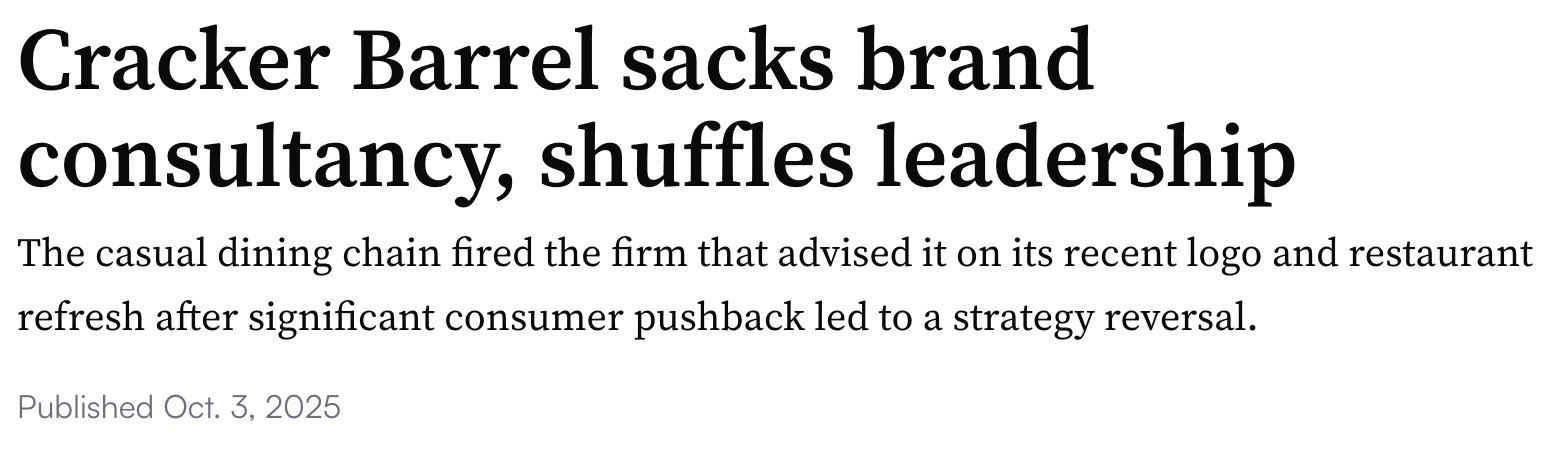
Some senior people who were in the headquarters office last Monday weren’t there anymore as the weekend drew near, some old managers from an earlier corporate culture came back to rewind the clock, and the branding consultant that advised on the now-fatally-wounded rebranding effort was sent packing. The new logo departed. The redesigned stores were acknowledged as a failure and an embarrassment.

[…]

See what they said about the redesign? “We won’t continue with it”. The whole thing collapsed, a $700 million rebrand that slammed into a concrete wall and exploded.

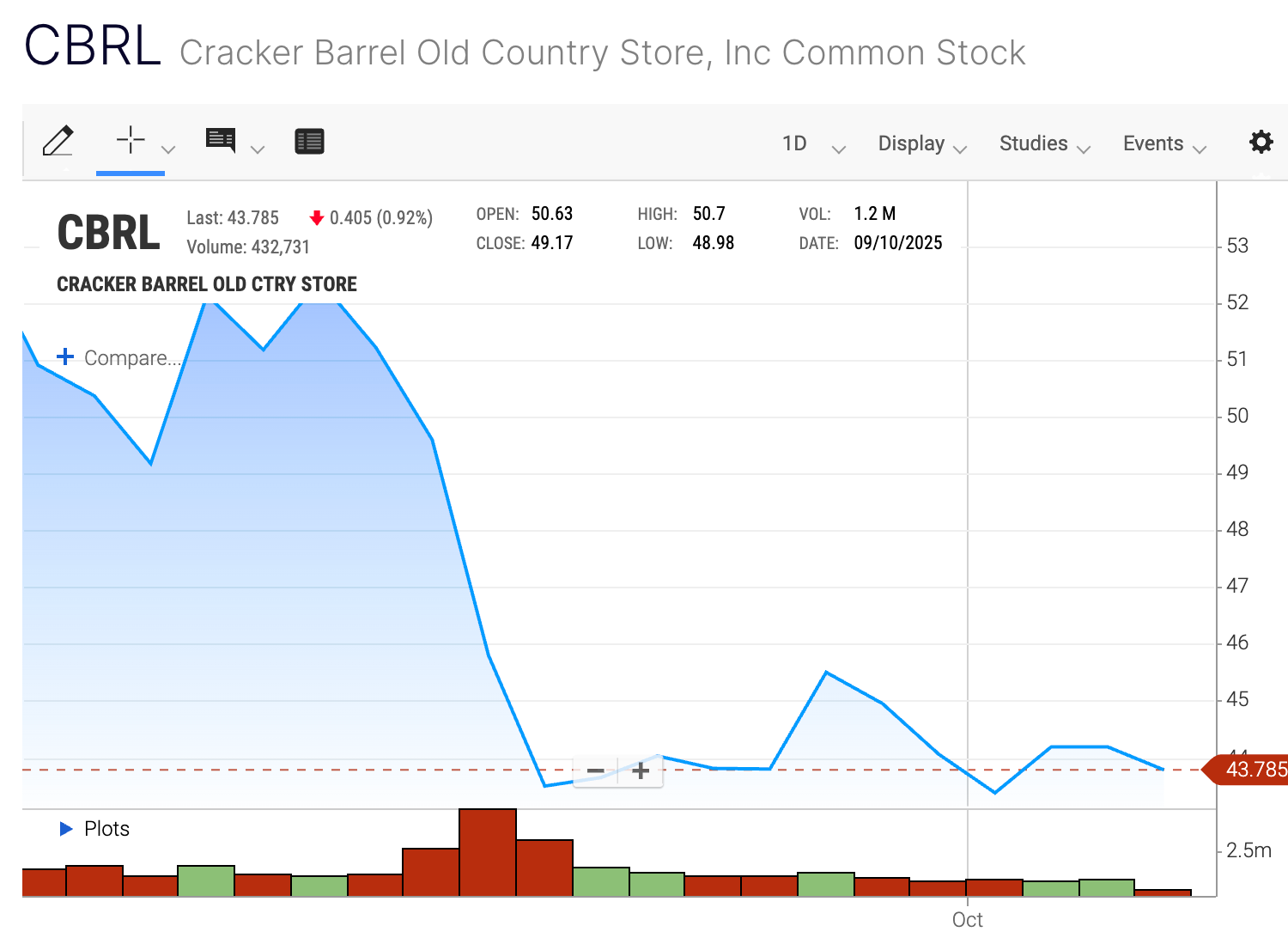
It remains to be seen how much the rebranding of the rebranding will matter, and this is what Cracker Barrel stock looks like in the last month:

Now, a reminder: The New York Times columnist David French explained, just over a month ago, that the controversy over Cracker Barrel’s rebranding was an absurd fake crisis ginned up by right-wing idiots who were just pretending that something had gone wrong at the company. Along with the Sydney Sweeney thing, he concluded that we were watching some “completely frivolous and meaningless cultural disputes,” examples of the way “right-wing media both mobilizes its base and bends political reality”. If you believed that the Cracker Barrel rebranding was poorly done and would alienate the company’s customers, you were falling for an invented reality that was completely meaningless and frivolous.

Then Cracker Barrel fired a bunch of managers and its rebranding consultant, abandoned the rebranding, and apologized profusely, while its stock plummeted.

If you listened to David French, if you trusted the op-ed pages of the New York Times to explain the world to you, your understanding of the most basic outline of factual reality was flipped over, turned precisely upside down. He was only wrong about literally every single detail, completely missing what was happening, what it meant, and what would happen in the near future as a result of it. To listen to this idiot is to abuse your own mind, trapping yourself in the confines of an absurd house of ideological mirrors. He is inevitably wrong, completely wrong, reliably wrong to the point of absolute and unyielding madness.

October 5, 2025

The New York Times finally decides that there’s a case for “splitting the Autism spectrum”

Filed under: Health, Media, Politics — Tags: , — Nicholas @ 03:00

Freddie deBoer on the stereotyped way that the “Gray Lady” — the New York Times — once again lets the independent media do all the serious work to investigate an issue before “the Grey Lady squats down on that issue and says ‘this is mine now'”:

You may groan! You may say, “Again?” You may roll your eyes. But I’m going to talk about this one more time, and then I think I’m done. But I’ve always been right about all of this, and it needs to be said.

The Times has once again parachuted into a conversation that has been going on for decades, planted its flag, and declared itself the discoverer of new territory. Yesterday they published a piece on autism, neurodiversity, RFK Jr., and whether the autism spectrum should be split up — split back up, that is, to reflect on the massive differences between those with profound autism and those for whom “neurodiversity” is mostly a social badge, a tidbit to be displayed on a Bumble profile. (The answer is yes, of course the spectrum should be split up again, for reasons I’ve written about at great length.) That issue, unusually raw, will bubble on, as it sits at a genuinely uncomfortable intersection of liberal identity norms, online culture, and the genuinely debilitating reality of severe autism. In terms of progressive discourse rules, the plight of the severely autistic and their loved ones is truly a problem from hell: those rules insist that you can’t ever question someone’s diagnosis, no matter how dubious; they demand that you acquiesce to claims made from a position of disability, no matter if they cut directly against the claims made by others from their own position of disability; they have long ago lost sight of any distinction between identity and disorder; and they’re governed by a selective and incoherent vision of standpoint theory that insists that only the autistic can speak out about autism – which perversely empowers the least-afflicted and silences the interests of the most-afflicted, as the most-afflicted literally cannot speak for themselves. You know my rap on all this.

In meta terms, though? This tendency of the NYT to helicopter in to long-simmering debates and bless them with the paper’s attention, and in so doing anoint those debates as worthy of attention by grownups, is only the latest example in an old, ugly dynamic. The little people in independent media ask difficult questions and engage in rancorous debates and stick their necks out in the service of ideas, which is what the media is supposed to do. Then, once the heavy lifting is done, the Grey Lady squats down on that issue and says “this is mine now”. The paper’s consolidation of both prestige and financial security — its status as both far and away the most prestigious publication in world media and maybe literally the only financially healthy newspaper left in the United States — has all manner of pernicious, perverse consequences in an industry that can only function when people within it are engaged in debates with real stakes and real hurt feelings. Again, nothing you haven’t already heard from me. But when there is only one endpoint for the ambitious to aspire to, there’s an inherent and unavoidable silence about that endpoint’s myriad failings. The Times, for its part, has walled off criticism within its own pages with its “we don’t do media criticism” rule, a profoundly self-interested and cynical policy that helps them evade ever having to justify their own widely-criticized practices. And for all manner of complex reasons, the broader world of stodgy old media, dying though it may be, still holds all the cards when it comes to defining debates that involve institutional stakeholders, as the debate about autism’s future certainly does.

I don’t begrudge any writer for wanting to weigh in on these issues — God knows they matter and need more attention — but what’s striking about the Times‘s coverage is how effortlessly it erases the long history of people already fighting these battles, and the richness of the debate that preceded them. Whole archives of independent writing, analysis, and advocacy disappear when the Paper of Record decides that a question now exists. Until then, the issue is marginal, unserious, relegated to the sidelines; afterward, it’s real, it’s official, it’s legitimate … and therefore too important to be left up to those of us in the cheap seats. This is the paradox, you see; no issue that independent media concerns itself with can be considered truly serious, and no issue that they (eventually) deign to be truly serious is something that they trust the independent media to engage with responsibly. Quite a little trap, there. And when the grownups in the room walk in, we’re meant to feel blessed by their presence, happy to have our pet issues taken seriously. Everyone else who’s been in the trenches for years is supposed to be grateful for their newfound recognition.

September 30, 2025

When your prime minister is addicted to photo ops

Filed under: Cancon, Government, Media, Politics — Tags: , , , , , — Nicholas @ 05:00

You might think, from my headline, that I’m referring to former prime minister Justin Trudeau — who really, really did love him some gushing media coverage accompanied by advertising-agency-quality visual effects. But it’s actually our current prime minister who has somehow managed to show even more love for the photogenic backdrop and the appealing props in media coverage:

Twice in four days, Prime Minister Mark Carney scheduled official photo ops in front of environments that weren’t entirely real.

During a Sept. 19 visit to Mexico, Carney led cameras through a railyard stocked with pallets of artfully arranged sacks decorated with a maple leaf and the words “product of Canada”.

The site was the Canadian Pacific Kansas City Ferrovalle train yard, located outside Mexico City.

The yard is indeed equipped to process incoming railcars of Canadian wheat, but that’s all done in bulk. Hopper cars are positioned over large tanks to disgorge their loads, multiple tonnes at a time.

If any sacks ever enter into the equation, it’s long after Canadian producers have exited the process.

“Canadian grain farmers haven’t shipped wheat in sacks for over a century!” read a reaction by Chris Warkentin, Conservative MP for the heavily wheat-growing riding of Grande Prairie, Alta.

Sylvain Charlebois, a food scientist at Dalhousie University, wrote in a column this week that “bagged wheat is a relic of less mechanized economies”.

“We are among the most efficient bulk grain exporters in the world, shipping millions of tonnes through rail networks and ocean vessels designed for efficiency, safety, and traceability,” he wrote.

But it was a housing announcement just outside Ottawa where Carney would run into more direct accusations of being deliberately deceptive with his photo backdrop.

On Sept. 14, just before the opening of the fall session of Parliament, Carney stood in front of two under-construction homes in the Ottawa area and announced the official launch of Build Canada Homes, a new federal agency tasked with developing subdivisions of manufactured homes on federal land.

“The two sets of homes behind me were manufactured in two days, assembled on site in one,” Carney said to applause.

“We wanted to keep the townhouses open; we held back the workers from finishing it so you could see how things fit together,” he said, adding that one of the homes was being shipped “to Nunavut”.

Once the press conference was over, both homes were dismantled, and the site returned to what it had been before: A patch of fallow government land located near the Ottawa airport.

The land is a right-of-way for high-voltage power lines, which is why it currently doesn’t contain any development.

At The Rewrite, Peter Menzies congratulates Brian Passifume for being one of the only legacy media reporters to look past the literal Potemkin Village structure Carney had assembled for his photo op:

Our Orwellian theme continues but, this time, it’s to credit Brian Passifume of the Toronto Sun for his work digging into how our prime minister and his staff work to create fantasy settings for their announcements. Canadian Press and others were happy to play government propagandist by captioning a photo taken at Prime Minister Mark Carney’s Canada Builds launch by stating “Workers from Caivan Homes look on from a modular home under construction in Ottawa during Prime Minister Carney’s announcement for the new agency.”

Near as I can tell, most other media were happy to play along. Except Passifume who broke from the pack and pointed out the whole scene was, essentially, a movie set.

After one X user pointed out that the entire scene was fake, Passifume jumped in with “Dude I was there, that’s exactly what happened. It was a freshly-graded gravel lot with no utilities or services run. I was discussing this very topic with other reporters covering it — they didn’t even move the crane or remove the lifting apparatus, they just repurposed it to hold a gigantic Canadian flag.”

I expect some in the trade will say “hey, everyone does it” and no doubt that is true. But when people with power and those who crave it misrepresent reality, journalists are obliged to point that out. It doesn’t even have to be aggressive, just “Carney said in front of a set created for the announcement”.

Journalism isn’t actually that complicated. You just have to subscribe to its principles.

September 26, 2025

A ministry for “Heritage” should not be funding hate publications

Filed under: Cancon, Government, Media, Politics — Tags: , , , , — Nicholas @ 04:00

I’m with Dan Knight that the government shouldn’t be funding any private networks, magazines, or newspapers, but since it does provide a lot of funds through various programs, it should at the very least strive to avoid funding open hatred toward ordinary Canadians:

Steven Guilbeault at a happier stage of his life, before joining the Liberal cabinet.

In a fiery exchange at the Standing Committee on Canadian Heritage (CHPC), Conservative MP Rachel Thomas dismantled Liberal Minister Hon. Steven Guilbeault, P.C., M.P., Minister of Canadian Identity and Culture and Minister responsible for Official Languages, over taxpayer money funneled into groups publishing hate-laced screeds and smearing everyday Canadians.

Thomas zeroed in on Cult MTL, a publication receiving federal heritage funds. She read into the record a headline published the very day after reports of Charlie Kirk’s assassination attempt: “To Hell with Charlie Kirk”.

“Minister, do you think that is wrong? Taxpayer dollars are funding this group. Will you revoke their funding?” Thomas demanded.

Guilbeault looked blindsided. He admitted he had no idea the government was bankrolling a tabloid openly celebrating political violence. His answer:

    I have not been made aware of this. I will verify with the department and report back to you. Obviously, spreading hate has no place in Canada, and if this is the case, we will make the necessary verifications and take the necessary steps.

Thomas didn’t stop there. She turned to the Canadian Anti-Hate Network, which she said has already pocketed about $1 million from Guilbeault’s department. Documents show the group paid an “investigative journalist” to hunt down so-called “far-right” targets — defining the term so broadly it included Catholics and pro-life Canadians — before seeding the stories into mainstream news outlets.

[…]

Conservative MP Rachel Thomas quoted former CBC anchor Travis Dhanraj, who launched a human rights complaint this summer […]

    To be honest, this has been the hardest period of my life. What happened at CBC really broke me.

Then she put it directly to Guilbeault:

    Have you reached out to the CEO of the CBC regarding this situation and the toxic work environment that is being accused there?

Guilbeault’s answer? Bureaucratic shrugging:

    The government role is not to get mixed into the daily operations and management of the organization. That is the purview of the organization, in this case, the public broadcaster.

Translation: $1.4 billion of your money flows into CBC every year, but the minister says he can’t pick up the phone when staff say they’re being harassed.

September 22, 2025

The Liberals fervently believe that saying something is the same as doing something

One of the most irritating aspects of Justin Trudeau’s long reign of error was his evident joy in making announcements about this or that topic. It got to the point that even the pro-Liberal media started to notice that the same policy would be announced several times over a few months but no actual progress was made (except where they could start setting up a new government program … they’d hire the staff very quickly, but little or nothing would get done beyond that). Mark Carney was supposed to be a clean break from the Trudeau years — even though most of his ministers were Trudeau retreads — but Carney may actually be worse than Trudeau in that he just loves photo ops with pretty props for the cameras. As Dr. Sylvain Charlebois notes, we need a lot fewer photogenic Potemkin Villages in how our federal government operates:

In recent weeks, we have witnessed politicians lean on powerful visuals to make their case on food and trade. But these staged moments rarely serve the public interest. Worse, they often deepen food illiteracy in a country where understanding how our system works is already fragile.

Take Ontario Premier Doug Ford’s stunt. Upset with Diageo’s decision to close its bottling plant in Ontario, he theatrically dumped a bottle of Crown Royal and urged Ontarians to boycott the brand. What he didn’t mention is that the bottle in question was made in Manitoba and bottled in Quebec by unionized Canadian workers — jobs unaffected by the Ontario closure. The Windsor facility mainly serviced the U.S. market, and Diageo’s decision was years in the making. Ironically, the boycott risks punishing Canadian workers who will continue producing Crown Royal for Canadians. And for future investors, the message is chilling: why put capital into Ontario if a government will trash your brand on television for a corporate restructuring decision?

The federal stage brought us another head-scratcher. During a trade visit to Mexico, Prime Minister Mark Carney posed with bags of Canadian wheat stamped with a maple leaf. The problem? Canada doesn’t export wheat in bags. We are among the most efficient bulk grain exporters in the world, shipping millions of tonnes through rail networks and ocean vessels designed for efficiency, safety, and traceability. Bagged wheat is a relic of less mechanized economies. For Canada to present itself this way trivializes our status as a modern agri-food powerhouse. Beyond being misleading, the image suggests to global partners that our system is less advanced than it truly is — a dangerous misrepresentation for a nation that depends on reputation as much as price.

Even I didn’t realize how bad it got until the feds paid contractors to put up a fake building site for Mark Carney to pose in front of, then tore it all down:

September 7, 2025

Long before the “Bad Orange Man”, there was “T.R.”

In the Coolidge Review, Amity Shlaes points out some strong similarities between Donald Trump’s career and that of the Bull Moose himself, Theodore Roosevelt:

Though a century apart—TR served from 1901 to 1909 — these two chief executives have favored the same modus operandi: using unpredictability to amass power. And the record of Theodore Rex, as Edmund Morris titled his TR biography, bodes ill for both the economy and the Republican Party.

The Trump-TR Parallels

But to the similarities. They start, for both men, pre–White House. As Trump did, TR staged his pre-presidential efforts as much with an eye to public recognition as to sustained reform or strengthening institutions.

Whenever TR stumbled, he pivoted to a new venture and publicized it like mad, though the medium in those days was the printed word, not season after season on The Apprentice. Before the cognoscenti had even absorbed the meaning of the young Roosevelt’s humiliating fourth-place score in a key 1886 New York City mayoral contest, for example, TR was off to the Badlands, memorializing his ranching experiences in dispatches and books such as Ranch Life and the Hunting Trail.

As Trump does, TR routinely alienated GOP grandees, circumventing them to get ahead. As Trump has, TR skillfully cultivated the media — so skillfully that members of Congress were left trying catch up with whatever shifts in public opinion resulted from the politician’s press alliances. TR’s Rupert Murdoch was the widely syndicated William Allen White of Kansas’s influential Emporia Gazette. TR’s equivalent of Fox News was the New York Journal, whose owner, William Randolph Hearst, drummed a steady beat of support when Roosevelt called for war against Spain.

Today, Murdoch must be scratching his head over what his showcasing Trump has wrought, especially now that Trump decided to sue both Murdoch and his Wall Street Journal. White, too, found that he had second thoughts about his decision to back TR: “Roosevelt bit me and I went mad,” White reportedly told a colleague.

[…]

BULLY

The occupant of what he labeled the Bully Pulpit — “bully” as in “excellent” — proved a literal bully as well.

As president, TR perpetually unnerved fellow Republicans, pivoting back to domestic politics. As Trump has, TR cast his campaigns in moral terms rather than economic ones. Where Trump launched his tariff war, TR made war against trusts, large combinations of companies. Relying more on whim than statute, Roosevelt segregated trusts into “good trusts” and “bad trusts”.

TR targeted an invincible-looking industry that, in those days, mattered as much as the interstate highways, or the internet, do today: railroads. James Hill’s Great Northern Railway took over a struggling competitor, Northern Pacific. Roosevelt asked Hanna what he made of the combined entity, Great Northern Securities. Hanna replied that it was “the very best thing possible for the future of the whole Northwest territory”. Roosevelt nonetheless sicced the Justice Department on the Great Northern.

J. Pierpont Morgan, a participant in the beleaguered deal, called on the president to inquire, as desperate steel importers these days do from time to time, whether their attorneys might work out the matter behind the scenes.

No.

Next, the disconcerted Morgan asked whether other investments of the House of Morgan might be assailed. Roosevelt’s reply captures the chill of arbitrary leadership. The administration would not go after the other Morgan companies, he said — unless “they have done something we regard as wrong”.

As Edmund Morris reports in Theodore Rex, to observers such as French ambassador Jules Jusserand, Roosevelt seemed “more powerful than a king”. That power suited many voters fine, which is why Roosevelt won so headily when he ran for office on his own in 1904.

Of course TR, like Trump, occasionally supported laws that aligned with his impulses. One example is the Elkins Act of 1903, which made it illegal for railroads to charge different freight rates for different customers. This shallow effort to achieve market “fairness” deprived the railroads of a standard business tool: the ability to provides discounts to those who buy the product in larger quantities. Shares in railroads promptly dropped more than 20 percent, a shift that undermined TR’s premise of railroad invincibility.

August 18, 2025

Canada’s state-subsidized media now seem to see their job as pro-government PR

Filed under: Cancon, Government, Liberty, Media, Politics — Tags: , , , , , — Nicholas @ 05:00

At The Rewrite, Peter Menzies considers the state of Canadian media in how they reported on the Maritime provinces’ draconian policies during the ongoing wildfire season:

Screencaptured image of one of the August 2025 wildfires in the Maritimes from Global News via The Rewrite

There will always be conflicts between collective rights and individual liberties. One is valuable in ensuring there is order in society, which is important. The other is necessary to maintain freedom, which lots of people live without but is nevertheless desirable. When there’s too much freedom, people look for politicians who will restore order. When there is too much order, people rebel and demand freedom (see everything from the French Revolution to the Freedom Convoy).

Traditionally, those inclined to the order side if the ledger have been viewed as conservatives while “liberals” have led the fight for individual freedom manifest in the civil rights movement, the emancipation and advancement of women, freedom of speech, etc. that are now viewed as fundamental to the maintenance of a modern, liberal democracy.

But as Pete Townsend wrote a little more than half a century ago, the parting on the left is now the parting on the right (and the beards have all grown longer overnight). Journalists tend to lean left, which means their traditional opposition to the imposition of order has been replaced by a collectivist tendency to sympathize with those imposing it. It is left to the newsroom minorities on the right to carry the torch for individual liberties.

To wit, this CBC story on Nova Scotia’s wild fire-induced ban — enforced with a $25,000 fine until Oct. 15 — on walking anywhere in the woods was oblivious to the impact on personal freedom. Never crossed their minds. When the issue was raised on social media, Twitter journos took up the cause. Stephen Maher dismissed individual liberty concerns as fringe views and maintained that the restrictions could be justified as “reasonable” limitations of Charter rights. While the Globe and Mail‘s editorial board called the Nova Scotia move “draconian”, Globe columnist Andrew Coyne nevertheless wondered “How the hell did the right to walk in the woods of Nova Scotia during a forest fire emergency get elevated into the right’s latest cultural obsession?”

It was left to commentators such as Marco Navarro-Genie to point out the intellectual flaccidity fueling parts of the collectivist argument when New Brunswick followed Nova Scotia’s lead and NB Premier Susan Holt said this:

    Me going for a walk in the woods is gonna cause a fire. I can understand why people, uh, think that that’s, that’s. That’s ridiculous. But the reality is, it’s not that you might cause a fire, it’s that if you’re out there walking in the woods and you break your leg, we’re not gonna come and get you because we have emergency responders that are out focused on a fire that is, uh, threatening the lives of New Brunswickers.

That, believe it or not, was a good enough explanation for the collectivist thinking in most mainstream newsrooms.

If journalism is to be useful in defending democracy, those involved in it need to be intellectually equipped to understand the stakes. And their first instinct must be to treat the suppression of liberty as a serious issue whenever the powerful indulge in it at the expense of the powerless. That doesn’t mean liberty should always trump order (traffic lights are eminently reasonable). But it does mean that journos should demand that politicians justify their actions rather than simply helping them explain them to the Great Unwashed. To do otherwise is to fail.

August 13, 2025

QotD: The New York Times and their 1619 project

Filed under: History, Media, Quotations, USA — Tags: , , , , — Nicholas @ 01:00

In a NYT town hall recently leaked to the press, a reporter asked the executive editor, Dean Baquet, why the Times doesn’t integrate the message of the 1619 Project into every single subject the paper covers: “I’m wondering to what extent you think that the fact of racism and white supremacy being sort of the foundation of this country should play into our reporting … I just feel like racism is in everything. It should be considered in our science reporting, in our culture reporting, in our national reporting. And so, to me, it’s less about the individual instances of racism, and sort of how we’re thinking about racism and white supremacy as the foundation of all of the systems in the country.”

It’s a good point, isn’t it? If you don’t believe in a liberal view of the world, if you hold the doctrines of critical race theory, and believe that “all of the systems in the country” whatever they may be, are defined by a belief in the sub-humanity of black Americans, why isn’t every issue covered that way? Baquet had no answer to this contradiction, except to say that the 1619 Project was a good start: “One reason we all signed off on the 1619 Project and made it so ambitious and expansive was to teach our readers to think a little bit more like that”. In other words, the objective was to get liberal readers to think a little bit more like neo-Marxists.

The New York Times, by its executive editor’s own admission, is increasingly engaged in a project of reporting everything through the prism of white supremacy and critical race theory, in order to “teach” its readers to think in these crudely reductionist and racial terms. That’s why this issue wasn’t called, say, “special issue”, but a “project”. It’s as much activism as journalism. And that’s the reason I’m dwelling on this a few weeks later. I’m constantly told that critical race theory is secluded on college campuses, and has no impact outside of them … and yet the newspaper of record, in a dizzyingly short space of time, is now captive to it. Its magazine covers the legacy of slavery not with a variety of scholars, or a diversity of views, but with critical race theory, espoused almost exclusively by black writers, as its sole interpretative mechanism.

Don’t get me wrong. I think that view deserves to be heard. The idea that the core truth of human society is that it is composed of invisible systems of oppression based on race (sex, gender, etc.), and that liberal democracy is merely a mask to conceal this core truth, and that a liberal society must therefore be dismantled in order to secure racial/social justice is a legitimate worldview. (That view that “systems” determine human history and that the individual is a mere cog in those systems is what makes it neo-Marxist and anti-liberal.) But I sure don’t think it deserves to be incarnated as the only way to understand our collective history, let alone be presented as the authoritative truth, in a newspaper people rely on for some gesture toward objectivity.

Andrew Sullivan, “The New York Times Has Abandoned Liberalism for Activism”, New York, 2019-09-13.

August 9, 2025

QotD: The New Newspeak

Filed under: Africa, Media, Politics, Quotations, USA — Tags: , , , , — Nicholas @ 01:00

One of the core premises of critical theory — the academic project that undergirds much of today’s progressive politics — is that controlling language is essential. Since critical theorists suggest that there is not any objective reality, and that there are only narratives imposed by oppressors, changing the meaning of words is essential to gaining and maintaining power. After all, they sure don’t believe in open debate. Some of this is subtle. The New York Times, an institution now meaningfully captured by the doctrines of critical theory, will now capitalize “Black,” for example, but will not capitalize “white” or “brown”.

I’ve read their explanation a few times and it seems to boil down to the idea that all people of African descent all around the world are somehow one single identifiable entity, while white and brown people are too diverse and variegated to be treated the same way. (The Times explains: “We’ve decided to adopt the change and start using uppercase ‘Black’ to describe people and cultures of African origin, both in the United States and elsewhere.”)

Given the extraordinary diversity of the African continent, and the vast range of cultural, ethnic, religious, and tribal differences among Americans of African descent — new immigrants and descendants of slaves, East and West Africans, people from the Caribbean and South America, and the Middle East — this seems more than a little reductionist. As Times contributor Thomas Chatterton Williams has noted, there are “371 tribes in Nigeria alone. How can even all the immigrants from Nigeria, from Igbo to Yoruba, be said to constitute a single ethnicity? Let alone belong to the same ethnicity as tenth-generation descendants from Mississippi share-croppers?” The point, of course, is to ignore all these real-life differences in order to promote the narrative that critical race theory demands: All that matters is oppression.

Andrew Sullivan, “China Is a Genocidal Menace”, New York, 2020-07-03.

August 6, 2025

Do journalists’ “unnamed sources” have to actually exist? Asking for an imaginary friend …

Filed under: Cancon, Media, Politics — Tags: , , , , — Nicholas @ 03:00

At The Rewrite, Peter Menzies discusses the growing trend of Canadian journalists depending on “unnamed sources” to fill in details in their political stories:

No name news image created by Grok, via The Rewrite

If I spun you a tale about my life as a mercenary in the 2012 Guinea-Bissau coup d’etat, I’d probably get your attention.

It would be a ripping good yarn, filled with evil masterminds, hints of Bond villains, precious relics, and blood diamonds. I might even sprinkle it with how I’d heard that the Ark of the Covenant is guarded quietly and stored in Nokolo-Koba National Park, not far from the Gambia River.

You might enjoy it. But I’m thinking you might ask for proof. Trust me, I would say, it’s not something I’m at liberty to discuss freely. Loose lips sink ships, these boys don’t like publicity, I’m not authorized, I wish to speak freely, etc. You’re going to have to put your faith in me.

Which, while I used hyperbole to make the point, is what the nation’s reporters are increasingly asking the public to do.

The once rare use of unnamed sources in the new “just trust me” world of Canadian journalism is getting out of control.

Exhibit A is a National Post story posted on May 23 in which readers learn of changes in the Prime Minister’s Office where staff are now expected to dress professionally and show up on time. In other words, a return to what most people would view as normal office decorum. Yes, you might wonder — as I did — why this constitutes news while the previous nine years’ shabbily-attired tardiness went unreported, but that would involve a significant digression. Another day, perhaps.

The sources were “half a dozen current and former PMO officials, senior bureaucrats and caucus members”, granted anonymity “to discuss internal workings of government openly”.

Two are “former” Liberal staffers, which makes one wonder if they might bear a grudge and what their motivations are. There is not a single named source in the story, nor is there any reference to the Post having asked the current management of the PMO for comment.

Exhibit B is the May 14 analysis on the pages of the Globe and Mail, which explains the thinking involved in selecting a finance minister. The thesis was based on “seven sources who have worked for Liberal and Conservative governments over the last two decades”, whose identities are being hidden “because they were not authorized by their parties to speak publicly about the federal finance minister”.

In Exhibit C, CBC/Radio Canada uses no fewer than 12 — count ’em — anonymous sources discussing whether party leader Pierre Poilievre should dismiss his chief of staff and recent campaign manager, Jenni Byrne. All were granted “confidentiality to discuss internal party matters”.

To his credit, the reporter selected sources offering a variety of perspectives on the issue. But still, other than reference to public statements by Poilievre, no one is on the record even for passive phrases such as “No one seems ready to make this their hill to die on”. Are there no political scientists left to comment on such topics?

July 27, 2025

QotD: London coffeehouses and Paris salons of the Ancien Régime

Marie Antoinette arrived in Paris at the end of this era of strict censorship, which helps explain why her honeymoon with French public opinion was short-lived. The official press, notably the Mercure and Gazette, continued churning out fawning snippets of society news about the royal couple. But the scandal-mongering libelles and pamphlets had their own paragraph men, called nouvellistes, who picked up “news” from well-informed sources posted on benches in the Tuileries, Luxembourg Gardens, and, of course, under the tree of Cracow. Police efforts to repress nouvellistes‘ gossip proved futile in the face of high demand. One famous libelle of the era, Le Gazetier cuirassé promised “scandalous anecdotes about the French court”. (It was printed in London, out of reach of official French censors.) Another publication printed in London starting in the 1760s was the famous Mémoires secrets, an anonymous chronicle of insider gossip and anecdotes from Parisian high society. A scurrilous book about Louis XV’s mistress, Madame du Barry, also appeared as a collection of gossip that nouvellistes had picked up around Paris.

Despite the libelles circulating in Paris, the Bourbon monarchy was still relatively protected compared with the hurly-burly across the channel in London, where coffeehouses buzzed with political innuendo and intrigue. Some French philosophes, it is true, attempted to replicate London’s coffeehouse culture at Parisian cafés, such as the Procope on the Left Bank. (Voltaire frequented the place, where he liked to add chocolate to his coffee.) Other regulars at the Procope — named after the Byzantine writer Procopius, famous for his Secret History — were Rousseau, Danton, and Robespierre, as well as Americans Benjamin Franklin and Thomas Jefferson.

The Parisian equivalent of the coffeehouse was the salon, which differed from London coffeehouses in both ambience and function. Whereas London coffeehouses were boisterously public, salons were essentially closed spaces, usually held in private homes. Most were by invitation only. Many were hosted by women, usually titled or wealthy ladies with an interest in culture and politics — such as Madame de Rambouillet, Madame Necker, Madame Geoffrin, and Mademoiselle Lespinasse. There was also the Marquise du Deffand, a friend to Voltaire and the English man of letters Horace Walpole, to whom she bequeathed not only her papers, but also her pet dog, Tonton.

As access to these rarefied spaces increasingly became a symbol of social success, admission got more tightly controlled. (Madame Geoffrin expelled Diderot from her salon because she found his conversation “quite beyond control”.) Still, those who frequented salons represented a great diversity within the elites — from rising young writers and established authors to powerful politicians and eccentric aristocrats. The tacit rule was, as in London coffeehouses, that wit was more important than rank. Many great French writers launched their careers thanks to their admittance. One was the philosopher Montesquieu, who found success at the salon of Madame Lambert.

Matthew Fraser, “Marie Antoinette: Figure of Myth, Magnet for Lies”, Quillette, 2020-06-24.

July 9, 2025

NATO secretary general Mark Rutte – Trump’s biggest European fanboy?

Filed under: Europe, Military, Politics, USA — Tags: , , — Nicholas @ 03:00

I don’t often encounter positive reactions to US President Donald Trump from the other side of the pond, but Paul Wells makes a case here for Mark Rutte, the current secretary general of the NATO alliance, being utterly sincere in his regard for his American “daddy”:

Mark Rutte, the NATO secretary general.
Photo from Paul Wells’ substack

I haven’t seen much commentary about Mark Rutte’s weekend interview with the New York Times. It’s quite an interview. If the NATO secretary general is faking his enthusiasm for Donald Trump, he’s really committing to the bit.

I’m going to quote Rutte’s remarks in greater detail than you sometimes get, because what really stands out over the 36-minute podcast that resulted from the Times interview is Rutte’s doggedness. He doesn’t simply treat the US president as a containable problem, as European security experts sometimes do, but as nothing less than a full NATO partner and, indeed, as the hero of the alliance’s revitalization.

“President Trump deserves all the praise,” he tells interviewer Lulu Garcia-Navarro, a longtime NPR foreign correspondent before she joined the Times, “because without his leadership, without him being re-elected president of the United States, the 2% this year and the 5% in 2035 — we would never, ever, ever have been able to achieve agreement on this.”

Does he regret that Trump posted what the AP and a lot of others called a “fawning” text message in which Rutte wrote to Trump, “Europe is going to pay in a BIG way, as they should, and it will be your win”? “Not at all, because what was in the text message is exactly as I see it.”

Is the integrity of NATO’s defense perimeter solid? “But it’s not that the Estonians are left to themselves. It would be the full force of NATO, including the full backup of the United States, which will come to the rescue. Putin knows this.”

Garcia-Navarro keeps pushing. Full backup of the United States, she says? You bet, Rutte says. In “everything I’ve discussed over the last six months with the new U.S. administration” there is “absolutely no shiver of a doubt that the U.S. is completely committed to NATO, is completely committed to Article 5,” the Alliance’s collective-defence principle.

Isn’t there a “fundamental disconnect” between the way Trump views the world and the commitments needed to make NATO work? Rutte answers: Nope! “President Trump put in place an excellent foreign-policy team, including Marco Rubio and Pete Hegseth,” he offers.

But “what we are seeing,” Garcia-Navarro insists, perhaps in reference to this or this, “is the United States pulling back from Europe.”

“I really have to correct you,” Rutte insists in turn. “The United States is not pulling away from Europe.”

Where does Rutte stand on the credibility and prospects of Russia-Ukraine peace talks? “With the risk that I’m again praising President Trump: He is the one who broke the deadlock with Putin. When he became president in January, he started these discussions with Putin, and he was the only one who was able to do this. This had to happen.”

July 4, 2025

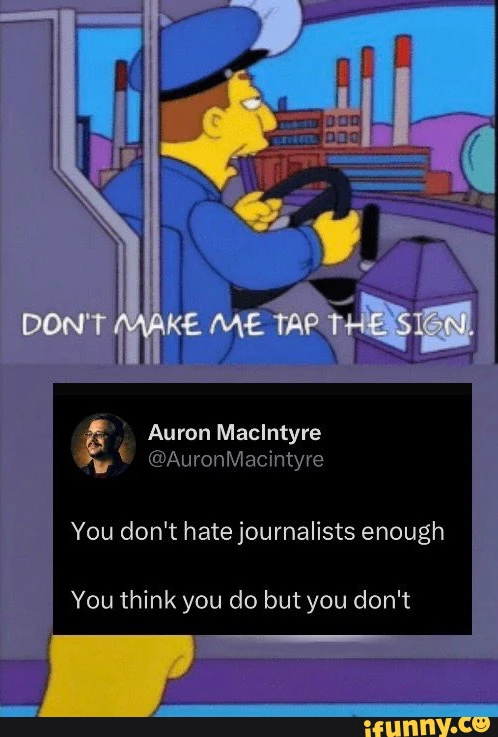
As they say, “you don’t hate the media enough”

Filed under: Cancon, Media, Politics — Tags: , , , , — Nicholas @ 05:00

In the National Post, Chris Selley points out that it was literally just the media who got their panties twisted up over flying the Canadian flag during and after the Freedom Convoy protests in 2022:

One of the stupidest arguments to emerge during Canada’s pandemic experience was the idea that by flying the Canadian flag, the Freedom Convoy types had ruined the Canadian flag for everyone else. And that Canadians, as a result, were hesitant to display the flag lest they be thought of as anti-vaxxers, COVID-deniers or outright Nazis.

It’s not true, and the idea was completely absurd. If you’re driving through, say, Vermont and see the stars and stripes flying on someone’s front lawn, do you assume they supported the Jan. 6, 2021 attack on the Capitol? When you see the St. George’s Cross waved at an English soccer game, do you assume the flag-waver supports the English Defence League? When you see the French tricolour do you instantly think of Marine Le Pen and the far-right Front National?

You don’t, because that would be stupid. People advancing causes that they feel to be of national importance tend to deploy national flags. Rarely are those causes universally supported. Few causes are.

At the time I ascribed the narrative mostly to COVID-induced hysteria. The Globe and Mail‘s and Toronto Star‘s comment pages always reflect a somewhat, shall we say, limited perspective on Canadian society. But the pandemic trapped opinion writers behind their keyboards and in their online echo chambers more than ever before. It was febrile. People across the political spectrum went just a bit nuts, and I don’t exclude myself.

But with the pandemic behind us, with the keyboard class mostly resigned-to-happy with how it went (better than America is all that really counts, right?) I was a bit surprised to see this narrative exhumed, dressed up in a Hawaiian shirt and dragged around town for Canada Day in triumph. The narrative: We have our flag back!

“The dissidents stole our flag,” Gary Mason wrote in the Globe. “They flew our flag from their trucks. They hung it over their encampments. By the end, many Canadians associated the red-and-white Maple Leaf with the so-called Freedom Convoy.

July 3, 2025

“[T]he old Fleet Street … would not have foregone the pleasures of a story involving the words ‘prime minister’, ‘firebombings’ and ‘quartet of male models'”

Filed under: Britain, Government, Media, Politics — Tags: , , , — Nicholas @ 04:00

Mark Steyn notes the amazing disinterest the British press has been showing for Prime Minister Keir Starmer’s recent firebombing “male model” troubles:

Sir Keir Starmer speaking to the media outside Number 10 Downing Street upon his appointment.
Picture by Kirsty O’Connor/ No 10 Downing Street via Wikimedia Commons.

Meanwhile, “Two-Teir Keir” gave an extraordinary interview to a friend from The Observer, in which he reveals that, other than his war on the remnants of UK free speech, he’s spent the last year getting everything wrong. It’s a weird and psychologically unhealthy confessional that one could not imagine from any of his predecessors, whether the wretched David Cameron or the Marquess of Salisbury. If you want the scoop, skip the lame-arse coverage from the decaying Spectator and go to my old chum Dan Wootton. The Speccie’s snoozeroo “gossip columnist” headlines his piece “Four lowlights from Starmer’s Observer interview“, yet fails to note the most intriguing lowlight of all.

Six weeks ago, Sir Keir gave a speech on immigration which, while being a statement of the bloody obvious two decades too late, nevertheless went further than anyone else of any consequence in British life has been prepared to go. Somewhat curiously, this speech came just a few hours after his car exploded and two houses of his were firebombed — for which three (at the time of writing) Ukrainian “male models” have been arrested. I would not wish to suggest the PM has a unique fascination with Ukrainian “male models”. A fourth man has since been arrested — a “male model” from Romania. Diversity is our happy ending! The words “male model” do not appear in The Observer‘s account:

    In the small hours of 12 May this year, there was a firebomb attack on the Starmer family home in Kentish Town. His sister-in-law, who had been renting the house since he became prime minister, was upstairs with her partner when the front door was set alight. “She happened to still be awake,” Starmer says, “so she heard the noise and got the fire brigade. But it could have been a different story …”

    The prime minister, who had arrived back from a three-day trip to Ukraine the night before, was due to unveil the government’s new immigration policy that morning. “It’s fair to say I wasn’t in the best state to make a big speech,” he says. “I was really, really worried. I almost said: ‘I won’t do the bloody press conference.’ Vic [Lady Starmer] was really shaken up as, in truth, was I. It was just a case of reading the words out and getting through it somehow …” – his voice trails off …

So Sir Keir has now disavowed the only non-bollocks thing he has ever said. He “deeply regrets” saying Britain risked becoming “an island of strangers”, but he only did so, he offers in mitigation, because he was stressed out by all the firebombing from the massed ranks of fetching Slav twinks congregated on his various doorsteps. Unlike the Speccie, my chum Dan Wootton has a nose for a story:

Lucy Connolly was fast-tracked into her gaol cell in nothing flat – because that was the priority of the British state. By comparison, the men who firebombed the Prime Minister’s car and houses will not appear in court until next April, because determining how a remarkable number of East European “models” with no English-language facility were sufficiently familiar with Sir Keir’s homes and car to firebomb them is not a priority. Presumably, by the time April rolls around, the boyish charmers will have been persuaded to do an Axel Rudakubana and cop a plea, so that no trial need be held at all.

Say what you like about the old Fleet Street, but they would not have foregone the pleasures of a story involving the words “prime minister”, “firebombings” and “quartet of male models”. The silence of The Spectator is very typical. If you subscribe to James Delingpole’s view that the increasingly bizarre individuals who make it to the top of the greasy pole — Starmer, Macron, Trudeau — are there because the people who really run the world have got kompromat on them (which is your basic Occam’s Razor), then terror cells of Donbass rent boys blowing up the PM’s motor is an obvious false-flag operation designed to discredit the general thesis …

Here’s the gist of it all, courtesy of another Bob Vylan crowdpleaser:

    Heard you want your country back Ha! Shut the f*** up! Heard you want your country back

    You can’t have that!

I’m Keir Starmer and I endorse this message. As I wrote twenty years ago — whoops, no, thirty sodding years ago, a counter-culture has to have a culture to counter. And in Britain and elsewhere an old establishment has merely been supplanted by a new one with lousier tunes. It’s not “edgy” or “transgressive” if you’re live on the BBC’s biggest outlet at an event run by a bloke with a knighthood. The only true counter-culture is that identified by the pseudo-edgy ersatz-transgressive Sir Bob Vylan — the ones who want their country back. Ask Peter Lynch.

Oh, wait, you can’t: He’s dead. Sir Keir Starmer and Jeremy Richardson KC killed him — because, in order to prevent you “harming” them, it is necessary for them to harm you.

June 18, 2025

QotD: The “doctrine of media untruth”

Filed under: Media, Politics, Quotations, USA — Tags: , , , — Nicholas @ 01:00

As a general rule, when the New York Times, the Washington Post, National Public Radio, Public Broadcasting Service, NBC, CBS, ABC, MSNBC, and CNN begin to parrot a narrative, the truth often is found in simply believing just the opposite.

Put another way, the media’s “truth” is a good guide to what is abjectly false. Perhaps we can call the lesson of this valuable service, the media’s inadvertent ability to convey truth by disguising it with transparent bias and falsehood, the “Doctrine of Media Untruth”.

Victor Davis Hanson, “The Doctrine of Media Untruth”, American Greatness, 2020-05-24.

« Newer PostsOlder Posts »

Powered by WordPress