Quotulatiousness

June 29, 2025

The oddity of Donald Trump’s personal “golden share” in US Steel

Filed under: Business, Government, Japan, USA — Tags: , , — Nicholas @ 04:00

In the National Post, Colby Cosh points out the weirdest element of President Trump’s deal with Nippon Steel for the takeover of venerable US Steel:

A “golden share” is a special kind of equity that gives its holder veto power over specified corporate decisions. It is often used in privatizations to give governments some vestige of control over corporate entities originally created by the state (or, in Canada, the Crown) for public purposes. In this unusual case, the U.S. government is magically gaining a golden share in exchange for permitting the sale of one private company to another. The government will be given the right to choose some U.S. Steel board directors, to forbid any name change, and to veto factory closures, offshoring, acquisitions and other moves.

As the Cato Institute immediately pointed out, this is a de facto nationalization of U.S. Steel — the sort of thing that would have had Cold War conservatives climbing the walls and hooting about socialism. But at least socialism professes to be social! Yesterday a lefty energy reporter named Robinson Meyer was nosing around in the revised corporate charter for the newly-acquired U.S. Steel, and he discovered a remarkable detail that the Cato folks had missed: the decision powers of the golden share have been legally assigned to Donald Trump in person and by name for the duration of his presidency. Only after Trump has left the White House do those golden-share powers revert to actual U.S. government departments (Treasury and Commerce).

The stench of banana-republicanism here is truly overwhelming. Again, any species of government foreign-investment review is bound to have a personal character, but such decisions are not supposed to involve the legally explicit assignment of a valuable corporate asset to the decision-maker in his own person. Can this be described as anything but legalized, open bribery — assuming that U.S. courts will find it legal if the terms of sale are challenged? Where in the U.S. Constitution, or in the history of the United States, can any warrant for this extraordinary behaviour conceivably be found? And will unholy bargains of this nature soon become routine?

June 26, 2025

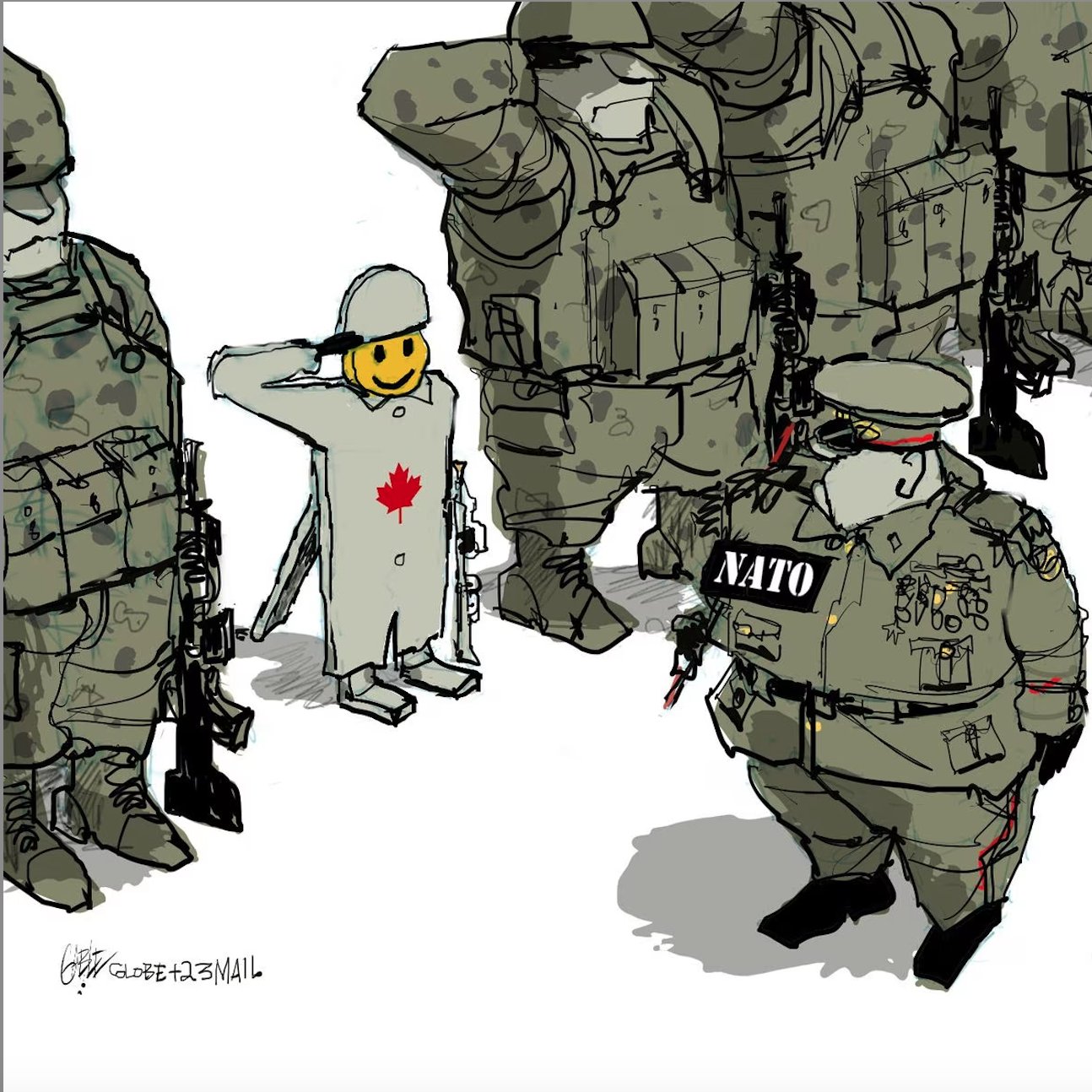
NATO members “commit” to a new 5% defence spending target

Filed under: Cancon, Europe, Military, USA — Tags: , , , , , , — Nicholas @ 03:00

As many predicted, just as Canada finally gets around to at least pretending to meet the 2% defence spending target we agreed to over a decade ago, those goalposts get moved:

So today the leaders of Nato convene for a landmark summit:

NATO countries agree to increase defence spending to 5%

That headline isn’t strictly accurate. Member states have apparently agreed to commit to a target of 5% by 2035, to mark the start of the fourteenth anniversary of the Ukraine war. Which means that, as always with Nato, they’ll all look butch at the photo-op, and then they’ll do bugger all. Even the “commitment” to a “target” is too much for Spain, which has secured an opt-out.

But hang on a minute: Nato has been at war — or at proxy-war — with Russia for three-and-a-half years now. So it’s been on a war-footing, supposedly, for seven-eighths of the length of the First World War. How’s that war-footing going? Per Nato’s head honcho, Mark Rutte (the woeful former Dutch PM — ask our pal Eva Vlaardingerbroek), earlier this month:

    The Russian army is developing its war capabilities by multiple times more than that of NATO despite having an economy 25 times smaller, NATO’s secretary general has warned …

    “The Russians, as we speak are reconstituting themselves at a rapid pace and producing four times more ammunition in three months than the whole of NATO in a year,” said Rutte.

That’s a rather confusing way of putting it; what he means is: the Russians (who, as Mark Levin assures us, “scare nobody”) produce more ammunition in three weeks than the whole of Nato does in a year. Can even Nato be that worthless?

Taking the Secretary-General at his word, if you’re wondering why the Pentagon has to divert ammo marked for Israel to Ukraine and then divert it back from Ukraine to Israel … well, let’s do what everybody else does and dredge up the only historical analogy anybody knows — not the First World War, but the Second (see Levin’s “Iranian Nazi regime”): We’re asked to believe that Nato needs longer than the US was in the Second World War for to move to a war-production footing.

To be sure, supply chains are always difficult: Iran’s threat to close the Strait of Hormuz could have seriously impacted McDonald’s need to recall the hash browns it sent to Montenegro and divert them to Kiribati.

Trump gets something very basic: Flying the highest of high-tech weaponry seven thousand miles to drop down a ventilation shaft opening the size of a dishwasher is the kind of brilliant, dazzling one-off only the United States can do. But what next? Almost all geopolitical conflicts start with a bit of shock-&-awe (Pearl Harbor, even the assassination of the Archduke) and then dwindle down to old-school wars of attrition – as the United States should certainly know after taking twenty years to lose to goatherds with fertiliser, and three years to lose to “a gas station masquerading as a country” (thank you, John McCain). In wars of attrition, old-fashioned unglamorous things become important, like the ability to manufacture bullets in a timely manner. The basic arithmetical calculations are not complex: Don’t get into a long war with an enemy whose stock of long-range ballistic missiles outnumbers your surface-to-air missiles.

So Trump had the narrowest window of opportunity, and used it.

On the other side, the last week-and-a-half mostly revealed the shallowness of the War Party. You’ll recall, for example, that Ted Cruz got into a spat with Tucker over the actual population of Iran. Last week, a UK podcast had a brief discussion on The US Army-Marine Corps Counter-Insurgency Field Manual, which notes the following (foot of page xxvi):

    The troop demands are significant. The manual’s recommendation is a minimum of twenty counterinsurgents per 1,000 residents.

That’s roughly what the British had in Malaya. Which they won, by the way. Twenty-two years ago, a couple of weeks after the fall of Saddam, I stopped on the shoulder of the main western highway from Jordan to Baghdad to fill up from an enterprising Iraqi who’d retrieved some supplies from a looted petrol station and was anxious to sell them to any passing Canadian tourists. As he was topping off, I asked him how agreeable he found the western soldiery. He grinned a big toothless grin and pointed to a chopper that had just come up over the horizon to hover above our heads. Then he said: “Americans only in the sky.”

We did not win that one, you’ll recall. Instead, we created an Iranian client-state.

That’s why Ted Cruz’s breezy indifference when Tucker asked him the population of Iran was so revealing. The senator told Tucker that it doesn’t matter whether the population of Iran is eighty million or a hundred million. Really?

Because, per the Pentagon’s own field manual, the latter figure would require finding an extra 400,000 troops. Oh, wait. If it’s a Nato mission, the other members could muster 127 guys between them, so it would only require 399,873 extra Americans.

Even if the public were minded to put one-and-a-half million pairs of boots on the ground, it couldn’t do it. “Americans only in the sky” equals what an Australian prime minister told me, after a flying visit to the troops in Afghanistan, was “the Crusader fort mentality”.

It doesn’t work. The political divide in America is between, crudely, Trumpians and neocons. The former are anti-war; the latter are pro-war … but a way of war that doesn’t work.

June 12, 2025

Why it’s economically impossible for Walmart to “eat the tariffs” as Trump demands

Filed under: Business, Economics, Government, Politics, USA — Tags: , — Nicholas @ 04:00

At FEE, Peter Jacobsen shows the clear financial reason why Walmart and other big US retailers are passing along the price increases due to Trump’s tariffs rather than “eating them”:

Recently, a post from President Trump on Truth Social went viral. An attempt to convince retail giant Walmart to keep prices down despite the tariffs, it read:

    Walmart should STOP trying to blame Tariffs as the reason for raising prices throughout the chain. Walmart made BILLIONS OF DOLLARS last year, far more than expected. Between Walmart and China they should, as is said, “EAT THE TARIFFS”, and not charge valued customers ANYTHING. I’ll be watching, and so will your customers!!!

Trump’s demand here is, simply put, unreasonable, and it reflects a basic misunderstanding of how pricing decisions are made in a market economy. Let’s unpack why.

Walmart’s Thin Margins

The biggest problem with the President’s view is that it doesn’t pass a basic numbers test. To break it down, let’s look at Walmart’s financials.

It’s true that Walmart generates billions of dollars in revenue each year, but revenue alone doesn’t tell us how much Walmart makes.

To understand that, we need to consider profit, which accounts for the company’s costs. More specifically, we want to look at Walmart’s net profit margin, because that’s an extremely important indicator of whether Walmart could realistically “eat the tariffs”.

Depending on the source, Walmart’s net profit margin is somewhere between 2% and 3%. Let’s split the difference and say it’s 2.5%. What does that mean?

That means, if Walmart sells you $1 of goods, it only keeps 2.5 cents in profit. That’s right, 97.5 cents goes toward inventory, employee wages, store maintenance, and a variety of other operating costs.

Put another way, if you spend $100 at Walmart, they make $2.50 in profit.

Now let’s say you buy a $100 television that Walmart imports. A $20 tariff is imposed — an added cost Walmart has to pay to import the TV. Before the tariff, Walmart was making $2.50 in profits. After the tariff, it’s now taking a $17.50 loss.

The only way Walmart can still sell this TV is by raising the price.

At this point, a tariff supporter might respond: “The easy way to fix this is to buy US-made TVs instead!”

Sure — you can avoid tariffs by only buying domestic, but the problem is that domestic TVs tend to be more expensive. If they weren’t, Walmart wouldn’t be importing them in the first place. So even if Walmart pulls international TVs off the shelves and replaces them with US-made ones, the prices still increase.

Here’s the key point: “eating” the tariffs is not an option. Walmart operates on slim margins, barely making pennies on the dollar — there isn’t room to eat 20% cost increases!

June 4, 2025

“Asshole Britain”

Filed under: Britain, Cancon, Media, Politics, USA — Tags: , , , , — Nicholas @ 05:00

In The Line, Greg Quinn indulges in a bit of struggle sessioning about his earlier disagreements with the editors of The Line about Britain and Canada (protip: don’t search for images to go along with that particular headline, especially if you have “safe search” filters turned off):

Yeah, let’s go with an inoffensive photo of His Royal Majesty and his Canadian First Minister chatting in the Senate chamber, rather than anything remotely to do with the headline of this post.
Photo by Paul Wells from his Substack

On February 12th of this year, I wrote in The Line about how my country, the United Kingdom, had “ghosted” Canada by refusing to come out strongly in reaction to U.S. President Donald Trump’s egregious attacks on the country and his calls for it to become the 51st state. In writing that piece, I didn’t beat around the bush — I called the U.K.’s actions what they were at the time: cowardice and sycophancy.

Since February, there have been a few (many?!) developments in Canada’s — and the world’s — relationship with President Trump.

Not least among these are Matt Gurney and Jen Gerson’s depiction (or technically, implication) of the U.K. as “Asshole Britain”. As other regular Line readers will know, “Asshole Canada” or “Maximum Canada” is an idea the editors floated here some months ago, where they asserted that Canada should abandon its typical desire to be seen as a global do-gooder and simply assert its national interests, vigorously and unapologetically, and if other countries, even allies, object, well, to hell with them. Editor Gurney, in a recent podcast, cited the just-concluded visit of His Majesty the King to Canada to deliver the Throne Speech — the first time a monarch has done so since 1977 — as an example of that. Prime Minister Mark Carney issued the invite to the King despite obvious discomfort with the idea among senior officials in my government.

Carney didn’t care. The King is the sovereign of Canada, too, and Carney didn’t let British discomfort deter him.

I have to say that HM the King’s speech was a blinder and (in its own royal diplomatic way) left no doubt as to where His Majesty’s sympathies lie and how he supports Canada’s sovereignty and independence. Whether you are a royalist or a republican, the fact that HM the King made the trip and read the speech should be welcomed. And I entirely agree with the editors here — Canadians should and must ignore the comments from the U.K. Who cares? HM the King was acting in his capacity as Canada‘s monarch — the views of anyone in the U.K. (government or otherwise) are irrelevant.

I wish I could condemn Jen and Matt for their (again, implied) characterization of the U.K. — Britain has needed no urging to unapologetically assert its own interests in this revived era of Trump. But I can’t. They are absolutely correct. And every day that passes, I’m sorry to say that the U.K. becomes more and more “Asshole Britain” when it comes to its relationship with Canada and the U.S.

The reasons remain much the same as I identified before: cowardice and sycophancy. To that, I’d now like to add venality. We think we have a special relationship with the U.S., as demonstrated by our recent trade agreement — except the impact of that agreement is open to some question. We seem to be afraid of saying anything that might upset President Trump, in case he reacts. Although we fail to understand that upsetting the President does not follow a rational process. He could (and does) get upset and react extremely easily at the simplest and most unexpected of things.

The President continues to make unacceptable claims against Canada, including reiterating his call for it to become the 51st state shortly after the King’s visit concluded. His latest iteration of this includes claims that Canada could save U.S.$61 billion it “should” be charged for the so-called Golden Dome (what is it with adjectives and this President?) if it joins the U.S. This, of course, fails to grasp the simple strategic fact that if you want a defence shield like this over North America, then you’re going to have to use sensors and other infrastructure on Canadian soil. Is he expecting to be provided that land for free?

By continuing to refuse to stand up to President Trump and clearly express our support for Canada, we are submitting to his attempts to divide and rule those of us who remain like-minded. At its worst, we are now venal — selling out to the president.

Instead, we should be standing true to our roots — as defenders of the free market and democracy. We should be leading the way, and we should be building an alliance of those who continue to share our values.

That is what we should be doing. That we aren’t is nothing short of a disgrace.

Update: Fixed broken link to Greg Quinn’s article. Doh!

May 31, 2025

Depending on how you read the tea leaves, are all the signed treaties now to be ignored?

Filed under: Cancon, Government, History — Tags: , , , , , — Nicholas @ 04:00

In The Free Press Rupa Subramanya discusses King Charles’s land acknowledgement at the start of the Throne Speech earlier this week:

Mark Carney joins our visiting King in the traditional Making of the Small Talk.
Photo by Paul Wells from his Substack

Canadians have a fondness for land acknowledgments, [NR: while some of us think they’re merely virtue signalling on steriods which will end up causing more mischief in the long run] which have now become common at police press conferences, on Air Canada flights, at hockey games, and even at a Taylor Swift concert.

But nothing has caused more commotion than the spectacle of King Charles III opening the 45th legislative session of Parliament on May 27 with a land acknowledgment, when he declared from his throne: “I would like to acknowledge that we are gathered on the unceded territory of the Algonquin Anishinabe people. This land acknowledgment is a recognition of shared history as a nation.”

People will point out that King Charles’s speech was written by Canadian prime minister Mark Carney’s government (true) and that as the monarch he was being respectful to Canadian traditions (fine). But there is something deeply funny about the literal King of England talking about the lands his predecessors brutally conquered centuries ago like they’re still up grabs.

Kicking off Parliament with a speech is a time-honored tradition, but it’s rare for the monarch to deliver it in person, and is normally delivered by the governor general, Canada’s official stand-in for the king. The reason the king was there was to push back against the idea that Canada is for sale.

“There is no better way to assert Canada’s sovereignty than by inviting the sovereign,” said Philippe Lagassé, a constitutional expert at Carleton University in Ottawa, Ontario. “Carney invited the king as part of his renewed emphasis on Canadian nationalism rooted in our institutions and history.” (Unlike the U.S., which broke from Britain in 1776, Canada remained a colony until 1867, when it became a constitutional monarchy with a British-style parliamentary system and the UK monarch as head of state.)

Lagassé added that Carney’s invite to Charles was also likely done to “leverage President Trump’s affection for the king in Canada’s favor.”

Trump may love the monarchy, but Canadians have traditionally been indifferent towards it. But that’s changing, thanks to Trump’s “51st state” rhetoric.

According to a recent poll, 66 percent of Canadians now believe the monarchy helps set the country apart from the United States, up from 54 percent in April 2023. In 2023, 67 percent thought the royal family should have no formal role in Canadian society; today, that number has dropped to 56 percent.

In his speech, King Charles didn’t mention Trump by name, but the subtext was hard to miss: “Canada faces another critical moment. Democracy, pluralism, the rule of law, self-determination, and freedom are values which Canadians hold dear, and ones which the government is determined to protect.”

“U.S. libertarians [are] the best friends Canada doesn’t know it has”

In the National Post, Colby Cosh sings the praises of American libertarians for their work in trying to dismantle some of Donald Trump’s dubiously Constitutional extensions of presidential power:

The James L. Watson Court of International Trade Building at 1 Federal Plaza in Lower Manhattan, New York City.
Photo by Americasroof via Wikimedia Commons.

The U.S. Court of International Trade (CIT) issued a decision Wednesday that annuls various salvos of surprise economic tariffs, including ones on Canada, that have been enacted by President Donald Trump since his inauguration in January. I won’t lie to you: I had the same initial reaction to this consequential news that you probably did, which was “Hooray!” and then “Huh, there’s a U.S. Court of International Trade?”

This court is surely unfamiliar even to most Americans, no doubt because much of its work involves settling issues like “Do hockey pants count as ‘garments’ or ‘sports equipment’ under customs law?” Nevertheless, the CIT does have exclusive jurisdiction over civil actions involving U.S. trade law. It’s just that no president has ever before rewritten the tariff schedule of the republic in the half-mad fashion of a child taking crayons to a fresh-painted wall.

The American Constitution, from day one, has unambiguously assigned the right to set international tariffs to Congress. Congress is allowed to delegate its powers to the president and his agents for limited or temporary purposes, but it can’t abandon those powers to him altogether. Defining this legal frontier is what the CIT was asked to do, and their demarcation of it will now swim upward through higher appellate courts (its decision has been put on hold in the meantime).

The lawsuit was actually two parallel suits raising overlapping objections to the tariffs. One was brought forward by 12 U.S. states, and the other was filed by a group of tariff-exposed American businesses, including manufacturers of bikes, electronics kits and fishing equipment. The latter set of plaintiffs was roped together by the usual posse of heroic libertarians and legal originalists, including George Mason University law prof Ilya Somin.

About 24 hours after Trump originally announced the “Liberation Day” worldwide tariffs, Somin quickly blogged about how insanely unconstitutional the whole idea was, and concluded his article essentially by saying “I’m darn well gonna do something about this nonsense”. I don’t mean to suggest he deserves primary credit; I only intend to call attention, once again, to U.S. libertarians being the best friends Canada doesn’t know it has.

May 29, 2025

The King of Canada

Filed under: Britain, Cancon, Government, History — Tags: , , , , , , — Nicholas @ 04:00

In the National Post, Colby Cosh tweaks the berries of the tiny number of dedicated Canadian republicans:

King Charles III and Queen Camilla, official portrait by Millie Pilkington.

The Post and other Canadian organs have been full of conscious praise for our unusual absentee monarchy lately, what with the King being in the capital to give the throne speech in person. But Canadian republicans must be hoping that our people will instinctively reject the spectacle, and at least see the genuine need for that blessing without which no sovereign state can hope to be taken seriously — a president.

There are rumblings about behind-the-scenes diplomatic tensions between Canada and the United Kingdom over the royal visit, rumblings which the Sunday Times (of London) put in print this weekend. The crux of the story is that Canada and the U.K. are not quite using the same playbook in dealing with the volatile and cutthroat Trump administration.

Sir Keir Starmer’s Labour government is applying lots of soft-soap, using Trump’s fondness for the British monarchy and its highly ornamented nature as a means of getting special treatment in trade negotiations. Meanwhile, Canada and its government hope to use the presence in Canada of Canada’s King as a subtle way of asserting independence, determination and strength as we bear the economic blows of Trumpian whim.

And — wait for it — the crazy part is, THOSE TWO KINGS ARE THE SAME EXACT DUDE. WHAAAT?

To a republican, this seems like a mystery concocted to obfuscate a logical weakness in the system. No doubt they see it just the same way an atheist looks at the centuries of early Christian debate over the Holy Trinity. It’s not exactly as though the U.K. and Canada are at war, or as though there is any overt disharmony between the two states. But the monarchists have to concede at least this much: when mutually sovereign countries have a shared head of state, you do in fact end up with the exotic possibility that George XIV of Canada might one day, in theory, have to issue a declaration of war on George XIV of Great Britain and Northern Ireland. This is baked into the improvised post-Imperial ontology of our government and of Britain’s.

This is why Canadian monarchists are so fussy about the independent constitutional footing on which the Canadian Crown rests. We do this, implicitly insisting that our system of government was reinvented in 1931, while at the same time arguing that the advantages of monarchy include antiquity, historical continuity and the preservation of a special bond between Commonwealth realms. Perhaps we are sneaky imperialist (or racist) hypocrites. Perhaps we just feel that those advantages are legitimate and important, and that the Statute of Westminster is an optimum compromise that preserves them while guaranteeing our sovereign freedom of action in the interplay of governments.

May 28, 2025

The Throne Speech

Filed under: Cancon, Media, Politics, USA — Tags: , , , , , — Nicholas @ 03:00

On his Substack, Paul Wells reports on the first Throne Speech delivered by the reigning monarch since the 1970s:

Mark Carney joins our visiting King in the traditional Making of the Small Talk.
Photo by Paul Wells from his Substack

We’re like Charlie Brown with Lucy’s football, or I guess, since the new PM is said to prefer British spellings, Charlye Brownne with Lewsey’s Foote Ball. Each generation of Canadian leadership tries to find a new way to make throne speeches exciting. These attempts are forever doomed, because no generation of Canadian leadership is exciting and because the format — a statement of intent from a dignitary who is forbidden to harbour autonomous intent — tends to short-circuit the delivery.

This time the delivery mechanism was the King of Canada, Charles Philip Arthur George, popping over from his secondary residence at Buckingham. His French tops Mary Simon’s, though his Inuktitut is shaky. He did his best to sound excited, or resolute, about the CBSA’s “new powers to examine goods”.

A quarter-century ago the reliably impish John Fraser told me he was preparing a book called Eminent Canadians that would survey recent developments in four Canadian institutions. The institutions he’d selected were the office of the Prime Minister; the Globe and Mail; the Anglican Church; — and here Fraser urged me to guess the fourth. Canadian institution? I dunno, the armed forces? The NHL? “The Crown”, Fraser said with a twinkle. Thus was I prepped for this week’s extended round of you-know-he’s-really-the-king-of-Canada browbeating.

This throne speech was like many before it, though out of deference for the deliverer it was on the short side, 21 pages tucked inside wide margins. In substance it was a paraphrase of Mark Carney’s already-semi-legendary Single Mandate Letter for cabinet ministers. There were sections on redefining Canada’s relationship with the United States; on internal trade; on crimefighting and national defence; and on “spending less and investing more”, which, I mean, we’ll see.

The mandate letter seems to have supplanted the Liberal election platform as the main blueprint for Carney’s action. The two aren’t wildly incompatible, but the mandate letter/throne speech is streamlined and puts stuff in different order.

I saw two surprises big enough to make me write today, but first I want to point to a few elements that are worth noting in the less-surprising stuff. That’s right, I’m trying to be useful, not just smart-assed, so here’s a way to thank me. […]

First, Carney (through His Majesty) makes claims for the “new economic and security relationship with the United States” that seem unrealistic. He expects “transformational benefits for both sovereign nations”. But surely any cross-border negotiation can only be, at best, an exercise in damage control? Any security costs that would be newly borne by Canada would represent a net cost. Trade arrangements short of the substantially free trade we’ve enjoyed for 40 years will also represent a net cost. The point of seeking “one Canadian economy” and taking relations with third countries more seriously is to offset the cost of a degraded Canada-US relationship, no?

Under “more affordable”, the throne speech repeats campaign promises for income-tax cuts and cuts to GST on new homes. The list of tangible financial benefits to individuals doesn’t go much past that. “The Government will protect the programs that are already saving families thousands of dollars every year. These include child care and pharmacare.” “Protect” is an old Ottawa word meaning “not extend”.

The goals for the “one Canadian economy” now include “free trade across the nation”, at both federal and provincial levels of government, “by Canada Day”. Which is 34 days away. The staffing and mandate of another new entity, a single-wicket “Major Federal Project Office”, may end up mattering more to this government’s success and Canada’s prosperity than the name of the PM’s next chief of staff, so put an asterisk next to that.

The government repeats a mysterious claim I’ve found shaky since Carney became a Liberal leadership candidate. It “will take a series of measures to catalyse new investment to create better jobs and higher incomes for Canadians. The scale of the Government’s initiative will match the challenges of our times and the ambitions of Canadians.” The challenges of our times, at least, are large.

So again: if the Canada Infrastructure Bank, the Canada Growth Fund and the Freeland-Sabia investment tax credits are sufficient to catalyse (British spelling) new investment, why duplicate them?

And if they haven’t worked, why keep them?

May 22, 2025

Trump, “the American Mussolini”, versus ever-so-democratic Mark Carney

Filed under: Cancon, Government, Media, Politics, USA — Tags: , , , , , — Nicholas @ 03:00

In the National Post, John Robson contrasts the authoritarian dictator at the helm of the American ship of state with our peaceful, democratic, and fully accountable to the voters prime minister:

President Donald Trump greets Prime Minister of Canada Mark Carney, Tuesday, May 6, 2025, at the West Wing entrance of the White House.
(Official White House Photo by Gabriel B Kotico)

It was the best of budgets, it was the worst of budgets, it was the age of restraint, it was the age of profligacy, it was the epoch of the legislature, it was the epoch of the executive, it was the season of open debate, it was the season of closed doors, it was the spring of Canada, it was the winter of America. Or possibly the other way around.

The confusion arises because as a patriotic Canadian I keep hearing how U.S. President Donald Trump is an American Mussolini who has abolished the last vestiges of the old Republic, so we should drink rye not bourbon or some other decisive action easily performed while sitting down. Yet the news media mysteriously insist that the Bad Orange Man is having trouble getting his budget through some quaint relic called the United States Congress while Green Mark Carney isn’t bothering to get his spending plans rubber-stamped by some quaint relic called the Canadian Parliament. How can it be?

Tuesday’s the Morning newsletter from the New York Times, which is no MAGA outlet, reads: “Speaker Mike Johnson has a math problem. He wants to pass a megabill before Memorial Day to deliver President Trump’s legislative agenda.” But with only three spare votes in the House, “there are way more than three G.O.P. dissenters, and they don’t agree on what the problem is. Some think the cuts to Medicaid are too large. Others think they’re too small. Some want to purge clean-energy tax breaks. Others want to preserve them because their constituents have used them.”

Likewise The Atlantic, part of the thundering herd of independent liberal American minds, says: “The struggle to pass Donald Trump’s second-term agenda in Congress has never been between Republicans and Democrats … it’s been a battle between the House and Senate GOP, between moderates and hard-liners, and, most salient, between Republicans and reality.”

Egad. What manner of rambunctious folly is this? Open debate within the Maximum Leader’s own party? Dictatorship! By contrast here in decorous Canada can someone remind me which inane or malicious measures from former prime minister Justin Trudeau were ever put at risk by the principled courage, truculence or mere pandering even of his NDP coalition non-partners, let alone the trained seals in red?

Periodically one would bark. But which ever bit? To be sure, as the Canadian Press noted on Sunday, “Prime Minister Mark Carney says the Liberal government will present a federal budget in the fall, allowing time for clarity on some key economic and fiscal issues to emerge”. But if there’s going to be a brawl, it will be inside his office, or head, with his finance minister promising to brush aside Parliament with an “economic statement” before Carney overrode him, saying the government would introduce “a much more comprehensive, effective, ambitious, prudent budget in the fall”.

May 21, 2025

Canadian voters got fooled again

Filed under: Cancon, Media, Politics, USA — Tags: , , , , — Nicholas @ 03:00

Roxanne Halverson on Canadian voter gullibility that Mark Carney and the Liberals took full advantage of in the election campaign:

Offer not applicable in Canada, apparently.

Liberals voters on your elbows up crusade — do you feel foolish, do you feel shamed? Are you ready to admit that you were duped? That you were played like the fiddle in the Devil went down to Georgia. How does it feel to know that you fell for Mark Carney’s fear mongering fabricated crisis that made him Prime Minister. Or is your Trump Derangement Syndrome so severe that you cannot recognize how the Liberals used it and used you to win an election they didn’t deserve to win. It wouldn’t be so bad if only you had to pay the price, but unlike the phony COVID mantra, of we’re all in this together, we really are all in this nightmare together for another possible four years of Liberal rule and corruption, and we’re all going to pay the price. That includes those of us who didn’t get fooled again, but most of us are the same ones who also didn’t get fooled in the last three elections that gave the country the Liberals under Justin Trudeau for a decade of destruction.

Did you see the interview Prime Minister Mark Carney did with Sky News Australia?

You really should watch it. Because in it he admits what those of us who didn’t vote for him knew, and what he, himself also knew. There was never any real threat from Trump to annex Canada. And when pushed on it by the Sky News interviewer Samantha Washington who asks if he inflated the threat as political tool to inflame voters who hated Donald Trump, Carney dances around it saying one minute it wasn’t a threat and the next minute, well he thought it was and so did the Canadian people and well maybe he did use it to kind of stir them up. Essentially he was trying to dodge the fact that he lied and knew all along that Trump wasn’t really going to make Canada the 51st state.

So, let’s begin with the Trump threat — the existential threat to the existence of our country! According to Carney, Trump “wanted to take Canada, he wanted to break it“. But when asked by Washington about that ‘existential threat’, Carney walked it back. In his words, “No the existence is not at stake, it was more of economic crisis, and had a heavy element of national security comes with it, the extent to which we will be cooperating with others, particularly with the United States“.

Now wait a minute, Carney told voters — the elbows uppers — that Canada’s existence was at stake. And now he’s adding in a national security element? I don’t recall Trump ever saying anything about invading Canada or threatening our national security, in fact it was quite the opposite, he said the United States would always protect Canada for any foreign threat. His interest in national security had to do with Canada’s porous border and the fentanyl trade that the Liberals chose to ignore. This response is a typical Carney word salad dancing around answering the question. Something he seems to have in common with his predecessor Justin Trudeau. But at its core, he says, no Canada’s existence was never in danger.

Yet, he repeatedly told crowds at rallies that the US wanted to break us, when it was really just an economic crisis — something Canada has faced many times before, often due to bad Liberal policies.

But that’s what Mark Carney, with the help of his cartel media echo chamber, drummed into the heads of the elbows up crowd during his leadership campaign and during his entire election campaign. Trump was going to come and take our country — “he wants our resources, he wants our land, and he wants our water“.

Now here’s another word salad, walking back the ‘threat’ from Trump. When Washington asked him why he met with Trump when he was still disrespecting Canada by talking about making it the 51st state, even during their meeting in the Oval Office, which he said it, as she described it, “right to your face“. According to Carney this was ‘different’, and then he delivers another word salad because apparently, “Trump was expressing a desire … he had shifted from an expectation to a desire for that to happen. He was also coming from a place where he recognized that that wasn’t going to happen. I made it clear to him in that context.”

May 11, 2025

The devastating toll of Trump’s reckless plan to dismiss transgendered members of the armed forces

Filed under: Government, Health, Media, Military, Politics, USA — Tags: , , , , , — Nicholas @ 05:00

Chris Bray called this to our attention back in November, as President-elect Donald Trump foolishly planned to purge the US military of transgendered troops, regardless of the vast impact it was predicted to have on military readiness:

We’ll practically have no military left! It would be like a whole infantry division suddenly just vanishing: 15,000-plus transgendered service members.

You’re going to see this number a lot in the weeks ahead. The New Republic, today: “Donald Trump’s plan to ban transgender people from the military would have a devastating effect: At least 15,000 members would be forced to leave.”

That number comes from a 2018 report by the now-defunct Palm Center, a pro-LGBT independent research institute in California, which reached this conclusion: “Transgender troops make up 0.7% (seven-tenths of one percent) of the military (Active Component and Selected Reserve)”. Their best guess about a total number: 14,707. The media is just rounding that number up to the next thousand.

And … Chris Bray follows up on his November post, documenting the huge, unimaginable scale of long-term damage to US military preparedness:

As the new Trump administration prepared to issue an order forbidding transgender people to serve in the armed forces, a bunch of profoundly stupid news stories issued panicked warnings that military readiness would DEVASTATED by a giant purge of at least 15,000 transgender servicemembers, the very core of our military strength. Warplanes grounded! Ships trapped in port as all their trans sailors were tossed out! Whole artillery batteries sitting silent! […]

The removal of trans servicemembers would inflict such a ghastly crisis on the armed forces that it would take twenty years to recover our military strength! Destruction and ruin and crisis and collapse!

[…]

Now the removal of transgender troops is actually underway, and guess what?

The number is “up to” 1,000. It’s in the hundreds.

So. When — quite recently! — dozens of panicked news stories reported as fact that 15,000-plus transgender servicemembers were about to be purged, the news was frankly and nakedly a complete invention. They made it up. They sold an invented panic. The “news” was entirely fake.

Remember that, and apply that lesson widely.

May 6, 2025

If “a trade imbalance constitutes an American ‘subsidy’ justifying annexation of that country, then the US is going to have to annex most of the planet”

Filed under: Britain, Cancon, Government, Media, Politics, USA — Tags: , , , , , — Nicholas @ 05:00

Despite getting his preferred choice elected as Canadian Prime Minister, US President Donald Trump still seems determined to troll Canadians about becoming the “51st state”. Among his shifting set of justifications for this is the trade imbalance between the US and Canada, which Trump chooses to interpet as a “huge” subsidy the US is providing to Canada. On that basis, there are going to have to be a lot more US states in the future:

So now we have serious commentators gaming out the pros and cons of war with Canada. What started out as a mildly amusing bit of presidential “trolling” is now being discussed as next year’s Donbass.

If, for the purposes of argument, one accepts the President’s line that a trade imbalance constitutes an American “subsidy” justifying annexation of that country, then the US is going to have to annex most of the planet: last year Washington had a one-and-a-quarter trillion-dollar imbalance with the world. It’s not hard to figure out why: over recent decades the uniparty turned a country that used to make things into a crappy low-wage service economy. […] The US now has trade imbalances with — or “subsidies” of — not only the countries that you’d expect (China, Mexico, Germany, Japan, India) but a lot of ones you wouldn’t (Finland, Algeria).

True, Canada is closer than Algeria, so there are national-security implications for Washington: the country and its politicians (Trudeau, Carney) have been entirely hollowed out by Peking, but then so it goes south of the border (Biden, McConnell). And Trump’s plan for a “fifty-first state” will not solve that problem.

The “fifty-first state” shtick can’t ever have been serious, can it? Geographically, the fifty-first state would be bigger than the other fifty combined, and with a bigger population than California’s. Last time they added stars to the flag, both parties got something out of it: the GOP Alaska and the Dems Hawaii. So wouldn’t it make more sense to make Canada’s ten provinces and three territories a baker’s dozen of new American states with a couple of senators apiece? Yeah, sure – if you want Republicans never to win a national election again.

So, aside from last week’s vote, how is the other side reacting? Last Thursday’s print edition of The Spectator contained a curiously phrased squib from my old editor, Charles Moore:

    The President may be only hazily aware that the King, of whom, he says, he has the “honour to be a friend”, is also King of Canada. If, as seems likely, the King follows his mother’s twice-used precedent and opens the new Canadian parliament in person, Trump may come to see that his next-door neighbour is part of a long-standing, legitimate order which Canadian voters are happy to endorse.

Let’s just run that again:

    If, as seems likely, the King follows his mother’s twice-used precedent and opens the new Canadian parliament in person …

The last time his mother opened Parliament in Ottawa was in 1977 — her Silver Jubilee year. Trudeau-wise, Justin’s father Pierre was not keen on it, but didn’t feel he could pick and win a fight with the Palace over it. A quarter-century later, Trudeau’s successor Jean Chrétien, a towering colossus of micro-pettiness, was annoyed at being given a crappy seat at the Queen Mum’s funeral and so scuttled Her Majesty’s Golden Jubilee throne speech.

So why would Charles Moore think it “likely” that the King would be opening Parliament in Ottawa later this month? If, as it was in my day, Speccie columns for Thursday’s magazine have to be filed on Tuesday, that would make Moore the first guy in either the Canadian or UK media to know what was not revealed to the world until Friday […]

The King has travelled far less in the first three years of his reign than his mother did: shortly after her Coronation, the Queen set off on a tour of parts of the Commonwealth that kept her away from London for six months. Her son can’t do that because he’s very sick with cancer. So it’s quite something that he’ll land in Ottawa on Monday May 26th, deliver the throne speech the following day, and then fly out again. Carney wouldn’t be doing this if he weren’t going to take the opportunity to put his view of Canadian sovereignty into the Sovereign’s mouth.

So, if Trump really has the “honour to be a friend” of the King, the only point of this 24-hour flying visit is so His Majesty can send the message that friends don’t let friends threaten to steal each other’s countries. In fact, he has made a point of referring to himself as “King of Canada” quite a bit of late. […] The “King of Canada” bit was done at the instigation of Carney. Which is odd. Especially from a party that has spent half-a-century diminishing and degrading the Crown, and for a monarch who is, unlike his mother, largely unloved and unloveable. Yet Carney seems belatedly to have come around to the old-school monarchist view that, without the Sovereign, there is insufficient to distinguish Canada from its domineering southern neighbour — especially when that neighbour keeps talking about taking it. On the other hand, both the King and his Canadian prime minister are bigtime players at the World Economic Forum, so they’re not the most obvious choice for defenders of national sovereignty. On the other other hand, it’s one thing to surrender it to fellow globalists, quite another to surrender it to Donald Trump.

I have no idea where this is headed, and if anyone can enlighten me I’d be happy to hear it. But Trump has doubled down on it, and Carney is playing the King card to oppose it. As longtime readers know, I have a general preference for smaller nations as happier homes for their people. If Alberta or Quebec voted to secede, why would you take the trouble to do that just to become a minor and inconsequential part of another big country?

But, that aside, why would it be in America’s interest to absorb a hostile population of mostly lefties over a vast and unpoliceable landmass? The history of the last thirty years is that China has shown there are subtler ways of taking over the world without firing a shot, while America has persisted in doing it the old-fashioned way and, in Iraq, Afghanistan, Ukraine and elsewhere, has gotten nowhere. Why add Canada to the list?

May 5, 2025

Make America Austere Again?

Filed under: Economics, Government, Media, Politics, USA — Tags: , , , , — Nicholas @ 03:00

The first 100 days of the BOM haven’t been quite what anyone expected. Close allies and trading partners were shocked at the new administration’s devotion to 1920s tariff “diplomacy”, supporters were dismayed to not get lots and lots of perceived wrongdoers of the Biden administration getting perp-walked for the cameras, and ordinary Americans were presented with a much worse domestic economy than they were promised:

Trump wasn’t totally fixated on economic matters … he still found time in his busy schedule to troll Catholics on his Truth Social platform.

On Wednesday, in the prelude to a cabinet meeting, U.S. President Donald Trump made yet another remark to chill the blood for those concerned about his country. Trump’s cat-and-mouse game of arbitrary changes to American import tariffs is starting to raise concerns about prices and supply chains for consumer goods. The American economy has unexpectedly shrunk in the first 100 days of Trump 2.0, even though workers and businesses are scrambling to make purchases before the effects of Trump tariffs set in. The underlying state of the economy is probably worse than the short-term numbers.

Trump says this is all a matter of “get(ting) rid of the Biden ‘Overhang'”, i.e., it’s his immediate predecessor’s fault. And let’s face it: no other politician on Earth would say anything else 100 days into an executive term. If that was as far as Trump went, it wouldn’t be of unusual concern. What struck me was his separate remark implying that, yeah, tariffs might foul up supply chains a little in the transition to the glorious economy of the future, but haven’t we Americans had it too soft for too long?

“Maybe the children will have two dolls instead of 30 dolls,” the president mused. “So maybe the two dolls will cost a couple bucks more than they would normally.” The message, which brazenly puts the contentment of children front and centre, is one you can’t imagine any other American leader delivering so directly in peacetime: have you all considered being happy with less?

The answer one would expect the median American voter to give is “Hell no”. It’s crazy that I should have to write this, but consumer abundance is a defining feature of the United States! During the Cold War, American supermarkets were the unanswerable argument for economic freedom: you could summarize the United States pretty reasonably as “It’s the country that coined the word ‘super-market'”. In our hyper-interconnected social-media world, I see a dozen conversations a week in which some European boasts of affordable healthcare, walkable neighbourhoods and having July and August and half of September off work every year: the inevitable answer from Americans is “OK, but have you been inside a Buc-ee’s, Gustav?”

Of course, it’s been a very long time since media-decried austerity in government has actually meant any kind of actual reduction in outlay … it’s usually just a (very) slight decrease in the rate of increase rather than actual dollar-value reduction. But, as Chris Bray points out, this time for sure:

I was planning to spend $100 on groceries this morning, but then I decided to slash my grocery budget, so the amount I actually spent on groceries plummeted to just $99.97, plus a small eight dollar supplemental on previously deferred grocery needs, bringing the total to a shockingly parsimonious $107.97. These major cuts caused serious alarm in my household.

Donald Trump, Politico warns, is scorching the earth:

This is the common theme everywhere, as the administration offers the first not-very-detailed hints about its plans for FY ‘26 discretionary federal outlays. The Huffington Post concludes that Trump is pulling out the BUZZSAW:

The Federal News Network sums up the size of the hit, and compare the topline number to the language about scorched earth and buzzsaws:

    Overall, the administration is looking to increase national security spending next year by 13% and decrease non-defense discretionary spending by 7.6%, meaning the White House is asking for $1.7 trillion for the discretionary budget down from $1.83 trillion this year.

While the White House plans don’t get into the subject of total federal spending, focusing narrowly on discretionary spending, the implication is that federal spending overall will go from about $7 trillion to about … $7 trillion. But TBD.

You can read the entire White House proposal for discretionary funding here. Trump is proposing deep cuts in some federal departments and programs, but is also proposing to offset those cuts with sharp increases in military spending and “homeland security”, meaning border security and sending poor gentle immigrants to places where Chris Van Hollen will fly to stare into their beautiful eyes.

May 2, 2025

Trump’s victory lap after getting his preferred PM elected in Canada

In the National Post, Tristin Hopper rounds up American reactions to the Liberal victory in the Monday election, as many Americans seem to agree that Carney’s win was at least partly their doing:

As the U.S. awoke to a renewed Liberal government on their northern border, Americans of all political persuasions embraced the view that they — for better or worse — had caused it.

“Carney owes his job to President Donald Trump,” was the Tuesday view of the Washington Post editorial board, declaring that the U.S. president had singlehandedly thwarted the election of a populist Conservative government in Canada.

The Centre for American Progress Action Fund — a left-wing Washington, D.C.-based think tank — framed Carney’s win as a model for how anti-Trump rhetoric can win elections.

“Prime Minister Carney’s success demonstrates that resistance to President Trump’s bullying has mass popular appeal,” read a statement.

Actor Billy Baldwin, a perennial backer of progressive causes, cheered Carney’s victory with a viral social media post declaring “Trump singlehandedly delivers the election for the liberals in Canada with his 51st state bullsh-t.”

Even Rolling Stone, which put Justin Trudeau on the magazine’s cover in 2017, opined that Canada’s newest Liberal government was effectively a Trump creation. “Donald Trump single-handedly elected a new Canadian Liberal Government that was down 25 points in January with his endless ’51st State’ bloviation,” wrote the publication.

Conservative podcaster Ben Shapiro broke down the Canadian election in an extended segment on his Tuesday show, framing it as a direct failure of Trump’s foreign policy.

“Let’s be real about this; the rhetorical attacks on Canada have not actually resulted in a net good for the United States,” said Shapiro. A perennial critic of Trump’s tariff policy, Shapiro said that the White House’s habit of “yelling at Canada” had helped install a “far left-leaning internationalist” hostile to U.S. interests.

“All of this started off as a joke, and I think President Trump is so committed to the bit at this point that he couldn’t get off the train,” said Shapiro, in reference to Trump’s repeated pledges to turn Canada into the “51st state”.

A Republican consultant quoted anonymously by Politico on Tuesday was of a similar view, saying the outcome in Canada was a “pretty specific result based on the tariffs and 51st state trolling.”

On his Substack, Paul Wells offers some advice to Mark Carney about his dealings with Pierre Poilievre at this awkward time for the Conservative leader:

Stornoway in the Rockcliffe Park area of Ottawa, Ontario. It has been the official residence of the leader of the Official Opposition in Parliament since 1950.

One danger for Mark Carney is that he will be taught how to be a terrible politician by terrible politicians. A low-stakes test case is at hand. In this as in all things, a decent guiding principle should be: Don’t be like your opponent, and don’t be like your predecessor.

The test at hand is the uncomfortable predicament of Pierre Poilievre, who used to be a Member of Parliament and may want to be one again. In the meantime he is still the leader of the Conservative Party of Canada.

Poilievre lost his seat in Carleton on Monday night. This is not entirely his fault. Liberal campaign teams from neighbouring ridings were invited to spend part of their time door-knocking in Poilievre’s riding. But candidates should try to win even when their opponents work hard to defeat them. I bet this thought has occurred to Poilievre since Monday.

The usual route to the Commons, for a leader who is not yet an MP, is to run in a by-election. Often new leaders find a sitting MP somewhere to vacate their seat and enable a by-election. Brian Mulroney ran in Central Nova in 1983, Jean Chrétien in Beauséjour in New Brunswick in 1990, Stephen Harper in Calgary Southwest in 2002.

Assume Poilievre can find some Conservative MP-elect willing to abandon a seat they just won so Poilievre can try his chance (again). How should Carney react?

It’s really a question in three parts. Should a by-election be held quickly or much later? Should the Liberals run a candidate? Should the Poilievre family keep living at Stornoway, the Opposition leader’s official residence, in the meantime?

I’m hearing from a lot of people who say Carney should wait as long as the law permits — up to a half year after a seat opens — before calling the by-election; that the Liberals should definitely run a candidate; and that Poilievre and his family should be evicted from their current fancy abode.

I spent part of Wednesday debating these questions with readers on Substack Notes. Most of the people offering this advice — let him twist, then hit him hard — pointed out that if Poilievre had a say about an adversary’s career plans, he would do everything in his power to make that adversary hurt.

I think it’s bad advice. It manages to be bad tactics and bad for the soul. The two considerations don’t always line up, but here they do.

Carney should call a by-election as soon as possible after a sitting MP resigns — 11 days after the notice of vacancy is received, the minimum permitted in law. If asked, he should prefer that the Poilievre family stay at Stornoway in the meantime. And while the third question is less clear, I’d argue that the Liberals should refrain from running a candidate in the by-election.

This plan would have Poilievre back in the Commons as soon as possible, with minimal risk and discomfort. He’ll be lucky to receive such generous treatment and, while I’m less confident than ever that I know how he thinks, what he should feel is gratitude. I suspect the feeling would confuse him.

April 24, 2025

“Call for Admiral Ackbar! Paging Admiral Ackbar. Admiral Ackbar to the white courtesy phone, please.”

Filed under: Cancon, China, Media, Politics, USA — Tags: , , , — Nicholas @ 05:00

What a wonderful, heartwarming story: those cuddly folks in Beijing are reaching out to Canada to “partner with” as a way of warding off American “bullying”. How nice! What a great idea! With the best possible intentions. What could possibly go wrong?

China’s ambassador says Beijing is offering to form a partnership with Canada to push back against American “bullying”, suggesting the two countries could rally other nations to stop Washington from undermining global rules.

“We want to avoid the situation where humanity is brought back to a world of the law of the jungle again,” Chinese Ambassador Wang Di told The Canadian Press in a wide-ranging interview.

“China is Canada’s opportunity, not Canada’s threat,” he said through the embassy’s interpreter.

Wang — whose office requested the interview with The Canadian Press — said that China and Canada appear to be the only countries taking “concrete and real countermeasures against the unjustified U.S. tariffs” imposed by U.S. President Donald Trump.

“We have taken notice that, faced with the U.S.’s unilateral bullying, Canada has not backed down,” he said. “Instead, Canada is standing on the right side of the history, on the right side of international fairness and justice.”

He said Beijing and Ottawa should work together to convince other countries not to placate the Trump administration and to make Washington pay a price for breaking global trade rules.

Roland Paris, who leads the University of Ottawa’s graduate school of international affairs, said Beijing has long sought to reshape international institutions to advance its own interests — efforts that often have put China at odds with Ottawa’s foreign policy.

He said Canadian businesses should take a cautious approach to China, where they still face the risk of import bans and arbitrary detainment.

“The mercenary use of tariffs and non-tariff barriers that we’re seeing from the Trump administration has been practised for a long time by China in different forms,” Paris said.

“China has played its own version of hardball and abused trade rules in the past to coerce countries, including Canada, that have dared to displease Beijing.”

As the rivalry between the U.S. and China has intensified, Canada has generally followed Washington’s lead on restricting certain types of commerce with China.

Last fall — in an effort to protect Canadian auto sector jobs and allay American concerns about threats to supply chains — the federal government imposed 100 per cent tariffs on imports of Chinese-made electric vehicles that all but banned Chinese EVs from the Canadian market.

Canada alleged unfair trade practices including “a state-directed policy of overcapacity and oversupply,” and “lack of rigorous labour and environmental standards”.

Beijing retaliated by imposing large tariffs on Canadian canola and pork — duties Wang said Beijing is happy to drop if Ottawa drops its own tariffs.

In totally unrelated news, a Conservative candidate has been advised by the RCMP to “pause in-person campaigning” in the current federal election campaign due to threats originating in the People’s Republic of China:

Joseph Tay, the Conservative candidate identified by federal authorities as the target of aggressive Chinese election interference operations, paused in-person campaigning yesterday following advice from federal police, The Bureau has learned.

Two sources with awareness of the matter said the move came after the SITE Task Force — Canada’s election-threat monitor — confirmed that Tay is the subject of a highly coordinated transnational repression operation tied to the People’s Republic of China. The campaign seeks not only to discredit Tay, but to suppress the ability of Chinese Canadian voters to access his campaign messages online, via cyber operations conducted by Beijing’s internet authorities.

Now, with six days until Canada’s pivotal vote — in an election likely to be decided across key Toronto battleground ridings — it appears that Tay’s ability to reach voters in person has also been downgraded.

Tay, a journalist and pro-democracy advocate born in Hong Kong, is running for the Conservative Party in the Don Valley North riding. Federal intelligence sources have confirmed that his political activities have made him a top target for Beijing-linked online attacks and digital suppression efforts in the lead-up to next week’s federal election.

Tay’s need to suspend door-knocking yesterday in Don Valley North echoes concerns raised in a neighbouring riding during the 2021 federal campaign — where The Bureau previously uncovered allegations of Chinese government intimidation and targeting of voters and a Conservative incumbent. According to senior Conservative sources, Chinese agents attempted to intimidate voters and monitor the door-to-door campaign of then-incumbent MP Bob Saroya in Markham–Unionville.

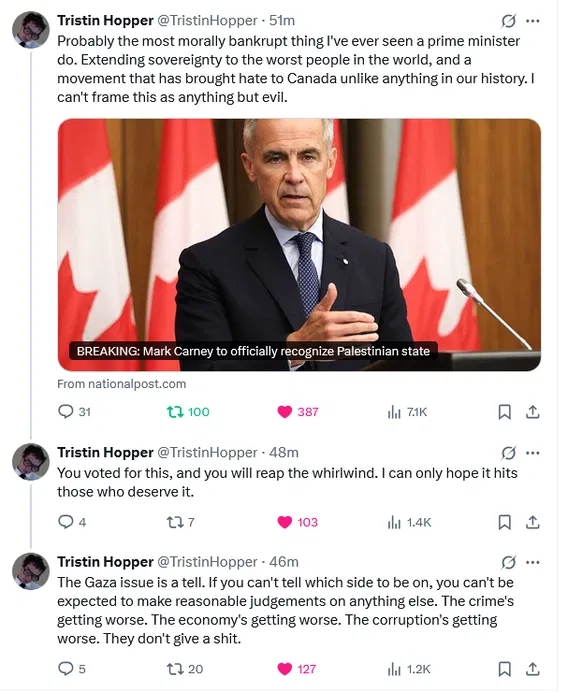
Update: Spotted on the social network formerly known as Twitter:

« Newer PostsOlder Posts »

Powered by WordPress