Quotulatiousness

September 17, 2025

“It would be a grave error to scrap NORAD”

Filed under: Cancon, Media, Military, Politics, USA — Tags: , , , , , , — Nicholas @ 03:00

J.L. Granatstein makes the case that abandoning NORAD in a fit of pique over the antics of the Bad Orange Man would be worse for Canadian national defence interests and might not even be noticed in Washington DC:

There are beginning murmurings that Canada should get out of the North American Aerospace Defence agreement (NORAD). Given the Trump administration’s hostile tone — its 51st state suggestions, its tariffs, and its growing concerns with Arctic defence — the United States has become a difficult partner and a threat to Canadian sovereignty. But would this be a sensible decision for Ottawa to make?

Not at all. In the first place, NORAD is a joint alliance to defend North America against Russian, Chinese, or other potential attackers. Canada provides aircraft, radars, personnel, and expertise to this role that serves our national interests. It would be a grave error to scrap NORAD and to take on the role of defending our part of North America on our own. It would also be hugely expensive.

The problem, however, is that the Trump administration is right: Canada is, in fact, not doing enough today to defend our portion of North America and protect our sovereignty in the region.

The Royal Canadian Air Force has 1980s vintage CF-18s flying patrols and occasional larger surveillance aircraft monitoring traffic in Arctic waters; there are snowmobile and ATV patrols of Canadian Rangers armed with rifles; and a few army exercises in the north each year. The Royal Canadian Navy has a half dozen new Arctic Offshore Patrol Vessels that have limited utility in Arctic waters and are very lightly armed, and the Canadian Coast Guard (CCG) has only one 66-year-old icebreaker capable of clearing thick ice. The CCG is now under the authority of the Department of National Defence, but its members, unlike those in the Canadian Armed Forces, are unionized, and its vessels are unarmed. This could be a problem in a conflict.

Yes, Ottawa has promised to do more. The Trudeau government agreed to the $38.6 billion NORAD Modernization Plan, which includes the new Northern Approaches Surveillance System featuring the Arctic Over-the-Horizon Radar and a Polar Over-the-Horizon Radar, enhancing early warning and threat tracking from the North for air and maritime threats. These systems will not be fully operational until the 2040s.

There’s more, but it’s behind the paywall.

September 7, 2025

Long before the “Bad Orange Man”, there was “T.R.”

In the Coolidge Review, Amity Shlaes points out some strong similarities between Donald Trump’s career and that of the Bull Moose himself, Theodore Roosevelt:

Though a century apart—TR served from 1901 to 1909 — these two chief executives have favored the same modus operandi: using unpredictability to amass power. And the record of Theodore Rex, as Edmund Morris titled his TR biography, bodes ill for both the economy and the Republican Party.

The Trump-TR Parallels

But to the similarities. They start, for both men, pre–White House. As Trump did, TR staged his pre-presidential efforts as much with an eye to public recognition as to sustained reform or strengthening institutions.

Whenever TR stumbled, he pivoted to a new venture and publicized it like mad, though the medium in those days was the printed word, not season after season on The Apprentice. Before the cognoscenti had even absorbed the meaning of the young Roosevelt’s humiliating fourth-place score in a key 1886 New York City mayoral contest, for example, TR was off to the Badlands, memorializing his ranching experiences in dispatches and books such as Ranch Life and the Hunting Trail.

As Trump does, TR routinely alienated GOP grandees, circumventing them to get ahead. As Trump has, TR skillfully cultivated the media — so skillfully that members of Congress were left trying catch up with whatever shifts in public opinion resulted from the politician’s press alliances. TR’s Rupert Murdoch was the widely syndicated William Allen White of Kansas’s influential Emporia Gazette. TR’s equivalent of Fox News was the New York Journal, whose owner, William Randolph Hearst, drummed a steady beat of support when Roosevelt called for war against Spain.

Today, Murdoch must be scratching his head over what his showcasing Trump has wrought, especially now that Trump decided to sue both Murdoch and his Wall Street Journal. White, too, found that he had second thoughts about his decision to back TR: “Roosevelt bit me and I went mad,” White reportedly told a colleague.

[…]

BULLY

The occupant of what he labeled the Bully Pulpit — “bully” as in “excellent” — proved a literal bully as well.

As president, TR perpetually unnerved fellow Republicans, pivoting back to domestic politics. As Trump has, TR cast his campaigns in moral terms rather than economic ones. Where Trump launched his tariff war, TR made war against trusts, large combinations of companies. Relying more on whim than statute, Roosevelt segregated trusts into “good trusts” and “bad trusts”.

TR targeted an invincible-looking industry that, in those days, mattered as much as the interstate highways, or the internet, do today: railroads. James Hill’s Great Northern Railway took over a struggling competitor, Northern Pacific. Roosevelt asked Hanna what he made of the combined entity, Great Northern Securities. Hanna replied that it was “the very best thing possible for the future of the whole Northwest territory”. Roosevelt nonetheless sicced the Justice Department on the Great Northern.

J. Pierpont Morgan, a participant in the beleaguered deal, called on the president to inquire, as desperate steel importers these days do from time to time, whether their attorneys might work out the matter behind the scenes.

No.

Next, the disconcerted Morgan asked whether other investments of the House of Morgan might be assailed. Roosevelt’s reply captures the chill of arbitrary leadership. The administration would not go after the other Morgan companies, he said — unless “they have done something we regard as wrong”.

As Edmund Morris reports in Theodore Rex, to observers such as French ambassador Jules Jusserand, Roosevelt seemed “more powerful than a king”. That power suited many voters fine, which is why Roosevelt won so headily when he ran for office on his own in 1904.

Of course TR, like Trump, occasionally supported laws that aligned with his impulses. One example is the Elkins Act of 1903, which made it illegal for railroads to charge different freight rates for different customers. This shallow effort to achieve market “fairness” deprived the railroads of a standard business tool: the ability to provides discounts to those who buy the product in larger quantities. Shares in railroads promptly dropped more than 20 percent, a shift that undermined TR’s premise of railroad invincibility.

August 23, 2025

“Trump … sees transshipment and nearshoring as sneaky workarounds”

Filed under: China, Economics, Government, Politics, USA — Tags: , , , — Nicholas @ 05:00

At the Foundation for Economic Education, Jake Scott explains Donald Trump’s latest anti-trade moves:

President Donald Trump’s executive order of July 31st, effective August 7th, has upended global trade dynamics in a single stroke. Slapping a 40% tariff on all “transshipped goods” — products rerouted through third countries to dodge US duties — this is merely the natural development of his evolving protectionist agenda.

Just a week after the order, the move is a clear shot at China’s sprawling manufacturing empire, which has long exploited methods like transshipment and “nearshoring” to skirt American tariffs in general, and Trump’s tariff policies in particular.

While applied globally, China stands to take the biggest hit (and likely already is), with its vast factory networks and knack for rerouting goods through Southeast Asia, Mexico, and beyond. This isn’t just a tariff hike; it’s a calculated escalation in Trump’s ongoing crusade to reshape US trade policy and the global economy in the United States’ favor. But ripple effects that bruise consumers are already visible — and this move is likely to strain relationships with key allies as well.

The new tariffs build on Trump’s first-term strategy — so extensive that it now has a Wikipedia entry — when he wielded America’s economic heft like a sledgehammer to renegotiate or smash trade deals he deemed unfair. Back then, Chinese firms sidestepped US tariffs by setting up shop in countries like Vietnam and Mexico, funneling goods through these hubs to mask their origins.

This nearshoring strategy buoyed many economies that had pre-existing arrangements with the United States or were treated more favorably than China, such as Canada and Latin American nations. It is also seen as a natural part of globalization: shipping parts from where they are constructed (like China), assembling them in developing nations (like Mexico), and then exporting to high-value markets (like the United States). Nearshoring has a long history, but the fragility of extended global supply chains was exposed in the Covid pandemic; since then, manufacturers have sought to mitigate their damage.

The US trade deficit with China (roughly $295 billion) has long been a sore point for Trump, who sees transshipment and nearshoring as sneaky workarounds. The 40% duty on these goods, layered atop existing tariffs, aims to plug this loophole. As Stephen Olson, a former US trade negotiator, noted in the New York Times, China will likely view this as a direct attempt to “box them in”, potentially souring already tense talks.

August 8, 2025

China’s short- to medium-term reaction to Trump’s tariffs

Filed under: China, Economics, Government, USA — Tags: , , — Nicholas @ 03:00

In Reason, Liz Wolfe outlines some of the reasons China has not been suffering under the tariffs President Trump has levied on them over the last few months (unlike, say, Canada):

President Donald Trump and PRC President Xi Jinping at the G20 Japan Summit in Osaka, 29 June, 2019.
Cropped from an official White House photo by Shealah Craighead via Wikimedia Commons.

Total Chinese exports surged in July … but not to us. Compared to July 2024, Chinese exports were up 7.2 percent last month. “Its exports to Southeast Asia and Africa, key regions for reshipment to the United States, rose more than twice as fast as its overall exports”, per The New York Times‘ reading of the data. “China’s exports to the European Union, its main alternative to the American market, were also up very strongly.”

Specifically, “data released Thursday by the customs authorities showed the pickup was driven by strong growth in shipments to the European Union, Southeast Asia, Australia, Hong Kong and other markets, which more than made up for the fourth month of double-digit declines in US purchases”, reports Bloomberg.

Predictably, even the threat of tariffs has been enough to dampen trade. Remember, Washington and Beijing are still operating under a 90-day truce — set to expire on August 12, though it could be extended if a new agreement is reached — that holds off the imposition of higher tariff levels, namely, the tit-for-tat tariff increases that both countries had threatened. The truce also staves off export controls on certain critical rare-earth minerals and items that fall into the technology category. But still, current tariff levels mean a baseline 30 percent tariff on Chinese imports, which has been enough to depress trade.

For those in the Trump administration who are worried about trade deficits in particular, I suppose the good news is that we’ve made progress there: “For the last several decades, China has been selling as much as $4 worth of goods to the United States for each $1 of American goods that it buys”, reports The New York Times. Following China’s admission into the World Trade Organization, the trade deficit rose. Now, “tariffs have begun to reduce the imbalance. The United States announced on Tuesday that its overall trade deficit had narrowed in June to $60.2 billion, the smallest in nearly two years.”

It’s not clear why Trump administration officials, and the president himself, are so worried about trade deficits as something to eliminate for their own sake. We are dependent on Chinese goods to a rather substantial degree, which would pose a problem in the event of war with China (which is why the previous administration focused on improving our semiconductor manufacturing capabilities back in 2022). But you can just as easily make the case that it’s the vast volume of trade between the two countries — the deeply intertwined economies so reliant on each other (despite China’s claims of autarky and, more amusingly, communism) — that are incentivizing continued decent relations.

A few factors are at play that might help to explain why you likely haven’t felt a drastic increase in prices just yet. First, since there’s been a long lead-up to this trade war, many larger importers have stockpiled product over the last few months, so shortages haven’t been felt yet — they’ve just been selling off product they’ve been storing. Second, China has already managed to divert some stages of manufacturing to other countries—namely Vietnam — and some larger companies already have factories up and running in other Southeast Asian countries to avoid the “made in China” or “shipped from China” labeling. Expect more transshipping and manufacturing-locale creativity as a means of throwing customs officials off the scent.

August 5, 2025

Will the courts take away Tariff-master Trump’s favourite toy?

Filed under: Government, Law, Politics, USA — Tags: , , , — Nicholas @ 03:00

President Donald Trump’s second term in office has been dominated by his capricious and seemingly random deployment of tariffs as a bludgeon to intimidate and coerce America’s allies and enemies alike. In Reason, J.D. Tuccille considers the possibility of the courts taking away the one tool Trump has been using to get his own way in trade negotiations:

Everybody with a brain knows that tariffs are taxes. And they know that tariffs imposed on goods imported to the United States are largely paid by American businesses and consumers. The big question is whether tariffs unilaterally imposed by President Donald Trump under creative interpretations of emergency executive powers will withstand a federal court challenge. So far, the signs are promising for those hoping that a law intended to rein in the power of the presidency will not be read to permit the president to set trade policy of his own accord.

As CBS News reported this week, the U.S. Court of Appeals for the Federal Circuit in Washington, D.C. heard “oral arguments on Thursday in V.O.S. Selections v. Trump, a case brought by five small business owners and 12 states who allege they have been harmed by President Trump’s import taxes. V.O.S., the lead plaintiff in the case, is a New-York based wine importer.”

Representing the plaintiffs is the free-market Liberty Justice Center, along with co-counsel Ilya Somin, a law professor at George Mason University’s Scalia Law School. The plaintiffs are challenging the Trump administration’s invocation of the International Emergency Economic Powers Act (IEEPA) as the basis for the “Liberation Day” tariffs on much of the world as well as related tariffs on Mexico, Canada, and China.

A Law Intended To Trim Presidential Power, Not Expand It

The plaintiffs maintain that “under that law, the President may invoke emergency economic powers only after declaring a national emergency in response to an ‘unusual and extraordinary threat’ to national security, foreign policy, or the U.S. economy originating outside of the United States. The lawsuit argues that the Administration’s justification — a trade deficit in goods — is neither an emergency nor an unusual or extraordinary threat.”

What’s interesting is that Congress passed IEEPA not to expand presidential power, but to restrict it. According to a 2024 Congressional Research Service report, “following committee investigations that discovered that the United States had been in a state of emergency for more than 40 years, Congress passed the National Emergencies Act (NEA) in 1976 and IEEPA in 1977. The pair of statutes placed new limits on presidential emergency powers”. Under these laws, presidents are required to assess emergencies on an annual basis, extend them if necessary, and report on their status to Congress.

“Some experts argue that the renewal process has become pro forma“, the report acknowledges. “History shows that national emergencies invoking IEEPA often last nearly a decade, although some have lasted significantly longer — the first state of emergency declared under the NEA and IEEPA, which was declared in response to the taking of U.S. embassy staff as hostages by Iran in 1979, is in its fifth decade.”

August 2, 2025

“[T]he United States is an imperial power … it does not give foreign nations free rides and unearned favours”

Filed under: Economics, Europe, Media, Politics, USA — Tags: , , , , , , — Nicholas @ 04:00

On Substack, eugyppius discusses the European situation in a time of seemingly random and capricious tariffs from the Trump administration:

Europe in 1899, when the continent contained multiple world powers, before the rise of non-European power.

Whenever I talk about things like tariffs, Trump supporters appear in my comments to tell me that Europe has gotten a free ride for long enough and that it is time we learned to pay our way. I find it a little frustrating to read this, because in Europe it does not feel like we are getting a free ride at all. In fact it seems like the opposite: The most common complaint on the populist German right is that our political class refuses to represent our interests and will not stop carrying water for the Americans.

I recognise that I’ll never be able to put this right, but it’s worth trying, because it is important to understand the world as it is. The truth is that the United States is an imperial power. Generally speaking, it does not give foreign nations free rides and it does not hand out unearned favours. There is however a lot of confusion here, because hardly anybody bothers to describe honestly the geopolitical strategy pursued by the United States or the nature of the American empire. Western liberalism cannot conceptualise imperial politics, and while empire generally benefits political elites on both sides of the Atlantic, it is not necessarily or always in the interests of ordinary Americans or ordinary Europeans, which is yet another reason not to talk about it.

The Americans and the British before them expended enormous effort to preempt the emergence of a dominant power on the European Continent that might challenge their successive naval empires. They fought two world wars to stop Germany from becoming just such a power. This great struggle ended in 1945 with Western Europe as a fully subjugated imperial province. Since then, the Americans have coordinated the NATO alliance and guaranteed the security of European countries not out of charity, but because Europe is their provincial possession. As a rule, they have not wanted Europe to assume full responsibility for its own defence, because a world in which America no longer guarantees the security of Europe is a world in which Europe is no longer an American province. It’s that simple.

To fend off the Soviets, the Americans nevertheless rebuilt and rearmed the nations of Western Europe. Everyone involved in this project had to come up with a way to allow the Germans to become a dominant economic power again, without displacing the United States or provoking the hostilities of wary postwar neighbours like France. One solution here was the European Union, which promoted economic interdependency as a counterweight to nationalist concerns. Another solution came at the cultural level, where Germany sought to allay European anxieties over possible Teutonic aggression by developing a national cult of historical guilt for World War II, which steadily blossomed into a full-blown civic religion. This exercise in self-effacement has grown more and not less extreme over time, in part as a response to nervousness about the consequences of German reunification. Many voices on the right like to portray Germans as victims of an externally imposed guilt regime, but the truth is that we did most of this to ourselves. The German left in particular has profited from and encouraged this mindset from the beginning.

German political self-effacement had one unexpected feature, in that it proved to be contagious. Within a generation of 1945, many of the victorious allied powers were striving to develop their own historical guilt cults after the German example, in each case centred around a national original sin like slavery or colonialism. Just as the German political class found it expedient to foreground collective European concerns at the expense of a more narrowly construed German nationalism, so did the broader West develop an overarching obsession with global issues and the plight of the developing world. This has caused the proliferation of a lot of silly people in our political culture, a lot of profoundly stupid organisations, and at least two cancerous ideological systems in the form of climatism and migrationism. We have had a nearly incalculable gift in the form of 80 years of peace, which may yet be offset by the equally incalculable costs of the lunacies this peace has encouraged.

Canada’s PM “… has a job which, like that of most politicians, requires low intelligence and moral vacuousness”

At Essays in Idleness, David Warren explains why Canadian political leadership is so desperately uninspiring … except to our enemies and ill-wishers:

The Canadian prime minister — currently Mr Mark Carney — has a job which, like that of most politicians, requires low intelligence and moral vacuousness. At his cleverest he may exhibit a species of rat cunning. His views on Israel and the Middle East are quite uninteresting, for no rat cunning is required. He simply observes that an anti-Semitic policy is necessary, now that Muslim immigration exceeds the Jewish vote.

Not one good thing has come out of the Liberal Party since Louis St-Laurent was defeated in 1957. He, at least, achieved mediocrity. But what can we do? Canada’s population is one with the Liberals.

What happened on October 7th, 2023 — the slaughter of huge numbers of mostly unarmed Jews when Palestinians got outside the Gaza perimeter — can happen again and again. It will happen as long as Palestinians are, from childhood, taught or brainwashed to kill Jews throughout their education and social systems. I also protest against the disproportionate Israeli response. I think the Israelis have been much too restrained.

My model for “Palestine” would be Germany, or Japan. These formerly vicious nations became harmlessly bourgeois after they unconditionally surrendered to the United States and allies. It is ludicrous to think we should have offered them a peace deal, instead.

Damian Penny points out the sad truth that we get more obstinate even in support of a terrible idea when someone tries to bully us out of it:

… I find myself torn between being frustrated with my own government and simultaneously outraged by another government trying to bully us out of a policy decision with which I disagree.

I don’t expect most other Canadians to feel so conflicted, however. Trump may not realize it (nor care one bit even if he does understand it) but he just made it more likely that Canadian voters will rally around the flag.

This flag, specifically.

Nothing, and I mean nothing, has the motivational power of your opponent pushing back against you. That social media has given us a new and effective way to yell at and insult each other across partisan lines is part of the reason partisanship has become so much more entrenched in recent years.

And that includes me. During the last election campaign it was when I argued with Liberals on Facebook that I found myself feeling less like a Conservative voter and more like a Conservative militant, and my sparring partners likely felt the same way, only in the opposite direction.

Now, replace political partisanship with nationalism, and the effect becomes that much stronger.

Of course, hardcore supporters of either side won’t be moved. (That Carney is placing any conditions at all on Palestinian statehood, and saying a two-state solution remains the ultimate goal, makes him a filthy Zionist genocidaire as far as that crowd is concerned.) But sometimes it’s easy to forget that most people simply don’t pay as much attention to, and aren’t nearly as emotionally invested in, this conflict as much as we very online types are.

July 29, 2025

EU Commission President Ursula von der Leyen triumphantly announces EU capitulation to Trump’s demands

Filed under: Bureaucracy, Economics, Government, Media, Politics, USA — Tags: , , , , — Nicholas @ 05:00

The EU and the United States are finalizing negotiations on bilateral trade issues that basically give Trump everything he wanted with very little in return for the EU’s concessions. It’s almost as if Trump has some kind of experience in negotiating lopsided agreements, isn’t it? I guess von der Leyen didn’t get Mark Carney’s memo on the importance of keeping your eLbOwS uP:

EU Commission President Ursula von der Leyen “[learning] in real time that weakness and submission do not in fact invite conciliation”

Donald Trump has shown up the European Union. He’s revealed that the world’s largest single market is a paper tiger to be kicked around, with basically no leverage or strength to resist American demands.

All of these supposedly fierce backroom tariff negotiations have yielded an incredibly one-sided deal – really an unparalleled embarrassment. As announced yesterday, the EU promises to invest $600 billion in the U.S. economy and to make $750 billion worth of “strategic purchases” of oil, gas and the like over the next three years. We also promise to buy a bunch of American military equipment. In return for giving the Americans $1.35 trillion, we earn the privilege of a 15% baseline tariff on all of our exports to America and we drop our own tariffs to zero. At least we don’t have to pay the 30% tariffs Trump threatened!

[…]

While von der Leyen was trying weakly to put a happy face on her total failure, Trump gave her what we might call a softer Zelensky treatment. He twisted the knife in the wound, calling out the idiocy of EU wind energy in an extended soliloquy that will surely keep the fact-checkers and the regime deboonkers up late for weeks to come. I transcribe his remarks in full, because the whole moment was wonderful:

    And the other thing I say to Europe, we will not allow a windmill to be built in the United States. They’re killing us. They’re killing the beauty of our scenery, our valleys, our beautiful plains. And I’m not talking about airplanes. I’m talking about beautiful plains, the beautiful areas in the United States. And you look up and you see windmills all over the place. It’s a horrible thing. It’s the most expensive form of energy. It’s no good.

    They’re made in China, almost all of them. When they start to rust and rot in eight years, you can’t really turn them off. You can’t bury them. They won’t let you bury the propellers, you know, the props, because they’re a certain type of fiber that doesn’t go well with the land. That’s what they say. The environmentalists say you can’t bury them because the fiber doesn’t go well with the land. In other words, if you bury it, it will harm our soil.

    The whole thing is a con job. It’s very expensive. And in all fairness, Germany tried it and, wind doesn’t work. You need subsidy for wind and energy should not need subsidy. With energy, you make money. You don’t lose money.

    But more important than that is it ruins the landscape. It kills the birds. They’re noisy. You know, you have a certain place in the Massachusetts area that over the last 20 years had one or two whales wash ashore and over the last short period of time they had 18, okay, because it’s driving them loco, it’s driving them crazy. Now, windmills will not come, it’s not going to happen in the United States, and it’s a very expensive …

    I would love to see, I mean, today I’m playing the best course I think in the world, Turnberry, even though I own it, it’s probably the best course in the world, right? And I look over the horizon and I see nine windmills. It’s like right at the end of the 18. I said, “Isn’t that a shame? What a shame.” You have the same thing all over, all over Europe in particular. You have windmills all over the place.

    Some of the countries prohibit it. But, people ought to know that these windmills are very destructive. They’re environmentally unsound. Just the exact opposite. Because the environmentalists, they’re not really environmentalists, they’re political hacks. These are people that, they almost want to harm the country. But you look at these beautiful landscapes all over all, over the the world. Many countries have gotten smart. They will not allow it. They will not. It’s the worst form of energy, the most expensive form of energy. But, windmills should not be allowed. Okay?

All the while von der Leyen had to sit there, absolutely frozen except for a curiously accelerated rate of blinking, as she learned in real time that weakness and submission do not in fact invite conciliation.

In Spiked, Jacob Reynolds agrees that the deal is a humiliation for the European Union:

So this is the famous “trade superpower”. After months of tough talk, European Commission president Ursula von der Leyen announced a trade deal with Donald Trump this week which is nothing short of total capitulation. The Commission has accepted a 15 per cent baseline US tariff on most EU goods, agreed to purchase $750 billion worth of American gas and procure billions more of US military kit. What did Queen Ursula get in return? Nothing.

“VDL”, as she is known in the Brussels Bubble, tried desperately to spin this as a win. Sitting anxiously next to Trump in Scotland last weekend, she recited impressive-sounding numbers – such as the EU and US’s combined 800million consumers and the EU’s $1.7 trillion trade volume – like a nervous student. Trump cut through the spin by greeting the deal as fantastic for US cars and agriculture. He didn’t need to say much else – indeed, it was clear for all to see that there was only one winner in this deal.

For decades, even critics of the EU had to concede that whatever its many economic and democratic shortcomings, it still possessed enormous leverage when it came to trade. At the very least, it was more than capable of defending EU interests in trade deals. Evidently, this is no longer the case. When even the hapless government of Keir Starmer can negotiate a better trade deal with Trump, the problems with the EU should be clear to see. (Tariffs on most UK goods are just 10 per cent.)

Even the most ardent Europhiles have found it hard to put a positive spin on the deal. Manfred Weber, leader of the European People’s Party (a coalition of Europe’s legacy centre-right parties) described it as “damage control” and better than not reaching a deal at all. Guy Verhofstadt, former prime minister of Belgium and usually the most maniacal of EU fanboys, slammed the deal as not only “badly negotiated”, but also “scandalous” and a “disaster”, with “not one concession from the American side”. Member states, from Ireland to France, have been similarly unenthusiastic. Yet the brutal truth is that the deal reflects how America views the EU – as strategically weak and politically empty.

Trump has taught the EU a harsh lesson in statecraft. The EU has long relied on its neighbours for energy production. It has long underinvested in defence. And now it throttles its biggest industries with green dogma. This left it with little leverage for the negotiations with the US.

Of course, after Mark Carney being elected on a highly dubious platform of being “the right person to deal with Trump”, this is almost inevitable at this stage:

July 19, 2025

Old and tired: the Overton Window … New and hot: the Trump Door

Filed under: Government, Media, Politics, USA — Tags: , , — Nicholas @ 04:00

In The Line, Mike Colledge considers how Trump has managed to change the political environment that used to be fairly well described by the Overton Window:

Diagram of the “Overton Window”, based on a concept promoted by Joseph P. Overton (1960–2003), former director of the Mackinac Center for Public Policy. The term “Overton Window” was coined by colleagues of Joe Overton after his death. In the political theory of the Overton Window, new ideas fall into a range of acceptability to the public, at the edges of which an elected official risks being voted out of office.
Illustration by Hydrargyrum via Wikimedia Commons

The Overton Window, named after Joseph Overton of the Mackinac Center for Public Policy, is used to explain how policy ideas gain acceptance and move from idea to policy. The “window”, as Overton saw, could include a wide range of ideas from those with little to no support to those that have matured, gained public traction, and could be supported by the public as legitimate policy options for governments. The “window” was not static. It could — and did — shift, expand, or contract based on social movements, economic pressures, cultural trends, and/or the actions of leaders in the public and private sectors.

Those who wanted to push ideas into the window and gain acceptance and support usually had to spend considerable effort — and sometimes years — promoting and making the case for their cause and moving it into the mainstream. Al Gore’s documentary An Inconvenient Truth and Greta Thunberg’s ongoing efforts to push for action on climate change are examples of leaders using their profile to push and keep climate change action in Overton’s Window.

Lately, though, it feels like the Overton Window has been replaced by the Trump Door. While Overton observed and studied what was happening, Trump is more of an active participant. Overton provided us with an analytical framework; Trump’s door is more of a tactical approach.

And this is a big change. The world moves much faster than it did in the mid-90s when Overton first created his “window”. The democratization of communications and the speed of communications means anyone can comment, report, or share an opinion instantly (and often without considering the consequences). Increased polarization means that leaders looking to act and to reinforce support for their desired policies do not have to wait for a majority to support a given policy before they act. They merely need a vocal plurality of their own supporters to move forward with an idea.

Trump hasn’t so much smashed the window as he has replaced it with a large swinging Western saloon-style door. He has shown no interest in framing and positioning an issue for the public’s consideration in hopes of building support from a majority. He is throwing ideas into and out of the public-consideration saloon as fast as possible. Some ideas he throws in as distractions. Others he throws in as announcements of his intent regardless of the public’s perspective.

To those of you saying in your head “I don’t think Trump thinks this deeply about what he is doing,” you could be correct. But the net impact of his actions is the creation of a Trump Door that, unlike a window, is not transparent and, again unlike Overton’s Window, is not about building public acceptance. It is a tool to achieve his goals as fast as possible. When obstacles require a shift in policy — given there is no need to engage the public — he simply throws another idea into the saloon.

Trump administration records huge increase in tariff revenues

Filed under: Government, Media, Politics, USA — Tags: , , — Nicholas @ 03:00

Oddly, most of the coverage on the US government’s surge in tariff income fail to emphasize two relevant facts: first, that the money is largely being paid by American consumers and second that it’s a surge driven by the fact that higher tariffs will kick in soon. J.D. Tuccille reports:

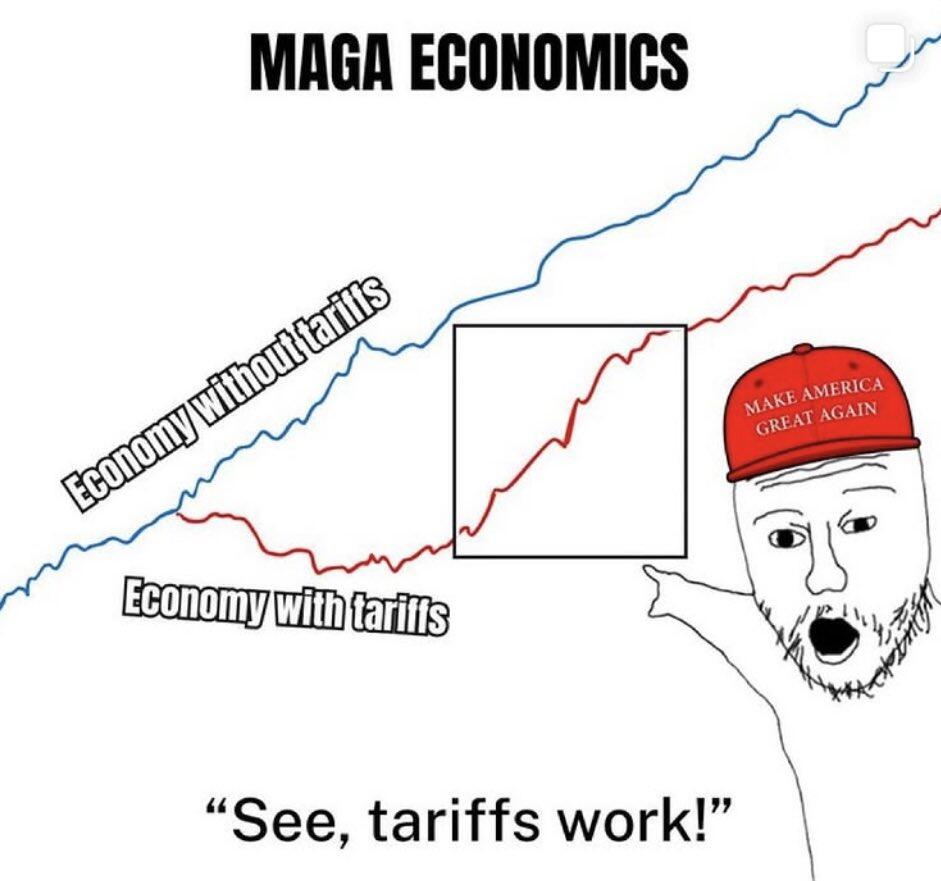
I have no idea where I saw this meme, but it makes me laugh

Last Friday, U.S. Treasury Secretary Scott Bessent took a victory lap as his department reported an unexpected increase in receipts from tariffs. The revenue undoubtedly came from a surge in imports to the U.S., which led to payments that filled federal coffers. It would seem to be a win for an administration that has staked an awful lot on waging a trade war with the entire planet to (take your pick) redress wrongs done to America, raise revenue for the government, and encourage domestic manufacturing and employment. But that victory lap comes too soon; the tariff windfall more likely represents efforts by U.S. firms to accumulate inventory before tariff rates rise even higher.

[…]

That mention of “higher prices on imported goods paid by US consumers and firms” deserves to be emphasized because it highlights the fact that tariffs are taxes on Americans. Ultimately, most of the burden of high rates is shouldered by companies and individuals within the U.S. As the Tax Foundation’s Alex Durante pointed out in February, “rather than hurting foreign exporters, the economic evidence shows American firms and consumers were hardest hit by the Trump tariffs”.

The Yale Budget Lab agrees, estimating in May that “the price level from all 2025 tariffs rises by 1.7% in the short-run, the equivalent of an average per household consumer loss of $2,800” in 2024 dollars. In particular, the Yale economists found “consumers facing 15% higher shoe prices and 14% higher apparel prices in the short-run”.

Even Walmart, which had vowed to absorb as much as possible of the tariff burden, conceded two months ago that prices would have to rise because of the trade war.

This week, the Federal Reserve Bank’s “beige book” noted that “in all twelve Districts, businesses reported experiencing modest to pronounced input cost pressures related to tariffs” and that “many firms passed on at least a portion of cost increases to consumers through price hikes or surcharges”.

Penn Wharton’s concerns, mentioned above, about “lower economic growth” are shared by the Tax Foundation and by the Yale Budget Project. The Tax Foundation’s Erica York and Alex Durante forecast that the Trump administration’s tariffs would “reduce US GDP by 0.8 percent” before taking foreign retaliation into account. Yale economists see a similar GDP reduction of 0.7 percent.

If the courts issue a final ruling against Trump’s use of the International Emergency Economic Powers Act (IEEPA) to impose tariffs, that will reduce the negative effects on the economy. But it will also take a chunk out of the revenues the administration expects to collect.

So, Secretary Bessent’s victory lap on tariff revenues was a little premature. And so are hopes that the trade war won’t damage commerce and the U.S. economy.

July 9, 2025

NATO secretary general Mark Rutte – Trump’s biggest European fanboy?

Filed under: Europe, Military, Politics, USA — Tags: , , — Nicholas @ 03:00

I don’t often encounter positive reactions to US President Donald Trump from the other side of the pond, but Paul Wells makes a case here for Mark Rutte, the current secretary general of the NATO alliance, being utterly sincere in his regard for his American “daddy”:

Mark Rutte, the NATO secretary general.
Photo from Paul Wells’ substack

I haven’t seen much commentary about Mark Rutte’s weekend interview with the New York Times. It’s quite an interview. If the NATO secretary general is faking his enthusiasm for Donald Trump, he’s really committing to the bit.

I’m going to quote Rutte’s remarks in greater detail than you sometimes get, because what really stands out over the 36-minute podcast that resulted from the Times interview is Rutte’s doggedness. He doesn’t simply treat the US president as a containable problem, as European security experts sometimes do, but as nothing less than a full NATO partner and, indeed, as the hero of the alliance’s revitalization.

“President Trump deserves all the praise,” he tells interviewer Lulu Garcia-Navarro, a longtime NPR foreign correspondent before she joined the Times, “because without his leadership, without him being re-elected president of the United States, the 2% this year and the 5% in 2035 — we would never, ever, ever have been able to achieve agreement on this.”

Does he regret that Trump posted what the AP and a lot of others called a “fawning” text message in which Rutte wrote to Trump, “Europe is going to pay in a BIG way, as they should, and it will be your win”? “Not at all, because what was in the text message is exactly as I see it.”

Is the integrity of NATO’s defense perimeter solid? “But it’s not that the Estonians are left to themselves. It would be the full force of NATO, including the full backup of the United States, which will come to the rescue. Putin knows this.”

Garcia-Navarro keeps pushing. Full backup of the United States, she says? You bet, Rutte says. In “everything I’ve discussed over the last six months with the new U.S. administration” there is “absolutely no shiver of a doubt that the U.S. is completely committed to NATO, is completely committed to Article 5,” the Alliance’s collective-defence principle.

Isn’t there a “fundamental disconnect” between the way Trump views the world and the commitments needed to make NATO work? Rutte answers: Nope! “President Trump put in place an excellent foreign-policy team, including Marco Rubio and Pete Hegseth,” he offers.

But “what we are seeing,” Garcia-Navarro insists, perhaps in reference to this or this, “is the United States pulling back from Europe.”

“I really have to correct you,” Rutte insists in turn. “The United States is not pulling away from Europe.”

Where does Rutte stand on the credibility and prospects of Russia-Ukraine peace talks? “With the risk that I’m again praising President Trump: He is the one who broke the deadlock with Putin. When he became president in January, he started these discussions with Putin, and he was the only one who was able to do this. This had to happen.”

July 1, 2025

Like a cheap suit, Canada folds under Trumpian pressure on the Digital Services Tax grab

Filed under: Cancon, Government, Media, Politics, USA — Tags: , , , , , — Nicholas @ 05:00

A couple of days back, I characterized Prime Minister Mark Carney’s determination to push ahead with the Digital Services Tax “insane”, as it was overwhelmingly likely to trigger a strong reaction from the Trump administration. As it did. So, finally recognizing they were in a no-win situation, the federal government announced at the last minute that they wouldn’t be demanding the literally billions of dollars from the US “tech giants” after all. Michael Geist can legitimately say “I told you so” on this issue:

President Trump Attends G7 Summit in Canada by White House https://www.whitehouse.gov/gallery/president-trump-attends-g7-summit-in-canada/ CC BY 3.0 US

After years of dismissing the warnings of likely retaliation, the Canadian government caved last night on the digital services tax. Faced with the prospect of the U.S. suspending trade negotiations, Finance Minister François-Philippe Champagne announced that the government would drop the DST altogether, payments scheduled for Monday would be cancelled, and legislation will be forthcoming to rescind the legislation that created it in the first place. Over the weekend, I wrote about the repeated warnings that the DST was a serious trade irritant with the U.S. that cut across party and presidential lines. While ignoring the risks was bad enough, I argued that Canada played its DST card too early. Rather than delaying implementation in the hopes of incorporating it into a broader trade deal with U.S., it marched ahead, leading to an entirely predictable response from U.S. President Donald Trump. That left Canada in a no-win situation: stick with the DST but face the prospect of higher tariffs or embarrassingly drop the DST (and $7.2 billion in revenue over five years) with only restarting negotiations that were on until government overplayed its hand to show for it.

It is hard to overstate how badly the government managed the DST issue over the past five years. It alienated allies by pushing ahead with the DST despite efforts at an international deal at the OECD, stood alone in rejecting an extension of a moratorium on new DSTs, made the DST retroactive which solidified opposition, and continually downplayed the concerns of successive U.S. Presidents and Members of Congress from both sides of the aisle. Meanwhile, when companies began passing along the costs of the DST to Canadian businesses, it did nothing. And when they urged the government to delay implementation to at least allow for the issue to be incorporated into a broader trade pact, it ignored the advice.

At every step, there were better options. This year, the likelihood that the DST would come to a boil was obvious to anyone who was paying attention. But rather than following the UK strategy, which managed to salvage a smaller DST (2% rather than 3%) as part of a bigger agreement that includes a commitment to support UK digital access to the U.S. market and to negotiate a larger digital trade deal, Canadian officials seemingly assumed that the U.S. was bluffing and would not retaliate.

If this sounds familiar, it is because the Canadian government misreading the tech sector has become a hallmark of its policy. Talk tough, practically dare companies and foreign governments to respond, and then frantically seek an exit strategy when they do. This was the case with the Online News Act and Meta’s blocking of news links, with the government’s AI regulation which new Minister of AI Evan Solomon says will not be re-introduced, with the Online Harms bill, and now with the DST.

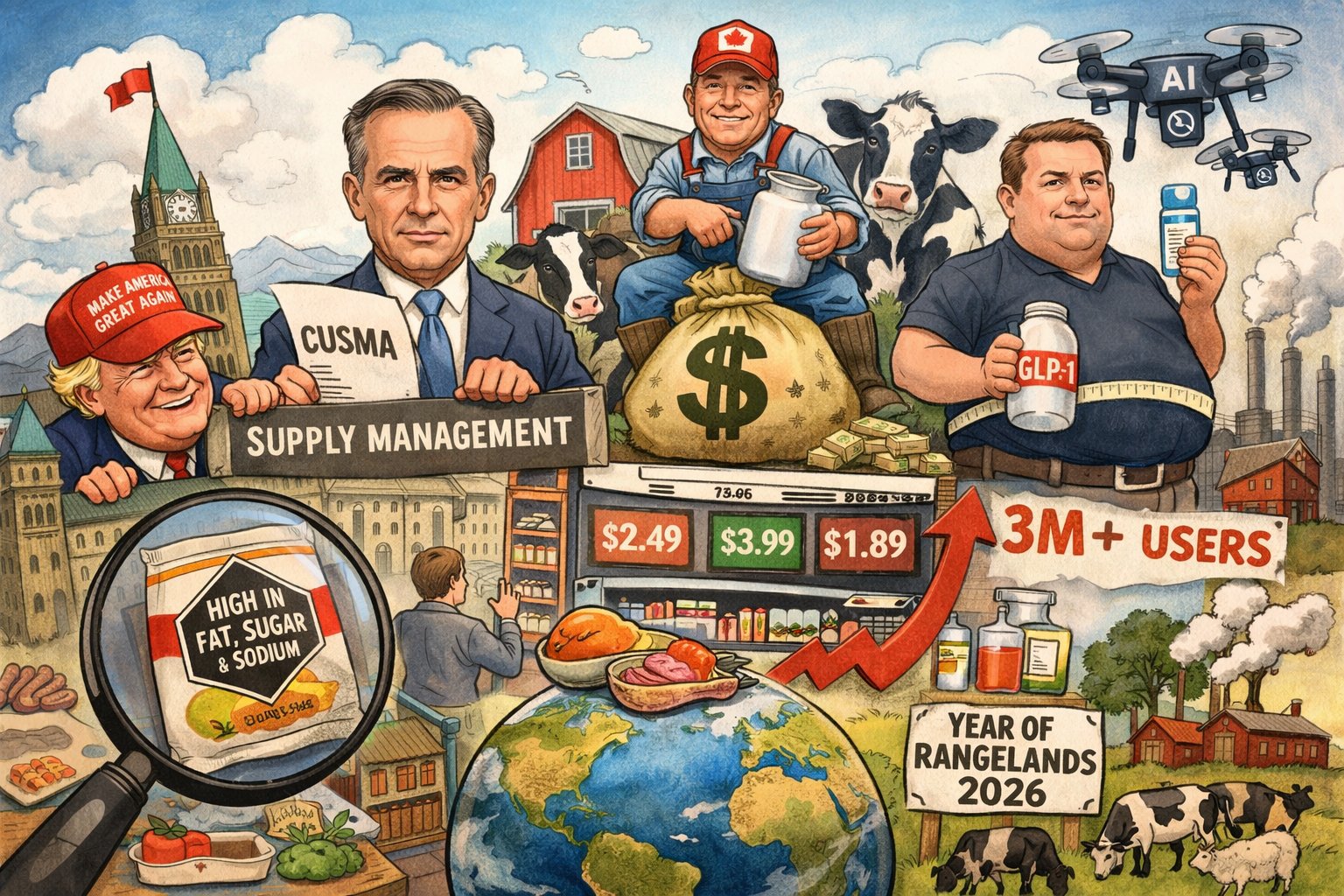
The Food Professor explains what Trump got right in his Trade War

On the social media site formerly known as Twitter, Dr. Sylvain Charlebois, aka @FoodProfessor explains how Trump’s Trade War strategy is working out for US interests, in contrast to the Trudeau/Carney governments’ approach:

The Globalism Hangover: What Trump’s Trade War Got Right

“Trump’s bombastic style aside, his nationalist approach to trade and food policy is forcing global institutions to justify their existence — and that’s a conversation Canada can no longer afford to ignore.”

For the past six months, President Donald Trump’s trade policies have been widely mocked, criticized, and condemned. Some of it is certainly warranted. The Wall Street Journal, for instance, recently likened his tariff-heavy approach to global trade as a direct path toward another Great Depression. But data out of the United States tells a more nuanced story — one that challenges conventional wisdom.

Despite persistent headwinds, the U.S. economy continues to outperform expectations. The Federal Reserve Bank of Atlanta projects second-quarter GDP growth at 3.8%. In May, the U.S. economy added 139,000 jobs, outpacing forecasts, while inflation remained subdued at 0.1% month-over-month and 2.4% annually. The U.S. trade deficit has been cut nearly in half, pointing to stronger export performance and a rebalancing of trade relationships.

Canada, by contrast, is showing signs of economic strain. The national economy is shrinking, manufacturing is struggling under U.S. trade pressure, and food inflation is outpacing general inflation. In short, our economy is not keeping pace—despite our public criticism of the Trump administration.

To make matters worse, the Trump administration has now halted all trade negotiations with Canada, signaling that our bilateral economic relationship holds little strategic value for Washington. For the U.S., Canada is no longer a priority — especially under a Carney-led government that has visibly pivoted toward Europe, a market still heavily invested in maintaining close ties with the United States. From an agri-food standpoint, this shift is consequential: access to our largest trading partner is narrowing, while Ottawa appears more focused on diplomatic optics than on securing stable, competitive trade channels for the Canadian agrifood economy.

This is the one thing the ‘Elbows Up’ crowd never understood — and still doesn’t. We’re not in a trade war with the U.S. There’s no war to be won. For Trump, this is about a realignment of the global order, plain and simple — one centered entirely on American supremacy.

Love him or loathe him, Trump is not destroying the U.S. economy — not yet, anyway. His unapologetically nationalist agenda extends far beyond tariffs. He has withdrawn U.S. support from key global institutions such as the WHO and is threatening to sever ties with others, including NATO and several UN-affiliated agencies. Among them is the Food and Agriculture Organization (FAO), the UN’s most authoritative body on food security.

At a recent event in Brazil, a senior FAO official acknowledged that fundraising dynamics have shifted. In the Trump era, governments are asking harder questions: Why should we fund the FAO? What domestic benefit does it provide? What used to be assumed support is now conditional — and arguably, more accountable.

This shift isn’t unique to Washington. Many countries are quietly aligning with the U.S. position, scrutinizing globalist institutions with renewed skepticism. Transparency and accountability are byproducts of this anti-globalist sentiment — something not inherently negative.

For decades, globalism pushed the world to believe that trade liberalization was the only viable path to growth and prosperity. It became conventional wisdom. But globalism has made some nations — and some people — richer, while leaving others behind. In the process, domestic sectors, including agriculture, were often sidelined or sacrificed in the name of global efficiency.

The problem with globalism, particularly in agri-food policy, is its tendency to pursue uniformity over relevance. Canada, for example, adopted the carbon tax under a globalist climate agenda that often overlooks the vital role food producers play in feeding people. Instead of being supported, the sector is too often vilified as a problem. But agriculture is not a liability — it is a necessity.

Trump’s message — wrapped, of course, in provocative and often abrasive language — is that one-size-fits-all global policies rarely work. Nations have different socio-economic realities, and those should come first. While cooperation is essential, so is recognizing local and regional priorities. In this sense, his “America First” approach is not without logic — especially when it seems to be yielding short-term economic gains.

For Canada’s agri-food sector, the lesson is clear: striking a better balance between global commitments and national imperatives is overdue. We should not abandon multilateral cooperation, but we must stop anchoring policy to global agendas we have little influence over. Instead, let’s define what works for Canadians — what supports our farmers, protects our food security, and reflects our unique landscape — while keeping the broader global context in view.

We are not there yet. But if this moment of disruption sparks a more realistic and regionally attuned approach to food policy, we’ll be better for it.

June 30, 2025

DOGE couldn’t address the structural problems with the US government

At the Foundation for Economic Education, Mohamed Moutii looks at the reasons DOGE was unable to come close to achieving the lofty goals it was launched with:

DOGE’s biggest failure was its inability to deliver its promised sweeping transformation. From the start, its $2 trillion savings target was unrealistic. Cutting nearly 30% from a $7 trillion budget was never feasible, especially with politically untouchable programs like Social Security, Medicare, Medicaid, and Defense off the table.

Musk’s claim that eliminating waste alone could close the gap didn’t hold up. While most budget experts support cutting inefficiencies, they agree that waste isn’t the main driver of the fiscal crisis. Even slashing all discretionary spending would save only $1.7 trillion. The real pressure comes from mandatory programs, which account for nearly two-thirds of the budget, leaving only a quarter of spending truly up for debate.

As reality set in, Musk’s savings claims shrank from $2 trillion to just $150 billion. While DOGE cites $170 billion saved, independent estimates suggest closer to $63 billion, less than 1% of federal spending, with many claims either inflated or unverifiable. Some savings were credited to long-canceled contracts. Though headline-grabbing layoffs and cuts were made, they were often botched, forcing agencies to rehire staff or reverse course. Meanwhile, federal spending rose by $166 billion, erasing any gains. Trump’s fiscal agenda worsens the outlook with the first-ever $1 trillion defense budget, sweeping tax cuts, and protected entitlements — all while annual deficits approach $2 trillion.

Yet DOGE’s failures ran deeper than mere fiscal naiveté. What began as Musk’s role as a “special government employee” quickly expanded into an unchecked exercise of executive power, raising constitutional alarms. His team reportedly accessed classified data, redirected funds, and sidelined entire agencies — actions taken without Senate confirmation, potentially in violation of the Appointments Clause of the Constitution. Legal pushback swiftly followed, with fourteen states suing Trump and Musk over the constitutionality of Musk’s White House-granted authority.

Meanwhile, glaring conflicts of interest became impossible to ignore. Musk’s companies — X, SpaceX, and Tesla — hold $38 billion in federal contracts, loans, tax breaks, and subsidies while facing over 30 federal investigations. His push to dismantle regulatory agencies like the Consumer Financial Protection Bureau (CFPB) — while X launches the “X Money Account“, a mobile payment service subject to CFPB oversight — only deepened concerns. Musk was legally obligated to separate his business dealings from government decisions. One major result has been the impact on Musk’s reputation. Once hailed as a visionary for his promotion of electric cars, he is now viewed unfavorably by many former fans.

June 29, 2025

Carney’s insane determination to keep the Digital Services Tax

One of the most noted features of Prime Minister Mark Carney’s attitude toward, well, everything is his unwillingness to take the concerns of his opponents into account. He seems to feel that he always knows best and therefore any opposition is therefore, by his definition, wrong. The government had been warned by pretty much every observer that the attempt to impose a protectionist digital service levy had incredibly high chances of triggering blowback … and it has:

Mark Carney’s thought process when he encounters dissent, probably

In other words, you can have many reactions to the current DST battle, but surprise should not be one of them. Canada pushed ahead despite efforts at an international agreement on the issue and later dismissed the increasing friction over the issue with the U.S., which has been signalling its opposition to the DST for many years. Donald Trump has taken action, but his views are not dissimilar from Joe Biden’s on the issue nor Members of Congress from both parties. Further, the companies directly affected by the rules have been similarly responsive. For example, Google began levying a 2.5% DST fee on Canadian advertisers last year in anticipation of the DST taking effect in 2025, thereby passing along much of the DST cost to Canadian businesses and consumers.

To be clear, Canada is free to adopt whatever tax policies it wants and tech companies should pay their fair share of taxes. Ensuring tech companies collect and remit sales taxes on digital sales and services is now well established in Canada. But the government’s policy of “making web giants pay” by going above taxes all companies pay with a percentage of revenues to support Canadian film and television, millions for the news sector, and now the DST was always going to spark a reaction.

Further, the Canadian DST is exceptionally complex, covering a wide range of digital revenues that occur in Canada. The baseline applicability is for companies that generate 750 million euros (about C$1.1 billion) in global revenue of which at least $20 million is digital services revenue in Canada. Digital services revenue can arise from (1) online marketplace services revenue (which would cover an Ebay, Airbnb or Uber), (2) online advertising services revenue (Google or Microsoft), (3) social media services revenue (Facebook or TikTok), and (4) user data revenue (any company that collects and sells user data). Targeting these services means there is a lot stake, estimated by the Parliamentary Budget Officer at $7.2 billion over five years.

Other countries have DSTs, but Canada was the only one to introduce one despite an agreement to institute a moratorium on new DSTs years ago at the OECD. And then it was one of the only countries to reject an extension of that moratorium. The government insisted it would move ahead without delays and indicated it was confident it could avoid retaliation.

Given the trade tensions with the U.S. since the election of Donald Trump, unilaterally dropping the DST in the midst of a trade battle did not make much sense as we needed policy certainty under a broader deal. In other words, the DST was a card we had to play as part of a negotiation. But once we played that card by announcing the tax would take effect next week, it virtually guaranteed the U.S. would respond as it did. The priority should have been a broader deal. The government could have adopted a Trump-style delay for a month to give more time for negotiations. It could have have followed the UK model of weaving it into a broader agreement and committing to a larger digital trade deal. Instead, the government continued years of dismissing the trade risks associated with the DST, potentially creating bigger economic problems in the process.

Dan Knight on how Ottawa deliberately baited Trump, despite all the warnings that this was an incredibly stupid idea:

Donald Trump has officially walked away from the negotiating table. The trigger? Canada’s ill-conceived Digital Services Tax (DST) — a reckless, retroactive grab for revenue targeting U.S. tech firms. Trump isn’t mincing words: he’s calling it a “blatant, discriminatory attack” on American innovation, and now he’s moving to punish Canada economically for it.

So what exactly is this tax?

The Digital Services Tax, passed by the Liberal government and implemented under Mark Carney’s leadership, applies a 3% levy on revenue — not profits — earned by large digital firms operating in Canada. And it’s retroactive. That means it’s being applied to earnings from as far back as January 1, 2022, with companies forced to make lump-sum payments by June 30, 2025.

This tax specifically targets companies with global revenue of at least 750 million and Canadian digital revenue of at least CAD 20 million. Translation: It’s a direct hit on American giants like Google, Amazon, Meta, Airbnb, and Uber, and it spares Canadian firms and EU-based entities from equivalent exposure. It’s not tax fairness — it’s protectionism with a smiley-face sticker.

Trump has responded in kind. As of June 27, all trade negotiations with Canada are suspended. Retaliatory tariffs — already mounting since February — are set to escalate. Trump is drawing a red line, and he’s daring Canada to cross it.

What’s at stake?

Everything. Canada sends over 75% of its exports to the United States. We’re talking about nearly a trillion dollars in annual trade. With Trump now actively leveraging tariffs and ending negotiations, entire sectors — from automotive to agriculture, energy to manufacturing — are in the crosshairs.

Already this year, Trump has slapped 25% tariffs on Canadian imports, with specific hits to steel, aluminum, vehicles, and auto parts, and 10% tariffs on Canadian oil, gas, and potash. These moves have already disrupted markets. Ending trade negotiations is a body blow to an already wobbly Canadian economy — still reeling from Trudeau-era mismanagement and Carney’s corporate globalist agenda.

So who could have seen this coming?

Almost everyone.

« Newer PostsOlder Posts »

Powered by WordPress