Quotulatiousness

April 19, 2025

Notes on the English debate

In the National Post, Chris Selley explains the apparent utility of having Bloc Québécois leader Yves-François Blanchet included in the English-language leaders’ debate:

Bloc Québécois leader Yves-François Blanchet, 8 November, 2023.
Screencapture from a TVA Nouvelles video via Wikimedia Commons.

Wednesday evening’s French-language leaders’ debate kicked off with a video montage that mentioned President Donald Trump roughly 175 times. (I exaggerate somewhat.) Thursday evening’s English-language leaders’ debate was much less focused specifically on Trump, to an almost bizarre extent. When moderator Steve Paikin offered each leader a chance to ask a question of an opponent, Liberal Leader Mark Carney chose to ask Conservative Leader Pierre Poilievre about the security-clearance drama.

Carney’s campaign clearly believes Poilievre’s Achilles’ heel is Trump. One has to wonder how many Canadians even know the basics of the security-clearance issue. It was a baffling decision.

Ultimately, though, leaving Trump aside was a benefit. One of Carney or Poilievre will be prime minister in a month, and they essentially agree that Trump is too unpredictable to strategize against with any confidence from our current position as a semi-deadbeat country. (Again, I paraphrase.)

The only thing we can really do is focus on our own affairs in ways that would make us more prosperous, safe, happy and independent in every sense. In the long term: diversify our trade partners in every sector, including natural resources; improve border security, not to satisfy Trump’s fentanyl obsession but to prevent the northbound flow of illegal firearms (and because borders are supposed to be secure by definition); rebuild the military, not because Trump demands it but out of respect to our existing commitment to NATO and our self-styled reputation as An Important Country; fix health care; make housing affordable; get a handle on our own opioid crisis; fix our broken justice system. All that jazz.

You might think in a debate on those big national issues Bloc Québécois Leader Yves-François Blanchet would be extraneous on the stage. I saw plenty of people reacting in real time in that vein: Why is this man here? But in fact Blanchet served a very useful purpose: He was the voice of comfy Canadian inertia; the voice of Quebec continuing to plod along in its own way under Canada’s protective umbrella (ludicrous sovereignty-referendum threats notwithstanding).

Blanchet embodied how Canada might very plausibly abandon the opportunity that Trump’s kick in our rear end, however unjustified, offered us to live up to the greatness Canadian politicians always ascribe — often dubiously — to this country.

“The building of (new) pipelines will take at least 10 to 14 years. Mr. Trump will be 90 years old, not president … and somebody of course less terrible will be there before you can even dream of having oil through (a new) pipeline,” Blanchet said, kiboshing (as ever) the notion of any new pipeline running through Quebec.

At Rigid Thinking, Damian Penny tries to explain Jagmeet Singh’s performance as the designated interrupter:

Federal NDP leader Jagmeet Singh taking part in a Pride Parade in June 2017 (during the leadership campaign).
Photo via Wikimedia.

I didn’t see the entire English-language, federal leaders debate on Thursday night, but from what I did see each of the leaders accomplished exactly what they set out to do:

  • Pierre Poilievre went on offence against the liberals and tried to show that, despite their new leader, it’s the same bunch that have been running the country for the past decade.
  • Mark Carney portrayed himself as much more measured and serious than either his main opponent or his predecessor.
  • The Bloc guy showed that his only concern is Quebec and by the way everything comes down to immigration.
  • And the NDP’s Jagmeet Singh did everything he had to do to lock down that cushy patronage appointment he’ll receive should Carney be elected Prime Minister on April 28.

    There was far more cross talk and interruptions during Thursday’s English debate compared to the French parlay the night before. Singh in particular seemed prone to interrupt his opponents.

    Poilievre was the main target of Singh’s interjections — so much so that at one point Carney told the NDP leader to let his Conservative rival finish his point.

    When Poilievre criticized the industrial carbon tax, Singh jumped in and accused the Conservatives of wanting to let everyone pollute. Poilievre spoke about border issues and Singh accused the former Conservative government of cutting border officers.

    Poilievre at one point tried to make an appeal to voters: “The question that Canadians have to ask…”

    “Why vote for Conservatives?” Singh jumped in before Poilievre could finish.

As of this writing, the venerable NDP is polling about as well in Canada as Marjorie Taylor Greene, and their only real shot at even maintaining major party status is to peel off voters from the Liberals, since no one even considering voting Conservative will vote for Singh’s party.

The Line‘s election Bullshit Bulletin overflowed with bullshit from the debates, including some Mark Carney blarney about pipelines:

Mark Carney had quite a few howlers during Thursday’s debate, one of which was aptly called out by Blanchet (hey, we like the guy, we just don’t think he should be in the debate). Carney wants to portray himself as strongly pro-pipeline, while still respecting Quebec’s ability to effectively veto national projects. That’s bullshit — and Carney should stop pretending otherwise.

Carney has been out of the country in recent years, so he may be unaware of how things are actually working. To sum up the last 10 years of internecine battles on this point: Pipelines absolutely fall under federal jurisdiction to approve or disapprove. However, provinces can hold up or significantly delay certain aspects of the process, either through legal challenges, or through sandbagging local permitting processes. The big lesson of the last 10 years is that absolute jackshit can actually get built when provincial governments try to encroach on federal authority to stall projects that fall under the national interest. Duties for First Nations consultation add another complicating step. Lastly, this country couldn’t build a goddamn supermarket (and Singh might try to stop it, even if we could) if conditions veer into the quasi-spiritual realm of “social license” — because nobody really knows what that means, or how the bar for “social license” can be cleared when any project at all is even remotely contested or controversial.

Add Bill C-69 to the mix, and what we’re facing is a regulatory quagmire in which the Liberals have made the approvals process practically impossible, and pissed everybody off while doing it. It’s worse than that almost nothing is getting built; the situation is now such a disaster that major projects are no longer even being seriously proposed. Even CEOs of Canadian companies know that their best return on investment is energy projects outside of Canada (see The Line Podcast episode from a week ago and our dispatch last Sunday for discussion of this).

In short, Blanchet is correct, here. A pipeline filled with Alberta oil is not getting through Quebec if Quebec gets a veto. Either we’re in a Confederation in which a federal government has the final say over these things, or Quebec has already separated, and that’s the end of it.

There was also an excellent dissection of the Liberal Party’s endless games with Canadian firearm laws, but it was too long to sensibly excerpt, but if you have any interest or curiosity about why so many Canadian gun owners are pissed off with the feds, it’s worth reading in full.

April 12, 2025

President Trump … or any president … shouldn’t have the unilateral power to levy tariffs

Filed under: Economics, Government, Politics, USA — Tags: , , , , — Nicholas @ 03:00

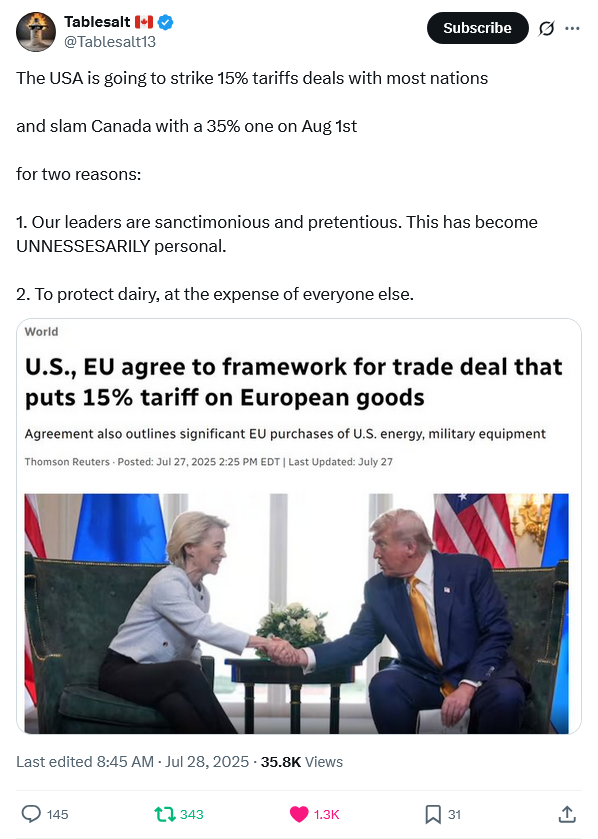
Love him or hate him — and there are lots of people in both camps — President Donald Trump has the power to randomly throw spanners into the international trade arena … because Congress ceded that power to the presidency long before Trump began his political career:

In response to Donald Trump’s tariff maneuvers, Senator Rand Paul has been arguing that presidents shouldn’t have the power to raise tariffs themselves. Taxing power belongs to Congress, and that’s where tariffs should be born. Trump’s tariffs result from the use of emergency power that Congress gave to the POTUS, and we shouldn’t normalize emergency rule. You can watch him say all of that here.

Every word of that is completely right. I don’t disagree with a single breath of it. I respect Rand Paul, and I’m inordinately fond of his dad. But it misses the point about how we got here, and why, starting with the fact that Congress gave away its taxing authority.

  1. Congress delegated its authority;
  2. Donald Trump used the authority that Congress gave him;
  3. Therefore, Donald Trump is very bad, and what he’s doing is wrong.

The core sickness at the heart of the American republic is Congress, and we keep discussing that sickness by saying that Trump sucks. He’s doing what you gave him the power to do, and he’s not the first.

See also my recent post in which I described a time when Congress made something illegal, than asked the administrative agencies to explain to them what they had just banned. Congress has delegated its authority, over and over again, and the resulting political vacuum is a serious problem. But anyway, TRUMP TRUMP TRUMP.

American political discourse keeps taking a wide range of political pathologies and assigning them to the same account. Orange Man Bad, Orange Man Bad, Orange Man Bad, they explained, with drool running down their chins. Donald Trump is our deflector object, our national excuse. [Problem name here]; OH NO WHY IS TRUMP DOING THIS TO US.

The commandant of the United States Coast Guard spoke at a maritime conference, a few days ago, and he said that the organization he runs wakes up every day and tries to keep the doors from falling off: “The US Coast Guard is less ready today than any other time since World War II. We are on a readiness spiral. Today our fleet of cutters are in significant decline. We are in repair failure mode … No ship today gets underway without cannibalizing others for parts.”

See also, from one of his subordinates:

Serious question: Did all of those problems begin at noon on January 20, 2025?

April 11, 2025

Critical Trade Theory

A discussion at the amusingly named Handwaving Freakoutery on the ongoing wave of tariff activity under the Trump II administration, characterizing them as “woke” tariffs:

The great argument playing out in the media right now about the relative value and ethical implications of reciprocal tariffs is not relevant. It is not relevant because these tariffs are not reciprocal tariffs in any measurable way. They aren’t reciprocal, they aren’t sensible, and the justification for them is Woke in every sense of the word. Let’s take a close look at what we might call Critical Trade Theory, back our way into an understanding of what a woke tariff is and how this is definitely that, and close with a quick word about how political realignments portend doom for the left even though the right is really screwing this up. Then we’ll all buy mop handle futures.

Awokening

The Great Awokening of the prior decade was founded in part on the False Cause Fallacy. Our major institutions for the better part of the last ten years were operated by wokerists, who used an Intersectional Matrix of Culturally Encouraged Race and Gender Prejudice to counteract what they viewed as hidden unmeasurable forces such as “systemic racism”. They couldn’t point to the systemic racism, but they knew it must be there because of the imbalance in socioeconomic metrics, and they denied any other possible explanation for the imbalance. Once the False Cause was in place, the devout wokerist was forced to fight the hidden prejudice with overt reverse prejudice, because they couldn’t conceive any other cause.

For example, if black folks have a hard time getting into Harvard or UNC, it must be because society is systemically racist against black people, and no other reason, therefore we should redirect admission slots from Asians who earned them to blacks who didn’t, for race balancing.

Harvard did exactly that, for exactly that reason, and admitted it, and it was sent to the Supreme Court, and the Supreme Court banned it, and then Harvard kept doing it and is still doing it using different words.

Some of our other institutions are still running this wokery program, although the Trump Administration purged much of it from the halls of federal power this year under their DEI ban, and many other institutions used Trump as cover to independently purge it from theirs. But this same smooth-brained thinking wiggled its way right into Trump’s tariff plan last week, through an equation that looks fancy but is something my middle school son could figure out.

[…]

The media thinks these woke tariffs are going to bomb the economy back to the stone age, but when I make the abhorrent choice to read the graphs myself it looks more like January 2024. A 20% tariff on Chinese goods is rough. Adding 34% more to it is rougher. But a 54% tariff on Chinese goods is nothing compared to Shenzhen closing its entire manufacturing sector down because they found a germ, and probably not significantly worse than the Fed turning off the free money spigot in 2022.

These tariffs are going to do goofy shit to the economy. I don’t like the goofy shit they’re likely to do. I think that trade balancing through tariffs is an idea so stupid that only Rust Belt union workers could come up with it, which is why they probably did come up with it, and also probably why Trump won the election by flipping the Rust Belt.

April 10, 2025

Late onset Trump Derangement Syndrome

Filed under: Media, Politics, USA — Tags: , , , , — Nicholas @ 05:00

Ed West diagnoses himself with a raging case of late onset TDS:

What has caused this late-onset TDS, however, is not Trump’s behaviour, but the relative silence of his critics. During Trump’s first term, everyone in the American establishment seemed to be calling him the next Hitler, and this included not just the usual academics and journalists but many major corporations; companies like Nike, Heineken and Airbnb were at the forefront of the “resistance” against the president, a trend labelled “CEO Activism”. It was quite obviously self-interested and performative, because if everyone in your country is calling its leader a fascist dictator, then you probably don’t live in a fascist dictatorship.

I have no idea where I saw this meme, but it makes me laugh

That is not the case this time around, and that is more troubling. I recall from my time volunteering for first aid training that, when you arrive at the scene of an accident, you don’t go to the person screaming in pain, but the individual lying on the ground in stony silence. Similarly, the fact that people working for large corporations now keep quiet about Trump, even as he embarks on the most reckless economic policy in recent years, should probably concern us. The reason they keep quiet — and this is something I have heard from the horse’s mouth — is because they feel that there is a real risk of punitive action if they speak out.

One of the things more moderate folks used to warn the far left activists about using any and all tools to “get” their enemies is that it can — and in this case has — unleashed exactly the same kind of retribution when their former target now has the power to do so. “Muh norms!” indeed.

The constant evocation of fascism is not just mistaken in my view, but neurotic. Western civilisation is emotionally scarred by the violent racial supremacism of the Nazi regime and in particular the Holocaust, the worst crime in history, yet people have a tendency to fight the last war and this isn’t the danger that Trump represents. He is not a white supremacist and not especially motivated by ethnic nationalism. He is, however, authoritarian in nature, prone to be vengeful to those who cross him while also surrounding himself with yes-men, and he does seem to have territorial ambitions, even if they concern a frozen wasteland. Those things are all bad enough in themselves.

Rather than being a new Hitler, a more realistic concern is that Trump represents the 19th century spectre of Caesarism, a man who uses democracy in order to establish himself as an imperial figure. The fear of a Caesar always haunted the founders of the Republic, obsessed with Roman history as they were and sceptical of democracy and mobs.

Trump as a modern Louis Napoleon? A case could certainly be made for it.

Caesars do not come out of nowhere, and the progressivism of the last few years has been deeply illiberal, hostile to freedom of speech and even more so to freedom of association. Jonathan Haidt talked of “decentralized totalitarianism” and it was the chaotic nature of woke progressivism that made it so disconcerting and caused many people, including those same corporate leaders, to stay silent.

Many of the things Trump is now doing are not entirely dissimilar to what radical progressives did when the opportunity arose, in particular the determination that institutions are cleared of their opponents. It is bitterly ironic, for instance, to have the Left accuse Trump of “rewriting history” for ideological reasons (gosh, imagine!). Yet there is something quite different about people scared of online mobs and being scared of the government. Activists, though loud and hysterical, could be ignored if people only had the courage to face them (which they usually didn’t); the state can make your life very difficult indeed. Already the Trump regime has punished law firms which oppose their leader; foreign nationals who’ve expressed criticism of the regime have been detained. These are not good signs.

I’ve sneered at the American critics who worked themselves up into hysterical rages about Trump, not just because of their puritanical piety but because of the lack of awareness about their own behaviour, in particular the conspiracies about Russia and the dishonest, partisan nature of American journalism (Trump is probably the most dishonest president in US history, but it may also be true that he is the most lied about). In the modern liberal imagination, in part because so many people read far more fiction than history, Trumpian figures tend to be opposed by a courageous “resistance”, whereas in reality most dictatorial leaders arise because there are no moderate alternatives, and the opposition is similarly extreme and unpalatable. There were no real goodies in the Spanish Civil War, nor in Syria, nor even in much of central-eastern Europe in the mid-20th century, where fascists fought communists for control of the streets.

April 7, 2025

Those brave, rare contrarians willing to risk everything by … criticizing Trump?

Filed under: Books, Government, Media, Politics, USA — Tags: , , , , , — Nicholas @ 05:00

Chris Bray is deeply concerned that a free society seems unable to produce even a mild array of differing political opinions these days:

I was at a small independent bookstore today, the exact kind of place that’s supposed to curate a culture of argument and criticism. The prominently displayed books about politics and current events were Timothy Snyder’s book about the terrifying rise of American fascism under that monster Trump, Jason Stanley’s book about the terrifying rise of American fascism under that monster Trump, Anne Applebaum’s book about the terrifying rise of American fascism under that monster Trump, and a bunch of other books by prominent journalists and professors about … okay, try to guess.

On the other side of that exchange, the books by public intellectuals offering a favorable or even neutral view of Trump and the Trump era were … not there? Maybe I just missed them. So every prominent figure moving to the cultural foreground from academia and “mainstream” journalism — every brave contrarian, every freethinking intellectual warrior rising against the prevailing fascist sentiment of the age to speak in his own voice as a free person — thinks and says the same things, the same ways, with the same evidence and the same framing and the same tone and in the same state of mind. They’re so free and brave and iconoclastic that they’re essentially identical, chanting in intellectual unison.

Forget Trump for a moment and answer this question in general: If you’re living through an era in which every prominent journalist and academic and artist says exactly the same fucking thing all the time, what kind of moment are you living in? Would you call people who all chant in unison the resistance?

Any engagement with these books reveals their emptiness. Snyder, Stanley, Applebaum, whatever: pick a book, then pick a page. See if it makes sense. Here, I spent a few nauseating minutes today with brave Jason Stanley’s book How Fascism Works: The Politics of Us and Them. Here’s a paragraph from the introduction to the paperback edition:

ICE is novel: It was created after 9/11, by the same law that created a bureau tasked with border protection: a “special force, created in an anti-democratic moment”.

I can’t calibrate the degree to which this person is a fool or a liar, but let’s go with both. The Border Patrol was created in 1924, and was itself the successor agency to a different organization that was created in 1904. You can read that history here. The post-9/11 organization that supposedly created this novel American institution merely reorganized a century-old American institution, making it not the least bit novel. Before ICE, we had INS. Yes, we had a border before 2003, and we policed it. This isn’t a novel concept at all, as it has operated in any form of practice.

You can go through that single amazing paragraph sentence by sentence and tear every last bit of it apart, at the lowest, simplest factual level. The argument isn’t wrong: all of it is wrong, every layer of fact and interpretation. This man is an absolutely enormous jackass. And he’s … important. An important public intellectual, you see.

April 4, 2025

Alberta plays a separate hand

In The Line, Jen Gerson discusses the disconnects between “Team Canada” (such as it is) and Alberta that now have Alberta sending its own delegation to talk to … someone … in Washington DC:

Photo by Jen Gerson, The Line.

Alberta’s periodic bursts of secessionist sentiment operate a little like the aurora that occasionally flash across the prairie sky, in tune with decades-long solar flare cycles. The phenomenon is always fascinating, yet it’s always impossible to know how seriously to take it. It waxes and wanes in line with a number of factors, only some of which can be predicted — oil prices, the partisan stripe of the federal government, and the introduction of new regulations.

We are getting another show, of late, and The Line has responded by commissioning some fresh hot polling numbers to determine just how willing Albertans are to take up U.S. President Donald Trump’s call of becoming the 51st state.

It is not a surprise that this is being talked about again. We appear to be on the verge of a potential fourth term of loathed Liberals — after being all but promised a Conservative one. Trump has declared economic war, and openly undermines our sovereignty. Alberta has elected a premier who seems to be willing to go much further than leaders past to both threaten the federal government, and align herself with Americans. Danielle Smith has made several appearances in conservative American media institutions to argue against tariffs; she also made a public appeal to her Quebec counterpart to create a common front for greater provincial autonomy. This after threatening to form another “Fair Deal” panel if a future federal government doesn’t meet a list of requests.

In the midst of this revived inter-provincial tension, an Alberta delegation has formed, insisting that it will be travelling to the U.S. in coming weeks to meet with members of the Trump administration.

Who are they meeting? Well, they won’t say.

“The response that we’re getting, quite frankly, from the present U.S. administration is very positive. We’ve been advised that the interest in what we’re doing is extremely high, and certainly everything that we’ve seen indicates that this is far from a fool’s errand,” said Jeffrey Rath, an Alberta lawyer leading the delegation, during a press conference last week held just off the lobby of a well-known Calgary hotel. The conference wasn’t well publicized, and it was obscurely signed — if you knew, you knew — and was thus populated by about 80 fellow travellers of the Alberta independence movement.

“We’ve been advised by the people we’re speaking to in the States to not disclose who it is that we’re talking to at this point,” Rath said. But the goal is clear. They’re going to Washington to meet with representatives of the Trump administration to “determine the level of support that the government of the United States would be prepared to provide to an independent Alberta.”

Admittedly, they’re only independent citizens — former Premier Jason Kenney called Rath a “treasonous kook” — though the press conference featured one former Conservative MP, LaVar Payne, and the U.S. delegation will reportedly include former Conservative MP Rob Anders.

March 31, 2025

The infighting among the Conservatives is becoming a story in this election

Listening to Jen Gerson and Matt Gurney on The Line podcast a few days ago, I was surprised to hear that the Ontario Progressive Conservatives seem to be trying to actively torpedo the federal Conservative election campaign. While internecine combat among conservative factions is pretty normal, it isn’t quite as normal for it to be happening in the middle of a federal election campaign. It’s almost as if Ontario Premier Doug Ford’s team would rather throw the election to the Liberals than to let Pierre Poilievre’s team score a win. Some friction, sure, but this level of conflict is almost unheard of.

At Acceptable Views, Alexander Brown mulls the chatter he’s been hearing from the campaign trail:

“Something’s really going on here,” says word from on the ground in once-Liberal-safe Toronto.

“The polls say one thing, but we’ve never given out so many signs. We’ve had to print thousands more than usual.”

“We’re actually doing just fine,” says another source high up on the federal campaign trail.

“Don’t believe the chatter from disgruntled so-called conservatives … Nobody here is hanging up their skates. We’ve had a very good week — long days notwithstanding! — and are beginning to inflict solid brand damage on Carney.”

“The best is yet to come. We are running the campaign we should be running. One that’s true to conservative values and principles.”

On that “chatter”, this non-profit campaigner and writer has no qualms about going weapons-hot.

For those unaware, Ford-“conservative” insiders in Ontario have been taking to the media circuit, issuing complaint after complaint, as both anonymous and named sources, in an effort to pull the Conservatives off of major pocketbook issues such as immigration, housing, affordability, and crime, and on to, all but exclusively, Trump, Trump, Trump.

It matters to them not, apparently, that the Liberals have lucked into booby-trapping both sides of the Trump issue, and that it forces the Conservatives onto uneven terrain.

Drag this out and make it worse, as Carney has largely chosen to do? His elbows are up!

Get shoved around by the administration to the south? See, this is why he’s the one to deal with it. He’s Trump’s enemy!

(Apparently, it also matters not that Carney has received repeated pats on the head and quasi-endorsements from #45, and now, #47.)

The real story here? Allegedly embittered that they were left out of the war-room for reasons of not being all that conservative and being untrustworthy (a point they are now proving over and over again), and wanting to neglect a youth vote they were incapable of turning out, a select few in an Ontario crew think they know best, and would rather engage in public displays of industrial sabotage than keep it private and above the belt.

It’s a ridiculous little consultant slap-fight, at a time when 5000 people are standing out in the rain, to tell a man they don’t know that their Canadian Dream is now a nightmare, that they’re now drowning in debt and don’t feel hope for the future.

“These guys have no idea what they’re talking about. When this is all over, I hope they regret ever weighing in like this.”

For Doug Ford’s campaign manager Kory Teneycke, who has been working the Liberal podcast and media circuit the hardest, it might be worth noting that not every campaign has the advantage — nor indulgence — of being able to run on Liberal-lite and solely Trump.

The Ontario PCs were granted the easy road of being able to cut the corner to the polls in February, in an election no one asked for, while running Carney-adjacent messaging, and they still couldn’t pick up a seat against the worst Ontario Liberal leader of a generation.

The Line‘s Gerson and Gurney both seem quite taken with the attacks on Poilievre by Ford’s right-hand spokes-hatchetman, but others are reporting lots of enthusiasm on the campaign trail and contrasting it with Carney’s handlers deliberately keeping the PM away from the press as much as they can.

The numbers of people who show up to political events isn’t a dependable metric, but if the disproportion gets to the point that you’re able to hand-count the number of supporters at a given venue, it might be a useful bit of anecdata:

March 24, 2025

Canada could learn from the Finnish example

Filed under: Cancon, History, Military, USA, Weapons — Tags: , , , , — Nicholas @ 05:00

US President Donald Trump tossed several grenades into the still waters of Canadian defence platitudes and forcefully called attention to the clear fact that Canada has been a world-leader in defence freeloading since the late 1960s. In The Line, Tim Thurley suggests that Canada should look more closely at how Finland has maintained its sovereignty with a larger, militarily dominant, and unpredictable neighbour for more than a century:

Map of Finland (Suomen kartta) by Oona Räisänen. Boundaries, rivers, roads, and railroads are based on a 1996 CIA map, with revisions. (via Wikimedia – https://en.wikipedia.org/wiki/File:Map_of_Finland-en.svg)

Canadians pretended we didn’t need to take defence seriously. We justified it with fantasies — the world wasn’t that dangerous, threats were distant, and America would rescue us if needed. That delusion is dead. U.S. Republicans and some Democrats don’t trust us to defend our own territory. Trump openly floated annexation and made clear that military protection now comes at a price — potentially statehood. Canadian military leaders now describe our closest ally as “unpredictable and potentially unreliable”. And even when America was a sure bet, our overreliance was reckless. Sovereignty requires self-defence; outsourcing it means surrendering power.

We should take cues from nations in similar situations, like Finland. Both of us border stronger powers, control vast, harsh landscapes, and hold valuable strategic resources. We’re internally stable, democratic, and potential targets.

We also share a key strength — one that could expand our military recruitment, onshore defence production, rebuild social trust, and bolster deterrence: a strong civilian firearms tradition.

We should be doing everything we can to make that tradition a bigger part of Canadian defence, and a larger part of our economy, too.

That may sound absurd to some Canadians. It shouldn’t. Finland is taking full advantage by attempting to expand shooting and military training for civilians both through private and public ranges and the voluntary National Defence Training Association. Finland is seeking to massively upgrade civilian range capacity by building 300 new ones and upgrading others to encourage civilian interest in firearms and national defence, and is doing so in partnership with civilian firearm owners and existing non-government institutions.

Multiple other states near Finland are investing in similar programs. Poland is even involving the education system. Firearm safety training and target practice for school children are part of a new defence education curriculum component, which includes conflict zone survival, cybersecurity, and first aid training. Poland’s aim is to help civilians manage conflict zones, but also to bolster military recruitment.

Lithuania and Estonia encourage civilian marksmanship as part of a society-wide comprehensive defence strategy. The Lithuanian Riflemen’s Union, one of the small nation’s most recognizable institutions, is a voluntary government-sponsored organization intended to prepare civilians for resistance to an occupying power. It has 15,000 members in a population of 2.8 million. The Estonian Defence League trains mostly-unpaid civilian volunteers in guerrilla warfare. It has an 80 per cent approval rating in Estonia, where over one in every 100 men and women with ordinary jobs have joined to learn defence techniques, including mastering standard-issue military service rifles that they may keep at home, ready to fight on a moment’s notice.

These strategies are modern. These countries are no strangers to cutting-edge modern warfare, necessitated by a common border with an aggressive Russia. But technologies like drones are not a replacement for a trained and motivated citizenry, as the Ukraine conflict illustrates. Against a stronger and more aggressive neighbour, these societies deter and respond to aggression through organized, determined, and trained populations prepared to resist attackers in-depth — by putting a potential rifle behind every blade of grass.

Canada, meanwhile, is spending money to hurt our own capacity. It’s coming back to bite us. The Trudeau government misused civilian firearm ownership as a partisan political wedge and ignored the grave flaws of that strategy when they were pointed out, hundreds of times, by good-faith critics. Thousands of firearm models have been banned at massive and increasing expense since 2020 despite no evident public safety benefit. In the recently concluded party leadership race, Mark Carney pledged to spend billions of dollars confiscating them. Government policies eliminating significant portions of business revenue have maimed a firearm industry that historically contributed to our defence infrastructure. Civilian range numbers, which often do double-duty with police and even military use, plunged from roughly 1,400 to 891 in five years. Without civilians to maintain ranges for necessary exercises and qualification shoots, governments must assume the operating expenses, construct new ranges, or fly participants elsewhere to train.

March 23, 2025

Tariffs versus income taxes – pick your poison

Walter Block on the pros and cons (from the government’s point of view) of income taxes and tariffs:

Every fiber of my economic being cries out against tariffs. If they are so good, why doesn’t each state in the US have one against the products of all of the other 49? That is, Ohio could “protect” its industries against the incursions from Arizona. This is obviously silly. One of the important reasons America is so prosperous is that we have a gigantic, internal, free trade area.

Donald Trump supports them on the ground that the McKinley administration was prosperous, and relied upon tariffs. But this is to commit the post hoc ergo propter hoc logical fallacy: that since A precedes B, A must be the cause of B. No, America did indeed become rich during this epoch, but that was in spite of tariffs, not due to their benign influence. If you are looking for a historical episode to shed light on this matter, the Smoot-Hawley Tariff of 1930 will do far better: it greatly worsened an already bad recession, plunging our economy into a deep depression.

Our President also claims that the US is victimized by a negative balance of trade: we buy more from Canada and other countries than they purchase from us. However, I have a horrid balance of trade with McDonald’s and Wal-Mart. I acquire several hundreds of dollars’ worth of their products every year, and neither has yet seen fit to reciprocate with any of my economic services (hint, hint!). On the other hand, I have a very strong positive balance of trade with my employer, Loyola University New Orleans. They pay me a decent salary; apart from a few lunches in their cafeteria, my expenditures to them fill their coffers to a zero degree. Should anyone worry about this sort of thing? Of course not. Ditto for international trade. If Country A buys more from B than it sells to it, money will flow from the former to the latter, reducing prices in the former and raising them in the latter, until matters balance out.

Everyone realizes the foolishness of tariffs when it comes to absolute advantage. No Canadian objects to the importation of bananas from Costa Rica. Producing this tropical product in the frozen North would be financially prohibitive (gigantic hothouses). Ditto for maple syrup in the country to the south. The only way they could produce this item would be to place maple trees in gigantic refrigerators. Ludicrous and prohibitively expensive.

But when it comes to comparative advantage, all too many people are out to lunch insofar as the teachings of Economics 101 are concerned. They fear that other countries might be more efficient than we are; with free trade, they would produce everything, we, nothing, and we would all starve to death from massive unemployment.

March 22, 2025

Fundraising is much tougher for Democrats right now … and they’re not coping well

Filed under: Media, Politics, USA — Tags: , , , , , , — Nicholas @ 03:00

It’s not just Canadian politicians getting driven completely insane by the Bad Orange Man’s antics — he’s even doing it to his domestic opponents in the Democratic party as well:

“REMINDER: It Is Offensive And Possibly Illegal To Photoshop Anything On These Democrats’ Signs That Would Make Them Look Foolish.
The Babylon Bee.

Kansas City Star:

    Democrats Suffer Blow Ahead of Senate Elections

It’s a goddamn slide show, but as it might be amusing I shall wade in. The things I do for you people …

    Sen. Jeanne Shaheen’s retirement is expected to significantly impact the Democratic Party’s prospects for the upcoming Senate elections, amplifying pressure on Senate Minority Leader Chuck Schumer (D-NY). The party’s challenges ahead have heightened with the departures of Sen. Gary Peters (D-MI) and Sen. Tina Smith (D-MN). Democrats must regain four seats to reclaim the majority.

It sure looks like the Donks are planning to get clobbered in 2026. Or, more likely, they anticipate a series of bruising primary fights as the old grift-and-grin Democrats are challenged by True Believers, because as HGG has taught us — credit where it’s due — SJWs always double down. Batshit insanity is the hill they’ve chosen to die on — Trump keeps handing them 80/20 issues, and they keep jumping on the 20 with both feet.

    CNN’s Chris Cillizza recently noted the Party’s challenges in the upcoming Senate elections. With the need for a net gain of four seats, Cillizza expressed concern over potential financial limitations that may hinder effective campaigning.

Yes. “Financial limitations”. Democrat donors are stupid — if they weren’t, they wouldn’t be Democrats — but even they can see that 80 is way, way bigger than 20.

Oh, and also: It doesn’t help that you’re openly, gleefully endorsing no-shit terrorism against Tesla dealerships — and drivers! — calling for Musk’s assassination, and so on. It’s a bad look in general, and a bad look in particular, because now the guys with the big checkbooks are wondering if that kind of thing won’t happen to them if they get crosswise with the most lunatic members of the lunatic fringe (hint: It will. As the scorpion said to the frog: can’t be ‘elped, mate, it’s me nature).

    Cillizza said, “The money that gets spent there playing defense, just to hold Democratic seats, means money that doesn’t get spent playing offense in, let’s say, a state like Ohio, where Democrats are trying to recruit Sherrod Brown, the former senator, to take on John Huston, the appointed Republican senator.”

Yes, a dwindling asset pool forces those kinds of choices. It also doesn’t help that you keep going back to the well like that. One assumes there’s a reason Sherrod Brown is a former senator. Do you have no one else?

Haha, just kidding, obviously you don’t have anyone else. That’s one of the biggest problems with gerontocracy — the Groovy Fossils are going to have to be carried out at room temperature, so anyone with anything on the ball has been giving Government a pass since the 1980s. Trump went around the Official GOP for lots of reasons, but not the least of them was: he had to. They have the same gerontocracy problem as the other side of the Uniparty. It’s turtles all the way down.

    Cillizza concluded, “I just do not see it. I don’t see the money there. I don’t see the energy there. I don’t see the candidates there to expand the playing field”.

It won’t be for lack of trying, though. You’ve still got The Media in your pocket, and they can still do some damage. You’ll never get to the 80 side of those 80/20 issues, but you might get it to 50/50 — as has been done with abortion, gay “marriage”, and so on. On the other hand, those took 40, 50 years, and The Media hadn’t totally pissed away all its credibility back then. It’s a real corner you’ve backed yourselves into, guys gals persyns.

It also doesn’t help that you’re stupid:

    Democrats have identified potential pickup opportunities in Maine and North Carolina, targeting Sen. Susan Collins (R-ME) and Sen. Thom Tillis (R-NC).

Holy breakdancing Buddha, why would you target them? Thom Tillis is the very definition of “RINO”; Collins is a Leftist, full stop. The next time they vote against the Democrats on any issue of substance will be the first time they’ve ever done it. It’s as predictable as sunrise, so much so that it’s a joke to anyone right of Mao — the GOP officially has X number of seats, minus Collins and Murkowski.

    Vulnerabilities among current incumbents, especially Sen. Jon Ossoff (D-GA), have added to the party’s challenges.

    Oh, don’t worry about it — the GOP will find some way to throw it. Georgia, Georgia … hey, what’s Herschel Walker up to these days? Think he’s up for another run? Why not parachute in Alan Keyes or Ben Carson? They’re still alive, right? What about “Nikki” “Haley”? She’s gotta keep her arm loose for the 2028 primaries …

      Some Democrats have remained optimistic despite the hurdles. Discussions have included potential candidates such as Rep. Haley Stevens (D-MI) and State Sen. Mallory McMorrow (D-MI) for key races. New Hampshire Democrats have prepared for competitive primaries, with Rep. Chris Pappas (D-NH) considering a bid for Shaheen’s seat.

    As we know, when it comes to crime 13 does 50. When it comes to Leftism, though, it’s more like 20 does 100, and there’s no better illustration than New Hampshire. It should be the reddest state in the union, and people who live there tell me it really is… except for their Congresscritters, because the good people of New Hampshire didn’t shoot every Masshole they could catch. The fine folks in Oregon, Colorado, and (soon enough) Texas know what I mean — y’all didn’t introduce migrating Californians to wood chippers when you had the chance.

March 21, 2025

Apparently the US Constitution elevates the judiciary over the other branches of government

Filed under: Bureaucracy, Government, Law, Military, USA — Tags: , , , , , — Nicholas @ 03:00

Chris Bray on recent innovative judicial activism to constrain the evil machinations of the Bad Orange Man:

It won’t be news to anyone that the federal judiciary has decided Donald Trump has no authority as President of the United States but to serve and protect the status quo, absolutely without deviation. Change is unconstitutional. Policy is unconstitutional. But even by that standard, today has been very special.

Without digging into all the details about everything, skim your way through a single judicial decision to begin to see what’s happening: the decision from District Court Judge Ana Reyes, ordering the Department of Defense to allow the continued service of transgender military personnel. You can click here to read it, or open the PDF file below.

This is not a judicial decision. I mean, it is a judicial decision, but it doesn’t represent judicial culture or a judicial outlook. At all. It’s a bitchy schoolgirl essay about being fair and not being mean, with healthy doses of platitudinous foot stompery. Screenshot, bottom of page one and top of page two:

“Today, however, our military is stronger and our Nation is safer for the millions of such blanks (and all other persons) who serve.” Because she says so, is why. The old bigoted American military was very weak. I don’t remember: Did the old dumb bigots ever even win any wars or anything?

[…]

Our military is much stronger now than it was when gay and transgender service wasn’t warmly encouraged, the end. (Stomps foot.) It’s a TikTok video formatted to look like a, you know, a judge thing. You can even agree with the judge and see that she hasn’t made an argument. “Today, however, our military is stronger.” Like when we beat the Taliban, or all the other wars we’ve won lately. This is the declarative reality in which a thing becomes true because you type it.

Now, watch this. Watch Judge Ana Reyes roll right over herself without noticing that she’s doing it. You don’t have to read past page two to see this.

On page one, she characterizes the reasoning — the premise the administration advanced to forbid military service by transgender personnel: “Service by transgender persons is ‘inconsistent’ with this mission because they lack the ‘requisite warrior ethos’ to achieve ‘military excellence’.” That’s it, those mean monsters! That’s their whole reason! They said trans people can’t serve because of, I don’t know, some stupid ethos thing. What does that even mean?

March 19, 2025

The Trumpocalypse – “The outlook for universities has become dire”

Filed under: Education, Media, Politics, USA — Tags: , , , , , — Nicholas @ 05:00

John Carter suggests that American higher education needs to find a new funding model that doesn’t depend on governments to shower their administrative organizations with unearned loot:

Shortly after taking power, the Trump administration announced a freeze on academic grants at the National Science Foundation and the National Institute for Health. New grant proposal reviews were halted, locking up billions in research funding. Naturally, the courts pushed back, with progressive judges issuing injunctions demanding the funding be reinstated. Judicial activism has so far met with only mixed success: the NSF has resumed the flow of money to existing grants, but the NIH has continued to resist. While the grant review process has been restarted at the NSF, the pause created a huge backlog, resulting in considerable uncertainty for applicants.

The NIH has instituted a 15% cap to indirect costs, commonly referred to as overheads. This has universities squealing. Overheads are meant to offset the budgetary strain research groups place on universities, covering the costs of the facilities they work in – maintenance, power and heating, paper for the departmental printer, that kind of thing. Universities have been sticking a blood funnel into this superficially reasonable line item for decades, gulping down additional surcharges up to 50% of the value of research grants, a bounty which largely goes towards inflating the salaries of the little armies of self-aggrandizing political commissars with titles like Associate Vice Assistant Deanlet of Advancing Excellence who infest the flesh of the modern campus like deer ticks swarming on the neck of a sick dog. Easily startled readers may wish to close their eyes and scroll past the next few images btw, but I really want to make this point here. When you look at this:

A 15% overhead cap, if applied across the board, has an effect on the parasitic university administration class similar to a diversity truck finding parking at a German Christmas market. Thoughts and prayers, everyone.

Meanwhile at the NSF, massive layoffs are ongoing, and there are apparently plans to slash the research budget by up to 50%. While specific overhead caps haven’t been announced at the NSF yet, there’s every reason to expect that these will be imposed as well, compounding the effect of budget cuts.

There is no attempt to hide the motivation behind the funding freeze, which is obvious to both the appalled and the cuts’ cheerleaders. Just as overheads serve as a blood meal for the administrative caste, scientific research funding has been getting brazenly appropriated by political activists at obscene scales. A recent Senate Commerce Committee report found that $2 billion in NSF funding had been diverted towards DEI promotion under the Biden administration. In reaction to this travesty, as this recent Nature article notes, there are apparently plans to outright cancel ongoing grants funding “research” into gay race communism. DEI programs, formerly ubiquitous across Federal agencies, have already been scrubbed both from departmental budgets and web pages. Indeed, killing those programs was one of the first actions of the MAGA administration.

The outlook for universities has become dire, and academics have been sweating bullets all over social media. Postdocs aren’t being hired, faculty offers are being rescinded, careers are on hold, research programs are in limbo. This comes at the same time that budgets are being hit by declining enrolment due to the demographic impact of an extended period of below-replacement fertility along with rapidly declining confidence in the value of university degrees, with young men in particular checking out at increasing rates as universities become tacitly understood as hostile feminine environments. They’re hitting a financial cliff at the same point that they’ve burned through the sympathy of the general public.

The entire sector is in grave danger.

Politically, going after research funding is astute. Academia is well known to be a Blue America power centre, used to indoctrinate the young with the antivalues of race Marxism, provide a halo of scholarly legitimacy to the left’s ideological pronouncements, and hand out comfortable sinecures to left-wing activists. The overwhelming left-wing bias of university faculties is proverbial. The Trump administration is using the budgetary crisis as a handy excuse to sic its attack DOGE on the unclean beast – starting with cutting off funding to the most ideological research projects, but apparently also intending to ruin the financial viability of the progressives’ academic spoils system as a whole.

Cutting the NSF budget by half may seem at first glance like punitive overkill, and no doubt the left is screeching that Orange Hitler is throwing a destructive tantrum like a vindictive child and thereby endangering American leadership in scientific research. After all, for all the attention that NASA diversity programs have received, the bulk of research funding still goes to legitimate scientific inquiry, surely? However, the problems in academic research go much deeper than its relentless production of partisan activist slop. Strip out all of the DEI funding, fire every equitied commissar and inclusioned diversity hire, and you’re still left with a sclerotic academic research landscape that has spent decades doing little of use – or interest – to anyone, and doing this great nothing at great expense.

March 17, 2025

America’s modern Triumvirate

Filed under: Media, Politics, USA — Tags: , , — Nicholas @ 05:00

Last month, I posted John Carter’s amusing riff on Trump, Musk, and Vance as the American Pompey, Crassus, and Caesar, the original Triumvirate. Apparently John isn’t the only one struck by the similarities, as David Friedman also considers the three as America’s modern Triumvirate:

Trump, Vance, and Musk as America’s Triumvirate – Grok

Trump is the most important at present, since both Vance and Musk have political power only to the extent he gives it to them. He is a very competent demagogue, as demonstrated by his winning a series of political conflicts that almost everyone expected him to lose. So far as I can tell from his history he has no political views of his own, uses ideology as a tool to get power, attention, status. Conservatives were a substantial faction unhappy with the state of the nation, with what they viewed as the political and cultural domination of the country by their opponents, hence a potential power base for him. Progressives had overplayed their hand, pushed woke ideology too far, due to face a backlash, useful as enemies. He adopted the role of conservative champion, destroyer of wokeism, borrowing details of his program most recently from Project 2025, a detailed conservative plan for how a conservative administration could restructure the federal government.

Trump’s Ukraine policy is to produce a peace for which he could claim credit, a deal that holds until at least 2028. To force Zelensky to accept he had to make it believable that he was willing to drop US support for Ukraine if Ukraine refuses to go along, and he did. To force Putin to accept he will have to make it believable that the US is willing to continue, even expand, support for Ukraine if Russia refuses to accept a peace plan.

[…]

Assuming no rupture with Trump and no failure of their administration extreme enough to break Trump’s control over his party, Vance will be the Republican nominee in 2028. He is young, handsome and smart with a beautiful and intelligent wife, is playing a minor role now but could be a major political figure in the post-Trump world. Unlike Trump he has political views of his own, not merely the desire for power. What are they?

I devoted two of my earlier posts to trying to answer that question, Vance and Revising the Republican Party. My conclusion:

    The conservative movement of Bill Buckley rejected the New Deal. Vance does not. The past he wants to return to is an idealized version of America in the fifties, perhaps the sixties. The movement he wants to build rejects both the pro-market economics of the pre-Trump conservative movement and the cultural program of current progressives. He wants an America of stable marriages, views parents as more reliably committed to the future than the childless — hence the much-quoted line about childless cat ladies. One of his more intriguing proposals is that children should get votes, cast by their parents, giving a family with three children five votes.

    The Republican party Vance wants to build looks, economically, like the Democratic party of the fifties and sixties, culturally like the inverse of the progressive, aka woke, movement.

[…]

The project the three of them are attempting is a full scale revision of the federal government. Of the three, Musk is the one who might be competent to do it. Trump’s skill is charisma, the ability to get people to pay attention to him, admire him, want to please him. That is how he got to a position from which to revise the government but it is not the skill needed to do it. Vance has demonstrated even less of the relevant abilities; his accomplishments so far are writing a very interesting book and winning a senate election

Musk, in contrast, has created two very successful firms, taken over and revised a third. None were projects on the scale of what he is now attempting but they are smaller projects of the same sort. Hence it is at least possible that, with the authority Trump has so far been willing to delegate to him, he can convert the federal government into something smaller, less expensive, better functioning, judged at least by the standards of Trump and his supporters.

March 15, 2025

Trump’s actual goal in Ukraine

Filed under: Europe, Military, Russia, USA — Tags: , , , — Nicholas @ 05:00

David Friedman posted this a couple of days ago, considering what President Trump’s real goals may be in the Russo-Ukraine conflict:

There are two possible interpretations of Trump’s policy. The pessimistic one is that he plans to give Putin what he wants, force Zelensky to accept peace terms that give Russia substantial amounts of Ukrainian territory and leave Ukraine disarmed and defenseless against future Russian demands. On that theory the clash with Zelensky was a pre-planned drama intended to provide an excuse for the US withdrawing support, make it less obvious that Trump now supports Putin. As of Monday that looked like a plausible reading of the situation.

The optimistic reading was that Trump wanted to force an end to the war on compromise terms, use the withdrawal of support to force Zelensky to agree. Tuesday’s news, Zelensky agreeing to a proposed cease fire and Trump responding by resuming US support for Ukraine, is evidence for that reading. The ball is now in Putin’s court. If he rejects the proposal Trump will be under pressure to continue, perhaps even increase, US support. That is a reason for him not to reject the proposal. My guess is that Putin will agree to a temporary cease fire, at least in principle, although he may haggle over details, try to push for a version more favorable to him.

What Trump wants, on the optimistic interpretation, which I now find likely, is to end the war. To do that he needs to find terms that both sides will accept. Zelensky will not accept terms that amount to surrender — even if the US abandons him, he has the option of continuing the war with increased support from the European powers, now moving to rearm. If they are sufficiently committed to Ukraine or sufficiently annoyed at the US they should be able to replace most, although not all, of what the US has been providing, if necessary with munitions purchased from the US; it is hard to imagine even Trump forbidding US arms manufacturers from selling to allies. Ukraine would be worse off than continuing the war with US support but, if Russia is willing to agree to terms Trump approves of and Ukraine is not, that will not be an option.

Putin was, despite American support for Ukraine under the previous administration, winning, although very slowly and at considerable cost. Unless Trump is willing to respond to Russian rejection of his peace plan by greatly increasing US support, which I think unlikely — no boots on the ground nor wings in the air — Putin has the option of returning to that, so will not accept anything much less. That suggests that the most likely terms amount to an extended cease fire. Ukraine does not disarm, Russia does not withdraw from territory it is occupying. Both sides stop blowing things up on territory controlled by the other, stop shooting at each other.

Judged by territorial control that is a win for Russia, since it ends up controlling most of what it wanted, the parts of Ukraine occupied by Russian speakers plus the areas that can block the water supply into Crimea, with Ukraine even further from recovering Crimea than before. That might be enough to let Putin present it to his population has a victory sufficient to justify the decision to invade Ukraine.

Seen from the outside, it would be an expensive victory, which might be enough to deter future adventurism or a renewal of the war. To get it, Russia has consumed a large part of the store of military equipment inherited from the Soviet Union, making it less formidable in any future conflict with Ukraine or anyone else. Worse still, the war has driven two neutral powers, both militarily substantial and one of them on the Russian border, into joining NATO. And between Putin and Trump they may have pushed the European powers into finally rearming. The population of the European NATO members is several times that of Russia, their economies as well:

    “It’s striking but it’s true. Right now, 500 million Europeans are begging 300 million Americans for protection from 140 million Russians who have been unable to overcome 50 million Ukrainians for three years.” (Donald Tusk, prime minister of Poland)

What would be the effect of an extended pause in the war on the balance of power between Russia and Ukraine, the prospects for a renewed conflict? Both Russia and Ukraine will be able to rebuild what the war has destroyed; that will be a bigger benefit for Ukraine, since it has lost much more. One of Russia’s advantages in the war was that it not only had more munitions, it could build more, could fire far more shells at Ukrainian forces than Ukraine could fire back. An extended pause will give Ukraine and its allies time to build the factories they need. It will give states not involved in the war, such as South Korea and India, time to build up supplies of armaments and ammunition some of which can be sold to Ukraine when and if the pause ends. It will give US arms firms time to expand for a world where there is increased demand for what they produce.

If the European powers go through with their current talk of greatly increased military expenditure and continue to back Ukraine, there will be much more money bidding for arms on behalf of Ukraine than on behalf of Russia. That could shift the balance when and if the war resumes.

March 10, 2025

Deep State delenda est

Filed under: Bureaucracy, Cancon, Economics, Government, Politics — Tags: , , , , , — Nicholas @ 03:00

Elizabeth Nickson calls for the destruction of the deep state, Cato the Censor-style: salt the earth and leave no stone standing upon another stone:

There has been some argument in my house about Trump’s tariffs on Canada, and indeed the rest of the world. I’m on the American side; why on earth should the Americans pay for everything? Because they do. They pay for Europe’s defence, they allow every single country to tariff American products while allowing their goods in for pennies. When anyone, anywhere is in trouble, who do they call? The Yanks. Where do the pleas of all the desperate people all over the world land? America. Who did the Israeli captives hope for? Trump and the Americans. (Actually just Trump. They didn’t think that the Biden people would lift a finger. Which they didn’t.)

Please explain why these countries below, numbering 550 million people, cannot defend themselves?

Why can’t they defend themselves? They are broke.

The following represents $150 billion in missed opportunity in the last FIVE years. Canada is so broke, it is broke-ass broke; it is a shriveling carbuncle on the American economy. We send 80% of our exports to you because we are TOO DAMNED LAZY to develop our own country.

If we had built those projects, Canada would be rich, the middle class would be crackling along, creativity would have soared and we would actually be proud. No one is proud of Canada except for the people paid to bloviate or who hope to be paid to bloviate, and those too stupid to bloviate. The rest of us are sullen and angry and so frustrated we don’t know what to do with ourselves.

But no. Climate Change. Look, I am sorry to say this, but anyone who “believes” in climate change being somehow catastrophic is stupid, malignant or has not done the required reading. Which means lazy. Which means childlike. There is no there there. Climate alarmism is nonsense, it is bullshit, it is utter crap made up by subsidized kids looking for “significance” and an endless supply of taxpayer dollars. The science is far too new to be reliable, there are thousands of real (not NGO) scientists in opposition to it and the policy implications are so vast we are looking at a new feudalism. Anyone promoting climate change is unserious.

Childhood is where we are. Canada is the only country in the Western Hemisphere which exacts a crippling carbon tax. And this:

The above is a perfect illustration of vanity, of a detachment from reality. And the only way people can detach from reality is that they are subsidized by the Americans. This means the Heartland people, the Flyover people. Those subsidies to the world added to a massive, unsustainable, insane, debt of thirty-seven trillion, created a giant fuzzy rainbow coloured cloud inhabited by perpetual children built by ghastly people like Samantha Powers, Al Gore, Hillary Clinton, and their legion of sick, larcenous, pedophile supporters, the ferociously stupid women on the east coat of America, the idiots at all the Ivies, and the two million federal workers who are about to be reduced by, I wish, 50%.

« Newer PostsOlder Posts »

Powered by WordPress