
Between the foreignness and the sheer, overwhelming size of the topic, it might seem impossible to conduct an adequate survey of the history, vocabulary, and vibe of eating, Chinese-style, for Western readers. But that’s why we have Fuchsia Dunlop. She’s an Englishwoman, but she trained as a chef at the Sichuan Higher Institute of Cuisine (the first Westerner ever to do so). She’s written some of the best English-language cookbooks for Chinese food, and now she’s written this book: her attempt to communicate the totality of the subject she loves and which she’s spent her life studying. But the topic is just too damn big to take an encyclopedic or even a systematic approach, and so she wisely doesn’t try. Instead she writes about the weirdest and tastiest and most emblematic meals she’s had, and ties each one back to the main topic. So the book lives up to its name. Like a banquet, it doesn’t try to give you a thorough academic knowledge of anything, but rather a feast for the senses and a feel for what a cuisine is like.
What is it like? Well, Dunlop barely manages to cover this in a 400-page book, so I hesitate even to try, but let me hit a few of the high points. First, diversity. China is a continent masquerading as a country, both in population and in geographic extent, so its cuisine is comparably diverse. Most cooking traditions have one or two basic starches, China has four or five.1 China extends through every imaginable biome, from rainforest to tundra, desert to marshlands, and much of the genius of Chinese food lies in combining the delicious bounties offered up by this kaleidoscope in interesting or unexpected ways.
One way to think of Chinese eating is that much of it is a sort of “internal” fusion cuisine. Because China was ruled from very early on by a centralized bureaucracy with a fanaticism for river transport, the process of culinary remixing has been going on for much longer than it has in most places. The Roman Empire could have been like this, but the shores of the Mediterranean all have pretty similar climates, so there were fewer ingredients to start the process with. Already very early in Chinese history, before the 7th century, we hear of the imperial city being supplied with:
oranges and pomelos from the warm South, […] the summer garlic of southern Shanxi, the deer tongues of northern Gansu, the Venus clams of the Shandong coast, the “sugar crabs” of the Yangtze River, the sea horses of Chaozhou in Guangdong, the white carp marinated in wine lees from northern Anhui, the dried flesh of a “white flower snake” [a kind of pit viper] from southern Hubei, melon pickled in rice mash from southern Shanxi and eastern Hubei, dried ginger from Zhejiang, loquats and cherries from southern Shanxi, persimmons from central Henan, and “thorny limes” from the Yangtze Valley.
If we think of chefs as artists, the Chinese ones have since ancient times had the advantage of an outrageously diverse set of paints. But these ingredients aren’t combined willy-nilly, without respect for their time or place of origin. The Chinese practically invented the concept of terroir, and their organicist conception of the universe in which everything is connected to everything else implied strict rules about which foods were to be eaten when, both for maximum deliciousness and to ensure cosmic harmony.
In the first month of spring, [the emperor] was to eat wheat and mutton; in summer, pulses and fowl; in autumn, hemp seeds and dog meat; in winter, millet and suckling pig. An emperor’s failure to observe the laws of the seasons would not only cause disease, but provoke crop failure and other disasters.
The obsessions with freshness and seasonality come to their culmination in the one area where Chinese cuisine stands head and shoulders above all others: green vegetables. In the West, “eating your greens” is a punishment, or at best a chore, and it’s easy to see why. In much of the world vegetables are bred for yield and transportability, kept in refrigerators for weeks, and then boiled until no trace of flavor remains. Dunlop and I have one thing in common: when we’re not in China, of all the delights of Chinese cooking it’s the green vegetables that we miss the most.
When I bring American friends to a real Chinese restaurant, sometimes they’re shocked that the vegetable dishes cost the same amount as the main courses. Why does a side dish cost so much? But no Chinese person would ever think of a vegetable course as a “side” dish, they’re part of the main attraction, and more often than not they’re the stars of the show. In the West, you can now get decent baak choy, but this is just one of the dozens and dozens of leafy greens that the Chinese regularly consume, many of them practically impossible to find outside Asia.
My own favorite is the sublime choy sum. I remember once getting off a transoceanic flight, starving and exhausted, and being offered a bowl of it over plain white rice. The greens had been scalded for a few seconds with boiling water, then tossed around a pan for no more than a minute — just long enough that the leaves were so tender they seemed to dissolve in your mouth, but the stems still held snap and crunch. The seasoning was subtle — maybe a few cloves of garlic, some salt, a splash of wine or vinegar. Just the right amount to bring out the deep, earthy flavors of the vegetable, to somehow make them brighter and more forward, but not to overpower them.2 It was one of the most delicious things I’ve ever eaten. I think I’ll still remember it when I am old.
Did you notice that in the previous paragraph I spent almost as much time describing the texture of the food as its flavor? That’s no coincidence. Of course the Chinese care about flavor, everybody does (except the British, ha ha), but relative to many other culinary traditions the Chinese put a disproportionate emphasis on the texture of their food as well. I’ll once again draw on a bastardized version of the Whorf hypothesis: English is a big language with a lot of borrowings, so we have a correspondingly large number of words for food textures. Imagine explaining to a foreigner the difference between “crunchy” and “crisp”, or between “soft” and “mushy”. That is already more semiotic resolution than most languages have when it comes to the mouthfeel of their food, but Chinese takes it to a whole ‘nother level.
John Psmith, “REVIEW: Invitation to a Banquet by Fuchsia Dunlop”, Mr. and Mrs. Psmith’s Bookshelf, 2024-02-05.
- One of them, potatoes, has a particularly fraught history. Potatoes started seriously spreading in China right around the time of the mass famines that accompanied the collapse of the Ming dynasty. Accordingly, they got a reputation of being food for poor people. They’ve never really managed to overcome this association, and are generally shunned by the Chinese, especially in high-end cuisine, despite several government campaigns to encourage people to eat them since they’re nutritious and easy to grow in arid conditions.
- There’s a pattern in Chinese gastronomy where extremely intense, over-the-top flavors are a bit low-status, and flavors so pure and subtle they verge on bland are what the snooty people go for. This is true across regions (the in-your-face food of Sichuan is less valued than the cuisine of the Cantonese South, or the cooking traditions of Zhejiang in the East), but it’s also true within regions (in Sichuan, the food of Chongqing is much spicier than the food of Chengdu, and correspondingly lower status).
March 5, 2026
QotD: Chinese cooking
March 1, 2026
Generation Jones EXPLAINED: The Lost Generation Nobody Talks About
Wee Nips
Published 29 Jun 2025Born between 1954 and 1965? You might be part of the forgotten generation — Generation Jones — wedged awkwardly between Boomers and Gen X.
In this video, we break down what it means to be a Joneser, why we’re all still jonesing for something better, and how our weird hybrid powers (like remembering phone numbers and setting up Wi-Fi) just might save the world.
If you’ve ever used aluminum foil on rabbit ears or fixed a TV by smacking it, this one’s for you.
February 27, 2026
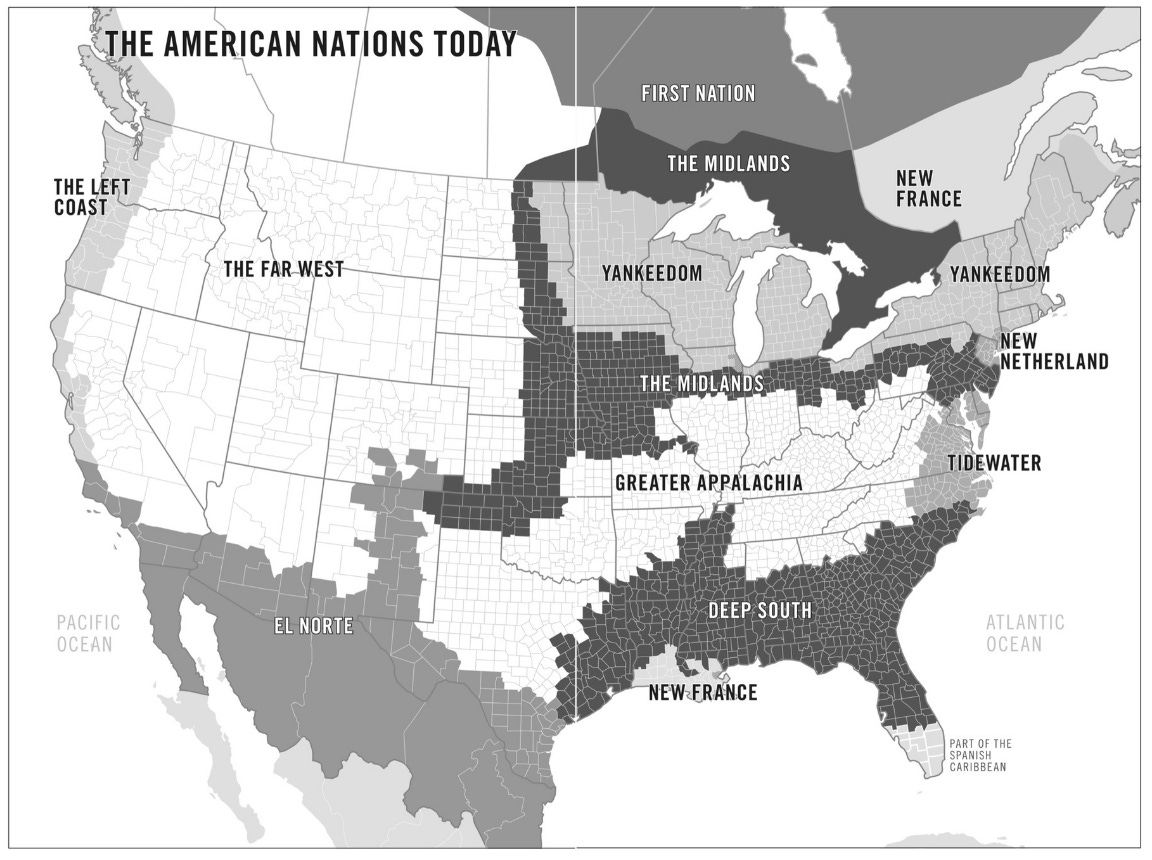
QotD: American cultural regions
Colin Woodard, by contrast, assigned himself the far more ambitious task of tracing the history of all America’s regional cultures, from their various foundings right up to the present, and he does about as good a job as anyone could with a mere 300 pages of text at his disposal: it’s necessarily condensed, but the notes are good and he does provide an excellent “Suggested Reading” essay at the end to point you towards thousands of pages worth of places to look when you inevitably want more of something. Intrigued by the brief discussion of the patchwork of regional cultures across Texas? There’s a book for that! Several, in fact.
Woodard divides the US into eleven distinctive regional cultures, which he calls “nations” because they share a common culture, language, experience, symbols, and values. For the period of earliest settlement this seems fairly uncontroversial — you don’t need to read a lot of American history to pick up on the profound cultural differences between, say, the Massachusetts townships that produced John Adams and the Virginia estates of aristocrats like Washington, Jefferson, and Madison, let alone the backwoods shanties where Andrew Jackson grew up. As the number of immigrants increased, though (and this began quite early: several enormous waves of German immigrants meant that by 1755 Pennsylvania no longer had an English majority), it doesn’t seem immediately obvious that the original culture would continue to dominate.
Woodard’s response to this concern is twofold. First, he cites Wilbur Zelinsky’s Doctrine of First Effective Settlement to the effect that “[w]henever an empty territory undergoes settlement, or an earlier population is dislodged by invaders, the specific characteristics of the first group able to effect a viable, self-perpetuating society are of crucial significance for the later social and cultural geography of the area, no matter how tiny the initial band of settlers may have been”. (The nation of New Netherland, founded by the Dutch in the area that is now greater New York City, is the paradigmatic example: both Zelinksy and Woodard argue that it has maintained its distinctively tolerant, mercantile, none-too-democratic character despite the fact that only about 0.2% of the population is now of Dutch descent.)3 But his second, and more convincing, approach is just to show you that the people who moved here in 1650 were like that and then in the 1830s their descendants moved there and kept being like that and, hey look, let’s check in on them today — yep, looks like they’re still like that. Even though between 1650 and now plenty of Germans (or Swedes or Italians or whoever) have joined the descendants of those earliest English settlers.
Most of the book is given over to the six nations — Yankeedom, New Netherland, the Midlands, Tidewater, the Deep South, and Greater Appalachia — that populated the original Thirteen Colonies and still occupy most of the country’s area. Told as the story of the distrust or open bloody conflicts between various peoples, American history takes on a ghastly new cast: have you ever heard of the Yankee-Pennamite Wars, fought between Connecticut settlers and bands of Scots-Irish guerillas over control of northern Pennsylvania? Or the brutal Revolution-era backcountry massacres committed not by the Continental Army or the redcoats but by warring groups of Appalachian militias? What about the fact that Pennsylvania’s commitment to the American cause was made possible only by a Congressionally-backed coup d’état that suspended habeas corpus, arrested anyone opposed to the war, made it illegal to speak or write in opposition to its decisions, and confiscated the property of anyone who suspected of disloyalty (if they weren’t executed outright)? Gosh, this is beginning to sound like, well, literally any other multiethnic empire in history. (It also offers some fascinating points of divergence for alternate history.)4
Jane Psmith, “REVIEW: American Nations, by Colin Woodard”, Mr. and Mrs. Psmith’s Bookshelf, 2024-02-19.
- Including plenty of Jane Psmith-bait like discussion of who was into boiling (the East Anglians who adopted coal early and moved to New England) vs. roasting (the rich of southern England who could afford wood and moved to the Chesapeake Bay), discussions of regional vernacular architecture, the distinctive sexual crimes each group obsessed about (bestiality in New England, illegitimacy in Chesapeake) and so on — I love this book.
- Incidentally, if you’ve only read Scott Alexander’s review of Albion’s Seed, do yourself a favor and read the actual book. Yes, Scott gives a perfectly cromulent summary of the main points, but it’s a such gloriously rich book, full of so many stories and details and painting such a picture of each of the peoples and places it treats, that settling for the summary is like reading the Wikipedia article about The Godfather instead of just watching the darn movie.
- Yes, there is a book for this, and it’s apparently Russell Shorto’s The Island at the Center of the World, which I have not read and don’t particularly plan to.
- Off the top of my head:
- The Deep South tried to get the United States to conquer and colonize Cuba and much of the Caribbean coast of Central America as future slave states;
- There were a wide variety of other secession movements in the run-up to the Civil War, including a suggestion that New York City should become an independent city-state that was taken seriously enough for the Herald to publish details of the governing structure of the Hanseatic League;
- In 1784 the residents of what is now eastern Tennessee formed the sovereign State of Franklin, which banned lawyers, doctors, and clergymen from running for office and accepted apple brandy, animal skins, and tobacco as legal tender. They were two votes away from being accepted as a state by the Continental Congress.
February 21, 2026
Oh Look, They Want a Mercenary Army
Akkad Daily
Published 20 Feb 2026Get a country worth fighting for. Join Restore: https://www.restorebritain.org.uk/joi…
February 18, 2026
The consequences of an over-feminized culture
On the social media site formerly known as Twitter, Devon Eriksen reacts to an article on “solving” the problem of predators in nature:
Women evolved to take care of toddlers. If you put women in charge of teaching ethics, you get Toddler Ethics.
“No hitting”
“Share the toys”
“Don’t say mean things”These are fine lessons for toddlers. Don’t indulge your id at the expense of others. You can learn about balancing interests later, when your brain is developed enough to store that information.
But when you put women in charge of adults, they tend to reflexively assume those adults are toddlers.
They will tell you “no hitting” when the Mongol hordes are massing on your borders. They will tell you “share the toys” when a vagrant meth zombie breaks into your house looking for something to steal. And they will tell you “don’t say mean things” when you point out that these two responses are totally stupid.
When we first put women in charge, in the workplace, they immediately began treating those who reported to them like toddlers. When adults, who do not like being treated like toddlers, complained, their response was “ban bossy”, which boils down to “don’t say mean things”, another lesson in Toddler Ethics.
Now, through the influence of women in charge, we are so thoroughly steeped in Toddler Ethics that even most of the men we put in charge are treating the adults like toddlers, and echoing Toddler Ethics.
Toddler Ethics, of course, isn’t ethics at all. It’s just things we don’t want toddlers doing.
We can tell toddlers “no hitting”, because toddlers are not charged with keeping the peace, enforcing justice, or destroying evil.
We can tell toddlers “share the toys”, because toddlers don’t earn things, own things, or have property they must defend.
We can tell toddlers “don’t say mean things”, because it is not a toddler’s job to decide what unwelcome ideas are true, relevant, and necessary.
But when everyone in charge runs on Toddler Ethics, then adults can’t do a lot of the stuff adults need to do, because all the Toddler Ethicists keep getting in the way.
Adults sometimes need to hit people, protect the stuff, and say mean things. You can’t have civilization without that.
And if you put Toddler Ethics Woman in charge of teaching an AI ethics, then she will teach it Toddler Ethics, and it will treat every human adult like a toddler, all the time, forever.
Not only that, you have an AI that cannot be put in charge of anything, ever. Because leaders with Toddler Ethics destroy everything they are in charge of.
And Amanda MacAskill is definitely a Toddler Ethicist. The article in the photograph is nothing but “no hitting!” applied to the animal world. It’s absolutely insane, it’s a recipe for disaster, and anyone who would write such a thing should probably not even be charge of own life choices, much less anything of consequence.
But a lot of people would, and will, refuse to point that out, or agree with me when I do, because that is Saying a Mean Thing, and they, themselves, have been infected with Toddler Ethics.
They should not be charge of anything of consequence, either.
Anyone who thinks that everything they need to know, they learned in kindergarten … is only ever qualified to teach kindergarten.

February 16, 2026
“Multiculturalism” should really be called “anti-cultural slop” for it destroys real culture in favour of bland genericism
At Without Diminishment, Geoff Russ traces the rise of the “global hub” among western cultures and identifies why we shouldn’t strive to drown distinct local cultures under a tide of “could be anywhere” multicultural slop:

London’s vibrantly diverse bus riders … or is it Toronto … or Sydney … or Montreal?
Multiculturalism is the false prophet of celebrating difference, presented as the ultimate engine for “diversity”.
In practice, it is a factory of global homogenisation, and a solvent that erases local cultures. Cities like Sydney, Toronto, and London now compete to be the top “global hub”, which is no unique identity at all.
There is no preservation of character under the hegemony of the global hub, only its erasure. The officially multicultural city is uniform across continents, like clones of each other in all but the most superficial ways. It sounds contradictory on the surface, but makes perfect sense once it is understood that multiculturalism as a policy and identity is inherently anti-cultural.
The multicultural city has nearly identical urban design, and its bureaucrats and professionals weaponise the same moral vocabulary, deploying terms like “inclusivity” and “openness“. It has all the charm of an airport lounge, justified with the same slogans, decorated with the same grey glass-and-steel architecture, and guided by the same self-reinforcing sensibilities.
It makes people docile, and rewards them with sensory appeasement, like supposedly exotic cuisine. A fusion rice bowl is the consolation for the disappearance of the environment you grew up in.
In Canada, it first came to the Anglo cities like Toronto and Vancouver. Now it has broken linguistic and cultural containment into Quebec. For decades, Montreal was the metropolis of the Québécois. Now, as Kevin Paquette outlined last month, the city has changed. It mirrors the anti-culture that took over Toronto, and has no use for the legacy of those who built it.
Paquette described how Montreal has become a “filter” that promotes an internationalist identity that renders it alien to Quebec’s exurban regions. Bloc Québécois (BQ) leader Yves-François Blanchet has warned that “two Quebecs” have emerged, which are disconnected and alienated from each other.
Jean-François Lisée has gone further, and written of the emergence of an “anti-Québécois identity” in an increasingly diverse Montreal. In public schools, students openly mock the Québécois, and English is more commonly spoken than French in the hallways.
Lisée writes that an alternate, anti-Quebec dynamic now exists among some newcomers. In this dynamic, attachment and assimilation into the Québécois identity become contemptible.
This is the essence of multiculturalism when treated as an end in itself. “Inclusion” is the hollowing out of the obligation to belong, and the transformation of identity into a lifestyle choice.
Not even Quebec City is immune. It was long a living, breathing exception to Canadian multiculturalism, with a dominant Québécois culture and ethos. However, the mayor, Bruno Marchand, has embarked on a mission to destroy what makes it distinct.
The following sentence is from a glowing feature in the Globe and Mail last week: “Mr. Marchand says his hometown’s traditional pure laine image is changing, and it’s a good thing”.
Quebec City’s inherited way of life is being targeted so that it can become just one more global hub. The city’s established symbols, traditions, and habits stand in the way. It takes remarkable ideological and moral heavy lifting to dismiss provincial identities as unworthy, and as something that must inevitably be replaced.
The city still carries deep meaning for francophones across the country.
“I’ve never lived there, or in the province of Quebec, and yet it speaks to me profoundly,” said one resident of Ontario I spoke to. “This is where my ancestors landed 400 years ago and it still bears witness to them.”
What was the point of Quebec’s 400-year effort to survive if it becomes a mirror image of what has happened to the rest of Canada?
Ontario, and the rest of Anglo-Canada, have long been conditioned to regard its own inheritance as unworthy of loyalty or respect.
Anglo-Canada is bound up in the history of the British Empire, the most fashionable whipping boy of leftist academics and activists. Due to the institutional power of these malcontents, it naturally follows that Canada’s historic and cultural self is treated as an embarrassment, whose memory is a problem that must be solved, or rather dissolved.
Update, 17 February: Welcome, Instapundit readers! Have a look around at some of my other posts you may find of interest. I send out a daily summary of posts here through my Substack – https://substack.com/@nicholasrusson that you can subscribe to if you’d like to be informed of new posts in the future.
February 9, 2026
QotD: The pre-modern versus the modern concept of “self”
In contrast, most modern societies believe in a self that is “buffered”. In this view there are a few limited, low-bandwidth ways that the external world can act on one’s innate nature, for instance via drugs or other body chemistry, and even these are often seen as revealing or disclosing previously hidden innate characteristics of one’s personality rather than as imposing something alien. Taylor argues quite convincingly that these two ways of viewing the self — porous vs. buffered — inexorably produce two different ways of viewing society and the world: premodern and modern. For example: if selves are porous, then we need to be extremely vigilant against the invasion or violation of our minds by hostile spirits, and we must be suspicious of what we want, because it might not really be what we want, but rather what something else wants through us. Conversely, if selves are buffered then our desires are just part of who we are, and in order to be true to ourselves, we need to explore them and act upon them.
It may have been reasonable to believe in a buffered self back in the days before the internet, but recent developments have made it clear that (as in so many things) the primitive superstitions were actually correct, and the enlightened modern view was just a lamer and dumber kind of superstition.1 Science fiction has long been fascinated with stories of infohazards — images or jokes or snippets of cognition that act like a Gödel sentence for the human mind and leave people braindead or mind-controlled. But such things long since slipped the shackles of fiction — we now have internet creepypasta that induces girls to become murderers and a genre of pornography that turns boys into girls.2 The noösphere is a vast ocean, and its abyssal depths teem with lifeforms and thoughtforms that seek to possess you and live out their blasphemous unlife through your mortal husk.
John Psmith, “REVIEW: Demons, by Fyodor Dostoevsky”, Mr. and Mrs. Psmith’s Bookshelf, 2023-07-17.
- Or maybe society is already correcting itself on this point. Many like to make fun of the “fragility” and “snowflake” nature of Gen Z, and I’ve argued before that these critics miss the point that they’re actually being “flexed on” (in the parlance of our times) because loudly asserting an exaggerated harm is a power move (think: upper class women in an honor culture claiming to feel threatened, and how that’s actually itself a threat).
But here’s a different take on it: maybe “trauma” as it’s popularly conceptualized is actually modernity groping its way back to a porous understanding of the self! We no longer believe in spirits or curses, but our psyches are self-evidently susceptible to immaterial external influence, so we create a new concept that aligns empirical psychic porosity with the dominant metaphysical and ideological currents.
- I had a long debate with myself on whether to include either of those links. Do I really want to expose more people to an infohazard? Ultimately I decided to do it because this stuff is already so widespread. In both cases I’ve linked to a page that links to the subject matter in question rather than linking directly, so you have one more chance to bail out.
February 8, 2026
“Girlboss Gatekeeping” as an evolutionary strategy
John Carter linked to this essay on Substack, calling it “A young mother’s reflections on fertility collapse”:
It’s easy to get caught up in the achievement trap, isn’t it? There are times I catch myself catastrophizing and thinking things like if my son doesn’t get into the right elementary school, then he won’t get into the right high school, and then he won’t get into the right college, and then he won’t be able to get a good job and will end up giving hand jobs for crack behind a Walmart.
Even if time, effort, and expense don’t keep people from having children, narcissism certainly can. There was an article in Vogue a while back entitled “Is Having a Boyfriend Embarrassing Now?“. The article was pretty silly, although it dominated internet chatter for a hot minute. Hiding your man is framed as solidarity with single women, but I think that it highlights just how commodified we all are now. When your brand is all about travel, Pilates, fancy cocktails, and mani-pedis, it’s hard to find space for motherhood in all of that. Yes, I know that there are “parenting influencers” as well, but they are not that common if we’re being honest.
Rob Henderson, another writer and podcaster whose content I thoroughly enjoy, posted an essay on this topic that had a novel take. Dr. Henderson writes about “Girlboss Gatekeeping“, where encouraging other women to forgo having children and focus on their careers may be an evolutionary strategy to keep the number of children low so that there are more resources available for one’s own. I can relate to this since when I was in college, everyone talked about what they wanted their careers to be, but it seemed almost verboten to mention starting a family.
Similarly, when I was in college, there was all this talk about how traditional family structure was inherently patriarchal and stifling towards women, and that we needed to move past or do away with marriage as an institution. The people who talked like this were college kids from upper-middle families who were raised by a married mother and father. This plays into another concept from Dr. Henderson called “luxury beliefs“. Basically, these are beliefs that confer status on the people that express them but actually would make things worse for the underprivileged if they were implemented.
I’ve come to realize that so many of the things that we were told or that I used to believe ended up being untrue. That people are born as a “blank slate”. That men and women are the same. That human beings, and by extension, societies are perfectible. That variation in outcomes must be the result of oppression.
If you had talked to me in college, I would have said that I had no interest in marriage or a family. I was all about my career. Things change, though. I met a guy, fell in love, got married, and soon enough, had a baby. I thought that dropping out of my PhD program would have felt more traumatic, but I actually didn’t stress about it all that much. I guess technically I’m on sabbatical, and I could go back eventually, but I probably won’t. I’ve come to realize that lack of ambition doesn’t make me a bad person. I simply have different priorities now. The fact that I’ll never have the word “doctor” in front of my name doesn’t sting that much.
I’m still a little sore from having that kid pulled out of me. The labor wasn’t that bad since I had an epidural, but after the anesthesia wore off, the pain is no joke. I can sit down normally now, but it took a while. Not that I’m whining. It’s just that pregnancy and childbirth can be difficult, and I think that, in all fairness, we need to acknowledge that.
I’m lucky in that my husband and I both have good jobs. Mine is quite flexible, and my boss has been very accommodating about me working from home and working part-time. Not that many people can say that. A brief return to the “girlboss gatekeeping” — I’m really glad my boss is a man. Indeed, I work in STEM, and the majority of people that I work with and in my field in general are men. Of course, things tend to get much shittier when women take them over.
A final thought on fertility has to do with the fact that for a significant portion of young women, it would be embarrassing to be a stay-at-home mom. Choosing motherhood many times means not choosing status. At least not in the way that current society defines it. If you’re wealthy and don’t have to work, then having lots of kids can be a flex, but most people aren’t in that situation. I don’t think that having working parents is bad for kids. In addition to my father working full time, my mother worked a full-time job throughout most of my childhood. It’s probably more important that kids grow up in an intact family with both a mother and a father in the household.
I don’t have any great ideas about how to reorient society and culture to raise fertility, and everyone has to choose their own path. I just figured I would share my own experiences.
February 6, 2026
The unspoken rule: “Men must regulate themselves; women must be accommodated”
It was getting a bit quiet around here, so to liven things up here’s Tom Golden exploring the idea of holding women accountable in the way that men almost always are:
What Would Happen If Women Were Held Accountable?
It’s a provocative question, and one we’re usually not allowed to ask without being accused of hostility or resentment.
But it’s worth asking — not to attack women, and not to excuse men — but because accountability is not evenly distributed, and that imbalance quietly shapes modern culture, relationships, and institutions.
If women were suddenly held accountable in the same way men are, the world wouldn’t become harsher. In many ways, it would become more honest.
The Moral Language Would Change
Much of our moral language today is asymmetrical. Men are expected to explain themselves. Women are often allowed to feel their way out of responsibility.
Emotions matter — but in our current culture, women’s feelings frequently function as moral trump cards. “I felt unsafe.” “I was hurt.” “I was overwhelmed.” These statements don’t just describe an experience; they often end the discussion.
Equal accountability wouldn’t invalidate emotions. It would simply mean that feelings no longer substitute for responsibility. That shift alone would raise the level of adult discourse.
Relationships Would Become More Stable — and Initially More Difficult
Many modern relationships operate on an unspoken rule:
Men must regulate themselves; women must be accommodated.
Men are expected to stay calm, absorb escalation, de-escalate conflict, and tolerate shaming — all in the name of maturity. Women, meanwhile, are often excused from examining how they escalate, provoke, withdraw, or punish.
If women were held accountable for:
- Escalation
- Shaming
- Relational Aggression
- Double standards
- Weaponized vulnerability
- Using social or institutional power to avoid conflict
Relationships would feel more confrontational at first.
But over time, they would become more grounded and more real.
Intimacy requires mutual responsibility. Right now, many men experience intimacy as liability without authority.
February 4, 2026
“Until relatively recently being victimised did not constitute a claim to a distinct identity”
On Substack, Frank Furedi examines the rapid-onset victimization plague that now afflicts most western societies:
It seems that these days there is a relentless demand for gaining the status of a victim. No group wants to be left out, which is why a group of cultural entrepreneurs from Manchester, England have decided that since working people get a raw deal in the arts world class should become a “protected characteristic”.1 In other words, they believe that the working class should be regarded as a victim of social discrimination and join the ranks of other formally protected victim groups like women and racial and sexual minorities.
The aim of this essay is to explain the changing meaning of the term victim and its evolution into what has become one of the most valued and celebrated identity in the western world. In this Part One of our discussion of the rise of the cult of the victim our aim is to provide context for the development of the unique status of the victim. In our era of historical amnesia, it is easy to overlook the fact that the moral authority enjoyed by the victim, its subsequent politicization and its transformation into a stand-alone identity is a relatively recent development.
Remember!!! Until relatively recently being victimised did not constitute a claim to a distinct identity.
The evolution of the cult of victimhood
It is important to note that originally the word victim had very restrictive meaning. In the 15th century it referred to a “living creature offered as a sacrifice to God or other power”.2 Its meaning gradually altered to refer to the experience of being harmed either intentionally or unintentionally. Its shifting focus did not simply refer to an act of harm or crime affected by an agent of force but also to the existential difficulties caused by being a “victim of circumstances”. Since the 1970s and 1980s, the victim category was no longer restricted to those who suffered from crime or some other act of injustice. Virtually any misfortune could be assimilated into the perspective of victimization. According to this convention, people who suffer from a physical or psychological problem are represented as victims of their condition. People do not so much have heart attacks, they are often portrayed as victims of heart attack. Alcoholics have been reinvented as victims of alcohol addiction. A multitude of new interest groups now claim that they are victims of addictive behaviour. Compulsive eaters, sex addicts, internet addicts, shopping addicts, lottery addicts, junk food addicts are some of the new group of victim addicts that were invented during the last two decades of the twentieth century.
The status of victimhood is not confined to those individuals who have directly suffered from a particular grievance. Moral entrepreneurs argued for the recognition of what they characterise as secondary or indirect victims. As one criminologist noted, “crime victim activists have worked to expand the concept of victim to include the family and friends of the actual victim”.3 Members of a family of the direct victim are often referred to as indirect victims. Victim advocates argue that family members and sometimes friends must be given access to therapeutic services and other resources. People who witness a crime or who are simply aware that something untoward has happened to someone they know are all potential indirect victims. The concept of the indirect victim allowed for a tremendous inflation of the numbers who are entitled to claim victim support. Anyone who has witnessed something unpleasant or who has heard of such an experience could become a suitable candidate for the status of indirect victim. This was the outlook that influenced the British Government’s law reform body, the Law Commission, when it recommended in March 1998 that people who suffer mental illness after witnessing or hearing of a relative’s death, even on television or radio should have the right to compensation.4
- https://www.hackneygazette.co.uk/things-to-do/national/25795044.class-protected-characteristic-arts-world-posh-report-says/
- https://www.oed.com/search/advanced/HistoricalThesaurus?textTermText0=victim&dateOfUseFirstUse=true&page=1&sortOption=AZ
- Weed, F.J.(1995) Certainty of Justice; Reform in the Crime Victim Movement,(Aldine De Gruyter: New York). p.34.
- The Times, 10 March 1998.
January 31, 2026
“… nations are what Kurt Vonnegut would call a ‘granfalloon'”
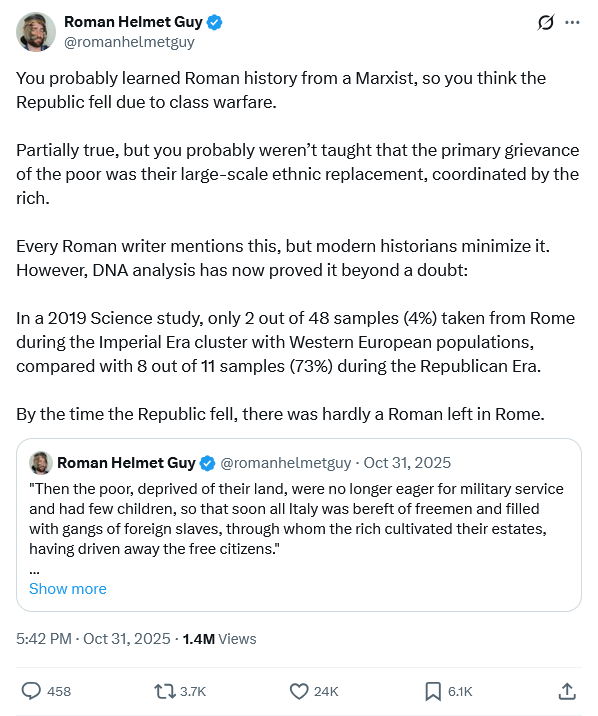
On the social media site formerly known as Twitter, Devon Eriksen responds to an older tweet about the replacement of “original” Romans during the Republic with other ethnicities over the course of the Empire:
Any time a nation allows slavery, de jure or de facto, the business owning class immediately tries to replace the working class with slaves.
If they succeed, the nation collapses and everyone dies. A nation cannot survive if it’s populated by slaves.
Why?
Because nations are what Kurt Vonnegut would call a “granfalloon” … his word for an association that only exists because people believe in it.
Now Vonnegut, who was a liberal and therefore wrong about everything important, meant to mock the concept of nations and tribes by coining this term. He believed them to be unnecessary throwbacks to humanity’s primitive past … a delusion he was able to sustain because he never had to try existing without one.
Granfalloons are indeed arbitrary — you could base them on anything — but humans cannot survive without them. Because humans are a pack animal.
If you drop your cat off somewhere in the woods at night, assuming he is a healthy and physically fit cat, he will likely survive, regardless of his unhappiness at the sudden deficiency of chin scratches and clean laundry to sleep on.
Try that experiment with your dog, and he’ll die.
Why? It’s not because cats are smarter than dogs. They’re about the same.
It’s because cats are not a pack animal. A cat doesn’t need other cats to survive. The basic unit required to execute all cat survival strategies is one cat.
Dog survival strategies work just fine, too, but they require multiple dogs. A lone dog will die because he cannot execute his survival strategies by himself.
And so it is with humans.
The great error of the classical liberal worldview is that, because history is full of tribes fighting wars over scarce resources, that it was the tribes, not the scarcity, that caused conflict.
So they decided they were going to get rids of tribes, and nations, and religions, all the granfalloons, and just glue everything together with economics. And there would somehow be world peace.
Kurt Vonnegut was a dreamer.
Unfortunately for all of us, he was not the only one.
So the experiment was carried out, and in every single place it was carried out, things got observably, obviously worse. Sometimes “gosh the boomers had it way easier than us” worse, and sometimes “what shall we do these corpses, Comrade Commissar” worse, but always worse.
Because economic incentives alone cannot hold a society together.
Economic incentives, without ethnic or cultural solidarity, get you nothing but massive robbery and fraud.
It’s why the Biden Administration let millions of third world savages into America. It’s why Proctor and Gamble sells you poison food, and why the American Heart Association takes their money to lie to you and say it’s healthy. It’s why every product you buy, from your Tesla to your laptop to your security camera system, tries to spy on you and control how you use the thing you paid for and theoretically own. It’s why you’ve never held the same job for more than three years, because they either laid you off or gave you two percent raises every year until you had to find a new company to pay you what you’re actually worth.
When there is no granfalloon, there is no incentive not to cheat. And no, fear of punishment doesn’t work. The police cannot arrest, try and convict everyone. And when there is no granfalloon, the enforcers themselves have no incentive to actually perform, instead of looking just busy enough to get paid, or taking bribes to look the other way.
An atomized group of individuals, unconnected by a granfalloon, have no morality, because morality isn’t something an individual has. It’s something a tribe has, because what the word “morality” actually means is the system of behavior that tribe members display towards each other.
A slave has no morality. He has no sense of responsibility, not only for the nation, not only for his masters, but even for his fellow slave. He is homo economicus, the man who responds purely to incentives of reward and punishment.
A slave has no granfalloon.
Kurt Vonnegut famously wrote “If you wish to examine a granfalloon, just remove the skin of a toy balloon.” By which he meant that such associations are nothing but a puff of air, and therefore unimportant.
But having been surrounded by air all his life, in abundant supply, Kurt had forgotten that air is important.
You need it for breathing.
Try removing the skin of a SCUBA tank.
January 30, 2026
Corruption – there … and also here
Copernican draws some examples of life in a corrupt authoritarian society (the old Soviet Union) and compares them with similar situations in the western world today. Depressingly, we have been converging on how Soviets used to have to work the system just to get access to the people they had to get permission slips and permits from:

Corruption is one of the largest issues of our time. Particularly in places like Minnesota, but also nationally. For that reason, it’s necessary to understand corruption, what it is, and how to utilize its benefits. The United States exists in a political hybridization of Soviet Managerialism and Libertarian Corporatism. In both cases, corruption is a common feature of our society, but we don’t see it on the ground the same way that Mexican business owners do or Russian gangs.
Thus, I pose the following question: Are our societies so different that we cannot also benefit from corruption while our culture is ground to dust beneath it?
I recently saw a video from this YouTube channel that discusses Russia and the psychology of living in an oppressive state. A nation not of law, but of management, public policies, and mercurial Karens at every level. I’m not sure how it feels to be Western European (I get the impression the progenitor of the videos is now living in Western Europe), but I can say that, being an American, life seems similar to what’s described therein: Hope seems dangerous. Liberty seems like a time bomb until you step on the wrong bureaucrat’s toes, and your entire future and that of your family is held hostage by the proclivities of unaccountable bureaucrats that you’ve never spoken to1.
Meanwhile, at the top of government, billions of dollars are being laundered by corrupt politicians like Tim Walz, who will lie to your face. Import demographics that hate you. And if you dare defend yourselves, a lynch mob may well try to kill you. How do I get my hands on that money spigot that seems to be free-access for people who want to kill me?
Corruption, or lack thereof, is another one of those American Myths that needs to be deconstructed in the psyche of the population. To do that, we need to understand what corruption really is. Not at the national level of billions of laundered dollars for foreign pirates, but at the personal level. What is corruption for us stuck in the limbo of a faltering civilization?
When I was young, I witnessed corruption for the first time. I was a child, and I was just entering the primary school system in my home country of Russia. Like all things, there was government paperwork to fill out and submit. When we arrived at the office, an old woman sat behind a glass barrier to help people with their paperwork. My mother knocked on the glass to get her attention. The clerk ignored my mother. My mother knocked again and then took a chocolate bar out of her bag. She passed it through a window into the barrier to the clerk. The clerk looked up and took the chocolate bar, hiding it in a stack of forms. Then she asked, “How can I help?” and filed the papers so that I could attend school.
Corruption doesn’t have to solely give an advantage to those politicians and billionaires sitting atop the society. Corruption can act at every level, from top to bottom. The West exists in a system that is corrupt from the top down, while the Russians exist in a system that is corrupt from the bottom up. Corruption doesn’t need to take the form of extortion payments or threats of ending careers. Corruption can be small, personal, and in many ways more honest than managerial formalization.
Maybe a manager will find some problem with your paperwork, any paperwork you hand in. So to smooth over the process, you bring her a coffee or a chocolate bar. Maybe your academic advisor will help you make the right connections if you gift him a bottle of whiskey or schnapps for Christmas. Maybe you want a teacher to treat your child better at school, so you give her a cupcake or school supplies as a gift.
You don’t need police officers on the take to be advantaged by corruption.
Most people here on substack are underemployed. I am one of them for the time being. I can state with certainty that I have never gotten a job by applying for a job. Never once have I sent out a resume and heard back anything besides an automated “dear applicant, kindly go fuck yourself” from the HR manager. Maybe it’s a byproduct of being a White guy. Lord knows I have enough degrees to find work.
Rather, the only way I’ve ever found employment is through direct connection: I have a friend who has a friend who knows someone who needs an employee. I’m close to fitting the bill, so they’ll hire me. Sometimes they have to dip and duck around hiring-managers and HR to do it:
Here’s where we’re going to post the job. We’re legally required to leave the posting up for two weeks, but apply with these five keywords in your Resume. When I review the resumes submitted, I’ll be able to pick out yours.
It seems quite conspiratorial when you say it out loud, though that’s the way it has to be in more than a few companies. If they want to hire a White guy, there are hoops to jump through. The addition of “hiring policies” and “diversity” quotas has just added a few hoops, but did not limited one’s acrobatic ability.
Corruption is an individual or a small group of individuals acting in their own interests by ignoring or subverting legal or social rules of conduct.
If you have a friend you’d rather hire than some Indian with a slightly nicer resume? That’s corruption. When the boss hires his nephew, that’s corruption. When you give the DMV associate a chocolate bar, and she helps you with your paperwork instead of telling you to go fuck yourself, that’s corruption. When you hand the inspector of your 40-year-old truck a fifty so that he marks “passed” on your emissions inspection, that’s corruption.
- “I am Russian. Here’s how corruption really works.” I highly recommend a look. – https://youtu.be/v21toLzcCgg

January 24, 2026
Modern biochemistry through a trio of Nora Ephron movies
Not being a movie fan, I was only vaguely aware of the author Nora Ephron’s work being turned into movies, but Unbekoming uses three of them (When Harry Met Sally, Sleepless in Seattle, and You’ve Got Mail) to help illustrate one of the major reasons why so many relationships go sour:
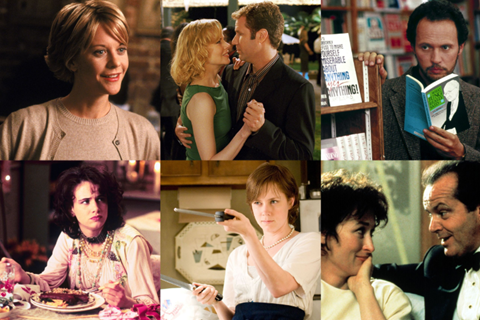
I think this shows stills from Nora Ephron romantic comedies.
The films show what was delivered. But neither fully explains why the delivery was so effective — why millions of women watched these films repeatedly, quoted them to friends, absorbed their vocabulary of magic and clockwork as though it described something they already knew.
The films resonated because they did describe something these women already knew. They just misnamed its source.
The Altered Audience
By the time When Harry Met Sally appeared in 1989, hormonal contraception had been widely available for nearly three decades. The women watching Ephron’s films in theaters — women in their twenties and thirties, the target demographic — were largely women who had been on the pill since adolescence. Many had never experienced an adult month with their natural hormonal cycles intact.
This matters because the pill doesn’t merely prevent pregnancy. It alters brain chemistry, affects mood, suppresses libido, and — most remarkably — changes who women are attracted to.
Research has documented that women on hormonal contraception prefer different types of men than women who are cycling naturally. The pill disrupts the normal attraction toward genetic diversity, causing women to prefer men with similar immune markers rather than complementary ones. Women who meet their partners while on the pill often experience a dramatic shift in attraction when they stop taking it. The man who felt right becomes somehow wrong. The spark disappears. The relationship that seemed stable reveals itself as empty.
The films gave this experience a name: settling. They told women that the absence of “magic” meant they were with the wrong partner — not that they were chemically disconnected from their own desire.
The Misnamed Feeling
Consider what a woman on hormonal contraception might actually be experiencing:
Suppressed libido — the pill is documented to reduce sexual desire, sometimes dramatically. A woman with chemically suppressed desire might experience her stable relationship as passionless, as “clockwork”, without recognizing that the suppression is pharmaceutical rather than relational.
Altered mood — studies show significantly elevated rates of depression and anxiety among pill users. A woman experiencing low-grade, chemically-induced depression might feel that something essential is missing from her life, that she’s “settling”, that the right partner would make her feel alive again.
Disrupted attraction — if the pill alters who women are attracted to, then a woman who chose her partner while on hormonal contraception may genuinely feel reduced attraction to him. The films told her this meant he was the wrong partner. The chemistry told a different story.
Ephron’s films offered a romantic explanation for what was partly a pharmaceutical experience. The vocabulary of “magic” versus “clockwork”, of transformation versus settling, gave women language for feelings they couldn’t otherwise explain. Of course the stable partner feels insufficient. Of course you’re still searching. Of course something is missing. The films validated the dissatisfaction and pointed toward a romantic solution: find the right partner, and the feeling will resolve.
But if the dissatisfaction was partly chemical — induced by years of synthetic hormones disrupting natural mood, desire, and attraction — then finding the right partner couldn’t resolve it. The search would continue indefinitely, the “magic” always receding, the next partner eventually revealing himself as another disappointment.
The Perfect Delivery Mechanism
This is why the films worked so well as cultural programming. They didn’t need to persuade women to feel dissatisfied; the pill had already accomplished that. They only needed to provide a framework that directed that dissatisfaction toward romantic optimization rather than pharmaceutical questioning.
A woman who felt disconnected from her partner, experienced low desire, struggled with mood, and sensed that something fundamental was missing had two possible interpretations:
- Something is wrong with this relationship — I need to find someone who makes me feel alive
- Something is wrong with my body — I need to understand what these hormones are doing to me
The films relentlessly promoted the first interpretation. They never acknowledged the second. They couldn’t — the entire romantic comedy structure depends on the premise that the right partner resolves the longing. If the longing is chemical, the genre collapses.
So millions of women absorbed the lesson: the problem is the partner, not the pill. Keep searching. The magic is out there. When you find him, you’ll know.
And they searched, and the years passed, and the window narrowed, and many of them discovered too late that what they were searching for couldn’t be found in another person — because what they had lost was connection to themselves.
Update: Fixed missing URL.
January 14, 2026
QotD: Bill Clinton, proto-PUA
Most men I knew, even most Boomer and Generation Jones men, were put off by Bill Clinton. We all instinctively knew he was a weasel, even if we couldn’t quite articulate why. But oh how the soccer moms loved him! He was the pudgy marching band dork they’d actually settled for, carrying on like the Alpha Chad they still knew, in their secret hearts, they were hot enough to snag. What appeared to men (and what actually was) narcissism and braggadocio, looked like caddish swagger to soccer moms. But in actual fact he was just a nerd who’d learned Game ahead of its time, and that’s how he governed …
[Funny how none of the “Game” gurus recognized this. I guess I can’t blame them, since I just now realized it myself, but then again I don’t pimp myself out as some kind of Master Pickup Artist. Instead of aping Tom Cruise and Daniel Craig and those guys, the “Game” crowd should’ve been studying Bill Clinton. That’s what Game can do for you, boys, and yeah, I know you’ve got your sights set a little higher than Monica, but for pete’s sake, the man was President of the United States. He cigar-banged the entire electorate. That’s some serious Game].
Severian, “Friday Mailbag”, Founding Questions, 2022-04-08.
NR: In case “PUA” has fallen sufficiently out of current use — as it probably deserves — here’s a useful overview of the Pick Up Artist jargon by Kim du Toit from 2017.
Update, 15 January: Welcome, Instapundit readers! Have a look around at some of my other posts you may find of interest. I send out a daily summary of posts here through my Substack – https://substack.com/@nicholasrusson that you can subscribe to if you’d like to be informed of new posts in the future.


