Quotulatiousness

December 14, 2023

Pervasive disrespect for the human form in art (and everything else) is a leading indicator of collapse

Filed under: Health, History, Media, USA — Tags: , , , , — Nicholas @ 03:00

My headline isn’t exactly what Ted Gioia says here (although this is only the beginning of his article, as the rest is behind a paywall) but it’s definitely an aspect of what he’s seeing:

For thousands of years, flourishing societies treated the human form with love and respect.

The connection is hard to describe with precision. But, it seems, you can’t make much progress promoting human rights if you don’t start with some degree of reverence for the embodied individual.

Even neanderthals knew about ornamentation and figurative art, but paintings of actual people, created by communities along the Nile River, some 8,000 years ago, signaled the rise of more advanced, stable institutions. It’s no coincidence that democracy and personal autonomy in Greece and Rome happened in conjunction with obsessively realistic renderings of the human body.

Much of this was lost in the post-classical world, but Renaissance artists rediscovered this passion for the human figure — which was embedded in its nurturing of science, art, and free inquiry

But something very different is happening in our own time.

I won’t offer any theories today. I’ll just share the facts — in the form of news stories, all about different subjects.

None of these stories have any direct connection with the others. Yet they fit together like the pieces of a strange puzzle. The picture they make is ominous.

Maybe you have some explanations. In the meantime, let’s just plunge in …

1. You can’t hear people talking in movies — because directors prefer to share background sounds.
“I used to be able to understand 99% of the dialogue in Hollywood films. But over the past 10 years or so, I’ve noticed that percentage has dropped significantly — and it’s not due to hearing loss on my end. It’s gotten to the point where I find myself occasionally not being able to parse entire lines of dialogue when I see a movie in a theater, and when I watch things at home, I’ve defaulted to turning the subtitles on to make sure I don’t miss anything crucial to the plot.”

2. Lead vocalists are getting quieter while the sound of the instruments become louder.
“Lead vocalists have gotten quieter over the decades, compared with the rest of the band. That’s the conclusion of a new study that analyzes chart-topping pop tunes from 1946 to 2020 …”

3. Anthropophobia — the fear of other people — is on the rise.
“Anthropophobia, or the fear of people, has so far been America’s most searched-for phobia this year. In that study, anthropophobia accounted for 22% of all phobias that people searched for online, a five-fold increase over 2019. And the state-by-state results affirm common stereotypes. New York’s most-searched phobia in 2020, for example, has been “philophobia.” That’s a big word for the fear of intimacy.”

4. Time spent alone is rising for all demographic groups.

“According to data from the American Time Use Survey, the amount of time people spent with their friends, family and other companions was mostly unchanged between 1970 and 2013. Then, after decades of stability, the numbers began falling. By 2019, on average people were spending almost three hours less with their friends than only six years earlier, and four hours less with their family, neighbors and other companions.

“None of that time was transferred to more time with partners, children or others. All of it was swallowed up by time spent alone … Strikingly, the average American teenager today spends 11 hours fewer with their friends than they did only eight years ago, and 12 hours more time alone.”

5. Clothing retailers replace realistic mannequins with abstract forms.
“There were a ton of used mannequins sitting in retailers’ attics and storerooms. Every time they re-merchandised or remodeled, they were bringing in new mannequins to replace the old, increasingly replacing realistics with abstracts. And it wasn’t just full mannequins, it was head forms, leg forms, maternity mannequins, swimwear mannequins and all kinds of props, as well. Retailers would throw these items in the trash.”

6. Social media causes children to dislike their own bodies.
“Three out of four children as young as 12 dislike their bodies and are embarrassed by the way they look, increasing to eight in 10 young people aged 18 to 21 … Nearly half of all children and young people aged from 12 to 21 questioned said they have become withdrawn, started exercising excessively, stopped socialising completely or self-harmed because they are regularly bullied or trolled online about their physical appearance.

December 11, 2023

Roman glossary

Filed under: Europe, Government, History, Religion — Tags: , , , , , — Nicholas @ 03:00

As I continue to post QotD entries drawn from Bret Devereaux’s fascinating historical blog A Collection of Unmitigated Pedantry (with Dr. Devereaux’s kind permission, I hasten to add), the number of names and specialized terms from the Roman Republic and Empire also expands. As some of these terms pop up in my shorter excerpts without immediate context, I think that a glossary for Rome is called for (similar to the Spartan glossary, as there’s a lot more Roman content coming up, it being Dr. Devereaux’s area of academic specialization) to help explain the terms that I think may need expansion in these excerpts from his longer posts. As usual, most of the information is drawn directly from ACOUP (often from more than one original post) and where I’ve felt the need to interpolate any additional information it will be enclosed in square brackets. Errors and misinterpretations of his original work are purely mine.


(more…)

December 9, 2023

The coming Micro-Macro culture war … and who’s going to win it

Filed under: Business, Economics, Media, Technology, USA — Tags: , , , , , , , , — Nicholas @ 05:00

Ted Gioia outlines the dismal state of the “macro” culture — television, movies, newspapers, book publishing and all the big corporations that control them — with the dynamism of the “micro” culture:

In the beginning, all culture was microculture.

You knew what was happening in your tribe or village. But your knowledge of the wider world was limited.

So you had your own songs and your own stories. You had your own rituals and traditions. You even had your own language.

But all these familiar things disappeared when you went off into the world. That was dangerous, however. That’s why only heroes, in traditional stories, go on journeys.

You learn on the journey. But you might not survive.

But all that changed long before I was born.

In my childhood, everything was controlled by a monoculture. There were only three national TV networks, but they were pretty much the same.

    When I went to the office, back then, we had all watched the same thing on TV the night before. We had all seen the same movie the previous weekend. We had all heard the same song on the radio while driving to work.

The TV shows were so similar that they sometimes moved from CBS to NBC, and you never noticed a change. The newscasters also looked pretty much the same and always talked the same — with that flat Midwestern accent that broadcasters always adopted in the US.

The same monoculture controlled every other creative idiom. Six major studios dominated the film business. And just as Hollywood controlled movies, New York set the rules in publishing. Everything from Broadway musicals to comic books was similarly concentrated and centralized.

The newspaper business was still local, but most cities had 2 or 3 daily newspapers — and much of the coverage they offered was interchangeable. Radio was a little more freewheeling, but eventually deregulation allowed huge corporations to acquire and standardize what happened over the airwaves. [NR: I suspect the “freewheeling” went away once the government started imposing regulations, and the corporate consolidation was enabled when they “deregulated” the radio licensing regime several decades later.]

When I went to work in an office, back then, we had all watched the same thing on TV the night before. We had all seen the same movie the previous weekend. We had all heard the same song on the radio while driving to work.

And that’s why smart people back then paid attention to the counterculture.

The counterculture might be crazy or foolish or even boring. But it was still your only chance to break out of the monolithic macroculture.

Many of the art films I saw at the indie cinema were awful. But I still kept coming back — because I needed the fresh air these oddball movies provided. For the same reason, I read the alt weekly newspapers and kept tabs on alt music.

In fact, whenever I saw the word alt, I paid attention.

That doesn’t mean that I hated the major TV networks, or the large daily newspaper, or 20th Century Fox. But I craved access to creative and investigative work that hadn’t been approved by people in suits working for large organizations.


The Internet should have changed all this. And it did — but not much. Even now the collapse in the monoculture is still in its early stages.

But that’s about to change.

If you don’t pay close attention, the media landscape seems pretty much the same now as it did in the 1990s. The movie business is still controlled in Hollywood. The publishing business is still controlled in New York. The radio stations are still controlled by a few large companies. And instead of three national TV networks plus PBS, we have four dominant streaming platforms — who control almost 70% of the market.

So we still live in a macro culture. But it feels increasingly claustrophobic. Or even worse, it feels dead.

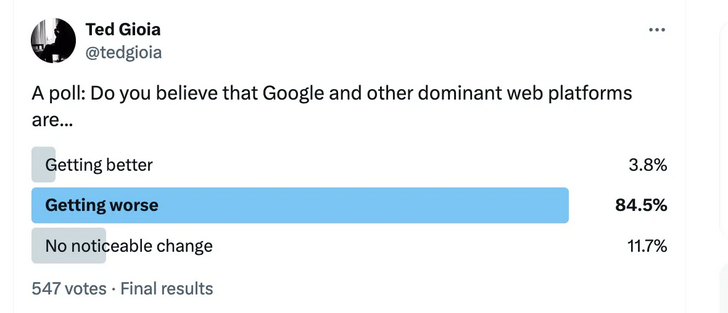
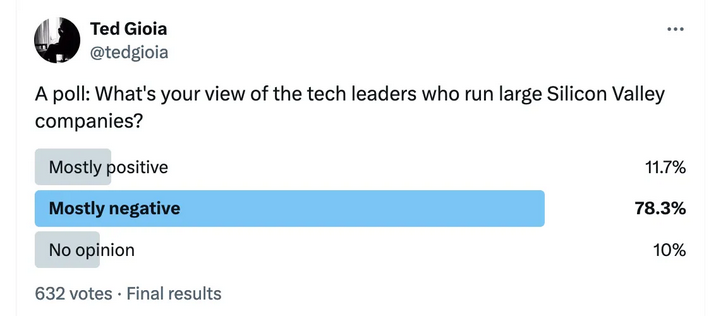
Meanwhile, a handful of Silicon Valley platforms (Google, Facebook, etc.) have become more powerful than the New York Times or Hollywood studios or even Netflix. It’s not even close — the market capitalization of Google’s parent Alphabet is now almost ten times larger than Disney’s.

But here’s the key point — these huge tech companies rely on the microculture for their dominance.

Where is Facebook without users contributing photos, text and video? Where is Google’s YouTube without individual creators?

In terms of economic growth or audience capture, the microculture has already won the war. But it doesn’t feel that way.

Why not?

First and foremost, Silicon Valley is a reluctant home for the microculture. To some extent Alphabet and Facebook are even going to war with microculture creators — they try to make money with them even while they punish them.

  • So Mark Zuckerberg needs creators, but won’t even let them put a live link on Instagram and limits their visibility on Facebook and Threads.
  • Alphabet needs creators to keep YouTube thriving, but gives better search engine visibility to total garbage that pays for placement.
  • Twitter also claims it wants to support independent journalists — but if you’re truly independent from Elon Musk, your links are brutally punished by the algorithm.

This tension won’t go away, and next year it will get worse. The microculture will increasingly find itself at war with the same platforms they rely on today.

And legacy media and non-profits are even more hostile to emerging media. Go see who wins Pulitzer Prizes, and count how many journalists on alternative platforms get honored.

I’ll save you the trouble. They don’t.

December 8, 2023

“When you see the same signs here that characterised collapse in other polities for the last 5000 years, it means collapse is coming here too – we’re not special snowflakes”

Filed under: Government, Politics, USA — Tags: , , — Nicholas @ 03:00

Feeling good? Happy with your culture and comfortable that major disruptions won’t disturb you? Here’s Theophilus Chilton to harsh your mellow:

There are essentially three basic reasons why those on the American Right haven’t shrugged the same way regular folks in Europe are beginning to (see Spain and France as well as Ireland for recent examples). The first of these is because the American Right still holds onto a residual trust in elections and democracy and the whole “We’ll get ‘em next election!” mentality. Having been fed a decades-long diet of reverence for democracy and voting and whatnot acts as a desensitising agent that keeps many Americans anesthetised to the actual uselessness of such attitudes.

But this will continue to erode as we see more obvious election fraud. Eventually, when the norm becomes “go to bed with the right-wing candidate ahead by 10% and wake up with the left-wing candidate winning by 0.5%,” elections will lose what legitimacy they have left. Further, as “democracy” comes to be increasingly defined as “whatever the Regime wants to do“, more and more normies will start to clue in to the fact that democratic forms are not going to save America, but are in fact what are destroying it.

Second, Heritage Americans and those on the normie Right tend to assume that everybody still plays by the old, traditional set of norms, including FedGov. This “seemed” plausible when the Regime employed incrementalism to gradually acculturate normies to its agenda. But as they accelerate their revolutionary overthrow of everything that normies thought would be sacrosanct like they have over the past few years, this sense of “norms” will go away. And when that happens, there will be a whole lot of people suddenly open to the possibility that something else might become a new set of norms.

Third, because America is so BIG – especially in the geographical sense – Heritage Americans have been able to self-mitigate many of the worse aspects of the Regime agenda. They could get away from the slums. Federalism allowed them to find states in which to prosper despite the Regime’s efforts. And so forth. Regular folks in many places could still plausibly think America was a high trust, high social cohesion society because where they were at locally might well have been. But as the Regime accelerates, this also will stop. $oros DAs will continue to release violent criminals while punishing law-abiding citizens for defending themselves and their property. Immigration and inflation will further erode the economic prosperity that still remains, which is something that fleeing to a Red state can’t fix. And of course, it will all be brought home starkly once 20,000 or so Palestinian “refugees” get relocated into their counties.

Let’s remember that this is what we actually saw in Ireland. Even into the Oughts, Ireland was homogenous, relatively high IQ and high trust, was the Celtic Tiger with lots of prosperity. Then globohomo decided that Ireland needed tons of “refugees” just like the rest of Europe and suddenly that prosperity and safety and high trust went away. What was the response? Riots and continued disorder that Regime attempts to clamp down on are only going to make worse.

This is going to wear out eventually, which is something that FedGov knows. That’s why they’ve been ramping up gun control efforts over the past few years despite constant opposition from the courts. They’re merely trying to prepare for the inevitable by disarming the people they know they need to suppress the most. Unlike most Euro and Anglosphere countries, Americans haven’t allowed themselves to be disarmed — and that’s something that really does vex The Powers That Be.

But the problem is that it isn’t the 1950s anymore, or even the 1990s for that matter. Back in the 1950s, FedGov could literally stick bayonets at the backs of high school students and force unwilling southern states to integrate their schools. Even in the 1990s FedGov could send its agents to besiege and murder dozens of men, women, and children and most people even at an official level wouldn’t say a thing. But now its 2023 and we’re quite a bit further along the decentralisation path in our secular collapse phase. What FedGov had the moral legitimacy and competency to pull off back then isn’t guaranteed for them now anymore.

So what happens when the FBI wants to do another Waco? What happens if Texas decides it doesn’t want to allow the FBI to do another Waco? We’re past the point where we can blithely say, “Well, the Feds can just make Texas go along with it!” Our place in our collapse cycle means that’s not going to fly like it could have 30 years ago.

At this point, the goal should not be to calm people down but to get them riled up so that when (not if) the break comes, it will be so widespread and numerous that it will completely overwhelm the ability of FedGov and its agencies to deal with it. In this vein, I think of Solzhenitsin’s quote from Gulag Archipelago,

    And how we burned in the camps later, thinking: What would things have been like if every Security operative, when he went out at night to make an arrest, had been uncertain whether he would return alive and had to say good-bye to his family? Or if, during periods of mass arrests, as for example in Leningrad, when they arrested a quarter of the entire city, people had not simply sat there in their lairs, paling with terror at every bang of the downstairs door and at every step on the staircase, but had understood they had nothing left to lose and had boldly set up in the downstairs hall an ambush of half a dozen people with axes, hammers, pokers, or whatever else was at hand? … The Organs would very quickly have suffered a shortage of officers and transport and, notwithstanding all of Stalin’s thirst, the cursed machine would have ground to a halt! If … if … We didn’t love freedom enough. And even more – we had no awareness of the real situation … We purely and simply deserved everything that happened afterward.

So what does this mean practically? It means people need to start organising locally with people they trust, building a network in their town or county, coordinating with friendly local power holders. It means stockpiling the necessary tools for the maintenance of their freedoms. It means training to shoot, learning how to use comms, thinking both strategically and tactically — obtaining the knowledge to use with your organising. Most of all, it means being morally and temperamentally prepared to oppose the enemies of our people, both foreign and domestic.

December 7, 2023

QotD: Displacing the “little platoons”

Filed under: Government, Liberty, Quotations, USA — Tags: — Nicholas @ 01:00

Where government moves in, community retreats, civil society disintegrates and our ability to control our own destiny atrophies. The result is: families under siege; war in the streets; unapologetic expropriation of property; the precipitous decline of the rule of law; the rapid rise of corruption; the loss of civility and the triumph of deceit. The result is a debased, debauched culture which finds moral depravity entertaining and virtue contemptible.

Janice Rogers Brown, “A Whiter Shade of Pale”, a speech to the Federalist Society, 2000-04-11.

November 28, 2023

“This was a document from a parallel universe with familiar-sounding people and places, but a totally bizarre worldview and culture”

Filed under: Books — Tags: , , , , , — Nicholas @ 04:00

In the latest addition to Mr. and Mrs. Psmith’s Bookshelf, John Psmith reviews The Man Who Rode the Thunder, by William H. Rankin:

Like many little boys, I loved learning lists of things. One day it was clouds. How could I not love them? The names were fluffy and Latinate, delicate little words like “cumulus” and “cirrus” that sounded like they might float away on a puff of wind. But there was also a structure to the words, intimations and hints of taxonomy. Was the relationship of an altocumulus to an altostratus the same as that of a cirrocumulus to a cirrostratus? I wasn’t sure, but it seemed likely! So here I had not just a heap of words, but something more like a map to making sense of a new part of the world.

So I learned the names of all the clouds, but I quickly got bored of most of them. Only one of them held my attention, but it made up for the rest by becoming an obsession. Yes, it was the mighty cumulonimbus, the towering, violent monster that heralds the approach of a thunderstorm. By then I had already met plenty of them — one of my earliest memories is of huddling with my mother in the room of our house that was farthest from any exterior walls, while lightning struck again and again and again, the echoes of the previous thunderclap still reverberating off the landscape when the next one began. What, I wondered, would it be like to be inside one?

There’s one man who knows. His name is Colonel William H. Rankin, and he fell through a thunderstorm and lived to tell the tale. After his ordeal Rankin published a memoir that was a bestseller in the early ’60s, but is out of print today. If you click the Amazon link at the top of this page, you will see that secondhand copies of the paperback edition go for about $150. If that’s too steep for you, I’m told that Good Samaritans communists have uploaded high-quality scans of the book to various nefarious and America-hating websites, but this is a patriotic Substack and we would never condone that sort of behavior. Be warned!

I sought out and read Rankin’s memoir for the part where he falls through a cloud, so I was planning on skimming and/or skipping the hundred or so pages where he narrates his life and career up to that point. When I actually cracked open the pdf legally-purchased paperback, though, I found that I couldn’t. Somehow an artifact from an alien world had fallen into my hands. This was a document from a parallel universe with familiar-sounding people and places, but a totally bizarre worldview and culture.

They say you should read books to broaden yourself, to learn about foreign peoples and about cultures not your own. I was unprepared for late 1950s America being as foreign as it turned out to be. There’s a whole genre comprised of parodying the supposed mid-century American combo of sunny faith in scientific progress, squeaky-clean public morality, and blithe indifference to the horrors of industrial warfare. In my own reading and watching, I had only ever encountered the parodies, never the genuine article, until I read this book. Rankin’s memoir exudes gee-whiz enthusiasm from every pore. He is patriotic without a trace of irony, giddy as a schoolboy about advances in jet propulsion, and then uses a totally unchanged tone of giddiness and enthusiasm to describe melting hundreds of Korean peasants with napalm.

Reading this stuff fills me with the same feeling of vertigo that I get reading about Bronze Age Greek warriors — here is a human being just like me, but inhabiting a cultural, spiritual, and memetic universe so different from mine. Are we the same species? If we were to meet each other would we even be able to communicate? Or perhaps every age has had people like him and people like me, and all that’s changed is that the dominant mode of social interaction shifted from favoring one of us to the other. After all, I know people today who are incapable of irony or reflection. For instance, TSA agents. Was 1950s America an entire society of TSA agents? And if so, what am I to make of the fact that in so many ways it seems to have been more functional than America today?

November 23, 2023

Clown world is what you get when children run things in the real world

Filed under: Media, Politics, Technology, USA — Tags: , , , , , — Nicholas @ 05:00

Theophilus Chilton on the overgrown children who populate what used to be the adult world in the West:

If you’ve been around dissident Right circles for any length of time, you’re probably seen the term “clown world” used to describe the modern Western world. If you’ve paid any attention at all to the state of the world around us, you know just how apt of a description that term really is. Modernity as it is expressed today transcends the types of degeneracy and corruption that have been seen in previous decadent periods and has plumbed to nadirs of human depravity that previous generations would have literally found unspeakable because they would not have had the vocabulary to even describe them. To any rational adult observer of any previous age, no matter how dissolute, today’s western social, political, and moral situation would seem completely clownish and unserious.

That this would be the case is practically inevitable given the type of people involved within the plethora of left-wing causes and intersectionality factions. As a general rule, the political and cultural Left are very childish, not just in their behaviour, but also in their worldview, demeanor, and mindset. Any normal person who has ever dealt with them on social media (or the real world, if you’ve had the misfortune) can abundantly testify to this. Now, I’m not really talking about the “boss lefties”, the people who really run the show concerning left-wing activism. Rather, I’m describing the rank-and-file lefties who fill out the echelons of “ground level” activism – ranging from the antifa street drek to the college students whining about microaggressions to the HR representatives in multinational corporations.

I sincerely believe that to understand the psychology of those on the Left, one must approach the issue from the standpoint of juvenile behaviourism. Observing how and why children – as in actual children – act as they do will shed light on why those on the Left are the way they are. I want to emphasise that what I’m saying here isn’t meant to be the usual derogation that people on opposite sides of the political divide routinely throw at each other. I am literally saying that, for whatever reason, the stunting of the emotional and rational growth of the minds of those who are drawn to the hard core of the Left results in similarities in psyche and behaviour between the two groups.

The first and most obvious similarity revolves around the acceptance of wishful thinking as a credible alternative to verifiable reality. This manifests itself in two related ways – the willingness to believe fantasies that have no credible claims to being truth, and the concurrent unwillingness to accept legitimate evidences which disagree with those fantasies.

Anyone who has kids knows that when a small child wants to believe something, they’re going to believe it, no matter what you say or show them to the contrary. Children do this because they do not have a firm grasp on the nature of reality, since they’re still essentially learning from the world around them what reality even is. They haven’t quite learned yet “how the world works”, so to speak, hence they’re still open to “other possibilities”, and assume that if they want these possibilities to be, then they can be.

Sadly, left-wing activists and SJWs operate on essentially the same set of basic premises. Despite all evidences to the contrary, they will believe that homosexuality is normal, people can actually change their sexes, adult-child sexual relationships are healthy, large-scale third world immigration is enriching, computer simulations that predict extremes of global warming are credible reflections of actual climatological science, and so forth. Instead of accepting that arguments to the contrary can even exist, much less penetrate their self-contained fact space, leftists will attempt to mold reality to their preferences by dismissing contrary arguments with one of more “signaling phrases” (i.e. racist, sexist, transphobic, etc.). In this way, they believe they have negated the very existence of those contrary arguments, thus preserving their preferred perceptions.

Another area of similarity is seen in the social dynamics of cliquishness, which both children and leftists display in social settings. We should understand that cliquishness involves much more than the mere existence of in-groups and out-groups. Everybody has groups to which they belong and do not belong, and that is a fundamental factor in human sociability. What makes cliquishness different is that it involves the purposeful engineering of social dynamics for the objective of establishing the power of and loyalty to one or a small group of actors within a set which normally would act as a broad in-group. In other words, it functions as a way of destructively dividing a body of people who you would typically find bound together by more commonalities than differences. For children, this could be classmates within a school setting. For adults, it could mean anything from an office or church environment all the way up to the national level. Ostensibly, children at a school are all there for the same purpose. In the corporation, workers are, in theory, all supporting the company’s stated goals. Within a nation, a sense of asabiyya, of social solidarity, is supposed to obtain.

The whole purpose of left-wing activism is to destroy social solidarity, and to do so in an ever-changing and unpredictable manner. Within cliques, the accepted in-group is ever-shifting and individual members can be subject to sudden changes in status among the group based on anything from personal whim to the requirements of a newly imposed ideological orthodoxy. This is seen regularly on the Left and serves to demonstrate the fragility of the Left’s intersectionality alliance.

November 19, 2023

QotD: Defining “social justice”

Filed under: Politics, Quotations — Tags: , , , , — Nicholas @ 01:00

Despite the term being used frequently and ostentatiously, clear definitions are rarely volunteered. That’s the first warning sign.

As you say, “social justice” entails treating people not as individuals but as mascots and categories. And judging a person and their actions based on which Designated Victim Group they supposedly belong to and then assigning various exemptions and indulgences depending on that notional group identity and whatever presumptuous baggage can be attached to it, with varying degrees of perversity. And conversely, assigning imaginary sins and “privilege” to someone else based on whatever Designated Oppressor Group they can be said to belong to, however fatuously, and regardless of the particulars of the actual person.

Which is to say, “social justice” is largely about judging people tribally, cartoonishly, and by different and contradictory standards, based on some supposed group identity, which apparently — and conveniently — overrides all else. It’s glib, question-begging and instantly pernicious. Morality for the mediocre. As you say, viewed rationally, it’s something close to the opposite of justice. And yet, among our self-imagined betters, it’s the latest must-have.

In much the same way, “equity” — another word favoured by both educators and campus activists — is defined, if at all, only in the woolliest and most evasive of terms. And which, when used by those same educators and activists, seems to mean something like “equality of outcome regardless of inputs.” Inputs including diligence and punctuality. And that isn’t fair either.

David Thompson, commenting on “Everything It Touches”, davidthompson, 2019-04-22.

November 15, 2023

QotD: Enid Blyton not considered worthy of a commemorative coin

… the discovery by the Mail on Sunday that Enid Blyton — one of Britain’s most enduringly popular and influential children’s authors, creator of Noddy and the Famous Five series — was denied a commemorative 50p coin on the 50th anniversary of her death because a Royal Mint “advisory committee” declared that “she is known to have been a racist, sexist, homophobe and not a very well-regarded writer”.

Enid Blyton was born in 1897. Pretty much everyone of that generation — and of every one preceding it — would qualify as a “racist, sexist, homophobe” by the standards of the modern left.

As for “not very well-regarded”, well she has sold over 600 million books — which probably counts for something, no?

We do not know the identities of this Royal Mint “advisory committee” but we know exactly what type of person they are. They are the same type of people who make up the committee of the Advertising Standards Authority (ASA) which has decided to make adverts that promote “gender stereotypes” effectively illegal in the UK.

[…]

There is no shortage of similar examples of the “political correctness gone mad” which has hijacked British culture. But the people enforcing it are a tiny minority of committed Social Justice Warriors — most of them educated in some worthless degree subject like gender studies, often “working” either in the human resources department or one with “diversity”, “equality”, or “sustainability” in their title — entirely at odds with the way most of the country still thinks.

Like the Soviet Politburo or China’s Central Committee, they are the very few who exert extraordinary — indeed, terrifying — power over the many.

True to Marxist Antonio Gramsci’s call for a “long march through the institutions”, these people have gained key positions of power the length and breadth of British culture.

James Delingpole, “From ‘Sexist’ Advert Bans to ‘Racist’ Enid Blyton, the Left Has Ruined Britain”, Breitbart, 2018-08-27.

November 9, 2023

Remembering Weimar

Filed under: Books, Germany, History — Tags: , , , , , — Nicholas @ 04:00

In The Critic, Darren O’Byrne reviews some recent books on German society between the Armistice of 1918 and the rise of Hitler, including Frank McDonough’s The Weimar Years: Rise and Fall 1918–1933.

One of the latest additions to the canon is Frank McDonough’s The Weimar Years (1918–33). A prequel to his two-volume narrative history of the Third Reich, The Hitler Years, it sets out to explain the Nazis’ rise to power by examining the reasons why democracy failed in Germany. Like the earliest histories of the period, the Republic is not examined on its own terms but rather as a kind of backstory to what followed, the numerous crises that befell it being used to explain the ultimate catastrophe.

Structured chronologically, the book provides a devastating, play-by-play account of why, for McDonough, democracy stood little chance in Germany. Defeat in World War I, the Kaiser’s abdication and the humiliating terms of the Versailles treaties challenged the legitimacy of the Republic from the start, as did its failure to contain political violence. Crippling inflation and mounting government debt, exacerbated by the obligation to pay reparations to the Allies, hampered German economic recovery from the start and threatened to wipe out the middle classes.

A degree of economic stability did return in the mid-1920s, but the country experienced its second “once-in-a-lifetime” economic crisis in the early 1930s, causing further instability and ultimately paving the way for Hitler. It’s a well-known story, skilfully retold for a contemporary audience by one of the foremost authorities on modern German history.

Does McDonough tell us anything we didn’t already know? The answer, in short, is no. In comparison to other recent histories of the period, more attention is paid here to high politics than Weimar’s cultural achievements, which are mentioned, but this tends to disrupt the flow of what is otherwise a high-paced, edge-of-the-seat political history of Germany’s first democracy. Despite being nearly 600 pages in length, the book’s focus is quite narrow, with little attention paid to what was happening below the national level in the federal states.

This may seem like an inane criticism. Who, after all, would demand to read more about Buckinghamshire in a political history of interwar Britain? However, the Weimar Republic, like Germany today, was a federation. Understanding what was happening in states like Prussia, which contained three-fifths of Germany’s population, is crucial to understanding the country as a whole.

Indeed, McDonough places some of the blame for Weimar’s collapse on the Social Democrats, who he argues should have participated in more national governments. Prussia was governed by an SPD-led coalition for most of the Weimar years, though, yet the Republic still fell. McDonough sees another reason for this fall in the failure to purge the military and civil service of hostile elements.

Again, Prussia replaced a considerable number of these officials with others loyal to the new democratic order, yet the Republic still fell. The book’s rigid focus on high politics, in short, obscures an understanding of the more structural reasons why democracy failed.

Unlike most history books, however, The Weimar Years is a genuine page-turner, full of lessons for those who want to learn something about the present from the past. It’s also a beautiful book to hold, full of period photos that help bring the story alive. This all makes the book worth reading, even if there’s not much in it that can’t be found in other histories of the period.

November 8, 2023

Mel Blanc on How He Created His Iconic Voices | Carson Tonight Show

Filed under: Humour, Media, USA — Tags: , — Nicholas @ 02:00

Johnny Carson
Published 27 Jun 2023

Original Airdate: May 26, 1983
(more…)

November 6, 2023

QotD: The “German Catastrophe”

Filed under: Books, Germany, Government, History, Quotations — Tags: , , , , , — Nicholas @ 01:00

The obvious frame for this book is what has been fittingly termed the German Catastrophe: the fate of Germany in the late 19th and early 20th century, as viewed from the perspective of German nationalists who were not Nazis — the perspective of people like Ernst Jünger.

Germany had entered modernity without democracy. The Kaiserreich (German Empire) had united the many small German states, aggressively worked to catch up with industrialization, built a state to rival France and Great Britain, and remained authoritarian throughout. Commoners had negligible political influence. They did get social insurance, but not through their own political power but granted top-down, as an appeasement to undermine socialist movements. Civil marriage, secularized state education, prospering state universities and a long series of modernizing laws kept increasing state power. And that meant executive power. There were parties, a parliament and a newly homogenized judiciary, but they had little power to check the executive.

And this entire development was accompanied by a lot of theorizing about this new German nation. Much of this theorizing ended up justifying authoritarianism, by making quickly-spreading myths about how obedience to authority, respect for aristocracy and love for tradition were uniquely German traits that set Germans apart from the French and the Jews and other dubious foreigners. Such myths, and opposition to them, colored the German population’s hard work to get accustomed to industrialization, urbanization, education, rapid population growth, militarization, national media and various culture wars.

This had seemed to work okay-ish while Bismarck, wielding both enormous ruthlessness and enormous political acumen, had navigated Germany through the trials and tribulations of the late 19th century, largely at the expense of France. But in 1890, Emperor Wilhelm II had taken over authority with less ruthlessness and much less political acumen. While his populace remained nearly unable to influence politics, Wilhelm II made critical political mistakes, especially in dealing with other European powers.

These mistakes culminated in the first World War. You know how that one went.

Germany’s defeat led into Germany’s first real democracy. Everyone was very obviously new to this. The right attacked the new state, falsely claiming it had needlessly capitulated. The left also attacked the new state, because it wasn’t Soviet-Union-like enough. There was a lot of political violence. The massive damage incurred in the war, and the restrictions and reparations Germany had accepted in the peace settlement, put massive strains on an already fragile political system. Elections were tumultuous and frequent. Hyperinflation caused a huge crisis in 1923, and the Great Depression of 1929 was another huge disaster for Germany. Overall, the abolition of authoritarianism was widely felt to be a mistake.

This seeming mistake was fixed when Hitler stepped in. And you know how that one went.

Anonymous, “Your Book Review: On the Marble Cliffs”, Astral Codex Ten, 2023-07-28.

November 2, 2023

Keeping Clean in Rome

Filed under: Architecture, Europe, Health, History, Technology — Tags: , , , , , — Nicholas @ 02:00

seangabb
Published 2 Jul 2023

A lecture, given in June 2023, about bathing and keeping clean in the Roman World — plus an overview of depilation and going to the toilet.
(more…)

October 31, 2023

The “better than average” effect versus the suspicion that everyone is partying without you

Filed under: Health, USA — Tags: , — Nicholas @ 03:00

Rob Henderson considers the friendship paradox and the illusion of loneliness:

Generally, people hold a high opinion of themselves.

A large body of research has found that people tend to believe they are more intelligent, trustworthy, and have a better sense of humor than others. A recent study found that people believe they use ChatGPT more critically, ethically and efficiently than others.

People think they are better drivers than average, students think they are better students than average, professors think they are better professors than average. This is known as the “better than average” effect.

Intriguingly, people are selectively overconfident in their abilities that will garner higher status in their specific social environment. For example, people in individualistic cultures like the U.S. overestimate their ability to lead. But people in collectivistic cultures in Asia overestimate their ability to listen.

We even think we are better than ourselves.

One study asked participants how often they engaged in kind and cooperative acts to help others. A month and a half later, researchers showed these same people their own scores. But the researchers told them that these scores were provided by “their average peer”. So the participants didn’t know they were looking at their own scores.

The researchers asked them to rate themselves again. People rated themselves as higher than the score they were shown, claiming they were superior to themselves.

People also believe others are more susceptible to mass media influence than they themselves are. We overestimate the influence media has on others and underestimate the influence media has on ourselves. This tendency increases people’s support for censorship, because we think others are sheep who can’t handle certain information (or “misinformation”) while we are independent thinkers who can critically evaluate the information we encounter.

Likewise, people believe they are more immune to social biases than others. A recent study found that people think others are more likely than themselves to make decisions based on their preconceived notions and preexisting beliefs. And people believe others are less willing than themselves to update their views in light of new information.

The researchers concluded, “The more strongly people believed that biases widely existed, the more inclined they were to ascribe biases to others but not themselves”.

October 29, 2023

“Citizens of the World, Unite! You have nothing to lose but your illusions!”

Sarah Hoyt addresses the people who think of themselves not as Americans, Canadians, Brits, or Germans, but as “Citizens of the world”:

One of the funniest conceit of our age has to be the idea that the sophisticated and “bien pensant” are “citizens of the world”.

I was profoundly amused that Alvin Toffler fell for his in his last book I read sometime in the 90s. Keep in mind that, despite everything else, I believe his Future Shock is brilliant and explains a lot of life in the US in the last fifty years. (Note in the US. I’m not sure about the rest of the world. And I could explain why, but it would sidetrack us a lot more than this.) However the book about how the most powerful were the ones who had the most information (arguable) also pushed the “citizens of the world, not a country” thing as being the one for most powerful people.

I was amused because, though I agree this is the CONCEIT of most self-styled international elites, it is also in practicality, a load of stinking Hooey. (Or as we call it around here, #2 son’s pre-school teacher. Yes, that really was her last name.)

Part of the reason the “elites” believe themselves multinational or “citizens of the world” is oikophobia. They believe themselves to have risen above their co-citizens in their lands of origin, who are … well, in their minds, stupid and uneducated, which is a way to say “less rich” than the “elites”.

Therefore, in the same way that the nobility of old had more in common with other nobility from other lands than with their own country, they think they are a caste set aside and by reason of existing or having money inherently superior to all those who are loyal in and interested in their homelands.

Part of it is the belief that “nationalism” is bad and it led to WWI and WWII. Having been taught that (at this point it, drank it with mother’s milk) the richest and “best” (Most expensively) educated want to get as far away from that as possible, and be at a level when they’re free from that irrational passion, since it’s their conceit that they can rule “impartially” and from above for the good of all.

The problem with it is that not only is none of it true, but they are in fact both more provincial and less well educated than their countrymen. And also that what they aspire to is not only impossible, but really easy to manipulate.

So, the long war of the 20th century was not because of nationalism. In fact, the only explanation I have found for its being assumed to be so is that the international socialists who dominated intellectual discourse for the rest of the century despised the fact that, against their theory, workers of the world didn’t unite, but rather rallied to defend their homeland.

However, if you do a deep dive into the reasons for the first war, ignoring the opinions of those writing about it — which I did, because I was profoundly unsatisfied with the reasons given and none of it made sense — the war’s causation was attempts at internationalism. yes, the internationalism wasn’t of the “supra-national, pseudo worldwide” type (Actually the mask worn by Russian national imperialism) but of the “extended noble family trying to grab the entire world” type. But it was still internationalism, with all the problems of internationalism. (More on that later.)

And the current elites are not “better educated” and don’t rise above much of anything. In fact the world-renowned establishments most of them attend take so many “legacy” and “endowed an entire specialty” students, not to mention “admitted because diversity of skin color or origin” that their meritocratic requirements (I.E. knows or gives a damn about the subject), might be lower than your average state university. Also, once admitted, these people are guaranteed to graduate. Or at least will, barring some particularly egregious violation of code of “everybody knows”.

[…]

But more importantly, these “Citizens of the world” have no clue how their country is constituted, nor how many miles of miles and miles with the occasional house there are in this country. Or that each state has a different culture. Or –

In fact, these people who by and large don’t mix with local populations have a vague idea that the country has a lot more cities/apartments than it does, and that people act more compliant than they do. Because like Europeans, what they know about America is what they see in movies, not realizing movies are made by people like them and are feeding their assumptions back to them.

They also have a vague idea most of the country is easily led, because of course the only reason to disagree with them is that we’re being lied to by extremely persuasive evil people. (That it never occurs to them this might be happening to them, is a measure of [their] lack of self awareness.) Hence their reason to try to get Trump. Because without his evil persuasion, we’d be fully on board with their crazy-cakes insanity.

As for the European elites, I don’t know. I used to hobnob with them, in the sense that I tended to hobnob with the over-educated which were, definitionally, better off than I, but it’s been a minute. However, judging from that and what I see now, my belief is they’re not really “citizens of the world” so much as citizens of their homeland which they secretly believe should rule all nations due to the “nationality” — race/breed being obviously superior.

What I do know is that there is no such a thing as a citizen of the world, no matter the level of self delusion that induces people to believe they are such.

We are all members of our culture. While we can believe everything about our culture is bad and evil, we still project it on everything else we see. Therefore, you know, well to do Americans keep believing criminals and terrorists don’t really exist, and must be decent people driven to extremes by need or oppression. (The results of these beliefs would be hilarious, if they didn’t more or less break everything.) Heck, they keep believing the LAZY or lacking ambition don’t exist, and if people aren’t working hard to succeed it must be because of a terrible condition. (Look up “Bee sting” theory of poverty sometime.)
When the various international elites meet abroad, they each read in the other what they themselves would do, but don’t actually understand each other beyond vague fashion sense, and spending money like water.

Ultimately their entire attempt to be “international” seems to consist of an idea that if they just become the people of the song “Imagine” and don’t believe in or care about anything, they can lead people better.

They are wrong because it’s not only impossible to divest yourself of all passion and interest (well, without offing yourself or doing a lot of drugs) but also because it’s impossible to totally divest yourself of your basic culture. (You can acculturate, but that involves a lot of work, and ACQUIRING another culture, which defeats their purpose. The “citizen of the world” culture doesn’t exist, beyond some shibboleths like “humans are killing the Earth” and “The proles are really stupid, eh?”). MORE IMPORTANTLY, even if they managed it, that wouldn’t make them impartial or able to lead anyone to utopia. What it would make them is very, very people-stupid and unable to realize why certain people do certain things, and others don’t. Or why certain countries are the way they are.

In fact, to the extent they’ve managed to shed their culture and replace it with Marxism, all they’ve done is become an unreasoning cult, unable to realize the population isn’t in fact exploding — because people lie in census, and so do nations — but also that there is not only no necessity but no benefit in “eating bugs”.

« Newer PostsOlder Posts »

Powered by WordPress