Quotulatiousness

February 15, 2021

HMCS Magnificent (CVL 21) – Majestic-Class Light Aircraft Carrier

Filed under: Cancon, History, Military — Tags: , , , — Nicholas @ 04:00

canmildoc
Published 7 Apr 2013

HMCS Magnificent (CVL 21) was a Majestic-class light aircraft carrier that served the Royal Canadian Navy from 1948-1957.

The third ship of the Majestic class, Magnificent was built by Harland and Wolff, laid down 29 July 1943 and launched 16 November 1944. Purchased from the Royal Navy (RN) to replace HMCS Warrior, she served in a variety of roles, operating both fixed and rotary-wing aircraft. She was generally referred to as the Maggie. Her aircraft complement included Fairey Fireflies and Hawker Sea Furies, as well as Seafires and Avengers.

Tags: HMCS Magnificent, CVL 21, Majestic Class Light Aircraft Carrier, Royal Canadian Navy, RCN, CV, Maggie, Fairey Fireflies, Hawker Sea Furies, Seafires, Avengers, Canada, aircraft carrier, Canada

From the comments:

Tibor80
5 years ago
That’s me with the mike in hand, interviewing the staff. It was the last TV work I did in Canada before leaving the industry and settling on Madison Avenue in the fall of 1954. Don Harron had been hosting a series titled ON THE SPOT, produced by NFB for 2-year old CBC-TV. They were running behind and NFB called me to fill in. I had never before done ad lib of this sort. They were supposed to have an advance man to do research and provide points to be covered or some sort of script but that never materialized. There was no crew either, so I doubled on grip work, hauled equipment from setup to setup — couldn’t do the camera and be in front of it, too — though I’m sure NFB would have loved that.

I was just naturally very interested in the ship and asked a lot of questions and it worked out fine. The ship had no air conditioning. We were on maneuvers in the Gulf Stream near Bermuda in August. The heat was a killer. I couldn’t sleep. I shared a cabin with a lieutenant, a really nice fellow. He said, “Hey, Andy, you’re a V.I.P. here, I could get you a cot on a deck.” There was a little deck at the rear below the flight deck. All lights were out on maneuvers. I had never seen so many stars in my life — and the sea was filled with phosphorescence — like millions of fire flies. I thought I had died and gone to heaven.

We only had one week on the Maggie making the documentary but I was tempted to sign up for life. The navy had turned me down once before. A buddy and I got terrible marks in high school in the spring ’45 so we ran down to the Navy Recruiting station in Toronto and asked to sign up. A wiseguy behind the desk said, “Leave your names and if Hitler attacks Toronto, we’ll give you a call.” (Hitler shot himself a week later)

A video editor friend up in Belleville found this video and wrote to me saying there was a fellow with my name in this video. I told him that was me 70 pounds ago. Great days.

The Wikipedia entry says:

HMCS Magnificent (CVL 21) was a Majestic-class light aircraft carrier that served the Royal Canadian Navy from 1948–1957. Initially ordered by the Royal Navy during World War II, the Royal Canadian Navy acquired the carrier as a larger replacement for its existing operational carrier. Magnificent was generally referred to as Maggie in Canadian service. Following its return to the United Kingdom in 1956, the ship remained in reserve until being scrapped in 1965.

Description and construction

The 1942 Design Light Fleet carrier was divided into the original ten Colossus-class ships, followed by the five Majestic-class ships, which had some design changes that accommodated larger and heavier aircraft. The changes reduced the weight of petrol and fuel storage by reducing them to 75,000 gallons, to offset the additional weight from strengthening of the deck to operate aircraft as heavy as 20,000 pounds (9,100 kg). Further improvements over the Colossus class included larger aircraft elevators (54 by 34 feet, 16 m × 10 m) and improvements made to internal subdivisions for survivability purposes and accommodations.

The ship was 698 feet (212.8 m) long with a beam of 80 ft (24.4 m) and a draught of 25 ft (7.6 m). The carrier displaced 15,700 long tons (16,000 t). The ship was powered by steam from four Admiralty three-drum boilers. This propelled two Parsons geared steam turbines driving two shafts creating 40,000 shaft horsepower (30,000 kW). Magnificent had a top speed of 24 knots (44 km/h; 28 mph).

The aircraft carrier was armed with 24 2-pounder and 19 Bofors 40 mm guns for anti-aircraft defence. Majestic-class carriers were fitted out with Type 281, Type 293 and two Type 277 radar installations. The ship had a complement of 1,100, including the air group.

The third ship of the Majestic class, Magnificent was ordered 16 October 1942. The order was placed with Harland and Wolff in Belfast who were also constructing the Colossus-class ships Glory and Warrior. Magnificent was laid down on 29 July 1943 with the yard number 1228 and launched on 16 November 1944.


The current (and future) rash of newsroom purges

Filed under: Business, Media, Politics — Tags: , , , , — Nicholas @ 03:00

Some thoughts from The Line on why people like former New York Times science reporter Donald McNeil are being given the show trial treatment and why it’s not going to stop quickly:

The New York Times Building in New York City, 1 January, 2008.
Photo by Frieder Blickle via Wikimedia Commons.

The first issue, of course, is a steady weaponization of HR processes and unions. Vehicles intended to fix problems like unfair pay structures, workplace misconduct and lack of due process are being re-deployed as tools of ideological conformity — fuelled by healthy doses of personal dislike and professional resentment.

Make no mistake: there are bad people in journalism, as there are in any profession. Abusers should be rooted out, and there should always be clear processes in place to handle toxic personalities fairly, decisively and effectively. (“Fairly” isn’t a buzzword here — the accused must have rights, too.)

But there has also been a steady lowering of the bar as to what evils warrant an HR intervention. Every newsroom should be a safe place from abuse, harassment and violence — but not from ideas that are offensive. We recognize the entirely legitimate concerns of employees who are from marginalized groups about historic injustices, microaggressions and systemic power imbalances. But being in the world sometimes involves working with people who are simply insensitive assholes. Drawing the line between the merely difficult and the truly dysfunctional isn’t always easy.

Further, many of the complaints now being bandied about are strategic. They are being used to pummel terrified HR staffs and weak, ineffectual managers into compliance with ideological agendas. A staff at war with itself and ever-fearful of the axe is easier to silence and control. Owners have long understood this; it’s a grim irony that our peers have now decided to take up the hood and the blade.

These workplace revolts always boil down to an internal struggle for control. The very concept of where power rests is being challenged by those who think the traditional way of running newsrooms is as obsolete as a classifieds page. Uprisings are about who decides institutional values, and who gets to enforce those values. An entire class of leaders needs to wake up to the fact that they’re three campaigns deep into a battle for their own legitimacy. And they’re losing.

That brings us to the third issue: management. We’ve said this before, but managers need to show some spine. The most consistent theme in all these newsroom eruptions is management either lacking the confidence to assert its authority, or hesitating to do so just long enough to make things worse. Too many leaders have been selected for their affability rather than their toughness. We at The Line suspect this is no accident. Powerful editors, necessary for effective management of staff, are inconvenient for owners intent on slashing said newsrooms. The kind of people who’d be most effective at crushing the odd staff rebellion also annoy the suits. So instead, we get nice people — truly nice people — who know the right folks and subscribe to the right politics, and shy away from embarrassment, conflict, and loss of status. They’re marks.

Gewehr 71/84: Germany’s Transitional Repeating Rifle

Filed under: Germany, History, Military, Weapons — Tags: , , — Nicholas @ 02:00

Forgotten Weapons
Published 10 Jun 2018

http://www.forgottenweapons.com/geweh…

http://www.patreon.com/ForgottenWeapons

Cool Forgotten Weapons merch! http://shop.bbtv.com/collections/forg…

In the ongoing arms race between France and Germany, the Mauser 71/84 was the first German repeating rifle. Paul Mauser began work on it in the late 1870s, patented the design in 1881, and it was adopted formally in 1884. Production began in 1885, with a total of 1,161,148 rifles being delivered by the four major state arsenals (Spandau, Amberg, Erfurt, and Danzig) by 1888 — when it was replaced by the Gewehr 88. With an 8-round tube magazine under the barrel, the 71/84 represented a substantial increase in firepower over the single-shot Mauser 71 and the French 1874 single shot Gras — but it was put into production just in time to be rendered obsolete by the Lebel and its smokeless powder cartridge in 1886.

The 71/84 was perhaps the German rifle with the shortest service life, at barely 5 years. It would come back out as a reserve rifle during World War One, of course, and it also was responsible for a change in German arms that would last all the way to the present day — the pull-through cleaning kit. The tubular magazine made it impossible to leave a cleaning rod under the barrel as on the Gew71, and rather than put it on the side like the French and Portuguese, Germany opted to remove it entirely in favor of the then-new pull-through cleaning kit.

If you enjoy Forgotten Weapons, check out its sister channel, InRangeTV! http://www.youtube.com/InRangeTVShow

QotD: Tail-end boomers aren’t really Baby Boomers at all

Filed under: History, Quotations, USA — Tags: , , , , , — Nicholas @ 01:00

I was born in late ’62. I never considered myself a boomer. And before you scream that boomers go to ’64, let me explain: I swear to you they didn’t use to. My brother, born in early ’54 was considered one of the youngest boomers. And if you look at the ethos of the generation and what formed it, and how its public image was created and also when they came of age, you’ll understand that makes a ton more sense.

The boomers were the baby boom after WWII. By the time I hit school, the classrooms were half empty, the trailers that they’d added the decade before were being used for craft classes or gym or something that required tons of space.

It would take a long time to come home if you were still being born in ’62. (And I’d been due in ’63.)

This is important simply because I want to make it clear when I came of age it wasn’t with the boomer ethos of “each generation is going to be bigger than the last and we’re going to remake the world in our image.” That expectation is still obvious in books of the fifties and sixties, as well as the attached Malthusian panic.

The boomers, like now the millenials, are a much maligned generation. The public image is almost not at all that of the people in the generation I actually know, with a very few exceptions.

The people the media chose to highlight were the ones they wanted the boomers to be, not who they were.

But something about the boomers is true — ironically the reason that caused them to hate my generation before they decided to aggregate us, because it gave them more power to still be considered young and marketable-to — and that is that they were raised in the expectation they would make the world a better place, and that they could because of sheer numbers, and because they’d been brought up to be better than their parents.

Sarah Hoyt, “Business From The Wrong End”, According to Hoyt, 2018-09-27.

February 14, 2021

German Army Surrounded: You Did Nazi That Coming! – WW2 – 129- February 13, 1942

Filed under: Britain, Germany, History, Japan, Military, Russia, USA, WW2 — Tags: , , , , , — Nicholas @ 06:00

World War Two
Published 13 Feb 2021

The Soviet Red Army has managed to surround some 100,000 German soldiers in the Demyansk Pocket. The Allies are surrounded in Fortress Singapore and the Japanese spend the week breaking in. The Allies are also unable to supply Malta by ship because of continuous heavy Axis bombing of the island and its surroundings, which bodes ill for Allied operations in North Africa. The Germans also make a bold naval move this week — sending two capital ships right up the English Channel under British noses, making for German ports.

Join us on Patreon: https://www.patreon.com/TimeGhostHistory
Or join The TimeGhost Army directly at: https://timeghost.tv

Follow WW2 day by day on Instagram @ww2_day_by_day – https://www.instagram.com/ww2_day_by_day
Between 2 Wars: https://www.youtube.com/playlist?list…
Source list: http://bit.ly/WW2sources

Written and Hosted by: Indy Neidell
Director: Astrid Deinhard
Producers: Astrid Deinhard and Spartacus Olsson
Executive Producers: Astrid Deinhard, Indy Neidell, Spartacus Olsson, Bodo Rittenauer
Creative Producer: Maria Kyhle
Post-Production Director: Wieke Kapteijns
Research by: Indy Neidell
Edited by: Iryna Dulka
Sound design: Marek Kamiński
Map animations: Eastory (https://www.youtube.com/c/eastory​)

Colorizations by:
– Mikołaj Uchman
– Carlos Ortega Pereira, BlauColorizations – https://www.instagram.com/blaucolorizations
– Norman Stewart – https://oldtimesincolor.blogspot.com/​

Sources:
– National Portrait Gallery
– IWM: FE 218, FE 312, A 9692, A 9694, HU 2765, A 9514, MH 4981, FE 222, FE 583

Soundtracks from the Epidemic Sound:
– Rannar Sillard – “Easy Target”
– Jo Wandrini – “Dragon King”
– Andreas Jamsheree – “Guilty Shadows 4”
– Fabien Tell – “Break Free ”
– Fabien Tell – “Weapon of Choice”
– Wendel Scherer – “Growing Doubt”
– Johan Hynynen – “Dark Beginning”
– Gunnar Johnsen – “Not Safe Yet”
– Wendel Scherer – “Out the Window”
– Howard Harper-Barnes – “Underlying Truth”
– Philip Ayers – “Ominous”
– Johan Hynynen – “One More Thought”

Archive by Screenocean/Reuters https://www.screenocean.com​.

A TimeGhost chronological documentary produced by OnLion Entertainment GmbH.

History’s Best(?) Couples — Valentine’s Day Special

Overly Sarcastic Productions
Published 5 Feb 2021

Celebrate Valentine’s Day with a look at some of the best couples in history. Well, “Best” is a stretch — definitely most entertaining — but the pairings on display today are FAR from healthy. Enjoy the slow descent into insanity that is “Me Discussing These Stories”.

SOURCES & Further Reading: Suetonius’ Twelve Caesars, Plutarch’s Parallel Lives: Julius Caesar, China: A History by John Keay, “Song of Everlasting Sorrow” by Bai Juyi, Smithsonian Magazine & Biography.com entries on Marie Antoinette & Louis XVI.

Our content is intended for teenage audiences and up.

TRACKLIST: “Scheming Weasel (faster version),” “Local Forecast – Elevator”, “Sneaky Snitch” Kevin MacLeod (incompetech.com)
Licensed under Creative Commons: By Attribution 4.0 License
http://creativecommons.org/licenses/b…​

PATREON: https://www.Patreon.com/OSP​

PODCAST: https://overlysarcasticpodcast.transi…​

DISCORD: https://discord.gg/osp

MERCH LINKS: http://rdbl.co/osp​

OUR WEBSITE: https://www.OverlySarcasticProductions.com
Find us on Twitter https://www.Twitter.com/OSPYouTube​
Find us on Reddit https://www.Reddit.com/r/OSP/

Helping to make more innovators

Filed under: Books, History, Media, Technology — Tags: , , — Nicholas @ 03:00

In the most recent Age of Invention newsletter, Anton Howes considers what “spark” seems to be needed to get people to think of innovations and how it can be done — albeit less efficiently — by reading about innovators or for more modern audiences, watching movies:

As I mentioned last time, increasing the supply of people becoming inventors is possibly one of the most significant, world-changing things that anyone can do. So I’ve been thinking a lot lately about what I call upstream policies: things that expose people to the idea of invention, increasing the chances that they themselves will be inspired with an improving mentality — a mindset of seeing problems where others do not, and then developing solutions to them. Contrary to “if it ain’t broke, don’t fix it”, the inventor is the person who can’t help but see the extra potential to improve things, and can’t resist applying their fixes too.

During the Industrial Revolution, most exposure to invention seems to have been face-to-face. There are a handful of cases where reading about inventors may have played a role in inspiring some people to invent. John Harrison, the clockmaker who created a timepiece so advanced that it allowed sailors to find their longitude even at sea, was allegedly given a copy of the scientific lectures of Nicholas Saunderson by a visiting clergyman when he was just a boy. (Whether it was the book or really the clergyman who inspired him, however, it is difficult to say.) Likewise, Francis Maceroni, an early nineteenth-century pioneer of kite-surfing, who also applied himself to improving swimming, paddle wheels, rockets, asphalt paving, and steam carriages, among other things, seems to have first been exposed to innovation by reading various books on science, including the works of Benjamin Franklin. Or take the young George Stephenson, pioneer of railway locomotion, who read a history of inventions that apparently prompted him to try to invent a perpetual motion machine (before another book, this time on mechanics, revealed to him the error in trying).

Inspiration can be indirect, with the written word complementing face-to-face interactions, or even prompting them to seek them, as well as giving people a taste of the improving mentality. I suspect that books like Samuel Smiles’s bestseller Self Help — essentially a collection of pulled-themselves-up-by-their-bootstraps stories about inventors — played a part in inspiring people to also have a go at improvement in the late nineteenth century, a little after the period I mainly study.

Today, however, we have many more media available to us to encourage people to become inventors — from radio and film, to video games and various other kinds of social media. Yet I’m not sure we’re doing it all that well. As I mentioned last time, I’ve been working my way through a bunch of the films that were suggested to me (the list is here), and so far I have largely been disappointed.

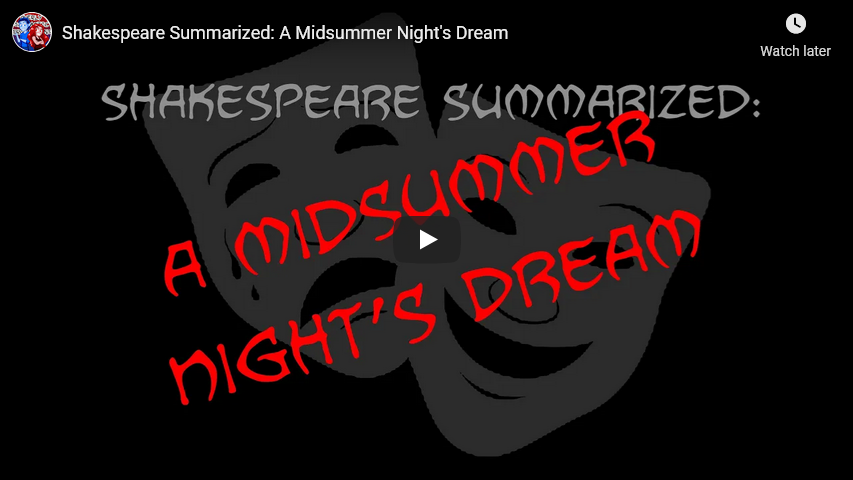
Shakespeare Summarized: A Midsummer Night’s Dream

Filed under: Humour, Media — Tags: , , — Nicholas @ 02:00

Overly Sarcastic Productions
Published 27 Feb 2014

Finally, a summarized comedic romance! And it was almost out in time for Valentine’s Day, when it would have been legitimately appropriate to release!

…I’m making progress, guys. Cut me some slack. 😛

Midsummer Night’s Dream is one of Shakespeare’s best plays. And nobody died this time! What a twist!

QotD: Pauline Réage’s Story of O

Filed under: Books, France, Quotations — Tags: , , , , , — Nicholas @ 01:00

I’m sitting on a plane and I’m feeling increasingly excited. I’m flushed. My heart rate is up, and I can’t seem to find a comfortable way to sit. My agitation isn’t caused by any nervousness about flying, nor by any fears of contracting COVID-19 during the flight. My disquiet has been triggered by the book I’m reading. The sensations it arouses almost overwhelm me. I find I have to pause every few paragraphs, close the slim volume, and rest it on my lap in order to regain some sense of personal composure. Fiction usually transports my imagination away from myself, but this book is accomplishing the opposite: I feel increasingly aware of my body as I read it, as though being immersed in fiction has drawn me into a moment of privacy with myself. It feels somehow unseemly for the public world of the airplane to intrude on my private sensations. I have to put the book down frequently in order to remind myself that it is no act of indecency for the happy family sitting down the aisle from me to be talking casually, but rather that it is my own sense of secrecy that must be reconciled to the ordinary world around me.

I am reading Story of O, a novel written in 1954 that recounts the titular character’s journey into sexual bondage, violent penetrations, beatings, whippings, burnings, chains, gags, and dungeons. Readers only familiar with the pedestrian 1975 adaption are advised not to be put off — director Just Jaeckin’s film benefits from the lovely Corinne Cléry’s beguiling performance in the title role, but his soft-focus softcore aesthetic (gauzy white linen dresses and a smooth classical guitar soundtrack) miss the tenderness, the elegance, and the literary grace of the source. Graham Greene described Story of O as a “rare thing, a pornographic book well written and without a trace of obscenity”; Brian Aldiss remarked that O makes “pornography (if that is what it is) an art”; even JK Rowling has offered praise for the book, observing that, “If you’ve read Story of O you’ve kind of read the ultimate.” But it is JG Ballard’s description of the novel as “a deeply moral homily … touched by the magic of love” that resonates most powerfully with me. O is a radical instruction in morals (the book has a clear sense of feminine virtue, for one thing), and yet this sexual morality is unlike any I can find in our contemporary expression of sexual ethics, where self-expression is valued more than self-giving.

O is the story of a woman objectified and humiliated, of a woman who submits to being violated by the countless tongues and phalluses and fingers which enter her. The novel is more sensual than suspenseful — although there is a clear narrative, it is not a story driven by plot, but rather by a series of erotic episodes (Geraldine Bedell writing for the Observer described them as written with “a hallucinatory, erotic intensity”). It is a psychologically as well as sexually penetrative story of surrender, of being mastered and of becoming enslaved, especially its first chapter which describes the elegant sexual tortures of the Chateau at Roissy, a kind of playboy mansion with fewer grottos and more dungeons.

It is here that, at the request of her lover René, O acquiesces in her complete submission. The cast of characters is sparse: O and René; Jacqueline, a young model whom O seduces, and Jacqueline’s 16-year-old sister, Natalie, a virgin eager to be initiated into the sexual rites of Roissy; Anne-Marie, an older and more ruthless mistress than are the many men at the Chateau; sundry blondes, brunettes, and redheads arranged alluringly throughout the text; and finally O’s ultimate lover, the sophisticated Sir Stephen, a kind of father-figure to René who ends up laying claim to O, flogging her, shackling her labia with an iron ring, and branding her with his initials as his slave, “a condition,” the narrator tells us, “of which O herself was proud.” As I read of the many exquisite ways O gives herself for men’s uses, I begin to wonder if the book was presenting me not with a picture of masculine sexual fantasies, but with a vision of my own.

The novel was written by the mysterious Pauline Réage, a pseudonym. In what is arguably one of the most successful literary secrets, Réage’s identity was kept hidden for decades. It wasn’t until 40 years after the novel’s publication that the then 86-year-old Dominique Aury, a respected editor and French intellectual, revealed that she was the author. It seems fitting that in a novel of sexual submission, Aury — Dominique, dominance, dominatrix — maintained such strict control over her own identity. Even Dominique Aury was not her “real” name: she was born Anne Desclos, but legally changed it in 1940. Aury’s nested names and identities are like a meta-fictitious exercise in un-making and making the self, for questions of self-identity and self-integrity lie at the heart of her novel.

Marilyn Simon, “My Own Private Chateau — Pauline Réage’s Story of O Revisited”, Quillete, 2020-10-18.

February 13, 2021

Miscellaneous Myths: Hades and Persephone

Filed under: Europe, Greece, History, Humour — Tags: , , — Nicholas @ 04:00

Overly Sarcastic Productions
Published 12 Feb 2021

You asked, I’ve answered! Today let’s discuss greek mythology’s most beloved AND most maligned relationship — but which reputation is truly deserved? You all know where *I* stand on the matter, but today I’ll do my best to justify my hot take that Hades And Persephone Is Romantic Actually.

Our content is intended for teenage audiences and up.

PARTIAL TRACKLIST: Hall of the Mountain King, Black Blade, Starfall, World Annihilation, Lacrimosa, Voice of Rushing Waters, Atlas, Breath and Life, Fire And Ice

PATREON: https://www.Patreon.com/OSP​

PODCAST: https://overlysarcasticpodcast.transi…​

DISCORD: https://discord.gg/osp

MERCH LINKS: http://rdbl.co/osp​

OUR WEBSITE: https://www.OverlySarcasticProductions.com
Find us on Twitter https://www.Twitter.com/OSPYouTube​
Find us on Reddit https://www.Reddit.com/r/OSP/

MORE cultural appropriation foods!

Filed under: Americas, Europe, Food, History, India, Japan — Tags: , , , , , — Nicholas @ 02:00

J.J. McCullough
Published 14 Nov 2020

How much famous food is just copied from some other country? Thanks to Jack Rackham for the shogun animation!
https://www.youtube.com/channel/UCaQz…

FOLLOW ME:

🇨🇦Support me on Patreon! https://www.patreon.com/jjmccullough
🤖Join my Discord! https://discord.gg/3X64ww7
🇺🇸Follow me on Instagram! https://www.instagram.com/jjmccullough/
🇨🇦Read my latest Washington Post columns: https://www.washingtonpost.com/people…
🇨🇦Visit my Canada Website http://thecanadaguide.com

HASHTAGS: #food #cooking #history

QotD: Haynes guide to tools of the trade

Filed under: Books, Britain, Humour, Quotations, Technology, Tools — Tags: , , , — Nicholas @ 01:00

HAMMER: Originally employed as a weapon of war, the hammer is nowadays used as a kind of divining rod to locate expensive parts not far from the object we are trying to hit.

ELECTRIC HAND DRILL: Normally used for spinning steel Pop rivets in their holes until you die of old age, but it also works great for drilling mounting holes just above the brake line that goes to the rear wheel.

PLIERS: Used to round off bolt heads.

HACKSAW: One of a family of cutting tools built on the Ouija board principle. It transforms human energy into a crooked, unpredictable motion, and the more you attempt to influence its course, the more dismal your future becomes.

MOLE-GRIPS/ADJUSTABLE spanner: Used to round off bolt heads. If nothing else is available, they can also be used to transfer intense welding heat to the palm of your hand.

OXYACETELENE TORCH: Used almost entirely for lighting various flammable objects in your garage on fire. Also handy for igniting the grease inside a brake-drum you’re trying to get the bearing race out of.

WHITWORTH SOCKETS: Once used for working on older cars and motorcycles, they are now used mainly for impersonating that 9/16″ or 1/2″ socket you’ve been searching for for the last 15 minutes.

DRILL PRESS: A tall upright machine useful for suddenly snatching flat metal bar stock out of your hands so that it smacks you in the chest and flings your beer across the room, splattering it against that freshly painted part you were drying.

WIRE WHEEL: Cleans rust off old bolts and then throws them somewhere under the workbench with the speed of light. Also removes fingerprint whorls in about the time it takes you to say, “F….”

Do it by the book — the real meaning of Haynes instructions.

February 12, 2021

Calls for the federal government’s Broadcasting bill (Bill C-10) to be withdrawn

Filed under: Cancon, Government, Media, Technology — Tags: , , , , , — Nicholas @ 05:00

Michael Geist updates the situation with the federal government’s attempt to massively rework the Canadian broadcast and internet regulation framework without proper scrutiny or transparency:

I have not been shy about expressing my concerns with the Bill C-10, the Broadcasting Act reform bill. From a 20 part series examining the legislation to two podcasts to a debate with Janet Yale, I have actively engaged on policy concerns involving regulation that extends far beyond the “web giants”, the loss of Canadian sovereignty over broadcast ownership, the threat to Canadian intellectual property, and the uncertainty of leaving many questions to the CRTC to answer. Yet beyond the substance of the bill, in recent days an even more troubling issue has emerged as Canadian Heritage Minister Steven Guilbeault, his Parliamentary Secretary Julie Dabrusin, and the Liberal government abandon longstanding commitments to full consultation, transparency, and parliamentary process.

Last week, I appeared before the Standing Committee on Canadian Heritage as part of what it is calling a “pre-study” on Bill C-10. In this case, “pre-study” is euphemism for avoiding the conventional parliamentary process. Bill C-10 has not yet passed second reading in the House of Commons and has not been referred to committee for study. There have been extensive debates in the House and last week Conservative MP Michael Kram called for the bill to be withdrawn, noting that politicians could do Canadians a lot of good by “rewriting it from scratch.” That move drew criticism from Guilbeault during an interview at the CMPA Prime Time event, as he called for pressure on the Conservatives to support referring the bill to committee. There are instances of pre-study, but doing so concurrently with second reading makes no sense since a pre-study allows for a wide range of amendments, whereas after second reading the permitted amendments are more limited.

In an earlier era (or with a different government), the prospect of conducting a study of the bill while simultaneously engaging in second reading would garner loud objections. In fact, at the Heritage Committee hearing last week, opposition MPs wondered why they were already being asked for amendments to the bill when they had yet to hear from witnesses, much less conduct an actual study of the bill. Indeed, for a government that once prized itself on robust consultation, it seemingly now wants to avoid any genuine consultation on Bill C-10, content to have potential amendments presented through lobbyists, rather than on the public record in open hearings.

The secrecy does not end there. At the same hearing (I was a witness and waited patiently for these issues to play out), Conservative MPs raised questions about promised data on how the government had arrived at claims that the bill will generate over $800 million in new money. Leaving aside the fact that Guilbeault has often inflated that figure to over $1 billion, there has no public disclosure about the source of this claim. Cartt.ca reports that officials told the committee that the calculations could be “confusing” without a verbal explanation. Days later, Dabrusin told the committee that in fact the data had been provided to the committee late last year but perhaps not distributed to committee members.

When I was questioned by Conservative MP Kevin Waugh during my appearance before the committee, he again raised concerns about the claim. Dabrusin interjected with a point of order to make it clear that the data had been provided to the committee, albeit not distributed to MPs. What made the exchange so striking was that Dabrusin – a parliamentary secretary – seemingly did not give any thought to the fact that the data has not been made publicly available. Promoting long overdue disclosures to a handful of MPs while the public is kept in the dark is hardly the stuff worthy of praise or a point of order.

Britain Chooses War Crimes – RAF Strategic Bombing – WAH 028 – February 1942, Pt. 1

World War Two
Published 11 Feb 2021

As the winter of 1942 continues, many Soviet civilians suffer under the German Siege of Leningrad. Meanwhile, the British are shifting their bombing strategy from targeting factories to targeting homes.

Join us on Patreon: https://www.patreon.com/TimeGhostHistory
Or join The TimeGhost Army directly at: https://timeghost.tv

Follow WW2 day by day on Instagram @ww2_day_by_day – https://www.instagram.com/ww2_day_by_day
Between 2 Wars: https://www.youtube.com/playlist?list…
Source list: http://bit.ly/WW2sources

Hosted by: Spartacus Olsson
Written by: Joram Appel and Spartacus Olsson
Director: Astrid Deinhard
Producers: Astrid Deinhard and Spartacus Olsson
Executive Producers: Astrid Deinhard, Indy Neidell, Spartacus Olsson, Bodo Rittenauer
Creative Producer: Maria Kyhle
Post-Production Director: Wieke Kapteijns
Research by: Joram Appel
Edited by: Miki Cackowski
Sound design: Marek Kamiński
Map animations: Eastory (https://www.youtube.com/c/eastory​)

Colorizations by:
Norman Stewart – https://oldtimesincolor.blogspot.com/​
Daniel Weiss

Sources:
USHMM
Bundesarchiv
Yad Vashem 2695/7, 5761/12
IWM MH 24747
RIA Novosti archive, image #762, #244
from the Noun Project:
Skull by Muhamad Ulum

Soundtracks from the Epidemic Sound:
Reynard Seidel – “Deflection”
Fabien Tell – “Last Point of Safe Return”
Farrell Wooten – “Blunt Object”
Jo Wandrini – “Dawn Of Civilization”
Wendel Scherer – “Defeated”
Jon Bjork – “Icicles”
Gunnar Johnsen – “Not Safe Yet”
Peter Sandberg – “Document This 1”

Archive by Screenocean/Reuters https://www.screenocean.com​.

A TimeGhost chronological documentary produced by OnLion Entertainment GmbH.

From the comments:

World War Two
4 hours ago
We are covering the RAF’s bombing campaigns in the War Against Humanity series because it concerns warfare against the civilian population. On previous occasions, we have been accused of relativizing Nazi’s war-crimes by covering Allied atrocities in the same space, but we argue that for a fact-based reporting on how WW2 impacted the civilian population we need to be complete and unbiased.

The facts speak for themselves, and we document those facts that by providing an exhaustive record with equal coverage of all events and parties. Covering one event doesn’t relativize or justify the other and vice versa. We will not tolerate any whataboutism in the comments.

We will also not tolerate a justification of these crimes based on pragmatism, or equal proportionality — on an absolute moral level the goal never justifies the means. In this case we look at our comment section from a 21st century perspective and hold ourselves and anyone using our forums to the modern standards laid down in the laws of war. Explaining, analyzing and discussing war crimes and crimes against humanity is fine, even desired — celebrating, hailing, or justifying them is not.

A significant percentage of psychiatric problems have a genetic component

Filed under: Health, Science — Tags: , , , — Nicholas @ 03:00

This is not an area I’ve heard much discussion about, other than on Scott Alexander‘s blog(s):

“Codon Wheel for translating genetic code from the Wellcome Trust Sanger Institute” by dullhunk is licensed under CC BY 2.0

Most psychiatric disorders are at least partly genetic. Some, like schizophrenia and ADHD, are very genetic, probably 80% plus. This is strange, because having psychiatric disorders seems bad, so you would expect evolution to have eliminated those genes. Researchers looking into this question argue between two hypotheses.

First, a failure. Evolution is imperfect, so some bad genes manage to slip through. This sounds dismissive, but it’s definitely true to some degree. Thousands of different genes contribute to risk for conditions like ADHD and schizophrenia, with each adding only a tiny amount of risk. When a gene is only very slightly bad, it takes evolution millennia to get rid of it, and during those millennia people are getting new very-slightly-bad mutations, so it all balances out at a certain level of bad genes per generation. Those bad genes are sufficient to explain the existing amount of ADHD and schizophrenia; they’re just evolution not working as well as we’d hope.

Second, a tradeoff between two goods. The genes for psychiatric disorders are good in some way. Maybe having some schizophrenia genes (maybe not enough to give you schizophrenia) makes you more creative and raises your inclusive fitness. This keeps schizophrenia risk genes in the population, and sometimes two people with very high level of these genes will mate and their child will have schizophrenia. “Higher creativity” vs. “lower schizophrenia risk” is a tradeoff, and different people are at different points on the tradeoff, and some people will be so far to one end that they will get schizophrenia.

Recent research has pretty heavily favored the failure hypothesis. If you have enough people’s genomes, you can use some complicated math to infer how evolution is affecting different genes. And on most of the schizophrenia risk genes we know about, evolution has been gradually eliminating them in a way that looks like they’re on net harmful — not keeping them around in a way that looks like they have counterbalancing advantages. In the modern day, people with genes for psychiatric disorders tend to have fewer, rather than more children than people without those genes – except in the case of ADHD, which I’m tempted to cynically attribute to them being less likely to remember to use contraception.

Also, a lot of the theories about how psychiatric disorder genes are good suggest that different disorders are good in opposite ways. For example, schizophrenia genes are supposed to give you more artistic creativity, whereas autism genes are supposed to make you more cool-headed and rational. This makes a kind of intuitive sense looking at the symptoms of the disorders. But it turns out that many, many of the genes that cause autism also cause schizophrenia, and vice versa. They seem to be general genes for having mental disorders, with a wide variety of negative effects — which seems like a better match for the first theory where they’re just plain bad news and evolution hasn’t gotten around to eliminating them yet.

« Newer PostsOlder Posts »

Powered by WordPress