World War Two
Published 18 Feb 2021The name of Norwegian National Socialist Politician Vidkun Quisling became synonymous with “traitor” and “collaborator”. In this gallery episode, we’ll cover some of the most prominent Quislings in World War Two.
Join us on Patreon: https://www.patreon.com/TimeGhostHistory
Or join The TimeGhost Army directly at: https://timeghost.tvFollow WW2 day by day on Instagram @ww2_day_by_day – https://www.instagram.com/ww2_day_by_day
Between 2 Wars: https://www.youtube.com/playlist?list…
Source list: http://bit.ly/WW2sourcesHosted by: Indy Neidell
Written by: Joram Appel
Director: Astrid Deinhard
Producers: Astrid Deinhard and Spartacus Olsson
Executive Producers: Astrid Deinhard, Indy Neidell, Spartacus Olsson, Bodo Rittenauer
Creative Producer: Maria Kyhle
Post-Production Director: Wieke Kapteijns
Research by: Joram Appel
Edited by: Miki Cackowski
Sound design: Marek Kamiński
Map animations: Eastory (https://www.youtube.com/c/eastory)Colorizations by:
Norman Stewart – https://oldtimesincolor.blogspot.com/
Adrien Fillon – https://www.instagram.com/adrien.colo…
Jaris Almazani (Artistic Man) – https://instagram.com/artistic.man
Julius Jääskeläinen – https://www.facebook.com/JJcolorization/
Carlos Ortega Pereira, BlauColorizations – https://www.instagram.com/blaucolorizations
Dmitriy Vasilyev – https://commons.wikimedia.org/wiki/Fi…Sources:
USHMM
Narodowe Archiwum Cyfrowe
Bundesarchiv
efsyn.gr
Yad Vashem 85DO
Amsab Institute of Social History www.amsab.be
Picture of Mussert shaking hands with Hitler, courtesy of Beeldbankwo2 https://beeldbankwo2.nl/Soundtracks from the Epidemic Sound:
Johannes Bornlof – “The Inspector 4”
Philip Ayers – “Trapped in a Maze”
Cobby Costa – “Flight Path”
Rannar Sillard – “March Of The Brave 4”
Johan Hynynen – “Dark Beginning”
Farrell Wooten – “Blunt Object”
Reynard Seidel – “Deflection”
Yi Nantiro – “Watchman”
Hakan Eriksson – “Epic Adventure Theme 4”Archive by Screenocean/Reuters https://www.screenocean.com.
A TimeGhost chronological documentary produced by OnLion Entertainment GmbH.

February 19, 2021
Quislings! – Traitors of World War Two – WW2 Gallery 02
Freddie DeBoer’s arguments against successful charter schools
Scott Alexander’s extensive review of Freddie DeBoer’s book The Cult of Smart includes this discussion of DeBoer’s belief that American charter schools are fraudulent and only manage their headline-worthy educational outcomes by “cooking the books”:
I think DeBoer would argue he’s not against improving schools. He just thinks all attempts to do it so far have been crooks and liars pillaging the commons, so much so that we need a moratorium on this kind of thing until we can figure out what’s going on. But I’m worried that his arguments against existing school reform are in some cases kind of weak.
DeBoer does make things hard for himself by focusing on two of the most successful charter school experiments. If he’d been a little less honest, he could have passed over these and instead mentioned the many charter schools that fail, or just sort of plod onward doing about as well as public schools do. I think the closest thing to a consensus right now is that most charter schools do about the same as public schools for white/advantaged students, and slightly better than public schools for minority/disadvantaged students. But DeBoer very virtuously thinks it’s important to confront his opponents’ strongest cases, so these are the ones I’ll focus on here.
Success Academy is a chain of New York charter schools with superficially amazing results. They take the worst-off students — “76% of students are less advantaged and 94% are minorities” — and achieve results better than the ritziest schools in the best neighborhoods — it ranked “in the top 1% of New York state schools in math, and in the top 3% for reading” — while spending “as much as $3000 to $4000 less per child per year than their public school counterparts.” Its supporters credit it with showing “what you can accomplish when you are free from the regulations and mindsets that have taken over education, and do things in a different way.”
DeBoer will have none of it. He thinks they’re cooking the books by kicking out lower-performing students in a way public schools can’t do, leaving them with a student body heavily-selected for intelligence. Any remaining advantage is due to “teacher tourism”, where ultra-bright Ivy League grads who want a “taste of the real world” go to teach at private schools for a year or two before going into their permanent career as consultants or something. This would work — many studies show that smarter teachers make students learn more (though this specifically means high-IQ teachers; making teachers get more credentials has no effect). But it doesn’t scale (there are only so many Ivy League grads willing to accept low salaries for a year or two in order to have a fun time teaching children), and it only works in places like New York (Ivy League grads would not go to North Dakota no matter how fun a time they were promised).
I’m not sure I share this perspective. Success Academy isn’t just cooking the books — you would test for that using a randomized trial with intention-to-treat analysis. The one that I found is small-n, short timescale, and a little ambiguous, but I think basically supports the contention that there’s something there beyond selection bias. Teacher tourism might be a factor, but hardly justifies DeBoer’s “charter schools are frauds, shut them down” perspective. Even if Success Academy’s results are 100% because of teacher tourism, they found a way to educate thousands of extremely disadvantaged minority kids to a very high standard at low cost, a way public schools had previously failed to exploit. That’s not “cheating”, it’s something exciting that we should celebrate. If it doesn’t scale, it doesn’t scale, but maybe the same search process that found this particular way can also find other ways? Surely it doesn’t seem like the obvious next step is to ban anyone else from even trying?
And we only have DeBoer’s assumption that all of this is teacher tourism. Success Academy itself claims that they have lots of innovative teaching methods and a different administrative culture. If this explains even 10% of their results, spreading it to other schools would be enough to make the US rocket up the PISA rankings and become an unparalleled educational powerhouse. I’m not claiming to know for sure that this is true, but not even being curious about this seems sort of weird; wanting to ban stuff like Success Academy so nobody can ever study it again doubly so.
DeBoer’s second tough example is New Orleans. Hurricane Katrina destroyed most of their schools, forcing the city to redesign their education system from the ground up. They decided to go a 100% charter school route, and it seemed to be very successful. Unlike Success Academy, this can’t be selection bias (it was every student in the city), and you can’t argue it doesn’t scale (it scaled to an entire city!). But DeBoer writes:
After Hurricane Katrina, the neoliberal powers that be took advantage of a crisis (as they always do) to enforce their agenda. The schools in New Orleans were transformed into a 100% charter system, and reformers were quick to crow about improved test scores, the only metric for success they recognize. Whether these gains stand up to scrutiny is debatable. But even if these results hold, the notion of using New Orleans as a model for other school districts is absurd on its face. When we make policy decisions, we want to isolate variables and compare like with like, to whatever degree possible. The story of New Orleans makes this impossible. Katrina changed everything in the city, where 100,000 of the city’s poorest residents were permanently displaced. The civic architecture of the city was entirely rebuilt. Billions of dollars of public and private money poured in. An army of do-gooders arrived to try to save the city, willing to work for lower wages than they would ordinarily accept. How could these massive overall social changes possibly be replicated elsewhere? And how could we have any faith that adopting the New Orleans schooling system — without the massive civic overhaul — would replicate the supposed advantages?
These are good points, and I would accept them from anyone other than DeBoer, who will go on to say in a few chapters that the solution to our education issues is a Marxist revolution that overthrows capitalism and dispenses with the very concept of economic value. If he’s willing to accept a massive overhaul of everything, that’s failed every time it’s tried, why not accept a much smaller overhaul-of-everything, that’s succeeded at least once? There are plenty of billionaires willing to pour fortunes into reforming various cities — DeBoer will go on to criticize them as deluded do-gooders a few chapters later. If billions of dollars plus a serious commitment to ground-up reform are what we need, let’s just spend billions of dollars and have a serious commitment to ground-up reform! If more hurricanes is what it takes to fix education, I’m willing to do my part by leaving my air conditioner on “high” all the time.
Krupp 50mm Mountain Guns for Siam (Thailand)
Forgotten Weapons
Published 16 Nov 2020http://www.patreon.com/ForgottenWeapons
https://www.floatplane.com/channel/Fo…
Cool Forgotten Weapons merch! http://shop.bbtv.com/collections/forg…
Edit: The three interlocking rings are Krupp’s logo, not a Thai property mark — sorry!
In 1906, Siam (now Thailand) purchased a batch of 50mm mountain guns from Krupp of Germany. These were simple fixed-barrel guns with steel-belted wooden wheels. Designed to be carried by elephant, mule, or even soldiers, the guns disassemble into a number of man-portable pieces. Two different styles of rear sight were used, although it is unclear when one replaced the other. Today, these guns are a great choice for the cannon enthusiast as they have been specifically exempted from the NFA and thus transfer like any simple firearm (no tax stamp required).
Contact:
Forgotten Weapons
6281 N. Oracle #36270
Tucson, AZ 85740
QotD: The disillusionment of working in a bookshop
For the better part of 2006, while studying for a master’s degree, I worked part-time in a branch of Waterstone’s, in *REDACTED*, the county capital of *REDACTED*.
I got the interview by stating openly in my covering letter that I was 24, still living with my mum, and asking her for train-fare had become a bit undignified. This seemed encouraging. But then the panel (2 pax.) asked what I was reading currently, and I said Sam Harris’s The End of Faith, and there was awkward silence. This set the tone for almost every “literary” chat thereafter.
Call me an idiot, but I was genuinely stunned to find we weren’t allowed to read on the job. Instead, booksellers had to devote any time not spent actually dealing with customers (which on a rainy weekend, in the wrong bit of the shop, could be a lot) with often-fruitless searches for books which had been lost, mis-shelved, or maybe stolen, or because they had to be returned to publishers (another surprise), and at the publisher’s expense.
I also quickly realised that the layout of the shop was not an accident (even in the jury-rigged “commercial” buildings of many an English town centre), and that the unadvertised steering of a customer around a bookshop was near-identical to how the algorithms work in the online equivalents (or vice versa, probably). If you like Poetry, you’re more likely to also like Philosophy, (right here on the next set of shelves), or Music (by the window), or History books (just across the room there), than if you came in looking for the latest Jeffrey Archer novel (downstairs, on the pile-’em-high islands).
Most of the time, I was just moving “stock” about, taking maddening credit card orders over the phone, or walking people literally to alphabetised mass-market fiction. All of which required no interest in, let alone knowledge of, literature. To a middle-class nerd such as myself, discovering that working in a bookshop [cue poetic images of James Frain, or similar] was fundamentally no different from working in a Sports Direct or Tesco was about the most depressing thing imaginable. That, and waiting for the Sunday trains in winter.
A.S.H. Smyth, “Seven kinds of people you find in bookshops”, The Critic, 2020-11-14.
February 18, 2021
Choosing and Using Wooden Planes: A Complete Guide
Rex Krueger
Published 17 Feb 2021From adjusting to gripping to taking your first shavings, learn all about this historical tool.
More video and exclusive content: http://www.patreon.com/rexkrueger
Build your own Jointer Plane: https://youtu.be/DeWrLfOnyhs
Get the plans: https://www.rexkrueger.com/store/plan…
Build your own Sharpening Jig: https://youtu.be/EmyW8nFDLr4
(more…)
Fallen Flag — The Newfoundland Railway

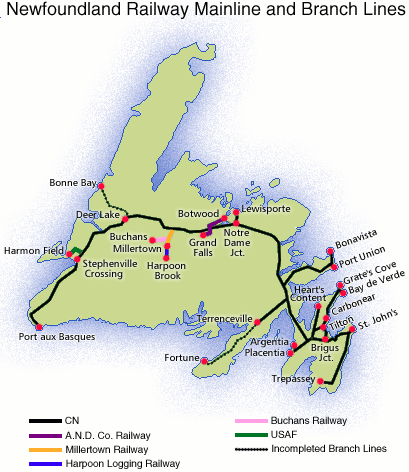
Newfoundland played a pivotal role in World War II during the Battle of the Atlantic and as a staging point for ship convoys and aircraft movements. Construction of Allied bases and the associated movement of personnel resulted in a railway traffic surge. A British and Canadian airfield grew near the main line at Gander, and the United States also exploited Newfoundland’s relative proximity to Europe. The two largest American installations were a naval base at Argentia — site of the 1941 shipboard meeting between President Roosevelt and Prime Minister Churchill — and Harmon Field, an Air Force base on the west coast at Stephenville. Rail traffic was a barometer of wartime pressures; between 1941 and 1943, NR’s passenger count rose from 223,000 to 500,000; freight tonnage also doubled. So important was the line to American military interests that the U.S. government allocated $2 million of “lend-lease” funds for locomotive and car construction.
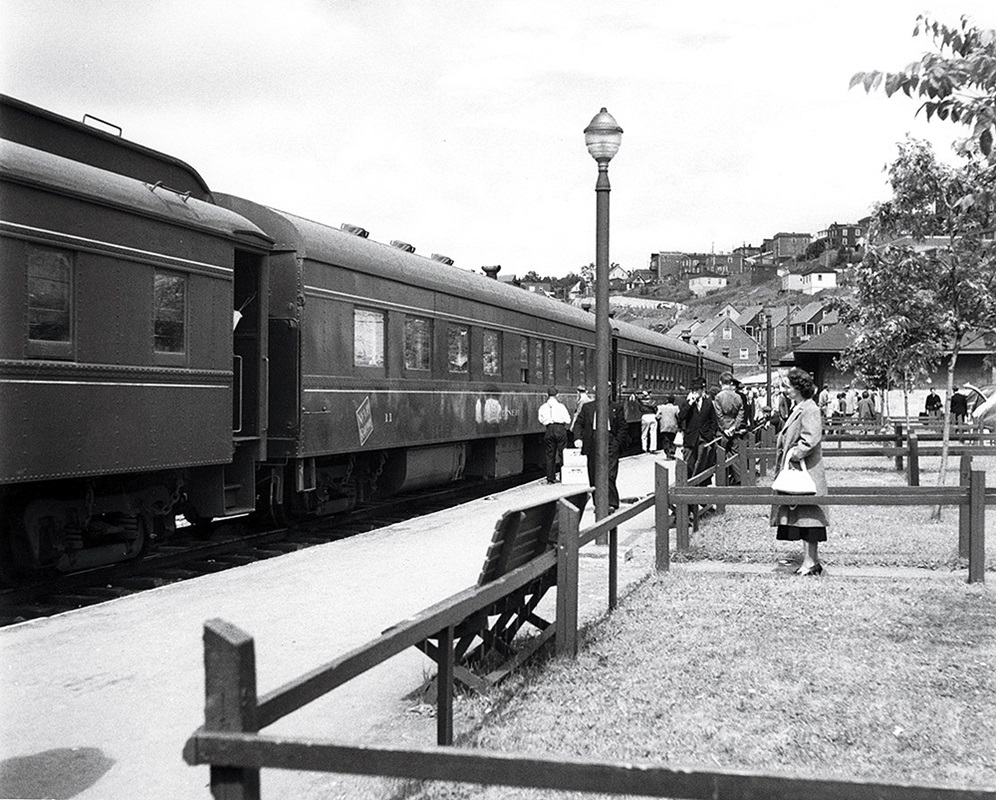
Newfoundland Railway’s Overland Limited (a.k.a. the “Newfie Bullet”) calls at Corner Brook in 1948, the year before CN took over.
Canadian National photo via Classic TrainsAlthough the war brought profits and a revitalized equipment roster, the railway was not immune from the conflict’s brutality. On October 14, 1942, the Port aux Basques–North Sydney (N.S.) ferry Caribou was torpedoed and sunk by a German submarine. Of 237 passengers and crew on board, 136 perished.
Canadian National control
Newfoundland’s 1949 entry into Canada saw responsibility for much of the transport infrastructure assumed by the Canadian government, whose Canadian National Railways was charged with the management and operation of the railway, as well as coastal steamship services and the ferry link to Nova Scotia. The federal government agreed to subsidize the operations. Despite wartime profits and some postwar rebounds, though, the railway had been and would continue to be a chronic money-loser.
Newfoundland Railway was exclusively steam-powered for all but the final seven months of its pre-Confederation existence, as GE 47-ton center-cab diesels 5000–5002 arrived in August 1948. The last new NR locomotives were class R-2-d Mikados 324–329, built by Montreal and delivered just weeks before Confederation. They became the youngest steam locomotives, by five years, on the entire CNR. In all, four 4-6-0s, a 2-8-0, 10 4-6-2s, and 30 2-8-2s were conveyed to CN.
[…]
Well into the 1960s, the railway provided the only land link spanning Newfoundland. When the first road across the island opened as part of the Trans-Canada Highway in late 1965, it triggered an irreversible shift of traffic off the railway. In the highway’s first 15 years, the percentage of island freight handled by train dropped by more than half. More than 24 hours — double the road time — was required for the St. John’s–Port aux Basques rail trip, and that was if the trains ran on time, a spotty prospect especially in winter.
Passengers benefitted from CN’s continued investment in rolling stock, although the non-air-conditioned fleet couldn’t provide mainland comfort levels. The principal pre-Confederation passenger train was the overnight Overland Limited. CN renamed it Caribou in 1950, a fitting tribute to the ferry lost in 1942. To most folks, though, the train was known from the war onward as the “Newfie Bullet,” a wry reference to its leisurely schedule (daily in summer, triweekly the rest of the year). Although CN buses replaced the “Bullet” in July 1969, mixed trains kept serving isolated mainline points and the Carbonear, Bonavista, and Argentia branches.
From the Wikipedia entry on the post-abandonment fate of the line:
The former Newfoundland Railway station in St. John’s now hosts the Railway Coastal Museum. Numerous towns across the island have preserved railway equipment on display.
With few exceptions, the roadbed now forms the T’Railway Provincial Park rail trail. Until 2005, the Trinity Loop Amusement Park operated a miniature train, one of the few remaining places on Newfoundland with tracks still in place. The park closed down and was abandoned in 2005 due to lack of interest. Since then, all of the buildings have been heavily vandalized and Hurricane Igor washed away part of the park, including a large section of the rail bed. Local railway fans have been pushing government to retain the park as an historic site but officials have expressed little interest.
Some rolling stock was converted to a narrower gauge of 914 mm (3 ft) and sold to the White Pass & Yukon Route (WP&YR) railway, which reopened for service in 1988. Gravel cars used by WP&YR are still painted in CN orange; unconfirmed information indicates that some Newfoundland passenger cars were converted into passenger cars of vintage appearance for WP&YR.
Tank Chats #95 | L1E3 Amphibious Tank | The Tank Museum
The Tank Museum
Published 21 Feb 2020Here David Fletcher examines the Vickers-Carden-Loyd L1E3 Amphibious Tank. Produced in the 1930s, the L1E3 was a pre-WW2 experimental tank which never entered service with the British Army.
Support the work of The Tank Museum on Patreon: ► https://www.patreon.com/tankmuseum
Visit The Tank Museum SHOP: ► tankmuseumshop.org
Twitter: ► https://twitter.com/TankMuseum
Instagram: ► https://www.instagram.com/tankmuseum/
Tiger Tank Blog: ► http://blog.tiger-tank.com/
Tank 100 First World War Centenary Blog: ► http://tank100.com/
#tankmuseum #tanks
QotD: The “European Project”
Whatever else the European project was meant to be, it was never meant to be very democratic. Its deus ex machina, Jean Monnet, was quite clear abut this: the plebe was neither intelligent or informed enough to decide its own fate, at least as regards high politics. It would be dishonest to say that such thoughts never run through the heads of the more intelligent sector of the population in respect of the less intelligent; you have only to walk down the street to see that the voice of the people is hardly that of God. How many people, for example, know what the interest rate should be (assuming, that is, that there is a correct answer), or even what factors should be taken into account when assessing it? But few highly intelligent people would put their night thoughts into practice, and simply say, “We should rule because we are the most intelligent and know best.”
Theodore Dalrymple, “European Empire, Fractured”, Law & Liberty, 2020-11-10.
February 17, 2021
Communist Amazons – Women of the Red Army – WW2 Special
World War Two
Published 16 Feb 2021Hundreds of thousands of Soviet Women were deployed in the Red Army and Red Navy during World War Two. They served in a multitude of functions, from traditional roles like nurses to roles previously associated with men. They were pilots, snipers, tank-crews, and fought on the very front of the lines.
Join us on Patreon: https://www.patreon.com/TimeGhostHistory
Or join The TimeGhost Army directly at: https://timeghost.tvFollow WW2 day by day on Instagram @ww2_day_by_day – https://www.instagram.com/ww2_day_by_day
Between 2 Wars: https://www.youtube.com/playlist?list…
Source list: http://bit.ly/WW2sourcesHosted by: Indy Neidell
Written by: Joram Appel
Director: Astrid Deinhard
Producers: Astrid Deinhard and Spartacus Olsson
Executive Producers: Astrid Deinhard, Indy Neidell, Spartacus Olsson, Bodo Rittenauer
Creative Producer: Maria Kyhle
Post-Production Director: Wieke Kapteijns
Research by: Joram Appel
Edited by: Karolina Dołęga
Sound design: Marek KamińskiColorizations by:
– Klimbim
– Daniel WeissSources:
– National Archives NARA
– Woman and Man in 1930s Soviet Propaganda Poster courtesy of Adam Jones from Flickr
– Yad Vashem: 953
– Library of Congress
– RIA Novosti archive
– BundesarchivSoundtracks from Epidemic Sound:
– “The Inspector 4” – Johannes Bornlöf
– “London” – Howard Harper-Barnes
– “Dark Beginning” – Johan Hynynen
– “Other Sides of Glory” – Fabien Tell
– “Break Free” – Fabien Tell
– “Deviation In Time” – Johannes Bornlof
– “Ominous” – Philip Ayers
– “Moving to Disturbia” – ExperiaArchive by Screenocean/Reuters https://www.screenocean.com.
A TimeGhost chronological documentary produced by OnLion Entertainment GmbH.

From the comments:
World War Two
5 hours ago (edited)
Because of the pandemic, we have not been able to publish episodes of On the Homefront for a while. But don’t worry, we’re working on a new episode, which should arrive in your subscription box this spring. Now, we have made an On the Homefront episode which offers some great context to this episode on Women in the Soviet Armies. It is about (the myth of) Soviet Gender Equality, and you can watch it right here: https://youtu.be/zLcHbUrnl6Q
The Rise of Rome – How Italy Was Conquered
Invicta
Published 4 Aug 2018Let’s talk about the rise of the Roman Republic in its early years, specifically how the diverse communities across Italy were united! If you love this time period, I suggest you take a look at the “Rise of Rome” DLC coming out soon for Rome II Total War. I’ll be showing off gameplay on the 2nd channel.
Literary Sources:
“The Rise of Rome” by Anthony Everitt
“Early Roman Warrior” by Osprey Publishing
“The Roman Army” by Chris McNab
“Uniforms of the Roman World” by Kevin F. Kiley
“The Archaic Community of the Romans” by Robert E. Palmer#RomanHistory
#RiseofRome
QotD: Protectionists, left and right
Conservatives who embrace protectionism thereby embrace both the fear that businesses, entrepreneurs, and workers in their country are simply not up to the task of competing against foreign rivals, and the belief that among the steps in making their country “great” is for their own government to restrict the freedom consumers in their country.
“Progressives” who embrace protectionism share conservatives’ low opinion of their country’s businesses, entrepreneurs, and workers, but also mistakenly believe that protectionism “sticks it to” corporate oligarchs when, in fact, it creates corporate oligarchs.
Don Boudreaux, “Quotation of the Day…”, Café Hayek, 2018-09-10.
February 16, 2021
Reduce, re-use, recycle … reject
John Miltimore rounds up several recent stories about American cities backing away from their elaborate, expensive, and wasteful recycling programs. We’ve had three generations of kids brought up indoctrinated into the belief that recycling was not only a good idea, but that it had almost mystical qualities and that it was essential to “saving the world”. The economic facts strongly contradict that, and have always revealed the inefficiencies and outright waste produced by even the best-run municipal recycling programs.
China, perhaps the largest buyer of US recyclables, stopped accepting them in 2018. Other countries, such as Thailand and India, have increased imports, but not in sufficient tonnage to alleviate the mounting costs cities are facing.
“We are in a crisis moment in the recycling movement right now,” Fiona Ma, the treasurer of California, told the Times.
Cost is the key word. Like any activity or service, recycling is an economic activity. The dirty little secret is that the benefits of recycling have been dubious for some time.
“Recycling has been dysfunctional for a long time,” Mitch Hedlund, executive director of Recycle Across America, told The Times.
[…]
And then there are the energy and resources that go into recycling. How much water do Americans spend annually rinsing items that end up in a landfill? How much fuel is spent deploying fleets of barges and trucks across highways and oceans, carrying tons of garbage to be processed at facilities that belch their own emissions?
The data on this front is thin, and results on the environmental effectiveness of recycling vary based on the material being recycled. Yet all of this presumes the recyclables are not being cleaned and shipped only to be buried in a landfill, like so much of it is today. This, Mises would say, is planned chaos, the inevitable result of central planners making decisions instead of consumers through free markets.
Most market economists, Reed points out, “by nature, philosophy, and experience” a bunch skeptical of centrally planned schemes that supplant choice, were wise to the dynamics of recycling from the beginning.
In a 2004 episode of Penn & Teller’s Bullshit, they discussed recycling:
Here’s The REAL DIFFERENCE Between OAK Lumber
Woodworkers Source
Published 14 Apr 2019PLEASE EXPLAIN the difference between oak lumber? And the difference between quarter sawn and flat sawn? (See 4:26)
Okay. Let’s do that!
Seriously folks, we get this question a lot. LIKE, A LOT. First of all, sorry about the confusion. Second, it even confounds us from time to time. But we’re gonna fix that today.
Let’s do this! This video walks you through the differences that would matter to a woodworker when you’re choosing a wood for your project and you’re just sick of hearing the word “OAK” and not knowing what the heck that means.
***
Visit us for hardwood lumber
https://www.woodworkerssource.com
***Tunes:
Stock Media provided by SoundWiz / Pond5Sounds:
Stock Media provided by Bassment55 / Pond5
Stock Media provided by SoundIdeasCom / Pond5
Stock Media provided by EAR / Pond5
Stock Media provided by SoundJay / Pond5
Stock Media provided by MellauSFX / Pond5Footage & Stills:
Stock Media provided by ArtbeatsExpress / Pond5
Stock Media provided by GovernmentFootage / Pond5
Stock Media provided by crewcut / Pond5
Stock Media provided by BSANI / Pond5
Stock Media provided by lachetas / Pond5
Stock Media provided by one4two / Pond5
Stock Media provided by ason / Pond5
From the comments:
Woodworkers Source
1 year ago (edited)
Fact Check: 3:14 USS Constitution‘s hull is made of both white oak and live oak. While the ship’s ability to take a pounding of cannonball fire isn’t because of the white oak alone. Our point remains the same, though, that white oak is strong, durable, and a good choice for projects that will be exposed to water or when toughness is important to you. Thanks for your time. 👍
QotD: Homo electronicus and the falling murder rate
It should be clear to even the dullest social observer that human software has well and truly outstripped our hardware. We’re not built for the world we’ve built. This has been happening for a long time, of course, but it has really taken off recently. Note how hard it is not to watch tv, for instance. Even if you don’t have one in your home, go to a bar, an airport, hell, go to the grocery store — there are blinking screens everywhere, and it takes serious effort not to watch them. Our hardware interprets bright flashing things as a threat — can’t be helped. If you’ve been away from civilization for a few days, like I was recently, you’ll experience fatigue, even nausea when you first come back into town. The low-level-but-constant effort it takes to override your hardware when surrounded by blinking screens wears you out.
If you don’t feel like going all Thoreau, you can test the effect by simply writing your comments to this post out longhand, and then waiting an hour before typing them up. I bet you’ll find it mildly annoying no matter what, but if you’ve really got some thoughts on this matter, by then end of the hour you’ll be something close to furious. You’ve been rewired, comrade. You’re homo electronicus. We all are.
This stuff is recent — really recent. There was a limit to how screen-addled even the infamous “latchkey kids” of the 1980s could be. I had “latchkey kid” buddies, and although we had everything we needed to veg out in front of the tube in the very best Gen Z style — video games, sugary snacks, cable — we couldn’t sit and play Atari all day. I don’t mean that we didn’t; we were no smarter than any other boys; we sure as hell didn’t do anything for our health. I mean we couldn’t. Playing video games gave us ants in the pants — my Mom always knew when I’d been over at Steve’s — and eventually it got to the point where we had to put the joystick down and go throw around a football or something.
These days, the inability to play Nintendo for hours on end means you’ve got ADHD. Pass the Ritalin.
Three things made homo electronicus:
- modern medicine
- instant communications
- permanent caloric surplus.
Ritalin is actually one of the more benign examples. Back in the days when we were allowed to notice such things, a certain kind of social critic pointed out that falling murder rates have very little to do with crime reduction. Instead, it’s almost all attributable to advances in emergency medicine. It’s much tougher for Shitavious to kill D’L’eondrae over a pair of sneakers these days. The ER docs patch the victim up, and so what would’ve been murder one is now mere ADW, which means — Soros-funded DAs being what they are — both victim and perp are soon back on the streets, ready for round two. This idiot rapper, for instance, survived being shot nine times. That’s not nine separate shootings, mind you, that’s nine slugs in one incident. Granted the slipshod motherfuckers who capped him need to work on their aim, but surviving even nine flesh wounds from modern firearms is one hell of a testimony to the power of modern medicine …
… a power that does not, I suggest, conduce to positive eugenic outcomes.
Severian, “Recent Evolution”, Rotten Chestnuts, 2020-09-28.