Quotulatiousness

February 23, 2021

The danger period is when “the coherence of the news breaks” … and it appears to be breaking before our eyes

In the latest Libertarian Enterprise, Sarah Hoyt remembers the breakdown of the Soviet Union and the disturbing parallels we can see today:
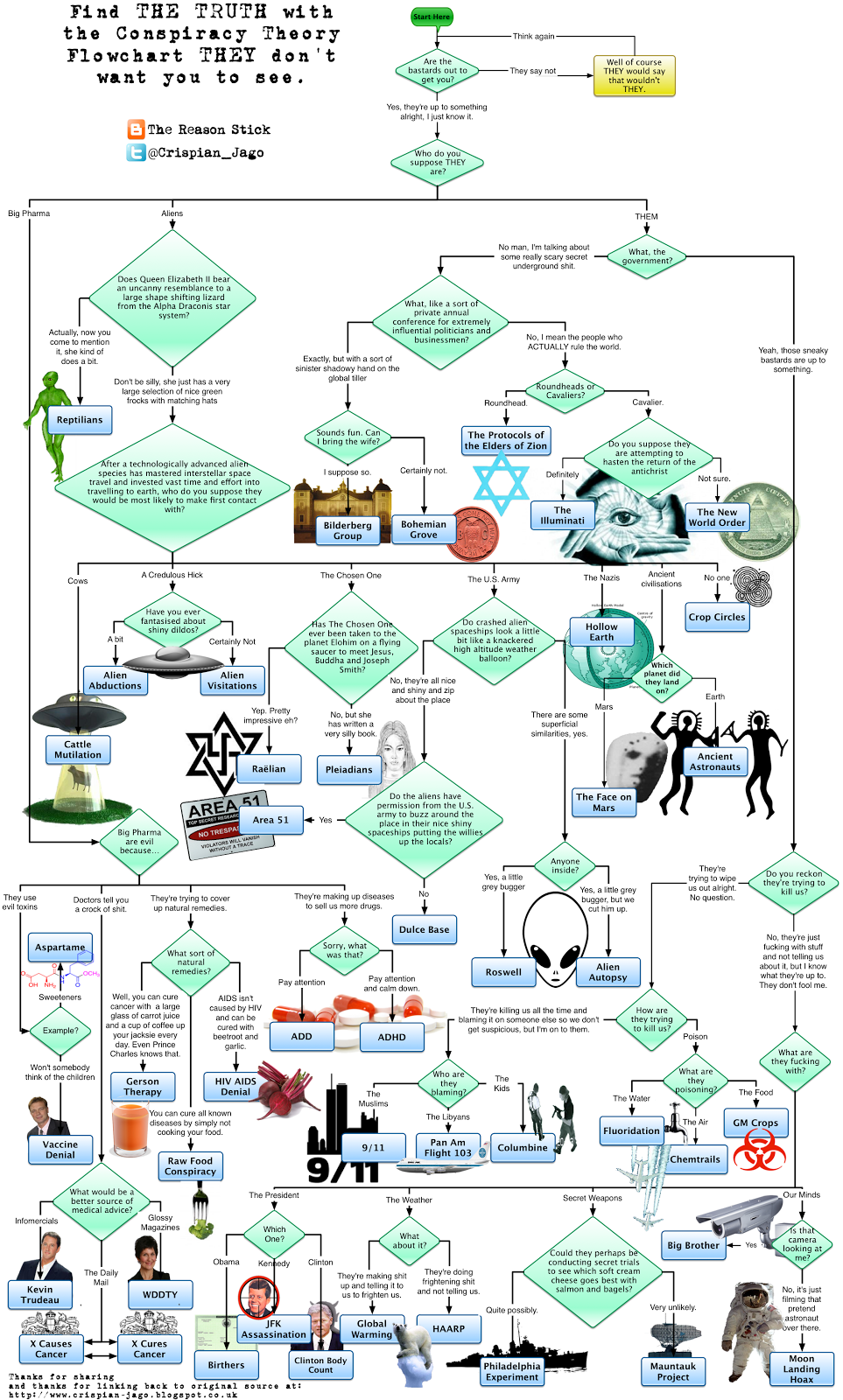
[Click to see full-size flowchart]

Our likelihood of coming out of this a constitutional republic is still high. Why? Well, because societies under stress become more themselves.

I remember when the USSR fell. And out of the ashes Tzar Putin emerged, who is despicable, but not particularly out of keeping with Russian monarchy.

So, yeah, the pull of our culture will be towards the reestablishment of who and what we are and were: a constitutional republic.

But on the way …

Look, I remember when the USSR fell.

The people in the USSR knew they were being treated like mushrooms: kept in the dark and fed on crap. They knew there was truth in Pravda. But they were used to having certain information, and interpreting it.

And there is something worse than reading the news in totalitarianism. You can get used to interpreting the news, and knowing the shape of the hole of what they’re not reporting.

But once you realize it’s all nonsense, once the coherence of the news breaks — and it’s doing so now, earlier than I expected, with the Times article, with the New York Times admitting the protesters at the capitol didn’t kill the police officer — once there are holes, but they’re not consistent, or they’re consistent, but then contradicted; once the narrative changes almost by the week, to the point it can’t be ignored, that’s the dangerous period.

I know I joke that by the end of this year I’ll have to apologize to the lizard-people conspiracy theorists. But the problem is that the lizard people conspiracy theorists can acquire respectability and a strange new respect. Or something even crazier. Heck, a lot of crazier things.

To an extent the 9/11 troofer conspiracies, which yes, are crazy and also anti-scientific were our warning shot. That they flourished and that to this day a lot of people believe them means that there was already a sense that the news made no sense, that there were other things going on behind the scenes that we weren’t aware of.

It’s going to get far, far worse than that, as the actual elites, the top of various fields fall like struck trees in a thunder storm. There is a good chance that authorities you rely on for your profession, or just for your knowledge have been compromised. A lot of our research is tainted by China paying to get the results it wants, for instance. And there’s probably worse. You already know most research can’t be reproduced, and that’s not even recent.

As all this stuff comes out, the problem is that people won’t stop believing. Instead they’ll believe in all and everything.

I don’t know how much was reported here, as the USSR collapsed. but I remember what I read in European magazines and journals. All of a sudden it was all new age mysticism and spoon bending and only the good Lord knew what else.

And that’s what we’re going to head into. So, when you find yourself in the middle of an elaborate explanation that someone constructed, well …

First find the facts. Pace Heinlein: Again, and again what are the facts. Never mind if your ideology demands they be something else. Establish the facts to the extent you can. Facts and math don’t lie. (Statistics do. So be aware you can lie with them. And any metrics that involve intangibles, like intelligence or performance much less sociability or micro anything? forget about it.)

From the facts, deploy Occam’s razor. What is the simplest explanation?

Then remember that humans run at the mouth, and the more humans in the conspiracy, the more facts are likely to leak out somewhere.

And while we’ve seen a lot of Omerta among leftists, note that they’re all afflicted by evil villain syndrome. Sooner or later, they brag about how clever they were in deceiving us. So, if your conspiracy theory requires perfect silence forever, it’s probably not true.


The Corgi Toys Story

Filed under: Britain, Business, History — Tags: , , , , , , — Nicholas @ 02:00

Little Car
Published 4 Feb 2020

Corgi Toys is the name of a range of die-cast toy vehicles produced by Mettoy Playcraft Ltd. in the United Kingdom.

The script for this video comes from Wikipedia: https://en.wikipedia.org/wiki/Corgi_Toys

If you find issues with the content, I encourage you to update the Wikipedia article, so everyone can benefit from your knowledge.

To get early ad-free access to new videos, or your name at the end of my videos, please consider supporting me from just $1 or 80p a month at https://www.patreon.com/bigcar

Link to my other channel – Big Car: https://www.youtube.com/bigcar2

QotD: Canadian myths

Filed under: Cancon, Quotations — Tags: , — Nicholas @ 01:00

The Canadian national temper is a funny thing, riddled with contradictions. It is plainly an abstraction, and yet it does seem to have discernible traits. Some jokingly regard it as absurdly apologetic — a Canadian is someone who says “sorry” when he is jostled. Canadians are polite and amiable, pacifist by nature; they are the world’s peacekeepers. Canadians regard themselves as morally superior, especially with regard to Americans. Canadians are inwardly attracted to failure, as Margaret Atwood contended in Survival — Canadians have a will to lose as powerful as the American will to win. And so on.

Canada is a huge but under-populated country. The wind echoes in our ears. Much has been made in our literature of the hardiness and resilience necessary for existence in a punishing climate and of the harsh labor required to extract the benefits of a resource-based economy. Susanna Moodie’s Roughing It in the Bush is an early classic detailing the rigors and challenges of domesticating an unforgiving milieu. Canadian fortitude is a national foundation myth.

David Solway, “The Canadian Mind: A Culture So Open, Its ‘Brains Fall Out'”, PJ Media, 2018-10-10.

February 22, 2021

The “Infantry Revolution” of the Late Middle Ages

Filed under: Europe, History, Military, Weapons — Tags: , , , , — Nicholas @ 04:00

SandRhoman History
Published 21 Feb 2021

CuriosityStream link: https://curiositystream.com/sandrhoman

The “Infantry Revolution” of the late Middle Ages is kind of a hot topic among armchair historians and academics alike. This is how the argument goes: In the late Middle Ages, infantry grew in importance to the detriment of heavy cavalry; by then battles were increasingly won with pikes, longbows and arquebuses instead of mounted knights with lances, the argument continues, and as a result of that, the socio-political make-up and development of European polities changed lastingly. So, this Infantry Revolution supposedly had an incredible impact on European state building processes AND, the argument finally concludes, it laid the foundation to Europe’s conquest and colonization of many parts of the world. However, in public spaces such as YouTube this whole debate is more discussed in regards to tactics and fighting techniques than economics and politics. Consequently, much of the public discussion is about how and if the importance of knights changed after the High Middle Ages. Likewise, topics such as the efficacy of the English longbow or the impact of pikes in the late Middle Ages are frequently the subject of discussions. All of that is controversial to say the least but it gets worse: these changes must be viewed in the broader military changes such as the rise of gunpowder artillery between 1420 and 1530 — called an artillery revolution — the decline of sieges between the 1420s and the 1530s which, among many things, led to the resurgence of heavy cavalry in the later late Middle Ages. Lastly, all of these revolutions belong to a notion called “military revolution”. This video is not intended to argue one side or the other of the “infantry revolution” but to provide a broad overview over both the debate and the military changes during the 14th and 15th centuries. It explains how contemporary historiography quarrels over the infantry revolution.

Patreon: https://www.patreon.com/sandrhomanhis…​

Twitter: https://twitter.com/SandrhomanBibliog…​

Bibliography:
Bane, M., English Longbow Testing against various armor circa 1400, 2006.
Ayton, A., / Price, J. L., (Hrsg.), The Medieval Military Revolution. State, Society and Military Change in Medieval and Early Modern Europe, 199J.
Black, A Military Revolution? Military Change and European Society 1550–1800, 1991.
Devries, K., Medieval Military Technology, 1994.
Dierk, W., s.v. “Heeresreform”, in: Enzyklopädie der Neuzeit
Ortenburg, G., “Waffe und Waffengebrauch im Zeitalter der Landsknechte” (Heerwesen der Neuzeit, Abt. 1, Bd. 1) Koblenz 1984.
Magier, Mariusz; Nowak, Adrian; et al., “Numerical Analysis of English Bows used in Battle of Crécy”. Problemy Techniki Uzbrojenia. 142 (2), 2017, 69–85.
Meumann, M., s.v. “Military Revolution”, in: Enzyklopädie der Neuzeit.
Parker G., “The ‘Military Revolution’, 1560–1660 – a Myth?”, in: Journal of Modern History 48.2, 1976, 196–214
Parker, G., Die militärische Revolution. Die Kriegskunst und der Aufstieg des Westens 1500–1800, 1990 (Engl. 1988)
Roberts, M.: “The military revolution, 1560–1660”. In: Clifford J. Rogers: The military revolution debate. Readings on the military transformation of early modern Europe. Westview Press, Boulder, Colo. 1995, S. 13–35.
Rogers, C.J. / Tallet F. (editors), European Warfare, 1350–1750, 2010.
Rogers, C.J., The Efficacy of the English Longbow, 1998.
Schmidtchen, Volker, Kriegswesen im späten Mittelalter. Technik, Taktik, Theorie, Weinheim 1990.
Soar, H., Gibbs, J., Jury, C., Stretton, M., Secrets of the English War Bow. Westholme, 2010, pp. 127–151.

Australia experiments with social distancing from social media

Filed under: Australia, Government, Media, Politics, Technology — Tags: , — Nicholas @ 03:00

Arthur Chrenkoff is mildly surprised to find that the Leviathan of social media — Facebook — considers his personal account to be a publisher for Australian ban purposes:

As of this morning, Australian media outlets – as well as government agencies – are not able to post anything on Facebook, and their articles and stories cannot be shared by anyone in the world using Mark Zuckerberg’s now somewhat anti-social network. This is Facebook’s retaliation for a law being introduced by the Australian government that would have companies like Facebook and Google pay Australian media outlets for having their content on their sites. Google has in fact just reached a global agreement with News Corp regarding content use, but Facebook is opting for a much more of a FU negotiating approach.

As much as I dislike Big Tech, I have so far been unable to see a good rationale for the new law. While the media keeps complaining that Facebook and Google (in particular) are monopolising the online advertising revenue, links to media stories are to my mind advertisements that drive online users to the source – and to the source’s advertisers. Perhaps it’s the media who should be paying the socials for this publicity. In the end, the war between the Big Tech and the Mainstream Media is one, to borrow from Henry Kissinger, it’s a pity that both sides can’t lose.

Apart from the fact that various health authorities around Australia are now unable to share COVID information on Facebook, the other ironic casualty of the Aust-Zuck spat is yours truly, whom Facebook has kindly deemed to be an Australian publisher, even though The Daily Chrenk media empire consists of a single ageing desktop in an inner Brisbane suburb utilised (all too rarely and irregularly) by yours truly for the love of it with no commercial element whatsoever. And so, the main avenue of promoting my new posts by sharing their links with the 1000-plus good people around the world who follow TDC page on Facebook has been (I hope only temporarily) lost to me. While it’s flattering to stand shoulder-to-shoulder with The Australian, I’m now somewhat confused: should Facebook be paying me when I voluntarily use their site to try to get eyeballs for my work? Thank you, Australian government, for thinking that should be the model.

I think the whole notion of taxing social media sites like Facebook is cracked … which might explain why the Canadian government has legislation in the works to do something similar … and earlier European attempts to extract money from the “tech giants” have always backfired. That said, I think Facebook’s retaliation is ill-advised, being both disproportional and very likely to induce other governments to look into ways to exercise more control over Facebook and other social media platforms. There are likely no winners in this dispute or the future confrontations that this will likely inform.

The Best BAR: Luxembourg .30-06 FN-D at the Range

Filed under: Europe, History, Military, Weapons — Tags: , , , , — Nicholas @ 02:00

Forgotten Weapons
Published 17 Nov 2020

http://www.patreon.com/ForgottenWeapons

https://www.floatplane.com/channel/Fo…

Cool Forgotten Weapons merch! http://shop.bbtv.com/collections/forg…

I normally want to have something specific to demonstrate when I take a gun to the range, but today I don’t. What I have today is and FN-D, the very best iteration of the Browning Automatic Rifle (BAR) — and I just wanted an excuse to take it out to enjoy. Specifically, this is a Luxembourg contract FN-D chambered for .30-06. So, please pardon my flimsy excuse, and enjoy!

Contact:
Forgotten Weapons
6281 N. Oracle #36270
Tucson, AZ 85740

QotD: Modern academic “life”

Filed under: Education, Humour, Quotations, USA — Tags: , , , — Nicholas @ 01:00

The point of all this isn’t just more academia-bashing (fun as that is, and thank you Jesus for early retirement). The point is: Life deals people bad hands. Many, perhaps most, of the people I know in academia are there because they really can’t do anything else — a combination of (as they feel it) genes and circumstance has landed them there, and while it looks like a really cushy upper-middle-class life materially, spiritually it’s the pits, because it’s aesthetically awful. The Classical Greek adage that the Good is the True is the Beautiful might not be factually accurate, but it sure feels right …

… and never more than to people who know themselves un-beautiful, therefore not good, therefore false, and locked in it. Forever.

These people hate us, not because we’re better looking, more socially skilled, or whatever — this is, after all, the Internet — but because we’ve got options. We’re not all fighting over who gets to be Big Fish in an ever-shrinking pond. We’re different things to different people; we haven’t collapsed our social context down to faculty mixers and the one or two non-hamplanet grad students who are silly enough to apply each semester. We can go days, maybe even weeks, without obsessively comparing ourselves to our peers. We don’t care that we’re not “Chad” or “Stacy,” because we’ve got other settings on the emotional dial than “smugness” and “jealousy.”

But we need to start caring. I don’t mean getting obsessive over our appearance. I mean that, since this is in many ways an aesthetic battle, aesthetics will help us win. I half-jokingly suggested a “Normal Guy Uniform” a while back – an all-white ball cap with the New England Patriots’ logo on it. I’m not really kidding now. The Left wins, in large part, because they’re fugly losers that no normal person could possibly consider a threat … until they bash your skull in, or get you fired, or send a SWAT team to your house.

Severian, “Politics for Fugly People”, Rotten Chestnuts, 2018-08-24.

February 21, 2021

WW2 – 130 – Britain’s Worst Defeat – Singapore Falls – February 20, 1942

World War Two
Published 20 Feb 2021

The most humiliating defeat in British history according to Winston Churchill — 80,000 men lost as prisoners of war! Humiliated by an enemy far less numerous than themselves! There are many ways to describe the fall of Singapore; these are but two of them. The Japanese are also bombing Australia and invading Sumatra, Bali, and Timor this week, so they are certainly not resting on their laurels. Meanwhile in the Soviet Union, thousands of Red Army paratroops are dropping behind German lines.

Join us on Patreon: https://www.patreon.com/TimeGhostHistory
Or join The TimeGhost Army directly at: https://timeghost.tv

Follow WW2 day by day on Instagram @ww2_day_by_day – https://www.instagram.com/ww2_day_by_day
Between 2 Wars: https://www.youtube.com/playlist?list…
Source list: http://bit.ly/WW2sources

Written and Hosted by: Indy Neidell
Director: Astrid Deinhard
Producers: Astrid Deinhard and Spartacus Olsson
Executive Producers: Astrid Deinhard, Indy Neidell, Spartacus Olsson, Bodo Rittenauer
Creative Producer: Maria Kyhle
Post-Production Director: Wieke Kapteijns
Research by: Indy Neidell
Edited by: Iryna Dulka
Sound design: Marek Kamiński
Map animations: Eastory (https://www.youtube.com/c/eastory​)

Colorizations by:
– Norman Stewart – https://oldtimesincolor.blogspot.com/​
– Adrien Fillon – https://www.instagram.com/adrien.colo…​

Sources:
– IWM ART: LD 6042, 15747 12, 15747 139, 15747 14

Soundtracks from the Epidemic Sound:
– Rannar Sillard – “Easy Target”
– Fabien Tell – “Other Sides of Glory”
– Rannar Sillard – “Split Decision”
– Gunnar Johnsen – “Not Safe Yet”
– Farrell Wooten – “Blunt Object”
– Howard Harper-Barnes – “Underlying Truth”
– Jo Wandrini – “Dragon King”
– Fabien Tell – “Break Free”
– Christian Andersen – “Barrel”
– Johan Hynynen – “Dark Beginning”
– David Celeste – “Try and Catch Us Now”
– Farrell Wooten – “Mystery Minutes (STEMS INSTRUMENTS)”

Archive by Screenocean/Reuters https://www.screenocean.com​.

A TimeGhost chronological documentary produced by OnLion Entertainment GmbH.

Missing the point of the 1851 Great Exhibition

Filed under: Britain, History, Technology — Tags: , , , — Nicholas @ 03:00

In the latest Age of Invention newsletter, Anton Howes explains why the 1951 Festival of Britain failed to reproduce the success of the Great Exhibition of a century earlier, even though it did succeed in other ways:

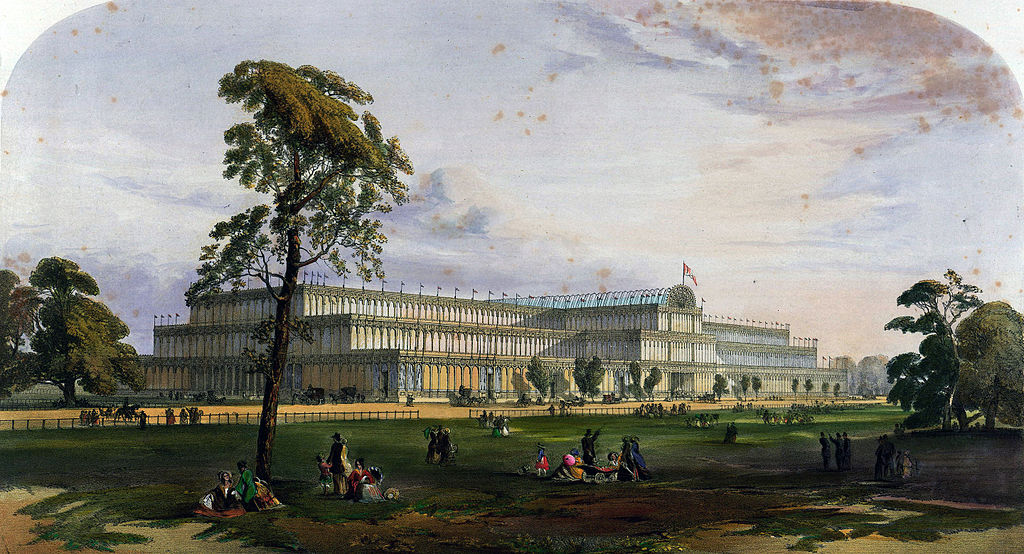
The Crystal Palace from the northeast during the Great Exhibition of 1851, image from the 1852 book Dickinsons’ comprehensive pictures of the Great Exhibition of 1851
Wikimedia Commons.

… the idea that I tend to get most excited about, which I mentioned only in passing last month, is how we might resurrect the spirit of the nineteenth-century exhibitions of industry.

The best-known of these is undoubtedly the Great Exhibition of the Works of Industry of All Nations of 1851, still famous for its Crystal Palace. Held in Hyde Park, London, it attracted six million visitors, and has been emulated many times since. The World Fairs of today number the Great Exhibition as their first. Yet most people today don’t really appreciate what the Great Exhibition was actually for. They see it as a big, international event, with millions of visitors, who saw all sorts of fancy and exciting things — a chance for Britain, and many other countries since, to show off. The result is that many of the events that seek to capture something of the spirit of the original exhibition — 1951’s Festival of Britain, most of the World Fairs since the Second World War, the Millennium Experience, the 2018 Great Exhibition of the North, and now an upcoming “definitely-not-a-Festival-of-Brexit” (currently branded as Festival UK* 2022) — totally and utterly miss the point.

This is perhaps best illustrated by the runup to the 1951 Festival of Britain. Its proposers in the 1940s saw that the centenary of the Great Exhibition was coming up, so they proposed that there should be something similar to mark it. Yet by doing so, they did things entirely back-to-front. The Great Exhibition had a purpose; the exhibition was just the medium. It was the tool for a specific and sophisticated agenda. The Festival of Britain, by contrast, started with the idea of an exhibition, and then flailed about for a reason why. The government had a vague idea of organising an event to lift the country’s spirits after the Second World War, as well as to have it Britain-focused so as to craft a new national identity as the old empire disintegrated. But as its director-general Gerald Barry put it when they actually started work on the event: “we sat before our blotting pads industriously doodling, in the hope perhaps that a coherent pattern might eventually emerge, on the same principle that if you set down twelve apes before twelve typewriters they will (or so it is said) in the course of infinity type out the complete works of Shakespeare.”

The Skylon at the Festival of Britain, 1951.
Photo by Bernard William Lee via Wikimedia Commons.

Looking at the build-up to Festival UK* 2022, it’s hard not to get the same impression. The government wanted something to vaguely help craft a post-Brexit identity, on which it is happy to spend well over a hundred million pounds. Yet to make it happen it has funded a “research and development” project: a whole bunch of committees tasked with coming up with ideas of what to actually do (so far, it’s to be “a collection of ten large-scale, public engagement projects”). This is not to say that the event won’t, in some sense, succeed. The 1951 Festival of Britain, after all, was widely lauded. Barry’s twelve apes at their typewriters didn’t quite write Shakespeare, but they did manage to come up with something that many people remembered fondly. Perhaps some of the projects in 2022 will be similarly impressive.

Yet that doesn’t change the fact that the more recent projects miss the point. In fact, I’d say they are the exact inverse of the Great Exhibition. For a start, the 1851 event was entirely self-funded. It had government support, of course, including a cross-party Royal Commission to oversee the team that did the day-to-day running of things, but it raised its money through a public subscription and, when this was insufficient, took out a loan backed by a group of wealthy guarantors. Fortunately, the guarantors never had to pay out, as the event made so much through ticket sales that it was wildly profitable — so much so that the Royal Commission for the Great Exhibition of 1851 still exists. It purchased the 87 acres of land immediately south of the exhibition site, at South Kensington, for a more permanent collection of cultural institutions including many of London’s major museums. It helped fund a subsequent exhibition of industry on that site in 1862 — which actually had even more visitors, though it’s hardly remembered today. And even now, the Royal Commission continues to dispense over £3m every year to students and researchers.

That self-funding was important, I think, because it removed one of the main criticisms faced by modern large-scale events: that they are expensive wastes of taxpayer money on the vanity projects of politicians. The crowd-funding and finding of sufficient guarantors meant that the event needed to be accepted by the public at large, and even had them committed to the project before it had even begun. It necessitated a clear, exciting message from the get-go, rather than a post-hoc rationalisation.

And what was that message? For nineteenth-century organisers, an exhibition of industry was not just some grand display with a certain je ne sais quoi. It was intended as an engine of improvement: a direct way to actually encourage invention rather than just celebrate it, to raise the standards of consumers, and to lower barriers to trade. It was even a tool of industrial policy, and a springboard for reform.

“House Of The Rising Sun” 1270 A.D (cover in Old French 800-1400 A.D) Bardcore

Filed under: France, Media — Tags: , , — Nicholas @ 02:00

the_miracle_aligner
Published 9 Jul 2020

1270 A.D was a bad year to be in Tunisia, nobody won 😢
Also, take me back to when the French used trilled R’s 😂

Original song by @The Animals: https://www.youtube.com/watch?v=4-43l…

Apologies to all the French-speaking folk out there 😅 This was a really hard one and I know it’s not perfect but please let me know what you think ❤❤❤

Consider supporting the channel, I know what I do ain’t much but its honest work ❤: https://www.patreon.com/the_miracle_a…

Wanna follow me?
https://twitter.com/KholeJa
https://www.instagram.com/the_miracle…

Big thanks to Ser @Graywyck now pls go check out his channel XD
https://www.youtube.com/channel/UCRBC…

As always, big thanks to @ABAlphaBeta for all the help with the translations and training,
Please go check out his channel, its a treat for historical enthusiast XD
https://www.youtube.com/channel/UCoDe…

Also while making this video, a friend of mine introduced me to a cover of the original song done by a French artist Johnny Hallyday called “Le Penitencier.” Its a damn nice cover too, (THANKS EMMAAA) Here’s the link: https://www.youtube.com/watch?v=F3wqO…

I have been procrastinating a lot after going on a break weeks ago but I’m back folks. Currently working on upgrading my hardware, I will be getting a better mic and also a camera as I want to start posting videos soon. Want nothing but the best for all you lovely folk. Thank you as always ya’ll kind folk for all the love and support. Let’s make Bardcore last a 1000 years yeah?

Also, Here be the lyrics. Courtesy of AB

Il y a une meson en Orleans
Qui se sousnomme le Soleil levant
Et ele fu la ruine de maint garsilleurs
Dont fui aussi partant …

Ma mere estoit une taillieuse
Qui cousit mes braies de lin
Mon pere lui estoit un joueur et
D’Orleans un citadin

E les seules choses qu’un joueur requiert
Sont une male et une botte
E le seul moment de repos pour lui
Est saül au fond d’un pot

O, mere, di le aus anfaz
De ne pas feire com moi
Pechiez tout au lonc de vos tristes vies
La ou le Soleil feict loy

Bien, j’ai un pié sur le pavement
L’autre est sur le char
Sui de retorn a Orleans
Ou l’air-mesme est une bare

#TheAnimals #HouseOfTheRisingSun #Bardcore #OldFrench #Medieval

QotD: Journalism

Filed under: Humour, Media, Quotations, USA — Tags: , , , — Nicholas @ 01:00

Journalism is not a profession or a trade. It is a cheap catch-all for fuckoffs and misfits — a false doorway to the backside of life, a filthy piss-ridden little hole nailed off by the building inspector, but just deep enough for a wino to curl up from the sidewalk and masturbate like a chimp in a zoo-cage.

Hunter S. Thompson, Fear and Loathing in Las Vegas, 1972.

February 20, 2021

History Summarized: South Africa

Overly Sarcastic Productions
Published 19 Feb 2021

In the past few centuries, few corners of the African Continent were quite as busy as the south. It’s a winding river from the first migrations and waves of colonists in the Cape Colonies to the Rainbow Nation we know today, so let’s dive in and see how it all played out!

SOURCES & Further Reading for Black History Month:
The African Experience From ‘Lucy’ to Mandela From the Great Courses Plus, lectures 15-18 “South Africa: The Dutch Cape Colony & The Zulu Kingdom & Frontier and Unification & Diamonds and Gold”, 26 “Segregation and Apartheid in South Africa”, and 32 “The South African Miracle”

Born A Crime by Trevor Noah: https://bookshop.org/books/born-a-cri…​
— Home Team History is a YouTube channel covering all corners of the African continent. They have several videos about Southern Africa, such as “A History of Stone Architecture in Southern Africa” (https://youtu.be/0U4Wu3CmL0U​) and “Southern Africa: The Birthplace of Iron Mining” (https://www.youtube.com/watch?v=b9HO0…​), and “A history of the Xhosa People” (https://youtu.be/axajPiZnDqo​)
— Lastly, looking to modern times, it’s important to recognize how the COVID crisis has exacerbated massive preexisting disparities between healthcare for Black and minority communities and that of white Americans. It’s not enough to just acknowledge history, we all have a responsibility to understand modern problems and work on solutions. Read more: (https://www.scientificamerican.com/ar…​) and please consider Donating to support the NAACP’s COVID relief programs: (https://naacp.org/coronavirus/coronav…​)

With special thanks to the members of our discord community who helped polish my script: Holben, Klieg, Good Hunter, and Sticc (who has a History of Africa podcast: https://www.listennotes.com/podcasts/…​)

This topic was voted on by our community of Patrons! If you’d like to get extra rewards and play a role in the content we make, please consider supporting our channel at https://www.Patreon.com/OSP​

Our content is intended for teenage audiences and up.

PODCAST: https://overlysarcasticpodcast.transi…​

DISCORD: https://discord.gg/osp

MERCH LINKS: http://rdbl.co/osp​

OUR WEBSITE: https://www.OverlySarcasticProductions.com
Find us on Twitter https://www.Twitter.com/OSPYouTube​
Find us on Reddit https://www.Reddit.com/r/OSP/

Confessed genocidal nation refuses to accuse China of genocide

Filed under: Cancon, China, Politics — Tags: , , , — Nicholas @ 03:00

Jen Gerson considers the moral smallness of Canadian government wiggling out of labelling China’s treatment of their Uyghur minority as the genocide it certainly is:

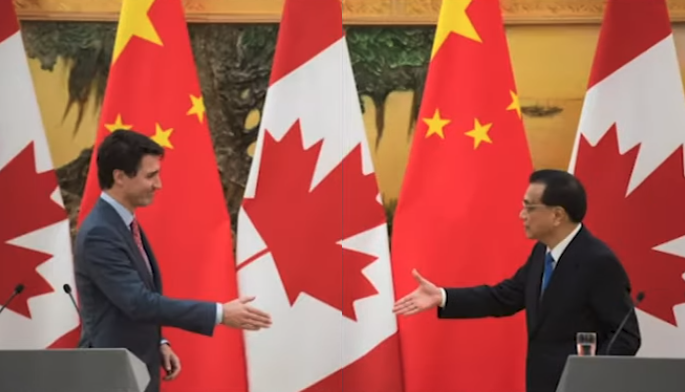
This week, the Prime Minister of an admittedly genocidal G7 state refused to condemn China for its treatment of its minority Uyghur population. A treatment that has included family separation, forced sterilization, and warehousing thousands of people in what can only be described as modern concentration camps.

Justin Trudeau failed to condemn China, noting, quite rightly, that genocide is an “extremely loaded” term. One not to be bandied about lightly. It demonstrates some moral cowardice on his part, certainly, but also a degree of pragmatism. Canada’s squeaky and lonely objection would do little good. We’re already in a vulnerable position, what with the ongoing captivity of two Canadians who remain in Chinese detention as an act of retaliation for our arrest of Huawei executive Meng Wanzhou. A declaration of genocide in this case is probably better handled by a collection of nations. As long as we can live with the shame of the smallness that such an argument implies.

(Although perhaps it was unwise to pin so many of our early hopes of an early vaccine rollout on a doomed collaboration with a Chinese manufacturer with a vaccine backed by China’s Institute of Biotechnology and its Academy of Military Medical Sciences. Who could have predicted we would run into problems with such a notoriously reliable and honourable global partner that occasionally engages in hostage diplomacy? But I digress.)

The real issue with Trudeau’s grovelling little deflection on the question of Chinese genocide is that it made his own position on the subject not two years ago impossible to ignore in comparison. The final report of the Missing and Murdered Indigenous Women and Girls inquiry stated that the truths it uncovered in the process of its years-long investigations:

    … tell the story — or, more accurately, thousands of stories — of acts of genocide against First Nations, Inuit and Métis women, girls, and 2SLGBTQQIA people. This violence amounts to a race-based genocide of Indigenous Peoples … This genocide has been empowered by colonial structures, evidenced notably by the Indian Act, the Sixties Scoop, residential schools, and breaches of human and Inuit, Métis and First Nations rights, leading directly to the current increased rates of violence, death, and suicide in Indigenous populations.

Several pundits at the time noted at the time that this stretched the definition of “genocide” beyond ordinary recognition. “Genocide” is not the result of a set of compounding government failures over time: it’s a word that we reserve to describe a discreet set of acts motivated by the deliberate intent to decimate or totally exterminate an ethnic population. But after a day or so of hemming and hawing on the issue after the report was released, our prime minister noted: “The issue that we have is that people are getting wrapped up in debates over a very important and powerful term … We accept the finding that this was genocide, and we will move forward to end this ongoing national tragedy.”

There was some careful phrasing in this response. Note, Trudeau agreed that this was genocide, not that it is genocide. The prime minister dodged the implication that Canada is engaged in deliberate ethnic cleansing. But it’s worth peeling back the skin of the onion, past the obvious and easy allegation of hypocrisy, and instead ask ourselves why?

Why can we get away with calling ourselves a genocidal state, but not China?

Napoleonic Wars: Battle of Austerlitz 1805

Filed under: Europe, France, History, Military, Russia — Tags: , , — Nicholas @ 02:00

Kings and Generals
Published 19 Nov 2017

We are continuing our documentary series on the Napoleonic Wars and this time we are covering the land portion of the War of the Third Coalition (1805) in which Napoleon faced the forces of Britain, Russia, Austria and Naples. This video depicts the overall campaign and the battles of Ulm and Austerlitz, both of which are considered some of the finest in the career of the French Emperor. The strategic and tactical moves made during these battles are still taught in the military schools and rightly so — Napoleon Bonaparte proved that he was the best general of his time.

Support us on Patreon: http://www.patreon.com/KingsandGenerals or Paypal: http://paypal.me/kingsandgenerals

We are grateful to our patrons, who made this video possible: Ibrahim Rahman, Koopinator, Daisho, Łukasz Maliszewski, Nicolas Quinones, William Fluit, Juan Camilo Rodriguez, Murray Dubs, Dimitris Valurdos, Félix Gagné-Dion, Fahri Dashwali, Kyle Hooton, Dan Mullen, Mohamed Thair, Pablo Aparicio Martínez, Iulian Margeloiu, Chet, Nick Nasad, Jeyares, Amir Eppel, Thomas Bloch, Uri Sternfeld, Juha Mäkelä, Georgi Kirilov, Mohammad Mian, Daniel Yifrach, Brian Crane, Muramasa, Gerald Tnay, Hassan Ali, Richie Thierry, David O’Hare, Christopher Commins, Chris Glantzis, Mike, William Pugh, Stefan Dt, indy, Bashir Hammour, Mario Nickel and R.G. Ferrick.

This video was narrated by good friend Officially Devin. Check out his channel for some kick-ass Let’s Plays. https://www.youtube.com/user/OfficiallyDevin

The Machinimas for this video are created by one more friend – Malay Archer. Check out his channel, he has some of the best Total War machinimas ever created: https://www.youtube.com/user/Mathemed…

✔ Twitch ► https://www.twitch.tv/nurrrik_phoenix
✔ Twitter ► https://twitter.com/KingsGenerals
✔ Instagram ► https://www.instagram.com/nurrrrrik
✔ Steam ► http://steamcommunity.com/id/nurrrik

Inspired by: BazBattles, Invicta (THFE), Epic History TV, Historia Civilis and Time Commanders

Machinimas made on the Napoleon Total War

Production Music courtesy of Epidemic Sound, Total War Napoleon OST: http://www.epidemicsound.com

Songs used:
Total War Napoleon OST – “Napoleonic Code”
Rannar Sillard – “Identity Crisis”
Hakan Ericsson – “Darkness closing in”
Total War Napoleon OST – “The Battle at Arcole”
Total War Napoleon OST – “Naval Battle at St. Vincent”
Five Armies
Total War Napoleon OST – “From Egypt to France”

QotD: The Infantry

Filed under: Britain, Humour, Military, Quotations — Tags: , — Nicholas @ 01:00

The infantry do not have a single capbadge, they are described as a single capbadge but they all have different badges, lots and lots of them. Due to amalgamations and drawing down they are merged and start using new ones. One day they will be merged into the Royal Corps of Infantry.

The infantry (note not “infanteers” as they really hate that) are the actual troops who stand toe-to-toe with the enemy and bayonet them in the face. Boots on the ground, their job is to be pointed at the bad guys and go wreck it. They may get delivered in various ways including aircraft, boat, ship or their own vehicles, but same job: “infantry go smash”. Can be identified by neck tattoos, traditions that the Victorians would think are dated, officers wear faded red trousers and soldiers fight each other on Friday nights.

Combat Boot, “So, ‘capbadges’, what’s that all about then?”, combatboot.co.uk, 2020-11-13.

« Newer PostsOlder Posts »

Powered by WordPress