Haynes: Should remove easily.
Translation: Will be corroded into place … Clamp with adjustable spanner then beat repeatedly with a hammer.Haynes: This is a snug fit.
Translation: You will skin your knuckles! … Clamp with adjustable spanner then beat repeatedly with hammer.Haynes: This is a tight fit.
Translation: Not a hope in hell matey! … Clamp with adjustable spanner then beat repeatedly with hammer.Haynes: As described in Chapter 7 …
Translation: That’ll teach you not to read through before you start, now you are looking at scary photos of the inside of a gearbox.Haynes: Pry …
Translation: Hammer a screwdriver into …Haynes: Undo …
Translation: Go buy a tin of WD40 (industrial size).Haynes: Ease …
Translation: Apply superhuman strength to …Haynes: Retain tiny spring …
Translation: “Crikey what was that, it nearly had my eye out”!Haynes: Press and rotate to remove bulb …
Translation: OK — that’s the glass bit off, now fetch some good pliers to dig out the bayonet part and remaining glass shards.Do it by the book — the real meaning of Haynes instructions.
February 27, 2021
QotD: What the instructions in Haynes manuals really mean
February 26, 2021
U.S. Detention, Nazi Deportation, and Death in the East – WAH 029 – February 1942, Pt. 2
World War Two
Published 25 Feb 2021Franklin D. Roosevelt signs an order to intern all Japanese-American citizens on the West Coast of the United States, while the Italians open up new concentration camps to deal with their ethnic enemies in the Balkans. At the same time, a large group of Jews attempts to escape Europe by boat, with disastrous consequences.
Join us on Patreon: https://www.patreon.com/TimeGhostHistory
Or join The TimeGhost Army directly at: https://timeghost.tvFollow WW2 day by day on Instagram @ww2_day_by_day – https://www.instagram.com/ww2_day_by_day
Between 2 Wars: https://www.youtube.com/playlist?list…
Source list: http://bit.ly/WW2sourcesHosted by: Spartacus Olsson
Written by: Joram Appel and Spartacus Olsson
Director: Astrid Deinhard
Producers: Astrid Deinhard and Spartacus Olsson
Executive Producers: Astrid Deinhard, Indy Neidell, Spartacus Olsson, Bodo Rittenauer
Creative Producer: Maria Kyhle
Post-Production Director: Wieke Kapteijns
Research by: Joram Appel
Edited by: Miki Cackowski
Sound design: Marek Kamiński
Map animations: Eastory (https://www.youtube.com/c/eastory), Miki CackowskiColorizations by:
Norman Stewart – https://oldtimesincolor.blogspot.com/
Mikołaj UchmanSources:
Yad Vashem 143BO2, 5344/2, 6263, 9744/1, 15000/14187511, 15000/14258277, 15000/14088811
Martyr’s path to freedom (Mučeniška pot k svobodi), Ljubljana, 1946
USHMM
View of the Struma in the Istanbul harbor, February 1942, courtesy of USHMM, David Stoliar
From the Noun Project: Ship by kareemovic1000Soundtracks from the Epidemic Sound:
Cobby Costa – “Flight Path”
Fabien Tell – “Break Free”
Philip Ayers – “It’s Not a Game”
Fabien Tell – “Last Point of Safe Return”
Fabien Tell – “Remembrance”
Rannar Sillard – “Split Decision”
Skrya – “First Responders”Archive by Screenocean/Reuters https://www.screenocean.com.
A TimeGhost chronological documentary produced by OnLion Entertainment GmbH.

Waymarkers of the American caste system
Scott Alexander reviews Paul Fussell’s Class: A Guide Through The American Status System, and finds Fussell has helpfully delineated how an outsider can guess someone’s class (or caste, as Fussell would prefer) … at least how that outsider could do so in 1983:
The upper class is old money. The people you think of as rich and famous — tech billionaires, celebrities, whatever — aren’t upper class. However privileged they started off, they still had to put in at least a smidgeon of work to get their money, which disqualifies them. Real uppers inherit. Even famous people who come from old money usually aren’t central examples of upper class; the real upper class has no need to seek fame. They mostly just throw parties — but not interesting parties, because that would imply they have something to prove, which they don’t. They live in mansions — but not awesome mansions they designed themselves with some kind of amazing gaming room or something, because that would imply they have something to prove, which they don’t. They live in meticulously boring mansions and throw meticulously boring parties. They have the best and classiest versions of everything, but it’s a faux pas to compliment any of it, because that would imply that they were the sort of people who might potentially not have had the best and classiest version of that thing. They fill their houses with Picassos and exquisite antique furniture, and none of them ever express the slightest bit of satisfaction or praise about any of it. You have never heard of any of these people, although you might recognize the last name they share with a famous ancestor (Rockefeller, Ford, etc).
The middle classes are salaried professionals, starting with the upper-middle class. Jeff Bezos, for all his billions, is only upper-middle-class at best. So are many of the other people you think of as rich and famous and successful. The upper-middle-class likes New England, Old England, yachts, education, good grammar, yachts, chastity, androgyny, the classics, the humanities, and did I mention yachts?
The middle class is marked by status anxiety. The working class knows where they stand and are content. The upper-middle class has made it; they’re fine. And the upper class doesn’t worry about status because that would imply they have something to prove, which they don’t. But the middle class is terrified. These are the people with corporate jobs who say things like “I’ve got to make a good impression at the meeting Tuesday because my boss’ boss will be there and that might determine whether I get the promotion I’m going for”. The same attitude carries into the rest of their lives; their yards and houses are maintained with a sort of “someone who could change my status might be watching, better make a good impression”. They desperately avoid all potentially controversial opinions — what if the boss disagrees and doesn’t promote them? What if the neighbors disagree and they don’t get invited to parties? They are the most likely to be snobbish and overuse big words, the most obsessed with enforcing norms of virtuous behavior, and the least interested in privacy — asserting any claim to privacy would imply they have something to hide. Their Official Class Emotions are earnestness and optimism; they are the people who patronize musicals like Annie and Man of La Mancha where people sing saccharine songs about hopes and dreams and striving, and the people who buy inspirational posters featuring quotes about perseverance underneath pictures of clouds or something.
Proles do wage labor. High proles are skilled craftspeople like plumbers. Medium and low proles are more typical factory workers. They have a certain kind of freedom, in that they don’t have status anxiety and do what they want. But they’re also kind of sheep. They really like mass culture — the more branded, the better. These are people who drink Coca-Cola (and feel good about themselves for doing so), visit Disneyland (and accept its mystique at face value), and go on Royal Caribbean cruises. When they hear an ad say a product is good, they think of it as a strong point in favor of buying the product. They feel completely comfortable expressing their opinions, but their opinions tend to be things like “Jesus is Lord!”, “USA is number one!”, “McDonalds is so great!”, and “Go $LOCAL_SPORTS_TEAM!”. They are weirdly obsessed with cowboys (Fussell says cowboys represent the idea that poorer people are freer and more authentic than rich office-worker types, plus the West is the prole capital of the USA) and with unicorns (Fussell: “I’ve spent six months trying to find out exactly why, and I’m finally stumped”). When they have unique quirks, they tend to be things like “collecting lots of Disney memorabilia” or “going powerboating slightly more often than the other proles do”. There’s also a sort of desperate prole desire to be noticed and individuated, which takes the form of lots of “Personalized X” or “Y with your name on it”, and also with making a lot of noise (see: powerboating). Fussell describes the most perfectly prole piece of decor as “a blue flameproof hearthrug with your family name in Gothic letters beneath seven spaced gold stars and above a golden eagle in Federal style”.
It’s impossible to tell when Fussell is serious vs. joking. The section on the physiognomy of different classes has to be a joke, right? But then how did he come up with the Virgin vs. Chad meme in 1983? Also, why does my brain keep telling me these are John McCain and Donald Trump?
A friend urges me to think of these not as “rich/successful people” vs. “poor/unsuccessful people”, but as three different ladders on which one can rise or fall. The most successful proles are lumber barons or pro athletes or reality TV stars. These people are much richer and more powerful than, say, a schoolteacher, but they’re still proles, and the schoolteacher is still middle class. Likewise, a very successful middle class person might become a professor or a Senator or Jeff Bezos, but this doesn’t make them even a bit upper class.
(I’m not sure it’s possible to be a more or less successful upper class person; being successful would imply having something to prove, which they don’t).

Germany’s First Smokeless Carbines: the Kar 88 and Gewehr 91
Forgotten Weapons
Published 27 May 2018http://www.forgottenweapons.com/germa…
http://www.patreon.com/ForgottenWeapons
Cool Forgotten Weapons merch! http://shop.bbtv.com/collections/forg…
With the development of the smokeless Gewehr 88 “Commission Rifle”, the German Army finally made a serious effort to bring their cavalry units up to a modern standard. There had never been a carbine variant of the Mauser 71/84 produced, and even by the late 1880s many German cavalrymen were still carrying single shot Mauser 71 carbines — or worse, converted captured Chassepots from the Franco-Prussian War. While the Karabiner 88 wasn’t in production quite as quickly as they would have liked, guns were coming off the factory line in quantity by the summer of 1890. The factories tasked with this production were not actually the major state arsenals, but rather two private companies in Suhl — CG Haenel and VC Schilling (although the Erfurt Arsenal would step in in 1891 to make a batch of 25,000 carbines).
The Kar 88 was remarkable light and handy, and designed for use in a cavalry scabbard, meaning that it had a nice slick profile. This became a problem when the Army wanted to issue the carbines for foot artillery crews as well, because it gave them no way to stack the rifles while tending to their artillery pieces. The result was the Gewehr 91, which was identical to the Kar 88 in every way except for the addition of a stacking rod under the muzzle.
Both the Kar 88 and Get 91 were already being slowly taken out of service before World War One, as the new Mauser 98 pattern carbines introduced in 1909 or 1910 were taking their place. This would change with the outbreak of war, of course, and every one of the 88 pattern carbines in German inventory would be issued out during the Great War. Their size and weight made them ideal for the troops who needed a personal weapon but were unlikely to actually have to fight with it (artillery crews, cyclists, supply drivers, balloon crews, etc). After the war, they all disappeared from military service, though. The arms limitations of the Treaty of Versailles gave Germany no reason to keep obsolescent arms, and they were discarded in favor of keeping Mauser 98 pattern rifles and carbines.
Contact:
Forgotten Weapons
6281 N Oracle #36270
Tucson, AZ 85704

QotD: “What have the Romans ever done for us?”
LORETTA: And from our fathers’ fathers’ fathers.
REG: Yeah.
LORETTA: And from our fathers’ fathers’ fathers’ fathers.
REG: Yeah. All right, Stan. Don’t labour the point. And what have they ever given us in return?!
XERXES: The aqueduct?
REG: What?
XERXES: The aqueduct.
REG: Oh. Yeah, yeah. They did give us that. Uh, that’s true. Yeah.
COMMANDO #3: And the sanitation.
LORETTA: Oh, yeah, the sanitation, Reg. Remember what the city used to be like?
REG: Yeah. All right. I’ll grant you the aqueduct and the sanitation are two things that the Romans have done.
MATTHIAS: And the roads.
REG: Well, yeah. Obviously the roads. I mean, the roads go without saying, don’t they? But apart from the sanitation, the aqueduct, and the roads–
COMMANDO: Irrigation.
XERXES: Medicine.
COMMANDOS: Huh? Heh? Huh…
COMMANDO #2: Education.
COMMANDOS: Ohh…
REG: Yeah, yeah. All right. Fair enough.
COMMANDO #1: And the wine.
COMMANDOS: Oh, yes. Yeah…
FRANCIS: Yeah. Yeah, that’s something we’d really miss, Reg, if the Romans left. Huh.
COMMANDO: Public baths.
LORETTA: And it’s safe to walk in the streets at night now, Reg.
FRANCIS: Yeah, they certainly know how to keep order. Let’s face it. They’re the only ones who could in a place like this.
COMMANDOS: Hehh, heh. Heh heh heh heh heh heh heh.
REG: All right, but apart from the sanitation, the medicine, education, wine, public order, irrigation, roads, a fresh water system, and public health, what have the Romans ever done for us?
XERXES: Brought peace.
REG: Oh. Peace? Shut up!
Monty Python’s Life of Brian, 1979.
February 25, 2021
Mortise Basics: Marking, Chopping, Fitting
Rex Krueger
Published 24 Feb 2021Don’t struggle with your mortises. Learn the simple, traditional methods that get results.
More video and exclusive content: http://www.patreon.com/rexkrueger
Videos and links below! (Scroll down)
(more…)
Malthusian cheerleaders
Barry Brownstein looks at some of the claims from Malthus onward about the imminent demise of humanity due to overpopulation and how that same concern keeps popping up again and again:
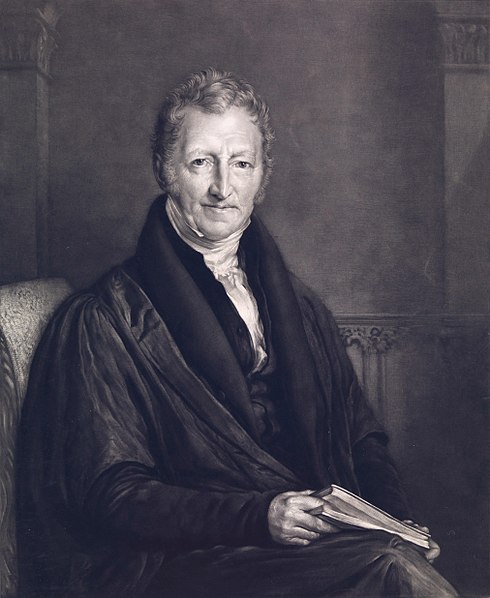
Thomas Malthus.
Portrait by John Linnell, 1834, via Wikimedia Commons
… James Lovelock advanced the Gaia hypothesis that Earth is one “self-regulating organism.” Lovelock forecasts the population of the Earth will fall to one billion from its current total of over seven billion people. Given Lovelock’s cheerfulness about such carnage, it is easy to see why Alan Hall, a senior analyst at The Socionomist, wonders whether “today’s drives to limit consumption and population” are ideologically related to the eugenics movement from the past century. In his essay “A Socionomic Study of Eugenics,” Hall writes in The Socionomist:
Circa 1900, influential intellectuals in Europe and the U.S. voiced concerns about uncontrolled procreation causing a supposed decline in the quality of human beings. Today, similar groups voice concerns about uncontrolled population growth and resource consumption causing a decline in the quality of the environment … Today’s green advocates brandish images of an overrun, dying planet.
Today, the Bill and Melinda Gates Foundation is working to aid the lives of children living “in extreme poverty.” In his book, Factfulness, the late professor of international health Hans Rosling, reports on critics of the Gates Foundation who reject such efforts. “The argument goes like this,” Rosling writes. “If you keep saving poor children, you’ll kill the planet by causing overpopulation.”
In the face of advocates for such beliefs, no wonder Hall asks us to reflect on whether we “will make the cut” if those seeking to cull humanity are successful.
Malthusian Doom
We’ve all heard the SparkNotes version of Malthusian predictions of doom caused by overpopulation. Malthus thought food production could not keep pace with population growth. In his 1798 “Essay on the Principle of Population,” Malthus anticipated the suffering that awaited humanity.
The power of population is so superior to the power in the earth to produce subsistence for man, that premature death must in some shape or other visit the human race. The vices of mankind are active and able ministers of depopulation. They are the precursors in the great army of destruction; and often finish the dreadful work themselves. But should they fail in this war of extermination, sickly seasons, epidemics, pestilence, and plague, advance in terrific array, and sweep off their thousands and ten thousands. Should success be still incomplete, gigantic inevitable famine stalks in the rear, and with one mighty blow levels the population with the food of the world.
Unlike Ehrlich and others, Malthus had reason to be a pessimist in his lifetime. If Malthus had been writing history or predicting the near future, he would not have been far from the mark.
Many of the predictions of overpopulation were based on estimates of population growth (especially in sub-Saharan Africa) which were far from accurate, and in every case we know of, increased economic well-being directly impacts population growth so as a country begins to get richer its population growth begins to slow down significantly (most first-world nations are already at or below population-replacement birthrates).
In their book, Empty Planet: The Shock of Global Population Decline, Darrell Bricker and John Ibbitson have startling facts for those who believe the population will continue to explode.
No, we are not going to keep adding bodies until the world is groaning at the weight of eleven billion of us and more; nine billion is probably closer to the truth, before the population starts to decline. No, fertility rates are not astronomically high in developing countries; many of them are at or below replacement rate. No, Africa is not a chronically impoverished continent doomed to forever grow its population while lacking the resources to sustain it; the continent is dynamic, its economies are in flux, and birth rates are falling rapidly. No, African Americans and Latino Americans are not overwhelming white America with their higher fertility rates. The fertility rates of all three groups have essentially converged.
Looking at current trends and expecting them to continue is what Hans Rosling calls “the straight line instinct.” That instinct often leads to false conclusions.

Tank Chats #96 | D3E1 Wheel-cum-Track Machine | The Tank Museum
The Tank Museum
Published 28 Feb 2020David Fletcher looks at the experimental inter-war Vickers D3E1, which was conceived to solve the problem of track wear, with wheels that could be used instead where the ground was suitable. In practice the concept proved too complicated.
Support the work of The Tank Museum on Patreon: ► https://www.patreon.com/tankmuseum
Visit The Tank Museum SHOP: ►tankmuseumshop.org
Twitter: ► https://twitter.com/TankMuseum
Instagram: ► https://www.instagram.com/tankmuseum/
Tiger Tank Blog: ► http://blog.tiger-tank.com/
Tank 100 First World War Centenary Blog: ► http://tank100.com/
#tankmuseum #tanks

QotD: Islam and the impact of the Enlightenment
The blaze of the Enlightenment, although it might seem to have been lit in Europe, was not just for Europeans. All the world had the potential to share in its radiance. Illumination was the same wherever it manifested itself, and this meant that in Peking as in Paris, in Baghdad as in Bordeaux, there were sages more than qualified to rank alongside Voltaire and Diderot.
The Enlightenment, far from ranking as something parochial and culturally contingent, was properly a global phenomenon. These various dogmas, which the philosophes had tended to take for granted, had then been given a new and militant edge by the French Revolution. That religion was superstition; that rights were universal; that equality, individual liberty and freedom of expression were simultaneously natural and sacred: these were the convictions that had inspired in the citizens of revolutionary France their continent-shaking sense of certitude. Thrones had been toppled; abbeys demolished; the detritus of a benighted past erased. And if in Europe, then why not further afield? The Rights of Man were for everyone, after all, or they were nothing. “Any law that violates them,” as Robespierre had put it, “is fundamentally unjust and tyrannical. Indeed, it is not law at all.”
This sense of missionary purpose, which inspired in those who felt it an ambition to bring the entire world from darkness into light, outlasted the execution of Robespierre, the defeat of Napoleon, the seeming triumph of reaction across post-revolutionary Europe. In 1854, when the Ottoman Empire was facing a critical threat from Russia, France joined Britain in insisting as a condition of its entry into the Crimean War that the slave trade across the Black Sea be abolished.
Also abolished was the jizya, a tax on Jews and Christians that reached back to the very beginnings of Islam, and was directly mandated by the Qur’an. Such measures, to the Ottomans, risked immense embarrassment. The effect, after all, was to reform Islamic jurisprudence according to the standards of non-believers. It was, for Muslim traditionalists, an ominous straw in the wind. Over the course of the century and more that followed, the weathering effects of Western hegemony on the practices that Muslims believed they had inherited from Muhammad — the Sunnah — became more and more pronounced.
Tom Holland, “The age-old tension between Islam and France”, UnHerd, 2020-11-02.
February 24, 2021
Solzhenitsyn was far from the first to warn about the evils of Soviet rule
Theodore Dalrymple had a discussion recently with a Marxist professor:
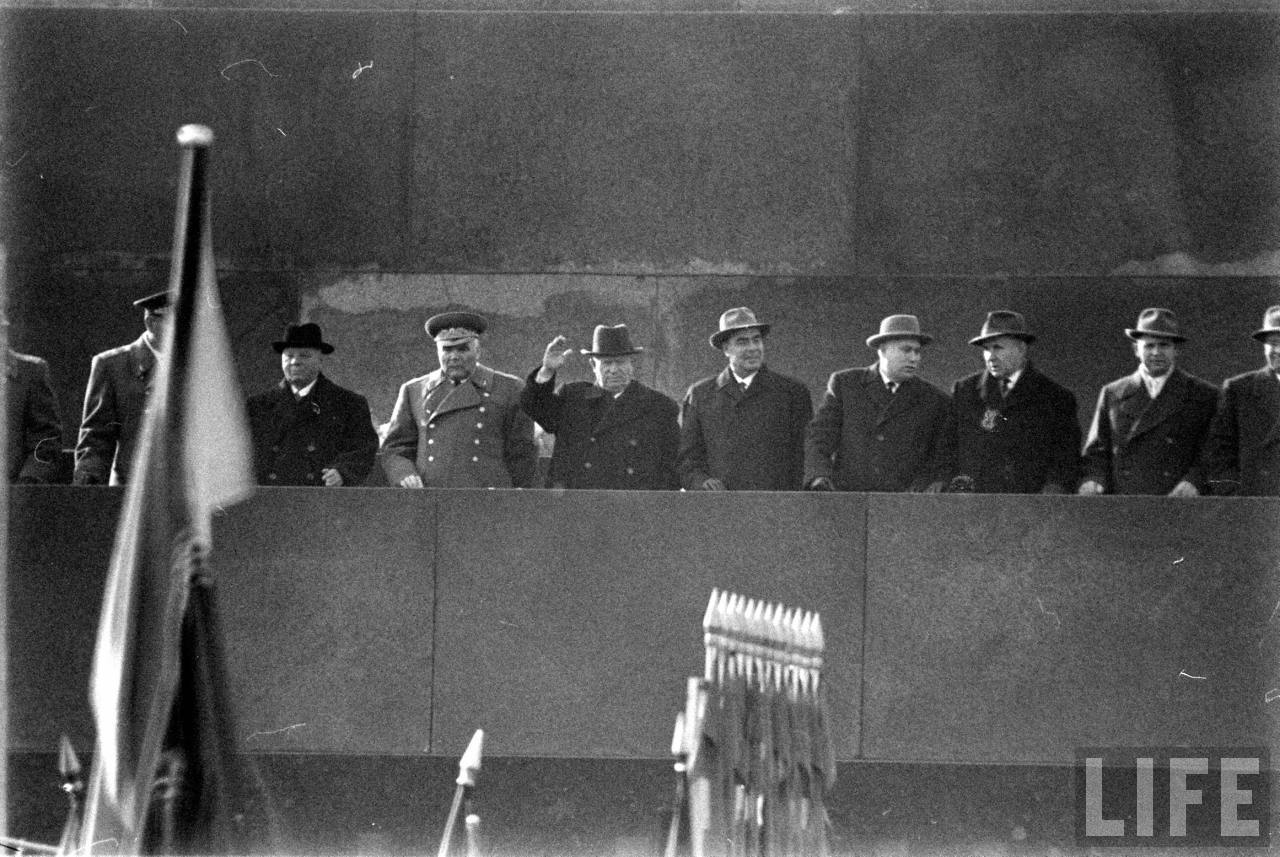
Krushchev, Brezhnev and other Soviet leaders review the Revolution parade in Red Square, 1962.
LIFE magazine photo by Stan Wayman.
The professor was an intelligent man, and probably cultivated too. How was it possible, in the Year of Our Lord 2021, for such a person still to believe that, until the advent of Stalin, the Russian revolution was a good thing, to be emulated or repeated elsewhere?
How could anyone of his intelligence fail to realise that, though as ever there was much wrong with the world, attempts to put everything right at once by the implementation of petty intellectual schemes are fraught with danger, and have a history of mass slaughter behind them?
I think the answer must lie in the psychology of religion: when religious faith is replaced by a philosophy that prides itself on its rationality, it soon turns religious in the worst possible sense. it becomes an atheist theocracy.
Everything was known about the Soviet Union from the first. It is simply not true that Solzhenitsyn revealed anything to the West that, in essence, was not, or could not have been, known before.
I have, in desultory fashion for a number of decades, been collecting books about Russia and the Soviet Union from just before the Revolution until the Second World War, and while it is true that many of them are laudatory, with titles that now seem hilarious to us such as The Soviet Union Fights Neurosis, a very large number books of various genres, from essays to histories to memoirs to novels and short stories, were published that exposed the viciousness of Bolshevism from the very first — a viciousness that anyone with any imagination could have anticipated from Lenin’s literary style alone.
Leninist viciousness was viciousness of a new and more thoroughgoing type that acted on the mind as a virus acts on a computer (viciousness, both actual and potential, is, alas, a constant of human history because of our flawed nature).
Solzhenitsyn was right about the difference between Macbeth, who from personal ambition killed people, but only a few, and the ideologically-motivated mass-killings of the Soviet Union and elsewhere — the difference being precisely in the effect of ideology.
But what was really different about Solzhenitsyn, apart from his literary talent, was that Western intellectuals were now prepared to believe what he said, whereas shortly before they had rejected as mere propaganda evidence of a very similar nature produced by others.It was so startling to meet someone who still believed that a “pure” revolution could take place, and that such a person was teaching history of all things, in a reputable, or at any rate reputed, university, that, like Karl Kraus confronted by Hitler, I could think of nothing to say.
I had no idea whether he still taught undergraduates, or whether in doing so he suppressed at least some of his views (as a judge is supposed to suppress his own private opinions): but I confess that the charge against Socrates, that of corrupting youth, came into my mind.
Japan’s Biological Terror! – The Horror of Unit 731 – WW2 Special
World War Two
Published 23 Feb 2021As one of the few nations during World War Two, Japan made expensive use of biological and chemical weapons, both on and off the battlefield. Unit 731 is their special bio-warfare department, which conducts testing on living human civilians.
Join us on Patreon: https://www.patreon.com/TimeGhostHistory
Or join The TimeGhost Army directly at: https://timeghost.tvFollow WW2 day by day on Instagram @ww2_day_by_day – https://www.instagram.com/ww2_day_by_day
Between 2 Wars: https://www.youtube.com/playlist?list…
Source list: http://bit.ly/WW2sourcesHosted by: Spartacus Olsson
Written by: Joram Appel
Director: Astrid Deinhard
Producers: Astrid Deinhard and Spartacus Olsson
Executive Producers: Astrid Deinhard, Indy Neidell, Spartacus Olsson, Bodo Rittenauer
Creative Producer: Maria Kyhle
Post-Production Director: Wieke Kapteijns
Research by: Joram Appel
Edited by: Karolina Dołęga
Sound design: Marek KamińskiColorizations by:
– Daniel Weiss
– Mikołaj Uchman
– Dememorabilia – https://www.instagram.com/dememorabilia
– Klimbim
– Norman Stewart – https://oldtimesincolor.blogspot.com/Sources:
– National Archive NARA
– Imperial War Museums: D 3162, HU67224, HU 44941, Q 114057
– BundesarchivSoundtracks from Epidemic Sound:
– “For the Many STEMS INSTRUMENTS” – Jon Bjork
– “Weapon of Choice” – Fabien Tell.
– “Moving to Disturbia” – Experia
– “Symphony of the Cold-Blooded” – Christian Andersen
– “It’s Not a Game” – Philip Ayers
– “Please Hear Me Out STEMS INSTRUMENTS” – Philip Ayers
– “London” – Howard Harper-Barnes
– “Break Free” – Fabien Tell
– “Not Safe Yet” – Gunnar JohnsenArchive by Screenocean/Reuters https://www.screenocean.com.
A TimeGhost chronological documentary produced by OnLion Entertainment GmbH.

An antidote to the poison of modern architecture?
In The Critic, James Stevens Curl reviews a new work by Mark Alan Hewitt that he calls “a welcome breath of sound common sense in a field where expensive insanity seems to have ruled the roost for far too long”:

Draw in Order to See: A Cognitive History of Architectural Design
by Mark Alan Hewitt
That architecture and architectural education are in a terrible state is obvious to anybody in the field. The reasons for this catastrophe are many, but some of the primary causes have been the universal embrace of the cult of inhumane modernism devoid of ornament (“a crime”), beauty, or even fun; the arrogant ditching of history and disregard of architectural precedents; the devaluation of craftsmanship through the adoption of factory-made components; and the desensitisation of architectural students terrorised and bullied into acceptance of nonsense by means of design “juries”, and by the compulsory study of false “grand narratives” of modernism that are patently distorted.
One of the worst of those pernicious texts was Nikolaus Pevsner’s Pioneers of the Modern Movement from William Morris to Walter Gropius (1936), the title of which should have been enough to put off anyone who knew anything about art history. The creation of an entirely spurious connection between Arts-and-Crafts practitioners like Morris and modernists like Gropius was part of a campaign to create respectable father-figures for disreputable modernism; to legitimise the unspeakable by giving it a fabricated historical pedigree.
It says a lot about the flabbiness of the architectural world that it so readily accepted not only Pevsner’s sacred cowdom, but his enthusiastic endorsement of the Modern Movement in architecture as the “new style” of the twentieth century; a “genuine style as opposed to a passing fashion”, and one, moreover, that was, as Pevsner approvingly noted, “totalitarian”, a remark that did not even arouse a frisson of anxiety among the dimwits. Elizabeth Cumming and Wendy Kaplan put it neatly in their The Arts and Crafts Movement (1991 & 2002): they observed that few “now accept the view of Nikolaus Pevsner, put forward in his influential Pioneers … of Arts and Crafts as an antecedent of modernism”. Unfortunately, that is not true of “schools of architecture” in which falsehoods are still taught, and people like C.F.A. Voysey, who hated the modernists and everything they stood for, was held by Pevsner, in the teeth of objections by Voysey himself, to have been such a “pioneer”, a libel still perpetrated to this day in recent publications.
The widespread acceptance of untruths, obvious errors, and false attributions can only be explained if some cognitive functions have been shut down. To swallow the sort of twaddle peddled by Pevsner one would need to disengage what one actually sees from one’s understanding: in other words, instead of looking at something with care and forming sensible judgements based on careful comparisons and observations, one has one’s vision impaired by peering through Bauhaus-tinted spectacles, and therefore sees what Pevsner & Co. want one to see. In other words, whole generations have been brought up, not to see with their eyes, but to look with their ears.
Hewitt’s intelligent new book argues persuasively for the advantages of drawing in helping us to see. So often, the camera and the mobile phone are used to record something, but it is true (and I speak from many years of experience), that one can really only understand a building or an artefact by drawing it.
Disney’s Best Propaganda Cartoon
J.J. McCullough
Published 21 Nov 2020A review of Education for Death, a WW2 propaganda film. This video was sponsored by the Great Courses Plus! Start your free trial today by clicking here: http://ow.ly/az9m30rkCKF
Check out Three Arrows here: https://www.youtube.com/channel/UCCT8…
During the World War II, Disney made a number of cartoons to boost public support for the Allies and denounce Germany. This one, about Little Hans, has always been my favorite.
FOLLOW ME:
🇨🇦Support me on Patreon! https://www.patreon.com/jjmccullough
🤖Join my Discord! https://discord.gg/3X64ww7
🇺🇸Follow me on Instagram! https://www.instagram.com/jjmccullough/
🇨🇦Read my latest Washington Post columns: https://www.washingtonpost.com/people…
🇨🇦Visit my Canada Website http://thecanadaguide.comHASHTAGS: #propaganda #history #germany

QotD: Margaret Thatcher
But here’s the thing: I don’t hate Thatcher. It’s not that I’m a huge fan of her legacy or anything (although anyone who thinks that industrial relations were doing fine before her or that the Falklands were some kind of unjustified expedition is clearly a fantasist), it simply doesn’t matter whether I like her or not because she is just too interesting.
Thatcher wasn’t the first woman to lead a country, but unlike her predecessors, Indira Gandhi in India or Isabel Martínez de Perón in Argentina, she didn’t arrive sanctified by a political dynasty. She was, as Prince Phillip snobbily points out to the Queen in The Crown, a grocer’s daughter. In real life, such condescension came strongly from the Left. The Blow Monkeys, one of the bands involved in the Red Wedge tour to support Labour, released an album called She was only a Grocer’s Daughter in 1987; and even though several pop songs fantasised about her death, that never seemed quite as ugly as supposed defenders of the working class announcing that Thatcher was just too common to rule.
Sarah Ditum, “How Thatcher rejected feminism”, UnHerd, 2020-11-15.
February 23, 2021
Hitler’s Raiders in the Pacific
Kings and Generals
Published 21 Feb 2021Get your free trial of MagellanTV here: https://try.magellantv.com/kingsandge…. It’s an exclusive offer for our viewers: an extended, month-long trial, FREE. MagellanTV is a new kind of streaming service run by filmmakers with 3,000+ documentaries! Check out our personal recommendation and MagellanTV’s exclusive playlists: https://www.magellantv.com/explore/hi…
Kings and Generals 3d animated historical documentary series on modern warfare continues with a video on the German naval raiding vessels which attacked Australia, New Zealand and other Allied territories in the Pacific Ocean during the early portions of World War II. This episode focuses on the exploits of Orion, Komet, Pinguin, and Kormoran, explaining how the Kriegsmarine‘s vessels attacked the targets in the Pacific Ocean, especially Nauru and its phosphate facilities.
Support us on Patreon: http://www.patreon.com/KingsandGenerals or Paypal: http://paypal.me/kingsandgenerals. We are grateful to our patrons and sponsors, who made this video possible: https://docs.google.com/document/d/1o…
The video was made by Leif Sick, while the script was developed by Ivan Moran. The video was narrated by Officially Devin (https://www.youtube.com/user/Official…)
✔ Merch store ► teespring.com/stores/kingsandgenerals
✔ Podcast ► http://www.kingsandgenerals.net/podcast/
✔ Twitter ► https://twitter.com/KingsGenerals
✔ Instagram ► http://www.instagram.com/Kings_GeneralsProduction Music courtesy of Epidemic Sound: http://www.epidemicsound.com
#Documentary #WorldWar #Raiders