Quotulatiousness

March 2, 2021

The Evolution of Shock Cavalry – From Antiquity to the Middle Ages

Invicta
Published 1 Mar 2021

Learn about the evolution of shock cavalry from antiquity before the use of saddles and stirrups! Check out The Great Courses Plus to learn about shock cavalry in the campaigns of Alexander the Great: http://ow.ly/osex30rvhjf​

In this history documentary we explore the topic of ancient cavalry. The basic idea is that these units often get depicted in media as performing glorious massed charges headlong into the enemy ranks as seen in such scenes as the Charge of the Rohirrim from the Battle of Pelenor Fields. In reality this would have been a very dangerous situation for cavalrymen even under the best circumstances. But to make matters worse, riders from antiquity fought without the use of either saddles or stirrups. So how on earth did they manage to dominate the battlefield with these handicaps. Let’s find out.

We begin by covering the history of cavalry with the first domestication of the horse and its introduction to warfare first as member of the baggage train and soon after as a part of chariot crews rather than as actual mounted forces. This was in large part due to the lack of riding experience and technology on behalf of the rider. Soon after the Bronze Age Collapse however cavalry began to rise to prominence across the armies of the Mediterranean. We speak about the various forms of equine practices which ranged from riding bareback into combat as with the Numidian Cavalry to the use of simple bridles and cloth seats as with Greek Cavalry and Persian Cavalry.

We then cover the techniques used by these cavalrymen to mount, ride, and fight. As a part of this discussion, we rely heavily on Xenophon’s Manual on Horsemanship which provides excellent first hand details from the period. We also show how these techniques were successfully used by shock cavalry of antiquity such as the Macedonian Companion Cavalry, the Saka Steppe Lancers, and the Persian Cataphracts to great effect even without the use of saddles and stirrups.

Finally we do pose the question of why they didn’t use the saddle and stirrup given its seemingly obvious advantages. To answer this question we look at the history of its development from late antiquity to the early Middle Ages.

Bibliography and Suggested Reading
On Horsemanship, by Xenophon
Adrian Goldsworthy, The Complete Roman Army
Adrian Goldsworthy, Roman Warfare
J.C. Coulston, Cavalry Equipment of the Roman Army in the First Century A.D.
George T. Dennis, Maurice’s Strategikon, p. 38.
Julius Caesar, Commentarii de Bello Civili
Russel H. Beaty, Saddles

#History​
#Documentary​
#ShockCavalry

From the comments:

Invicta
13 hours ago
I was inspired by comments on our latest Units of History episode covering the Companion Cavalry which asked about how shock tactics worked in an age before the stirrup and saddle. I went down the rabbit hole finding answers and present to you my findings in this video! One awesome source we used was the Manual on Horsemanship by Xenophon which you can read for yourself here: http://www.gutenberg.org/files/1176/1176-h/1176-h.htm


Warship purchasing is not for the faint-of-heart

Filed under: Bureaucracy, Cancon, Economics, Government, Military — Tags: , , , , , — Nicholas @ 03:00

Ted Campbell talks about the way the Royal Canadian Navy plans for warship purchases … and how the best-laid plans can be derailed by ignorant political advisors:

An artist’s rendition of BAE’s Type 26 Global Combat Ship, which was selected as the Canadian Surface Combatant design in 2019, the most recent “largest single expenditure in Canadian government history” (until the RCAF gets their replacement for the CF-18 Hornet).
(BAE Systems, via Flickr)

Once upon time,* about 25 to 30 years ago, in the mid 1990s, when I was the director of a small, very specialized team in National Defence Headquarters (NDHQ) in Ottawa, something like this happened: One of my colleague, who had a title like Director of Maritime Requirements or something similar said to one of his principle subordinates, “Look, now that the 280s (Canada had four Tribal Class destroyers with pennant numbers starting at 280, they were often just called ‘280s’) are finished their mid-life refit and now that the new frigates are entering service it is time to put a ‘placeholder’ in the DSP for their eventual replacements.” The DSP was (still is?) the Defence Services Programme, it is the internal document which sets out the long range spending plans (maybe hopes is a better word) for the Canadian Armed Forces.

Anyway, the Navy commander (the officer assigned to write the document, not the Commander of the Royal Canadian Navy who is nicknamed the Kraken (CRCN)) sat at his desk and consulted the most recently approved planning document which, as far as I can remember, called for a surface fleet of 25 combat vessels and four large support ships plus numerous minor war vessels (like minesweepers) and training vessels. The officer then prepared a memorandum for the joint planning staff which said that the Navy would need 25 new combat ships, to be procured between about 2015 and 2035, in five “batches” of five ships each** at a total cost of about $100 Billion, in 2025 dollars. He didn’t say much beyond that, actually, he was just intending to “reserve” some money a generation or so in the future. His memorandum sailed, smoothly, past his boss and the commodore but questions came from a very senior Air Force general: Where he asked, did the $100 Billion come from? That was an outrageous number, he said.

A meeting ensure where the Navy engineering people came and said, “$100 Billion is a very reasonable guesstimate. Our brand new frigate are costing $1 Billion each when they come down the slipway. They will each have cost the taxpayers two to three times that by the time we send them to be broken up thirty or forty years from now. Adding in the inevitable costs of new technology and inflation, which we know is higher for things like military ships and aircraft than it is for consumer goods, then a life-cycle cost of $4 Billion for each ship is very conservative. The admirals and generals huffed and puffed but they didn’t argue ~ they knew that the engineering branch insisted on using life cycle costing, even though no-one but them understood it, and they also knew that arguing with engineers is like mud-wrestling with pigs: everyone gets dirty but the pigs love it.

A decade later, when a new government was planning the National Shipbuilding Procurement Strategy, which was all about making the Canadian shipbuilding industry competitive and had very little to do with ships ~ except they would be the “product” for which the Government of Canada would pay top-dollar, the Navy was told it could have fewer ships, in two classes, and someone ~ NOT the military’s engineering branch ~ assigned a cost figure to the project which was, to be charitable, pulled out of some political/public relations staffer’s arse.

[…]

* The story is true, in general, but I was not directly involved in any of it. I learned about what happened from three main sources: 1. routine briefings that my bosses (directors-general and branch chiefs) gave, regularly, to we directors, dealing with what was going on in the HQ and in the big wide world; 2. periodic chats with my colleagues, after work on Friday afternoons, in the bar of the Officers’ Mess ~ many of us regarded 2. as a more reliable source of information than 1.; and 3. in the case of the story about the Navy engineers and the Air Force general, by a friend and colleague who was in the room.

** The idea, long before the National Shipbuilding Strategy, was to keep shipyards moderately busy on a continuous basis. The 25 ships would all be similar: the first “batch” of five would be identical, one to the other; the second “batch” would be very similar but with some improvements; the five ships of batch 3 would be similar to the ships from the second batch and those from batch 4 would be rather like their batch 3 sisters. Finally, the batch 5 ships would be product improved versions of batch 4 ~ they would still be “sisters” of the batch 1 ships, but not, in any way, twins. The idea was that about the time that the batch 5 ships were being delivered the first of the batch 1 ships would be getting ready for a mid-life refit (after 15 to 20 years of service) which would result in it being much more like the batch 5 ships … and so on.

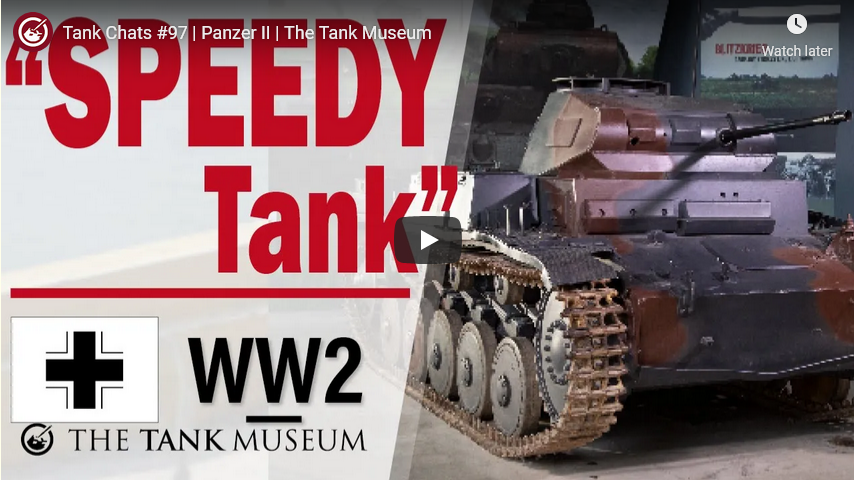
Tank Chats #97 | Panzer II | The Tank Museum

Filed under: Germany, History, Military, Weapons, WW2 — Tags: , , , — Nicholas @ 02:00

The Tank Museum
Published 20 Mar 2020

Here David Willey discusses the Panzer II, a German tank which was instrumental in the early days of the Second World War, especially during the Blitzkrieg.

Support the work of The Tank Museum on Patreon: ► https://www.patreon.com/tankmuseum

Visit The Tank Museum SHOP: ►tankmuseumshop.org

Twitter: ► https://twitter.com/TankMuseum
Instagram: ► https://www.instagram.com/tankmuseum/
Tiger Tank Blog: ► http://blog.tiger-tank.com/
Tank 100 First World War Centenary Blog: ► http://tank100.com/
#tankmuseum #tanks

QotD: “The List”

Filed under: Humour, Quotations — Tags: — Nicholas @ 01:00

“The List” is the bane of testosterone-driven humans. “The List” is kept in the secret mental lock-box of human beings of the estrogen persuasion. Some believe that “The List” is a social construct, while others believe that “The List” is hard-wired into the DNA of the human female. I favor the latter theory since it seems to me that “The List” is merely a subset of “The Plan” — and “The Plan” is not only part and parcel of the basic makeup of the human female regardless of race, color, creed, national origin, or historical epoch, it is also the reason that — over time — women triumph over men. Women, in short, always have a life plan while men are stuck with something that looks like a cross between a spreadsheet without a recalc button and a really slick marketing idea.

In short, men might have a plan for making a rocket-propelled street luge, but they have none at all when it comes to human activities that stretch across decades — unless it involves such trifles as national defense or energy policy. Men seem to see items like this as actually important, but women know that what is really important is the command and control of male behavior. Hence, “Your Permanent Conduct Record” aka “The List.”

Women reading this essay are, of course, not the type to ever keep an indelible list of male transgressions, large and teeny-tiny. But trust me, there are many that do. Why? Because it works.

“The List” is a means of male-control through negative feedback. Positive male actions towards a woman are expected, perhaps noted at the time, perhaps not — but always in pencil. A brief pat and nod of encouragement and then the woman goes back into the default mode of “what have you done for me lately?” “Lately” is, as all men know, but a small subset of a single day.

Failings of the male — such as lapses in mental telepathy — are kept on “The List” in indelible ink, preferably blood-red. “The List” also includes transgressions, large and small, against the woman from previous relationships with previous males. The ownership of all these transgressions is automatically transferred to the male of the current relationship at the moment of inception or conception, whichever comes first. This is the reason men sometimes feel they are expected to pay an overdue bill for a meal they did not eat in a restaurant that no longer exists. Plus a 20% tip.

Gerard Vanderleun, “The List”, American Digest, 2018-10-21.

March 1, 2021

Why the Bronze Age Collapse matters today. Dr. Eric Cline (If Civilization Collapsed Would We Know?)

Study of Antiquity and the Middle Ages
Published 13 Jun 2020

Ladies and Gentlemen we arrive finally to the part of our series that you have all been waiting for! And that is the Bronze Age Collapse and here to guide us through it is none other than Dr. Eric Cline, the rock star archaeologist, historian and author of none other than 1177 BC!

He will give us an overview history of the collapse along with sharing his own personal views on the subject! Guiding us briefly through archaeology, trade, national politics, and contact in the ancient Mediterranean we will get a nice picture of the Bronze Age and how it all came crashing down in a perfect storm of events. But what is ever more awesome is he even gives us the inside scoop on why he wrote 1177 BC? And how he did it!

But at the end of this episode we come to our modern world and Dr. Cline explains why the Bronze Age Collapse matters today. What we need to look at when comparing it to our modern world and the current events and impacts affecting our world. Did the peoples living through the Bronze Age Collapse know they were living in a collapse? And he asks a delicate and intense question and that is if civilization collapsed today would we know?

Check out our new store! teespring.com/stores/the-history-shop​

Support Dr. Eric Cline at the links below!

Personal web page: https://ehcline.com​

Get all of his books here at his Amazon Author page:
https://www.amazon.com/s?i=stripbooks…​

GW pages:
https://cnelc.columbian.gwu.edu/eric-…​

https://anthropology.columbian.gwu.ed…

https://gwu.academia.edu/EricCline​

Image credits: Manna Nader, Gabana Studios Cairo

Hittite 3D City and intro footage credits: 3D reconstruction of Imperial Hittite Karkemish by Giampaolo Luglio, Turco-Italian Archaeological Expedition to Karkemish directed by Nicolò Marchetti (University of Boologna)

KARKEMISH (Carchemish) 1300 BC (3D) – The Southern Capital of the Empire Hittite

https://youtu.be/RsTdoY__F4U​

Music Attribution: Herknungr – Megaliths | Dark Neolithic Meditive Shamanic Ambient Music https://youtu.be/oc8FQwNjPu0

In the 2020 US federal election, “Each side felt that the stakes were existential”

Filed under: Government, Media, Politics, USA — Tags: , , , , , — Nicholas @ 03:00

Michael Anton discusses what he calls the “Continuing Crisis” in the Claremont Review of Books:

“Polling Place Vote Here” by Scott Beale is licensed under CC BY-NC-ND 2.0

A full understanding of what happened that Wednesday would begin with the ruling class’s decades-long betrayal and despoliation of what would eventually come to be called Red or Deplorable or Flyover America. But the more proximate cause was the 2020 election — easily the highest intensity such contest of my lifetime. Each side felt that the stakes were existential. The accuracy of those feelings doesn’t matter; their existence was enough to drive events.

As an incumbent seeking a second term, President Trump — even after the COVID lockdowns had tanked America’s previously supercharged economy — seemed to have a lot of things going for him: near-unanimous support from the base, high primary turnout even though he faced no opposition, a seemingly unified party, approval ratings not far from Barack Obama’s in 2012. According to Gallup, in September 2020 56% of Americans reported doing better than they had four years prior — a level that, in ordinary times, would all but guarantee an incumbent’s re-election.

But these were not ordinary times. It was also easy to see — and many friends and supporters of the president did see, and warned about — shoals ahead. The Democrats used the pandemic as an excuse to accelerate and intensify their decades-long effort to loosen and change American election practices in ways that favor their party. In the spring, they began openly talking about staging a coup: literally using the military to yank Trump from power. It’s one thing to hold a “war game” and plot in secret about a president’s ouster, but why leak the result? Only if you want the public prepared for what otherwise would look like outrageous interference in “our democracy.” Democrats and their media allies also, and for the same reason, assiduously pushed the so-called “Red Mirage” narrative: the story that, while you are likely to see Trump way ahead on election night, he will certainly lose as all the votes are counted. This was less a prediction than preemptive explanation: what you see might look funny, but let us assure you in advance that it’s all on the up-and-up.

In response (or lack thereof) to the other side’s assiduous preparations, the president, his staff, his campaign, and his party committed four serious errors of omission. First, they made hardly any attempt to work with Republican state officials — governors, legislatures, and secretaries of state — to oppose and amend rule changes that would disadvantage them and favor their opponents. As far back as the 2016 election, Trump had complained that Hillary Clinton’s popular vote total had been padded by several million votes by illegal immigrants. Yet he and the GOP did very little to tighten state election procedures. Second, after having failed adequately to oppose those changes, they mounted far too few legal challenges to get them overturned or modified. Third, having declined to challenge the changes, they barely even tried to ramp up their own mail-in voting operation to rival the Democrats’. Fourth, despite numerous loud predictions — both as boasts and warnings — that the election outcome would be unclear and disputed in several states, no team was assembled in advance to investigate and, if necessary, litigate the results. Florida 2000 came as a surprise to candidates Al Gore and George W. Bush. Nonetheless the Bush campaign was able to field almost immediately an army of lawyers, including experts on election law, headed by a former secretary of state, the wily James Baker. The Trump team had at least six months’ warning and, as far as I can see, did nothing to prepare.

H/T to “currencylad” at Catallaxy Files for the link.

Solothurn S18-1000: The Pinnacle of Anti-Tank Rifles

Filed under: Europe, History, Military, Weapons, WW2 — Tags: , , , , , — Nicholas @ 02:00

Forgotten Weapons
Published 13 Oct 2017

Among all the antitank rifles developed between the World Wars, the highest quality and most sophisticated was the Solothurn S18-1000. It fires the 20x138B cartridge which was also used in the Finnish Lahti L-39 and the German 20mm Flak guns, and it does so using a semiautomatic action and an 8-round box magazine. It is a short-recoil system, with a rotating bolt rather similar to that of the MG-34 machine gun.

The recoil-operated action of the Solothurn helps dampen its recoil more than the Lahti, and is definitely a more comfortable gun to shoot. The Solothurn is equipped with both iron sights and an optical sight (we used the irons in this shooting, because the rubber eye cup on the scope is fairly hard and brittle on this example). Remarkably for its 100+ pound weight, the gun definitely jumps back a few inches when fired unless one has firmly sunk the bipod feet into the earth. However, the recoil force is really more of a push than a sharp impact, and combined with the large surface area of the shoulder pad it is not at all a bad experience.

A number of different countries bought the S18-1000 (and many others bought the smaller S18-100), including the Italians and Hungarians. The only combat account I was able to find was from a Dutch antitank gun team that used one to successfully engage several German armored cars during the invasion of the Netherlands in 1940.

http://www.patreon.com/ForgottenWeapons

Cool Forgotten Weapons merch! http://shop.bbtv.com/collections/forg…

If you enjoy Forgotten Weapons, check out its sister channel, InRangeTV! http://www.youtube.com/InRangeTVShow

QotD: Anti-semitism in Harold Lamb’s novels

Filed under: Asia, Books, History, Quotations, Religion — Tags: , , , , , , — Nicholas @ 01:00

The “brushes with anti-Semitism” lie in Lamb’s portrayal of the Jewish merchants of the time [Wikipedia]. They sell the Cossacks clothes, weapons, food, and gunpowder and turn the freebooters’ loot into cash. They are depicted as avaricious, cowardly, mean, and quite willing to toady to the warriors and princes they serve. How are we to interpret this in light of Lamb’s sympathetic portrayals of a dozen other races and cultures?

Of course it’s possible Lamb was simply replaying anti-Semitic attitudes he had absorbed somewhere. But in reading these stories I had another moment like the one in which I understood that [Edgar Rice] Burroughs [Wikipedia] was using “white” as culturist code for “civilized”. It was this: the behavior of Lamb’s Jewish merchants made adaptive sense. Maybe they were really like that!

Consider: The Jews of Lamb’s milieu lived under Christian and Islamic rulers who forbade them from carrying weapons, who despised them, who taxed and persecuted them with a heavy hand. If you were a Jew in that time and place, exhibiting courage and the warrior virtues that Lamb was so ready to recognize in a Mongol or an Afghani was likely to earn you a swift and ugly death.

Under those conditions, I’m thinking that being cowardly and avaricious and toadying would have been completely sensible; after all, what other options than flattering the authorities and getting rich enough to buy themselves out of trouble did Jews actually have?

Lamb seems to have have mined the historical sources pretty assiduously in his portrayals of other cultures and races. Rather than dismissing Lamb’s Jews as creatures of his prejudices, I think we need to at least consider the possibility that he was mostly replaying period beliefs about Jewish merchants, and that those beliefs were in fact fairly accurate. He certainly seems to have tried to do something similar with the other flavors of human being in his books.

Nowadays we tend to interpret Lamb’s Jewish merchants through assumptions that read something like this: (1) All racial labels are indications of racist thinking, and (2) all race-associated stereotypes are necessarily false, and (3) all racial labels and race-related stereotypes are malicious. But it seems to me that, at least as I read Burroughs and Lamb, all these assumptions are highly questionable. As long as you hold them, you can’t notice what “whiteness” in Burroughs really means, or account for the genuine multiculturalism of Lamb’s books.

Eric S. Raymond, “Reading racism into pulp fiction”, Armed and Dangerous, 2010-01-18.

February 28, 2021

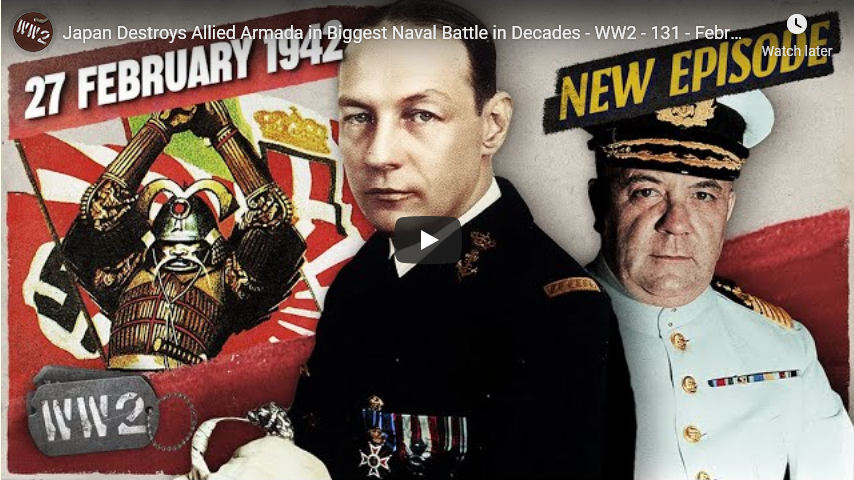
Japan Destroys Allied Armada in Biggest Naval Battle in Decades – WW2 – 131 – February 27, 1942

World War Two
Published 27 Feb 2021

The Japanese are advancing in the Dutch East Indies and Burma, brushing aside defenders, but their biggest victory this week is at sea, when they not only brush aside the ABDA Fleet, but literally wipe it out of existence. Meanwhile Italian and German submarines are patrolling the Caribbean, sinking any Allied merchant shipping they find. It is yet another week of Axis successes.

Join us on Patreon: https://www.patreon.com/TimeGhostHistory
Or join The TimeGhost Army directly at: https://timeghost.tv

Follow WW2 day by day on Instagram @ww2_day_by_day – https://www.instagram.com/ww2_day_by_day
Between 2 Wars: https://www.youtube.com/playlist?list…
Source list: http://bit.ly/WW2sources

Written and Hosted by: Indy Neidell
Director: Astrid Deinhard
Producers: Astrid Deinhard and Spartacus Olsson
Executive Producers: Astrid Deinhard, Indy Neidell, Spartacus Olsson, Bodo Rittenauer
Creative Producer: Maria Kyhle
Post-Production Director: Wieke Kapteijns
Research by: Indy Neidell
Edited by: Iryna Dulka
Sound design: Marek Kamiński
Map animations: Eastory (https://www.youtube.com/c/eastory​)

Colorizations by:
– Mikołaj Uchman
– Norman Stewart – https://oldtimesincolor.blogspot.com/​

Sources:
– National Portrait Gallery
– IWM: H 17365, A_238, CB(OPS) 5008

Soundtracks from the Epidemic Sound:
– Rannar Sillard – “Easy Target”
– Howard Harper-Barnes- “Underlying Truth”
– Jo Wandrini – “Dragon King”
– Fabien Tell – “Last Point of Safe Return”
– Wendel Scherer – “Out the Window”
– Reynard Seidel – “Rush of Blood”
– Brightarm Orchestra – “On the Edge of Change”
– Craft Case – “Secret Cargo”
– Phoenix Tail – “At the Front”
– Johan Hynynen – “Dark Beginning”
– Wendel Scherer – “Growing Doubt”

Archive by Screenocean/Reuters https://www.screenocean.com​.

A TimeGhost chronological documentary produced by OnLion Entertainment GmbH.

Should the Republicans embrace “class warfare”?

Filed under: Politics, USA — Tags: , , , — Nicholas @ 03:00

Scott Alexander proffers some advice to the US Republican Party in its post-Trump doldrums, even though he admits that “I hate you and you hate me. But maybe I would hate you less if you didn’t suck. Also, the more confused you are, the more you flail around sabotaging everything.”

So here’s my recommendation: use the word “class”. Pivot from mindless populist rage to a thoughtful campaign to fight classism.

Yeah, yeah, “class” sounds Marxist, class warfare and all that, you’re supposed to be against that kind of thing, right? Wrong. Economic class warfare is Marxist, but here in the US class isn’t a purely economic concept. Class is also about culture. You’re already doing class warfare, you’re just doing it blindly and confusedly. Instead, do it openly, while using the words “class” and “classism”.

Trump didn’t win on a platform of capitalism and liberty and whatever. He won on a platform of being anti-establishment. But which establishment? Not rich people. Trump is rich, lots of his Cabinet picks were rich, practically the first thing he did was cut taxes on the rich. Some people thought that contradicted his anti-establishment message, but those people were wrong. Powerful people? Getting warmer, but Mike Pence is a powerful person and Trump wasn’t against Mike Pence. Smart people? Now you’re burning hot.

Trump stood against the upper class. He might define them as: people who live in nice apartments in Manhattan or SF or DC and laugh under their breath if anybody comes from Akron or Tampa. Who eat Thai food and Ethiopian food and anything fusion, think they would gain 200 lbs if they ever stepped in a McDonalds, and won’t even speak the name Chick-Fil-A. Who usually go to Ivy League colleges, though Amherst or Berkeley is acceptable if absolutely necessary. Who conspicuously love Broadway (especially Hamilton), LGBT, education, “expertise”, mass transit, and foreign anything. They conspicuously hate NASCAR, wrestling, football, “fast food”, SUVs, FOX, guns, the South, evangelicals, and reality TV. Who would never get married before age 25 and have cutesy pins about how cats are better than children. Who get jobs in journalism, academia, government, consulting, or anything else with no time-card where you never have to use your hands. Who all have exactly the same political and aesthetic opinions on everything, and think the noblest and most important task imaginable is to gatekeep information in ways that force everyone else to share those opinions too.

(full disclosure: I fit like 2/3 of these descriptors)

Aren’t I just describing well-off people? No. Teachers, social workers, grad students, and starving artists may be poor, but can still be upper-class. Pilots, plumbers, and lumber barons are well-off, but not upper-class. Donald Trump is a billionaire, but still recognizably not upper class. The upper class is a cultural phenomenon.

Aren’t I just describing Democrats? No. The Democrats are a coalition of the upper class, various poor minorities, union labor, and lots of other groups. It’s an easy mistake to make, because you Republicans absolutely loathe the upper class, and whenever you’re talking about Democrats you focus on this group and how much you hate them. But you make the mistake of saying you hate Democrats, and then it looks like boring old partisanship. Or saying you hate the elites, and then it looks like boring old populism. Or saying you hate rootless cosmopolitans, and then it looks like boring old anti-Semitism. Or saying you hate the government, and then it looks like boring old libertarianism.

Instead, just use the words “class” and “classism”. Say “Hey, we Republicans want to be the party of the working class. We are concerned about the rising power of the upper class, and we are dedicated to stamping out classism.”

This is what happens when nobody uses the word “class”!

Cultural appropriation foods around the world

Filed under: Britain, Europe, Food, France, History, India, Italy, Japan, Pacific, USA — Tags: , , , , — Nicholas @ 02:00

J.J. McCullough
Published 14 Dec 2019

Baguettes in Vietnam! Curry in Japan! Tea in India! Let’s look at the practice of eating food from other countries, which is more widespread than you might think, thanks to imperialism and immigration.

FOLLOW ME:

🇨🇦Support me on Patreon! https://www.patreon.com/jjmccullough
🤖Join my Discord! https://discord.gg/3X64ww7
🇺🇸Follow me on Instagram! https://www.instagram.com/jjmccullough/
🇨🇦Read my latest Washington Post columns: https://www.washingtonpost.com/people…
🇨🇦Visit my Canada Website http://thecanadaguide.com

HASHTAGS:
#food #curry #empire

QotD: The essential role of writers like Twain and Mencken

Filed under: Humour, Politics, Quotations, USA — Tags: , , , , , — Nicholas @ 01:00

Mencken lived in horror of the American people, “who put the Hon. Warren Gamaliel Harding beside Friedrich Barbarossa and Charlemagne, and hold the Supreme Court to be directly inspired by the Holy Spirit, and belong ardently to every Rotary Club, Ku Klux Klan, and anti-Saloon League, and choke with emotion when the band plays ‘The Star-Spangled Banner.'” Much of that horror was imaginary, and still is. But we must have horror, especially in politics. How else to justify present and familiar horror except but by reference to a greater horror? In this year’s election, each candidate’s partisans already have been reduced to making the argument that while their own candidate might be awful, the other candidate is literally akin to Adolf Hitler. Yesterday, I heard both from Clinton supporters and Trump supporters that the other one would usher in Third Reich U.S.A. “Don’t tell yourself that it can’t happen here,” one wrote.

A nation needs its Twains and Menckens. (We could have got by without Molly Ivins.) The excrement and sentimentality piles up high and thick in a democratic society, and it’s sometimes easier to burn it away rather than try to shovel it. But they are only counterpoints: They cannot be the leading voice, or the dominant spirit of the age. That is because this is a republic, and in a republic, a politics based on one half of the population hating the other half is a politics that loses even if it wins. The same holds true for one that relies on half of us seeing the other half as useless, wicked, moronic, deluded, or “prehensile morons.” (I know, I know, and you can save your keystrokes: I myself am not running for office.) If you happen to be Mark Twain, that sort of thing is good for a laugh, and maybe for more than a laugh. But it isn’t enough. “We must not be enemies,” President Lincoln declared, and he saw the republic through a good deal worse than weak GDP growth and the sack of a Libyan consulate.

Kevin D. Williamson, “Bitter Laughter: Humor and the politics of hate”, National Review, 2016-08-11.

February 27, 2021

Q&A: Shooting the $ɦ!☦ with InRangeTV

Filed under: Food, History, USA — Tags: , , , , , — Nicholas @ 04:00

Atun-Shei Films
Published 26 Feb 2021

See the rest of our conversation over on Karl’s channel ► https://youtu.be/3sgc0BckrB8​

Atun-Shei and InRange finally got together for a chat! In this video we answer questions from our generous patrons, discussing New Orleans culture, Creole food, the gunfight at the OK Corral, urban life in the ancient world, Confederate monuments, historical justifications for slavery, Louisiana Voodoo, Cajun French, Ron Maxwell movies, and the importance of compassion and empathy.

Support Atun-Shei Films on Patreon ► https://www.patreon.com/atunsheifilms​
Leave a Tip via Paypal ► https://www.paypal.me/atunsheifilms

Buy Merch ► teespring.com/stores/atun-shei-films​

#AtunSheiFilms​ #InRangeTV​ #History​

Original Music by Dillon DeRosa ► http://dillonderosa.com/​
Reddit ► https://www.reddit.com/r/atunsheifilms​
Twitter ► https://twitter.com/atun_shei

Profiles in Cowardice — Justin Trudeau

Filed under: Cancon, China, Government, Politics — Tags: , , , , — Nicholas @ 03:00

Matt Gurney on how Prime Minister Justin Trudeau’s latest act of moral cowardice probably won’t hurt him at all in the polls:

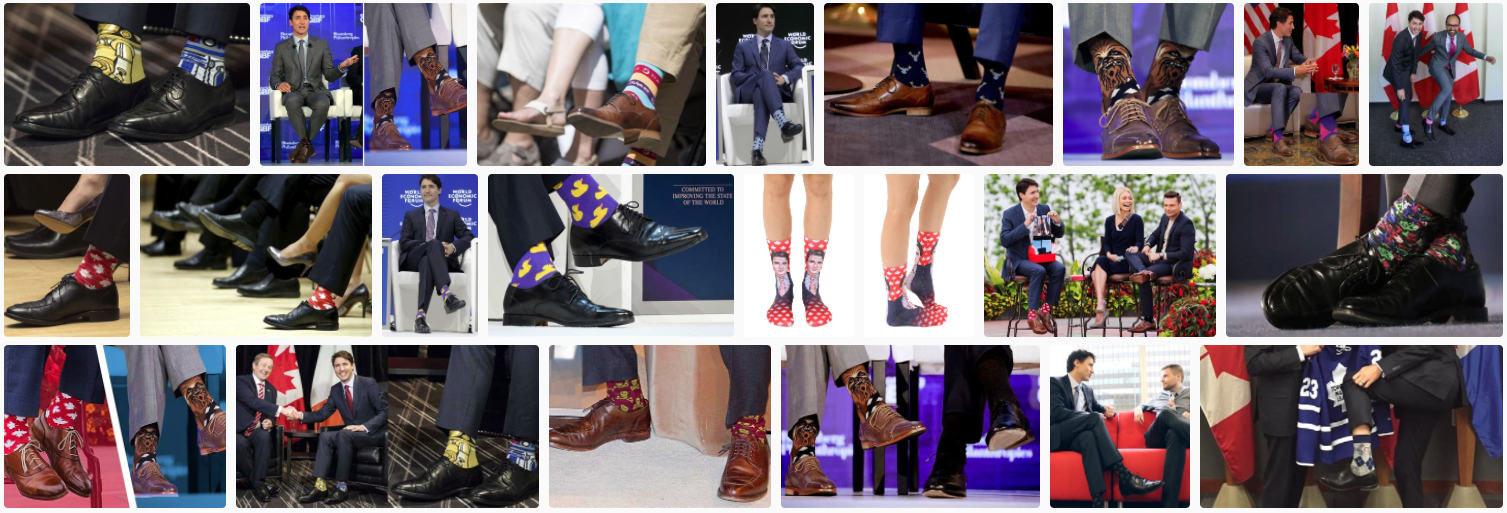
Typical image search results for “Justin Trudeau socks”

It has been fascinating to watch the reaction to Prime Minister Justin Trudeau’s profile in non-courage this week, after he and most of his cabinet skipped a vote on a Tory motion seeking to declare China’s brutal campaign against the Uyghur people a genocide. (Marc Garneau, who was probably desperately wishing he was back in low-Earth orbit, showed up to abstain … because that’s a good use of an astronaut.) If there is anything close to a consensus on the matter, it’s that the PM was in a difficult spot and found a way to slither out of it at the cost of some dignity, but no other real loss.

Kaveh Shahrooz, in a piece here at The Line on Thursday, made that case well. He savaged Trudeau for his hypocrisy — “when the chips were down, the [gender-based analysis], the intersectional lens and the feminist foreign policy were tossed aside in favour of appeasing China,” he wrote — but he also noted that the entire affair won’t really hurt the PM. “Sadly, the worst that will happen to Trudeau because of the hypocrisy and incompetence displayed is some angry tweets and a few articles like this one,” said Shahrooz.

Maybe. But maybe not. Shahrooz and others are certainly right that the prime minister won’t pay an electoral price, and probably won’t see his polling waver. But history makes its own judgments. And I suspect this prime minister is more aware of that than most.

It seems a long time ago now, but in his first term, Trudeau made a habit of apologizing. Only rarely for stuff that he was actually himself responsible for — he’s kinda averse to doing that. But formal and public apologies for past failures? He was all over those. In 2018, the BBC even ran a piece noting the PM’s habit, and asked in the headline, “Does Justin Trudeau apologize too much?”

It’s not that there weren’t things worth apologizing for. In 2016, he apologized for Canada turning back the Komagata Maru, a ship carrying mostly Sikhs that was then forced to return to India, where 20 of them were killed in a riot. The next year, he apologized to survivors of residential schools in Newfoundland and Labrador, and to LGBT Canadians for discrimination they faced at the hands of the federal government. The next year, Jews and members of the Tsilhqot’in Nation received apologies for historical wrongs inflicted on them. And so on. It was a thing.

A man who so clearly adores taking a stage to shed a few tears while acknowledging wrongs committed by someone else, long ago, probably can’t avoid wondering who, in a hundred years, will be apologizing to Uyghurs for his refusal to clearly state that what is happening to them is a genocide.

Overwhelming video game tutorials – Combat Tips

Filed under: Gaming, Humour — Tags: , — Nicholas @ 02:00

Viva La Dirt League
Published 25 Nov 2020

When a game tries to give you all the tutorials at once

Get a 12% discount off all SteelSeries products by using our code VLDL12. Not only do you get a special discount but we make 8% on all sales! So get a great deal and help support us!
Link: https://bit.ly/31ltYT2
Code: VLDL12

WATCH MORE SKITS HERE: https://bit.ly/34oAolt
SUPPORT ON PATREON – https://bit.ly/36Hg7ZY
DISCORD – http://discord.gg/VLDL
TWITTER: https://bit.ly/36R84dt
INSTAGRAM: https://bit.ly/2EoniKD

« Newer PostsOlder Posts »

Powered by WordPress