Forgotten Weapons
Published 3 Mar 2018The Nock Volley Gun was actually invented by an Englishman named James Wilson in 1789, and presented to the British military as a potential infantry weapons. This was declined as impractical, but the Royal Navy found the concept interesting for shipboard use. In 1790 the Navy ordered two prototypes made by the British gunsmith Henry Nock, and finding them suitable, proceeded to oder a total of 500 of the guns (thus forever associating Nock’s name with the gun instead of Wilson’s). A further 100 or so were ordered in 1797, and the guns were in fact issued out to various ships — although accounts of their use in combat are difficult to find.
Unfortunately for Nock, the guns presented a couple of substantial problems in use. One was simply the recoil of firing. A single 32-bore (approximately .55 caliber) round ball over 40 grains of black powder is not a very impressive load, but seven of them firing simultaneously add up to a recoil comparable to 4- or 6-bore rifles, and in a volley gun weighing just 13 pounds (5.9kg). In addition, the guns did not always reliably fire all barrels, especially when dirty. This produced a conundrum: how to determine which barrels had fired and which had not? The practical result was double-loaded barrels, which could be liable to bulge or burst. For these reasons, the weapon was declared obsolete in 1805, and never appeared to play any significant military role.
The gun did receive a new wave of popular awareness in 1960, when the character of Jim Bowie was outfitted with one in the movie The Alamo (against all historical evidence). His easy handling of the weapon and the waves of men he was able to mow down with it brought the gun back into the popular consciousness.
http://www.patreon.com/ForgottenWeapons
Cool Forgotten Weapons merch! http://shop.bbtv.com/collections/forg…
If you enjoy Forgotten Weapons, check out its sister channel, InRangeTV! http://www.youtube.com/InRangeTVShow
Contact:
Forgotten Weapons
6281 N Oracle #36270
Tucson, AZ 85704
February 12, 2021
Nock’s Volley Gun: Clearing the Decks in the 1700s
QotD: Repartee
Clever banter can only be called “repartee” if it’s from the Repartée region of France. Otherwise it’s just sparkling wit.
Daniel Hannan, Twitter, 2020-11-06.
February 11, 2021
Thrift store wooden planes: total restoration, perfect shavings
Rex Krueger
Published 10 Feb 2021Is that wooden plane one for the woodpile, or your next great tool?
More video and exclusive content: http://www.patreon.com/rexkrueger
Get the free template!: https://www.rexkrueger.com/store/plan…
(more…)
Tom Brady’s Super Bowl success has outlasted many titans of corporate America
Despite the headline, this isn’t really about the NFL, Tom Brady or the S*per B*wl, it’s about a key factor in free market economies: creative destruction.

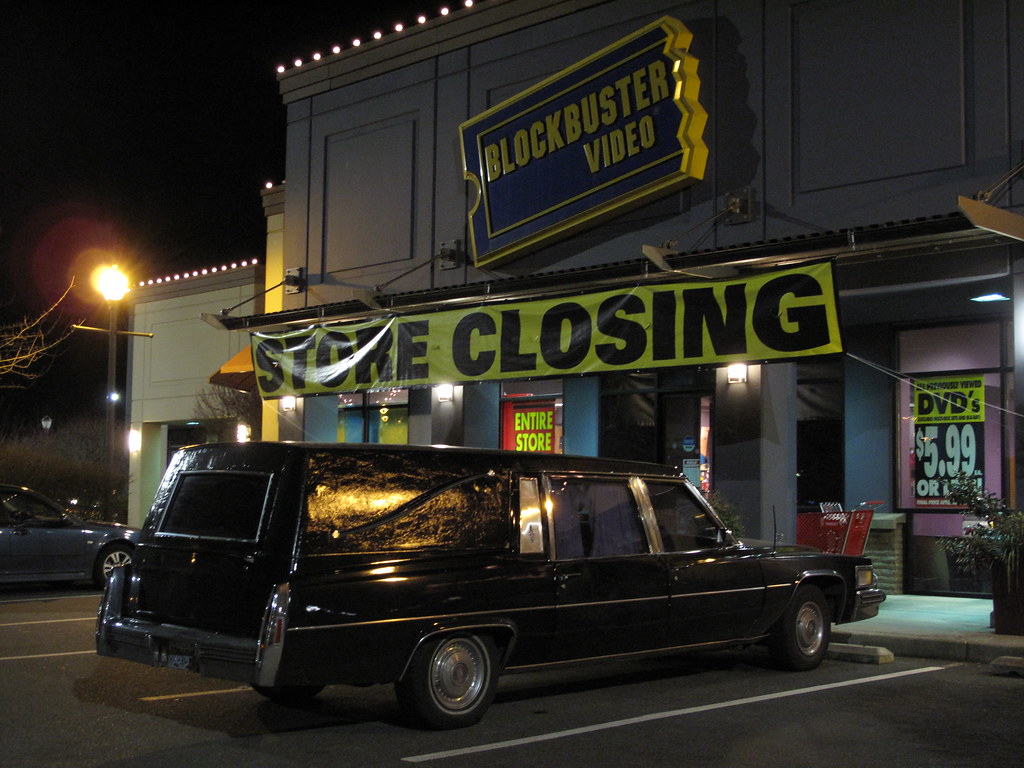
“Blockbuster store closing sale” by Consumerist Dot Com is licensed under CC BY 2.0
Consider some of the names that bought Super Bowl airtime during Brady’s first rodeo in January 2002: AOL, Blockbuster, Radio Shack, Circuit City, CompUSA, Sears, Yahoo, VoiceStream Wireless, and Gateway Computers.
The Titans of Yesterday
Notice a theme? That list features some companies we saw in Captain Marvel, the 2019 hit movie that nailed 90s nostalgia and reminded us how fast the world had changed. Like when Blockbuster Video stores were still a thing.
For those who may not recall, when Brady was winning his first Super Bowl, Blockbuster was approaching its peak. In 2004, it operated 9,094 stores and employed some 84,300 people. The company was pulling in $6 billion in revenue annually and looked invincible. Today, a single Blockbuster store remains open — in the world.
Remember RadioShack? Once upon a time, it seemed as if you could find one of their brick-and-mortar stores in every corner of the USA. Not anymore. In 2015, RadioShack filed for Chapter 11 bankruptcy, in large part because of those many store locations, which cannibalized revenues.
Sears, one of the historic giants of retail, managed to make it to 2018 before announcing its bankruptcy. Its stores continue to close so fast, it’s hard to tell how many remain in operation. (The best guess is about 60.)
It’s sometimes difficult to remember that the titans of industry aren’t always the same companies from year to year, and the sector-dominating company today might well be begging for a bailout (or demanding protection from uppity new competitors) only a few years down the way.
Some might see the collapse of Blockbuster, Sears and company as a sign of something terribly wrong with our economic system. After all, Blockbuster alone paid rent at tens of thousands of properties and employed tens of thousands of workers. Sears was the largest American retailer (by far) for decades.
Watching the companies we once shopped at flounder and fail can be surprising, jarring even. But a closer look shows this cycle is not unusual and is actually the sign of a healthy market economy, not a dysfunctional one. What may seem like pure destruction actually clears the way for economic innovation and renewal. “Creative destruction” is how the economist Joseph Schumpeter (1880-1950) characterized business failure in a free market.
As economist Mark Perry points out, companies on top have a very hard time staying on top. Perry, a scholar at the American Enterprise institute and a professor of economics at the University of Michigan’s Flint campus, compared the 1955 Fortune 500 companies to the 2019 Fortune 500. He found that just 52 were still on the list six decades later.
I spent most of my working career in the software business, and many of the companies I’ve worked for over the years aren’t in business any more (my first job out of school was with Northern Telecom … remember them?). Software is a particularly fast-cycling industry, but it’s true of the economy as a whole at a slightly more sedate pace.
The Zionism of Albert Einstein | BETWEEN 2 WARS: ZEITGEIST! I E.11 – Spring 1921
TimeGhost History
Published 10 Feb 2021Albert Einstein may be renowned for his work in the field of science, but this season he is fundraising for a new Jewish university. Charity isn’t the only activity on the cards in the United States this season however, much more tragic events are also afoot …
Join us on Patreon: https://www.patreon.com/TimeGhostHistory
Hosted by: Indy Neidell
Written by: Francis van Berkel
Director: Astrid Deinhard
Producers: Astrid Deinhard and Spartacus Olsson
Executive Producers: Astrid Deinhard, Indy Neidell, Spartacus Olsson, Bodo Rittenauer
Creative Producer: Maria Kyhle
Post-Production Director: Wieke Kapteijns
Research by: Francis van Berkel
Image Research by: Daniel Weiss
Edited by: Daniel Weiss
Sound design: Marek KamińskiColorizations:
– Daniel Weiss – https://www.facebook.com/TheYankeeCol…
– Dememorabilia – https://www.instagram.com/dememorabilia/
– Daniel HassSources:
Some images from the Library of CongressFrom the Noun Project:
– Death by Adrien Coquet
– Ukraine by Lluisa Iborra, ES
– Immigrants by Luis Prado
– sun by MRFA
– Wine by Made
– orange By lieuchien, SG
– Champagne By Pete BakerSoundtracks from Epidemic Sound and ODJB
– “One More for the Road” – Golden Age Radio
– “Dawn Of Civilization” – Jo Wandrini
– “London” – Howard Harper-Barnes
– “Ominous” – Philip Ayers
– “Prescient” – Howard Harper-Barnes
– “Not Safe Yet” – Gunnar Johnsen
– “Document This 1” – Peter Sandberg
– “Growing Doubt” – Wendel Scherer
– “Tiger Rag” – ODJB
– “It’s Not a Game” – Philip AyersArchive by Screenocean/Reuters https://www.screenocean.com.
A TimeGhost chronological documentary produced by OnLion Entertainment GmbH.
From the comments:
TimeGhost History
2 days ago
In the year that Buck’s Fizz is born, the USA promises to be a hotbed of funding for Albert Einstein. But for the nation’s black population, this season will brutally prove that the USA is still lightyears from any semblance of racial equality. Further highlighting this racial inwardness will be legislation to curb immigration. Clearly, America is still a long way from being the Land of the Free.Raunchy literature, Broadway and Buck’s Fizz will also make an appearance this season, tune in to find out how!
“… the entire Canadian constitution boiled down to the government saying, essentially, ‘trust us'”
Andrew Potter on the interesting and almost certainly unCanadian notion that the Prime Minister actually accept responsibility for things that happen on his watch:

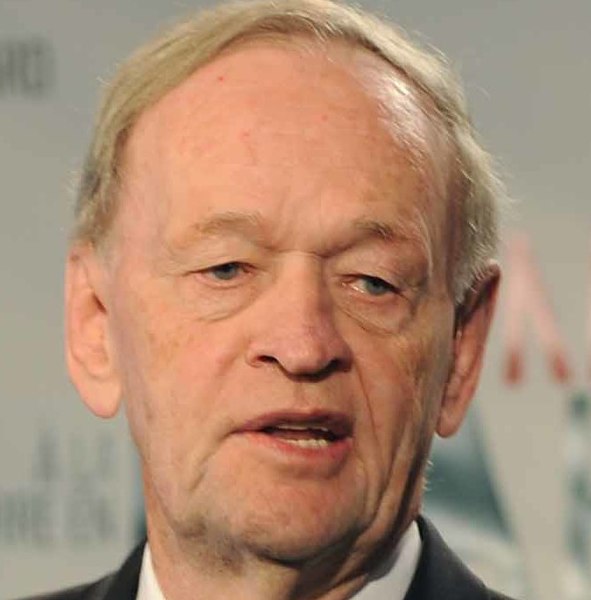
Former Prime Minister Jean Chrétien speaking at the “No to the war in Iraq: 10 years later” colloquium, 15 March 2013.
Detail of a photo by Gopmtl1 via Wikimedia Commons.
The late UBC law professor Wesley Pue once remarked that the entire Canadian constitution boiled down to the government saying, essentially, “trust us.” He was speaking in the wake of the release of the Hughes Report into the APEC affair.
A refresher: In 1997 it was Canada’s turn to host the annual APEC summit, a free trade and cooperation gabfest for countries in the Pacific Rim. Prime Minister Jean Chrétien decided to hold the meeting on the campus of UBC. Given that it is probably one of the most gorgeous pieces of real estate in the country, Chrétien probably thought he was being a good host. But some UBC students objected to the presence of Indonesian dictator Suharto at their school, and so they marched, held up signs, blocked campus roads and exits, chanted slogans, the usual student protest stuff.
Chrétien was clearly embarrassed, and orders went out from the PMO to clear the roads. The Mounties started telling students their campus was now a “Charter-free zone,” arresting a bunch of them. In a notorious incident captured by CBC cameras, RCMP Staff Sgt. Hugh Stewart walked amongst the students hosing them down with pepper spray. (Asked about the incident at a press conference, Chrétien made a joke.)
The only proper investigation into the affair was led by commissioner Ted Hughes, who issued his report in the summer of 2001. Hughes found that the RCMP had behaved by turns incompetently and unprofessionally and that they had systematically violated the Charter rights of the students. Further, Hughes found that they had done so under direction from the PMO — in particular at the behest of its director of operations, Jean Carle. While Chrétien himself escaped direct censure (Hughes could find no evidence that Carle had acted on Chrétien’s explicit orders), Pue pointed out that the fundamental principle of responsible government requires that the prime minister accept responsibility for what happened. Yet Chrétien did not. He neither accepted personal responsibility, nor did he throw Carle under the bus. Instead, what happened was typically Canadian: the matter simply went away.
The APEC affair serves as a useful reminder of a fundamental truth about our system of government. As Pue noted, there are virtually no effective parliamentary or legal checks on a prime minister’s authority, and as a result it is pretty much impossible to hold our executive branch to account. We need to just trust them.
[…]
It’s worth rehearsing all of this because we are going through a rather extended “just trust us” phase in Ottawa. After shuttering parliament last spring, ostensibly to focus their energies on fighting the COVID-19 pandemic, Justin Trudeau’s Liberals spent the summer dreaming of “building back better” while fighting a ferocious rearguard action to keep MPs from finding out the truth about payments to Trudeau’s family by a charity. Trudeau has since spent the better part of the last six months governing by press conference from the front steps of his cottage, but even as the extreme levels of federal spending continue, and even as scandals and reports of gross mismanagement pile up, the Liberals have been brazenly testing the waters for a spring election.
Tank Chats #94 | Kettenkrad and Springer | The Tank Museum
The Tank Museum
Published 31 Jan 2020Here David Willey examines two WW2 German tracked vehicles. The first is the Sd.Kfz. 2, better known as the Kettenkrad, a light tractor. The second, the Springer, a demolition vehicle which was fundamentally a mobile bomb, which shared the Kettenkrad’s running gear and engine.
Support the work of The Tank Museum on Patreon: ► https://www.patreon.com/tankmuseum
Visit The Tank Museum SHOP: ►tankmuseumshop.org
Twitter: ► https://twitter.com/TankMuseum
Instagram: ► https://www.instagram.com/tankmuseum/
Tiger Tank Blog: ► http://blog.tiger-tank.com/
Tank 100 First World War Centenary Blog: ► http://tank100.com/
QotD: Progressive credentials as positional goods
[Political correctness] is driven by a loathing for ordinary people. According to spiked, PC brigadiers view ordinary folks as extremely impressionable, easily excitable, and full of latent resentment. Exposure to the wrong opinions, even isolated words, could immediately awaken the lynch mob. PC, then, is about protecting “the vulnerable” from the nasty tendencies of the majority population.
But if PC was not really about protecting anyone, and really all about expressing one’s own moral superiority, PC credentials would be akin to what economists call a “positional good”.
A positional good is a good that people acquire to signalise where they stand in a social hierarchy; it is acquired in order to set oneself apart from others. Positional goods therefore have a peculiar property: the utility their consumers derive from them is inversely related to the number of people who can access them.
Positionality is not a property of the good itself, it is a matter of the consumer’s motivations. I may buy an exquisite variety of wine because I genuinely enjoy the taste, or acquire a degree from a reputable university because I genuinely appreciate what that university has to offer. But my motivation could also be to set myself apart from others, to present myself as more sophisticated or smarter. From merely observing that I consume the product, you could not tell my motivation. But you could tell it by observing how I respond once other people start drinking the same wine, or attending the same university.
If I value those goods for their intrinsic qualities, their increasing popularity will not trouble me at all. After all, the enjoyment derived from wine or learning is not fixed, so your enjoyment does not subtract from my enjoyment. I may even invite others to join me – we can all have more of it.
But if you see me moaning that the winemakers/the university have “sold out”, if you see me whinging about those ignoramuses who do not deserve the product because they (unlike me, of course) do not really appreciate it, you can safely conclude that for me, this good is a positional good. (Or was, before everybody else discovered it.) We can all become more sophisticated wine consumers, and we can all become better educated. But we can never all be above the national average, or in the top group, in terms of wine-connoisseurship, education, income, or anything else. We can all improve in absolute terms, but we cannot all simultaneously improve in relative terms. And that is what positional goods are all about – signalising a high position in a ranking, that is, a relation to others. This leads to a problem. Positional goods are used to signalise something that is by definition scarce, and yet the product which does the signalling is not scarce, or at least not inherently. You can increase the number of goods which signal a position in the Top 20 (of whatever), but the number of places in that Top 20 will only ever be, er, twenty. Increasing the number of signalling products will simply destroy their signalling function. Which is why the early owners of such a signalling product can get really mad at you if you acquire one too.
Kristian Niemietz, “The economics of political correctness”, Institute of Economic Affairs, 2014-04-30.
February 10, 2021
“Did you know that seventy years ago, our grandparents were having an underpolarization crisis?”
Scott Alexander reviews Why We’re Polarized by Ezra Klein, beginning with the underpolarization crisis of the mid-20th century:
In 1950, the American Political Science Association “released a call to arms … pleading for a more polarized political system”. The report argued that “the parties contain too much diversity of opinion and work together too easily, leaving voters confused about who to vote for and why”. Everyone agreed with each other so much, and compromised so readily, that supporting one party over the other seemed almost pointless.
In 1976, three years after Roe v. Wade, Democrats and Republicans were about equally likely to support abortion restrictions. That same year, a poll found that “only 54% of the electorate believed that the Republican Party was more conservative than the Democratic Party”; 30% thought there was no difference. As late as 2004, about equal numbers (within 5 pp) of Democrats and Republicans agreed with statements like “government is almost always wasteful and inefficient” and “immigrants are a burden on our country”. Between the late 60s and early 90s, Democratic presidents deregulated the airlines and passed welfare reform; Republican presidents pushed immigration amnesties and founded the EPA.
What happened between then and now? Klein has two answers: a historical answer, and a structural answer.
The historical answer is: the Dixiecrats switched from Democrat to Republican.
When the North won the Civil War, it had grand plans to remake the South into a paradise of racial equality and universal love. After Lincoln’s death, his successor Andrew Johnson decided this sounded hard and gave up. Within a few decades, the South was back to being a racist, paramilitary-violence-prone one-party dictatorship. That one party called itself “Democrat”, but had few similiarites to the Democrats in the North. The Southern Democrats (“Dixiecrats”) and northern Democrats disagreed on lots of issues, but the South hated the Republicans so much after their experience with Lincoln that they caucused with the northern Democrats anyway. This turned into a stable coalition, with northern Democrats agreeing to support the South against civil rights for blacks, and the Dixiecrats supporting the northern Democrats whenever they needed something.
But since the Democratic party contained both northern Democrats (relatively liberal) and Dixiecrats (relatively conservative), it didn’t want to take a coherent party-wide stance on liberalism vs. conservatism. And by the median voter theorem, that meant the Republicans also didn’t want to take a coherent stance on liberalism vs. conservatism. So both parties ended out centrist and identical.
In 1964, the Civil Rights Act threatened the Dixiecrats’ key issue. It wasn’t quite as simple as “Democrats were for it, Republicans were against it” – in fact, 80% of Republicans and 60% of Democrats supported it. But that year’s presidential election pitted heavily pro-CRA Democrat Lyndon Johnson against anti-CRA Republican Barry Goldwater, beginning Southerners’ defection to the Republican Party.
Klein says this successfully got all the conservatives on one side of the aisle and all the liberals on the other, allowing polarization to begin. Essentially, he believes polarization is a natural process, which the odd coalitions of the early 20th century temporarily prevented. Once the coalitions were broken, it could begin to do its work. He spends the rest of the book talking about why exactly polarization is so natural, what aspects of modernization have made it worse, and what sort of feedback loops make it keep going
One Advantage of Swiss Neutrality: LSD! – WW2 – Reading Comments
World War Two
Published 9 Feb 2021Another edition of Across the Airwaves, where Indy and Sparty look at interesting and unique comments from our videos. In this episode, they look at gentlemanly declarations of war, Partisan memories, and LSD.
Join us on Patreon: https://www.patreon.com/TimeGhostHistory
Or join The TimeGhost Army directly at: https://timeghost.tvFollow WW2 day by day on Instagram @ww2_day_by_day – https://www.instagram.com/ww2_day_by_day
Between 2 Wars: https://www.youtube.com/playlist?list…
Source list: http://bit.ly/WW2sourcesHosted by: Indy Neidell & Spartacus Olsson
Director: Astrid Deinhard
Producers: Astrid Deinhard and Spartacus Olsson
Executive Producers: Astrid Deinhard, Indy Neidell, Spartacus Olsson, Bodo Rittenauer
Creative Producer: Maria Kyhle
Post-Production Director: Wieke Kapteijns
Edited by: Karolina Dołęga
Sound design: Marek Kamiński
Map animations: Eastory (https://www.youtube.com/c/eastory)Colorizations by:
– Daniel Weiss
– Mikołaj Uchman
– JHM Color
– Julius Jääskeläinen – https://www.facebook.com/JJcolorization/Sources:
– Imperial War Museums: MH 1324, CH 1533, HU111054, TR 1468, MGH 4464
– National Archives NARA
– United States Holocaust Memorial Museum
– Yad Vashem: 4360-99, 2725-5, 4788-73,
– Bundesarchiv
– Picture of Soviet Soldiers with DShK-38 gun courtesy of Leduytoan2003 from Wikimedia Commons
– Picture of 19th Army troops storming Mogile courtesy of Mil.ruSoundtracks from Epidemic Sound:
– “The Unexplored” – Philip Ayers
– “The Inspector 4” – Johannes Bornlöf
– “London” – Howard Harper-Barnes
– “Document This 1” – Peter Sandberg
– “Dark Beginning” – Johan Hynynen
– “Rubik’s Cube” – From Now On
– “Getaway Rock” – Elliot HolmesArchive by Screenocean/Reuters https://www.screenocean.com.
A TimeGhost chronological documentary produced by OnLion Entertainment GmbH.
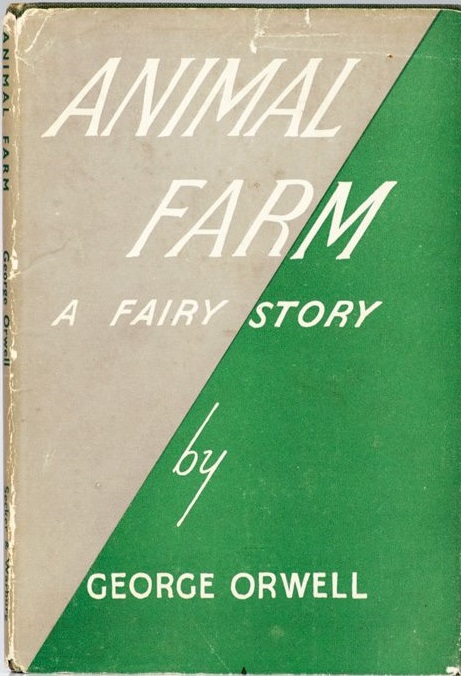
Victor Davis Hanson on Animal Farm, America’s nightmare 2021 version
Victor Davis Hanson outlines the original George Orwell novel and then contrasts today’s situation with what progressives demanded back in the 1960s and 70s:
Yes, the downtrodden pigs, the exploited horses, and the victimized sheep finally did expel Farmer Jones from America’s Animal Farm.
But in his place, as Orwell predicted, revolutionary pigs began walking on two feet and absorbed all the levers of American cultural influence and power: the media, the bureaucracies, Wall Street, Silicon Valley, publishing, the academy, K-12 education, professional sports, and entertainment. And to them all, the revolutionaries added their past coarseness and 1960s-era by-any-means-necessary absolutism.
We are now finally witnessing the logical fruition of their radical utopia: Censorship, electronic surveillance, internal spying, monopolies, cartels, conspiracy theories, weaponization of the intelligence agencies, pouring billions of dollars into campaigns, changing voting laws by fiat, a woke revolutionary military, book banning, bleeding the First Amendment, canceling careers, blacklisting, separate-but-equal racial segregation and separatism.
Conspiracies? Now they brag of them in Time. Read their hubristic confessionals in “The Secret History of the Shadow Campaign That Saved the 2020 Election.” Once upon a Time, radicals used to talk of a “secret history” in terms of the Pentagon Papers, or a “shadow campaign” in detailing Hollywood blacklisting. They are exactly what they once despised, with one key qualifier: Sixties crudity and venom are central to their metamorphosis.
Our left-wing American revolutionary cycle from the barricades to the boardroom was pretty quick — in the manner that the ideology of the Battleship Potemkin soon led to Stalin’s show trials, or Mao’s “long march” logically resulted in the Cultural Revolution. The credo, again, is that the noble ends of forced “equity” require any means necessary to achieve them.
The Left censors books in our schools, whether To Kill a Mockingbird or Tom Sawyer. It is the Left who organizes efforts to shout down campus speakers or even allows them to be roughed up.
The Left demands not free-speech areas anymore, but no-speech “safe spaces” and “theme houses” — euphemisms for racially segregated, “separate-but-equal” zones. “Microaggressions” are tantamount to thought crimes. The mere way we look, smile, or blink can indict us as counterrevolutionaries. Stalin’s Trotskyization of all incorrect names, statues, and commemoratives is the Left’s ideal, as they seek to relabel Old America in one fell swoop. No one is spared from the new racists, not Honest Abe, not Tom Jefferson, not you, not me.
For “teach-ins,” we now have indoctrination sessions. But the handlers are no longer long-haired 1960’s dreamy, sloppy, and incoherent mentors. They are disciplined, no-nonsense brain-washers.
The Left’s Russia is our new old bogeyman. Putin is the new “We will bury you” Khrushchev.
Napoleonic Wars: Battle of Trafalgar 1805
Kings and Generals
Published 5 Nov 2017Napoleon Bonaparte fought all his battles on land, but no other battle influenced his military and political decisions as the battle of Trafalgar that was fought in 1805 off the coast of Spain between the allied Franco-Spanish fleet lead by the admirals Pierre-Charles Villeneuve and Federico Gravina and the Royal Navy of the United Kingdom commanded by the admirals Horatio Nelson and Cuthbert Collingwood. This is our first video on the War of the Third Coalition and second video in this series. We hope to have much more and cover all the Napoleonic Wars.
Support us on Patreon: http://www.patreon.com/KingsandGenerals or Paypal: http://paypal.me/kingsandgenerals
We are grateful to our patrons, who made this video possible: Koopinator, Daisho, Łukasz Maliszewski, Nicolas Quinones, William Fluit, Juan Camilo Rodriguez, Murray Dubs, Dimitris Valurdos, Félix Gagné-Dion, Fahri Dashwali, Kyle Hooton, Dan Mullen, Mohamed Thair, Pablo Aparicio Martínez, Iulian Margeloiu, Chet, Nick Nasad, Jeyares, Amir Eppel, Thomas Bloch, Uri Sternfeld, Juha Mäkelä, Georgi Kirilov, Moe Mia, Daniel Yifrach, Brian Crane, Muramasa, Gerald Tnay, Hassan Ali and Richie Thierry.
This video was narrated by good friend Officially Devin. Check out his channel for some kick-ass Let’s Plays. https://www.youtube.com/user/Official…
The Machinimas for this video are created by one more friend – ltflak. Check out his channel for some great Let’s Plays and Machinimas: https://www.youtube.com/user/ltflak
✔ Twitch ► https://www.twitch.tv/nurrrik_phoenix
✔ Twitter ► https://twitter.com/KingsGenerals
✔ Instagram ► https://www.instagram.com/nurrrrrik
✔ Steam ► http://steamcommunity.com/id/nurrrikInspired by: BazBattles, Invicta (THFE), Epic History TV, Historia Civilis and Time Commanders
Machinimas made on the Napoleon Total War
Production Music courtesy of Epidemic Sound and Total War Napoleon: http://www.epidemicsound.com
Songs used:Epidemicsound:
“Slaves” – Gunnar Johnsén
“At The Front” – Johan Hynynen
“Battle Ostinato 3” – Valdemar HansenTotal War Napoleon:
Richard Beddow – “Corsica, Humble Beginnings”
Ian Livingstone – “The Battle At Arcole”
Richard Beddow – “HMS Victory”
Richard Beddow – “The End”
QotD: Wells’s Rules of Canadian Politics
There have been questions about my Rules of Politics around here in the last few days. Okay, not a lot of questions, but still. Here is the full list of rules. About a year after I came up with the original two, I added two more, which was probably a mistake. Sometimes I come up with candidates for additions to the list, and here today I will reveal one I considered adding, before deciding against it. But I think it’s time to show a little discipline, so the canonical list will stop at four. Four shall be the number thou shalt count, and the number of the counting shall be four. Ready?
1: For any given situation, Canadian politics will tend toward the least exciting possible outcome.
2: If everyone in Ottawa knows something, it’s not true.
3. The candidate in the best mood wins.
4. The guy who auditions for the role of opposition leader will get the job.
Paul Wells, “Wells’s Rules, annotated”, Maclean’s, 2009-05-21.
February 9, 2021
History Summarized: Alexander the Great
Overly Sarcastic Productions
Published 19 Sep 2017Linguistically speaking, Alexander means “Defender of Men” from the Greek “alexo“, defend, and “aner/ander“, man. I’ll never be able to not internally think of his name as just meaning “Alex-Man”.
Oh, yeah, also he conquered an empire or something? IDK. I stopped paying attention after his bland name.
PATREON: www.patreon.com/OSP
MERCH LINKS:
Shirts – https://overlysarcasticproducts.threa…
All the other stuff – http://www.cafepress.com/OverlySarcas…Find us on Twitter @OSPYouTube!
Tampa Bay quarterback Tom Brady – “What’s not to hate?”
I did watch the S*per B*wl on Sunday, although as the Canadian broadcast carefully replaces almost all of the expensive, creative, one-off ads with exactly the same ads the network showed all through the rest of the season, I watched it on my computer, and kept my mute button handy to silence the roughly 2/3rds of the broadcast that wasn’t actually football-related. (Although I’ve read many people commenting that the “special” ads aren’t as good as they used to be, I watch so little TV that I’m hardly qualified to judge personally.) In Monday’s NP Platformed newsletter, Colby Cosh used the old “there’s two kinds of people” device to talk about Tom Brady:
You can easily have an opinion about Brady, and you probably do, even if you’ve never watched a whole football game. But I have no way of predicting what that opinion is. Do you see him as a cheerful, intelligent family man who has transcended his natural limitations through hard work and study? Or is he just the jammiest SOB who ever lived? There was definitely something cruel in watching the immobile Brady dismantle the Chiefs of Patrick Mahomes, a passer equipped with physical gifts whose possibility was inconceivable before he broke into the league.
That’s probably part of how Brady has driven such a fault into North American bedrock. If there were a stat representing handsomeness-to-physical-impressiveness ratio, he would dominate the NFL. When you see photos of young Brady, who famously dropped to the sixth round of the draft, you no longer wonder how he dropped so far but why he was taken at all. Did the scouts fall in love, as they are known to do, with the “good face”?
Ancient Brady is young Brady with less mobility and accuracy. Mostly, like a relief pitcher with nothing but a fastball, he just darts the ball very efficiently at nearby targets. (Trading New England’s targets for Tampa Bay’s was, obviously, shrewd to the point of genius.) He is becoming as specialized, as optimized for one function, as a punter. But in his case the function seems to be “winning Super Bowls,” and we can’t attribute one iota of that to innate gifts denied to ordinary mortals. What’s not to hate?
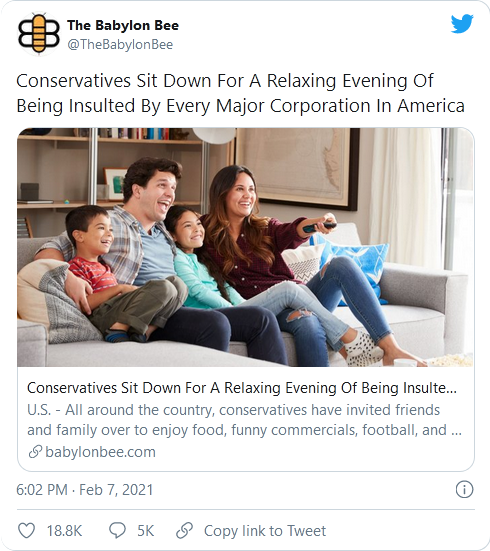
Speaking of the ads, I do think the Babylon Bee got it exactly right here:
As a comment at Ace of Spades H.Q. related, the S*per B*wl has lost a lot of its cultural capital over the last few years:
49 — I work at a somewhat woke company. While talking about some projects we were working on the new guy asked me “hey why isn’t anyone talking about the superbowl?” and I remembered that even last year everyone was talking about the superbowl none stop the monday after.
Well you’ve finally done it lefties you’ve killed the NFL.
Posted by: 18-1
I tuned out the halftime show, even though the performer was kinda-sorta a local boy (born in Toronto), and I was a bit nonplussed with the visuals (I had the whole thing muted, natch). James Lileks found the show to be oddly reminiscent of 70’s SciFi movies:
The halftime show had a strange 70s sci-fi aesthetic; for some reason I kept thinking of The Black Hole and Logan’s Run. The most interesting part was picking out the buildings in the New York skyline arrayed in neon. Ah, it’s the AT&T Building, Philip Johnson’s famous po-mo Chippendale tower! And that would be the Met Life tower, which is actually the base for a much-larger tower unbuilt after the Crash of ’29. Hey, everyone, let’s pause this elaborate routine and destroy its momentum so I can wax pedantic!
Then there were all those dancers in masks, looking like victims of surgery in an old movie where a gangster got plastic surgery. A way of incorporating the pandemic zeitgeist, right? Last year: EMPOWERMENT AND SEX AND SEX EMPOWERMENT! This year: faceless people moving in mass to choreographed steps, then dissolving into random panic. There was something wrong about it, like some dank gas blown up through a fissure, filling balloons that looked like the humans who populate the shadows of a nightmare.
Previous years, the Super Bowl event was pure excess — mad, crass, exuberant, American overdrive, American overkill, a mix of skill and brute force. Something about this one felt desperate and shellshocked. I suppose I’m reading too much into it. But I don’t think we need fever dreams and worried-looking buskers in empty fields, at this point. It would be nice just to have some Clydesdales again.
I saw on another site (sorry, forgotten where I noticed it) that the bandages were an in-joke for The Weeknd’s fans, who’d been teased with several social media posts about him recovering from some sort of mysterious plastic surgery procedure leading up to the performance.