
Real Time History
Published 16 May 2025In the early 19th century, the United States and Mexico share a massive cross-continental border, but US settlement in Mexico, expansionist ideals and religious differences put the young republics on a collision course. As tensions boil over into bloodshed, the tiny, inexperienced US army marches to a war which will forge the modern United States.
Chapters:
00:00 Texas Republic
05:06 Declaration of War
07:03 The US Army
09:26 British Muskets in the Mexican Army
16:19 The Mexican Army
18:24 The Battles of Palo Alto and Resaca de la Palma
21:38 California and New Mexico
25:11 US Volunteers
28:40 Battle of Monterrey
33:03 Expanding the War
36:59 The Pedregal Battles
40:18 Battles for Mexico City
43:42 Treaty of Guadalupe Hidalgo
45:14 Legacy
(more…)
October 16, 2025
The Mexican-American War 1846-48
October 15, 2025
The Korean War Week 69: Conquered … But At What Cost? – October 14, 1951
The Korean War by Indy Neidell
Published 14 Oct 2025The Battle of Heartbreak Ridge ends with victory for the UN forces, though the casualty count is alarmingly high for both sides. One must wonder, is that sustainable? It’s a week of action, as Operation Commando continues further west. The Commonwealth Division takes Maryang-San, but taking it and holding it are two different things. A 9th Corps offensive kicks off as well, slowly grinding forward. There’s a breakthrough away from the battlefield, as both sides finally agree on a site for any future peace talks- Panmunjom.
Chapters
00:00 Intro
00:29 Recap
00:47 Operation Commando
03:01 Heartbreak Ridge Ends
07:44 Comparing the Two Ridges
10:25 9th Corps Attacks
11:24 The Belgians
12:17 Panmunjom
13:19 Summary
13:39 Conclusion
October 14, 2025
White Hoods, Bloody Hands: The Klan as America’s First Terrorists – W2W 048
TimeGhost History
Published 12 Oct 2025From Pulaski to Stone Mountain to Brown v. Board, the Ku Klux Klan evolves from Reconstruction terror to a decentralized, Cold War–era movement that bombed churches, lynched citizens, and hid behind “anti-communism”. We trace the First, Second, and Third Klans — rituals, networks, and the brutal campaign against desegregation and civil rights.
(more…)
DSA’s Unique Titanium FAL Project
Forgotten Weapons
Published 28 May 2025DS Arms got some billet titanium and decided to make a batch of titanium receivers and other parts. This turned out to be a nightmarish amount of work, and two of the receivers had to be scrapped, leaving only 10 completed. They also made a number of other titanium parts, including flash hiders (which this rifle has) and gas blocks (which this one does not). Between the titanium and aluminum parts and the choice of a lightweight configuration, this FAL tips the scale at just UNDER 7.5 pounds (3.4kg). That is a very remarkable achievement, and does so without making sacrifices in durability or features. It is slightly sharper recoiling than a standard 50.00 FAL (which weighs almost 10 pounds / 4.5kg), but not uncomfortable at all — the recoil is less than I had expected.
Unfortunately DSA does not appear to have any plans to make addition titanium receivers, but this small batch serves as a very cool proof of concept!
(more…)
October 13, 2025
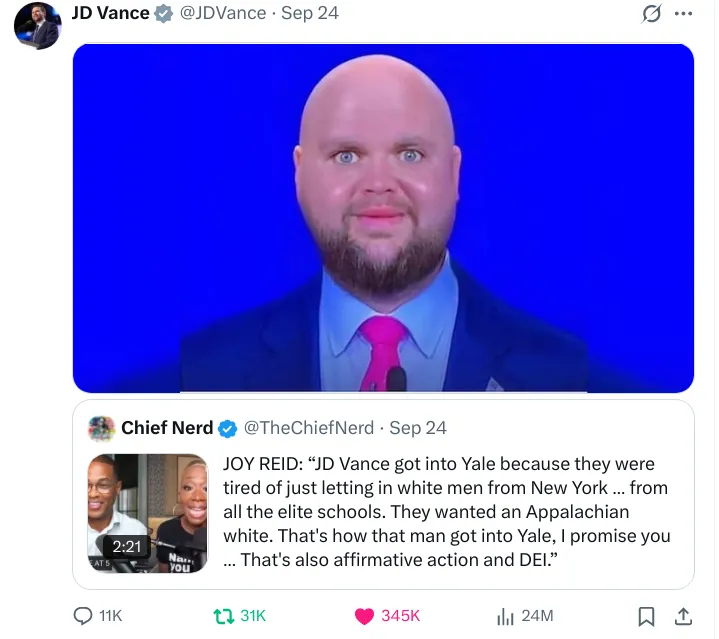
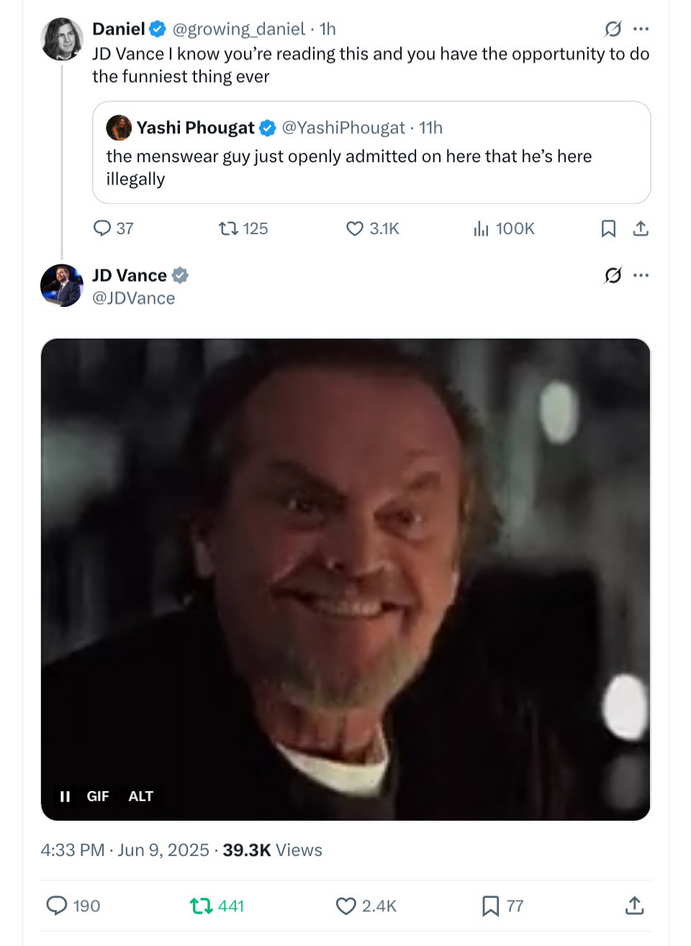
Speculation that J.D. Vance “maintains a Twitter alt, that he is in fact an anon poaster”
The latest post from John Carter at Postcards from Barsoom includes some interesting speculation about how well J.D. Vance has handled his engagement with social media trolling and why that might be:
Gigachads on the official DHS X account only provide evidence of one poaster in the administration, but this is a poaster in a very prominent, public-facing role, who has been allowed to do this for quite some time now, obviously without rebuke. That strongly suggests that the administration smiles upon the memelord, and it also makes it more likely that the chud running the DHS X account is far from alone. An obvious question is why the DHS would be so tolerant of its social media manager posting right wing memes, when this is guaranteed to draw the ire of the left. One possible explanation is that the administration wants its anon army to understand that they have guys on the inside. Memes are a tool for informal coordination; by posting these memes, the administration is winking at the base, telling them “We’re listening to you, and as for CNN … we don’t think about them at all. Now follow our lead …”
The young men powering the new administration were acculturated within the free-wheeling environment of loosely connected online networks, in which irony and ambiguity is simply the water in which they swim, and the only hierarchy is the one established by informal influence and demonstrated ability. They are not accustomed to subordinating their activities to directives pushed down from the summits of rigid org charts. Their basic assumptions are individual initiative, freedom of action, and a magpie willingness to grab good ideas wherever they can be found and put them to immediate use without waiting for permission.
And it is not only the junior staffers and federal agents who have this mindset.
Importantly, at 41, Vance is a young man by political standards. His cultural assumptions are not those of network news, but of digital networks. When the Vance memes making fun of his weight, or riffing off of his remark to Zelensky that he never even said “Thank you”, started circulating, he didn’t get mad about them. He laughed, and rolled with it, because he understood that – coming from the online right – these memes were an expression of affection, the way you rib your friend by calling him a faggot and he pokes you back by calling you a fat retard. Naturally the feminized left does not understand this at all. They think that these memes are humiliating to Vance and so spread the memes themselves, while interpreting the popularity of the memes amongst the online right as an indication that the base loathes him. As always, the left lacks theory of mind for their opponents. Imprisoned within the iron bars of their own ideological-managerial cage, the left has completely failed to learn the lessons of participatory media, and like a general staff doggedly trying to break the trench lines with cavalry charges, continues to try to fight the current war with the weapons they used to win the last one.
There is widespread speculation that Vance’s comfortable navigation of meme culture comes from direct experience, that he maintains a Twitter alt, that he is in fact an anon poaster. There is of course even speculation as to which account is his, although naturally, no one knows for sure, and Vance sure isn’t telling.
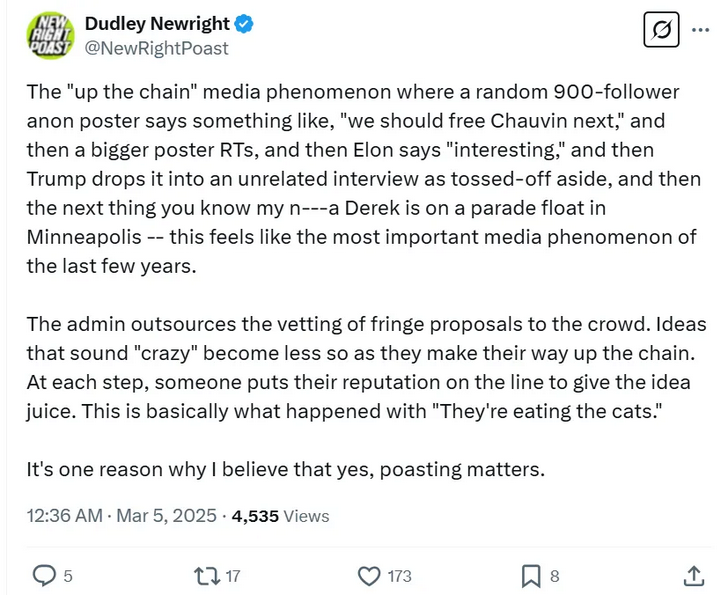
If there are poasters in the administration, we might expect them to treat policy the way they learned to handle memes. Any random small-account anon might come up with an absolute banger of post … so why shouldn’t they be able to come up with banger policies, too? Why limit themselves to adopting policies developed inside the long, tedious processes of bureaucratic committees and comfortable think tanks? If rapisthitler1488 has a good idea, well, why not use it? You can just do things. This attitude is at the heart of what Dudley Newright calls the “up-the-chain phenomenon”.
We’d also expect an administration laced with poasters to pay careful attention to the online right, using it to gauge the public mood in order to correct course. At its worst this could turn into audience capture, but at its best this enables a much more responsive reaction to public sentiment than that afforded by polling data since it is both immediate and disintermediated. Rather than waiting for the polling agency to carefully word a question to get the answer it wants, and then painstakingly call up and interview a statistically representative and unbiased sample so that it can provide rigorous Poisson errors for the answers to its biased questions, public sentiment can be analyzed as soon as people start tweeting, and evaluated in terms of the public’s own words. In essence, the poastocratic administration becomes akin to a livestreamer monitoring the chat.
Finally, we might expect to see the administration deliberately trolling the base. Experienced influencers know that outrage bait drives engagement. If you want to move in a certain policy direction but are being pressured behind the scenes not to do that, or conversely if you are being pressured to do something you know will be unpopular, an excellent way of assembling the political capital necessary to do what you want is to announce that you’re going to do the opposite. The howls of outrage from the base then provide you with the excuse you need to do what you wanted to do in the first place. “Let me check with the boss … Well, sorry, I’d really love to help you, but the boss won’t let me do that.”
OK, you say, this is all very interesting, an emergent feedback loop of cybernetic governance linking the networked hive mind to the traditional institutions of government, but is there any actual evidence beyond some meme-slop posted by the DHS in an effort to assure the base that they are getting the Got What They Voted For Award? Well, let’s get into that.

Update, 14 October: Welcome, Instapundit readers! Please do have a look around at some of my other posts you may find of interest. I send out a daily summary of posts here through my Substack – https://substack.com/@nicholasrusson that you can subscribe to if you’d like to be informed of new posts in the future.
October 12, 2025
Restricting activism from the bench
As we’ve seen far too many times in Canadian courts, when judges become politically active, they can produce far worse situations than the politicians who cynics might say are specialists in that discipline. British judges, however, are still well ahead of their Canadian counterparts:
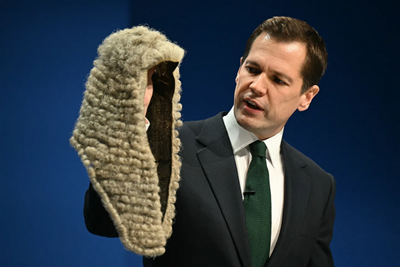
Until judges are replaced by robots, we will have to accept the reality of activist judges. Even the most august patriarch of the bench cannot wholly escape his innate human biases. And so perhaps there was something in Robert Jenrick’s speech at this week’s Conservative Party Conference, in which he announced that, if elected, the Tories would empower the Lord Chancellor to appoint judges and more carefully scrutinise their political activities.
Those who have supported the ideological capture of our major institutions were understandably furious. The New Statesman claimed that Jenrick had “declared war on the judiciary”. But then, the New Statesman is an activist publication which can make no serious claim to impartiality or sound journalistic standards. (Those in any doubt about its mendacity should take the time to read about its shameful treatment of Roger Scruton.)
The problem of an activist judiciary is currently preoccupying the White House, given that a number of federal judges have attempted to block executive policies or have issued nationwide injunctions. Trump himself was convicted on thirty-four felony counts by a judge who had made small political donations to Democratic-aligned causes. It seems clear that given these circumstances he ought to have recused himself. The entire case, of course, was an example of the law being twisted for politically partisan ends. (The best overview is by the senior legal analyst for CNN, Elie Honig, which can be read here.) Little wonder that Trump now appears to be seeking revenge through the courts.
In the UK, there have been a number of revelations of judges tied to political causes whose claim to impartiality seems shaky at best. During his speech, Jenrick spoke of those judges who have been associated with pro-immigration campaign groups and have “spent their whole careers fighting to keep illegal migrants in this country”. Many commentators have observed a generalised bias toward asylum applications, sometimes to an absurd extent. Who could possibly forget the Albanian criminal whose deportation was halted by an immigration tribunal on the grounds that his ten-year-old son did not like foreign chicken nuggets?
Leaving such outliers aside, most of us will have noticed patently ideological remarks occasionally uttered by judges during sentencing. In the Lucy Connolly case, the judge explicitly expressed his support for the creed of DEI before sentencing her to 31 months in prison for an offensive and hastily deleted post on social media. “It is a strength of our society that it is both diverse and inclusive”, he said. It couldn’t be much clearer than that.
That lawfare has become a major weapon in the settling of political disputes should trouble us all. Judges are not accountable to the electorate, and so any suggestion that they are exercising power for their own political ends is bound to be interpreted as a threat to democracy. Inevitably, Jenrick’s criticism of activist judges, and his call for them to be removed, has led to some commentators assuming that he would prefer judges who simply acted according to the government’s bidding. That way lies tyranny.
A second American Civil War would not resemble the first one
The American Civil War, if you try to look at the big picture, started off with the states dividing as this Wikipedia map indicates (although no state was all secessionist or all unionist, of course):
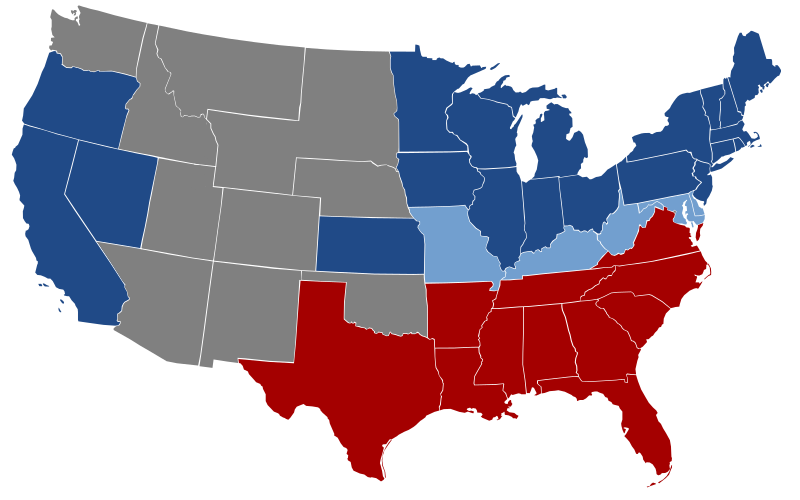
Union states in blue (light blue for states that permitted slavery), Confederate states in red.
Map by Júlio Reis via Wikimedia Commons.
Potential lines of demarcation today, well, here’s a guess from a few years ago based on county voting patterns, and again it’s still an approximation:
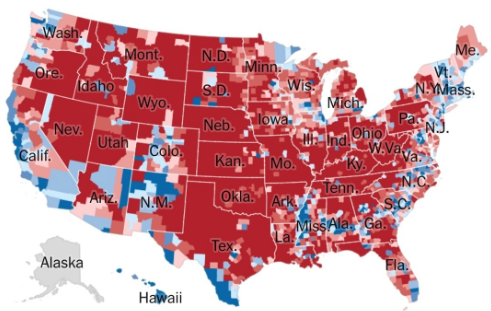
Any civil strife on this modern battlefield will be very unlike the organized Union and Confederate armies of 1861-65 having stand-up battles against one another in the countryside. Tom Kratman wrote about a potential civil war breaking out several years ago and has reposted the first part on his Substack:
I can’t quite shake the feeling that the side that wins any new civil war, to the extent that anyone can be said to “win” such a frightfulness, will be the side that a) engages in as humanitarian a form of ethnic and political cleansing as possible, first, and b) shoots second. I say “as humanitarian … as possible” because, as previously discussed,1 we are not a nation of red and blue states. Rather, instead of red and blue states, we are, as discussed a couple of years ago, “counties and neighborhoods and streets and the couch versus the bedroom after an argument with a spouse or significant other over political matters”. In short, anyone who engages in really harsh internal security measures will tend to drive people who should be its friends over to the other side. Since I’m writing this on behalf of the more or less anti-bolshevik, anti-progressive, anti-SJW2 half of the country, let me emphasize that, when the northeast, the left coast, “Yes, we old retired farts can be bribed by robbing the future” Florida, “Under the Fairfax County Bootheel” Virginia, “Cannot control Baltimore” Maryland, and CorruptionRus Illinois, unchained from the restraints we’ve imposed on them, go full lunatic lefty, let them turn into Beirut of the 80s while we try to maintain something approaching civilization as long as we can. Yes, that means I think it would be easier for us to conquer or reconquer a California devolved into its own civil war if we can avoid the same in our areas.
Note that it’s a fine line we’ll have to try to walk, rounding up those who would turn us into Beirut, without rounding up those whose rounding up will cause their friends and family to turn us into Beirut. My suggestion would be using extreme measures for those who are certain enemies, but safe and comfortable lagering or exile for those about whom there might be some doubts.
Though I may find it distasteful, honesty compels that I not shy away from that other aspect of securing the base areas, ethnic cleansing. If this nightmare comes to pass then ethnic cleansing is going to happen, I am certain, to at least three groups, Moslems, Blacks, and Hispanics. Some of it will probably come in the form of self-exile, but I would be very surprised if more of it isn’t forced. So let me throw a little damper on the KKK/alt-white-wing of my readership, if any; Trump is leading by comfortable margins in Louisiana (over a third Black and Hispanic), Mississippi (close to 40% Black and Hispanic), and Alabama (over a quarter). He’s not leading in those places by the kinds of margins he is without a more than fair sprinkling of Blacks and Hispanics, who will not be much like the rioting for fun and profit thugs of Black Lives Matter (and White Lives Don’t). Those people are us as much as anyone can be. It would be a grievous and perhaps unhealable wound to your alleged souls if you don’t treat them that way.
- http://www.everyjoe.com/2015/01/12/politics/breakup-of-united-states-terrible-idea/#1
- SJW stands for social justice warrior. Unlike many such epithets, this one was coined by the people to whom it applies. Think of idiot PhDs who call canoeing “racist”, the universe of the trigglypuffs, and those who consider eating a taco to be a crime against Mexicans, if not even a crime against humanity, which latter classification expressly excludes whites.
Update, 14 October: Welcome, Instapundit readers! Please do have a look around at some of my other posts you may find of interest. I send out a daily summary of posts here through my Substack – https://substack.com/@nicholasrusson that you can subscribe to if you’d like to be informed of new posts in the future.
October 11, 2025
Antifa declared a foreign terrorist organization
On the social media site formerly known as Twitter, ESR claims a win from his earlier analysis posts on Antifa in the United States:
For those of you who have been tracking my intelligence analysis posts about Antifa, I now get to claim a correct prediction.
The President of the United States has declared Antifa a foreign terrorist organization.
Providing aid to an FTO is a crime (18 U.S.C. § 2339B). This declaration unlocks the legal tools required to go after Antifa’s funding network and allies, both foreign and domestic.
Those of you who are watching as USAID was unmasked as a left-wing slush fund won’t have any trouble understanding how the funding network functions. Allies of revolutionary Communism and nihilism at large charitable foundations direct money to smaller foundations which act as pass-throughs to others. After enough layers of this to maintain deniability (because the federal statute specifies “knowingly”), direct enablers of terrorism collect the money and use to fund things like a bullet ripping through Charlie Kirk’s neck.
There’s some rake-off along the way, of course. Can’t have all those elite failsons and faildaughters going without sinecures, after all. They have expensive habits to maintain.
Following the FTO declaration, the government can now gin up a case for seizing the assets of anybody in the funding chain, all the way back to the initial donors. The usual doctrine that “knowingly” extends to those who should have known, and who willfully failed to perform due diligence in order to avoid criminal exposure, applies here. Precedent for this was well established by organized-crime prosecutions 50 years ago; it’s why we have RICO laws.
It remains to be seen how much political will there is to actually bring down this hammer. In the maximal scenario,
(1) Trump issues a loud public warning to all charitable donors that they’d better cut ties to any organization that doesn’t provide them with full transparency about where the money is going.
(2) Left-wing dark money outfits like Arabella and the Tides Foundation get sent formal spoliation-of-evidence warnings, followed swiftly with audits by people with zero sense of humor.
I wish I were confident that all of this is going to happen. There’s going to be a lot of obstruction from Democrats and screaming by the media — the people who keep telling you that Antifa doesn’t exist because they want to keep their army of brownshirts intact. The administration could lose its nerve.
But at least it’s possible now. The political conditions for it are better than they have been in my entire lifetime.
Update: Fixed messed-up URL.
QotD: Riot control tips
1. The press is not only the enemy; they must be presumed to be an utterly unprincipled and dishonest enemy. Anything and everything the riot control force does will be filmed and, if necessary, edited, to present it in the worst possible light. Therefore, they must have their own camera teams recording everything to both clear themselves of wrongdoing or spurious charges of indiscipline, as well as to discredit the press which will have edited the truth heavily. NB: There is no real limit to how dishonest the modern press can be and will be in support of the leftist agenda. There is no placating them. There is no degree of righteous conduct they will not twist into wrongdoing. There is thus no sense in trying to placate them, in trying to be nice, in tightly limiting violence, etc.; because they will lie about you and all those who want to believe their lies will.
2. Riot Control Women. They’re rather preposterous, in the main, if employed on the riot control line. It’s one of the reasons why MPs have for long been useless at riot control; they’re simply too heavily laden with women, who almost universally lack the size, strength, and aggressiveness for hand to hand combat with stone age weapons. Indeed, while the infantry and other combat and combat support unit in the old 193rd were excellent at riot control, the MPs – yes, I have seen it – were useless. Worse, riot control is a perfect environment to cause what the Israeli’s found out when they mixed men and women in the same units in their War of Independence; men will abandon the mission to succor one of their own women. This is the fault of the men, by the way, and not of the women, but it is even more the fault of the dogmatic shitheads of the left who refuse to see men and women for what they are.
3. Rioting women. I don’t care if you have a warrant for their arrest for murder, arson, mayhem, and massacre, plus cellulite and bad makeup, do not arrest or detain them at the scene. Shoot them if their conduct (to include dress) warrants it, but otherwise just push them away or wound them slightly and push them away. Why? Because, though ill-disciplined rabble, for the most part, the rioters are also mostly male and will also rush to the defense of “their” women. There is no better substitute for the cohesion and moral fiber a mob usually lacks than going after the women in the mob. They can turn ferocious very quickly, indeed, if you do.
And that’s all good and maybe it will get us through the summer, should it turn out as badly as it might, but, America, I suspect that you and the president are ultimately still going to need a dedicated, well trained, highly mobile, professional force for riot suppression.
Tom Kratman, The social media site formerly known as Twitter, 2025-06-11.
Update, 12 October: Welcome, Instapundit readers! Please do have a look around at some of my other posts you may find of interest. I send out a daily summary of posts here through my Substack – https://substack.com/@nicholasrusson that you can subscribe to if you’d like to be informed of new posts in the future.
October 9, 2025
QotD: Ontario and the Loyalists
In 1784, after the American Revolution, Loyalist settlers arrived with intention, bringing with them the legal traditions, religious institutions, and steadfast allegiance to the Crown that had shaped their former world. They sought to uphold a civilisational order rooted in monarchy, Church, and Law, and to establish a society founded on duty, hierarchy, and restraint. From these early Loyalist settlements, beginning at Kingston, a distinct political and cultural tradition emerged. It was neither British nor American. It became the foundation of a new people.
Today, the descendants of these settlers form the core of an ethnocultural identity known as Anglo-Canadian. Numbering over ten million across the country, and more than six million in Ontario, Anglo-Canadians are known for their enduring institutions: constitutional monarchy, common law, Protestant-rooted civic morality, and a national ethos shaped by loyalty and order. This cultural framework shaped Ontario’s development across every sphere of life.
Loyalists built the province’s schools, banks, and legal systems. They established its early industries, including agriculture, forestry, mining, and railroads, and later came to dominate the professional sectors of law, education, public administration, and finance. Their shining city, Toronto the Good, became the centre of Canadian banking and corporate life, while small towns across the province were anchored by courthouses, parish churches, and grain elevators.
Language and schooling played a central role in shaping the Anglo-Canadian character. Ontario’s education system, from common schools to universities, was built to transmit British values, civic order, and the English language. Protestant denominational schools and later public grammar schools taught the children of settlers to read scripture, study British history, and speak in the elite formal register of English Canada. Institutions such as Upper Canada College, Queen’s University, and the University of Toronto became pillars of elite formation, producing the clergy, lawyers, teachers, and administrators who carried the culture forward.
Culturally, Anglo-Canadians preserved a rhythm of domestic and seasonal life rooted in British tradition but adapted to the northern landscape. Autumn fairs, apple bobbing, and harvest suppers marked the calendar in rural communities. Roast beef, butter tarts, mincemeat pies, and tea with milk became the everyday fare of farmhouses and urban kitchens alike. Sunday observance, cenotaph ceremonies, school uniforms, and service clubs reflected a moral seriousness and civic sense inherited from the Loyalist project. It is this tradition that formed the structural spine of its political and cultural development.
Fortissax, “Loyal she Began, Loyal she Remains”, Fortissax is Typing, 2025-07-07.
October 8, 2025
The Korean War Week 68: Aussies Take the Lead In Operation Commando – October 7, 1951
The Korean War by Indy Neidell
Published 7 Oct 2025Omar Bradley, Chairman of the Joint Chiefs, arrives in Korea to see the war for himself. At the same time, UN forces launch new offensives — Operation Touchdown at Heartbreak Ridge and Operation Commando to the west. Both promise heavy fighting, but can they finally break the stalemate?
#KoreanWar #HeartbreakRidge #OperationCommando #OmarBradley
Chapters
00:00 Intro
00:54 Recap
01:16 Bradley and Bohlen
02:17 Operation Touchdown
05:07 Heartbreak Ridge
08:44 Operation Commando
11:20 The Cavalry Attacks
14:49 The Commonwealth Division
16:03 Summary
16:18 Conclusion
(more…)
October 7, 2025
Antifa and the “propaganda of the deed”
On the social media site formerly known as Twitter, ESR examines the irrational behaviour of Antifa as an inheritance from their chosen historical models:
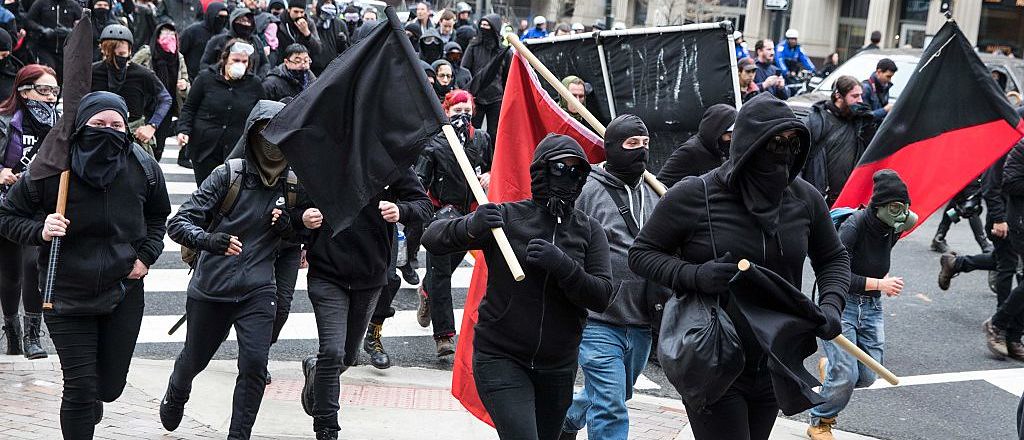
“antifa 8973ag” by cantfightthetendies is licensed under CC BY 2.0

An important concept for understanding why the behavior of Antifa is not strategically rational is “propaganda of the deed”.
This is a concept with a long pedigree in left-anarchist theory, transmitted to Antifa via its minority “black flag” left anarchist faction
19th-century romantic anarchists viewed the state and capitalism as powerful illusions that could be shattered by bold, exemplary acts, thereby proving their vulnerability and offering hope to the oppressed. These deeds were intended to ignite the spirit of revolt by alerting the masses to the possibility of revolution, much like a spark that could set off a larger fire — thus, the emphasis on symbolic targets over objectively effective ones.
This kind of political communication could be effective if a majority of society, or at least a critical minority, are seething cauldrons of resentment just begging to be triggered against their oppressors. It also assumes that the revolutionary rage of the masses can, once unleashed, be effectively directed against Antifa’s enemies.
Both assumptions are highly questionable, but the important thing to understand for purposes of predicting Antifa’s behavior is that (a) Antifa behaves as though it still believes them, and (b) Antifa’s aboveground allies don’t have the capacity to restrain its behavior in detail.
The Gramscian infiltrators in the U.S.’s institutions need to keep their links to overt terrorism deniable, so they manage it mostly by raising or lowering the temperature of public propaganda. For example, when a Democratic politician says “Abolish ICE”, describes government actions as “fascism”, or wishes death on the children of a political opponent, this is raising the temperature. The effect, the intended effect, is to license increased propaganda of the deed by Antifa.
Reminder: unceasing damnation of conservatives as fascists and Nazis constituted instructions to stochastic terrorists like Tyler Robinson that the time had come to do something like shooting Charlie Kirk through the neck.
One problem with this is that because of Antifa’s psychology and doctrine, raising the temperature is easy, but lowering it is hard. Thus, it’s not a process the Gramscians want to start unless they believe either that they have escalation dominance over their opponents, or their political position is deteriorating so rapidly that they’ll never get a better chance to induce a legitimacy collapse.
It is out of scope for this essay to analyze to what extent those conditions are true. The point is, we are in a situation where the limited control Antifa’s aboveground allies can exert is all directed towards escalation, and Antifa’s belief in “propaganda of the deed” makes this very difficult to reverse.
Antifa has probably lost sight of the fact that escalating to insurrectionary violence is premature — it doesn’t have an army or a sufficiently powerful and nearby state sponsor for that.
Thus, absent serious degradation of Antifa’s capacity by law enforcement, expect increasing violence. Including, but not limited to, the deliberate murders of law enforcement personnel and opposing politicians.
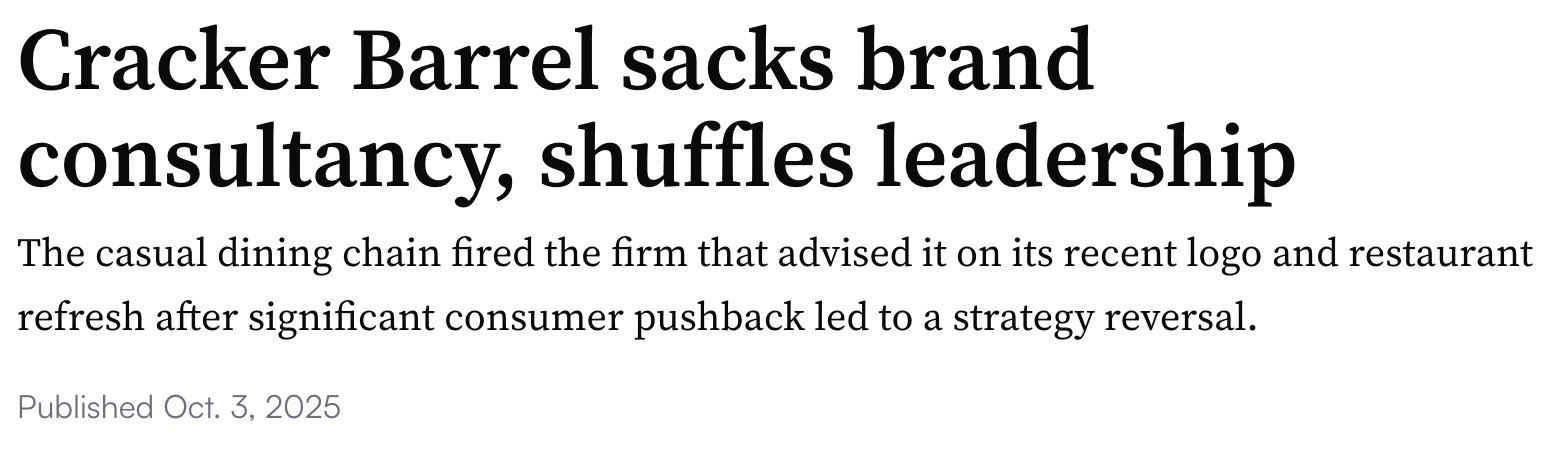
Big management shake-up at Cracker Barrel’s corporate HQ
Back in August, the US chain restaurant field saw a corporation decide that doing what their customers wanted was actually a pretty good strategy … after they’d tried the opposite and nearly gone the way of Bud Light:
Last week was the Red Wedding for Cracker Barrel.
Some senior people who were in the headquarters office last Monday weren’t there anymore as the weekend drew near, some old managers from an earlier corporate culture came back to rewind the clock, and the branding consultant that advised on the now-fatally-wounded rebranding effort was sent packing. The new logo departed. The redesigned stores were acknowledged as a failure and an embarrassment.
[…]
See what they said about the redesign? “We won’t continue with it”. The whole thing collapsed, a $700 million rebrand that slammed into a concrete wall and exploded.
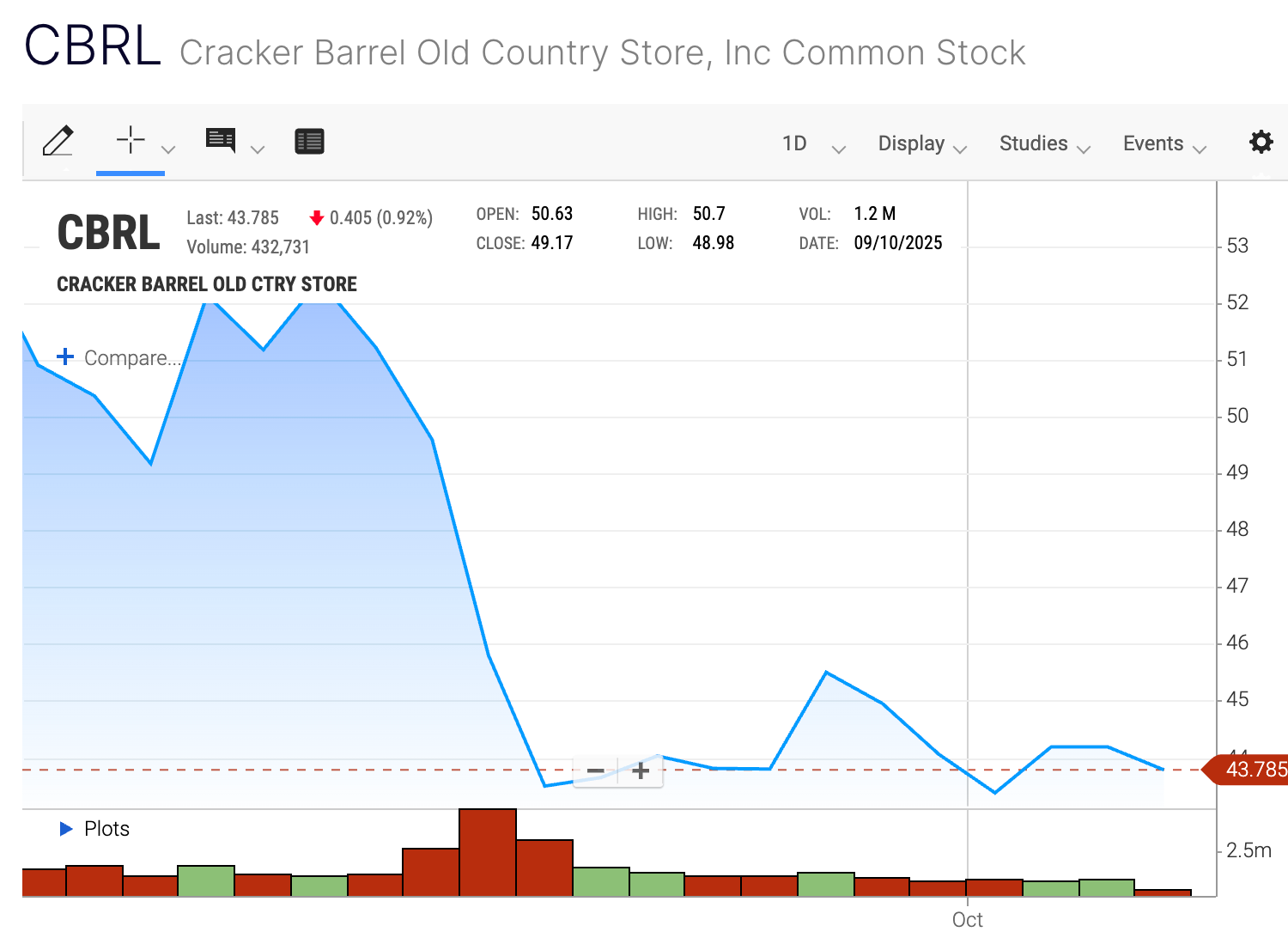
It remains to be seen how much the rebranding of the rebranding will matter, and this is what Cracker Barrel stock looks like in the last month:
Now, a reminder: The New York Times columnist David French explained, just over a month ago, that the controversy over Cracker Barrel’s rebranding was an absurd fake crisis ginned up by right-wing idiots who were just pretending that something had gone wrong at the company. Along with the Sydney Sweeney thing, he concluded that we were watching some “completely frivolous and meaningless cultural disputes,” examples of the way “right-wing media both mobilizes its base and bends political reality”. If you believed that the Cracker Barrel rebranding was poorly done and would alienate the company’s customers, you were falling for an invented reality that was completely meaningless and frivolous.
Then Cracker Barrel fired a bunch of managers and its rebranding consultant, abandoned the rebranding, and apologized profusely, while its stock plummeted.
If you listened to David French, if you trusted the op-ed pages of the New York Times to explain the world to you, your understanding of the most basic outline of factual reality was flipped over, turned precisely upside down. He was only wrong about literally every single detail, completely missing what was happening, what it meant, and what would happen in the near future as a result of it. To listen to this idiot is to abuse your own mind, trapping yourself in the confines of an absurd house of ideological mirrors. He is inevitably wrong, completely wrong, reliably wrong to the point of absolute and unyielding madness.
How a Myth Started the Nuclear Arms Race – W2W 47
TimeGhost History
Published 5 Oct 2025The Bomber Gap: a mid-1950s panic that convinced Washington the USSR was outproducing the U.S. in long-range strategic bombers — and triggered a massive nuclear buildup. This episode traces Eisenhower’s New Look, Curtis LeMay and SAC’s push for jets, the Dulles brothers’ influence, the M-4 “Bison” bluff, and the Symington hearings that turned bad intel into national policy. Learn how politics, optics, and deliberate Soviet deception combined to accelerate the arms race and reshape deterrence for decades.
[NR: At Dominion Review, Palmiro Campagna discusses the missile gap and how it impacted the decision to cancel the Avro Arrow.]
(more…)
October 4, 2025
Warner Carbine
Forgotten Weapons
Published 8 Sept 2015The Warner carbine was another of the weapons used in small numbers by the Union cavalry during the Civil War. It is a pivoting breechblock action built on a brass frame. These carbines were made in two batches, known as the Greene and Springfield. The first guns were chambered for a proprietary .50 Warner cartridge, which was replaced with .56 Spencer in the later versions (for compatibility with other cavalry arms).
This particular Warner shows some interesting modification to its breechblock, which has been converted to use either rimfire or centerfire ammunition. This was not an uncommon modification for .56 Spencer weapons, as the centerfire type of Spencer ammunition could be reloaded (unlike the rimfire cartridges). With this modification, the firing pin can be switched from rimfire to centerfire position fairly easily.


