Forgotten Weapons
Published 8 Sept 2015The Warner carbine was another of the weapons used in small numbers by the Union cavalry during the Civil War. It is a pivoting breechblock action built on a brass frame. These carbines were made in two batches, known as the Greene and Springfield. The first guns were chambered for a proprietary .50 Warner cartridge, which was replaced with .56 Spencer in the later versions (for compatibility with other cavalry arms).
This particular Warner shows some interesting modification to its breechblock, which has been converted to use either rimfire or centerfire ammunition. This was not an uncommon modification for .56 Spencer weapons, as the centerfire type of Spencer ammunition could be reloaded (unlike the rimfire cartridges). With this modification, the firing pin can be switched from rimfire to centerfire position fairly easily.
October 4, 2025
Warner Carbine
October 3, 2025
Women and credit card access … another “just so” story
Janice Fiamengo debunks a common “just so” story about women only gaining the right to hold a credit card in the 1970s:
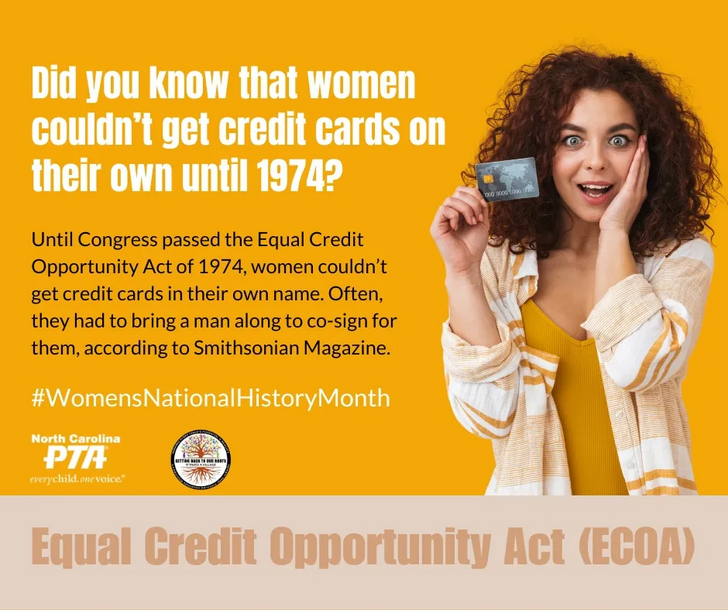
A few years ago, I started hearing that women, before feminism, couldn’t have their own credit cards. Or they couldn’t get one without a man’s signature. Or married women couldn’t have one in their own name. Divorced women, apparently, couldn’t get credit at all. Men conspired to keep women powerless and dependent.
THANK THE GODDESS FOR FEMINISM!
Just last June, on the podcast Diary of a CEO (in an episode viewed by nearly two million people), three feminists debating feminism agreed that, in the words of one of the panelists, “None of us could get a credit card a few decades ago … We couldn’t have anything …” (see 1:50:37).
Before correcting herself, in fact, the panelist had started to say, “None of us could get a credit card a couple of decades ago …”
The statement struck me with the full force of the ludicrous. I started school in 1970. My teachers were nearly all women, at least half of them unmarried. They certainly seemed to live full, normal lives in obeisance to no man. They were paid a salary; they had bank accounts; they owned cars; they bought things and went on vacations.
My mother had worked in an insurance office for years both before and after she married my father in 1956. She had purchased appliances and paid her own rent, helped my father buy his first commercial fishing boat, and handled all the household expenses when my dad was away fishing for months every summer.
My friends’ mothers were similarly active and self-determining. Were all these women actually hobbled by the patriarchy, cut off from the economy?
Received knowledge would have us believe so. Last year, The Globe and Mail published a paid advertisement for Women’s History Month titled “50 Years Ago: Women Got the Right to Have Credit Cards”. Written by a financial services company seeking to drum up business, the article repeated the popular story that women in North America could not get their own credit cards until 1974.
Credit cards were one of the growth areas for banks and other financial service companies in the 1960s and 70s … from something only relatively wealthy travellers and business executives used, they expanded to become widely used by ordinary consumers for all kinds of purchases. Consumers benefitted from access to useful financial tools, while banks enjoyed the profits from the widespread use of credit cards. So where did the idea that they were male-only come from?
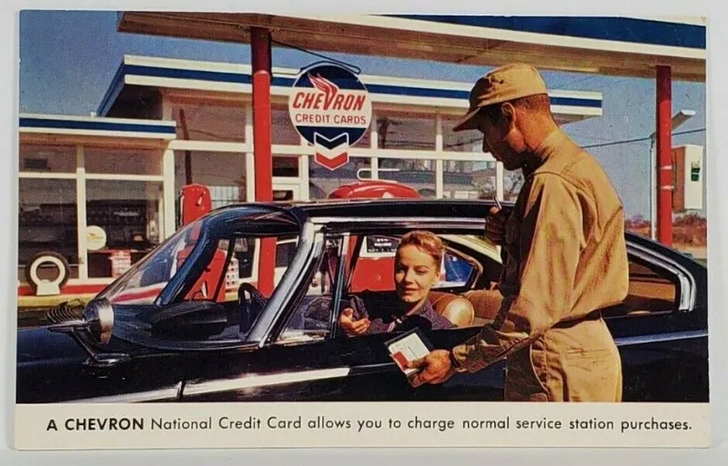
The reality is that from the 1950s on, credit cards were a new invention being aggressively marketed to both men and women. Advertising from the era shows how keen credit card companies were to target female customers, how eager to tap into women’s spending power.
Originally introduced as a convenience for travelers on business, credit cards began to expand their purview in the late 1950s. Bank Americard (later Visa) became the first consumer credit card in 1958. A network of banks formed the Interbank Card Association, originally named Master Charge (later Mastercard), in 1966.
Yet we are somehow to believe that half the population was deliberately excluded from this new consumer venture for no other reason than that they were female?
“It wasn’t until 1974 that women were allowed to open a credit card under their own name,” the Globe article states emphatically. “Before 1974, if women wanted to open a credit card, they would be asked a bunch of intrusive questions, like if they were married or whether they planned to have children. If a woman was married, she could (hopefully) get a credit card with her husband. But single, divorced, or widowed women weren’t allowed to get a credit card of their own — they had to have a man cosign for the credit application.”
The explanation is dramatic and incoherent, undoing its own logic from the beginning. It backtracks to allege that women were in fact “allowed” to have a credit card so long as they answered “a bunch of intrusive questions” or found a co-signer. Even this lesser claim is false, but it is rather different from the prior assertion about women “not having the right” to a card.
At a time when many married women either did not work outside the home or worked only part-time and on a temporary basis, there would have been nothing unreasonable about a woman’s husband co-signing her credit card application. Many married women were happy to purchase what they wanted on the assurance that their husbands would pay the bill when it came in, and credit card issuers saw joint accounts as a way of ensuring payment.
Update, 4 October: Welcome, Instapundit readers! Please have a look around at some of my other posts you may find of interest. I send out a daily summary of posts here through my Substack – https://substack.com/@nicholasrusson that you can subscribe to if you’d like to be informed of new posts in the future.
Mulligan “Hobo” Stew from the Great Depression
Tasting History with Max Miller
Published 29 Apr 2025Soup with canned peas, canned corned beef, onion, and ketchup
City/Region: United States of America
Time Period: 1940Today the word “hobo” is usually used in a derogatory manner, but back in the time between the end of the Civil War and the end of the Great Depression, it referred to a specific group of migrant workers and their culture.
Part of that culture was mulligan stew, which was basically a stew of any meat and vegetables that were thrown together. The ingredients would be made up of things that keep well, mostly food that was canned or bottled.
The flavor of this soup is surprisingly good, but it’s maybe a little too sweet, even for me. The prodigious amount of ketchup is the dominant flavor, and maybe 1940 ketchup was less sweet than modern versions.
Mulligan Stew (Serves 6)
1 medium size can corned beef — minced
1 onion — minced fine
1 No. 2 can peas with liquid
1 medium size bottle tomato catsup
1 cup water
Salt and pepper to tastePut all ingredients in saucepan and simmer gently over low flame for about one hour. The flavor improves with the length of cooking time.
— The Brookshire Times, August 2, 1940
October 1, 2025
The Korean War Week 67: Ridgway Questions Truman’s Resolve – September 30, 1951
The Korean War by Indy Neidell
Published 30 Sep 2025There’s worry and chaos in Washington when UN Commander Matt Ridgway indicates that there is one order that if given from above, he will not obey. That order concerns the possible resumption of peace talks with the Communists at Kaesong. Meanwhile in the field, the bloody Battle of Heartbreak Ridge continues, though US 2nd Division has a new commander who has new plans for how to bring about victory.
Chapters
00:00 Hook
00:53 Recap
01:07 Heartbreak Ridge
04:04 Replacement Troops
06:30 Operation Commando
09:25 Ridgway Refuses
12:52 Summary
13:11 Conclusion
(more…)
September 30, 2025
“San Francisco [is] a sort of market-segmented scheme [extracting] the basic comforts of civilization and licensing them back as upgrades”
On the social media site formerly known as Twitter, Devon Eriksen describes the very comfortable lives of the very wealthy, who can support any kind of luxury beliefs because they never have to face the consequences that “the poors” who ape them do:
Dear sir,
I am not a filthy poor, and therefore conditions on the street level in Portland do not matter to me.
I drive my Jaguar to nice restaurants, give it to the valet to park, then go inside and order a fancy treat. So long as the valet parks my car, and the waiter brings my fancy treat for me to consoome in peace, I am utterly unaffected by conditions ten blocks away.
While I am technically forced to acknowledge that other humans exist — otherwise who would park my car or prepare my fancy treat? — I am not actually forced to consider what their lives are like.
And if you try to force me to confront this, I will simply point out that you are a filthy poor, who is unable to live a lifestyle that insulates you from this sort of unpleasantness.
At which point I don’t have to pay attention to you, loser.
Okay, here’s what’s really going on.
At a recent gathering in San Francisco, I listened to the tech bros I was dining with and their complaints about spending a million dollars a year on security teams, and a thought occurred to me, which I shared with the congregation.
I observed that San Fransisco, and perhaps other cities as well, seemed to be a sort of market-segmented money extraction scheme whereby the basic comforts of civilization are systematically removed from the environment, and then licensed back as upgrades to those who can afford them.
In Tennessee, it doesn’t cost me a thing to not be murdered for what I write online. Sure, I have a metric fuckton of extremely high-powered weapons and the skills to use them, but let’s be honest … I own them on principle, not because I would be murdered without them.
In SF, saying right-of-center things online while not being murdered costs a million dollars a year.
It probably costs slightly less than that to have zero drugged-out and/or schizophrenic bums urinating on your porch, but again, in Tennessee, this is a free service that comes with the “Western Civilization” package.
Also, it doesn’t cost anything go to a drugstore where nothing is locked behind glass, and be told “have a nice day” by someone at the register who actually means it.
And I’m told there is some sort of mythical beast called “graffiti”, but I have to go online to find out what it looks like.
In short, the argument that “civilization is just fine because I can still buy my way out of trouble” doesn’t hold any water, because it ignores the fact that you have to buy your way out of trouble, because civilization is shrinking.
You can’t have civilization without ass-kickings.
And if you forget that, you start having to buy your way into ever more and more exclusive clubs where the uncivilized can’t afford to go.
Until they figure out that they don’t have to pay, they can just push their way past the doorman. At which point you must be prepared to kick ass again.
All civilization rests on pillars made of violence. You are in danger until the moment you understand this.
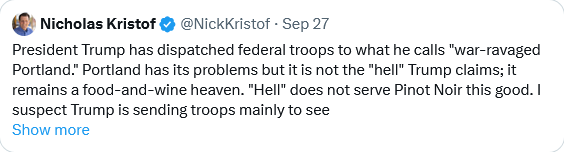
Chris Bray also responded to the Nicholas Kristof take:
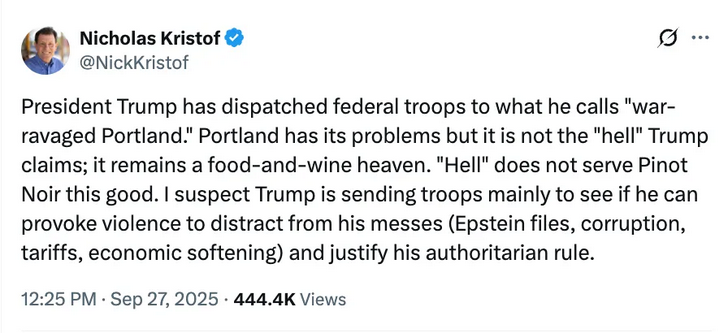
Now, here’s the hugely respectable New York Times columnist Nicholas Kristof, a very important Pulitzer Prize recipient, explaining from the heights of his journalistic perch what’s really happening in Portland:
This is as flawless a summary of the progressive cathedral classes as you could possibly manage: “‘Hell’ does not serve Pinot Noir this good”.
- Portland street journalist: Portland is a public graveyard
- Progressive New York Times columnist: Akshully, the Pinot Noir is exquisite
It’s time to shove these people onto a barge and tow them out to sea.
Like Karen Bass describing the open-air drug market of MacArthur Park as a sylvan paradise full of happy children and wonderful families having picnics, Oregon Governor Tina Kotek explained this week that Donald Trump is bizarrely intervening in a utopia, and for crying out loud look at this facial expression:
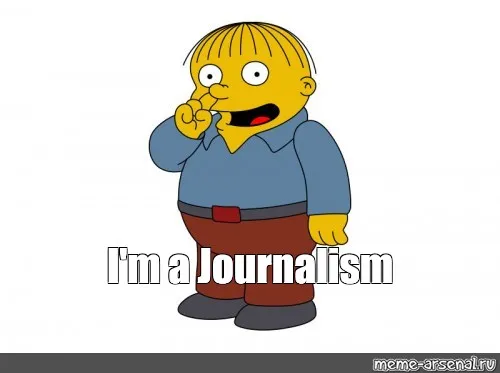
No one has ever been more lost than this. Your average good urban liberal is more insane than a psych ward full of psychotics. Akshully, the Pinot Noir is delightful. We are burdened with the existence of high-status people who have departed from earthly reality, and we can’t afford them.

Update, 1 October: Welcome, Instapundit readers! Please do have a look around at some of my other posts you may find of interest. I send out a daily summary of posts here through my Substack – https://substack.com/@nicholasrusson that you can subscribe to if you’d like to be informed of new posts in the future.
QotD: The modern cult of “victimhood”
It is the idea of “victimhood”; the idea that a man is not responsible for his acts; that he is instead a victim of the oppression of some abstraction called “society” — because he is black, or on welfare, or whatever. And everyone who isn’t can be held guilty, regardless of how they have actually behaved.
Oppressed by whom?
Oppressed, actually, by the implied permission that is granted in advance, to looters, and rapists, and thugs, and amateur neighbourhood terrorists, by that very satanic idea of victimhood, and its practical corollary, that if you can play the victim, you can manoeuvre yourself into a position to victimize everyone around you.
David Warren, “Bad Gumbo”, DavidWarrenOnline, 2005-09-03.
September 27, 2025
NATO – the alliance of paper tigers?
In UnHerd, Edward Luttwak suggests that despite President Trump calling the Russians “paper tigers”, the non-US members of the NATO alliance could more appropriately be described that way:
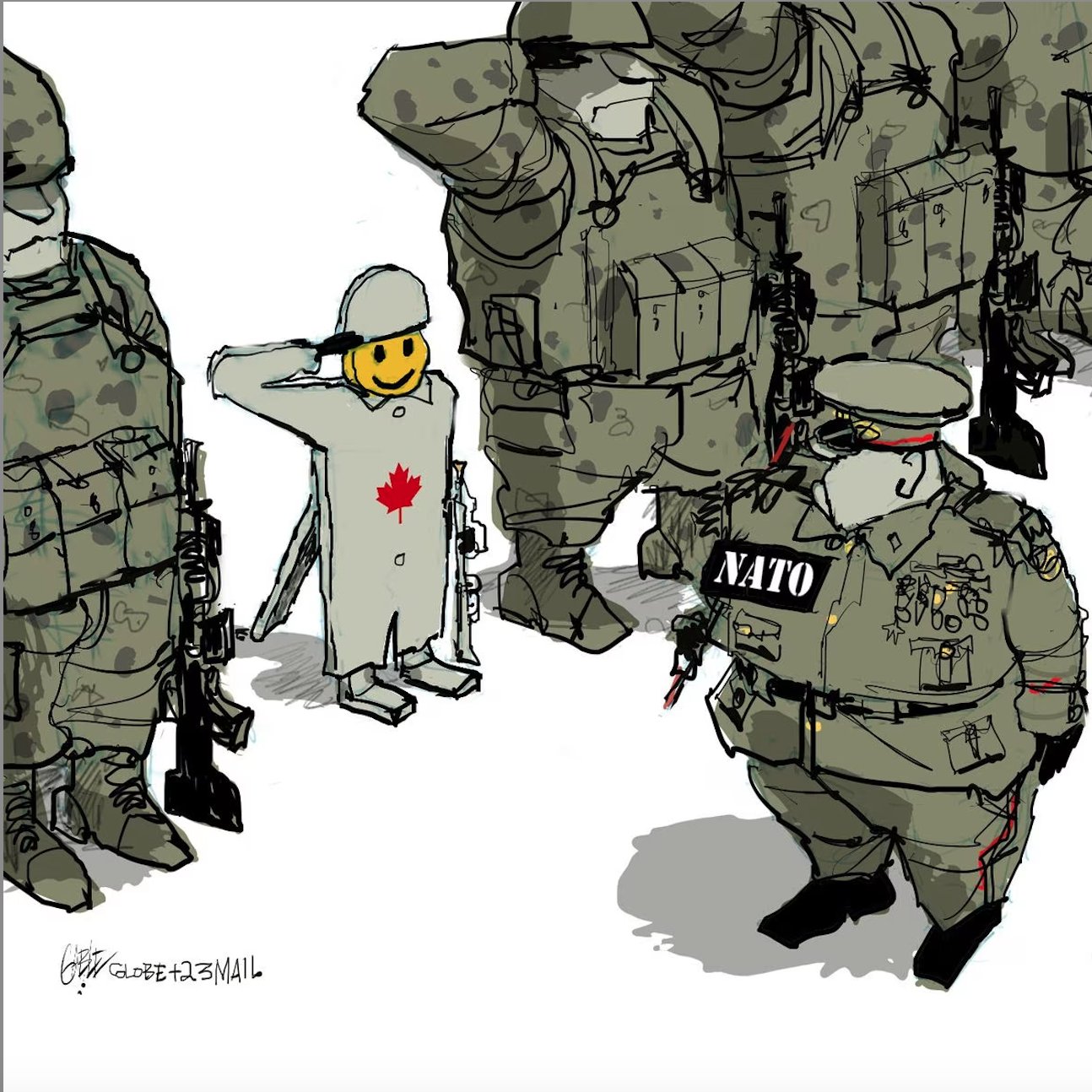
It’s been an open secret for decades that Canada’s NATO contributions are more rhetoric than reality, but it’s true of many of the European NATO allies, too.
… simply raising defence spending will not turn Europe’s states into genuinely effective military powers. For one thing, the GDP criterion is much too vague to mean much. Finland, for instance, spends only 2.4% of its GDP on defence and yet can mobilise some 250,000 determined soldiers. Other Nato members, which spend much more than the Finns, obtain far less for their money.
Moreover, focusing on GDP instead of force requirements — so many battalions, artillery regiments, fighter squadrons — is nothing but an invitation to cheat, an opportunity lustily taken up across the continent. The latest Spanish submarine, for instance, is not imported for €1 billion or so from Thyssen-Krupp, which supplies navies around the world with competent, well-proven submarines. Instead, it was proudly designed and built at the Navantia state-owned Spanish shipyard: for €3.8 billion, roughly the cost of a much bigger French nuclear-powered submarine. As a feeble justification for that absurdly high cost, Spain’s defence minister cited a supposedly advanced air-recirculation system — so greatly advanced, in fact, that it is not actually ready, and will not be installed even in the submarine’s next iteration.
Soon, though, Italy will outdo Spain’s platinum submarine: by including a new bridge to Sicily, set to cost some €13.5 billion, into its 2% of GDP Nato spending quota. The government’s excuse is that some 3,000 Italian troops may need to cross the Strait of Messina were the Italian army ever to be fully mobilised. But it would be much cheaper to fly them individually, each trooper in his own luxurious private jet. Even without the bridge, meanwhile, Italy’s cheating on the 2% target is bad enough. Most notably, much of the Italian Navy’s spending goes towards warships made by Italy’s state-owned Fincantieri shipyard. But there is not enough money for the fuel and maintenance expenses to operate more than half of them, meaning another industrial subsidy is camouflaged as defence spending. All the while, Italy refuses to increase its defence budget beyond the very modest target of 2% — which it has yet to meet.
As for Germany, three and half years since the start of the Ukraine war, with ever more ambitious rearmament plans loudly promised, the total number of personnel in uniform has actually slightly decreased. And, aside from beginning a multi-billion euro purchase on an Israeli missile-defence system, nothing much has happened. Despite its high demand in Ukraine, even the battle tank, that German specialty, is being produced in very, very small numbers: so low that the annual output could be lost in a morning of combat. In May 2023, indeed, a meagre 18 Leopard tanks were ordered to replace older models lost in Ukraine. The expected delivery date? Between 2025 and 2026! Then, in July, Germany purchased a further 105 advanced Leopard 2A8s. That is the number needed to equip a single brigade, the German force stationed in Lithuania — and they are expected to arrive in 2030!
The sad truth, then, is that Germany has yet to start working in earnest to correct the extreme neglect inflicted on its armed forces during the long Merkel premiership, when she kept saying that “even if we had the money we would not know how to spend it”. All the while, German helicopters lacked rotors and tanks lacked engines. The exceedingly slow recovery of the German army is especially frustrating because Nato is not actually short of air or naval forces. What it lacks are ground forces, soldiers more simply, or rather soldiers actually willing to fight. Having added Estonia, Latvia and Lithuania to the alliance, tiny countries with outsized defence needs, the alliance faces a severe troop deficit across the entire Baltic sector. The troops so far sent by Nato allies, such as visiting Alpini battalions from Italy, cannot improve the maths.
Update, 30 September: Welcome, Instapundit readers! Please do have a look around at some of my other posts you may find of interest. I send out a daily summary of posts here through my Substack – https://substack.com/@nicholasrusson that you can subscribe to if you’d like to be informed of new posts in the future.
Canada’s supply management cartels benefit “an affluent few, burdening the poorest, and creating needless friction with allies and trading partners”
In Reason, J.D. Tuccille explains to an American audience why Donald Trump has been playing hardball with Canada on trade issues:
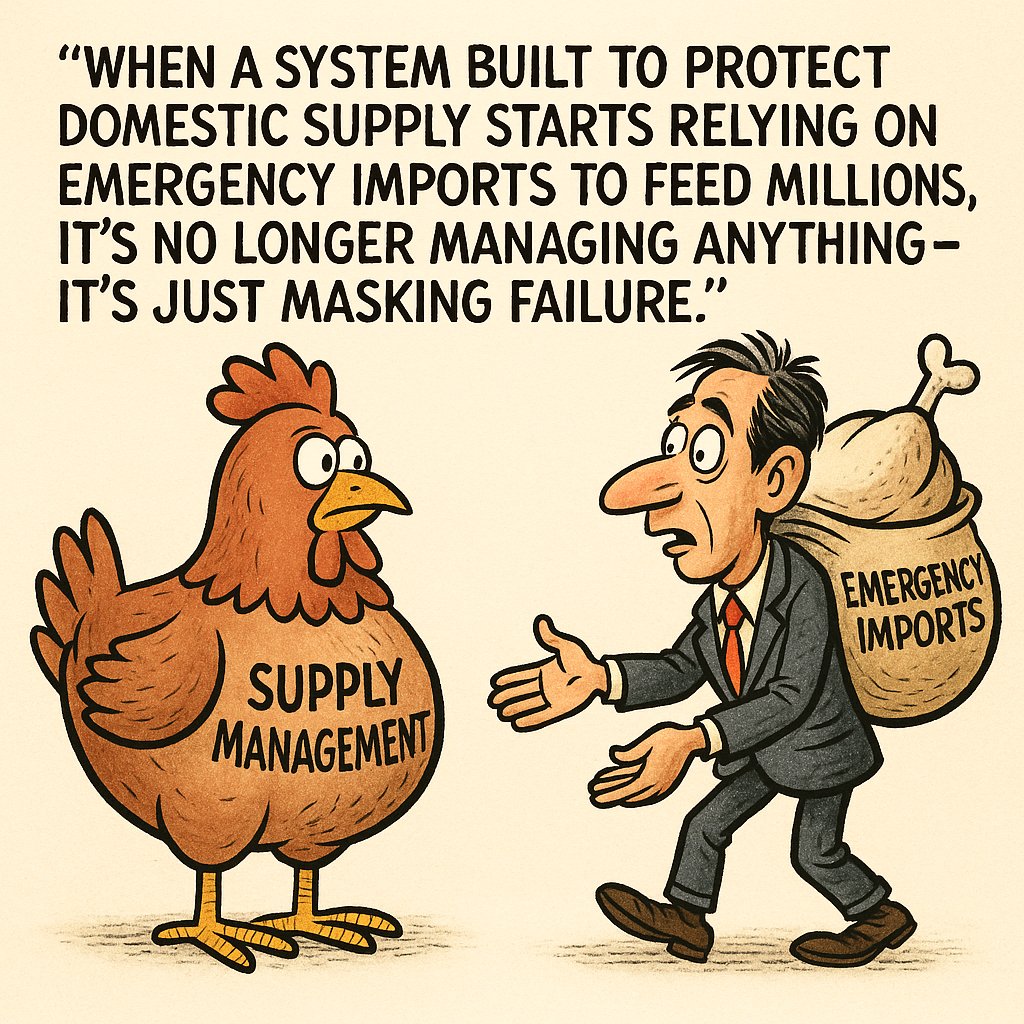
President Donald Trump justifies his enthusiasm for prohibitively high tariffs by insisting the U.S. is being “ripped off” by other countries. It’s a strange argument, since people only trade with one another if they see benefit in the deal. But the president is right to complain that other governments impose trade barriers of their own that are often every bit as burdensome as the high taxes Americans pay on imports. If foreign officials honestly wish to restore something like free trade, they should emphasize dropping their own barriers in return for lower U.S. levies. Case in point: Canada, which sends three-quarters of its exports across its southern border but imposes damaging restrictions on imports.
In a February proclamation of trade war on the world, Trump announced, “the United States will no longer tolerate being ripped off” and complained that “our trading partners keep their markets closed to U.S. exports”. The first part of that claim is silly. But the second part has a kernel of truth.
A glimpse at that truth came in June when Trump angrily posted that Canada “has just announced that they are putting a Digital Services Tax on our American Technology Companies” and, as a result, “we are hereby terminating ALL discussions on Trade with Canada”.
The threat had the desired impact. Canada rescinded the tax immediately before it was supposed to take effect. While nominally targeted at all large tech companies, in practice that meant American companies and everybody knew it, since U.S. firms dominate the industry.
But that was only the tip of the iceberg when it comes to Canada’s trade barriers. Also in June, international trade attorney Lawrence Herman, a senior fellow at Canada’s C.D. Howe Institute, bemoaned proposed legislation in the Canadian parliament that he characterized as “yet another regrettable effort to enshrine Canada’s Soviet-style supply management system in the statute books.”
He added, “the bill would prohibit any increase in imports of supply-managed goods – dairy products, eggs and poultry – under current or future trade agreements”.
The legislation about which Herman complained has since become law.
[…]
More skeptically, Fraser Institute senior fellow Fred McMahon notes, “supply management is uniquely Canadian. No other country has such a system. And for good reason. It’s odious policy, favouring an affluent few, burdening the poorest, and creating needless friction with allies and trading partners.”
McMahon elaborates that the supply management process is controlled by agricultural management boards which “employ a variety of tools, including quotas and tariffs, and a large bureaucracy to block international and interprovincial trade and deprive Canadians of choice in dairy, eggs and poultry”.
But as we’ve seen so many times over the years, it disproportionally benefits Quebec, and the Liberals desperately need those Quebec votes to stay in power, so the government would rather destroy the national economy rather than give up on our Stalinist supply management cartels.
Dislike of Trump prompts the CBC to spread faulty medical advice
It’s a long-running joke that US progressives — and the legacy media, BIRM — are programmed to respond to anything Donald Trump says by doing the exact opposite of what he says:

The CBC apparently felt the need to do the meme:
It was not controversial for news outlets like CBC to report in 2016, and later 2021, on new medical research raising concerns about the impact of Tylenol use on pregnancy and fetal development. But in 2025, those studies (among others) have become the basis for a new cautionary approach by the U.S. government that critics and media are trying to debunk.
On Monday, the U.S. Department of Health and Human Services announced that, as part of a bigger strategy in quelling autism, it would be issuing a “physician notice and begin the process to initiate a safety label change for acetaminophen”.
President Donald Trump relayed this to the press, stating the medication “can be associated with a very increased risk of autism”.
“So taking Tylenol is not good, all right? I’ll say it; it’s not good. For this reason, they are strongly recommending that women limit Tylenol use during pregnancy unless medically necessary. That’s, for instance, in cases of extremely high fever that you feel you can’t tough it out.”
[…]
The statement was reported in the mainstream news — including CBC, which found Canadian doctors who seemed to support the cautionary approach. The impression from these experts was that this wasn’t cause for panic and that more evidence was needed, but it was an occasion for discussion. The advice back then? Take the smallest amount for the shortest period of time, and don’t use it as a first resort to managing pain, which is consistent with the U.S. guidance.
Indeed, no major figure in this story is advocating for total avoidance because unmitigated pain and fever are bad for pregnancy, and in small amounts, Tylenol seems to be fine. That said, the manufacturer doesn’t recommend it for pregnant women (which they can’t really do without extensive testing, even if doctors generally consider it safe for mothers in minimized amounts when medically indicated).
More recently, a review of other studies by a team including Harvard University’s public health dean found similar “evidence of an association” between the drug and neurodevelopmental conditions. The dean released a statement saying that the “association is strongest when acetaminophen is taken for four weeks or longer”. That should be uncontroversial, because nobody is supposed to take Tylenol for that long, pregnant or not.
But perhaps, as the Babylon Bee suggests, it’s all Trumpian 4D Chess:

September 26, 2025
John Carter revisits the cancellation debate
As part of a much longer essay, covering a lot more ground, John Carter considers the pro and con arguments for the much-cancelled right to fully indulge in cancelling figures on the left in the wake of the Charlie Kirk assassination and the widespread celebration of the murder by leftists:
Talking heads on network television are whining that it’s getting out of hand, while abruptly unemployed leftists take to GoFundMe to beg for support.
The purge has started, and yes, thank you, I’m feeling quite vindicated right now.
Repeating myself is boring, so I’m not going to rehash the arguments in favour of turning cancellation against the left. Suffice to say, they have it coming. It’s also worth pointing out that there’s an important distinction to be made between getting a labourer fired because he made the OK sign, and removing a medical professional who openly celebrates the death of a man for having opinions shared by half the country. Can a bloody-minded leftist doctor be trusted to give medical care to a Trump voter, when he’s on the record as advocating the execution of Trump voters? The doctor should certainly be allowed to say what he pleases, and he should have the same right to use a social media account as anyone else, but he probably shouldn’t be allowed to practice medicine.
But I don’t want to rehash that. Instead, I want to focus back in on human water fountain women as an exemplar of that choir of liars suddenly singing hymns to the sacred practice of freedom of speech. People would be shocked by this self-serving mendacity if long experience had not accustomed them to it.
We aren’t shocked because we’ve seen this before, repeatedly. The left screamed about the spontaneous unguided tour of the capitol on J6 as an insurrection and an unforgivable attack on our democracy, conveniently forgetting that the Weather Underground were bombing federal facilities, including the Capitol, back in the 70s, or that the state capitol of Wisconsin was occupied by protesters in 2011 … or that they’d attacked the White House in 2020 … to say nothing of the nation-wide Burning Looting and Murdering they committed in the wake of Floyd’s fentanyl overdose.
The curious phenomenon of leftist narrative blindness was repeatedly demonstrated during the COVID years, in which the entire professional-managerial caste would switch from one narrative to its opposite like a school of fish, confidently proclaiming on one day what they had denounced as anti-scientific misinformation just the day before.
Sure enough, in the wake of Kirk’s murder, with his blood still on the ground and their gleeful cries ringing in the world’s ears, the left went on an immediate disinformation counter-offensive. They adopted the narrative that Tyler Robinson was a right-wing groyper – an online follower of Nick Fuentes – who had assassinated Kirk for not being based enough, or for supporting Israel, or something. It was for lying about this that Kimmel was pulled off the air. The evidence for Robinson’s right-wing sympathies were that he’d been raised in a conservative Mormon household by a police officer father, and that he’d dressed up as a gopnik once or something. Robinson’s live-in relationship with a troon, the Antifa slogans he’d carved into the bullet casings, and his friends and family attesting to his left-wing radicalization were waved away. This is what abusive narcissists do: “I didn’t do the thing you just saw me do to you, and anyhow you deserved it”. Sure enough, as I wrote this, another leftist sniper attacked an ICE facility in Dallas; sure enough, leftists immediately began insisting that he couldn’t possibly have been a leftist, this time on the grounds that the shooter inscribed “Anti-ICE” rather than “Fuck ICE” on his bullets.
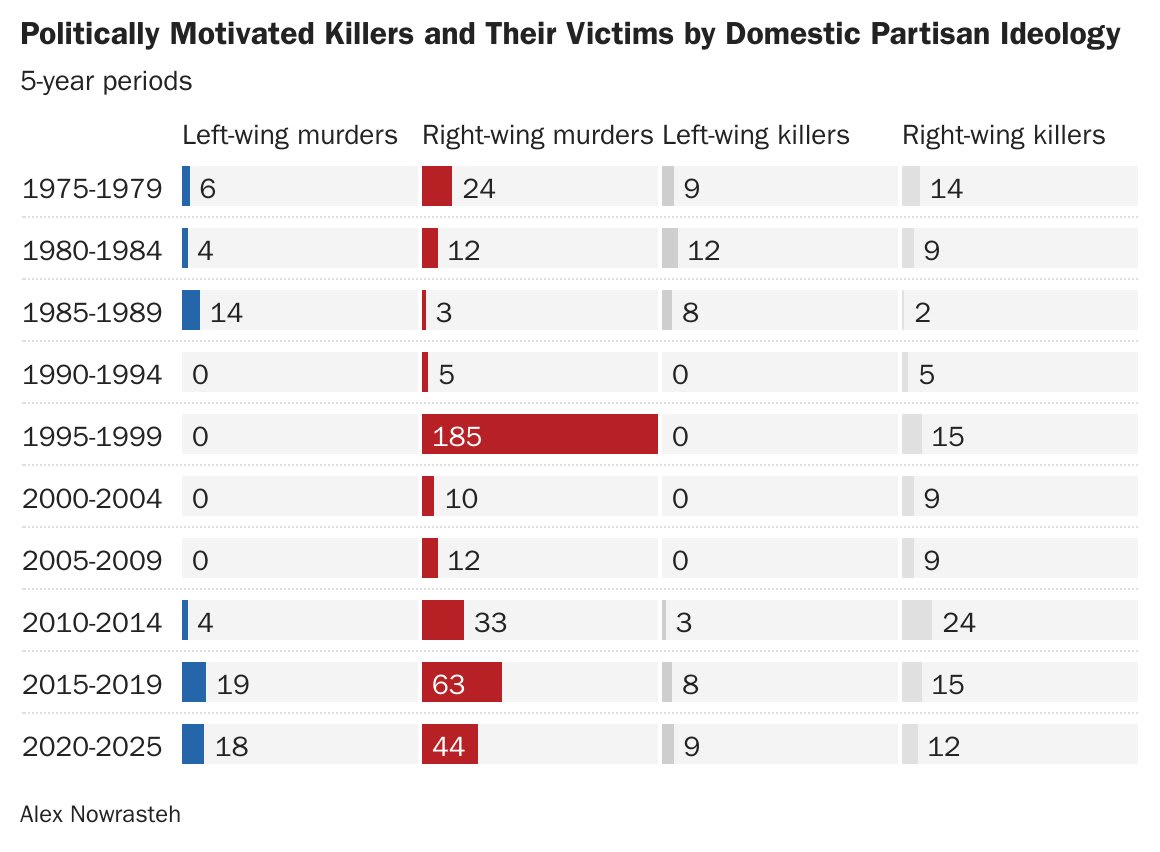
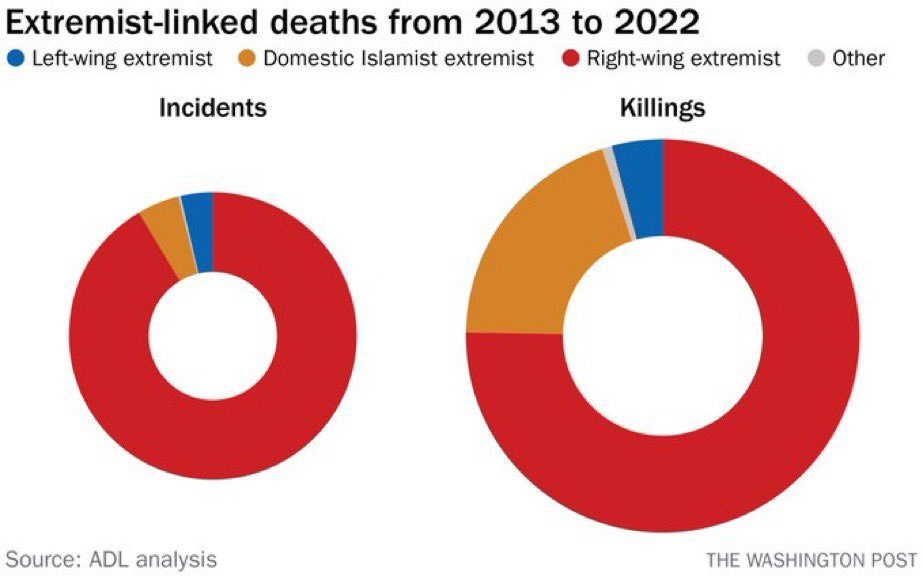
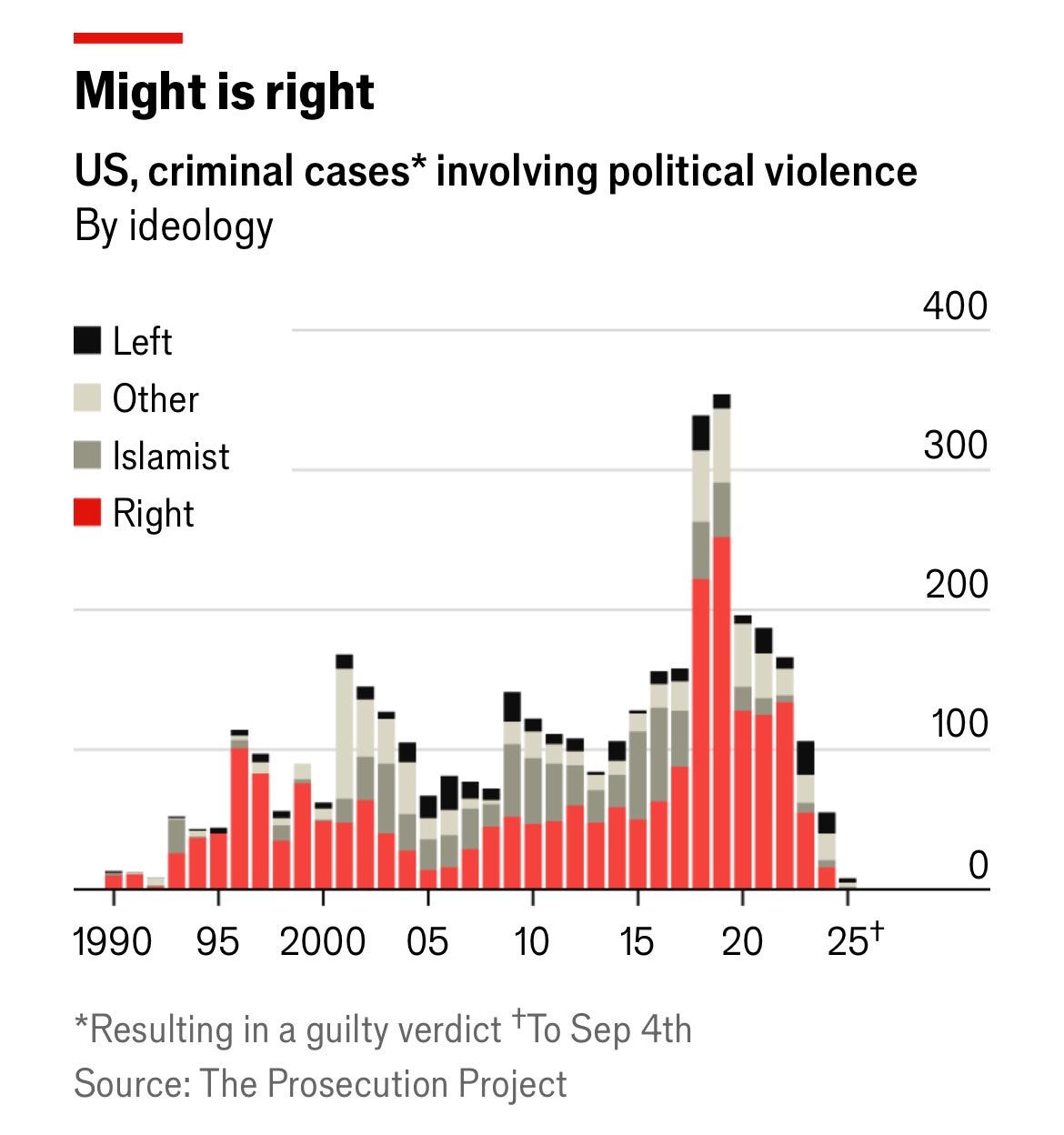
The left also tried to change the conversation to the supposed problem of right-wing violence. Professional-looking infographics flooded onto social media, pushed by Alex Nowrasteh of the Cato Institute, Ilhan Omar, and the Economist.
Ilhan Omar (note that the data are from the ADL).
The infographics make it look like there’s an epidemic of right-wing political violence being waged against a peaceful, tolerant, and defenceless left. This is of course nonsense. Every time someone dug into their data, it turned out that they were basically doing this:
It isn’t even necessary to subject the datasets to close scrutiny. Look at the Economist graphic. See that little black rectangle in 2020? The Economist would have you believe that there was practically no left-wing political violence at all in 2020, which as everyone remembers was a fiery but mostly peaceful year. The Economist dataset turns out to have been curated by an Antifa activist, by the way, which I suppose makes the Economist an affiliate of an international terrorist organization, now.
Now, you can say “they’re just lying”, and yes, quite a few of them know exactly what they’re doing.
[…]
In a lot of cases, however, calling them “liars” isn’t quite accurate. Lying implies conscious deception. If you’ve talked to these people, which I know you have to the point where you have post-traumatic stress disorder, you know that they seem to really believe the things they say. It does not matter in the slightest if they contradict the thing they said yesterday. They apparently have no memory of their previous statements. Their present belief is always entirely sincere. It does not matter if observable reality is in stark contradiction to their belief. They have lost the ability to distinguish between fact and fiction, with the result that they routinely mistake their own pop culture propaganda for reality.
That they do not even seem to notice when they contradict themselves suggests a void of self-awareness. This is the origin of the NPC meme, which depicts leftists as Non-Player Characters, effectively no more than computer programs that emulate human behaviour. When the meme first began to spread a few years ago, there was a purge of Twitter accounts that posted it. The NPC meme cut leftists to the quick because they instinctively recognized – as everyone did – the truth in it. Leftists complained that the NPC meme was dehumanizing, which is actually perfectly correct. An NPC is not really human.
We see evidence for this NPC absence of self-awareness everywhere. A self-aware person who had spent a decade viciously persecuting anyone who publicly contradicted leftist orthodoxy would understand that an appeal to freedom of speech once they themselves were persecuted for their words would garner mockery rather than sympathy. A clever Machiavellian would therefore preface their entreaties with expressions of contrition for their past behaviour, however insincere. Not one of them has done this, which makes it less likely that their attempt to appeal to freedom of speech is mere calculated cynicism. It is instead as though they themselves are not aware of their own previous actions.


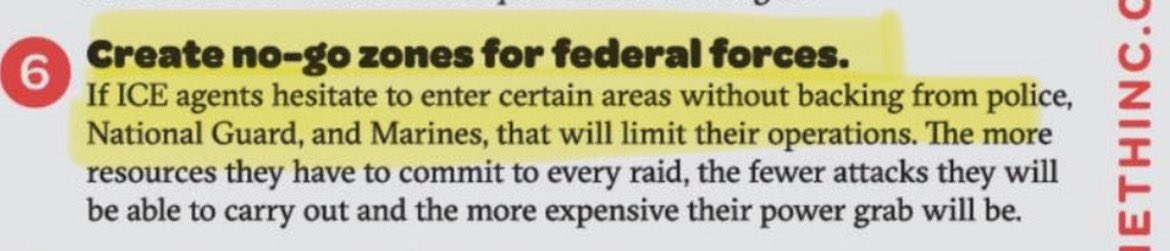
“Create no-go zones for federal forces”
On the social media site formerly known as Twitter, ESR responds to a comment about his three possible futures after the Charlie Kirk assassination (linked here):
Mike Benz @MikeBenzCyber
Antifa websites totally open to the public explicitly call to so utterly terrorize ICE that federal agents are physically afraid to enter a city. If the Proud Boys wrote this about the FBI how fast would every single person around that website be indicted by Merrick Garland.
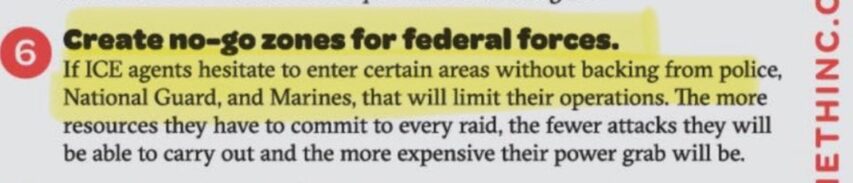
“Create no-go zones for federal forces.’
In one of my previous analysis postings, I outlined three possible scenarios for the future after the assassination of Charlie Kirk.
This corresponds to scenario 3, the one where insurrection edges into a simmering civil war a la Bosnia. I caught some flak in my replies at the time from people who thought an insurrection based in urban areas isn’t practical under modern conditions.
Antifa thinks it is. It’s what they’re planning for.
One of the things I have to remind myself of occasionally is that most people know essentially nothing about Communist theory and Communist revolutionary tactics.
Antifa is running the classic Communist playbook. Make the enemy fight you where you are strong and they are weak — where you have support among the people and (when possible) cover from sympathetic local officials.
Historically that has usually meant fighting from rural areas where the reach of the government is weak. But the Russian Revolution was an exception, and the revolution Antifa is trying to fight is another. Their natural home ground is large coastal cities run by left-wing Democrats.
School Cafeteria Sloppy Joe from the 1980s & ’90s
Tasting History with Max Miller
Published 22 Apr 2025Ground beef in a delicious tomato-based sauce on a hamburger bun, part of a classic 90s American school lunch
City/Region: United States of America
Time Period: 1988Today we know sloppy joes as a saucy ground beef sandwich, but the term sloppy joe has referred to many things over the years. A sloppy joe could be other kinds of sandwiches, a nickname for a messy friend, or women’s fashion from the 1940s and 50s that included pants and looser fitting styles.
For me, though, it is this style of sandwich. Really, it is this version of this sandwich. Sloppy joes were a larger part of my adolescent diet than was healthy, and these taste exactly like the ones I remember from middle school.
Be sure to get the cheapest hamburger buns possible to authentically recreate this nostalgic lunchtime favorite.
Sloppy Joe on a Roll (50 servings)
Raw ground beef (no more than 24% fat) … 17 lb 4 oz
Dehydrated onions … 2 1/4 oz … 2/3 cup
OR Fresh onions, chopped … 1 lb 2 oz … 3 cups
Garlic powder … 2 Tbsp
Tomato paste … 3 lb 8 oz … 1/2 No. 10 can
Catsup … 3 lb 9 oz … 1/2 No. 10 can
Water … 2 qt 3 1/2 cups
Vinegar … 2 1/4 cups
Dry mustard … 1/4 cup
Black pepper … 2 tsp
Brown sugar, packed … 5 1/2 oz … 3/4 cup
Hamburger rolls…100
— Quantity Recipes for School Food Service by the United States Department of Agriculture, 1988
September 25, 2025
An unanticipated danger of AI – “classified” videos for decision-makers
Until fairly recently, even the least tech-savvy among us could distinguish AI-generated videos from the real thing … but most of the leaders and decision-makers in western governments aren’t very tech-savvy and put into high-pressure environments may be uniquely susceptible to AI manipulation:

What If I Told You … One of the biggest applications of AI for misinformation hasn’t been online but in the halls of power.
Aging boomer politicians, generals, and major figures are manipulated by showing them AI videos they can’t tell, can’t pause to look at, and certainly can’t digitally examine or geolocate …
“And as you saw Mr President.”
Pay attention. All of them reference seeing “videos” that you aren’t allowed to see, of events which they claim are public record, but appear no-where and no reporting supports …
Sean Hannity was interviewing a world leader and even said “You should show the public the video you showed me it’d really change everyone’s opinion. it changed mine” LIVE ON AIR. And the world leader said some non-committal maybe, then released nothing.
These aging politicians, media figures, corporate personalities, etc. all casually reference seeing insane videos that would CHANGE EVERYTHING and would have been immediately released to sway public opinion if they existed or would have been leaked if it would have been in poor taste to be seen directly releasing them (like gore films)
But of course they aren’t released because they’re faked and the internet would immediately piece together that they’re faked with AI, video game, and archival footage from old conflicts … But the aging 60- and 80-year-olds who run the world can’t tell.
There was a case where they challenged Greta Thunberg “Would you watch this video it’d change your mind” and she refused telling them to just release it … Then they didn’t and attacked her for not being willing to view evidence contrary to her views … in a controlled environment where she couldn’t scrutinize it or check its authenticity against anything else …
It sounds insane! But if you pay attention all of these politicians, media figures, and even influencers … People who often have ZERO security clearance or any official attachment of real trust or allegiance to the governments showing them this “classified” or “controlled” footage … Regularly reference seeing footage which does not exist in the public domain, for events which are viciously contested in which any of the footage they claim to have seen would be WORLD CHANGING news … Yet all these figures are just left out in the wind repeating “Trust me bro”s for some of the most important occurrences of the past decade.
“Intentionally elevating strangers above ourselves, xenophilia, is artificial”
In Aporia, Spaceman Spiff explains the function and value of what are called “dead man’s switches” both for railway locomotives and societies:

Image from Aporia
A dead man’s brake is a safety feature found in dangerous machines such as lifts or trains. With this mechanism, a brake is always on, preventing action or movement. A conscious choice or effort must be made to override it.
On a train, a human driver must be present to depress a foot pedal that disengages the brake so the train can move at all. If he is absent the train cannot move. If he withdraws his foot while the train is in motion — if he dies, for instance — the train stops. Hence the name.
The key feature of a dead man’s brake is that it requires energy to operate. Its default zero-energy position is OFF; only with energy can it go to ON.
Wariness of strangers, xenophobia, is the default position for most human beings. This is a hardwired evolutionary response to protect us. It served us well. It requires no energy to operate. Children quickly point out people who seem different.
Intentionally elevating strangers above ourselves, xenophilia, is artificial. We must be educated to make it happen, and explicitly taught to overlook differences. It must be reinforced to remain in operation as our instincts typically push against it.
This requires energy. In parts of the world not subject to Western educational norms, they do not teach it to children. Consequently, they do not usually adopt policies like mass immigration or asymmetric multiculturalism.
It is worth noting that xenophobia denotes a wariness of strangers, not hatred or disdain of them. In practice, our working assumption is people different from us may be a threat, and our actions should reflect this until proven otherwise.
Xenophobia is not the racial animosity the propaganda wishes us to believe, such as harming others based on visible differences like skin colour. Such extreme views are in fact rare. The underlying drive of xenophobia is caution, not aggression. Xenophilia attempts to ignore this sensible restraint, which is why it often fails without external pressure.
These instincts are deeply embedded within us because a cautious approach is a strong foundation upon which to preserve our lives and our cultures. It is the reason we have a nation and a culture in the first place.
Xenophilia, then, is a dead man’s brake. It requires energy applied to something that would not typically occur in nature. It makes us ignore differences in order to get along. Or so the theory goes.
Update, 26 September: Welcome, Instapundit readers! Please do have a look around at some of my other posts you may find of interest. I send out a daily summary of posts here through my Substack – https://substack.com/@nicholasrusson that you can subscribe to if you’d like to be informed of new posts in the future.
Streaming subscriptions rising far faster than official inflation rate
I haven’t been a regular TV watcher for a long time, but I still watch the Minnesota Vikings meaning that I need to pay for a streaming service … which has definitely been going up every year at a significantly higher-than-inflation rate. At The Honest Broker, Ted Gioia shows that this is now a very common thing indeed:
It’s not every day that I get an email from Apple. But yesterday the Cupertino leviathan reached out to me.
Can you guess why? Do they have some cool new gadget that will make my life better? Are they opening an Apple Store in my neighborhood? Does Tim Cook want to take me out to dinner?
None of the above. Apple is raising my subscription price for Apple TV by a whopping 30%.
Apple is not alone. The very next day, Disney announced a similar move.
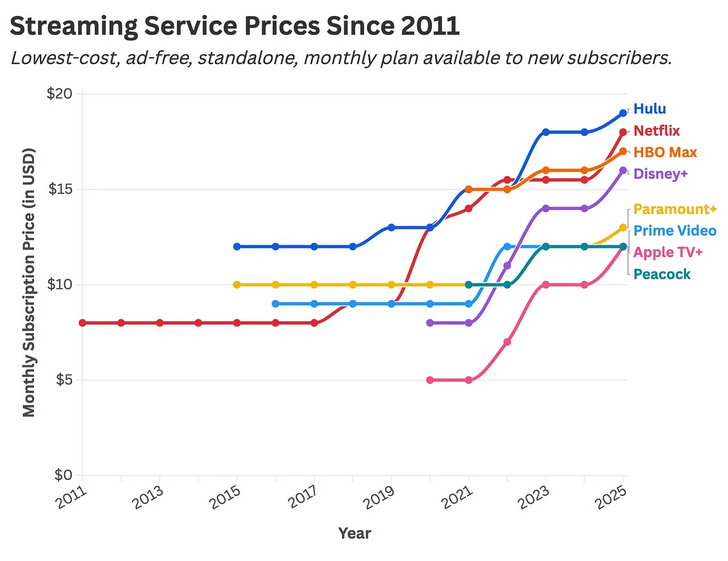
This is the fourth straight year that Disney+ has forced a price increase on viewers. The ad-free subscription price has almost tripled in just six years. During that same period, Disney’s movies have gone from bad to worse — but you pay more to stream them.
The company is truly tapping into its inner Scrooge McDuck. Inflation is just 3% now (according to official, if somewhat dubious, sources). But the ad-free subscription to Disney+ was jacked up 14% last year and is now getting another 19% boost.
Take a look at the larger picture, via this chart from Daniel Parris of Stat Significant (a friend of The Honest Broker). This stuff is reaching greed-is-good levels of abuse.
Meanwhile, the number of scripted shows commissioned by these streamers has dropped significantly. So the audience is asked to pay more for less.