
I think governments, being human institutions, evolve as people do – and evolution, as we know, is copious, local, and recent. Put as simply as possible: If the government the Founders designed worked as intended (note: IF), it only really worked for them – that is, for Anglo-Celt misfits in a frontier society with, at best, 18th century technology and information velocity.
And in any case, that government – IF it worked as designed – lasted the span of one long-ish (then, average now) human lifetime: 1788-1861.
Most “political” problems, on this theory, can be boiled down to the attempt to retrofit old, unsuitable institutions to new creatures. To take the most basic example, that stuff about a “well-regulated militia” rests on the assumption – integral to a rough frontier society of Anglo-Celt misfits – that everyone is armed, and competent with their arms. This is simply not the case in a more settled society, with the higher information velocity that entails / requires, so we get all the endless wrangling over “gun control” (assuming anyone in that debate was ever arguing in good faith, which is also a big IF, etc.).
One obvious counter to this line of thought is to put it mostly down to technology – just as the Founders couldn’t imagine drones and ballistic missiles and “assault rifles” and the rest while they were writing the 2nd Amendment, so the problems with government can almost all be boiled down to old institutions trying to cope, not with new people, but with new technology.
Severian, “Bio-Marxism Grab Bag”, Founding Questions, 2021-01-21.
November 1, 2023
QotD: The original United States government
October 31, 2023
As we’re always told in a pious tone of voice, “violence never settles anything”
Chris Bray, ever the iconoclast, begs to differ:
One of the things everyone knows about Gaza is that the Israeli attack is just creating more violence, as the next generation of Palestinians watches the bombs fall. Inevitably, the story goes, the young are learning hate and rage, and will pay it forward. Here’s the upscale think tank version of the argument, under the headline, “Israel risks creating a newly traumatized and radicalized generation of Palestinians”:
What will remain of Gaza’s population, and among Palestinians elsewhere in the occupied West Bank and East Jerusalem and inside Israel proper, will be a newly traumatized and radicalized generation of youth, none of whom were born or of voting age when Hamas was elected … As a result, Hamas’s self-declared raison d’etre — “resisting the [Israeli] occupation with all means and methods” — will only grow in the minds of Palestinian youth. This will render unsuccessful Israel’s attempts to eliminate Hamas militarily.
Here’s an example of the Twitter rando version, which you’ll see over and over again if you engage with social media at all:
But is that true? Without advocating for brutality, I find myself looking for historical examples and mostly coming up with the opposite. To start managing the “yes, but” up front, there are many ways of waging war, and the extractive nation-building warfare of an imperial constabulary — low-grade fighting, prolonged counterinsurgency without decisive violence — does seem to often lead to more violence and “blowback” over time. But what Israel is doing now in Gaza seems like something else entirely.
If this violence will create “the next generation of Hamas”, then the children of the Germans who were firebombed in Dresden and Hamburg should be constantly strapping on suicide vests and attacking Ramstein air base. After the Wounded Knee massacre, it shouldn’t be safe for white settlers to live near the Lakota, and South Dakota should be a hellscape. Or consider North Vietnam, which won its war: “The US carried out more than a million bombing raids during the 20-year conflict, dropping some 5 million tonnes of ordnance on the Southeast Asian country.” After the war, a substantial Vietnamese population resettled in California. Violence trains the next generation to hate, right? So the Vietnamese must constantly attack Orange County.
The horror of total war has mostly not seemed to produce more violence. It seems to have mostly left later generations brutalized and horrified, and highly unlikely to go on fighting. Waging war decisively seems to be historically … decisive? The experience of crushing defeat seems to be a cycle-breaker, and even a horrifyingly costly victory — as for the North Vietnamese — seems to limit the appetite of next generations for more war.
Japan nurtured a profoundly violent warrior culture for a long time, with the nation’s soldiers serving as brutal invaders and horrible occupiers, then faced a ghastly campaign of firebombing and two nuclear bombs. Japan no longer has a brutal martial culture; the next generations didn’t become the new warriors. The currently popular theory says that they had to: the children witnessing this horror will be the next generation of militants, because trauma teaches violence. Tomorrow’s Hamas comes from today’s JDAMs. The people who lost World War II don’t seem to prove that theory.
Someone is going to say in the comments that I have blood on my fangs, but the point isn’t to cheerlead for the killing in Gaza. The point is to consider evidence about what comes next, and to ask what the comparable examples are. Is it factually true that youth, traumatized by war, become the violent next generation? We ran this experiment a lot in the twentieth century, and I think we have some strong hints at a consistent answer.


As Robert Heinlein had retired Lt. Col. Jean V. Dubois say to his History and Moral Philosophy class in Starship Troopers:
Anyone who clings to the historically untrue — and thoroughly immoral — doctrine that “violence never settles anything” I would advise to conjure the ghosts of Napoleon Bonaparte and the Duke of Wellington and let them debate it. The ghost of Hitler could referee, and the jury might well be the Dodo, the Great Auk and the Passenger Pigeon. Violence, naked force, has settled more issues in history than has any other factor, and the contrary opinion is wishful thinking at its worst. Breeds that forget this basic truth have always paid for it with their lives and their freedoms.
In the 1920 presidential election, Americans voted overwhelmingly for a return to “normalcy”
Warren G. Harding’s term in office has been treated like a punchline by progressive writers and commentators for a century, but Lawrence W. Reed refutes this easy mockery and points out that the winner of the 1920 election deserves much better:

Warren G. Harding, 14 June 1920.
Library of Congress control number 2016828156
Routinely dismissed as a bad chief executive, Harding’s reputation is undergoing a long overdue renovation. The latest contribution in that regard is a new, must-read biography by Ryan S. Walters titled, The Jazz Age President. Read it, and you’ll forever be skeptical of the lazy, biased, conventional historians who worship power and those who wield it.
Warren Harding didn’t just tell audiences what they wanted to hear. He sometimes told them what they did not want to hear. He went to Birmingham, Alabama to condemn racism and Jim Crow laws, for example — a fact I’ve previously pointed out.
Conventional historians praise Presidents for the bills they signed into law but often it requires more courage and conviction to veto them. On that score too, Harding can be judged favorably. He vetoed six bills in the 2-1/2 years he served in the White House. None of the six was overridden. That may not sound like a lot but remember, his party controlled both houses by big majorities; Congress didn’t send him much it thought he wouldn’t sign.
Four bills Harding vetoed concerned minor issues and generated little attention, but one concerned a bonus for veterans of World War I. It stirred up quite a fuss. As the bill worked its way through the House and Senate, Harding gave ample warning that he wouldn’t even consider a bonus that wasn’t paid for. Congress ignored him and sent the bill to his desk. He rejected it, noting as follows:
In legislating for what is called adjusted compensation, Congress fails to provide the revenue from which the bestowal is to be paid. We have been driving in every direction to curtail our expenditures and establish economies without impairing the essentials of governmental activities. It has been a difficult and unpopular task. It is vastly more applauded to expend than to deny.
After the Civil War, Congress paid pensions to veterans of the conflict and their dependents. Sixty years later, in 1923, it sent a bill to Harding to grant pensions to women who married aging Civil War veterans long after the war. It even authorized higher payments to them than what recent widows of veterans in the war with Germany were getting. His veto message included this unassailable objection:
The compensation paid to the widows of World War veterans, those who shared the shock and sorrows of the conflict, amounts to $24 per month. It would be indefensible to insist on that limitation upon actual war widows if we are to pay $50 per month to widows who marry veterans 60 years after the Civil War.
Congress should have known better than to expect Harding to sign such bills. This was the same man who declared at his modest, unembellished inauguration that “Our most dangerous tendency is to expect too much of government”. He had expressed a desire to put “our public household in order”. He said he wanted “sanity” in economic policy, combined with “individual prudence and thrift, which are so essential to this trying hour and reassuring for the future”.
If somebody told me all that, I wouldn’t even think of asking him to approve a check for an able-bodied 30-year-old simply because she married an 80-year-old veteran.
This was the same Warren Harding, remember, who gave the country perhaps the best Treasury Secretary in its history, Andrew Mellon. According to historian Burton Folsom, Mellon slashed government expenses and eliminated an average of one Treasury staffer per day for every single day he held the office. Harding, Mellon and Calvin Coolidge (Harding’s successor), together with a friendly Congress, reduced the federal budget and cut the national debt by more than one-third.
The “better than average” effect versus the suspicion that everyone is partying without you
Rob Henderson considers the friendship paradox and the illusion of loneliness:
Generally, people hold a high opinion of themselves.
A large body of research has found that people tend to believe they are more intelligent, trustworthy, and have a better sense of humor than others. A recent study found that people believe they use ChatGPT more critically, ethically and efficiently than others.
People think they are better drivers than average, students think they are better students than average, professors think they are better professors than average. This is known as the “better than average” effect.
Intriguingly, people are selectively overconfident in their abilities that will garner higher status in their specific social environment. For example, people in individualistic cultures like the U.S. overestimate their ability to lead. But people in collectivistic cultures in Asia overestimate their ability to listen.
We even think we are better than ourselves.
One study asked participants how often they engaged in kind and cooperative acts to help others. A month and a half later, researchers showed these same people their own scores. But the researchers told them that these scores were provided by “their average peer”. So the participants didn’t know they were looking at their own scores.
The researchers asked them to rate themselves again. People rated themselves as higher than the score they were shown, claiming they were superior to themselves.
People also believe others are more susceptible to mass media influence than they themselves are. We overestimate the influence media has on others and underestimate the influence media has on ourselves. This tendency increases people’s support for censorship, because we think others are sheep who can’t handle certain information (or “misinformation”) while we are independent thinkers who can critically evaluate the information we encounter.
Likewise, people believe they are more immune to social biases than others. A recent study found that people think others are more likely than themselves to make decisions based on their preconceived notions and preexisting beliefs. And people believe others are less willing than themselves to update their views in light of new information.
The researchers concluded, “The more strongly people believed that biases widely existed, the more inclined they were to ascribe biases to others but not themselves”.
October 30, 2023
The rapidly fading market for “song investing”
Ted Gioia called it over two years ago, and now it’s coming true:
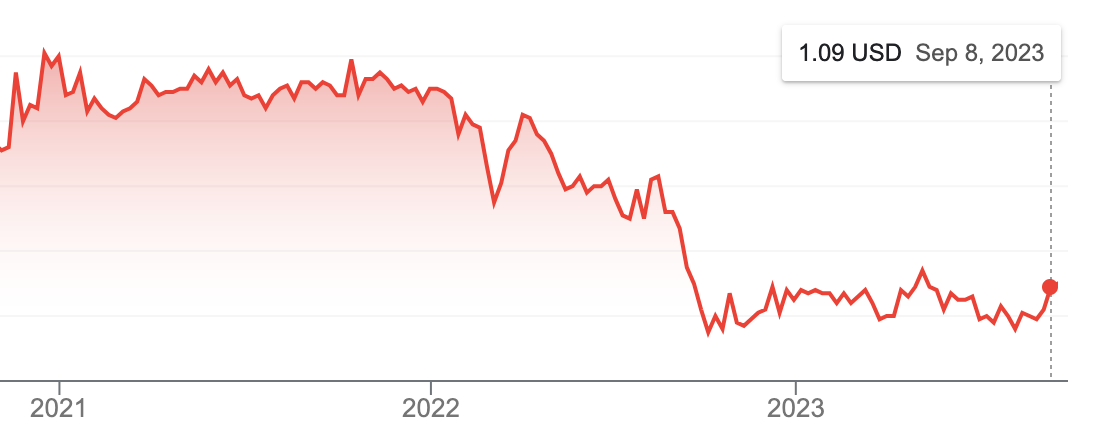
The collapse finally came.
When I analyzed the song buyout mania, led by the Hipgnosis fund, back in June 2021, I predicted that this ultra-hot investment trend would “come to an unhappy end”. And now the collapse has arrived.
We’ve reached the endgame. The song fund’s share price has dropped 50% since I made that assessment — and now shareholders have voted to dissolve or reorganize the investment trust.
But where do we go from here? What are old songs really worth? And who will end up owning all these old rock and pop tunes?
Below I offer 12 predictions.
Much of what I have to say is harsh. That’s unfortunate — if I were a real judge, I’d err on the side of leniency. It’s never fun issuing such hardass verdicts. But if I claim to be the Honest Broker, I really have to stick with truths, even when (as in this case) they’re painful truths.
(1) Many musicians still want to sell their songs, but it will be hard to find generous buyers.
Bob Dylan got out at the top, but the times are now a-changin’. Musicians won’t get the big payouts available back in 2021. A telltale sign will be more deals with “undisclosed terms” — because nobody will want to brag about these lowball transactions.(2) Professional financiers have finally learned their lesson.
The two big finance outfits promoting song investing, Hipgnosis and Round Hill, have faltered and will now sell the songs they bought. Sophisticated investors no longer believe the hype. So don’t expect to see the launch of new song investment funds any time soon. The remaining buyers will be bottom fishers and the terminally naive (described in more detail below).[…]
(5) Look out for these vultures in all sectors of the music business.
When private equity firms knock on your door, it’s a sign that you’re already half dead. These folks actually enjoy picking on carcasses — which is easier work than hunting for live prey. I tend to avoid name-calling, but there’s a reason why some folks refer to them as vulture capitalists. That’s their specialty and their economic model is built on bottom-feeding. This is why private equity firms bought up lots of failing local newspaper, struggling local radio stations, etc. Guess what’s next on their list? Expect to see these tough hombres play a bigger role in all aspects of the music business over the next decade.[…]
(7) This whole situation is a case study in misallocated investment capital.
There’s a general lesson here too. I realized, early on in my consulting work, that the single biggest mistake large corporations make is investing too much to keep their old business units alive — when they would be wiser putting that cash to work in new opportunities. The major record labels in the current moment are poster children for exactly this mistaken sense of priorities. They will support the “old songs” business model at all costs — it’s a core part of their self image — but return on investment will be dismal.
October 29, 2023
Arguments for not buying military kit “off the shelf”
Sir Humphrey provides some of the reasons why it’s not a simple economic case for a nation’s military procurement to buy “off the shelf” equipment even from a close ally:

Not all kit needs to be or can be domestically sourced. The British army uses Apache attack helicopters which are licensed from the original US manufacturer.
Westland Apache WAH-64D Longbow helicopter (UK Army registration ZJ206) displays at Kemble Air Day 2008, Kemble Airport, Gloucestershire, England in June 2008.
Public domain photograph by Adrian Pingstone.
The arguments for buying American are on the face of it reasonable. The US produces good quality equipment able to meet many UK defence needs. There is a strong supply chain in place, ensuring that there are plenty of spare parts in the system to draw on when needed, and at cheaper cost due to bulk buying. The equipment is usually designed to be interoperable with NATO partners, so it can be integrated to work alongside allies and with existing equipment. It can be delivered quickly, it works and lots of other people use it, so why shouldn’t the UK? There are in fact many good reasons why the UK should not exclusively buy American.
Earlier this month, we looked at the Canadian Surface Combatant (CSC) program and why the Canadian Armed Forces never seemed to get the same “bang for the buck” that our American or British allies seem to manage. Here, Sir Humphrey points out that even the British military has to make procurement decisions that weigh cost and convenience with some very significant national security concerns:
To start with, US kit is designed by US companies to meet US requirements, not British ones. This may sound obvious but there is a dangerous view some put forward that “off the shelf” means the UK could just buy something and use it. There is no such thing as “off the shelf” unless you want it as it comes in its US version, with no modifications, changes or installation of British equipment. The moment you do this, you’ve created a UK variant with its own bespoke requirements and supply needs, for which you are dependent on the US defence industry to support – and there is no guarantee that this can or will happen. From the outset you have lost operational sovereignty and control over your military equipment.
Buying from the US means the UK would need to request a Foreign Military Sale (FMS) case through the US government, seeking legislative approval to purchase the equipment. If, for example, the UK wanted to buy a new tank, it would be reliant on US government approval to do so, not just for the initial purchase, but for all spares buy thereafter. The way that FMS works is that it sets out approval not just for purchase, but sets a schedule for spare parts purchases, services, and upgrades, all of which are done at the time and schedule set by US government and industry, and not the British government. This means that the UK would lose control over when to purchase spares or upgrades and would be forced to buy to a foreign governments timetable. This is why FMS is so successful for the US – it offers cheap entry prices but makes a killing in the long-term spares and support market. To buy from the US means to accept that you are handing over control of your spares and logistics chain to a foreign power who determines the timing of when and what you buy. This is fine in small doses but if you buy exclusively from the US, suddenly means you’ve got no control over how you want to support your armed forces.
The next challenge is the integration work needed to make things work for the UK. One of the risks of buying a foreign design is that you lack operational sovereignty over the design and its internal contents. Equipment supplied by the US will often come with a variety of sealed, tamper proof boxes containing US government-controlled technology that cannot be accessed by the purchasing nation. As the operator, you do not have full control over your military equipment, you don’t know what is necessarily in the boxes, and you are reliant on the US to fix issues with them. By contrast any equipment designed and built in the UK means that the MOD has full control and sovereignty over it to open it up, modify, adapt or change it to meet British needs. To buy US means accepting we cannot change a design without a foreign nations’ approval, which in turn means exposing our own sensitive military technology and equipment to the US, to conduct trials to ensure it can work with the US provided equipment. This represents an astounding loss of sovereign control on advanced weapon systems and means potentially giving the US defence industry insight into UK capabilities that manufacturers may want to keep commercially sensitive.
The Battle of Leyte Gulf – WW2 – Week 270 – October 28, 1944
World War Two
Published 28 Oct 2023This is it — the big showdown between US and Japanese Navies, and the largest naval battle ever fought in terms of total tonnage. American landings on Leyte itself are still in progress, and the Soviets’ Debrecen Operation comes to its end.
(more…)
“Citizens of the World, Unite! You have nothing to lose but your illusions!”
Sarah Hoyt addresses the people who think of themselves not as Americans, Canadians, Brits, or Germans, but as “Citizens of the world”:

One of the funniest conceit of our age has to be the idea that the sophisticated and “bien pensant” are “citizens of the world”.
I was profoundly amused that Alvin Toffler fell for his in his last book I read sometime in the 90s. Keep in mind that, despite everything else, I believe his Future Shock is brilliant and explains a lot of life in the US in the last fifty years. (Note in the US. I’m not sure about the rest of the world. And I could explain why, but it would sidetrack us a lot more than this.) However the book about how the most powerful were the ones who had the most information (arguable) also pushed the “citizens of the world, not a country” thing as being the one for most powerful people.
I was amused because, though I agree this is the CONCEIT of most self-styled international elites, it is also in practicality, a load of stinking Hooey. (Or as we call it around here, #2 son’s pre-school teacher. Yes, that really was her last name.)
Part of the reason the “elites” believe themselves multinational or “citizens of the world” is oikophobia. They believe themselves to have risen above their co-citizens in their lands of origin, who are … well, in their minds, stupid and uneducated, which is a way to say “less rich” than the “elites”.
Therefore, in the same way that the nobility of old had more in common with other nobility from other lands than with their own country, they think they are a caste set aside and by reason of existing or having money inherently superior to all those who are loyal in and interested in their homelands.
Part of it is the belief that “nationalism” is bad and it led to WWI and WWII. Having been taught that (at this point it, drank it with mother’s milk) the richest and “best” (Most expensively) educated want to get as far away from that as possible, and be at a level when they’re free from that irrational passion, since it’s their conceit that they can rule “impartially” and from above for the good of all.
The problem with it is that not only is none of it true, but they are in fact both more provincial and less well educated than their countrymen. And also that what they aspire to is not only impossible, but really easy to manipulate.
So, the long war of the 20th century was not because of nationalism. In fact, the only explanation I have found for its being assumed to be so is that the international socialists who dominated intellectual discourse for the rest of the century despised the fact that, against their theory, workers of the world didn’t unite, but rather rallied to defend their homeland.
However, if you do a deep dive into the reasons for the first war, ignoring the opinions of those writing about it — which I did, because I was profoundly unsatisfied with the reasons given and none of it made sense — the war’s causation was attempts at internationalism. yes, the internationalism wasn’t of the “supra-national, pseudo worldwide” type (Actually the mask worn by Russian national imperialism) but of the “extended noble family trying to grab the entire world” type. But it was still internationalism, with all the problems of internationalism. (More on that later.)
And the current elites are not “better educated” and don’t rise above much of anything. In fact the world-renowned establishments most of them attend take so many “legacy” and “endowed an entire specialty” students, not to mention “admitted because diversity of skin color or origin” that their meritocratic requirements (I.E. knows or gives a damn about the subject), might be lower than your average state university. Also, once admitted, these people are guaranteed to graduate. Or at least will, barring some particularly egregious violation of code of “everybody knows”.
[…]
But more importantly, these “Citizens of the world” have no clue how their country is constituted, nor how many miles of miles and miles with the occasional house there are in this country. Or that each state has a different culture. Or –
In fact, these people who by and large don’t mix with local populations have a vague idea that the country has a lot more cities/apartments than it does, and that people act more compliant than they do. Because like Europeans, what they know about America is what they see in movies, not realizing movies are made by people like them and are feeding their assumptions back to them.
They also have a vague idea most of the country is easily led, because of course the only reason to disagree with them is that we’re being lied to by extremely persuasive evil people. (That it never occurs to them this might be happening to them, is a measure of [their] lack of self awareness.) Hence their reason to try to get Trump. Because without his evil persuasion, we’d be fully on board with their crazy-cakes insanity.
As for the European elites, I don’t know. I used to hobnob with them, in the sense that I tended to hobnob with the over-educated which were, definitionally, better off than I, but it’s been a minute. However, judging from that and what I see now, my belief is they’re not really “citizens of the world” so much as citizens of their homeland which they secretly believe should rule all nations due to the “nationality” — race/breed being obviously superior.
What I do know is that there is no such a thing as a citizen of the world, no matter the level of self delusion that induces people to believe they are such.
We are all members of our culture. While we can believe everything about our culture is bad and evil, we still project it on everything else we see. Therefore, you know, well to do Americans keep believing criminals and terrorists don’t really exist, and must be decent people driven to extremes by need or oppression. (The results of these beliefs would be hilarious, if they didn’t more or less break everything.) Heck, they keep believing the LAZY or lacking ambition don’t exist, and if people aren’t working hard to succeed it must be because of a terrible condition. (Look up “Bee sting” theory of poverty sometime.)
When the various international elites meet abroad, they each read in the other what they themselves would do, but don’t actually understand each other beyond vague fashion sense, and spending money like water.Ultimately their entire attempt to be “international” seems to consist of an idea that if they just become the people of the song “Imagine” and don’t believe in or care about anything, they can lead people better.
They are wrong because it’s not only impossible to divest yourself of all passion and interest (well, without offing yourself or doing a lot of drugs) but also because it’s impossible to totally divest yourself of your basic culture. (You can acculturate, but that involves a lot of work, and ACQUIRING another culture, which defeats their purpose. The “citizen of the world” culture doesn’t exist, beyond some shibboleths like “humans are killing the Earth” and “The proles are really stupid, eh?”). MORE IMPORTANTLY, even if they managed it, that wouldn’t make them impartial or able to lead anyone to utopia. What it would make them is very, very people-stupid and unable to realize why certain people do certain things, and others don’t. Or why certain countries are the way they are.
In fact, to the extent they’ve managed to shed their culture and replace it with Marxism, all they’ve done is become an unreasoning cult, unable to realize the population isn’t in fact exploding — because people lie in census, and so do nations — but also that there is not only no necessity but no benefit in “eating bugs”.
Architect Breaks Down 5 of the Most Common New York Apartments | Architectural Digest
Architectural Digest
Published 14 Jun 2022Michael Wyetzner of Michielli + Wyetzner Architects returns to AD, this time breaking down five of the most common apartment types found in New York City. From long and narrow railroad-style abodes to stately multi-level brownstones and everything in between, Michael gives expert insight on the many different places you can call home in the big apple.
(more…)
October 28, 2023
Israel’s Zugzwang
Not being a huge chess nerd, I’d never encountered the term “zugzwang” before, but as Niall Ferguson and Jay Mens explain here, it’s an appropriate way to characterize the situation Israel finds itself in at the moment:

Zugzwang is one of the ultimate challenges for a chess player. In zugzwang, a player is in a situation where any move can only weaken one’s position and carries the risk of checkmate — but not moving isn’t an option. Beyond the intrinsic horror of Hamas’s October 7 massacre, it is now obvious that the attack was designed to provoke Israel into reacting. The extent of the zugzwang is increasingly clear, and Israel has few good options. Nor does the United States.
No one should have been surprised by the attacks on Israel by Hamas and Palestinian Islamic Jihad (PIJ). Over the last year, there have been more than a dozen public meetings between Iranian officials and the leaders of Hamas, Hezbollah, and PIJ. Enormous quantities of men and matériel have moved from Iraq into Syria, with other matériel arriving by land and air to Lebanon. Hezbollah and the Iranian Revolutionary Guards Corps (IRGC), the common thread of the region’s so-called “Axis of Resistance”, have worked to build and consolidate enormous bunkers and fortifications across Syria along with Hezbollah. Some anticipated another Lebanon War, others expected another Gaza War, and others expected a Third Intifada. The only thing few — if any — expected was a design to drag Israel into all these battles and several more at once.
The Imperative to Act
In the aftermath of October 7, Israel must strike back. Propelled by nationwide rage, a new government of national unity in Jerusalem has vowed to destroy Hamas. If that is the true goal, a ground operation in Gaza is necessary. Such an operation began in Israel on Friday night. The very nature of urban warfare means that it will have an enormous human cost and an uncertain duration. And this is not just urban warfare: there are two Gazas — the aboveground and the underground network of tunnels where Hamas’s men and weapons are stored.
And time is not on Israel’s side. International support is already waning, and nowhere more than in the Arab world. Egypt and Jordan, Israel’s most important security partners in the region, have already accused Israel of planning the ethnic cleansing of Gaza. Worse still, the operation will tie down a significant portion of Israel’s manpower and assets. Israel will, as a result, be especially vulnerable to the risk of overextension.
Gaza isn’t the only problem. There is also the West Bank, where unrest is already growing and where the Palestinian Authority is at risk of collapse. Then, to the north, Hezbollah has its vast arsenal of rockets, drones, men, and missiles in Lebanon, while on the Syrian border tens of thousands of Iraqi militants have amassed with the goal of “liberating” the Golan. Thousands more Iranian-made drones and ballistic missiles are spread out across dozens of bases in Iraq, Syria, and Yemen. For that reason, Israel now relies on American support. Jerusalem is likely waiting for the last of American reinforcements — including another carrier strike group — to arrive in the region prior to launching its attack. But is there an alternative?
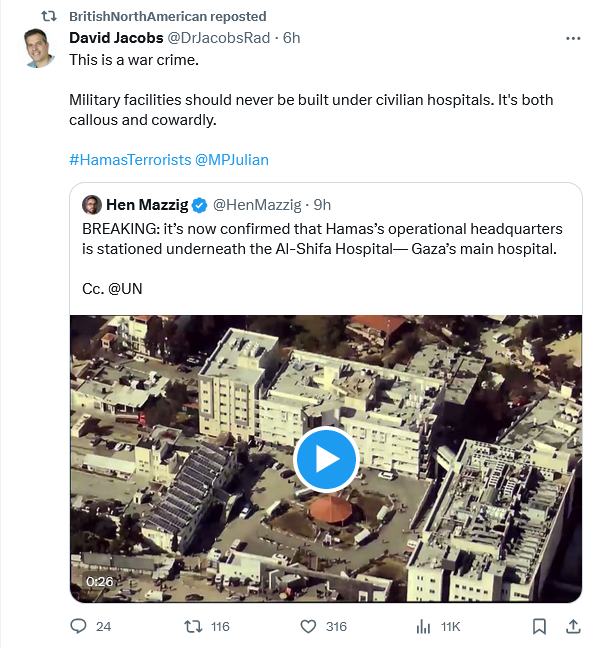
Of course, it’s widely believed that Hamas deliberately positions its facilities to make Israeli attacks less likely due to the elevated risk of unacceptable levels of collateral damage … like this:
Smith versus Smith: US Army/Marine relations in 1944
World War Two
Published 27 Oct 2023When Marine Corps General Holland “Howling Mad” Smith removed Infantry General Ralph Smith from command in 1944 during the Battle of Saipan, it began a controversy that soon snowballed, threatening to sabotage Army-Marine relations at a time when cooperation was the key to victory.
(more…)
Prototype Winchester WW1 .50 Cal Antitank Rifle
Forgotten Weapons
Published 5 Jul 2017With the advent of the tank in World War One, antitank rifles became a priority for many countries, to provide infantry with some weapon to counter the new armored threat. The best known example of these (and the only one to see significant production before the end of WWI) was the German Tankgewehr, any captured Tankgewehrs would form the basis for the US development of the .50 BMG cartridge.
This experimental Winchester rifle, made in late 1918, was part of that development. It is the only known surviving example of its type, and suffered a catastrophic failure during testing, as the receiver is cracked completely in half. The mechanism, however, is quite interesting. It uses a 1911-styled pistol grip as the bolt handle (similar to the Czech SS41 antitank rifle that would come decades later). It was fitted with a relatively large detachable box magazine and a mounting point for a telescopic sight.
(more…)
October 27, 2023
Scientific Wokemerican
In Spiked, James Esses on the formerly respected magazine Scientific American (I’ve been calling it JunkScientific American since they published a story on the “Racist Roots of Fighting Obesity”):
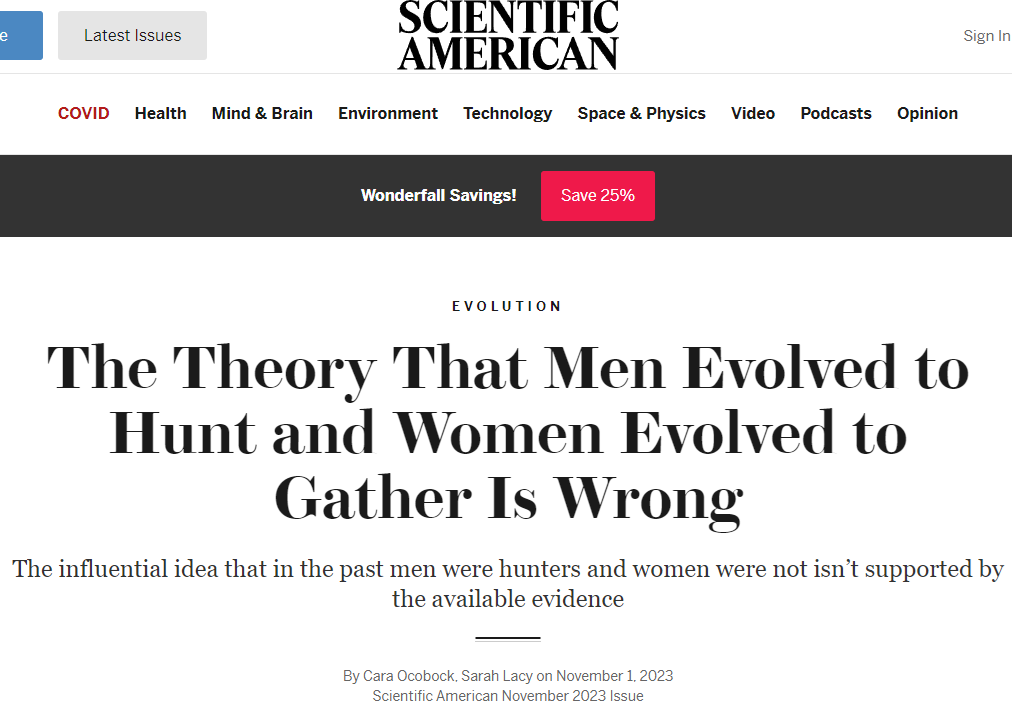
When you come across the longstanding magazine, Scientific American, you could be forgiven for assuming that scientific truth would play a pivotal role in its output.
But not any more, it seems. Scientific American, founded in 1845, is the oldest continuously published magazine in the United States. It has previously featured work by Albert Einstein, among others. However, in recent years, it appears to have been taken over by contributors who consider themselves activists first and scientists second. The magazine’s ethos now includes the express aim of “sharing trustworthy knowledge, enhancing our understanding of the world, and advancing social justice” (my emphasis). It has also started to intervene in electoral politics, too. In 2020, Scientific American broke with a 175-year history of non-partisanship to endorse Joe Biden in the US presidential election.
Worst of all, when its articles touch on questions of gender and biological sex, Scientific American seems to have abandoned objective facts entirely, in favour of trans-activist pseudoscience.
In 2019, an article by Simón(e) D Sun, who identifies as a “transgender nonbinary woman”, tells us to “Stop using phoney science to justify transphobia”. The piece is, as you might expect, filled with ideologically driven language and easily disprovable claims. For instance, it asserts that sex is “assigned” at birth when it is not – it is observed and recorded. It also suggests that “scientific endeavour is quantifiably better when it is more inclusive”. But what if “being inclusive” requires us to deny the reality of biological sex? That would surely put inclusivity at odds with science.
A patronising, finger-wagging tone runs throughout, too. At one point, readers are told to “hold onto your parts, whatever they may be. It’s time for ‘the talk'”.
Ironically, the article undermines its own premise within the first few paragraphs, as it walks readers through the clear biological differences between males and females, ranging from chromosomes to sexual characteristics to brain development. And at the end of the article, having done nothing to challenge the status quo of human biology, we are told: “The science is clear and conclusive: sex is not binary, transgender people are real”.
Of course, nobody has ever claimed “transgender people” are a figment of our imaginations. What gender-critical feminists have argued, however, is that sex is both binary and immutable – and that feeling uneasy about one’s sex is a symptom of mental distress, rather than proof of an innate gender identity that is at odds with one’s body.
And now, for its upcoming November issue, Scientific American has published another piece denying biological reality. Again, this article is peppered with ideological claims that purport to be scientific facts.
The Tale of Fat Man and Little Boy
World War Two
Published 26 Oct 2023Here near the end of 1944, we look at the development of the atomic bomb. What different methods of creating a nuclear reaction are being developed? How close are they to development? How does it work? Will they be able to make one in 1945? Will it go boom?
(more…)
Two wild-eyed optimists claim that things aren’t as bad as you think
Who lets these dangerous lunatics talk to the press? If anyone listens to them, they may get unwarranted optimistic notions that go against the narrative:

Jordan Peterson speaking at an event in Dallas, Texas on 15 June, 2018.
Detail of a photo by Gage Skidmore via Wikimedia Commons.
War is endlessly and eternally horrific. It is understandable and even necessary that the media spotlights today’s conflicts. But this can make us believe that we’re living through unprecedented violence. Russia’s war indeed meant that battle deaths in 2022 reached a high for this century, but they are still very low by historical standards. Last year, 3.5 in 100,000 people died as a consequence of war, below even the 1980s and far below the 20th-century average of 30 per 100,000. The world has in fact become much more peaceful.
This is of course little consolation to those living in conflict zones. But the data speaks to the problem with the constant barrage of contextless catastrophe and doom. Analysis of media content across 130 countries from 1970 to 2010 indicates that the emotional tone has dramatically and consistently become more negative. Negativity sells, but it informs badly.
The same pattern characterizes climate change reporting. A pervasive and false apocalyptic narrative draws together every negative event — ignoring the bigger picture almost entirely. Last summer, for example, forest fires made headlines, but coverage largely failed to mention that the annual burned global area has been declining for decades, reaching the lowest level ever last year. Likewise, deaths from droughts and floods make fill the front pages, but we don’t hear that deaths from such climate-related disasters have declined 50-fold over the past century.
The data show what we all fundamentally know: the world has improved dramatically. Life expectancy has more than doubled since 1900. Two centuries ago, almost everyone was illiterate. Now, almost everyone can read. In 1820, nearly 90 per cent of people lived in extreme poverty. Now it’s less than 10 per cent. Indoor air pollution has declined dramatically, and its outdoor equivalent has also done so in rich countries. If we could choose when to be born, having all the facts at hand, few would choose any time before today.
This incontrovertible progress has been driven by ethical and responsible conduct, trust, well-functioning markets, the rule of law, scientific innovation and political stability. We have to recognize, appreciate and proclaim the value, and comparative rarity, of each of these.
The constant barrage of negative stories may lead us to imagine that our forward progress is about to end. However, the evidence at hand does not support this conclusion. The latest Intergovernmental Panel on Climate Change scenarios indicate that, if not for climate change, the average person would be 4.5-times richer by the end of the century than they are today.


