Quotulatiousness

May 16, 2025

For some reason, men who sleep around don’t want to marry women who sleep around

Filed under: Health, Media, USA — Tags: , , , , — Nicholas @ 03:00

Young women who approach casual sex the way that young men do (or used to, anyway) are shocked to find that men don’t want to settle down in a long term relationship with a woman with a similar “bodycount”:

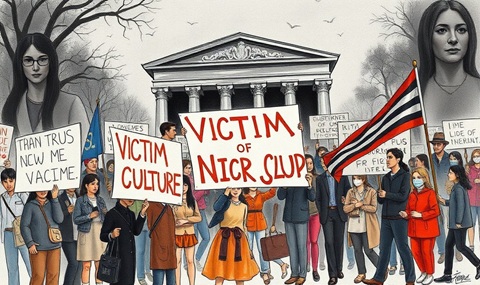
A young woman at a club with unrealistically disinterested young men.
Image generated by Grok.

First of all, men are very different than women, but guys are also fairly simple creatures.

Here are the fundamentals, ladies …

If a man sees you as a potential match, is attracted to you, you feed him, seem to want to take care of him, you’re a good mom (if you have kids), have good sex with him, are nice to him, he enjoys talking to you and you genuinely seem to think he’s great, he will think he’s the luckiest guy on earth. The great thing about all of this is that it’s mostly under your control. Yes, you might have to dress up and have some open conversations about what the two of you like in bed, but it’s a doable list. Being 6’4′ or making $500,000 per year to get some woman’s attention may be outside of a man’s control, but if a man considers a woman relationship material, she is probably capable of locking him in if she wants to do it.

Of course, like everything else in life, there is some nuance involved here.

For one thing, good sex is a key part of a good relationship, BUT unlike a lot of women, men are also generally very comfortable with the idea of having sex OUTSIDE OF RELATIONSHIPS. A lot of men can enjoy sex with women they just met, women they know they’ll never see again, or even women THEY DON’T EVEN LIKE AS HUMAN BEINGS. Men just have a biological drive toward sex, the same way, for example, a lot of dogs have a biological drive toward prey. The second my dog sees a cat; she wants to chase it. If she catches up to the cat, she doesn’t even know what to do, but she does know she wants it to run so she can have the fun of running after it. It’s an innate drive for her and most men have that same kind of innate drive around sex, even though most of us never have the opportunity to fully express it.

[…]

For example, all other things being equal, just about every man would prefer a virgin to a woman with say 50 previous partners. Why? Well, in a man’s book, being promiscuous is a huge negative in a woman you’re interested in long term for reasons great and small, fair and unfair.

Like what?

Well, first and foremost, the traditional concern is that if she’s sleeping around, how do you know your child is yours? The last thing any man wants to do is get cucked and end up spending his life raising a child some other man impregnated his wife with right under his nose. Along similar lines, the more a woman has slept around, the more likely it is that she may cheat. After all, unless you’re the absolute peak of the pyramid for men, having sex requires a lot of effort and work. For women? Not so much. She’ll have easy opportunities every day of the week, probably multiple times per day, and if she feels comfortable sleeping around, can you trust her?

How easy is it? Well, once, I remember talking to a female friend of mine who had moved to another city, was lonely, and she complained to me that she “Just needed to get laid.” I laughed at her over the phone and told her something like, “All you have to do is dress up, go to a hotel bar, look for any attractive single man, sit next to him, and talk to him for 5 minutes, then ask him to take you up to his room. You’ll be having sex 5 minutes after. It’s that easy” – and it is, for women.

We can go on. Promiscuous women are statistically less likely to stay married. You also have to think they probably aren’t going to be as satisfied in bed if they’re comparing you to a large number of men. You know, “Well, Brett had that amazing 8 pack, Jimmy was really hung, Paul could go forever, and Todd did that really cool thing with his tongue, so how good is this compared to those guys?” Furthermore, it’s natural for men to want large numbers of female partners, but not so much for women, which usually means women who sleep around have issues. How many mentally healthy, happy women are racking up truly large numbers of guys? Not many.

May 13, 2025

Gout – The Disease of Kings

Filed under: Europe, Food, Health, History — Tags: , , , , , , — Nicholas @ 02:00

Tasting History with Max Miller
Published 7 Jan 2025

Sliced roast venison with a spiced red wine sauce and a sprinkling of salt

City/Region: England
Time Period: 1723

Gout has plagued people for thousands of years, but mostly the rich people. It often follows an indulgent diet full of red meat and alcohol, so for a long time only the rich had regular access to a gout-inducing food.

This recipe from 1723 is delicious, as well it ought to be as it flies in the face of the rules you should follow to prevent gout with venison (red meat) served with a wine sauce (alcohol). Venison is best when it’s not cooked past medium, and this recipe is tender and flavorful with the rosemary coming through. The sauce could really go on anything, and you could swap out the red wine for something different. Port would be delicious, though I would reduce the amount of sugar a bit.

I don’t expect most people will have a larding needle on hand, and I think you could probably skip the larding and still end up with a flavorful, tender dish.

    To roast a Haunch of Venison.
    First lard it with Bacon, and stick it thin with Rosemary; then roast it with a brisk Fire; but let it not lye too near it; bate it with fresh Butter; then boil a Pint of Claret with a little beaten Ginger, Cinnamon and Sugar, with a half a dozen whole Cloves, and some grated bread; and when they have boil’d enough, put in a little Salt, Vinegar and fresh Butter; dish your Venison, strew Salt about the Dish, and serve it with this Sauce.
    The Cooks and Confectioners Dictionary: Or, the Accomplish’d Housewives Companion by John Nott, 1723

(more…)

May 11, 2025

The devastating toll of Trump’s reckless plan to dismiss transgendered members of the armed forces

Filed under: Government, Health, Media, Military, Politics, USA — Tags: , , , , , — Nicholas @ 05:00

Chris Bray called this to our attention back in November, as President-elect Donald Trump foolishly planned to purge the US military of transgendered troops, regardless of the vast impact it was predicted to have on military readiness:

We’ll practically have no military left! It would be like a whole infantry division suddenly just vanishing: 15,000-plus transgendered service members.

You’re going to see this number a lot in the weeks ahead. The New Republic, today: “Donald Trump’s plan to ban transgender people from the military would have a devastating effect: At least 15,000 members would be forced to leave.”

That number comes from a 2018 report by the now-defunct Palm Center, a pro-LGBT independent research institute in California, which reached this conclusion: “Transgender troops make up 0.7% (seven-tenths of one percent) of the military (Active Component and Selected Reserve)”. Their best guess about a total number: 14,707. The media is just rounding that number up to the next thousand.

And … Chris Bray follows up on his November post, documenting the huge, unimaginable scale of long-term damage to US military preparedness:

As the new Trump administration prepared to issue an order forbidding transgender people to serve in the armed forces, a bunch of profoundly stupid news stories issued panicked warnings that military readiness would DEVASTATED by a giant purge of at least 15,000 transgender servicemembers, the very core of our military strength. Warplanes grounded! Ships trapped in port as all their trans sailors were tossed out! Whole artillery batteries sitting silent! […]

The removal of trans servicemembers would inflict such a ghastly crisis on the armed forces that it would take twenty years to recover our military strength! Destruction and ruin and crisis and collapse!

[…]

Now the removal of transgender troops is actually underway, and guess what?

The number is “up to” 1,000. It’s in the hundreds.

So. When — quite recently! — dozens of panicked news stories reported as fact that 15,000-plus transgender servicemembers were about to be purged, the news was frankly and nakedly a complete invention. They made it up. They sold an invented panic. The “news” was entirely fake.

Remember that, and apply that lesson widely.

May 9, 2025

QotD: Becoming a parent

Filed under: Business, Health, Quotations, USA — Tags: , , , , , , — Nicholas @ 01:00

I know lots of female professionals — doctors, lawyers, professors, etc. — many of whom are quite good at their jobs. Let’s even, for the sake of argument, stipulate that they’re slightly better than their male colleagues. Leaving aside the thorny (and probably unanswerable) question of just how you’d rank, say, doctors — is strength of schedule a factor? do we trust the coaches’ poll? — the real question is, does society benefit more from a slightly-better, but childless, female MD, or from an excellent stay-at-home mom? Or a pretty-good nurse who works part time while the kids are in school?

Younger folks are no doubt shocked by that question, and if some BCG were ever to read this, she’d try to string me up, but it’s the only question that matters long term. The BCG would start sputtering some question about “what about her happiness?” — the only answer to which, if you want to maintain a stable society, must be: “Category error”. It’s like “staying together for the kids”, another phrase we oldsters recognize, but the younger generation can’t grok. But … but … but … whaddabout your feeeeeelings?

What about them?

Seriously: Who gives a shit? Viddy well, oh my brothers: When you decided to have kids, you didn’t hit the pause button on some video game RPG called “Your Career”; you ejected the disk, snapped that fucker in half, and smashed the Xbox Office Space-style for good measure. What’s good for you, personally, just got sent to the back of the line. Permanently. Yeah yeah, I know, you can’t fulfill your parental obligations if you’re completely miserable all the time, but you can find lots of joy and meaning and yes, even fulfillment (that most insidious of modern weasel words) doing stuff other than making partner down at the law firm.

Men used to understand this, because men were once trained to take the long view, to delay gratification, to suck it the fuck up for the greater good. It’s the same gene — and it IS genetic, 1,000,000+ years of evolution — that causes men to charge bullets or punch kangaroos or do whatever else needs to be done in the face of obvious threats, even at the risk, or even the near certainty, of his own injury or death.

Women don’t roll like that, because they can’t — “that 1,000,000+ years of evolved behavior” thing again. They’re evolved to put the kids first — their kids, not some abstract ideal. Women can be, and often are, suicidally brave — for their own offspring. But absent those — absent the possibility of those — all those maternal instincts go septic, which is how you get the BCG. She knows she’s not cut out for this, no matter how successful she is academically — indeed, in my experience it’s precisely the most academically successful ones who sense it the clearest.

Alas, they are trained that feminism is the answer to those inner alarm bells, so they carry on like caricature cavemen — being as crude and offensive and obnoxious as possible, trying to treat sex like an itch to be scratched while beefing with that basic bitch Becky on the next dorm block.

Severian, “Gettin’ Jiggy in College Town”, Founding Questions, 2021-10-08.

May 4, 2025

QotD: Women and depression

Filed under: Health, Quotations — Tags: , , , , — Nicholas @ 01:00

    Why wouldn’t powerlessness cause depression in women too?

Well, in a backwards sort of way it actually does.

The difference is this: women feel powerful when they are loved, and powerless when they are not, because their instinct wiring tells them that safety lies in being able to form social coalitions and attract a strong mate.

Women, in general (there are always outlier exceptions) don’t get major antidepressive help from just going outside and chopping up a cord of firewood, the way men do. Because the woman’s game is to give a man a good reason to chop firewood for her.

It’s when she can’t do *that* that she feels powerless.

ESR, Twitter, 2024-05-06.

April 25, 2025

What Were Georgian Attitudes Towards Sex? | Georgian Pleasures

Filed under: Books, Britain, Health, History — Tags: , , , , , — Nicholas @ 02:00

History Hit
Published 12 Sept 2024

Historian Dr Kate Lister removes Bridgerton‘s rose-tinted glasses, unlaces the corsets and unbuttons the breaches of the Georgians. Join Kate as she investigates how s*x and the world of celebrity were a big thing long before the 20th century.

The fabulous wealthy elite of Bridgerton look perfectly preened, their teeth, hair, make up, even their sex scenes are all filled with opulent glamour! But in reality a lot of people in Georgian society, including the wealthy, were dealing with a myriad of issues, from syphilis, teeth decay and scandals to laudanum and gin addictions. All of this would have been rife and incredibly visible on the big city streets during the booming industrial revolution.

Kate uncovers what went on betwixt the Georgian sheets: who’s doing what, where, how and with whom. Along the way she’ll explore extraordinary guides to s*x work in London and Edinburgh and unwrap the world of 18th century condoms, syphilis and even high profile and hidden sex clubs. All of this will help to unearth the real lives of the people stomping the streets, pubs and back alleys of these lavish Georgian cities. No stone is left unturned in the quest to reveal the real lives of Georgian society!
(more…)

April 23, 2025

QotD: Why most westerners aren’t having kids

Filed under: Health, Quotations, USA — Tags: , , , , — Nicholas @ 10:05

[Jane:] So what do you think? Why don’t more people [have kids]? Why are we so weird?

John: I am a simple man, and prefer simple (preferably materialist) explanations. It’s effective birth control, duh.

Oh, I’m sure all the stuff [Family Unfriendly author Timothy P.] Carney talks about in his book plays some role. All the economic factors and the regulatory factors and the changed social expectations and the lack of sidewalks, and the blah blah blah. But why did those things all happen, all of a sudden? It’s actually very simple — now you can have sex without children necessarily resulting.

The correct way to view all the changes that Carney lists is as a sort of transmission belt that has slowly and inexorably propagated and magnified the effects of the one, very simple technological change that occurred. The story goes something like this: birth control is introduced, but large families are still normative and supported by generations of cultural accretion. So people still have an above-replacement number of kids, because they remember their mothers and grandmothers having 10 or 12 kids, and because society is still basically set up for families. But time passes, and culture gradually shifts to accommodate material reality. Law and economics follow culture. The next generation remembers their parents having 3 or 4, and maybe manages 1 or 2 themselves. The fewer people are having lots of kids, the less of a constituency there is for having lots of kids, and the harder society makes it, further turning the screws on marginal parents.

One objection from those who disdain the simple, materialist explanation is that the change didn’t happen overnight. The transmission belt theory nicely addresses this — it doesn’t happen overnight because societies have culture, and culture has inertia. Even insanely messed-up cultures that are inimical to human flourishing are hard to change. A residual, pro-childrearing cultural hangover can last for a while after the facts on the ground shift, and means people keep having babies for a little while. But it can’t last forever. Eventually it crumbles.

The other big objection to this theory, one Carney raises himself, is that if you do surveys of people, especially women, they report having fewer children than they want. So, the argument goes, it can’t just be birth control, because if it were people would have all the kids they want. But the answer to this is so obvious I’m shocked it isn’t apparent to Carney. People have high time-preference. People procrastinate. People are really bad at doing things which are hard in the short-term but make you happy in the long-term. The great thing about unprotected sex is that it connects your short-term and long-term happiness. As soon as you have the option to not have a baby right now, this time, it’s awfully tempting to say: “you know, I totally want all the diapers and spit-up eventually, but not this time, maybe next time”. In other words, people only reach the actual number of children they want via happy accidents or, in the old days, by having all thoughts of long-term consequences banished by good old-fashioned lust. This is literally why evolution made sex fun. The position of having to make an affirmative decision to have a baby is completely unnatural, and sometimes I’m amazed that anybody does it at all.

So you wind up with people like the friend I mentioned at the end of this book review (who, by the way, a year and a half later is still no closer to having a baby). Desperately wanting a child, sort of, but too neurotic or hesitant or conflicted or something to do it. In the old days, it would have been simpler, because they wouldn’t have had a choice. Biology would have made the decision for them, and a few years later they’d be happily bouncing a baby on their knee (or miserably bouncing a baby, whatever, the point is they’d have a baby). I really think that’s all there is to it. What truly blows my mind is that Carney wrote an entire book about this stuff while barely mentioning birth control (and only discussing its second-order cultural effects when he did). Presumably he had orders from his Jesuit masters to avoid the topic lest his cover be blown.

Jane and John Psmith, “JOINT REVIEW: Family Unfriendly, by Timothy P. Carney”, Mr. and Mrs. Psmith’s Bookshelf, 2024-10-14.

April 22, 2025

QotD: Fear, uncertainty, and doubt from the Reagan era

Filed under: Health, History, Humour, Media, Quotations — Tags: , , — Nicholas @ 01:00

Leafing through an old Idler magazine, during my own compulsory isolation, I was reminded of the scary age of Reagan. If my reader is old enough, he will remember nuclear annihilation. Did I know, I was then told, that the superpowers had enough A-bombs to vaporize everyone on the planet ten times over? — provided they were efficiently deployed, and we all held still. But as I argued then, there were other terrifying threats to human life.

“There is, for instance, enough water in the planet to drown everyone four thousand times; there are enough matches to set fire to every wooden building; enough kitchen knives to murder all the husbands of the world; enough hairspray (if drunk) to poison all their wives; enough pillows to smother the entire population of Asia; enough pencils to put out everyone’s eyes; enough fishbones to choke the combined population of France and Italy; enough ties, belts, suspenders, and pyjama draw strings to hang everyone over the age of forty; enough cigarettes (if eaten) to make everyone in Africa south of the Sahara throw up; enough stairs for all the toddlers in the world to fall down; enough statues to crush the inhabitants of the fourteen largest cities in the American Midwest; enough piano wire to garrot three-quarters of the population of Roumania; enough frozen lamb chops to club to death the entire Scottish aristocracy.”

Granted, the weight of human suffering. Granted, that we all progress to biological death, after a brief illusion of invincibility. But would it be entirely irresponsible, to dance our way through the interim? Even while the vultures are circling in the sky?

David Warren, “Be afraid, be very afraid”, Essays in Idleness, 2020-04-14.

April 17, 2025

Canadian labelling regulations save us from “too many vitamins”

Filed under: Australia, Britain, Bureaucracy, Cancon, Food, Government, Health — Tags: , , , , — Nicholas @ 03:00

In the National Post, Jesse Kline points out that Canadian food label regulations have become so nit-picky that they prevent safe and accurately labelled foods from Australia, Britain, and other countries from being sold here:

Marmite from the UK and Vegemite from Australia, two of the products at risk of Canadian over-regulatory twitches.

Shortly after winning the Liberal leadership, Mark Carney travelled to Paris and London to shore up our trading relationship with our European allies.

Yet it is noteworthy that Canada is one of only two countries that has not yet ratified the United Kingdom’s accession into the CPTPP, meaning that we don’t enjoy the benefits of free trade with the country with whom we share a system of government and a King. Meanwhile, France is one of a handful of countries that has yet to ratify the free-trade agreement between Canada and the EU.

If we can’t even agree to implement trade deals that have already been negotiated and agreed upon with countries that have such deep historical ties to Canada, what hope do we have of improving trade with our other partners around the world?

Part of the problem is that Canada refuses to follow the example of countries like Australia and New Zealand, which successfully phased out their own systems of supply management years ago with great success.

As a result, supply management has proven to be a sticking point in virtually every trade negotiation we’ve entered into, and is a constant source of tension even among countries we have free-trade deals with.

But we have also fallen into the trap, along with our European friends, of over-regulation. Modern bureaucratic states impose so many restrictions on commercial enterprises, it often becomes uneconomic to market their products in other countries.

Canada, for example, imposes stringent labelling requirements to ensure product information is available in both English and French, and that nutritional information conforms to our very specific requirements.

None of this is necessary, especially in an age in which we can hold a phone up to a box of French crackers to see what it says. But the problem extends far beyond language or disagreements over the recommended daily intake of fibre.

As the CBC reported on Monday, Leighton Walters, an expat from Down Under who owns several Australian-themed coffee shops in the Greater Toronto Area, was told earlier this year by the Canadian Food Inspection Agency (CFIA) that he was no longer allowed to sell the roughly $8,000 worth of Vegemite he had imported because it contains … too many vitamins.

Under current regulations, only a select list of products are allowed to contain added vitamins. Vitamin B-rich spreads like Vegemite and its British equivalent Marmite are not among them because … well, just because.

A similar situation arose a decade ago when reports that the government had ordered Marmite and the Scottish drink Irn-Bru to be taken off the shelves of a British supermarket in Saskatoon caused outrage on both sides of the pond.

The CFIA later clarified that only versions of those products formulated specifically to meet Canadian requirements — i.e., those that don’t contain added vitamins or a specific type of food colouring — are allowed to be sold in this country. Because heaven forbid we trust that other advanced Commonwealth nations would have reasonable enough food safety standards.

We have quite literally regulated ourselves into a corner. We can’t even import spreads like Marmite and Vegemite — which have been staples of British and Australian diets for decades — not because they’re unhealthy or unsafe, but because they don’t conform to our nit-picky regulations.

April 16, 2025

The “medicalization” or “syndromization” of aspects of the normal human condition

Filed under: Health, Media, USA — Tags: , , , — Nicholas @ 05:00

On his Substack, Freddie deBoer wonders why we can’t be honest about the rise of bespoke “mental disorders” that look remarkably like typical human reaction to stimuli:

I just found a cost-free way to farm sympathy and attention 😊

I will never not be fascinated by those issues or arguments or perspectives that are studiously ignored by the media generally and the New York Times in particular. I’ve whinged about this many times when it comes to education, as the NYT is simply not going to consider the notion that different individual people have fundamentally different levels of academic potential in its pages, not even in an attempt to rebut the idea. I suppose that notion is just too challenging to the elite meritocratic liberalism that the Times epitomizes; the idea that we are all ultimately capable of achieving academic and professional greatness flatters the high-achievers who read and write the paper, and the “anyone can be anything” ethos is pleasant and unchallenging. It’s also destructive, which is the point. Bad ideas grow like weeds in the shade, or whatever the saying is. Disability issues are another place where the Grey Lady is very picky about what ideas to consider, and as usual they set the rhythm for many other publications.

This weekend the Times released a long piece looking at the ever-escalating rates of ADHD diagnoses and what exactly they tell us. What’s in the piece is fine — of course, the ADHD activist class doesn’t like it — but what’s remarkable is what isn’t in it. Once again, there’s just about zero consideration of ADHD as a social contagion, any recognition that there is now a vast and deeply annoying ADHD culture online that acts as a kind of evangelical movement for a neurodevelopment disorder. There are millions of people on ADHD TikTok and ADHD Tumblr and ADHD Twitter. There’s a vast universe of facile memes, dubious statistics, and self-flattering nostrums about ADHD floating around out there, and increasingly they’re penetrating into broader internet culture. (I am genuinely unaware of a subculture that is more directly and shamelessly self-celebrating than the online ADHD community, and I’ve read the comments at LessWrong.) Unsurprisingly, a big subsidiary industry has sprung up, with all kinds of products and services for sale, books and apparel and tchotchkes and conferences and boutique forms of therapy and exclusive members-only Discords … Whether neurodevelopmental disorders should have merch is an open question. What’s not subject to questioning is that this is happening. Five minutes of cursory searching would reveal the remarkable scope of online ADHD culture.

And yet the piece’s author, Paul Tough, is just about totally silent on this glaring reality. I find it genuinely bizarre. In a long and rambling (in a good way) piece where he kicks the various rocks of ADHD and asks good-faith questions about how diagnostic rules and social perception of the disorder influence medical practice, he still somehow fails to ever refer to the large, influential, and growing online movement that has raised the profile of the disorder even beyond its prior notoriety and in doing so injected a ton of money into the equation. You can dismiss that community as an online sideshow if you choose, but of course the online world has become profoundly influential on real life, and in other contexts neither the New York Times specifically nor the elite media generally has any problem acknowledging that fact. Why not here?

This tendency extends beyond ADHD. Recently Holden Thorp, editor in chief of the prestigious journal Science, wrote an essay for the NYT that explores the rise of autism diagnoses, which have expanded at truly ludicrous rates. To the extent that it’s referenced at all, the idea of social contagion is dismissed without argument. A couple years ago the Times published a piece by Azeen Ghorayshi about the absurd case of Tourette’s spreading (or “spreading”) among too-online adolescent girls via TikTok; though Ghorayshi is admirably clear that those young women did not in fact have Tourette’s, her piece is also slavishly, almost comically sympathetic to them, never bothering to suggest that maybe these were just bored teenagers who engaged in a frivolous and offensive bit of minstrelsy. (Imagine, judging teenagers for doing something stupid!) The idea that anyone could ever have unserious and wrongheaded motivations for adopting a disability seems to be one of those stories that the New York Times absolutely refuses to tell.

But why? People make up fake illnesses all the time, both consciously and unconsciously. Factitious disorders are real; we have references to what we might now call psychosomatic illnesses that stretch back to antiquity. Munchausen by internet is real. Hypochondria, factitious illness, Munchausen’s, the worried well … these have represented a major challenge for psychiatry for as long as the field has been formalized and integrated into the larger medical project. Why does no one ever talk about this stuff in our stuffy elite publications? Why do so many people in our media dance and shuffle rather than ask direct questions like “How many of these diagnoses are fundamentally faulty?” Why can’t anyone point out that saying you have a medical disorder is a shortcut to getting sympathy and attention, and that human beings crave sympathy and attention the way they crave water and air? We’ve lived through something like a “vibe shift,” and previously-unchallengeable social justice pieties are increasingly challenged, in good ways and bad. Yet under the broad umbrella of disability rhetoric, it’s always 2018, with both traditional and social media operating under a cloud of fear of giving offense. As I’ve said many times, the number of people who privately agree with me about all this is legion. The number who are willing to say so publicly are very few indeed. Nobody wants to paint that target on their back, I suppose. But why do these issues make people feel like targets at all?

April 10, 2025

QotD: Epicurus on death

Filed under: Health, History, Quotations — Tags: , , — Nicholas @ 01:00

If it is to succeed, Epicureanism must deliver us not only from physical pain but also from anxiety and mental anguish. The prospect of death, Epicurus knew, upset many people. Hence he and his followers expended a great deal of effort trying to remove the sting, the fear, from the prospect of death.

Epicurus offered two things to battle the fear of death: an attitude and an argument. The attitude was one of mild contempt: the right sort of people, he implies, do not get in a tizzy about things, not even about death. The argument is equally compelling. “Get used to believing,” he says, “that death is nothing to us.”

Why?

Because all good and bad consist in sense experience. Death is the absence of sense experience. Therefore, “when we exist, death is not yet present, and when death is present, then we do not exist. Therefore it is relevant neither to the living nor to the dead, since it does not affect the former, and the latter do not exist.”

How convincing is this?

Not very. Even if one were to grant the materialism that Epicureanism assumes, one might object that what one resents about death is not the simple absence of sense experience but the loss of the world: one’s friends, engagements, duties, involvements, as well as the panoply of sense experience that attends living.

Death also brings with it the prospect of pain and suffering: few of us can count on a pain-free exit, and that fact also helps to account for the bad reputation death has among non-Epicureans.

Finally, Epicurus and his followers say “death is nothing to us,” but they leave out of account the fact that human beings exist not simply as individuals but as part of a network of family, friends, and a larger community.

Epicurus taught that “self-sufficiency is a great good”. But who, really, is self-sufficient? Let’s say you are married with young children. Your death, quite apart from the inconvenience it might be thought to cause you, would also gravely affect your spouse and children.

There is not much room from children or spouses in the Epicurean philosophy. Why? Because they threaten to compromise the ideal of self-sufficiency. At bottom, Epicureanism is a workable philosophy only for a small subset of people. You must be unafflicted by life’s tragedies: grave poverty or illness or oppression makes being an Epicurean difficult. You must also be largely unafflicted by deep passions. A profound love of life is incompatible with Epicureanism, as is a profound love of one’s children.

The true Epicurean is more of a spectator of than a participant in life. The Roman poet Lucretius (c. 99-c. 55 BC) was one of Epicurus’ greatest disciples. In his long paean to Epicureanism “De Rerum Natura” (“On The Nature of Things”), Lucretius extolled the great sweetness of disengagement, of becoming a spectator rather than a participant in life. In a famous passage, Lucretius warns that “medio de fonte leporum surgit aliquid amari quod in ipsis floribus angat” — “even in the midst of the fountain of pleasure there is something bitter that torments us in the midst of our flowering”. Hence it is better to step back, to watch “the clash of battle / Across the plains, yourself immune to danger”.

One is left with two questions. The first is whether the immunity that Lucretius (like Epicurus) promises is real or illusory. Can we really remain mere spectators of our lives? The second question is whether, even if possible, such disengagement is finally desirable. Perhaps some battles can only be won by engaging with the enemy.

Roger Kimball, “Coronavirus, Flynn and Epicureanism”, American Greatness, 2020-05-02.

April 8, 2025

Mark Carney explained how he viewed the world in his book Values

It’s worth considering what Mark Carney wrote about his beliefs before becoming prime minister and how he’s campaigning right now:

For those who haven’t had the misfortune of parsing through Mark Carney’s Values, it reads like a sermon from a high priest of globalism — polished, preachy, and packed with ideas that should send shivers down the spine of anyone who cares about Canada’s economy, especially Western energy producers.

Writing as the former Bank of Canada governor and a darling of the Liberal elite, Carney pitches a vision of “sustainable finance”, net-zero absolutism, and heavy-handed regulation. To the National Citizens Coalition, it’s clear: this isn’t a roadmap to prosperity, it’s a wrecking ball aimed at the heart of Canada’s resource sector and the West’s economic lifeline.

Start with Carney’s obsession with “revaluing value”. In Values, he argues markets should prioritize climate goals over profit, pushing financial institutions to choke funding for oil and gas.

For Alberta and Saskatchewan, where energy employs tens of thousands and pumps billions into the economy, this is a death knell dressed up as virtue.

Western producers aren’t just businesses; they’re the backbone of communities, powering schools, hospitals, and homes. Carney’s disdain for fossil fuels ignores their role in keeping Canada competitive while our allies and adversaries keep drilling. His plan? Starve the sector, stranding assets and jobs, all to appease international green lobbyists in European nations with nationalized economies on the road to being as disastrous as Canada’s.

Then there’s his love affair with regulation. Values champions policies just like Bill C-69 — the “No More Pipelines Bill” — which Carney has refused to repeal. He sees it as a tool to enforce his net-zero utopia, but for the West, it’s a padlock on progress. Pipelines that could carry Canadian oil to global markets sit stalled, leaving producers at the mercy of low prices, foreign competitors, and now, tariff threats.

Carney’s mental framework both then and now doesn’t just stop projects, it signals to investors that Canada’s energy sector is a no-go zone. The result? Capital flees, jobs vanish, and the West pays the price for the lofty ideals of a London and Manhattan banker, who spends only part of his time in Canada — specifically, Ontario and Quebec.

Dan Knight on Carney’s swing through some British Columbia ridings this week:

A mock campaign sign for the Liberals spotted on social media.

Mark Carney rolled into Victoria this week with the swagger of a man who’s never missed a wine-and-cheese reception in his life and delivered what the Liberal brain trust likely considers a “bold vision” for Canada. But peel back the banker buzzwords and Churchill cosplay, and what you really got was a cringeworthy display of delusion, detachment, and recycled globalist dogma.

He opened his mouth and immediately signaled his marching orders: “clean energy”. Not once. Not twice. It was practically every other sentence. Because when you’re out of ideas, just say “green transition” on repeat and hope nobody checks the receipts.

He’s not just pushing the same failed Liberal climate ideology — he’s doubling down on it.

Carney promised to turn Canada into a “clean energy superpower” — without explaining how, exactly, we get there when his party has spent years shutting down oil and gas, blocking pipelines, and handing our resource wealth to the Americans.

This wasn’t new policy. It was the same Liberal fantasy that has already gutted Alberta, choked investment, and driven electricity prices through the roof — just ask Europe how that’s going. And when it comes to reopening auto plants or restoring manufacturing jobs? Nothing. Not a plan, not a word, not a clue.

And don’t worry — when Trump’s tariffs hit our industries, Carney says we’ll respond with “retaliatory tariffs”. Sounds tough, until you remember who actually pays those. Working Canadians. Line workers. Parts manufacturers. People trying to keep the lights on while Ottawa plays global economic chicken.

Carney’s big idea for recovery? Just keep handing money to the Liberal-connected elite.

He promised to “give back” — and by that, he means pouring another $180 million into the CBC, the same taxpayer-funded mouthpiece that’s been running interference for the Liberals for nearly a decade. This comes after ArriveCAN, the $60 million QR code boondoggle funneled through Liberal contractors, and countless other slush funds masquerading as “public service”.

While the working class is bracing for a made-in-Ottawa recession, Carney’s pledging more green slogans, more centralized control, and more taxpayer money to keep the illusion alive.

March 29, 2025

QotD: Becoming a human being

Filed under: Health, Quotations — Tags: , , , — Nicholas @ 01:00

“So how does it feel to be a human being now?” That wasn’t the question I expected to get from my aunt, the first time I saw her after my oldest kid was born. For starters she was a feminist, a prominent academic1 with several books to her name, and somebody who’d always struck me as mercilessly unsentimental. “Do you get it now?” she pressed on. “Before this your life was in shadow, it was fake. Now you’re in the sunlight, now it means something.”

She had kids, so despite having some ideological resistance to getting it, she got it. I got it too. It’s hard to describe what “it” is if you haven’t gotten it, but I’ll try to explain. The moment I first held my child, I had a vision of every human being who had ever done the same. I stood paralyzed, rooted to the spot while before my eyes a whole field of ancestors stretched back into the forgotten past, each cradling a baby just like I was doing. What was I without them? Nothing at all. A cosmic joke, a fluke, or a random collection of atoms. But with them, I was one stage of a process, a chapter of a story.

And not only that, but I was also no longer alone. It had always seemed to me that the problem of intersubjectivity could never be conquered, that between minds there yawned an unbridgeable epistemic chasm. Yet here was an experience that I shared with countless others from the most varied places and times, an experience I shared with emperors and with slaves. André Maurois once said: “Without a family, man, alone in the world, trembles with the cold”. I had always thought he meant this in a practical, or perhaps an emotional sense, but I now realized it was even truer cosmically. I had, as my aunt said, become a human being.

I didn’t just see the past. In that moment, the future also resolved itself into dreadful clarity. I had always known intellectually that someday I would die, and that the world would continue mostly as it had, but I never really believed it. Anything beyond the horizon delimited by my lifetime had been hazy and indistinct. Not anymore. Now I regarded the newborn squirming in my arms, and knew with absolute certainty that if things went well this child would bury me, and then continue living. Suddenly the far-future mattered, I had skin in the game now. I was no longer a temporal provincial, past and future both had an immediate and urgent reality, and I knew that I would never think the same way about them again.

John Psmith, “REVIEW: The Children of Men by P.D. James”, Mr. and Mrs. Psmith’s Bookshelf, 2023-04-17.

    1. This was in the days before cancellation, I’ve often wondered since then whether she would have allowed herself to think the thought today.

    2. It also caused me to wonder whether people without living descendants should be permitted any political representation at all.

March 27, 2025

QotD: Did humans domesticate plants, or was it the other way around?

Filed under: Books, Environment, History, Quotations — Tags: , , — Nicholas @ 01:00

In Sapiens: A brief history of humankind, Yuval Noah Harari locates the agricultural revolution to a period roughly some 10,000 years ago when humankind, having survived as a hunter and forager for over two million years, began to domesticate various plants and animals, thus to have a better control over its food supply. Harari calls this revolution “history’s biggest fraud” because he believes that what actually happened here is that plants, like wheat, domesticated human beings rather than the other way round, crops turning people into its willing slaves. Humans ended up doing back-breaking work in the fields so that crops like wheat could spread themselves over every corner of the planet.

Of course, the cultivation of crops enabled human beings to produce far more calories per unit of territory than foraging ever could. And this enabled the human population to expand exponentially, thus putting even more pressure on the food supply, thus necessitating an even greater emphasis on agriculture. Alongside this deepening spiral there were other unintended consequences as well. As Harari puts it: “Nor did the farmers foresee that in good years their bulging granaries would tempt thieves and enemies, compelling them to start building walls and doing guard duty”.

Giles Fraser, The Magnificent Seven is a post-liberal idyll”, UnHerd, 2020-04-01.

March 26, 2025

QotD: Therapy that works for women doesn’t necessarily work for men

Filed under: Health, Quotations — Tags: , , — Nicholas @ 01:00

The most important thing I’ve learned about human psychology in the last five years: therapy for depression in men is usually mistargeted and ineffective because therapists think men are like women, who become depressed because they don’t feel loved.

This is completely wrong. Men cope with feeling unloved relatively easily. What destroys them is feeling powerless.

So yeah. Swing a sword. Restore a steam engine. Climb a rock. Do something — anything — that asserts your competence and control over your environment.

For men, this is much better therapy than talking about feelings.

ESR, Twitter, 2024-05-06.

« Newer PostsOlder Posts »

Powered by WordPress