
Feral Historian
Published 8 Aug 2025Vernor Vinge’s A Fire Upon The Deep would take a two-hour video to completely dissect. This is not that video. Instead, I’m looking just at the recurring ideas of collective identity and distributed consciousness. And all without a single mention of Skroderiders.
This one has been sitting around for about a year, due to lack of b-roll to cover the numerous jumpcuts due to my rambling and the rather persistent flies on that particular day. It’s a little rough, but let’s just roll with it.
(more…)
December 14, 2025
A Fire Upon The Deep and the Identity Gradient
Comments Off on A Fire Upon The Deep and the Identity Gradient
December 12, 2025
Starships and Walls : Which Shall We Build?
Feral Historian
Published 25 Jul 2025While faster than light travel may be impossible, proclaiming absolutes based on the understanding of a particular time has a spotty record. But even if we are limited to sublight travel by the fundamental nature of the universe, we as a civilization have several macro-level choices to make, one of the most significant being which foundational concept do we want to build a future on: Ships? Or walls?
00:00 Intro
01:50 The Athenian Sailor
05:25 Frontiers
06:00 Assuming it’s Impossible
07:26 Picard Without Starfleet?
09:40 Culture over Economics
15:28 Founders of Worlds🔹 Patreon | patreon.com/FeralHistorian
🔹 Ko-Fi | ko-fi.com/feralhistorian
Comments Off on Starships and Walls : Which Shall We Build?
December 4, 2025
“… the biggest problem facing disabled people is that they aren’t eager enough to call themselves disabled”
On his Substack, Freddie deBoer decries the New York Times viewpoint that “there is no such thing as a person, only beings that exist to function as sets of interlocking identities”:
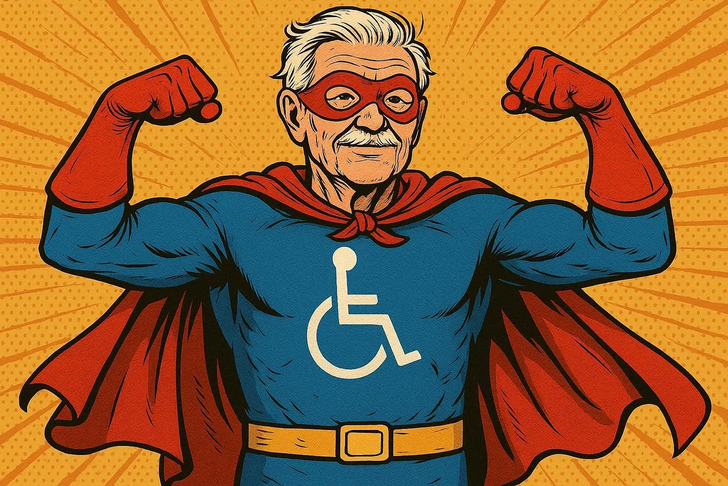
(you would find this horribly condescending too)
Image from Freddie deBoer
I’m not joking! Paula Span has produced this particular bit of scolding for The Official Publication of Liberals Who Occasionally Look Up From Their Crosswords to Disapprove of Everyone and Everything. Span writes
Identifying as a person with a disability provides other benefits, advocates say. It can mean avoiding isolation and “being part of a community of people who are good problem-solvers, who figure things out and work in partnership to do things better”
Of course, you can enjoy those benefits without identifying as disabled, without allowing one unfortunate aspect of your life become an entire identity. But that doesn’t fly in the world of the brownstone liberals who fund and run the New York Times, who seem to believe that there is no such thing as a person, only beings that exist to function as sets of interlocking identities.
Here’s the maddening thing about this piece: it quietly smuggles in a worldview that has metastasized across the discourse, a worldview in which the biggest problem facing disabled people is that they aren’t eager enough to call themselves disabled. Not, you know, being blind or paralyzed or suffering from dementia or constantly wracked with chronic pain, no, all of that is subservient to the only question anybody seems to care about anymore, the all-devouring question of identity. The whole thing hums along with the cheery institutional conviction that the answer to every human frailty is more identitarian self-labeling. If only the elderly would embrace the capital-D Disability identity, we’re told, everything would be better — their health care would run smoother, their interactions with institutions would be less demeaning, their sense of community would blossom. Maybe they’d even be happier! The Times treats this as self-corroborating common sense, like, well, everything else argued in the New York Times.
What this kind of thinking actually represents is the natural endpoint of a cultural project that has turned medical pathology into a personality type. It’s the codification of a worldview where suffering is not something to address, treat, alleviate, or recover from, but a new kind of boutique identity, complete with community membership, branded discourse, and moral status. It turns vulnerability into a form of social currency, rewarding performance over authenticity and turning genuine suffering into a spectacle for peer validation. In doing so, it erodes the very possibility of meaningful treatment, because the focus is no longer on recovery or well-being, but on cultivating a carefully curated self-image that fixates on impairment. And what I think, as I read this person tut-tutting senior citizens for not embracing that new ethos, is “Maybe they just feel like they’re too fucking old to take part in such nonsense?”
The piece insists, without evidence or even really argument, that treating disability as an identity will improve access to accommodation. Disability accommodations matter; of course they do. But what this article is concerned with is patently not getting older adults the practical support they need. The piece is instead fixated on the idea that the real issue here is that people don’t want to be disabled in the metaphysical, self-defining sense, as though the reluctance of an 84-year-old to call herself Disabled-with-a-capital-D is some retrograde psychological failure rather than a perfectly sane human impulse born of a lifetime of struggle. Span frames this as a story about insufficiently enlightened seniors who need to be ushered into the disability “community”. But maybe the reluctance they’re describing is the whisper of something older and much wiser: the understanding that disability is not a polity you join, not a club whose membership conveys special epistemic authority, but a condition of life that you endure and attempt to mitigate. These older people don’t identify as disabled because they remember, stubbornly enough, the distinction between having a problem and being the problem. They treat disability as a practical reality, not an existential category. And they’re right to do so.
Update, 5 December: Welcome, Instapundit readers! Please do have a look around at some of my other posts you may find of interest. I send out a daily summary of posts here through my Substack – https://substack.com/@nicholasrusson that you can subscribe to if you’d like to be informed of new posts in the future.
November 30, 2025
The plight of most young western men
At Postcards from Barsoom, John Carter explores the dangerous psychological rift in western thought that casts young men into a literal no-win situation and yet blames them for not succeeding:

La Belle Dame Sans Merci by Frank Bernard Dicksee, 1901
A great deal of Discourse revolves around the desultory state of the broken modern young man. We wring our hands about porn brained incels, and about the incel’s mirror image in the sociopathic gym bro fuckboy. We talk about how men need to man up, put down the console controller, get out of the basement, talk to real girls, and wife them up. At the same time, we do everything we can to make this as difficult and unappealing as possible. Male sexuality is relentlessly demonized, and this is at the root of great deal of social dysfunction.
Our society has established new social norms that make talking to girls in the wild, or even looking at them, tantamount to a sex crime. Buying a girl a drink at the bar is an imposition, an implicit expectation that she will at the very least say thank you, and this is essentially sexual harassment. As a result of this men do not buy girls drinks anymore. Glance at a girl’s cameltoe as she places her yoga pants between you and the mirror to do hip thrusts while you’re trying to focus on your deadlift, and get put on blast on TikTok as a perv. As a result men carefully avoid looking at girls, and girls wonder why they don’t get attention. Office romances are right out: ask Betty from accounting if she’d like to get a coffee, and you’re rolling the dice between getting lucky and getting a talking to from HR (if you’re lucky). Friend-group romances are discouraged: they bring too much drama.
The only romantic avenue still permitted is the dating apps. The de facto proscription of every other venue was so abrupt and thorough that I can’t help but wonder if MeToo was engineered by Match Group, in order to do to dating what Uber did to taxis. Just like Uber took an occupation that was able to provide a reasonable living standard for working class guys and turned it into piece-work for an imported third-world precariat, so Tinder wiped away thousands of years of accumulated social technologies optimized for the purpose of bringing young men and women together into stable, loving, and fecund matrimony, and replaced it with a winner-take-all meat market in which a small minority of the best-looking men swipe their way through a digital harem of emotionally crippled cum-dumpsters, while women retaliate by using their matches to get free meals and ghosting as soon as the cheque comes without so much as a thanks for the company. Commoditizing romance left everyone more lonesome and miserable than ever, but would you look at that market cap.
The decay set in long before Tinder, however.
Feminists have gotten a great deal of mileage out of Freud’s Madonna-whore complex. This is the idea of a Manichean division of femininity: the chaste purity of the innocent nurturing mother, contrasted with the wanton looseness of the degraded prostitute. The Madonna is embodied by the Virgin Mary, whose only begotten child was conceived immaculately, which is to say without actually having sex. Both archetypes are caricatures that fail to capture the full range of feminine sexuality, but a traditional, god-fearing society effectively forced women to choose between one or the other. Either she represses her instincts and lives a passionless life of quiet misery, or she becomes a fallen woman.
Unlike much of Freud’s oeuvre, which largely consisted of the author’s barely concealed fetishes, the Madonna-whore complex has held up fairly well in the era of evolutionary psychology. Freud’s explanation for the phenomenon – that it is rooted in the Oedipal desire to rut with your own mother – is of course nonsense (except possibly insofar as it may have applied to him). Its origin is more plausibly in the predicament of paternal uncertainty which has bedevilled men since before the dawn of mankind, and which leads to a trade-off between short- and long-term mating strategies with easy women on the one hand (with whom paternity is always in question, and in whom investment should therefore be kept to a minimum, but since they’re easy you can sow your seed in lots of them), and chaste women on the other (with whom paternity can be more reliably determined, and in whom greater investment is therefore warranted). It doesn’t matter that we have paternity tests now: evolved instincts don’t care about your technology.
In the aftermath of the sexual revolution female sexuality was freed from these ancient constraints. Women are permitted to dress as they please, date who they want, have sex with as many partners as they desire. Any attempt to dissuade women from such behaviour is attacked as slut shaming, a ploy by the patriarchy to control their bodies.
Promiscuous premarital sex was once a one-way street to single motherhood. The pill and legal abortion reduced that risk considerably, which provided the justification for eliminating sexual restraint in the first place. Male sexual psychology presents its own problems, however. Revealing attire invites male attention, and often not from the males whose attention a woman wants to attract. Women enjoy male attention, and so dress to attract it. Sexually excited men are liable to behave badly. Badly behaving men result in women getting hurt. Obviously, if a man behaves badly, society will punish him … but the wise course is to avoid putting temptation in his way in the first place. Those ancient restrictions on female sexuality weren’t there to oppress women: they were there to protect women from themselves.
Women may have chafed under the chastity belt of the Madonna-whore complex, but it caused problems for men too. Men don’t generally want either a frigid Victorian schoolmarm or a drunken slattern for a wife: he wants the happy medium between the two, purity in the streets but a prostie in the sheets, a girl who enjoys sex and is good at it, but only has it with him. The Madonna-whore complex is a schizoid separation of these two conflicting desires, which then leads to the romantic frustration of both sexes: men have to choose between two equally unappealing options, and women are required to deny one or the other aspect of their own sexuality.
Just like men, women tend to want two, somewhat contradictory things from the opposite sex. First, they want men to protect and provide for them: to build what needs building, fix what needs fixing, pay for dinner, buy them pretty jewellery. In other words, they want men to sacrifice their time and energy of their behalf. At the same time they want men who are dominant, strong, confident, and at least potentially dangerous, for the obvious reason that men must compete with other men, and men who do not possess these traits make terrible protectors and providers in comparison with men who do. The necessary tension is that dominant, aggressive men are generally much less interested in protecting and providing: a man who won’t submit easily to other men, won’t submit to women either; a man who can force other men to submit to his will, can also force a woman to do the same. This mirrors the tension in male desires: a girl who’s a good lay might not be the most impeccably virginal of innocent maidens.
We can’t call women whores anymore in order to enforce virginal purity, but bad romantic decisions still carry bad consequences, and women also need to be protected from those consequences (and can’t ever be held responsible for them). The emphasis has therefore shifted from policing female sexuality to policing male sexuality. The result of this is the emergence of the simp-rapist complex.
The only way to create a safe environment for women whose behaviour is entirely unrestricted is to ruthlessly suppress precisely those masculine traits of dominance and aggression that women find attractive in the first place. All of these traits get included into the broad category of “rape culture”. Even looking at a woman without her expressly stated positive consent becomes a problematic act. Men who violate these norms become, according to this standard, “rapists”.
Update, 1 December: Welcome, Instapundit readers! Please do have a look around at some of my other posts you may find of interest. I send out a daily summary of posts here through my Substack – https://substack.com/@nicholasrusson that you can subscribe to if you’d like to be informed of new posts in the future.
November 29, 2025
QotD: Are there no prisons? Are there no asylums?
When the Trump administration proposed imprisoning homeless people who don’t voluntarily go to shelters, and the predictable howls of outrage arose, I remembered the most interesting fact I’ve ever learned about imprisonment rates.
The US is often pilloried for having a high level of imprisonment per capita relative to other countries. The US is also quite unusual in having shut down most of its insane asylums many decades ago.
My perspective on these facts changed a great deal when I learned that if you aggregate rates of imprisonment with rates of commitment to mental institutions, the US stops looking like an outlier.
The low-level mentally ill didn’t go away when we closed the asylums. Nor did they magically become more able to function in society when we pushed them out the doors. Instead, they now land in our prisons.
Another implication of all this is that it’s not “structural racism” or any other specific evil that gives the US high imprisonment rates. It’s an inevitable consequence of the social decision to make it very difficult to involuntarily commit people to asylums.
I’m not going to argue today about whether that decision should be reversed. I have an opinion about that, but this post is about facts and consequences, not value claims or what “should” be.
Let’s return to the homeless. It is now common knowledge that homeless people are almost never simply poor or down on their luck. Almost all have serious issues with mental illness or drug addiction, or both. Many refuse to go to shelters because they don’t want to — or are not capable of — complying with a homeless shelter’s behavioral restrictions.
While I don’t have firsthand knowledge or controlled studies to back me up, it seems obvious that the shelters are acting as a filter — the least damaged and most functional homeless go to them, leaving the crazies to inhabit the streets.
Thus, throwing homeless people who won’t go to shelters in prison is an exact functional equivalent of involuntary commitment to a mental asylum.
My question for people who object to imprisoning the mentally ill and drug-addicted homeless is: what do you propose we do instead? Are we prepared to reopen the asylums and lower the bar for involuntary commitment?
I don’t think there’s a third alternative anymore. Donald Trump, whatever his other failings might be, has an acute sense of the zeitgeist; popular tolerance for having the streets of our cities inhabited by crazy people is collapsing. It turns out we can only tolerate so many news stories about naked screaming nut-jobs on the subway.
I’m not going to propose an answer to the question I just raised, because I’m conflicted about it myself. My goal is to start people thinking about the right question, which is a very large one.
What is the humane way to treat people who are too damaged or broken to be functional members of society, and who inflict large costs on others if they’re not separated from society?
If it’s not prisons or asylums, what are we going to do? And given how ineffective psychiatric treatment is at anything beyond management of symptoms, is “prison” vs. “asylum” even a meaningful distinction?
ESR, The social media site formerly known as Twitter, 2025-08-13.
Comments Off on QotD: Are there no prisons? Are there no asylums?
November 27, 2025
We’re not quite at the point that we get trigger warnings for trigger warnings, but …
On her blog, Sarah Hoyt discusses the continued expansion of trigger warnings in fan fiction, but not because the readers demand it:

Image from According to Hoyt
… I’ve noticed a creep up of trigger warnings in fanfic. Some of these would be incomprehensible to non-Jane-Austen fans and are actually not so much trigger warnings as sub-genre warnings. There are subgenres some fans (sometimes I’m some fans) hate, like “Lizzy is not a Bennet” or “Bingley is evil” or … whatever. That’s fine. It saves me the trouble of reading a fanfic that’s going to annoy me. Unless I’m in the mood to be annoyed, in which case I will read it so I can grit my teeth and mentally yell at the writer. (Bingley is evil is a problem because it usually turns into a revenge-fest on EVERYONE. Everyone is evil. Etc. I don’t think there’s ever a time I want to read that. You find yourself wanting to take a shower for the soul. With a wire scrub brush.)
We make fun of trigger warnings, often, but it’s a real measure of how stupid things have gotten. When I’m having to read a trigger warning for say “kissing without consent.” or “violence against children” (Okay, you’ll think that last makes perfect sense, until you find out it’s because a kid gets slapped once in the novel) or “verbal violence” or –
And you start wondering, on the serious, if the ideal novel for these people has no plot at all, just people sitting around having a nice meal and talking.
This is disturbing, because the whole point of a novel is to make you feel emotions and experience things you either can’t in your real life, or which wouldn’t be safe to experience in your real life, followed by resolution and catharsis. That’s what a novel offers you. The opportunity to be the someone else far away experiencing “Adventure” (which as we all know is really a series of unpleasant events.)
Anyway, I’ve slowly come to the conclusion all this demand for warnings and screeching about offense isn’t by real readers.
No, seriously. Real readers know that no one can insulate them against all surprises in a book (or blog) and that in fact the point of reading is to get out of your head and experience different things, different events, different emotions and different points of view. You might disagree vehemently with them (I actually do with most of the really old science fiction. Really, scientists in charge? Who thinks that’s even safe? Oh, yeah, the Soviet Union. But even they didn’t DO IT. They just paid lip service. They might have killed a lot more people if they’d done it, at that.) but that forces you to think about why you disagree and how you’d do it differently. If you’re of a certain frame of mind, you [might] end up becoming a novelist and writing your response to what you disagree with. Though if you are worth spit, even then, your “response” will be less of a response and more of this whole new thing it became, with the response buried somewhere inside it. And if you’re not of that frame of mind, you’ll still end up a more considered and self-reflective thinker than you were before. For one, while you might think that the other POV is stupid, if you read a whole novel with it, you’ll be aware that thought went into it, and might even have to confront that the worst stupid takes a lot of thought and self deception.
Anyway, the point is, I don’t think the offense-monsters read. Because the whole point of their screeching is to shut down the thinking and prevent ANYONE ELSE from being exposed to the material, and maybe thinking.
That’s not what they say, of course. They say “I’m offended”. And “I’m hurt”. And “You’re mean because you offended me”.
But what they really mean is “this you cannot think” “This you cannot see” and “this you cannot read” and “this you cannot write”. And “this you cannot say”.
They have, you see, completely surrendered their very core to the herd. They have given up their right to think and feel and be, in favor of belonging completely to the herd. (They used to have a term for this and said it as though it were praiseworthy: “mind-kill”.) So being exposed to contrary things hurts, and they have no defense, because they have taught themselves not to think and/or reason through things.
The pain they feel at the slightest hint of disagreement is true. It is also a symptom of what they have done to themselves, and has nothing to do with being mentally or emotionally healthy.
Just like the pain of withdrawal of a chronic alcoholic denied alcohol is real, and continued and too fast withdrawal might kill him, however continuing to feed his drinking habit will also kill him, faster.
To give them trigger warnings, apologize for any offense and handle them with kid gloves is not only bad for them but bad for society in general.
Comments Off on We’re not quite at the point that we get trigger warnings for trigger warnings, but …
November 24, 2025
Fairy tales for Canadian boomers – “we have the best healthcare system in the world”
Older Canadians, especially the Baby Boom generation, have a huge blind spot when it comes to any discussion about healthcare … because they believe what they were told as children about Canada’s healthcare system being the “envy of the world” and other such comforting notions. (It’s not just Canada, as British belief in the quality of their National Health Service is very much at odds with the evidence.) This rose-coloured nostalgic faith makes it very difficult to address some of the very real problems that beset Canada’s hospitals and doctors. The media are understandably reluctant to publish anything that goes against this, as Peter Menzies explains:

Grok image from The Rewrite
About the same time as William Watson’s outstanding book Globalization and the Meaning of Canadian Life was being published in the late 1990s, the newspaper I worked for was sending a journalist to Europe to research a series of articles on how health care systems work in some of those countries.
I mention Bill’s book, which was runner-up for a public policy Donner Prize, because it exquisitely details many of the things Canadians believe about themselves that simply aren’t true. Which was the same reason why the Calgary Herald sent its health reporter (yes, there used to be such a thing), Robert Walker, to Europe — to expose its readers to the fact that there are more than two health care systems: our “defining” one and America’s, both of which are extremes. To the best of my knowledge, that remains the only time a Canadian news organization has taken on that task.
In every country examined in Walker’s reports, as is the case with almost every country in the world, public and private health care and insurance systems maintained a peaceful coexistence and the public’s needs were being met. Almost 30 years later, that remains the case. Also almost 30 years later, neither Bill’s book nor the Herald‘s reporting has had the slightest impact on the prevailing media narrative in Canada. It remains determined to perpetuate the fear that any move to increase the role of private health providers or even allow doctors to work in both systems (as was proposed this week by Alberta Premier Danielle Smith) is the first step on the slippery slope to “American-style” health care. This line has been successfully used for decades — often hyperbolically and occasionally hysterically — by public monopoly advocates for Canada’s increasingly expensive and difficult to access systems. We have known for 40 years that once Baby Boomers like your faithful servant turned bald and grey that the system would be unsustainable. But that single, terrifying “American-style” slur has halted reform at every turn.
The Tyee responded with a “Danielle Smith’s secret plan to Destroy Public Health Care” column while the Globe and Mail‘s Gary Mason, a Boomer, challenged my thesis here by suggesting it was time for open minds because “the reality is, the health care system in Canada is a mess”.
It is. And at least some of the blame — a lot, in my view — belongs at the door of Canadian news organizations that for decades have failed to fully inform readers by making them aware that there are a great many alternatives to just “ours” and “US-style”.
I was reminded of this in a recent Postmedia story concerning the perils of private health care provision. Referencing a study on MRIs, the story, right on cue, quotes the part of a study that states “It’s a quiet but rapid march toward U.S.-style health care”.
One would not want to suggest that those clinging to that parochial view should be denied a platform. But at the same time, readers have every right to demand that journalists push back and ask advocates for state monopolies simple questions such as “Why do you say that? Could it not be the first step towards UK-, German-, Dutch-, French-, Portugese- or Swedish-style health care?” and open the debate.
Comments Off on Fairy tales for Canadian boomers – “we have the best healthcare system in the world”
November 16, 2025
QotD: Elon the gambler
Each of these bets might have been a smart one in a statistical sense, but it still requires a special kind of person to take a $200 billion market cap and bet it all on black. So why has Elon done this? Does he just not believe in the St. Petersburg paradox, like Sam Bankman-Fried claimed to do? No! It’s actually very simple: remember all that stuff about how SpaceX is less of a company and more of a religious movement, with a goal of making life multi-planetary? Elon and SpaceX behave the way that they do because they believe that stuff very sincerely. A version of SpaceX that merely became worth trillions of dollars, but never enabled the colonization of Mars, would be a disastrous failure in Elon’s eyes.
Every bit of company strategy is evaluated on the basis of whether it makes Mars more or less likely. This fully explains all the choices that look crazy from the outside. SpaceX does things that look incredibly risky to conventional business analysts because they reduce the risk of never getting to Mars, and that’s the only risk that matters. This has the nice side-benefit for shareholders that it’s revolutionized space travel several times and built several durable monopolies, but if Elon decided that actually blowing up the business increased the odds of getting to Mars, he would do it in a heartbeat. He’s said as much. This all has very important implications that we will return to in a moment.
A necessary, and to me charming, component of this approach is an utter disregard for bad press. Most corporate communications departments live in flinching terror of the slightest whiff of negative PR. Meanwhile, SpaceX’s puts out official blooper reels of exploding rockets. More seriously, one of the company’s lowest points came in the aftermath of the CRS-7 mission, when a rocket exploded two and a half minutes after launch and totally destroyed its payload. Most companies would do everything possible to minimize the risk of the following “return-to-flight” mission. SpaceX instead used it to debut a completely untested overhaul of the rocket and to attempt the first ever solid ground landing of an orbital-class booster. (It succeeded.)
Hopefully by now it’s not a mystery why SpaceX is a far more effective organization than NASA, but I think this last point is underappreciated. NASA, unfortunately, has boxed itself into a corner where it cannot publicly fail at anything.2 But if you aren’t failing, you aren’t learning, and you certainly aren’t trying to do things that are very hard. SpaceX, conversely, rapidly iterates in public and blows up rockets to deafening cheers. Permission to fail in public is one of the most powerful assets an organization has, and it flows directly from the top. This, too, is something for which Musk deserves credit.
The last thing I’ll say about Elon is that he is notably, uhhh, unafraid to disagree with people. In fact, this book literally has a chapter subheading called “Musk versus the entire human spaceflight community”.3 This quality can be a bit of a two-edged sword, but it’s safe to say that without it the company would never have gotten anywhere. Practically from the moment SpaceX came into existence, its enemies were trying to destroy it. Anybody who followed space policy in the early-to-mid 2010s knows what I’m talking about — politicians like the imbecilic NASA administrator Charles Bolden and the flamboyantly corrupt US Senator Richard Shelby did everything in their power to make life difficult for SpaceX and to smother the newborn company in its crib.
It’s a sign of how total SpaceX’s victory has been that some of those old episodes feel surreal in hindsight. Not just the antics of clowns like Bolden and crooks like Shelby, but also the honest-to-goodness competition in the form of Boeing and Lockheed, who fought dirty from the very beginning. For instance, they lobbied hard to block SpaceX from having any place to launch rockets at all, and dispatched their employees to stand around SpaceX facilities mocking and jeering while taking photographs of operations. In those early, desperate days, it would only have taken one or two successes of Boeing’s massive lobbying team to lock SpaceX completely out of government contracts and starve them of business. It was only Elon’s reputation as “a lunatic who will sue everyone” that prevented NASA from awarding the entire Commercial Crew Program to Boeing despite SpaceX offering to do it for about half as much money.4 And of course Elon actually did sue the Air Force when under intense lobbying they froze SpaceX out of the EELV program.
All of this is ancient history now. SpaceX’s competitors are no longer trying to stop the company with lawfare, because SpaceX no longer has any meaningful competition. But there are still people trying to slow down and sabotage the company; they’re just doing it for ideological rather than economic reasons. In the early days of SpaceX, the “deep state” of unelected bureaucrats who direct and control the United States government were huge supporters of the company, because back then the reigning ideology of that set was a sort of good-government technocratic progressivism and the idea of a scrappy new launch provider disrupting the incumbents genuinely pleased and excited them. A few years later, the state religion changed, and a few years after that, Musk revealed himself to be a definite heretic. And so, in utterly predictable and mechanistic fashion, the agencies that once made exceptions for SpaceX now began demanding years of delays in the Starship program in order to study the effects of sonic booms on tadpoles and so on.
One might be tempted to rage about how detrimental this all is to the rule of law. Think of the norms. Berger is certainly upset by it, and he ends his book (published in September 2024) by urging Musk to self-censor and stop antagonizing powerful forces with his political activism. Implicit to this demand is the advice, “If you just act like a good boy and stop making trouble, they’ll go back to leaving you alone.” Obviously, Musk did not take this advice. He instead further kicked the hornet’s nest by redoubling his support for Donald Trump. By October, the social network formerly known as Twitter was teeming with employees of US spy agencies and their allies demanding that SpaceX be nationalized and that Musk be deported.5 Given that Trump’s election was no sure thing, why would he take this risk?
There was a famous uprising against the Qin dynasty that happened when two generals realized that (1) they were going to be late, and (2) that the punishment for being late was death, and (3) that the punishment for treason was … also death. Elon Musk thinks being late to Mars is just as bad as being deported and having his companies taken away from him. He has already gambled the entire future of SpaceX on a coin flip five or six times, because he considers partial success and total failure to be literally equivalent. When it became clear that an FAA empowered by a Harris administration would put one roadblock after another in front of him, his only choice was to rebel and to flip the coin one more time.
When I saw Musk charging into the lion’s den back in October, I immediately thought of the Haywood Algorithm and its dreadful, stark simplicity. “Make a list of everything you need to do in order to succeed, and then do each item on your list.” When you run a normal company, the algorithm sometimes demands that you stay late at work or come in on a weekend. When you run a rocket company, the algorithm sometimes demands that you buy Twitter6 and use it to take over the United States government. It’s far from the riskiest thing Musk has done on his path to Mars. At this point, it might be wise to stop betting against him.
John Psmith, “REVIEW: Reentry, by Eric Berger”, Mr. and Mrs. Psmith’s Bookshelf, 2024-12-09.
- “Propellant densification” may sound like a nerdy topic, but it’s actually one of the most interesting subplots in the entire book. In the interest of making the Falcon 9 the highest performing rocket ever, and especially in the interest of improving the economics of booster landing and reuse, SpaceX decided to try to just pack more fuel and oxidizer into the tanks. The way you fit more of a gas or liquid into a given volume is by making it colder. So they developed a way to chill liquid oxygen down to -340 degrees Fahrenheit, way colder than anybody had ever made it before. What they weren’t prepared for was that at these temperatures, liquid oxygen starts making all kinds of horrible, eerie noises that made the engineers not want to be around it.
- Remember propellant densification? NASA considered it in the 80s and 90s, but dismissed it. Not for technical reasons, but because the need to destructively test pressure vessels might result in negative news stories.
- The subject of this section is whether it’s acceptable to fuel a rocket when the astronauts are already inside. The position of “the entire human spaceflight community” was that fueling can be dangerous, so better to complete propellant loading first, wait for everything to settle, and only afterwards being the astronauts on board. Seems sensible enough, but remember propellant densification? SpaceX’s ultra-cold liquid oxygen immediately begins heating up after loading, so the only practical way to use it is to load at the last minute and then immediately launch the rocket. Densification was vital to eking out the last bit of performance margin that makes rocket reuse possible, so Musk stuck to his guns. So far zero astronauts have died as a result.
- NASA’s pretext for favoring Boeing over SpaceX was the former’s “reliability” and “experience” and “technical superiority”. In the decade since then, SpaceX has completely dozens of missions flawlessly, while Boeing has yet to actually make it to the International Space Station and back.
- It’s hard to tell when the radical centrists mean things “seriously but not literally”, but I sincerely think that had Trump lost the best case outcome for Musk would be something like Jack Ma: chastened, humiliated, wings clipped, freedom of action greatly reduced.
- It’s become fashionable to mock Musk for running Twitter into the ground, but control over the social network’s content policies probably had a major effect on the election outcome. Even if Twitter literally becomes worth zero dollars (which given Musk’s track record I doubt), surely you can imagine how when you have a tremendous amount of money, $44 billion might seem like a small price to pay to have the President of the United States owe you some major favors.
November 14, 2025
This is in your house … and you’ve never noticed
Rex Krueger
Published 12 Nov 2025The Secret History of Wood – Rubber wood
(more…)
Comments Off on This is in your house … and you’ve never noticed
November 10, 2025
QotD: “Is it a boy or a girl?”
People are intrinsically fascinated by psychological sex differences — the average differences between men and women in personality, behavior, and preferences. Psychologists have studied this topic systematically for decades, beginning with landmark works like The Psychology of Sex Differences (1974) by Eleanor Maccoby and Carol Jacklin. That book helped spark a wave of research that continues to this day. Since then, increasingly sophisticated methods have enabled researchers to detect subtle but consistent differences in how men and women think, feel, and act.
Men and women use language and think about the world in broadly similar ways. They experience the same basic emotions. Both seek kind, intelligent, and attractive romantic partners, enjoy sex, get jealous, make sacrifices for their children, compete for status, and sometimes resort to aggression in pursuit of their interests. In the end, women and men are more alike than different. But they are not identical.
To be sure, sociocultural influences play a role in creating those differences. But environmental factors don’t act on blank slates. To understand young men and young women, we must consider not only cultural context but also evolved sex differences. We are, after all, biological creatures. Like other mammals, we share similar physiology and emotional systems, so it’s not surprising that meaningful differences exist between human males and females.
To understand why psychological and behavioral sex differences evolved, the key concept is parental investment theory, developed by evolutionary biologist Robert Trivers in 1972. The basic idea is straightforward: the sex that invests more in offspring tends to be more selective when choosing a mate. This selectivity follows basic evolutionary logic: those with more to lose are more cautious and risk-averse. To put the stakes in perspective: raising a child from birth to independence in a traditional, preindustrial society requires an estimated 10 million to 13 million calories — the equivalent of about 20,000 Big Macs. For women, reproduction is enormously expensive.
Men also incur reproductive costs, though of a different kind. On average, they have about 20 percent more active metabolic tissue — such as muscle — that fuels their efforts in competition, courtship, and provisioning. While pregnancy requires a large, immediate investment from women, men’s reproductive effort is more gradual, spread out over a lifetime. In evolutionary terms, both sexes pay a price for reproduction, but in different currencies — women through gestation and caregiving, men through physical competition and resource acquisition.
Yet while nature can inform our understanding of human behavior, it does not dictate how we ought to live. A clearer grasp of sex differences can help guide our decisions. It cannot define our values.
Rob Henderson, “Sex Differences Don’t Go Away Just Because You Want Them To”, Rob Henderson’s Newsletter, 2025-08-03.
Comments Off on QotD: “Is it a boy or a girl?”
November 9, 2025
When “research shows” in a headline indicates “bullshit here”
At Science Is Not The Answer, William M. Briggs says we should never trust stories headlined with “research shows X” (although if you’re a regular reader, you probably already know this):

Research Shows headlines are generated from papers by academics, and these all have explicit or tacit claims of cause, all purporting to explain some set of observations (whether gathered in history, the world, or by experiment). To explain is to state or to tacitly point to a cause.
The problem is that the methods science has developed to affirm or claim cause are often wrong: they are not right; they are in error; they are incorrect; they are fallacious; they sometimes make the right decisions, but only accidentally. By which I mean, cause is arrived at not by the methods, but by other means, yet the methods are credited.
I hope it is clear when I say that these methods are not to be used.
But are.
The worst tool, and one whose use is always and every instance a fallacy, is the so-called hypothesis test. We have done (“wee Ps”) in Class so many times, we’re sick of it (or I am). But I want to prove to you “tests” are fallacious another way, using one familiar example and one common situation. And with no math!
The idea is simple: a researcher makes observations, runs a “test”, and makes a pronouncement the cause he thought of is the one correct explanation for the observations.
He might be right about this, but it will only be accidentally, and not because of the “test”. For that same “test” could be used in support of an infinite number of other possible causes. That is the proof against “tests”: that they can support anything.
This will always be the case. As in every time. As in it is inescapable.
Our familiar example comes from A Global Enlightenment: Western Progress and Chinese Science by Alexander Statman (his surname guaranteeing I would read the book). It is mostly a review of the 18th Century Jesuit mission to China, and those Jesuits’ interactions with major figures of the so-called Enlightenment.
An important observation Statman makes is man’s proclivity to look for wisdom in the past or the future. One believes those in the past had superior knowledge, knew more secrets and could communicate with God (or the gods) with greater ease and facility, yet somehow that knowledge was lost (possibly wiped away in the flood; China, having the oldest extant civilization was thought to hold vast repositories). Or one believes those to come will be better than we, will know more, and will lead easier and happier lives, if only they are not held back by those who look to that past (China was also by others thought to have stagnated and could only copy their betters).
Comments Off on When “research shows” in a headline indicates “bullshit here”
November 7, 2025
“BookTok on its own sounds innocent enough”
I’ve seen occasional references to BookTok on other platforms but as it seemed to be as female-coded as an online community can be, I’d never bothered to pay close attention to it. If Zoomertea is to be believed, it’s a weird and disturbing space for the unprepared to visit:

Image from “The Female Gooner Epidemic” at Zoomertea
If you’re smart enough to have never downloaded TikTok, then you’ve probably never heard of BookTok and the resulting epidemic of female gooners (a term borrowed from porn culture to describe obsessive arousal and fixation). BookTok on its own sounds innocent enough, women rediscovering the joys of reading, romanticising cozy nights in, or even joining a book club. In theory, what could be more wholesome? However, the reality is more concerning. It turns out the bookish girls have traded the likes of Pride and Prejudice for highly pornographic dark fantasy erotica, stories that make Fifty Shades of Grey seem tame.
Women have always enjoyed a flair for romance. Once it was the slow burn longing of Romeo & Juliet or Wuthering Heights – the stories weren’t explicit, yet still roused deep, passionate feelings. By the 2000s, romance had evolved into “chick lit” – breezy novels about friendship, love and self-discovery. Books like Bridget Jones and the Devil Wears Prada swapped tragic love for witty realism, capturing the struggles of modern women navigating careers, dating, and independence. It seems like in all aspects of modern culture, people have been pushing for the “reliability factor” – they wanted to see themselves in the characters and storylines. But somewhere along the way, the realism and reliability factor lost its appeal.
During the pandemic, while the virus spread and the world stayed home, TikTok spread too, surpassing 2 billion downloads by mid-2020. With endless free time, people picked up new hobbies: some tried Chloe Ting’s “Get Abs in 2 Weeks” workouts, others turned to BookTok and rediscovered their love for literature. Booktok isn’t just for explicit romantasy novels, however it’s become synonymous with women who obsessively consume dark romance. On BookTok, desire isn’t intimate anymore; it’s performed.
While Fifty Shades of Grey, a book very explicitly about sex, came almost ten years before BookTok, it wasn’t exposed to the algorithmic amplification loop we see today. Although its release did shock readers and spark feminist critiques about patriarchal relationships and sexual themes, it still felt more like a dirty secret. Its eroticism was discussed privately, even sheepishly. It was a book club secret, not a TikTok performance. Now, even the most unassuming women are flocking to BookTok and demanding books with a maximum “spice rating”, without an ounce of shame. But how did this happen?
Somewhere between the isolation and scrolling, the lines between fantasy and reality began to blur. The algorithm on TikTok can be very dangerous for enforcing unhealthy habits on its users. When a woman watches or likes just one “spicy book” video, even just out of curiosity, TikTok interprets it as interest in similar content. Without the user’s knowledge, suddenly their ForYou page is filled with similar videos, “books with a max spice rating”, “extreme taboo book recommendations” or “Top five dark romance recs”. The more they see, the more they engage, the more the algo pushes darker more extreme content. Essentially, the algorithm learns: You like desire, here’s more. Louder. Darker
Comments Off on “BookTok on its own sounds innocent enough”
November 5, 2025
QotD: Progressive anger
As they did so in this case, I could not help but think of the analogy with our present situation. We have a huge fund of very angry people buzzing about in mobs looking for somewhere on which their anger can settle. It seems an epoch ago that it landed on #MeToo and turned all men into Harvey Weinstein. Then, under the direction of little Greta, who somehow managed to combine an autistic manner with hysteria, opposing tendencies reconciled no doubt by the ineffable self-pity of the privileged, global warming provided a temporary resting place. However, with the killing of George Floyd, climate change seems as passé as Mussolini’s spats. (“Too many spats, too many spats!” someone once said of him.) But if no new thing is found after all the statues have been pulled down, the books burned, and the films withdrawn from circulation, climate change could return faute de mieux. On the other hand, free-floating anger is highly inventive as to the reasons for its existence: It can attach itself to almost anything, as flies can walk upside down on ceilings. Being no prophet myself, I have no idea what will be the next object of angry righteousness by people brought up to believe in moral relativism.
Theodore Dalrymple, “Bees With Degrees”, Taki’s Magazine, 2020-07-02.
Comments Off on QotD: Progressive anger
October 31, 2025
Halloween Special: Doctor Jekyll and Mister Hyde
Overly Sarcastic Productions
Published 31 Oct 2019Some monsters are undead creatures of the night. Some monsters are cosmic horror nightmare gods. Some monsters are existential personifications of dread and decay. But perhaps the greatest monster of all… is man.
Have a very spooky Halloween! And don’t forget the explicit moral of Jekyll and Hyde — that the greatest danger you’ll ever face comes from wealthy middle-aged white men who get away with their crimes because society refuses to believe they would ever do such horrible things. … Hm. Are we SURE this was written in 1886 …?
(Topic originally requested by patron Kyakan!)
MERCH LINKS: https://www.redbubble.com/people/OSPY…
OUR WEBSITE: https://www.OverlySarcasticProduction…
Comments Off on Halloween Special: Doctor Jekyll and Mister Hyde
October 30, 2025
Cowardice & Courage – Fear, Flying & Combat Stress
HardThrasher
Published 24 Oct 2025Just getting into a bomber took guts. To do it twice required balls of steel. What happened when men wouldn’t or couldn’t continue to fly? We’ll look at the dangers they faced, what the RAF and the USAAF did to tackle the problem and talk about the infamous “LMF” cases in the RAF
00:00 – Come with Me
03:51 – Intro
04:16 – Shell Shock
06:00 – Inter War vs Early War
09:17 – Night Terrors
10:31 – Death in the Daylight
11:00 – Common Fears
13:22 – Raw Numbers
14:55 – The Mew Who Flew
16:35 – In The Hands of the CO
18:53 – LMF
21:01 – Combat Stress in the USAAF
22:03 – Attempts at treatment
24:47 – Wrap up and Closing Message
(more…)
Comments Off on Cowardice & Courage – Fear, Flying & Combat Stress


