
Rob Henderson @robkhenderson
The actual truth is a lot of guys are naturally timid and are secretly grateful that approaching women was stigmatized because it gave them a righteous-sounding excuse for their own cowardice.
Is thirty seconds’ thought before posting too much to ask?
If cold approaching strange women was part of the natural human reproductive cycle, no men would [be] afraid to do it, because those who were would not have had descendants.
Every species has mating rituals. If those rituals are not disrupted, they will mate. If they are disrupted, they will not mate.
This is why a cattery run by a middle aged housewife in her own home can breed Occicats, Russian Blues, or Bengals, but the best zoos in the world can’t make two pandas into three pandas.
The basic mating ritual of human beings does not begin with a man cold approaching a strange woman.
It begins with a woman covertly signalling a willingness to be approached, either to a specific man, or in general. Only then is the man supposed to respond with an overt approach.
Women raised under the heel of feminism not only don’t know how to signal, they don’t even know that they should.
Men raised under the heel of feminism not only don’t know how to spot a signal, they don’t know they should be looking for one. And even if they did, it wouldn’t do them any good, because the women are not signalling.
This is why women’s twitter histories are an endless litany of “don’t approach me at the park, don’t approach me in the dark, don’t approach me here or there, don’t approach me anywhere”, alternating with “why don’t I get any attention? *sob*”.
They instinctively know that an approach from a man they do not favor is an affront, so they are affronted, and demand not be approached, when it happens.
Then everyone stops approaching, and they cry.
They want only men they like to approach them, but they have no idea that it’s their responsibility to make this happen.
If you attempt to make them understand this, most of them think you are telling them to overtly cold approach men, and they hate this idea, because it’s not natural to them, either.
Blank slatists, who don’t think humans have mating rituals, or at least don’t want them to, will insist that men “man up” and do all the work of solving this problem by cold approaching a steady stream of women until something clicks.
Or they will try to get women to do the approaching by building a dating website where only women can make first contact.
Doesn’t work.
Because mating rituals aren’t just “things you’re afraid to stop doing”, they are “things that make you feel attracted at all”.
When I was in my 20s, I would certainly cold approach women. But only for sex. If a woman didn’t make some sort of “come-hither” signal to me, sex was all I was in it for, and sex was the highest level of commitment she could expect from me.
Because it was firmly fixed in my mind, on an instinctive level, that she wasn’t actually that enthusiastic about me. And if she wasn’t enthusiastic about me, how could I be about her?
No thanks. I wanted to be appreciated, and so do most men.
Walking around with your breasts on display may attract the male gaze, but it’s not a substitute for contributing some energy and enthusiasm to the process.
This is what men really mean when they say “you told us not to approach you”.
It doesn’t mean “I am afraid of being called a creepy pervert or even arrested”.
It means “I can’t drum up much enthusiasm if you don’t show any”.
It means “You told everyone not to approach you, and you never shot me that eye contact and smile to say ‘I didn’t mean you'”.
It means “You project an air of defensiveness, and I’m not interested in rowing upstream. I want to be appreciated.”
No one wants to dance with a mannequin.
Devon Eriksen The social media site formerly known as Twitter, 2025-07-26.
October 30, 2025
QotD: When species’ mating rituals are disturbed, they don’t mate … and Humans are a species
October 29, 2025
QotD: Having kids
So, we have a bunch of kids. And sometimes, usually when something pleasantly mundane is happening — the little kids are building something and the big kids are reading their books and the baby is gurgling away and I’m making dinner, perhaps, or when we’re all bustling around packing lunches and practicing spelling words and chitchatting — I look around and think to myself, “Wow, this is so great. I’m so lucky to have all these awesome people in my house. Why don’t more people do this?”
There are, of course, downsides: I am typing this very slowly because one of my arms is full of a baby who doesn’t like to nap unless I’m holding him. You have to label the leftover lasagna you’re taking for lunch tomorrow or else someone will have it for a snack. I am staring down the barrel of at least another decade of the exact same Mother’s Day musical program at the kids’ school, and it would probably be rude if I started singing along. And there are days when we’re waiting around like Kurt Russell at the end of The Thing to see where the stomach bug will strike next. But come on, nobody doesn’t have kids because of the existence of norovirus.
So … why don’t more people do this? (Either having a bunch of kids or, increasingly, just having kids period.) I’ve heard a lot of theories: just recently and off the top of my head, I’ve been told that kids cost too much money, that kids don’t actually have to cost a lot of money but we have very high standards for our parenting, that there are too many fun things you can’t do anymore when you have kids, that having a lot of kids is low status, and that being a housewife (an increasingly sensible choice the more kids you have) is low status. And, of course, car seat mandates. There’s something to most of those theories, but they all boil down to one fundamental claim: we’ve built a world where having kids, and especially having a lot of kids, just … kind of sucks.
It’s never going to be easy — there will always be sleepless nights and bickering siblings and twelve different people who all need incompatible things from you all at once — but anything worth doing is hard sometimes. It’s also often wonderful, and it doesn’t need to be this hard.
Tim Carney agrees with me, providing a guided tour of the cultural and structural factors that combine to make American parenting so overwhelming that many couples are stopping after one or two children — or opting out altogether. We think our children require our constant close attention. We worry about them incessantly. We think anything that’s not absolute top-tier achievement is failure. We build neighborhoods that mean they need to be driven everywhere, and then between car trips we all stare at our glowing rectangles. We, and they, are sad and lonely, and then no one around us has kids and we all get sadder and lonelier.
Jane Psmith, “JOINT REVIEW: Family Unfriendly, by Timothy P. Carney”, Mr. and Mrs. Psmith’s Bookshelf, 2024-10-14.
October 20, 2025
From Hitler’s Rockets to America’s Arsenal – W2W 049
TimeGhost History
Published 19 Oct 2025From the ashes of Nazi Germany to the launch pads of the American desert, the story of the nation’s first ballistic missile is one filled with contradiction. A man who once served the SS soon became a celebrated figure in the United States, and his weapon of war was transformed into a symbol of progress. Here, we will explore how this unlikely journey unfolded and what it reveals about science, power, and morality in the modern age.
(more…)
QotD: Wanting to be a pet, not an adult human
Sagu @Sagutxis
Seeing so many men happy to replace us with robots is very blackpilling nglI didn’t go to college until I was 30. This gave me a chance to see it with the perspective of an adult.
One lecture in Industrial Psychology, in particular, I will never forget.
The professor spoke about how an effective job description focused on concretely measurable tasks, not vague instructions, or characteristics.
For example, “maintain an 85% or greater average on customer feedback surveys”, instead of “be cheerful and upbeat”, or even “interact positively with customers”.
This means that goals are clear, and performance is measurable. A job is to do something, not be something.
Once some of the students had wrapped their minds around this concept, the professor decided to do a class exercise.
He asked the female students to come up with a job description for “husband”. At first, this went fine. The girls noodled around a bit with things they wanted their husbands to be (tall, etc), but he was able to gradually steer them towards describing what they wanted in terms of actions.
But then he asked the male students to define a wife in the same way.
And all the girls became upset. Some of them had full-on meltdowns.
Every single thing that a male student wanted, or expected, from his hypothetical future wife was sexist, oppressive, old-fashioned, misogynistic, patriarchal, etc.
They were literally screaming. Some of them in tears.
And I realized something pretty quickly. It wasn’t the actual, concrete responsibilities of the female role that they objected to.
It was the idea of there being a female role at all, with any attached responsibilities.
These women didn’t want to be wives. They wanted to be pets.
What’s a pet? Well a pet is not a wife, or a friend. A pet is a creature of instinct, which you bring into your home because you like how it naturally behaves.
You get a cat because you want [it] to behave like a cat, and do things a cat naturally does, like play with string, and purr when you pet him. If he’s smart, he’ll adapt [to] you somewhat, but he doesn’t have responsibilities other than “be a cat”.
If you get a wife, you get a wife so she will do things for you, specific things that are the responsibilities of wife, like care for your home, bear and raise your children, cook nutritious meals so you don’t have to eat processed slop, look after your emotional well-being, and so on.
These girls didn’t want to be held responsible for those things. As married women, they might have anticipated doing some of them, but some of the time. When they felt like it.
The cat chases the string if and when it wants to, not because chasing the string is its job.
These young millennial women didn’t realize it, but they wanted to be pets. And that’s what they were in their college relationships. They hung out with guys when they wanted to, had sex with them when they wanted to, broke up with them for someone new when they wanted to.
Their relationships had no element of reciprocal responsibilities. They were perfectly at home with the idea of men having responsibilities to them, but they would repay those men if they chose, and how they chose, not how the men actually wanted.
And as I’ve said twice already, someone you have responsibilities to, but who has none to you, is a pet, or a child.
The reason that a significant portion of men want to invent sentient feminine robots so that they can marry them is because they want wives, and they have given up on the possibility of young women re-embracing the concept of sex roles and actually having to do something for someone else.
Women didn’t spontaneously became more selfish than previous generations, of course. They were the targets of a concerted psyop whose purpose was to convince them that female responsibilities were demeaning. It was tailored to their unique psychological vulnerabilities, and they swallowed it hook, line, and sinker.
Who mounted that psyop, and why, is a conversation most of us aren’t ready for yet.
But our point for today is don’t worry, young ladies.
The robots aren’t being brought in to replace you.
Just to do the jobs you won’t do.
Devon Eriksen, The social media site formerly known as Twitter, 2025-07-18.
October 15, 2025
Hamburg votes to secede from industrial civilization
Despite my always plummetting hopes for Canada I have to admit that I do enjoy a little soupçon of schadenfreude with every new bit of evidence from eugyppius that Germany is determined to ostentatiously self-destruct even before the demented Dominion can:
Hamburg is German’s leading industrial city. Its companies add 20 billion Euros in gross value every year. Much of this economic output is related to Hamburg’s happy location on the Elbe and the fact that the city is home to Europe’s third-largest port. All of this has made Hamburg extremely prosperous, which prosperity has filled it with rafts of clueless virtue-signalling morons who have no idea how anything works, why they find Hamburg attractive in the first place or how their hip urban lifestyles are maintained.
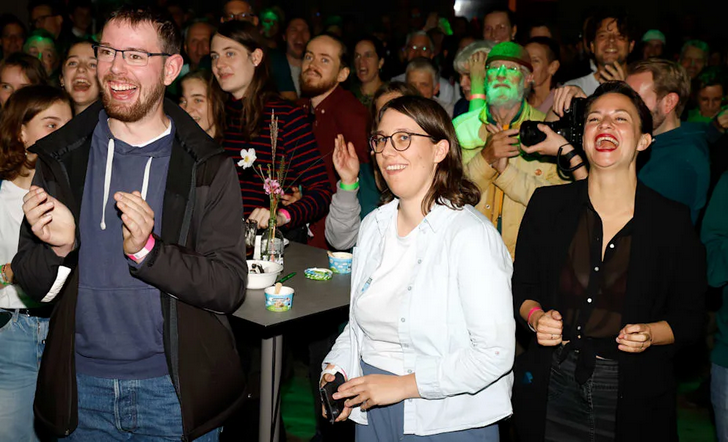
In this photo, published by BILD, you can see some of these unmitigated retards having a happy because they’ve just scored cheap virtue points by voting in their own personal energy apocalypse.
Photo from BILD via eugyppius
Specifically, these dumbasses are celebrating because their completely insane popular referendum passed with 53.2% of the vote on Sunday. This referendum, the so-called Zukunftsentscheid (“future decision”), binds the Free and Hanseatic City to achieving total carbon neutrality by 2040, five years earlier than the 2045 goal set by the almost equally insane Germany-wide Climate Protection Law as emended in 2021, which is in turn five years earlier than the 2050 goal established by the selfsame law as it originally passed the Bundestag in the year of the child-saint Greta Thunberg 2019.
Turnout was pretty low in Hamburg last Sunday, with less than 44% of eligible voters bothering to cast a ballot, most of them by mail. Thus just 23% of the most deranged Hamburgians could take their city hostage and commit its government to destroying all of its industry and most of its economic activity inside the next decade and a half. The biggest joke is that when Hamburg has finally achieved the sacred Net Zero, it will make absolutely zero net difference to anything. Hamburg is responsible for something 0.022% percent of CO2 emissions globally. The city is not even a rounding error.
The referendum was an initiative of Fridays for Future, but it gathered the support of various social and environmental organisations, among them Greenpeace, the union Verdi and even FC St. Pauli. It will successively cap annual CO2 emissions sector-by-sector, imposing a slow and relentless strangulation in turn on transit, households, commerce and industry.
October 14, 2025
QotD: The trade in fake doctor’s notes
A reporter for the Daily Telegraph newspaper managed to obtain a certificate from the company to excuse him from work for five months, because he claimed (falsely) to be suffering from the long-term effects of COVID. He obtained the note without providing any medical evidence whatsoever.
The only thing that surprised me about this was that anyone thought that it was necessary in Britain to buy or pay for such a certificate. I thought of the famous lines of Humbert Wolfe, the otherwise all-but-forgotten England man of letters:
You cannot hope
to bribe or twist,
thank God! the
British journalist.
But, seeing what
the man will do
unbribed, there’s
no occasion to.The same might almost be said of British doctors, many of whom, I suspect, issue such certificates incontinently, for one of two reasons: fear of their patients, and sentimentality.
Not surprisingly, doctors do not like unpleasant scenes in their consulting rooms, and refusal of requests for time off sick can easily lead to such scenes, and occasionally to threatened or actual violence.
Naturally, no doctor likes to think of himself as a coward, the kind of person who caves in to such threats. The best way to avoid so humiliating a thought is never to risk having to think it, that is to say by granting the patients’ wishes in this matter immediately.
But in order to do this without feeling self-contempt, it is necessary to rationalize, that is to say to find supposed reasons for why everyone who wants a certificate should be given one. The English philosopher F.H. Bradley once said that metaphysics is the finding of bad reasons for what we believe on instinct, adding however that it was a human propensity to do so. In like fashion, we could say that doctors find bad reasons for giving sick certificates when they suspect that not to do so might lead to a confrontation with a patient.
Thus they convince themselves that if a person tells them that they are unfit for work, for whatever reason, it would be wrong to question it. No one would make a claim to be unable to work unless he were in some way discontented, unhappy, depressed, anxious, stressed, in a word suffering, and it is the object of doctors to reduce human suffering.
The doctor is aided in this train of thought by the looseness of psychiatric diagnosis, so that practically all forms of distress can be fitted into the procrustean bed of diagnosis. Even outright faking can now be construed as an illness or disorder, provided only that it goes on for long enough or is deceptive enough.
Does this mean that the patients seeking sick notes are all faking it? The matter is more complex than this would suggest. There is, of course, conscious, outright fraud, but this is comparatively rare. Just as doctors don’t like to think of themselves as cowards in the face of their patients, so patients don’t like to think of themselves as frauds.
Distress can be conjured out of almost anything and is not necessarily proportional to whatever causes it. Dwelling on the ill treatment one has suffered — and who has not suffered ill treatment at some time in his life? — can magnify something minor into something major, to the point at which it seems almost to have ruined one’s life. And it is certainly capable of rendering a person unfit for work in his own estimation — though in fact continuing at work would be a remedy for, rather than an exacerbation of, the problem.
However, where economic loss is not too severe when stopping work on medical grounds is possible, medical grounds will be both sought and found. In the days of the Soviet Union, the workers had a saying: “We pretend to work, and they pretend to pay us.” In our kinder and more enlightened societies, we pretend to be ill, and they pretend to treat us — except that the word “pretend” does not quite capture the subtlety of the transactions between doctor and patients.
Theodore Dalrymple, “Make Me Sick”, New English Review, 2025-07-04.
October 12, 2025
QotD: Male privilege revealed
Vincent described herself as a “bull dyke” and held strong feminist views. She expected, throughout the course of the experiment to uncover the secrets of male privilege and the societal advantages that, she was sure, are afforded to men. She anticipated that living life as a man would validate her beliefs that men lead easier lives and wield unchecked power. She figured that, at the very least, she could enjoy a couple of years as a powerful male.
Vincent disguised herself as a man by getting a new hair style and giving herself a fake five o’clock shadow, among other things. She had always been considered rather masculine in her usual feminist and lesbian circles, so she figured she could pass rather easily as a man, if perhaps a slightly effeminate one. She was right.
Her initial assumptions changed when Vincent discovered that men, contrary to her expectations of power and privilege, face their own unique set of pressures and struggles. Men, she discovered, were expected to suppress any signs of vulnerability. This quickly led to feelings of extreme isolation that she did not expect. Nobody “had her back” because, as far as they knew, she was just a man, and should “man up”. She quickly realized that men do not have inherently easier lives. Her preconceived notions of in-born male advantage evaporated. She was getting worried.
She realized that women do not have empathy for the struggles of men.
Norah, as Ned, experienced the behavior of women toward men firsthand. At one point, she tried dating women as a man. She figured this would be incredibly easy for her. Not only was she a woman herself and knew how women think, but she was also a lesbian and already liked women. She worried at first that she’d be too good at it and would have to tell interested women that she was a woman to stop them from pursuing her.
The reality was sharply different from her expectations. Her apparent femininity came across as her simply being an effeminate man. This caused women to be disinterested in her and their rejections were dismissive, cold, and often extremely brutal. Women would sometimes treat her with suspicion or outright hostility as they assumed her intent was negative.
These interactions eventually led Vincent to start developing misogynistic thoughts. That’s right: women treated her so poorly when they believed her to be a man that she started to develop misogynistic thoughts.
Interestingly, many of the supposedly straight women she had attempted to date, even those who had been brutal and cold toward her, immediately expressed interest in a lesbian “hook-up” when she told them she was a woman who had been disguised as a man for the sake of journalism.
Perhaps there’s no such thing as a “straight woman”. Is there even a such thing as a lesbian?
CTCG, “UNDERCOVER: A Feminist’s Year Living as a Man”, Codex Trivium Cosmic Genesis, 2025-06-16.
October 7, 2025
An unexpected Gen Z “influencer” – Shakespeare
Ted Gioia describes the plight of a young man who had to move home after college and falls into a state of depression thanks to his hopeless situation and his dysfunctional home and social life. His name is Hamlet:
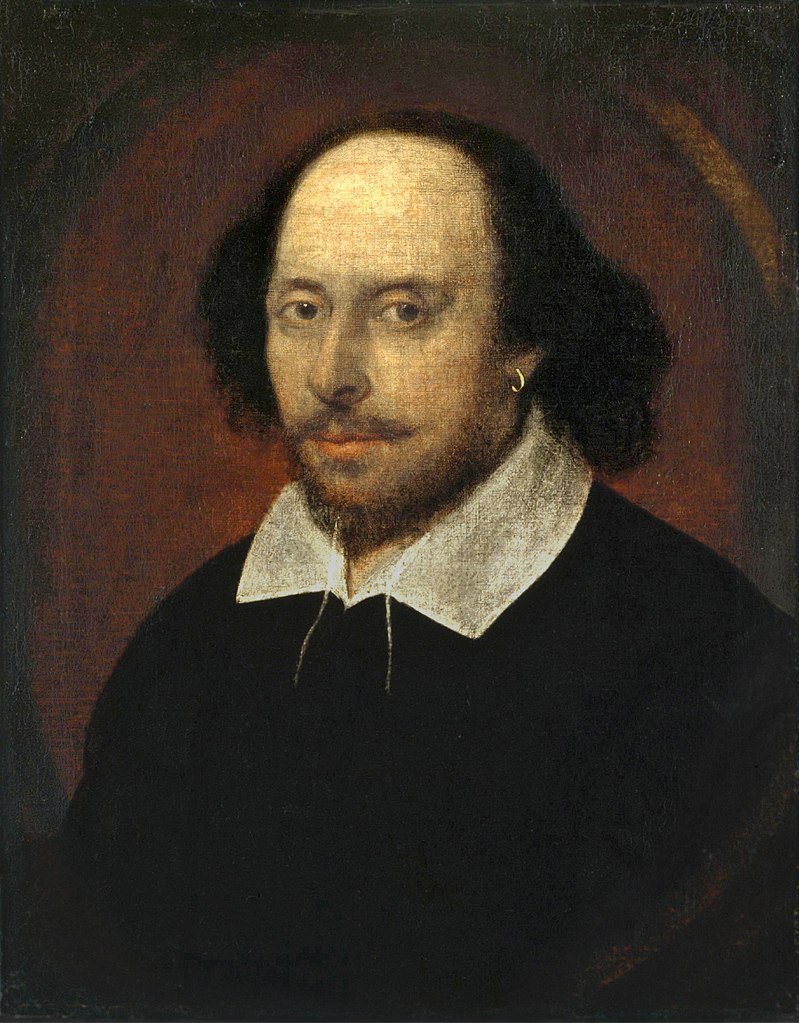
This was long thought to be the only portrait of William Shakespeare that had any claim to have been painted from life, until another possible life portrait, the Cobbe portrait, was revealed in 2009. The portrait is known as the “Chandos portrait” after a previous owner, James Brydges, 1st Duke of Chandos. It was the first portrait to be acquired by the National Portrait Gallery in 1856. The artist may be by a painter called John Taylor who was an important member of the Painter-Stainers’ Company.
National Portrait Gallery image via Wikimedia Commons.
It’s almost uncanny how relevant it feels right now.
So if I were directing Hamlet in the current moment, I’d give the title character an iPhone and game console. I’d have the characters onstage share photos on Instagram — and put up a big screen so the audience could see them posted in real time.
Hamlet could add pithy captions to his social media images. What a piece of work is a man! or maybe The lady doth protest too much!
Yes, Hamlet is many things, but one of them is, perhaps, a failed influencer.
Along the way, we may have answered the classic question about this play. For generations, critics have wondered why Hamlet wastes so much time, and can’t be bothered to take action.
Maybe he’s just too busy gaming and scrolling.
Okay, it sounds ridiculous. But is it really? Shakespeare possessed tremendous insight into the human condition — perhaps more than any author in history. So maybe he really did grasp the dominant personality types of our own time.
The Prince of Denmark still walks in our midst. And maybe — just maybe — careful attention to this play might help us, in some small degree, to heal the Hamlets all around us. Their number is legion.
Of course, the larger reality is that Shakespeare has proven himself relevant to every time and place. We can see that easily be examining how other generations viewed this same play.
Hamlet‘s original audience, four hundred years ago, clearly enjoyed the spectacle of violence and adultery. Nine key characters die during the course of the play — most of them murdered. Audiences loved these kinds of dramas back then, and Shakespeare always knew how to please the crowd.
But more sophisticated viewers, circa 1600, would have seen Hamlet as a political commentary — a reflection of all the tensions and rivalries of Elizabethan England. Nobody knew better than Shakespeare that monarchy is a dangerous game, and he always looked for opportunities to refer to current events in roundabout ways.
But two hundred years later, the Romanticists were in ascendancy, and they saw Hamlet as a very different kind of play. They ditched the politics, and embraced the Prince of Denmark for his pathos and personality. They tapped into the intense emotional currents of Shakespeare’s heroes — and the plays seemed perfectly suited for this kind of interpretation.
It’s no exaggeration to say that Hamlet continued to change for each new generation. He always feels timely and relevant.
A hundred years ago, critics began grappling with psychology and the unconscious — and Hamlet was a perfect character for these kinds of interests. In his 1900 book The Interpretation of Dreams, Freud focused on Hamlet as a case study in repression.
And who could disagree?
But fifty years later, Hamlet changed again. It now was the perfect play for those who had survived World War II. Jan Kott insists, in his book Shakespeare, Our Contemporary, that these old plays were more relevant than ever during the Cold War — just as timely as Beckett or Sartre or Brecht or Ionesco.
October 5, 2025
The New York Times finally decides that there’s a case for “splitting the Autism spectrum”
Freddie deBoer on the stereotyped way that the “Gray Lady” — the New York Times — once again lets the independent media do all the serious work to investigate an issue before “the Grey Lady squats down on that issue and says ‘this is mine now'”:
You may groan! You may say, “Again?” You may roll your eyes. But I’m going to talk about this one more time, and then I think I’m done. But I’ve always been right about all of this, and it needs to be said.
The Times has once again parachuted into a conversation that has been going on for decades, planted its flag, and declared itself the discoverer of new territory. Yesterday they published a piece on autism, neurodiversity, RFK Jr., and whether the autism spectrum should be split up — split back up, that is, to reflect on the massive differences between those with profound autism and those for whom “neurodiversity” is mostly a social badge, a tidbit to be displayed on a Bumble profile. (The answer is yes, of course the spectrum should be split up again, for reasons I’ve written about at great length.) That issue, unusually raw, will bubble on, as it sits at a genuinely uncomfortable intersection of liberal identity norms, online culture, and the genuinely debilitating reality of severe autism. In terms of progressive discourse rules, the plight of the severely autistic and their loved ones is truly a problem from hell: those rules insist that you can’t ever question someone’s diagnosis, no matter how dubious; they demand that you acquiesce to claims made from a position of disability, no matter if they cut directly against the claims made by others from their own position of disability; they have long ago lost sight of any distinction between identity and disorder; and they’re governed by a selective and incoherent vision of standpoint theory that insists that only the autistic can speak out about autism – which perversely empowers the least-afflicted and silences the interests of the most-afflicted, as the most-afflicted literally cannot speak for themselves. You know my rap on all this.
In meta terms, though? This tendency of the NYT to helicopter in to long-simmering debates and bless them with the paper’s attention, and in so doing anoint those debates as worthy of attention by grownups, is only the latest example in an old, ugly dynamic. The little people in independent media ask difficult questions and engage in rancorous debates and stick their necks out in the service of ideas, which is what the media is supposed to do. Then, once the heavy lifting is done, the Grey Lady squats down on that issue and says “this is mine now”. The paper’s consolidation of both prestige and financial security — its status as both far and away the most prestigious publication in world media and maybe literally the only financially healthy newspaper left in the United States — has all manner of pernicious, perverse consequences in an industry that can only function when people within it are engaged in debates with real stakes and real hurt feelings. Again, nothing you haven’t already heard from me. But when there is only one endpoint for the ambitious to aspire to, there’s an inherent and unavoidable silence about that endpoint’s myriad failings. The Times, for its part, has walled off criticism within its own pages with its “we don’t do media criticism” rule, a profoundly self-interested and cynical policy that helps them evade ever having to justify their own widely-criticized practices. And for all manner of complex reasons, the broader world of stodgy old media, dying though it may be, still holds all the cards when it comes to defining debates that involve institutional stakeholders, as the debate about autism’s future certainly does.
I don’t begrudge any writer for wanting to weigh in on these issues — God knows they matter and need more attention — but what’s striking about the Times‘s coverage is how effortlessly it erases the long history of people already fighting these battles, and the richness of the debate that preceded them. Whole archives of independent writing, analysis, and advocacy disappear when the Paper of Record decides that a question now exists. Until then, the issue is marginal, unserious, relegated to the sidelines; afterward, it’s real, it’s official, it’s legitimate … and therefore too important to be left up to those of us in the cheap seats. This is the paradox, you see; no issue that independent media concerns itself with can be considered truly serious, and no issue that they (eventually) deign to be truly serious is something that they trust the independent media to engage with responsibly. Quite a little trap, there. And when the grownups in the room walk in, we’re meant to feel blessed by their presence, happy to have our pet issues taken seriously. Everyone else who’s been in the trenches for years is supposed to be grateful for their newfound recognition.
QotD: Why go to the Moon or Mars?
But this misses the point. Yes, space colonization appeals because it’s part of the wizardly dream of innovation, of building new and exciting things, and thus has an aesthetic draw that goes beyond practical arguments. Yes, long-term we probably shouldn’t put all our civilizational eggs at the bottom of one gravity well. And yes, many humans have a Promethean (Faustian? Icarusian?) drive to expand, to explore, to see what’s beyond the horizon. All of which is a pull to space.
Now pause for a moment and think about what would actually happen if you decided to set up your terran terraforming in, say, the Owyhee Desert of southwestern Idaho. There’s a river in parts of it. It rains occasionally, and snows in the winter. Whatever techniques you were planning to generate power and conserve water on Mars would certainly work in Idaho — more efficiently, for solar, since we’re closer to the source, and with more margin of error if you can add water to the system. Plus the desert is full of exciting minerals you can mine to sell or even to extract water from! And the second you tried, the Bureau of Land Management (which owns most of the Owyhee, and indeed most of the American West) and the Environmental Protection Agency (which has opinions about mining) and the ranchers (who would also like to use that water, thank you) will come down on you like a ton of bricks.
That’s the push to space.
The dream of space colonization is partly about all the ways it would be cool to live on Mars or the Moon. But it’s also, implicitly or explicitly, a claim that it’s easier to solve enormous technical challenges (air! water! food! solar radiation!) than it is to solve societal challenges on Earth. Terraforming is hard; eunomiforming is harder.1
Jane Psmith, “REVIEW: The Powers of the Earth, by Travis J.I. Corcoran”, Mr. and Mrs. Psmith’s Bookshelf, 2024-04-29.
- Though to his credit Corcoran has a diverse portfolio: in addition to the space colonization dreams, he’s tackling the “terraform Terra” angle with an active homestead (he’s written some guides) and the “improve society somewhat” approach through more direct political engagement than I’ve ever done.
October 4, 2025
Rapid onset gender dysphoria (ROGD)
At Woke Watch Canada, Igor Stravinsky tells the story of “Jane and John”, a distressing tale of rapid onset gender dysphoria:
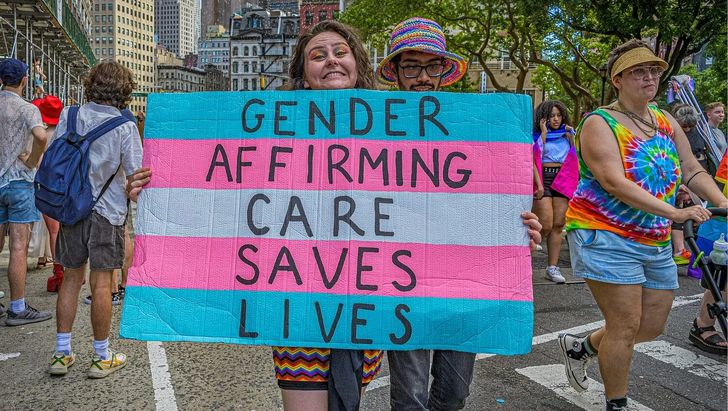
Image via the Boston Medical Center
In Ontario elementary schools, students are taught that whether you’re a boy or a girl is not determined by your physical body. Kids are encouraged to “explore their identity”. You may have a girl’s body. But how do you feel about it?
These kinds of discussions are going on because schools have accepted what rational people call “gender ideology”, but I prefer the term “gender mythology” because an ideology usually has to do with political systems. In my view the idea that a person’s sex is unrelated to their physical body, that they have a kind of soul sex, if you will, is clearly a myth.
[…]
Jane and John
This is a true story. The names have been changed to protect the privacy of this person.
Jane was a happy, clever, talented, and expressive girl who always wanted to help others. She displayed precocious empathy and enjoyed teaching younger kids various skills. Jane became socially conscious at an early age and was bothered by the fact that she enjoyed a middle-class, Western quality of life while so many others were clearly struggling. As an elementary student, she canvassed her neighbourhood collecting donations for disadvantaged kids. She came to identify with groups she saw as persecuted or oppressed.
Her school was very racially diverse, but she did not observe much racial discrimination. What she did notice was a fair bit of homophobia. She quickly took every opportunity to be an ally to the LGBT cause. In her middle school, there was an LGBT club, which she joined. Jane would often arrive home from school in an angry state because another student had said something that upset her, like, “being gay is a sin”, for example.
Jane’s parents were progressives who made it clear that she would be loved and accepted if she were a lesbian. Jane laughed at that and replied that she “dreamed about boys”.
Jane was a high achiever who was active in athletics and music. At 16, she became a vegan. She was in most ways a typical high school student, but her allyship with LGBT people gradually moved towards activism.
At university she quickly gravitated towards Indigenous and Gender Studies. Her close friends were all LGBT people. Her best friend was a transwoman (a man who identified as a woman). Jane came out as “bisexual” but her main romantic relationship was with a man.
Then, abruptly at the age of 20, she announced to her parents that she was to be called “John” and that she was going to transition to male.
By her own admission, Jane had been perfectly happy as a girl/woman for 20 years- “until I wasn’t”. This does not fit the Gender Mythology narrative. There is simply no way you can reasonably argue that she had, at this late age, suddenly realized what she truly was. She herself did not even claim that. So, what happened?
[…]
It was pretty obvious to me that Jane’s “transition”, like [trans-race activist Rachel] Dolezal, was the result of a combination of personal qualities and social influences. All the stars aligned to point her in that direction. She desperately wanted to be part of the community she had connected with and was tired of just being an ally. Claiming to be bisexual did not really cement her position as an insider. But becoming trans was her ticket.
Due to the extreme nature of taking on that identity — lifelong drug regimens and a number of surgeries, all of which presented serious health risks, going down that road reflected a true commitment and not only made her a part of the LGBT tribe but catapulted her to the top of the hierarchy.
What Jane experienced is known as Rapid Onset Gender Dysphoria (ROGD) and was first identified by the physician/researcher Lisa Littman. Learn more about it here. If you want to get a 2SLGBTQ++ (plus whatever other letters and numbers they’re using now — I can’t keep up) activist spitting mad mention ROGD. The phenomenon proves beyond a reasonable doubt that gender dysphoria can be induced in vulnerable people by social circumstances and aligns well with the research and clinical practice of Dr. Kenneth Zucker from the Centre for Addiction and Mental Health (CAMH) in Toronto.
Zucker ran the clinic for some 20 years and was pushed out due to his refusal to accept “affirmative care” as the only acceptable treatment for gender dysphoria. Zucker found that about 80% of kids would eventually grow out of their dysphoria and thus did not believe in affirming kids’ identities but rather focused on helping them cope with their condition.
Since affirmative care (an oxymoron!) has been adopted, we thus know that 80% of the kids who have been put on the road to gender transitions (and most carry through to the end) would have seen their gender dysphoria dissipate naturally over time. But once the first step — puberty blocking drugs, is taken, kids almost always go on to cross sex hormones and many continue with various surgeries.
Gender clinics do not do follow up nor do they support de-transitioning, but it is clear that the number of young people out there who have seriously harmed themselves through “affirmation” treatments is significant, and more harm is being done day by day as long as affirmative care remains the standard treatment for gender dysphoria.
September 30, 2025
“San Francisco [is] a sort of market-segmented scheme [extracting] the basic comforts of civilization and licensing them back as upgrades”
On the social media site formerly known as Twitter, Devon Eriksen describes the very comfortable lives of the very wealthy, who can support any kind of luxury beliefs because they never have to face the consequences that “the poors” who ape them do:
Dear sir,
I am not a filthy poor, and therefore conditions on the street level in Portland do not matter to me.
I drive my Jaguar to nice restaurants, give it to the valet to park, then go inside and order a fancy treat. So long as the valet parks my car, and the waiter brings my fancy treat for me to consoome in peace, I am utterly unaffected by conditions ten blocks away.
While I am technically forced to acknowledge that other humans exist — otherwise who would park my car or prepare my fancy treat? — I am not actually forced to consider what their lives are like.
And if you try to force me to confront this, I will simply point out that you are a filthy poor, who is unable to live a lifestyle that insulates you from this sort of unpleasantness.
At which point I don’t have to pay attention to you, loser.
Okay, here’s what’s really going on.
At a recent gathering in San Francisco, I listened to the tech bros I was dining with and their complaints about spending a million dollars a year on security teams, and a thought occurred to me, which I shared with the congregation.
I observed that San Fransisco, and perhaps other cities as well, seemed to be a sort of market-segmented money extraction scheme whereby the basic comforts of civilization are systematically removed from the environment, and then licensed back as upgrades to those who can afford them.
In Tennessee, it doesn’t cost me a thing to not be murdered for what I write online. Sure, I have a metric fuckton of extremely high-powered weapons and the skills to use them, but let’s be honest … I own them on principle, not because I would be murdered without them.
In SF, saying right-of-center things online while not being murdered costs a million dollars a year.
It probably costs slightly less than that to have zero drugged-out and/or schizophrenic bums urinating on your porch, but again, in Tennessee, this is a free service that comes with the “Western Civilization” package.
Also, it doesn’t cost anything go to a drugstore where nothing is locked behind glass, and be told “have a nice day” by someone at the register who actually means it.
And I’m told there is some sort of mythical beast called “graffiti”, but I have to go online to find out what it looks like.
In short, the argument that “civilization is just fine because I can still buy my way out of trouble” doesn’t hold any water, because it ignores the fact that you have to buy your way out of trouble, because civilization is shrinking.
You can’t have civilization without ass-kickings.
And if you forget that, you start having to buy your way into ever more and more exclusive clubs where the uncivilized can’t afford to go.
Until they figure out that they don’t have to pay, they can just push their way past the doorman. At which point you must be prepared to kick ass again.
All civilization rests on pillars made of violence. You are in danger until the moment you understand this.

Chris Bray also responded to the Nicholas Kristof take:
Now, here’s the hugely respectable New York Times columnist Nicholas Kristof, a very important Pulitzer Prize recipient, explaining from the heights of his journalistic perch what’s really happening in Portland:
This is as flawless a summary of the progressive cathedral classes as you could possibly manage: “‘Hell’ does not serve Pinot Noir this good”.
- Portland street journalist: Portland is a public graveyard
- Progressive New York Times columnist: Akshully, the Pinot Noir is exquisite
It’s time to shove these people onto a barge and tow them out to sea.
Like Karen Bass describing the open-air drug market of MacArthur Park as a sylvan paradise full of happy children and wonderful families having picnics, Oregon Governor Tina Kotek explained this week that Donald Trump is bizarrely intervening in a utopia, and for crying out loud look at this facial expression:
No one has ever been more lost than this. Your average good urban liberal is more insane than a psych ward full of psychotics. Akshully, the Pinot Noir is delightful. We are burdened with the existence of high-status people who have departed from earthly reality, and we can’t afford them.



Update, 1 October: Welcome, Instapundit readers! Please do have a look around at some of my other posts you may find of interest. I send out a daily summary of posts here through my Substack – https://substack.com/@nicholasrusson that you can subscribe to if you’d like to be informed of new posts in the future.
September 29, 2025
Screen addiction – “No drug cartel makes as much money as the screen-and-app companies”
Ted Gioia on the eight things about screen addiction that David Foster Wallace tried to warn us about before he took his own life in 2008:
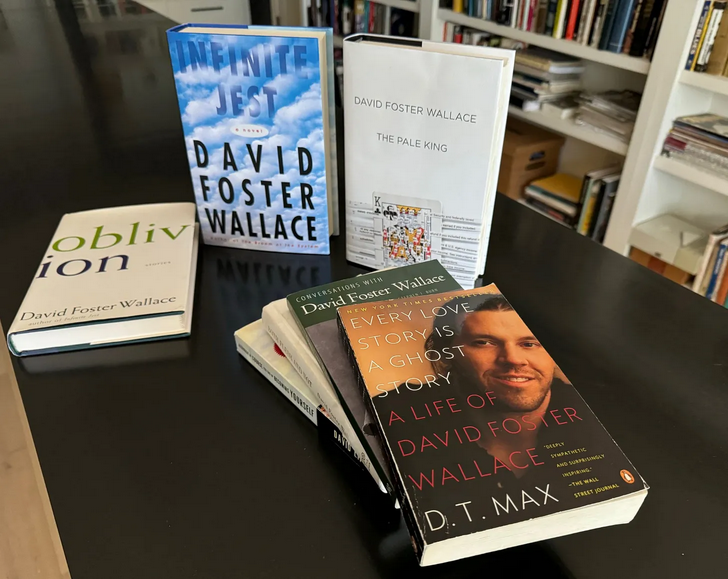
Those same youngsters are now showing up on college campuses, and we can begin to gauge the societal impact of a screen-driven life. It ain’t pretty.
So this is a good time to revisit what Wallace tried to warn us about thirty years ago. He was ahead of his time in the worst possible way, experiencing firsthand all the debilitating symptoms that now plague millions.
That’s why his writings feel so eerily contemporary. They read like commentaries on what’s happening right now.
Of course, Wallace knew very little about the Internet — he deliberately avoided it. He also refused to own a television. He understood how susceptible he was to screen addiction, and took drastic steps to reduce his exposure to all screens.
But he wrote about it — most tellingly in his huge novel Infinite Jest. The title refers to a film that is so addictive that people who watch it can’t stop. They literally watch it to death. It’s an infinite diversion, much like the endless scrolls on today’s social media apps.
He returned to the topic in his final book The Pale King, and also discussed it in interviews and essays. I’ve read through all of these including more than thirty interviews with the author. These allow me to put together a point-by-point summary of what Wallace tried to tell us.
We ignore his warnings at great risk.
(1) Screen technology will cause a crisis of loneliness, especially among young people.
In almost every interview, Wallace eventually talks about loneliness. It was a looming crisis, he insisted. But he was one of the first to link this to the ways we divert ourselves via screens. […](2) This will lead to widespread depression.
Wallace also knew this firsthand. He suffered intensely from depression. His inability to find a suitable treatment led to his suicide in 2008. […](3) This will also happen at a larger scale. Society will grow more fragmented and disconnected.
As each person falls into an isolated relationship with a screen, larger communities begin to fray. Wallace anticipated a “new vision of the U.S.A. as an atomized mass of watchers and appearers”. […](4) Screen technology promises to liberate us, but the reality is that it controls us for the benefit of others.
The most dangerous part of the screen entertainment is the illusion that it serves us. But the reality is that we actually serve tech platforms and their advertisers. […](5) The people who control the technology work to hide their purposes and goals.
“They’re trying to lock us tighter into certain conventions, in this case habits of consumption,” Wallace told Larry McCaffery in 1993. “This is McLuhan right? ‘The medium is the message’ and all that? But notice that TV’s mediated message is never that the medium is the message.” […](6) Our survival will depend on our ability to remain independent of these forces.
If we abandon ourselves completely to the tech (as many now do), we become pawns in the corporate agenda to monetize us — at a tremendous cost in loneliness, depression, and social disconnection. […](7) We don’t have many tools, but kindness and compassion will be the starting point.
We need to replace irony, sarcasm, and cynicism — which have contributed to our self-debasement — with softer, gentler attitudes. Cynicism is useful in criticizing, but is impotent when we need to build something better. Irony only destroys, never builds. […](8) Art can help us heal.
He wrote his big books with the hope that they would help us find a way back to a more caring and connected world — but connected via people, not screens. […]
September 27, 2025
Dislike of Trump prompts the CBC to spread faulty medical advice
It’s a long-running joke that US progressives — and the legacy media, BIRM — are programmed to respond to anything Donald Trump says by doing the exact opposite of what he says:

The CBC apparently felt the need to do the meme:
It was not controversial for news outlets like CBC to report in 2016, and later 2021, on new medical research raising concerns about the impact of Tylenol use on pregnancy and fetal development. But in 2025, those studies (among others) have become the basis for a new cautionary approach by the U.S. government that critics and media are trying to debunk.
On Monday, the U.S. Department of Health and Human Services announced that, as part of a bigger strategy in quelling autism, it would be issuing a “physician notice and begin the process to initiate a safety label change for acetaminophen”.
President Donald Trump relayed this to the press, stating the medication “can be associated with a very increased risk of autism”.
“So taking Tylenol is not good, all right? I’ll say it; it’s not good. For this reason, they are strongly recommending that women limit Tylenol use during pregnancy unless medically necessary. That’s, for instance, in cases of extremely high fever that you feel you can’t tough it out.”
[…]
The statement was reported in the mainstream news — including CBC, which found Canadian doctors who seemed to support the cautionary approach. The impression from these experts was that this wasn’t cause for panic and that more evidence was needed, but it was an occasion for discussion. The advice back then? Take the smallest amount for the shortest period of time, and don’t use it as a first resort to managing pain, which is consistent with the U.S. guidance.
Indeed, no major figure in this story is advocating for total avoidance because unmitigated pain and fever are bad for pregnancy, and in small amounts, Tylenol seems to be fine. That said, the manufacturer doesn’t recommend it for pregnant women (which they can’t really do without extensive testing, even if doctors generally consider it safe for mothers in minimized amounts when medically indicated).
More recently, a review of other studies by a team including Harvard University’s public health dean found similar “evidence of an association” between the drug and neurodevelopmental conditions. The dean released a statement saying that the “association is strongest when acetaminophen is taken for four weeks or longer”. That should be uncontroversial, because nobody is supposed to take Tylenol for that long, pregnant or not.
But perhaps, as the Babylon Bee suggests, it’s all Trumpian 4D Chess:

September 25, 2025
“Intentionally elevating strangers above ourselves, xenophilia, is artificial”
In Aporia, Spaceman Spiff explains the function and value of what are called “dead man’s switches” both for railway locomotives and societies:

Image from Aporia
A dead man’s brake is a safety feature found in dangerous machines such as lifts or trains. With this mechanism, a brake is always on, preventing action or movement. A conscious choice or effort must be made to override it.
On a train, a human driver must be present to depress a foot pedal that disengages the brake so the train can move at all. If he is absent the train cannot move. If he withdraws his foot while the train is in motion — if he dies, for instance — the train stops. Hence the name.
The key feature of a dead man’s brake is that it requires energy to operate. Its default zero-energy position is OFF; only with energy can it go to ON.
Wariness of strangers, xenophobia, is the default position for most human beings. This is a hardwired evolutionary response to protect us. It served us well. It requires no energy to operate. Children quickly point out people who seem different.
Intentionally elevating strangers above ourselves, xenophilia, is artificial. We must be educated to make it happen, and explicitly taught to overlook differences. It must be reinforced to remain in operation as our instincts typically push against it.
This requires energy. In parts of the world not subject to Western educational norms, they do not teach it to children. Consequently, they do not usually adopt policies like mass immigration or asymmetric multiculturalism.
It is worth noting that xenophobia denotes a wariness of strangers, not hatred or disdain of them. In practice, our working assumption is people different from us may be a threat, and our actions should reflect this until proven otherwise.
Xenophobia is not the racial animosity the propaganda wishes us to believe, such as harming others based on visible differences like skin colour. Such extreme views are in fact rare. The underlying drive of xenophobia is caution, not aggression. Xenophilia attempts to ignore this sensible restraint, which is why it often fails without external pressure.
These instincts are deeply embedded within us because a cautious approach is a strong foundation upon which to preserve our lives and our cultures. It is the reason we have a nation and a culture in the first place.
Xenophilia, then, is a dead man’s brake. It requires energy applied to something that would not typically occur in nature. It makes us ignore differences in order to get along. Or so the theory goes.
Update, 26 September: Welcome, Instapundit readers! Please do have a look around at some of my other posts you may find of interest. I send out a daily summary of posts here through my Substack – https://substack.com/@nicholasrusson that you can subscribe to if you’d like to be informed of new posts in the future.


