
Feral Historian
Published 30 Jun 2023After another viewing, I now think of Zardoz as an unintentional parody of the technocratic mindset that was congealing in the 1970s. It’s a strange film, a sometimes tedious film, but it’s worth a look if only because there’s nothing else quite like Zardoz.
I keep saying “Immortals” when I mean “Eternals” and I had to recut this one a bit due to some semi-random copyright issues so I apologize for any perceptible jank.
The tip jar at Ko-Fi helps keep Feral Historians in the woods and off the streets.
🔹 Ko-Fi | ko-fi.com/feralhistorian
September 24, 2025
Zardoz: A Technocratic Parody
Comments Off on Zardoz: A Technocratic Parody
September 21, 2025
From Eat Pray Love to plotting a murder
On Substack, Elizabeth Nickson charts the career of Elizabeth Gilbert who wrote Eat Pray Love and more recently a memoir of her life up to the point where she planned to murder her “once in a million year” partner:

Gilbert, you certainly know, wrote Eat Pray Love which was a massive international bestseller made into a film with Julia Roberts, which was also very successful. During the Pray portion, Gilbert retreated to an ashram in India to worship a living sub-deity called The Mother. At the time I was still tangentially aware of life in the world of moderately successful upscale arty women from the mega-cities and I’d heard of the Mother and her clinging clanging worship sessions — Siddha Yoga — going round the Pilates and yoga studios and the upscale self-help programs. The Mother’s satsangs were guaranteed to put you into an ecstatic state where you fused with the divine. And then you’d heal. From the abuse of the Patriarchy.
During the Pray section, Gilbert had a series of intense moments, which &mddash; coupled with an earlier session on the bathroom floor where God told her to wash her face and go to bed — meant, to her, a great deal. Her “God” gave her direction and purpose, where before she was caught in an unhappy marriage, being apparently the breadwinner in that marriage with a husband who a) didn’t work, b) wanted her to buy more and more stuff and c) have a child.
This seems a poor choice for a husband, but never mind. Gilbert was successful in the New York world of publishing and magazines and much occupied with that pursuit, a business which I now suspect is financed by the drug trade and used to launder money. In that world where success is one in ten thousand, one hundred thousand, and where Gilbert experienced perhaps the biggest literary success of her generation. She became universally, ridiculously, excessively loved.
And embrace it she did. For the past 15 years, Gilbert has traveled the world, usually with a woman companion to keep her on the rails, dishing out nostrums and platitudes with relish meant to show you how to “find yourself” and “live your truth” to women searching for purpose. “Creativity” or “art” is now substituted for what women in the before times used to call service to their communities and families, which is now called slavery to the patriarchy.
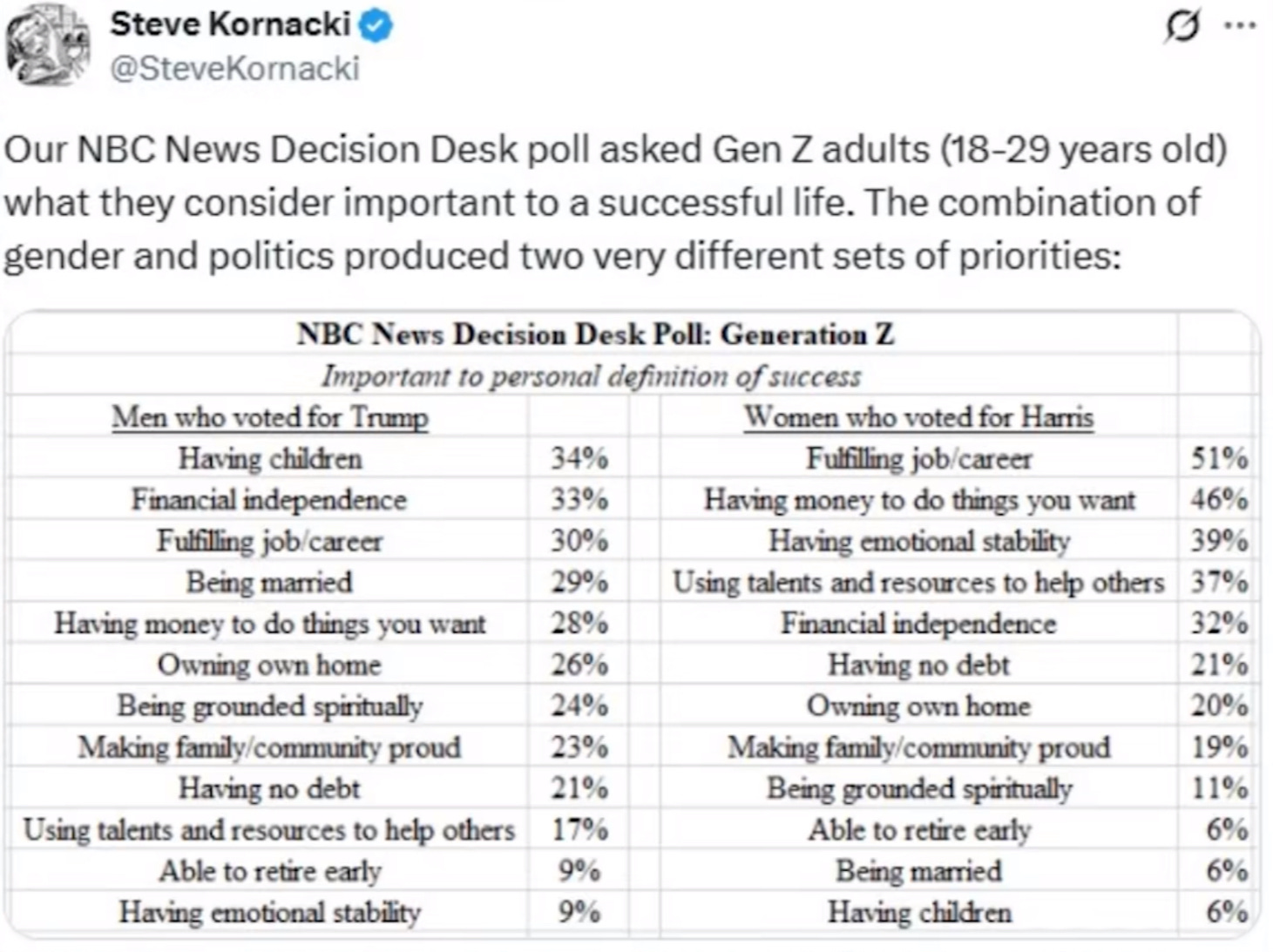
The following is the progression of “evolving” for modern left-of-center women, for whom finding a meaningful work is the number one priority, children being the last, as the below illustrates.
When the recognition of slim to no talent or at least un-sellable talent, is made and a future of grinding for multinationals is revealed, and spiritual enlightenment or Kundalini awakening seems out of reach, the desperation moves onto Democrat politics, and ends in middle-aged and elderly woman on the streets, face contorted in rage. Those women, a full 40% of whom are childless and family-less, spend their lives slogging away in some corporate or health or educational structure, becoming semi-insane. As an aside note, in my years-long investigation of voter fraud, many of the operators are women just like these below: middle-aged, put together, well dressed, polite, fully criminal.
In searching for your creativity — the highest good — you have to become fully aligned with your child self, your spiritual self, and that self becomes the most cherished part of you. Your intelligence, your executive function is demoted. Your creativity, your spirituality, then becomes fused to others whom you perceive being as weak as that child self you have elevated as spiritually superior. Women, it seems hardwired, must have people to care about. In the absence of family, it is the helpless to whom you assign your life.
Gilbert’s once-in-a-million-years love was a gay Syrian immigrant hairdresser with a history of heroin addiction and incarceration. No more victimish victim can be found.
For Gilbert’s millions of acolytes, spiritual worth, meaning,creative power is found in allyship with the weak, with whom they fully identify. And meaning is also found in hysterical advocacy and fury on behalf of the weak. There is no thinking attached to any of this, no analysis, no study. Just intense emotionality.

Comments Off on From Eat Pray Love to plotting a murder
September 18, 2025
NYC smokers get most of their cigarettes from the black market
Smokers in New York City pay very high taxes for their nicotine delivery systems, so it shouldn’t have surprised public health officials that many would turn to the black market … but the state and local taxes add so much to the price of a pack of cigarettes that most of the supply now comes from the black market:
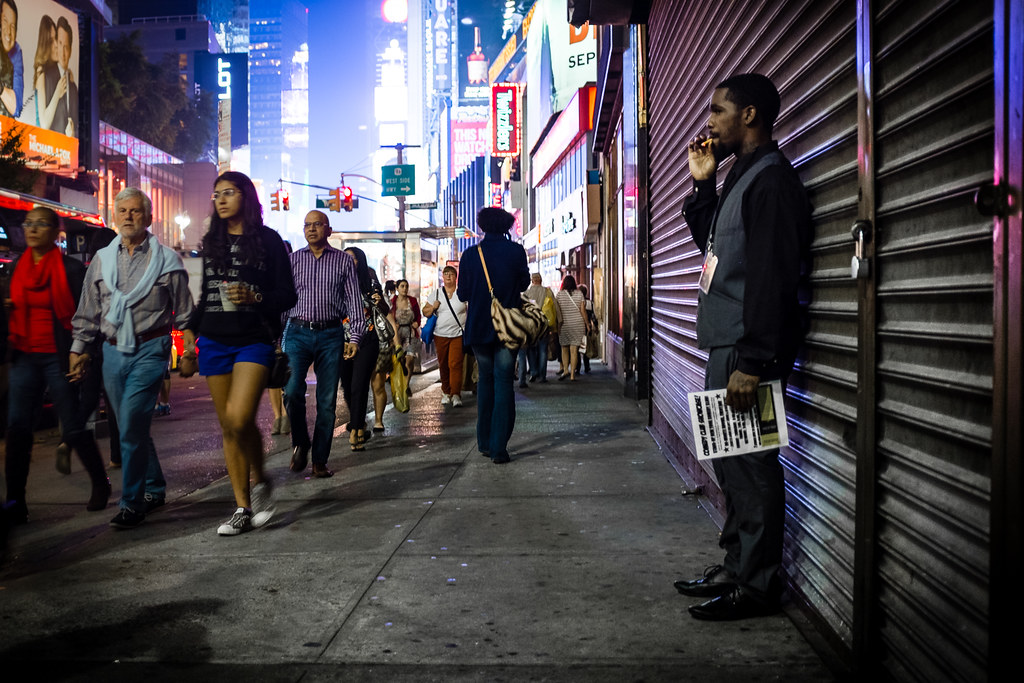
“Enjoyin’ a cigarette at busy Time Square, NYC” by Mel Schmidt is licensed under CC BY 2.0 
 .
.
In 2023, New York raised its cigarette excise tax by $1.00 to $5.35 per pack. New York City imposes its own tax of $1.50 per pack, and that’s before you include federal and sales taxes, making for the most expensive smokes in the country. That is, cigarettes are expensive in New York for those who pay those taxes. But state officials were warned that such a high rate would drive consumers to the black market, and that’s exactly what happened. According to recent research, more New Yorkers than ever are turning to tax-evading illicit sources for their nicotine needs.
Taxes Into Good Health — or Not
When the New York excise tax was hiked, the Albany Times-Union noted, “it’s the nation’s highest and brings a pack of cigarettes at many retailers to about $12 … Health advocates hailed the increase, saying it will lead to fewer smokers and cancer deaths. Anti-tax groups, though, predicted it will increase trafficking in illicit untaxed cigarettes in the state.”
Health advocates like taxing vices on the theory that raising taxes simultaneously generates government revenue while escalating prices for allegedly bad things — like cigarettes — out of reach of many consumers. What they rarely consider is that there are other options, such as buying cigarettes smuggled from jurisdictions with lower levies.
“New York has created a cigarette-smuggling empire, and the worst is yet to come,” Todd Nesbit, an economics professor at Ball State University, and Michael LaFaive, of the Mackinac Center for Public Policy, warned even before the 2023 tax increase. “It’s the unavoidable consequence of the state’s decades long history of raising the cigarette tax.”
“If enacted, consumers will go across borders to do their shopping or rely on black-market suppliers,” agreed the Tax Foundation’s Adam Hoffer. “Tax revenues will fall, illicit activities will thrive, and law enforcement spending will need to increase.”
In fact, as Nesbit, LaFaive, and Hoffer emphasized, even before the dollar-per-pack tax hike, more than half of cigarettes sold in the state of New York lacked local tax stamps and were smuggled from elsewhere. Since 2023, illicit dealers appear to have claimed even more market share.
Comments Off on NYC smokers get most of their cigarettes from the black market
September 17, 2025
Dark Forest Deterrence: Bureaucrats are Destroying the Universe
Feral Historian
Published 2 Sept 2022A quick look at a minor and neglected detail of Cixin Liu’s Three Body Problem series. I trust that everyone has done the reading.
Comments Off on Dark Forest Deterrence: Bureaucrats are Destroying the Universe
September 13, 2025
“It was about control before green policy became popular, and it is about control now”
In the National Post, Carson Jerema identifies the common thread among all of Prime Minister Mark Carney’s efforts since becoming Liberal party leader:

Then-Governor of the Bank of Canada Mark Carney at the 2012 Annual Meeting of the World Economic Forum in Davos, Switzerland.
WEF photo via Wikimedia Commons.
Prime Minister Mark Carney may not be as obnoxiously progressive as Justin Trudeau, but that doesn’t mean he isn’t stubbornly left wing in his own right, though he has managed to convince many critics otherwise.
Over the past decade, the Liberals were particularly self-righteous over climate policy, so much so that the deviations made by Carney since assuming office have been met with praise — or, on the left, with scorn — that he is somehow pro-business and represents the return of the centre-right Liberals. Some even think he’s a conservative. Others have suggested that Conservative Leader Pierre Poilievre is now entirely redundant.
This narrative is just more proof of how utterly captured the media is in this country by the Liberal party. It is true that Carney gives the appearance that he is abandoning many of the government’s environmental policies. He set the carbon tax rate to zero, paused the EV mandate and, on Thursday, he refused to endorse his government’s own carbon-emissions targets.
None of this, however, should be taken as evidence that Carney represents some sort of rightward or pro-business shift in the Liberal party. He is not proposing to let markets determine what infrastructure projects get built. Nor is he proposing to minimize regulations to attract investment.
Instead, Carney wants to command the economy by himself, laying bare the reality that what attracts left-wing politicians to climate policy is not saving the planet from carbon, but using environmental objectives to manage the economy. It was about control before green policy became popular, and it is about control now. For Carney specifically, before he entered politics, “decarbonizing” markets was quite remunerative in his various banking roles.
Noticeably absent from the five infrastructure projects that the prime minister said on Thursday would be fast-tracked under the Major Projects Office was an oil and gas pipeline. Also noticeable was the fact that all five of the projects had already been approved, but the government tried to pass them off as something new anyway.
Even if the projects had been all brand new, the lack of a pipeline would still be of no surprise, as what private investor would be willing to back a pipeline when the Liberals’ Impact Assessment Act, tanker ban and emissions cap all exist to conspire against energy projects of any kind?
One thing that became incredibly obvious early in Justin Trudeau’s premiership was that the prime minister — and his ministers in general — really did seem to believe that talking about doing something was as effective in solving problems as actually doing the thing. Many had hoped that Mark Carney would be different … but as Dan Knight points out, he may actually be worse:
From there, [Poilievre] broadened the attack. He spoke of an entire generation priced out of homeownership, of immigration growing “three times faster than housing and jobs”, of crime rising, and of what he called “the worst economy in the G7”. And then he turned squarely on Carney: “Mr. Carney is actually more irresponsible than even Justin Trudeau was“, citing an 8% increase in government spending, 37% more for consultants, and 62 billion dollars in lost investment — the largest outflow in Canadian history, according to the National Bank.
The message was simple: Liberals talk, Conservatives build. Poilievre painted Carney as a man of speeches and promises, not results. “The mistake the media is making is they’re judging him by his words rather than his deeds“, he said.
It was an opening statement designed less to introduce policy — those details came later — and more to frame the battle. For Poilievre, Carney isn’t just Trudeau’s replacement. He’s Trudeau’s sequel, and in some ways worse.
[…]
Pierre Poilievre didn’t hold back when asked about Mark Carney’s record. His words: “Mr. Carney is actually more irresponsible than even Justin Trudeau was“. That’s not a throwaway line, he backed it with numbers.
According to Poilievre, Carney inherited what he called a “morbidly obese government” from Trudeau and made it worse: 8% bigger overall, 37% more for consultants, and 6% more bureaucracy. He says Carney’s deficit is set to be even larger than Trudeau’s.
Then the jobs number: 86,000 more unemployed people under Carney than under Trudeau. That, Poilievre argued, is the real measure, not the polished speeches Carney gives. His line: “The mistake the media is making is they’re judging him by his words rather than his deeds“.
Comments Off on “It was about control before green policy became popular, and it is about control now”
September 12, 2025
Canada’s temporary foreign worker programs
At Acceptable Views, Alexander Brown calls for the end to the Canadian federal temporary immigration scam programs:
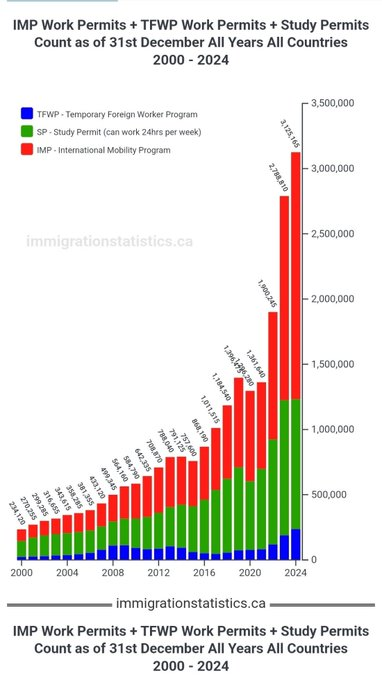
It’s not hyperbole to say that Canada has built an entire economy on exploiting cheap, foreign labour through TWFP, as well as the International Mobility Program (IMP). These are two slightly different programs that allow foreign nationals to work in Canada, with most going to Ontario. But contrary to its name, there is nothing “temporary” about the TFWP. Its original purpose was to remedy proven labour shortages while Canadians were hired and trained to eventually do the jobs in question. Meanwhile, the IMP allows international students to work—with or without a proven labour shortage—while they’re studying in Canada.
Between 2019 and 2023, the TFWP increased by 88 percent and the IMP increased 126 percent. They account for close to 1.58 million work permit holders, equal to roughly 7 percent of Canada’s labour force.
Taken together, the results of the TFWP and IMP are deplorable. The TFWP allows foreign nationals to be recruited abroad in vast numbers, brought to Canada, housed in degrading conditions, paid the minimum wage, forced to work long hours, pressured into not joining a union, and required to work for only one employer. Yes, the IMP is more flexible, but it’s more pernicious because it does not even pretend to address labour shortages.
Both schemes are also of course bad for Canadians themselves. The problem is especially grievous for young Canadians trying to get started in the labour market. Canada lost 40,800 jobs this past July, the unemployment rate is now 6.9 percent, and youth unemployment (those between 15 and 24 years old) is now 14.6 percent.
Both the TFWP and IMP are used as business models. Hiring foreign nationals at minimum wage keeps prices low and profits high—most notoriously in the hospitality and trucking sectors, but no industry seems untouched now.
Addicted to cheap foreign labour
The use of the TFWP in the healthcare sector, for example, has grown by an appalling 1,700 percent since 2000. That dramatic rise has no doubt been abetted by the absence of uniform standards and credential recognition among Canadian provinces. If medical personnel could move easily from one province to another, shortages could be filled by Canadians. But historically this has not been possible, and so medical institutions have had to turn to the TFWP. Ontario’s recent determination to solve this problem by speeding up recognition of 50 “in-demand” professions from other provinces is a step in the right direction, and hopefully not too little too late.
Meanwhile, the IMP is a vehicle for outright fraud, ranging from fake acceptance letters from bogus “colleges” to elaborate human-trafficking schemes. Not long ago, nearly 50,000 holders of foreign student visas were working and attempting to settle here, rather than studying at any Canadian university or college. Most were migrants from India, and some were trying to cross the border illegally into the United States. The RCMP is now working with Indian law-enforcement to investigate alleged links between dozens of “colleges” in Canada and two “entities” in India allegedly facilitating passage into the U.S. When we reflect that an astounding 4.9 million temporary visas are set to expire this year, we have reason to believe that this abuse, exploitation, and fraud are on a much larger scale that we understand.
The consequences for young Canadians
Both the TFWP and the IMP serve to keep wages artificially low and profits high, and to price Canadians out of the job market. It wouldn’t be wrong to view these programs as distortionary government subsidies or welfare for unproductive businesses. The effects disproportionately harm younger Canadians who are priced out of the labour market, given that temporary workers overwhelmingly earn less than the median wage. And yet, we’re constantly hectored about labour shortages, Canadians’ “unwillingness” to do certain jobs, and the need for foreign workers.
It shouldn’t take much intellectual effort to see that the use of foreign labour and the difficulties of employing younger Canadians are two sides of the same ugly coin. Foreign workers are more cooperative because they are bound to their employers like serfs. They face normally insurmountable barriers to joining unions and have no attachment to the community in which they’re expected to work. In comparison, the domestic population is generally better educated and rooted in the local community.
Young Canadians can afford to be discriminating and should rightly expect higher wages than foreign nationals. Employers should instead work harder to invest in and reward their domestic workforce. In any other era, this would have been obvious. But now there is little incentive for businesses to look beyond cheap, foreign labour.
To get an idea of the magnitude of our collective failure here, consider the following fact. A 2024 study by RBC Economics revealed that Canadian businesses are sitting on a stockpile of cash worth almost a third of our country’s GDP. In other words, Canadian companies have the means to invest in hiring and training Canadians, but simply refuse to do so. The results of this refusal are stagnant wages, structural unemployment, and a de-skilling of the domestic population.
Comments Off on Canada’s temporary foreign worker programs
Britain’s network of weather stations is becoming less and less reliable
Well-sited weather stations can provide useful raw data on temperature ranges, wind speed, precipitation, and other measurables, but that “well-sited” makes a huge difference. Older weather stations situated in areas of rapid urban expansion will often be less reliable as they become part of the urban heat island and report higher temperatures due to locally generated heat sources rather than the ambient temperature they were able to record before. This is what has apparently happened to far too many of the UK’s temperature measuring sites, according to Chris Morrison in The Daily Sceptic:
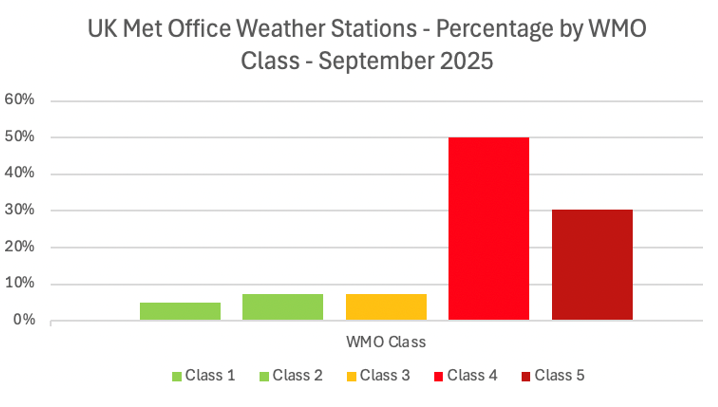
The latest WMO Class figures at the Met Office shown in block graph form. The higher the class number, the less reliable the station reports become.
Image from The Daily Sceptic
In March 2024 the Daily Sceptic shocked the science and political world by disclosing that nearly 80% of the UK Met Office’s temperature measuring sites were so poorly located that potential “uncertainties” could corrupt the readings by a numbers of degrees of centigrade. World Meteorological Organisation (WMO) Classes 4 and 5 in its CIMO scale come with “uncertainties” up to 2°C and 5°C respectively, and a Freedom of Information (FOI) request found that 77.9% of its sites were in these two “junk” categories. It should have been a wake-up call demanding immediate improvement of the nationwide network, not least because the Met Office frequently catastrophises its temperature figures in the interest of promoting the Net Zero fantasy. Alas, no. A new FOI has found that the Classes 4 and 5 junk sites have increased significantly over the last 18 months and now total an appalling 80.6% of the entire network. Pristine Class 1 sites – which measure a credible ambient air temperature with little chance of unnatural heat corruption – are just 4.9% of the total, having fallen in number in this short period from 24 to 19.
Hundreds of millions of pounds have flowed through this Government department over the last 18 months but little effort seems to have been made to improve its basic and important meteorological measuring function. What is worse is that the Met Office doesn’t seem to understand the scale of the problem. Over the 18 months, it appears that 20 new sites have been opened in its now 387-strong network. Seventeen of these have been given WMO classifications, of which a frankly ludicrous 64.7% are starting life in the Class 4/5 junk lane.
The WMO rates weather stations by the degree of possible temperature corruption caused by nearby unnatural or natural influences. Classes 1 and 2 are considered what we might call pristine, with no significant errors arising from artificial influences. The latest figures show that the Met Office has just 12.1% of its sites in these two unadulterated categories. Class 3 comes with an uncertainty of up to 1°C and accounts for 7.23% of the total. The real shocker is Class 4 where the percentage of the total has risen from 48.7% to over half at 50.1%. Class 5 has no defining conditions and could be located next to a blast furnace door. It has risen over the last 18 months from 29.2% to 30.5%. The WMO states that a Class 1 location can be considered a “reference site”. A Class 5 site is said to be a location “where nearby obstacles create an inappropriate environment for a meteorological measurement that is intended to be representative of a wide area”.
Despite this, Class 5 “extremes”, often caused by temporary but obvious heat spikes, litter the Met Office databases and record books. Of course such Class 5 data, unsuitable for providing an accurate temperature for a “wide area”, are loaded into databases producing “hottest evah” days, months, seasons and years. Their final destinations are the global datasets that exaggerate recent warming, again to promote Net Zero. Sprinkling the Class 4 and 5 fairy dust over the figures adds a bit more of the urgency required for elite political purposes.
Comments Off on Britain’s network of weather stations is becoming less and less reliable
September 11, 2025
QotD: Heritable IQ and the ability to think critically
Critical thinking may not be a heritable trait, but the IQ required to do it is.
It has become well-known recently that at IQ 90 and downward people start having real trouble handling counterfactual conditionals. “How would you feel if you hadn’t eaten breakfast this morning?” is the probe of this capability that has gone viral.
How are you going to do critical thinking if you can’t process counterfactual conditionals? It would be like trying to dance when you can’t walk. But this is a problem that extends above the normal IQ 85 threshold for mental subnormality. We’re looking at 20% to 25% of the U.S. population here.
Eric S. Raymond, Twitter, 2024-05-19.
Comments Off on QotD: Heritable IQ and the ability to think critically
September 9, 2025
Uh-oh. It’s not a good sign to see your town’s name in Not the Bee
We’ve lived in Bowmanville for ten years and in that time the demographics have changed substantially. Some of those changes have been positive, but others have definitely been negative:
Video out of Bowmanville, Ontario, shows Southeast Asian men (do with that what you will) flipping salmon out of a small stream during the annual salmon run back to their spawning locations.
Early September is peak salmon-fishing season. Fisherman across the continent catch millions of fish as they return upriver to spawn.
But it is highly illegal to catch salmon near their actual spawning sites (especially with nets), which includes Bowmanville (upriver from Lake Ontario). It is also unsafe, as the fish die off in mass numbers after spawning, making the meat inedible.
Despite this, migrants have been seen poaching fish in the area for several years (at least).
In the comment section, some people shared stories of their own, including this anecdote from Port Hope, Ontario.
Over the summer, SE Asian men went viral in Muskoka, Ontario, for filming themselves shooting up a local bridge and river. Locals say they have reported such incidents for years, but despite the danger and the leftover environmental pollution, authorities have been slow to act.



Comments Off on Uh-oh. It’s not a good sign to see your town’s name in Not the Bee
September 4, 2025
Net Zero targets and Britain’s ever-declining car industry
At the Foundation for Economic Education, Jake Scott charts the decline of the British auto manufacturing centres and the government’s allegiance to its Net Zero programs:

Custom image by FEE
Britain was once a giant of car manufacturing. In the 1950s, we were the second-largest producer in the world and the biggest exporter. Coventry, Birmingham, and Oxford built not just cars, but the reputation of an industrial nation; to this day, it is a source of great pride that Jaguar–Land Rover, a global automotive icon, still stands between Coventry and Birmingham. By the 1970s, we were producing more than 1.6 million vehicles a year.
Today? We have fallen back to 1950s levels. Last year, Britain built fewer than half our peak output—800,000 cars, and the lowest outside the pandemic since 1954. Half a year later, by mid-2025, production has slumped a further 12%. The country that once led the automotive revolution is now struggling to stay afloat, and fighting to remain relevant.
This is why the news that BMW will end car production at Oxford’s Mini plant, shifting work to China, is so damning, bringing this decline into sharp focus. The Mini is not only a classic British car; Alec Issigonis’s original design made it an international icon. For decades, the Mini has been the bridge between British design flair and foreign investment. Its departure leaves 1,500 jobs at risk at a time when the government is desperate to fuel growth and convince a wavering consumer market that there is no tension between industrial production and Net Zero goals.
It’s a bitter reminder that we in Britain have been here before: letting an industrial crown jewel slip away.
The usual explanations will be offered: global competition, exchange rates, supply chains. All true, in the midst of a global trade war that is heating up and damaging major British exports. But such a diagnosis is incomplete. The truth is that Britain’s car industry is being squeezed by a mix of geopolitical realignment and government missteps.
The car industry has become the frontline of a new trade war. Washington has already moved aggressively to shield its own firms: the Inflation Reduction Act offers vast subsidies for US-made EVs and batteries, an unapologetic attempt to onshore production, and something that became a flashpoint of tension in Trump’s negotiation with the EU in the latest trade deal. On the production side, the Act has poured billions into US manufacturing: investment in EV and battery plants hit around $11 billion per quarter in 2024.
Ripples have been sent across the world in the US’s wake: Europe, faced with a flood of cheap Chinese EVs, has imposed tariffs of up to 35% after an anti-subsidy investigation. Talks have even turned to a system of minimum import prices instead of tariffs. Unsurprisingly, China has threatened retaliation against European luxury marques, while experts warn the tariffs may slow the EU’s green transition by raising prices.
This is no longer a free market: cars are treated as strategic assets, the 21st-century equivalent of shipbuilding or steel. Whoever controls the supply chains, particularly for EV batteries and the mining of lithium, controls not only the future of the industry but an important lever of national power.
The results are visible. In July 2025, Tesla’s UK sales collapsed nearly 60%, while Chinese giant BYD’s deliveries quadrupled. Europe responded by talking up new tariffs. Britain did nothing. In this asymmetric contest, our market risks becoming a showroom for foreign producers — subsidizing both sides of the trade war without defending our own.
Comments Off on Net Zero targets and Britain’s ever-declining car industry
September 3, 2025
QotD: The distance between NHS PR and NHS reality
It wasn’t difficult to promote such historiography by using horror stories from the past, stories which were perfectly plausible because almost any conceivable system will give rise to such stories. If, per impossibile, a new system were to replace the NHS, it would not be difficult to justify it by reference to horror stories, whether or not the new system was better. A war of anecdotes, while always gratifying to the human mind, is not the way to decide important questions such as the superiority or inferiority of a system of health care. Only anecdotes that also illustrate statistical trends or truths are valuable in such a context.
The statistics are not favourable to the NHS, at least if one chooses reasonable standards of comparison, namely other European countries. The results are not disastrous, but they are not good either. The NHS has failed even in its egalitarian goal: the gap between the health of the richest and poorest in society has only grown under its dispensation. And yet the belief in its levelling effect persists.
The propaganda in favour of the NHS has been so successful that it now accords with the sentiments of the population, a triumph that no communist regime achieved despite herculean efforts at indoctrination. The triumph has been achieved without compulsion or violence and ought to be an interesting case for political scientists who study the successful inculcation of political mythology. Of course, the danger of such a study would be that it might induce doubt or cynicism about other political mythologies, and we all need such mythologies to live by.
Theodore Dalrymple, “Worshipping the NHS”, New English Review, 2020-05-07.
Comments Off on QotD: The distance between NHS PR and NHS reality
September 2, 2025
Too much empathy can be more dangerous than too little
Spaceman Spiff explains why boundaries matter, in so many different areas of modern life:

Empathy is a virtue many strive to demonstrate. But few will discuss its downsides. Why it is not universally good or useful. How it can be misdirected.
In some situations it is lethal. It can reflect a suicidal urge we now see in Western nations.
Much empathy in society is in fact sentimentality, which is dangerous. Sentimental ideas about mixing cultures, elevating poor performers through quotas, or tinkering with traditional gender roles have real world effects.
With such an emphasis on empathy, which many think of as niceness, we overlook the need for boundaries to maintain a functioning society.
This is the issue at the heart of much that is damaging us today.
Individual rights
We live in an era that champions individual rights to an almost autistic degree. This is a product of Western liberalism, which now seems to be entering its terminal phase as its effects ultimately destroy what made Western societies strong.
Since an individual’s rights trump everything we cannot easily enforce boundaries our ancestors could take for granted. Try challenging a gay pride parade or transgender material in schools on the grounds of public decency and the least you can expect is to lose your job.
Profound changes have happened just in the last few decades and all in the name of individual rights. The erosion of boundaries on behaviour is one of the most visible aspects of this.
Physical boundaries
The concept of boundaries is almost universal and spans everything from the mundane to the spiritual.
Most countries recognize the right to private property and inherent within this is the notion of boundaries. My car is mine and no one else’s, for example.
This is applied to our homes and gardens. These are ours and defendable from theft. Ultimately this in turn includes a neighbourhood or locale, even a region or state. All these things have visible boundaries that demarcate where they begin and end.
Most famously this applies to national borders, a traditional form of boundary in use for thousands of years. Failing to enforce this barrier is national suicide. The world is not like us and if it comes to us we will look like the world in return. Borders keep the barbarians out.
Everyone instinctively grasps these kinds of boundaries. We close our windows and have locks on our doors because of this understanding.
Using boundaries to exclude others feels natural.
Cultural boundaries
Less explicitly visible are cultural boundaries, often transmitted via tradition and convention. We have spent the last century attacking many of these as old fashioned, with little pause to consider why tradition emerges in the first place.
Marriage between men and women. Complementary gender roles. Sexual mores kept private. The sanctity of childhood, its innocence protected from intrusion.
As we removed constraints in the name of progress we destroyed much of the glue that held our societies together. We are now watching things unravel as people marry less and produce fewer children. We see widespread mental illness and anguish as the few basic certainties of life are destroyed in the name of progress.
People don’t know who or what they are when cultural boundaries are deleted. Women, men, natives, newcomers, the working class. Who are we really without some certainties in life?
Comments Off on Too much empathy can be more dangerous than too little
August 21, 2025
Most of us learned the “pull my finger” gag around grade 2, so why are so many of us still gullible about “scientists warn”?
At Watts Up With That?, Willis Eschenbach warns us yet again about believing headlines that say things like “Scientists Warn!”
Only a journalist truly committed to the ancient art of panic-clickbait could squeeze all the world’s existential dread into a headline like, “A Giant, Destructive Volcanic Eruption Is Set to Shake the World in the Coming Months, Bringing About the End of Mankind, Scientists Warn“. They’ve accompanied it with the following graphic, in case you weren’t adequately terrified.
The dead giveaway? “Scientists Warn“. Whenever you see those two words sandwiched together above the fold, you know you’re about to step into a wonderland of wild extrapolation, qualified maybes, and models run so far into the future they boomerang back with “robots take over” as the y-axis.
They start out as follows:
A detailed geophysical study published in Nature in by the U.S. Geological Survey (USGS) has refined our understanding of the Yellowstone supervolcano, uncovering new insights into its subsurface magma dynamics. Concurrently, climatological assessments by researchers such as Markus Stoffel (University of Geneva) have renewed discourse around the global systemic risks posed by a potential super-eruption — not only at Yellowstone, but at several other active volcanic complexes worldwide.
There’s an oddity here to start with. They’ve pushed together into one paragraph an actual scientific study of the Yellowstone caldera, and a paywalled puff piece by some random guy trying to frighten people about future eruptions. Unless you’re watching very closely to see which walnut the pea is under, it’s likely to be successful in making you think “Wow, a predicted super-eruption at Yellowstone, and the odds are high in other locations as well“.
Which does sound scary. So keep that thought in mind while we look at the first of the two parts they’ve pushed into one paragraph — the actual Yellowstone scientific study.
It’s the latest USGS study published in Nature under the very boring title “The progression of basaltic–rhyolitic melt storage at Yellowstone Caldera“. It gives us an upgraded, high-res CAT scan of Yellowstone’s magma plumbing. Instead of a giant pool of liquid doom sloshing under Wyoming, the new imaging shows a club sandwich: scattered blobs of partially molten rock, unevenly distributed, with most of the melt sitting in the northeast sector. The scale is impressive — 400–500 cubic kilometers of rhyolitic magma waiting for its cosmic moment. The heat just keeps bubbling up from below, slow and relentless, and with enough time, these melt zones might even hook up into a larger reservoir. But spoiler: no scientist anywhere is claiming that’s on tomorrow’s chore list.
Which brings us to the great, headline-grabbing “16% chance (one in six) of apocalypse by 2100” further down in the popular reports — a number that, if ever printed on a lottery ticket, would bankrupt Las Vegas. From the article:
Still, climatologist Markus Stoffel and affiliated risk researchers estimate a ~16% probability of a VEI 7 or higher eruption occurring globally before the year 2100.
Except that particular prediction is not referred to by the scientists of the actual Yellowstone study, and has nothing to do with the Yellowstone study.
It comes from a some gentleman yclept Markus Stoffel. And he’s not even talking about Yellowstone. He’s talking about the entire planet. Nothing to do with Yellowstone.
And who is Markus when he’s at home? Is he a member of the team of authors of the Yellowstone study?
Nope.
Well, is he a vulcanologist?
Nope again.
He’s a climate professor at the University of Geneva. He’s published a lot, almost entirely regarding the effects of “climate change” on glaciers, mountain landslides, and mountain lakes.


Comments Off on Most of us learned the “pull my finger” gag around grade 2, so why are so many of us still gullible about “scientists warn”?
August 8, 2025
QotD: Accelerating back towards bicamerality
This hypothesis seems to explain a few huge, otherwise perplexing facts of Leftist behavior. First: The further Left a person is, the more desperate xzhey are to put everyone else into one, and only one, category. Starting, of course, with themselves — I often joke that they’re trying to get their own bespoke “sexuality” so refined that no one else in the world could possibly share it. That would relieve them from the burden of ever actually having to be intimate — sexually or otherwise — with anyone. They can sit in the dark in their masks, eating bugs and watching Netflix, totally alone, forever.
I’m joking, but I’m not kidding. They really do seem to want that. And bicamerality explains it. I’ve also frequently likened them to the “zooanthrops” from The Book of the New Sun, from whence my stupid nom de blog comes. In that book, the literal end of the world was just around the corner — the sun, long expanded into a cool red giant, was about to go out, possibly within the current generation’s lifetime. Because of that, some people decided to “lay the burden of consciousness down” — they had themselves lobotomized and dumped in the woods.
Again, I’m joking, but I’m not kidding: Doesn’t that seem to be what so many on the Left really want? To be relieved of the burden of thought?
It applies even more so when they’re forced to interact with the world. We’ve all seen how desperate they are to shove people into one, and only one, box. Actually “desperate” is too mild a word — nothing frightens them more than the fact that a person can look one way, but actually be another way. It’s why they’re such slaves to fashion — literal fashion, not just fads trending on Twitter. Even before Der Hamsterkauf you could tell a Leftist just by looking at them, pretty much 100% of the time. Afterwards … well, we’ve all advanced a lot of explanations for why they’re so bizarrely insistent on the mask, especially for children: It’s their new purity ritual. They’re all chicks, and that’s the ultimate chick herd behavior. They’re just sadists. And so on.
But what if it’s as simple as The Mask relieves them, as nothing else can, from a significant source of interpersonal stress? “Interpersonal” again is too mild a word. They don’t want to “get to know you”. They don’t even want to talk to you. Hell, they don’t even want to share the same air with you, and do you see what I mean? Their “lives” would be so much better if we all had to wear colored patches on our jumpsuits, Dachau-style, telling everyone exactly what we are (exactly and only). Barring that, they’d love to reimpose some of the old medieval sumptuary laws — again, you will eat the bugs, because that’s what you deserve, peasant! But it’s not just that. It’s also a huge stress relief for them, to be able to tell a person’s social status at a glance.
Consider further (just briefly) how much a non-victim Victim fries their circuits. A gay conservative, say, or a pro-life woman, or a black “acting White” (your average liberal makes your average rapper look like a paragon of tolerance when it comes to that particular sin, though of course the liberal dresses it up in a thousand syllables of fugly jargon). Even though “the sex you’re attracted to” has no possible relationship to “your stance on the tax code”, the Left has made it so — first as a cynical political maneuver, but now because it minimizes their “interpersonal” (again, for lack of a better word) stress.
The tl;dr here is that your typical Leftist seems to spend all xzheir time in xzheir own head — always labeling, cataloging, frantically shoving everyone and everything into its own little box. But they do this, I think, because they know subconsciously that once they’ve got everything shoved into one and only box, forever, they’ll never have to think again … and that’s what they really want. A life of perfect unconscious bliss, where any “decision” that needs to get made comes from the blinking box.
Severian, “Striving Towards Bicamerality”, Founding Questions, 2022-03-20.
Comments Off on QotD: Accelerating back towards bicamerality
August 6, 2025
Actual data demolishes the “climate catastrophe” narrative
At The Conservative Woman, Paul Homewood summarizes the findings of a new report for the US Department of Energy:
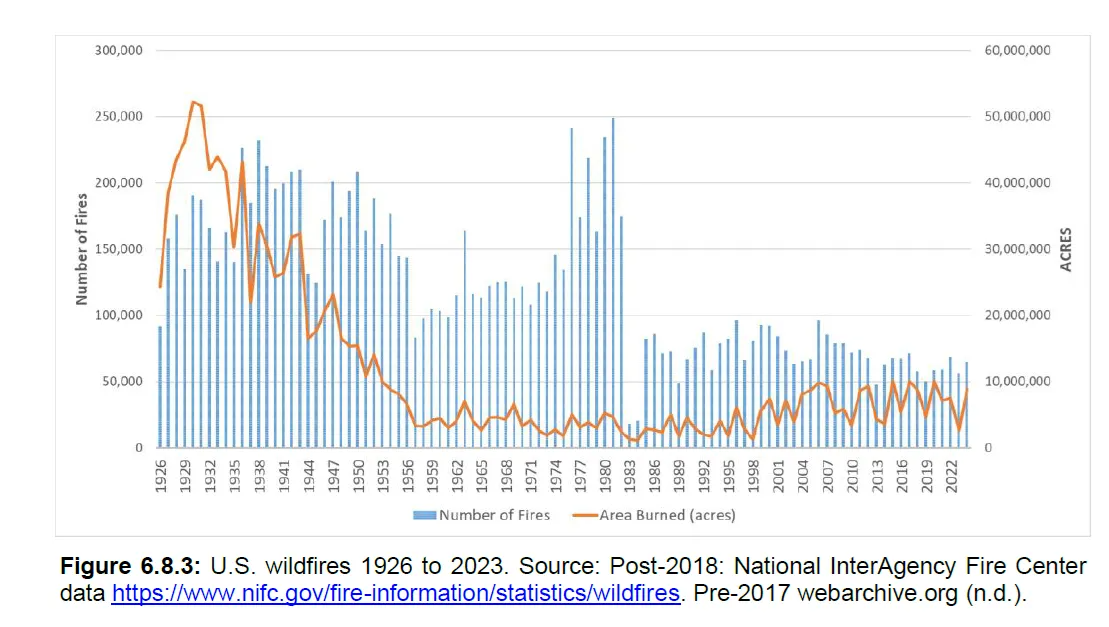
A report by five independent, eminent scientists has blown apart the myth of catastrophic climate change, destroying the case for Net Zero in the process.
Judith Curry, Roy Spencer, Ross McKitrick, John Christy and Steve Koonin are all highly respected leaders in their respective fields. Their report was commissioned by the US Department of Energy (DOE) but written with no editorial oversight by the DOE and with no political influence whatsoever. Although it specifically covers the US, its findings have worldwide ramifications.
The 151-page report, A Critical Review of Impacts of Greenhouse Gas Emissions on the US Climate, reviews scientific certainties and uncertainties in how anthropogenic carbon dioxide (CO2) and other greenhouse gas emissions have affected, or will affect, the nation’s climate, extreme weather events, and selected metrics of societal well-being.
Maybe the most relevant part concerns extreme weather. According to the report: ‘Most extreme weather events in the US do not show long-term trends. Claims of increased frequency or intensity of hurricanes, tornadoes, floods, and droughts are not supported by US historical data. Additionally, forest management practices are often overlooked in assessing changes in wildfire activity. Global sea level has risen approximately 8 inches since 1900, but there are significant regional variations driven primarily by local land subsidence; US tide gauge measurements in aggregate show no obvious acceleration in sea level rise beyond the historical average rate.
A few graphs from the report tell the story, and you can see them at the end of this article.
- US landfalling hurricanes show no long-term trends, either in frequency or intensity;
- Heatwaves were much worse than now before the 1960s;
- Temperature extremes are reducing, as a greater number of extremely hot days is more than offset by fewer extremely cold ones;
- There has been a marked decline in the number of the strongest tornadoes, EF3 to EF5, since the 1970s. The increased numbers of weaker tornadoes is the result of better observation methods, including Doppler radar, not an actual increase;
- US droughts were much more severe for most of the historical record going back to 1895;
- While wildfire activity has marginally increased since the 1980s, it was considerably worse up to the Second World War. Most of these long-term changes are caused by fire management practices, not climate changes;
- Tide gauges all around the US show the same story – a slow and steady sea level rise beginning in the mid 19thC. The rate of rise can vary considerably from station to station because of local factors. New York and the rest of the Atlantic Coast, for example, has been subsiding since the Ice Age; Galveston is sinking as a direct result of groundwater withdrawals.
The scientists pour scorn on weather attribution computer models, which have become the media’s go-to source for climate apocalypse stories. These attribution models routinely claim that extreme weather events have been made more likely because of global warming. They are dismissed in the report, which highlights the lack of high-quality data and reliance on deficient climate models. Other scientists have not been so kind!
Comments Off on Actual data demolishes the “climate catastrophe” narrative


