
Keeping the simple spectrum approach of “Left” and “Right”, I’d divide the world into the fundamentally incompatible camps of “Theory” people and “Reality” people. We all know all about the Theory People, so just one quick example: J.B.S. Haldane. Indisputably a great scientist, and not just a great scientist, a great evolutionary biologist. If there’s anyone on this earth who should’ve been convinced, right down to the very marrow of his bones, that human beings are NOT blank slates, it was J.B.S. Haldane. And yet, he was a Marxist — and not just a Marxist, a really loopy one, even by the standards of the early 20th century.
It was guys like Haldane who caused Stove to write a great essay about “The Ishmael Effect”. He said something like (from memory) it’s a striking fact about powerful minds, that even though they know better than everyone else some fact about the physical world — the conservation of energy, say — their powerful minds cause them to get caught up in all the fascinating implications of their pet theory, such that they fail to see their pet theory requires energy not to be conserved. Thus (said Stove), a guy like Kant: After telling us that no human mind can access the Thing-in-Itself, he gives us four hundred pages of extremely detailed information about the Thing-in-Itself. Or Karl Marx, who was able to soar so far above his own economic class situation as to tell us, with oracular certainty, that no one is able to transcend the cognitive limits of his economic class situation. I don’t think it’s much of an exaggeration to say that “the Ishmael Effect” pretty much IS 19th century philosophy … and thanks to entropy, 20th century politics, and now 21st century culture.
Such are the Theory People who, however many raw IQ points they have, will really see five lights if The Party tells them to, because The Party controls the Theory and the Theory is never wrong, facts be damned. Call them Rubashovs if you like (and are feeling literary), but let’s move on to the Reality People. If Rubashov is the ultimate Theory Person — marching willingly off to his destiny in the dreaded Lubyanka, because The Party requires it and The Party is never wrong — so the ultimate Reality Person is Niccolo Machiavelli.
Much hooey has been written about The Prince, that it’s ACK-shully a biting satire (you could call the Rubashovs’ junior varsity the ACK-shully kids), but Ol’ Nick meant every fucking word. Politics was a contact sport in his day — he picked the wrong side of a political dispute, and got the strappado for it. He knew exactly what he was talking about, and had the disjointed shoulders to prove it.
Machiavelli is often called a cynic, but just as everything in Clown World always turns out faker and gayer than the most jaded can imagine, so even the hardest-bitten cynic can’t touch Ol’ Nick. The Prince is beautifully written, but it’s one of the toughest reads you’ll ever have, because surely he can’t mean what he just wrote … he just can’t. But he does, and it’s true — that for example a man will more quickly get over the murder of his father than the loss of his patrimony. And you know it’s true, if only in the darkest watches of the night when you toss and turn in the coldest of cold sweats. There aren’t more than a handful of sentences in The Prince that won’t give you insomnia, if you really start thinking them through …
But just as (one hopes) even Rubashov would balk at shooting his children on The Party’s orders, so even Machiavelli marvels at the truth that no one is thoroughly, consciously evil, even when it’s in his obvious best interest to be. A man will always convince himself he’s doing good, even when he’s obviously, objectively doing the most heinous evil, and that — Nick implies — is the way to manage a tyrant. Even when doing X is the obviously advantageous thing to do, and doing Y is obviously disadvantageous, you can convince someone to do Y by changing the moral frame.
There’s obviously a spectrum here, which like all human behavior bends in on itself at the extremes. One imagines Rubashov, for instance, going through an “if only Comrade Stalin knew!” type thought process if The Party ordered him to shoot his infant children. Yes, The Party is never wrong … but even though Comrade Stalin IS The Party, The Party is, finally, the historical manifestation of a metaphysical necessity, and therefore, in the light of the Highest Truth, Comrade Stalin — though never wrong!! — is perhaps misinformed in this case … Just as Francesco Sforza or whomever balks at murdering those infants in their cribs, though it’s clearly the very best course of action, politically.
Rubashov vs. Machiavelli. That’s the best I can do.
Severian, “Mail / Grab Bag”, Rotten Chestnuts, 2021-09-10.
December 19, 2024
QotD: Replacing the outdated “left” and “right” with more accurate terms
December 18, 2024
Justin Trudeau at bay
However much you may dislike the man — and there’s just so much to dislike — it’s impossible to write him off no matter how bad the situation may look. In The Free Press, Rupa Subramanya explains to non-Canadian audiences what has been going on in the Deranged Dominion lately:
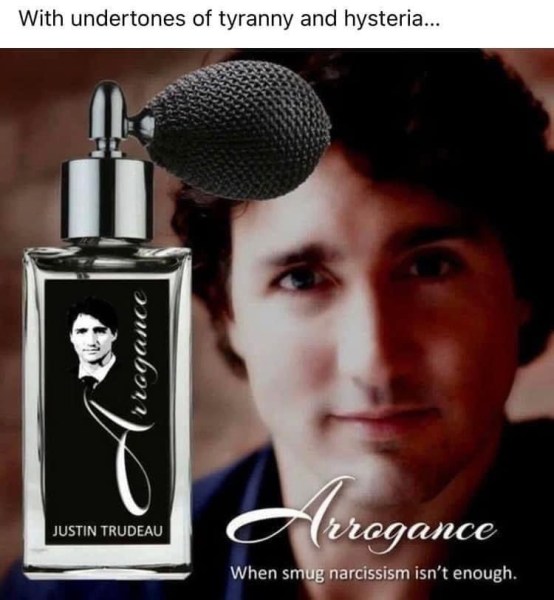
Justin Trudeau’s government could be at the point of collapse. And a social media post from Donald Trump about tariffs may have set off the latest in a chain of dominoes for Canada’s prime minister.
On November 25, Trump posted on his platform Truth Social that, as one of his first executive orders, he would “sign all necessary documents to charge Mexico and Canada a 25% Tariff on ALL products coming into the United States, and its ridiculous Open Borders”. Four days later, Trudeau flew to Mar-a-Lago to meet Trump for dinner. Although the content of their discussion has not been made public, Trump’s tariff threat may have landed a death blow to Trudeau’s cabinet.
On Monday morning, Trudeau’s most important ally — his number two, finance minister Chrystia Freeland — resigned in a fiery letter directed at her boss, which she posted on X.
“Our country today faces a grave challenge,” she wrote. “The incoming administration in the United States is pursuing a policy of aggressive economic nationalism, including a threat of 25 percent tariffs. We need to take that threat extremely seriously.” She continued: “That means pushing back against ‘America First’ economic nationalism with a determined effort to fight for capital and investment and the jobs they bring”.
The same morning, Trudeau’s housing minister Sean Fraser also announced his departure, saying he wanted to spend more time with his family. This brings the total number of cabinet members who’ve resigned under Trudeau in 2024 to nine. But a walkout from Freeland, his most trusted lieutenant, who was expected to release her fall economic statement Monday, is by far the biggest. That such a loyal servant who has worked for Trudeau since 2015 would resign so publicly shows just how deep the rot is these days. Freeland stood by the prime minister as his popularity began to tank in February 2022 when Canadian truckers protested his harsh Covid vaccine mandates. She even authorized the debanking of those protesters, freezing their bank accounts as a means of punishment [NR: with no legal authority, it must be noted].
Now, her resignation is feeding feverish speculation that the longtime progressive darling could finally be on his way out, amid his sinking popularity and the country’s economic slump. By Monday night, a prominent member of Trudeau’s Liberal Party, Anthony Housefather, went on TV to say the prime minister is “past his shelf life“.
The modern Furies
In Greek mythology, the Erinyes (the Furies) — euphemized as the Eumenides (the “Gracious ones”) were the goddesses of vengeance. You may dismiss the ancient Greeks and their beliefs, yet they often encapsulate hidden wisdom for those who know how to interpret their stories. Today, as Janice Fiamengo points out, we have no need for mythological Furies, as they’re frequently embodied in otherwise ordinary women:
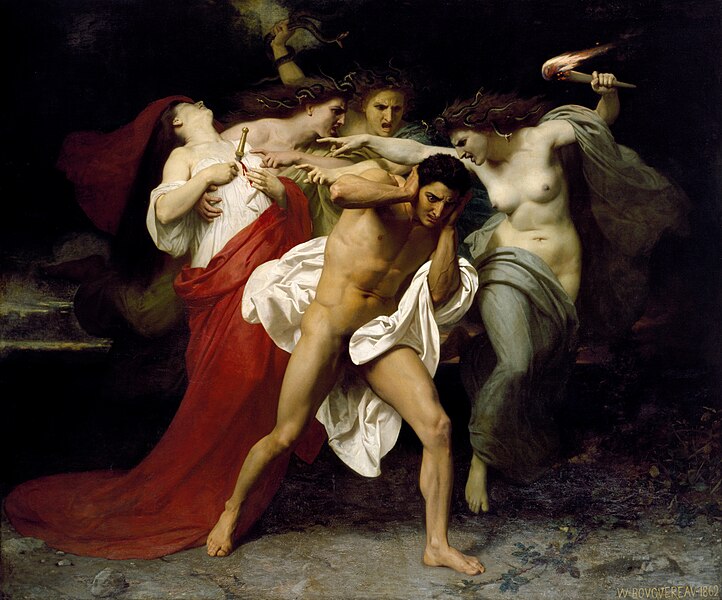
The Remorse of Orestes or Orestes Pursued by the Furies
Oil painting by William-Adolphe Bouguereau, 1862, in the Chrysler Museum of Art via Wikimedia Commons.
Feminist uproar over Trump’s election was easy to predict, and not long in coming. Within ten days of the election, Clara Jeffery wrote in Mother Jones that “Women are furious — in a Greek mythology sort of way“. Taking examples from TikTok, Jeffery chronicled abundant “sorrow, disbelief and terror, but also incandescent rage”, which many women vowed to exorcise on men: “‘If his ballot was red, his balls stay blue‘”, she quoted one.
In The New York Times, a 16-year-old girl, Naomi Beinart, charted her tumultuous emotions, which included a sense of betrayal because her male classmates had carried on with their lives on the day after the election, seemingly immune to the girls’ all-pervasive gloom and outrage. “Many of them didn’t seem to share our rage, our fear, our despair. We don’t even share the same future,” Beinart opined melodramatically.
No one with even a minimal acquaintance with social media can have missed the many similar, raging reactions: the heads being shaved, the death threats, the promised sex strikes, the fantasies of revenge against Trump-voting husbands. We are to understand that the re-election of a man rumored to lack sufficient pro-abortion commitment justifies thousands of self-recorded screams, imprecations, and poisoning plots.
At least one group of women gathered physically in Wisconsin to shout their angst and anger at Lake Michigan, and there have already been tentative (though apparently less enthusiastic than formerly) plans for a revival of the anti-Trump Women’s March protests, in which women with vulgar placards and pink hats exhibited their “collective rage“.
Women’s rage is all the rage.
It is not enough, it seems, for these women to say that they are disappointed by Trump’s win, and certainly inadequate for them to state strong disagreement with his policies or style. Expressing evidence-based positions is the sort of thing a rational person would do, and significant groups of women appear increasingly uninterested in rational talk or behavior. Instead, they reach for the most extreme language, tone of voice, postures and actions to express what feminist journalist Rhiannon Lucy Cosslett called the “visceral” “body horror” produced by the Trump victory, including the “profound physical revulsion” Cosslett and many of her sisters allegedly feel simply as a result of seeing one of Trump’s tweets (talk about fragility!).
Like so many feminist pundits telling us of women’s “horror” and “fury“, the emphasis is squarely on feeling and the female body, as if to bypass the intellect and the will altogether. The idea some feminists once scorned — that women are less reasonable and self-controlled than men — seems to have become a feminist axiom.
[NR: Edited to fix the broken URL.]
December 17, 2024
The rejection-in-advance of Bovaer as a “climate-friendly” “solution” to the “problem” of climate change
At Watts Up With That?, Charles Rotter documents yet another imposed-from-above bright idea that consumers are already eager to reject:

When global elites and bureaucrats decide they must “fix” the world, the results often speak for themselves. Take the latest technocratic debacle: Bovaer, a feed additive designed to reduce methane emissions from cows, marketed as a “climate-friendly” solution. It’s now being shelved by Norwegian dairy producer Q-Meieriene after consumers flatly rejected its so-called “climate milk”.
This is more than a simple story of market rejection. It’s a cautionary tale of what happens when governments, corporations, and globalists push policies and products that tamper with the food supply to address a problem that may not even exist.
The Quest to Solve a “Crisis”
Bovaer, developed by DSM-Firmenich, has been touted as a game-changer in the fight against methane emissions — a major target of climate policies. The additive is said to suppress a key enzyme in the cow’s digestive process, reducing methane emissions by up to 30%. Regulatory bodies in over 68 countries, including the EU, Australia, and the U.S., have approved its use.
But let’s step back for a moment. Why are we targeting cow burps and farts in the first place? Methane is indeed a greenhouse gas, but it’s also a short-lived one that breaks down in the atmosphere within about a decade. Moreover, cows and bison have been emitting methane for millennia without triggering apocalyptic climate shifts. Yet suddenly, livestock emissions are treated as a planetary emergency demanding immediate action.
This myopic focus on cow methane is a prime example of how climate zealotry warps priorities. Rather than addressing real and immediate issues — like the energy crises their own policies create — governments and globalists have decided to micromanage how your milk is produced, all to reduce emissions by an imperceptible fraction of a percentage point.
Consumer Rebellion
The backlash against Bovaer has been swift and fierce. In Norway, Q-Meieriene began using the additive in 2023, branding the resulting product as “climate milk”. The response? Consumers overwhelmingly rejected it, leaving supermarket shelves stocked with unsold cartons while Bovaer-free milk flew off the shelves.
Facing dismal sales, Q-Meieriene recently announced it would discontinue the use of Bovaer, stating:
Demand for Q climate milk has not been high enough to continue production … we phased out the use of methane suppressants in cow feed and are putting this project on pause.
https://www.nettavisen.no/nyheter/ville-redde-klimaet-med-prompe-fri-kumelk-snur/s/5-95-2166980
This is not merely a marketing failure. It reflects a broader consumer revolt against the technocratic imposition of “solutions” no one asked for. People are increasingly skeptical of being told that their daily choices — what they eat, how they travel, how they heat their homes — must be sacrificed on the altar of climate orthodoxy.
Canada’s deputy prime minister heads for the exits
After being informed by Justin Trudeau that he no longer wanted her to be the finance minister on Friday, but still apparently expecting her to present the fall economic statement on Monday, Chrystia Freeland instead submitted her resignation from cabinet:

In the National Post, John Ivison calls it her “gangster move” against Trudeau:
Who saw Chrystia Freeland pulling a gun, after Justin Trudeau unsheathed a knife?
The finance minister is an unlikely champion of the Chicago Way, but she has just pulled off a coup that may end up toppling this government.
Just hours before she was due to give her fall economic statement, she quit.
Despite the widespread media speculation about a falling out between Freeland and Trudeau, it’s a good bet that no one was more surprised at the finance minister’s gangster move than the prime minister.
Her resignation letter was savage. She said that on Friday, Trudeau had told her he no longer wanted her as finance minister and offered her another job in cabinet.
She said that she concluded she had no option but to resign because she had lost the prime minister’s confidence.
The casus belli was the multi-billion-dollar affordability package that included a two-month GST holiday and mailing $250 cheques to nearly 19 million working Canadians.
As the National Post reported late Sunday, Freeland had already reversed the government’s position on the rebate cheques that would have cost an estimated $4.68 billion. One person with knowledge of the plans said that the measure will not be in the fiscal update but the government hopes to take another look in the new year, if it can find another party to support it.
Oh, and the financial update Freeland was still expected to deliver after being underbussed by Trudeau? It apparently did get released:

You can always count on the Babylon Bee to find the most accurate and tasteful way to present the news:

December 16, 2024
The academic battle over the legacy of the British Empire
In the Washington Examiner, Yuan Yi Zhu reviews The Truth About Empire: Real histories of British Colonialism edited by Alan Lester:
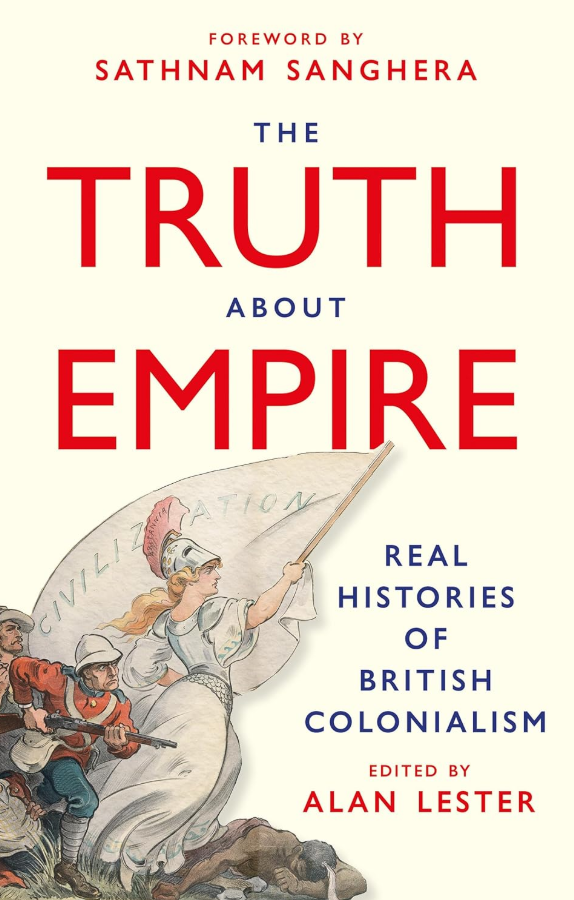
… the story fitted awkwardly with the new dominant historical narrative in Britain, according to which the British Empire was an unequivocally evil institution whose lingering miasma still corrupts not only its former territories but also modern-day Britain.
When Kipling lamented, “What do they know of England, who only England know?” he was not being elegiac as much as describing a statistical fact. Contrary to modern caricatures, apart from episodic busts of enthusiasm, Britons were never very interested in their empire. At its Victorian peak, the great public controversies were more likely to be liturgical than imperial. In 1948, 51% of the British public could not name a single British colony; three years later, the figure had risen to 59%. Admittedly, this was after Indian independence, but it should not have been that hard. Proponents of the “imperial miasma” theory are right in saying that British people are woefully ignorant about their imperial past; but that was the case even when much of the world was colored red.
The Truth About Empire: Real Histories of British Colonialism is a collection of essays edited by Alan Lester, an academic at the University of Sussex who has been at the forefront of the cultural conflict over British imperialism on the “miasma” side — though, like all combatants, he denies being a participant. Indeed, one of the book’s declared aims is to show that its contributors are not engaged in cultural warring.
Their nemesis, whose name appears 376 times in this book (more often than the word “Britain”) is Nigel Biggar, a retired theologian and priest at the University of Oxford. In 2017, Biggar began a project to study the ethics of empire alongside John Darwin, a distinguished imperial historian. The now-familiar academic denunciations then came along, and Darwin, on the cusp of a quiet retirement, withdrew from the project.
Lester was not part of the initial assault on Biggar but has since then emerged as his most voluble critic. He disclaims any political aims, protesting that he and his colleagues are engaged in a purely scholarly enterprise, based on facts and the study of the evidence.
Yet some of Lester’s public interventions — he recently described a poll showing that British people are less proud of their history than before as an “encouraging sign” — are hard to square with this denial. Biggar, by contrast, is refreshingly honest that his aims are both intellectual and political. I must add that both men are serious scholars, which is perhaps why neither has been able to decisively bloody the other in their jousts.
[…]
“What about slavery?” asks Dubow’s Cambridge colleague Bronwen Everill. Unfortunately, her four pages, which read like a last-minute student essay, do not enlighten us. The most she can manage is to point to an 18th-century African monarch abolishing the slave trade as evidence that the British do not deserve any plaudits for their abolitionist efforts across the world, whose cost has been estimated at 1.8% of its gross domestic product over a period of 60 years.
Meanwhile, Abd al Qadir Kane, Everill’s abolitionist monarch, only objected to the enslavement of Muslims but not to slavery generally, his progressive reputation resting mainly on the misunderstandings of Thomas Clarkson, an overenthusiastic English abolitionist. (Either cleverly or lazily, Everill quotes Clarkson’s misleading account, thus avoiding the need to engage with the historiography on Islamic slavery in Africa.)
Everill’s central argument is that abolitionism allowed Britain to rove the world as a moral policeman and to overthrow rulers who refused to abolish slavery. It is never clear, however, why this was morally bad. If anything, Britain did not go far enough: Well into the 1960s, British representatives still manumitted slaves on an ad hoc basis in its Gulf protectorates, when the moral thing would have been to force their rulers to abolish slavery, at gunpoint if necessary.
December 15, 2024
QotD: Elite luxury beliefs – cultivated non-disgust
But now they’ve moved on to the kids. It is easy to believe a listless, drug-addled elite might indulge in sexual degeneracy just for the hell of it. But how do we explain kindergarten teachers teaching their pupils about pronouns? Doctors emotionally blackmailing parents by insisting that the alternative to mutilating their children is their suicides? Or civil servants quietly putting gender-neutral bathrooms in public spaces?
How do we explain any of this? How do we even explain the emergence of transgenderism at all? There have been transexuals and gender dysphorics throughout history. They were typically understood as an offshoot of homosexuality, the extreme end of the effeminacy spectrum, and a vanishingly small fraction of the population.
But the current contagion is unusual and is clearly artificial. Its scale can only be a result of active promotion. Much of that is accomplished via the media and fellow travellers who champion these activities. But it is helped along by a collection of other professionals, and any attempt to question it is met with energetic pushback.
It is apparent that much of this comes from on-high, a literal top-down initiative. In less than twenty years we have witnessed a journey that began with gay rights and now includes active promotion of sexual deviancy to children, none of it natural or wanted by the majority. There is lots of speculation as to why this may be, including the part it may play in a comprehensive depopulation agenda.
What is apparent is that the professional class who endorse and promote this perceive it as an exercise in tolerance.
The notion of tolerance has typically been invoked for the distasteful, a last line of defence when direct measures fail, not a behavioural response indicating sophistication.
We rely on tolerance for things we dislike but cannot avoid. We learn to tolerate a persistent whine from an air conditioning unit, a noisy neighbour, or a noxious smell. But our goal is always to remove the source of the problem. Tolerance is a stopgap only when more permanent solutions are absent.
Their belief that tolerance is a virtue is one of the greatest shortcomings of today’s chattering classes. It is exactly the kind of signal error that exemplifies the disconnect between globalist elites and their obedient cheerleaders. The mechanism here seems to be a kind of learned override to natural disgust or discomfort. When others then object to whatever letter they have just added to the LGBTQWERTY+ community on the basis that it can’t be healthy or normal to endorse this stuff, that learned response includes the flare of superiority at your obvious backwardness.
How satisfying it must feel to have your natural inclination toward superiority endorsed in this way. Like whole food vegans at a Medieval banquet, it must provide an irresistible sense of smugness to know that you are the one-eyed man in the rainbow-decked land of the blind, with the uneducated hopelessly lost in their backward understanding of the benefits of sexual liberation.
While elites and their public relations machine happily endorse this misplaced emphasis on tolerance, all evidence suggests the elites themselves are not tolerating anything, despite what their obedient minions may think. They really are indulging in the cocaine-fuelled all-star human sacrifice orgies for real because they are cosmically bored and rich.
They aren’t rising above intrinsic disgust responses, they have sexualized them. They seem to have fetishized everything we consider unacceptable. Trafficked kids, femboys, chicks with dicks, gangbangs, farmyard orgies, human sacrifice, the lot.
They may even experience a thrill in seeing just how far they can push public morality as many have suggested, and especially how far they can get otherwise normal middle-class people to champion deviancy and hedonism most cultures find distasteful enough to ban.
The excessive promotion of tolerance is a defence against unnatural practices bored elites are rumoured to engage in. The professional class, for all their faults, probably aren’t into human sacrifice or animal orgies. So their response is to elevate the importance of visible acceptance of alternative lifestyles, hence gay kids, castrated boys, invented genders and other absurdities they cannot possibly believe themselves, and all of it instantly conveyed to one’s peers with nothing more than a multicoloured flag.
To top it all when they see how normals react, those unmoved by inept calls to be more understanding about sexual abuse, when they see parents reach for the shotgun at the very idea of sexually mutilating children, they get to invoke the conjoined twin of their cultivated tolerance, namely artificial superiority. The deep belief that they see further than the yokels with their primitive instinct to actually protect the vulnerable and embrace some basic sense of public morality.
These absurd beliefs can be observed in our educated classes because they ostentatiously demonstrate tolerance and its newfound position as the supreme virtue of the post-Christian age, one of the most successful public relations campaigns ever run by elites.
Spaceman Spiff (guest-post) “Praying to Absent Gods”, Postcards from Barsoom, 2024-07-16.
December 14, 2024
Matt Gurney’s final thoughts from the Halifax International Security Forum
One of the things I regret about being totally broke is that I can’t pay for a full subscription to The Line, which is one of Canada’s best sources of (relatively) unbiased commentary on current events both in Canada and around the world. This is the third instalment of Matt Gurney’s report from the recent Halifax International Security Forum (earlier parts linked here and here):

This next one is going to be very brief, since it’s really just an observation. There was very little discussion of Israel. As I noted at the top, there was discussion of the situation in the Middle East. But it was mostly in the context of “The world is currently a mess”. Parts of the Forum involve breaking into smaller groups for more focused discussion on specific issues, and some of those might have focused on Israel or the Middle East more broadly. I can’t speak to what I didn’t see. But I was surprised by a relative lack of focus on the ongoing fighting around Israel in the main events.
A notable exception was the presence of Dr. Cochav Elkayam-Levy on one of the on-record panels. An international law expert, she has spent the months since the October 7th attacks documenting the mass sexual violence that was such an awful feature of Hamas’s attack. Her comments were brief but powerful and can be seen here starting at around the nine-minute mark. I’d like to zoom in on one comment in particular. Dr. Elkayam-Levy told the audience how the invaders were able to capture the personal devices of many of their victims, and use those devices to broadcast the abuse and sometimes murder of these victims via the victims’ own social media apps. This was something that was discussed shortly after the October 7 attacks but not much after: by seizing the victims’ phones, the invaders were able to spread terror and traumatize the loved ones of the victims by showing their friends and family, via photos and videos and live streams, exactly what the victims were being made to suffer.
“I thought I had seen the worst,” the doctor told the assembled audience. “But really, if there is hell, this is what it looks like. Someone abusing your kin. Someone killing your loved ones in front of your eyes.”
Though it was only a small part of the official agenda, Dr. Elkayam-Levy’s comments left an outsized impression on me, and I suspect on many others.
He also discussed his own professional path which he regrets didn’t include a lot of traditional on-the-spot reporting on tragedies and interviewing survivors, as he feels he doesn’t have a good “game face” for those times when he now finds himself doing that kind of work:
I am 100 per cent on side with Ukraine in its war with Russia. I’m not blind to flaws in Ukraine today or in Ukraine’s history, but I have absolutely no doubt who’s the good guy and the bad guy in that ongoing war. I’ve had wonderful opportunities to speak with many Ukrainians since their country was invaded. I have heard their stories and tried to share them on my platforms. I’ve also had opportunities to meet and talk to many Ukrainians who are living now in my own hometown, mostly women with young children, who fled the fighting or once lived in parts of the country that are now occupied by Russia.
I feel so profoundly that these people have been wronged, and tremendously wronged. I believe so sincerely that they should have our full backing as they try and drive back the invaders and liberate their country. That their cause is not just in the West’s strategic interests, and I very much think that it is, but also that it is morally just.
But I have concluded that they’re screwed. We’ve lost interest, and Ukrainians are about to get the Kurd treatment, if I can be so crass. And I just didn’t have the heart to tell them that. I don’t even know how I’d begin to say that to them. I write and speak for a living. And words still failed me.
During a meal in Halifax, a woman who’d flown in to give a presentation on the work her organization does in Ukraine assisting displaced people told me a story of her own experience with the war. The original Russian invasion in 2014 hadn’t been anywhere near where she lived. She was somewhat shocked, she told me, when in 2022, her hometown came under attack. She described the first time she heard air raid sirens. The first time she heard a bomb blast. The first time she could hear the gunfire of advancing ground troops. She told me about the first person from her small community to die, a paramedic who was on her way to collect wounded when their ambulance was hit. And then she told me how, months later, she realized she couldn’t remember any of those things anymore, except for the first time, because they’d happened so much. Constant sirens. Constant bombings. Constant gunfire. The deaths of more people she personally knew than she could even remember.
And as she told me this story, I found myself near tears. I was able to cover it up, I think. I wish I had better game face, but I have some. But my tears weren’t even of sympathy. I wasn’t overwhelmed by her sad story, though it was awfully goddamned sad. No, the tears I felt were tears of shame. I knew that at the end of the conference, I’d get to go home. Toronto is a bit rougher than it was when I was growing up, but it ain’t a war zone.
This woman doesn’t get to go home, assuming her home is even still standing. She knew it, I think. I knew it. I think we both knew that the other knew. But we talked around it.
History is going to judge us harshly for our failure to do more, faster, to help Ukrainians defend themselves.
And alas, we’ll deserve it.
Tulsi Gabbard as the Director of National Intelligence
To the left, Gabbard is widely criticized as some sort of Russian pawn, while to many on the right she’s unacceptable as a former Democrat and “girlboss”. Despite this, J.D. Tuccille says President-elect Donald Trump seems quite confident that she’s the right person for the job:
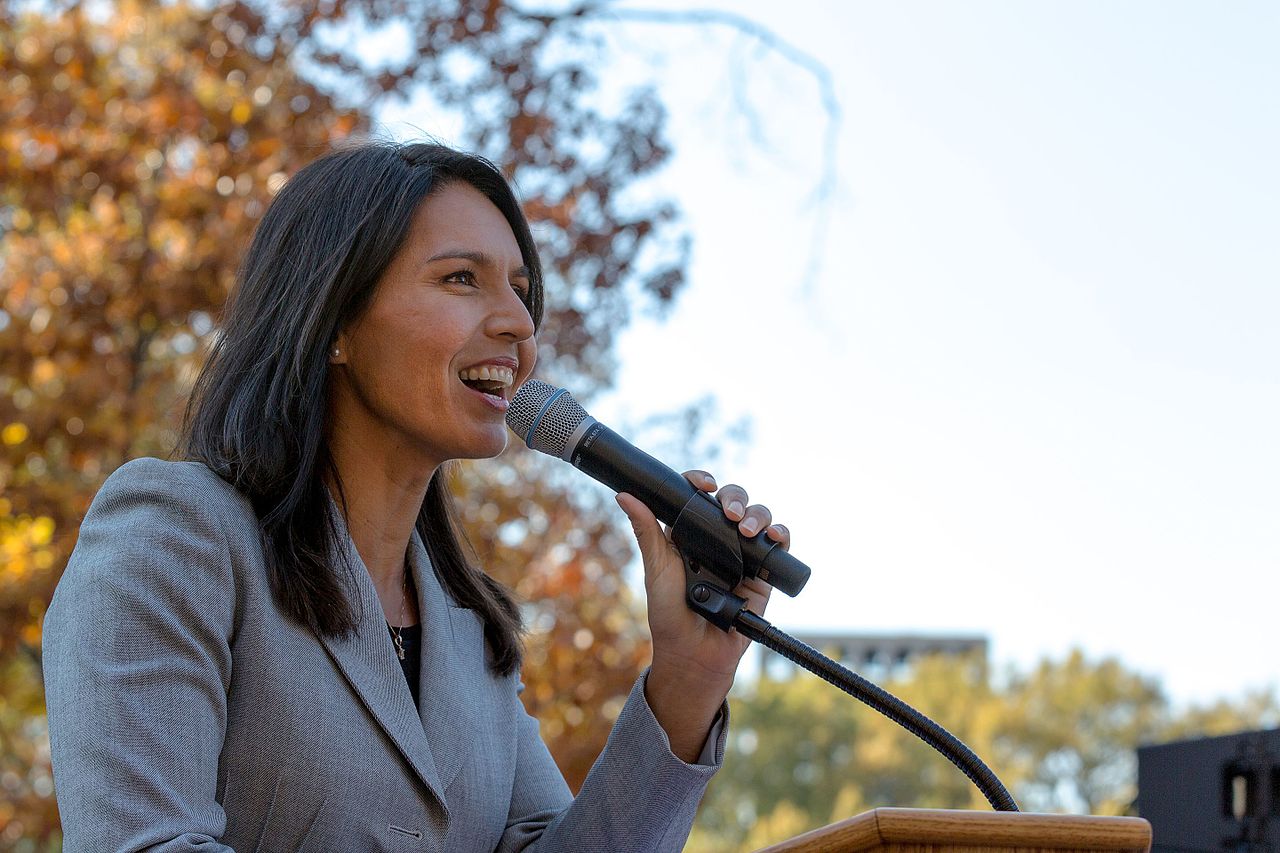
Tulsi Gabbard speaks at the “People’s Rally” in Washington DC on 17 November, 2016.
Photo by Lorie Shaull via Wikimedia Commons.
United States President-elect Donald Trump is standing behind Tulsi Gabbard, his pick to be director of national intelligence. Like several of Trump’s nominees, former Democratic congresswoman Gabbard is controversial in D.C.-insider circles, and understandably so; she’s skeptical of the political establishment, often criticizes foreign policy and was apparently subject to surveillance and put on a terrorist watch list because of her dissident ways. In other words, she’s a rather promising nominee for an incoming administration that wants to completely revamp government institutions that desperately need reform.
Asked this week by NBC’s Kristen Welker if he has confidence in Gabbard despite objections raised in certain circles to her past actions and positions, Trump responded, “I do. I mean, she’s a very respected person.”
Trump was specifically asked about two meetings Gabbard had in 2017 with then-Syrian dictator Bashar al-Assad. Now in exile, al-Assad and his relationships with American politicians shouldn’t be much of a worry anymore, but he plays a part in the official panic over Gabbard’s views on foreign policy.
In 2019, former Democratic presidential candidate Hillary Clinton famously called Gabbard a “Russian asset“. Gabbard, a veteran of the Iraq war, aroused Clinton’s ire with her anti-interventionism in foreign policy matters and criticism of the political establishment and its hawkishness during the course of a short-lived campaign for her party’s presidential nomination.
“There are brutal dictators in the world. Assad of Syria is one of them. That does not mean the U.S. should be waging regime-change wars around the world,” Gabbard told CNN in early 2019. Her long-standing fears of Islamist extremism led her to consider al-Assad a less-bad alternative to a potential fundamentalist regime.
Gabbard returned Clinton’s slight by calling her “the queen of warmongers” and the “embodiment of corruption”. It’s unsurprising that the two no longer share a political party.
Gabbard’s dissent from establishment orthodoxy doesn’t stop at military matters. In 2020, she joined with libertarian-leaning Republican Thomas Massie, from Kentucky, to call on the U.S. government to cease its persecution of Wikileaks founder Julian Assange. Assange ran afoul of the U.S. government when he published leaked documents revealing embarrassing details about official misconduct in Iraq and elsewhere.
Explaining the collapse in North American birth rates
The demographic collapse of both Canadian and American birthrates has many causes, but kulak definitely identifies a major one here:

📜Antidiscrimination law is the reason for the Birthrate Collapse.
In North America, for a guy to marry a girl, it’s basically expected that he must make enough more than her that he can pay for himself and support her while she provides for kids, without a decline in her lifestyle… and his status, quality of wife, and whether the marriage will be rocky or happy is determined by whether or not he can actually materially IMPROVE her lifestyle over unmarried life. Which was very achievable in the 50s and 60s when women were paid poorly and largely couldn’t get high status complex careers, and didn’t want to have to, and couldn’t, compete to male standards…
Whereas after antidiscrimination laws it is MANDATED 30-50% of high paying jobs must go to to women, no matter how many more hours men put in, or how less productive the women are. Ie. It is literally legally impossible for the average man to earn more than the average woman, no matter how hard or effectively he works… and because he WILL work harder to try, and because he competing against other men who are working harder to compete for the few high status jobs men can get, Men across the board are effectively POORER than women, they are doing way more work for equal or less pay and status.
It’s a meme now that girls will goof off at office jobs doing tik toks while the male workers are stressed and annoyed in the corner trying to keep the business afloat for the same pay. As such those girls won’t even date those men… because if you have to be stressed at the job for the same pay, you naturally seem poorer.
This is why western marriage and birthrates are collapsing.
And a follow-up response to another comment:
THis leads to spoiled delusional women convinced men are useless on the one hand, and the few self-aware women having to medicate to overcome their “imposter syndrome” as they subconsciously know they’re dead weight which psychologically breaks them.
QotD: The One Ring in Lord of the Rings
Unlike his friend C.S. Lewis, Tolkien was not fond of allegorical fiction. He had no time for the idea that the Ring — extremely dangerous but hard to get rid of — was an allegory of the atomic bomb. Rather, it was exactly what he said it was: an embodiment of power and the corrupting effects of power.
Tolkien shows us that the only people who can be trusted with great power are those who don’t really want it — or who do, but have the moral strength to reject it. Even then, it’s touch-and-go, the burden of responsibility taking a terrible toll on the reluctant bearer.
Numerous commentaries have been written on this aspect of the story — often summed up by the Lord Acton quote: “power tends to corrupt and absolute power corrupts absolutely”. Which is true enough. But Tolkien was onto a whole lot more than that …
Let’s begin at the beginning. The Ring was made at great cost to Sauron, its creator. He poured much of his own strength into an external object — one from which he could be separated, which in due course he was. So why take the risk? Sauron, though evil, was possessed of great cunning — why did he expose himself to such a vulnerability? Did old JRR just not think it through? Does the Ring actually represent a massive hole in the plot?
Not a bit of it. When you understand what Tolkien understood about the nature of power, it all makes perfect sense.
In a letter, he once wrote that the Ring was a “mythological way of presenting the truth that potency … if it is to be exercised, and produce results, has to be externalised and so as it were passed, to a greater or less degree, out of one’s direct control”. This is a crucial insight into the way Tolkien understood power to work.
Peter Franklin, “Tolkien’s guide to contemporary politics”, Unherd, 2019-12-24.
December 13, 2024
Kemi Badenoch … a Thatcher for the 2020s?
In The Free Press, Oliver Wiseman wonders if new British Conservative Party leader Kemi Badenoch will do for her party what Margaret Thatcher did after she was elected leader in 1975:

“I like fixing things that are broken,” says Kemi Badenoch in her interview with Bari on the latest episode of Honestly. Badenoch, 44, was elected as the new leader of the UK’s Conservatives last month. And luckily for her, there are a lot of things that are broken.
One of them is her party.
In July, after fourteen years in office, the Tories were unceremoniously booted from power. They lost more than 250 of their Members of Parliament in the biggest electoral defeat in the party’s history. On the long road back to power, Badenoch must contend not only with a Labour government with a huge majority in Parliament, but also Nigel Farage — the Brexit-backing populist is on a mission to supplant the Conservative Party as the main alternative to Labour.
If Badenoch somehow manages to fix her party and return to power, she must then figure out a way to fix Britain — a country where wages have stagnated for a generation, public debt has ballooned, and there’s widespread anger at high rates of immigration. As another Brit, Free Press columnist Niall Ferguson, put it recently in these pages: “Lately it seems that mine is a country with a death wish.” (Read his full account of what ails the UK here.)
In other words, Badenoch has a daunting in tray. And yet many — including Niall — are bullish on Badenoch, who he believes could be a “black Thatcher”.
As a woman in charge of the Conservative Party, Badenoch was bound to be compared to the Iron Lady. But in this case there are undeniable parallels. Much like Thatcher, Badenoch mixes steely determination with charm and charisma. She also, like Thatcher, knows what she believes. Her diagnosis of her party’s problems is straightforward: It has strayed too far from the values that have historically made it — and Britain — so successful.
And while Thatcher and Badenoch’s backgrounds are very different — one grew up in provincial England, the other spent most of her childhood in Nigeria — they are both self-made women with an appetite for hard work. Badenoch’s own story, and her family’s, is central to her politics. “I know what it is like to be wealthy and also to be poor,” she says today on Honestly.
There’s one other Badenoch–Thatcher parallel: the circumstances in which they took over their party’s leadership. Thatcher became Tory leader in 1975 — then, like today, a malaise had descended over the country, one that would lift during her time in office. These comparisons may be unavoidable, but does Badenoch welcome them? Bari asked her that in their conversation. “She is a heroine of mine. So it’s very flattering,” said Badenoch. “But it’s also quite heavy and she’s a different person. I admire her. But I want people to recognize that I’m not a pastiche of this person, that I am my own person.”
December 11, 2024
Canada’s current situation, as viewed by Fortissax
Fortissax recently spoke to an audience in Toronto. This is part of the transcript of his speech:

No doubt, many of you already have an idea.
The fact of the matter is this: 25% of the people in this country are, or soon will be, foreigners. Most of them are not the children of immigrants but fresh-off-the-boat migrants.
The economy? It’s in the dumps. Canada has the lowest upward mobility in the OECD for young people. One of the lowest fertility rates in the Western world. And the fastest-changing demographics in the Western world — as I’m sure you’ve all noticed here in the streets of Toronto, the old capital of Anglo-Canadians.
Think about this: approximately 4.9 million foreigners are classified as “temporary migrants.” Combine that with permanent residents, refugees, and immigrants, and that number swells to 6.2 million in just four years.
And it doesn’t stop there.
Crime is reportedly the highest it’s ever been. We have no military. The Canadian Armed Forces has faced retention issues for two decades. And what is command preoccupied with? Men’s bathrooms stocked with tampons and servicemen being “radicalized” by wearing extremist clothing like MAGA hats.
Let’s not forget foreign influence.
The Chinese Communist Party exploited the Hong Kong handover in the 1990s to infiltrate Canada, using British Columbia as their foothold. As Sam Cooper exposes in Claws of the Panda and Willful Blindness, they established a stronghold in Metro Vancouver, taking over the business community.
This “Vancouver Model”, as we Canadians ironically call it, normalizes our capitulation to foreign hostiles. Triads, working hand-in-glove with the Chinese communists, built a global drug empire. Fentanyl, mass-produced in football field-sized factories in China, is shipped to Vancouver and distributed across the entire Western Hemisphere.
Let this sink in: more Canadians have died from this economic warfare than all our soldiers lost in the Second World War.
And now, there’s India.
Intelligence agencies from the Republic of India have demonstrated their ability to conduct assassinations on Canadian soil. Recently, a Khalistani nationalist and separatist was killed — a figure I’ll leave to your sympathies or judgments. Regardless, this marks a disturbing shift.
India weaponizes its diaspora against the international community. In exchange for non-alignment with China, the West — particularly the Anglosphere — uses Indian migrants as wage-slave labor to suppress costs.
The result? A disaster.
In Canada, Australia, the U.K., and increasingly the United States, we see Indians climbing the ladders of power, pursuing their own interests — often brazenly. In Brampton, part of Greater Toronto, a 50-foot statue of the Hindu god Hanuman looms.
And let’s not forget the Punjabi Sikh population. They openly support an independent Khalistan — or remain at best indifferent to the cause. They have infiltrated Canada’s state apparatus, even reaching the Ministry of National Defense, where Harjit Sajjan prioritized rescuing Afghan Sikhs during Kabul operations over broader Canadian interests.
In Surrey, British Columbia, the trucking industry is effectively controlled by Sikhs. In online spaces, Sikh nationalists demand Brampton be recognized as a province, seemingly aware that their homeland exists more abroad than in Punjab itself. The leader of the NDP, Jagmeet Singh, serves as yet another example — barred from entering India due to his sympathies for separatism.
But foreign influence is only half the story. Among our own lies another problem: disintegration.
Decades of Western alienation and economic parasitism by the federal government are fueling separatist movements in places like Alberta and Saskatchewan. In Quebec, the Parti Québécois is polling higher than the ruling CAQ, openly advocating for secession from Confederation.
Meanwhile, the federal Conservatives court immigrant voters, alienating native Canadians and abandoning their base.
And then there’s the economic misery.
The average Canadian home costs $700,000. The median income? Just $48,000. Upward mobility is nonexistent. The managerial regime hoards wealth and power, gatekeeping opportunity through credentialism, exorbitant tuition, and crushing taxes.
55% of Canadians have post-secondary education, and yet most have nothing to show for it. The regime is not run by titans of intelligence or visionaries. It’s run by ideologues — loyal to their cause, not to competence or merit.
The final insult: demographics.
Over the next six years, British Columbia, Alberta, Saskatchewan, and Manitoba will become majority non-Canadian. The 50% threshold will be breached, with profound consequences for local politics.
Ontario will hover just above 50%, while Quebec and the Maritime provinces will remain over 70% and 80% Canadian, respectively. This is not a death sentence, but it is a profound transformation for Western Canada, which has historically been more propositional and less identitarian than the East.
This is where we are.
Our sovereignty is compromised. Our identity is eroded. But we are not yet defeated. What happens next depends entirely on us.
QotD: Simon Leys on George Orwell
What Leys wrote in 1984 in a short book about George Orwell might just as well have been written about him: “In contrast to certified specialists and senior academics, he saw the evidence in front of his eyes; in contrast to wily politicians and fashionable intellectuals, he was not afraid to give it a name; and in contrast to the sociologists and political scientists, he knew how to spell it out in understandable language.”
Leys drew a distinction between simplicity and simplification: Orwell had the first without indulgence in the second. Again, the same might be said of Leys — who, of course, like Orwell, had taken a pseudonym, and with whose work there were many parallels in his own.
But immense as was Leys’s achievement in destroying the ridiculous illusions of Western intellectuals, as Orwell had tried to do before him, it was a task thrust upon him by circumstance rather than one that he would have chosen for himself. He was by nature an aesthete and a man of letters, and I confess that great was my surprise (and pleasurable awe) when I discovered that he was, in addition to being a great sinologist, a great literary essayist.
Theodore Dalrymple, “Rare and Common Sense”, First Things, 2017-11.
December 9, 2024
“Take the lecture, America. This person is tired of you being so weird all the time”
Chris Bray checks in on the vocational mental health clinic known as the New York Times:

Non-binary New York Times op-ed writer M Gessen
A cruel government official absolutely brutalized and devastated some journalists this week, in a horrifying showdown that the New York Times op-ed writer M Gessen bravely describes this morning:
Shortly before allowing reporters into the main chamber of the Supreme Court for oral arguments in United States v. Skrmetti, a court employee asked us all if we needed to use a bathroom. The men’s room was right next door, the staff member said, and the women’s room down the hall.
“Where should nonbinary people go?” one of the reporters asked.
An uncomfortable back-and-forth followed. The staff person seemed not to understand the question. In the end, there was no answer. It just didn’t seem to compute.
The men’s room is over there, the Nazi said, not even seeing what a vicious act this was.
This is the lede; given the richest real estate in journalism, Gessen opens a discussion of a Supreme Court case with the story of victims denied the right to drop a deuce in a manner that fully provides them with the rich tapestry of social equity. The arc of the moral universe is long, but it apparently bends toward just using a gendered toilet stall to wipe your ass. The piece goes on the warn about the American descent into Trumpian autocracy, in case you hadn’t guessed.
After an election season in which Tim Walz, of all people, was sent out to sell the narrative that JD Vance, of all people, was deeply weird and socially marginal, I constantly find myself seeing representations of strangeness and darkness and cruelty and horror that make me … shrug? “Which part is the bad part?”
I mentioned this yesterday, but I’m fixating this morning on the journalist who just crushed Pete Hegseth, just absolutely caught his ass, dead to rights, and bragged that she had the receipts. Mic drop, bitch — she got you! Your deviant behavior is on video. And then you watch the video, and it’s some way-obvious dads drinking a glass of whiskey together, obviously sober and acting with restraint, in a dead-center normal piece of social behavior.
This happens daily. HERE IS A SCARY WEIRD THING, a headline says, and I click on the link and see an unremarkable thing. The nonbinary journalist M Gessen is deeply concerned that the Supreme Court building is operated in such a bizarre way, consistent with a brutal descent into autocracy, not the socially reasonable way in which a diverse regime of toilet facilities are aligned with the infinite number of possible ways to represent your relationship to your crotch. M Gessen.
Take the lecture, America. This person is tired of you being so weird all the time.


