
We Americans are truly blessed by having a mainstream media full of brilliant renaissance men, women, and gender non-specific entities who are masters of so many varied and intermittently useful skills and who are eager to share their knowledge with us benighted souls. The pandemic has revealed that every urban Twitter blue check scribbler, MSNBCNN panelist, NYT/WaPo doofus, and barely legal “senior editor” of a website you never heard of, is a Nobel Prize-winning epidemiologist, a master logistician, and a diversity consultant to boot.
They may all be lousy journalists, but damn it, they are also lousy at other jobs that they didn’t even pretend to train to do.
It’s awesome to see people with zero life experience in any relevant field weighing in as if we shouldn’t just laugh in their pimply faces. Here’s the typical resume of one of these hacks:
- Went to high school, and never went to parties
- Went to college, majored in journalism, and never went to parties
- Went to journalism grad school, and never went to parties
- Works in the media, and goes to Manhattan/Georgetown cocktail parties
This apparently qualifies them to explain to people like us who have actually done something in our lives how stuff is supposed to work.
Kurt Schlicter, “Our Super Smart Elite Shines During This Pandemic!”, TownHall.com, 2020-04-02.
February 22, 2025
February 21, 2025
“… a sea change in American foreign policy priorities”
Theophilus Chilton on how the markedly changed US foreign policies under Donald Trump are roiling the old certainties of so many western “transnational” elites:

Last Friday, an event occurred which represents a sea change in American foreign policy priorities, but the importance of which may have been missed by many. Vice-President Vance gave a speech at the Munich Security Conference. In this speech, he basically pulled no punches, calling out the various Western European governments for their support for mass immigration, their opposition to free speech, and the erosion of democratic functions within their governments. The speech itself presented a stark contrast between the new American administration and the “leadership” that currently exists in most European countries. It represents a decisive rupture between an American executive which is in the process of refuting the influence of a globalist transnational “elite” over its country and European governments which are still firmly ensconced in that elite’s thrall.
The thing is, Vance was pretty much right about everything he said. Mass immigration, especially that part of it coming from Africa and the Muslim world, is absolutely destroying the social fabric of every European nation as well as dragging down their standards of living toward third world levels. Euro governments, in fact, do absolutely hate freedom of speech and apply strictures that medieval monarchies would never have dreamed of instituting. For all their talk about the importance of democracy and the “threat” to it represented by Trump and his administration, Euro countries make an absolute mockery out of the entire concept. Those European slaves of the globalists can grumble and sit there aghast at Vance’s words, but the simple fact of the matter is that he was right in every way in the criticisms he leveled against them.
After all, these are the people who overturn Romanian elections because actual Romanians voted for the wrong person — all to “defend democracy”. These are the people who ban political parties to “defend democracy”. These are the people who let “migrants” stab little girls to death to “defend democracy”. These are the people who arrest Christians for singing hymns on a public street to “defend democracy”. These are the people who do armed midnight raids and throw people into prison for sharing memes on social media to “defend democracy”. You get the picture. Populism and popular sovereignty are such a threat to these regimes because their democracy is a sham, a foil used to give a pretended legitimacy to globalist policies which are destroying the actual people of these various countries.
For all the breathless hyperventilating about Russia “invading Europe” (which it is in no position to do, LOL), the fact is that there is nothing that the Russians could do to the people of Europe that would be worse than what their own governments already subject them to.
What makes this all the more amusing is the excited “nationalism” we’ve been seeing from the lefties and globalists in several of the countries that have been in the Trump/Vance crosshairs over the past month. A good example would be in Canada, in response to the tariff threats that Trump made to try to push the Canadian government into being a little more proactive about securing their side of the border from the fentanyl and illegal aliens that enter the USA. Watching the Canadian government fall all over itself trying to fake an exuberant pride in their Canadian-ness, even as they continue to turn their country into an Indian colony and treat their own White Canadian population like a bunch of expendable paypigs has been enlightening, to say the least. Obviously, what’s driving the reaction is not a genuine love of country or people, but loyalty to the transnational elite that is piqued at recently being disempowered in the USA.
In all of this, it’s important to remember that the enemies here, the people who deserve our ire and derision, are not the peoples of Canada, the UK, the European countries. It is the transnational clique and their progressive Left hangers-on, the same people who were until very recently doing the exact same things to the American people, too. We need to be very clear that regular, everyday Americans and regular, everyday Frenchmen, Germans, Canadians, Italians, and all the rest are on the same side here. We have the same enemy. The European and other peoples are victims of their own governments, first and foremost. I mean, their own governments are now formally making them eat the bugs as part of their anti-human green agenda, just to give one example.
February 19, 2025
Europe’s moral leaders stand strong against grotesque American fascism
You have to hand it to the great and the good of Europe … they sure can find every. last. rake. to step on as they hysterically react to the slightest hint of disagreement or contradiction:
Germany is right. Opposition parties must be forbidden or firewalled. Political criticism must be criminalized. The public sphere must be firmly controlled by government, with guardrails against disagreement and heterodoxy. If we don’t do these things, we might descend into authoritarianism.
Margaret Brennan’s bizarre response to JD Vance’s speech in Munich — free speech? but that’s the weapon the Nazis used to commit the Holocaust! — wasn’t mere ignorance or accident. It’s a maneuver. You’re going to see more of it, in an urgent wave of moral inversion. Case in point, from the New Republic today:
Remember that Vance said things like this:
The good news is that I happen to think your democracies are substantially less brittle than many people apparently fear.
And I really do believe that allowing our citizens to speak their mind will make them stronger still. Which, of course, brings us back to Munich, where the organisers of this very conference have banned lawmakers representing populist parties on both the left and the right from participating in these conversations. Now, again, we don’t have to agree with everything or anything that people say. But when political leaders represent an important constituency, it is incumbent upon us to at least participate in dialogue with them …
I believe deeply that there is no security if you are afraid of the voices, the opinions and the conscience that guide your very own people.
So governments should live in dialogue with the populations they govern; citizens should speak freely; banning or limiting political parties makes society less free and less open. From start to finish, Vance spoke for liberty and openness, for free expression and societies organized through unfettered debate.
The calculated response — the calculated response, a deliberate deflection — is: Oh no, he’s saying we should turn into Nazis! Look at the subhed to the thing in the New Republic: arguing for freedom is aligning ourselves with international fascism.
Openness is genocide. Freedom is fascism. Speech is violence. Free societies arrest people for saying the wrong thing. Free speech — you mean like ADOLF HITLER!?!?
Read the piece in the New Republic, and look closely at Michael Tomasky’s language, which is full of Stasi-adjacent framing: “The Alternative fur Deutschland (AfD) has been declared a ‘suspected extremist’ organization by the German domestic intelligence agency.”
A brief nod to the shade of Missouri Representative James Beauchamp “Champ” Clark
I was aware that the greatest Liberal Prime Minister in Canadian history, Sir Wilfred Laurier, had lost an election on the basis of a negotiated free trade deal with the United States, but I was not aware of exactly how that happened. Colby Cosh provides the gory details that got Laurier out of office for good:

Funny thing I noticed: Friday marked the anniversary of the 20th century’s most remarkable explosion in Canadian-American relations, which took place on the floor of the U.S. House of Representatives in 1911. On that day, Feb. 14, Missouri Democratic congressman James Beauchamp “Champ” Clark gave a short speech in defence of a free-trade agreement that had been hammered out between the (Republican) Taft administration and Wilfrid Laurier’s Liberal government.
Clark, a progressive and witty westerner who had already been chosen to become Speaker of the House in April, was widely expected to be the Democratic nominee for president in 1912. He was, in other words, a man who counted. And on the floor of the House, he advocated passage of the free-trade deal on grounds that eventually doomed it: namely, that it was a conscious step toward total American absorption of the Dominion of Canada.
When Clark’s remarks hit the newspapers up north — and no news story hit harder between 1900 and the dawn of the Great War — there was a spasm of anti-American and pro-Empire feeling throughout the country. As any schoolbook will tell you, this helped lead to the defeat of Laurier and the ruin of the trade deal in September 1911’s general election. This gaffe is indeed now what Clark is best remembered for, along with his eventual fumbling away of the 1912 presidential nomination to an unassuming professor named Woodrow Wilson.
When I was an undergraduate, we all had to have it explicitly explained to us that back in Edwardian days, the Liberals were the party of free trade, and the Conservatives the great defenders of tariff protection (although Sir John A. had sometimes sought without success to kick-stark “reciprocity” negotiations with the U.S.). Perhaps the most confusing feature of the 1911 controversy to students of today will be Champ Clark’s idea that the U.S. government would want to lower trade barriers to facilitate eventual annexation of Canada, rather than raising them to mutually punitive levels as a matter of crude antagonism.
Between Confederation and Champ’s time, Americans often just assumed as a matter of course that Canada would fall into their laps without any need for aggression or invasion. We northerners would eventually see that the benefits of American citizenship were more valuable than our romantic imperial attachments, and we would come beat down the door. This was certainly Clark’s own idea, and it created no controversy among Americans themselves when he expressed it.
Of course, in Laurier’s day “liberal” meant something closer to the modern sense of “libertarian” than it does to the current incarnation (or shambling corpse) of that party.
February 18, 2025
Canadian academic life now entails mandatory indoctrination about “settler colonialism”
In Quillette, Jon Kay talks about the pervasive indoctrination of Canadian university students in that invasive intellectual weed from Australia, “settler colonialism”:

Last month, I received a tip from a nursing student at University of Alberta who’d been required to take a course called Indigenous Health in Canada. It’s a “worthwhile subject”, my correspondent (correctly) noted, “but it won’t surprise you to learn [that the course consists of] four months of self-flagellation led by a white woman. One of our assignments, worth 30%, is a land acknowledgement, and instructions include to ‘commit to concrete actions to disrupt settler colonialism’ … This feels like a religious ritual to me.”
Canadian universities are now full of courses like this — which are supposed to teach students about Indigenous issues, but instead consist of little more than ideologically programmed call-and-response sessions. As I wrote on social media, this University of Alberta course offers a particularly appalling specimen of the genre, especially in regard to the instructor’s use of repetitive academic jargon, and the explicit blurring of boundaries between legitimate academic instruction and cultish struggle session.
Students are instructed, for instance, to “commit to concrete actions that disrupt the perpetuation of settler colonialism and articulate pathways that embrace decolonial futures”, and are asked to probe their consciences for actions that “perpetuate settler colonial futurity”. In the land-acknowledgement exercise, students pledge to engage in the act of “reclaiming history” through “nurturing … relationships within the living realities of Indigenous sovereignties”.
My source had no idea what any of this nonsense meant. It seems unlikely the professor knew either. And University of Alberta is not an outlier: For years now, whole legions of Canadian university students across the country have been required to robotically mumble similarly fatuous platitudes as a condition of graduation. It’s effectively become Canada’s national liturgy.
After my tweet went viral, I was contacted by a US-based publication called The College Fix, which covers post-secondary education from a (typically) conservative perspective. Like many observers from outside Canada, reporter Samantha Swenson couldn’t understand why Canadian students were being subjected to this kind of indoctrination session. “I hope you can answer,” she wrote: “Why do schools make mandatory classes like these?”
I sent Swenson a long 13-paragraph answer — which, at the time, felt like a waste of my time: I assumed the reporter would pluck a sentence or two from my lengthy ramble, and the rest of my words would fall down a memory hole.
So when her article did come out — under the title, Mandatory ‘Indigenous Health’ class for U. Alberta nursing students teaches ‘systemic racism’ — I was pleased to see that I’d been quoted at length. I especially appreciated the fact that Swenson had kept in my point that educating Canadians (especially students in the medical field) about Indigenous issues is important work; and that courses such as Indigenous Health in Canada would provide value if they actually served up useful facts and information, instead of self-parodic faculty-lounge gibberish about “decolonized futurities”.

Trump is a lot of things, but he’s no Neville Chamberlain
Tom at The Last Ditch reacts to his European friends’ facile association of Trump’s overtures to Putin with Chamberlain’s ill-fated attempts to appease Hitler:
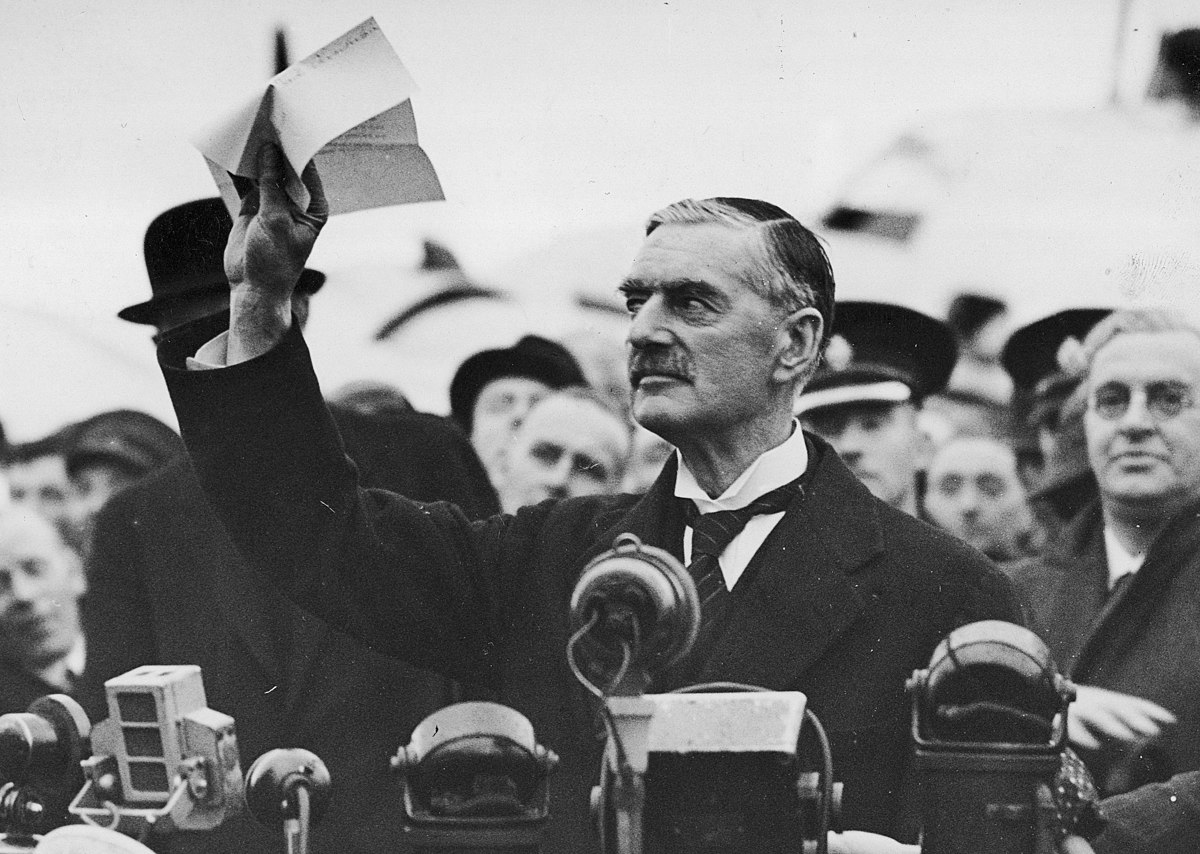
Prime Minister Neville Chamberlain at Heston Aerodrome, waving a copy of the Anglo-German Declaration he had negotiated with Adolf Hitler, 30 September, 1938.
Narodowe Archiwum Cyfrowe via Wikimedia Commons.
It’s interesting to watch my Continental friends react on their socials to President Trump’s overtures to that monster Putin — the greatest modern example of a real life Bond villain. Their sympathies, like mine, are with plucky Ukraine. Its soldiers, outgunned and outmanned, have fought like lions and their place in history is assured. Toasts will be drunk and songs will be sung, for sure. But they’re losing and not one European power is ready to send in troops. Under Biden the policy of the West was to fight to the last Ukrainian. Trump sees it in more practical terms.
[…]
Trump’s drama, trolling and exaggeration is in the same category. Most people just don’t get it and react to his bluster like that naive articled clerk I once was. Everything he says and does is calculated to find a path to the best achievable outcome. There’s not a virtue-signalling molecule in his body and yet there’s more actual virtue than in his hypocritical critics.
My European friends are comparing Trump to Chamberlain and Putin to Hitler. Europe seems unable to move on from World War II. Every issue is analysed through the historical lens of how they mishandled the rise of the Nazis. As someone once said, all we really learn from history is that we never learn from history.
The hypocrisy here is breathtaking. If his critics were any more ready than him to send in their troops, they’d have the moral high ground over him. They aren’t and (Poland perhaps excepted) they never will be. So whether it’s just or not, Ukraine can’t win. The only people the Germans and French are ready to see die in this war are Ukrainians, Americans and their loyal English-speaking sidekicks — as usual. So they have no moral basis for their maiden auntery
The post-war settlement has expired. Continental Europeans have to meet their long-neglected NATO obligations and stop expecting Uncle Sam (already carrying more debt than the world has assets) to pay for everything.
Putin is evil, yes, but Ukraine is every bit as corrupt as Russia and would add nothing to NATO’s strength. It’s in the right here as a matter of international law and (for what it’s worth in war) morality. But international law is a myth unless the rich nations enforce it by (plausible threat of) military action. Europe is just standing by signalling virtue while breaching sanctions and sending half the military matériels it promises. Meanwhile Ukraine loses men and wealth with no hope of victory. When the last Ukrainian soldier has died or surrendered, what do Europeans think the outcome will be? Ukrainian flags on your socials won’t win it mes amis.
My advice to my Continental chums? They should let the President try to make peace and hold their comments until they see the result. Based on all my years working in Continental Europe, I expect them all to decry the result and pretend their leaders (prepared to sacrifice nothing) would have done better. It’s bullshit. War is hell and has to end eventually. This is not a Hollywood movie. There are no guarantees that the (relatively) good guys will win. If you won’t end it with arms, then jaw jaw is all you have. This man is much better at jaw jaw than you are so shut up and stop assisting the enemy by showing him how divided the West is.
QotD: The soft sexism of low expectations
- She’s been told she’s great — fabulous! — just the way she is.
- She’s been taught to dismiss all push-back as misogynistic.
- She’s been assured that she’s entitled to success — and that any failures to achieve said success are the fault of men.
- She’s been trained to demand that these dastardly men — who are totes holding her back — kindly step aside and let her take the trophy — whether she’s actually earned it or not.
You might think I’m being unfair here, but frankly? I don’t agree. Given all the stuff I’ve read in the news for the past decade plus, I believe I’m right on the money.
Everywhere I look, I see illustrations of all four of the above bullet points. I hate to keep harping on the fat acceptance movement, but really: isn’t that a textbook example of point number one? Go ahead, ladies: eff those unrealistic beauty standards and rock on with your 300 pound selves. Yas, queen, slay! (And don’t worry that you can’t make it up a single flight of stairs without getting winded. The negative impacts of extreme obesity are way over-stated, amirite?)
Then there are all the times leftists of the distaff persuasion have thrown down the poor-me-I’m-being-harassed-by-meanie-sexist-men card each time they start losing an online argument. To be sure, in the absolute dumpster fire that is internet discourse, such women probably do get burned with the occasional “die, bitch!” PM or email. But as I noted on my fan blog, men get that crap too — and oddly, I don’t see them whining about it nearly as often. (Probably because crying doesn’t work for men. Only women get picked up by the waaaaaambulance.)
And just to hit on bullets three and four: everywhere I look, I see leftists justifying moves to ease standards to give vag a hand up. Just last month, for example, it was reported that Oxford is considering removing Homer and Virgil from a foundational classics course due to “attainment gaps between male and female candidates”. Don’t buckle down and study your Latin and Greek, dears. We’ll remove that pesky obstacle for you. And oh my great and fluffy Lord, I can’t even count the number of times I’ve heard feminists complain about the academic weeding that goes on in engineering or computer science — because apparently, advanced math is oppressive and patriarchal. As a woman who numbers pretty good — indeed, I even teach that stuff for a living! — I headdesk so hard whenever I hear this BS that I’m surprised my skull is still intact.
Where does all this anal-smoke-blowing lead? When you’re told constantly that you should get prizes simply for being a good little girl — as leftist women are — the result is predictable: you stop developing. If you’re already Ms. Polly Perfect, well — that obviates the need for critical self-examination and the consequent moves towards self-improvement. If your naysayers are all dismissible as “women-hating men bitter over the loss of their privilege” (or as women suffering from “internalized misogyny”), then your arguments are almost certainly untested and malformed. And if people have always been clearing the road for you and shielding you from any real challenges, you’re no doubt much stupider than your competition — and much weaker.
Stephanie S., “Prizes for Good Little Girls Syndrome”, Conservative Thoughts, 2020-03-07.
February 17, 2025
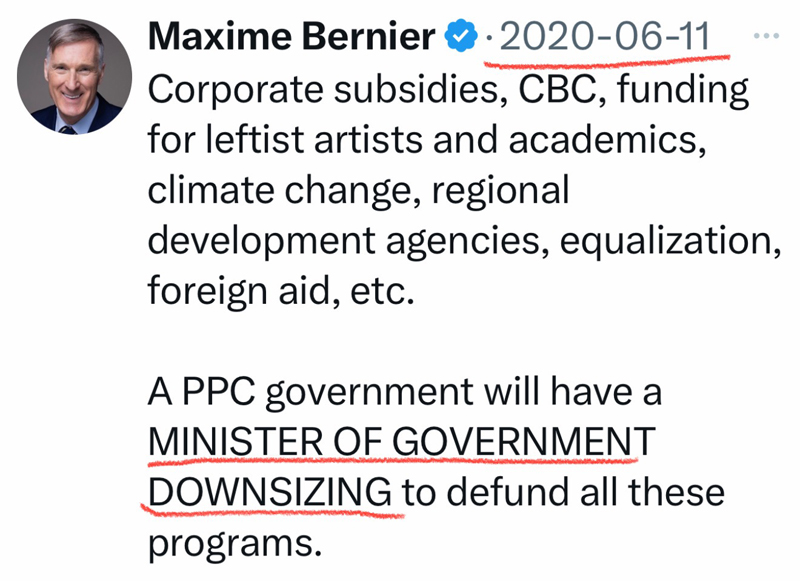
A maple-flavoured DOGE? Maxime Bernier proposed this in 2020
It’s both amusing and alarming seeing the kind of things the US government has been pouring money into, as the young auditors of Elon Musk’s DOGE dig into the accounts. Some folks on social media have been asking for a Canadian version of DOGE, but they’re nearly five years behind PPC leader Maxime Bernier:
Did you know that the Canadian government is spending $143,000 to help the African country of Senegal implement a “sectorial gender strategy” in its armed forces?
Or $46,793 to improve healthcare for intersex people in the Chinese province of Shandong?
What about $4.6 million to develop programs promoting a “positive masculinity” in Cuba?
There are hundreds of such crazy programs costing Canadian taxpayers billions of dollars every year to fund the Liberals’ woke ideology in other countries.
Many people on social media just found out that these programs exist last week, after they started looking for them on the website of the Government of Canada.
They were inspired by similar crazy programs that Elon Musk has unearthed with his DOGE team in Washington.
The DOGE – or Department of Government Efficiency – was created by President Trump and has already cut tens of billions of dollars in frivolous spending after only a few weeks.
I’m being asked if I support having the equivalent of a DOGE in Canada.
Not only do I support it, but I didn’t wait for Trump and Musk to do it to propose one. I did years ago!
In 2020, I stated that a PPC government would have a Minister of Government Downsizing to examine every federal program and cut or abolish everything that is inefficient, wasteful or not essential.
And speaking of DOGE, Coyote Blog shares some thoughts about some of the reasons Democrats are critical of the organization’s efforts:
… having thought about this longer, I think this is about more than just money. It is also about class. Just listen to how the cool kids in the media talk about Musk’s group of young weirdly-nicknamed geeks. This is fairly typical:
He was speaking specifically about a Trump executive order that decrees that the Department for Government Efficiency can force federal agencies into firing four people for every new hire. “Who the hell voted for Mr. Musk?” Begala raged. “Who the hell voted for — excuse the phrase — a guy who calls himself Big Balls? A 19-year-old kid going in there and trying to fire cancer researchers and scientists and teachers and agricultural specialists. It’s, it’s appalling.”
This is moderately hilarious from a) a party who still has not told us which unelected people really were making decisions behind the curtain for a senile Joe Biden; and b) an individual (Begala) who wielded immense power and influence across all departments of the Clinton Administration. The department staffs in DC are 99.99% people who are both unelected and unconfirmed by Congress. The issue is not that they are unelected, the issue is that they are “the wrong sort”. I am reminded of the British aristocracy in the 19th century that would tolerate almost any sort of governmental incompetence or malfeasance as long as the people were “the right sort” — meaning of their class.
The mention of Victorian England reminds me of another way that class is likely involved here. In the English aristocracy the oldest son inherited the title and often all the land and income (which was entailed to the title). This left little for any additional sons, so an income had to be found somewhere for them in a profession that did not require them to sully themselves with “trade” (daughters were handled a different way, through the marriage market). Reading for the law was an acceptable profession for a son with brains, and the army or navy were outlets for many. But most families needed a way for their sons without too much brains or ability and not militarily inclined to make a living. A position in the Church was often the solution.
Modern American blue-blood parents are no different — they need a way to secure a living for their kids who won’t or can’t land a job in the modern elite career choices (law, consulting, investment banking, or a sexy startup). Unlike in Victorian times, the military or the Church are no longer preferred elite options. So what to do with your 22-year-old gender studies major? The parents need her to get an income and they need her to do it in a context that they can proudly report to their friends — Paul Begala does not want to tell his friends that his son’s job is maintaining distributor pricing lists (anyone who does not believe the latter criteria should have been at my Princeton or Harvard Business School 25th reunions).
The solution? Get them a job at a non-profit, the modern American version of going to the Church. As Arnold Kling noted once, non-profits tend to have much higher status than do for-profits. And without competition they don’t have to carry the same performance standards as for-profits. And they are incredibly susceptible to trading a position for your kid in exchange for a nice donation.
The employment rosters of non-profits and NGO’s are stuffed with the children of privilege. So much so that there are many non-profits that seem to do nothing EXCEPT employ and pay the travel expenses of 20-something kids from rich and/or influential families. I have been writing about the non-profit scam for years. As I wrote then:
From my direct experience, I would go further. There is a tranche (I don’t know how large) of non-profits that are close to outright scams, providing most of their benefits to their managers and employees rather to anyone outside the organization. These benefits include 1) a salary with few performance expectations; 2) expense-paid parties and travel; 3) myriad virtue-signalling opportunities; 4) opportunities to build personal networks. This isn’t just criticizing theoretical institutions — people I know are in such jobs in these organizations.
The spending that DOGE is going after at USAID and other departments likely threatens the income of a number of under-qualified elite kids. So I will update my meme:

February 16, 2025
Canada – parliamentary democracy or elected dictatorship?
During the entire dramatic confrontation with Donald Trump, Canada’s parliament has been prorogued … effectively meaning that the opposition can’t hold the government to task for how it is handling Trump’s aggression. In any other western country, parliament would have been in session all the way through this, but because Justin Trudeau was aware that his government might be defeated in the house, he chose to ask the Governor General to prorogue until late March.
Not everyone has been meekly accepting Trudeau’s position, and the Justice Centre for Constitutional Freedoms is challenging the prorogation in Federal Court. Dan Knight updates us on the progress of the hearing:
Arms of the Federal Court of Canada
We are now in Day 2 of the Federal Court hearing, where Justin Trudeau’s government is trying to convince a judge that shutting down Parliament to avoid Well, folks, here we are. Day two of the Federal Court showdown, where the Trudeau government is desperately trying to convince Canadians that shutting down Parliament to protect their own hide was a completely reasonable thing to do. They want you to believe that this is all perfectly normal, that it’s routine, that it’s just a quirk of the system. Nothing to see here, folks!
But the problem with lying is that eventually, you get caught. And on Day 2 of this hearing, Justin Trudeau’s legal team got caught. Over and over again.
If you watched what unfolded in court, you saw the Trudeau government’s lawyers flailing like fish on dry land, fumbling through weak excuses as Chief Justice Paul S. Crampton shredded their arguments one by one. At one point, they actually misrepresented a legal precedent in court, only for the Chief Justice to read the case aloud and reveal that it actually contradicted their argument. Humiliating.
And that was just the start.
This case isn’t just about whether Trudeau technically had the ability to prorogue Parliament. It’s about why he did it — and more importantly, whether Canada is now a country where the Prime Minister can shut down democracy whenever it gets inconvenient for him. Because if the courts let this stand, what’s stopping the next Prime Minister from proroguing indefinitely? What’s stopping the government from suspending Parliament every time there’s a corruption scandal, every time they fear a non-confidence vote, every time they need to cover up a mess of their own making?
And that’s exactly what Trudeau did. His government was facing multiple crises all at once — a massive financial scandal, a looming non-confidence vote, and an economic firestorm caused by Trump’s tariff threats. So rather than actually dealing with it, he shut Parliament down. The question is: Did he have the right to do that?
[…]
The Chief Justice has promised to issue a ruling before Parliament resumes on March 24. That means this case will be decided before Trudeau can walk away and pretend none of this ever happened.
If the court rules against the government, it will mean that future Prime Ministers cannot abuse prorogation to avoid scrutiny. It will send a clear message that shutting down Parliament to protect yourself is unconstitutional and illegal.
But if the government wins, it will mean that the Prime Minister can shut down democracy anytime he wants. It will mean that Canada is no longer a functioning parliamentary system but a country where the executive can do whatever it pleases.
And if that happens, ask yourself this: What’s stopping the next Prime Minister from just shutting down Parliament indefinitely?
Trudeau might be stepping down soon, but his legacy of corruption, incompetence, and political cowardice will haunt this country for years. The question now is whether the courts will allow him to rewrite the rules of democracy on his way out the door.
We’ll find out soon.
Update: Fixed broken link.
Free-market economist grapples with a new kind of tariff
With US President Donald Trump seemingly utterly entranced by the possibilities of killing off as much world trade as he can using tariffs, I did not expect to read that renowned libertarian economist David Friedman is not sure about the latest kind of tariffs being proposed:

I have finally encountered a kind of tariff that I am not sure I am against. The idea is to impose the same tariff on another country’s exports that they impose on your exports. A tariff makes the country that imposes it worse off, a fact that neither Trump or most of the media appear to understand — Vance may — but it makes the country it is imposed against worse off as well. Imposing a tariff can be in the interest of the politicians who impose it for public choice reasons, as a way of buying support from a concentrated and well organized interest group such as the auto industry at the expense of a dispersed interest group such as their customers. That is one of the two reasons tariffs exist, the other being that the false theory of trade economics is simpler and easier to understand than the true theory.1
But another country’s tariff barriers against your exports make both your country and its politicians worse off. So if imposing tariffs on their imports results in tariffs being imposed on their exports, it might be in the interest of the politicians as well as the country they rule to lower, even abolish, their tariffs — and free trade, zero tariffs, is my first best tariff policy.
Reciprocal reduction of tariffs is, of course, a routine objective of trade negotiations. What Trump appears to be proposing is to automate the process. That might have some advantages. It would reduce the amount of time and effort spent on trade negotiations. More important, it would make it harder for a government that wanted to keep its tariffs to pretend to its citizens that negotiations for mutual reductions had broken down over details.
It is not obvious what “reciprocal tariffs” means in practice, because tariffs, typically, are on particular goods. China imports oil and exports textiles. If they impose a tariff on American oil there would be no point to the US retaliating by imposing a tariff on Chinese oil — we don’t import Chinese oil.
Under the Plan, my Administration will work strenuously to counter non-reciprocal trading arrangements with trading partners by determining the equivalent of a reciprocal tariff with respect to each foreign trading partner. (Reciprocal Trade and Tariffs Memo)
It isn’t clear what “the equivalent” means. One possible approach would be to figure how much revenue a country collects from tariffs on American exports and set a uniform tariff on that country’s exports set to bring in the same amount of revenue. That would be simple and would reduce the political support for tariffs, since they could not be targeted to protect specific industries.
For which reason I don’t expect it to happen. The closest version that seems politically plausible is a nonuniform tariff schedule that brings in the equivalent revenue. Unfortunately that would let the administration protect favored industries with tariffs high enough to reduce imports, and revenue, to near zero.
Of course, the target country could, in a true system of reciprocal tariffs, solve the problem by reducing their tariffs to zero.
1. I discuss the relevant economics in Ptolemaic Trade Theory.
February 15, 2025
“Trump marks the overdue end of the Long Twentieth Century”
At The Upheaval, N.S. Lyons suggests that the arrival of Donald Trump, version 2.0, may finally end the era we’ve been living in since immediately after the end of WW2:
The 125 years between the French Revolution in 1789 and the outbreak of WWI in 1914 was later described as the “Long Nineteenth Century”. The phrase recognized that to speak of “the nineteenth century” was to describe far more than a specific hundred-year span on the calendar; it was to capture the whole spirit of an age: a rapturous epoch of expansion, empire, and Enlightenment, characterized by a triumphalist faith in human reason and progress. That lingering historical spirit, distinct from any before or after, was extinguished in the trenches of the Great War. After the cataclysm, an interregnum that ended only with the conclusion of WWII, everything about how the people of Western civilization perceived and engaged with the world – politically, psychologically, artistically, spiritually – had changed.
R.R. Reno opens his 2019 book Return of the Strong Gods by quoting a young man who laments that “I am twenty-seven years old and hope to live to see the end of the twentieth century”. His paradoxical statement captures how the twentieth century has also extended well past its official sell-by date in the year 2000. Our Long Twentieth Century had a late start, fully solidifying only in 1945, but in the 80 years since its spirit has dominated our civilization’s whole understanding of how the world is and should be. It has set all of our society’s fears, values, and moral orthodoxies. And, through the globe-spanning power of the United States, it has shaped the political and cultural order of the rest of the world as well.
The spirit of the Long Twentieth could not be more different from that which preceded it. In the wake of the horrors inflicted by WWII, the leadership classes of America and Europe understandably made “never again” the core of their ideational universe. They collectively resolved that fascism, war, and genocide must never again be allowed to threaten humanity. But this resolution, as reasonable and well-meaning as it seemed at the time, soon became an all-consuming obsession with negation.
Hugely influential liberal thinkers like Karl Popper and Theodor Adorno helped convince an ideologically amenable post-war establishment that the fundamental source of authoritarianism and conflict in the world was the “closed society”. Such a society is marked by what Reno dubs “strong gods”: strong beliefs and strong truth claims, strong moral codes, strong relational bonds, strong communal identities and connections to place and past – ultimately, all those “objects of men’s love and devotion, the sources of the passions and loyalties that unite societies”.
Now the unifying power of the strong gods came to be seen as dangerous, an infernal wellspring of fanaticism, oppression, hatred, and violence. Meaningful bonds of faith, family, and above all the nation were now seen as suspect, as alarmingly retrograde temptations to fascism. Adorno, who set the direction of post-war American psychology and education policy for decades, classified natural loyalties to family and nation as the hallmarks of a latent “authoritarian personality” that drove the common man to xenophobia and führer worship. Popper, in his sweepingly influential 1945 book The Open Society and Its Enemies, denounced the idea of national community entirely, labeling it as disastrous “anti-humanitarian propaganda” and smearing anyone who dared cherish as special his own homeland and history as a dangerous “racialist”. For such intellectuals, any definitive claim to authority or hierarchy, whether between men, morals, or metaphysical truths, seemed to stand as a mortal threat to peace on earth.
The great project of post-war establishment liberalism became to tear down the walls of the closed society and banish its gods forever. To be erected on its salted ground was an idyllic but exceptionally vague vision of an “open society” animated by peaceable weak gods of tolerance, doubt, dialogue, equality, and consumer comfort. This politically and culturally dominant “open society consensus” drew on theorists like Adorno and Popper to advance a program of social reforms intended to open minds, disenchant ideals, relativize truths, and weaken bonds.
As Reno catalogues in detail, new approaches to education, psychology, and management sought to relativize truths, elevate “critical thinking” over character, vilify collective loyalties, cast doubt on hierarchies, break down all boundaries and borders, and free individuals from the “repression” of all moral and relational duties. Aspiration to a vague universal humanitarianism soon became the only higher good that it was socially acceptable to aim for other than pure economic growth.
[…]
The Long Twentieth Century has been characterized by these three interlinked post-war projects: the progressive opening of societies through the deconstruction of norms and borders, the consolidation of the managerial state, and the hegemony of the liberal international order. The hope was that together they could form the foundation for a world that would finally achieve peace on earth and goodwill between all mankind. That this would be a weak, passionless, undemocratic, intricately micromanaged world of technocratic rationalism was a sacrifice the post-war consensus was willing to make.
That dream didn’t work out though, because the strong gods refused to die.
Update, 17 February: Welcome Instapundit readers! Thanks for dropping by. Please do look around at some of my other posts! I think the last time I got linked by Instapundit was back in 2008/9 just before I moved to the current location. Please do read the entire N.S. Lyons post, as this is just a taster of the full essay!
Nannies on the right are just as bad as nannies on the left
Jim Treacher briefly gets slightly serious about RFK Jr.’s new role as America’s chief health nanny:

Fake image generated by Grok
First things first: I’m fine with a United States president picking his own cabinet. Donald Trump won, so he gets to choose the people he wants. It’s not fascism, it’s not unconstitutional, and it’s not going to destroy the country. This is the system we have, and so far the Trump administration has been operating within precedent. (Yes, even with Elon Musk and DOGE.) Fair enough.
And, also, in addition to that: I don’t like RFK Jr., and I won’t pretend I do just so you don’t yell at me.
RFK is still the same guy he was before he suddenly started being nice to Trump. He’s the guy who thinks COVID-19 was “ethnically targeted” to attack Caucasians and blacks, while sparing the Jews and Chinese. He’s the guy who bragged about having a worm in his brain. He’s the guy who, just seven months ago, said “Trump was a terrible president“.
Now I’m supposed to pretend none of that happened, just because Trump likes him for the moment? Nah.
And, of course, RFK is the guy who thinks the role of government is to slap your hand at the dinner table. So I’m supposed to pretend nanny-statism is good now.
Yay, let’s embrace lib policies to own the libs!
If you didn’t want Michelle Obama telling you what to eat, why do you want RFK telling you what to eat? If you didn’t want the government telling you which vaccines to put in your body, why do you want the government telling you which food to put in your body?
“But seed oils and high-fructose corn syrup and Red Dye Number Whatever are bad for you!” Okay. So don’t eat that stuff. You can read labels, can’t you? Why do you need the feds to hold your hand?
It’s amazing: At the very same time MAGA is cheering on Trump for reducing the size of government — and buddy, I’m right there with them — they’re begging the government to “clean up the food supply”.
Which is it, friends?
Get mad at me all you want, but at least I’m consistent. I don’t want the government telling me what to do, no matter who’s in charge for the time being.
February 14, 2025
“Over half of all Germans now find themselves on ‘the right’ and urgently require democratic reeducation”
Ah, poor German democracy … you guessed it, once again it’s hanging by a thread as protests against the extremely extreme extreme right (the AfD) have now grown to include protests against the merely extreme extreme right (the CDU and CSU):
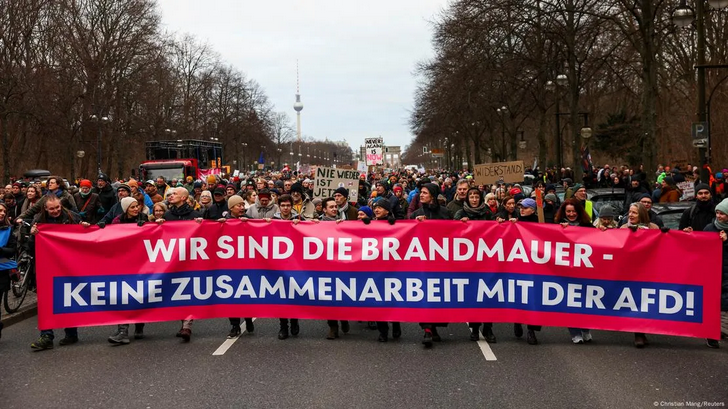
“We are the cordon sanitaire – no cooperation with the AfD”: the banner leading the Berlin protest against AfD and CDU on 2 February, which was financed in part by the German taxpayer and arranged by semi-affiliated apron organisations of the governing Green and Social Democrat parties of Germany.
All the activists are out in force.
Every day there are new protests “against the right”, and by “the right” they do not merely mean Alternative für Deutschland and the one-in-five Germans who vote for them, as was the case last year at this time. Since Friedrich Merz stepped over the cordon sanitaire at the beginning of this month, “the right” now also includes the centre-right CDU and CSU parties. Over half of all Germans now find themselves on “the right” and urgently require democratic reeducation. What is worse, it is not just crazy pink-haired activists and septum-pierced Antifa who want to do the reeducating, oh no. It is the government itself; the activists are merely their agents.
According to taz, 500,000 right-thinking Germans took to the streets this past weekend to combat the out-of-bounds radical views held by 52% of everybody. Perhaps 200,000 or 250,000 or 320,000 turned out for the massive “Democracy Needs You” protest in Munich on Saturday. A further 35,000 people “warned against a shift to the right” in Bremen, the absurd “Grannies against the Right” brought 24,000 people to the streets of Hannover, and another 14,000 denounced “right-wing extremism” in Marburg. There were also protests throughout Nordrhein-Westfalen, in Wuppertal, Aachen, Duisburg, Gütersloh, Gummersbach and Euskirchen. Yesterday 15,000 showed up to protest an AfD event in Freiburg; they were less than peaceful. And that is just what I found by scanning a few headlines. I could easily expand this paragraph into an entire post because they are protesting everywhere and all the time “against the right” these days.
I must emphasise again the extremely expansive notion of “the right” that is in play at these protests. Basically everyone who is not on the left – and particularly everyone who does not vote for the Greens or the Social Democrats (SPD) – presently attracts the activists’ ire. That is very interesting, because we are in the final stages of an election campaign and the Greens and the SPD are the only parties in government. Could it be that the Greens and the SPD are using the substantial resources of the German state to call forth massive street protests against all the Germans who are not planning to vote for them?
Yes, in fact that is exactly how it could be:
When 160,000 demonstrators turned out to protest on behalf of the cordon sanitaire on the first weekend in February, and organisers projected the words “All Berlin hates the CDU” onto the Victory Column, the red-green federal government provided financial support. The rally was co-sponsored from the coffers of the federal budget … indirectly and in two ways. As in many German cities, the organiser was the association Campact. Campact itself does not receive government funds. Yet they are the primary stakeholder of the nonprofit HateAid, which receives funds from the Ministry for Family Affairs. Since 2020, HateAid has received a total of almost 2.5 million Euros from the “Live Democracy” project, and their funding has just been extended. According to the Ministry for Family Affairs, HateAid can expect 424,823 Euros this year for its work against online hate speech.
Thousands also took to the streets in Dresden and Leipzig to protest CDU plans for migration policy. In both cities, the SPD and the Greens indirectly sponsored the rallies with taxpayer money, this time through the Workers’ Welfare Association (AWO). This association enjoys the favour of the Ministry of the Interior and the Ministry of Family Affairs. The AWO received tens of thousands of Euros … in 2024. In Saxony-Anhalt, the AWO state association received 90,043 Euros from the Ministry of Family Affairs in 2025, among other things from the ‘Live Democracy’ project …
Paus’s ministry also provides financial support to many of the organisers of demonstrations in Schleswig-Holstein. This year, a total of 1.525 million Euros will flow … The municipalities divide the money equally among themselves, with each receiving 140,000 Euros to form local “partnerships for democracy”. Many of the sponsored organisations have sponsored demonstrations on behalf of the cordon sanitaire. In Kiel, the Green-financed “Central Education and Advice Centre for Migrants” … called for a protest in front of the CDU headquarters, in Lübeck the “Lübeck Refugee Forum” did the same …
All of this is to varying degrees illegal. Non-profit organisations, which receive tax-deductible contributions from supporters, are bound to political neutrality. Nor can the government finance (directly or otherwise) campaign events against the political opposition. Since 2021, however, in the name of defending democracy, the traffic light coalition have called into being an absolute jungle of NGOs to intimidate voters, censor the internet and riot on the streets against parliamentary votes. Their semi-affiliated activist cadres police German politics and redefine as right-wing and forbidden whatever it is our rulers happen to disagree with at the moment.
Trump may start paying attention to Canadian cultural protectionist polices next
Michael Geist points out just how many Canadian federal policies and programs will likely come under scrutiny by the Trump administration for their blatant protectionism against US cultural products:

My Globe and Mail op-ed argues the need for change is particularly true for Canadian digital and cultural policy. Parliamentary prorogation ended efforts at privacy, cybersecurity and AI reforms and U.S. pressure has thrown the future of a series of mandated payments – digital service taxes, streaming payments and news media contributions – into doubt. But the Trump tariff escalation, which now extends to steel and aluminum as well as the prospect of reviving the original tariff plan in a matter of weeks, signals something far bigger that may ultimately render current Canadian digital and cultural policy unrecognizable.
Our cultural frameworks are largely based on decades-old policies premised on marketplace protections and mandated support payments. This included foreign ownership restrictions in the cultural sector and requirements that broadcasters contribute a portion of their revenues to support Canadian content production.
As we moved from an analog to digital world, the government simply extended those policies to the digital realm. But with Mr. Trump appearing to call out what he views to be Canadian protectionist policies in sensitive sectors such as banking ownership, the cultural and digital sectors may be next.
If so, there are no shortage of long-standing policies that tilt the playing field in favour of Canadians that could spark some uncomfortable conversations.
Why do U.S. companies face ownership restrictions in the telecom and broadcast sectors? Why are Canadian broadcasters permitted to block U.S. television signals in order to capture increased advertising revenue? Why do Canadian content rules exclude U.S. companies from owning productions featuring predominantly Canadian talent?
The Canadian response that this is how it has always been is unlikely to persuade Mr. Trump.
Canadian policies premised on “making web giants pay” may also be non-starters under Mr. Trump. For the past five years, the Canadian government seemingly welcomed the opportunity to sabre rattle with U.S. internet companies. This led to mandated payments for streaming services to support Canadian film, television and music production; link taxes that targeted Meta and Google to help Canadian news outlets; and the multibillion-dollar retroactive digital services tax that is primarily aimed at U.S. tech giants.
Not only have those policies raised consumer affordability and marketplace competition concerns, they have also emerged as increasingly contentious trade issues. If the trade battles with the U.S. continue, the pressure to scale back the policies will mount.
Beyond rethinking established cultural and digital policies both new and old, the bigger changes may come from re-evaluating the competitive impact of policies that rely heavily on regulation just as the U.S. prioritizes economic growth through deregulation. Proposed Canadian privacy, online harms and AI rules have all relied heavily on increased regulation, looking to Europe as the model.
For example, consider the Canadian approach to AI regulation in the now-defunct Artificial Intelligence and Data Act. It specifically referenced the European Union’s regulatory system, which establishes extensive regulatory requirements for high-risk AI systems and bans some AI systems altogether.
However, the European approach is not the only game in town. Mr. Trump moved swiftly to cancel the former Biden administration’s executive order on AI regulation, signalling that the U.S. will prioritize deregulation in pursuit of global AI leadership. Further, the arrival of DeepSeek, the Chinese answer to ChatGPT, took the world by storm and served notice that U.S. AI dominance is by no means guaranteed.
The competing approaches – U.S.-style lightweight regulation that favours economic growth against a more robust European regulatory model that emphasizes AI guardrails and public protections – will force difficult policy choices that Canada has thus far avoided.
February 13, 2025
Australia’s most toxic export (so far) – “Settler-colonial ideology”
Helen Dale explains how a lunatic fringe Australian notion has grown to be a major ideology in most of the Anglosphere and even as far afield as Israel:

Despite a great efflorescence of literature and especially film about the mafia, it’s a truism to say that it isn’t very good for Sicily. It also hasn’t been very good when exported to other countries, either, spreading violence, corruption, and lawlessness. Well, Australia is to settler-colonial ideology as Sicily is to mafia, and our poisonous gift to the world is, like Sicily’s mafia, one of those things about us that really isn’t for export.
“Settler-colonial ideology” seems a mouthful, but if I describe bits of it to you, you’ll recognise it. Heard Australia Day called “Invasion Day”? You’ve encountered settler-colonial ideology. Been called racist for voting NO in the 2023 Voice Referendum? You’ve encountered settler-colonial ideology. Noticed Aboriginal academics get hired with obviously inadequate qualifications? You’ve encountered settler-colonial ideology.
Many Australians — including me — first encountered settler-colonial ideology at university. Back then, it was a theoretical and foreign concern, and largely in languages other than English (mainly French and Arabic). I do remember one of the “post-colonial literatures” (note the s, the s is important) obsessives trying to convince me that Alan Paton’s Cry the Beloved Country wasn’t a “legitimate book” because its author was white, but back then, this was still a niche view.
Like other Australians confronted with daft academic ideas, I blamed the US or France and ignored my own country’s contribution. Australians aren’t noted for their theoretical acumen, which made this easier. Critical race theory and affirmative action are all-American, while US academics have often executed hostile takeovers of French nonsense like postmodernism or queer theory early on in proceedings. It gets easy to blame America and France.
Easy, but unfair.
I realised how mistaken I’d been when, in October last year, I returned to Australia for a stint. While I was there, I read Adam Kirsch’s On Settler Colonialism: Ideology, Violence and Justice. I did so in part because October 2024 was the one-year anniversary of two important events. Both concerned what Kirsch calls “the ideology of settler-colonialism”.
Kirsch documents a process whereby the French- and Arabic-speaking theorists of post WWII decolonial conflicts — particularly Frantz Fanon — had their ideas grafted (very, very awkwardly) onto dissimilar Australian history and conditions by Australian intellectuals. These were then exported throughout the English-speaking world, likely through academic conferences. This explains how cringeworthy Australian nonsense like land acknowledgments managed to spread first to Canada and then the US in a reversal of the usual process whereby America sneezes and so gives its Hat a cold.
Fanon was a Marxist and a Freudian. His writing seethes with angry bloodthirstiness and pseudoscientific psychodrama, but he was responding to a vicious war of independence and incipient civil conflict. Kirsch notices a pattern where Australian scholars borrow bits of Fanon to give a sanguinary rhetorical garnish to their writing. “Fanon’s praise of violence is a large part of his appeal for Western intellectuals,” he notes. “Many of the sentiments expressed in The Wretched of the Earth, coming from a European or American writer, would immediately be identified as fascistic.”
Australia’s intervention changed the ideology, in some ways making it more destructive. Fanon is shorn of most of his Marxism, for example (can’t have that, won’t be able to recruit rich minorities to the boss class otherwise). The key Australian shift coalesces around an oft-quoted aphorism from historian Patrick Wolfe: “invasion is a structure, not an event”. That is, colonisation trauma is constantly renewed because “settler” is a heritable identity. “Every inhabitant of a settler colonial society who is not descended from the original indigenous population,” Kirsch points out, “is, and always will be, a settler”.
“Settler” here includes people transported to both America and Australia in chains — slaves and convicts. Once it became acceptable to construe one group of people conveyed against their will across thousands of miles of ocean in dreadful conditions as providentially lucky (and genocidal) settlers, it became possible to extend the reasoning to other, similar groups. After all, the only difference between a convict and a slave is the presence or absence of a criminal conviction.
Kirsch’s attempt to explain how Australia was analogised with Fanon’s Algeria and then how Israel was analogised with Wolfe’s Australia is heroic, in part because the casuistry he seeks to unpick is so convoluted. Filtering Fanon through Australian academia and its claim that “settler” is a heritable identity did have the effect of making Jewish Israelis look more like non-indigenous Australians or Americans, however, especially when attention was focussed on European Jewish immigrants to Israel.



