
seangabb
Published 2 May 2021The Late Bronze Age is a story of collapse. From New Kingdom Egypt to Hittite Anatolia, from the Assyrian Empire to Babylonia and Mycenaean Greece, the coming of the Sea Peoples is a terror that threatens the end of all things. Between April and July 2021, Sean Gabb explored this collapse with his students. Here is one of his lectures. All student contributions have been removed.
(more…)
December 20, 2022
Coming of the Sea Peoples: Part 2 – The Old and New Chronology of the Bronze Age
Comments Off on Coming of the Sea Peoples: Part 2 – The Old and New Chronology of the Bronze Age
December 16, 2022
Coming of the Sea Peoples: Part 1 – Prelude
seangabb
Published 1 May 2021The Late Bronze Age is a story of collapse. From New Kingdom Egypt to Hittite Anatolia, from the Assyrian Empire to Babylonia and Mycenaean Greece, the coming of the Sea Peoples is a terror that threatens the end of all things. Between April and July 2021, Sean Gabb explored this collapse with his students. Here is one of his lectures. All student contributions have been removed.
More by Sean Gabb on the Ancient World: https://www.classicstuition.co.uk/
Learn Latin or Greek or both with him: https://www.udemy.com/user/sean-gabb/
His historical novels (under the pen name “Richard Blake”): https://www.amazon.co.uk/Richard-Blak…
Comments Off on Coming of the Sea Peoples: Part 1 – Prelude
December 13, 2022
Egypt’s postwar Nazi military advisors
In The Critic, James Barr reviews a book on the roles of former Nazi military and political figures in the Egyptian forces, Nazis on the Nile: The German Military Advisers in Egypt 1949-1967 by Vyvyan Kinross:
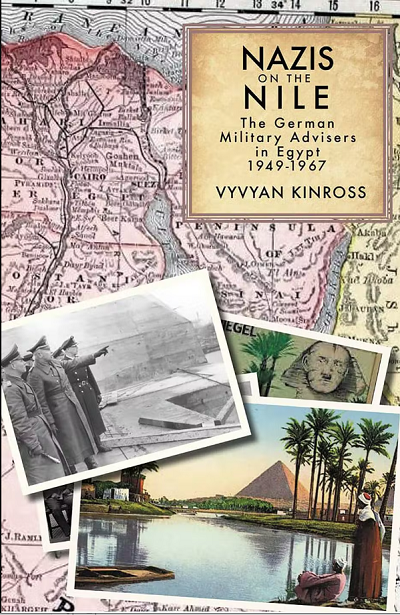
One of the paradoxes of the early postwar era is that, after Germany’s defeat, the Nazis were vilified at the same time that their expertise was sought after by both Cold War superpowers. Germans played key roles in both sides’ space programmes. Less infamous is the part they also went on to play in the Egyptian rocket programme, one of the subjects in this fascinating and disturbing book.
After suffering a humiliating defeat in the war that followed the establishment of Israel, the Egyptians wanted revenge. As the British had refused to help them — despite maintaining a deeply unpopular and large presence astride the Suez Canal — Egypt’s sybaritic King Farouq turned to his enemy’s enemy instead. In 1949 he commissioned an Afrika Korps general, Artur Schmitt, to review the Egyptian army.
Having checked in to a Cairo hotel under the name “Herr Goldstein”, Schmitt inspected Egyptian units and went on to Syria to survey Israel from the Golan Heights. The Egyptians’ failure to combine tanks, artillery and infantry effectively, he decided, explained their “inability to take advantage of the early stages of fighting to wipe the State of Israel off the map”.
Schmitt’s forthright conclusions were unwelcome, and he did not stay long. But some younger Egyptian army officers shared his views and, after they had overthrown Farouq in 1952, they picked up where the king had left off. Within days they offered Fritz Voss, the former head of the Skoda arms factory in Pilsen, the job of masterminding the retraining of the army and the establishment of a military industrial base that could produce jet aircraft and missiles.
Voss in turn invited old contacts to join him, including Wilhelm Beisner, an SS officer who had been part of Einsatzkommando Egypt, which would have spearheaded the Holocaust in Palestine had Rommel won at El Alamein. The Germans found Egyptian working conditions challenging. “Here one has to act much more slowly than in Prussia,” complained a German instructor who found “Oriental sloppiness” irritating. Of forty tanks lined up for a parade to celebrate the first anniversary of the coup, just twelve made it past the junta’s rostrum.
The author, Vyvyan Kinross, is a consultant by profession. He has advised Arab governments and clearly understands the fundamental problems. “The battle” for the Germans, he writes, “was always to reconcile finance, resourcing and the expertise required to execute a sophisticated manufacturing process with the challenging conditions and logistics that prevailed in a country that was late to industrialise and financially underpowered.”
Comments Off on Egypt’s postwar Nazi military advisors
December 4, 2022
Operation Overlord Confirmed at Teheran – WW2 – 223 – December 3, 1943
World War Two
Published 3 Dec 2022The Teheran Conference is in full swing and the Allied leadership and plan for a cross channel invasion of Europe is agreed upon by Stalin, Churchill, and Roosevelt. There are new Allied attacks across Italy, but at Bari a German air raid releases deadly poison gas.
(more…)
Comments Off on Operation Overlord Confirmed at Teheran – WW2 – 223 – December 3, 1943
December 2, 2022
Bombing Berlin with Ed Murrow of CBS – War Against Humanity 089
World War Two
Published 1 Dec 2022Ed Murrow accompanies the RAF on a bombing raid on Berlin, and files one of his most iconic broadcasts with CBS. In Teheran, Winston Churchill walks out on a dinner with Joseph Stalin, after the USSR Premiere suggests mass murdering German officers.
(more…)
Comments Off on Bombing Berlin with Ed Murrow of CBS – War Against Humanity 089
November 27, 2022
“The uncomfortable truth is that autocrats and architects share complimentary motivations”
In UnHerd, Wessie du Toit sets the Saudi Arabian “Neom” development in its true and unsavoury proper context:
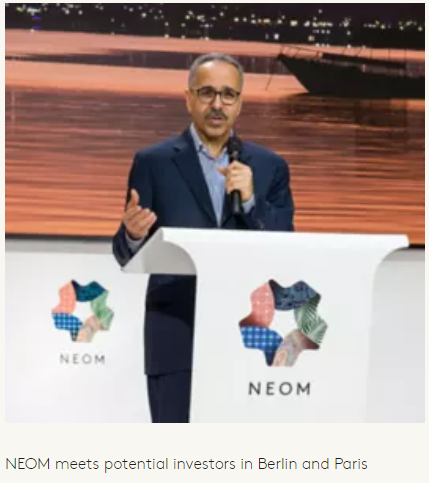
There may be no philosopher kings, but there are sci-fi princes. The dreams of Mohammed bin Salman, crown prince of Saudi Arabia and chairman of the Neom board, make the techno-futurism of Silicon Valley look down to earth. Bin Salman is especially fond of the cyber-punk genre of science fiction, which involves gritty hi-tech dystopias. He has enlisted a number of prominent Hollywood visual specialists for the Neom project, including Olivier Pron of Marvel’s Guardians of the Galaxy franchise. A team of consultants was asked to develop science-fiction aesthetics for a tourist resort, resulting in “37 options, arranged alphabetically from ‘Alien Invasion’ to ‘Utopia'”. One proposal for a luxury seaside destination, which featured a glowing beach of crushed marble, was deemed insufficiently imaginative.
Such spectacular indulgence must be causing envy among the high-flying architects and creative consultants not yet invited to join the project — if there are any left. But it also makes the moral dimension difficult to ignore: how should we judge those jumping on board bin Salman’s gravy train? Saudi Arabia — in case anyone has forgotten in the years since the journalist Jamal Khashoggi was murdered at its consulate in Istanbul — is a brutal authoritarian state.
In recent weeks, this has prompted some soul-searching in the architecture community, with several stinging rebukes aimed at Neom. Writing in Dezeen, the urbanist Adam Greenfield asks firms such as Morphosis, the California-based architects designing The Line, to consider “whether the satisfaction of working on this project, and the compensation that attends the work, will ever compensate you for your participation in an ecological and moral atrocity”. Ouch. Greenfield’s intervention came a week after Rowan Moore asked in The Observer: “When will whatever gain that might arise from the creation of extraordinary buildings cease to outweigh the atrocities that go with them?”
[…]
The uncomfortable truth is that autocrats and architects share complimentary motivations. The former use architecture to glorify their regimes, both domestically and internationally, whereas the latter are attracted to the creative freedom that only unconstrained state power can provide. In democratic societies, there is always tension between the grand visions of architects and the numerous interest groups that have a say in the final result. Why compromise with planning restrictions and irate neighbours when there is a dictator who, as Greenfield puts it, “offers you a fat purse for sharing the contents of your beautiful mind with the world?”
This is not just speculation. As Koolhaas himself stated: “What attracts me about China is that there is still a state. There is something that can take initiative on a scale and of a nature that almost nobody that we know of today could even afford or contemplate.”
But really this relationship between architect and state is a triangle, with financial interests making up the third pole. Despite the oft-repeated line that business loves the stability offered by the rule of law, when it comes to building things, the money-men are as fond of the autocrat’s empty canvas as the architects are. When he first pitched the Neom project to investors in 2017, bin Salman told them: “Imagine if you are the governor of New York without having any public demands. How much would you be able to create for the companies and the private sector?”
This points us to the deeper significance of the Gulf States and China as centres of high-profile architecture. These were crucial regions for post-Nineties global capitalism: the good illiberal states. Celebrity architects brought to these places the same spectacular style of building that was appearing in Europe and North America; each landmark “iconic” and distinct but, in their shared scale and audacity, also placeless and generic. Such buildings essentially provided a seal of legitimacy for the economic and financial networks of globalisation. Can this regime’s values really be so different to ours, an investor might say, when they have a museum by Jean Nouvel, or an arts centre by Norman Foster? British architects build football stadiums and skyscrapers in Qatar and Saudi Arabia, while those governments own football stadiums and skyscrapers in Britain, such as The Shard and Newcastle’s St James’s Park.
Comments Off on “The uncomfortable truth is that autocrats and architects share complimentary motivations”
November 12, 2022
Long distance communication in the pre-modern era
In the latest Age of Invention newsletter, Anton Howes considers why the telegraph took so long to be invented and describes some of the precursors that filled that niche over the centuries:
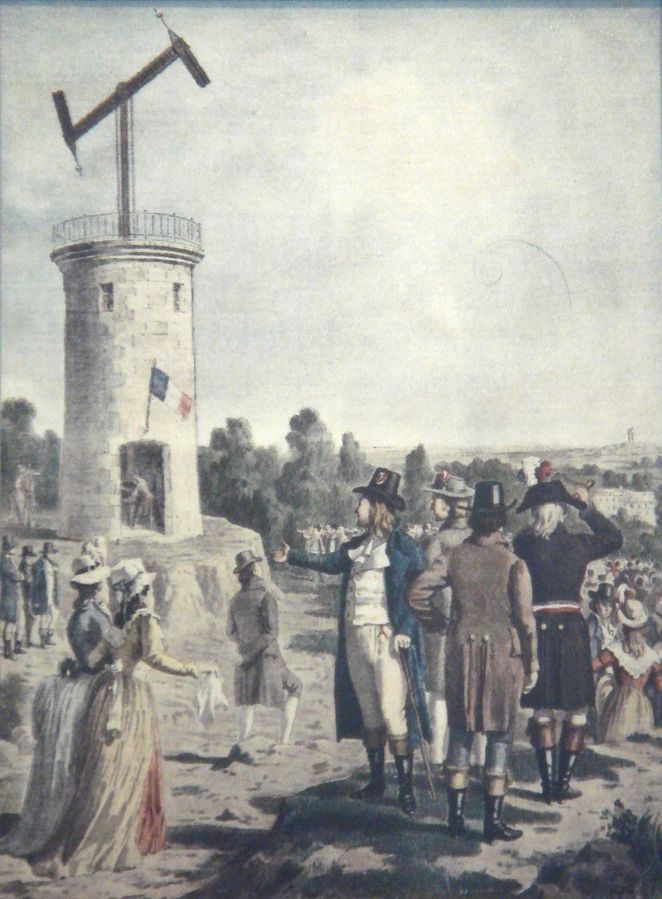
Early 19th century demonstration of Claude Chappe’s semaphore.
Wikimedia Commons.
… I’ve also long wondered the same about telegraphs — not the electric ones, but all the other long-distance signalling systems that used mechanical arms, waved flags, and flashed lights, which suddenly only began to really take off in the eighteenth century, and especially in the 1790s.
What makes the non-electric telegraph all the more interesting is that in its most basic forms it actually was used all over the world since ancient times. Yet the more sophisticated versions kept on being invented and then forgotten. It’s an interesting case because it shows just how many of the budding systems of the 1790s really were long behind their time — many had actually already been invented before.
The oldest and most widely-used telegraph system for transmitting over very long distances was akin to Gondor’s lighting of the beacons, capable only of communicating a single, pre-agreed message (with flames often more visible at night, and smoke during the day). Such chains of beacons were known to the Mari kingdom of modern-day Syria in the eighteenth century BC, and to the Neo-Assyrian emperor Ashurbanipal in the seventh century BC. They feature in the Old Testament and the works of Herodotus, Aeschylus, and Thucydides, with archaeological finds hinting at even more. They remained popular well beyond the middle ages, for example being used in England in 1588 to warn of the arrival of the Spanish Armada. And they were seemingly invented independently all over the world. Throughout the sixteenth century, Spanish conquistadors again and again reported simple smoke signals being used by the peoples they invaded throughout the Americas.
But what we’re really interested in here are systems that could transmit more complex messages, some of which may have already been in use by as early as the fifth century BC. During the Peloponnesian War, a garrison at Plataea apparently managed to confuse the torch signals of the attacking Thebans by waving torches of their own — strongly suggesting that the Thebans were doing more than just sending single pre-agreed messages.
About a century later, Aeneas Tacticus also wrote of how ordinary fire signals could be augmented by using identical water clocks — essentially just pots with taps at the bottom — which would lose their water at the same rate and would have different messages assigned to different water levels. By waving torches to signal when to start and stop the water clocks (Ready? Yes. Now start … stop!), the communicator could choose from a variety of messages rather than being limited to one. A very similar system was reportedly used by the Carthaginians during their conquests of Sicily, to send messages all the way back to North Africa requesting different kinds of supplies and reinforcement, choosing from a range of predetermined signals like “transports”, “warships”, “money”.
Diagram of a fire signal using the Polybius cipher.
Created by Jonathan Martineau via Wikimedia Commons.By the second century BC, a new method had appeared. We only know about it via Polybius, who claimed to have improved on an even older method that he attributed to a Cleoxenus and a Democleitus. The system that Polybius described allowed for the spelling out of more specific, detailed messages. It used ten torches, with five on the left and five on the right. The number of torches raised on the left indicated which row to consult on a pre-agreed tablet of letters, while the number of torches raised on the right indicated the column. The method used a lot of torches, which would have to be quite spread out to remain distinct over very long distances. So it must have been quite labour-intensive. But, crucially, it allowed for messages to be spelled out letter by letter, and quickly.
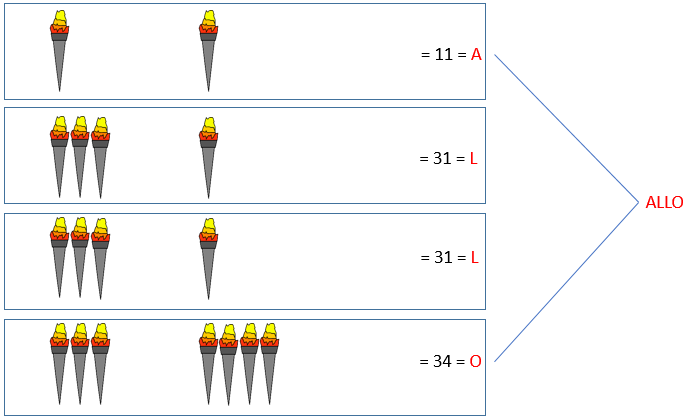
Three centuries later, the Romans were seemingly still using a much faster and simpler version of Polybius’s system, almost verging on a Morse-like code. The signalling area now had a left, right, and middle. But instead of signalling a letter by showing a certain number of torches in each field all at once, the senders waved the torches a certain number of times — up to eight times in each field, thereby dividing the alphabet into three chunks. One wave on the left thus signalled an A, twice on the left a B, once in the middle an I, twice in the middle a K, and so on.
By the height of the Roman Empire, fire signals had thus been adapted to rapidly transmit complex messages over long distances. But in the centuries that followed, these more sophisticated techniques seem to have disappeared. The technology appears to have regressed.
Comments Off on Long distance communication in the pre-modern era
November 5, 2022
The Byzantine Empire: Part 8 – The Breakdown, 1025-1204
seangabb
Published 20 May 2022In this, the eighth video in the series, Sean Gabb explains how, having acquired the wrong sort of ruling class, the Byzantine Empire passed in just under half a century from the hegemonic power of the Near East to a declining hulk, fought over by Turks and Crusaders.
Subjects covered include:
The damage caused by a landed nobility
The deadweight cost of uncontrolled bureaucracy
The first rise of an insatiable and all-conquering West
The failure of the Andronicus Reaction
The sack of Constantinople in 1204Between 330 AD and 1453, Constantinople (modern Istanbul) was the capital of the Roman Empire, otherwise known as the Later Roman Empire, the Eastern Roman Empire, the Mediaeval Roman Empire, or The Byzantine Empire. For most of this time, it was the largest and richest city in Christendom. The territories of which it was the central capital enjoyed better protections of life, liberty and property, and a higher standard of living, than any other Christian territory, and usually compared favourably with the neighbouring and rival Islamic empires.
The purpose of this course is to give an overview of Byzantine history, from the refoundation of the City by Constantine the Great to its final capture by the Turks.
Here is a series of lectures given by Sean Gabb in late 2021, in which he discusses and tries to explain the history of Byzantium. For reasons of politeness and data protection, all student contributions have been removed.
(more…)
Comments Off on The Byzantine Empire: Part 8 – The Breakdown, 1025-1204
November 2, 2022
Feeding King Tut
Tasting History with Max Miller
Published 1 Nov 2022
(more…)
Comments Off on Feeding King Tut
QotD: Being “the world’s policeman”
The British spent most of the 19th and the first half of the 20th centuries as the world’s policeman, responsible for keeping the peace, and for maintaining a balance of power. They were usually pilloried by all about them for this role, particularly by up and coming powers who wanted a “place in the sun” — Germany and the United States being the stand-out examples (though there is a lot of whinging from old allies like Russia). For the last half of that period, the British voter was having serious second thoughts about the whole concept.
The United States took on the mantle of world’s policeman in the post-Second World War world. They have spent much of the last 60 years trying to keep the peace, and, interestingly, to maintain the balance of power. (Do not be fooled by the concept of the overwhelming superpower. Britain was a lot closer to being able to take on the rest of the world in the 19th century, when it really could defeat every other navy in the world combined; than the US is now, where it could perhaps face Iran, Russia and India simultaneously, as long as the European Union is friendly. Whoops, forgot China, the Balkans, Palestine, Syria, North Korea, Iraq, Afghanistan, Somalia and other little blips on the US horizon. Well let’s be honest, no one has ever been able to take on more than a few of the other powers simultaneously. NO one.)
For their troubles, they are usually pilloried by those all about them, particularly by up and coming powers who want their “place in the sun” – the Soviet Union and China being the stand-out examples. (Though there is a lot of whinging from old allies like France). For the last forty years (since Vietnam, and certainly since Gulf War One), there have been signs that the US voter is having serious second thoughts about the whole concept.
Britain was quite reluctant to take over later imperial dependencies, particularly leftover states of defeated Empires like Turkey, such as Iraq and Palestine: but also parts of Africa and Asia “of interest to no bugger”. They were never part of the British ideal of commercial empire, and were almost impossible to govern. They were abandoned as soon as possible.
The United States is currently experiencing the joys of taking over, or being responsible for unwanted bits of empire. Strangely the names Iraq and Palestine are occurring on that list, as well as Afghanistan and possibly other commitments to come. (The US has interfered in these areas far longer than Britain had before she was stuck with them). They cannot be considered part of a logical geopolitical empire (not even for oil conspiracy nuts), and will be abandoned as soon as possible.
The British voter responded to the world wars by wanting out of empire. Now. Some of the states thus “released” were well-developed societies with decent infrastructure and good literacy and rule of law concepts. India, Malta, Ceylon, Bermuda and Singapore spring to mind. Others were abandoned prematurely: without literacy, rule of law, good infrastructure, a developed civil service, practice of voting, or any of the other minor necessities for establishing a democratic state. See any list of African dictatorships.
The US voter is responding to current events by wanting out of the Middle East ASAP. They are intent on abandoning states to “democracy”, regardless of a lack of literacy, rule of law, good infrastructure, a developed civil service, practice of voting, or any of the other minor necessities for establishing a democratic state. Whoops.
Britain suffered from an immense artificial economic high after the Napoleonic war. This left the British economy extremely artificially inflated for eighty years, and still well above its realistic weight in the world for another fifty (and only really brought back to the field by the immense economic losses of two world wars). In the last twenty years Britain has held a more realistic place in the world economy for its population and industrial level (though still relatively inflated by an immense backlog of prestige and sometimes reluctant respect.).
The US suffered from an immense artificial economic high after WWII. This left the US economy artificially inflated for the rest of the century, and still well above its realistic weight in the world to the present. … Sometime in the next few decades, the US will probably return to a more realistic place in the world economy for its population and industrial level. (Minor variables like World War III may make this projection uncertain as to actual timing, but it will happen: simply because the US will not be able to largely sit out most of the next world wars and profiteer from everyone else’s ruin the way she could in the last two).
Nigel Davies, “The Empires of Britain and the United States – Toying with Historical Analogy”, rethinking history, 2009-01-10.
Comments Off on QotD: Being “the world’s policeman”
November 1, 2022
QotD: Spartan strategy during the Persian wars
The hammer Sparta has, of course, is hoplite battle. Sparta seeks to solve almost all of its issues by applying a hoplite phalanx to the problem, regardless of if the problem can be solved by a hoplite phalanx. Spartan strategic thinking is thus marred by both a failure to consider military solutions that did not consist of traditional hoplite battles, as well as an inability to consider or execute non-military solutions at all.
We can see the former weakness in Spartan planning in the Persian Wars. Spartan planning is both direct and unrealistic: find a choke-point, fortify it and hold it indefinately with a hoplite army. Attempted at Thermopylae this plan fails; the Battle of Thermopylae is often represented in popular culture as an intentional delaying action, but it was nothing of the sort – Herodotus is clear that this was supposed to be the decisive land engagement (Hdt. 7.175; Cf. Diodorus 11.4.1-5). The Spartans then attempt to recreate this plan at the Isthmus of Corinth and have to be rescued from their strategic stupidity by the Athenians, who threaten to leave the alliance if the plan isn’t abandoned (Hdt. 8.49-62). A blockade at the Isthmus would be easy for the Persian army to bypass – assuming it didn’t simply defeat it with generally superior Persian siegecraft – and worse yet was a diplomatic disaster given that it meant essentially writing Athens off as a loss, when the Athenian navy provided the bulk of the ships protecting the Isthmus.
Bret Devereaux, “Collections: This. Isn’t. Sparta. Part VII: Spartan Ends”, A Collection of Unmitigated Pedantry, 2019-09-27.
Comments Off on QotD: Spartan strategy during the Persian wars
October 28, 2022
The Byzantine Empire: Part 7 – Recovery and Return to Hegemony, 717-1025 AD
seangabb
Published 2 May 2022In this, the seventh video in the series, Sean Gabb explains how, following the disaster of the seventh century, the Byzantine Empire not only survived, but even recovered its old position as hegemonic power in the Eastern Mediterranean. It also supervised a missionary outreach that spread Orthodox Christianity and civilisation to within reach of the Arctic Circle.
Subjects covered:
The legitimacy of the words “Byzantine” and “Byzantium”
The reign of the Empress Irene and its central importance to recovery
The recovery of the West and the Rise of the Franks
Charlemagne and the Holy Roman Empire
The Conversion of the Russians – St Vladimir or Vladimir the Damned?
The reign of Basil IIBetween 330 AD and 1453, Constantinople (modern Istanbul) was the capital of the Roman Empire, otherwise known as the Later Roman Empire, the Eastern Roman Empire, the Mediaeval Roman Empire, or The Byzantine Empire. For most of this time, it was the largest and richest city in Christendom. The territories of which it was the central capital enjoyed better protections of life, liberty and property, and a higher standard of living, than any other Christian territory, and usually compared favourably with the neighbouring and rival Islamic empires.
(more…)
Comments Off on The Byzantine Empire: Part 7 – Recovery and Return to Hegemony, 717-1025 AD
October 25, 2022
The Byzantine Empire: Part 6 – Weathering the Storm, 628-717 AD
seangabb
Published 16 Feb 2022In this, the sixth video in the series, Sean Gabb discusses the impact on the Byzantine Empire of the Islamic expansion of the seventh century. It begins with an overview of the Empire at the end of the great war with Persia, passes through the first use of Greek Fire, and ends with a consideration of the radically different Byzantine Empire of the Middle Ages.
Between 330 AD and 1453, Constantinople (modern Istanbul) was the capital of the Roman Empire, otherwise known as the Later Roman Empire, the Eastern Roman Empire, the Mediaeval Roman Empire, or the Byzantine Empire. For most of this time, it was the largest and richest city in Christendom. The territories of which it was the central capital enjoyed better protections of life, liberty and property, and a higher standard of living, than any other Christian territory, and usually compared favourably with the neighbouring and rival Islamic empires.
The purpose of this course is to give an overview of Byzantine history, from the refoundation of the City by Constantine the Great to its final capture by the Turks.
Here is a series of lectures given by Sean Gabb in late 2021, in which he discusses and tries to explain the history of Byzantium. For reasons of politeness and data protection, all student contributions have been removed.
(more…)
Comments Off on The Byzantine Empire: Part 6 – Weathering the Storm, 628-717 AD
October 23, 2022
T. E. Lawrence: The True Lawrence of Arabia
Biographics
Published 13 Jun 2022
(more…)
Comments Off on T. E. Lawrence: The True Lawrence of Arabia
October 18, 2022
The War That Ended the Ancient World
toldinstone
Published 10 Jun 2022In the early seventh century, a generation-long war exhausted and virtually destroyed the Roman Empire. This video explores that conflict through the lens of an Armenian cathedral built to celebrate the Roman victory.
(more…)
Comments Off on The War That Ended the Ancient World


