
Real Engineering
Published 18 Feb 2023
(more…)
May 28, 2023
This Gun Could Reach Space
Comments Off on This Gun Could Reach Space
May 19, 2023
QotD: The horses of the Eurasian Steppe
The horse is native to the Eurasian Steppe – that is where it evolved and was first domesticated, though the earliest domesticated wild horses were much smaller and weaker (but more robust and self-sufficient) than modern horses. The horse was first domesticated here, on the Eurasian Steppe, by the nomadic peoples there around 3,700 BCE. It seems likely that the nomads of the steppe were riding these horses more or less from the get-go (based on bridle and bit wear patterns on horse bones), but the domesticated horse first shows up in the settled Near East as chariotry (rather than cavalry) around 2000 BCE; true cavalry won’t become prominent in the agrarian world until after the Late Bronze Age Collapse (c. 1200 BCE).
I wanted to start by stressing these dates just to note that the peoples of the Eurasian Steppe had a long time to adapt themselves to a nomadic lifestyle structured around horses and pastoralism, which, as we’ve seen, was not the case for the peoples of the Americas, whose development of a sustainable system of horse nomadism was violently disrupted.
That said, the steppe horse (perhaps more correctly, the steppe pony) is not quite the same as modern domesticated horses. The sorts of horses that occupy stables in Europe or America are the product of centuries of selective breeding for larger and stronger horses. Because those horses were stable fed (that is, fed grains and hay, in addition to grass), they could be bred much larger what a horse fed entirely on grass could support (with the irony that many of those breeds of horses, if released into the wild in their native steppe, would be unable to subsist themselves), because processed grains have much higher nutrition and calorie density than grass. So while most modern horses range between c. 145-180cm tall, the horses of the steppe were substantially smaller, 122-142cm. Again, just to be clear, this is essential because the big chargers and work-horses of the agrarian world cannot sustain themselves purely on grass and the Steppe nomad needs a horse which can feed itself (while we’re on horse-size, mustangs, the feral horses of the Americas, generally occupy the low-end of the horse range as well, typically 142-152cm in height – even when it is clear that their domesticated ancestors were breeds of much larger work horses).
Bret Devereaux, “That Dothraki Horde, Part II: Subsistence on the Hoof”, A Collection of Unmitigated Pedantry, 2020-12-11.
Comments Off on QotD: The horses of the Eurasian Steppe
April 8, 2023
Russia’s Last Crusade – The Crimean War 1853-1856
Real Time History
Published 7 Apr 2023The Crimean War between the Ottoman Empire and Russia (and later the UK and France) has been called the last crusade and the first modern war at the same time.
(more…)
Comments Off on Russia’s Last Crusade – The Crimean War 1853-1856
April 4, 2023
Tank Chats Reloaded | Challenger 1 | The Tank Museum
The Tank Museum
Published 16 Dec 2022In the first episode of Tank Chats Reloaded we hear from Major General Patrick Cordingley who both commanded Challenger 1 during the First Gulf War and was involved in its design. Also introducing our new presenter Chris Copson, host of the new Tank Chats Reloaded series — where we’ll be revisiting old favourites from Tank Chats.
(more…)
Comments Off on Tank Chats Reloaded | Challenger 1 | The Tank Museum
March 24, 2023
QotD: The academic specializations of the Great Library
Which means it is perhaps less surprising to learn, on examining the sources, that the Great Library was actually celebrated mainly for a specialisation which is about as far from modern science as possible: the study of poetry. This makes some sense, given that the Mouseion was dedicated to the Muses, four of whom represented forms of verse. The works of Homer, in particular, were a primary focus of study across the Greek world and his poems permeated thought, writing and everyday speech rather like the works of Shakespeare and the texts of the Bible do today. It was the scholars of the Mouseion who, on gathering and comparing copies of the Illiad and Odyssey from across the Greek-speaking world, noticed textual differences large and small and established the kind of textual analysis still used by editors to this day; working to determine the best possible text from the manuscript variants. Other works of Greek poetry, such as the odes of Pindar, were also analysed and studied in a similar way, as were the works of the great Athenian playwrights.
The importance of literary studies at the Mouseion can be seen by analysing the specialisations of the men we know were directors of the institution and therefore “librarians” of the Great Library. […] of these scholars, only Eratosthenes is known for doing anything that we would consider “science”, the others were devoted to literary and textual analysis, poetry and grammar. Of course, these scholars were polymaths and most of them would probably have ranged over many topics including areas of mathematics and natural philosophy; Eratosthenes himself was nicknamed “Beta” because he covered so many disciplines he was something of a jack of all trades and master of none, so his colleagues mocked him as “Number 2” in all subjects. That aside, the idea that the Mouseion was a major centre of scientific speculation is at best an exaggeration and largely yet another fantasy.
Tim O’Neill, “The Great Myths 5: The Destruction Of The Great Library Of Alexandria”, History for Atheists, 2017-07-02.
March 20, 2023
“The New American Empire lasted, at most, twenty years, if one counts the two falls of Kabul as brackets”
Ed West on the brief — and largely unacknowledged by Americans — high-water mark of the 21st century’s biggest empire:
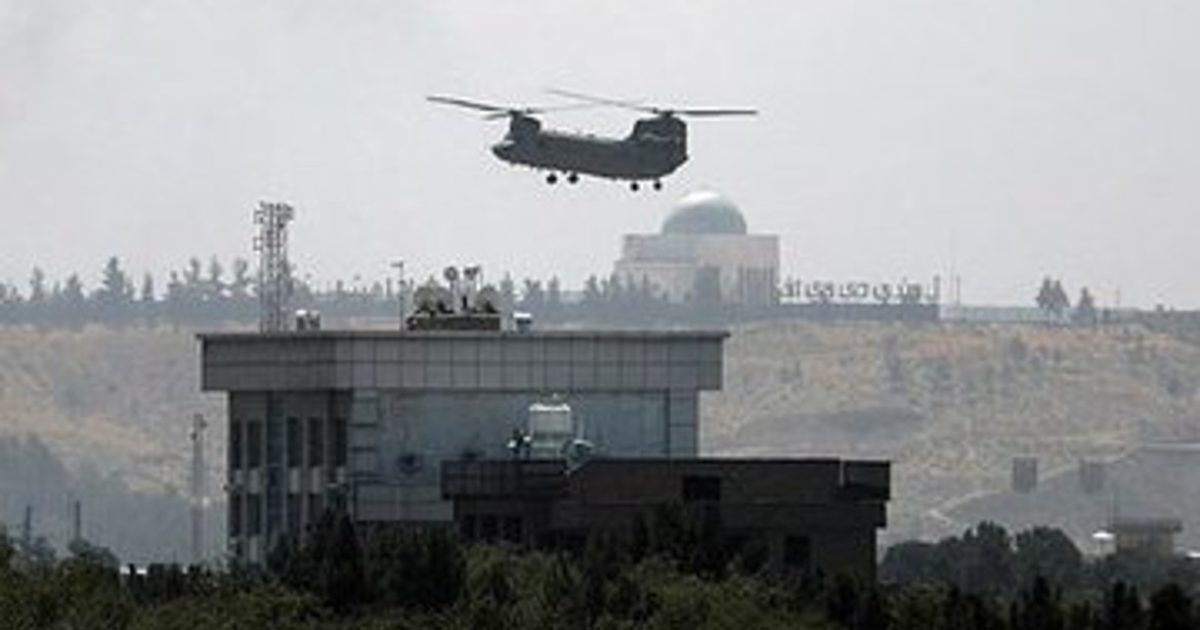
A Boeing CH-47 Chinook transport helicopter appears over the U.S. embassy compound in Kabul, 15 Aug 2021. Image from Twitter via libertyunyielding.com
This century has already seen its fair share of great delusions, society-changing disasters built on wishful thinking: you can loan mortgages to people who obviously can’t pay them back; you can cure pain with an opiate that won’t make people addicted; and now the unstoppable idea of equality of outcomes between races, a project doomed to failure and tragedy.
But none was perhaps so spectacularly disastrous as liberal imperialism. Twenty years ago, George W Bush sent the most powerful military the world had ever seen into the birthplace of Abraham to overthrow Saddam Hussein, and as Niall Ferguson wrote in the Wall Street Journal at the time: “the greatest empire of the modern times has come into existence without the American people even noticing”.
The New American Empire lasted, at most, twenty years, if one counts the two falls of Kabul as brackets. This was despite enormous technological supremacy, and genuine goodwill and benevolence among many of the state-builders.
The United States was “born liberal”, as historian Louis Hartz said, even if the crime wave of the late 20th century made that a dirty word, and the “New American Empire” would spread the benefits of liberalism to grateful beneficiaries around the world.
Yet what is so striking about the imperialists of the 21st century, compared to their forebears in the 19th, was just how little interest they seemed to show in the subject people. Their naivety about human nature, and their utopian belief that people around the world just wanted “freedom”, chimed with a lack of curiosity about humanity.
To think that people around the world might not be the same, that they might not want “freedom” nor have the social structure or culture that suited democracy, might be to venture into dangerous territory. To suggest that Iraq was incapable of democracy was insulting to Iraqis, since as the US president said ahead of the war: “There was a time when many said that the cultures of Japan and Germany were incapable of sustaining democratic values. Well, they were wrong. Some say the same of Iraq today. They are mistaken.”
Yet the defeated nations in 1945 had very old, well-established institutions and very strong national identities, something Iraq did not. The latter was extremely clannish, something no one seemed to consider. Sovereignty and strong institutions take generations to build, and cannot just be imposed by foreigners working on abstract principles like “democracy”.
Bush was not alone. That same year, John McCain had said: “There is not a history of clashes that are violent between Sunnis and Shias, so I think they can probably get along”. And on March 1, 2003, two weeks before the war started, Bill Kristol, editor of the Weekly Standard, had dismissed warnings about sectarian conflict: “We talk here about Shiites and Sunnis as if they’ve never lived together. Most Arab countries have Shiites and Sunnis, and a lot of them live perfectly well together.” On top of that, “Very few wars in American history were prepared better or more thoroughly than this one by this president.” He was totally wrong, while in contrast the American Conservative‘s pessimistic warnings about Iraq’s social fabric proved correct.
Comments Off on “The New American Empire lasted, at most, twenty years, if one counts the two falls of Kabul as brackets”
March 14, 2023
Turkey has always been the awkward ally in NATO, but for how much longer?
In Strategika, Zafiris Rossidis examines the shift of Turkish sentiment away from its longstanding role in the NATO alliance and toward a more Russian-friendly and more independent stance in international affairs:
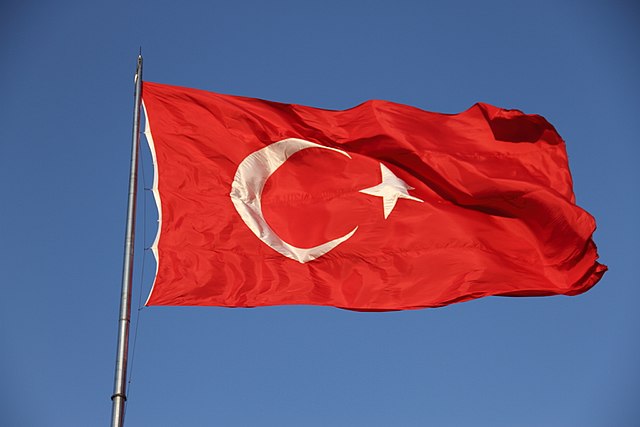
Turkish flag.
Photo by Burak Su via Wikimedia Commons.
A poll conducted in December 2022 by the Turkish company Gezici found that 72.8% of Turkish citizens polled were in favor of good relations with Russia. By comparison, nearly 90% perceive the United States as a hostile country. It also revealed that 24.2% of citizens believe that Russia is hostile, while 62.6% believe that Russia is a friendly country. Similarly, more than 60% of respondents said that Russia contributes positively to the Turkish economy.
Turkey began to distance itself from the United States as early as 2003, when it refused the passage of American troops to Iraq. In 2010, it destroyed the U.S.–Israel–Turkey triangle, breaking up with Israel. In 2011, Turkey implemented a policy in Syria that was hardly in line with U.S. interests. The final distancing took place in 2016, with the July coup, for which Turkey blamed the United States.
Turkey considers itself very important to the United States but declares that Ankara can live without Washington. This concept has become the point of departure for Turkey in its quest to reconstitute the Ottoman Empire. Minister of the Interior Süleyman Soylu declares that the Turkish government will design the new world order with the help of Allah, and Western powers will eat the dust behind almighty Turkey (December 8, 2022).
According to a RAND Corporation volume on Turkey, there are four scenarios for the future of Turkish strategic orientation: 1) Turkey will remain a difficult partner for the United States; 2) Turkey will become democratic and unite with the West; 3) Turkey will be between East and West, but have better relations with powers such as China, Iran, and Russia, than with the U.S. and the EU; and 4) Turkey will completely abandon the West.
From the evidence in the case of the Russian–Ukrainian war, Russia, China, Turkey, and Iran justify the Russian invasion since NATO and the EU have designs on their neighborhood. Above all, they are united by a common hatred for the West. They are frenemies and they know it: on the contrary, the U.S. tends to invest in frenemies as if they were true friends.
The U.S. observed the rapprochement of Turkey and Russia without renouncing the traditional alliance with Turkey, which today has no longer such importance. Turkey was useful when it was an “enemy” of the USSR and the U.S. made far too many concessions for the sake of this useful enmity. In short, there is some inertia in the modification of the principle “the enemy of my enemy is my friend”, as of course “the friend of a friend is my friend”. Turkey’s role in NATO worries the U.S., as Ankara–Moscow relations have acquired some shared strategic characteristics.
?he attraction between the two countries lies in their equally authoritarian governance models and the fact that their strategic culture and operational codes bear similarities: Both countries are revisionist, aggressive, and assertive in their regions; both countries claim to be encircled, which they use as a pretext for their unilateral actions; and both countries have militarized their foreign policy, waging hybrid warfare, resorting to proxy warfare, and blackmailing countries that offer resistance. Russia and Turkey cooperate on natural gas and oil pipelines; Russia has sold weapons such as the S-400 missile system to Turkey; Russia has provided technical assistance in the construction of Turkey’s nuclear plants; the two nations have collaborated in Central Asia (i.e., Azerbaijan); they import and export each other’s commodities; and Turkey has illegally transported Russian fuel to China and Iran, thereby bypassing sanctions on Russia, to mention only a few.
But the big issue for U.S.–Turkey relations against the backdrop of the Russian–Ukrainian war has four strands: First, the issue of the important role Turkey plays in the grain export agreement, which if cancelled will create a food crisis in Africa. Second, Turkey’s blackmailing of the NATO candidacies of Sweden and Finland. Third, the Turkish application to purchase the F-16 and the possible conflict between Congress and the Biden administration over the administration’s request to grant Turkey the license to do so. Finally, Turkey’s non-adoption of NATO sanctions against Russia. The possibility of Erdoğan using a strategy of tensions with Greece (e.g., multiple violations of Greek airspace, aggressiveness in the Aegean, weaponization of immigration, threats of bombing Athens with the new “Tayfun” short-range ballistic missile) to rally the electorate around his party and detach it from any opposition — all recent polls have AKP trailing the opposition — prior to the June election is one explanation for Turkey’s behavior that is being considered by the U.S., which nonetheless is angered that Turkey is the only NATO country that has not adopted the sanctions against Russia.
Comments Off on Turkey has always been the awkward ally in NATO, but for how much longer?
March 8, 2023
“By fostering intense family loyalties and strong nepotistic urges”, cousin marriage “makes the development of civil society more difficult”
Ed West on what he calls the worst western foreign policy disaster since 1204, the Iraq quagmire:
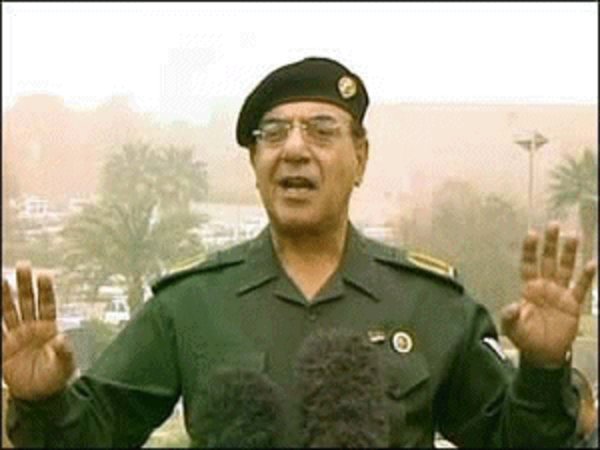
Mohammed Saeed al-Sahhaf, better known in the West as “Baghdad Bob” or “Comical Ali”, Iraqi Minister of Information for President Saddam Hussein.
This month marks the 20th anniversary of the greatest western foreign policy disaster since the Fourth Crusade. It was the pre-eminent modern-day example of folly, driven by wishful thinking, utopianism and a lack of interest in history and how human societies differ. This was mostly carried out by good people, including our own Tony Blair, and promoted by thoughtful and humanitarian commentators who thought they were making the world a better place.
The White House regime which brought chaos and misery to Iraq were most of all entranced by The Weekly Standard, the now-defunct magazine most associated with neoconservative foreign policy. Had any of them read The American Conservative instead, they might have avoided the whole tragedy. In particular they ought have read Steve Sailer’s “The Cousin Marriage Conundrum“, printed in the run-up to the invasion and in which the author made a seemingly curious argument for why nation-building in Iraq would fail — its high rates of cousin marriage.
Pointing out that between 46 and 53 percent of Iraqis who married did so to first or second cousins, Sailer wrote that: “By fostering intense family loyalties and strong nepotistic urges”, cousin marriage “makes the development of civil society more difficult”. The neocon dream of jumpstarting democracy was therefore clearly doomed to failure.
Even those with a cursory knowledge of the country knew that Iraq was split between Sunni and Shia Arabs, as well as Kurds in the north, each group’s area of dominance roughly corresponding to three former Ottoman provinces. However, these were further subdivided into “smaller tribes, clans, and inbred extended families — each with their own alliances, rivals, and feuds”, in total about 150 tribes comprising some 2,000 clans.
Saddam’s politics were mired in blood, in both senses. He came from the al-Bu Nasir, a tribe comprising some 25,000 people based in the town of Tikrit, and his regime was filled with his relatives. His political career had begun in 1957 when the 20-year-old had joined the revolutionary Ba’ath (“Resurrection”) Party, following his uncle Kharaillah Tulfha, who had fought against the British in the Second World War. Tulfha would become his father-in-law, for Saddam also married his first cousin, although he later took a second wife. Family life wasn’t entirely harmonious, and the man who introduced that couple, Saddam’s food taster, was later stabbed to death by the dictator’s psychotic eldest son Uday at a party thrown by Egyptian president Hosni Mubarak.
The unfortunate food taster was an Assyrian Christian, and within Saddam’s regime religious minorities could rise high, as is often the case in empires, because they presented no threat. His foreign minister, Tariq Aziz, was also a Christian, his birth name being Mikhail Yuhanna.
The family was everything in Saddam’s Iraq. Mark Weiner wrote in The Rule of the Clan of countries governed by “clannism” that: “These societies possess the outward trappings of a modern state but are founded on informal patronage networks, especially those of kinship, and traditional ideals of patriarchal family authority. In nations pervaded by clannism, government is co-opted for purely factional purposes.” The inevitable result of clannism is kin-based corruption whereby resources, positions and other rewards are monopolised by family groups. In these societies, Weiner wrote, “the nuclear family, with its revolutionary, individuating power, has yet to replace the extended lineage group as the principle framework for kinship or household organisation”.
The Weekly Standard was called the in-flight magazine of Air Force One, but presumably there weren’t that many White House staffers reading the American Conservative at the time, a publication started by Pat Buchanan, the great Republican critic of neocon foreign policy. So the Coalition blundered into a disastrous invasion that cost hundreds of thousands of lives, wrecking Iraq and leaving many areas newly-divided along sectarian lines, while minorities like the Christians and Mandaeans were driven almost to extinction.
Comments Off on “By fostering intense family loyalties and strong nepotistic urges”, cousin marriage “makes the development of civil society more difficult”
QotD: Who destroyed the Great Library?
The problem, however, is that there is no evidence that the Serapeum still contained any library by 391 AD and some good evidence indicating that it did not.
When the mythic version of the story of the destruction of the Serapeum gets told it usually begins without explaining why the temple was attacked. These retellings focus on the supposed destruction of its library, so they tend to assume that the mob was there simply because they hated learning. But several accounts of the end of the temple note that it came as the climax of a series of attacks by pagans on Christians in reaction to the desecration of pagan idols. Sozomen’s account details what happened next:
They killed many of the Christians, wounded others, and seized the Serapion, a temple which was conspicuous for beauty and vastness and which was seated on an eminence. This they converted into a temporary citadel; and hither they conveyed many of the Christians, put them to the torture, and compelled them to offer sacrifice. Those who refused compliance were crucified, had both legs broken, or were put to death in some cruel manner. When the sedition had prevailed for some time, the rulers came and urged the people to remember the laws, to lay down their arms, and to give up the Serapion (Sozomen, History of the Church, VII.15)
Sozomen was writing in the following century and, as a Christian, may not be reliable on the lurid details, but Socrates Scholasticus, writing a little closer to the events, confirms that many Christians were killed in the unrest. A stand-off followed, with Roman troops surrounding the temple while negotiations went on with the pagan militants inside. This situation must have continued for many weeks, as a petition went to the emperor in Constantinople about the siege and Theodosius ruled that the pagans should be pardoned for their murders and allowed to leave but that the temple should be demolished. Angry at this compromise, as the soldiers began to carry out the order, the Christian mob joined in the destruction, and made sure the great idol of Serapis was also destroyed.
We have no less than five accounts of the destruction of the Serapeum – Rufinius Tyrannius, Socrates Scholasticus, Sozomen, Theodoret and Eunapius of Antioch – which is rare in ancient history and actually makes this one of the best documented events in the period. What is significant about them is that not one of them mentions a library. Some try to argue that the Christian chroniclers would be ashamed of the crime of destroying the last remnant of the Great Library and so hushed it up in their accounts. This argument is hard to sustain. Firstly, Christian historians of the time did record other shameful acts against pagans, including the assassination of Hypatia, so at least one or two of the four Christians who describe the end of the Serapeum could be expected to at least lament the loss of a library. Socrates Scholasticus, who condemned the death of Hypatia, was a Novatian “heretic” and thus no fan of the bishop Theophilus, who urged on the crowd at the temple’s demolition, yet he makes no mention of a library. Even more significantly, Eunapius of Antioch was a pagan, a scholar and a vehement anti-Christian, so had every reason to condemn any destruction of a library, yet he too makes no mention of it. That great defender of New Atheist bad history, the inevitable Richard Carrier, has attempted to dismiss this silence by Eunapius by blithely claiming that “his account is too brief”. Carrier assures his online fan club “[a]ll he describes is the raid on its pagan statues, and some vague looting otherwise. His concern is clearly with the offense to the gods”. This is, as usual with Carrier, total nonsense. Eunapius’ account in his Lives of the Philosophers runs to 548 words in English translation. Of these, a full 245 are not about pagan statues etc, but are devoted wholly to detailed denigration of the ignorant Christian monks who destroyed the temple. He calls them “men in appearance (who) led the lives of swine”, says they “fettered the human race to the worship of slaves” and mocks them for their worship of martyrs’ relics and their general stupidity. Given that around 40% of his account is taken up with this scorning and mocking of these monks, it is still very strange that this scholar neglects to mention in his condemnation that these ignorant oafs also happened to destroy one of the best libraries in the world.
The lack of any mention of a library is most likely explained by concluding that it was no longer there by 391 AD. Temples had begun to be starved of funds with the conversion of the emperors [to] Christianity and the slower but gradual conversion of many rich patrons and city benefactors. The Serapeum survived most of the fourth century, but it is very likely that the expense of maintaining an extensive library would have been a strain. We know that it was ransacked on the orders of the Alexandrian bishop George the Cappodocian c. 360 AD and it is likely the library was looted in this action. Significantly, writing around 378 AD, Ammianus Marcellinus gave a detailed description of the Serapeum and mentions its libraries using the past tense:
In here have been valuable libraries and the unanimous testimony of ancient records declares that seven hundred thousand books, brought together by the unremitting energy of the Ptolemies, were burned in the Alexandrine War when the city was sacked under the dictator Caesar. (Ammianus, Roman History XXII.16-17)
Ammianus is muddling the Serapeum with the main Mouseion library with his reference to Caesar’s fire and the mythical “700,000” books, but the rest of his description is detailed and unique to his work in many respects. Other references in his work indicate that he had visited Egypt himself, probably around 363 AD (or three years after the sacking of the temple by Bishop George), so it is highly possible that his account is that of an eye-witness. This means his use of the past tense about the temple library is significant. Overall, the idea that there was still any library there when the temple was demolished is dubious at best and almost certainly wrong.
Tim O’Neill, “The Great Myths 5: The Destruction Of The Great Library Of Alexandria”, History for Atheists, 2017-07-02.
Comments Off on QotD: Who destroyed the Great Library?
January 29, 2023
“That is what Westerners like about Dubai: the indentured servitude. And the weather.”
Tanya Gold at The Free Press:
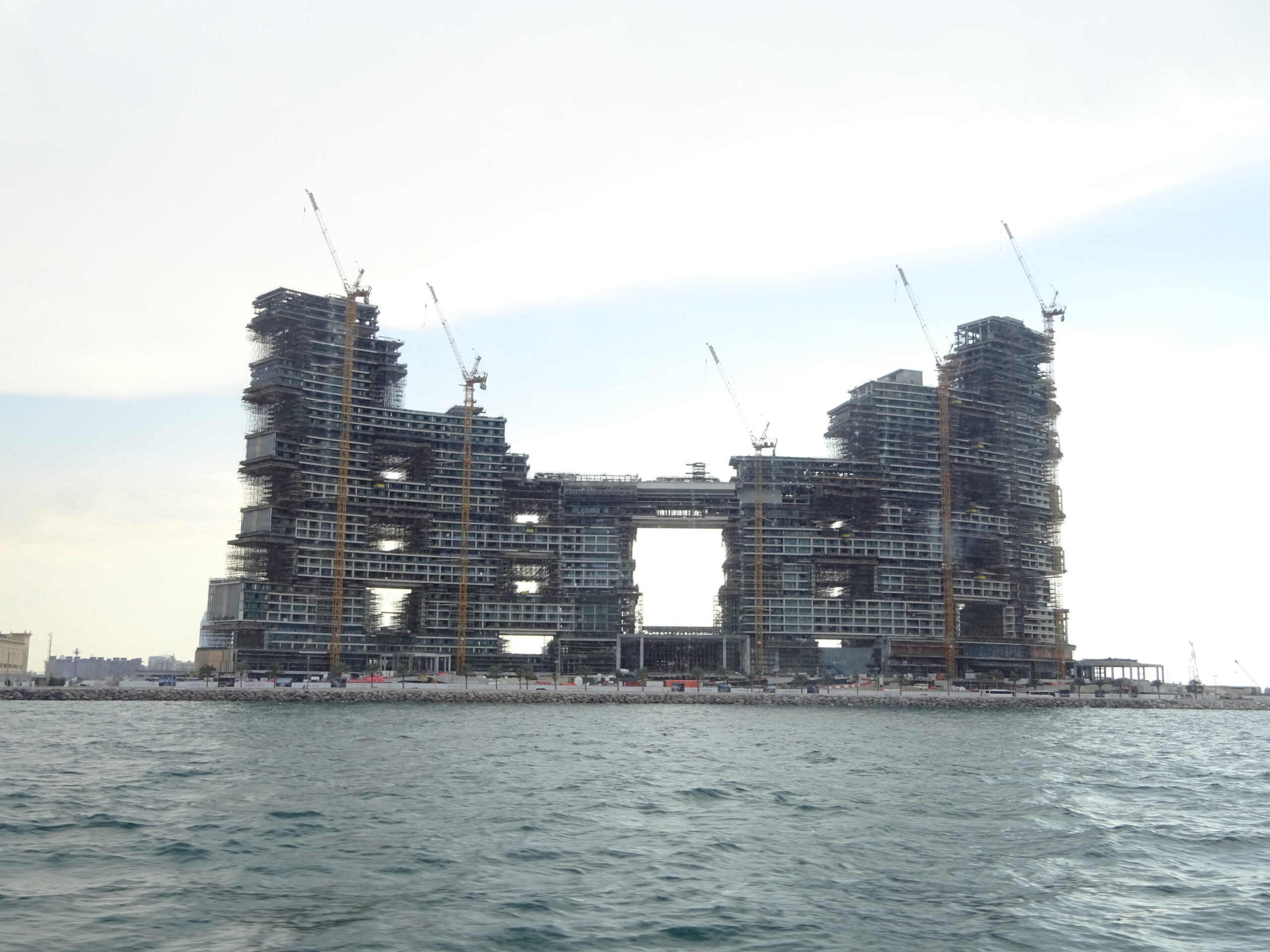
“Royal Atlantis Resort hotel under construction, Palm Jumeirah, Dubai” by Jpbowen is licensed under CC BY-SA 4.0 

 .
.
I went to Dubai once. It is where tyranny meets hyper-capitalism, and it is as awful as it sounds.
I was helping a journalist friend research an article. I spent my days admiring an undersea bedroom in a lagoon and a ski slope inside a mall. At night I would meet trafficked maids, or a woman imprisoned for adultery. I asked an ancient British tourist why he came here for his holidays. He said, “The staff will hold your dick if you ask them.” That is what Westerners like about Dubai: the indentured servitude. And the weather.
Last week, at the grand opening of Atlantis The Royal, Dubai’s newest luxury hotel, Beyoncé gave her first live performance in five years. This gig featured a 48-person all-female orchestra — how feminist — a Lebanese dance troupe, and her daughter. She was reportedly paid $24 million for the occasion.
Her latest album, Renaissance, is, among other things, an homage to black queer culture. She performed no songs from it; how could she in a country where homosexuality is punishable by death? So she sang her back catalog for the equivalent of ten Bugatti Chirons. Oil-rich tyrannies have generous marketing budgets; they’re selling tyranny itself.
What Beyoncé does or doesn’t do for money wouldn’t matter but for the trend of celebrity activism, which insinuates that morality travels with a star like her wardrobe. Beyoncé acolytes say that just by arriving in Dubai she made the city gayer, a kind of subtle protest. Perhaps so subtle that even Dubai’s ruler Sheikh Mohammed bin Rashid — accused of abducting two of his daughters for noncompliance with his wishes, one from England, and another from a ship as she tried to flee Dubai — wouldn’t notice. Did his enforcers reconsider their stance on gayness as they sang along to “Drunk in Love”? Or are they laughing themselves stupid at the PR coup of persuading an until-now gay ally to perform at the opening of a hotel in a country that hates gays?
Dubai, along with Saudi Arabia, wants to reinvent itself as a tourist destination for when the oil runs out. There is nothing understated there — the Burj Khalifa, which is the tallest building in the world; the Palm Jumeirah, a man-made archipelago in the shape of a palm tree. Everything is vast and highly colored, a distraction. It has to be: To enjoy yourself in Dubai, you must close your eyes to suffering. Almost 90 percent of Dubai’s residents are migrant workers, and many of them live in conditions amounting to indentured slavery.
Comments Off on “That is what Westerners like about Dubai: the indentured servitude. And the weather.”
January 24, 2023
The Byzantine Empire: Part 9 – The Last Centuries
seangabb
Published 30 Dec 2022In this, the ninth in the series, Sean Gabb gives an overview of the last years of Byzantium, from the Crusader sack in 1204 to the Turkish capture in 1453.
Between 330 AD and 1453, Constantinople (modern Istanbul) was the capital of the Roman Empire, otherwise known as the Later Roman Empire, the Eastern Roman Empire, the Mediaeval Roman Empire, or the Byzantine Empire. For most of this time, it was the largest and richest city in Christendom. The territories of which it was the central capital enjoyed better protections of life, liberty and property, and a higher standard of living, than any other Christian territory, and usually compared favourably with the neighbouring and rival Islamic empires.
(more…)
Comments Off on The Byzantine Empire: Part 9 – The Last Centuries
January 19, 2023
Tanks Chats #164 | M-50 Sherman | The Tank Museum
The Tank Museum
Published 23 Sep 2022In this episode of Tank Chats, David Willey discusses the history of the M-50 version of the Sherman.
(more…)
Comments Off on Tanks Chats #164 | M-50 Sherman | The Tank Museum
January 17, 2023
The Early Emperors, Part 11 – The Flavian Reconstruction
seangabb
Published 29 Dec 2022This is a video record of a lecture given by Sean Gabb, in which he discusses the three Flavian Emperors who ruled between 69 and 98 AD — Vespasian, Titus, and Domitian. He also discusses the Jewish Revolt and the eruption of Vesuvius.
The Roman Empire was the last and the greatest of the ancient empires. It is the origin from which springs the history of Western Europe and those nations that descend from Western Europe.
(more…)
Comments Off on The Early Emperors, Part 11 – The Flavian Reconstruction
December 29, 2022
Brewing Mesopotamian Beer – 4,000 Years Old
Tasting History with Max Miller
Published 27 Dec 2022
(more…)
Comments Off on Brewing Mesopotamian Beer – 4,000 Years Old
December 27, 2022
Coming of the Sea Peoples: Part 5 – The Hittites
seangabb
Published 6 Jul 2021[Unfortunately, parts 3 and 4 of this lecture series were not uploaded due to sound issues with the recording].
The Late Bronze Age is a story of collapse. From New Kingdom Egypt to Hittite Anatolia, from the Assyrian Empire to Babylonia and Mycenaean Greece, the coming of the Sea Peoples is a terror that threatens the end of all things. Between April and July 2021, Sean Gabb explored this collapse with his students. Here is one of his lectures. All student contributions have been removed.
(more…)
Comments Off on Coming of the Sea Peoples: Part 5 – The Hittites


